




Abstract
This article examines Chinese technology creators on Douyin and Bilibili as a peripheral creator culture situated outside institutional safeguards and professional ethics. Drawing on fifteen in-depth interviews, it conceptualises their work as triadic relational labour: the continual negotiation of ties with audiences and advertisers under platform mediation, whereby creators remain structurally subordinate. Their peripherality stems from the misalignment of moral economies – between user and creator commitments to sincerity and fidelity to self, and the monetisation and marketing logics of platforms and brands – rendering ethical ambiguity and precarity endemic. To navigate these tensions, creators rely on practices of maintenance, tactical resistance, and what this article terms contingent moral improvisation: situational, revisable repertoires of disclosure, boundary-work and selective sincerity. While these improvisations stabilise ties in the short term, they individualise responsibility and reputational risk, enabling platform moral economies to consolidate advantage. The article argues that platform-based creator work is not only emotionally and economically precarious, but also ethically ambiguous, as individual creators shoulder the burden of reconciling conflicting expectations without institutional support. The study contributes to debates on digital labour, platform governance and the moral dimensions of platform-based cultural production.
Introduction
For decades, product reviews have shaped consumer choice and marketing strategy (Bailey, 2005). Legacy technology outlets such as The Verge and Engadget have sought to protect impartiality through explicit ethics policies – separating editorial from advertising, restricting gifts or travel, and clearly labelling sponsored content (Engadget, 2023; The Verge, 2025). This durable division underwrote the credibility of professional news organisations. Yet the rise of user-generated content (UGC) platforms – YouTube, TikTok/Douyin and Bilibili – has reconfigured the field, with independent creators now rivalling media brands in reach (Cunningham and Craig, 2019). By 2025, for example, YouTuber Marques Brownlee had 19.8 million subscribers, while Bilibili influencer He Tong Xue exceeded 12 million, with coverage at times linked to market effects (36Kr, 2022). In China, where online-video users reached roughly 1.026 billion in December 2024, technology UGC has become one of the most heavily sponsored verticals (The Paper, 2023).
Within this platform ecology, creators – who monetise original content, cultivate personal brands and professionalise production – typically operate as one-person micro-enterprises, simultaneously handling filming, editing, distribution and brand liaison (Cunningham and Craig, 2019; Duffy and Sawey, 2021; Glatt, 2022; Hund, 2023). Their work follows a dual imperative: winning audience recognition while securing sponsorships (Abidin, 2018; Hearn and Schoenhoff, 2015; Khamis et al., 2017). Friction arises because ‘authenticity’ – celebrated not only as transparency and consistency but also as grassroots self-honesty (Banet-Weiser, 2018; Duffy and Hund, 2015)—in practice becomes a performative strategy conditioned by platform affordances, markets and audience expectations (Hund, 2023). Native advertising intensifies this dynamic by embedding promotion within familiar creator formats (Boerman et al., 2012; Campbell et al., 2013; Wojdynski and Evans, 2016). Unlike legacy organisations with formal editorial–commercial separation, solo creators must manage both, inviting criticism that self-expression and promotion blur (Abidin, 2015; Duffy, 2017). These tensions are especially pronounced among China’s technology creators: while reviewing digital products to inform consumer purchases, they must also solicit and negotiate sponsorships to sustain livelihoods. In the absence of newsroom-style disclosure protocols, labelling often rests on individual discretion; although the 2023 Internet Advertising Management Regulations, introduced by Chinese regulators, require that content presented as ‘experience’, ‘review’ or ‘recommendation’ be clearly identified as advertising, the sheer scale and decentralisation of UGC production complicate enforcement (CCTV News, 2023). Regulating disclosure and ethical norms therefore remains a persistent challenge – not only in China but also across global platform economies – underscoring the broader difficulties of governing creator labour within platformised media systems (Cunningham and Craig, 2019).
We argue that Chinese technology creators exemplify the distinctive labour conditions associated with ‘peripheral creator cultures’. Their online work unfolds outside resource-rich legacy media networks and beyond the normalising reach of governance and regulatory frameworks that structure professional media labour (Bidav and Mehta, 2024; Salamon and Saunders, 2024). As Bidav and Mehta (2024) contend, production, distribution and consumption environments at the industry’s margins shape diverse, localised practices and varied survival strategies. Prior research uses ‘peripheral’ to index creators’ positioning vis-à-vis global media cores across geographic, national, linguistic, economic, cultural and technological dimensions, highlighting instabilities in labour practices not reducible to algorithmic factors (Bidav and Mehta, 2024; Salamon, 2025; Salamon and Saunders, 2024). In this study, we foreground a related sense of marginalisation: the weak or absent efficacy of professional-ethical frameworks and the individualisation of organisational divisions of labour and monetisation that characterise creators’ work in China. At the national level, language barriers and the Great Firewall mean that Chinese creators predominantly rely on domestic platforms (e.g. Douyin, Bilibili and Kuaishou) to produce and circulate content for local audiences and to localise sponsorships, placing them largely outside international mainstream platforms such as YouTube, TikTok and Instagram, and contributing to a relatively independent creator ecosystem (Lin, 2021, 2023). Following Bidav and Mehta (2024) and Salamon (2025), recognising the plurality of marginalisation and heterogeneous local labour conditions is essential to identifying the distinct dilemmas and survival strategies that characterise different creator cultures.
This article examines Chinese technology creators on Douyin and Bilibili through in-depth interviews, analysing how those positioned at the margins of media ethics and organisational divisions of labour navigate audience engagement, sponsorship and self-positioning under de-institutionalised, individualised production. We extend Baym’s (2015) notion of relational labour to a platform-mediated triad of creators, audiences and brands, and use this lens to show how the triad shapes content strategies and embeds creators in asymmetrical power relations that amplify precarity. We trace the situated, ongoing processes through which misaligned normative expectations from different relational parties are continually negotiated, making questions of trust, legitimacy and sustainability central to creators’ everyday work. Accordingly, we ask, how do creators negotiate competing demands from audiences and brands as a sustained form of relational labour under platform mediation, and how do these triadic dynamics shape ethical decision-making, disclosure practices and content strategies in the absence of formal guidelines?
Literature review
Relational labour, triadic dynamics and resistance as an analytical lens
Drawing on interviews with 40 musicians, Baym (2015) conceptualises relational labour as the sustained, strategic cultivation of social ties across online and offline platforms to sustain creative livelihoods. She highlights that dominant discourses on social media often obscure the labour-intensive work of audience interaction, which demands social skills, strategic self-disclosure and ongoing engagement. As traditional revenue streams such as album sales have declined, creators increasingly mobilise intimacy and authenticity to secure loyalty and monetisation. Practices such as sharing personal details, responding to comments, or acknowledging fan contributions, exemplify how continuous investment in relational ties has become central to both artistic recognition and economic sustainability. The concept of relational labour has proven particularly valuable for platform labour studies, highlighting the urgency with which online creators must cultivate multiple, overlapping relationships. Creators attract audiences through original content (Marwick, 2013), engage them via cross-platform interaction (Abidin, 2018) and monetise visibility through collaborations with brands (Hearn and Schoenhoff, 2015; Khamis et al., 2017). Ye et al. (2023), for example, show how female streamers on Chinese live-streaming platforms carefully maintain precarious relationships with male fans – often their primary donors – while balancing profitability goals and fears of stigmatisation should they transgress prevailing moral norms. Similarly, Alacovska et al. (2024) document how platform-based freelance designers cultivate and repair client relations – sometimes through gift-giving or pseudo-friendships – as a buffer against precarity in the gig economy. Related findings appear in Hair’s (2021) study of digital technologists on Patreon, who maintain ties with fans acting as donors. Litt and Hargittai (2016) extend this perspective with the concept of the ‘imagined audience’, the mental construct of those perceived as recipients of online communication. They show that creators constantly negotiate between abstract publics and specific groups, calibrating self-presentation to anticipated reception. In parallel, Ouvrein’s (2024) typology of ‘followers, fans, friends, or haters’ illustrates how different audience types shape creators’ sense of closeness and engagement. Baym (2018) captures this condition vividly, likening creators to performers who ‘must simultaneously manage the relational demands of each person who reaches them and play to the crowd as a whole, with all of the diverse audiences of allies, antagonists, strangers, and others it contains’ (p. 20).
For independent, self-employed creators, relational management extends beyond audiences to encompass sponsors and advertisers. Hund (2023) finds that, despite experimenting with diverse forms of brand collaboration – advertising slots, sponsored content and affiliate promotions – income often remains modest and unstable. Duffy’s (2017) ethnography of female influencers similarly reveals how creators invest significant unpaid labour, sometimes accepting only free samples, in the hope of securing future brand partnerships. Duffy (2017) conceptualises this unpaid or low-paid, future-oriented self-investment – where creators pour money, effort and emotional energy into the present and treat themselves as professionals in the making in the hope of eventually making a living from their passions – as aspirational labour. Yet these heterogeneous relational demands can generate conflicts: audience expectations of authenticity often clash with advertisers’ promotional requirements, leaving creators torn between providing genuine product feedback and meeting commercial imperatives. Such tensions frequently produce suspicion of ‘selling out’. Likewise, Glatt and Banet-Weiser (2021) show that only ‘brand-safe’ feminist content, or creator personas deemed suitable for sponsorship, are likely to be funded and made visible. This dynamic compels creators to soften their positions, avoiding controversial political or social issues – even when these resonate most with their audiences. Collectively, these studies demonstrate how triadic relations among creators, audiences and advertisers are marked by conflict and interdependence, and how they condition the practices and challenges of platform labour.
While existing scholarship highlights the conflictual yet interdependent nature of triadic relations among creators, audiences and advertisers, the specific power asymmetries embedded in these relations remain comparatively under-examined. Commercial platforms mediate these dynamics by acting as ‘matchmakers’ (Evans and Schmalensee, 2016), aggregating producers, users and advertisers into ‘platform-mediated networks’ (McIntyre and Srinivasan, 2017). Yet monetisation is ultimately driven by audiences and advertisers, relegating creators to a subsidised and secondary position and rendering their content production ‘contingent’ (Nieborg and Poell, 2018). This subordinate position calls for closer attention to how marginal creators confront and resist the asymmetries that permeate relational labour. Resistance, here, refers to actions by subordinates that contest power dynamics or secure small, temporary advantages (Bonini and Treré, 2024; Salamon and Saunders, 2024). Sobande et al. (2020) conceptualise resistance as existing along a spectrum, from visible activism to subtle, everyday contestations. Salamon and Saunders (2024) further categorise creators’ responses to asymmetrical relations into non-resistance, individual e-resistance and collective e-resistance.
Extending this spectrum into practice, empirical studies show how unequal creator–audience–brand dynamics not only intensify labour pressures but also elicit everyday tactics of adjustment and resistance. For instance, Chinese female live-streamers often endure the ‘male gaze’ of top donors – obediently performing to their requests in order to sustain visibility – while at the same time withholding personal contact details to prevent online intimacies from intruding offline (Ye et al., 2023). In Glatt’s (2024) study, creators closed YouTube comment sections or moved intimate audience interactions behind paywalls to insulate themselves from harassment and hostility. Similarly, Salamon and Saunders (2024) describe creators who downplayed their ties to brands, rationalising unpaid promotional work as acceptable. These examples show that what appear to be minor adjustments or evasions can be understood as micro-acts of resistance, playing a vital role in mediating relational labour across creators, audiences and advertisers under asymmetrical conditions. As Baaz et al. (2016) argue, resistance is not simply the negation of power but a productive practice, whereby even unconscious or seemingly ineffective efforts may qualify as resistance. Building on this insight, our study of Chinese technology creators conceptualises resistance not as a separate category of practice, but as an integral dimension of triadic relational labour itself. Considering resistance alongside strategies of maintenance and engagement deepens our understanding of how creators navigate the tensions between audiences and brands as mediated by platforms. This perspective allows us to see everyday resistance not simply as isolated gestures but as constitutive of relational labour, illuminating how marginal creators cope with and contest the precarities of platformised creative work.
Authenticity and moral economies
The credibility of institutional media has long rested on an ethical pursuit of authenticity, a professional ideal central to journalistic integrity. Merrill (1977) frames authenticity as a continuous process of becoming more truthful, responsible and ethical. In legacy newsrooms, this ideal was operationalised through the structural separation of editorial and advertising functions – both a practical safeguard and a narrative device for asserting independence and objectivity (Hafez, 2002). Yet the presumed binary between authenticity and commerciality has been progressively unsettled. Banet-Weiser (2012) argues that authenticity itself has become a strategic branding practice, cultivating a sense of genuineness while remaining deeply embedded in commercial imperatives. This aligns with Peterson’s (2005) account of authenticity as a socially constructed, relational claim subject to audience validation or rejection. Authenticity, in this sense, is less a fixed attribute than an ongoing accomplishment, continually negotiated with multiple stakeholders rather than guaranteed by institutional safeguards.
A moral-economy perspective deepens this rethinking by foregrounding the normative frameworks through which economic activity is legitimated. The concept of ‘moral economy’, originally articulated by Thompson (1971), refers to the values, norms and expectations that regulate economic practices beyond market logics, shaping what actors consider legitimate or exploitative. Whereas legacy institutions codified acceptable boundaries between ‘authenticity’ and ‘commerciality’ through editorial–business separation and conflict-of-interest rules, platform-based production delegates both creation and monetisation to individuals, instituting a different moral economy of authenticity. Hund (2023) shows that influencer authenticity has shifted from spontaneous, non-commercial self-expression to a commodified, carefully curated and continuously performed asset shaped by industry logics. Influencers construct personae that are simultaneously intimate and marketable, embodying a strategically managed authenticity designed to maximise engagement and commercial value. Such authenticity is inherently performative—‘appearing authentic but not literally being authentic’ (Faleatua, 2018: 722). In Bonini and Treré’s (2024) formulation, platform moral economies are organised around optimisation, marketability, brand safety and data-driven valuation, legitimising competitive self-reliance and normalising profit via data extraction. Empirical studies reinforce this picture, showing how creators blur boundaries by embedding disclosure within self-presentation, making sponsored content difficult to distinguish from ‘organic’ material (Campbell and Grimm, 2019; Evans et al., 2017). Audiences often struggle to discern the difference, heightening the persuasive force of influencer marketing (Hwang and Jeong, 2016; Wellman et al., 2020). Accordingly, authenticity in influencer culture functions less as an ontological property than as an evaluative currency – an engineered perception designed to travel across audiences and advertisers irrespective of strict factuality or full alignment with creators’ convictions (Hund, 2023).
From this perspective, the question becomes not whether content is ‘truly’ authentic, but which normative order authorises authenticity claims. Here, moral economies come fully into view. User moral economies – audience-endorsed values and expectations of sincerity and trust – do not necessarily align with platform moral economies, which prioritise visibility, optimisation and brand-safety logics. These frictions often provoke adaptive responses. Strategic forms of action generally presuppose organisational capacity or material capital, whereas most solo creators rely on small-scale, short-term tactics (Bonini and Treré, 2024). Although platform cultures valorise entrepreneurial creators who package consumable identities to attract both audiences and sponsors (Hearn and Schoenhoff, 2015; Khamis et al., 2017; Wellman et al., 2020), this valorisation often leaves individuals suspended between audience-facing commitments to sincerity and the financial imperatives of sponsorship and optimisation. Empirical accounts illustrate this tension: Salamon and Saunders (2024) show that peripheral creators in England sometimes forgo lucrative advertising to honour obligations to their audiences, while Wellman et al. (2020) find that travel influencers use compromise tactics – such as subtle disclosure in less conspicuous locations, at off-peak times, or through coded signals to familiar followers – to manage sponsor pressure without eroding audience trust. These practices exemplify tactical assertions of user moral economies against platform moral economies (Bonini and Treré, 2024). Yet many of these studies still frame such negotiations as discrete, individualised choices, underplaying both the structural conditions of platform governance that reproduce ethical dilemmas, and the sustained relational labour through which creators continuously reconcile competing demands.
Taken together, these perspectives suggest that authenticity is best understood as a relational–moral practice embedded within – and continually negotiated across – user and platform moral economies. Bringing relational labour into dialogue with moral-economy analysis clarifies why creators’ efforts to maintain ties, cope with conflicting demands and at times resist normative pressures are not episodic adjustments but enduring modalities of work within creator–audience–brand relations. As Jarrett (2022: 192) argues, this requires ‘a heterogeneous and flexible approach to exploring creators’ struggle within all the moments of its articulation’, a view that also helps explain how peripheral locations can become sites of creativity and innovation (Power and Collins, 2021). This synthesis furnishes the conceptual footing for our inquiry, and highlights the mechanisms – maintenance, coping and resistance – through which authenticity is constructed, sustained and defended under platform mediation.
Building on this foundation, this study examines Chinese technology reviewers as a peripheral creator culture to illuminate how solo, self-employed creators navigate ethical ambiguity and professional precarity in the absence of institutional safeguards. By focusing on the triadic dynamics of creators, audiences and brands, we highlight authenticity not as a stable attribute but as a labour of moral negotiation – sustained through practices of maintenance, coping and resistance within platform-mediated relations. Rather than asking whether creators simply ‘balance’ audiences and advertisers, the analysis foregrounds the structural and relational processes through which credibility, commercial value and creative agency are continuously produced, showing how ongoing negotiations themselves constitute a mode of labour that both delimits and expands the possibilities of creator agency in contemporary platform economies.
Methods
This study employs in-depth interviews to investigate the lived experiences of technology-oriented creators on Bilibili and Douyin. This approach facilitates close researcher–participant interaction, allowing participants to describe their practices and dilemmas in their own terms while providing experience-near accounts that enrich analytic depth (Crouch and McKenzie, 2006).
Participants were recruited through two routes. First, potential interviewees were identified via platform keyword searches (e.g. ‘digital product reviews’, ‘technology’, ‘unboxing’ and ‘product experience’) and contacted via private messages. Second, snowball sampling was used (Bertrand and Hughes, 2017), with initial participants recommending peers from their professional networks. Eligibility required independent channel management, at least ten technology-related videos in the 6 months prior to fieldwork, and actual or intended monetisation beyond hobby activity. Fifteen creators participated: six had 10,000–50,000 followers, five 50,000–100,000 and four 100,000–500,000.
Overview of participants.
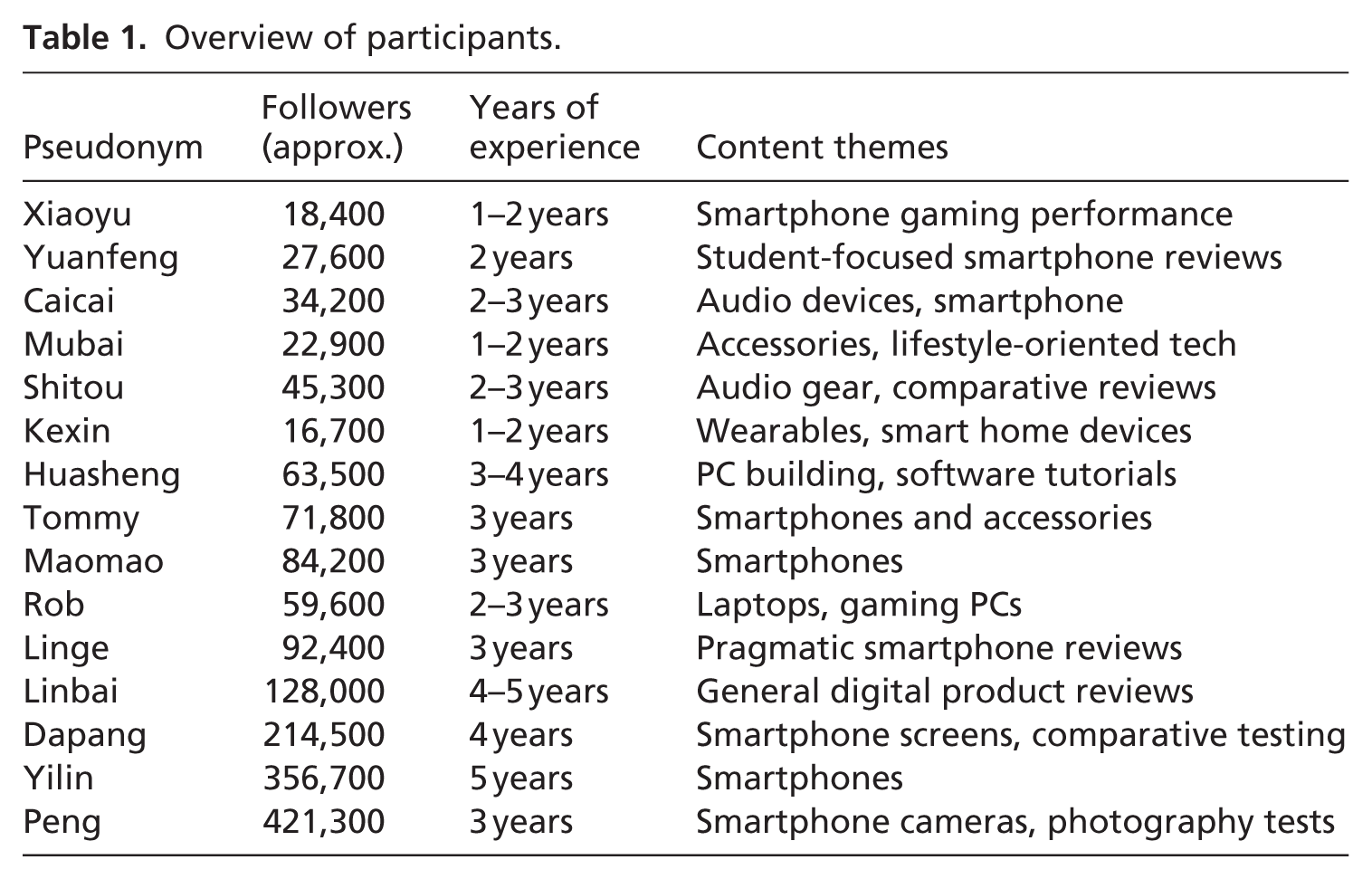
Interviews were conducted remotely via Microsoft Teams between August and November 2024, with participants dispersed across multiple Chinese cities. Each session lasted 90–150 minutes (average 118). Conversations traced creators’ career trajectories and creative practice along two linked dimensions: the organisation of content-production labour (topic selection, production workflows, dissemination) and the relational aspects of online work. Participants described ties with audiences, brands and platforms, how they interpreted these relations, strategies used to sustain or negotiate them, and how such ties in turn shaped creative decisions. With informed consent, all interviews were audio-recorded.
Transcripts were coded and analysed in Microsoft Word using comments, highlights and tables to track codes and analytic notes. The analysis followed reflexive thematic analysis (Braun and Clarke, 2006) with an abductive orientation (Timmermans and Tavory, 2012): inductive, line-by-line coding and memo writing were followed by iterative clustering and refinement. Sensitising concepts from the literature – relational labour, moral economies and resistance – were brought into dialogue with the data to sharpen themes while attending to counter-evidence and variation across cases. To align empirical material with the study’s theoretical lens, the presentation of findings reflects the triadic configuration of relational labour: creators’ accounts are grouped around ties with audiences and with brands, situated within the platform conditions that structure these relations, and oriented to the research questions of how creators develop, sustain and respond to these relations, and how these ties shape content decisions and ethical practices in the absence of formal guidelines. Ethical protocols were strictly observed: participants were fully briefed on the study and their rights, and pseudonyms were used with identifying details altered to ensure confidentiality.
Findings and analysis
Triadic relational labour
Creators and audiences
Our interviewees adopt pronounced audience-centred production strategies. Calibrating content to an imagined audience (Litt and Hargittai, 2016), they fine-tune formats and tone to anticipated reception. Xiaoyu – a 23-year-old recent graduate focused on mobile-gaming performance – targets ‘people like me’: instead of emphasising photography or design, he stress-tests mainstream titles on each handset, reports average frame rates, power draw and heat, and appends a comparative scorecard for easy reference. Unlike Baym’s (2015) musicians, for whom sharing and fan-contact sustain careers alongside music-making, our interviewees depict relational labour as constitutive of production from the outset. Intimacy and ongoing responsiveness are not add-ons but the engine of the workflow. In line with Nieborg and Poell’s (2018) portrayal of digital content as malleable and modular, creators iteratively re-cut and re-frame videos in response to analytics and comments – even when feedback is harsh. Huasheng, who runs a niche channel on mobile apps and PC building, described his approach as ‘appeasement’. After a monitor review drew accusations of being ‘unprofessional’, ‘misunderstanding GPUs’ and misreporting colour-gamut facts, he removed the video, revised it and issued a public apology. He reflected, My viewers know a lot – often more than you can gather for a single episode. Inevitably you miss details or get something slightly wrong. Some people correct you politely; others attack you personally. Still, nobody is perfect – how could anyone possibly know everything? (Interviewee: Huasheng)
Despite the emotional toll, he consistently thanks commenters for corrections and either re-uploads amended versions or adds clarifications in descriptions. Others take a pragmatic view of negativity. Linbai described certain comments as ‘nonsense’ or ‘a pile of rubbish’, but noted that spikes in criticism often coincided with follower growth: A video can be heavily criticised and still convert surprisingly well. One clip had only ~200k views but brought over 10k new followers. (Interviewee: Linbai)
Ouvrein (2024) conceptualises persistently oppositional engagement as an anti-fan relation: followers who sustain attention primarily through mockery, harsh critique, gossip, or shaming. Even within a negative discursive climate, such ties can generate visibility, traffic and ultimately commercial value. Several creators voiced frustration with hostile commentary but chose non-engagement as a guiding rule. Linbai offered a metaphor: ‘If a vicious dog bites you on the street, do you bite back? The best response to malice is to ignore it – don’t let them think they matter’. This stance exemplifies what Salamon and Saunders (2024) call individual e-resistance – discreet, personal, often anonymous tactics deployed by marginal creators to secure small, temporary relief from material or status subordination. Yet such tactics are double-edged: while they allow creators to retain dignity and conserve emotional energy by refusing to legitimise hostile audiences, they rarely challenge structural asymmetries and may even entrench neoliberal individualism by shifting responsibility for managing toxicity onto individuals. This ambivalence connects directly to how creators frame their relationships with audiences more broadly. The idiom ‘audience lord’ (‘Guan Zhong Lao Ye’) – invoked half-jokingly at the beginning or end of videos to solicit likes and subscriptions – surfaced across about half of our interviews. Its performative deference captures the affective pinch that Hochschild (2003) identifies: the tension between ‘a real but disapproved feeling’ and an ‘idealised’ one (p. xiv). In practice, performance metrics (views, likes, follower counts) often outweigh the psychological costs of constant accessibility. For the tech creators in our study, relational labour encompasses not only responding to feedback but also metabolising the negative emotions triggered by hostile commentary, where affective strain becomes normalised as the trade-off for visibility and growth, with traffic and follower gains serving as quantifiable compensation.
Creators also invest in intimate infrastructures of engagement, consistent with prior influencer research (Abidin, 2015; Duffy, 2017). All fifteen maintained fan chat groups; eight listed personal WeChat accounts. Tommy, a smartphone and accessories reviewer, created a fan group at viewers’ request, co-moderated by peers. The work required both financial and emotional labour – holiday cash giveaways, low-price secondhand sales, one-to-one advice. He recounted warning a member who mocked another’s cheaper phone: Not everyone is privileged – some cannot study abroad or afford expensive devices. Respect is my bottom line: criticise me if you wish, but don’t insult other fans. If it happens again, I’ll remove him. (Interviewee: Tommy)
What these practices accumulate, as Banet-Weiser (2012: 8) puts it, are ‘memories, emotions, personal narratives, and expectations’ that knit fragmented viewers into communities. Yet, unlike musicians or live streamers who monetise ties directly via sales or tips (Baym, 2015; Ye et al., 2023), tech reviewers seldom extract direct revenue from fan relationships. Time, care and money invested in community-building typically yield indirect payoffs – credibility, retention and algorithmic momentum – while brand partnerships and product sponsorships remain the primary income source. This asymmetry foreshadows the second pole of triadic relational labour: creators’ concurrent work with advertisers and brands, where the moral claims of audience intimacy meet the commercial logics that sustain creators’ livelihoods.
Creators and brands
For technology reviewers, whose work entails assessing hardware and software, production costs are high. A single device may yield only two or three publishable pieces – unboxing, first impressions and a full review – so maintaining a steady pipeline of products is essential for regular uploads. Partnerships with brands therefore become critical for both sponsorship and timely product access.
The colloquial term ‘Rich Father’ (Jin Zhu Ba Ba), used for sponsors, signals not only financial dependence but also the hierarchical dynamics of commercial partnerships. Brands provide early access to unreleased products and commission promotional content; creators are expected to attend launches – important sites for cultivating ties with marketing and PR staff. Early-career creators often self-fund travel; established ones are typically invited, with expenses covered and a modest stipend of 800–1000 RMB (c. £90–120). Interviewees described these arrangements as routine. Launch events serve dual purposes: they enable time-sensitive content and consolidate relationships. As Xiaoyu put it, the aim is to ‘show that you understand the product and bring a distinctive angle’. Dapang recounted persuading a PR representative to send a review unit by reframing the brand’s gendered positioning: V-brand phones target women for their selfie features, but selfies shouldn’t ‘belong’ to women – this stereotypes everyone. The new line is gender-neutral, suited to anyone who enjoys portraits. I told them I’d argue against boxing it into gender and urged a campaign with diverse users. Days later they sent me the device. (Interviewee: Dapang)
In contrast, Maomao emphasised personal rapport: For brand staff this is still just a job. I met a PR manager who, like me, loved skiing. We talked a lot and actually went skiing together. We became friends; when he moved to another brand, he introduced me to his former colleagues and invited me to his new employer’s launch. I now have good ties with both brands. (Interviewee: Maomao)
In this sense, relational labour extends beyond ‘pleasing, approaching, and connecting with others’ in audience relations (Baym, 2015), to encompass brand-facing work. Yilin framed business communication as a survival skill: Anyone can shoot video – that’s not enough. You need to understand the business side: learn to communicate with brands and convince them to work with you, or you won’t last. If you can make 1,000 RMB (about £120) from a video, you’re already ahead of most people. (Interviewee: Yilin)
In 2022, Yilin attended 20 launches across eight cities; the pace proved unsustainable. His experience illustrates the precarity of brand-facing relational labour, which rises and falls with market conditions (Duffy et al., 2021). After a 2023 downturn, smartphone brands reduced advertising budgets, and his invitations halved. Competition intensified: Bilibili reported a 24% increase in active creators that year (China Youth Daily, 2024). In this crowded field, content itself becomes a tool of relationship management. To attract brand attention, creators aim to produce ‘brand-friendly’ videos. Yuanfeng described crafting ‘pseudo-sponsored’ pieces – self-funded purchases reviewed with an emphasis on strengths, calibrated to the audience segment the brand likely targets, with the hope of catching the attention of brand representatives and prompting future collaborations or product seeding: I bought Brand M’s mid-range phone, praised it as ideal for students and delivery drivers, and avoided criticising competitors – I imagined that was the audience the brand wanted. (Interviewee: Yuanfeng)
Creators also calculate commercial risk in advance. As Dapang noted, If I compared top-selling Bluetooth earbuds and listed all their flaws, it might go viral. But for survival, that’s suicidal – you’ll be blacklisted by brands you haven’t even worked with yet. (Interviewee: Dapang)
Another strategy is ‘taking sides’. Given intense inter-brand competition, maintaining equally close ties with all firms is unrealistic. Some creators explicitly align with certain brands through what they call ‘pledges of allegiance’. Shitou described publicly criticising Brand X for copying the design of Brand S’s speakers: I knew it would likely end any future with Brand X. But for Brand S I became a trustworthy partner. Being willing to speak out left a strong impression on viewers and boosted engagement – and it attracted other brands as well. (Interviewee: Shitou)
Across these efforts to cultivate brand relations, our data suggest a prevalent non-resistance stance (Salamon and Saunders, 2024). Whether through personalised networking, ‘pseudo-sponsored’ content, strategic criticism of competitors to signal allegiance, or pre-emptive self-censorship to avoid ‘commercial suicide’, creators typically accommodate advertisers’ material dominance. These accounts show how playful language and perks help to naturalise hierarchy within creator–brand relations. The joking honorific ‘Rich Father’ is telling: rich indexes sponsors’ material superiority; father encodes dependence and authority. Often, influence is exercised less through the ‘stick’ than through the ‘carrot’. Interviewees eagerly shared photos of embossed invitations, holiday gifts and selfies with founders; many recalled that their first experience of first-class flights or luxury suites came via launch events – perks far beyond their previous salaries. As Mubai remarked, a single round-trip first-class ticket ‘was practically a month’s pay’ in his prior job. The fleeting weekend of luxury vis-à-vis ordinary routines fuels what Duffy (2017) terms aspirational labour – hope-driven creative work aimed at securing future invitations and, potentially, social mobility.
These symbolic and material incentives dovetail with platform moral economies that valorise self-entrepreneurship, individualism, performance optimisation and competitive ranking (Bonini and Treré, 2024). Within creator communities, proximity to brands and acceptance of gifts are rarely seen as questionable; they can even function as coveted social capital. Whether individual e-resistance towards ‘audience lord’ or non-resistance towards ‘rich-father’ sponsors, such tactics may deliver short-term gains – follower growth, heightened visibility, easier access to sponsorships – without contesting the underlying asymmetries of the triad. Indeed, they more tightly embed creators within an unequal creator–audience–advertiser nexus, tacitly reaffirming audience and sponsor dominance over creative and economic agency. Any rupture in one link reverberates across the others: a loss of audience intimacy and satisfaction undermines channel metrics and brand visibility; overly sharp criticism jeopardises sponsorship and income continuity. Such structure heightens both the demands and the precarity of relational labour, requiring creators to balance emotional resilience, strategic self-presentation and a continually shifting ethical calculus. The next section examines how these contradictory pressures generate ambivalent performances of authenticity, as creators negotiate credibility, commercial value and creative autonomy under platform-mediated conditions.
The ambivalence of authenticity in relational labour
Lovelock (2017) argues that influencers build trustworthy, consistent personae through strategic transparency, often by selectively sharing personal life (Duffy and Hund, 2015; Marwick, 2013). Extending this, Hund (2023) notes that authenticity has become institutionalised: success hinges on performances of spontaneity and ordinariness. For our technology reviewers, this yields a trust script anchored in ‘hands-on’ use. Identity cues (channel taglines), domestic mise-en-scène (bedrooms or studies with gaming monitors/RGB keyboards) and access framings (personal purchase or peer loans) function as semiotic anchors of ordinary use – what Peterson (2005) calls relational claims to authenticity, calibrated to audience judgements of sincerity and competence. Yet our interviews show that these anchors often sit atop sponsored production: brand briefs specify formats and features to highlight, and scripts or cuts are routinely submitted for approval, with leeway varying by brand. Echoing Hund (2023), practice has shifted from interest-driven posting to standardised, exchange-value production in which authenticity is engineered to meet commercial expectations. Rob’s collaboration with Brand A exemplifies this negotiated order. Comparing Brand A’s gaming laptop to competitor Brand L, he was permitted to ‘speak freely’ yet chose not to disclose that both units were provided by Brand A, instead stating that he had borrowed them from friends – reasoning that such a narrative would feel ‘more acceptable and natural’ to viewers. He nonetheless viewed his assessment as substantively fair: I’ll compare brands if asked, but not “boost one, slam the other”. Brand A’s design is bolder and runs cooler, but I’ll also make clear that Brand L’s thinner build – though weaker in battery and cooling – suits professionals who still want gaming performance. (Interviewee: Rob)
By contrast, Peng’s collaboration with Brand O imposed tighter constraints. Although his tests suggested that Brand M performed better overall, Brand O requested script revisions to foreground the telephoto lens: I hated doing that – viewers pick up inconsistencies and criticise you. I was in a tight spot financially, so I briefly said Brand O was better on telephoto. But I refused to alter the sample photos to discredit others; I wanted viewers to judge for themselves. (Interviewee: Peng)
These cases show creators working within dual regimes of accountability: audience-side expectations that authenticate independence and truthfulness, and sponsor/platform-side expectations that authenticate positioning and marketability. The resulting manoeuvres – calibrated disclosure, narrative reframing, evidentiary selection – are not mere ‘tricks’ but what Bonini and Treré (2024) call gaming efforts: situational tactics for negotiating what counts as legitimate conduct when user moral economies collide with platform/brand logics of optimisation and brand safety. As Ziewitz (2019) notes, gaming ‘is not given in advance, but needs to be established, navigated and negotiated in specific situations’ (p. 732). In this sense, tech reviewing becomes a practice of ‘performing non-performance’ – acting ‘as if nothing is performed’ (Dubrofsky and Ryalls, 2014) – through which subordinate actors attempt to redraw acceptable boundaries across asymmetrical relations without rupturing the triad. In practice, the balance hinges on ongoing, situated improvisation as creators reconcile the competing priorities of audiences and brands – maintaining audience engagement while safeguarding income – and authenticity is enacted as a contingent, negotiated accomplishment rather than a fixed moral state.
Contingent moral improvisation
In legacy journalism, conflicts of interest were traditionally mitigated through codified rules that erected a ‘wall’ between editorial judgement and commercial revenue (McManus, 1992). Platform creators, in contrast, inhabit a field where such a wall has never existed. Indeed, collapsing – rather than safeguarding – the boundary between editorial independence and advertising is often valorised as entrepreneurial acumen (Wellman et al., 2020). This dynamic underpins the rise of sponsored videos that deliberately ‘mirror the format of non-paid content’ (Amazeen and Wojdynski, 2020). Although commercial collaborations must formally pass through Bilibili or Douyin’s official systems (Huahuo and Xingtu, respectively) – ostensibly to protect creators’ contractual rights and verify product legality – most creators perceive these mechanisms as primarily serving to guarantee the platform’s commission (usually 10–20%). Content flagged as sponsored but not brokered via these official channels is routinely subject to reduced algorithmic visibility. Yet, even for officially sanctioned partnerships, platforms rarely mandate prominent sponsorship disclosures visible to audiences. In such conditions, the codified ethical safeguards of legacy media are effectively replaced by what we term contingent moral improvisation: ad hoc, improvised modes of disclosure and responsibility devised by creators themselves. These practices are contingent in that they lack institutional standardisation, and improvisational in that they are adjusted situationally in response to shifting pressures from audiences, brands and platforms. Caicai, for instance, declined a sponsorship with a bone-conduction headphone brand because she believed its poor sound quality would betray her audience’s trust: The sound quality was poor – like a Bluetooth speaker in a shoebox heard from a few metres away. I could have skipped sound quality and highlighted scenarios like swimming or jogging. But the brand insisted I praise the sound, and I wasn’t willing to do that. I couldn’t cover up its flaws. (Interviewee: Caicai)
Her response illustrates what Salamon and Saunders (2024) describe as individual e-resistance: subtle, personal attempts to counterbalance advertisers’ material dominance. Unlike the avoidance of hostile audiences discussed earlier, here resistance emerges in relation to commercial pressures and sponsorship demands. Yet, as Salamon and Saunders (2024) caution, such resistance often produces the illusion that individual creators – rather than platforms or advertisers – should bear the bulk of ethical responsibility. By refusing sponsorships on moral grounds or invoking obligations to their audiences, creators internalise systemic challenges as personal duties. This not only displaces accountability away from those with structural power but also reinforces precarity, leaving creators to manage disclosure dilemmas and reputational risks largely on their own. In doing so, they reproduce neoliberal ideologies of self-responsibility, which simultaneously enable tactical coping and reinforce their structurally marginal position. Even for the same creator, contingent moral improvisation is rarely consistent. Caicai, for example, insisted on highlighting technical shortcomings but simultaneously sought to compensate advertisers by reframing narratives in ways that still served promotional aims: If a brand pays me to test a product, I’ll point out the flaws. Brand H’s chip isn’t advanced – it limits performance, and I’ll say so. But I can also tell a story about the company’s culture and its persistence under sanctions – often more moving than most reviewers on Bilibili. That way, I criticise honestly while still giving the brand something of value. (Interviewee: Caicai)
While Caicai framed herself as ‘the watchdog of the audience, not the lapdog of brands’, Linge adopted a different stance, likening his role to that of a salesperson: When you test-drive a car, would you call it immoral if the salesperson highlights the positives and glosses over the negatives? (Interviewee: Linge)
When asked how he reconciled this openly commercial role with his position as a creator – particularly given that he does not always disclose sponsorship – Linge remained untroubled: I don’t think it matters. I’m just providing information. Most viewers won’t base their decisions on a single video. As long as I don’t distort the facts – turning black into white or white into black – it’s fine. (Interviewee: Linge)
Such divergent narratives show how contingent moral improvisation functions as a flexible form of self-justification, enabling creators to navigate contradictions between audience trust and advertiser demands. As Bonini and Treré (2024) argue, user moral economies – the audience-endorsed values of sincerity and fairness – often diverge from platform moral economies, producing persistent frictions. In our study, creators adopt improvisational tactics to manage these frictions: sometimes refusing collaborations, sometimes downplaying flaws, sometimes imposing self-devised disclosure ratios. Peng, for example, reluctantly praised Brand O’s telephoto lens despite his reservations. Feeling uneasy, he later imposed a ‘three-to-one’ rule: for every sponsored video, he would publish three unsponsored ones. For him, this ratio offered ‘peace of mind’, balancing financial stability with a sense of ethical self-control.
In this sense, contingent moral improvisation does not establish stable ethical codes but functions as a coping mechanism. It is situational, improvised and tactical – invoked whenever creators are challenged about conflicts of interest or ethical lapses in their relational labour. What emerges is not ethical consistency but a continuous process of moral improvisation, whereby creators rationalise their actions in environments where relationships with both audiences and brand partners remain fragile. These improvisations underscore the moral precarity of platform labour: credibility and income are not guaranteed by structural safeguards but by the fragile, ongoing labour of narrating one’s ethical agency under constraint.
Discussion and conclusion
This article demonstrates that Chinese technology creators operate under the persistent demands of triadic relational labour: cultivating audience trust through ostensibly authentic self-presentation while accommodating sponsors within platform architectures optimised for engagement and brand monetisation. In this environment, authenticity is less an intrinsic virtue than a commodified performance – both staged and unstable amid shifting monetisation logics, sponsor requirements and audience expectations (Banet-Weiser, 2012; Hund, 2023). Our analysis further shows that creators respond to these conditions not only by maintaining ties with audiences and brands, but also by resisting them in subtle and situated ways. Maintenance and resistance thus emerge as intertwined modes of relational labour – strategies through which creators keep their projects viable while negotiating their subordinate position within the triad.
A moral-economy lens shows why these tensions are structural rather than episodic. Platforms privilege self-entrepreneurship, free competition and datafied metrics aligned with ad monetisation; advertisers emphasise persuasive reach and the commercial performance of campaigns, seeking content that maximises visibility and drives consumer uptake; audiences value creators’ fidelity to self, transparency and responsiveness to community norms. Misalignment across these spheres shifts ethical adjudication onto individuals. Lacking the editorial–commercial separation and codified disclosure rules of mainstream news organisations, creators must generate revenue, decide on disclosures and absorb reputational fallout, producing a double marginality – material and normative. For peripheral creators, these pressures are not incidental but systemic. Peripherality signals structural distance from the protections, bargaining power and professional standards of mainstream media. Our analysis specifies how peripherality heightens triadic exposure – to audiences for credibility and uptake, to brands for financial input and to platforms for distribution and monetisation – embedding ethical ambiguity into everyday practice rather than leaving it as an occasional lapse.
Against this backdrop, creators do respond, but mainly through contingent moral improvisation: situated, revisable repertoires that blend justification, boundary-work and emotional self-management to keep projects viable under constraint. Interviewees described techniques such as rationing sponsorships over time, setting personal ‘red lines’ for comparative claims, crafting strategic sincerity through selective disclosure, and temporarily suspending paid content to reset credibility. Contingent moral improvisation, alongside the coping tactics of non-resistance and individual e-resistance, stabilises relations in the short term yet is readily absorbed by platform moral economies; these responses manage friction without altering asymmetric bargaining positions and therefore do not challenge creators’ subordinate location in the triad. This helps explain the precarity of relational labour: because such tactics rely on continual anticipation and self-adjustment, they convert instability into an ongoing maintenance task, raising emotional load and reputational volatility even when immediate conflicts are defused. Meanwhile, the outsourcing of ethical risk persists – creators shoulder disclosure burdens and reputational hazards while platforms benefit – echoing critiques of platform capitalism’s socialisation of risk and privatisation of profit (Srnicek, 2017). Platforms act here as purposeful fourth agents: not merely mediating creator–audience–brand ties, but actively structuring and intensifying the very dynamics of triadic relational labour from which they extract engagement and revenue, while further displacing and individualising the moral risks borne by creators.
These patterns align with but also complicate broader scholarship. Prior studies show that in some Anglophone contexts, peripheral creators have experimented with collective associations or unions as bottom-up strategies to resist platform rules and power asymmetries. In contrast, our study found no evidence that Chinese technology creators pursued collective responses. Although some knew each other online or occasionally met at brand events, their ties rarely extended beyond casual exchanges. This contrasts with research that documents creator alliances in Western contexts, while resonating with findings from the global South, where peripheral creators tend to rely on short-term tactical coping or adaptive survival strategies aligned with platform logics (Arriagada and Siles, 2024; Cunningham and Craig, 2019). In the Chinese creator economy, gonghui is often translated as a ‘union’, but it actually refers to for-profit creator agencies that recruit, train and manage streamers for platforms, taking a cut of their income rather than representing their labour rights. In practice, both gonghui and other MCN organisations function as commercial intermediaries and talent brokers, not as independent labour unions or ethical watchdogs in the Western sense (Wang et al., 2023). In their absence, boundary-setting remains individualised, uneven and affectively costly. We therefore argue that as creator work becomes more professionalised, bottom-up associations are urgently needed to establish disclosure norms, conflict-of-interest protocols and fair-dealing guidelines tailored to creator labour. Such infrastructures would not only help audiences distinguish sponsored from non-sponsored content and reduce accusations of opportunism, but also alleviate creators’ moral anxieties, protect creative autonomy from triadic pressures, and mitigate reputational risks. As Salamon and Saunders (2024) note, collective organisation enables creators to recognise shared conditions and support one another. For Chinese technology creators, this could transform dispersed coping into coordinated capacity, creating conditions for negotiating with platforms, pressing for shared ethical responsibility and encouraging business models that balance profitability with support for non-commercial, self-produced content.
While this study centres on Chinese tech creators, its analysis echoes empirical studies on beauty, lifestyle and travel influencers who likewise juggle brands’ promotional demands, pressures of economic survival and ongoing commitments to their audiences (Duffy, 2017; Hund, 2023; Wellman et al., 2020). These parallels suggest that the dynamics traced here – triadic exposure, contingent moral improvisation and related precarity – may be a common response to platformised pressures, even as their concrete forms vary across content genres and settings; future research could examine how far they generalise across platforms, genres and cultural contexts. Building on this, comparative designs beyond Anglophone cores may examine how local socio-technical configurations recalibrate ethical frictions and tilt practice towards coping tactics or collective resistance. Within this study, we foreground independent creators to show how ethical negotiation is personalised where organisational support is minimal; none of our interviewees were signed to MCNs or similar agencies, and the specific role of such intermediaries therefore lies beyond the remit of this analysis. Future work following creators embedded in MCNs and related organisations could clarify how these agents add further complexity to the creator–brand–audience triad, by inserting new layers of mediation, redistributing risks and rewards and complicating accountability for disclosure and ethics. Framed through a moral-economy perspective, such studies may illuminate how competing rules of worth are negotiated in everyday production, and where institutional remedies – not only individual improvisation – best sustain trust, autonomy and the sustainability of creative work.
Footnotes
Acknowledgements
The author would like to thank Dr Heidi Ashton, Professor Chris Bilton, Professor Pietari Kappa and Dr David Wright at the University of Warwick for their insightful comments on earlier versions of this manuscript. The author is also grateful to Dr Christine Larson at the University of Colorado Boulder for her generous and thoughtful suggestions on a draft presented at ICA 2025, and to the two anonymous reviewers for their constructive and generous feedback.
Author’s note
The author has agreed to this submission, and the article is not currently under consideration for publication by any other print or electronic journal.

Ethical considerations
The study has been approved by the Research Ethics Committee of the School of Creative Arts, Performance and Visual Cultures (approval no. 1956928), University of Warwick.
Funding
The author received no financial support for the research, authorship and/or publication of this article.
Declaration of conflicting interests
The author declared no potential conflicts of interest with respect to the research, authorship and/or publication of this article.
Data availability statement
The data supporting the findings of this study are not publicly available due to confidentiality and ethical restrictions; however, anonymised interview materials that would not lead to participant identification may be made available by the corresponding author upon reasonable request.