




Abstract
In this study, we theoretically conceptualize and empirically investigate translocal spatial arrangements of networked public spheres on social media. In digital communication networks, actors easily connect with others globally, crossing the borders of cities, nations and languages. However, the spatial notions evoked in public sphere research to date remain largely territorial. We propose a theoretical framework drawing on Löw’s sociology of space, which highlights the relational and translocal nature of spatial arrangements. In a case study of the translocal interaction network of Berlin Twitter users, we demonstrate how this framework can be leveraged empirically using network analysis. Despite the overall network of Berlin’s Twittersphere spanning the whole world, we find territorialized as well as deterritorialized translocal communities. This points to the simultaneity of territorial and networked spatial logics in digital public spheres.
In digital networked public spheres (Benkler, 2008; Castells, 2008), individual and collective actors connect with others, crossing the borders of cities, nations, and languages. New translocal networks of communication emerge, which are locally anchored but simultaneously transcend boundaries. We argue that these developments require a redefinition of public spheres pertaining to their spatial dimensions. With this article, we offer a theoretical framework for theorizing and studying the spatiality of public spheres in a way that acknowledges the relationality and translocality of spatial arrangements.
Research on public spheres typically builds on national (Wallner and Adolf, 2014) or transnational concepts (Brüggemann et al., 2009; Pfetsch et al., 2008), while neglecting local forms, such as urban public spheres (Friedland, 2016). However, recent empirical findings highlight the relevance of local ties in digital public spheres and suggest that networked communication entails a close linking of specific places, and thus, the formation of new, translocal public spheres (Pfetsch et al., 2021). These digital spaces are anchored in, but not bound to, specific localities.
Many recent studies on social media communication, especially Twitter, have uncovered translocal ties (e.g. Shelton et al., 2014; Van Haperen et al., 2018; Zou et al., 2019), which tend to mirror social connections, including travel and migration (Samuel-Azran and Hayat, 2020; Takhteyev et al., 2012) or political relations (Shelton et al., 2014). Remarkably, none of these studies on Twitter geographies refer to theories of the public sphere. While scholars have called for a spatial turn in media and communication studies (e.g. Couldry and McCarthy, 2004; Jansson and Falkheimer, 2006), such an approach has yet to be specified for public sphere theory (Waldherr et al., 2021). Our overall research question is therefore: How can we theoretically conceptualize and empirically describe networked public spheres in spatial terms?
Our contribution is threefold: first, we draw on a relational understanding of space as put forward by the German sociologist Martina Löw (2008, 2016) to specify the spatial dimensions of networked public spheres. Löw understands space as emerging from the relations between placed entities. Spaces can then be analyzed as the spatial arrangements of placed entities, such as social media users in the case of digital public spheres. Highlighting the relational characteristic of space, this concept detaches the notion of space from the territory or container, which can result in different spatial arrangements, such as network spaces (Mol and Law, 1994: 649).
Second, taking the notion of network spaces seriously, we argue that we have to understand the changing spatiality of public spheres in a digitized world through the process of translocalization (Hepp, 2009; Knoblauch, 2020) rather than transnationalization, or globalization. Contrary to suggestions of a “death of distance” (Cairncross, 1997) promoted in the early days of digitalization, place and space continue to matter in structuring digital communication networks (Rodríguez-Amat and Brantner, 2016). Social media users are located in specific places between which they create translocal connections via their digital communication. Thus, we argue that physical places gain importance as reference points and contexts for public communication in digital, highly connected public spheres.
Third, we elaborate on four main perspectives for studying the translocal spatial arrangements of networked public spheres, which are based on the works of Adams and Jansson (2012) and Brantner et al. (2021): textures, structures, representations, and connections. Then, we exploratively illustrate our theoretical framework with data on Berlin metropolitan Twitter. We gathered the Twitter communication of users who indicated the city of Berlin (Germany) as their center of living and reconstructed the spatial network emerging from their communication with others. Through studying densely connected areas in the network of Twitter users, we identify translocal communities (Hepp, 2009). We analyze the spatial patterns of these communities with regard to the places in the world they connect, uncovering territorialized, as well as de-territorialized spatial arrangements.
Public spheres and the spatial turn
In the age of digital communication, and particularly social media communication, the public sphere can no longer be thought of in the singular. It is rather a multitude of different forums that are interconnected and hybrid; that is, they afford a range of privately public and publicly private forms of communication (Papacharissi, 2010: 142), with users often not having control over their level of publicness (boyd, 2010). Accordingly, we embrace an understanding of networked public spheres in the plural highlighting the relational communicative linkages between societal speakers and their forums (Benkler, 2008). This understanding of public spheres is rooted in the tradition of public arena models (Gerhards and Neidhardt, 1991; Hilgartner and Bosk, 1988) and broad enough to include different layers of public spheres—from unplanned personal encounters to smaller public events and issue publics to mass audiences (Maireder and Schlögl, 2014). Networked public spheres thus include a variety of semi- and counter-public spheres that might emerge from networked communicative interactions. The specific spatial references of this networked communication have been increasingly studied empirically, but not yet sufficiently conceptualized theoretically.
The spatial turn in media and communication studies has been called out repeatedly over the past decades (e.g. Couldry and McCarthy, 2004; Jansson and Falkheimer, 2006). Highlighting the basic tension between spaces/places and content/context, Adams and Jansson (2012) introduced a taxonomy for structuring the field of communication geography, which almost 10 years later proves helpful in reviewing the state of the spatial turn in communication research. The authors distinguished the study of representations (places in communication), connections (spaces in communication), textures (communication in places), and structures (communication in spaces).
Earlier studies referring to the spatial turn in communication focused mainly on textures and structures, that is, how spaces and places give context to communication and mediated action. The main foci of investigations were on individual appropriation and practices regarding mobile technologies (e.g. De Souza e Silva, 2013; Waite, 2020) and locative media (e.g. Fan, 2017; Schwartz and Halegoua, 2015). Scholars in this research tradition studied how individuals interact with technological artifacts and interfaces in space and in certain places.
To a lesser extent, scholars also examined how spaces and places structure public communication. In a recent theoretical contribution, Keinert et al. (2021) carved out the role of spatial infrastructures as “crucial socio-material preconditions of public communication” (p. 86). This argument connects the call for a spatial turn to the material turn in communication (e.g. Willems, 2019). Empirically, the relevance of infrastructures is, for instance, evident for the formation of protests (Karduni and Sauda, 2020; Rodríguez-Amat and Brantner, 2016). Physical urban spaces and digital spaces work together, as they are “co-constitutive” (Willems, 2019: 1194) in shaping social movements. We also observe a growing number of studies geographically mapping social media communication, especially on Twitter (e.g. Bastos et al., 2018; Hoffmann and Heft, 2020; Wehden and Stoltenberg, 2019).
In recent years, we have seen a rising interest in the dimensions of spatial representations and connections in communication research (i.e. how places and spaces are represented, negotiated and constructed via media and communication). To grasp how spaces are constructed in public discourses, Stoltenberg (2021) developed the theoretical concept of “issue spatiality.” Empirically, journalism scholars have turned to studying how place and space are represented in news, and how aware journalists are of these dimensions (Schmitz Weiss, 2015; Usher, 2019).
Despite this increasing relevance of the spatial turn for communication research in general, the relevance of space and place has not yet been spelled out in detail for public sphere research in particular (Waldherr et al., 2021). Spatial concepts have to date been mainly used metaphorically. Habermas, for example, conceives of the public sphere as a “social space generated in communicative action” (Habermas, 1996: 360). As introduced above, other scholars conceptualize public spheres as arenas or forums, in which societal speakers (actors) engage in discourse, seeking attention of the audience for their issues, frames, and opinions (e.g. Gerhards and Neidhardt, 1991; Hilgartner and Bosk, 1988). Such arenas are implicitly understood and examined in a national scope (Maier et al., 2021).
However, globalization and digitalization have urged scholars to conceptualize transnational notions of the public sphere, such as a European public sphere (e.g. Brüggemann et al., 2009; Pfetsch et al., 2008). Moving beyond territorial concepts, Castells (2008) and Volkmer (2014) observe the emergence of a de-territorialized, global public sphere characterized by networked transborder communication between world citizens. However, not all places in the world are connected equally in this global network, and many are excluded, leading Castells (1996: 407–459) to differentiate between a de-territorialized space of flows, integrating central metropolitan nodes, and a space of places, which are excluded and increasingly segmented. This relates to what Massey has described as “power geometries” of space (e.g. Massey, 1994): inequalities based on capital, gender, or race, shape how people connect via networks, if and how they initiate own connections and control others’.
We argue that neither the traditional, territorial concepts, nor the de-territorialized, global concept fully grasp the networked character of contemporary public spheres. As we will further elaborate, networked communication enables both global transborder communication as well as the connection of specific places. Therefore, we not only see a need to push forward the spatial turn for public sphere research, but also to revise and refine the spatial concepts used for this endeavor, which is the major aim of our article. In the following, we develop a theoretical framework which adapts a relational understanding of space for public sphere theory, conceptualizes the spatial dimensions of public spheres and integrates the tensions between the local and the global references of networked public spheres.
Spatial dimensions of public spheres
Spatial theory has moved away from understanding spaces exclusively as containers or territories. Scholars such as Lefebvre (1991), Castells (1996), or Massey (1994) emphasize the relational nature of space: it is always produced in social processes of space-making and characterized by fluid configurations and interrelations. As part of the spatial turn, these concepts have been taken up and further theorized by media and communication scholars (e.g. Couldry and McCarthy, 2004; Ek, 2006), highlighting that media practices are constructing space as well as shaped by spatial structures. However, we still see a gap in specifically connecting these ideas to the concept of networked public spheres and conceptualizing their spatial dimensions. In this section, we propose a theoretical framework for integrating these two strands of research.
In the following, we mainly draw on the works of the German sociologist Löw (2008, 2016), who has elaborated a relational theory of space in great detail, which integrates well with notions of networked public spheres. Coming from urban sociology, Löw was particularly inspired by the writings of Lefebvre (1991), Mol and Law (1994), Massey (1994), and others. She defined spaces as “relational orderings of people (living entities) and social goods” (Löw, 2008: 38) which arise “from the activity of experiencing objects as relating to one another” (Löw, 2008: 26). Two social processes are fundamental to the constitution of spaces: (1) spacing, that is, the placing of entities, and (2) synthesizing, that is, experiencing these placed entities as relating to one another. The latter process can take place in the minds and memories of individuals as well as emerge from communicative interactions and discursive processes (Keinert et al., 2021).
Löw’s theoretical concept of space is particularly conducive to the spatial analysis of public spheres, because it offers a clear distinction between place and space which have been contested and often blurry concepts (cf. Usher, 2019, for a discussion). The term place, according to Löw (2008: 42), “denotes an area, a site, which can be specifically named, usually geographically marked.” Places are constituted in the process of spacing, while spaces emerge in synthesizing connections between places. For the spatial analysis of public spheres, we can, thus, infer two fundamental dimensions: (1) places and (2) the relations between them.
For further conceptualization, we draw on the distinctions between communication in places/spaces and places/spaces in communication, which was put forward by Adams and Jansson (2012) and translated to the study of public spheres by Brantner et al. (2021). Integrating this taxonomy with Löw’s (2008) relational concept of space yields four main foci for the spatial analysis of public spheres, as shown in Table 1.
Four foci for the spatial analysis of public spheres.

Referring to the arena models of public spheres introduced above (Gerhards and Neidhardt, 1991), we distinguish between the speakers (actors) and their discourse. The actors are placed in specific geographic locations when communicating publicly (textures), and through their interactions create relations between these locations (structures), which then may be experienced by actors as a space. For example, activists live-tweeting on several protests in different locations report perceiving those as hybrid spaces in which virtual and physical realities are closely intertwined (Bastos and Mercea, 2016: 2371–2372).
In discourse, actors make spatial references (representations) in the form of place-naming (Wiard and Pereira, 2019). They also discursively link places by repeatedly referencing places together (connections), for example, in the context of specific issues, thereby creating issue spaces (Stoltenberg, 2021).
The forms of structures and connections can be diverse. For example, the actors of a public discourse could all be located in the same place, for example, a town hall. However, using digital media, they could also be located all over the world, creating a digital space. Knoblauch and Löw (2020: 273–276) offer a heuristic of spatial figures which helps systematize the most basic spatial arrangements and their respective logics. They distinguish between territory, trajectory, place, and network.
Territorial spaces are surfaces (e.g. territories, regions, zones) or containers (e.g. rooms, houses) which separate the inside from the outside through the establishment of clear boundaries. In network spaces, by contrast, also distant entities are connected via the logic of association; there are no clear boundaries. Trajectorial spaces are linear and traversing; they are experienced along clearly defined routes such as on a highway, train, or sidewalk. Finally, if spacing and synthesizing are centered around and limited to a specific locality, this place can also be experienced as a space on its own.
For our argument, we will mainly refer to the figures of territorial space and network space. As mentioned above, territorial notions of space have been prevalent in public sphere research so far. The networked character of digitized public spheres, however, resonates well with the relational logic of association in network spaces. Places and trajectories might play a role as spatial infrastructures for urban public communication; however, they appear less central for the analysis of spatial arrangements of networked public spheres in social media.
Translocalization and translocality
Knoblauch and Löw (2020) postulate an ongoing meta-process of the refiguration of space. They do not simply assume a transition from territorial space to network space, but observe a simultaneity and tension between different spatial figures. One central characteristic of the network space is that distantly placed entities are connected and synthesized. Thus, Knoblauch and Löw (2020: 281–282) see translocalization as an important process in the refiguration of spaces, which is fostered by the digitalization of communicative actions.
On digital communication platforms, users can connect easily and constantly across borders in a way “that presence, proximity, and distance are less and less a criterion for the quality of communicative actions, and for the duration, intensity, and type of social relations” (Knoblauch, 2020: 258). This does not mean that places become meaningless. Digital communication allows individuals to connect manifold places which are relevant to them, and to maintain personal relationships to these different localities. Thus, the concept of translocalization emphasizes both the rootedness in place and the transcending connections between places. It is, therefore, closely related to what Massey (1994: 146–156) earlier described as a progressive, “global sense of place,” which is aware of the links of a place to other places in the world, this way productively integrating the local with the global.
While translocalization describes a process, translocality refers to the pattern of linkages between specific places and the resulting sense of connectedness (Wehden and Stoltenberg, 2019). Focusing on the translocality of public spheres, we stress the relevance of physical places as anchors and points of reference for public communication in digitized public spheres: “Locality emphasizes that—also in the time of media globalization—the local world does not cease to exist.” (Hepp, 2009: para. 9). The lifeworld of citizens and large parts of civic communication continue to be anchored in and structured by local places (Friedland, 2016: 25). The boundary-transgressing nature of digital communication allows for the emergence of a variety of semi-local public spheres (Pfetsch et al., 2021), for example, when users follow local news elsewhere (Wehden and Stoltenberg, 2019), or when local publics mobilize for matters of global concern such as climate change (Beck et al., 2013).
Shifting the focus from local to translocal public spheres, we ask what specific places actors connect in their digital communication, and what spatial patterns emerge from these interactions. A growing number of studies on Twitter geographies yields first insights into the spatial arrangements of translocal public spheres. While the networks of digital communication are of potential global reach, many interactions occur in close proximity (Samuel-Azran and Hayat, 2020; Stephens and Poorthuis, 2015; Takhteyev et al., 2012).
However, translocal connections between more distant places have been observed repeatedly and in different social, cultural, and situational contexts, for example, in the aftermath of disasters (Lin and Margolin, 2014; Shelton et al., 2014; Zou et al., 2019), during protests (Bastos and Mercea, 2016; Van Haperen et al., 2018), or connecting diasporas (Afeworki, 2018; Mearns et al., 2014). Cosmopolitan cities are of outstanding relevance in the global Twitter network (Cvetojevic and Hochmair, 2021; Hedayatifar et al., 2020; Leetaru et al., 2013)—particularly those urban spaces which are close to political power (Casero-Ripollés et al., 2020), have large populations (Cvetojevic and Hochmair, 2021), and share many flight connections (Samuel-Azran and Hayat, 2020; Takhteyev et al., 2012). Many translocal ties also remain within boundaries defined by country, culture, and/or language (Hedayatifar et al., 2020; Samuel-Azran and Hayat, 2020; Stephens and Poorthuis, 2015; Takhteyev et al., 2012). We can, thus, summarize with Stephens and Poorthuis (2015: 87) that translocal Twitter interaction networks “do not invent completely new social and spatial patterns, but instead replicate existing arrangements” and their inequalities.
Networked digital communication likely affords the emergence of translocal communities (Hepp, 2009; Maier et al., 2021). By community, we mean cohesive social networks, which are “based on sociable and supportive social relations” (Gruzd et al., 2011: 1298) between individuals who share a sense of belonging and an imagination of a common identity (Anderson, 2006). Translocal communities, according to Hepp (2009, para. 12), emerge from processes of “translocal communicative thickening,” that is, communicative actions increasingly and repeatedly connecting to other places. These translocal patterns of densification may or may not extend beyond geopolitical territories, leading Hepp (2009) to distinguish territorialized translocal communities (which are based on regions, nations, or associations of regions) and de-territorialized translocal communities (which share ethnic, cultural, social, or religious identities). This heuristic will further guide our empirical investigation of the spatial arrangements of networked public spheres.
Empirical case study
To empirically qualify the spatial core dimensions of networked public spheres, and explore their translocality, we conducted an exploratory case study of metropolitan Twitter communication. Twitter is one of the most public social media platforms. Its network structure, which is afforded by functions such as retweets, quotes, replies, and mentions, makes it a compelling case for the study of translocal networked public spheres. Users do not need an account to read tweets and emerging discussion threads, and registered users can follow any other account, regardless of reciprocity. Thus, Twitter communication by default is potentially public, and any tweet may propagate to a mass audience at any time (boyd, 2010). Consequently, Twitter hosts networked public spheres on all levels, from personal encounters to ad hoc issue publics forming around trending hashtags to mass communication broadcasted from famous influencer accounts (Maireder and Schlögl, 2014).
Following the concept of translocalization, we decided to start from one anchoring place and investigate the interaction network emerging around it. We chose Berlin, Germany, an example of a large, diverse metropolis, as the anchoring place for our data collection. Germany is a country with high Internet penetration, and one in four Germans use social media daily (Beisch et al., 2019). Twitter is used at least weekly by 13% of German onliners (Hölig and Hasebrink, 2020). The Berlin Twittersphere features a diverse actor set, which prominently includes private individuals, actors from culture and sports, journalists, politicians, and economic actors (Pfetsch et al., 2021). It is not representative of the overall population, but includes a set of highly engaged and likely internationally oriented actors.
Research questions
We take a structural approach to the analysis of networked public spheres as networks of speakers (nodes) linked by interactions (edges) such as retweets, mentions, quotes, and replies. More specifically, the focus of our case study is on the dimension of communication in places and spaces. We examine the spatial textures (locations of actors) and structures (networks of placed actors) of the Berlin Twittersphere. From Löw’s (2016) sociology of space, we inferred places and the relations between them as the two fundamental dimensions for the spatial analysis of public spheres. In a first step, we thus ask for the places in which the actors of the Berlin Twittersphere and their interaction partners are located. Moreover, we inquire into the interaction network’s translocality by focusing on the role of proximity and distance.
RQ1. Which places in the world do Berlin Twitter users connect to in their interactions with other users and how translocal is the resulting interaction network?
Then, we more closely examine the networked patterns between places, focusing on the second dimension of relations between places. Our second research question asks whether translocal communities can be identified in the networked public sphere, and what spatial patterns they show. Here, we particularly refer to Hepp’s (2009) distinction of territorialized and de-territorialized translocal communities.
RQ2. Can we observe distinct spatial patterns for communities of densely connected, placed actors in the network?
Data and methods
Data collection
Twitter’s Search API was leveraged using rtweet (Kearney, 2019) to collect tweets sent from within the urban area of Berlin during two weeks in 2018 (July 23 to August 5). 1 To focus on publicly visible accounts, we limited data collection to accounts within the above-median range of the follower distribution. For these, all tweets were retrieved and interaction markers (retweets, quotes, replies, and mentions) were extracted. For all interaction partners of the Berlin-based users, their timelines and interactions were also retrieved.
Network reconstruction and geocoding
Interaction markers were translated into relational features (ties) of a large network. Due to the data collection protocol, this yielded a network with a degree of separation of one. That is, the network contains ties between Berlin-based users and their interaction partners, as well as ties between those interaction partners. The initial network consisted of around 231,000 users (nodes) and almost 10 million communicative ties. When studying the translocality of networked public spheres, it is useful to include actors only if location information is available. Because the vast majority of tweets were not geotagged, we focused on the location field within user profiles.
The location field is a freeform text field, where users can choose to provide location information in any language, at any geographic scale, to enter unrelated text, or which can be left blank. Thus, standardization was required. We leveraged the commercial geocoding platform Opencage for the purposes of unifying heterogeneous descriptions of the same place, extracting the scope of geographic entities (e.g. city, country), and translating location names into coordinates (see Stoltenberg et al., 2021, for details). Manual quality checks showed the coding to be highly valid. Out of 231,000 users, around 46% could be assigned a location at the level of a city. 2 A total of 93,342 nodes remained part of the reduced network’s largest component and were connected by 1,249,622 ties. These users and interactions form the basis for the analyses in this article.
Community detection and interpretation
In order to identify densely connected clusters of users, who interact with each other very frequently, we applied a community detection algorithm. Specifically, we used the Louvain or multilevel algorithm (Blondel et al., 2008). The algorithm uncovered a solution of 125 communities and a modularity of 0.76, which indicates a highly clustered network (Newman and Girvan, 2004). Most communities were very small. For deeper analysis, we focused on the 20 communities with more than 1,000 nodes, which covered 88.29% of all users in the network. For these, we tabulated the most prevalent languages, places, and countries. Moreover, for each community, we calculated the share of ties which ran between users in Berlin, those between Berliners and users located elsewhere, and those exclusively involving users located elsewhere.
While network reconstruction and community detection were applied at the actor level, visualizations of such extremely large networks are not useful. Thus, for visualization, the complete network and the community subgraphs were aggregated to the level of places. The graphs were reduced by focusing only on strong ties which occurred between a certain number of user dyads. 3 Based on the lists of top languages, places, and countries, as well as the network visualizations, the network and its 20 largest communities were jointly interpreted by two of the authors in terms of their spatiality, geographic and linguistic foci.
Results
Data from the Berlin case study showcase how urban networked public spheres are spatially arranged with regard to their textures and structures. We first analyze the translocality of the whole network (RQ1), before focusing on the spatial patterns of specific communities (RQ2).
The translocality of the Berlin Twittersphere
To investigate the whole network, we asked which places in the world Berlin Twitter users connected to in their communication, and to what extent the resulting network was translocal (RQ1). Figure 1 shows a visualization of the geolocated network, while Table 2 provides lists of the most prominent places, countries, and languages in the set of users.
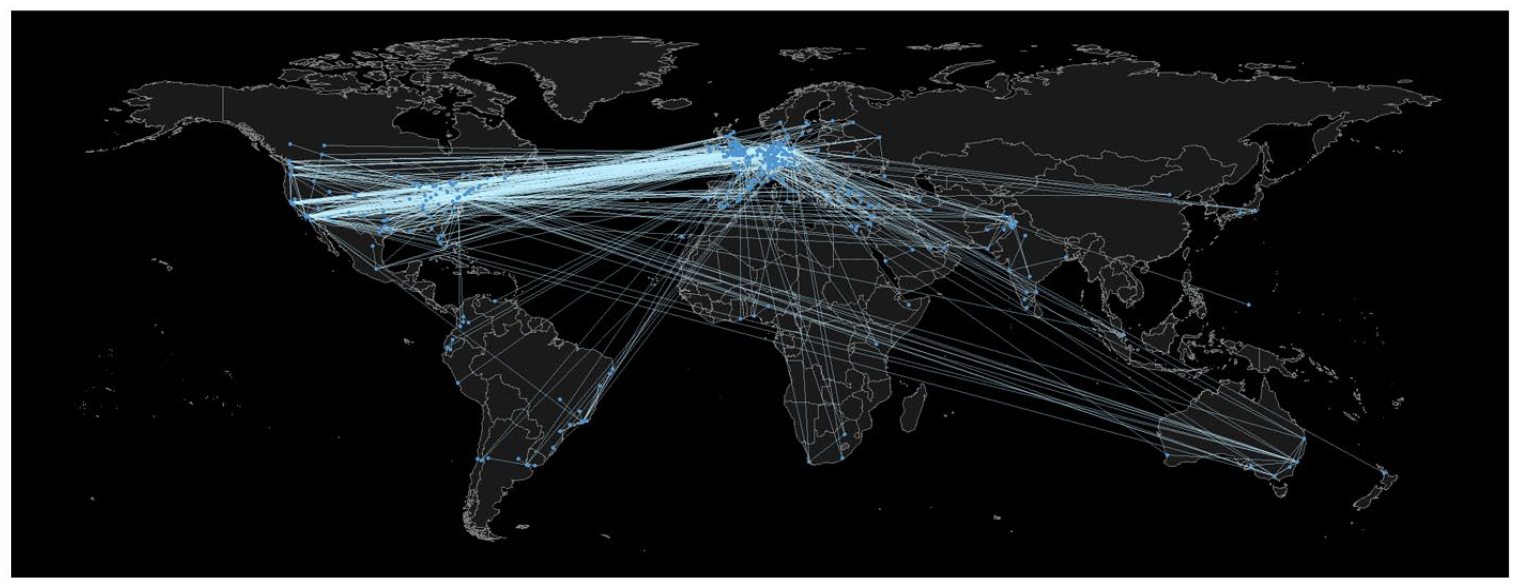
Geographical network of communicative ties in the Berlin Twittersphere.
Description of the whole network.
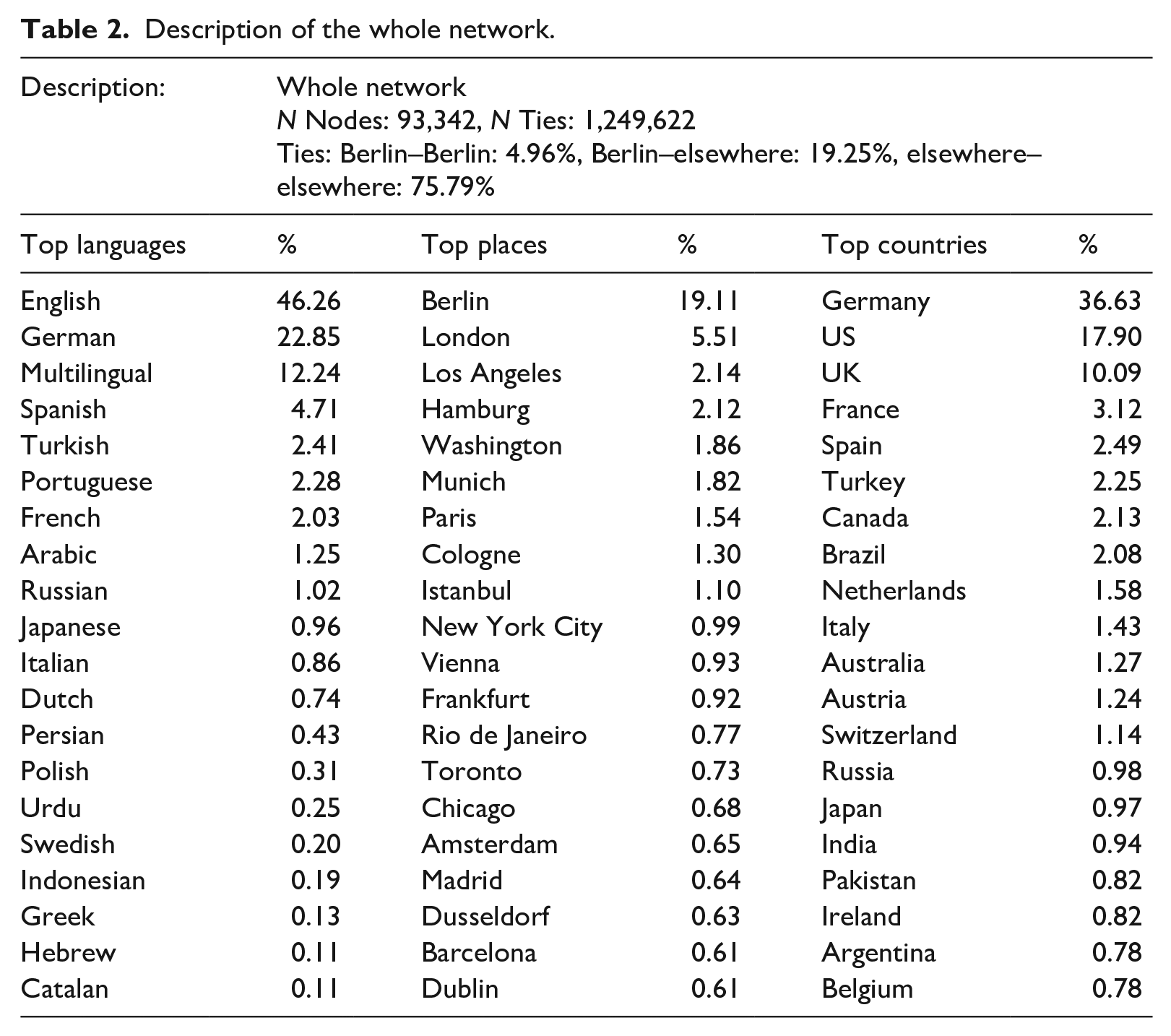
The network features both proximity and distance. More than one-third of all users are located in Germany, and 6 of the 20 most prominent places are large German cities, pointing to the continued structuring role of the national territory surrounding Berlin. At the same time, almost two-thirds of users who interact with Berliners are located outside this national territory. Both the network visualization and the lists of top places and countries show specific spatial patterns within this de-territorialized component of the urban Twittersphere.
One feature is the strong transatlantic connection between Berlin and cities in North America. Almost 18% of users are located in the United States (US), with an additional 2% in Canada. This is also mirrored in five North American metropolises among the list of top places. Second, a broader Anglophone connection structures the network with English as the dominant language of connected accounts. Moreover, the United Kingdom (UK), Australia, and Ireland feature prominently in the list of top places. Third, even when ties extend beyond the national territory of Germany, geographic proximity structures the network, with eight of the top cities located outside Germany, but within Europe. Finally, even though the network is clearly structured by territoriality, transatlantic connections, and proximity, it also exhibits a global reach. The network ties Berlin to places on all continents and, with relatively small shares, includes a wide range of languages and countries.
One intuitive way of thinking about the question of translocality in the network is to divide the ties into those bound to Berlin, those connecting Berliners to users elsewhere, and those excluding Berlin altogether. The respective values are listed at the top of Table 2. The analysis shows that only a small minority (5%) of ties connect Berliners to one another. Conversely, 19% of ties connect Berliners to users located elsewhere in the world. Finally
Beyond this classification of three types of ties, we can assess network translocality by investigating the geographical distances covered by communicative connections. Figure 2 shows a plot of the frequency with which ties reaching out from Berlin cover specific distances. It clearly illustrates that, while most ties are translocal, geographic proximity plays a structuring role in these translocal connections. Most are proximate enough to connect to other German and European places. Beyond that, only smaller spikes in the frequency of tie distances become visible. These align well with places on the US East and West Coasts and highlight the strong transatlantic connection in Berlin’s Twitter communication. Moreover, the spiky nature of the plot points to the prominent role of large metropolises, including nearby places, such as Hamburg, Munich, and London, and distant ones, such as Los Angeles or Washington.
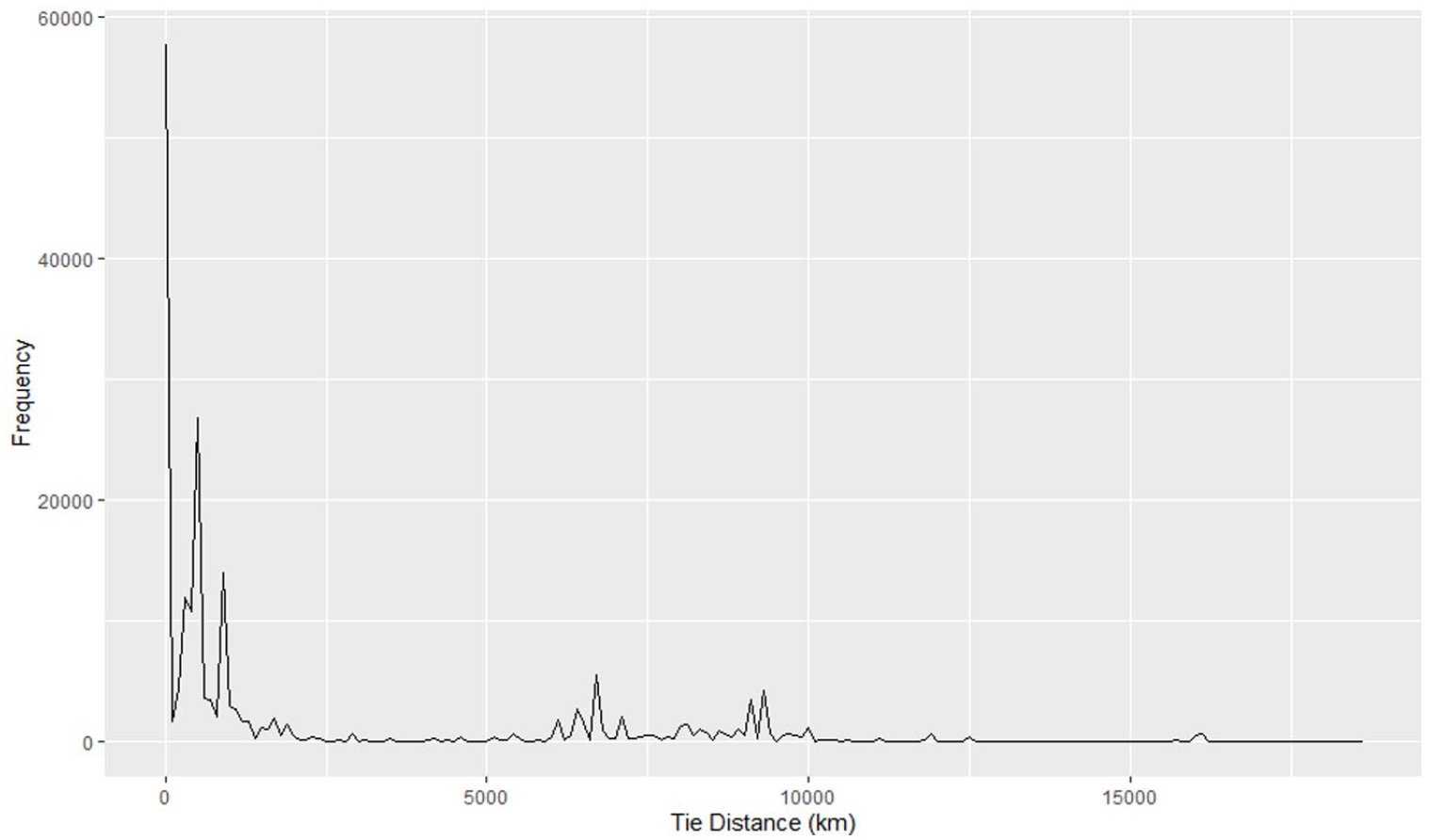
Geographic reach of ties reaching out from Berlin.
The spatiality of networked communities
RQ2 focuses on the spatial patterns of communities, that is, densely connected clusters of actors in the network. Our qualitative and explorative interpretation of the 20 largest communities led us to three spatial types of communities. We refer to these types as (1) national arrangements, (2) transatlantic translocal arrangements, and (3) far-reaching translocal arrangements. Following Hepp’s (2009) scheme, the first may be understood as instances of territorialized communities, while the latter two are de-territorialized. We will discuss the three types by presenting one illustrative example, while pointing out commonalities shared by all communities assigned to the type.
National arrangements remain strongly bound to the borders of one nation state. Overall, 12 out of 20 communities were classified as national arrangements, making it the most prevalent type. Figure 3 and Table 3 show one community, which exemplifies the features of these communicative arrangements.
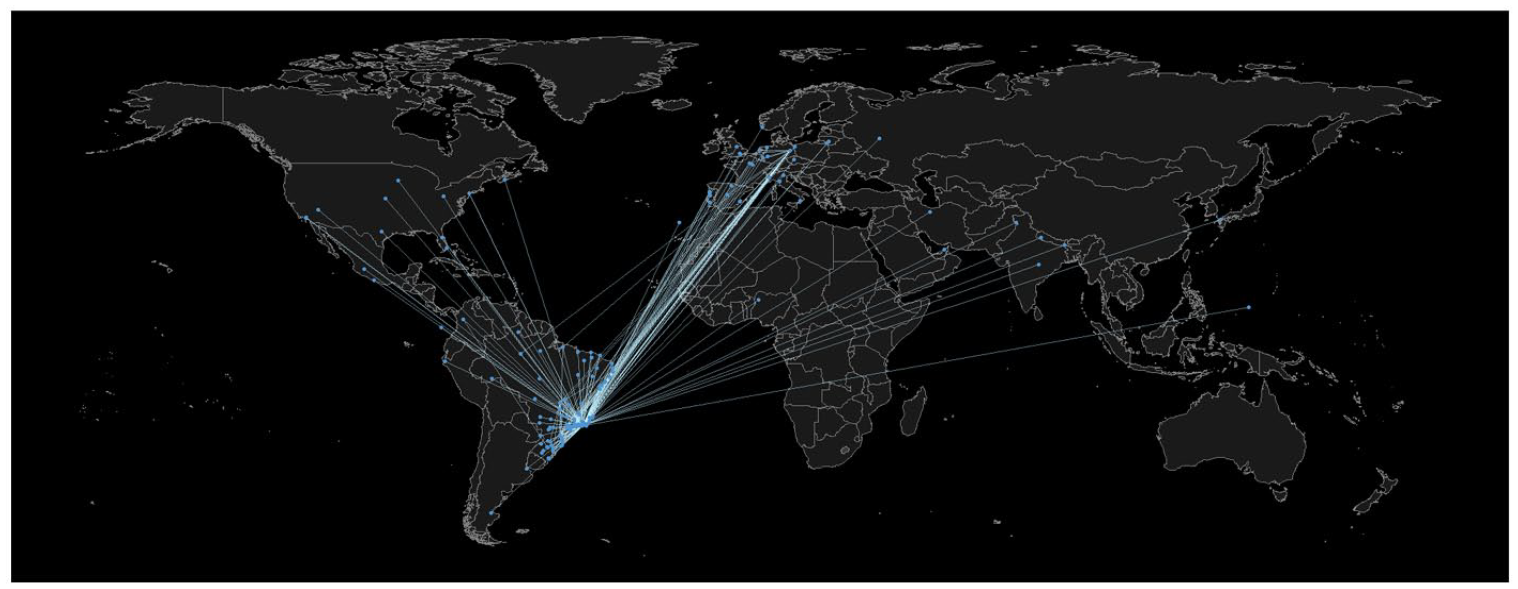
Geographical network of an exemplary national community.
Description of an exemplary national community.
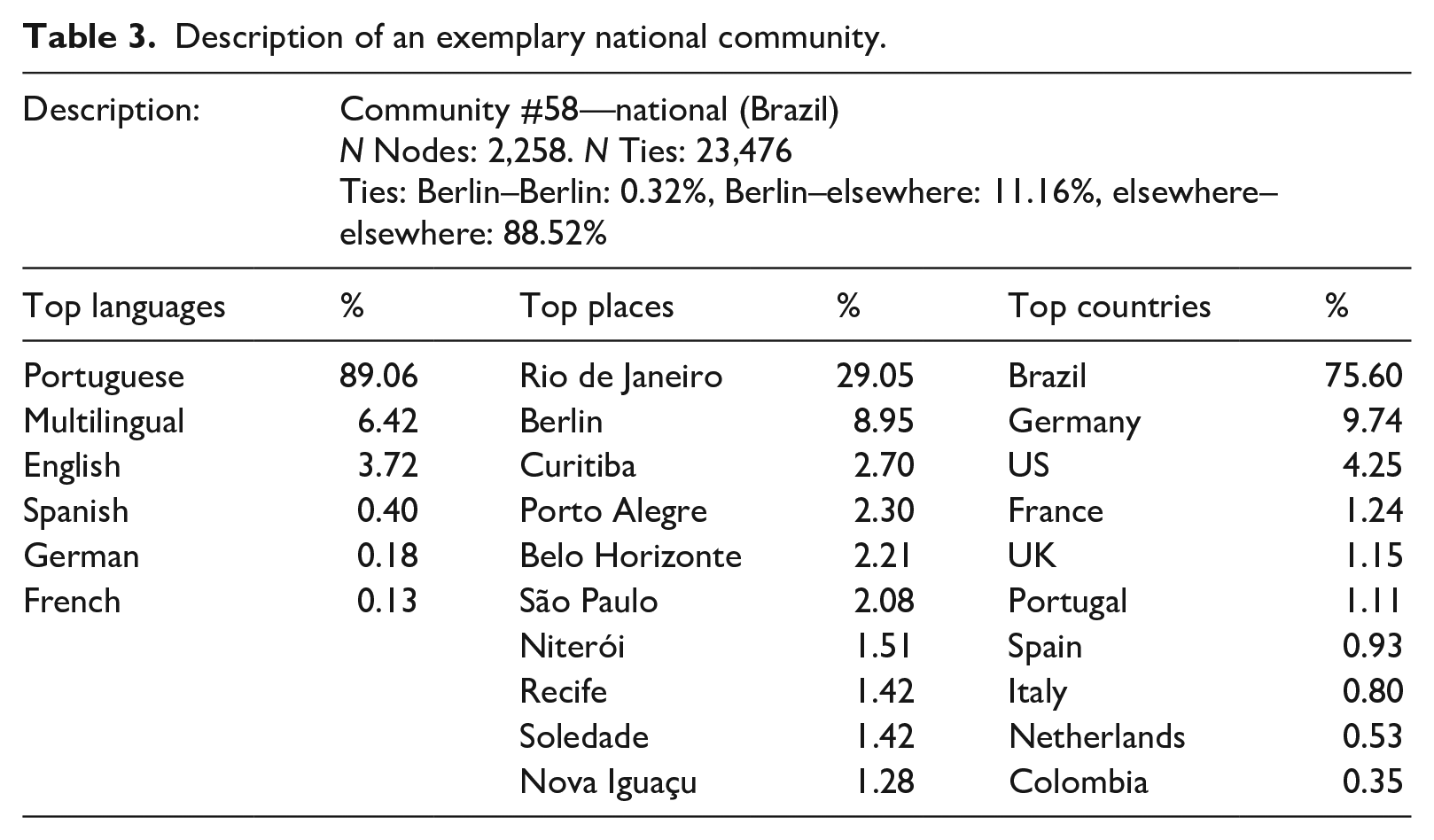
As is typical for this type of community, the vast majority of nodes are concentrated within one country, and most top places are large cities within that country. In this example, 76% of users are located in Brazil and all top places, except for Berlin, are Brazilian cities. This corresponds with a dominance of the national language. Berlin plays a relatively marginal role, with around 89% of ties not involving Berlin-based users. What is more, when ties reach out beyond the national territory, they are more likely to be rooted within the focal country than to be originating from Berlin.
Other national communities center on the US, the UK, Turkey, France, Spain, Russia, Pakistan, and the Netherlands. Moreover, there are three Germany-centric national communities. All the properties laid out above—the predominance of one country and its cities, the predominance of a national language, and the relatively marginal role of Berlin—can be generalized to this type of community. The Germany-centric communities are a slight deviation, as Berlin is very central here and in one case, English- and German-speaking users are almost equally present, pointing to the specificities of the Berlin-rooted network sampling approach.
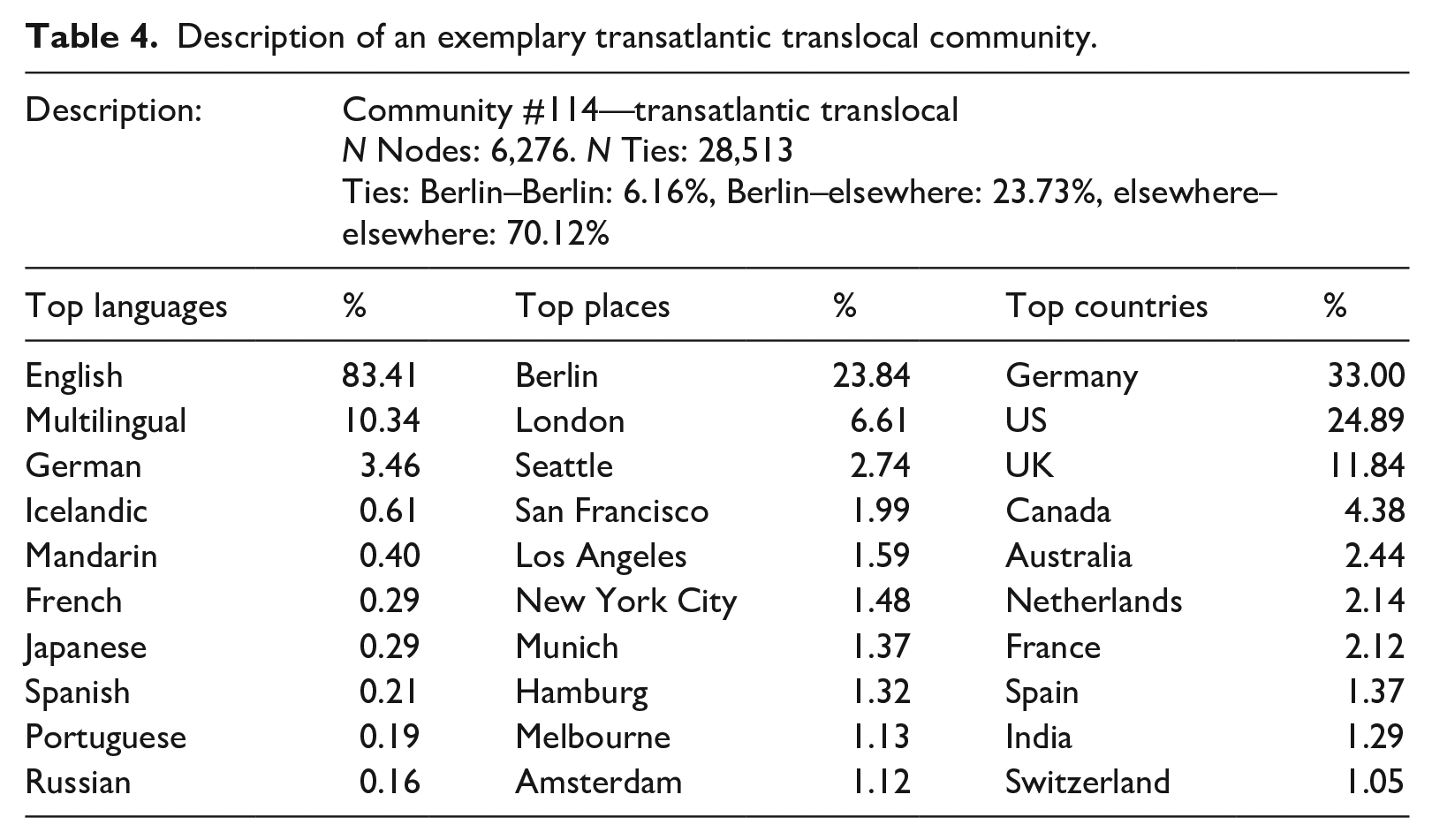
While national communities are clearly territorially structured, the second type of community is more geographically de-territorialized. It reflects the dominant role of the Berlin–North America connection in the overall network. Six communities were classified as transatlantic translocal. Figure 4 and Table 4 show one example. Like all communities of this type, it is dominated by users located in cities within Germany, the US, and the UK. English is the dominant language for this type of communicative arrangement. Unlike the national communities related to the US and the UK, Berlin plays an important role in the communicative connections tying these communities together. In this example, 6% of ties connect Berliners and 24% reach out from Berlin to elsewhere. Beyond the three most dominant countries being Germany, the US, and the UK, some differences emerge within the type. While most communities feature other European countries and places as well, one prominently includes places all over the African continent.
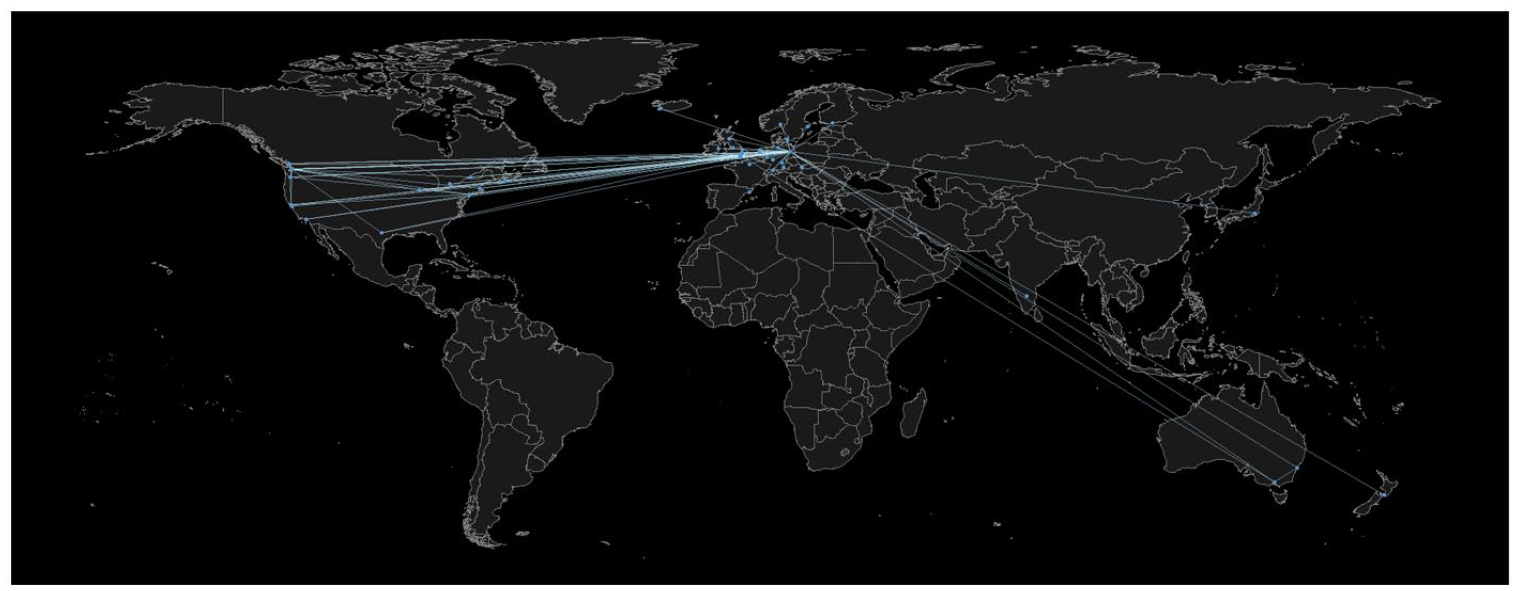
Geographical network of an exemplary transatlantic translocal community.
Description of an exemplary transatlantic translocal community.
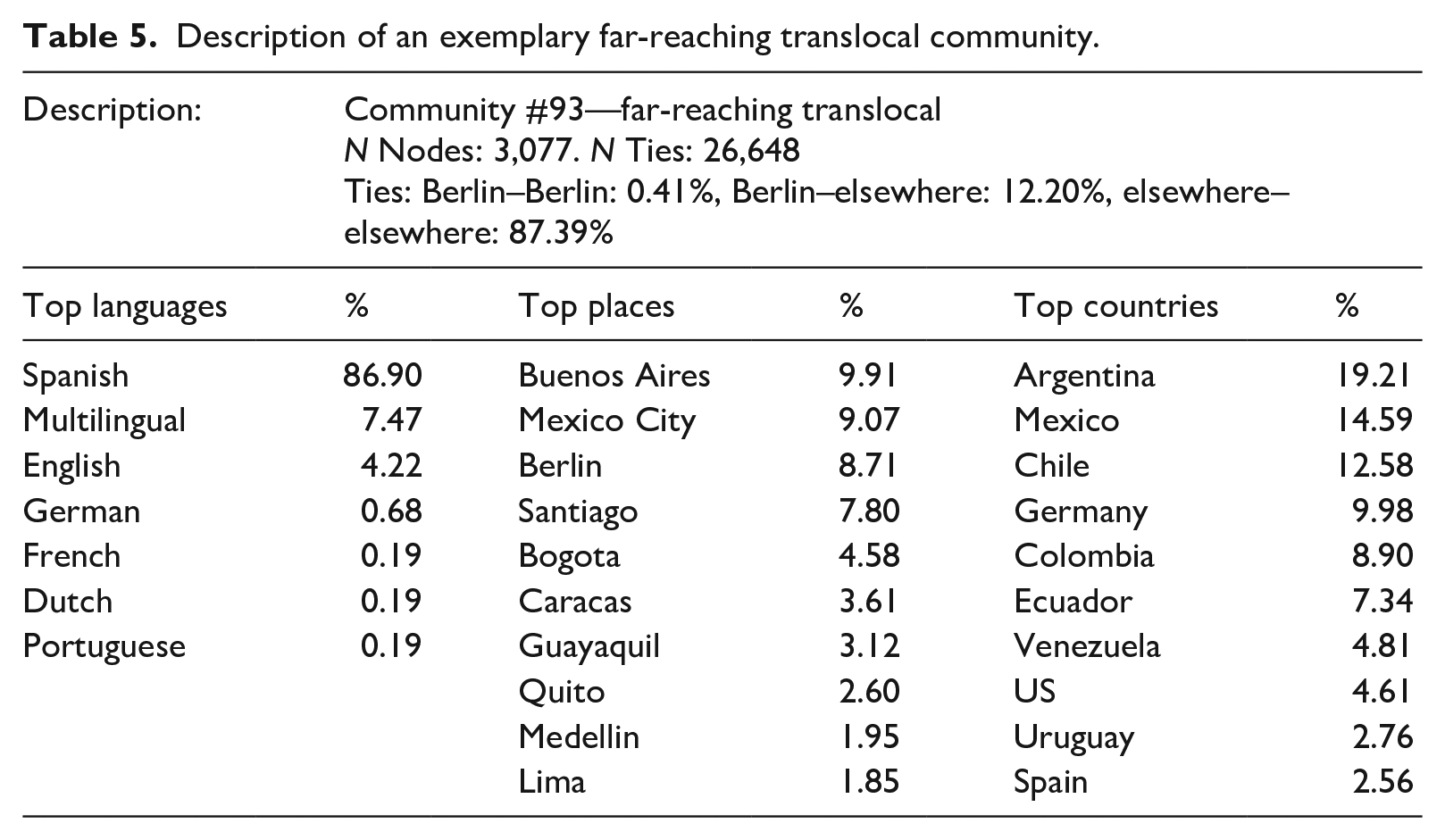
Finally, two communities were classified as far-reaching translocal arrangements. Both cover large world regions. Figure 5 and Table 5 show one example of such a far-reaching community. It connects places all across South America, including in Argentina, Mexico, Chile, and Columbia, and is dominated by Spanish-speaking users (87%). Compared to the transatlantic arrangements, Berlin plays a marginal role. The second far-reaching translocal community is dominated by Arabic-speaking users and covers countries across the Arabian Peninsula and North Africa, prominently including Egypt and Saudi Arabia.
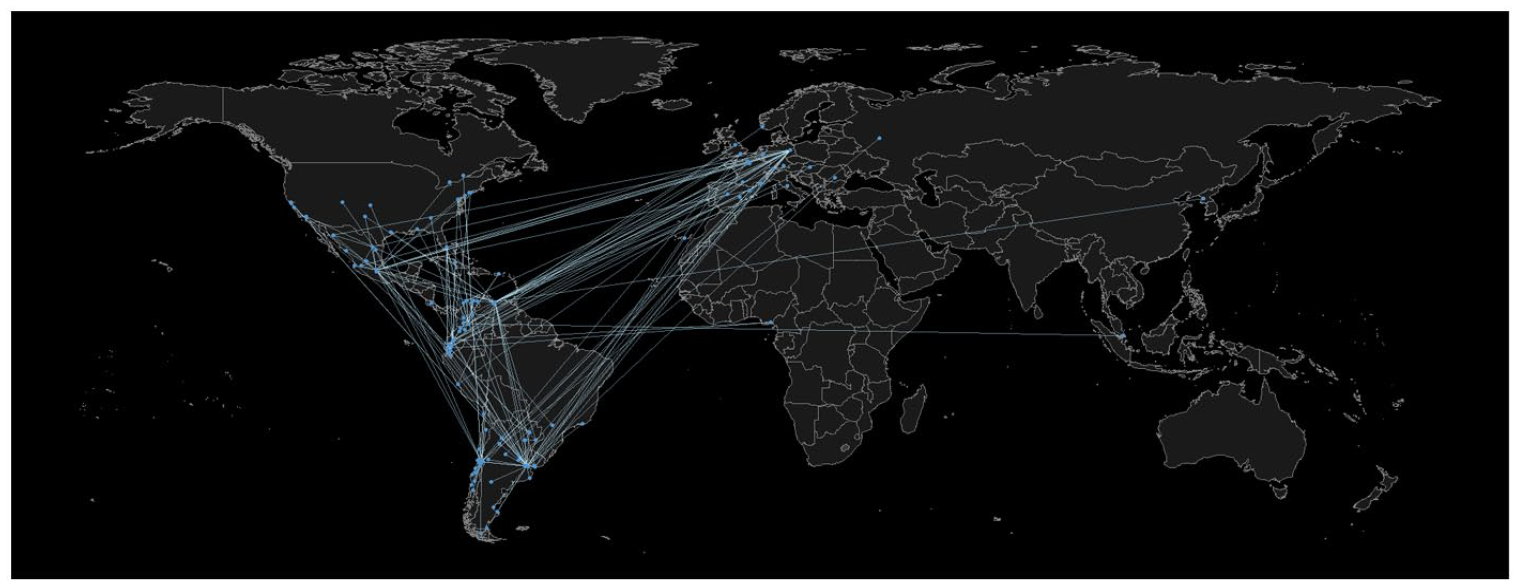
Geographical network of an exemplary far-reaching translocal community.
Description of an exemplary far-reaching translocal community.
Altogether, the community analysis shows a variegated spatial structure of different, densely connected parts of the network. While territories still play a clear role in structuring user connections in some parts of the network, other de-territorialized and spatially distributed arrangements can also be found.
Discussion
In this article, we develop a theoretical framework for the analysis of spatial arrangements of networked public spheres. We draw on a relational concept of space which in our view matches better with the networked and translocal character of digital public spheres than the territorial notions of public spheres still prevailing in communication research. Specifically, following Löw’s (2016) understanding of space as emerging from the spacing and synthesis of placed entities, we infer places and the relations between them as the two core dimensions for the spatial analysis of public spheres. Connecting these dimensions with Adams and Jansson’s (2012) terms of communication geography, we distinguish four main perspectives for the spatial analysis of public spheres: the places where speakers are located (textures), the networks between them (structures), the place-naming in public discourse (representations), and the discursive linking of places (connections).
In our empirical case study, we demonstrate how we can employ this theoretical framework to analyze the spatial arrangements of actors in networked public spheres. Using the example of the interaction network emerging from the Berlin Twittersphere, we study the places where actors are located and the structures of translocal relations between them. We find the network to be structured by proximity, language, transatlantic connections, and metropolitan centers
While the bulk of interactions remain in closer proximity to Berlin, at least some connections reach out to all parts of the world with metropolitan hubs generating spikes of interactions—indications of the space of flows and the global public sphere that Castells (1996, 2008) envisioned. Not all places are connected equally, revealing existing power geometries (Massey, 1994). For example, the most dominant feature of the overall network is the strong transatlantic connection between Northern European and North American cities. Berliners turn toward the US as a political, economic, and cultural superpower, thus ensuring its dominant role is replicated in the Twittersphere. To the contrary, places in the Global South and rural places all over the world are much less tied into the network, because Berliners rarely reach out to them. Structures of spatial power and marginality, which align with historical trajectories of local exploitation, are thus mirrored digitally.
The network is also highly clustered, and it is clear that different commonalities guide the formation of translocal communities and their spatial arrangements. Some highlight the ease with which geographical distances and geopolitical boundaries can be crossed in digital media, forming transatlantic or far-reaching translocal arrangements and de-territorialized communities. However, shared language is an underlying feature of most communities and many continue to be territorialized around nation-states (Hepp, 2009).
Thus, we find evidence for both de-territorialization and territorialization in the same network. This shows that despite digital transborder communication, a territorial logic continues to be relevant in structuring the particular spatial arrangements of networked public spheres. Löw’s (2016) relational concept of space allows us to grasp exactly this simultaneity and diversity of spatial arrangements. From this perspective, the overlaps and tensions between different spatial logics (such as territory vs deterritorialization) are not only central features of networked public spheres, but more general manifestations of an ongoing process of spatial refiguration in contemporary societies (Knoblauch and Löw, 2020).
Our empirical findings highlight the prevalence of translocality in networked public spheres. We did not find a single community bound to Berlin as the original place of our data collection, but we found several national communities where ties to Berlin played only a minor role. While proximity plays a role in the overall spatial pattern of the Berlin Twittersphere, it is not the central glue holding together the communities in the network, which corroborates earlier findings on digital communities on Twitter (e.g. Gruzd et al., 2011). At a closer look, however, these patterns are very context-specific. The relevance of national communities in the network, for example, a Turkish national community, indicates that the place of Berlin as the starting point of the network matters for configuring its structure. Of course, to find out what common interests and shared identities hold these translocal communities together, we would need content analyses of the tweets, complemented by in-depth, qualitative case studies.
There are several further limitations to our empirical study: first, while Twitter exhibits central affordances of social media platforms, the spatial arrangements of different platforms warrant investigation. Second, our study is also limited with regard to its temporal context. The network we collected is based on the cross-sectional analysis of Twitter communication in a limited time frame. We do not know how ephemeral or stable spatial arrangements are. Third, we included only users for whom a location at the city level could be extracted. We do not suspect any systematic biases. However, we cannot rule out the possibility that users from some places may be more likely to report their locations or that users with a profile location may form different communicative ties than those without.
Finally, our findings are limited and specific to the structural features of the actor network of Berlin’s translocal Twittersphere. While some structural features such as the role of proximity, language, and metropolitan centers might be generalized to other contexts, the specific types of translocal communities might vary. This calls for further empirical studies of translocal public spheres in different cities of the world. Future studies should also extend the focus to the discursive dimension of space in public spheres, that is, the representations and connections of places in public discourses.
Footnotes
Declaration of conflicting interests
The author(s) declared no potential conflicts of interest with respect to the research, authorship, and/or publication of this article.
Funding
The author(s) disclosed receipt of the following financial support for the research, authorship, and/or publication of this article: Deutsche Forschungsgemeinschaft (DFG, German Research Foundation) under grant project number 290045248—SFB 1265.
