




Abstract
Despite the numerous projects and exhibitions dedicated to technology and Internet infrastructure, “Data Center Studies” has not yet fully grappled with art’s role in the wider intervention critical scholarship is making via the data center—as object, cultural image, sociotechnical imaginary, site, metaphor, and concept. In this article, I weave in artworks and insights from artists to make a theoretical intervention about what constitutes environmental media “in the cloud,” and how a critique of Internet infrastructure has spurred a critical data center art movement.
Data Center Studies is now a vibrant subset of Critical Infrastructure Studies, as established by interdisciplinary scholars Lisa Parks and Nicole Starosielski (2015) in Signal Traffic: Critical Studies of Media Infrastructures, John Durham Peters’ (2015) The Marvelous Clouds: Toward a Philosophy of Elemental Media, and others. 2015–2016 seems like a culminating moment for data center-specific scholarship becoming an object of inquiry across the humanities and social sciences. I was personally awakened to the topic of data centers in 2012 by an article in The New York Times: “Power, Pollution and the Internet” by James Glantz (2012). This article warned that, not only was our data not ephemeral—as we shifted from external hard drives to online storage services 1 —but that containing its growth was costly in terms of land, energy, and water. 2 I build a case for understanding Data Center Studies, or, better yet, Critical Data Center Studies as a subset of Critical Infrastructure Studies on the basis of the insights that have emerged specifically from this site of inquiry; the data center, unlike related but distinct studies of the cloud, has focused on material impacts, which are in turn environmental, political and social. In this article, I am making the argument that the data center is an important enough node in the overall infrastructure of the Internet to warrant its own subfield title, and that much of that significance is due to the journalistic and artistic interventions done alongside scholarship.
In my own work about the data center, I never set out to confirm, measure, or tally their environmental impacts (or those of Internet infrastructure more generally), as engineers might. 3 Instead, I began to examine the conceptual and political relationships between “the environment” and data centers. Over time, and as I became Director of the Environmental Media Lab (EML) at the University of Calgary in 2019, I worked to expand the definition of “environmental,” away from simple binaries like human/machine, nature/nurture, or technology/wilderness, toward a framework for analysis that showed that everything has, and is, a complex environment that requires being situated within existing social anxieties and systems. Specific to data centers, I have also tried to understand the environment beyond extractivist modes of thinking, in relation to particular infrastructural sites; for example, in the heart of cities like Chicago (US), or more remotely in near-Arctic places like Luleå (Sweden), or never built/only imagined, like Ballangen’s (Norway) Kolos (Moss, 2021). I spent years traveling, interviewing data-center managers and people in adjacent industries to make my contributions to the field(s) of Media and Communication Studies—especially to engage critically with and within Media Studies—that focus on expanding the idea of “Environmental Media” (environmentalmedialab.com). “Environmental Media,” not unlike “Energy Humanities” (for example), brings together traditionally disparate sites of inquiry that coalesce around urgent, usually expansive and previously overlooked objects, sites, texts, and metaphors. Data centers are all of these things. “Environmental Media,” however, also circulates widely without the expected “Studies” attached to it (like “Environmental Studies”), which means that like “Elemental Media” or “Ecomedia” (as close comparisons), it has no specific theories, approaches, or frameworks associated with it: when I look at data centers tucked away in old factories, underwater, or designed as icebergs, for example, I consider the media as environment, and vice versa.
Again, having closely tracked the industry’s discourse for almost a decade, I am also making the case that “Data Center Studies” is now a strong subset of “Critical Infrastructure Studies,” generated by interdisciplinary scholars, journalists and artists. Of particular interest here are the contributions of artists in the making of “Critical Data Center Art,” arguably an important component of scholarly work as well, that has not yet been fully explored or integrated into media analyses. Journalistic takes have greatly impacted scholars’ understanding and conception of data centers, including my own. They have also influenced artworks, and often overlap with what many of us would see as an artistic intervention. Each artwork focused on here specifically exemplifies “environmental media.”
For the purposes of this article, it has not been so important to hardline the distinctions between art, journalism, and academia, while centering artworks that bring into relief things not dealt with within documentary forms. There are too many examples to list entirely; however, much credit goes to Ingrid Burrington’s (2015) series about Internet infrastructure in The Atlantic, and her insights elsewhere. As both an artist and journalist, Burrington drew our attention to the way subsidies, low rent, property tax exemptions and cheap electricity are primary motivators when companies decide where to build their data centers. Andrew Blum’s (2012) journalistic quest to locate and document the Internet’s physical infrastructure gave us Tubes: A Journey to the Center of the Internet—another important early voice on this topic. Recently, author and technologist James Bridle (2020) wrote and presented a half-hour documentary for BBC Radio 4 called “Under the Cloud,” revisiting the illusory place-less-ness of data transmission and storage. There are also industry-tracking sites dedicated to data centers, with www.datacenterknowledge.com and datacenterfrontier.com being most popular, both founded and edited by Rich Miller. An industry-focused podcast called “I Love Data Centers” features interviews with those “advising the data driven economy.” 4 There are also numerous pop culture representations of data centers in books, television, and film—from The Matrix to David Eggers’ The Circle, to James Bond Skyfall and many more in recent decades. So, while these formats arguably have an artistic component, I center artists who have a dedicated art practice and use data centers as their site of environmental critique.
I propose that with increased exposure and attention, art might be woven into scholarly arguments as scholarly arguments seem to be woven into the art. Despite the numerous projects and exhibitions dedicated to technology and Internet infrastructure, I have observed that Data Center Studies has not yet fully grappled with art’s role in the wider intervention critical scholarship is making via the data center—as object, cultural image, sociotechnical imaginary, site, metaphor, and concept. For my purposes here, I am interested in putting artworks and artists in direct and critical conversations with scholarly literature on data centers. To do this, I weave in artworks, as well as insights from artists, into the discussion of environmental media, as opposed to using art to illustrate a particular scholarly argument. Artworks here are generative, not simply illustrative, in their contributions to the field of environmental media. I think that this methodological distinction is important for the making of the field, where art and scholarship, in their various forms and formats, are working in tandem. In writing about data center art here, I am not focusing specifically on aesthetics, but rather with art objects as creative and generative interventions into Internet histories and contexts. The artworks I bring forward here in this manner are those that intervene in “environmental” questions and that speak to (or counter) much of what we engage with as critics who use data centers as sites of inquiry. 5 Specifically, I use these artworks, and conversations with artists about their works, to make a theoretical intervention about what constitutes environmental media “in the cloud,” and how a critique of Internet infrastructure has spurred critical data center art.
For this piece, I worked closely with PhD student Crystal Chokshi, in conversation with some of the artists discussed and quoted in this piece. For a future EML exhibit about data centers, we had artists think about their interventions’ significance, in relation to the growing context of data centers, as an object of critical inquiry. 6 Their insights are contextualized here. I also drew from networks of artists alerting me to each other’s works, and am grateful for this collaboration. I was not able to include and discuss all works suggested to me, but I provide a loose (and ideally ongoing) chronology of data center artworks at criticalstudiesofthe.cloud. I hope this serves future research.
Data center exposé
When I began tracking and collecting data center artworks for this article, filmmaker Alex Tyson shared with me a short educational documentary “on the hidden natural resources needed for us to work from home amidst the COVID pandemic and beyond.” Called “Material Zoom—The Hidden Elements of Working from Home Amidst COVID” (Tyson, 2020), the documentary was produced by International Resource Panel member Saleem Ali, directed by Tyson, and posted on the UN Environment Programme YouTube channel. The film depicted the Internet as a tool and technology that we rely on, one that ultimately saves us from harsher (climate) realities. We might wonder, in these pandemic times: Where would we be without the Internet? How have we coped so far with such global anxieties? How do our Internet infrastructures maintain and sustain a certain way of life? Who does it work for? When we ask such questions about Internet politics, we are simultaneously asking if we should maintain or enhance the superstructure, radically transform it, or abolish it. This is why questions about data centers are always already largely about the environment.
The emergent field of Data Center Studies has already generously illustrated and documented the Internet’s materialities—server racks, cables and wires, massive buildings—with a focus on corporate ownership of big data, real estate deals, and their environs. In the early 2000s, however, it was quite remarkable to hear about, and especially to see, a “data storage center.” As many of us had not yet considered data’s material storage needs and conditions, a mere photograph of a data center would put things into perspective—we would at least begin to have a sense that our data was stored in large warehouses and that data management and storage were, materially, massively intertwined industries. Ten years ago, it was also quite novel to consider the site, building, and geographical location where data were stored, when people and corporations were shifting from external hard drives to storage in the so-called “cloud.” Before “the cloud” unified global storage imaginaries, we largely thought of it in terms of third party services—a nomenclature too explicitly corporate to be good marketing. In those early days, artists were key in exposing the data center as massive data storage warehouses, which would eventually be generally understood as “the cloud.” Some artists exposed these sites poetically, and some more dramatically, by anticipating Big Tech’s brutal evolution via vast material instantiations in a time of ceaseless climate catastrophes and growing social unrest. 7
Notably, for John Gerrard, the question of visibility of data centers became a question of access to those sites. Gerrard’s (2015) “Farm” was an exposé of this sort. With two works created in 2008, “Grow Finish Unit (near Elkhart, Kansas)” and “Grow Finish Unit (Eva, Oklahoma),” Gerrard produced a detailed photographic survey of a Google data server building in Pryor Creek, Oklahoma (US)—shot from a helicopter. Gerrard calls his work “simulation.” The work started with a photographic survey, but then the thousands of photographs were fed to a game engine, and in essence he and his team rebuilt the site as a 3D virtual model/simulation. Speaking to the EML, Gerrard (29 October 2020, Interview. Conducted by the EML) reflects on this work:
The term “the cloud” has been really scrutinized since then, but suddenly it was revealed that the cloud were these squat buildings in Iowa and Oklahoma. And it just struck me as very interesting that they’re data farms. [. . .] With Google more so than the Grow Finish Units, there’s an ambiguity to the idea of the farm, because what’s being consumed, who’s consuming it? They’ve got the bodies of the servers that are both feeding the public, so it’s a feeder, but also a consumer, because you’ve got Google training its mainframes for its AI embellishments. It is selling. All of this information is becoming more visible, but at one point, Google’s function as an advertising entity was really less visible.
Reviewing Gerrard’s work, Adam Kleinman (2015) writes, “the work not only speaks about computing, it is computing itself”—“Farm,” a simulation using real-time algorithmically- generated computer graphics, relied on a mix of military and gaming tools. I am interested in Gerrard’s inspiration, which came from Google’s refusing him access to their data center, while Google itself is heavily invested in surveilling its users. These kinds of problems are common, providing endless fodder for scholars and artists working to dismantle (the logics of) surveillance capitalism (Zuboff, 2019). The idea that by mapping infrastructure, surveillance of users could be thwarted, is something that artists explored at the time of emerging giants like Google, Facebook and Amazon. The idea was to flip the gaze onto Big Tech.
While many works came before and after hers, Ingrid Burrington’s (2016) Networks Of New York: An Illustrated Field Guide To Urban Internet Infrastructure was a landmark project for those interested in Internet infrastructure. The book showed markings, usually spray painted on the ground or walls or buildings in NYC, which made the invisible visible through a decoding of infrastructural markers. Speaking with the EML in 2020, Burrington conceptualizes this work simply, saying: “it’s a way of further situating facts about a place.” Burrington (13 August 2020, Interview. Conducted by the EML) has a long-standing interest in maps, and her work was informed by the urge to locate and “reconnect digital spaces to physical spaces or mapping digital community onto physical reality.” This set her on the path to mapping infrastructure. Burrington’s (13 August 2020, Interview. Conducted by the EML) ongoing work stems from a need to recognize that “things are spatially situated and rooted in places, and that shapes them, and it shapes the place in this sort of relationship,” and in turn, recognizing power and power systems that become a kind of “aggressive optimization” by large computational networks and systems onto our lived experiences. But the means and maintenance of the Internet remain somewhat invisible. As she suggests, we trust that it’s being taken care of (by a general somebody) and that the infrastructure makes sense and runs itself. Her work also shows that the Internet is not a public resource; it’s privately run and owned. She reflects on Robert Smithson’s “A Tour of the Monuments of Passaic, New Jersey” (Holt/Smithson Foundation, 2023):
I think about Smithson’s essay [. . .] where he takes the bus to New Jersey and he walks around and he writes about these construction sites as though they’re classical Roman architecture or something. He describes it as the future ruins of this place. [. . .] That was a period where there were a lot of new infrastructural developments specifically around ruins and highways happening. The things that become part of a vernacular of a landscape I think are really interesting. Again, it’s another thing that’s sort of designed to be ignored or seen as deliberately unremarkable. (Burrington, 13 August 2020, Interview. Conducted by the EML
Burrington connects this desire to document the mundane with today’s data center landscape—most are deliberately designed to be unnoticeable. While not invisible per se, the attempt to obscure things is obvious, whether using landscape to hide the buildings, or deploying boring aesthetics or no signage. “I think that the unremarkable quality of many data centres” Burrington (13 August 2020, Interview. Conducted by the EML) suggests, “is generally how things fade into the background and how power fades itself into the background.”
In 2014, Amber Frid-Jimenez, Ben Dalton, Joe Dahmen, and Tim Waters launched “The New Cloud Atlas,” expanding mapping to include the global Internet infrastructure’s material and operational components, saying these should be observed, documented and rendered for everyone to see, analyze, and critique. Thus, they offer a map of connectivity, calling for accountability and openness (by using OpenStreetMap and the Open Data Commons Open Database Licence). In this same vein, Ryan S. Jeffery and Boaz Levin’s (2016) “All That Is Solid Melts Into Data” is a documentary video tracing developments of structures that make up “the cloud”—again exposing vast material repositories for digital data. This documentary uses materiality to interrogate structures of power that have developed from technologies of global computation. Similarly, Evan Roth set out on a pilgrimage to visit coastal sites where undersea Internet cables emerged from the waters. The trips form the basis of Roth’s (2017) project, “Landscapes”, a series of videos and sculptures grappling with the fast-changing concept of being, in time and space. This interest in Internet cable landing sites was brought into academic focus at almost the same time, with “Surfacing” (Starosielski et al., 2016), a companion piece to Starosielski’s (2015) The Undersea Network. Launched as an interactive map, “Surfacing” showed how signals travel through the undersea Internet network, from landing sites to other nodes across oceans.
Later, Trevor Paglen’s “A Study of Invisible Images” (2017) (and other projects by him) used photography to reveal the various NSA Internet cables, becoming an important commentary on tapping physical infrastructure. And recently, Kirk Gordon’s (2019) The Weight of the Cloud tracked Google, Facebook, Apple, and Amazon’s recent proliferation of data centers along the Columbia River in Washington and Oregon. Gordon says,
Part mapping, part documentary, part investigative journalism—this project tracks Big Tech’s ever expanding land grabs, juxtaposing it with historic practices of industry and expropriation in order to reveal the unsettling landscapes of corporate power quickly emerging in the region.
8
With similar motives, the artist group Annex (Sven Anderson, Alan Butler, David Capener, Donal Lally, Clare Lyster, and Fiona McDermott) is slated to curate Ireland’s pavilion for the 17th International Architecture Biennale at Venice in 2020 (postponed to 2021 due to the pandemic) with the theme “Entanglement.” The curators connect Internet infrastructure not only to the cloud metaphor, but to the cultural meanings informing it. Lally explains,
We talk of “the cloud” as almost a kind of marketing sleight of hand behind which all of these multi-scaled, geological, epistemological, phenomenological . . . all these different processes, that are all material in and of themselves, take place. We read “the cloud” as an assemblage that produces new kinds of space, new kinds of ways of being in the world. There isn’t just a technological revolution, but an ontological and philosophical revolution that changes our very state of being present in the world, and how we experience what we do in the world. (Annex, 28 September 2020, Interview. Conducted by the EML
Data center assemblages
Many artists have taken on this idea of the assemblage, and have reflected on the “new kinds of ways of being in the world” that emerge from thinking about energy and environment. For example, 2010 was the UK miners’ strike’s 25th anniversary, the year YoHa (Matsuko Yokokoji and Graham Harwood) created “Coal Fired Computers” (2010). They were asked to think about post-industrial areas in the Rhine Valley and Newcastle—both places were strongly connected to coal. YoHa was interested in “what we become when we collaborate with machines” and the “hypocrisy around the European imaging, that they were greening the environment, but in reality shifting the pollution elsewhere.” Speaking with the EML, Harwood in 2020 explains:
How we think individually or collectively with and through machines or share tasks with them is bound up in their workings and their logics, and their workings are bound up in us. So fundamentally the problem is how do we escape the notion of Technology the Enslaver / the Slave—with all the racialised otherness overtones such a reading infers. It seems to YoHa that what we need to do is see technology as human as we are. That we become a different kind of organism when we collaborate with machines.
Exploring the relationship between human and machine, Simon Denny’s “Mine” (2020)—while not specifically about data centers—explores interconnections between capitalism, exploitation, technology and environmental catastrophe. Lalla Merlin (2020) describes Denny’s work as a “theme park to extraction” of both the mineral and data kind highlighting the fact that what is being mined, or extracted, is always ultimately data. Both works reflect on the material conditions that make us aware of climate change—the tools we use to measure and contain that data also contribute to global warming. Mining specifically has become an important concept to understanding big data’s role in constructing the cloud to the scale that it is, and for future exploitation.
Good examples of this are Ivar Veermäe’s “The Flood” (2018–2019), Misho Antadze’s (2019) “The Harvest,” and Zane Griffin Talley Cooper’s (2020) “Alchemical Infrastructures: Making Blockchain in Iceland”—exploring the complex, energy-intensive practices involved in cryptocurrency, in Estonia, Georgia, and Iceland respectively. Veermäe’s three-channel installation video was shot in Estonia, juxtaposing the project’s materialities with abstract exploration of its forms. Veermäe uses footage from Estonian oil shale mines and industrial-scale cryptomines as a backdrop to 3D animations that “recall the original use of the powerful graphic cards enlisted to encrypt and decrypt currency transactions” (e-flux, 2020a). Antadze’s (2019) “The Harvest” charts technology’s cartography, ecology, and history by way of the vineyard region of Kakheti, Georgia, where wilderness and modern technological infrastructure converge. 9 Like Veermäe, Antadze homes in on blurred boundaries between material and virtual worlds (e-flux, 2020b). Both videos were available as part of “Ecology After Nature: Industries, Communities, and Environmental Memory: An online series of film programs and discussions on e-flux Video & Film” in October 2020.
Closely connected, Cooper’s (2020) “Alchemical Infrastructures” highlights the “combinatory process of infrastructures, social systems, political institutions, and desires, all intentionally brought together in search of new monetary futures—or, in other words, alchemy” (Cooper et al., 2019). One of his goals, he explained, is “to show how bitcoin, and cryptocurrency more generally, should be seen as an infrastructural problem, deeply tied to place, and specific ecological arrangements” (Cooper, 27 July, 2020, Interview. Conducted by the EML). The deep insight of “Alchemical Infrastructures” (Cooper, 2020) is that quantitative metrics aggregating emissions generally fail to provide guidance on addressing cryptocurrency’s environmental impacts. Moreover, as Cooper notes, ethnography is essential. Working on site, he can assess what people are doing, observe the processes, and get a sense of the politics at play. Cooper (27 July, 2020, Interview. Conducted by the EML) says one important revelation is how regionally situated these things are, and that “we need to lean into that situatedness.” He adds,
Only by understanding how cryptocurrency infrastructures are built and maintained at a material level can we begin to formulate possible ways forward. And this is where my framework of “infrastructural alchemy” comes in. By moving away from the idea of cryptocurrency mining as fundamentally a process of “extraction” (which, materially speaking, it’s not), I instead want to highlight all of the various social, political, and material infrastructures that must be combined and mixed together in order to produce these novel forms of value. The idea of alchemy deemphasizes the bitcoin itself, moving the focus onto the peripheral processes on which it is dependent. (Cooper, 27 July, 2020, Interview. Conducted by the EML
Cooper draws our attention to the fact that if Bitcoin mining continues using its current energy sources, it alone will push the planet over the two degree warming mark (Mora et al., 2018). This energy suck is partly due to the practice’s complicated infrastructure, as Cooper (27 July, 2020, Interview. Conducted by the EML) explains:
You have the cryptocurrency and then you have the machines that are working to mine it, but then you also have these people that are maintaining these machines. I started learning about all these different negotiations that have to go on between them. If you’re a cryptocurrency miner, the first thing that you have to do is you have to go into a location, and you have to negotiate energy access from the political body or a corporate body. There’s all these sorts of complicated layers of action and choices and agency that are happening, in order to sustain this one process.
Cooper also uses this work to suggest that art can better illustrate these sites’ socio-material effects, rather than more traditional academic articles and monographs. Adopting a spherical canvas and virtual reality (VR) cameras for his project, Cooper (27 July, 2020, Interview. Conducted by the EML) reflects:
I started thinking about Susan Leigh Star,
10
who wrote all about infrastructure, about infrastructure being naturally multi-sited. An infrastructure is never singular. You can’t see just one. No, it’s always multiple places. You can never know it completely. But I thought that VR might be a really cool way to visualize infrastructural entanglement, and to see the ways in which different spaces act on each other. And to communicate that to a viewer in a way that writing just a lot of times can’t.
Cooper explains that VR allows the viewer to be in the midst of a process rather than a space—spaces are “painted” with the gaze. Importantly, Cooper sees the spaces that make the logics of technology, and exposes those baked into the code. As a documentarian-researcher, he addresses the dearth of ethnographic work on the topic, and observes on-the-ground practices, which remain largely unknown.
Through cloud mapping and an exploration of data mining, more insights into the tangible, material and infrastructural nature of data centers became available. As sites that could be located, artists and scholars alike began to intervene directly at data center sites, and some worked their way inside to explore the rows of servers as ethnographers (Image 1). 11
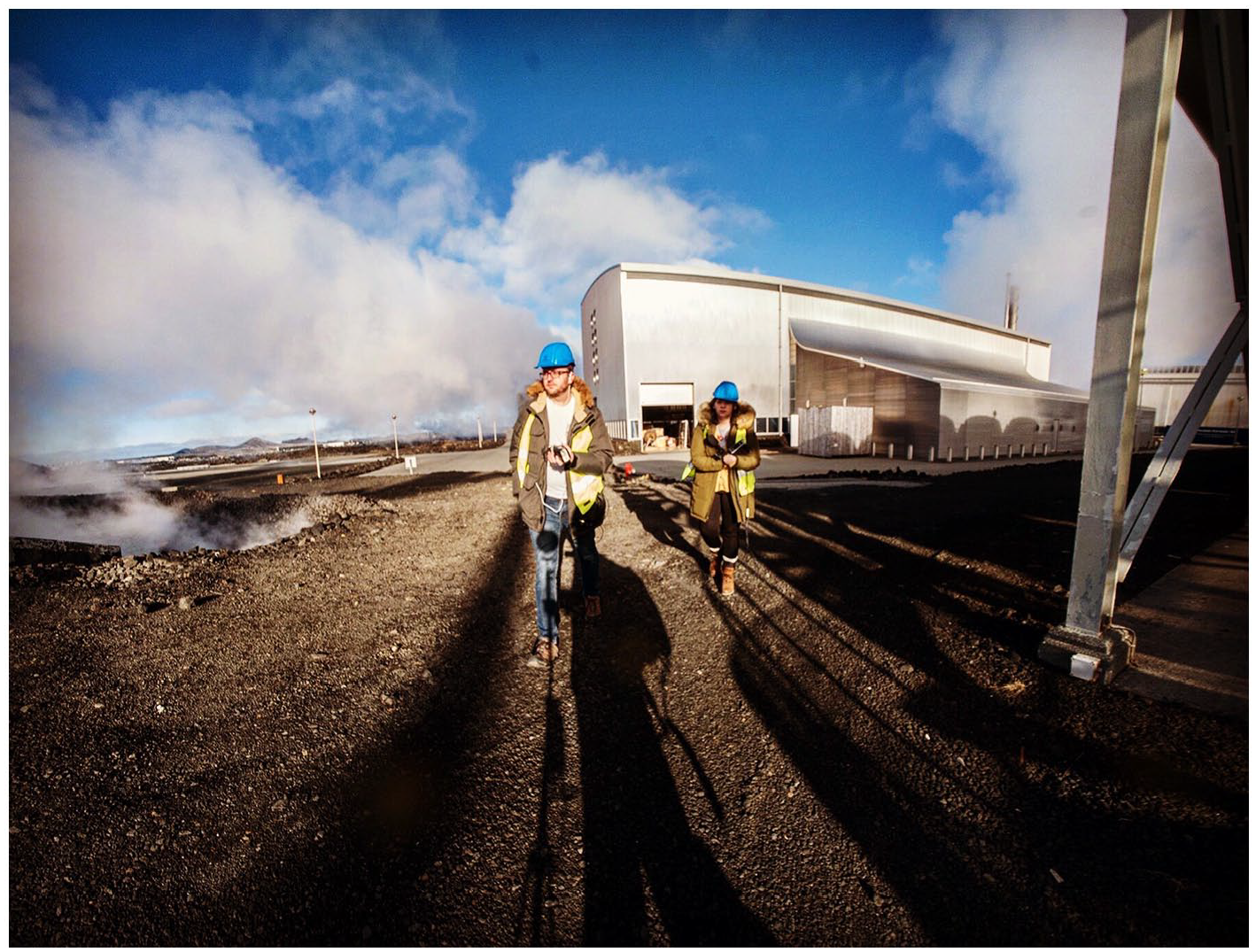
Cooper (2020) featured here, on set of “Alchemical Infrastructures”: Svartsengi Geothermal Power Plant in Grindaík, image courtesy of the artist, Zane Griffin Talley Cooper ©.
Data center remix
In 2016, IBM hired Warp Records artist Tim Exile to make music inspired by their data centers. Exile spent months live-sampling sounds and building a track for his IBM “#RemixIT” project. On his SoundCloud page he comments: “This track is made up of live performances on the Flow Machine with the sounds of cooling fans, hitting server cases and opening door latches etc. No synths or drum machines were touched in this process!” While not overtly critical of the space, this project is part of a growing body of work that sparks questions about energy and the environment, such as inadvertently making us aware of cooling and heating in the data center.
Matt Parker has long used data centers as his object of inquiry and artistic intervention. From “The Cloud Is More than Air and Water” (Parker, 2014), an installation investigating the mechanical nature and acoustic ecology of data centers and Internet storage systems, to his documentary “The People’s Cloud” (Parker, 2017), Parker draws our attention to sound in the data center, and its undergirding infrastructure (Image 2).
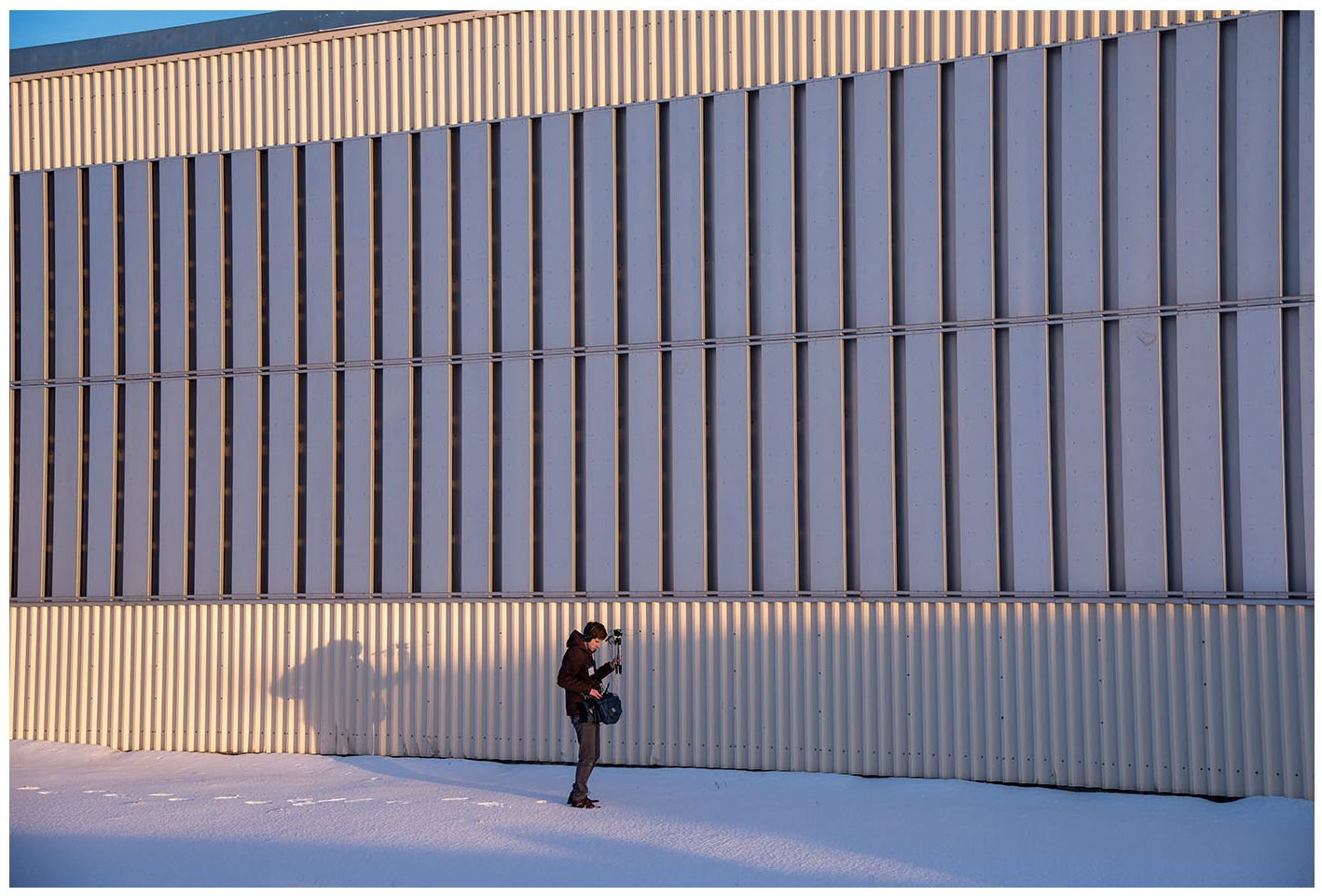
Recording audio for “The Peoples Cloud” (Parker, 2017). Photo credit Sebastien Dehesdin. Image courtesy of the artist, Matt Parker ©.
The old media song is that we notice infrastructure only when it breaks or fails, but in a July 2020 conversation with the EML, Parker shared stories recalling how the seams of media infrastructures actually always pop up in our daily experience. On holiday, he remembers his mother trying to find photos on her phone, and not finding them, deciding they were in “the cloud.” They had a short conversation about where this could be. Parker also recalls playing sick from school as a child, and going to work with his father who did installation work in the telephone exchanges. That labor—“ripping out the analog telephone exchanges of copper and replacing it with ASDL at the time” (Parker, 30 July 2020, Interview. Conducted by the EML)—left a lasting impression on Parker. He went into sound recording and remained interested in technology. Later, as an artist-scholar, he gained access to a data center partnered with the university where he was doing his master’s degree. Parker (30 July 2020, Interview. Conducted by the EML) remembers that experience vividly:
Acoustically, it’s not only terrifying—the sound is intense, which is effectively the heating ventilation and cooling systems and specifically the cooling of the fans of these individual units, miniature CPUs that make up clusters of the data centre. But also, it’s so much air being moved and transferred in that space. The sound itself is pressure. That is sound. Sound is pressure differentials in the air that affect your ear drum or your skin, your body. On top of it, it’s also like the massive pressure of the air as well. All of this air flowed around. It’s quite stifling . . . I mean, this is my feeling. One of the things that I really like about sound recording is the way you amplify your world.
Parker’s process (what he calls “sonospheric investigation”) is part of a larger subgroup of artists and practitioners focused on sound (often in addition to the visual); such as Pali Meursault and Timo Arnall. Meursault’s (2017) earlier “Datascapes” was a research project on the soundscape of data centers that he, like others, claims “remains most of the time invisible and inaccessible.”
In the early 2010s, Arnall created a “multi-screen film” about the Internet’s “invisible infrastructure,” in “Internet Machine” (2014). In conversation with the EML (Arnall, 3 August 2020, Interview. Conducted by the EML), Arnall explains how he took on the challenge of making visual the many facets of the Internet, especially those that counter the mythology of seamlessness and expose the fragile ecosystem that must be tended and intact to work as advertised. Focusing on rendering WiFi and radio-frequency identification technology and demonstrating their physicality and presence in physical space, Arnall traveled to a data center in Madrid, Spain after failing to gain access to the Luleå Facebook data center. There, constrained by the set-up of the exhibit that commissioned the work, Arnall (3 August 2020, Interview. Conducted by the EML) used a single digital single-lens reflex camera: “I arrived at this idea of taking these enormous panoramic images.” In the data center, Arnall had to pick his shots. He reflects:
There were these huge cavernous spaces that were just empty, and then there were very tight spaces filled with wires and infrastructure. And then there was all of the surrounding infrastructure like the generators and batteries and a place where the pipe came through the wall in the underground, all that kind of stuff. And I had to go and choose the spaces, and I had to choose it photographically, so I could sort of see, okay, we’re in a corridor. I can see that it’s going to be great in this installation to have these huge wires on either side of us and then the kind of perspective receding into the distance and the main screen. So I could see that it could work, but it wasn’t until post production that I actually turned it into a kind of super cinematic piece of footage. (Arnall, 3 August 2020, Interview. Conducted by the EML
Through Arnall’s description-of-process we begin to see how the data center’s image is created. Through the final cinematic experience, we are immersed in its sounds—while Arnall is a visual (not sound) artist, the project tends to be remembered for both. Interestingly, the sound quality (or element) stems from the site’s energy. As Arnall (3 August 2020, Interview. Conducted by the EML) thinks back:
What I really wanted to get across was . . . the enormous amount of power—just the lingering sense of power and energy running through this entire space. Even in the empty spaces, you can’t avoid the sound because in the walls and in the vibrations coming through from the generators below, there’s just this incredible racket humming, these kind of whining, pitching modes that interfere with each other and make patterns. And after being in there two days, my ears started . . . I don’t know whether you have that, but sometimes your ears start generating their own noises? When I went out, my ears were still . . . ringing.
Exile, Meursault, Arnall, and Parker’s works do more than point to and record sound; they seek to make things tangible through the audible. They encourage contemplation of the Internet’s materiality, its scale, how data and connectivity are managed (Images 3 and 4) . They investigate the environmental and geopolitical impact of data storage—respectively. Together, they insist the data center be made tangible, visible, and audible.
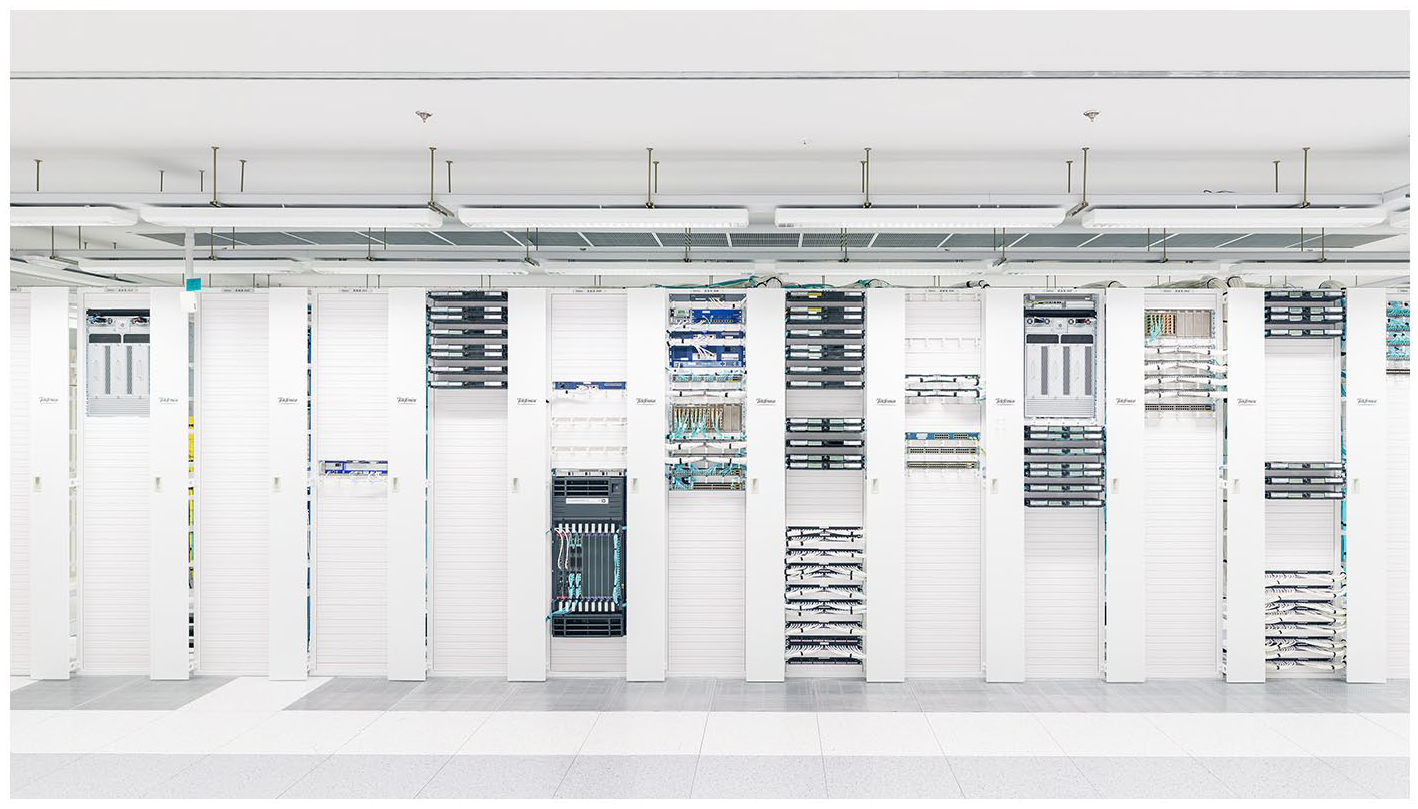
Internet Machine (7, 10), images courtesy of the artist, © Timo Arnall.
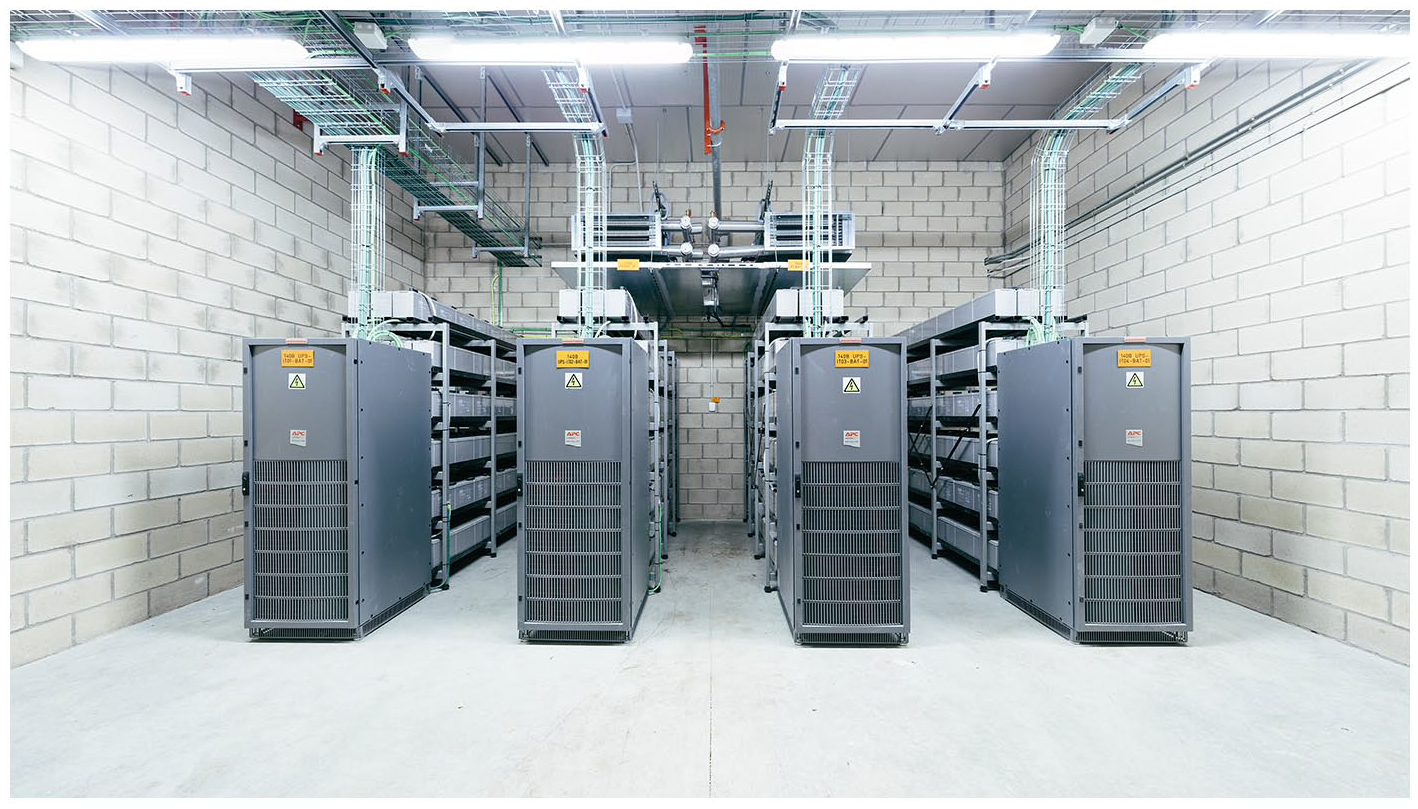
Internet Machine (7, 10), images courtesy of the artist, © Timo Arnall.
Projects have splintered from exposing the Internet’s material infrastructures to playful renditions of infrastructural affordances. A theme shared across these works is how space and time shape connectivity. Specifically, works “connecting” the data center expose cables, trays, wires and their underlying logics—what circulates in these networks, for how long and for whose sake. For example, Stéphane Degoutin and Gwenola Wagon’s (2015) “World Brain” explored “the hidden stories of data centers, animal magnetism, . . . the inner life of rats” to understand how “the planet captures itself” (Rauth, 2015)—that is, how the world increasingly looks and feels like cyberspace, a world of science fiction. In Eva Mattes & Franco Mattes’ (2019) “Personal Photographs,” a network of metallic cable trays winds through and around the exhibition site, indoors and out. The artists’ photos (in a given month) constantly circulated within the cables—without viewers, yet always there.
Data center futurities
Anxieties of constant connectivity and its consequences are explored in Samir Bhowmik’s “Circuit Breaker” (2018–2019), a networked installation drawing attention to the materialities and infrastructures of connectivity, enabled by the cloud. The project’s website (2019) says, “the Circuit Breaker is a networked participated installation that critiques the culture of constant connectivity” (Pixelache Helsinki 2019 Festival, 2019). Participants are to reflect on the “social and energetic impact” of always being connected, drawing our attention to “long-term discord to both natural ecologies and wider implications to local communities” to counter notions of the cloud as intangible, immaterial, ephemeral and ethereal. The project’s environmental agenda leaves questions:
Could artistic methods question the ubiquitousness of connectivity and address related materialities and environmental impacts? Could dis-connectivity remind us of our choices? Could it persuade us to think that every “click” has an energetic footprint and every break in the circuit saves a piece of the earth? (Bhowmik, 2019)
Similarly, the last exhibit I saw for myself—moments before the pandemic broke out in Barcelona—was Mario Santamaría’s (2020) “Unfixed Infrastructures and Rabbit Holes.” The exhibit was stunning, minimal, but complex in its conceptualization. For the EML, Santamaría clarified a few of the key components and explained its two parts:
I used three different connected routers . . . and with these machines you have the possibility to decide three points: entry point, relay, and exit. So we moved these points around the world—South America, North America, Asia, and Europe—and we pushed against the limits and protocols of time. It was a very slow connection, a rabbit hole, but actually I’m more interested in the idea of space, and moving data across the longest “route.” In the gallery space with your mobile, you can connect to this WiFI . . . the rabbit hole . . . [A]t the same time, different elements in the installation . . . are using this connectivity. And we also have the normal connection, the local connection, as well as the connection using the rabbit hole. . . . [Y]ou can see the difference between this idea of real time and real time crossing all the internet. (Santamaría, 14 September, 2020, Interview. Conducted by the EML
Materially, the exhibit consisted of a server room floor (set up to allow for cooling) and several monitors. Conceptually, it spoke to the artist’s intentions and processes. This project was built on an earlier project with data centers. In 2016, Santamaría traveled to the server that hosts his website. He followed the same path the data travels, throughout the Internet’s infrastructure, taking 14 days to complete a journey that takes data 67 milliseconds. His website works 23 hours a day, while his email account is permanently in “out of office” mode, autoreplying: “I am sleeping. I will have limited access to my e-mail during this period” (Santamaría, 14 September 2020, Interview. Conducted by the EML) (Image 5).
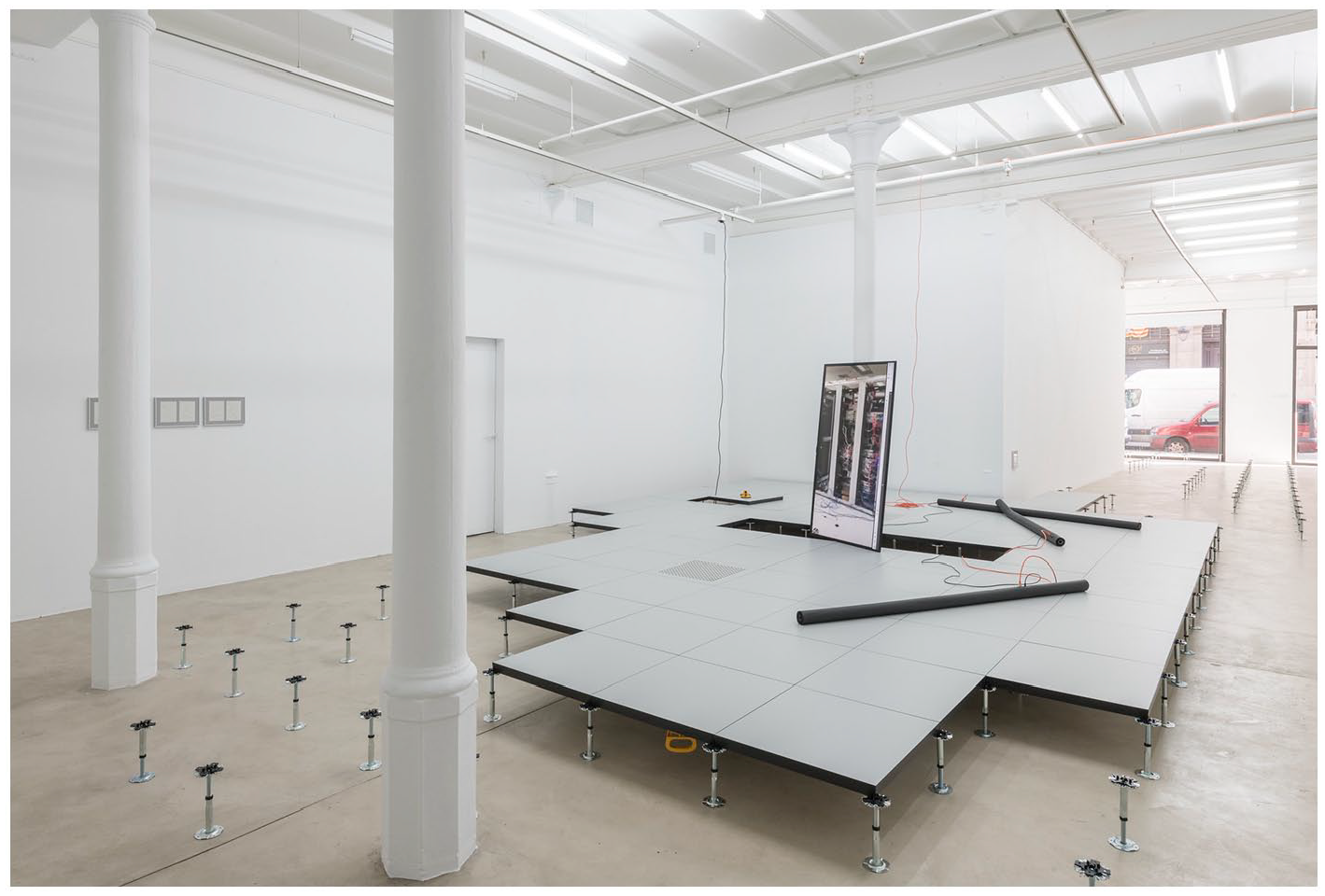
“Unfixed Infrastructures and Rabbit Holes” (Santamaría, 2020). Photography by Roberto Ruiz. Courtesy of Blueproject Foundation, and artist Mario Santamaría. ©
Artistic interventions about the data center are matching the sophistication of the new political insights garnered by years of scholarly questioning. One of the most important moves in building the field of Data Center Studies is that which disrupts and redefines environmental media. Looking at where data centers are located, mining metaphors, mapping disruptions undersea and above ground, and so on have all played a part in documenting the cloud’s materiality—and its massive impacts on water, land, air, and so on. But, more than this, it has helped us to rethink the theoretical implications of such sites, and how they alter our modes of being and living. Perhaps most illustrative of this are the two distinct works both called “Data Garden” that were launched 5 days apart. One “Data Garden” (Goni, 2020) was led by Kyriaki Goni, in Greece, and the other (ongoing as I write this) by Cyrus Clarke, Monika Seyfried, and Jeff Nivala, of the United Kingdom/United States.
12
Prior to their “Data Garden” (Clarke, 2020), Clarke et al. launched a project called “The Flowershop” (2018), a prototype for using plants as data storage based in scientific realism. On the site’s description they write:
Data Garden is a carbon negative data infrastructure that promotes unification between people, living systems and technology. [. . .] Continuing the approach of Grow Your Own Cloud, working with nature to alleviate the threat of “data warming,” the Data Garden invites visitors to experience a new materiality around data, and explore a world in which data storage is truly green, and exists as an accessible public resource that is shareable within communities. (Clarke, 9 October 2020, Interview. Conducted by the EML
These projects each consider the shift from binary code to DNA code, and their perceived compatibility. We connected with the artists via the EML and Clarke explained the underlying research question for their “Data Garden.” They asked, “Can we abandon the cloud completely? Can we find other ways to store data?” (Clarke, 2020). They admit that either way, drastic changes in behavior and attitudes toward data are needed. When “Data Garden” launched, the group looked to DNA as “a silver bullet,” but remained skeptical about finding a perfect solution.
Reflecting on how locked in to the cloud we’ve become, in their 2020 interview with the EML, Clarke (2020) says:
I read Mél Hogan’s (2015) piece about the dumpster analogy. [. . .] We talk about that whenever we are teaching what we do, because it’s this mental model, the metaphor of [. . .] calling it a cloud, rather than a dumpster. It just changes your whole conception of how you treat your data, how you manage it, the fact that you really don’t question too much about how it’s being stored, where it’s being stored, what that environment looks like because it’s—to all intents and purposes—unimportant to you. You just want to be able to access that file immediately.
More could be said about how we’ve reduced “the molecular” to such code, but even without extensive scientific explanation, we are drawn into worlds radically different from our current one.
In her work, her version of “Data Garden,” Goni asks: “would it be possible for our digital data to be hosted in a garden, in a secret network in the center of the city?” We are invited to imagine the specificity of the local within massive networks for connectivity, but more rhizomic, tentacular, and gentler than the existing Internet, where data is stored in remote, boxed, places. The work gets to the root of human greed and the narcissistic, obsessive tendencies borne of the Internet. In conversation with the EML July 29, 2020, Goni explains: “So at the same time our tendency is narcissistic, [. . .] the kinds of infrastructure that accommodate this tendency could be described as narcissistic ones.” Connecting human memory and data storage, Goni (29 July 2020, Interview. Conducted by the EML) addresses the implications of relying on systems to maintain our continuities:
I don’t mean to imply that we have to delete our memories, or that we have to choose more fragile ways of storing. But by pushing the discussion towards the fragility of deletion choices, I open a dialogue about other ways of storing and taking care of memory, in a way.
In 2013, before Goni, and Clarke et al., two undergraduate students at the University of Maribor (Slovenia), Karin Fister and Iztok Fister Jr., (with Jana Murovec) imagined storing data in plants, and were able to do so (Fister et al., 2017). Later they wrote about the affordances of a plant based “data center”; they anticipated some environmental influences and the risk of mutation (and therefore changes in the stored information) but concluded that plants could mitigate these problems (Fister et al., 2017) (Image 6).
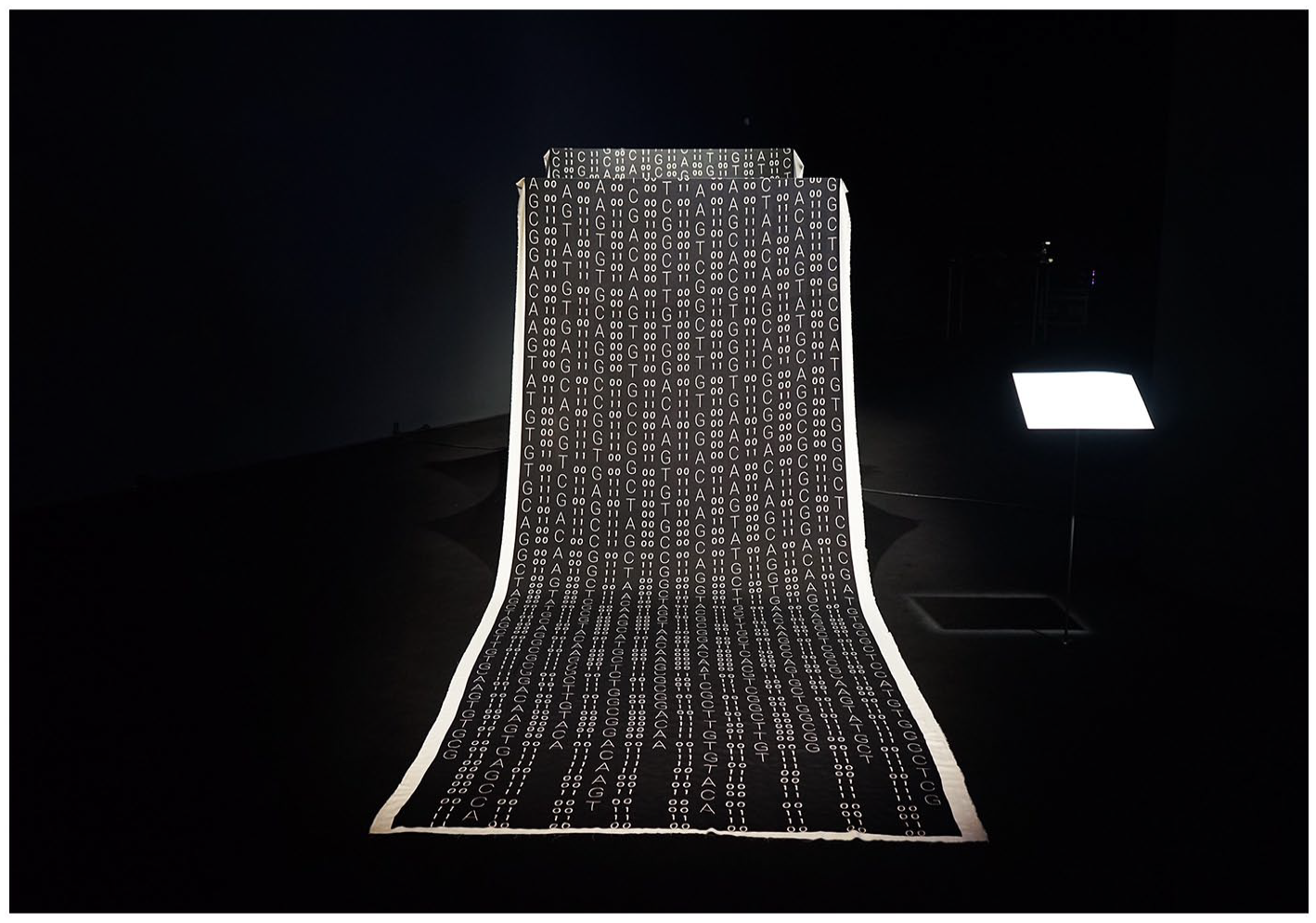
First encoding attempt for future storage in the plant’s DNA Manuscript and Digital Textile Print, 140 × 100 cm, solo show at Stegi. Image courtesy of the artist, Kyriaki Goni ©.
These projects represent a new data storage frontier. The idea of storing data outside of data centers, into plants, skin, bodies, is worthy of more than I can do here, but provides a temporary end—and reopening—on data centers. Data centers have become huge repositories of networks, exchanges, and transactions that are reconceptualized as of the body, a basic code of nature.
Closing remarks
All in all, there has been no one trajectory for artists working in, with, and through data centers or data storage modalities. However, key moments are evident in academic and journalistic writing, as well as in art. Infrastructure’s in/visibility, the data center’s connection to past industry, the retrofitting of “the material” and “the cultural” as a result, are all essential to this story of data center temporalities.
Accessing data centers renders the infrastructure less mysterious, shifting attention to labor, maintenance, and repair. Researchers pay more attention to larger spatial-temporal dimensions: real estate deals, tax breaks, policy contracts, marking the discourse of the “enterprise zone” in relation to industries shifted by the promise of Big Tech in city centers and rural areas. Government supports the industry for many reasons (or, promises): security and strategy, economic development and an expansionary, romantic vision of the “frontier” as something to be reached and surpassed by defying limitations imposed by distance (Burrington, 2015)—that is, the Internet’s imagined compression of space by time, made possible by data centers and network of cables (Jacobson & Hogan, 2019).
Scholars like Wiig (2015) and Pickren (2017) offer analyses about industrial infrastructure repurposed as data centers. Relatedly, with Vestberg (2016) and Holt and Vonderau (2015), we see the industry “working to conceal or obscure less picturesque dimensions of cloud infrastructure” because “making an environment visible could potentially have the effect of making it recede” (Vestberg, 2016). Amoore’s (2018) and Vonderau’s (2017) works evidence this rendering visible, identifying the “spatial location of data centres” and “technologies of bhowmik imagination” instrumental in connecting “industrial materialities and corporate images of the cloud to locally situated ontologies, [. . .]” that shape “the local geographies of the cloud as a space of anticipated post-extractive modernity,” respectively (Vonderau, 2017). Artists and researchers mining, mapping, and touring data centers became modes of evidencing these transformations and their social, political, historical and environmental repercussions. By recording server room sounds, commenting on various technical limitations, and intervening in playful and poetic ways in the data center’s space, artists shift focus from “the visual” as evidence, to other modalities for scrutinizing the data center as an object of inquiry with a particular attention paid to environmental disruptions, sores in the landscape, tethered to sick ways of being and preserving.
This moment registers another shift. Data centers are identified as fortresses, or prisons,—of data—upholding a sociotechnical imaginary, an instantiation of the future predicated on human optimization, surveillance, Big Tech oligopoly, a control society, and extreme extractivism, leading—irreversibly—to humanity’s and the planet’s devastation. Thus, data centers are always already of the environment, a medium with tentacles of destruction. The shift from data centers, as monuments, toward the things they uphold is why there is no clean line where this artwork ends, defining what counts as “data center art.” Attention to artificial intelligence, surveillance, machine learning, algorithms, and so on, are part of this story; the data center is one stop along the way (see Di Minardi, 2020). Soon it will not be possible to objectify the data center as we have done without accounting for non-human agents, water, energy, heat, land, landscape, geography, cybernetics, hardware, software, automation, artificial intelligence, and so on, together, shaping and controlling the world at the behest of increasingly authoritarian worldviews. Critical data center art, then, holds us accountable to what we long saw coming.
Supplemental Material
sj-docx-1-nms-10.1177_14614448221149942 – Supplemental material for “Environmental media” in the cloud: The making of critical data center art
Supplemental material, sj-docx-1-nms-10.1177_14614448221149942 for “Environmental media” in the cloud: The making of critical data center art by Mél Hogan in New Media & Society
Footnotes
Funding
The author(s) received no financial support for the research, authorship, and/or publication of this article.

Supplemental material
Supplemental material for this article is available online.
Notes
Author biography
References
Supplementary Material
Please find the following supplemental material available below.
For Open Access articles published under a Creative Commons License, all supplemental material carries the same license as the article it is associated with.
For non-Open Access articles published, all supplemental material carries a non-exclusive license, and permission requests for re-use of supplemental material or any part of supplemental material shall be sent directly to the copyright owner as specified in the copyright notice associated with the article.
