




Abstract
The political economy of the “cloud” depends on the continuous transformation of physical space to support the flow of digital commodities. Retrofitting disused infrastructure has been one of the strategies of data center operators to gain cheap access to such space. Tracking the temporal story of a retrofitted bunker in Helsinki, Finland, its conversion into a data center, and its subsequent dismantling, this article advocates for a processual perspective on data centers that does not take for granted their endurance and solidity, but instead sees them as processes of constant assembly and disassembly that interfere with multiple temporalities. I show how data center retrofitting intersects with and reforms multiple layers of historically entangled urban systems, while ruination stresses the fragility and provisional nature of these transformations, allowing to raise questions about the politics and ethics of data center dismantling that articulate data centers as a relevant object for discard studies.
Keywords
On a frosty winter day in 2019, I was guided into a bomb shelter carved out of the bedrock in the very center of Helsinki, Finland. Together with two fellow researchers, I visited HE2, a subterranean data center and part of what its owner, the US property fund Equinix, has called “the largest ecosystem of people, clouds, data and things” that “enables the digital future” (Equinix, n.d.) through infrastructural interconnections and the provision of physical space for servers. Opening massive, bolted doors one after the other, our guide, Antti, the local CEO of the company, gradually led us into a narrow space—a subterranean ventilation station full of thick electrical and communication cabling, UPS batteries, and pipes providing heating and cooling for the city of Helsinki. A wall covered with security warnings and procedures greeted visitors, while carefully placed plastic mats on the green epoxy floor suggested the walking path that should be taken when moving deeper into the bedrock—into the cave where HE2 resided.
However, instead of humming servers located in this dense, damp space in which energy, data, and civil defense infrastructures intersect, we encountered empty racks, moving crates and cartons, rolls of cables, and a vacuum cleaner placed beneath a long, rusty spot on the white bedrock wall. For the past 2 weeks, HE2 had been under active dismantling, and what we saw in front of us was the carcass of a data center (Figures 1 and 2). Echoing the familiar mantra in military discourse—“It is only safe for the public to know about things that are effectively redundant” (Beck, 2011: 97)—our guide was clear that we could visit the site only because the data center had lost its value for the company and would soon vanish into oblivion. In 8 weeks’ time, the space was supposed to be completely empty. Later, in August of the same year, the company threw a “cave party” there and moved on to expand in other locations.
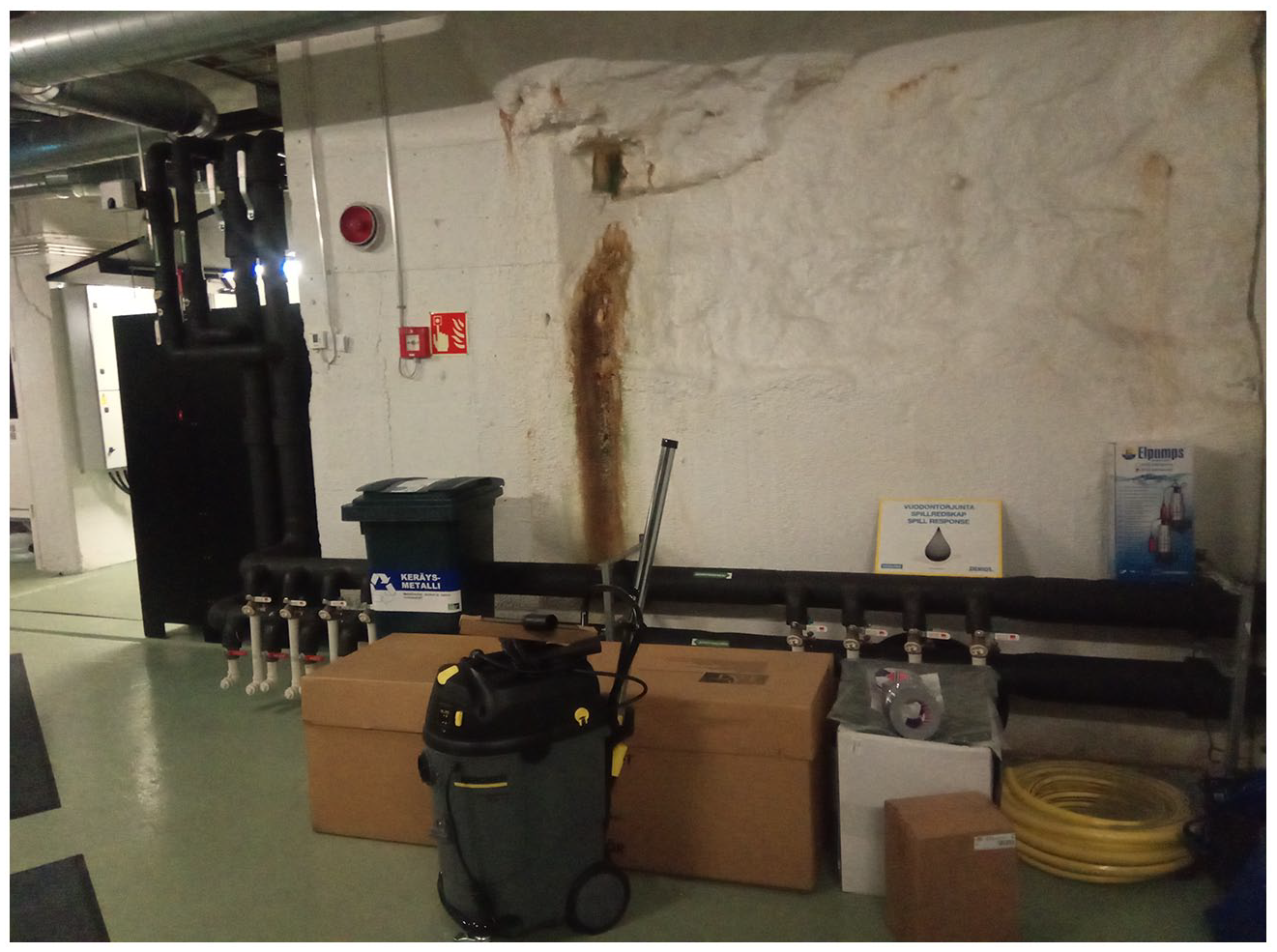
Emptied dataspace, Equinix HE2 data center.
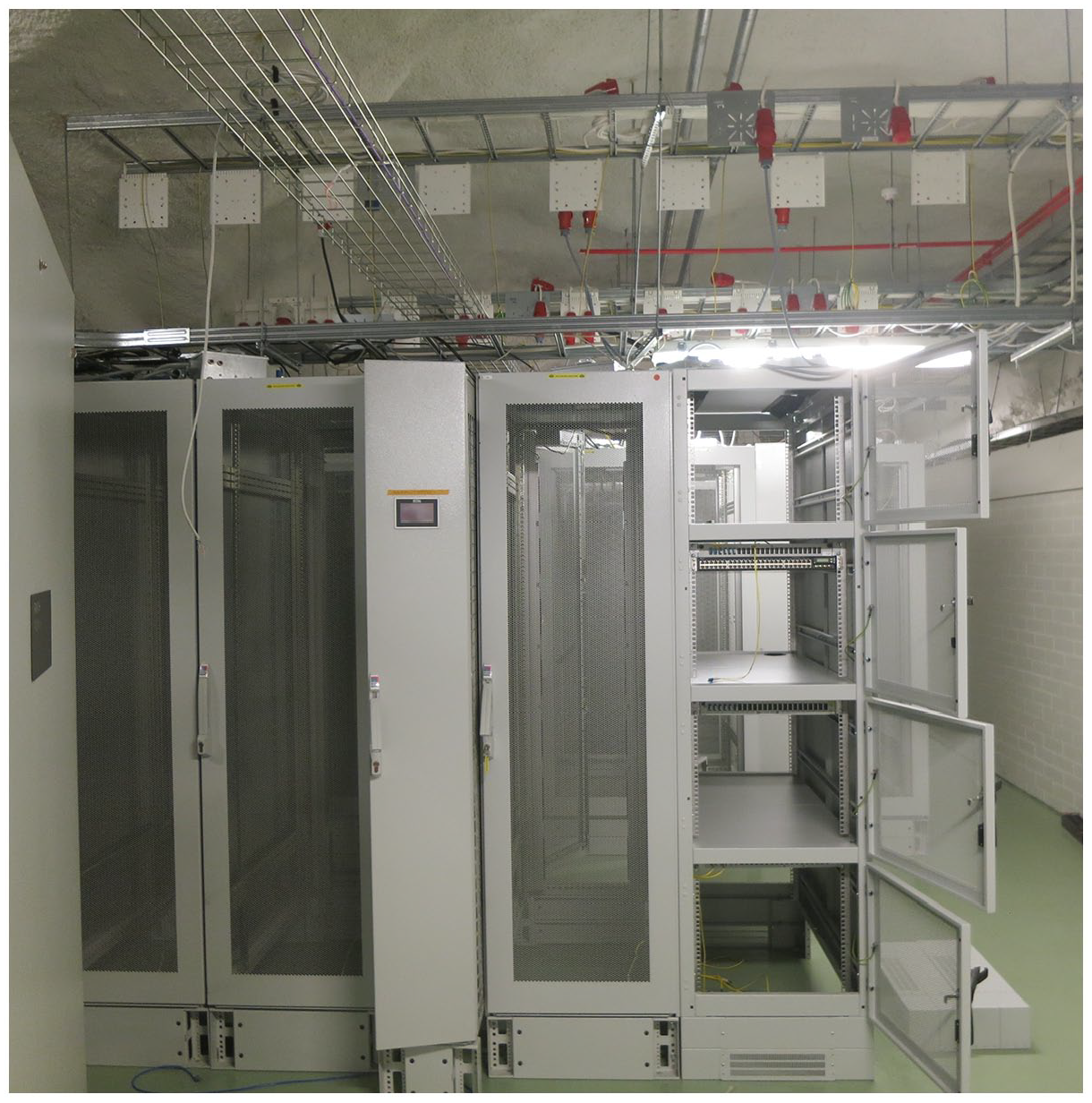
Emptied server racks in HE2.
Encountering this flagship data center—one owned by Equinix, currently the largest provider of global collocation service 1 —being dismantled contradicted my initial expectations of finding it enduring over time, supporting the “flow” and storage of data into the future.
Data centers in disused or repurposed military premises like HE2 have proliferated over the past two decades in many countries. In Latvia, a former Soviet bunker was repurposed into a co-location 2 data center. In the Swiss mountains, a former air force bunker was used to store the archival data of a range of European libraries and research institutions (Hu, 2015: 104–109). Locals in Helsinki tell anecdotes about a secret data center tucked in a cave outside of the city of Tampere and operated by the Israeli army. Equinix itself was among the first companies to make headlines in the years preceding the dot-com bust by repurposing a bunker into a data center and offering “unprecedented security” by placing armed guards and modern video surveillance in a military bunker in the United States (Wallack, 2000). As documented by a range of scholars, the thick bomb-proof walls of bunkers, their invisibility from public sight, and underground location have been used strategically by companies providing collocation services to craft an idea of the eternal preservation of an ephemeral object like data, that would seemingly persist long after catastrophes and disasters have possibly rendered humans extinct, inscribing data in the long-durée temporalities of geological time (Graham, 2018; Hu, 2015: 82–110; Jakobsson and Stiernstedt, 2012; Taylor, 2021a).
And yet, my encounter with the carcass of HE2, undergoing the process of swift dismantling—only 8 years after its inauguration by a local company that was later acquired by Equinix—spoke instead of the transience, potentially quick obsolescence, and eventual discard of these infrastructures. It emphasized the need to move beyond “the shock of the new” that has thus far surrounded much of the public and scholarly discourse on data centers, and instead follow Steve Jackson (2014) in his call to adopt “broken-world thinking” and begin thinking about “the timeliness of technology, discussing its temporal story, offering new insights and approaches to the understanding of technology as a timely and rhythmic phenomenon” (Jackson, 2014: 235).
Indeed, much of the critical scholarly work on data centers has so far been guided by the overarching assumption that data centers are here to stay, and like other infrastructures, will endure and produce effects that last beyond generations (Hogan, 2018; Jakobsson and Stiernstedt, 2012; Johnson, 2019; Taylor, 2021b). The dismantling of HE2 urges us instead to recognize that just as the “cloud” is infrastructurally made, it is also simultaneously unmade. As new data centers are constantly erected, others—including the seemingly most robust ones situated in bunkers—become obsolete and are dismantled after short-lived existences (see Brodie and Velkova, 2021).
Embracing Steve Jackson’s proposal to begin with breakdown, I track in this article the “temporal story” of HE2, discussing how digital infrastructure’s future-orientation and obsolescence, endurance, and disposal are both sides of the same coin, and can all co-exist over prolonged periods in a data center. This mutual co-existence reproduces a form of what Howe et al. (2016) have referred to as a paradox of infrastructure—that it can be generative while also degenerating, organizing connections while also disconnecting, and appearing solid and durable while being “broken down.” I analytically unpack this paradox in the context of HE2 along two temporal trajectories of its existence—retrofitting and ruining. I use these categories as both conceptual devices and themes through which I tell the “temporal story” of HE2. They allow us to see, on one hand, how data center retrofitting intersects with and reforms multiple layers of historically entangled urban systems, re-articulating them in the present as future-oriented infrastructures, while, on the other hand, ruination stresses the fragility and provisional nature of these transformations and raises questions about the politics and ethics of data center dismantling that articulate data centers as a relevant object for discard studies (Alexander and Reno, 2012; Liboiron, 2018) and for critical projects on digital ruination with media technologies (Brodie and Velkova, 2021; Gabrys, 2013; Parikka, 2011).
In composing the “temporal story” of HE2, I take methodological inspiration from Bowker and Star’s (2000) proposal for studying infrastructures through their inversion. I perform a variant of this method, which I call “temporal inversion,” by drawing on my situated, embodied experience of visiting HE2 in the winter of 2019, as well as the oral history of the place and the data center shared by the professional in charge of its dismantling, Antti Siitonen. Today, this oral history, my embodied experience of the place, and the experiences of the two fellow researchers who were part of the same visit are among the few remainders telling of the past existence and operation of this data center. I also draw on three interviews and follow-up email exchanges between me and a planning officer from the local civil defense service responsible for managing bomb shelters in Helsinki at the time, as well as an interview with two engineers working at the local energy company, Helen. These interviews were instructive in understanding the multivalent expectations towards HE2 and some of the ways in which the data center came to be entangled with the temporalities and infrastructures of the city through its retrofitting. The interviews led me further to archival documents at the Helsinki Civil Defence, discussing earlier uses of the bunker and providing important details about its past and continued uses. I also draw on some of the media coverage of this data center, as it evolved across its years of operation and I tracked some of the paths of its virtual life after it was disassembled. While patchy, partial, and provisional, these materials and conversations allowed me to assemble some of the threads accounting for the “temporal story” of HE2.
In the next section, I discuss retrofitting and ruination in relation to the operations of infrastructure and to the political economy of data center collocation service provisions. In the remaining sections of the article, I delve deeper into each of these aspects, tracking first the retrofitting of HE2 and then its ruining, raising questions about the politics of assembly and disassembly of the data center and its aftermath. I then conclude with a discussion of their broader relevance for critical scholarship on media infrastructures and future research on the temporalities of digital infrastructures.
Infrastructure retrofitting and ruination
Infrastructures are not solid entities, they are fluid and heterotemporal. A useful metaphor for thinking about heterotemporalities comes from Anna Tsing’s (2015) work on fragility, where she suggests the musical term polyphony. Polyphony, she reminds us, is the music that is not unified by a rhythm or a melody that holds a composition together in a unified coordination of time. This, Tsing notes, has historically been perceived as an archaic form of music, superseded by arrangements that strive toward coordination and linear rhythms. In polyphony, Tsing continues, multiple autonomous melodies intertwine, and the listener must pay attention to separate, simultaneous melodies while also hearing the moments of harmony and dissonance—an act that requires learning to appreciate the multiple temporal rhythms and trajectories of an assemblage.
Thinking about the temporalities of an infrastructure with polyphony involves recognizing that even when they operate from within buildings as solid as bunkers, they are always in the process of assembly and disassembly (Latour and Yaneva, 2008), of constant movement and adjustment that is fraught with ambiguities and contradictions. In this article, I have chosen to follow two temporalities—retrofit and ruin—through which these ambivalences and processes can be productively approached.
Retrofitting reflects a particular form of temporal work performed on infrastructures. This work is oriented toward the future, while it builds from the materials and technologies of the present (Howe et al., 2016). Retrofitting includes re-valorizing the “rubble” and excess produced by industrial modernity, warfare, or capitalism—reforming them into new structures imbued with different promises for a renewed future and desired modernity (Anand et al., 2018) that inherently anticipate their own end (Harvey, 2001).
Retrofitting has been of particular importance within the political economy of the “cloud,” which is crucially dependent on managing and organizing spaces, both virtually and physically, for computation (Easterling, 2016; Hu, 2015). The “rubble” of a large variety of disused infrastructures, produced during projects of “de-industrialization” or capital restructuring, has been a cheap source of space for many collocation service providers. 3 Data center retrofitting can be tracked back at least to the 1990s and the very early “collocation” facilities. During this period, data centers were hosted “in the carcasses of obsolete communications buildings: telephone switching stations, carrier hotels and early Internet exchange points (IXPs)” (Taylor, 2019). Since then, although many new data centers have been built, there are numerous others that have been constructed in abandoned coal mines, bankrupted printing factories, warehouses, and paper mills, or disused military infrastructures. Spectacular examples of retrofitted centers today include not only bunkers, but also Google’s largest European data center in Hamina, Finland, emplaced in a newsprint production plant that went bankrupt in the midst of the global financial crisis in 2008. The LefDal collocation data center in Norway is located in one of the largest former mines for olivine minerals. At around the same time, the former US military airbase in Iceland (Johnson, 2019) was closed and repurposed into data centers during the 2008 financial crisis.
Tapping into the preexisting infrastructural and symbolic “assets” left by their earlier owners, retrofitted data centers have paved the road for a new iteration of accelerated capital accumulation from data and digital services for their owners (Johnson and Hogan, 2017), all while reproducing relations of exclusion and marginalization at the intersections of data centers within the legacy infrastructures from which they arise (Johnson, 2019). Indeed, retrofitting can never entirely erase the influence of past structures that have been remade; it contributes to the layering of infrastructure (Star, 1999), entangling historical layers and social relations imbued in infrastructure in new constellations.
Importantly, retrofitting takes place on multiple scales. On a larger scale, it reflects the work of converting and adapting one kind of infrastructure into another in an attempt to transcend the past and bring it into a different future. On a micro scale, retrofitting becomes a particular form of repair (Jackson, 2014), a necessary part of the everyday operations and maintenance of infrastructure, continuously adjusting infrastructure toward changing expectations or new circumstances (Howe et al., 2016). Everyday retrofitting could mean, for example, expanding the traffic capacities of an infrastructure in anticipation of future needs or aligning operations and modes of work toward changing standards (Cohn, 2016). The aim of such adjustments is to eventually transcend and make commensurable the multiple timelines alongside which infrastructure exists, continuously orienting it to meet new demands and expectations for its performance. This process emphasizes how infrastructural solidity is a discursive rather than actual quality (Howe et al., 2016).
When an infrastructure can no longer “grow” or be transformed through retrofitting, it reaches the end of its life, losing value and becoming a ruin (Howe et al., 2016). In such moments, the temporal orientation of retrofit changes, away from renewal and toward decay, a process that Cohn (2016) terms “repair-into-decay” and DeSilvey (2017) calls “curated decay.” These terms connote particular forms of maintenance that are organized to ensure the “graceful” end of an infrastructure, the outcome of which has to be achieved through “active moves and cuts” (Cohn, 2016: 1513) made through the entangled lifetimes of entities that make up the infrastructure. Of course, not all infrastructural “deaths” are graceful—some are abrupt, sudden, and spectacular, while others are toxic and threaten future life. In its myriad expressions, ruination is a persistent reminder of the limitations of infrastructure—that they may support multiple kinds of activity but always remain “incapable of forever satisfying the tasks they are meant to carry out” (Howe et al., 2016). Recent work on data centers has begun to show how such structures have also begun to become ruins (Brodie, 2020; Brodie and Velkova, 2021; Velkova, 2019), leaving a trail of spectacular buildings left to linger in a state of contextual irrelevance, communities left in a state of affect, missing a future that never arrives (Burrell, 2020) or that lasted for only a short period.
When approaching retrofitting and ruination not as two extremes on a linear timescale of an infrastructure’s lifetime, but as two temporalities part of a polyphonic assemblage, we can notice a “paradox”:
The paradox of infrastructure is its double quality as both solid and durable and evaporative and itinerant; it is built and grown, rigid and fluid, meant to last but doomed to be outmoded, ruined, and exceeded. Therefore, it is in these nodes of paradoxical intermingling and entanglement that we can rethink the complexity of infrastructure; its realization is only the limit of our collective imaginary. (Howe et al., 2016: 13)
Unpacking this paradox through the categories of retrofit and ruin allows us to raise new questions about the ways in which data centers re-order the temporalities of infrastructures entangled in their own operations. On one hand, tracking back how older infrastructures are being retrofitted into outposts of modern global communications allows us to see “how ‘old’ infrastructures leak into new-media landscapes, when media of different epochs are layered palimpsestically, or when new urban media remediate their predecessors” (Mattern, 2015: 11). This retrospection reveals how infrastructures are reformed and re-valorized in novel ways, re-articulating them into a particular vision of a future while simultaneously pushing them back into the recent past. On the other hand, ruination prompts us to consider data centers as neglected sites, part of global “discardscapes” (Lepawsky, 2018), and ask questions about the ethics and politics of data center dismantling, which, as I will outline further, includes but also surpasses concerns regarding e-waste.
Bunker, ventilation station, data center: retrofitting a cave
The temporal story of HE2 began in a cave in central Helsinki that had once been retrofitted into a bomb shelter, later turned into a ventilation station as part of a growing urban energy infrastructure, and then eventually converted into a data center. Leading me and two fellow researchers on what was likely to be one of the last “tours” of the data center for external visitors prior to its closure, our guide emphasized this layered history as a feature of the data center:
Part of the space is still in its original use as a [bomb] shelter. Of course, because we do not need shelters all the time, the Helsinki fire brigade leases out this space. It is connected to tunnels, all around under the city, and the city energy company, Helen, utilizes these tunnels to distribute the district heating and also district cooling. And this cave here was a ventilation station that was unusable for Helen, and they leased it to us for a data center. When we started, this was actually Academica’s first proper data center, ten years ago.
The particular entanglement of military and energy infrastructures in the cave had attracted Academica, a local company, to convert the space initially into a data center. Antti told us,
There are some customers like the military; they would like to see the caves. Because of physical access. And also if you need to have EMP—electronic-magnetic pulse—insulation or protection, it is much easier to build it in a cave than on top of the ground,
reflecting the drive of the industry to store data in such bunkers (Hu, 2015; Taylor, 2021a). The connectivity to a large energy grid underground carried appeal for future scalability, with cheap power and cooling for energy-hungry servers, as our guide noted: “The district cooling was available here, because they [the energy company] need to have these ventilation locations here, so they have the piping network available. And they were able to provide electricity here.” The small cave of 350 m2 featured an exceptional amount of power, with up to 650 MW available as needed.
The availability of this much grid power in the shelter was the result of the historical change in the use of the bunker. Bomb shelters form an important pillar of the culture of “preparedness” (Lakoff and Collier, 2010) in the Finnish capital. A vast network of underground shelters has been built and maintained in Helsinki since the 1930s in anticipation of a potential attack of Finland by Russia. The bunker where HE2 was housed was one of the earliest facilities to become part of this network. Completed in 1941, the bunker has been retrofitted multiple times, shifting its purposes and societal functions while also always remaining partially functional as a bomb shelter. There have been periods during which it was used as a first aid shelter and hospital for Finnish civil defense and as a temporary accommodation for sailors arriving on cargo ships between 1945 and the early 1950s. For a short period in the 1950s, the shelter hosted homeless sailor families. From the 1980s onward, the shelter was connected to a growing underground 60-km-long network of “energy tunnels” in Helsinki through which heating and energy are delivered across the capital. Throughout the course of these transformations, parts of the bomb shelter were turned into a space for ventilation and energy exchange, invisibly entangling the military and energy infrastructures underground.
The multiple uses of the bunker have continually emphasized its role in the city, as a place offering solidity and protection to whoever needed it and as a temporary shelter. Retrofitting continuously brought the bunker “in time,” overcoming past uses and reconfirming its relevance to a particular historic period, with each new tenant upgrading the space and infrastructure inside to varying degrees and thus paving the road for the next tenant. No tenant stayed for long; and while energy traffic still goes through the underground network of tunnels in Helsinki, the ventilation station in the bunker fell into disuse long before the space became a data center, already reminding any future tenants that the permanence offered by the bunker was more illusory than real.
Adding yet another infrastructural layer, the retrofitting of the bunker ventilation station into a data center forged new entanglements between civil defense and the energy grid in Helsinki, mutually shaping one another. In terms of the bunker, a city planner confided that city residents’ contemporary expectations of digital connectivity had proven challenging within the existing network of bunkers in the area, as only a few of them had been equipped with an Internet or mobile phone connection. Retrofitting the bunker into a data center offered one such easy upgrade to a small part of the city infrastructure. Academica and later Equinix connected the space to high-speed transnational fiber optic cables in the Baltic Sea and expanded the mobile phone coverage of the space. This upgrade came at the cost of exempting parts of the bunker from its potential function as a civic shelter. Existing legislation mandated that all shelters in Helsinki must be ready to vacate their premise within 3 days of notice in case of an emergency. The ongoing retrofit required renegotiation of this temporal regime. “That would have been a disaster for us if it had to apply,” said Antti during our tour of HE2, emphasizing that the data center had to be exempted from this rule. An officer from the local fire brigade clarified as follows:
These spaces can be used in wartime. The data center is a sort of exception. In some shelters, some parts of them are given for other purposes; for example, there are telephone rooms in some spaces to provide secure telephone connections. In other places, there are small rooms for the purpose of “all society to benefit.” The data center, in this case, has a meaning for society.
The retrofitting of the bunker was also welcomed by the local energy company, Helen, whose engineers saw in the data center a way to cultivate a new imaginary related to the provisioning of district heating in the city in which data centers would play an important role. Two weeks prior to my visit to HE2, I learned about their plans. “We are forced to reduce our emissions quickly, and we do not have many choices on how to do it,” an engineer confided. “Because the scales are so big, we cannot just put solar panels and hope it is sunny . . . in a way, utilizing this type of heat sources [i.e., data centers] is crucial to achieve non-combustion heat production,” explained the engineer. In the infographic part of a PowerPoint presentation that was usually displayed to peers from the energy infrastructure sector, Helen’s engineers emphasized the central place of data centers in the future thermal infrastructure of Helsinki. In their vision, HE2 and similar data centers were conceived as superior sources of heat and “coolsinks,” part of a growing network of district cooling services. Data heat appealed to Helen because of its temporality—it was assumed to be steady and non-fluctuating, seemingly superior to more conventional sources of heat—as well as due to the intermittency of renewable energy sources: “Data centers run all year around, so they produce heat when the heat is needed most. And those are more valuable to us.”
Thus, the urban district heating system in Helsinki was to be tethered to data centers and heat production from computation, a practice that had become increasingly popular in the Nordic countries (see Velkova, 2016). HE2 would be the first such data center to be connected to the district heating, creating new dependencies between urban heat provision and the collocation of data in Helsinki, while both Helen and Academica capitalizing on the “promise” of this connection for de-carbonizing the city through heat and data. This promise was powerfully remediated in local and global media, with The Guardian, among others, celebrating the data center as “a mini revolution in eco-friendly computing” (Vela, 2010) that could provide heat to 350 households in town. The article also suggested that only days after the data center inauguration, the city of Helsinki “lowered the output from its coal-fired power stations, reducing pollution and saving money.” “Expectations for the future are high,” the piece continued, “and Academica has already been contracted to build a second data center—ten times larger—to provide heat for the city.”
Overall, the retrofitting of the bunker ventilation station into a data center connected parts of the urban infrastructure in Helsinki with the data economy through collocation space provision. Unlike other Nordic locations where retrofitted military infrastructures excluded local communities from connectivity (Johnson, 2019), in Helsinki, the interconnection to the district’s heating systems seemed to include local citizens in the economy of data in indirect ways, through thermal exchanges and the absorption of the exhaust of data computation (see Velkova, 2021). This reinforced the future outlook of the data center, the energy infrastructure connected to it, and the bunker. But, as the data center was reforming urban infrastructures in Helsinki, it was also turning into ruin, prematurely severing these new interconnections.
HE’s breakdown and ruination
Continuing on our underground tour of HE2 in Helsinki, Antti demonstrated the heat pumps, the pipelines that had been installed to transport heat, and the robust metal bomb-proof doors of the bunker, announcing in passing the timeline for the closure of the center: “The [place] should be totally empty in March. And then our lease runs out in August. So, then we hand it back to the landlord. As empty.” The reason for closing down the data center seemed to be the everyday dimensions of retrofitting—the difficulties in everyday adjustments and transformations due to changing circumstances that pushed the center into a mode of disassembly almost since the beginning of its operations. Some of these difficulties included the rigidity of the cave itself, as Antti explained:
Because this is a cave, it is very difficult for the logistics. There is no proper loading base, or anything like that. And when we have to install the computers in the data halls, they are quite heavy. And with those stairs, and [. . .] the parking lot is also difficult.
Furthermore, the central location of the bunker facilitated digital connectivity, but also slowed down physical access to the facility as technicians took time while looking to find a free parking lot in the congested center of Helsinki, explained Antti. The concrete stairs leading into the underground and the narrow tunnels slowed down the transportation of equipment in and out of the data center, representing physical “obstacles” for data flow. The original purpose of the bunker—to provide shelter for people, not bulky computer racks—was “leaking in” and disturbing the expectations of technicians like Antti toward the speed of maintenance in the data center, eventually slowing down the flow of capital moving in and out of the company through its servers. The bedrock, which was initially considered by the data center owners to be a feature, was also found to limit the scalability of the site. “We had quite a lot of power available here but quite little floor space,” he explained, “we had room only for so few racks here that it wouldn’t have been, on a larger scale, economically feasible. And we cannot . . . or, of course you can but it’s very difficult to expand the area.”
These features had obviously all been present since the beginning of the retrofit and formed part of the original design of the bunker. Yet, the data center owners recognized them as limiting under the ongoing reshaping of the political economy of the cloud, continuously posing new demands of greater scalability on data centers. Scaling up, Academica built several new data centers overground in Helsinki. Initially called HEL3 and HEL4, they were followed by three more facilities built by Equinix, forming a network that both duplicated and scaled up the functions of HE2. In 2016, the network was bought by the largest collocation service provider in Europe, TeleCity Group, which in turn was acquired 3 years later by Equinix. With these new data centers, and due to the burdens of everyday scalability and the transformation of the bunker, HE2 quickly lost its value for the company, producing the paradox of simultaneously being future-oriented and, shortly after its inauguration, becoming a ruin of that future, long before any disaster could damage data in the bunker.
The subsequent “curated decay” of HE2 was slow and spanned the majority of its existence because disentangling the data center from the infrastructures in which it was embedded required care:
You have to discuss with the customers whom you are going to migrate, because typically those are running the services 24/7, it’s quite difficult to find a slot where they cut down their services and do the move. And when we are doing the move, it has to be quite fast. Because they don’t want the offline time to be quite high. That’s quite tricky,
explained Antti. Performing this “trick” involved reconfiguring contractual relations with companies that dissolved obligations about uptime, connectivity, or security taken on by HE2. The guide continued as follows:
We had a 10-year lease contract. So, we knew already five years ago that the lease contract here will end in 2019. With Helen. We made all our customer contracts so that they were ending before the end of the last year. And of course, the customers who would like to continue, they make new contracts with us. But we said to them that well, we are happy to do the new contracts but those will be on the other sites. You can have the same services provided on the other sites. And we were also helping the customers to move their IT stuff from here to other sites.
Contrary to the publicity and celebratory headlines in the media that the retrofit of the data center prompted, its dismantling remained a secret to the industry, the clients who were on site, those operating the bomb shelter, and the energy company almost until the very end. Antti’s story continued: “It would be very confusing if we start to tell that we will close this and that we will open another one. So, people get confused.”
Given the imbrication of HE2 with multiple heterogeneous infrastructures in the city, it was remarkable that Equinix managed to conceal its dismantling and removal from the underground landscape of Helsinki, especially in terms of the physical disconnections that had to be done, such as cutting away pipes and cables. The provision of heat and cooling to the city, as well as digital services to multiple clients, continued despite, and alongside, the removal of heat pumps, pipes, and Internet cables. Thus, the subtle dismantling of the data center was an achievement no less complex and significant than its retrofitting. The politics and negotiations that had to be made in the process remained secret and analytically difficult to track, but from Antti’s story, it was clear that they involved making the city complicit in the process of “ruination,” delegating to it the mediation of times when servers could be evacuated from the bunker through the streets of Helsinki. The city mediated the disassembly by issuing permits that allowed Equinix to block central streets in the Finnish capital during the night to move servers out of the data center at particular intervals when there was little street traffic. This process, according to Antti, took more than 4 years to prepare and plan and several weeks to execute, all the while the media in Helsinki continued to regard HE2 as a durable, future-oriented construct.
Triggered by the move of the servers, other components of the data center also became subject to re-valuation and set in motion, pushed between the states of reuse and discard. Negotiating their further social afterlife, some components were destined to move to other data centers owned by the company, and others would go to the recycling company from which they would embark on a journey through the global economies of e-waste circulation (Gabrys, 2013; Lepawsky, 2018). Showing us the empty racks and the pipelines as we walked along the corridors of HE2, Antti explained their future trajectories of circulation:
These cabinets . . . we will take them out, and we will utilize these on the other sites. As well as those inline cooling units. Those are perfectly fine to be used on other sites. But then [. . .] these cable ladders, main switch boards, the cooling pipeline, those will be recycled by a recycling company, Kuusakoski. They will take care of everything that is recyclable. But of course, all those assets that could be reused on other sites, we will just move there.’
The pipes connecting the data center with the local district heating were disassembled, the heat pump was recycled, and the fiber optic cables were removed. The discreteness in which the servers were moved, the contracts refigured, the bunker vacated, and connections to the district heating removed reflected the corporate effort to maintain a public sense of solidity and invisibility to an otherwise fluid, motile, fragmented “cloud” space.
Absence defined to a great extent our experience of HE2 during our visit in 2019. There were no sounds of humming machines. Racks stood as empty frames deprived of value. And there was the absence of order, which Antti joked about. “Now that we have been stripping off the equipment it looks like . . . usually we have much better housekeeping (laughs). But as we are no longer operational this looks like . . . quite funny,” he said apologizing for the chaos of cables, extension cords, and bulky equipment stapled in piles behind a locked cage, as well as for the obviously misplaced furniture (Figure 3). There were no people working on the site either. Unlike other half-built or abandoned data centers (Brodie, 2020; Brodie and Velkova, 2021; Burrell, 2020), the closure of HE2 had not raised any social anxieties about employment, which otherwise surround projects of data center construction, and more traditionally factory closures. On the contrary, the shutdown remained invisible for most of those dwelling in Helsinki.
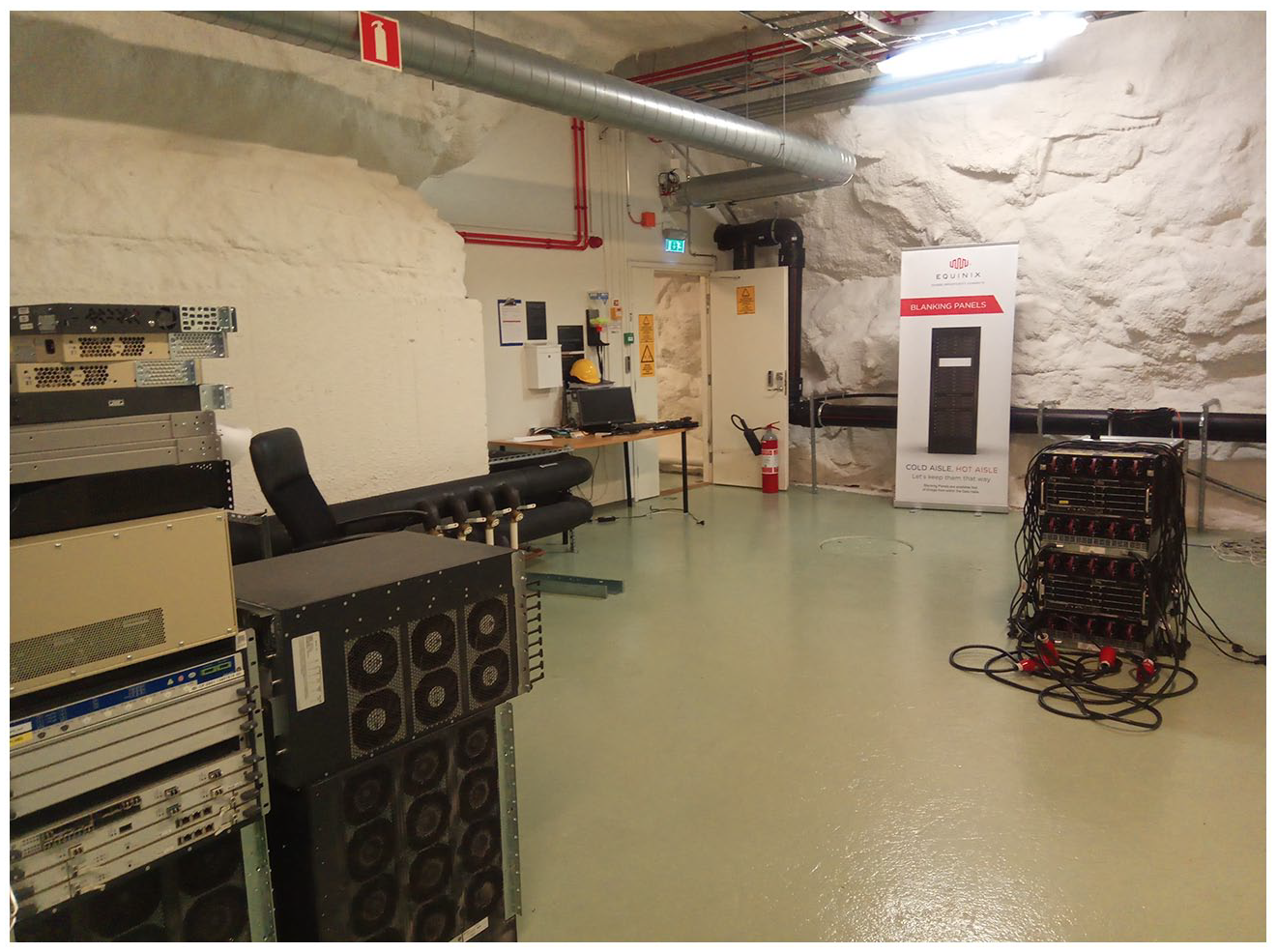
Disorder at HE2 in the process of dismantling.
Emptiness and absence seldom have such a strong presence at the end of the life of an infrastructure. Industrial infrastructural ruination has most often been associated with visible waste-making that results in ubiquitous, monumental, sometimes spectacular sites of ruination that may turn into objects of heritage or creative renewal (Edensor, 2005; Willim, 2008). But, like the innocuous metaphor of the “cloud” produced from within the data center, HE2’s material remainders seemed to dissolve, displaced and arranged in new locations and trajectories of movement, turning the data center into another site as part of the global “discardscapes” (Lepawsky, 2018) created by digital industrial capitalism.
Soon after our visit, the bunker space returned to a state of a double-disused infrastructure—as a former ventilation station and former data center space. The city offered the space to local musicians for rehearsals, thus continuing the long trajectory of bunker retrofit. The data center appeared as a parenthesis in the story of the bunker, while it continued to linger as a gap missing from the Equinix website. On an online map depicting all data centers run by Equinix in Helsinki, each facility was listed with its code starting, with HE1 and moving on to HE3, HE4, and so on, ending with the newest open site, HE7. HE2 was a gap in this numeric order, filling this missing symbolic representation of infrastructural space with a reminder of its own absence.
On other websites, a range of online infrastructural intermediaries that specialize in reselling data center server spaces have been advertising HE2 as fully operational. Some emphasized that it had recently been inaugurated. For instance, one such marketplace, DataCenters.com, presented HE2 in the fall of 2020, more than a year after its liquidation, as an active facility: “Located 30 minutes from Helsinki Airport 10 minutes from the city center, HE2 is an Equinix International Business Exchange™ (IBX) offering a full range of collocation and support services” (DataCenters.com, n.d.). This short introduction was followed by a full technical specification emphasizing HE2’s access to 640 MW of power—a quality suggestive of its potential scalability—and offered help in finding server space there. Other online platforms acting as digital brokers still promise to find “deals” for providing cheap space and computation at HE2.
In these remediated states, HE2 continued to linger online as multiple contextually irrelevant digital traces (Thylstrup, 2019), eventually becoming part of broader circuits of value production in online spaces. In Helsinki, though, there was little left of the space aside from the memories of the handful of people who had worked on the retrofitting and ruining throughout the 8 years of the data center’s operation.
Data centers in and out of time
Temporal stories that account for an infrastructure’s multiple timelines illuminate new forms of order and ordering of the object worlds around us (Jackson, 2017: 173). The story of the retrofit and ruin of HE2 emphasizes the paradox of data center infrastructure—of being future-oriented and obsolete, of forging new connections at the intersections of global data and local urban infrastructures while quietly organizing their own disconnection. This story stresses the need to question temporality at every moment during the lifetime of an infrastructure, as there is nothing pre-determined in the capacities of a bunker or a data center to endure in time. Data centers like HE2 only seem temporarily “in time,” an appearance crafted largely by the media and the regimes of invisibility maintained by the industry that preclude seeing these infrastructures as ruins, in a constant process of assembly and disassembly, and as yet more objects of planned obsolescence produced by digital capitalism.
Retrofit and ruin show data centers not as solid structures but as flexible, mobile entities in a constant spatial and temporal recomposition, always on the move to somewhere else, starting from components and ending up with massive pipelines and robust bunkered buildings. They not only move digital traffic, but can themselves be moved alongside other traffic, during the night, down the streets of cities like Helsinki. Thus, one avenue for further research would be to productively track and engage with the politics of this movement, tracking the social afterlife of a data center as an object of waste, studying how it is integrated into new structures and cities through the movement of servers, as well as how it further traverses and becomes part of the global economies of digital waste circulation. As HE2’s disposal has shown, waste is not only a feature of the data economy in the sense that it works to commodify data traces and symbolic forms of excess (Thylstrup, 2019). The infrastructures that support these processes of commodification themselves arise from waste, function as waste while operational, and eventually dissolve into waste, becoming part of the symbolic economy of commodifying digital excess. With this article, I thus show not only that waste is a constitutive element of industrial ways of life (Liboiron, 2013), but also the extent to which digital capitalism is deeply subsumed by its own production and the reworking of waste and excess, positioning data centers as a neglected but fruitful place for expanding understandings about the politics of waste in the digital era.
Finally, the temporal story of HE2 reveals the temporary and provisional nature of infrastructural layering and the reformation of urban infrastructures with data centers. The “cloud” today includes both experiments with new modes of value production from processing data in the digital economy and an emergent infrastructure built in a largely anticipatory fashion to support these experiments. Collocation data centers, even those located in bunkers, do not layer durably upon urban infrastructures—they do so parasitically, and for brief moments of time in the longer durée of infrastructure—tapping into an environment that could momentarily generate symbolic and economic value only to dissolve and move to another place at the next iteration of server upgrades or corporate upscaling of infrastructure. Data centers are thus both generative and destructive, aligning past infrastructures with the demands of the data economy, which requires the cooling, security, and speed of digital communications, only to push them back into their “outdated” temporalities, as data centers are perceived by their owners as “out-of-time.” Rather than adding another layer of media infrastructures in urban environments that co-evolve and reshape each other in time (Mattern, 2015), analyzing the temporal stories of data centers reveals the fragility of such reshaping and the degree of power that the data industry possesses to transform and act upon the temporalities of interconnected infrastructures. This prompts questions such as the following: Who is working for whose permanence at infrastructural nodes like HE2? How does the lack of care for particular temporal constellations inflect the topology and temporality of other infrastructures that intersect at global nodes of digital communication? What are cities and local communities left with by hosting nodes as part of an apparently mobile cloud network under constant disassembly and re-composition? By telling more temporal stories of data centers and other forms of digital infrastructures that begin with fragility and temporal polyphony rather than emergence, we can begin shedding light on these questions.
Footnotes
Acknowledgements
I thank Minna Ruckenstein, Lars Lundgren, Jean-Christophe Plantin, Francesco Colona, the STRIPE, and ValueS seminar groups at Linköping University, and the three anonymous reviewers for attentive readings and valuable comments on different versions of this article. I visited and researched HE2 during my time as a post-doctoral fellow at the Center for Consumer Society Research at the University of Helsinki.
Funding
The author(s) disclosed receipt of the following financial support for the research, authorship, and/or publication of this article: grant P18-0654:1 of the Swedish Riksbankens Jubileumsfond for the project “Earth Stations and Data Centers: Network buildings as transnational infrastructures and logistical media.”
