




Abstract
Processes of responsibilisation aim to configure individuals into the governance models of digital platforms and realise versions of the sharing economy pursued by powerful platform owners. Questions are raised, however, as to whether this is an empowering process or one that puts participants at risk. Based on a qualitative study of Airbnb hosts in Europe, we explore their understanding of their own responsibilities as emerging hospitality practitioners. Our analysis shows that hosts actively engage in professional identity work and map a practice architecture which includes a set of responsibilities. We suggest, however, that this is not by itself a sign of empowered individuals rather a reaction to the perceived shift of Airbnb’s strategy towards hotelisation of hosting practice. We contribute to an understanding of responsibilisation as a critical and reactionary process.
Introduction
Sharing economy is a term that has been used to describe peer-to-peer sharing of goods and utilisation of assets via digital platforms (Schor, 2016). There is, however, controversy around it as to whether it is a beneficial development for more sustainable and collaborative societies or another form of capitalism facilitated by digital platforms (Schor, 2016; Van Dijck et al., 2018). Although the sharing economy appears as a progressive, disruptive development that challenges the status quo and the unsustainable practices of capitalist economies (Botsman and Rogers, 2010; Heinrichs, 2013), more recently, critical voices started identifying it as a top-down process whereby entities with authority (i.e. platform leaders, algorithms, the state) subject certain forms of social interaction into economic logics. Research has highlighted the implications of the platformisation of the economy on work, whereby digitalisation is seen as representing an extreme form of commodification (Howcroft and Bergvall-Kareborn, 2019) through social engineering and algorithmic programming (Bucher, 2012), leading to the rise of precarious employment (Alberti et al., 2018), algorithmic control of the workforce (Cheng and Foley, 2019; Li, 2021; Wood et al., 2019) and even racial (Edelman and Geradin, 2015; Yu and Margolin, 2022), religious and sexual orientation discrimination (Edelman and Geradin, 2015). Airbnb, for instance, has been accused of promoting discrimination because its booking system allows users to select properties (i.e. hosts) and guests, based on personal characteristics (Edelman et al., 2017), such as sexual orientation (Ahuja and Lyons, 2019). Significant backlash has been reported, however, from Airbnb hosts, who believe they have the right to choose ‘who comes into their home’ (Cheng and Foley, 2018).
The earlier optimistic views of the sharing economy have, therefore, transformed into harsh critiques. The reason for this transformation is founded on the emergence of for-profit digital platforms such as Airbnb and Uber, who hijacked what started out as a progressive and transformative idea (Schor, 2016) and instead revamped it as ‘platform capitalism’ (Srnicek, 2017). During this transition, responsibility of online transactions and interactions is increasingly removed from the digital platform owners (and the state) and transferred to individuals who participate and engage with those platforms (Howcroft and Bergvall-Kareborn, 2019; Sundararajan, 2016; Van Doorn, 2020; Van Dyk, 2018).
In Airbnb, for example, as the platform gradually infiltrates social structures and practices in the hospitality industry, bypassing existing institutions and regulatory frameworks so that it allows individuals to make some money on a spare room (Van Dijck et al., 2018), there is a responsibility vacuum that is created (Codagnone et al., 2016). We therefore observe a process of responsibilisation (Garland, 1996; Hacker and O’Leary, 2012; Shamir, 2008) where individual middle-class homeowners are expected to assume certain responsibilities as they transformed into ‘micro-entrepreneurs’ (Dillahunt and Malone, 2015; Holikatti et al., 2019) and ideal hosts that are configured into the Airbnb platform’s governance model (Van Doorn, 2020).
Given the tension between optimistic and critical understandings of the sharing economy, there are debates as to whether the process of host responsibilisation is an empowering process towards the creative pursuit of hosting practitioner identity, or is it a threatening process that poses risks to hosts. In this article, we are set out to explore the views of Airbnb hosts, which have been under-represented in the literature. It is important to understand how Airbnb hosts understand their responsibilities as emerging sharing economy practitioners and micro-entrepreneurs. We therefore ask: How do Airbnb hosts understand their responsibilities as part of their hosting professional practice? Although Airbnb has now become the dominant platform in the hospitality industry listing a range of hotels and private lodgings, data collected through personal semi-structured interviews with hosts from February through April 2018 shed light to a historical snapshot in Airbnb’s history. Specifically, our interviews capture insights on the perceived transition of Airbnb’s strategy from the original collaborative tool tailored to the economic and social needs of middle-class homeowners and local communities, into an updated form of platform capitalism.
In the rest of the article, we define sharing economy; we present Airbnb’s version of it and the role of responsibilisation in realising it. This is followed by an explanation of our methods, a section with our empirical findings, followed by a discussion and conclusions.
Literature review
At present, although Airbnb does not list mass market chain hotels, it welcomes properties with unique style and environment, such as boutique hotels, bed and breakfasts and resorts (Airbnb website). Only a few years ago, however, the platform was mainly targeted towards middle-class homeowners who wanted to complement their income by utilising unused space for hospitality purposes (Van Doorn, 2020). This represents a shift in the position and role of what became known as sharing economy platforms, from facilitating a process of resocialisation of economic exchanges to establishing platform capitalism.
Sharing economy: from resocialisation of economic exchanges to platform capitalism
The term ‘sharing economy’ has been open to various interpretations (Botsman, 2013; Kennedy, 2016). However, it is often used as synonymous to ‘collaborative economy’ or ‘peer production’ to ‘denote a series of practices that build on distributed networks of connected individuals and communities, as opposed to centralized institutions, and where communal relations take the place of traditional economic institutions’ (Arvidsson, 2018). The concept is both associated with practices of collaborative production and collaborative consumption, each of which represents two opposing narratives (Martin, 2016). The first is about a mode of production that emerges as a new dominant paradigm in the aftermath of the 2008 economic crisis and denotes new practices of value production facilitated by digital technologies. This optimistic view of the sharing economy is based on the creativity of individuals and communities (Van Dyk, 2018), whereby sharing economy platforms promote a fairer labour market that enable lower-cost entry into traditional markets. In addition, sharing economy is seen as an antidote to unsustainable consumption practices of the capitalist economies (Botsman and Rogers, 2010) and a new pathway to sustainability (Heinrichs, 2013; Martin, 2016; Schor, 2016).
Digital platforms facilitating the sharing economy promise to offer personalised services and contribute to innovation and economic growth through a ‘participatory culture’ (Van Dijck et al., 2018). Digital platforms are seen as bringing about a ‘platform revolution’ (Parker et al., 2016) and mobilise technology, markets and the ‘wisdom of the crowds’ to bring strangers together (Schor, 2016). A new breed of ‘microentrepreneurs’ seems to be emerging (Dillahunt and Malone, 2015) of people who represent an unconventional workforce of ‘amateurs’ occasionally renting out their apartments which can mean a substantial source of income (Holikatti et al., 2019).
All these developments have been described as a more recent manifestation of the relationship between markets and society (Arcidiacono et al., 2018). Indeed, the emergence of the sharing economy has been theorised as a process of re-socialisation of economic exchanges (Arcidiacono et al., 2018; Pais and Provasi, 2015). While previous Keynsian economic models contributed to a ‘disembedding’ of economic relations from their social ties and contexts, the sharing economy is experimenting with emerging collaborative social forms able to potentially re-configure economic relations once again in social ones (Pais and Provasi, 2015).
There is a second, more critical narrative, however, focusing on the negative impact on local communities and where gains are concentrated in the hands of platform owners while workers are oppressed and forced to live in precarity and instability of employment (Alberti et al., 2018; Arcidiacono et al., 2018; Belk, 2010, 2014; Eckhardt and Bardhi, 2015; Lloyd, 2017; Pasquale, 2017). As digital platforms infiltrate existing institutions and social structures (Van Dijck et al., 2018), the critical narrative gains attention and the analytical tone shifts from a focus on ‘sharing’ towards the emergence of ‘platform capitalism’ (Langley and Leyshon, 2017; Liang et al., 2022; Pasquale, 2017) and from ‘collaborative production’ to ‘collaborative consumption’ (Belk, 2014; Kennedy, 2016). More specifically, critical approaches challenge the very concept of ‘sharing’ as it appears in the tech-driven narrative of innovation that surrounds the sharing economy. They are arguing, in fact, that it has very little to do with ‘sharing’ (John, 2022; Slee, 2016). As a form of social exchange among people known to each other with profit not being the main goal, sharing does not exist. Instead, in a platform-capitalism context, sharing is market-mediated and profit-driven and resembles more an ‘access-based consumption’ (Arcidiacono et al., 2018; Belk, 2014; Eckhardt and Bardhi, 2015). ‘Sharewashing’ has also been described as an activity by which digital platforms shift risk onto employees under the guise of sharing (Kalamar, 2013). Also, claims by platforms like Airbnb that its users are single individuals earning a small amount of extra money have been challenged with evidence that in New York City, for example, half the revenue generated is from hosts with multiple listings (Slee, 2014).
For the critical literature, therefore, the argument of resocialisation of market exchanges is interpreted as a ‘subjection’ of forms of sociality to economic activities (Gregg, 2013). This subjection is particularly facilitated via changes in digitally mediated communications (Kennedy, 2016). Some authors, for instance, suggest that the economic activity that leads to value creation is seen as fostering certain forms of sociality (Arcidiacono et al., 2018), one that is somehow ‘programmed’ or ‘engineered’ into economic practices in the sharing economy with the use of algorithms (Bucher, 2012). Activities that were previously in the realm of hobbies (Lee and Lin, 2011) or social interactions are therefore being commodified and transformed into post-wage precarious labour (Alberti et al., 2018; Van Dyk, 2018) subjected to Tayloristic control through algorithmic management (Li, 2021; Wood et al., 2019). This makes for a working environment that is fraught with anxieties and uncertainties (Holikatti et al., 2019; Jhaver et al., 2018).
Overall, there are conflicting and historically contrasting understandings of the sharing economy phenomenon in extant literature. This is not so much due to a shift in focus from the economic to the social (i.e. resocialisation) but about the gradual infiltration of for-profit digital platforms within broader social structures and institutional settings through which society is organised (Van Dijck et al., 2018), thus creating a type of platform capitalism.
The Airbnb model and the construction of the ideal host
Alongside the debate as to whether sharing economy is a new form of capitalism or an opportunity to realign economic activity with social and community relations, emerging research suggests that because some platforms are concentrating large amounts of institutional power, they are able to pursue their own model of the sharing economy. Airbnb, for example, has been theorised as a ‘regulatory entrepreneur’ which has the power to set new policy agendas around home sharing, something that forms a material part of its business plan (Van Doorn, 2020). Airbnb, therefore, is a powerful actor able to negotiate and change policies in the emerging industrial landscape and pursue its own version of the sharing economy, one that is most aligned with its business objectives.
The way digital platforms infiltrate social structures creates tensions between private gains and public benefits and pressures (Van Dijck et al., 2018). For example, Airbnb offers the opportunity to some individuals to earn money on a spare room, but it is not clear who will be responsible for the collective costs, such as enforce safety rules, clean the streets and protect neighbourhoods from noise (Van Dijck et al., 2018). Airbnb’s governance model focuses on the economic empowerment and responsibilisation of middle-class homeowners to become micro-entrepreneurs, while giving them a sense of civic purpose (Stabrowski, 2017). Airbnb, thus, is constructing an ideal type, model host on the premise of a people-to-people platform, by transferring onto them responsibilities and risks pertaining to their own social reproduction (Van Doorn, 2020). The choice of the specific social group (i.e. middle-class homeowners) fits with the narrative that sets out the governance structures for the Airbnb model of the sharing economy. First, the platform offers this group an opportunity to make ends meet during times of economic uncertainty, thus empowering and incentivising them on economic terms (Van Doorn, 2020); second, these hosts who are everyday people would offer a more authentic hospitality experience compared to a hotel – see house versus home comparisons by Airbnb’s CEO Brian Chesky (2014); and finally, by decentralising geographically the hospitality industry and moving tourists from the city centres to local communities, Airbnb contributes to sustainable tourism (Van Doorn, 2020). Through economic empowerment and responsibilisation of middle-class hosts, the Airbnb model claims an ‘everybody wins’ version of the sharing economy (Van Doorn, 2020).
In resocialisation terms, therefore, the Airbnb proposition configures homeowners into the sharing economy ecosystem; it incentivises them to become micro-entrepreneurs, while benefit local communities and neighbourhoods. There are questions, however, in relation to the role of Airbnb hosts in their construction as ideal sharing economy participants. Specifically, are Airbnb hosts’ interests aligned with those of the platform leader towards delivering the specific version of sharing economy or are they developing their own agenda and pursuing their own interests (Schor, 2016)? Although Airbnb claims to empower hosts, in reality, their model seems to favour more the corporate hosts, while hosts are put in a risky and uncertain situation (Jhaver et al., 2018) they cannot control (Van Doorn, 2020). In the next session, we discuss the role of responsibility in the construction of Airbnb hosts and the implications for their entrepreneurial and practitioner identity.
The role of responsibility
Responsibility is not simply complying with the rules but caring for your duties and applying certain values without coercion in your actions and their motivation (Selznick, 2002). We can contrast between individual and institutional responsibilities (Green, 2002), whereby institutional agents are more capable to collect and analyse information and also of taking the remote effects of their actions into account, than individuals are (Green, 2002). In addition, institutional agents have the power to alter mass behaviour and spread the costs of regulating a problem or an issue (Green, 2002). It would, therefore, make sense to expand attributions of responsibility to institutional agents as opposed to individuals (Green, 2002). Platform owners, in particular, do have responsibilities to comply with data protection laws, growing demands for social responsibility, but also responsibilities of transactions and allowing individual agents to comply with their own responsibilities, as these are reflected in the platform architecture (Helberger et al., 2018). Overall, although responsibility in the sharing economy should be divided and balanced between the platform owner (architects of the online environment), participants (individuals responsible for their behaviour in these online environments) and the government (overall ground rules for these interactions) (Gorwa, 2019), it increasingly seems to be removed from institutional agents and transferred to individuals (Howcroft and Bergvall-Kareborn, 2019; Sundararajan, 2016; Van Dyk, 2018). Although this can be seen as a positive move towards participatory forms of community governance (Garland, 1996), it threatens the role of public institutions able to provide public goods (Hacker and O’Leary, 2012) and creates power asymmetries between the citizens and the digital technologies (Van Dijck, 2019). Moreover, this responsibility transfer benefits platform leaders, who, on the one hand, establish themselves as an infrastructure that invisibly supports operations (Star and Ruhleder, 1996), while simultaneously minimising its presence as a business corporation (Van Doorn, 2020).
The responsibilisation of hosts with the purpose of configuring them into the governance model of the Airbnb assumes the autonomy and self-determination of hosts to sustain themselves through rational actions and them alone to bear the consequences of those actions (Shamir, 2008). A responsibilised individual is understood as a creative and innovative person who nurtures his or her own employability on the basis of his or her entrepreneurial and networking skills (Boltanski and Chiapello, 2006; Shamir, 2008). Responsibilised hosts, therefore, are constructed as ‘autonomous entrepreneurs’ fully responsible for improving their human capital and its investment (Boltanski and Chiapello, 2006; Shamir, 2008).
Responsibilisation, we argue, has implications beyond economic incentives and empowerment for hosts (Van Doorn, 2020). It also touches upon hosts’ identity as hospitality professionals and entrepreneurs. This includes identity work to form self-constructions of a sense of coherence and distinctiveness as a group (Alvesson and Willmott, 2002 ; Brown, 2015; Lok, 2010; Watson, 2008). In addition, it includes reflections on the cultural, material and socio-political orders and arrangements that enable and constrain hosting practice (Kemmis and Mutton, 2012). For example, there is ambiguity as to whether Airbnb exercises loose control on hosts and them having increased creativity and motivation to participate in value creating activities (Constantiou et al., 2017) or whether it facilitates top-down authority-based governance for their own economic interests (Leoni and Parker, s). Building on Van Doorn’s (2020) work on economic empowerment then, we also explore whether Airbnb hosts feel empowered to realise innovative and creative professional identity projects through their own agency (Giddens, 1991) or is their autonomy exaggerated (Collinson, 2003) and instead their identity work is a natural response to external threats (Beech et al., 2016) and strains (Sveningsson and Alvesson, 2003) and a creative resistance to platform monopolies (Wang, 2018). Such resistance has been reported in relation to other platforms, namely Uber. Uber drivers subject themselves to socio-technical and algorithmic controls; however, they also become empowered towards organising collective responses and forming informal communication networks (Chan, 2019).
In summary, since responsibility of transactions and relations is removed from states and platform owners and transferred to individuals, Airbnb hosts have to be self-reliant as they become configured into the governance model pursued by Airbnb. Questions, however, are raised as to whether this is a process of empowerment and pursuit of creative professional identity projects by individual hosts, or is it a response to a threat posed by efforts of the platform leader to control host behaviour?
In this article, we explore the views of Airbnb hosts themselves, namely, how they understand the elements of hosting practice and how they assume associated responsibilities in their hosting behaviour. Moreover, we dig deeper to understand their views on the institutional aspects of hosting. Specifically, we ask the following:
-How do Airbnb hosts understand their responsibilities as part of their hosting professional practice?
Methodology
Data collection
A qualitative research approach was followed which allowed an in-depth exploration of host views in relation to their practices. Data collection was undertaken as follows: in February 2018, the researchers targeted Airbnb host groups through the involvement of the co-author in a COST Action in Europe. Through this network, access was gained to Airbnb hosts in European countries who were approached and asked to take part in the research. Data were collected through semi-structured interviews with an initial sample of 18 Airbnb volunteer hosts via Skype on one-to-one basis. Subsequently, another open call was made to Airbnb host groups on Facebook in April 2018 with 15 Airbnb hosts expressing willingness to participate in the research. On top of that, the first author conducted personal interviews face to face with two hosts, one from Copenhagen, Denmark and one from Crete, Greece. Overall, 35 informants that were Airbnb hosts in various European countries were included in the sample (Table 1). While seeking interviewee consent, the researchers informed the interviewees of the purpose of the study and the way the data would be anonymised and kept in confidential and password-protected files. The choice to focus on European hosts was inspired by our involvement with a relevant COST Action. We aimed to cover both Northern and Southern European countries due to the differences in terms of destination branding and also a mix between city destinations (e.g. Amsterdam, Athens) and smaller countryside listings (e.g. Greek islands, small towns with rich history and distinct cultural characteristics, such as Pamplona, Spain or Limerick, Ireland). We decided to focus on individual hosts and exclude corporate hosts (i.e. hospitality businesses listed on Airbnb) in order to have a representative sample of non-institutional actors consisting of middle-class homeowners who joined the Airbnb platform and turned into micro-entrepreneurs, the original group also targeted by Airbnb as ideal hosts. We, therefore, sampled hosts who list either a room in their property or the entire property. We also selected hosts with more than one properties listed, thus achieving a good range of various types of micro-entrepreneurs. Finally, we aimed for an age- and gender-balanced sample, including both female and male hosts aged from 21 to 62, thus capturing different aspects of the hosting experience.
List of interviewees.
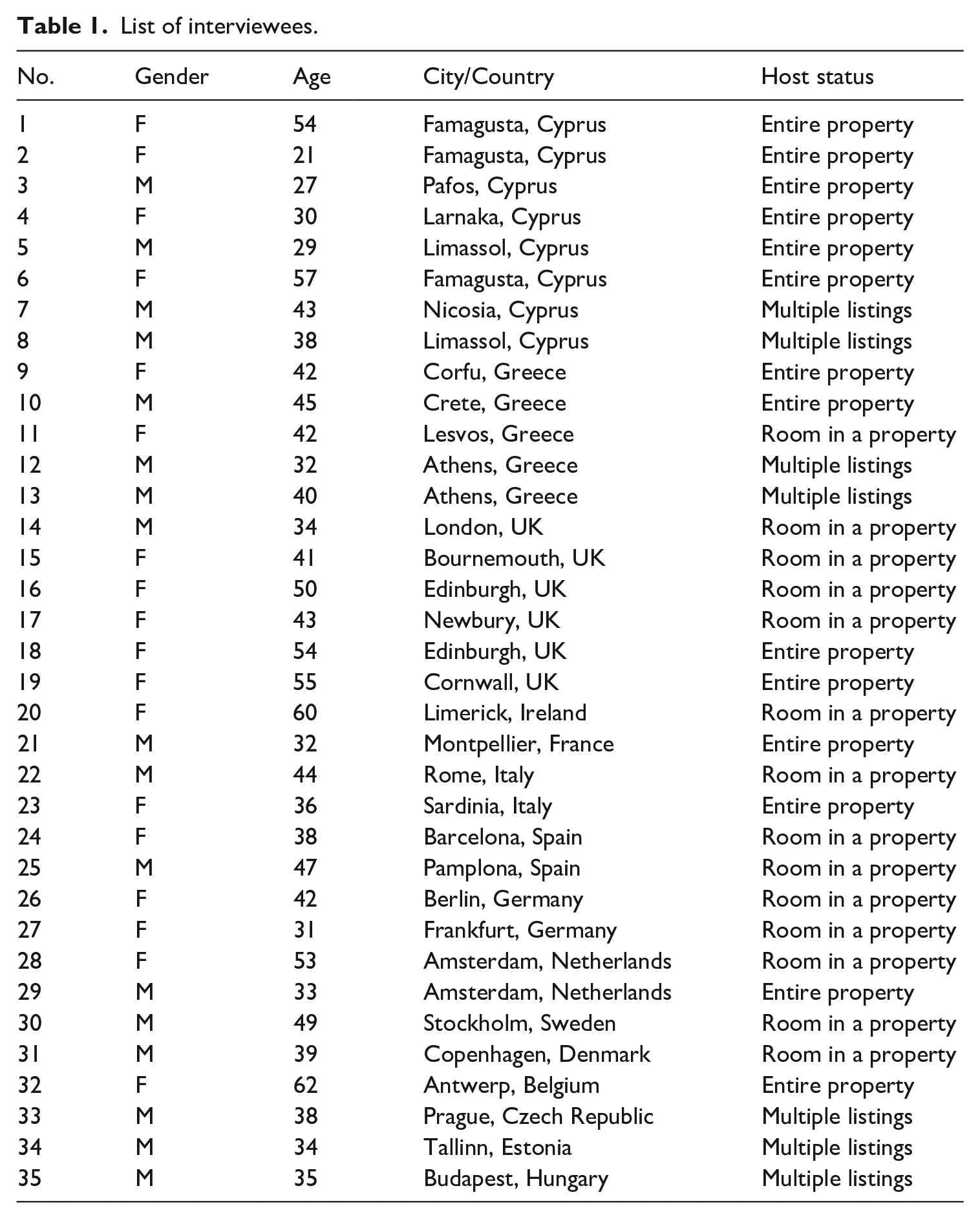
The interviews lasted approximately 60 minutes each and were voice-recorded. Interviews proceeded from a number of ‘grand tour’ questions (McCracken, 1988) seeking to establish the hosting profile of the informants (e.g. years of hosting) before moving into the topic of hosting motives. Beyond this point, questions reflected hosting practices, experiences and views of relations and dynamics between hosts–guests platform as these were becoming meaningful in reference to hosts’ understanding of their responsibilities.
Data analysis
The transcripts were analysed using thematic content analysis to illuminate underlying themes in the discussion. The framework for our analysis had to include both behavioural aspects but also emerging and evolving institutions in which such behaviours and social interactions would be embedded into. For this purpose, we explored views around hosting behaviours and practices as carried out by our interviewees. In addition, we took into consideration the institutional framework and changing industry dynamics as they were reflected in hosts’ own understandings.
As shown in Figure 1, such a framework was used to navigate empirical data and map themes relating to behavioural aspects (i.e. performing certain tasks and duties) with the institutional role of hosts and other institutional agents, such as the platform leader, in the broader changing industry environment. Hosts’ own account of these emerging professional practices and their understanding of the shifting institutional dynamics give us a glimpse into the identity work they engage in and whether it is driven by empowerment or threat. Analysis was a process of reflexive iteration whereby data were visited and revisited by both researchers trying to connect them with emerging insights, progressively leading to a refined focus and understanding (Srivastava and Hopwood, 2009). Specifically, there was a familiarisation layer of analysis, followed by a closer examination in a theory-driven manner (Braun and Clarke, 2006). Both researchers undertook an initial round of coding separately before converging the findings, to ensure validity and analytical integrity.
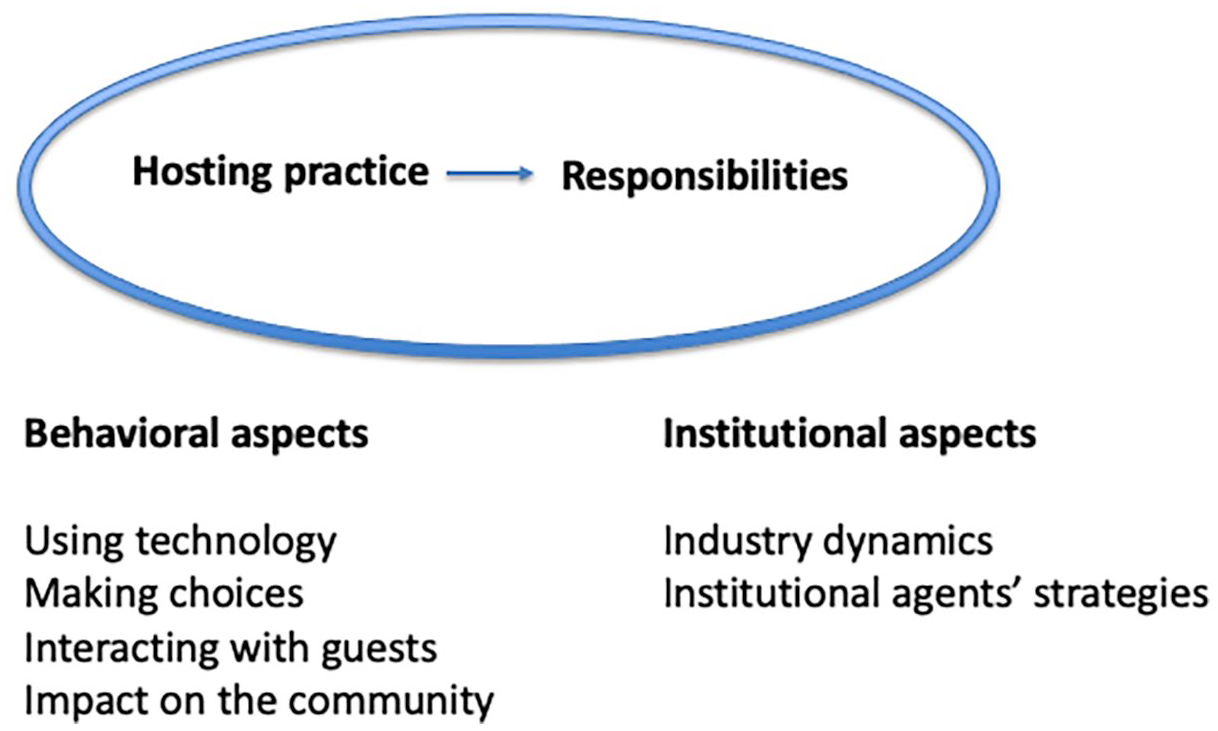
A framework for data analysis.
Empirical findings
Essential elements of hosting practice
Our interview findings show the hosts we spoke to develop an understanding of themselves as emerging hosting practitioners. Indeed, they draw the essential elements of hosting practice and make explicit connections between these and relevant responsibilities they see surfacing. We observe a mix of adapting to the algorithmic control of the platform leader but also drawing on moral values and critical evaluation of their activities and their impact. The essential elements of hosting practice that emerge from our data are as follows:
(a) Working the platform: how hosts utilise and navigate the platform and its algorithms as an infrastructure that supports their hosting practices and also their entrepreneurial efforts;
(b) Screening of guests: a process by which hosts evaluate guests before they accept or reject a booking request;
(c) Hosting service provision: communication with guests, cleaning and preparing the property, managing expectations; and
(d) Social/communal value: hosts evaluating their impact on the local community and their civic purpose.
The above practices identified by our interviewees are associated with certain responsibilities that hosts perceive as important. Below we present them in detail.
Host responsibilisation: behavioural aspects
Platform work responsibilities
Most interviewees seem to have an understanding of the rules of Airbnb hosting as they are expressed by the platform itself either as explicitly stated rules or as behaviours dictated by the platform algorithms. In relation to the former, a UK national sharing her entire property explains, ‘As an Airbnb host you need to follow the policies and regulations set by the company as outlined in the website’.. The most important rule that hosts need to abide by is to not communicate with guests or make bookings outside the platform. Responsibilities, however, go beyond simply obeying the platform rules and include working the platform in a way that would be beneficial from an entrepreneurial point of view. For example, the algorithm seems to regulate behaviour towards making and committing to a room reservation. High commitment rates are essential for hosts. To this end, hosts adapt and develop competencies that would allow them to adjust their behaviour in order to be rewarded, or rather, not to be penalised by the algorithm. A host from Cyprus with prior working experience in the hospitality industry who has one property listed for himself but also manages two other properties owned by others explains, If I hadn’t accepted your potential reservation, then my commitment rate would go slightly lower. [. . .] let’s say you do confirm the reservation, that is where my hands are tied and I am unable to cancel the reservation. Because I already pre-approved it, you paid the money because you are happy to close the deal. If you want to cancel, Airbnb will charge you 100 euros from your next payment. So, it is something you should very much avoid. So, I suggest that people take it seriously and are prepared. The higher the commitment rate, the higher the response rate and the faster you become a super host and the better reviews you have. That’s the whole idea.
Responsibilities relating to the screening of guests
The focus given by the platform leader on high commitment rates has pushed hosts to focus a lot of their efforts in ‘screening’ their guests before accepting a booking request. The screening can be done through the reviews that guests have been given on the platform, but most hosts choose to do a broader search in social media before accepting or rejecting a reservation. The judgement on potential guests is quite important for hosts and links with their responsibility to protect their investment/property and also with their competency to work around algorithmic control. Such judgements to determine suitability of guests, however, although they are justified and also encouraged by the platform (there is functionality that supports guest screening), are largely based on assumptions that hosts are making based on personal views or prior experience, some of which may lead to digital discrimination (Cheng and Foley, 2018). Guests with no reviews or those who are new to Airbnb, for example, tend to be avoided because of the assumption that ‘they don’t know their responsibilities’. Other hosts tend to favour families over singles or younger guests because families are seen as less risky.
During guest screening, hosts seem to recycle stereotypes associated with guests from different countries, cultural backgrounds and ethnic groups. A host from the Netherlands, for instance, mentioned that they are a bit sceptical with groups of British men as they are associated with being loud and getting drunk, something that would cause problems with the neighbourhood and potentially damages to the property. Hosts seem to really feel responsible to protect their investment, that is, their own property by making sure that it is not damaged. An illustrative quote from a host in Cyprus with a small flat listed, ‘I worked hard to get that flat in a very good area, especially next to the beach. I didn’t put all my effort to buy that flat so one day someone will destroy it just for fun’.
An experienced host from Athens with two flats listed and who also helps other hosts mentioned, From trial and error I have learnt that I need to decline certain guests otherwise I will create problems to myself. If I take up guests like the girls from Malaysia again [referring to a bad hosting experience] I would be irresponsible to myself. Airbnb will do nothing to help me clean the house.
Hosting service provision responsibilities
Hosting service provision relates to interactions between hosts and guests. Hosts feel that it is part of their responsibility to provide a good quality service. This includes basic provisions in regard to the condition of the property, such as cleanliness, toiletries and towels, safety (e.g. have working fire alarms). However, the quality of the service extends beyond these basic provisions to include good communication, friendliness, local info and the opportunity for guests to engage with the local culture. A host from Athens with two properties explains, As a host I want to be part of the visitors’ experience. Think that for someone to come to Greece it might be a life dream, my role as a host is very important as I can provide suggestions as to where to go and what to see, to get a more local experience.
In addition, they feel that they should demonstrate certain social values such as decency, honesty and common sense. An example from an Irish host: ‘Responsibility is about keeping your word. If you promise something, keep your word, do as you promised. That’s how you build trust’. Another host from Athens shows how honesty is not just a universal value but it also helps hosts to manage guests’ expectations: [It is a host’s responsibility] to provide an environment in which guests expect certain things. If I say in my listing that the house had linen for example, they should find linen, if I say the house is 54 square meters, it should be 54 sq. meters. So, as an Airbnb host I need to be honest, provide what I say I have in the property so that guests know what to expect.
Social/communal value responsibilities
Hosts showed awareness of the impact that Airbnb have had on local communities. Findings, however, tend to vary depending on the local circumstances. Although in some places negative effects on the communities surfaced, in some others, there was a view of a positive impact. For example, a host in Limerick, Ireland focused on the negative aspects: There are negative impacts with Airbnb. We have 10,000 homeless, out of which 3,000 are children. There are housing issues arising from Airbnb growth as more and more people prefer to list their properties on the platform than rent them out long-term.
The above view is also covered in newspapers with several cities implementing policies to limit the exponential growth of Airbnb and protect their low income citizens. In other places, however, Airbnb is perceived as a force against the big hotel businesses and all-inclusive tourism which is seen to be harmful to local communities. A host from Crete, Greece with a single listing explains, I don’t care about the hotels. Airbnb guests tend to spend their money within the local community. It’s good to see old houses that are not good for families, fixed as holiday accommodation [. . .] the local bars and restaurants benefit hugely. Also cleaners and handymen are employed. It is all very good.
Although in some cities Airbnb is at the centre of protests by citizens and renters, in others, it is the hoteliers who go on protests. In Cyprus, for example, hoteliers are ‘at war’ with Airbnb hosts. In addition, several hosts mentioned the importance of local legislation. A British host in Cyprus explained, You need to be obedient to the laws of the country in which you are hosting. For example, I am from the UK but have a property in Cyprus [. . .]. Before renting it out I looked at the laws of Cyprus, I declare the additional income on my tax forms and make sure that I remain a lawful citizen.
Institutional aspects: shifting platform strategies and ‘hotelisation’
Alongside the behavioural aspects of hosting practice, our interviewees identified the institutional dynamics that drive the resocialisation of economic exchanges in the context of Airbnb. Mainly, hosts identify a shift in the strategy of the platform from being host-oriented to guest-oriented. This shift promotes a specific kind of responsibilisation aiming to transform hosts from ‘sharers’ to ‘service providers’ and guests from ‘friends’ to ‘customers’. To this end, the hosts identify a process of ‘professionalisation’ or rather a ‘hotelisation’ of Airbnb hosting. Indeed, hosts referred to the fact that established hospitality professionals with multiple listings are joining the platform and as a result the concept of the ‘real sharing economy’ is undermined, as a result of Airbnb’s shifting strategy. A host from Athens, Greece with multiple listings explains, ‘Airbnb is changing, I personally don’t like the way it is turning at the moment. The good thing about Airbnb is that it was host-oriented and it is now becoming more guest-oriented’.. This translates to hosts listing a room in their own property. A host in Barcelona explains, ‘I don’t like this service approach like a hotel. I treat my guests as they are my flatmates’.
Moreover, whereas in the earlier days Airbnb was focusing more on motivating homeowners to join the platform as hosts, our interviewees feel that Airbnb is now shifting its focus towards the customer experience of the guests. For example, guests are seen as having similar expectations from Airbnb properties as they do from hotels. For this reason, our interviewees constantly compare themselves to hotels, in the context of guest expectations and try to differentiate from them by distinguishing between sharing and commodified hotel services. Quotes from various hosts with listings in different countries and locations are illustrative: Some people think Airbnb properties are like a hotel but they are not, it is about sharing and they [guests] need to respect that. (Host with a room in Pamplona, Spain) . . . they [guests] want a butler that will cater to their every need and demand, I am not a butler though nor am I a receptionist in a hotel. (Host with 2 listings in Athens, Greece) Today many guests view us [hosts] as hotels and gradually I saw my responsibilities as an Airbnb host increase because of these demands and expectations. Today guests expect that they will check in at midnight, come up with requests all the time..they don’’t realize that hosts are not hotels! [. . .] their responsibility is to understand what the sharing economy is all about. They need to understand that Airbnb does not run like a hotel. (Host with room in Amsterdam, the Netherlands).
From the above we can see that hosts believe that Airbnb as a platform leader and orchestrator of the guest–host relations do tend to treat guests as customers and hosts as Airbnb employees. Hosts, therefore, feel they are not supported enough by the platform and that are ‘punished’ in favour of the customer experience of guests. A host from the United Kingdom said, In their [Airbnb] effort to provide excellent guest experience, they are in fact breaking the rules they had set between themselves and hosts [. . .] Airbnb has no protection for hosts. They favour guests and it costs us hosts lots of money. They need guests but they also need hosts.
Given the critical stance of hosts towards the hotelisation of Airbnb hosting, they feel that a community-focused model of the sharing economy would be more appropriate. As quotes from hosts reveal, ‘Airbnb is not service for money, it brings hosts and guests together’. Moreover, a hotelised Airbnb hosting seems to pose threats to hosts’ interests as emerging practitioners, and as a response, they are trying to self-organise in some locations to protect themselves. For example, in some cities (e.g. Amsterdam), hosts have started to form communities of practice to promote such a community-style hosting model. FairBnB.coop is an example of such a community.
Overall, as shown in Figure 2, at the institutional level, hosts feel the pressure from the shifting platform strategies. They feel responsible to preserve an idealist and community-based sharing economy model (freedom, not about money and big business, no intermediaries and government intervention) against the shifting of the platform leader’s strategy towards more collaborative consumption, business-oriented models. On the other hand, we see tendencies for self-regulation and self-organisation as an alternative way to exercise more control and influence on the resocialisation process as it is pursued by Airbnb.
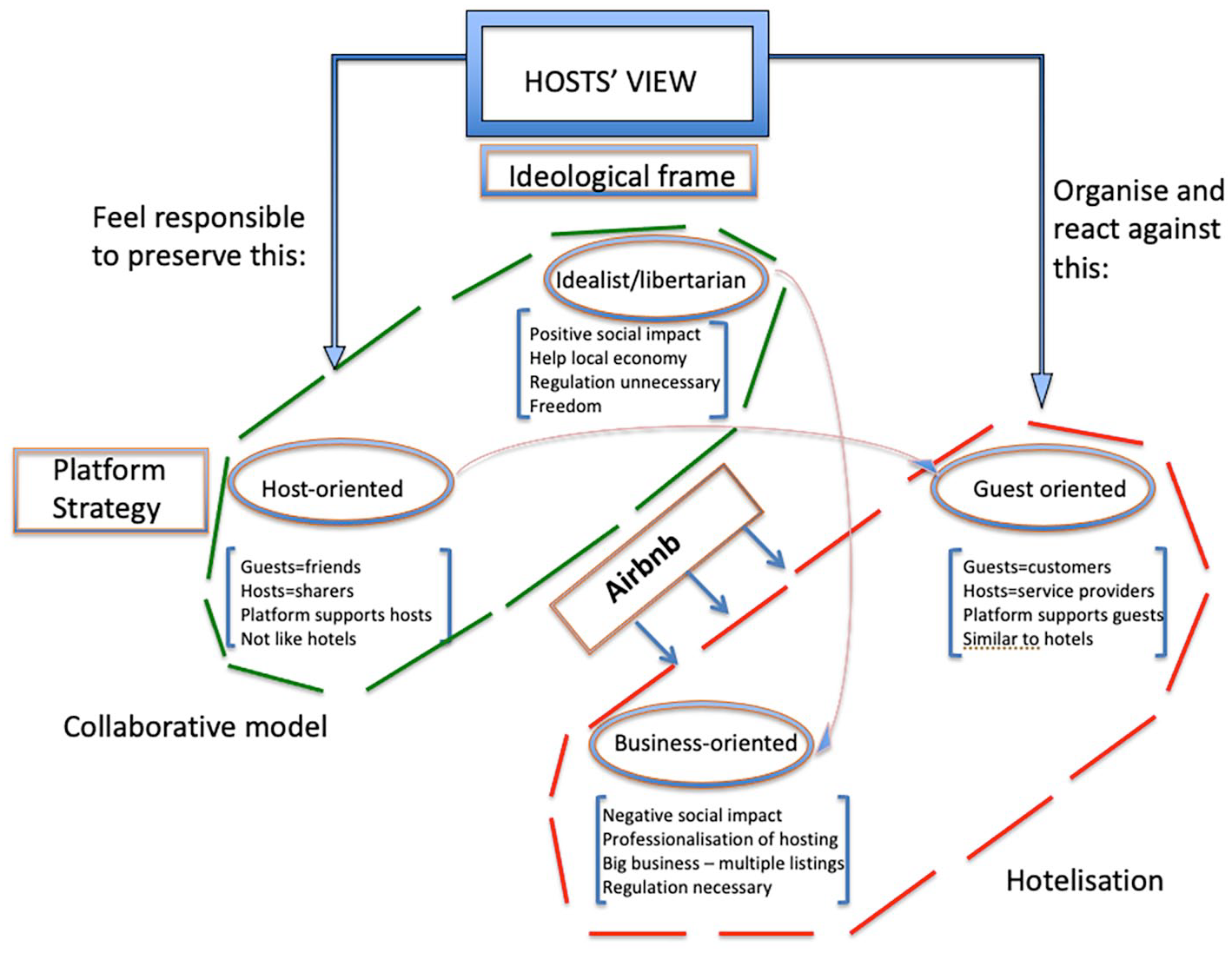
Institutional dynamics: shifting platform strategies towards hotelisation.
Discussion: a house, a home or . . . a hotel?
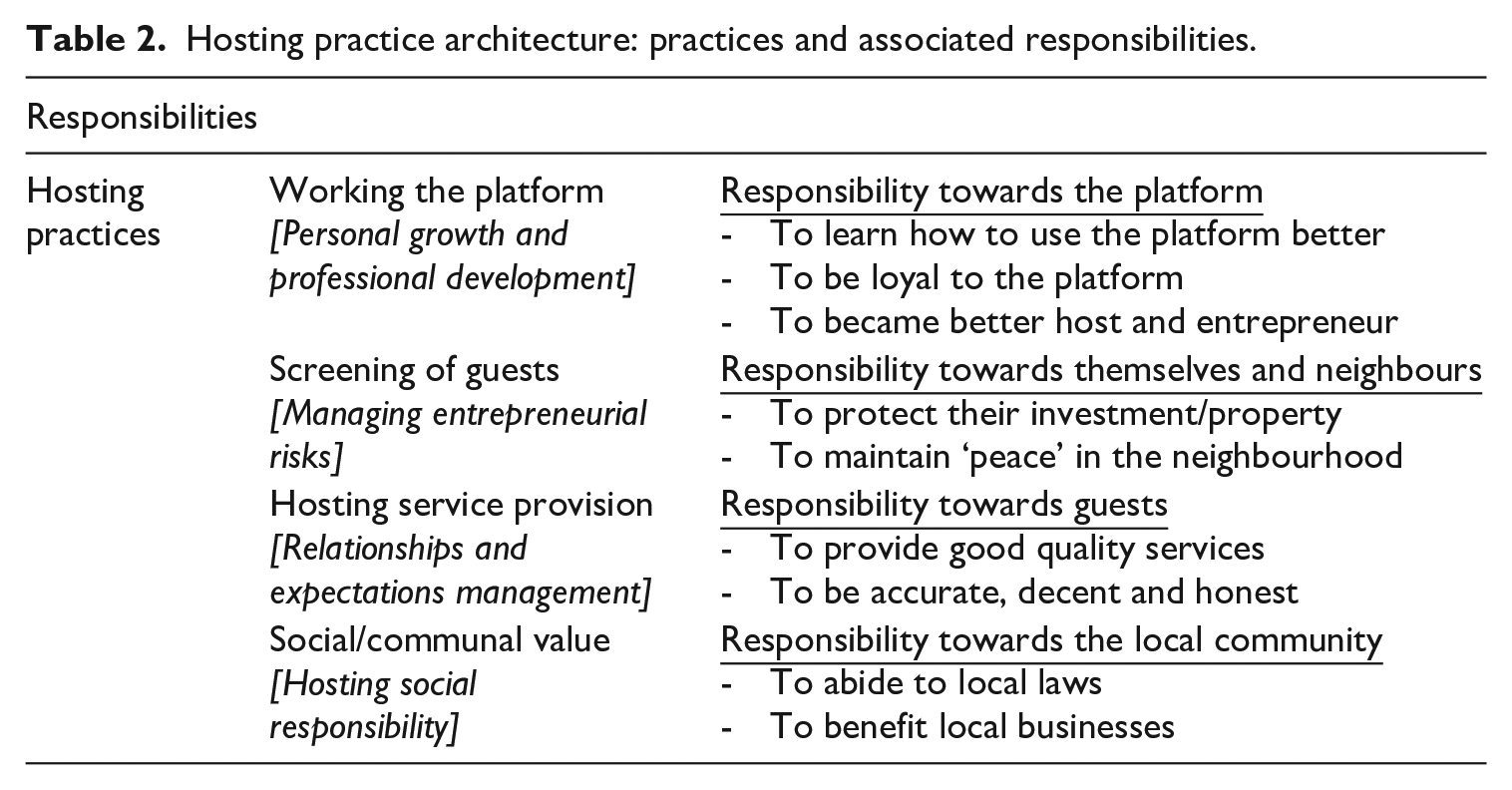
Our findings suggest that the Airbnb hosts we interviewed reflectively engage in identity work to help shape the boundaries of their professional hosting practice, while creating a responsibility framework for that practice. More specifically, they articulate the essential elements of hosting into what might be understood as a hosting ‘practice architecture’ (Kemmis and Grootenboer, 2008). This includes cultural (e.g. moral values of truthfulness and reliability for interactions with guests and managing their expectations), material (e.g. property-related) and socio-political orders and arrangements (e.g. algorithmic, community and platform leader strategy aspects) that enable and constrain their practice (Kemmis and Mutton, 2012). More specifically, within the hosting practice architecture, hosts flesh out the emerging responsibilities they see surfacing for them; however, at the same time, they reflect on the changing industry dynamics also manifested in the platform leader’s strategy. They, therefore, position themselves as custodians of what they perceive to be the original ideological framing of the sharing economy, against the hotelisation of hosting practice. Overall, Airbnb hosts do not simply accept a certain set of responsibilities dictated by the platform leader; instead, they articulate them in the form of a practice architecture, as part of a reflective process of re-defining themselves as hosting professionals. Such practice architecture, as shown in Table 2, includes aspirations for personal growth and professional development; it includes a risk management framework for entrepreneurial and operational risks, skills for managing expectations and relationships with guests and also principles for a hosting social responsibility.
Hosting practice architecture: practices and associated responsibilities.
Alongside a practice architecture, the interviewed hosts position themselves as professionals conceptually but also materially within the broader social context and socio-political arrangements. The fact that Airbnb hosts are engaging with their own responsibilisation may suggest that the sharing economy is empowering them to pursue new, innovative and creative professional identity projects (Giddens, 1991) and that they align their interests with Airbnb’s (Van Doorn, 2020). Our data reveal, however, that Airbnb hosts instead feel threatened by the changing institutional dynamics facilitated by shifting strategy of the platform owner towards ‘hotelisation’ of hosting. It seems that Airbnb has already shifted from a focus on guests, that is, an opportunity to belong everywhere through the ‘homes’ and not ‘houses’ listed on Airbnb to a focus on empowering hosts as middle-class struggling entrepreneurs (Van Doorn, 2020). Our research suggests that there is a shift back towards guests. This time, however, the attention is not on guests’ needs of belonging to a global home, but rather on their needs as hotel customers. A third component is therefore added to the debate on whether Airbnb offers a house or a home, and that is ‘a hotel’. The hotelisation of hosting as perceived by hosts is seen not as empowering but as a threatening and challenging process (Ashforth and Kreiner, 1999; Brown and Coupland, 2015), experienced as a discontent and disenfranchisement by the hosts. As we have seen, they saw their responsibilities increasing and also distanced from the early ideological framing of the sharing economy. Airbnb hosts do not simply seek to pursue a new identity project because they feel empowered; rather, they are being creative in finding responses to threats caused by institutional transformations outside of their control. Their identity work inevitably becomes a ‘natural response to a threat’ (Beech et al., 2016: 508) and the strains (Sveningsson and Alvesson, 2003) imposed by Airbnb’s hotelisation strategies. The hosts’ contribution to the responsibilisation process therefore is not solely aimed at supporting the interests of the platform leader and implement their sharing economy vision; rather, it has a reactionary and critical nature against hotel-style hosting.
Resocialisation of economic exchanges in the context of Airbnb does not simply mean commodification of sociality, meaning subjecting social relations into economic logics (making profit for something that you would previously offer for free), but to take things further, Airbnb’s hotelisation strategies, contrary to what is publicly promoted in their governance rhetoric, seek to normatively embed hosting within industrial and organisational practices that the Airbnb model is supposed to disrupt (i.e. hotel industry). Pushing hosts to adopt hotel-style approaches to hosting poses existential threats to hosts’ social reproduction as emerging practitioners who feel penalised and abandoned by the platform leader. On the one hand, they are being responsibilised to offer their homes to support sustainable tourism, while, on the other hand, they feel pressured to act as hotels.
Conclusion
The article is empirically grounded in the context of a historical snapshot of Airbnb’s shift from a community-based sharing economy governance model to a version of platform capitalism. Indeed, in the early days, Airbnb was seeking to economically empower middle-class homeowners and instil in them a sense of civic purpose (Van Doorn, 2020), but more recently, this shifted towards hotelisation of hosting and a focus on customer service.
Airbnb host responsibilisation, which is driving this strategic shift, unfolds as a process of identity work whereby hosts are re-defining themselves as hosting practitioners and entrepreneurs while mapping a hosting practice architecture. Our evidence shows that this on its own is not necessarily evidence of the empowering potential of the sharing economy, but rather evidence of an effort of less authoritative participants to react to the shifting strategies of a powerful institutional agent, the platform leader. In this sense, responsibilisation is not simply an empowering intended outcome of the governance style of the platform leader (e.g. loose control but with support) but rather a reactionary adaptation to it, following a critical interpretation of its shift towards mainstream hotelisation of hosting practice.
This research contributes to an extended and more holistic theoretical understanding of responsibilisation. Specifically, responsibilisation in extant literature is understood as a governance mechanism to practically implement neoliberal projects of powerful institutional agents, or a ‘reflexive subjectivity deemed suitable to partake in the deployment of horizontal authority and one which willingly bears the consequences of its actions’ (Shamir, 2008: 4). Based on our analysis, we suggest that it can also be a process to critically question the intentions or choices of authoritative institutional actors (i.e. platform leader) and be the basis of a reactive response to perceived threats that could undermine the social reproduction of specific groups (i.e. individual hosts). In other words, hosts do undergo responsibilisation and accept certain responsibilities and consequences related to their practice as set out by the platform leader; however, in light of existential threats posed by the platform leader’s shifting strategies, responsibilisation may extend to include critical reactions to the platform leader’s choices. Acknowledging such critical reactions, both in the context of Airbnb but also other similar platforms, may also help understand the links between private interests, both individual (e.g. hosts’) and corporate (e.g. Airbnb’s), and public values, as these become contested while digital platforms infiltrate existing social structures (Van Dijck et al., 2018).
Limitations include the fast pace by which things are changing in Airbnb and the sharing/platform economy more broadly. More specifically, our data which were collected in 2018, after a global pandemic and additional developments in peer-to-peer lodging might seem parochial. However, framing this article as a historical snapshot of the transition of Airbnb’s strategic focus allowed us to leverage interesting insights from our dataset and contribute an original and unique analysis of host responsibilisation.
Future work on the perceptions of participants in digital platforms should adopt this extended understanding of responsibility, not simply as conformity but as a more holistic approach to practicing socio-technical work, which includes critical awareness of the power dynamics between platform owner, the government and individual participants.
Footnotes
Funding
The author(s) received no financial support for the research, authorship and/or publication of this article.
