




Abstract
Scholarship on #MeToo has examined the feminist underpinnings of the movement and affordances of digital platforms to create space for telling stories of sexual harassment and violence. This essay makes a different contribution, in that we seek to understand the impact of the viral version of #MeToo on the established primarily Black community developed by Tarana Burke. In this essay, we use the framework of intersectionality and organizational paradox to examine the differences in the social construction of the two versions of the movement. The framework of intersectionality allows us to examine how the viral version of #MeToo perpetuated by Alyssa Milano reified the social construction of inequalities and interlocking systems of oppression for Black and other women of color. The article examines the effects of Milano’s entrance into the “me too” space on the community built through Burke’s “me too” movement. We identify an illumination/occlusion paradox that creates the illusion of inclusivity, creates difficulty in community boundary management, and allows for outsider gaze into a previously safe space. We argue for moving beyond the considerations of assigning credit for the movement and instead consider the impacts of the paradox of the original community experiencing erasure through the abrupt and swift increased visibility of the hashtag.
In 2006, activist Tarana Burke (2013) created “me too” movement to help Black girls and women to show support through empathy and discuss their experiences of sexual violence. Burke created this empathetic movement to help participants heal and see themselves as survivors rather than victims. This particular space was needed as broader society often ignores Black
1
sexual assault survivors’ pain and they receive minimal justice (National Center on Violence against Women in the Black Community, 2018). Eleven years later, actress Alyssa Milano’s use of the phrase “Me Too” inspired the hashtag #MeToo and ignited a movement initially based on turmoil in the entertainment industry. The hashtag resonated with women and quickly went viral due to the pervasiveness of sexual assault, harassment, and violence (Morgan and Truman, 2018). The #MeToo hashtag capitalized on the network connectivity of social media to allow many survivors to come forward and share their stories. However, the viral nature of this hashtag, while intended to open the discourse to survivors of all races, had the potential to disrupt the already established work of “me too.” As Burke (2021) reports, her reaction to the hashtag was as follows: Seeing “me too” the phrase I had built the word and purpose around, used by people outside of that community, was jarring . . .. My heart dropped at the thoughts of inviting people to open up and share their experience with sexual violence online without a way to help them process it. I knew it could lead to emotional crisis in the absence of caring, empathetic environments. This would be a disaster if it went viral. (para 6)
Yet, #MeToo did go viral, creating a different conversation than the grassroots community Burke (2017) had built to help Black girls and women give and receive empathy and support around sexual violence. In answering Quan-Haase et al.’s (2021) call for increased research on #MeToo, we attempt to center the “me too” movement. Throughout this article, we use the phrase “me too” for Burke’s movement and #MeToo for the viral hashtag. In addition, throughout this article, we will use Burke’s preferred term “survivor” instead of victim to recognize those who are survivors of sexual assault and violence. While discourse and activism surrounding sexual assault and harassment did not start or end with #MeToo (nor “me too”), the hashtag created a flashpoint for discourse.
While the hashtag provided a voice (or platform) for more voices to be seen and heard, the hashtag also decentered the most marginalized and vulnerable leaving them on the fringes of this viral movement (Clark-Parsons, 2021; Onwuachi-Willig, 2018). As Phipps (2019) stated the “historical dynamics prevail in #metoo and other public feminisms around sexual violence, which foreground a woundedness that is partially dependent on tropes of racist domination, even while articulating the gendered harm of sexual violence” (p. 12). Using Stohl and Cheney’s (2001) concept of organizational paradox, we articulate in this essay, how the sudden increase in visibility paradoxically led to the erasure of Black voices causing harm to the established “me too” movement. Specifically, we argue #MeToo created a paradox that at once illuminated the experiences of some survivors of sexual abuse while occluding the work and goals of the “me too” community. This paradox led to an illusion of inclusivity, problems in maintaining “me too’s” community boundaries, and introduced unwanted gaze into a carefully developed safe space.
The viral movement positioned sexual violence as occurring through a singular identity lens, gender, occluding the experiences of those who experience sexual violence from an intersectional position 2 (Chawla, 2019, see also Ibrahim, 2021). While ultimately sexual violence faced by women is the result of patriarchal systems, women in different intersectional positions have different needs and require different strategies. Failure to understand the different intersectional positions of “me too” and #MeToo leads to a misunderstanding of the potential harms #MeToo posed to “me too.” Burke’s (2017) work focused on creating a space for Black girls and women to support and assist each other in healing. Jane (2017) argued feminist digilantism often relies on “calling out” strategies. However, such campaigns function best for individuals who have a certain level of societal power, such as celebrities (Zarkov and Davis, 2018). Black women typically have not experienced justice in this way (Dougherty and Calafell, 2019). Instead, the injustices Black women experiences are complicated by their intersectional position.
Historical and cultural narratives related to intersectional identity are important for understanding the effects and experiences of Black women, particularly regarding sexual assault. Law professor Kimberlé Crenshaw (1993) coined the term “intersectionality” to describe how people with multiple marginalized social identities, such as gender and race, experience marginalization and discrimination differently than a single identity, such as a race-only lens or gender-only lens. Moreover, these intersections of race and gender cannot fully be understood separately; furthermore, this does not capture experiences of those who possess overlaps intersections of race and gender (i.e. Black women).
Thus, we will argue, in failing to appreciate the identity concerns of the original movement, the sudden viral proliferation of #MeToo created specific, generally unaddressed challenges and harms for the “me too” movement. Although Milano made attempts to make amends with Burke by providing attribution of the movement to Burke, the proffered repair strategy of assigning credit, cannot fully repair the damage of virality to an established, grassroots community movement. Furthermore, the offer assumes desiring “credit” is the goal of the “me too” movement organizers despite their voices claiming other specific goals of creating a community to help Black women find support for the sexual violence they have experienced. The desire to build a coherent, sustainable community for Black sexual violence survivors, Burke’s “me too” movement, is inherently at odds with the viral #MeToo movement due to the different intersectional positions and goals of the two movements.
“me too”
We begin, where “me too” began, as an anti-sexual violence campaign founded in 2006. Burke’s “me too” movement was a local, small-scale grassroots project created to help survivors of sexual violence. In Burke’s (2013) words, her vision
from the beginning was to address both the dearth in resources for survivors of sexual violence and to build a community of advocates, driven by survivors, who will be at the forefront of creating solutions to interrupt sexual violence in their communities. (para 3)
Burke’s “me too” movement identified experiences of sexual assault and violence among Black girls and women. The movement actively worked to create a space for sexual violence survivors to support one another. This movement provided a space to heal and claim survivorship not victimhood (Ohlheiser, 2017). Importantly, the movement’s objective was to create a haven of community; a space where girls and women could safely share their experiences and lift each other in support (Burke, 2018). Burke’s (2018) movement encouraged survivors to stand in their truth helping them to restore their humanity, challenging how people think about sexual violence, and “examining the ways that unchecked privilege and power accumulate and are wielded against the most vulnerable.”
While Burke’s movement used the Internet to create a network of women, the movement was created specifically from and for a specific intersectional group: Black women who were survivors of sexual violence. Historically, the voices of Black women are not heard and their bodies are not seen as worthy of saving (Collins, 2002, 2004). Collins (1986) discussed this “outsider within” status Black women possess as they navigate white society. Collins described this as Black girls and women having close and intimate encounters with white families yet remaining outsiders in the margins. This “outsider within” status occurs within the context of sexual assault as Black women and girls are still often left on the fringes of society as they try to seek justice. Hence, Burke (2017) felt the need to center her own community, often otherwise left on the edges of discussion regarding sexual justice.
Intersectionality
Burke’s creation of the “me too” movement embodies a specific intersectional framework. Intersectionality is a lens for the analysis of social movements and interactions allowing researchers to “grapple with interlocking forms of oppression” (Collins and Bilge, 2016: 43). Understanding intersectionality’s effect on identity frameworks is not a new phenomenon. Intersectionality has a rich genealogy rooted in Black Queer Feminist work and the foundational work of earlier voices for Black women, Sojourner Truth and Ida B. Wells (Collins and Bilge, 2016). Violence against women has been a powerful catalyst for intersectional analysis. As violence seems increasingly ubiquitous within a global context, intersectional analyses of violence against women are needed to inform political activism and public policy. Using intersectionality as an analytical tool fosters a broader conception of how heterogeneous forms of violence contribute to social inequality and social injustice.
An intersectional frame is particularly important for examining both the #MeToo viral movement and considerations of violence perpetrated against women of color. Collins and Bilge (2016) argued “gender-only lenses of male perpetrators and female victims, or race-only lenses that elevate police violence against Black men over domestic violence against Black women show the limitations of non-intersectional thinking” (p. 49). Society often fails to address and grapple with issues of violence when the survivors’ experience is grounded in an intersectional space. Cho et al. (2013) noted in the case of discrimination, Black male and white female narratives of discrimination were understood to be fully inclusive and universal, Black female narratives were rendered partial, unrecognizable, something apart from standard claims of race discrimination or gender discrimination. (p. 791)
As Crenshaw (1993) stated, Rape and other sexual abuse in the work context, now termed sexual harassment, have been a condition of Black women’s work life for centuries. Forced sexual access to Black women was of course institutionalized in slavery and was central to its reproduction. During the period when the domination of white women was justified and reinforced by the nineteenth-century separate-spheres ideology, the few privileges of separate spheres were not available to Black women at all. Instead, the subordination of African-American women recognized few boundaries between public and private life. Rape and other sexual abuses were justified by myths that Black women were sexually voracious, that they were sexually indiscriminate, and that they readily copulated with animals, most frequently imagined to be apes and monkeys. (p. 411)
Burke’s “me too” movement allowed Black women to draw upon their shared intersectional identity and experiences to shape how they could connect and safely share their survival stories of sexual abuse, assault harassment, and exploitation. These shared survivor stories allowed them to fully articulate their position as Black women from low wealth communities. Their narratives could be wholly accepted by others sharing similar intersectional positions without having to contort their stories to the frame of dominant or idealized images of sexual victims.
Applying an intersectional lens to the variations on the #MeToo movement allows us to understand how the viral version of the movement could engender harm against the community-based movement while furthering awareness of violence against women overall. Intersectionality allows us to reorient our perceptions from singular to multiple lens (Collins and Bilge, 2016). Solutions to violence against women remain unlikely if violence against women is imagined through singular lenses of just “gender, race or class” (Collins and Bilge, 2016: 49). This singular lens thinking can undermine and limit those who lie within the margins. The insistence of intersectionality scholars on examining the dynamics perpetuating the categories we live within as fluid and always in the process of creating and being created by dynamics of power allows academics and activists to understand how power works in diffuse and differentiated ways (Cho et al., 2013).
Intersectional analysis is no stranger to digital spaces. The perspective has been used as a foundation to analyze social movement hashtags to discuss discourse and exclusion between feminism and marginalized communities (Conley, 2017; Śliwa et al., 2018). The Internet is not immune to gender, class, and racial hierarchies (Nakamura, 2013). Indeed, offline inequalities often manifest online via digital technology (Gray, 2012). Understanding the intersectional experiences occurring in online spaces helps us to examine how and why #MeToo might reify further inequities.
#MeToo
On 15 October 2017, Hollywood actress, Alyssa Milano tweeted the following (see Figure 1):
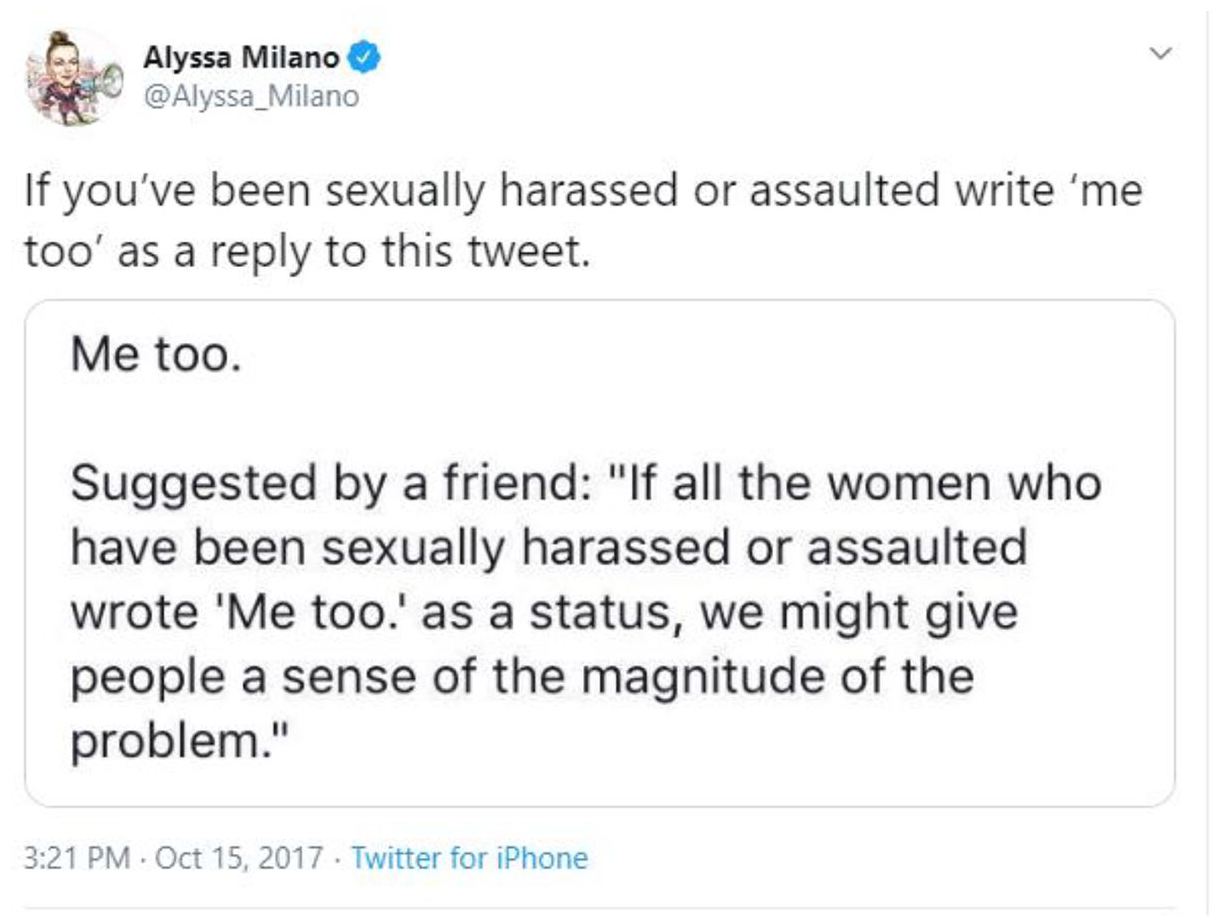
Alyssa Milano’s #MeToo tweet from October 2017.
Within the first 24 hours, there were more than 70,000 replies to the tweet (Zillman, 2017). Across social media, there were more than 4.5 million posts tagged #MeToo (Radu, 2017). Within the week, popular press articles appeared in The New York Times, Washington Post, CNN, The Guardian, Wired, NBC News, U.S. News & World Report, The Atlantic, Vox, The New Yorker, and ABC News.
Milano’s tweet was in the context of actresses accusing Hollywood producer Harvey Weinstein of sexual assault. However, her tweet was perfectly placed to have a viral moment due to her celebrity, the connectivity of Twitter, and the broad umbrella the tweet provided for sexual assault survivors. Disclosures of sexual abuse were already beginning to bubble up online as social media platforms allowed women to connect their experiences (Mendes et al., 2018). Milano’s tweet was captured sentiments of earlier hashtags, such as #BeenRapedNeverReported and quickly went viral.
Milano’s position as a white woman and a celebrity contributed to the initial visibility of the tweet. On October 15, 2017, Milano had over a million followers. Celebrities’ position in society can amplify messages and quickly capture public attention (Ellcessor, 2018). Furthermore, Milano’s specific position as a white woman may have also allowed greater message amplification (Clark-Parsons, 2021). While it could be Milano’s star power and not her whiteness contributing to the viral message, actress, activist, and sexual assault survivor, Gabrielle Union commented #MeToo resulted in the following: the floodgates opened for white women. I don’t think it’s a coincidence whose pain has been taken seriously. Whose pain we have showed historically and continued to show. Whose pain is tolerable and whose pain is intolerable. And whose pain needs to be addressed now. (Judge, 2017: para 7)
Twitter itself is a common site of social movements (Jackson et al., 2020). The short message format, open networks, and ease of re-tweeting and connecting tweets together with hashtags allows for movements to form quite quickly. Tufecki (2017: 55) noted Twitter’s design affordances allow anyone to “generate a whirlwind of attention” if the content is compelling. Twitter’s design allows messages to quickly flow through networks even if people are not directly following each other. Hashtags allow users to circumvent traditional media and engage in public speech (Jackson et al., 2020).
Hashtags can facilitate more horizontal movement-building arising from grievances (Tufecki, 2017). Such is the case with #MeToo, while the version Burke built was specifically for Black women, Milano called upon “all the women.” Given (a) the prevalence of sexual assault and harassment (McDonald, 2012; Morgan and Truman, 2018), (b) the difficulty of accessing justice in these cases (Randall, 2010), and (c) the tendency of the mass media to create narratives regarding the worthiness of the victim (Suarez and Gadalla, 2010), the #MeToo version tapped into a deep well of women unable to seek justice through other formats. The more democratic and horizontal networked nature of Twitter allowed for sharing these personal stories.
Milano received much early praise for #MeToo. The tweet was groundbreaking for its virality and encouraged women to share their stories. These stories led to calling out the patriarchal, sexist systems of both Hollywood and society writ large while highlighting the ubiquity of sexual violence against women across the globe. Although, many pointed out Burke founded “me too” nearly a decade before Milano tossed #MeToo to the Twitterati, this issue seemed easily resolved with Milano acknowledging Burke and her work. Indeed, Milano and Burke made TV appearances together and Milano to this day regularly speaks highly of Burke and retweets her messages (Today, 2017). And yet . . . similar to how the Today show presented the two women as “Milano and #MeToo movement founder,” Milano’s viral version of the #MeToo movement introduces difficult to articulate harms while seeming to elevate Burke. This difficulty arises because these harms stem from a paradox derived from the intersectional position of Black women, and thus are not easily seen and oft elided by white women. In several ways, the Milano #MeToo recreates previous instances of white feminism borrowing from Black women when it is desirable for white women without following through on creating greater equity and justice for Black women (Dougherty and Calafell, 2019; hooks, 1995; Marbley, 2005; Onwuachi-Willig, 2018). As Taylor (2019) argued, The only limit of intersectional politics for Black women and women of color often comes when you white women decide to be intersectional when it suits you. It is this linguistic and rhetorical tactic that has left many Black women and women of color to regard white women’s calls for intersectionality as the equivalent of a social justice booty call. Many are still waiting for you nice white ladies to show up. The reality is that until white women show up for the projects, protests, marches, and movements that are not directly about you, not to take up space, but to support women of color, work of feminism will always be incomplete. (pp. 188–189)
The “me too” / #MeToo paradox
We borrow the concept of paradox from organizational communication literature to consider the harm to the Burke movement by Milano’s tweet (Stohl and Cheney, 2001: 352). The paradox we identify is that the viral exposure of the Burke “me too” movement by the #MeToo tweet at once illuminates the experiences of the women who shared stories at Milano’s urging while occluding the work Burke and fellow Black women had accomplished to create safe community spaces for sexual harassment survivors. To expand the metaphor, the rhetorical light shining upon the issue through social media still creates shadows occluding the foundational work of Black women.
We note the existence of the paradox makes it difficult for some to see why Milano’s tweet was harmful to “me too.” If one is in a position where shining a light on the existence of sexual violence is seen as useful and believes an outed perpetrator might experience some recourse then illumination seems a key strategy to furthering the cause. Indeed, we see this belief in illumination in action in naming Burke as an early founder of the movement, while doing little else to repair other damages. This illumination occludes that Burke was not engaged in a widespread naming and shaming campaign like #MeToo rather her work was building a community, sheltered away from the gaze of others, in which women could support each other and heal. To turn the world’s gaze directly on that community with the spotlight of a viral tweet is to do damage to a decade’s worth of work creating that space.
Although developed for organizational analysis, Stohl and Cheney (2001) argued, “an entire class of social situations may be identified and analyzed in which the pursuit of an objective involves actions that are themselves antithetical to the desired end” (p. 354). In addition, “paradox delimits options for participants in a system, particularly if there is little awareness of what is happening or if the members are unable to comment on it” (Stohl and Cheney, 2001: 352). The concept of paradox has been used to examine social movements (see Ganesh and Stohl, 2013) and non-traditional organizations (Harter and Krone, 2001). Scholars have examined paradox in organizational diversity work (Mease, 2016) and feminist organizations (Linabary and Hamel, 2015).
One of the reasons our argument is important is because it puts a name to the paradox introduced by the co-option of the “me too” phrase, potentially allowing the affected community and future scholars to more fully understand and discuss the potential issues and harms. Stohl and Cheney (2001) argued “naming, explaining, and illustrating various paradoxes” can allow for “greater sensitivity to these challenges” (p. 352). We argue the illumination/occlusion paradox can only be understood from an intersectional lens. The intersectional lens allows us to understand that Burke’s community comes from a positionality of being both Black and women.
White feminists may feel unsettled in reading the exposure they sought through sharing their #MeToo stories might harm other women of different intersectional backgrounds. This is the nature of paradox. “Paradoxes are usually surprising, ironic, unintended, contrary to expectations and unsettling: Paradoxes are contradictions with an added element of interdependence” (Stohl and Cheney, 2001: 355). Yet, recognizing, naming, and calling out this paradox has allowed us to develop an understanding of three harms to the “me too” movement resulting from Milano’s tweet. First, that too easily “all the women” becomes a movement for “white women” turning #MeToo into a tool for white feminists built upon the work of Black women. Second, the exposure of “me too” to the #MeToo-facilitated gaze destroyed the community boundaries developed and carefully crafted by Burke and the other leaders of the “me too” movement. Third, this increased visibility was antithetical to the goals of “me too” which revolved around creating a safe space for a stigmatized identity concern.
All women = white women
The viral nature of #MeToo created what we call an illusion of inclusivity. This inclusive illusion suggests all women were incorporated into the #MeToo movement under the guise of the words “all women” yet the immediate focus is on white women which inherently excludes others. Thapar-Björkert and Tlostanova (2018) have argued that feminism is often positioned as universal and neutral for women. However, as whiteness scholars (Nakayama and Martin, 1998; Phipps, 2019) note, “neutral” is often code for “white.” Thus, it is unsurprising that women who were white, affluent, cisgender, and conventionally attractive were more likely to have their #MeToo posts amplified (Harris, 2017; Tambe, 2018) and taken seriously (Clark-Parsons, 2021). Women who did not fit these categories were less likely to perceive the #MeToo movement as being for them. Tweets from women of color noted the #MeToo conversation felt centered around women who were rich, white, cis, and privileged (Clark-Parsons, 2021). Activist Bree Newsome (2018, January 18) tweeted, While Tarana Burke & Alicia Garza have been pushing for MeToo to focus on the conditions of domestic workers, poor women and women of color, white feminists like Margaret Atwood continually focus on the movement’s potential negative impact on (mostly white) men . . . and in doing so, they, in typical white feminsting fashion, completely ignore the leadership of BW [Black Women] in favor of centering themselves & their perspective—perspective woefully ill-equipped to grasp the racialized gender & class dynamics of rape culture.
The illusion of inclusivity echoes how Crenshaw (1989: 154) described the relationship of feminist theory for Black women. She stated, the value of feminist theory to Black women is diminished because it evolves from a white racial context that is seldom acknowledged. Not only are women of colour in fact overlooked, but their exclusion is reinforced when white women speak for and as women.
Other scholars have also noted feminism traditionally centers white women’s experiences. This speaking of “all women” on the surface appears to be inclusive, however, with further exploration the frame reveals exclusion.
As hooks (1981, emphasis ours) writes, the white American woman’s experience is made synonymous with the American woman’s experience, While it is in no way racist for any author to write a book exclusively about white women, it is fundamentally racist for books to be published that focus solely on the American white woman’s experience in which that experience is assumed to be the American women’s experience. (p. 137)
Audre Lorde (1984) has also critiqued “all women” language stating, To imply, however, that all women suffer the same oppression simply because we are women is to lose sight of the many varied tools of patriarchy. It is to ignore how those tools are used by women without awareness against each other. (p. 64)
The viral response to #MeToo appears at first to stand for all American women. But without recognizing the need for intersectional communities, Milano engages in the very messaging hooks and Lorde critique. In addition, when others brought to attention that Burke had been using the “me too” phrase for nearly a decade later, the answer appeared to be to simply give Burke credit for the phrase. Yet, simply assigning credit does not erase the damage done when white women’s experiences begin to stand in as the discussion of all women’s experiences while Black women have very different experiences of both sexual violence and survivorship.
In this the #MeToo movement’s erasure of the “me too” movement mimics the way social movements like SlutWalk, It Gets Better project and Occupy Wall Street have been well-intentioned and yet “inadvertently (re)produce oppression along with one and several axes of power—even while attempting to combat it along other axes” (Bilge, 2012: 19). Bilge criticized these movements as failing to take into account intersectionality and the interlocking makeup of power and privilege. A similar sentiment can be expressed through Milano’s initial tweet calling for “all the women.” As hooks (1981) argued, a call for all women too often becomes about the experiences of white women while ignoring or reproducing the oppression of Black women. Attempts to tell stories for all women elide crucial intersectional differences around race, class, and sexuality, and prevent other stories from being told (Serisier, 2007).
Indeed, the widespread media coverage of Milano’s tweet centered a white woman’s pain, leaving Black women’s pain out of the conversation (Taylor, 2019). Adding insult to injury, scholars and the media often leave Burke’s name in the margins, as a footnote, or leave her work out of the story altogether (as noted by Chawla, 2019; Dougherty and Calafell, 2019; Taylor, 2019). This is amplified by mainstream media coverage leaving Burke out of the initial story (France, 2017; Haynes, 2017; Schmidt, 2017). Burke was invited on the Today show but with Milano. While Burke navigates a rhetorically difficult space in the interests of protecting her movement, there are also glimpses of her understanding the differences between #MeToo and “me too.” In a tweet responding to a Black woman who expressed feeling left out by #MeToo, Burke responded (2018, February 22), “I see you sis. The work *I* do sees you and acknowledges you.”
By not appreciating the prior work of Black women before tweeting #MeToo, Milano created this paradox. For white feminists and white survivors of sexual violence on Twitter, they hold enough power and privilege to have an expectation others will listen to their story. Black women and other women of color may both experience sexual violence at a greater level (Crenshaw, 1989, 1993; National Center on Violence against Women in the Black Community, 2018; Onwuachi-Willig, 2018) and have lower expectations regarding justice. Although Milano fairly regularly attempts to amplify Burke’s voice through her Twitter feed, #MeToo also subverted a movement devoted to protecting and holding space for Black women to a force seeking legal justice for crimes against highly privileged women.
Community boundary management
As the stories of all women began to overwhelm #MeToo there is a danger that Black women’s stories will be seen a “just another” #MeToo or the same experience as white women’s when their stories are from a different positionality in the patriarchal frame. The JustBeInc.’s mission statement was to “guide young women of color . . . to find the tool necessary to be empowered” (JustBeInc.com, n.d.). The intrusion of white women into the “me too” community runs the risk of washing away the needs and desires of Black women who were already participating in the movement.
Much of the literature on online activism has examined the use of Twitter to build awareness and information regarding a particular social movement. In some cases, building awareness can also be connected to the accumulation of other resources. For example, when the amyotrophic lateral sclerosis (ALS) “Ice Bucket” campaign went “viral,” the association also found itself with a considerable increase in donations (Haynes, 2019). However, activism may be the most sustainable when connected to a developed organizational structure (Tufecki, 2017).
The viral #MeToo movement was able to take advantage of organizational structures in place, by recognizing and pulling Burke and her “me too” community into the #MeToo discourse. “me too” had systematically and carefully built the foundation for a movement. The Milano tweet brought forth thousands if not millions of others into the fray without socializing them into the “me too” cause and goals.
For some women and survivors of sexual violence, the #MeToo movement has been helpful and perhaps cathartic, but the women of “me too” were not invited to the framing and construction of that conversation. Indeed, the “me too” movement was forced into reacting to the virality of #MeToo and expected to look gracious and grateful while doing so. As Taylor (2019) argued, “Burke did what so many Black women before her have done and continue to do; she owned her rhetorical space,” by activating her agency to remain in the conversation and center the conversation on healing and activism (p. 188). Still this activation could not prevent some erasure of Black women from the #MeToo discourse (Conner, 2018). Hence, Burke and “me too” were left in a double-bind resulting from the illumination–occlusion paradox.
Managing community boundaries is an important component of sustaining a long-lasting grassroots organization. As noted, the “me too” movement began as a grassroots community effort. Burke worked to develop skills and forums for Black girls and women to discuss sexual violence both within the Black community and society (metoomvmt.org, n.d.). Burke’s community-building, culturally informed approach was vital to the stated goals of the movement, supporting survivors, holding perpetrators accountable, and implementing long-term, systemic change (metoomvmt.org, n.d.). Over time, “me too” began to incorporate digital community building to connect survivors to resources.
Although not primarily an online community, Burke’s community was required in the #MeToo era to handle a digital viral onslaught of #MeToo constituents. However, viral communication and constituents can be difficult to manage (Tufecki, 2017). An influx of new members and voices into an established community may threaten the integrity of that community (Yeshua-Katz, 2016). It may be particularly important for communities to be able to maintain the boundaries of their group. Communities may feel more sustainable when they are a size where members feel they know each other (Butler, 2001).
Research has found deluges of new members may be worrying for current group members. Panek et al. (2019) noted that large influxes of newcomers to an online community can disrupt users’ sense of continuity and coherence to community norms. They found an influx of newcomers to the reddit, TwoXChromosomes, changed the nature of the board. While Panek et al. (2019) argued the newer version of TwoXChromosomes is still a legitimate community, the massive wave of newcomers still resulted in a loss of community for participants in the earlier version of the board.
Although Burke’s movement was primarily with some digital outreach, we draw parallels to the TwoXChromosomes example in how “me too” had #MeToo thrust upon their community without warning. Milano and followers may have been in earnest, but they did not familiarize themselves with the movement they were disrupting. #MeToo’s sudden incursion into the “me too” community allowed for none of the thoughtfulness, planning, negotiation, or engagement to occur that might have allowed for a coordinated facilitation of new constituents into the “me too” space. Most egregiously “me too” was never allowed the opportunity to say “No” to participating in the viral #MeToo discourse.
Community boundaries are often implicit until breached (Honeycutt, 2005). The intrusion of white women into the #MeToo community runs the risk of washing away the needs and desires of Black women already participating in the movement. At the very least, in one short tweet, Milano erased the pre-existing “me too” community’s ability to define their boundaries and defend the necessity of their group’s experience. Thus, the viral #MeToo, at the same time, it amplifies the generalized experience of sexual violence, erases Black agency in developing the narrative of their experience. The paradox also makes it complicated for Burke or others to push back against #MeToo. To do so would likely push them into a rhetorical position of having to defend not illuminating the atrocities of sexual violence and harassment. The discursive position within the paradox creates a conflict between being able claim the space cultivated to share a specific experience based on their intersectional position and potentially being viewed as denying other women space to discuss the experience of sexual violence. “me too” has graciously made the best of viral incursion into their community, but this also represents yet another example of where Black women have been asked to make space for white women’s concerns, while white women are rarely asked to do the reverse and likely feel much less pressure to comply.
We find evidence of “me too” wrestling with this boundary encroachment in Burke’s comments at the Aspen Ideas Festival in 2018 (Garber, 2018). “Part of the challenge we have right now,” Burke said, “is everybody trying to couch everything under #MeToo” (Garber, 2018). The visibility of #MeToo helped create the big tent Burke is concerned about—“What I’m saying is that, as a person who’s doing the work, and knows other people who are doing this work, it’s hurtful to us,” Burke said. “It is hurting the work that we’re trying to do. Because you can’t cover so much, and so many things. And sexual violence is wide enough” (Garber, 2018).
Gazing into a safe space
While both movements are focused on sexual violence and harassment, the goals and motivation of “me too” and #MeToo are often at odds. #MeToo is a call for greater visibility, to push narratives of sexual assault into the collective view. “me too,” on the other hand, was the calling for a community of Black women to have space away from public view to process and heal. There is something unsettlingly ironic that women who built a community focused on creating a safe space to discuss the impact of sexual violence on their lives are now forced to manage the intrusion of the public, and predominantly white gaze, into their space. The excessive visibility of a viral hashtag opens up members of the community to increased potential for online harassment and abuse (Citron, 2014).
Understanding sexual violence from an intersectional position allows for the understanding that different coping strategies may be necessary for how women address the violence they have experienced. Furthermore, women have agency and should be allowed to choose their own coping strategies. The intensity of the gaze created by #MeToo forced Burke and her community to change their coping strategies and create messaging and performances for an audience of primarily white women. The primary repair strategy we see within the #MeToo community, assigning credit to Burke, is fundamentally constructed from a position of whiteness, and thus fails to recognize the harm of introducing white gaze into these spaces and does not repair the damages articulated within this essay.
Centering intersectionality
Whiteness, even in feminist spaces, intrudes upon the collective efforts of established communities and co-opts the terms and experiences of carefully constructed and profoundly intersectional spaces to serve the ends of white feminism. Note while Milano’s #MeToo movement seeks and expects justice within the current political and legal power structures, Burke’s #MeToo community seeks comfort and support from each other in a forum peripheral to formal justice structures that have proved time and again to not support Black women (Clark-Parsons, 2021; Lang, 2019). The intersectional identity of the survivor influences the way women can(not) seek restoration for the sexual violence they experience. Other researchers have examined how different intersectional positions change a survivor’s ability or willingness to speak out about the violence they experience (Chawla, 2019; Moitra et al., 2020).
An intersectional perspective is key to both understanding different women’s positions within the broader discourse regarding sexual violence and was crucial for identifying the illumination–occlusion paradox. Intersectionality helps reveal how power works in diffused and differentiated ways through the creation and deployment of overlapping identity categories (Cho et al., 2013). Our lens of intersectionality is what allows greater understanding that the benefits and repercussions of #MeToo would likely be experienced very differently depending upon one’s intersectional position. In addition, framing the “me too”/#MeToo from an intersectional perspective allows us to draw contrast between the women of the “me too” movement and the #MeToo movement.
Virality can introduce attention and awareness into a movement. Yet, attention and awareness are not necessarily public goods. Sexual violence occurs within specific intersectional spaces. The frameworks perpetrators and victims use to make sense of their experiences are dependent upon the cultural frameworks within which the violence exists. Thus, a large-scale “all women together” movement cannot hold with explicitly recognizing the different experiences women bring to the movement. Evidence of this is found in the derivative hashtags (e.g. #mosquemetoo, #metooLGBTQ, #metooTrans, #metooblkchurch, and #metooChina) emerging after #MeToo went viral and the proliferation. In a concurrent project, the first author of this article developed the term “hashtag derivative” as a hashtag whose composition varies on but strongly reflects the original hashtag.
The appearance of these derivative hashtags provides evidence that while women of all races and ethnicities and cultural backgrounds experience sexual violence, harassment, or the threat of sexual violence, the intersectional position of this survivors of this violence matters a great deal for making sense of their experience and connecting with community members with similar experiences.
Conclusion
Our examination of these phenomena through an intersectional lens allows us to articulate the potential for harm when existing intersectional communities are forced to restructure and reorient due to the intrusion of whiteness. “Whether it is intended, the recognition of paradox is a very powerful experience. The productive handling of paradox requires some sort of synthesis and transcendence” (Stohl and Cheney, 2001: 356). “Using intersectionality as a heuristic has also prove to be especially valuable in rethinking the important social constructs of identity and subjectivity” (Collins, 2019: 37).
The #MeToo hashtag exposed the ubiquity of sexual violence, yet also revealed a consistent pattern of the elevation of white voices while ignoring or co-opting the work and voices of women of color. Providing Burke with credit for the movement was perhaps an improvement on the part of white activists but is not sufficient. We are concerned that as Burke noted in the recent Times article that the bright spotlight of viral hashtags may work against activists forming communities of support for sexual violence survivors. As women come together to combat patriarchal violence, we must be cognizant of intersectional identities and hold space for Black survivors’ communities without co-opting the work of those communities. When the wounds of white women are centered in movements around sexual violence, then “the much greater diversity of survivorship, scholarship, and political action tends to be erased” (Phipps, 2019: 9).
The intersectional lens articulated in this article allow us to understand more deeply how the #MeToo viral movement paradoxically illuminated experiences of sexual violence while occluding the work of “me too.” This paradox mirrors constraints and considerations of how Black women cope with sexual violence. We align our arguments with Moon and Holling (2020) who noted “(white) feminists must work deliberately, purposefully, and consistently to explode (white) patriarchal influences in their theory and practice” (p. 2) without erasing the experiences and expertise of women of color (see also Calafell, 2014). Ideally but not fully, our essay may help to avoid furthering a “counterfeit solidarity, false similarity of experience, and distorted significance of shared symbols” (de la Garza, 2019: 176).
Footnotes
Acknowledgements
The authors would like to thank Angela Tate for her valuable contributions to an earlier draft of this article.
Funding
The author(s) received no financial support for the research, authorship, and/or publication of this article.
