




Abstract
The COVID-19 pandemic has led to an increase in the digitalisation of services that poses the risk of digital exclusion, especially among older adults. We examined the predictors of Internet use for services and its increase or decrease among a longitudinal population-based sample of 1426 older adults from Finland aged between 70 and 100 years, gathered in 2017 and 2020. High education and high income positively predicted the use of the Internet for services, and age, deteriorated health and deteriorated memory negatively. High age, low education and a change to living alone predicted a decrease in use. High education predicted the increased Internet use due to COVID-19. Thus, it seems that those older adults who have low education level are very old, whose health or memory has deteriorated and those who have changed to living alone are particularly in danger of digital exclusion. Actions targeted to these people are needed.
Introduction
The COVID-19 pandemic has led to a remarkable increase in the digitalisation of different services, such as health care, governmental and retail services (Demeke et al., 2020; Statista, 2021; Tammaro, 2020; Wallis et al., 2021). These Internet services offer many benefits and possibilities for running daily errands without meeting anybody face to face. However, people do not have equal possibilities to meet these requirements. The increased provision of Internet services poses significant risks because, when becoming mainstream, the services may increase existing social inequalities and deepen the digital exclusion of non-users (Helsper and Reisdorf, 2015). At least some older adults have difficulties in taking advantage of all the possibilities that the Internet offers for taking care of their health, well-being, finances and errands. This all comes on top of the fact that COVID-19 pandemic restrictions and the fear of the disease have already widely excluded older adults from face-to-face encounters and social contacts in society. The increased need to use Internet services has the potential to exacerbate this social exclusion due to digital exclusion. This is a serious risk for older adults, given that an increasingly digital society can endanger the availability of many important services (Heponiemi et al., 2020, Heponiemi et al., 2022; Jaffe et al., 2020; Walker et al., 2020) and that way risk older adults’ health, well-being and quality of life. To shed more light on older adults’ Internet use, the present study aimed to examine the associations of socio-economic position (SEP) and changes in health and functioning with use and changes in the use of the Internet for obtaining services in a longitudinal data design among Finnish older adults between 70 and 100 years of age.
The importance of preventing digital exclusion is highlighted in many developed countries. The European Commission has presented a vision and avenues for Europe’s digital transformation by 2030 and, for example, one priority of the Commission’s strategies, namely, the digital single market, aims for an inclusive digital society, which warrants that everybody can contribute to and benefit from the digital economy and society (European Commission, 2021a). Digital exclusion is addressed in some of the activities supported by the European Commission, such as focussing on accessible information and communication technology (ICT), assistive technologies and digital skills.
Literature review
Numerous previous studies suggest that older adults are less likely to use the Internet than younger adults. For example, it has been shown that older adults use the Internet less in general (Quittschalle et al., 2020), search less for information in the Internet (Din et al., 2019; Quittschalle et al., 2020) and are less likely to adopt new information technology (Niehaves and Plattfaut, 2014) compared with younger adults. Moreover, older adults are less likely to use telemedicine and eHealth than younger people (Heponiemi et al., 2020; Jaffe et al., 2020; Walker et al., 2020).
Older adults have been shown to have less access to web-based services (Heponiemi et al., 2020) and a lower likelihood of owning and using a smartphone (Kumar et al., 2019) compared with younger adults. Older adults are less likely to find the Internet useful, and they more often rate access to Internet-based health resources as less important when compared with the ratings of younger people (Hoogland et al., 2020). Moreover, older adults have been found less likely to perceive that they benefit from the web-based services compared with the perceptions of younger adults, and this was at least partly explained by having less access, poorer digital skills and less use among older adults (Heponiemi et al., 2020).
Important determinants of digital exclusion are mostly the same factors for older adults as they are for adults in general. For example, a previous study in the EU showed that people over 55 years old with a lower level of education and a lower standard of living formed a group with the highest risk of digital exclusion (Vasilescu et al., 2020). In addition, high levels of income and education have been found to be important for Internet access, use and skills in older adulthood (Friemel, 2014; Hunsaker and Hargittai, 2018). Among those aged over 75 years old, Internet use was more likely among men and those with higher education, a wider social network and a higher health-related quality of life (Quittschalle et al., 2020).
However, there are many factors specifically related to older age that may predispose older adults to problems in the use of the Internet. For example, cognitive and physical problems may affect the use of the Internet for services, especially among the oldest adults (Sakaguchi-Tang et al., 2017). It has been shown that older adults who used the Internet daily performed better in terms of cognitive functioning, processing speed, short-term memory and executive functioning compared with those who did not use the Internet on a daily basis (Wu et al., 2019). Moreover, vision impairment has been found to predispose older adults to a lower level of use of the Internet and health information technology (Choi et al., 2020). Lee et al. (2011) have identified functional limitations, technology-related costs and a lack of support as significant constraints for older adults’ Internet usage.
The present study
The theoretical rationale for the present study comes from theories suggesting that social and digital exclusion are closely intertwined: socioeconomic inequalities and stratification affect possibilities to use information technologies and vice versa (Warschauer, 2004). This may lead to a vicious cycle where social disadvantage may result in digital exclusion, which, in turn, deepens social inequalities (Warschauer, 2004). Helsper’s (2012) corresponding fields model suggests that the resources a person has offline impact on the resources that person has to use online solutions and vice versa. The model proposes four fields of offline resources, that is, economic resources (such as income and education), cultural resources (such as gender), social resources (such as societal activities) and personal resources (such as health).
It has been suggested that one limitation of previous studies related to Internet use is that participant recruitment in many studies excludes adults over 70 years of age and older adults living at residential homes (Friemel, 2014; Hunsaker and Hargittai, 2018). Moreover, Hunsaker and Hargittai (2018) have highlighted that the association of health and well-being indicators with Internet use needs more attention, especially with longitudinal analysis. However, the longitudinal aspect is quite rarely examined in relation to digital exclusion among older adults. The effect of the deterioration of health or functioning on older adults’ use of the Internet is an aspect that needs more attention.
In light of these research gaps, the present study aimed to examine the associations of SEP and changes in health and functioning with use and changes in the use of the Internet for obtaining services in a study period of approximately 4 years among older adults (n = 1426) between 70 and 100 years of age. The present study did not examine directly how social and digital exclusion are intertwined but rather how offline resources predicted Internet use for services and changes in it. Services in this article refer to a wide range of transactions offered via the Internet by public administration and private actors. Services are not limited to certain sectors and include, for example, shopping, banking, ticket sales, tax office, local public and health care services. More specifically, we examined the associations of (a) Internet use for services in general in the follow-up, (b) a decrease of Internet use for services in general during the study period and (c) a self-rated increase in Internet use for health and social services due to COVID-19 in the follow-up with education; income; deteriorated health, vision and memory; and a change to living alone.
We hypothesised the following:
H1. Those with a lower SEP would use the Internet less and decrease their Internet use during the study period,
H2. Those with deteriorated health and functioning would use the Internet less and decrease their Internet use during the study period
H3. Those with a higher SEP would increase their Internet use due to COVID-19.
We used population-based longitudinal survey data from 2017 and 2020 which included residents living in residential homes. In addition to questionnaires, telephone interviews were made for those not responding to the questionnaire to ensure the inclusion of older adults with difficulties in filling out the questionnaire. A longitudinal approach enabled us to capture changes in functioning and actual changes in Internet use during the COVID-19 pandemic. Compared with cross-sectional data, longitudinal data gave as a possibility to examine temporal precedence which is a prerequisite for causal inference.
Methods
Sample
This study was based on the comprehensive, nationally representative FinHealth 2017 Study and its follow-up survey at the end of 2020. The FinHealth 2017 Study sample, representative of the Finnish adult population, was drawn from the Finnish Population Register and the data collection was conducted between January and May 2017. The sampling design was a one- and two-stage stratified random sample comprising individuals aged 18 years old or older and living in mainland Finland (n = 12,037). The response rate compared with the eligible population was 69% in 2017 (Borodulin and Sääksjärvi, 2019). In addition to the household population, people living in institutions, such as sheltered housing, were included. A more detailed description of the sample, data gathering and measures is given elsewhere (Borodulin and Sääksjärvi, 2019). Women, the highly educated and the age groups of 60–69 and 70–79 years old were over-represented among the respondents in comparison with the eligible population (Borodulin and Sääksjärvi, 2019). Therefore, an inverse probability weighting (IPW) correction was conducted based on variables such as age, sex, marital status, education level, region of residence, language and hospitalisations. Previous studies have shown this as a suitable method for adjusting for a possible non-response bias among the Finnish population (Härkänen et al., 2014).
For the follow-up, conducted between October 2020 and January 2021, the sample was updated to exclude those who had died, moved abroad or refused any further contact (n = 9580, aged 21 years and over) (Koponen and Ristiluoma, 2021). The information on age and sex were obtained when the sample was drawn from the National Population Register and later linked to the survey responses. The response rate regarding those aged 70 years old or more was 68.2% for this follow-up survey. In both data gatherings, it was possible to respond to the questionnaire on paper or online, and the opportunity for a telephone interview was also offered (this was a shorter version of the questionnaire that included key questions for those who had not answered the full version). In the follow-up of those aged 70 years old or more, 62% answered on paper, 33% online and 5% by telephone interview. The questionnaires were available in Finnish, Swedish and English.
The data of the present study only included respondents who had filled out the questionnaires at both time points (2017 and 2020) and were at least 70 years of age during the follow-up data sampling. Thus, the present sample included 1426 respondents (58.1% female) aged between 70 and 100 (mean = 78.2, SE = 0.19). Due to item nonresponse and shorter telephone interviews for some respondents, the number of observations varied between 1149 and 1243 in the analyses. A question about the use of Internet for services in general was only included for respondents who were 70 or older. Therefore, the number of observations decreased when calculating the ‘decrease of Internet use’ variable because respondents who were younger than 70 years old in 2017 were dropped out. Thus, the sample size was 728 in the analyses regarding the decrease of Internet use between 2017 and 2020.
Ethical issues
The FinHealth 2017 Study received approval from the Coordinating Ethics Committee at the Hospital District of Helsinki and Uusimaa (Reference 37/13/03/00/2016) and the follow-up study received approval from the Ethics Committee II of the Helsinki and Uusimaa hospital region (HUS/2391/2020).
Measurements
Dependent variables
In the follow-up in 2020
Use of the Internet for obtaining services in general in 2020 was assessed in the follow-up survey in 2020 by asking whether the respondent had used the Internet for electronic transactions or services (e.g. online banking, ticket sales or online shops; the services of the Social Insurance Institution of Finland [Kela], the tax office or local public services). Three options were available for answering this question: (a) ‘Yes’, (b) ‘I need assistance’ or ‘Someone else does it on my behalf’ and (c) ‘Never’. For the analyses, the measure was binary coded where 0 = ‘The respondent does not use the Internet independently’ (for the answer options ‘Never’ and ‘I need assistance’ or ‘Someone else does it on my behalf’) and 1 = ‘The respondent uses the Internet independently’ (for the answer option ‘Yes’).
A self-rated increase in Internet use for health and social services due to the COVID-19 epidemic in 2020 was assessed by asking the participants whether the corona epidemic or its restrictive measures had affected their use of the Internet for health and social services compared with the time before the epidemic. The options for answering were (a) ‘There has been no effect’, (b) ‘Yes, my use has decreased’, (c) ‘Yes, my use has increased’ and (d) ‘This does not apply to me’. The participants were advised to select the last alternative if the question did not apply to their life at all. Increased Internet use for services due to the COVID-19 epidemic was indicated by binary coding this measure as 0 = ‘all answer options except (c)’ and 1 = answer option ‘c’ (‘Yes, my use has increased’).
Change between 2017 and 2020
A decrease of Internet use for services in general between 2017 and 2020 was measured by the above-mentioned question related to use of the Internet for obtaining services. The respondents were asked in 2017 and 2020 whether they had used the Internet for electronic transactions or services (e.g. online banking, ticket sales or online shops; the services of the Social Insurance Institution of Finland [Kela], the tax office or local public services). The response options were (a) ‘Yes’, (b) ‘I need assistance’ or ‘Someone else does it on my behalf’ and (c) ‘Never’. The respondents were coded as having decreased their Internet use if their answer changed between 2017 and 2020 (1) from option ‘a’ to ‘b’ or ‘c’ or (2) from option ‘b’ to ‘c’. The measure was binary coded as 0 = ‘Internet use had not decreased’ and 1 = ‘decreased Internet use for services between 2017 and 2020’.
Independent variables
In the baseline, in 2017
The SEP variables education and income were measured in 2017. The questionnaire included a question about the highest educational degree. Education was coded as (a) basic = elementary school, basic education and lower secondary education; (b) secondary = vocational school / an equivalent and upper secondary education and (c) high level = a bachelor’s degree (including degrees from universities of applied sciences and colleges), a master’s degree (from a university) or a higher level of education. Household income was asked about by asking the question ‘How large was your household’s income last year (before tax deduction)?’, with 10 response alternatives ranging from ‘Less than 15 000 Euros’ to ‘More than 90 000 Euros’. For the analyses, these responses were divided into three (tertiles) coded as low = 25,000 Euros or under, average = 25,001–45,000 Euros and high = over 45,000 Euros.
Change between 2017 and 2020
Self-rated health, vision, memory and the number of household members were measured at both time points (2017 and 2020). The change score was calculated for these measures.
Deteriorated self-rated health was measured by a widely used question from previous national health surveys in Finland: ‘How is your present state of health?’, with the response options (a) ‘Good’, (b) ‘Rather good’, (c) ‘Moderately good’, (d) ‘Rather poor’ and (e) ‘Poor’. This wording differs from the widely used European (Eurostat, 2019) but was chosen for the FinHealth 2017 Study to follow national time trends, given that it has previously been widely used in Finland (Joutsenniemi et al., 2006; Kananen et al., 2021). Health was coded as deteriorated self-rated health if the respondent’s self-rated health had worsened from 2017 to 2020 (e.g. if the respondent’s reply changed from option ‘a’ in 2017 to any of the options from ‘b’ through to ‘e’ in 2020). The measure was binary coded as 1 = ‘those whose self-rated health had deteriorated’ and 0 = ‘all other options’.
Deteriorated vision was assessed with a question: ‘How do you manage the following activity nowadays? Reading ordinary newspaper print’. The question included four response categories: (a) ‘I can read it without difficulties’, (b) ‘I can read it with minor difficulties’, (c) ‘I can read it with major difficulties’ and (d) ‘I cannot read it at all’. This measure has been previously used, for example, when examining visual impairment (Viertiö et al., 2007). Vision was coded as deteriorated vision if the respondent’s capability to read an ordinary newspaper had worsened from 2017 to 2020 (e.g. if the respondent’s reply had changed from option ‘a’ in 2017 to options from ‘b’ through to ‘d’ in 2020). The measure was binary coded as 1 = ‘those whose vision had deteriorated’ and 0 = ‘all other options’
Deteriorated memory was measured by asking: ‘How well does your memory work?’ The question included five response options: (a) ‘Very well’, (b) ‘Well’, (c) ‘Adequately’, (d) ‘Poorly’ and (e) ‘Very poorly’. Deteriorated memory was indicated if the respondent’s memory had worsened from 2017 to 2020 (e.g. if the respondent’s reply had changed from option ‘a’ in 2017 to any of the options from ‘b’ through to ‘e’ in 2020). The measure was binary coded as 1 = ‘those whose memory had deteriorated’ and 0 = ‘all other options’.
A change to living alone was measured with the question: ‘How many members are there presently in your household (including yourself)?’ The participants who answered ‘Two or more’ in 2017 and ‘One’ in 2020 were considered to have changed to living alone. The measure was binary coded as 1 = ‘those who had changed to living alone’ and 0 = ‘all other options’.
Demographic characteristics
Age (in 2020) and sex were obtained from the National Population Register. Age was categorised as 70–74.9, 75–79.9, 80–84.9 and 85 and over.
Statistical analysis
Associations of independent variables with dependent variables were examined using logistic regression analyses. Dependent variables were (a) Internet use for services in general in 2020, (b) a decrease of Internet use for services in general between 2017 and 2020 and (c) a self-rated increase in Internet use for health and social services due to COVID-19 in 2020 (in separate analyses). Independent variables were age, sex, education, income, deteriorated self-rated health, deteriorated vision, deteriorated memory and a change to living alone. The analyses were conducted in two steps. First, we examined the independent effect of each predictor variable adjusted for age and sex (Model A). Second, we examined the multivariable associations in a fully adjusted model, including all the examined variables (Model B). The analyses were conducted in these two steps to first examine whether the predictor is associated with the outcome variable, omitting the possible effect of other variables (except age and sex), and then, in the fully adjusted Model B, to find out the relative importance of each variable when the effects of all other variables are controlled. The results of the logistic regression analyses were given as odds ratios (ORs) and their 95% confidence intervals (CIs). The analyses were conducted using the SPSS 27 statistical package. Methods suitable for weighted data were used: complex samples logistic regression and complex samples descriptives/frequencies for descriptive statistics.
As supplementary analyses, we conducted additional ordinal regression analysis and logistic regression analysis. These were conducted because our measure of Internet use for services in general in 2020 was assessed with three response options which were dichotomised for the main analyses by combining those who did not use Internet with those who used it with assistance. One reason for this combination was that only 14% used Internet with assistance. The ordinal regression analysis is a method suitable for predicting a dependent variable that is ordinal. Thus, ordinal regression analysis included all these three categories as a dependent variable and same independent variables as in the main analyses. Moreover, we examined whether excluding those who used Internet with assistance would change our logistic regression results. Therefore, we conducted logistic regression analysis with ‘does not use Internet at all’ and ‘uses Internet independently’ as dependent variable response categories excluding those who used Internet with assistance from the analysis altogether.
Results
Descriptive statistics
Table 1 shows the characteristics of the respondents. The weighted mean age of the respondents was 78.2 (SE = 0.19) at the follow-up in 2020. Slightly over half of the respondents had used the Internet for services in general in 2020. One in 10 of the respondents had decreased Internet use for services in general during the study period. Moreover, 1 in 10 of the respondents indicated in 2020 that they had increased their Internet use for health and social services due to the COVID-19 epidemic. Basic education was the most common education category and low income was the most common income category in 2017. During the study period, one in five respondent’s self-rated health had deteriorated. Vision had deteriorated among slightly over 1 in 10 of the respondents, whereas 15% of the respondents reported a deterioration in memory. Approximately 1 in 10 had changed to living alone. Of the respondents, 95.4% reported in 2020 that they lived in regular private residence, whereas others lived in sheltered housing units, care or group homes or retirement homes. This corresponds quite well to the figures showing that 94.6% of those aged 70 years or more lived at private residencies in Finland in 2020 (Sotkanet, 2022).
Characteristics of the respondents. a
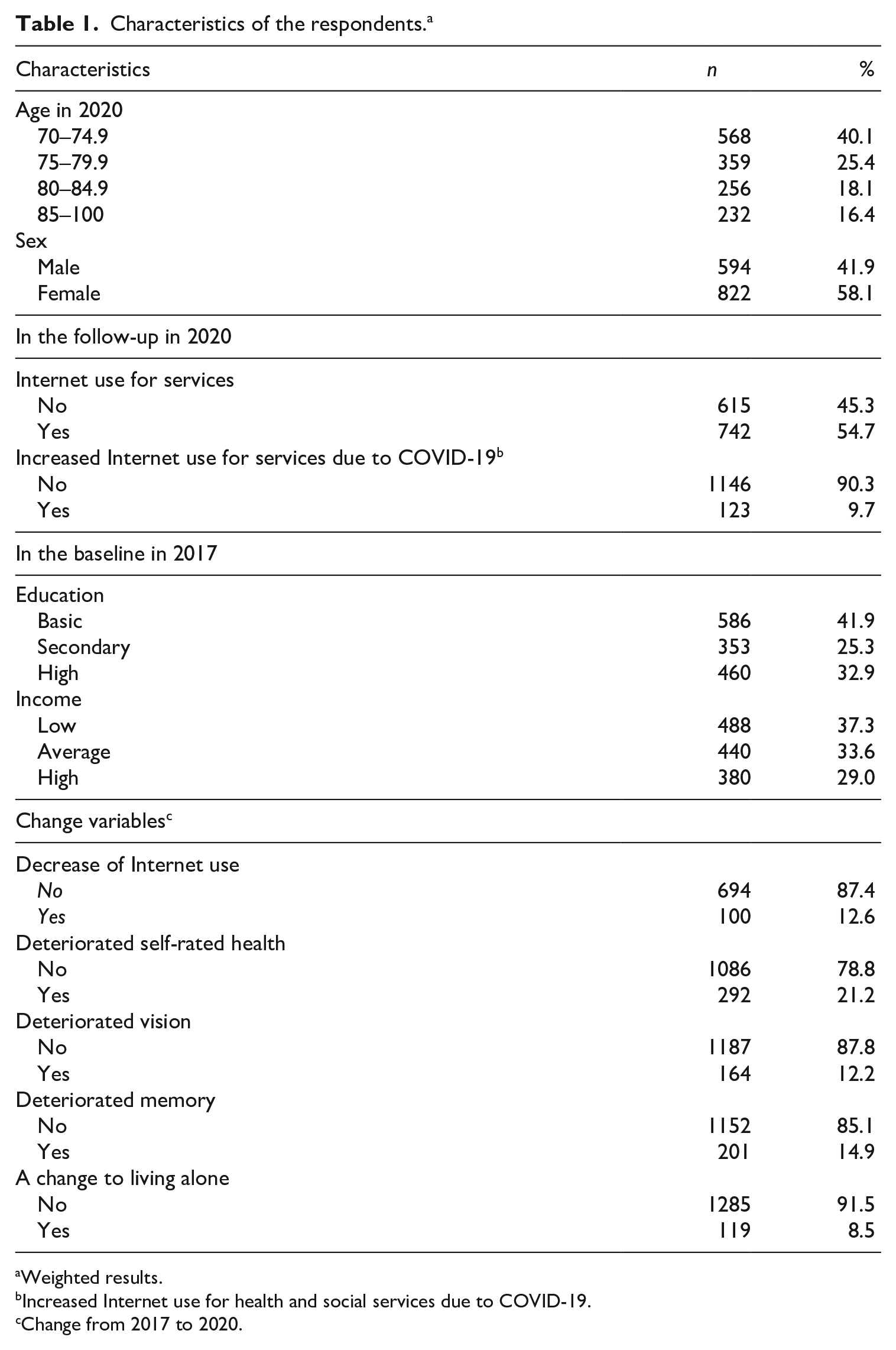
Weighted results.
Increased Internet use for health and social services due to COVID-19.
Change from 2017 to 2020.
Internet use for services in general in 2020
The results of logistic regression analyses regarding Internet use for services in general in 2020 are presented in Table 2. According to the results of Model A, older respondents, those with basic education, those with low income, those with deteriorated vision or memory and those having changed to living alone had significantly lower odds for Internet use for services in general when compared with their counterparts. In the fully adjusted Model B, age, education, income, deteriorated health and deteriorated memory were significant predictors of the use of the Internet for services in general. Respondents aged 70–74.9 years old at the follow-up had almost seven times greater odds for Internet use for services compared with those aged 85 years old or over. Highly educated persons had approximately 5.5 times greater odds for Internet use for services in general than those with basic education only, and those with a high income had 2.5 times greater odds than those with a low income. Those whose health and memory deteriorated during the study period had lower odds for Internet use for services in general when compared with their counterparts.
Results of the logistic regression analysis for Internet use for services in general in 2020. a ORs and their 95% CIs.
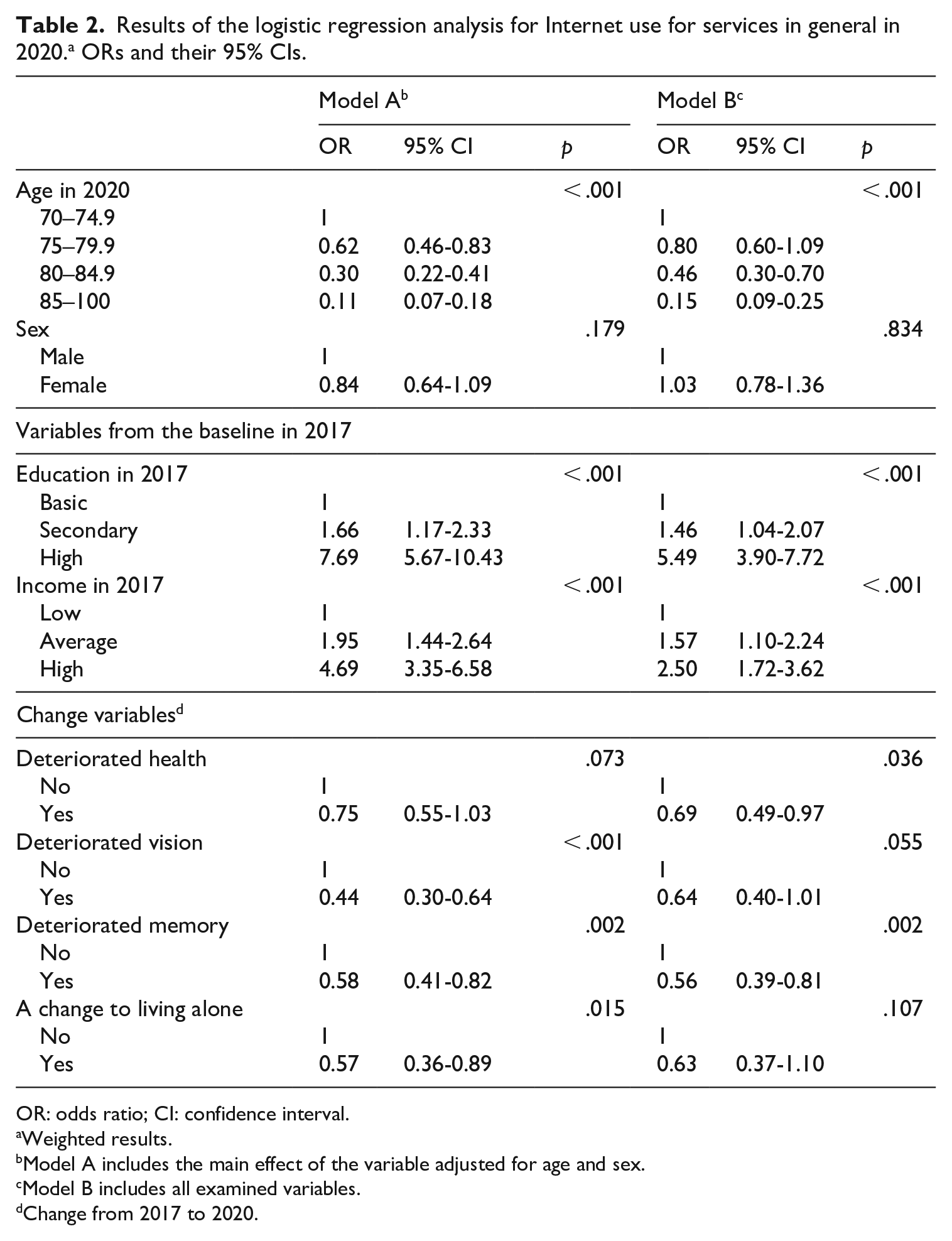
OR: odds ratio; CI: confidence interval.
Weighted results.
Model A includes the main effect of the variable adjusted for age and sex.
Model B includes all examined variables.
Change from 2017 to 2020.
The decrease of Internet use for services in general during the study period
Age, education and a change to living alone were significantly associated with the decrease of Internet use for services during the study period in Model A (see Table 3). Older respondents, those with basic education and those who had changed to living alone had greater odds for having decreased Internet use for services in general during the study period compared with their counterparts. In the fully adjusted Model B, these associations remained significant. Respondents aged 85 years old or more at the follow-up had almost four times greater odds for having decreased Internet use during the study period compared with the 73–74.9-year-olds. Those with only basic education had 2.4 times greater odds for having decreased Internet use for services compared with those who were highly educated. Those who had changed to living alone during the study period had 2.5 times greater odds for having decreased Internet use for services during the study period compared with their counterparts.
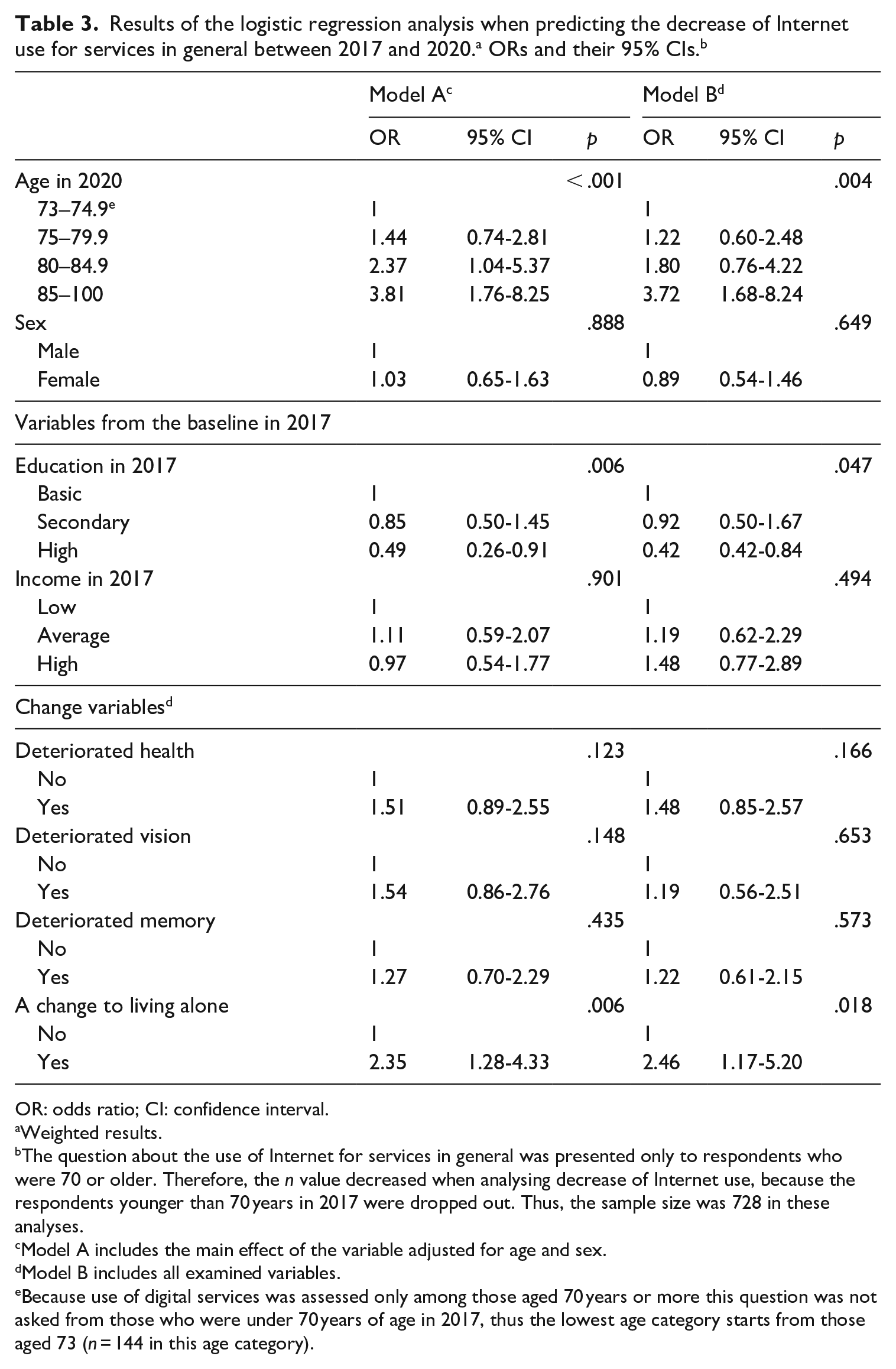
OR: odds ratio; CI: confidence interval.
Weighted results.
The question about the use of Internet for services in general was presented only to respondents who were 70 or older. Therefore, the n value decreased when analysing decrease of Internet use, because the respondents younger than 70 years in 2017 were dropped out. Thus, the sample size was 728 in these analyses.
Model A includes the main effect of the variable adjusted for age and sex.
Model B includes all examined variables.
Because use of digital services was assessed only among those aged 70 years or more this question was not asked from those who were under 70 years of age in 2017, thus the lowest age category starts from those aged 73 (n = 144 in this age category).
A self-rated increase in the use of Internet for health and social services due to COVID-19
Age, education and income were significantly associated with an increase in Internet use for health and social services due to COVID-19 in Model A (see Table 4). Younger respondents, those with a high level of education and high income had greater odds for having increased their Internet use for health and social services than their counterparts. In the fully adjusted Model B, only education remained significant. Highly educated participants had over two times greater odds for having increased their Internet use due to COVID-19 than those with basic education.
Results of the logistic regression analysis for increased use of Internet for health and social care services due to COVID-19. a ORs and their 95% CIs.
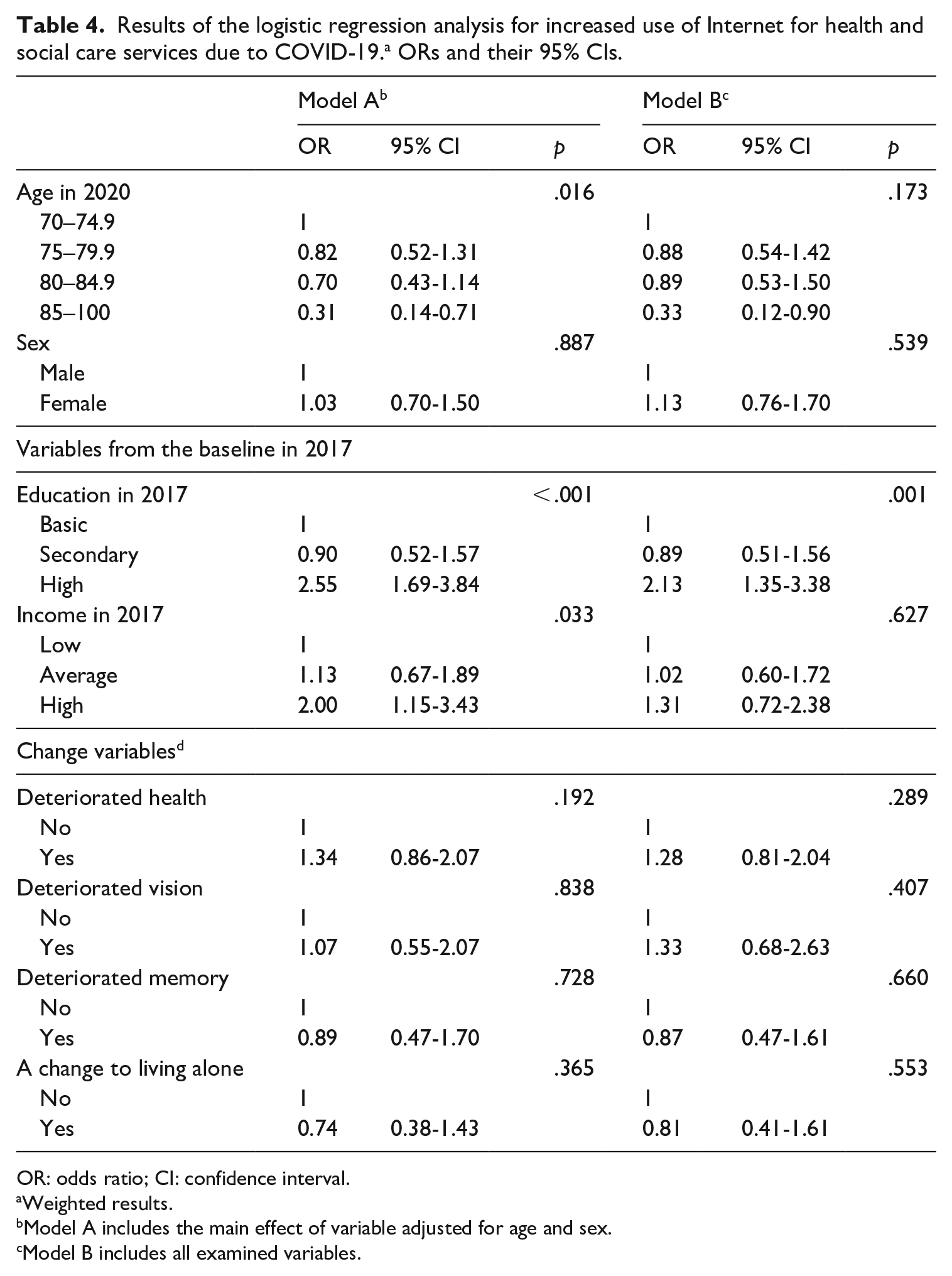
OR: odds ratio; CI: confidence interval.
Weighted results.
Model A includes the main effect of variable adjusted for age and sex.
Model B includes all examined variables.
Supplementary analyses
As supplementary analyses, we conducted ordinal regression analysis and additional logistic regression analysis for Internet use for services in general in 2020. The ordinal regression analysis showed similar results with the main analyses. Age, education, income, deteriorated health and deteriorated memory were significantly associated with Internet use for services in general in 2020 when it was used as a dependent variable with three categories (not using, using with assistance, using independently) (Supplementary Table 1). Moreover, additional logistic regression excluding altogether those who used Internet with assistance showed corresponding results as with the main analyses where those who did not use and those who used with assistance were combined together. Supplementary Table 2 shows that age, education, income and deteriorated memory were significantly associated with Internet use for services in general in 2020 when dependent variable included categories ‘does not use Internet at all’ and ‘uses Internet independently’ as dependent variable response categories. Thus, contrary to main analyses and ordinal regression analysis, deteriorated health did not reach significance in these analyses with a p-value of .056.
Discussion
Main findings
The present study examined the predictors of Internet use for services and its increase or decrease among a longitudinal population-based sample aged between 70 and 100 years. Our results highlight the importance of education for Internet use for services. As hypothesised (H1 and H3), highly educated respondents had higher odds for Internet use for services in general and having increased their Internet use for health and social services due to COVID-19 compared with those with basic education. Moreover, they had lower odds for having decreased their Internet use for services between 2017 and 2020. Age was also an important predictor of Internet use in our study. The oldest respondents had lower odds for Internet use for services and higher odds for having decreased their use during the study period than the youngest respondents. As hypothesised (H2), the deterioration of self-rated health and memory were strong predictors of Internet use for services during the follow-up but, in opposition to our hypothesis, not for the decrease of use. Those whose health or memory had deteriorated during the study period had lower odds for Internet use in the follow-up compared with their counterparts. In addition, those who had changed to living alone during the study period had higher odds for having decreased their Internet use than their counterparts.
In our study, the most important predictor of Internet use and its increase or decrease seemed to be the level of education. This confirms previous findings showing that education is an important determinant of Internet use among older adults (Hunsaker and Hargittai, 2018). Moreover, people with a low level of education have been reported to gain low levels of benefits from the Internet (Blank and Lutz, 2016; Van Deursen and Helsper, 2015). There may be many reasons behind lower Internet use among subjects with a low level of education. For example, a low level of education has been associated with poor skills for using the Internet for obtaining health-related information and services (Van Deursen and Van Dijk, 2011). A previous study has shown that the association of education with Internet benefits was at least partly explained by differences in access, skills and the extent of use (Heponiemi et al., 2020). Internet skills have also been found to have an important role in the association between online information seeking and life satisfaction (Hofer et al., 2019). Moreover, computer anxiety is more likely among those with a low level of education (Yoon et al., 2016). Our results also support the knowledge gap hypothesis (Gaziano and Gaziano, 1996) which suggests that those in a high SEP obtain and master information faster than those in a lower SEP, which can result in knowledge gaps between societal segments.
Among the indicators of SEP, education was more important than income in our study. However, participants with a low income in 2017 were less likely to use the Internet for services in 2020 than those with a high income, which corresponds to previous findings (Hunsaker and Hargittai, 2018). An old-age pension is commonly the primary source of income for many older adults but may amount to only one-third of their late-career work income (European Commission, 2021b), which may be inadequate to purchase the devices needed for Internet services. A low income can be especially challenging for single-person households (Eurostat, 2020). In Finland, public libraries provide free access to customer computers, but COVID-19 pushed libraries to close their doors temporarily, leaving some people without access to Internet services. Our results suggest that the provision of devices in public facilities may be of help by allowing older people to access the Internet.
According to our results, the oldest of the old are especially in danger of digital exclusion. Our findings are congruent with previous findings showing an age-related decline in Internet use (Din et al., 2019; Friemel, 2014; Hoogland et al., 2020; Quittschalle et al., 2020; Vasilescu et al., 2020; Walker et al., 2020) and in adopting new information technology (Niehaves and Plattfaut, 2014). One reason for lower use among the oldest of the old may be that they experience more challenges related to starting to learn to use computer-mediated information technology compared with younger older adults (Lee et al., 2011).
Our results show that the deterioration of self-rated health or memory may predispose older adults to digital exclusion and dropping out of important services that they would need. This is congruent with previous findings associating poor self-rated health with lower computer and Internet use (Creschi et al., 2010; Helsper and Reisdorf, 2015). Older adults with poor health have been found to be less likely to use patient portals than those with good health (Gordon and Hornbrook, 2016). Cognitive and physical impairments have been mentioned as barriers to the use of a personal health record among residents living in subsidised housing projects (Lober et al., 2006). Cognitive functioning has been found to be better among those older adults who use the Internet daily compared with those who do not use the Internet daily (Wu et al., 2019). Our results add to these findings, showing that not just their level of health and functioning but also their deterioration are important barriers to the use of Internet. However, also partially inconsistent findings exist showing that long-term illness or disability might be associated with higher Internet use among general population (e.g. Andreassen et al., 2007).
However, there is little and partly contradictory knowledge as to whether the direction of the association could also work the other way around, that is, whether the use of the Internet would help to maintain good cognitive functioning (Chan et al., 2016; Choi et al., 2021; Slegers et al., 2009). A recent study showed support for this, showing that Internet usage increases cognitive functioning among older people in a longitudinal data design (Green et al., 2021). Thus, a reinforcing spiral is possible here, that is, cognitive functioning affects the Internet use, which in turn, affects the cognitive functioning.
Older persons’ social offline resources seem to be an important determinant for Internet use, and according to our results, a change to living alone may predispose a person to dropping out of digital services. We found that older adults whose household size had declined to one during the study period were likely to have decreased their Internet use during the study period. This is consistent with previous findings showing the importance of social participation and having a partner for Internet use and benefitting from the Internet (Creschi et al., 2010; Heponiemi et al., 2020; Van Deursen and Helsper, 2015). Moreover, our finding corresponds to a previous finding showing the association between social isolation and lower Internet/email use among older people (Stockwell et al., 2021). In addition, it has been shown among older people that the lack of Internet use is associated with feelings of social exclusion (Seifert et al., 2018).
Encouragement by family and friends has previously been associated with Internet use among older adults, and family and friends have been found to be the most helpful sources when learning how to use the Internet (Friemel, 2014). Social networks also help to motivate older adults to use the Internet and may also provide secondhand access (Friemel, 2014). Thus, a change to living alone may decrease encouragement and motivation. Older persons living alone may lack a person who could teach them Internet use and such a person would perhaps also offer a device which they could use. Indeed, it has previously been found that households with younger people are more likely to be digitally included (Bunyan and Collins, 2013). Moreover, a previous study suggests that there is a greater need for technological support when age increases – often associated with a decrease in the support from family, friends and colleagues (Tirado-Morueta et al., 2021). As help is not easily available for everyone, adequate support and assistance for the use of the Internet for different purposes is crucial and should be available in a variety of easily accessible formats and channels.
During the COVID-19 pandemic, when face-to-face interactions have been minimised, the digital communication methods have taken an important role in keeping people socially connected (Nguyen et al., 2021). Older adults may be at a disadvantage when they have problems in connecting digitally with others. In this situation, the possible low use of the Internet may leave older adults socially isolated, and those living alone without close relations with relatives or others are especially in danger. Loneliness is a major problem, especially among older adults, and the increasing provision of services on the Internet has the potential to increase loneliness, for example, by decreasing possibilities for face-to-face contact.
Our results support theories suggesting a link between a person’s resources offline and possibilities to use the Internet (Helsper, 2012; Van Dijk, 2005). Our results show that personal, economic and social offline resources are associated with online resources, as suggested by Helsper (2012). This corresponds to a recent previous study giving support for Helsper’s theory (Heponiemi et al., 2021). However, theories also suggest a link in the opposite direction, that is, they suggest that digital inequality leads to social exclusion (Helsper, 2012; Van Dijk, 2005; Warschauer, 2004). Our study did not study this direction and whether social and digital exclusion are intertwined, thus, future studies should examine both directions and the possibility of a vicious cycle more thoroughly.
Implications
The provision of digital services is increasing rapidly, especially in developed countries. External support is especially needed for older adults living alone without close social contacts. Our results suggest that municipalities and service providers should be especially attentive when an older person encounters social isolation or problems in health or cognitive functioning. Service providers should conduct client segmenting (that is, dividing their clients into groups based on common characteristics) to find persons potentially in danger of digital exclusion, such as those living alone with a high age, low education and deteriorated health or memory. Face-to-face services and support should be offered to those persons that segmentation captures as being at risk.
One way to increase Internet use among older adults is to ensure use and skills prior to old age. It has been found that people aged over 75 years were confronted with many more challenges to starting to learn to use computer-mediated information technology than those faced by younger generations (50–64 years of age) (Lee et al., 2011). Moreover, the likelihood of using the Internet has been found to be almost nine times higher among those who used a computer prior to retirement compared with those who had not used a computer (Friemel, 2014). EU highlights the need for digital skills with its Digital Education Action Plan which is an initiative to support digital skills for the digital transformation (European Commission, 2021a). One should bear in mind that when teaching older adults to use computers and Internet, it is important to tie education to their current skills, ensure supportive teaching environment and pay attention to older adults’ goals (Mubarak and Nycyk, 2017).
It would be much easier for older adults to use the Internet for services if the services were easy to use and of high quality. Friemel (2014) has pointed out that, besides support for use, technological improvements are also essential to address the age-related barriers affecting older adults’ technology use. Older adults’ confidence in managing their errands via the Internet would be higher with the better usability of the systems (Lee et al., 2020). Moreover, older adults’ Internet use could perhaps be promoted by providing older adults places where they could use Internet safely and in peace as well as high speed broadbands. However, one must keep in mind that even with best possible solutions for easy use, there will always be a group of older adults who are not able to use the Internet, for example, due to physical limitations or memory problems.
Strengths and limitations
The strengths of the present study are the longitudinal design and that we were able to identify, for example, older adults with deteriorated health or who had decreased the use of Internet for services. Therefore, we were able to fulfil gaps in the earlier findings by examining the effects of changes in health, functioning and social resources on Internet use and changes in use. Thus, unlike with most often used cross-sectional designs, we were able to examine temporal precedence with our longitudinal data. We used a national population-based sample with a relatively good participation rate and individual-level register-based data to correct for non-participation, which enables us to better generalise our findings to the entire older Finnish population. We offered a possibility to answer either by postal questionnaires or web-based, which allowed us to reach both those who do not use Internet and those who actively use Internet. Moreover, we also gathered data from older adults who were living in residential homes and the possibility for toll-free telephone contact and interviews was offered, which enabled us to also reach older adults with difficulties in answering postal questionnaires or web-based surveys. Another strength of our study was that the data for the follow-up were gathered during the on-going COVID-19 pandemic, which led to a substantial increase in the provision of Internet services and had a tremendous impact, especially on the older adults’ lives. Therefore, we were able to examine the difference between the time before the COVID-19 pandemic and during the pandemic.
However, our study includes several limitations which should be kept in mind when interpreting our findings. Our findings are based on self-reported data, which can lead to problems associated with common method variance and inflation of the strengths of associations. We did not use validated widely used screening tools such as Mini-Mental State Examination (MMSE) and Most Accurate Detection of Cognitive Impairments (MoCa) -tests to measure cognitive impairment. By using these kinds of comprehensive measures, we could have achieved more specific information related to our predictor variables. Moreover, it would be important to achieve more reliable objective data in a way that the respondents would not have to rely on their memory to answer the questions. In addition, even though we controlled for many factors, the possibility of residual confounding still exists. In addition, given our analyses method and the fact that we had only two data points, the causality of our findings should be interpreted with caution. Future studies should examine these causal associations more thoroughly with longitudinal data including several data points and analyses methods best suitable for such longitudinal data. For example, latent change score models would better allow us to draw causal inferences. Moreover, future studies should use comprehensive validated measures and objective measures such as performance tests to measure functional and cognitive impairments.
Finland is among the forerunners in the digitalisation of services, and the literacy among older adults is very high, which is a prerequisite for using the Internet. Thus, generalising our findings to countries with a different level of digitalisation of services, dissimilar services or lower literacy should be done with caution.
Conclusions
According to our results, those older adults who have a low level of education, those are very old, those whose health or memory has deteriorated and those who have recently started to live alone are especially in danger of digital exclusion. Governments and those providing services through the Internet should implement means to ensure that those people who have difficulties in using the Internet also have possibilities to get the services they need. Actions are needed to reach those people who need external support and to provide them with that support. Organisations that provide services through the Internet should pay more attention to the good usability of their services and make sure that their systems are also easy to use for those with reduced ability or reduced possibilities to use the Internet. It has been shown that participating to online activities can bring joy and companionship to older people (Nimrod, 2012) and these positive feelings should be fostered in connection with Internet use. However, even though it is important to promote Internet use for services among older adults, it must be highlighted that face-to-face services should be guaranteed to those who need them to avoid digital exclusion.
Supplemental Material
sj-docx-1-nms-10.1177_14614448221097000 – Supplemental material for Use and changes in the use of the Internet for obtaining services among older adults during the COVID-19 pandemic: A longitudinal population-based survey study
Supplemental material, sj-docx-1-nms-10.1177_14614448221097000 for Use and changes in the use of the Internet for obtaining services among older adults during the COVID-19 pandemic: A longitudinal population-based survey study by Tarja Heponiemi, Lotta Virtanen, Anu-Marja Kaihlanen, Emma Kainiemi Päivikki Koponen and Seppo Koskinen in New Media & Society
Supplemental Material
sj-docx-2-nms-10.1177_14614448221097000 – Supplemental material for Use and changes in the use of the Internet for obtaining services among older adults during the COVID-19 pandemic: A longitudinal population-based survey study
Supplemental material, sj-docx-2-nms-10.1177_14614448221097000 for Use and changes in the use of the Internet for obtaining services among older adults during the COVID-19 pandemic: A longitudinal population-based survey study by Tarja Heponiemi, Lotta Virtanen, Anu-Marja Kaihlanen, Emma Kainiemi Päivikki Koponen and Seppo Koskinen in New Media & Society
Footnotes
Funding
The author(s) disclosed receipt of the following financial support for the research, authorship and/or publication of this article: The study was funded by the Strategic Research Council at the Academy of Finland (grant 327145 for the DigiIN Project) and THL coordinated funding for the COVID-19 research included in the Finnish government’s supplementary budget.

Supplemental material
Supplemental material for this article is available online.
Author biographies
References
Supplementary Material
Please find the following supplemental material available below.
For Open Access articles published under a Creative Commons License, all supplemental material carries the same license as the article it is associated with.
For non-Open Access articles published, all supplemental material carries a non-exclusive license, and permission requests for re-use of supplemental material or any part of supplemental material shall be sent directly to the copyright owner as specified in the copyright notice associated with the article.
