



Abstract
The growing significance of social networking sites (SNSs) as venues for political exchanges between citizens raises questions on the consequences of their use. This pre-registered experiment (N = 704) aexamined to what extent a gradual variation of congruence between users’ opinions and the opinion climate they encounter on SNSs affect their strength of opinion and selective exposure. No effects were found from the level of congruence on selective exposure, while exploratory analyses suggested that exposure to overly congruent opinion climates can lead to marginally stronger opinions. Building on research into political social identities which suggests polarizing effects of the latter, interaction effects of users’ ideological identities and exposure to opinions on SNS were additionally investigated. However, the present work found no indication that effects of congruence are modulated by identity salience. Taken together, findings of this study suggest that socially divisive effects of like-minded or non-like-minded opinion climates conveyed by SNS may be limited.
Keywords
Considering the growing importance of social networking sites (SNSs) for individuals’ lives, it is important to understand how these technologies impact the processing of political information. In this regard, one pivotal concern is that SNS might lead users to selectively expose themselves to politically congruent information (i.e. information which is in line with their own opinions) and, thereby, increase the share of political congruence in online networks (O’Hara and Stevens, 2015; Sunstein, 2017). However, existing empirical evidence shows that individuals encounter a significant amount of counter-attitudinal and politically diverse content on these platforms (Lee et al., 2015; Lu and Lee, 2018). Research on the effects of political congruence has not yet disentangled the ways in which this can affect the cognitions and behaviors of users. While overly congruent environments are often associated with polarization (Wojcieszak and Garrett, 2018), exposure to incongruent views is commonly linked with increased openness to diverging views and political tolerance (Mutz, 2002). However, some research suggested that exposure to incongruent views might not always be beneficial, but can instead foster polarization and selective exposure to information (Bail et al., 2018). Therefore, it appears that the effects of exposure to congruent and incongruent views are contingent on further contextual variables. The present study suggests that the degree of political congruence in a communication environment (i.e. the relative share of congruent and incongruent views represented within it) crucially determines specific outcomes.
Against the background of inconclusive prior findings, we argue that overly congruent and overly incongruent opinion climates may increase opinion strength and selective exposure (i.e. the preference for like-minded information). Importantly, prior research highlights that exposure to political information can activate the salience of political social identities (PI; see Turner and Reynolds, 2012; Wojcieszak and Garrett, 2018), which may have not only an independent but also a joint influence, that is, with political congruence, on selective exposure (Dvir-Gvirsman, 2018; Wojcieszak and Garrett, 2018).
Drawing on a representative sample of German social media users, an experimental online study was conducted. Subjects were exposed to fictitious Twitter comment threads varying in the proportion of congruent (i.e. like-minded) and incongruent opinions expressed by others. A portion of subjects additionally underwent an essay priming procedure to increase the salience of their political identities. Contrary to our hypotheses, it was revealed that exposure to congruent opinion climates on a single occasion marginally increases opinion strength when compared to exposure to incongruent ones, while there was no effect on selective exposure, regardless of political identity salience. The present study contributes to extant research by offering a new and more nuanced perspective on the circumstances under which politically congruent versus incongruent social media environments can affect both cognitive and behavioral responses. The study’s hypotheses and analysis plan were preregistered in the Open Science Framework (OSF) before data collection.
Cognitive effects of congruence and incongruence: opinion strength
In many instances, SNSs expose users to the opinions of others (e.g. in comment threads) and those opinions form opinion climates on an aggregate level. Opinions and opinion climates vary in their degree of congruence, and a congruent opinion climate can be conceived of as an environment where most or all opinions expressed are in line with or similar to the opinion of an individual. Besides addressing antecedents of individuals’ exposure to congruent (e.g. Wojcieszak and Garrett, 2018) and incongruent opinion climates (e.g. Lu and Lee, 2018), a number of studies addressed the cognitive consequences of being exposed to congruent and incongruent views and, in particular, the question of how exposure to congruent and incongruent information affects political attitudes (e.g. Huckfeldt et al., 2004; Stroud, 2010). For example, in a web-tracking study, Knobloch-Westerwick and colleagues (2015) assessed selective exposure to online news over a period of 3 days and found that exposure to attitude-consistent information increases attitude strength toward controversial issues, while exposure to incongruent information decreases attitude strength. In line with this, a number of other studies underscored the polarizing effects of exposure to congruent political information, while stressing the depolarizing potential of exposure to incongruent information (Kim, 2015; Parsons, 2010). They pointed out that a confirming environment increases certainty and faith in one’s own views as well as attachment to the political in-group, while fostering negative feelings toward political opponents and their opinions. At the same time, prior studies link exposure to incongruent views to political learning, more positive evaluations of the other side, and a depolarization of attitudes (Knobloch-Westerwick et al., 2015; Parsons, 2010).
Exposure to incongruent views still does not appear to decrease bias toward opposing political groups under all circumstances (Bail et al., 2018; Kim, 2015). For instance, a study that analyzed offline discussion networks (Huckfeldt et al., 2004) found that both overly congruent and overly incongruent online networks increase political polarization. At the same time, it underscored that more balanced networks can lead to ambivalence or even decrease the strength with which attitudes are held. Work on the effects of cross-cutting exposure on deliberation found evidence that avoidance of interactions with those who think differently may occur primarily under circumstances of uniform opposition within a person’s social network (Bello, 2012), and that some degree of heterogeneity may in contrast favor openness to counter-attitudinal views and their supporters (Lee et al., 2015). Others pointed out that individuals engage in motivated reasoning and selectively use both agreeable and counter-attitudinal information to confirm their views (Taber and Lodge, 2006). At the same time, balanced, two-sided arguments might facilitate thorough processing of available information and thereby counteract polarization (Karlsen et al., 2017). Within a preregistered multiwave field experiment, Bail and colleagues (2018) incentivized subjects in the treatment group to follow a bot (i.e. a programmed entity resembling another user) on Twitter that regularly exposed them to information from an opposing political party. They found that, over time, these subjects became more polarized compared to subjects from the control group who followed a bot exposing them to congruent content. The results of this methodologically strong study suggest that exposure to incongruent information may lead to a strengthening of preexisting opinions. This study provides hints that the observed “backfire effect” (resulting from being exposed to disagreement) increases as a function of the intensity with which individuals are exposed to counter-attitudinal messages via SNS.
Corroborating this notion, an experimental study by Hopmann and colleagues (2019) showed that individuals are most likely to seek compromise at low and moderate levels of disagreement, and tend to dominate or concede when disagreement is high. They argue that the kind of reaction also depends on the degree to which individuals are concerned with the needs of others, that is, individuals are likely to be more willing to seek compromise within close relationships. SNS users are commonly exposed to political information from and discuss politics with strangers and weak ties (Krämer et al., 2014). Given this, high levels of disagreement, whether in the sense of diverging strongly from the views of a particular person or finding one’s opinion underrepresented within the social environment, may drive users toward stronger opinions in much the same way that overrepresentation of their own opinion can. While the study by Hopmann and colleagues focused on the amount of disagreement in terms of the degree others’ attitudes diverge from one’s own, the present work addresses the amount of disagreement in terms of the shares of confirming and opposing political views within one’s own online network. Consequently, their findings do not directly translate to the assumptions of the present work. Nevertheless, they can provide some insight into the psychological processes at work when individuals are exposed to low compared to high degrees of political like-mindedness. In both cases, the perception of greater incongruence between one’s personal views and the views represented in the environment could lead to greater cognitive dissonance (i.e. psychological tension caused by the incompatibility between one’s own preexisting cognitions and new, incompatible cognitions; Festinger, 1957), which increases the likelihood of engaging in defensive and avoidant modes of dissonance reduction (McGrath, 2017; Zhu et al., 2017). Such modes include the reinforcement of own attitudes.
Kaczinski and colleagues (2019) revealed that users who perceive their online networks as very congruent or very incongruent have more extreme opinions than users who are surrounded by a more balanced mix of different opinions. Although the direction of influence remained unclear in this exploratory study, it can provide pointers on the idea that the effects of political congruence in online networks may be a question of dosage.
Effects of political congruence: a question of dosage?
In view of the inconsistencies within existing research, we suggest that effects of political congruence depend on the degree of congruence represented within an individual’s environment. Any “mix” of congruent and incongruent opinions can be encountered on SNS, and the way opinions are presented there (e.g. easily visible in comment threads) makes it even more likely for users to perceive slight differences in the situational climate of opinion (Neubaum and Krämer, 2017). Prior findings suggest that congruency of opinion climates should impact political cognition and behavior not in a linear but in a curvilinear manner, with relatively low and relatively high levels of congruency leading to the largest bias. On a theoretical level, this curvilinear link can be explained by different types of information processing, as suggested by the affective intelligence theory (Marcus et al., 2000, 2019). Accordingly, overly congruent and overly incongruent opinion climates may foster increased reliance on preexisting beliefs as they elicit enthusiasm and anger, respectively (Bakker et al., 2021). At the same time, being exposed to balanced opinion climates may facilitate the weighing up of different perspectives by inducing uncertainty and ambivalence regarding the accuracy of one’s own views (Huckfeldt et al., 2004; Mutz, 2002).
Based on this reasoning, we propose the following hypothesis:
H1. The degree of political congruence with opinion climates on SNS affects opinion strength in a curvilinear manner. A relatively high and a relatively low level of political congruence increase opinion strength compared to a more balanced SNS opinion climate.
Behavioral effects of congruence and incongruence: selective exposure
When it comes to effects on the behavioral level, findings by prior research suggest that not only exposure to politically congruent (Hutchens et al., 2019) but also to incongruent information can lead to increases in selective exposure (i.e. the preference for information that is in line with one’s preexisting beliefs; Zillmann and Bryant, 1985). For instance, Zhu et al. (2017) showed that when the opinion climate is perceived as overly incongruent, defense motivation might be triggered and a subsequent avoidance of incongruent opinions results (Yang et al., 2017). Furthermore, being exposed to incongruent opinion climates may lead to selective disconfirming of political opponents’ views and arguments rather than acknowledging and cognitively integrating them, and such motivated reasoning is a predictor of selective exposure (see Bail et al., 2018; Taber and Lodge, 2006). In contrast to that and as outlined above, exposure to politically balanced opinion climates is more likely to evoke doubts in one’s opinions and to increase their proneness to take different viewpoints into account when forming attitudes. While selective exposure is usually considered more of an antecedent of congruent environments (Sunstein, 2017), prior findings suggest that exposure to very congruent and very incongruent opinion climates and selective exposure may be linked in a mutually reinforcing process (Slater, 2007), in which both politically congruent and incongruent environments increase selective exposure. When exposed to very incongruent environments, users may feel threatened (Bakker et al., 2021) and therefore actively increase the number of supportive voices in their virtual environments by selectively exposing themselves to these. When consequently the environment shifts toward a more balanced distribution of supporting and opposing views, perceptions of threat and therefore the need for confirmation may decrease and make way for consideration of counter-attitudinal viewpoints.
In sum, we propose that the degree of political congruence determines the effect of exposure to opinion climates via SNS on selective exposure. We therefore hypothesize:
H2. The degree of political congruence with opinion climates on SNS affects selective exposure in a curvilinear manner. A relatively high and a relatively low level of political congruence increase selective exposure compared to a more balanced SNS opinion climate.
So far, we have focused on the effects of exposure to opinions on SNS without considering the social context in which such exposure takes place. The interwovenness of information exposure and identification with political groups (Wojcieszak and Garrett, 2018) points to the inter-group context of political interactions. To better understand the intergroup dimension in opinion climates and its impact on information selection on SNS, we need to address it on the level of users’ political social identities.
The intergroup dimension of opinion climates: political social identity
Individuals can identify with a range of social groups, including political groups, which can form part of self-concepts and direct individuals’ cognition, and behavior toward shared group norms (Turner and Reynolds, 2012). When a political social identity (e.g. considering oneself a member of the group of “left-leaning” or “rightist” individuals) becomes salient, for instance, through informational cues in the environment, individuals become susceptible to inter-group bias. In other words, they will favor those who they perceive as members of their political in-group (e.g. to whom they attribute the same ideological leaning; Greene, 1999). Perceiving oneself as a member of a politically defined group can affect perceptions and behaviors not only offline but also in online communication (Dvir-Gvirsman, 2018; Postmes and Spears, 2013). Cues that point to a user’s political leaning can serve as a heuristic for other attributes (e.g. trustworthiness), which carries the risk of poor decisional outcomes when it comes to the selection of political content (Iyengar and Westwood, 2015). The study by Iyengar and Westwood (2015) showed that individuals tend toward negative interpersonal evaluations of supporters of opposite political parties, while being more favorable toward supporters of their preferred party, which persists even when the latter outperforms the former in objective terms (e.g. with regard to qualification). In another study, Dvir-Gvirsman (2018) found that PI fosters selective exposure to congruent news posts, showing that intergroup bias not only affects interpersonal evaluations but also shapes informational selectivity. Further experimental evidence underscores that PI can increase selective exposure to political online content (Wojcieszak and Garrett, 2018). Taken together, when a user’s political social identity is salient, selective exposure will likely increase. We therefore hypothesize:
H3. A salient political social identity leads to higher levels of selective exposure compared to a nonsalient political social identity.
Importantly, as a PI can be central to an individual’s self-concept, it may generally boost favorability toward congruent information and thereby undermine the potential of balanced opinion climates to decrease divides between political camps. We therefore pose the following research question:
RQ1. Is there an interaction effect for the degree of political congruence and political social identity on selective exposure?
In addition to these hypotheses and this research question, we addressed further effects of exposure to congruent and incongruent opinion climates and political social identification on political tolerance. These were pre-registered jointly with the hypotheses reported here and the respective findings can be retrieved as supplemental online material.
Method
To address the hypotheses and research question, a pre-registered online experiment was conducted. All data were collected anonymously and under consideration of ethical norms in experimental research. The study was approved by the local IRB on 11 November 2019 (protocol no. 1910SPCM1532).
Sample
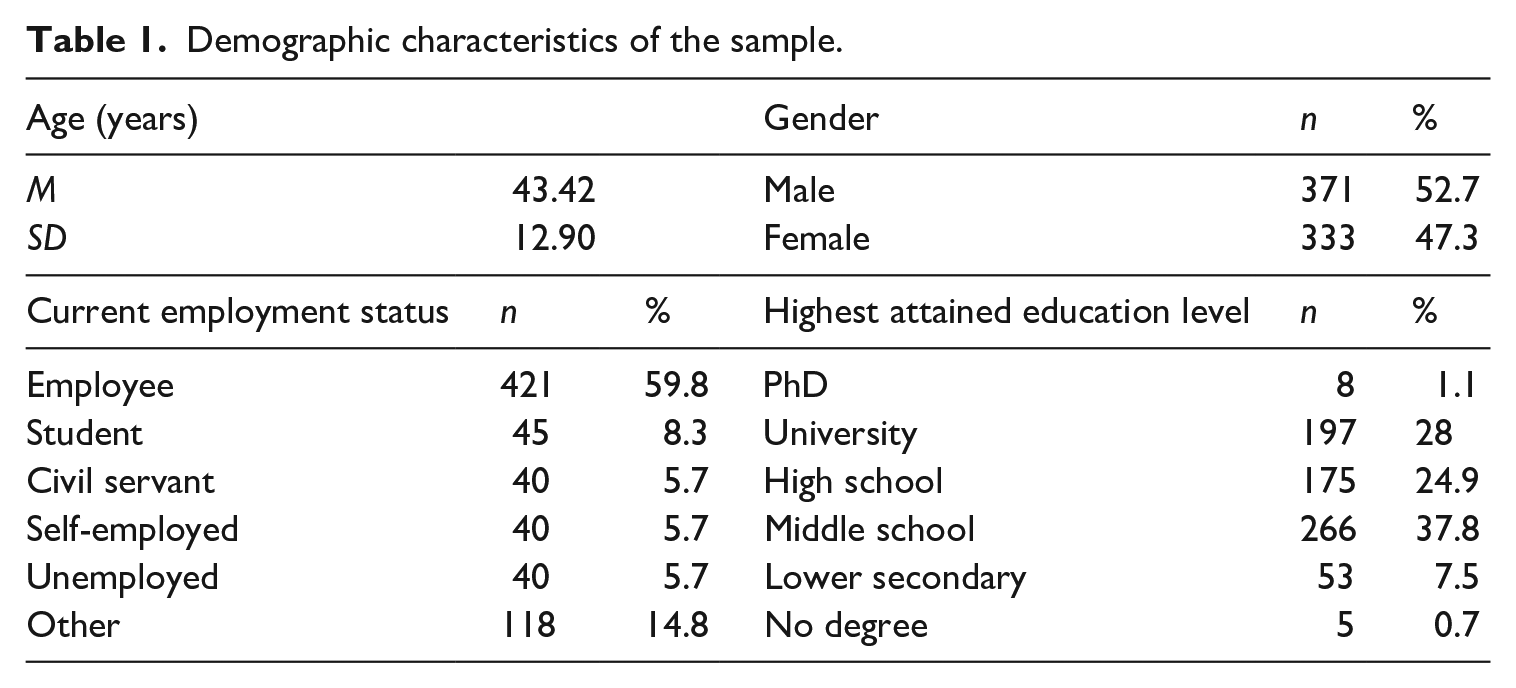
Participants were recruited via Respondi (respondi.com), a quality certified (ISO 2025) survey firm that offers a large online access panel. For our study, adult German panelists were contacted by the survey firm in accordance with predefined quotas (see below). To take part in the study, participants were required to regularly use at least one social media platform. Participants were invited to take part in an online questionnaire on “how users assess content on social networking sites”. We performed an a-priori calculation of sample size based on the planned analyses of variance (ANOVAs) with an alpha level of .05 and a small effect (f = .15), which we derived from prior research on links between exposure to political congruence, political extremity, and selective exposure (Heatherly et al., 2017; Knobloch-Westerwick et al., 2015). This suggested an ideal sample size of N = 690. After excluding participants who did not use any SNS (n = 208) or who did not answer the quality check item correctly (n = 83), the final sample was N = 704. Demographic characteristics of the sample are shown in Table 1. In accordance with predefined quotas, this sample is representative regarding age and gender of German SNS users between 18 and 69 years (GIK, 2018). The education level was higher when compared to the general population (Kaczinski et al., 2019).
Demographic characteristics of the sample.
Design and procedure
An experiment with 5 (congruence: completely congruent to completely incongruent) × 2 (political social identity: salient/nonsalient) × 2 (issue: deportation of criminal refugees/adoption rights for homosexual couples) experimental factors was conducted. The experiment had a between-subjects design, that is each participant was randomly assigned to one of the 20 resulting conditions and exposed to the same stimuli within but different stimuli between these conditions. They first provided informed consent and were then asked about sociodemographic characteristics, social media use, political orientation, and their opinions on the controversial issues. These issues and the experimental stimulus were addressed within and selected on the grounds of a pilot study (for a full report, see online material). Next, the salience of political identities was experimentally manipulated. Following this, political congruence was manipulated and the dependent variables (i.e. opinion strength and selective exposure) were assessed. We then obtained descriptive measures and debriefed participants.
Manipulation of political congruence
To manipulate the degree of political congruence of opinion climate, participants were exposed to fictitious user comments resembling a Twitter comment thread (Figure 1). They were instructed “to take a moment and look at the following comment thread” allegedly taken from Twitter. Each thread consisted of a short teaser text (presenting a neutral statement on one of the two issues) by an alleged news platform and a mixture of comments in favor and against one of the two issues below it (1: four comments in favor of [issue], none against; 2: three comments in favor of [issue], one against; 3: two comments in favor of [issue], two against; 4: one comment in favor of [issue], three against; 5: none comment in favor [issue], four against). These conditions were later recoded in accordance with each participant’s opinion toward deportation or adoption to represent the level of political congruence (i.e. 1: completely congruent, 2: somewhat congruent, 3: balanced, 4: somewhat incongruent, 5: completely incongruent). The thread was displayed on one single page and contained four comments expressing an opinion, some with a pertinent hashtag attached (e.g. deportation: “Please don’t draw wrong conclusions here! You cannot send people back to war zones. #WirSindMehr” / “Enough is Enough! I’m in favor of sending such refugees back to their home countries immediately. #EsReicht”; adoption: “Germany has enough problems to solve and instead of solving them, new problems are created with that! #EheBleibtEhe” / in favor: “Great, because with that society becomes more tolerant and open-minded. #LoveisLove”), as well as two neutral comments (e.g. “I don’t know what to say about that.”). The median time spent on the comment page was 30 seconds.
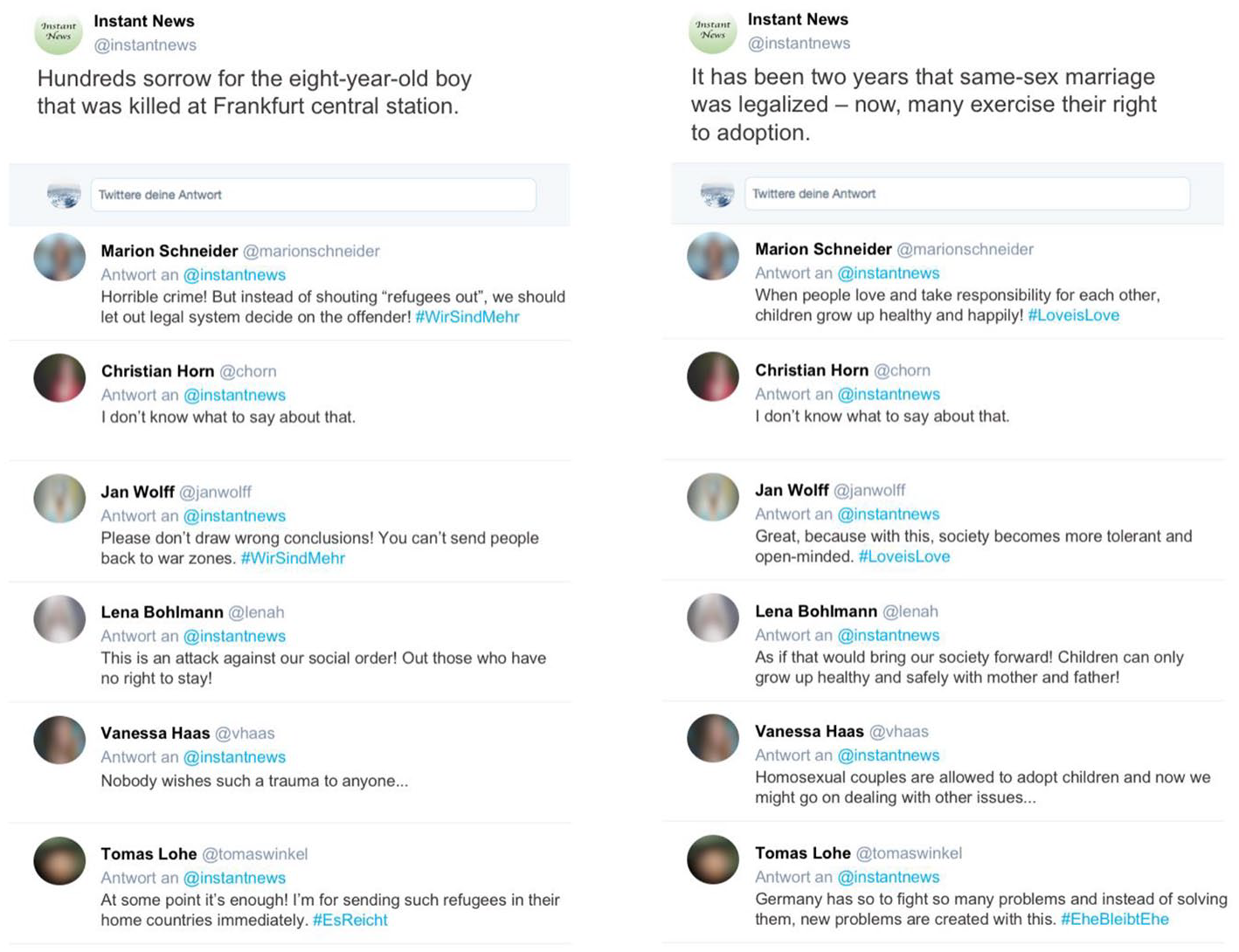
Two examples of comment threads to which participants were exposed in the manipulation of political congruence (left: deportation, right: adoption). The second and fifth comments did not express a clear stance and were equal for each issue.
To check the manipulation of political congruence, one item asked participants about their perception of the opinion climate within the ostensible Twitter comment thread they were exposed to beforehand (“the comments just shown were . . .”; 1: mostly in favor of [issue], 5: mostly against [issue]). An ANOVA with political congruence as an independent variable and perceived opinion climate within comment thread as a dependent variable was performed and revealed a significant effect: F(4, 699) = 78.87, p < .001,
Manipulation of political social identity salience
PI salience was manipulated by an essay priming procedure (adapted from Wojcieszak and Garrett, 2018). Accordingly, participants under the salient identity condition were instructed to “think about what it means to be part of” their “political group,” that is “people of the political left, right, or the political center,” and write a short essay about this (for the complete instructions, see the full questionnaire within online materials). Under the nonsalient identity condition, participants were instructed to write about their past day (see Galinsky et al., 2003). Participants in both groups were asked to spend a maximum of 5 minutes on the task and essays were allowed to be between 100 and 1500 characters in length. The median time spent on writing essays within the salient identity condition was 90 seconds.
To check the experimental manipulation of PI, a scale adapted from Greene (1999) measuring the degree of political social identification was used (e.g. “when someone criticizes people who belong to my political group it feels like a personal insult to me”) and mean scores were compared between the social identity conditions. A t-test for independent samples revealed that political social identification was significantly higher for individuals in the salient identity condition (M = 3.70, SD = 1.10) compared to individuals under the nonsalient identity condition (M = 3.32, SD = 1.28), t(690.18) = 4.22, p < .001, d = .31, indicating successful manipulation.
Measures
Opinions
Participants’ opinion on deportation and adoption was assessed by the items “What is your opinion on the deportation of criminal refugees?” (i.e. the deportation of refugees who committed a crime in Germany)/“Should homosexual couples have adoption rights?” (i.e. the legal provision that homosexual couples are allowed to jointly adopt children) (1: I’m strongly against it, 7: I’m strongly in favor of it); Mdeportation = 6.27, SD = 1.12; Madoption = 5.01, SD = 1.81. In addition, dichotomous forced-choice items were assessed to clearly determine (non)political congruence within our experimental design (“If you had to decide for or against [issue], what would you choose?,” 1: I would decide against it (ndeportation = 37, nadoption = 168), 2 = I would decide in favor of it (ndeportation = 667, nadoption = 536).
Selective exposure
Participants were exposed to 16 short summaries (teasers) of fictitious news articles (Figure 2) presented in random order on a single page. Each teaser expressed an opinion either against or in favor of one of the two issues used (four in favor and four against deportation/adoption). Participants were instructed to select any desired number of teasers of which they would like to receive the full article afterward. The median time spent on this task was 1.8 minutes and participants selected, on average, 2.8 teasers (SD = 3.00). A selective exposure variable was created by subtracting the number of incongruent news teasers from the number of congruent news teasers chosen by participants. Positive values thus indicate a preference for congruent news articles (M = 1.19, SD = 2.08).
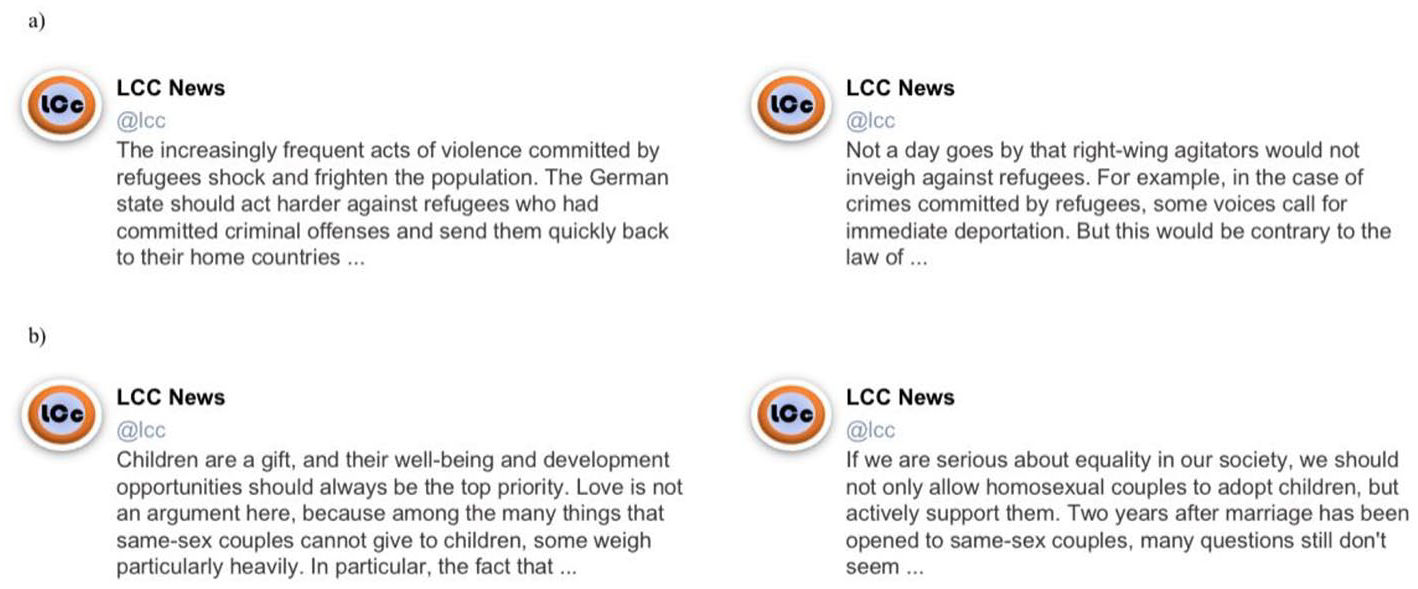
Examples of news article teasers that were used in the selective exposure task (a: deportation, b: adoption).
Opinion strength
Opinion strength was operationalized by a measure assessing the certainty with which a specific attitude is held (Petrocelli et al., 2007). The attitude certainty measure used in this study is composed of the subdimensions attitude clarity (four items, e.g. “how certain are you that you really know your opinion on [issue]?”) and attitude correctness (three items, e.g. “how certain are you that your opinion on [issue] is the right opinion on this topic”; 1: not certain at all, 9: completely certain), which were collapsed into one score of opinion strength for each issue (deportation: M = 6.95, SD = 1.48, Cronbach’s α = .93; adoption: M = 6.85, SD = 1.59, Cronbach’s α = .91, overall: M = 6.90, SD = 1.54, Cronbach’s α = .92). This measure enabled us to obtain a reliable score that is sensitive to potential, nuanced changes in participants’ opinion strength (see Petrocelli et al., 2007). Opinion strength was measured regarding the issue to which a participant was experimentally assigned beforehand.
Further measures
For descriptive purposes and further explorations, the intensity of social media use, political social media use (e.g. “How important are social media to you personally to keep on track politically?”), political interest (e.g. “In general, I find politics very interesting”), political extremity, political tolerance, as well as perceived authenticity of ostensible Twitter comment threads and of news teasers were assessed. Psychometric values and full wordings of all measures can be retrieved online.
Results
To investigate the hypotheses and research question two ANOVAs, each with political congruence, political social identity, and issue as independent variables and opinion strength and selective exposure as dependent variables were run. ANOVAs are the standard procedure to analyze experimental data, as they allow for the simultaneous comparison of various group means and avoid type-I error inflation resulting from repeated single tests (Field, 2013). Means and standard deviations of dependent variables as well as the distribution of participants over the political congruence conditions are shown in Table 2 (means and standard deviations across all conditions; original data and the analysis syntax can be retrieved online).
Cell means (standard deviations) of the dependent variables and distribution of participants across political congruence conditions.
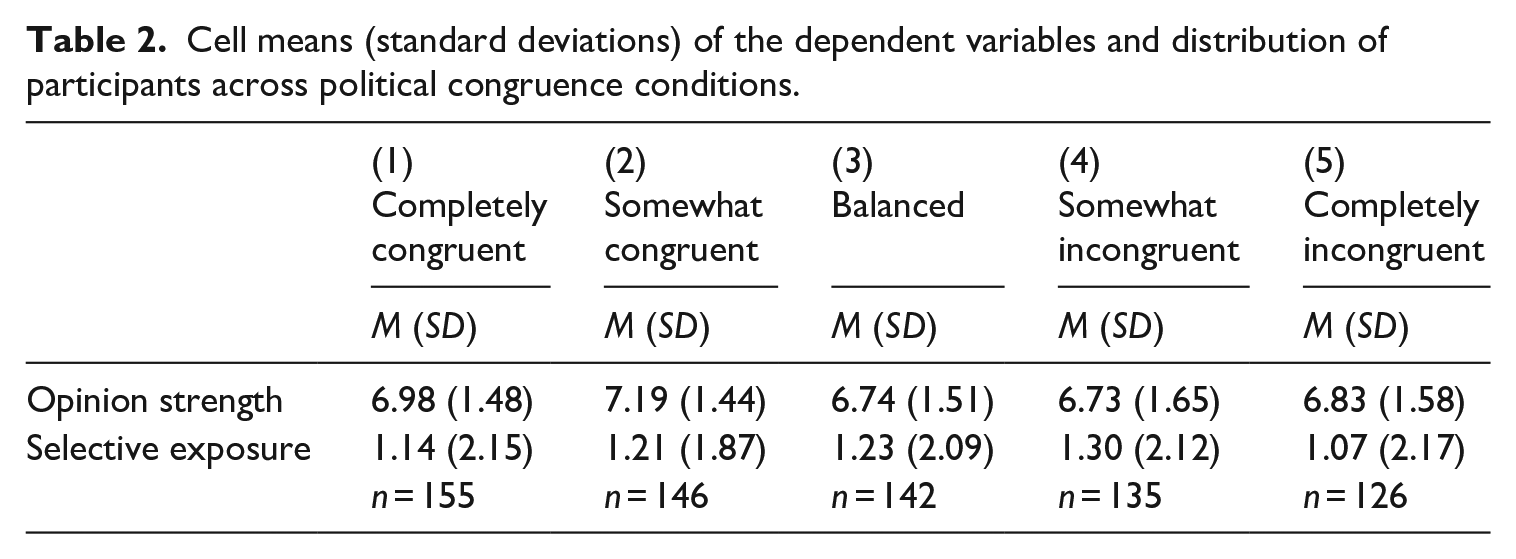
Participants were evenly distributed across conditions: χ2(19) = 20.77, p = .349.
H1 and H2 posited a curvilinear effect of political congruence on opinion strength and selective exposure, respectively. Neither opinion strength, F(4, 684) = 2.15, p = .073,
H3 proposed that a salient PI leads to higher levels of selective exposure compared to a non-salient PI. There was no effect of PI on selective exposure, F(1, 684) = 0.01, p = .929,
Cell means (standard deviations) of selective exposure across political identity and issue conditions.
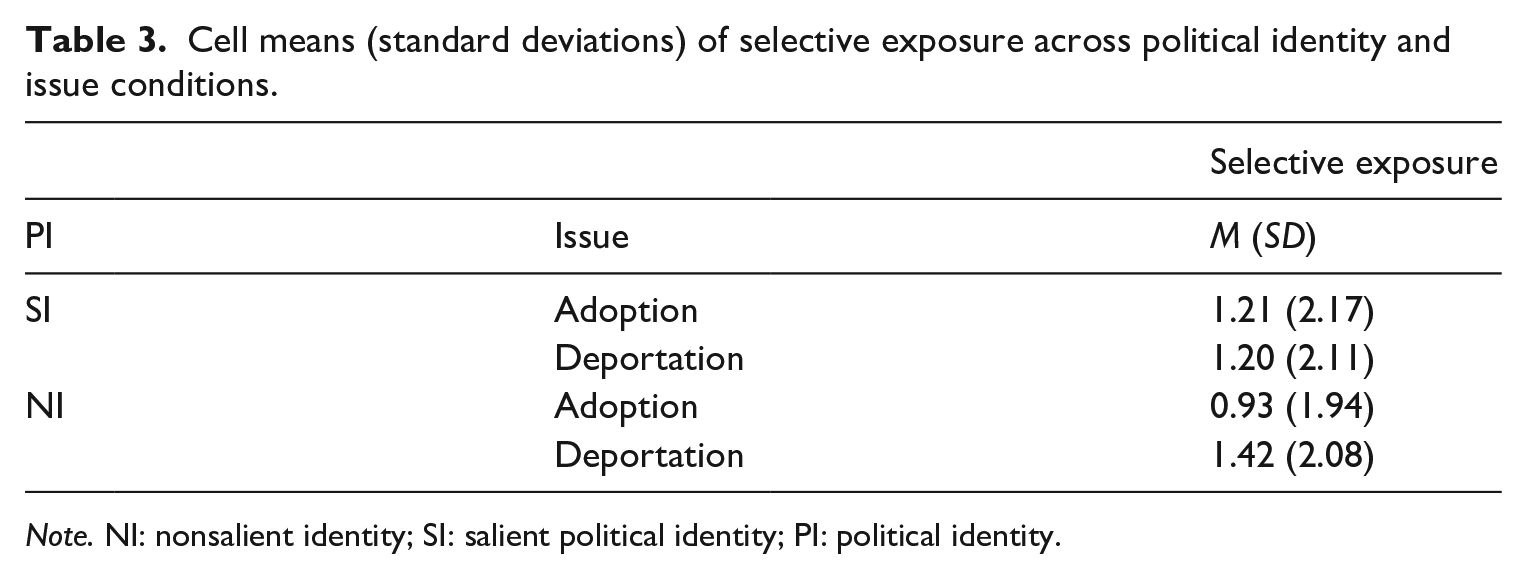
Note. NI: nonsalient identity; SI: salient political identity; PI: political identity.
Finally, RQ1 asked whether there is an interaction effect of political congruence and PI on selective exposure. Results indicated that there was no such effect, F(4, 684) = 0.41, p = .799,
Additional exploratory analyses
To rule out the possibility that results were biased by methodological artifacts, or that results differ for specific groups of users, we performed additional analyses on an exploratory level. For instance, the relatively small effect of the manipulation of political congruence might have had an impact on results. We therefore recoded the congruence variable into three categories by collapsing the political congruence conditions and leaving the neutral condition unchanged (congruent vs balanced vs incongruent). We then performed the ANOVA (see above), but used the modified political congruence variable. This revealed a small linear but not a quadratic effect of congruence on opinion strength, F(2, 692) = 3.81, p = .023,
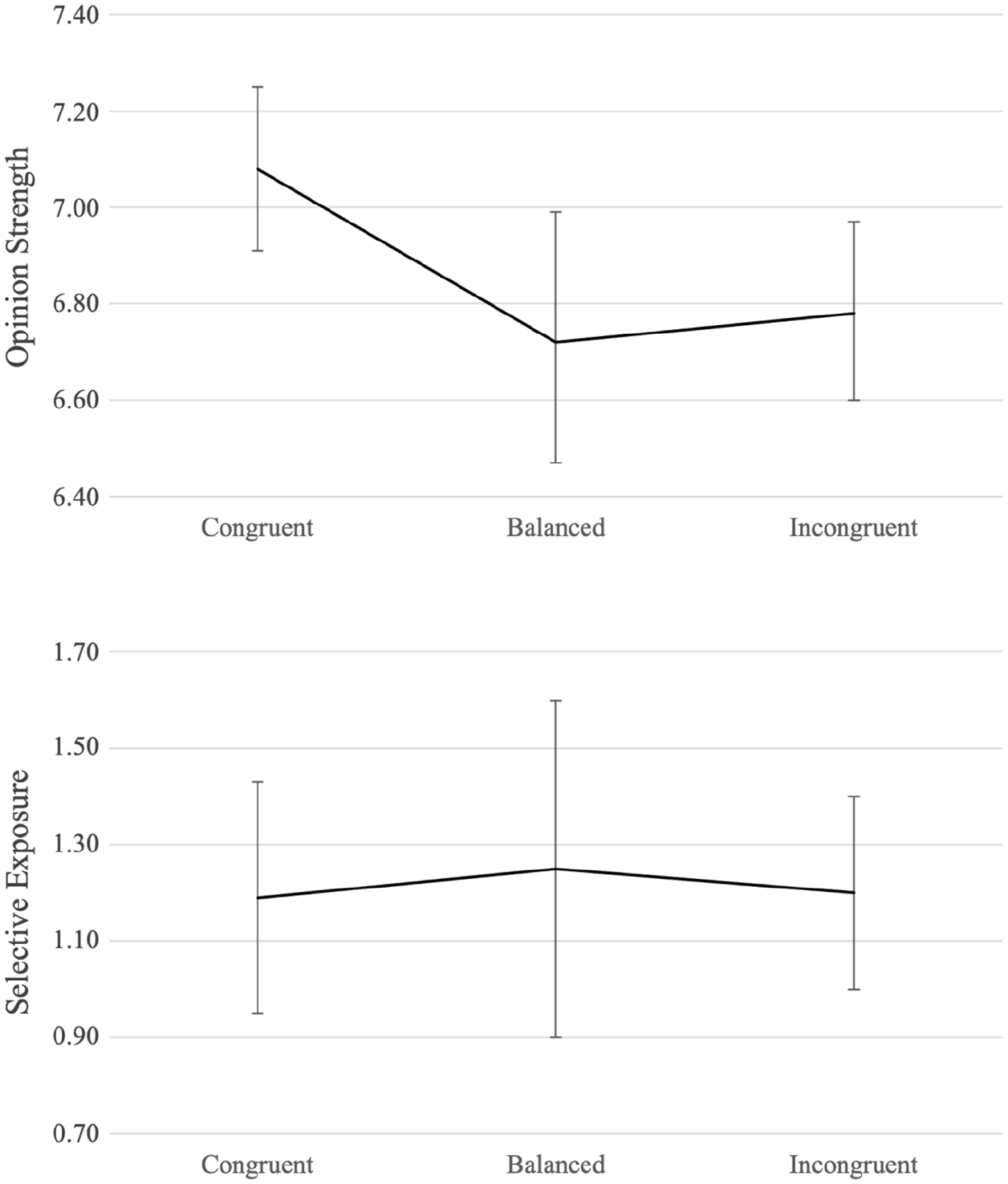
Mean values of opinion strength and selective exposure across levels of political congruence (trichotomized variable). Error bars indicate 95% confidence intervals.
Discussion
Drawing on a representative sample of social media users, this experimental study addressed circumstances under which opinion climates conveyed by SNS and political social identity impact users’ cognition and behavior. More precisely, considering mixed findings by extant research, we suggested that the degree of congruence of one’s opinion with the opinion climate is a crucial determinant of the former and posed curvilinear relationships, that is that both very congruent and very incongruent opinion climates can increase opinion strength and selective exposure. Surprisingly, however, our results suggest that the degree of political congruence of an opinion climate on SNS has, if any, very little impact on users’ political opinions and information selection—even when the opinion climate is completely congruent or completely incongruent with users’ preexisting opinion.
We found no evidence that being exposed to incongruent opinion climates alters opinion strength, irrespective of the amount of political incongruence encountered. While earlier work has pointed to the depolarizing effects of exposure to incongruent views (Knobloch-Westerwick et al., 2015; Parsons, 2010), such effects seem to be limited—at least when it comes to a one-time exposure to user-generated comments and in contexts of relatively low levels of polarization. At the same time, exposure to congruent opinion climates appears to weakly increase opinion strength. This finding is supported by related work on the polarizing effects of one-sided social and informational environments (Knobloch-Westerwick et al., 2015; Stroud, 2010; Sunstein, 2017). While the link between congruent opinion climates on SNS and opinion strength has been made mostly on a hypothetical level thus far, the present work provides experimental evidence – with a rather weak effect - for this causal claim. Moreover, our findings provide some support for the existence of a self-reinforcing mechanism (see Slater, 2007) between congruent SNS environments and opinion strength (indicated by an additional marginal correlation between opinion strength and selective exposure). However, given the possibility of incidental exposure to incongruent opinions via SNS (Lu and Lee, 2018), the degree of political congruence that users are exposed to in these environments may not be sufficient for such dynamics to unfold (O’Hara and Stevens, 2015).
While our results corroborate the general tendency of preference toward congruent information, the degree of political congruence within opinion climates on SNS does not appear to affect that tendency. In line with this, others have found that the amount of disagreement encountered on SNS is unrelated to the selective detachment from network contacts (Yang et al., 2017). Our findings are consistent with this and suggest that the amount of disagreement that users are exposed to is also unrelated to selecting opinion-congruent information (i.e. selective exposure to congruent news). Given the lack of support for our hypotheses, further explanations are necessary: First, it seems possible that inconclusive findings regarding exposure to congruent vs incongruent opinions cannot be explained by varying levels of political congruence. Other factors such as the source or the way of expression could play a more important role than the mere quantity of people supporting or opposing one’s viewpoint. Second, another explanation could be that our manipulation was too weak or not created in an appropriate manner. It seems conceivable that five comments are not enough to represent an opinion climate to the individual which, in turn, influences cognitions and behavior. Nevertheless, previous research showed that as few as four user-generated comments on Facebook are enough to slightly affect users’ perceptions of opinions (Neubaum and Krämer, 2017). Effects might also depend on the platform on which an opinion climate is present, and Twitter is not as popular in the country this study was conducted in comparison to other countries (see Nielsen and Schrøder, 2014). Contents from there may simply be perceived as less relevant to users’ lives. Moreover, the effects of exposure to opinions on SNS may be stronger in societies where political camps are highly polarized and where the debate of political issues is characterized by comparably high levels of hostility (Gervais, 2015; Hutchens et al., 2019). Entrenched political opinions make individuals more susceptible to actively seeking for confirmatory political information and to engaging in selective exposure (Garrett, 2009; Stroud, 2010). The relatively low level of political polarization in Germany (Munzert and Bauer, 2013) may thus be an explanation for the lack of effects from exposure to opinion climates via SNS.
Contrary to other research (Dvir-Gvirsman, 2018; Wojcieszak and Garrett, 2018), we did not find that the salience of a political social identity increases selective exposure to congruent information. Former research indicated that PI may only increase selective exposure of specific groups (e.g. politically more extreme individuals) and within highly polarized societies. As mentioned above, polarization and partisanship have been decreasing in Germany for decades and, therefore, political identities and their effects on cognition and behavior are likely to be weaker, if they exist at all (Knobloch-Westerwick et al., 2015). Interestingly, PI also does not appear to impact preference for political congruence when users are exposed to overly (in)congruent opinion climates. Some earlier research has suggested that in particular extreme partisans who identify with a political camp may be most susceptible to overly congruent online networks and their effects (Wojcieszak and Garrett, 2018). Our findings show that mere social identification with an ideological camp may not be a sufficient condition for any polarizing or depolarizing effects when it comes to exposure to political opinions on SNS. Moreover, contrary to related research that used convenience samples, we drew on a representative sample that included participants with overall low levels of political interest and identification. The mere salience of political identities may not affect users in general, but instead only those who are strongly attached to a political group and those who are exposed to more polarized societal and media environments.
Limitations
This study has several limitations. First, there is little doubt that the limited time and variety of opinions to which participants were exposed make the present study insensitive to potential long-time effects that may stem from exposure to opinions on SNS. Repeated and longer exposure may have led to stronger effects, and the present study cannot rule out the possibility that null findings were due to a weakness of the experimental treatment. However, given the relatively large sample and the independence of results from the time participants were exposed to stimuli puts this limitation somewhat into perspective, as even small effects could have been detected among participants who were exposed to the experimental stimulus for a considerable amount of time. Considering this, it seems unlikely that even a repeated exposure would lead to considerably larger effects. Moreover, in users’ everyday exposure to content on SNS, such effects would be diluted by incidental exposure to a heterogeneous mix of further political and non-political information (Lu and Lee, 2018).
Furthermore, the comment threads were to some degree artificial as they only resembled comments on social media. Even though participants’ perceptions of stimulus authenticity did not impact results, a lack of actual authenticity might still have biased our findings. Moreover, the applied communication setting only represents a small snapshot of the complex dynamics that communication via SNS involves, and political congruence can manifest itself in ways other than opinion climates in comment threads (e.g. by the dominance of congruent online media a user follows). Furthermore, our choice of specific issues may have had an impact on results. While both issues were perceived as interesting and controversial in a pilot survey, there might be interindividual variance in topical relevance influencing the potential effect on participants’ cognition and behavior (Johnson et al., 2020).
Finally, the comparatively high education level within our sample might have led to a distorted estimation of coefficients, such as an overestimation of selective exposure and an underestimation of its variability (Garrett, 2009). Taken together, our findings need to be evaluated through the lens of these shortcomings, which limit in particular external validity. Future work should investigate the potential long-term effects that exposure to congruent, incongruent, and balanced opinion climates on SNS might have on polarization and selectivity (e.g. by employing field experimental studies). Furthermore, the systematic inclusion of additional contextual factors of the communication setting (e.g. civility of opinion expression and societal context) would be advisable to explain gaps between related research and the present work.
Conclusion
Prior research was inconsistent regarding the effects of exposure to like-minded and opposing online environments, with some suggesting polarizing effects for the former and depolarizing effects for the latter, and others showing that even exposure to opposing political views can have polarizing effects. This study started from the notion that it might be the degree of political congruence of the opinion climate that determines whether it has desirable or undesirable effects on the individual. Our findings suggest that the opinion climates encountered in online networks may have very limited, if any, effects on opinion strength and selective exposure. Moreover, findings point to the boundaries of the idea that political social identities enhance the effects of political congruence on social media. Such mechanisms may be limited, particularly in politically less polarized societies, where political identities are not central to individuals’ self-concepts. With this, the present study adds to the understanding of the psychological consequences that congruent and incongruent environments may have for users and their online networks. The findings of the present experimental study suggest that immediate causal effects of congruent and incongruent opinion climates on users’ cognition (in terms of their opinions) and behavior (in terms of their information selection) may be, at most, very weak.
Footnotes
Funding
The author(s) disclosed receipt of the following financial support for the research, authorship, and/or publication of this article: This research was supported by the Digital Society research program funded by the Ministry of Culture and Science of the German State of North Rhine-Westphalia (Grant Number: 005-1709-0004), Junior Research Group “Digital Citizenship in Network Technologies” (Project Number: 1706dgn009).
Supplemental material
Supplemental material for this article is available online at https://osf.io/34fk6#61950fb40e2f500009c35e04;  .
.