




Abstract
In recent years, gambling has become increasingly prominent in everyday life; the term ‘gamblification’ first emerged in the late 2000s and was used to describe the colonisation of sports and sporting cultures by the gambling industry. Since that time, gamblification has been used to describe a range of phenomena in increasingly diffuse contexts; it has been variously used as a proxy for the convergence of gaming and gambling, to describe specific monetisation practices, or as a means of motivating consumer behaviours. Conceptual clarity has been further muddied by the positioning of gamblification as a form of gamification. This work provides a definition of gamblification, which draws upon and consolidates existing uses of the term while also providing a lens through which the differing aspects of gamblification can be understood and appraised. By doing so, this work will establish a clear conceptual framework, which can structure in-depth discussions of this multi-dimensional phenomenon.
Keywords
Introduction
The previous decade has seen the increasing prevalence of games, particularly digital games, as both an economic and a cultural force (Hamari, 2019; Raessens, 2006). Video games have become one of the most dominant forms of global media, driving the growth of new forms of entertainment such as streaming and esports, adjacent communities, novel business models such as free-to-play (Hamari et al., 2020; Lin and Sun, 2011) and the platform economy (Nieborg and Poell, 2018). Such developments further blur the boundaries between entertainment and occupation as well as intrinsically valuable activities with ones driven by monetary considerations.
This influence of games in contemporary society has led to the diffusion of games across domains of human life not just as consumable media products but also as cultures and practices of being. Video games in particular have been highlighted as possessing a level of persuasive power, which is unique in its capacity to influence behaviour (Bogost, 2007). The motivational ‘power’ of games is being employed across a range of fields as a means to encourage certain behaviours and manage individual user experiences (Koivisto and Hamari, 2019). This process of designing for gameful affordances, or ‘gamification’, has been feted for enhancing user experiences and providing intrinsic motivation; however, it has also been derided as being formulaic and exploitative (Hammedi et al., 2021; Thorpe and Roper, 2019).
Alongside the increasing significance of games and gaming in contemporary life, the same timeframe has also witnessed the growing acceptance of gambling as a leisure activity in Western societies (Cosgrave and Klassen, 2001). In addition, the opportunities afforded by digital and online technologies have resulted in the development of new gambling activities and new channels by which they can be accessed (Brock and Johnson, 2021; King et al., 2010; Macey and Hamari, 2019a; Schull, 2012). The gambling industry has seen remarkable growth with global revenues almost doubling between 2003 and 2013 alone, providing the basis for what has been dubbed the ‘industry-state complex’ or ‘Big Gambling’ (Markham and Young, 2015).
Although games and gambling are intimately connected to one another, gambling being a particular form of game play, traditionally they have remained relatively discrete activities, both conceptually and legislatively (Caillois, 2001; Jensen, 2017). Yet recent years have seen the convergence of gambling and gaming, a process which has been given added impetus with the emergence of digital and online technologies (King et al., 2015). Media convergence does not solely refer to the technologies by which content is both provided and accessed, but it is also a multifaceted phenomenon which is also evident in regulatory, economic and cultural spheres. Similarly, convergence does not only result in the development of new products or services, but it also creates new practices, behaviours and relationships (Jenkins, 2006).
As the convergence of gaming and gambling has gathered pace, so too has the body of academic literature addressing the issue; increasingly, researchers in the field are referring to the ‘gamification of gambling’ and, conversely, the ‘gamblification of gaming’ (Zanescu et al., 2019). While gamification has become an established field of study, gamblification is a term which has been employed much less frequently and with less coherence. Originating in the field of Gambling Studies it gained currency in non-academic contexts before witnessing a recent resurgence in works addressing the intersection of games and gambling. As the term has spread between different fields and contexts of usage, the meaning has evolved from the specific practice in which the gambling industry normalised participation in gambling (McMullan and Miller, 2008) to more ambiguous usage including as a proxy for the convergence of gaming and gambling (Macey and Hamari, 2020), for specific monetisation practices (Abarbanel and Johnson, 2020) or as a means of motivating consumer behaviours (Reinelt et al., 2021). Allied to these issues is the fact that the associated, but distinct, concepts of gamification and media convergence incorporate aspects of gamblification, thereby serving to further reduce theoretical clarity. As such, the increasingly diverse issues being attached to the term, arising from different perspectives, mean that there is a need to properly define the term, to conceptualise and define gamblification in an inclusive and holistic manner.
The two primary aims of this work are to establish (a) a formal definition of the term ‘gamblification’ and (b) a conceptual framework which can be used to identify gamblification across a range of contexts. Achieving these aims will provide a number of benefits, the first being that it will establish a clear theoretical framework which can structure in-depth discussions of this multi-dimensional phenomenon. Second, it will provide regulatory bodies in the fields of gambling and consumer protection with the knowledge needed to make more informed judgements on the legal standing of activities which stand at the intersection of gambling and digital media consumption. Indeed, it is expected that the conceptual framework produced by this research will have the potential to be utilised in reference to the consumption of a range of products and services, both digital and non-digital. Third, this work will allow consumers themselves to become more aware of the ways in which their behaviours and consumption patterns are being directed and, potentially, exploited. Finally, this work will allow product and service providers to understand the potential effects of their design choices and, consequently, allow them to make choices based on ethical considerations.
Background
Play is a fundamental aspect of human culture and development, indeed it has been proposed that culture could not exist without play (Huizinga, 1955). The presence of games determined, to a greater or lesser degree, by chance in human culture has been associated with the capability for abstract thought, sense-making and the ability to conceptualise potential visions of the future (Caillois, 2001), indeed, the origins of such games have been closely connected to cultural practices such as fortune-telling (Pfeiffer and Sedlecky, 2020).
Gambling has been a significant component of diverse human societies spanning both temporal and spatial distances (Binde, 2005). In addition to being a form of entertainment, it has many socio-cultural functions, including but not limited to serving as a method for resolving inter-group conflicts, for facilitating social mobility, and as a means of redistributing wealth (Abt et al., 1984). Despite the importance of gambling to the social and cultural fabric of human life, it has often been subject to restrictions, both moral and legal (Binde, 2007; Cosgrave and Klassen, 2001). It is noteworthy that, in Western societies, the social acceptance of gambling has increased alongside the degree of secularity; indeed, gambling and other forms of play have become direct rivals of, and substitutes for, religious experiences and practices (Sutton-Smith, 1997).
It is in the 20th century that gambling achieved the widest acceptance in Western societies, with increasingly liberal legislation being introduced from the 1960s onwards (Petry and Blanco, 2013). Liberalisation gathered pace over the following decades, with the 1980s marking the beginning of a shift in attitudes, whereby gambling began to emerge as a global industry of significant economic and political influence (Schull, 2012). The development, and subsequent legalisation, of online gambling in the early 21st century further increased both the number of gambling activities available to consumers and the ease by which gambling could be accessed. Gambling has become an extremely profitable global industry, both for nation states and for individual companies and has become an increasingly obvious presence in contemporary culture as ever more liberal legislation legitimises participation (Markham and Young, 2015). It has directly benefitted from the development of digital technologies, with the growth of computer-mediated gambling marking a shift from gambling as a source of volatile and consequential ‘action’ (Goffman, 1967) to one which occurs in carefully designed and managed spaces which provide protective and predictable experiences, a source of refuge from the precarious nature of modern life (Schull, 2012).
The increased salience of gambling as a socio-cultural and economic force in Western culture has been proposed as reflecting, and at the same time reinforcing, the materialist and competitive values enshrined in American society (Smith and Abt, 1984). These values have been spread globally, to varying degrees, through the predominance of American entertainment media as a cultural commodity, that is, ‘cultural colonialism’ (Amsler, 2008), and as a component of the ‘culture industry’ (Adorno and Bernstein, 1972). The extension of gambling as a leisure pursuit is representative of the ongoing commodification of leisure (Hemingway, 1996), in particular the commercialisation of play and the emergence of the experience economy (Pine and Gilmore, 2011). Examples of these intertwined phenomena can be found in the world of contemporary sports (Lopez-Gonzalez and Griffiths, 2018b; Sewart, 1987; Walsh and Giulianotti, 2001) and the reinvention of Las Vegas as an entertainment experience capital of America and, arguably, the world (Douglass and Raento, 2004).
Defining gambling
Gambling is an activity which occupies different spaces and roles across different cultures, even varying within a given culture over time. The meaning and practice of gambling, therefore, are dependent upon socio-historical context (McMillan, 1996). As such, the process of developing a formal definition of gamblification requires that we first offer a definition of gambling which can be used as a point of reference.
Legal definitions of gambling vary between jurisdictions but are most commonly built around three core concepts: an initial stake (the ‘consideration’), an event with an uncertain outcome (chance) and a potential reward (or ‘prize’). Prizes are often framed in terms of ‘money, or money’s worth’ (Abarbanel, 2018). In order for an activity to be categorised as gambling, all three components must be met, however, it is in the characterisation of these three elements that differences in interpretation arise. Indeed, the formalised legal definition of gambling highlights differences in interpretation both between different regulatory bodies and different sections of society. For example, while activities such as raffles are legally considered gambling, making investments in the stock market is not; however, research into public perceptions of gambling found that more than twice as many people thought that investing constituted gambling in comparison with raffles (Williams et al., 2011). The question of whether investments constitute gambling has been debated within academia (Borna and Lowry, 1987), as has the relationship between chance and skill in determining the outcome of the activity and the expectation for either long-term losses or zero-sum gain (i.e. that gambling involves only the transfer of capital and not the creation of capital) (Williams et al., 2017). However, in accordance with legal definitions of gambling, academic definitions contain three core components: (a) an item of value that is staked on an event, (b) that the event is of an uncertain outcome and (c) that there is a reward for correctly selecting the outcome of the event (Williams et al., 2017).
A recent development highlighting the differing conceptualisations of stake, chance and prize has been the growing prevalence of virtual items and loot boxes within contemporary video games, that is, items whose value may not be directly, or easily, quantifiable in real-world currencies. The emergence of in-game virtual items (Lehdonvirta, 2009), particularly cosmetic items known as ‘skins’, has played a major role in the development of video game-related gambling (Macey and Hamari, 2019a). They are predominantly obtained by opening loot boxes, a catch-all term referring to in-game items which distribute rewards to players based on random number generation (Macey and Hamari, 2019b). Some loot boxes can be opened for free, while many games also provide players with the opportunity to open loot boxes for a small fee. The combination of paid opening (consideration) and chance-based allocation of rewards, or ‘prizes’, has led to accusations that loot boxes are a form of gambling, with many authorities conducting investigations into the phenomenon. Several regulatory bodies have ruled that loot boxes constitute gambling under their local legislation, for example, The Isle of Man, Belgium and The Netherlands. Furthermore, several Asian countries have introduced legislation banning the sale of loot boxes or imposing certain conditions on their availability (Zanescu et al., 2021). Although specific interpretations of consideration and prize vary between regulators, the central role of uncertainty in determining the outcome remains constant. Furthermore, the differing interpretations do not move away from the three core components of gambling: a stake (consideration), an uncertain outcome (chance) and a prize.
Exploring the three elements of gambling
The stake
The stake is required to participate in gambling and has been variously conceptualised as ‘money or other belongings’, ‘wealth’ or ‘items of material value’, with the latter being defined as something for which someone is willing to pay money (Williams et al., 2017). As outlined previously, the development of virtual items calls into question traditional concepts of material value and of personal belongings. Aside from the growing prevalence of in-game items, which can be purchased separately from video games themselves, whether they be purely cosmetic or functional items, blockchain technology has facilitated the emergence of unique digital entities, non-fungible tokens, which have featured in the gambling ecosystem (Abarbanel and Macey, 2019). Operating at an even further distance from established concepts of ‘items of material value’ is the central importance of personal data to both legal and illegal digital economies (Li et al., 2019).
Uncertain outcome
The outcome of the event or activity which forms the basis of the gamble is one which is unknown to the participant prior to the gamble taking place. In many definitions, both legal and academic, the terms ‘random’ and ‘chance’ have been used in place of, or in addition to, uncertain(ty); however, these terms have stimulated discussion as to the precise nature of chance (Williams et al., 2017). One of the most prominent points of discussion relates to the degree to which chance influences the outcome, that is, whether an event must be wholly or predominantly determined by chance rather than skill (Abt et al., 1984; Reith, 2018; Stevens and Young, 2010). The proliferation of algorithms which are employed in online and digital gambling activities further questions the notion of randomness and chance. Indeed, so-called random number generators are often actually pseudo-random in nature, being determined by underlying algorithms and operating conditions (Grabarczyk, 2018).
Prize
As with the stake, legal definitions of the prize are often quantified in terms of money or ‘money’s worth’, this focus on financial, or material, gain is reflected in many theoretical approaches to understanding and explaining gambling as a practice. Early attempts to rationalise gambling were framed in terms of economic utility, that is, that the motivations to gamble were solely attributable to attempts to improve financial status (Friedman and Savage, 1948). An alternative perspective of gambling views it as an essentially unproductive activity where the prize is a function of wealth redistribution (Borna and Lowry, 1987). Such purely economic views fail to account for alternative forms of prizes afforded by a successful gamble, such as social benefits. Recent years have seen the emergence of online gambling activities with prizes ranging from virtual digital items (some of which can be exchanged for real-world currencies) to social rewards within virtual communities. Although these prizes have no physical or quantifiable monetary value, they can be considered as having material value within the system or community (Abarbanel and Johnson, 2020). Prospect theory (Kahneman and Tversky, 1979) provides a means to understand such behaviours as it includes the concept that potential losses and gains can be perceived differently by individual participants.
Considering these factors, we view the following definition as one which can account for the varied aspects of gambling in the contemporary socio-historical context: Staking money or something of material value on an event having an uncertain outcome in the hope of winning additional money and/or item of material value.
This is, essentially, the definition provided by Williams et al. (2017), with one amendment: in the original definition, the prize was defined as ‘additional money and/or material goods’. We feel that the concept of material value highlighted in the first part of the definition most accurately reflects both gambling conducted in physical, offline spaces and in digital, online spaces. Furthermore, defining the prize in the same way as the stake ensures conceptual clarity and consistency.
Defining gamblification
To produce a definition which is both comprehensive and meaningful, it is necessary to review the ways in which the term ‘gamblification’ has been employed since first appearing in the late 2000s. This section provides an overview of the main discourses concerning gamblification, organised into three distinct themes, before offering a consolidated definition.
Discourse concerning affective communication and the socialisation of gambling
The term ‘gamblification’ was first employed to describe the ongoing colonisation of sports, and sporting cultures, by the gambling industry (McMullan and Miller, 2008). Gamblification, as a concept, goes beyond mere advertising as it builds upon earlier work addressing the role of celebrity ambassadors, sponsorship and promotional products in creating an environment in which gambling is normalised, particularly among youth and young adults (Dyall et al., 2009; Monaghan et al., 2008), furthering the socialisation of gambling (Raymen and Smith, 2020). In this sense, gamblification is a process that utilises the affordances of gambling as a means of promoting consumer uptake, whether these be in respect to the exciting qualities of the games themselves or their potentially life-changing outcomes (McMullan and Miller, 2008). Such promotional strategies make use of underlying cultural meanings associated with the practice of gambling; the cultural salience of gambling is evident throughout popular culture, from the writings of Jane Austen to the James Bond franchise (Chan and Ohtsuka, 2011; Raento, 2013; Richard, 2011). Indeed, it has been proposed that gambling does not merely embody certain societal and cultural values, but that it serves as a ritualised means of asserting and reaffirming the basic values of a society (Abt et al., 1984). Gamblification, therefore, draws upon a wealth of cultural practices and values to promote gambling as an activity.
From the specific context of sport and sporting culture, gamblification has come to signify the spread of gambling into a range of adjacent, but traditionally distinct fields (Driver, 2018; Lopez-Gonzalez and Griffiths, 2018a; Zanescu et al., 2020). Perhaps the most obvious example is the convergence of gaming and gambling (Gainsbury et al., 2015; King et al., 2015). The gamblification of digital games was first discussed in relation to simulated gambling and, in particular, social casino games (SCGs) (King et al., 2010; Morgan Stanley, 2012). SCGs apply the free-to-play business model to traditional gambling games, but remove the ability for players to cash out any winnings. In this way, by removing the ‘prize’, the games are not covered by the legal definition of gambling, despite the fact that they directly replicate activities such as poker, roulette and slot machines (Abarbanel and Rahman, 2015).
The remediation of gambling is not restricted to positioning gambling games as games but also incorporates the inclusion of chance-based reward systems within games themselves, these systems are collectively referred to as ‘loot boxes’. Research has consistently demonstrated similarities between loot boxes and traditional forms of gambling (Kao, 2020; Zendle et al., 2020), with several national regulators concluding that loot boxes constitute gambling. This aspect of gamblification, therefore, uses the forms and conventions of an adjacent field, in this case games, as a means to reframe gambling as any other form of play, increasing ease of access and bypassing regulatory oversight. Indeed, loot boxes and other gamblified activities are a central component of online platforms in which they are used to drive both user engagement and monetisation strategies (Joseph, 2021; Zanescu et al., 2020).
Discourse concerning furthering user engagement and monetisation
The most recent usage of gamblification refers neither to the overt promotion of gambling nor the remediation of gambling, but in the use of gambling to further engagement with a particular product or service. While such practices are not themselves recent developments (Lawson, 2001; Peattie, 2003), the emergence of digital technologies has afforded many more opportunities to incorporate forms of gambling as a means to encourage desired behaviours. Contemporary digital and informational services are increasingly being provided through a platform-centred economy in which economic and social activities are conducted via digital infrastructures (Kenney and Zysman, 2016; Srnicek, 2017). Platforms are a notable online presence across a range of industries including, but not limited to, social networks (Facebook), online auction houses (ebay), sharing sites (AirBnB), digital distribution services (Steam) and video streaming sites (Twitch). Such is the influence of platform-centred interactions they have been proposed as not merely facilitating economic and social activities but, instead, of shaping them (Steinberg, 2019; van Dijcket al., 2018).
Online platforms centred on video games and gaming culture, such as Twitch and Steam, have been explicitly linked to gamblification through the development of monetisation practices that exploit gambling activities in a number of novel ways. Steam, for example, has developed a platform-centred economic ecosystem which both creates and distributes virtual items via mechanisms based on gambling (loot boxes). This ecosystem is not limited solely to products and services offered directly by Steam, but also incorporates third-party gambling sites which use the official Application Programming Interface (API) to conduct transactions on the platform’s marketplace (Zanescu et al., 2021), for which they must pay commission. Twitch, however, provides a number of tools to Streamers which can be integrated into their individual channels to increase monetisation. As with long-established, non-digital forms of gamblification, several of these tools incorporate gambling activities fully, such as prediction contests or raffles, while others distribute the component parts among different parties or incorporate the three core elements to varying degrees. The marketing of these tools and mini-games subvert the established conventions of discourse around gambling by promoting their ‘addictive’ or compulsive qualities as a positive or desirable aspect (Abarbanel and Johnson, 2020).
Discourse concerning the mechanics of gambling
Some have referred to gamblification as the use of gambling mechanics in non-gambling games (Driver, 2018), however, a lack of consensus as to what constitutes gambling mechanics results in conceptual ambiguity in the definition and questions the overall value of such an approach. The term ‘gambling mechanic’ has, variously, been used to refer to: games and activities (Zaman et al., 2020); aspects of behavioural psychology exploited by gambling companies (Griffiths, 2015); and the interactional structures which govern the practice of gambling (Abarbanel and Johnson, 2020; King et al., 2015).
If we examine a specific ‘mechanic’ identified by Driver (2018), that of variable reward schedule, we see that it is not unique to the practice of gambling. Indeed it is present in many contexts without reference to gambling or gamblification, for example, in the rehabilitation of convicted felons (Burrell and Gable, 2008); variable rewards are, in fact, a type of operant conditioning (Ferster and Skinner, 1957). Similarly, while such techniques such as ‘near misses’ and ‘losses disguised as wins’ have been exploited by the gambling industry to great effect (Newall, 2019), it would be hard to justify their classification as gambling mechanics per se. If the design choices which produce such effects were removed from a given gambling activity, for example, a slot machine, it would not change the way the basic structural characteristics of the game operate.
There is, however, one notable exception to this perspective, the affective phenomenon of reward uncertainty. Reward uncertainty describes situations in which the outcomes of a choice or action are not known beforehand, it is comprised of a set of neural processes concerning risk assessment and decision-making and has been particularly associated with learning, memory formation and economic behaviour (Fiorillo et al., 2003; Schultz et al., 2008; Stanek et al., 2019). Existing research has shown that both humans and animals tend to prefer situations characterised by reward uncertainty in preference to certain rewards (Zack et al., 2020). Rather than constituting a design choice which is applied to the activity of gambling to promote or encourage ongoing participation, it is, instead, the underlying phenomenon which defines gambling ( Clark et al., 2019; Fiorillo et al., 2003).
Others have referred to specific games or activities themselves as gambling mechanics, for example, in discussions of gaming/gambling convergence loot boxes, skins lotteries and ‘simulated gambling’ have all been referred to as gambling mechanics (Adam et al., 2021; Zaman et al., 2020). There are notable problems with such an approach, the first of which is that a mechanic is a means of interacting with a game or game environment (Sicart, 2008), as such gambling games or activities cannot, themselves, constitute mechanics. Second, there are a multitude of ways in which, for example, loot boxes are implemented within digital games, accordingly they themselves utilise a range of different mechanics according to their specific form. Perhaps the only defining characteristic which can be said to apply to the diverse forms of loot boxes is the use of random number generation when determining the contents, although this too has been questioned with the existence of ‘pity timers’ observed in some games (Xiao et al., 2021).
The role of chance in generating uncertain outcomes has been highlighted as a form of gambling mechanic (Abarbanel and Johnson, 2020), as have betting/wagering and the potential for payout to players (King et al., 2015). These elements both fulfil the criteria of mechanic, defined by Sicart (2008), and mirror the definition of gambling provided by Williams et al. (2017). Furthermore, chance or randomness serves as a means by which variable reward schedules are provided to players. Still, caution is needed as these interactional elements, when considered in isolation from one another, are present in other game forms. For example, although an uncertain outcome is a key mechanic of gambling, many games use chance to introduce uncertainty into the experience through, for example, the roll of a die (see Abarbanel, 2018).
Attempts to distinguish gambling mechanics from other game mechanics or psychological processes are fraught with potential pitfalls and may be subject to numerous qualifications, thereby rendering them unusable in practical terms. The practice of gambling is not determined by any one activity or individual mechanical feature but, rather, the specific combination of three elements outlined previously: stake, uncertain outcome and prize. These interactional elements can be conceptualised as mechanics accordingly: betting/wagering mechanics, chance-based mechanics and payout mechanics. Reward uncertainty is central to the activity of gambling; however, it need not constitute a distinct mechanic as it is realised through the combination of chance and payout mechanics.
Gamblification: a consolidated definition
To reconcile the different ways in which gamblification has been employed in prior literature, this work offers the following definition: Gamblification is the (increased) presence of gambling (or gambling-related content) in non-gambling contexts in order to realise desired outcomes. It incorporates two main aspects: affective (employing cultural values/signifiers of gambling); and effective, (employing gambling games and activities).
The outcomes of gamblification are context-specific, and as such vary between implementations; examples of such outcomes include, but are not limited to, the following: increasing monetisation of video games (Brock and Johnson, 2021), introducing excitement into information systems (Adam et al., 2021) and media representations which seek to both promote and benefit from the glamour and fantasy associated with a high-roller lifestyle (Humphreys, 2008; Luke, 2010; Milner and Nuske, 2012; Nicoll, 2013).
Affective gamblification can be separated into two distinct sub-types. First, it uses gambling-related imagery and language to evoke certain emotional responses, either positive or negative, in content consumers. This is termed ‘affective – emotive’ gamblification and can be seen in the use of gambling as a shorthand to communicate values or qualities about a service, product or even an individual’s character (Abarbanel and Johnson, 2020; Egerer and Rantala, 2015; Raento, 2013). Second, it includes the utilisation of non-gambling activities as a vehicle for promoting the acceptance of gambling at a societal level. This is termed ‘affective – normalising’ gamblification, evidence of which can be seen in, for example, the increased presence of gambling as a sponsor in both traditional sports, such as association football, and esports (Lopez-Gonzalez and Griffiths, 2018a; McMullan and Miller, 2008).
Similarly, effective gamblification comprises two sub-types. First, it refers to the addition or inclusion of activities which are direct, high-fidelity, reproductions of existing gambling games in non-gambling contexts. This is termed ‘effective – full fidelity’ gamblification and can be seen in the implementation of Battle Passes in modern video games (Zanescu et al., 2020) or the addition of activities such as raffles to non-gambling services (Adam et al., 2021). In addition, effective gamblification also includes the use of activities or games which are partial representations of existing gambling games, that is, that the core activity is based on an uncertain outcome, but that either the monetary stake or prize is absent. This is termed ‘effective – partial fidelity’, with SCGs and customer prize draws being notable examples (Macey and Kinnunen, 2020; Morgan Stanley, 2012).
Furthermore, effective gamblification can be considered in terms of how accurately it fulfils established definitions of gambling, that is, the inclusion of tangible assets (money, or money’s worth), as stakes and prizes. For example, the substitution of intangible or non-transferable assets for either, or both, the stake or the prize results in a situation where the academic definition of gambling is fulfilled, but the legal definition is not.
Although the term gamblification was first used in reference to the use of sports and sporting culture as a vehicle for the socialisation of gambling, it has increasingly been applied to the context of digital games. However, gamblification is neither limited to games, nor digital environments, indeed there are many practices which can be understood more completely when viewed through the lens of gamblification, as defined above. These range from portrayals of gambling and gamblers in various media as a shorthand for certain moral or lifestyle-based judgements to established marketing practices such as prize draws where an individual provides personal information to participate. Examples of the four types of gamblification are presented in Table 1. Given the extent to which gamblification has been discussed in reference to digital games, the table includes examples from both gaming and non-gaming contexts.
Gamblification types and examples.
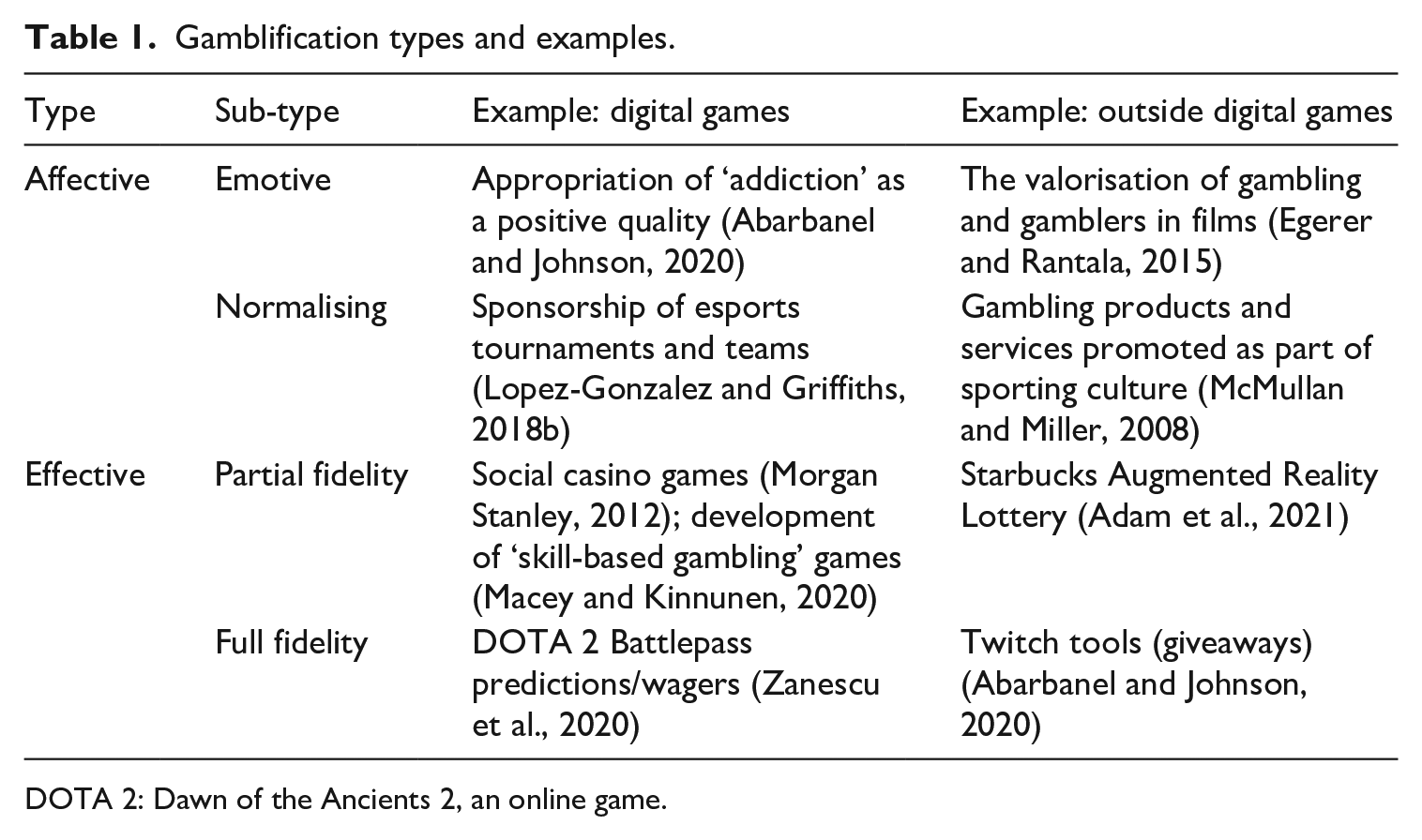
DOTA 2: Dawn of the Ancients 2, an online game.
Discussion
This work proposes a consolidated definition of gamblification, incorporating the varied uses of the term since it was first coined over a decade ago. The definition offered in this work is not simply descriptive but, in addition, provides a means to understand both the process and its effects.
The fact that the term gamblification has often been employed without explicit definition has resulted in a lack of conceptual clarity, reflected in the fact that some have considered gamblification to be a particular form of gamification (e.g. Reinelt et al., 2021). While such an approach is understandable given the fact that the practice of gambling is itself a specific form of game, it confounds attempts to understand the particular practices and effects of gamblification. Several definitions of gamification have been offered, none of which are consistent with the ways in which gamblification has been employed. For example, one of the earliest referred to the use of ‘game elements’ in non-gaming contexts (Deterding et al., 2011). As we have seen, attempts to use the same approach to understand gamblification are fraught with potential problems when it comes to identifying gambling elements.
Alternative approaches to gamification have discussed the ways in which it is employed to motivate behavioural change (Koivisto and Hamari, 2019). Gamblification can be used to promote certain behaviours by encouraging continued participation (Zanescu et al., 2020); however, any motivational affordances result from extrinsic rewards rather than intrinsic rewards. While gamification also utilises extrinsic rewards, research suggests that any attempt to gamify which focusses on extrinsic rewards is unlikely to achieve its aims (Hamari et al., 2014; Richter et al., 2015). Furthermore, the actions and rewards in gamified situations are, almost exclusively, contained within a specific context as points or badges from one system cannot be earned, redeemed or otherwise used in a separate system. In contrast, gamblification utilising rewards (i.e. effective) requires a stake and/or a prize which is independent of the system, something which has value outside of the gamblified context (Adam et al., 2021).
While gamblification can be used to promote pro-social behaviours or motivate users to reach personal goals (Reinelt et al., 2021) much of the current debate around gamblification concerns the degree to which it is being used to encourage behaviours with negative consequences or to introduce practices which are considered exploitative. It is unsurprising, therefore, to see concerns raised regarding the use of gamblification to increase monetisation of digital games (see Brock and Johnson, 2021).
The potential impact of gamblification is provided by the game GTA Online, which added an in-game casino via an update. Similar to SCGs, players could use real-world currencies to purchase game money with which they could gamble; however, there is no option to cash out any winnings. In the months immediately after the update was released, profits generated by the game increased by 23% (Strickland, 2020). Indeed, the earning potential of gamblification is such that dedicated companies now offer gamblification services as part of the game development process (Z Games, 2021).
Consequently, ethical concerns related to gamblification exist which require consideration, the first of these concerns the potential effects for vulnerable users, whether children or those who experience problematic consumption behaviours. These effects are further compounded by the fact that gamblified services or products may not always be obvious to users, or that they can be present in unanticipated locations. As such, there are concerns that gambling and gambling-like behaviours, that is, the preference for risk-based interactions, become normalised at an early stage, leading to increased likelihood of developing problematic consumption patterns (Abarbanel, 2018; Reith, 2018). This perspective results from the fact that exposure to gambling at an early age has been found to be a strong predictor of experiencing disordered or problematic gambling in later life (e.g. Gupta et al., 2013). A further concern is that SCGs have been found to directly encourage participation in real money online gambling, with migration rates of between 19.4% and 26% being reported ( Gainsbury et al., 2016; Kim et al., 2015). The structural characteristics of online gambling, for example, increased accessibility, have been highlighted as promoting the development of problematic consumption behaviours to a greater degree than offline gambling (Chóliz et al., 2021).
Another concern relates to transparency, in regard both to the way in which personal data collected from participants will be used and to the ways in which the gamblified activity operates, for example, in relation to the potential rewards and the odds of obtaining particular items. SCGs in particular have been criticised for presenting as ‘practice sites’ while employing unrealistic probabilities, as a consequence, players are provided with a false sense of mastery as, when migrating to online gambling services they are unlikely to achieve the same levels of success as experienced using SCGs (Abarbanel and Rahman, 2015). In addition to unrealistic odds, gamblification may also exploit the same psychological mechanisms as do established gambling services, reducing user’s agency and/or autonomy.
Although gamblification has been provided with added impetus from modern technologies, it is neither a novel phenomenon nor one confined to the digital environment, with the first national lottery in the United Kingdom being held in 1567 to raise money to develop trade networks (The British Museum, 2020). Indeed, the use of lotteries as a means of supplementing tax revenues is an established practice for governments across the globe, this practice can be considered as the gamblification of both taxation and of civic engagement. The financial rewards offered by gamblification are further demonstrated in the profitability of SCGs, loot boxes, and other practices adopted by contemporary gaming companies. Given the cultural and economic significance of gambling in contemporary Western societies (Abt et al., 1984; Markham and Young, 2015; Smith and Abt, 1984), and the continued convergence of digital media, the continued proliferation of gamblification appears likely.
A consequence of the ongoing convergence between video games and gambling is that established concepts around randomness and chance have become somewhat muddied; indeed, the process has resulted in a need to revisit, and potentially to revise, the definition of gambling itself. The fact that in many games chance is utilised as a game mechanic, introducing variation and unpredictability, has led some to conclude that any form of random event is equivalent to legally defined gambling. Attempts to regulate loot boxes have sparked debate concerning the potential for other forms of chance-based play, such as Kinder Eggs or collectible card games, to be considered as gambling (Abarbanel, 2018). Adopting the lens of gamblification allows us to recognise that, although such practices cannot be legally categorised as gambling, they incorporate aspects which utilise the affordances of gambling and which are, therefore, attractive to both producers and consumers. Accordingly, approaches to harm minimisation or other regulation could draw from existing practices related to gambling but be enacted by bodies working in different fields, such as digital literacy, youth services or consumer protection.
Similarly, effective gamblification highlights the differing ways in which value is realised, particularly in regard to virtual items and immaterial rewards. The social rewards or prizes offered to members of online communities are an area which requires further attention given the significance of gamblification to the platform and data economies that have been facilitated by digital technologies (Zanescu et al., 2020). Indeed, the way in which many gamblified services require personal data as a stake highlights the issues of transparency and data protection, or lack thereof, in contemporary digital economies. People are encouraged to provide data which are of potentially significant value to businesses, but which are of marginal value to the user in financial terms. This removes the basic loss aversion function that governs many assessments of risky or chance-based situations, virtually guaranteeing participation. In this way, gamblification highlights the inadequacy of traditional economic thinking to explain particular interactions.
Conclusion
Gamblification has been present in various societies for many centuries, but has been provided with increased impetus and scope by the expansion of media convergence, in both technological and cultural terms. Despite the fact that the term only emerged relatively recently, it has often been employed in reference to distinct, albeit connected, practices; this work proposes a consolidated definition of gamblification and attempts to provide a theoretical backgrounding of the term.
While many contemporary manifestations of gamblification are ethically questionable, such as those which have been used as a means of aggressive monetisation, it is not necessarily an exploitative practice as it can be used to provide individuals with meaningful rewards and experiences which increase engagement and motivate positive or pro-social behaviours. However, the potential consequences of introducing gamblification can be significant for users or consumers, and it should be approached with care. Utilising the lens of gamblification to understand specific practices highlights the need to develop new approaches to consumer protection and to renegotiate established concepts of value and of producer–consumer relationships; it offers a window to understand wider socio-economic adaptations to the possibilities afforded by media convergence, both online and offline.
Footnotes
Declaration of conflicting interests
The author(s) declared no potential conflicts of interest with respect to the research, authorship and/or publication of this article.
Funding
The author(s) disclosed receipt of the following financial support for the research, authorship and/or publication of this article: This work was supported by the Academy of Finland project Centre of Excellence in Game Culture Studies (CoE-GameCult, #312396) and the Academy of Finland Flagship Programme under Grant No. 337653 (Forest-Human-Machine Interplay [UNITE]). In addition, this work was supported by personal study grants from the Finnish Foundation for Alcohol Studies.
