




Abstract
The adoption of COVID-19 contact tracing apps (CTAs) has been proposed as an important measure to contain the spread of COVID-19. Based on a cross-national dataset, this article analyzes public perceptions toward CTAs and the factors that drive CTA acceptance in China, Germany, and the United States. We find that public acceptance of CTAs is significantly higher in China as compared with Germany and the United States. Despite very different sociopolitical contexts, there are striking similarities in the factors that drive CTA acceptance in all three countries. Citizens are willing to accept digital contact tracing despite concerns about privacy infringement and government surveillance, as long as the apps are perceived as effective in lowering infection rates and providing health information. This creates a chicken-and-egg problem for CTAs in Germany and the United States where CTAs are voluntary: a high citizen adoption rate is necessary for CTAs to be effective, but CTAs are only effective if adoption rates are high.
Introduction
Digital contact tracing apps (CTAs) have been widely employed to combat the global spread of COVID-19. Compared with manual contact tracing, which involves human contact tracers identifying, locating, and isolating individuals who have come into contact with infected persons, digital contact tracing uses smartphone apps to identify and notify individuals (Ferretti et al., 2020). As of February 2021, more than 49 countries have adopted CTAs (Howell et al., 2021). Despite the widespread introduction of CTAs, uptake by smartphone users varies between countries. States that made CTAs mandatory such as Singapore, Qatar, or China have reported the highest download rates, with a penetration rate of 80% or higher. Iceland and Finland also had high download rates, with approximately 40% of the population having voluntarily installed the national CTA. However, in the majority of countries, download rates were modest, with penetration rates of less than 10% in the United States, 12% in India, 14% in Canada, 29% in Australia, and 30% in Germany (Howell et al., 2021). Noticeably, each country tailored their CTA to technology availability as well as specific public or political preferences on issues such as privacy, transparency, and effectiveness.
Despite a growing literature on CTAs, research on public perceptions of CTAs remains limited. A range of on- and offline surveys have inquired about citizen attitudes toward CTAs (Abeler et al., 2020; Altmann et al., 2020; Simko et al., 2020; Zhang et al., 2020). However, these studies focus exclusively on Western democracies. To our knowledge, no large academic survey has been conducted on public attitudes toward CTAs in China. To fill this gap, we conducted an online survey (N = 6464) in June 2020 examining individual attitudes toward CTAs in China (N = 2201), Germany (N = 2083), and the United States (N = 2180). The study has two goals: first, document public perceptions toward CTAs; and second, identify the factors that drive CTA acceptance in these three countries. China, Germany, and the United States were selected as case studies as they differ in political systems with varying data privacy laws and related public perceptions that have resulted in different kinds of CTAs. While China is an authoritarian state with strict political control and looser data privacy laws until very recently, Germany and the United States are liberal states with more comprehensive strict data privacy laws. They are also at different stages of CTA adoption—in China CTA is quasi mandatory, while in Germany and the United States, contract tracing apps are voluntary and less than half of citizens installed a CTA during the COVID-19 pandemic.
Our analytical framework combines insights from different technology acceptance models (TAM), unified theory of acceptance and use of technology (UTAUT) models (Davis, 1989; Venkatesh and Davis, 2000; Venkatesh et al., 2003), the privacy calculus theory (Cottrill and Thakuriah, 2015; Dinev and Hart, 2006; Wadle et al., 2019), and privacy-security trade-off literatures (Davis and Silver, 2004; Pavone and Degli-Esposti, 2012). We show that public acceptance is highest among Chinese respondents, where 60% strongly accept the use of CTAs, while in Germany and the United States fewer than 20% strongly accept its use. Surprisingly, very similar factors influence CTA acceptance rates in all three countries. Despite different sociopolitical contexts, the strongest predictors of CTA acceptance are the perceived effectiveness of these apps, previous experience with CTAs, and perceived benefits (e.g. perception that the CTAs lower infections and provide important health information) and risks (privacy violations and potential for government surveillance).
Our findings make several contributions to the existing literature. First, they explore the acceptance of digital tracing technology during a global pandemic, providing unique insights on factors that contribute to the acceptance or rejection of CTAs in times of crisis and in different political regimes. Even in China, concerns about privacy are strongly associated with lower CTA acceptance rates. Second, our findings support research from previous technology acceptance studies showing that performance expectancy and technology efficacy are important factors in technology acceptance. Building on these previous studies, we add two new variables to explain acceptance rates: expectations of pandemic duration and perceptions of which social actors are most capable of handling the crisis. This allows us to provide a more nuanced understanding of how sociopolitical belief systems and perceptions about the pandemic affect CTA acceptance.
Literature review
Global adoption
Many countries adopted CTAs to combat the global spread of COVID-19 in 2020. National and local preferences have differed mainly in terms of app design, data privacy and storage, involvement of private companies and research institutes in the app development, and speed of adoption. For instance, most European countries opted for higher privacy-preserving CTAs using decentralized data storage through Bluetooth signals, like Austria, France, and Germany (Howell et al., 2021). Other countries chose more centralized approaches using GPS technologies, such as China, South Korea, Singapore, and Israel (Zastrow, 2020). In the United States, the central government did not employ a national CTA, instead, individual states adopted local CTAs which predominantly relied on Bluetooth technology.
China was the first country to introduce a CTA as a means of curbing the spread of the virus, rolling out its Health Code app nationwide in February 2020. The app was developed by Internet giants Alibaba and Tencent and made accessible to users through Alipay or WeChat using their phone number, full name, and government ID number. After registration, the app uses both automatically collected travel and medical data and self-reported travel histories to assign users a red, yellow, or green QR code. A green code gives users unhindered access to public spaces, a yellow code indicates that the person might have come into contact with a person infected with COVID-19 and therefore has to be confined to their homes or to an isolation facility, and a red code identifies users infected with the virus. As public spaces like shopping malls can only be accessed with a green QR code, installing the Health Code became effectively mandatory in China, resulting in broad adoption of the app among Chinese citizens. The app received criticism, however, for collecting a wide range of personal information on central servers including location data, recent contacts, health status, and travel history (Du, 2020).
By contrast, Germany launched its Corona-Warn-App in June 2020, after a drawn-out discussion about data privacy issues and the related design of the app. Developed by Deutsche Telekom and SAP, the app has been published by the Robert Koch-Institute (RKI), Germany’s central institute for public health, and can be downloaded voluntarily (DW, 2020). The app uses Bluetooth technology to track the distance and length of interpersonal encounters between people that carry a mobile phone with the app installed. Once a person has tested positive for the virus, that person may report this information to the app. Subsequently, all users receive the Bluetooth-ID (i.e. random and anonymized codes) of the infected person, and the app checks whether other users have been in close contact with that infected person. This verification process only takes place locally on people’s phones and does not give away information about personal identities or locations. Thus, compared with China’s Health Code, the German app puts more emphasis on data privacy and protection. As of September 2021, the app has been downloaded 34 million times (Robert Koch Institute, 2021).
In the United States, rather than a national approach by the central government, local governments cooperated with Apple and Google to develop local apps (Fox Business, 2020; Johnson, 2020). By the end of 2020, more than 19 states adopted local CTAs (Johnson, 2020). Similar to the German case, these apps rely on Bluetooth technology, their use is voluntary, and they notify users once they have been in close contact with infected persons. They do not collect personal information and do not upload information about personal encounters to central servers (Kreps et al., 2020). Table 1 compares different aspects of the CTAs implemented in these three countries.
Cross-country comparison of CTAs.
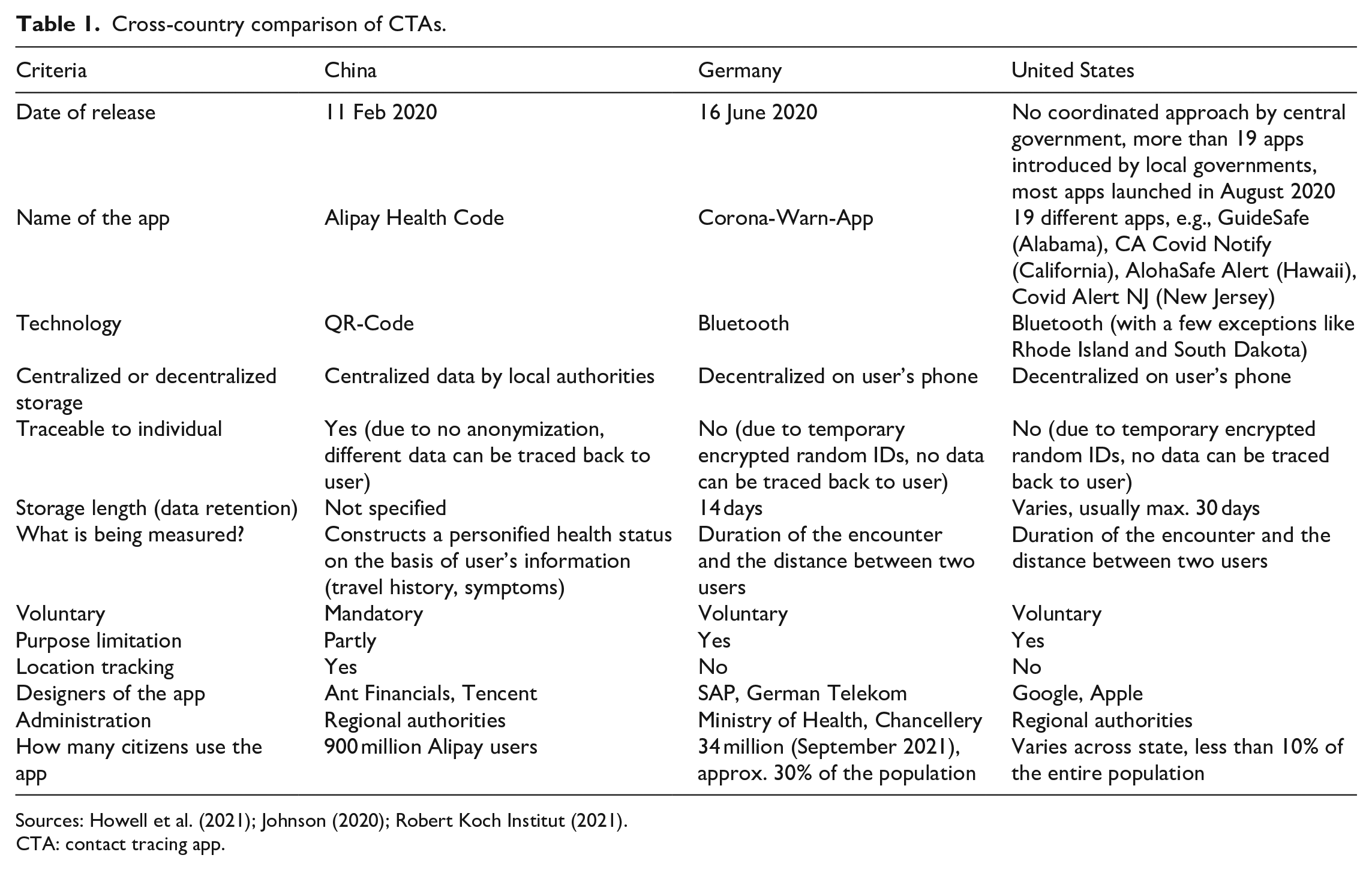
CTA: contact tracing app.
Public attitudes about CTAs
While massive resources were invested in development of COVID-19 CTA apps, little is known about public perceptions thereof. A small number of single country surveys provide some first insights into how individuals in China, Germany, and the United States perceive these apps. In spite of extensive international attention, no large academic survey has been conducted so far on public attitudes toward CTAs in China. However, anecdotal evidence suggests most people quickly embraced the system and it received much praise on the microblogging platform Weibo for tracing contacts with infected persons (Jao, 2020). However, due to the rapid implementation, various complaints emerged over time, including mistaken color codes, potential discrimination, privacy violation, and data security concerns (Feng, 2020). Privacy concerns also increased when the city government of Hangzhou announced it would “normalize” the Health Code practice by transforming the app into a permanent health index app (Du, 2020). In a poll of 6000 users on Weibo, 86% voted against the proposal. Faced with a barrage of questions and criticism, Hangzhou’s government eventually had to retract the proposed initiative (Zhang, 2020). This discussion illustrates that public opinion in China can at times be critical, and further research is needed to better understand citizens’ concerns and preferences.
In Germany, numerous surveys have examined public opinion toward the Corona-Warn-App, but findings vary across surveys and across time. Generally, the majority of opinion polls report acceptance rates between 40% and 60%. A YouGov (2020) online survey of 2258 Germans conducted in March 2020 finds that 43% of respondents were willing to install the app (Suhr, 2020). An online poll of 1,323 German residents conducted in April 2020 showed slightly higher acceptance rates, with 47% of respondents saying they would use a CTA (Statista, 2020). In a cross-country survey, Altmann et al. (2020) show that the CTA acceptance rate in Germany was still lower compared with response trends in the United Kingdom, France, and Italy. Most of these studies do not address important questions as to why people would accept or reject the use of the app.
For the United States, current studies show mixed public perceptions of CTAs. Some studies suggest that there is support for CTAs among the majority of respondents (Altmann et al., 2020; Hargittai and Redmiles, 2020; Simko et al., 2020); while other studies show that a large share of Americans are not willing to use CTAs (Timberg et al., 2020; Zhang et al., 2020). A survey of 1939 US residents conducted in April 2020 finds that 40% of respondents would definitely install a CTA (Altmann et al., 2020). A Washington Post-University of Maryland poll finds that among Americans who have smartphones, 50% would be willing to use a CTA (Timberg et al., 2020). Zhang et al. (2020) find that just over 30% of respondents in the United States support CTAs, which is lower than their support for expanding traditional contact tracing methods or introducing new measures like temperature checks and centralized quarantine. However, the study finds that including privacy-preserving features such as non-location-tracking Bluetooth technology would increase the acceptance of CTA apps. The surveys in the United States also show that attitudes are tightly linked with privacy concerns, albeit the strength of these concerns is unclear, particularly in times of crisis. One online survey found that 72% of participants would be at least somewhat likely to download a CTA if data were “protected perfectly” (Simko et al., 2020). Another survey in April 2020 found that two-thirds of Americans were willing to install an app that would help slow the spread of the virus and reduce the lockdown period, even if that app would collect information about their location data and health status (Hargittai and Redmiles, 2020).
In sum, the few current surveys on CTA acceptance focus mainly on the United States and European countries, excluding Asian countries like China, South Korea, and Singapore, who were among the first to implement CTAs. Recent studies on acceptance levels point to international differences in public opinion and offer a good starting point to derive hypotheses about factors that explain cross-country variation in acceptance levels. Our study draws on the literature on privacy-security trade-offs (e.g. Davis and Silver, 2004; Miltgen et al., 2013), privacy calculus theory (Cottrill and Thakuriah, 2015; Dinev and Hart, 2006; Wadle et al., 2019), and technology acceptance models (Davis, 1989; Venkatesh and Davis, 2000; Venkatesh et al., 2003) to provide further insight into individual willingness to accept a technology that allows for external tracing of individual health information and location data.
In the following sections, we construct a model that is technology-specific and can be applied to diverse country contexts. Previous studies highlight that factors such as the extent to which individuals perceive the COVID-19 pandemic to pose personal health or financial risks, perceptions of the pandemic in general, personal experiences with and perceptions of CTAs, and sociopolitical beliefs influence individuals’ acceptance level of CTAs.
Personal health or financial risks
The literatures on privacy calculus theory and privacy-security trade-offs note that concerns about risks and benefits influence peoples’ willingness to adopt certain technologies and share data online (Dinev and Hart, 2006; Ehrari et al., 2020). Perceptions on individual risks—including concerns about one’s own health or financial situation—can influence CTA acceptance levels in multiple ways. Personal health risks influence CTA acceptance, but previous research show mixed results in terms of the association between health beliefs and CTA acceptance and use intention (Hargittai and Redmiles, 2020; Walrave et al., 2020; Zhang et al., 2020). Hargittai and Redmiles (2020) and Zhang et al. (2020) show that individuals with higher health risks, those with pre-existing health conditions, and those who had been personally affected by the virus are more likely to install a CTA. We extend previous measurements of perceived susceptibility regarding oneself to also include perceived infection risks for others, that is, family and friends. Rather than asking respondents to assess their likelihood or risks of catching COVID-19, we ask whether respondents worry about themselves or others being infected. Worries, fear, or other emotions are important drivers to explain compliance or acceptance of CTAs (Harper et al., 2021; Shiina et al., 2020). From this, we derive the hypothesis that CTA acceptance is higher among people who worry about themselves and others getting infected with COVID-19 (H.1.1).
In addition to perceived personal health risks, we examine the link between changes in respondents’ financial position during the COVID-19 pandemic and CTA acceptance. The pandemic has resulted in declining living standards across the globe, both leading to drops in employment and income for citizens (Egger et al., 2021). Recent research finds that individuals’ changes in financial position during the pandemic influences their attitudes toward smartphone contact tracing and other surveillance policies (Zhang et al., 2020). Zhang et al. (2020) show that respondents who have seen a decline in income or employment are more supportive of surveillance policies during the pandemic, including higher support for smartphone contact tracing. We assume that a sudden decline in income or employment during the pandemic is psychologically painful, causing stress and financial pressure. Financial pressure might increase individual willingness to comply with a wide range of measures in order to contain the spread of COVID-19 as quickly as possible. We thus hypothesize that respondents who have experienced declining financial situations during the pandemic are more likely to accept CTAs (H1.2).
Perception about the pandemic
In line with previous findings from public health research, individual perceptions about the COVID-19 pandemic are likely associated with the acceptance of CTAs. Recent studies find that a significant share of the world population believes in conspiracy theories or perceives the risks of COVID-19 as being similar to those of a common flu (Imhoff and Lamberty, 2020; Uscinski et al., 2020), potentially affecting pandemic behavior. Imhoff and Lamberty (2020) find that people who belittle the risk of the COVID-19 pandemic are less likely to adopt containment-related behaviors, while people who believe that the virus originated in a laboratory are more likely to adopt self-centered prepping behavior (Imhoff and Lamberty, 2020). Based on these studies, we assume that CTA acceptance is higher among respondents who do not perceive the COVID-19 pandemic as a conspiracy (H.2.1).
Perceptions about the expected duration of the COVID-19 pandemic might also impact individual CTA acceptance. If individuals expect longer durations of the pandemic or believe in the potential for a “second wave,” then they might accept CTAs more readily due to anticipated economic, political, or social costs. A belief in a second wave measures expected length of the COVID-19 pandemic. With increased length, anticipated social and economic costs rise as, for instance, maximal durability is limited for government protection programs, household savings, and employers’ scope to adjust hours or compensation. Following this, we assume that CTA acceptance is higher among respondents who believe there will be a second wave (H.2.2).
Experiences with and perceptions of CTAs
Our analysis also investigates how an understanding of CTAs, experience with similar apps, or direct experience with CTAs influences acceptance of CTAs. We derive these factors from UTAUT and UTAUT2 models who show that experience (Venkatesh et al., 2003) and habits (Venkatesh et al., 2012) significantly influence technology acceptance. Experience is defined as passage of chronological time, while habits are defined as the extent to which people perform behaviors repeatedly and automatically (Venkatesh et al., 2012). Both prior and habitual use of technology are seen as important predictors for future technology use (Kim and Malhotra, 2005). Furthermore, familiarity with a technology or an understanding of a specific technology is also positively associated with technology acceptance (Buckley and Nurse, 2019; Idemudia and Raisinghani, 2014; Komiak and Benbasat, 2006; Kostka et al., 2021). Recent research on CTA adoption in the United States shows that technologically-savvy individuals who are also more likely to be familiar or have prior experience with fitness or health tracking apps are more willing to install CTAs (Abeler et al., 2020). As understanding, habits, and experience with a technology have a strong effect on technology acceptance and usage, we hypothesize CTA acceptance is higher among people who understand how CTAs work (H.3.1). We further assume that prior personal experience with other health apps (H.3.2) and experience with CTAs (H.3.3) increase CTA acceptance.
The TAM and UTAUT models further find that perceived usefulness and performance expectancy predict technology acceptance and use intention (Venkatesh et al., 2003). One of UTAUT’s four key constructs is performance expectancy, that is, what kind of benefits employees or consumers expect (Venkatesh et al., 2003, 2012). If employees or consumers expect certain benefits, they are more likely to accept a technology. Drawing on these theoretical models, we look at how the perceived effectiveness and consequences of using CTAs, including benefits and risks, affect CTA acceptance. According to polls conducted in Germany, CTA opponents believe such apps do not function well and thus will not be useful, and regard other measures to be more effective (Horstmann et al., 2021; Tagesschau, 2020). Following this, we predict that CTA acceptance is higher among people who believe digital contact tracing is better than manual contact tracing (H.3.4).
The literature on privacy-security trade-offs (e.g. Davis and Silver, 2004; Miltgen et al., 2013; Pavone and Degli-Esposti, 2012), also offers insights for explaining CTA acceptance. When confronting a crisis, such as the outbreak of a disease or a terrorist attack, citizens are willing to forgo civil liberties or privacy concerns for personal security or societal well-being. In other words, despite concerns about individual data protection, citizens can in certain circumstances accept far-reaching state surveillance measures, if, for instance, these measures target potential criminals or improve health security (Ziller and Helbling, 2021). In the COVID-19 pandemic, a study based on a survey across 15 countries finds that exposure to health risks leads to citizens’ greater willingness to sacrifice rights and freedoms (Alsan et al., 2020). Building on this literature, we look at perceived consequences of CTAs. This includes benefits (such as fewer COVID-19 infections, isolating infected people, better health information) but also risks (such as privacy violations, discrimination against people who tested positive, and fear of government surveillance). The assumption here is that with access to information, citizens understand the risks and benefits associated with surveillance technologies and accept that the state violates their individual freedom in exchange for the promise of greater security. Recent studies from Germany and the United States find that surveillance, privacy concerns, and data misuse are the main reasons for opposing CTAs (Abeler et al., 2020; Horstmann et al., 2021). Following this, we derive the hypothesis (H.3.5) that CTA acceptance is higher among individuals who believe CTAs result in positive consequences and lower among individuals who believe CTAs will result in negative consequences.
Sociopolitical belief and context
Acceptance of CTAs also depends more broadly on respondents’ sociopolitical beliefs and other contextual factors, such as the perceived capability of different actors and general trust in the government. Citizens perceive actors, ranging from individuals, governments, private companies, and scientific experts, to have varying capabilities in management of health crises. Cakanlar et al. (2020) show how respondents who believe that individuals are responsible for their personal action are less likely to adopt COVID-19 prevention measures. We thus assume that citizens who perceive individuals are capable of managing the crisis to be less accepting of government-led instruments like CTAs for pandemic management. We also look at the perceived capabilities in governments, private companies, and scientific experts. Drawing on the public goods literature, we follow Silverman et al. (2014) by differentiating between two kinds of authorities: government with coercive power as “authority to” and experts with expertise/knowledge as “authority in.” Central and local governments have legitimate power, while private companies and scientific experts have knowledge and expertise in managing the COVID-19 pandemic. Recent research finds that trust in science leads to higher compliance with COVID-19 guidelines (Plohl and Musil, 2021). Following these studies, our assumption is that people who believe in the capacity of certain authorities tend to have higher acceptance of CTAs, while people who believe in individuals’ capacity have lower acceptance of CTAs because CTAs are produced and recommended by such authorities. We hypothesize that CTA acceptance is higher among people who believe that the central and local government, private companies, and scientific expert communities are capable of managing the pandemic. CTA acceptance is lower among people who think that individuals are capable of managing the crisis (H.4.1).
Moreover, acceptance of CTAs is closely related with trust in the management and operation of CTAs (Altmann et al., 2020; Riemer et al., 2020; Zhang et al., 2020). Trust is needed as the responsible agencies have access to a variety of citizens’ health and personal data. In China, what kind of agency is handling personal data matters to citizens as previous study show that Chinese citizens hold higher trust in central or local governments than in businesses (Kostka, 2019; Wang and Yu, 2015). 1 For United States and Germany, trust seems to be low toward both private and government agencies. 2 A study in the United States, for instance, finds that 91% surveyed feel that consumers have lost control about personal data collection by companies, and 70% are concerned about the government covertly accessing user data on social networking sites (Madden, 2014). Health data are particularly sensitive and citizens who trust governmental actors are more supportive of public health surveillance measures, such as CTA acceptance (Zhang et al., 2020). Recent research using UTAUT models also find a positive effect of trust in government on e-gov adoption in China (Li, 2021; Mensah and Adams, 2020). According to these studies, citizens are more likely to adopt technologies introduced or managed by government agencies if they have a higher level of trust in the government in general. Following this, we derive that CTA acceptance is higher among people who have more trust in the government (H.4.2).
Control variables: sociodemographic factors
Sociodemographic factors may further influence individual acceptance of COVID-19 CTAs. Previous studies using TAM and UTAUT models or the privacy calculus and privacy-security trade-off literatures are often inconclusive about how individual sociodemographic characteristics affect peoples’ technology acceptance. In UTAUT and UTAUT2 models (Venkatesh et al., 2003, 2012), age and gender play a moderating role for explaining technology behavioral intention. Recent studies on CTAs either measure direct effects of sociodemographic factors on acceptance or use intention of COVID-19 CTAs (Abeler et al., 2020; Altmann et al., 2020; Hargittai and Redmiles, 2020; Horstmann et al., 2021), or control for them (Walrave et al., 2020, 2021; Wnuk et al., 2020; Zhang et al., 2020). We follow these studies and control for age, gender, income, education, and city size. 3
Overall CTA acceptance and regime type differences
Past research points to significant cross-country differences in terms of public opinion toward digital technologies, privacy, and surveillance (e.g. Kostka et al., 2021; Potoglou et al., 2017). China, Germany and the United States represent different political regimes. Past studies find that democratic governments show higher respect for human rights and protection of personal privacies, while authoritarian regimes do not shy away from privacy-intrusive and repressive measures to ensure regime survival (Poe et al., 1999). Research also finds that expectations of citizens in authoritarian regimes toward civil liberties are often lower (Keane, 1988; Putnam, 1993). Instead, personal security and preferences for social stability and social order are often cited as factors explaining public support for surveillance (Su et al., 2021).
China, Germany, and the United States also differ in terms of state–civil society relations, which likely influences CTA acceptances. Existing research proposes four different categorizations of state–civil society relations across countries: a state-oriented model, a model grounded on the dominance of civil society, a dual model, and a model of cooperation (Karjalainen, 2000). In China, state–civil society relations are state-oriented, as the state restricts civil society actors and controls key approval and funding decisions. By contrast, the United States can be characterized by the model of dominance of civil society and Germany by the model of cooperation (Karjalainen (2000). The size of civil society working on ethical implications of artificial intelligence and supporting citizens’ digital rights also differs in the three countries. While in China the public debate on these issues is mainly driven by the state or state-led media, nongovernmental organizations (NGOs), the private sector, scholars, and social media play only a supplementary role. 4 The Chinese state-led media, for instance, has generally reported quite uncritically about digital technologies. 5 By contrast, in the United States and Germany civil society is more developed and actively shaping public debate. NGOs such as the AI Now Institute in the United States or the Society for Digital Ethics in Germany regularly discuss digital rights and ethical implications. With more open debate, it might not be unsurprising that previous research notes high levels of concern about privacy and surveillance in the United States and Germany (Kostka et al., 2021; Potoglou et al., 2017).
The legal systems and regulatory contexts are also very different in the three countries. China does not have an independent legal system as this would be a threat for regime survival (Peerenboom, 2002). In the absence of a well-functioning legal system, cases of corruption, fraud, incivility, and crime are harder to systematically combat. In China’s legal system, privacy and data protection laws are weak and only in 2021 did China introduce more comprehensive laws by introducing a new Data Security Law (DSL) and Personal Information Protection Law (PIPL). By contrast, in advanced democracies such as Germany and the United States, the legal systems function through rule of law and a system of separation of powers where the executive discretion is constrained by legislatures and judiciaries. In these legally-advanced systems, privacy and data protection laws are more comprehensive and endow citizens with stronger legal rights to protect their personal information.
Thus, given fundamental differences, in an authoritarian regime like China, citizens’ attitudes toward CTAs are less likely to be constrained by liberty concerns, and citizens are more likely to accept CTAs than citizens in democracies. We thus hypothesize that CTA acceptance is higher in China than in Germany or the United States (H.1.0).
Conceptual framework
Drawing on the above literatures on technology acceptance, privacy calculus theory, and the privacy-security trade-offs, Figure 1 summarizes our conceptual framework of CTA acceptance integrating the aforementioned explanatory factors. We will test which factors explain individuals’ CTA acceptance within the selected countries but also across the national samples. Overall, we assume that CTA acceptance is higher in China than in Germany or the United States.
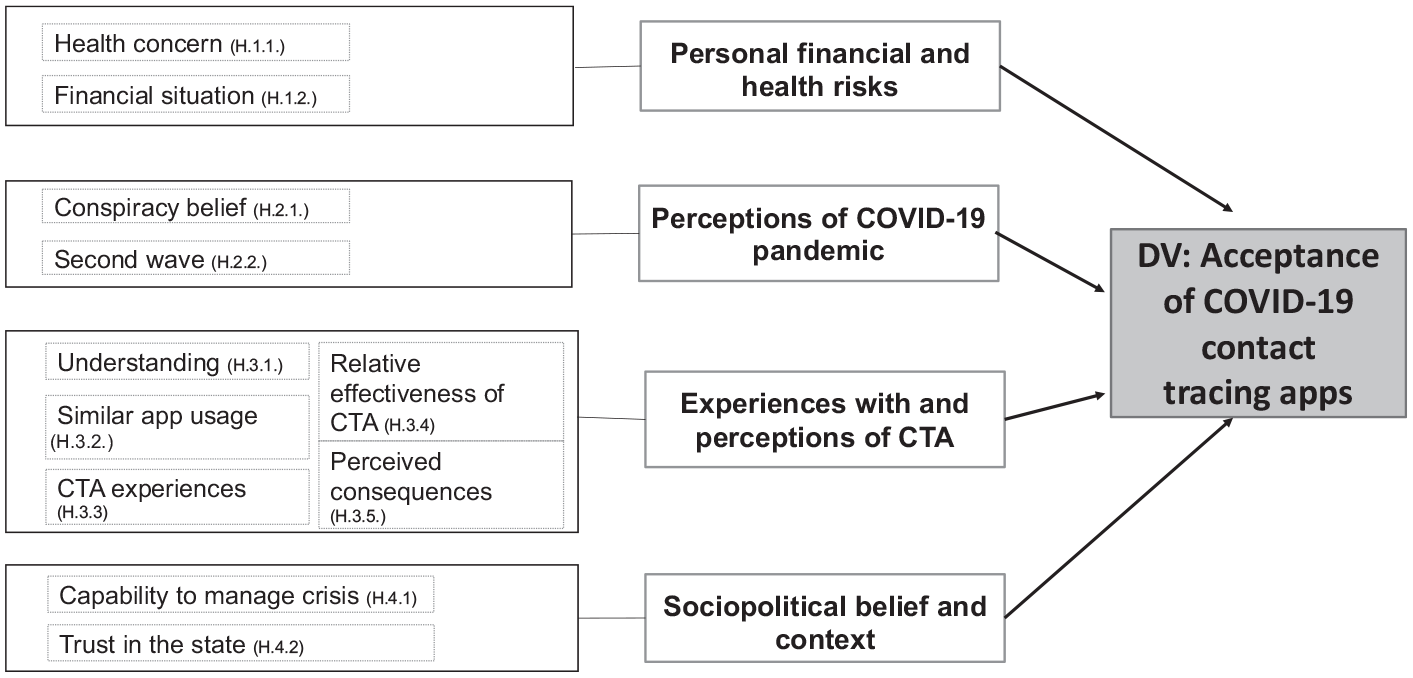
Conceptual framework.
Methodology
Data sources and questionnaire design
We conducted an online survey in China, Germany, and the United States through a Berlin-based survey firm between 5 June and 19 June 2020. We used a river sampling (also referred to as intercept or real-time sampling) method to draw participants from a base of 1–3 million unique users of cooperating apps and websites (Lehdonvirta et al., 2021). 6 First-time and regular survey-takers were recruited through over 100 apps comprising different formats and topics, such as shopping (e.g., Amazon), photo-sharing (e.g., Instagram), lifestyle (e.g., DesignHome), and messaging (e.g., Line). Offer walls provided participants options to receive rewards as an incentive to take part in our survey, in the form of premium content, extra features, vouchers, or PayPal cash.
The survey was a non-probability online survey using quota sampling. Sampling quotas were created from the most recent population statistics available from Barro Lee 2017 Census Population Data (Barro, 2017), Internet penetration data from the Pew Global Attitudes Survey (2017), and regional population statistics from Statista (2016). Findings from this online survey thus resemble the Internet-connected population in each country—meaning slightly younger and maybe higher levels of technology-affinity than the overall population. 7 As a result, it is possible that the sample is biased in favor of CTAs, as previous research shows that people are more accepting of technologies that they are most familiar with (Buckley and Nurse, 2019). The quotas used for sampling and weighting were set on age (18–65) and gender. For China, respondents were also sampled according to region, including quotas for the three main regions of China: Central (37%), Western (21%), and Eastern (42%). In the other countries, equal attention was paid to ensure accurate representation of local regions, including adequate representation of federal states in Germany and states in the United States. After collecting the necessary number of respondents meeting quotas for each subpopulation, a weighting algorithm corrected for any minor discrepancies between the collected sample and the quotas, adjusting for under- and overrepresentation of each group. The maximum weight allocated was 1.4 and the overall margin of error for estimates is 2.1% for China, 2.2% for Germany, and 2.1% for the United States.
Users did not know the topic of the questionnaire and were voluntarily prescreened before being matched to the survey. Participants were then shown a screen with information about the research and were asked to confirm that they understood the information before they proceeded with the survey. Questionnaires were deemed invalid if respondents completed them in a very short period of time or with inconsistent responses. The agency hosting the survey calculated an estimated completion time automatically based on the number of questions, and respondents who fell too far below this limit were not permitted to complete the survey. We also included consistency checks at the beginning and end of the survey. We asked certain questions twice. For example, respondents were asked to enter their date of birth both when they initially entered the survey system and at the end of our survey. We matched the responses to our survey questions and excluded respondents with inconsistent answers from the final dataset. Second, if someone selected both “I have tested positive for COVID-19” and “I have not been tested, but think I contracted COVID-19” (Question 1), they were manually cleaned out of the final dataset. Our total sample size was 6464 respondents from China (n = 2201), Germany (n = 2083), and the United States (n = 2180). Table 3 in Appendix 1 summarizes the respondents’ main sociodemographic characteristics.
Data analysis
Responses to the questionnaire were examined using linear regression analysis. Our dependent variable of interest is acceptance of the use of COVID-19 CTAs. This variable was captured in the survey question: “In general, do you accept or oppose the use of COVID-19 tracing apps to curb the current pandemic in your country?.” Possible responses included: strongly oppose, somewhat oppose, neither oppose nor accept, somewhat accept, or strongly accept. 8 Levels of acceptance were investigated by analyzing people’s personal health and financial risks, general perception of the COVID-19 crisis, experience with and perceptions of CTAs, and sociopolitical belief and context. Table 2 gives an overview of the measurements and hypotheses related to our selected independent variables. We checked for multicollinearity by calculating variance inflation factors (VIF) for all of the variables. VIFs between 1.039 and 3.537 allow us to rule out multicollinearity (see Table 4 in Appendix 1).
Variables, measurement, and hypotheses.
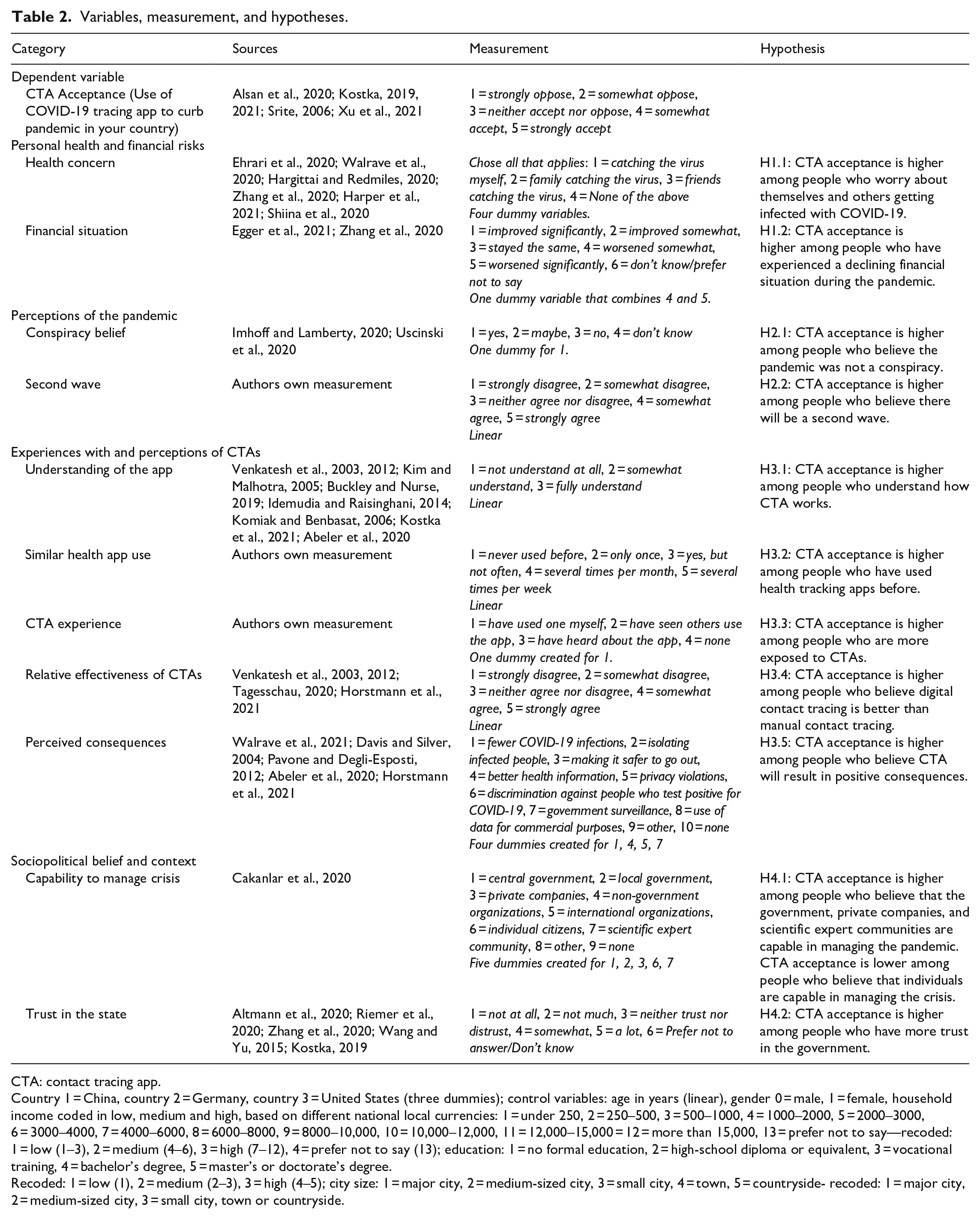
CTA: contact tracing app.
Country 1 = China, country 2 = Germany, country 3 = United States (three dummies); control variables: age in years (linear), gender 0 = male, 1 = female, household income coded in low, medium and high, based on different national local currencies: 1 = under 250, 2 = 250–500, 3 = 500–1000, 4 = 1000–2000, 5 = 2000–3000, 6 = 3000–4000, 7 = 4000–6000, 8 = 6000–8000, 9 = 8000–10,000, 10 = 10,000–12,000, 11 = 12,000–15,000 = 12 = more than 15,000, 13 = prefer not to say—recoded: 1 = low (1–3), 2 = medium (4–6), 3 = high (7–12), 4 = prefer not to say (13); education: 1 = no formal education, 2 = high-school diploma or equivalent, 3 = vocational training, 4 = bachelor’s degree, 5 = master’s or doctorate’s degree.
Recoded: 1 = low (1), 2 = medium (2–3), 3 = high (4–5); city size: 1 = major city, 2 = medium-sized city, 3 = small city, 4 = town, 5 = countryside- recoded: 1 = major city, 2 = medium-sized city, 3 = small city, town or countryside.
Results
Social acceptance of CTAs
Our survey finds that in the overall population, 54% of respondents either strongly accept or somewhat accept the use of CTAs. Responses vary across countries, with 80% of Chinese respondents reporting they strongly or somewhat accept CTAs, compared with 39% of US and 41% of German respondents. These country differences are statistically significant, as shown in Table 6 and Figure 4 in Appendix 1, supporting our hypothesis that CTA acceptance is highest in China compared with the United States and Germany. Opposition to CTAs also shows interesting cross-country variation. While 18% of overall respondents expressed either some or strong opposition to CTAs, this sentiment is less prevalent in China (2% of respondents) compared with Germany and the United States (27% and 22%, respectively). Noticeably, a third (29%) of the surveyed sample are neutral toward CTAs, with a wide range observed across countries: 17% of Chinese, 33% of German, and 39% of the US participants. Figure 2 summarizes varying levels of acceptance overall and by country. For more descriptive statistics, see Table 3 in Appendix 1.
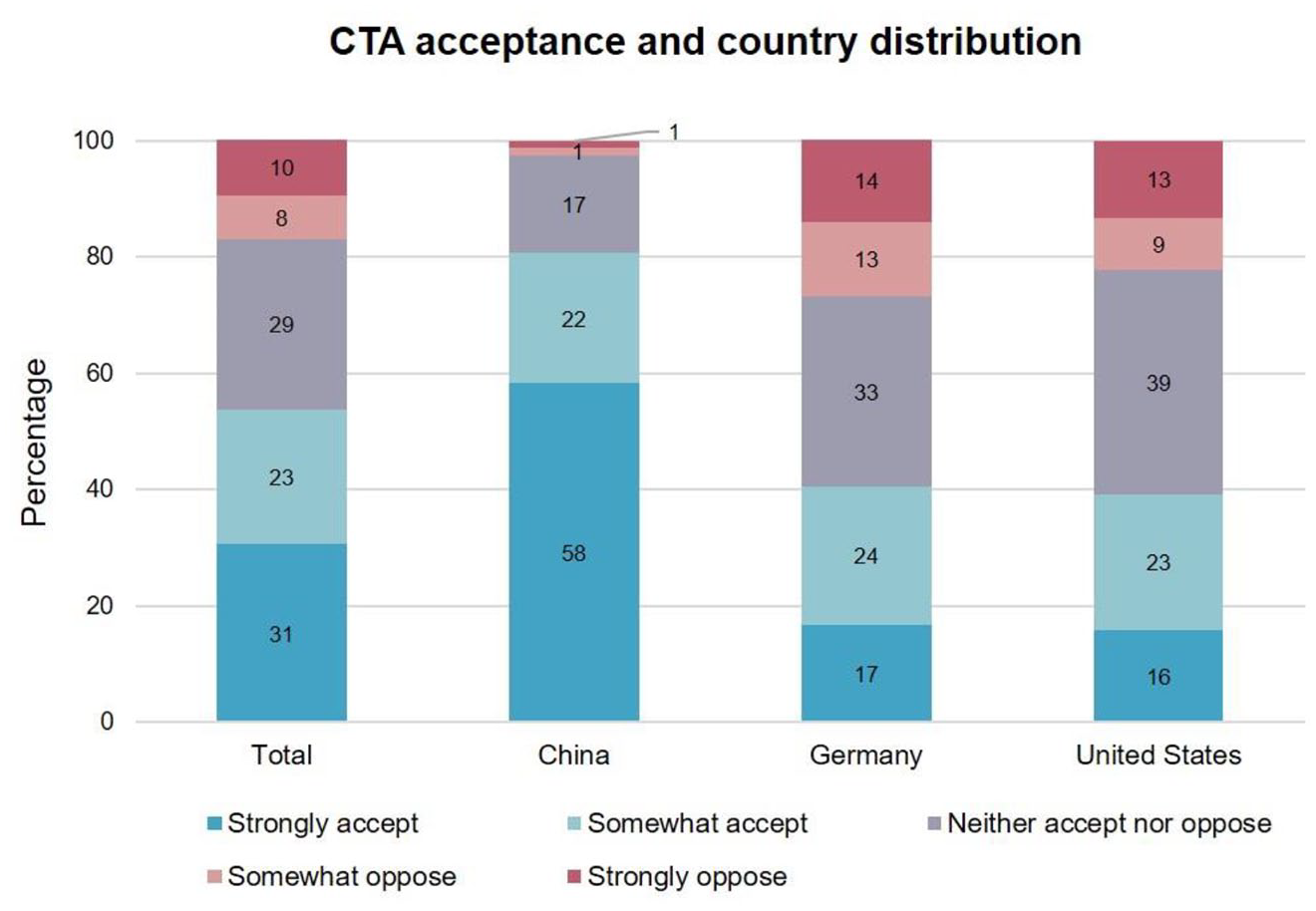
Public acceptance of CTAs—country distribution.
Effects on acceptance
We assessed the association between our predictor variables and CTA acceptance in three models, one for each country, using linear regression (see Figure 3). We also present a linear regression model with country as interaction variable for each predictor to allow for cross-country comparisons. The findings are presented in detail in Table 6 and Figure 4 in Appendix 1. 9 In line with our conceptual framework, our model measures the effects of personal health and financial risks (H1.1–H1.2), perceptions of the COVID-19 pandemic (H2.1–H2.2), experience with and perceptions of CTAs (H3.1–H3.5), and sociopolitical beliefs and context (H4.1–H4.2). Sociodemographic factors are controlled for. Tables 4 and 5 in Appendix 1 provide additional information on the coefficients and the fit of the linear regression models.
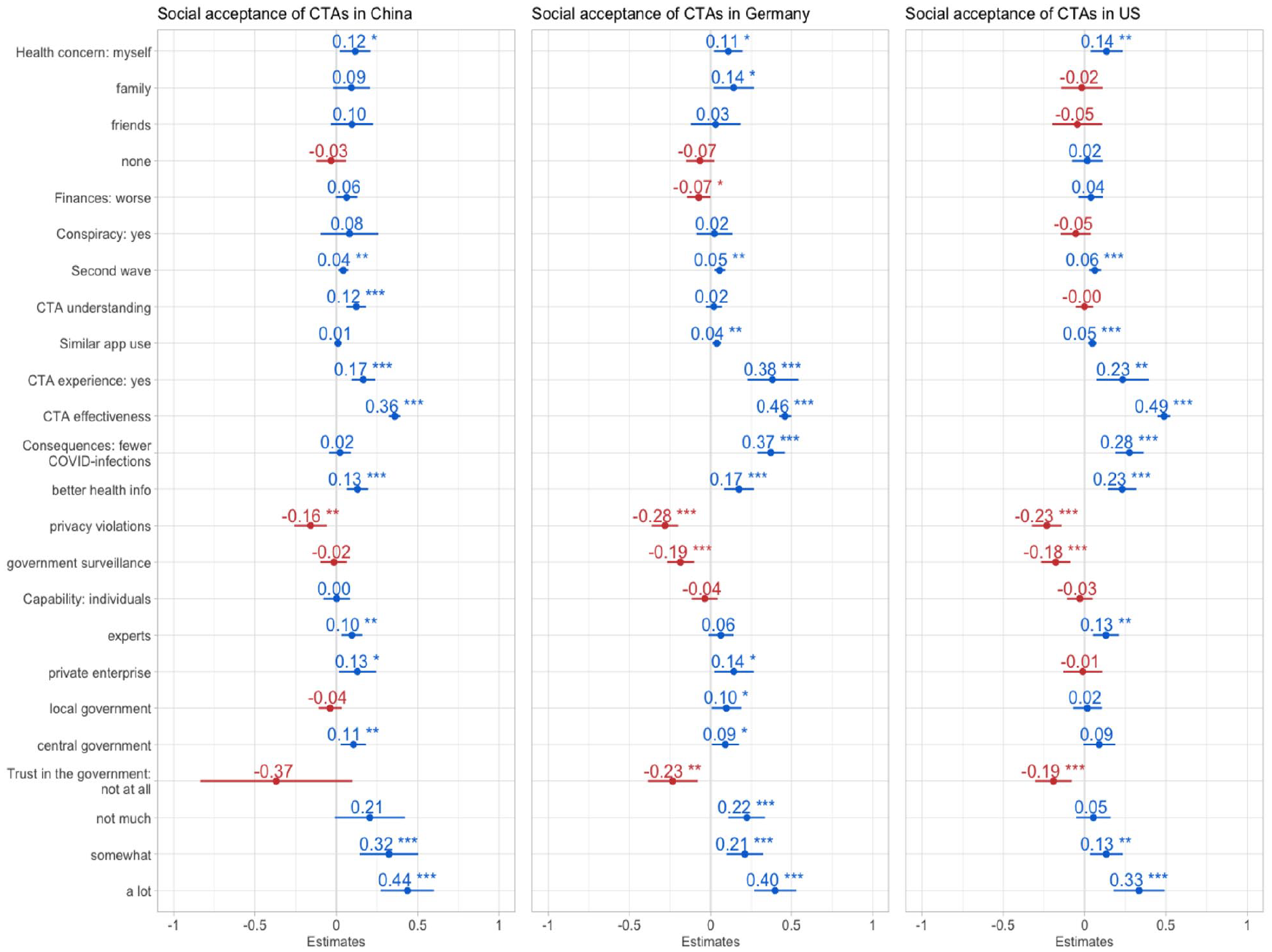
Linear regression model—social acceptance of CTAs in China, the United States, and Germany.
In terms of personal health and financial risks, being concerned about one’s own health or the health of family members or friends only partly affects CTA acceptance. Concerns about one’s own health are positively and significantly associated with CTA acceptance in all three countries. Concerns about a family member’s health have a positive significant effect in Germany, but it is not significant in China or the United States. In all three countries, neither concerns about a friend’s health nor no health concerns show significant correlations (disconfirming H1.1). CTA acceptance seems therefore higher among people who worry about themselves getting infected with COVID-19, but worries about others seem to not influence acceptance levels. Experiencing a declining financial situation in the wake of the pandemic shows a negative significant relationship in Germany but nonsignificant associations in China and the United States (disconfirming H1.2). Interestingly, neither health nor financial risks are very significant factors for CTA acceptance, which is likely due to the timing of the survey in June 2020, as infection rates were close to zero in China and health and financial risks seemed limited at this time.
As for different perceptions of the pandemic, we find that whether people “agree” that the pandemic is a conspiracy shows no significant relationship with CTA acceptance in all three countries, showing no support for H2.1. With regard to expectation of a second wave of infections, we find a positive significant effect on CTA acceptance in all three countries, confirming H2.2.
Experience and perceptions of CTAs are strongly associated with acceptance levels across countries. Respondents’ understanding of how CTAs work is not associated with acceptance in Germany and United States, but significant in China with a positive coefficient (only confirming H3.1 for the case of China). Since CTAs are mandatory in China, it is conceivable that a much higher share of the population understands how this technology works. People who regularly used other health apps prior to taking the survey were more accepting of CTAs in all three countries. We find a significant effect of prior health app usage on CTA acceptance in Germany and the United States, confirming H.3.2. This supports previous research that people are more accepting of technologies that they regularly use and are familiar with (Buckley and Nurse, 2019; Kostka et al., 2021). In the case of China, regular use of other health apps is not significant. CTA acceptance is also higher among those who have used CTAs before. The association here is strong and significant for all three countries, with coefficient of 0.17 (China), 0.38 (Germany), and 0.23 (United States). Whether or not respondents consider CTAs to be effective compared with other measures to contain the spread of COVID-19 is one of the strongest associated factors in all three countries, with significant coefficients of 0.36 (China), 0.46 (Germany) and 0.49 (United States), confirming H.3.4.
In terms of perceived consequences of using CTAs, respondents who report positive consequences, including receiving health information or reduced infections, accept CTAs with positive, significant coefficients for all three countries. By contrast, negative consequences, including the fear of privacy violations or government surveillance, are negatively associated with CTA acceptance. Concerns about privacy violations show a strong association in all three countries, with significant negative coefficients of −0.16 (China) and −0.28 (Germany), and −0.23 (United States). The coefficients for government surveillance are significant and negative for Germany and the United States with −0.19 and −0.18, respectively, but are not significant for China. In China, questions about surveillance are politically sensitive and this could have resulted in some preference falsification. Thus, H3.5 can be confirmed.
Finally, there is no significant relationship between beliefs that individuals are most capable in managing the crisis and CTA acceptance in all three countries. For China we find that acceptance is higher among respondents who stated that the central government, experts or private enterprises are most capable of managing the COVID-19 crisis, with significant, positive coefficients. For Germany, we find a positive significant coefficient for stating that central governments, local governments or private companies are most capable of managing the COVID-19 crisis. For the United States, we find only a significance for the role of experts. Trust in the government has a significant, positive effect in all three countries, with very high coefficients of 0.44 (China), 0.40 (Germany), and 0.33 (United States). In other words, trust in the government seems to increase people’s acceptance of CTAs in all three countries. No trust at all in the government was negatively related to CTA acceptance, but only significant for Germany and the United States. Finally, for our control variables, we find a significant, positive association between CTA acceptance and gender and age in Germany and city size in the United States. Overall, these mixed results for our control variables support previous research findings (Altmann et al., 2020; Williams et al., 2020) that sociodemographic factors are not important when trying to understand CTA acceptance.
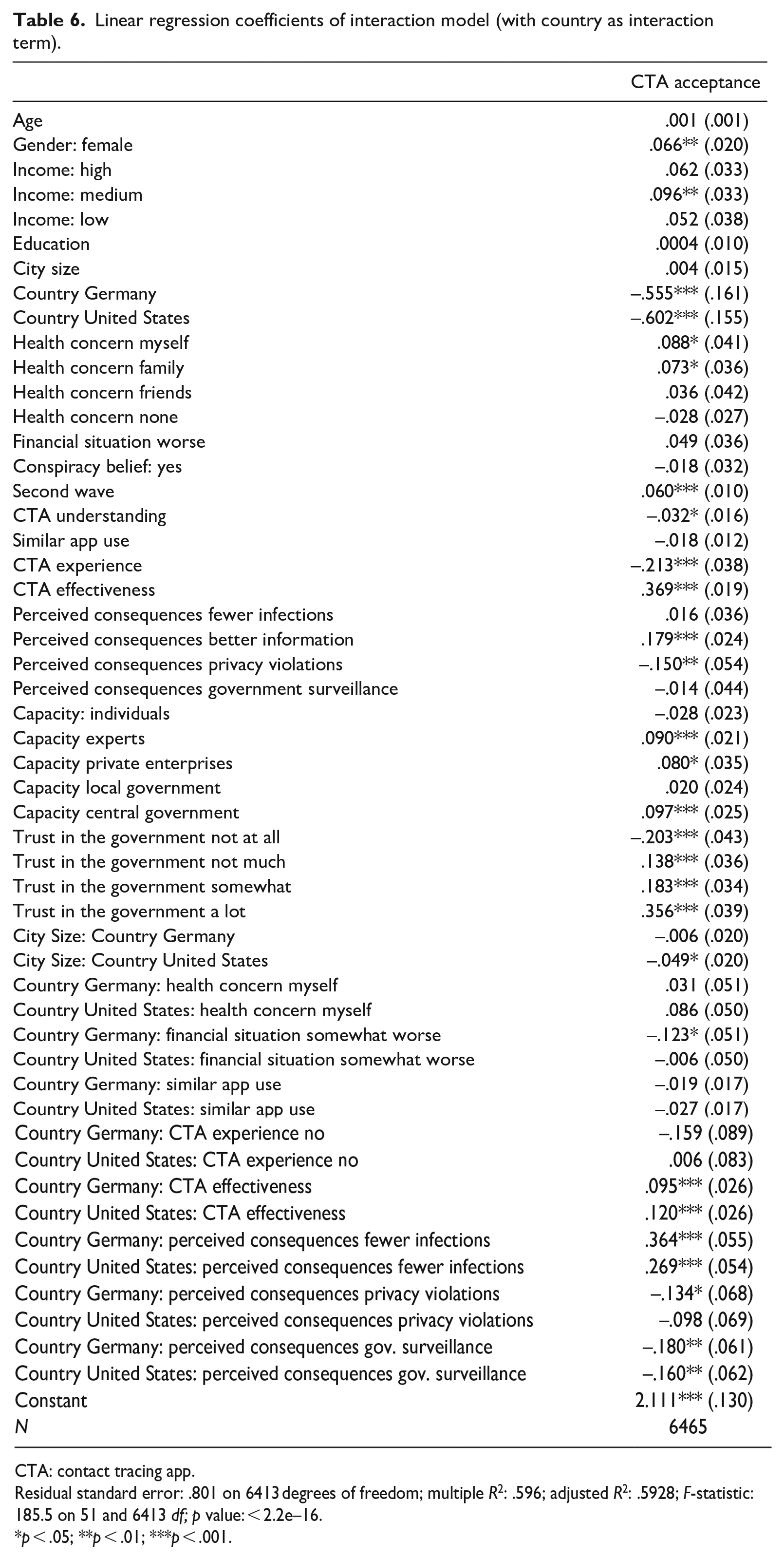
The findings from our linear regression model with country as interaction term confirm that the average acceptance level of CTA differs across regime types, supporting H1.0. The country estimators for Germany (−0.83) and the United States (−0.76) indicate that the average level of acceptance of CTAs is significantly higher in China as compared with Germany and the United States (see Figure 4 in Appendix 1). Interestingly, compared with the China sample, the fact that somebody is from Germany or United States has a significant impact on the correlation between CTA effectiveness and acceptance. The belief that CTAs reduce COVID-19 infections and previous CTA experience were also of particular importance to explain acceptance levels for the Germany and US sample. This suggests that technology effectiveness and usefulness is of particular importance in liberal states where downloading CTAs is voluntary. By contrast, in China CTAs are government-sponsored apps and mandatory. The interaction model further finds that the correlation between CTA acceptance and privacy and surveillance concerns is much more significant in Germany and United States compared with China. Most likely this is the combined result from a more advanced enforcement of data privacy laws, widespread discussion in the media, and a larger civil society sector raising awareness on these issues.
Discussion
Drawing upon previous studies on technology acceptance in national or cross-national studies of Western countries, our research derives a number of illuminating new observations about CTA acceptance in different sociopolitical contexts. First, noticeably, CTA acceptance is much higher in China than in Germany and the United States. This aligns with previous research showing that Chinese citizens are more accepting of digital technology, even if this technology has the potential to increase government surveillance (Alsan et al., 2020; Kostka, 2019; Su et al., 2021; Xu et al., 2021). In all three contexts, perceived health and financial risks, perceptions about the pandemic, and sociodemographic factors seem to be unhelpful in explaining CTA attitudes.
Instead, our findings show that perceived effectiveness, personal CTA experience, and perceived positive and negative consequences of CTAs are important factors that can account for the observed differences in CTA acceptance rates between individuals. TAM and UTAUT models (Davis, 1989; Venkatesh and Davis, 2000; Venkatesh et al., 2003) have previously highlighted the importance of perceived efficacy and technology usefulness for technology acceptance. Our findings offer further support for these arguments. It seems especially important that citizens believe in the effectiveness of CTAs as instruments for fighting the COVID-19 pandemic. It is worth noting that, compared with the voluntary installation of CTAs in the United States and Germany, CTAs were essentially mandatory in China and were necessary for accessing public spaces. This possibly results in higher acceptance of the technology in China simply due to the fact that the mandatory element might have increased the perceived effectiveness of the app. At the same time, users in China had limited input on the design and nature of the implemented CTA.
Our findings also support findings from previous studies (Abeler et al., 2020; Altmann et al., 2020; Horstmann et al., 2021) that CTA acceptance is influenced by respondents’ fear of negative consequences, such as privacy violations and government surveillance. This fear about privacy violations is interesting, as the design of CTAs in Germany and the United States took data privacy concerns into account by relying on Bluetooth technology and other measures. Despite these efforts, citizens’ concerns persist in these countries. In China, privacy concerns also explain why certain individuals are less accepting of CTAs. This shows that privacy concerns also play an important role in China, in contrast to the popularly held belief that Chinese citizens do not care about data privacy. While “fear of government surveillance” was common among those opposing the technology in Germany and the United States, in China this was not a significant factor. Very likely, this could be due to preference falsification, which is not uncommon in online surveys in an authoritarian context (see discussion below). This could, however, also be due to limited access to information, as the downsides of CTAs are less openly discussed in China’s state-controlled media, or simply due to the fact that a lot of people resign and accept that the Chinese Communist Party can have potentially unlimited access to citizens’ personal information.
Equally important, positive consequences, such as fewer infections and improved health information via CTAs, also strongly and positively affect people’s attitudes toward CTAs in all three countries. In Germany and the United States, the effect of fewer infections played a stronger role than health information access. In China, this was the opposite. Again, the timing of the survey is key to understanding this country difference—COVID-19 infections in Germany and the United States were still in the “first wave” in June 2020, while in China reported infection rates had declined to almost zero. Overall, the effect of perceived positive consequences was higher than the effect of perceived negative consequences. These findings contribute to the literature on privacy-security trade-offs (e.g. Davis and Silver, 2004; Miltgen et al., 2013), suggesting that security concerns /improved health outlook can off-set privacy concerns.
Finally, this study supports evidence from the literature of authority and public good provision (Silverman et al., 2014). Our results show that people who believe in the capacity of certain authorities tend to have higher acceptance of CTAs, while people who believe in the capacity of themselves have lower acceptance of CTAs because CTAs are produced and recommended by such authorities. Trust in the government and in scientific experts play particularly an important role, further supporting previous studies on the positive effect of trust in science in compliance with COVID-19 guidelines (Plohl and Musil, 2021) and the role of trust in the state for CTA adoption (e.g. Altmann et al., 2020). The more citizens trust the state and its government institutions, the more likely people are to accept CTAs in all three countries. Especially in the United States, trust in the government is most strongly associated with acceptance. Given that CTAs are still somewhat perceived as a government-managed tool, citizens in the United States might accept CTAs only if they also have trust in the government institutions. In China, we also see a positive association, but the findings are not significant. This could be partly due to the fact that CTA usage was essentially mandatory in China, as well as the fact that questions on trust are sensitive in China and potentially lead to preference falsification.
Research limitations
Our findings are subject to a number of limitations. First, as this was an online survey using mobile phones and desktops, the findings can only resemble the Internet-connected population in each country. Second, respondents who chose to participate in our survey may already have a particular affinity for technology, which could positively affect their stance toward innovations in this field, including the focus of this study. This effect may have been heightened by the virtual rewards individuals were promised for their participation, since they might have been more likely to associate the positivity of incentives with positivity toward CTAs. Third, it is possible that the mandatory nature and the early rollout of CTA in China contributed to the high acceptance rate in the country. Moreover, China’s authoritarian political context makes it difficult to express dissent from technologies that are officially endorsed by the government, and this might be reflected in the reported levels of social acceptance in our study. Although participants were aware that any identifying data was anonymized and analyzed for research purposes only, we cannot exclude the possibility of preference falsification as some more cautious respondents may have given false answers due to concerns about reprisals from the state. For instance, variables such as trust in the government or capability of the central government might be overreported, while attitudes toward surveillance might actually be underreported.
Finally, some questions might have been understood or interpreted differently across countries. As the adoption of COVID-19 CTAs varies widely between the three contexts studied, mentions of the technology may conjure up diverse associations and scenarios. This could influence the connotation participants have when asked about CTA acceptability. Some questions might also have been misunderstood, for instance, “Do you think that the COVID-19 pandemic is a conspiracy, i.e. engineered deliberately by humans?” might be understood differently depending on the country context. In addition, our survey likely also contains question biases, since offering possible consequences as response options may have induced the respondents to report their views accordingly (on limited answer possibilities and acquiescence bias, see Furnham, 1986). To address these issues, future research could advance our insights by adopting multi-item measures and conducting a multi group analysis.
Conclusion
Under which circumstances do people accept contact tracing apps during a pandemic? Based on an online survey with Internet users in China, Germany, and the United States, we show that in China public acceptance toward contact tracing apps was much higher than in Germany or the United States. Authoritarian countries such as China can make CTAs mandatory and not fear public backlash since a majority of people accept use of this technology to combat the pandemic. Yet, such acceptance does not imply that the Chinese public is unconcerned. In fact, our study shows that Chinese people do fear negative consequences, such as privacy violations. At the same time, Chinese citizens seem to accept mandatory instruments more easily, first, due to lack of alternate options, and second, because CTAs are a mandatory component of gaining access to public spaces. Hence, CTAs have become one of the main instruments in China by which individuals can return to normalcy during the pandemic. By contrast, in the United States and Germany, the purported usefulness of CTAs for individuals is indirect and only comes into play if a certain number of people install the app. Future research should further probe the influence that political regime type has on technology acceptance during times of crisis.
Our study shows that the effectiveness of CTAs, previous experience with CTAs, and perceived risks and benefits shape CTA acceptance rates. The findings contribute to a growing body of literature on how crises shape the perceptions of and preferences for digital technologies (Abeler et al., 2020; Simko et al., 2020; Zhang et al., 2020). We find that citizens are willing to accept digital contact tracing, despite concerns about privacy infringements and government surveillance, as long as the tools are effective and are associated with lower infection rates. The positive association between CTA effectiveness and acceptance creates a chicken-and-egg problem for CTAs where they are voluntary: a high citizen adoption rate is necessary for CTAs to be effective, but CTAs are only effective if adoption rates are high. Whether or not citizens trust the government has also a powerful impact on CTA acceptance in all three countries. While previous studies have mostly investigated CTAs in liberal political contexts that predominantly used privacy preserving Bluetooth technology for digital contact tracing, we also include a study of China’s CTA that is both mandatory and collects a wide range of personal data from its users. Through this we are able to show that despite these stark differences between the apps, there are striking similarities in the factors that drive CTA acceptance, especially with regard to CTA perception. This implies that differences in national techno-spheres do not necessarily lead to divergences in individual preferences, even if rates of acceptance are different.
Our study also contributes to the literature on digital surveillance, which has shown that in authoritarian context users support surveillance (such as the Chinese social credit system) as long as they see its social benefit (Kostka, 2019; Su et al., 2021; Xu et al., 2021). Although China’s social credit system and the Chinese CTAs are distinctively different, they share one commonality: their adoption provides users with access to loans and other benefits (in the case of the social credit system) and to public spaces or mobility more generally (in the case of the Health Code). These use cases make it harder for users to opt out, representing another tool normalizing digital surveillance technologies in people’s everyday lives.
This study also offers a number of policy implications for policymakers. First, the perceived effectiveness of CTAs is very strongly associated with acceptance rates across all three countries, suggesting that communicating the effectiveness of CTAs to the public is very important. Second, given the large cross-country preferences in CTA design as well as variations in people’s acceptance levels, our results indicate that the implementation of cross-national CTAs, for instance by international organizations, is unrealistic at this point. In order to increase the currently still limited adoption of CTAs in countries where app use is voluntary (as of February 2021 the adoption rate in the United States and Germany was only between approximately 10% and 30%), policymakers should address peoples’ fears concerning privacy infringements and government surveillance. At the same time, our data shows that highlighting the positive aspects of CTAs also has the potential to increase acceptance and therefore adoption rates. Here, it is likely insufficient to report positive aspects of CTAs through media channels, but rather add features to the app itself that notify users when and how the app works in the background. This is also in line with suggestions by Farronato et al. (2020), who propose more targeted launch strategies of CTAs in small communities (such as churches or restaurants), where people see direct value in CTA usage in protecting themselves and others. Finally, public opinion might also shift if perceived negative consequences, such as increased fear of government surveillance or privacy concerns, are not further addressed. The implementation of CTAs is ongoing on an international scale and it is conceivable that public opinion could shift as CTA software gets more widely adopted or the pandemic continues.
Footnotes
Appendix 1
Linear regression coefficients of interaction model (with country as interaction term).
| CTA acceptance | |
|---|---|
| Age | .001 (.001) |
| Gender: female | .066** (.020) |
| Income: high | .062 (.033) |
| Income: medium | .096** (.033) |
| Income: low | .052 (.038) |
| Education | .0004 (.010) |
| City size | .004 (.015) |
| Country Germany | –.555*** (.161) |
| Country United States | –.602*** (.155) |
| Health concern myself | .088* (.041) |
| Health concern family | .073* (.036) |
| Health concern friends | .036 (.042) |
| Health concern none | –.028 (.027) |
| Financial situation worse | .049 (.036) |
| Conspiracy belief: yes | –.018 (.032) |
| Second wave | .060*** (.010) |
| CTA understanding | –.032* (.016) |
| Similar app use | –.018 (.012) |
| CTA experience | –.213*** (.038) |
| CTA effectiveness | .369*** (.019) |
| Perceived consequences fewer infections | .016 (.036) |
| Perceived consequences better information | .179*** (.024) |
| Perceived consequences privacy violations | –.150** (.054) |
| Perceived consequences government surveillance | –.014 (.044) |
| Capacity: individuals | –.028 (.023) |
| Capacity experts | .090*** (.021) |
| Capacity private enterprises | .080* (.035) |
| Capacity local government | .020 (.024) |
| Capacity central government | .097*** (.025) |
| Trust in the government not at all | –.203*** (.043) |
| Trust in the government not much | .138*** (.036) |
| Trust in the government somewhat | .183*** (.034) |
| Trust in the government a lot | .356*** (.039) |
| City Size: Country Germany | –.006 (.020) |
| City Size: Country United States | –.049* (.020) |
| Country Germany: health concern myself | .031 (.051) |
| Country United States: health concern myself | .086 (.050) |
| Country Germany: financial situation somewhat worse | –.123* (.051) |
| Country United States: financial situation somewhat worse | –.006 (.050) |
| Country Germany: similar app use | –.019 (.017) |
| Country United States: similar app use | –.027 (.017) |
| Country Germany: CTA experience no | –.159 (.089) |
| Country United States: CTA experience no | .006 (.083) |
| Country Germany: CTA effectiveness | .095*** (.026) |
| Country United States: CTA effectiveness | .120*** (.026) |
| Country Germany: perceived consequences fewer infections | .364*** (.055) |
| Country United States: perceived consequences fewer infections | .269*** (.054) |
| Country Germany: perceived consequences privacy violations | –.134* (.068) |
| Country United States: perceived consequences privacy violations | –.098 (.069) |
| Country Germany: perceived consequences gov. surveillance | –.180** (.061) |
| Country United States: perceived consequences gov. surveillance | –.160** (.062) |
| Constant | 2.111*** (.130) |
| N | 6465 |
CTA: contact tracing app.
Residual standard error: .801 on 6413 degrees of freedom; multiple R2: .596; adjusted R2: .5928; F-statistic: 185.5 on 51 and 6413 df; p value: < 2.2e–16.
p < .05; **p < .01; ***p < .001.
Acknowledgements
We are very grateful to Danqi Guo for excellent research assistance. We also thank Sarah Eaton, Lukas Antoine and Yuchen Liu for comments on earlier versions of this paper. All remaining errors are our own.
Funding
The authors disclosed receipt of the following financial support for the research, authorship, and/or publication of this article: We acknowledge funding from the Volkswagen Foundation Planning Grant on “State-business relations in the Field of Artificial Intelligence and its Implications for Society” (Grant 95172).
