




Abstract
In this article we discuss the entanglement of apps, mobilities, and migration – and the way that apps work as migrant infrastructure in a Covid context. We develop our analysis through a case study of Singapore's response to the pandemic during 2020–22, centred on the control of migrant workers through the use of Covid apps. We argue that Covid apps enact ‘managed inequality’ in blatant as well as subtle ways for migrants and the societies in which they live and belong.
Keywords
Introduction
Mobile phone apps were a vital facet of responses to the pandemic. If ‘smartphones are structured into the very way that we coordinate society’ (Ling et al., 2020: 2; see also Haddon and Vincent, 2018), in the Covid-19 pandemic apps extended the capillary-like reach of this mobile technology even more deeply. For survival and in order to adapt to the altered conditions of the pandemic, people came to rely upon apps and associated digital media in a wide range of ways – such as the heightened reliance on apps for meetings and gatherings (Zoom, Teams), information and communication (social media and messaging apps), and transactions (the acceleration of the push for digitization of payment).
A salient and controversial function of apps in the pandemic was their use for governmental, corporate, and other systems of contact tracing, infection status, and vaccine records. As widely discussed, many countries, states, and provinces devised their own contact tracing apps for population-wide use. From their inception in the first half of 2020, these apps ignited intense debate as to their design, implementation, and governance – not to mention fairness and efficacy.
The introduction of Covid-19 apps had immediate implications for mobilities and how these were governed (Shin, 2021). In many countries, the deployment of apps was a tool by which mobilities of people could be managed within locations (including districts and suburbs, blocks, apartments, and single dwellings). Within public spaces, apps were also widely used to reconfigure entry, exit, and movement through buildings, environments (shopping centres, offices, campuses, public parks, playgrounds, and recreation spaces), transportation (buses, trains, taxis and ride-hailing vehicles), and so on. In the process the daily routines, and especially the mobilities, of vast numbers of people were severely disrupted.
Crucially, such mobility disruptions, displacements, and experiences played out differentially. This is evident in the experience of many people with disabilities, who found their customary navigation of places and spaces in their workplaces, neighbourhoods, service centres, and shops disrupted by interrupted accessibility. People with disabilities were often obliged to endure new forms of inaccessibility, having to find different pathways for accessibility as entrances and passageways were blocked off or modified.
These changes to mobility due to Covid-19 apps occurred against the background of broader changes to the relations of social life and technology. For people with disabilities, for example, during the pandemic apps and other digital technologies supporting and shaping health and well-being could offer extended forms of participation (Goggin and Ellis, 2020), as well as an opportunity for greater awareness of issues of barriers, access, and exclusions, and ways to address them. Yet, the pandemic apps turn was also fissured by negative developments (Ciciurkaite et al., 2022; Dorfman, 2021). The pandemic exposed and compounded existing digital inequalities (Chadwick et al., 2022). There were also complex implications of social distancing and people's negotiation of infection risk and safety, the heightened need for, yet loss of, connection during lockdown, quarantine, or restricted social interaction – for instance, due to group limits and other policies of ‘safe management’ that gridded and cut across social lives of people with disabilities (Goggin and Ellis, 2020; Lourens, 2021: 68).
Such disruptions to mobility associated with the population-wide Covid apps were augmented by the implementation of apps for specific groups – to provide targeted surveillance, control, and management of their health and the perceived additional risk they posed to others. One of the countries where this occurred was Singapore, which developed specific apps for the control and regulation of migrant workers (Kikkawa et al., 2021; Martin and Bergmann, 2021; Rao et al., 2021; Villa, 2021).
Accordingly, in this article we discuss the entanglement of apps, mobilities, and migration via the case of Singapore's response to the pandemic during 2020–22. To do so, our theoretical framework brings together research and concepts from various areas: mobile communication and media work, especially on smartphones and apps; media and migration studies, especially digital migrant studies; mobility studies; and disability studies. We are especially interested in the ways that apps serve as migrant infrastructure in a Covid context – often with troubling implications.
As Nick Couldry contends, the pandemic orients us towards the theoretical and political project of ‘understanding culture not as something held in common, but as more or less localized structures of managed inequality, that is, at root, structures of force that are managed in part through the sharing, and often non-sharing, of meaning’ (Couldry, 2022: 6). The Covid apps secure and extend such ‘managed inequality’ in blatant as well as subtle ways. The unequal situation of transient, low-wage migrant workers in Singapore continues, despite criticism from researchers, civil society groups, labour organizations, and many others, increasingly within the country also. Such inequality is a troubling and notable part of cultural and social life in the island state – a long-standing arrangement of ‘managed inequality’. With the deployment of Covid apps during the pandemic to provide specific and fine-grained health and mobility controls, a new biopolitical dimension to managed inequality emerged – enlisting and adapting smartphone cultures in the securing of the structures of societal inequality. If left unchallenged, such apps and their sociotechnical systems can entrench oppressive systems of control of migrants and the societies they inhabit and to which they belong.
App media in mobilities and migration
A central conundrum in research over the past 15–20 years has been the role that mobile communication and media plays in the lives of migrants. Researchers have especially been interested in the role that mobile phones play in migrants’ cultural negotiation (Morley, 2017). So, migration has been an early and generative topic in the emergence of mobile communication and media as a field (Fortunati et al., 2012).
Much work has focused on everyday innovations and cultural participation involving mobile phone users among communities of migrant workers in or from Asian contexts, such as rural people migrating to cities in China (Wallis, 2013) or India, or diasporic workers from Southeast Asia (especially the Philippines) working in various places around the world on a long-term basis (including in the Middle East, Hong Kong, and Singapore). With the growing diffusion and importance of mobile phones for migrants, research has covered all continents and many places (Nyamnjoh et al., 2013). With the rise of the smartphone, researchers turned their attention to understanding the new cultures of mobile and social media communication in migrant communities and transnational families (Cabalquinto, 2021; Lim, 2016; Madianou and Miller, 2012; Wang, 2016). Quite a number of studies have also noted the fascination of the topic of mobile technology and migration (Stremlau and Tsalapatanis, 2022). Research has explored the ambiguities and tensions in digital and media representations of migrants and refugees (Chouliaraki, 2017; Georgiou, 2018; Marino, 2021). Scholars have also delved into the dark side of mobile technology and ICTs in their uses for crime and human rights abuses, such as human trafficking (Kinfe Abraha et al., 2019).
Amidst this burgeoning literatures across disciplines such as internet and digital media studies, sociology, and anthropology, work has emerged on digital cultures and migration, notably Koen Leurs’ Digital Passages (2015). This area of ‘digital migration studies’ became a rich body of work charting many facets of migration, refugees, and the role and qualities of digital med in connection, care, encounter, and difference. In their conceptualization, Leurs and Smets provide an analysis of the imaginaries of digital migration, suggesting that: Digital migration means different things to different groups of actors. Moreover, digital technologies do not magically fix ‘the crisis’, neither through top-down government implementation, nor in bottom-up everyday use, rather they can actually exacerbate the situation halting mobility, dismissing voice, and surveilling connectivity. (Leurs and Smets, 2018: 4) By addressing smartphones as a component of the wider migration infrastructure, our aim is to move beyond fetishising the device and chart scholarship across the nexus of migrant-centric and non-migrant-centric scholarship and media-centric and non-media-centric approaches. (Leurs and Patterson, 2020: 584)
They discuss three ways that ‘smartphones are studied in the context of displaced migration, as part of infrastructures of (1) survival and surveillance, (2) transnational communication and emotion management, and (3) digital self-representation’ (Leurs and Patterson, 2020: 584). For our purposes here, we will pick up on the ways in which apps fit into these migration infrastructures, a term Leurs and Patterson have picked up from Biao Xiang and Johan Lindquist, who define it as ‘the systematically interlinked technologies, institutions, and actors that facilitate and condition mobility’ (Xiang and Lindquist, 2014: 124). Xiang and Lindquist (2014: 124) argue that ‘more than ever before labor migration is intensively mediated’ by infrastructures.
Apps are a species of software. They are designed for and work with hardware – with a focus on taking advantage of, amplifying, and curating the affordances of other technologies. In a sense, apps function as a fabric that weaves users, bodies, emotions, senses, contexts, and environments into layered digital infrastructures that societies rely upon. Apps also extend media and different kinds of innovation, such as alerts and notifications via chat or messaging apps, or new kinds of voice media (such as digital assistants), or the wide range of functions and features of social media apps (Goggin, 2021).
There are many contemporary examples of the ways in which apps are also an enabling technology for displaced migrants, conjuring with their changed temporalities (Eriksen, 2020) and encounters with new places. As Leurs and Patterson note, ‘multiple modalities of many social media apps … may increase feelings of belonging and emotional well-being among displaced migrants and their families’ (Leurs and Patterson, 2020: 588). This is a very important area of apps and migration in the Covid pandemic, however our focus will be on the area of ‘survival and surveillance’. Our analysis picks up one of the ‘digital migration imaginaries’ laid out by Leurs and Smets – namely, the top-down conceiving by government agencies of: Digital technologies, datafication, and databases employed for migration management, border control, surveillance, predictive analytics, deterrence campaigns, algorithmic decision making on the basis of biometrical data as well as using social media data. (Leurs and Smets, 2018: 3)
The digitalization of migrant infrastructures has been proceeding steadily for some years (Brom and Besters, 2010; Chinedu et al., 2021; Low, 2021; Martin-Shields et al., 2021) and was boosted during the pandemic by the reappearance of digitalization as a general theme and messy reality (McAuliffe et al., 2021). Here everyday digital media, especially apps, played an important role that needs to be unpicked. With technology as a signature motif of its modernity, and with its strong role for the state in both managing society and incubating technology – evidenced in its vanguard work on Covid apps – Singapore is a rich case study for consideration. This is especially the case given that the Singapore economy is highly reliant on transient migrant labour. As we shall argue, what is notable is the way that Covid apps developed for migrant workers provide a new kind of digitalization of migrant infrastructures to tackle the health challenge of a pandemic. In the case of Singapore, key to the decision to develop Covid apps for workers was consideration of how to release migrant workers back to their workplaces from their dormitories and other accommodation, to provide the necessary labour to restart an economy decimated by contagion, illness, impairment, and loss of life. Apps were a key tool to handle such a challenging twist to the long-running policies safeguarding the crucial work of migrants in the service of the contemporary economy and society.
Context: migrant workers in Singapore
Before proceeding with our discussion, it is important to establish some necessary context and background.
In the prosperous city-state of Singapore, migrant workers have long been imported and paid low wages for performing backbreaking manual labour. Migrant workers played a crucial role in colonial times in Singapore, creating much of the infrastructure as well as providing the necessary labour for key industries. Migrant workers remain a vital part of Singapore's much vaunted economic success since its independence.
The linchpin of the migrant and overseas worker regime is the work permit (at this time, generally for those earning less than $3000 monthly). There are three main groups of migrant and overseas workers.
First, there are workers on employment pass schemes (such as the S-pass and Employment pass), administered in a tight regime, something made easier by the small size of Singapore and its relatively easily policed land, sea, and air borders. On 2021 figures, non-resident workers were responsible for 28.1% of employment in Singapore (MOM, 2022c).
Second, there are migrant domestic workers, typically women (MOM, 2022c). They underpin an evolving development in the Singaporean care economy – namely, the ‘abdication of eldercare responsibilities to non-familial caregivers’ (Yeoh et al., 2021: 1). Numbering 246,3000 in 2021 (MOM, 2022b), or some 20% of the total foreign workforce of 1.2 million people), migrant domestic workers are one category of the group of transient workers with work permits. Such transient workers form a precarious, low-skilled, low-paid part of the foreign workforce, with visas that are typically shorter in duration and carrying fewer benefits and entitlements, compared to those of workers on employment passes (foreign professionals, managers, and executives) or S-pass (mid-level skilled staff).
Third, the other category of those on work permits comprises male workers in sectors such as construction, marine shipyards, and processing, amounting to 318,400 in 2021 (MOM, 2022b). This article focuses on this latter group, which makes up over 26% of the foreign workforce.
Despite their ongoing contributions to the prosperity of Singapore society, migrant workers experience considerable inequality, oppression, and injustice as documented in many years of research (for example: Bal, 2016; Goh, 2019; Gomes, 2015; Lorente, 2017; Mui Teng et al., 2014; Van Ditzhuijzen, 2018; Ye, 2016). In his pre-pandemic analysis, Daniel Goh (2019) discusses how the movements of these low-wage male migrant workers in Singapore are controlled, reflecting a spatial biopolitics that extends to their segregation in society. Highlighting how these workers engage in ‘dirty, dangerous, and demeaning’ forms of work that are shunned by Singaporeans and which constantly carry the risk of death, Pattana Kitiarsa (2014) characterizes these lives as a form of ‘bare life’. The debilitation that occurs as a result of the migrants’ labour has been discussed by scholars who have highlighted the injuries that such work entails (Baey and Yeoh, 2018; Dutta, 2017). (Here in thinking through the migrant worker with a disability analytic, we also acknowledge Jasbir Puar's [2017] call to consider how disability and debility are intertwined rather than separate categories of analysis.)
In our analysis, we build on this scholarship on the lives of migrant workers and focus on the apps designed and deployed for male migrant workers. Mobile phones have been a significant part of the migrant workers’, families’, and communities’ experience in Singapore (Aricat et al., 2015; Chib et al., 2021; Lim, 2016; Thomas and Lim, 2011; Thompson, 2009; Wang and Lim, 2020), with research pointing to the ‘unintended impacts’ that can be associated with the technology as well as programmes and policies aimed to facilitate its use (Chib et al., 2013; Platt et al., 2016). The work mobilities of male migrant workers were, in one sense, easier to circumscribe and control – with more visibility, due to their participation in the ‘official’ economy – than female migrant domestic workers who live in the households in which they also labour (Platt et al., 2016; Thomas and Lim, 2011), or the increasing number of migrant workers in Singapore's care economy (Huang et al., 2012; Ogawa et al., 2018). Such research underscores the fundamental ways in which mobile phones and mobile communication have been woven into the fabric of Singapore's migrant communities for the past 15 or so years at least – playing a Janus-faced role (Arnold, 2003; Mutsvairo and Rønning, 2020) in helping migrant workers renegotiate their everyday lives to cope with their subaltern status in the wider society (Solomon, 2016). With Covid apps comes a new kind of biopolitical management of migrant mobility, bodies, capacities, and debility, under the sign of health.
Singapore's Covid apps
On Tuesday 26 April 2022, Singapore ended the use of its ubiquitous Covid-19 tracing app, TraceTogether. For over two years, people living or passing through Singapore had become accustomed to the mandatory everyday use of the app for check-in, Bluetooth-based proximity contact tracing, and proof of vaccine status. Many of the cardinal patterns of movement had been constrained or rechannelled. This especially included entering, moving around in, and exiting the built environment, taxis, ride-shares, and public transportation, or outdoor spaces such as covered walkways and public parks.
As a relatively early and effective Covid tracing app, TraceTogether attracted significant international interest because of its use of Bluetooth to identify people who were in close proximity to Covid-19 cases. A collaboration with the Ministry of Health and the GovTech agency (tagline – ‘Engineering Digital Government, Making Lives Better’), the app was available in eight commonly used languages in Singapore (Singapore Government, 2022b) and its code was published as open-source (GovTech, 2020). After some months of functioning separately, TraceTogether integrated another Covid app – SafeEntry, developed by the Singapore government as a digital check-in system (Singapore Government, 2022a). SafeEntry logged the National Registration Identity Card (NRIC) and Foreign Identification Number (FIN), as well as mobile numbers of people visiting hotspots, workplaces, and many public venues to gather information for purposes of contact tracing of individuals and identification of Covid clusters (GovTech, 2022). For over a year, SafeEntry worked as a stand-alone app, then was incorporated into TraceTogether and, from May 2021, TraceTogether-only SafeEntry was progressively implemented – until the two became synonymous.
In lieu of the app, Singapore's lead agency for the design of Trace Together, GovTech, produced a token which provided many of the functions and that was especially aimed at older Singaporeans and those with a disability (Singapore Government, 2020b). The token initiative kicked off a public backlash (Soon, 2020), adding further to privacy concerns over TraceTogether (Greenleaf and Kemp, 2021; Nageshwaran et al., 2021), and the debate about whether its adoption represented trust in the government's approach to pandemic management (Stevens, 2020). The government was at pains to provide reassurance. However, the issue flared up when it was revealed that data from contact tracing could be used for law enforcement purposes, something not initially made clear by the government (Chong, 2021). In response to these concerns, in early February 2021, Parliament passed a bill to restrict use of contact tracing data in criminal investigations to serious crimes only (such as murder and terrorism) (Chee, 2021). TraceTogether also raised concerns about whether it represented a new extension and intensification of a surveillance society in Singapore (Lee and Lee, 2020; Stevens and Haines, 2020; Tan, 2021). After some months, the mandating of TraceTogether meant that the app or token was required to be able to move around Singapore – and to a great extent, it became taken-for-granted.
Until its late April 2022 demise, TraceTogether was one of the most visible features of pandemic life in Singapore, correlated with the new regime of mobility and immobility. Largely overlooked was another set of apps developed and applied to transient and temporary migrant workers.
Recall that Singapore's global reputation for a smart, fast, and effective response to the Covid-19 pandemic was marred by its first major uncontrolled outbreak, which originated from migrant worker dormitories, in early April 2021 (Koh, 2020). First, all dormitories went into lockdown, then this was extended to Singapore's major general lockdown of its population – the ‘circuit breaker’ stay-at-home order that extended for two and a half months in April–June 2020 (Yihang, 2020). A key underlying cause of the high rate of infections was the overcrowding and poor conditions in the dormitories, something that occasioned widespread international condemnation. The overseas criticisms araused the government's ire, and it moved quickly to stop the spread of infections emphasizing its desire to look after the migrant workers. Minister Lawrence Wong, leading Singapore's Covid response, was at pains to point out the government's compassionate stance as he detailed the measures in Parliament: ‘We are very mindful of our responsibility to these migrant workers who have contributed so much to Singapore. We will continue to ensure that they get the care and support they need’ (Wong, 2020). Yet the parlous conditions in the dormitories was the obvious symptom of the deeper problems in Singapore's treatment of migrant workers.
A multi-faceted response was put together by the government in conjunction with health practitioners and authorities, and migrant worker organizations, support groups, and volunteers (MOM, 2020b; Tam et al., 2021). It centred on extended lockdowns of dormitories followed by extended restrictions on workers' movements. It also included Covid testing of all workers, repeated regularly, and strict controls on when they were allowed to return to work. Workers were also denied the right to go into the wider community for many months, something that only slowly returned. Instead, workers had limited – if any – rights to spend time in recreation facilities.
An important tool in the surveillance of workers and regulation of their movement during the Covid pandemic was a suite of apps (Das and Zhang, 2021). In addition to TraceTogether, for migrant workers, a different kind of app was developed, associated with their work permits. On 18 May 2020, the Ministry of Manpower released the new app, FWMOMCare mobile app, as one of the ‘new resources to provide better care for migrant workers’ (MOM, 2020c). Workers were required to use the FWMOMCare (Foreign Worker Ministry of Manpower) app to record their temperatures twice daily and report a cough, sore throat, runny nose, or shortness of breath. In the case of reported symptoms: the app will prompt him to seek medical assistance. A doctor will also be alerted and will contact the worker within 30 min to provide a teleconsultation. (MOM, 2020c)
The app was mandatory for migrant workers living in dormitories and hostels, and encouraged for other workers living in the community (Gan and Koh, 2021; MOM, 2020c). Workers also were required to download and use TraceTogether (Yang, 2020). Privacy International was one of various groups that listed the apps as raising concerns (Privacy International, 2020).
As governments moved their public health responses to the ‘endemic phase’ – which entailed living with Covid rather than a zero-Covid policy – from April 2022, the Singapore government announced a redesign of the app: FWMOMCare app has a new look for a better user experience. Your workers can use the app to monitor their health, access medical records, and seek medical help. They can also view videos and infographics on latest advisories. Your workers can now enjoy personalised experience in eight different languages. (MOM, 2022a)
This modulation of the app away from its Covid originary moment and uses towards an ongoing digital health inventory (Lupton, 2014; Lupton and Jutel, 2015) may well bear out fears of the entrenchment of surveillance via the emergency conditions of the pandemic (Lee and Lee, 2020). The FWMOMCare app had the function of providing a way to monitor, record, and verify migrant worker's health conditions, to gatekeep their fitness and permission to work and move around associated with that. The prime audiences for the FWMOMCare app were bosses and worker managers, and, under direction, the workers themselves.
Besides the FWMOMCare app, an associated app directly targeted another key group in the regulation of migrant workers: the dormitory owners and operators. DormWatch allows dormitory operators ‘to manage list of all your dormitory residents, and track and monitor their daily entry and exit’ (MOM, 2020a). As explained by Ministry of Manpower, DormWatch allows the generation of a unique, validated QR code for each dormitory room: You can print the generated unique QR code and paste it in the respective room. Your residents must scan it to report their address using FWMOMCare. They need to report their address twice daily. (MOM, 2020a)
One functionality spelt out is: ‘View your residents’ daily check-in and check-out’ (MOM, 2020a).
The FWMOMCare app and DormWatch are relatively new. In addition, the Singapore government created an SGWorkPass app, which allows workers and employers to check the validity of work permits or other passes (MOM, 2020d). In January 2021, functionality was also introduced that allows work permit holders to see their salary information, after authentication by the Singpass user ID app.
It is important to appreciate at this point the wide extent and depth of the adoption of digital government services in Singapore, and the strongly encouraged cultures of data sharing by citizens and residents (including temporary as well as permanent residents) in its ‘smart nation’ and smart city policies (Kong and Woods, 2018). The centrepiece of the system is Singpass, the Singapore government's equivalent of an ID card. It has been extensively adapted for and has driven digital government service via the Singpass app. The Singpass app is also widely used for authentication and data sharing purposes via private sector organizations using its open APIs (application programming interfaces). For instance, to apply for a loan, many banks will provide customers the option to share their tax information – and, if the applicant consents, they would authenticate this request via the Singpass QR code or biometric recognition, and the information will be conveyed to the third-party service requirement. This availability of citizen's data because of the rapid roll-out of the Singpass app saw many companies require their customers to provide access to their government data until the government put a stop to this by underlining that users had the right to decide whether to authorize third-party access to their data.
Returning to the SGWorkPass app, there is another important functionality developed during the Covid-19 pandemic: AccessCode. AccessCode was an important pervasive form of mobility regulation for foreign workers, as the employers and workers could check it to see if workers were permitted to leave their residences – typically dormitories – for work. AccessCode did not apply to the female migrant domestic workers or those on non-working dependent passes or the more skilled employment pass holders. Rather, AccessCode served as the means to regulate the movement of migrant workers on work permits, where those with ‘Green’ AccessCode will be able to leave their dormitory for work.
The logics of control around the migrant workers’ movement is seen more clearly after the pandemic ended. When the dormitories were declared ‘cleared’ of Covid in August 2020, the Ministry of Manpower announcement included mention of small-scale trials to allow residents from selected dormitories to visit ‘Recreation Centres’ on their rest days for personal errands (buying groceries and SIM cards, and sending remittances) (Singapore Government, 2020a). This involved meeting the criteria for an Exit Pass, available for application through the SGWorkPass app, if a vacant Exit Pass timeslot was available. On 24 June 2022, Exit Pass was replaced by a Popular Places Pass to manage ‘crowding at four designated locations’ – Chinatown, Geylang Serai, Jurong East, Little India, on worker rest days (MOM, 2022e).
In summary, the use of apps for tracking, managing, and regulating the work of migrant workers in dormitories was a complex, layered, and important tool in the overall response of the Singapore government to one of its biggest challenges, a response which attracted much criticism. The government undertook a community engagement campaign, working with partners, as well as communication initiative. This included materials, such as videos which provided information on how to leave the ‘dormitory safely for work’, because this was not straightforward (Figure 1).
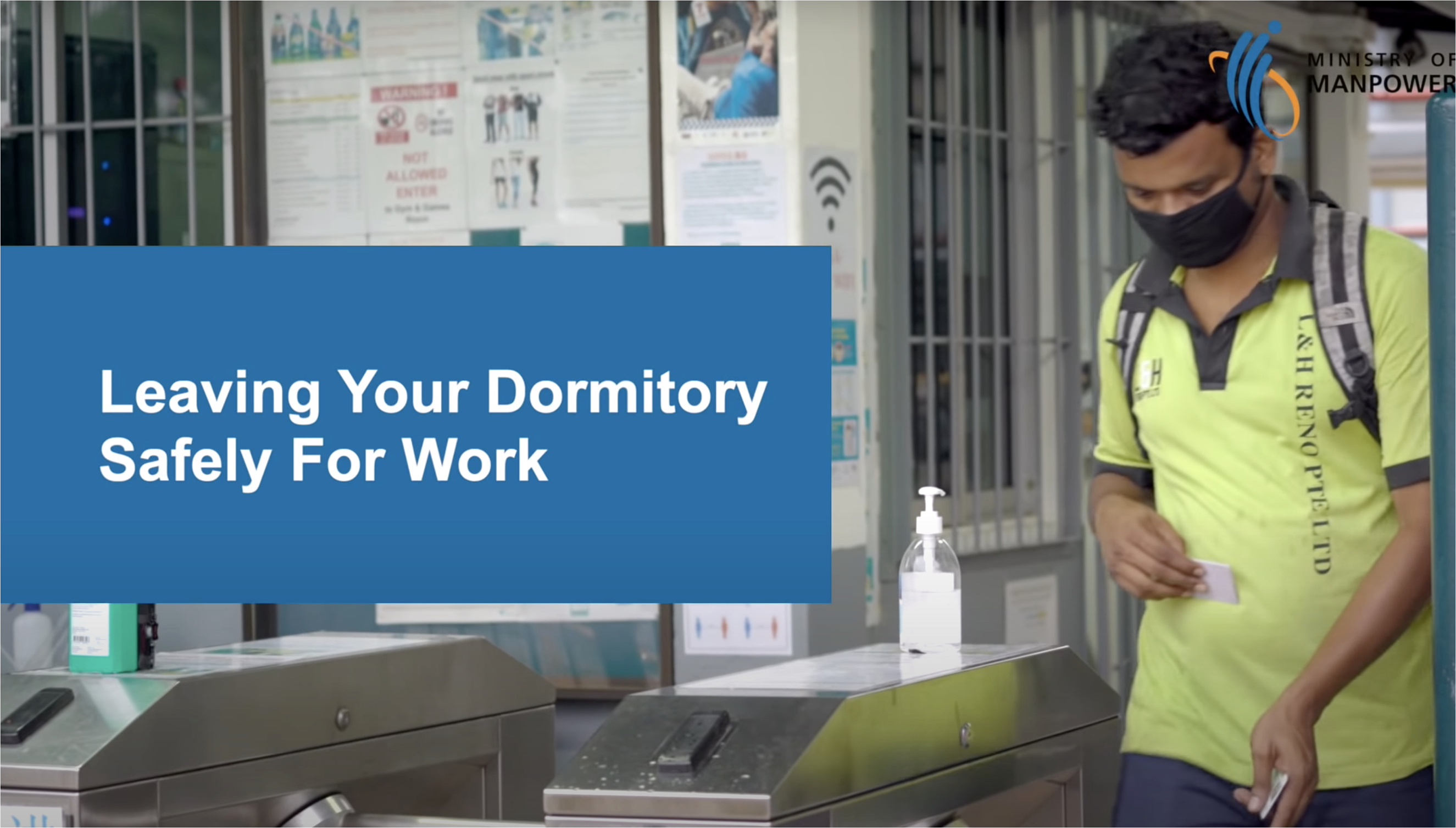
‘Leaving safely for work’
As one of the videos explained, there are ‘four different apps you need to download’ or you ‘won’t be allowed to go to work’ (MOM, 2020b). The technical and user complexity was evident also from the instructions to use an in-built QR code, or otherwise download a QR reader (Figures 2 and 3).
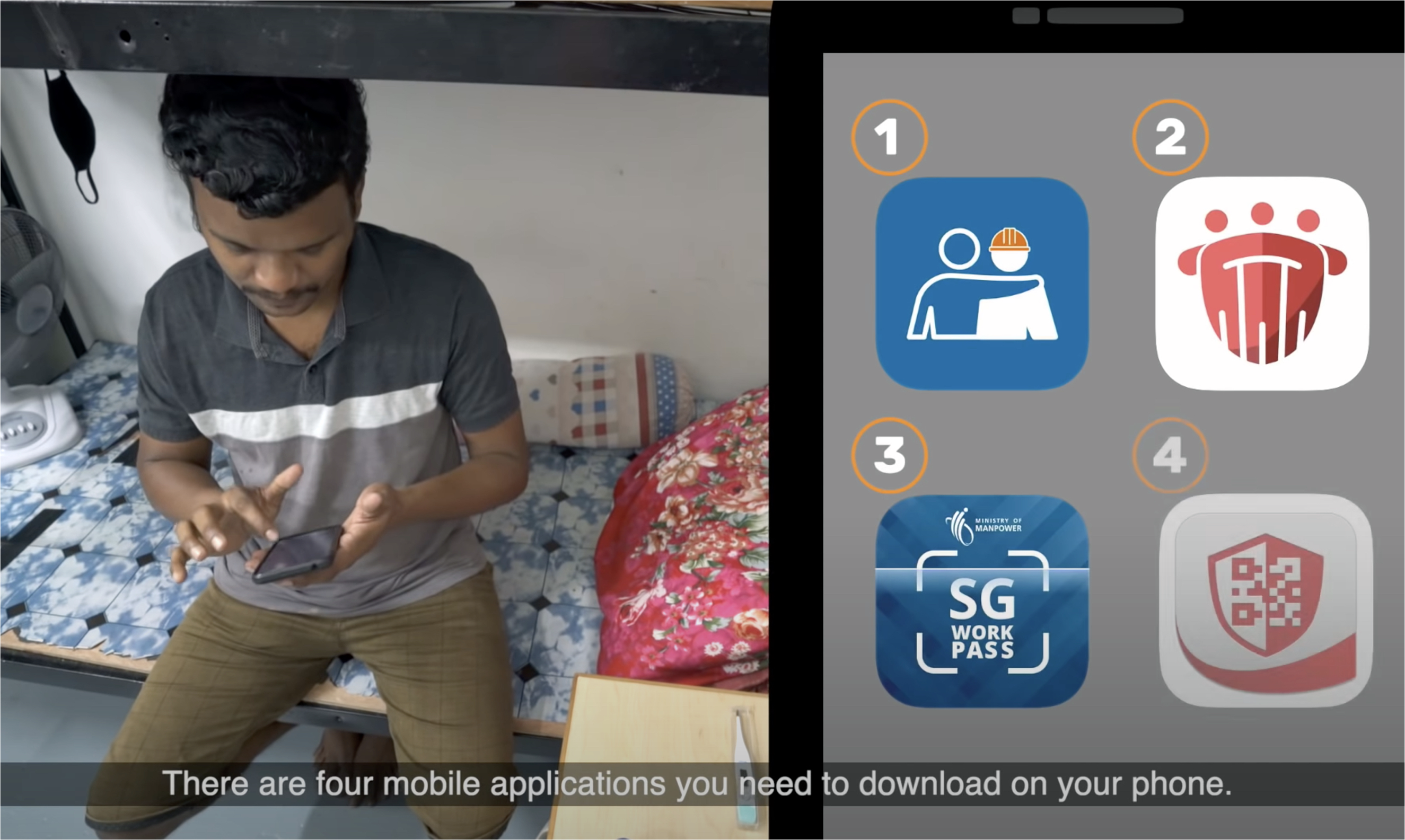
Migrant worker configuring the apps
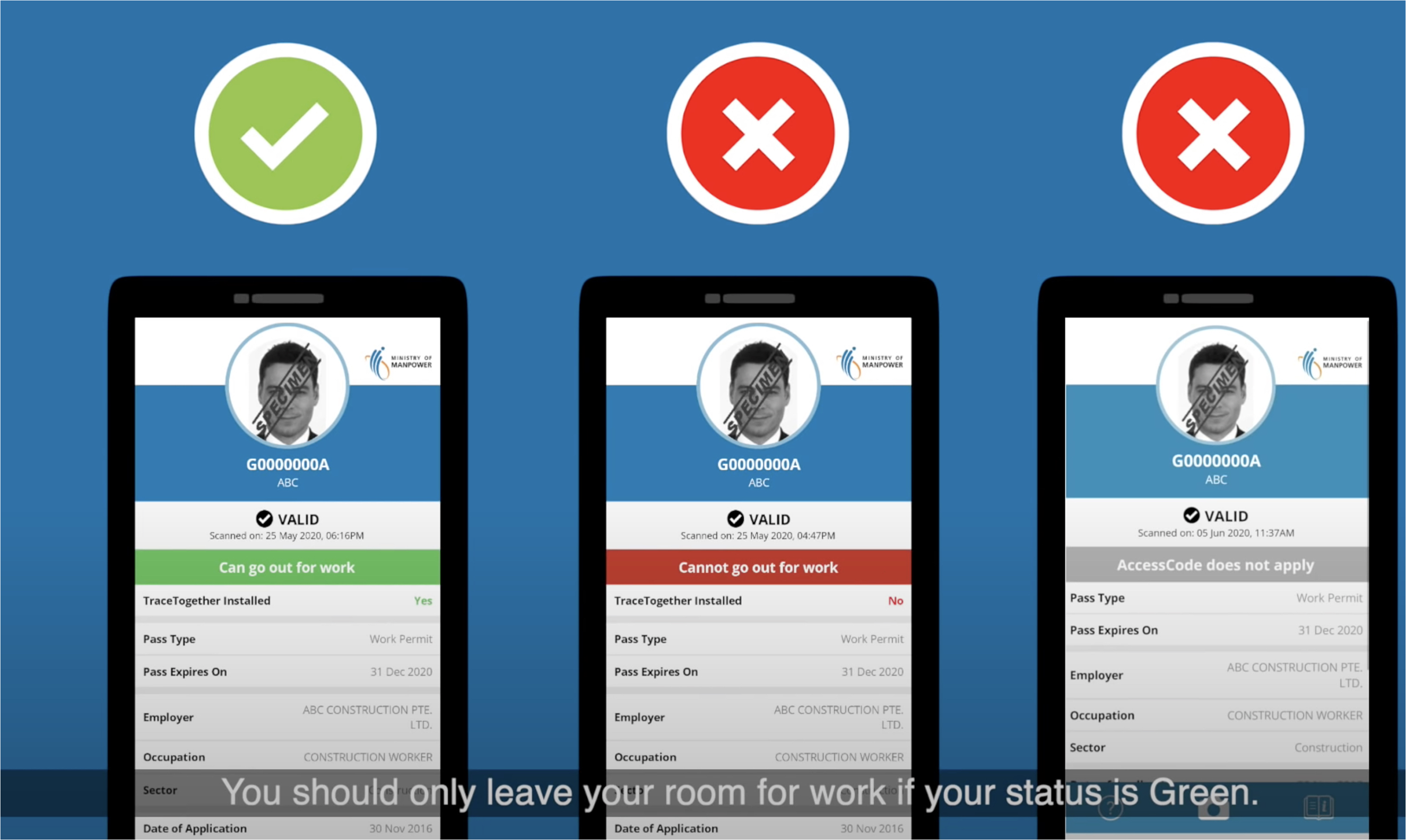
Access code feature on SGWorkPass app
What is conspicuous in how the government marshalled and presented these apps is the focus on the male migrant workers, specifically low-paid work permit holders. This is clearly because of the institutional setting of the dormitories and the passage of workers between the site of home and the site of work – typically of large construction and other sites of labour. This would presumably also be the case for female temporary migrant workers in factory and other settings in Singapore, an understudied group as noted by Yang (2022) – however this group does not appear to have been a priority in Covid app efforts compared to male counterparts. For female workers, such as the large group of migrant domestic workers (often still referred to as ‘maids’ or ‘helpers’), the government also sought to curtail and direct their movement and conduct during the pandemic in detailed and authoritarian ways. Given that female domestic workers are embedded in the households of the families who are their employers, the role of apps in governing their mobilities played out in different ways (Kaur-Gill et al., 2021).
Conclusion
In this article we have drawn attention to the stark way in which apps deployed during the Covid pandemic in Singapore ushered in a new phase of smartphones and digital technologies as migrant infrastructure. In oppressive ways, these apps were designed to tightly constrain and control the mobilities and lives of a group of male migrant workers working in crucial parts of the Singapore economy.
Of course, there are many other instances in which apps and mobile communication offer helpful and affirmative tools for migrants to negotiate their mobile lives and livelihoods (Donner, 2009) – and for the societies they inhabit to bridge and deal with everyday difference (Chong, 2020). In this case, however, the design and deployment of apps underpinned what Laavanya Kathiravelu (2021) has called ‘infrastructures of injustice’.
What emerges strikingly in our analysis is the ways that digital migrant infrastructures evolve with their shaping imaginaries of control, technophilia (Seuferling and Leurs, 2021), and tech solutionism (Milan, 2020) largely unquestioned. This is of grave concern, given that, in the effort to imagine, plan, and communicate the improvement of accommodation and support for migrant workers in the post-Covid future, smartphones and apps are set to play an important role in the integrated ecosystem the government is continuing to build (see Figure 4).
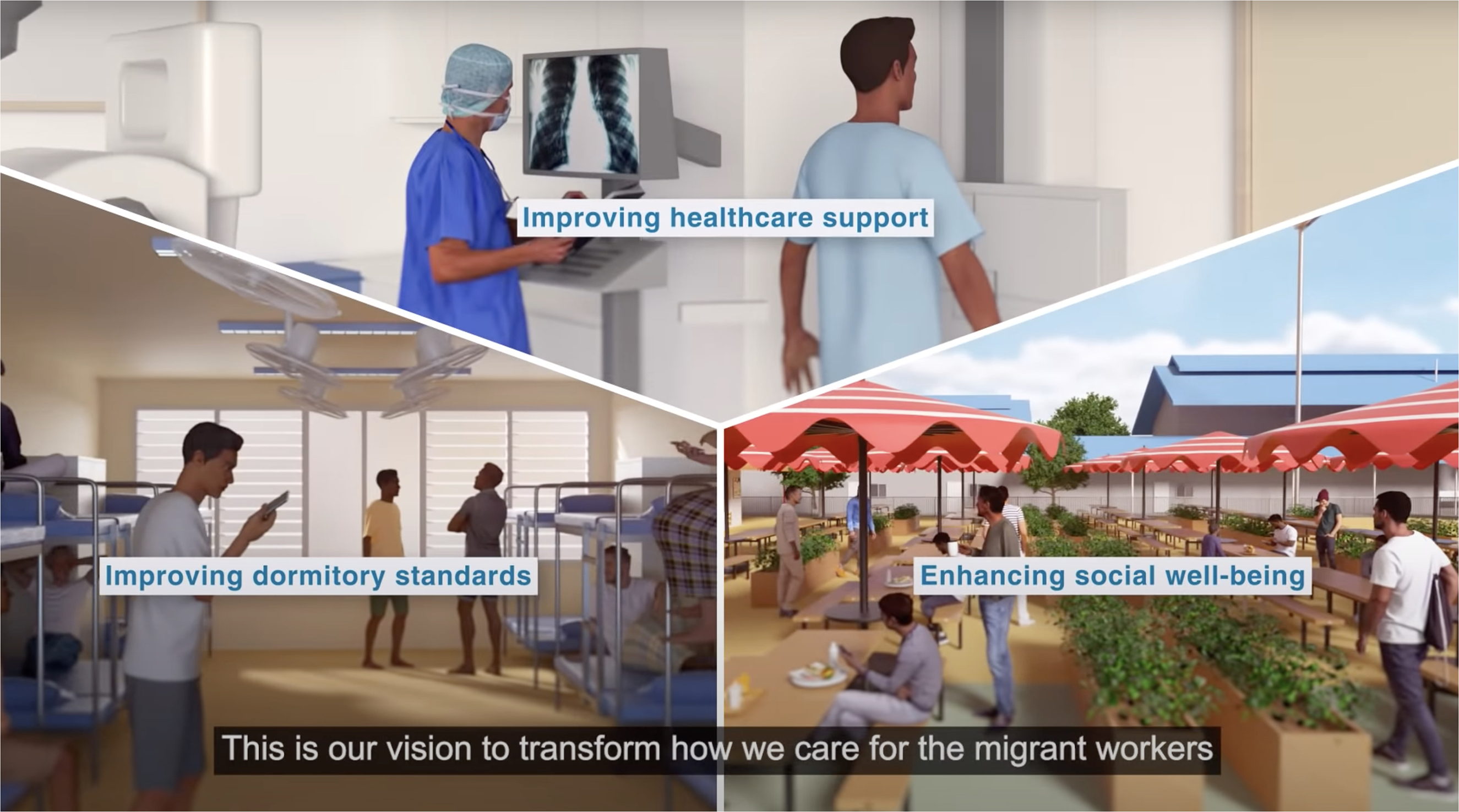
‘Transforming our migrant workers’ ecosystem’
There is a sad irony in this situation, given that migrant workers played a central role in how Singapore imagined and faced the Covid pandemic (Ye, 2021). The plight of migrant workers was also exposed to the wider world, as the face of Singapore's first major surge of Covid cases. In this adverse publicity, there was at least a reminder of the experiences of migrant workers in Singapore, and elsewhere, and the needless suffering they face – and how change can occur (Goh et al., 2020). The public solidarity shown across the region internationally also rekindles hope that headway can be made in addressing inequalities in communication regarding migrants (Kaur-Gill, 2020), where ‘communicative erasures … scripted into the digital infrastructures of “smart city”’ (Dutta, 2021: 1313) are compounded by long-standing problems in media rights and freedom of expression.
Footnotes
Funding
The author(s) disclosed receipt of the following financial support for the research, authorship, and/or publication of this article: This work was supported by the Ministry of Education Singapore Academic Research Fund Tier 1, (grant number RG131/19).

Author biographies
Gerard Goggin is Professor of Media and Communications, University of Sydney. He has published widely on media, culture, and disability, with a particular interest in emerging technology and communication rights. His books include Routledge Companion to Disability and Media (2020), Normality and Disability (2018), Disability and the Media (2005; with Katie Ellis), and with Christopher Newell, the two books Disability in Australia (2005) and Digital Disability (2003).
Kuansong Victor Zhuang is Fung Global Fellow at the Institute of International and Regional Studies, Princeton University, and International Postdoctoral Scholar at the Wee Kim Wee School of Communication and Information, Nanyang Technological University. He is also Principal Consultant at SG Enable, the national agency for disabled people, where he advises them on their plans to build a more inclusive society. He is working on two book projects at the moment. The first, based on his PhD research examines how inclusion as an ideology is created, circulated, communicated, and consumed in Singapore, and undertakes an interdisciplinary approach towards understanding the logics and implications of inclusion as a form of biopower, and the lived realities of disabled people in Singapore. The second, is a co-authored book with Gerard Goggin exploring the intersections of disability and emerging technologies. As a Fung Global Fellow, he is currently researching the intersections of disability, technology, and sustainability as it emerges within the smart city. He hopes to use his research to contribute to current debates about how inclusion happens both in Singapore and around the world.