



Abstract
Despite public discourses highlighting the negative consequences of time spent online (TSO) for children’s well-being, Norwegian children (aged 9–16 years) use the Internet more than other European children and score higher on self-reported life satisfaction (SRLS). To explore the possibility that TSO might contribute to high life satisfaction or other underlying explanatory factors, we investigate the relationship between TSO and SRLS in Norway while also accounting for how individual, family, school, and broader social circumstances influence this relationship. Countering prevailing discourses, we find a positive relationship between TSO and SRLS, which remains positive and significant even after a wider range of variables are accounted for. By explaining the circumstances under which TSO has a positive effect on SRLS, this article provides evidence of the complex role that digital technology plays in the lives of children. It also provides a critique of the often simplistic arguments found in public discourses around children’s digital media use.
Introduction
Public debates about children and harmful media effects have a long history and are not exclusive to digital environments (Livingstone, 2009; Staksrud, 2016). A growing reliance on digital technology for school and learning, further intensified during the Covid-19 pandemic, has compounded fears about the implications of digital media use for children’s well-being. Jean Twenge’s (2014) influential work, for example, argued that smartphones were an important factor in the deteriorating life satisfaction of young people. Yet we still need to understand how time spent online (TSO) impacts children and young people’s self-reported life satisfaction (SRLS), which is one component of subjective well-being (SWB) (Diener et al., 1999).
Norwegian children spend more time using the Internet than other European children, and in an apparent contrast to the findings of international research, they also report the highest levels of SRLS (see Figure 1) (Smahel et al., 2020). At the same time, Norwegian parents tend to worry a lot that their children spend too much time online and on social media and online gaming activities (Staksrud and Ólafsson, 2019). Norway is therefore an interesting country to examine the interrelationship between TSO and SRLS.
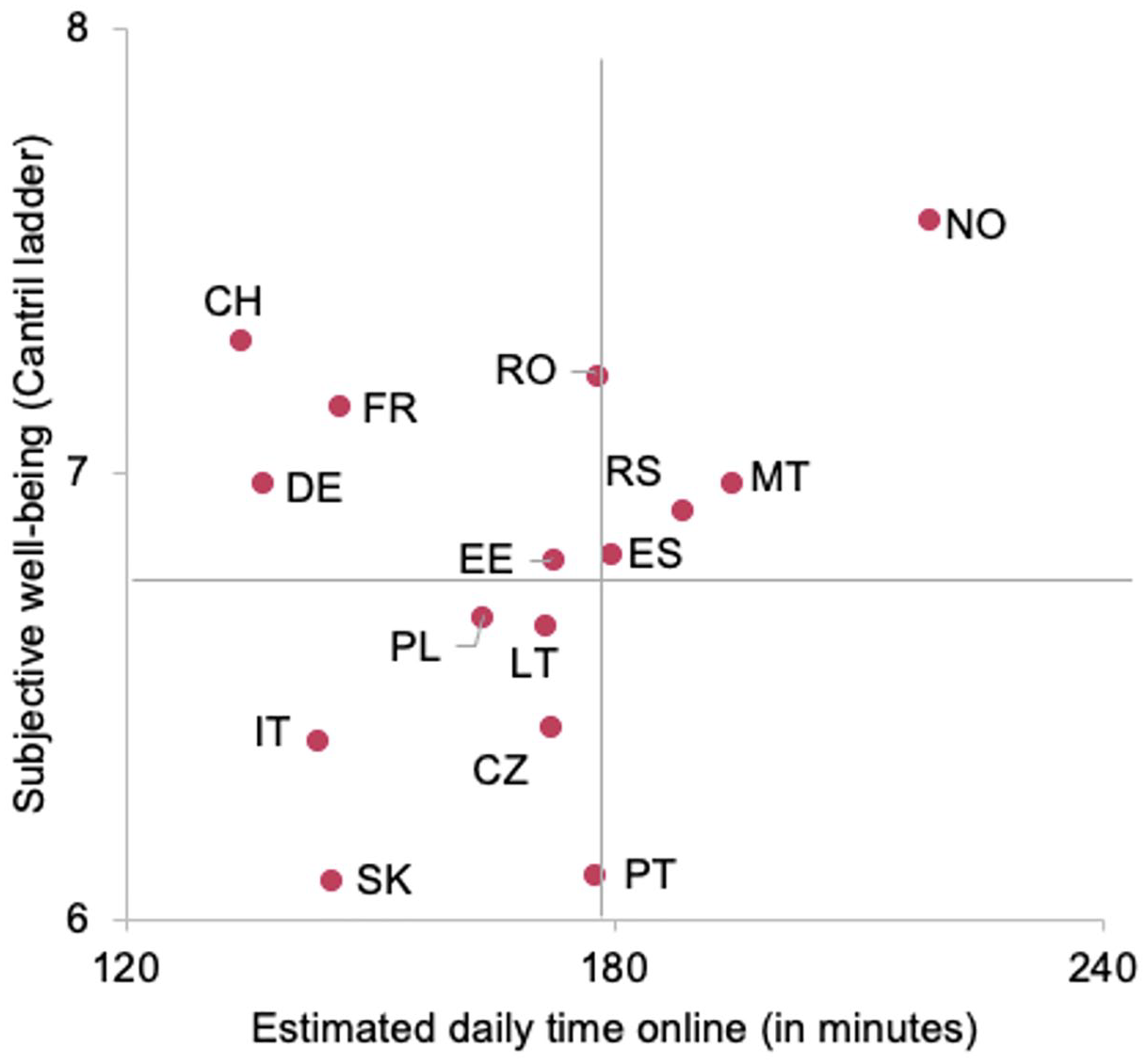
Time spent online and SRLS in European countries (figure created by EUKO, see Smahel et al., 2020).
Research has previously examined the various individual, relational, and contextual factors that influence the association between TSO and SRLS. These include demographics (e.g. age and gender) (Keresteš and Štulhofer, 2020; Lachmann et al., 2018; Orben et al., 2019; Twenge and Farley, 2020), relational (e.g. peer relations) (Kardefelt-Winther et al., 2020), individual (e.g. psychosomatic health) (Biolcati et al., 2018), and contextual factors (e.g. school and family environment; context of use) (Boer et al., 2020; Phan et al., 2020).
However, little research investigates how factors at the individual, social, and country levels influence the relationship between TSO and SRLS when considered together or how social-level variables might moderate the relationship between TSO and SRLS. In this article, we account both for children’s online practices (i.e. social media use, games, learning) and for variables that provide a broader context for socialization processes (i.e. family and school environments) to understand how their cumulative effect and interaction influence wellbeing. A supportive family and school environment might attenuate or offset any negative influences of TSO or negative online experiences on children’s life satisfaction. At the same time, we know that media effects cannot be understood as direct effects, but rather as dependent on the broader relational and contextual environments in which they occur (Livingstone et al., 2018). Furthermore, in accordance with theories of differential media effects, we know that media are likely to affect children in different ways (Piotrowski and Valkenburg, 2015). Scholars have previously posited that dispositional (e.g. gender, personality, cognitions, attitudes) developmental (cognitive, emotional development) and social factors (family, peer group, subcultures) can influence susceptibility to media effects (Valkenburg and Jochen, 2013). It is therefore important to consider children’s media use in a broader socio-ecological context.
Research design
Consequently, in this article, we seek to investigate precisely how factors at multiple levels influence the association between Norwegian children’s TSO and SRLS. We apply the EU Kids Online (EUKO) network’s analytic model for this purpose (Livingstone et al., 2018, Figure 2). The EUKO model, building on Bronfenbrenner’s (1979) ecological systems theory, enables us to contextualize the influence of TSO and online practices on children’s well-being within a broader set of variables at the individual, social, and country levels (Figure 2). The EUKO adaptation of Bronfenbrenner’s model reflects the idea of nested layers of social influence from the closest (family via parental mediation of child Internet use and family environment, pertaining to Bronfenbrenner’s Microsystem) to school environment and country-level influences, constituting mesosystem, macrosystem, and exosystem according to Bronfenbrenner (Livingstone et al., 2018). The specific variables investigated in this article as shown in Figure 2 have been found to influence SRLS in previous research. They comprise individual-level predictors (demographics, such as age and sex; child online practices that include using the Internet to communicate with others, for example, social media use, for games and learning; as well as negative online experiences); social-level predictors that include parental mediation of child Internet use, as well as family and school environment; and finally, the family’s socioeconomic status, which pertains to Bronfenbrenner’s exosystem—indicating family welfare in the context of the broader society that the child finds themselves in. We build on previous analyses by examining how the association between TSO and SRLS changes under the influence of different variables. To accomplish this, we leverage the results of the 2018 EUKO survey in Norway, where data were collected from a nationally representative sample of 1001 Internet-using children of 9–17 years old.
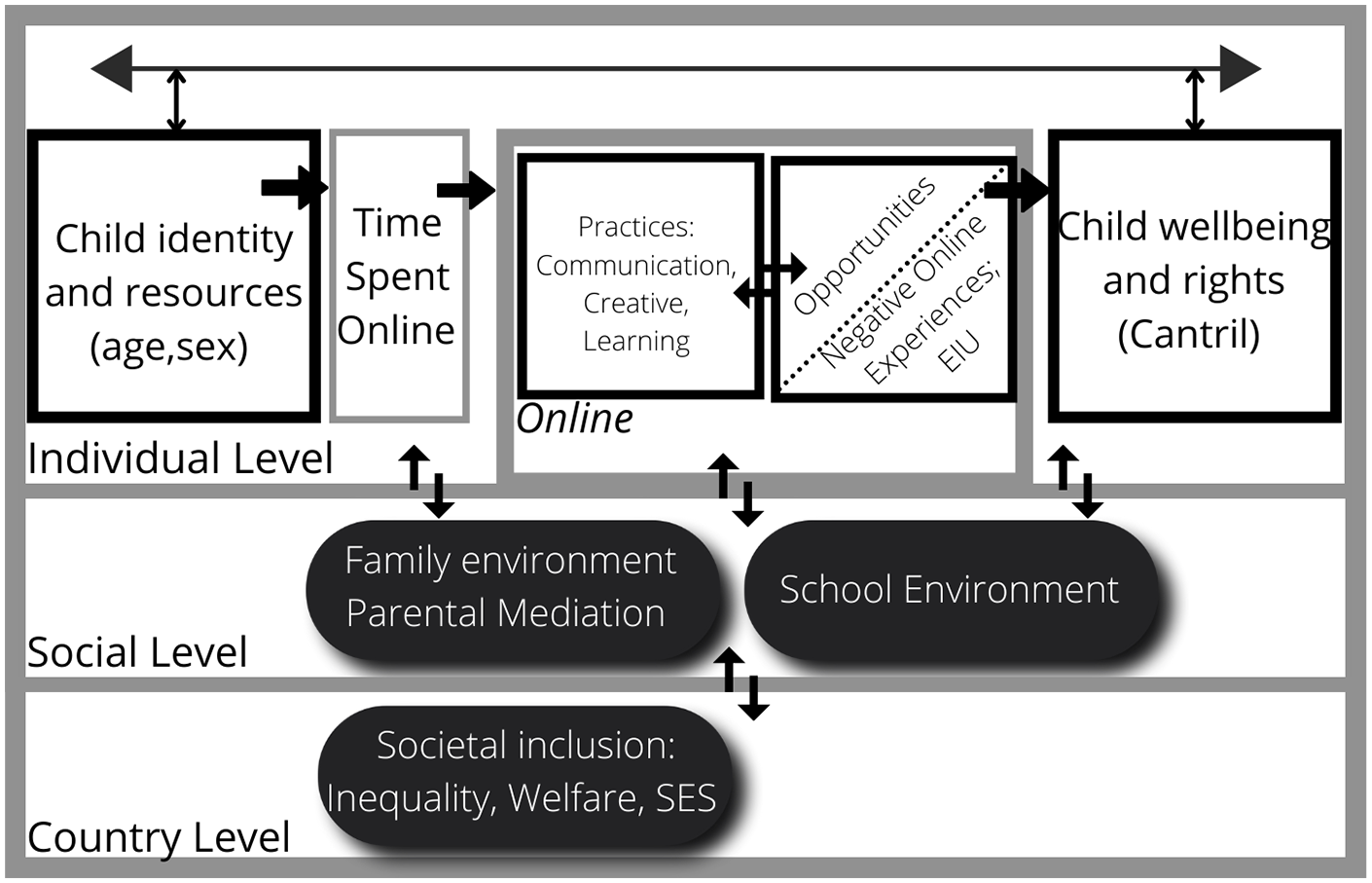
The EUKO analytical framework indicating variables used in this study (figure adapted from the EUKO Analytic model: Livingstone et al., 2018).
Children’s SRLS
Some studies, such as the World Happiness Reports, infer conclusions about children’s well-being following a set of external indicators, including socioeconomic status or gross domestic product (GDP) (Andreasson and Birkjaer, 2018; Helliwell et al., 2021). However, in this study, we are interested in children’s own perceptions of their well-being and the role that TSO plays therein in the context of other relevant variables. By studying children’s perceptions of well-being (their SRLS), we attempt to contribute to the implementation of children’s right to be heard on matters that concern them as enshrined in the United Nations Convention on the Rights of the Child (United Nations, 1990). Furthermore, while research about TSO and children’s well-being often examines negative outcomes such as anxiety, depression, or overall mental health as indicators of well-being, this study’s dependent variable is SRLS. We are therefore not measuring mental health outcomes as a proxy for well-being, but SRLS itself.
Literature review: interdisciplinary research on TSO and children’s well-being
A review of interdisciplinary research exploring the relationship between TSO, children’s online activities (“online practices” in Figure 2), and children’s well-being reveals that in general, TSO is understood to have a negative effect on children’s well-being. In fact, most studies echo popular media discourse, analyzing factors such as “problematic” or “compulsive” Internet use (e.g. Dhir et al., 2016), “gaming disorder” (Bargeron and Hormes, 2017), “Facebook addiction” (Biolcati et al., 2018), “intense and problematic social media use” (Boer et al., 2020), and “smartphone addiction” or “smartphone use disorder” (Lachmann et al., 2018). Fewer studies take a more open approach to exploring the relationship between TSO and life satisfaction (e.g. Liu et al., 2013). However, a recent longitudinal study examining time spent on social media and mental health issues could not establish a relationship between this predictor and individual levels of anxiety and depression (Coyne et al., 2020).
Internet use and SRLS
Demographic, individual, relational, social, and contextual factors have been found to influence how TSO affects children and adolescents’ life satisfaction. Findings on the direction and significance of these relationships, however, are not always consistent. Lachmann et al. (2016), for example, find that associations between problematic Internet use and life satisfaction are significantly higher for females compared to males. However, in a meta-analysis examining the relationship between social media use and life satisfaction, Huang (2017) finds that gender is not a significant factor. Boer et al. (2020) find that adolescents reporting problematic social media use are particularly at risk of lower levels of life satisfaction. However, they also point out that in many countries, intense social media use may be a normative adolescent behavior that contributes positively to well-being.
Regarding social factors, previous studies explore how peer relations (Phan et al., 2020; Poulain et al., 2019) and parental or family relations (Blau et al., 2019; Boniel-Nissim et al., 2015; Keresteš and Štulhofer, 2020; Phan et al., 2020; Twigg et al., 2020) influence the association between TSO and SRLS. Phan et al. (2020) argue that heavy video game use and socializing online may be valued socially by peers and that this, depending on gender and age, can increase life satisfaction. Exposure to harmful online content was also found to be associated with lower self-reported well-being in Finland and the United States (Keipi et al., 2017). Connected to this, support from and communication with parents are found to mediate the association between problematic Internet use, or the negative effects of this use, and life satisfaction (Blau et al., 2019; Boniel-Nissim et al., 2015).
Thus, negative online experiences, practices such as social media use and gaming, problematic Internet use, and parental and family relations have been identified as relevant variables in the association between TSO and SRLS. We include these variables in our investigation. To understand how a broader range of online practices might impact SRLS, we add other online practices such as Internet use for creative and learning purposes (e.g. making and sharing content or school-related uses, see Helsper et al., 2015).
Finally, and regarding contextual factors, school environment (school satisfaction and perceived school pressure) was studied in the context of school well-being and its relationship to intense and problematic social media use. Addictive social media use was found to be associated with lower school well-being (Boer et al., 2020). In a longitudinal study, intense computer or Internet use was associated with lower school environment satisfaction and reduced success at school. Adolescents who were intense mobile phone users at baseline also exhibited decreased school environment satisfaction at follow-up (Poulain et al., 2019). We therefore include measures on school environment in our study.
The “displacement” and “Goldilocks” hypotheses
Two key hypotheses have been proposed to explain how TSO influences children’s well-being. The displacement hypothesis suggests that TSO takes time away from other essential activities and that the associated harm is directly proportional to TSO or digital technology use (Przybylski and Weinstein, 2017). The Goldilocks hypothesis, on the contrary, proposes that while too much or too little technology use contributes negatively to well-being, a moderate use of technology might be “just right” and not inherently harmful (Przybylski and Weinstein, 2017). In this context, the curvilinear relationship between TSO and well-being suggests that too little digital engagement might deprive young people of the necessary social stimulation, while too much takes time away from other essential activities (Przybylski and Weinstein, 2017). While we do not test these hypotheses in this study, it is important to acknowledge these proposed explanations of how patterns of TSO might affect well-being.
The Norwegian context
In a global context, Norwegian citizens consistently report high levels of SRLS. Since 2013, Norway has been one of five Nordic countries ranking in the top 10 countries in the World Happiness Report (Helliwell et al., 2021: 130). While SRLS is consistently higher among wealthier nations, when compared to other regions of the world, Helliwell et al. (2021: 137) find that high levels of social support and trust (including generous and effective welfare benefits), freedom to make life choices (i.e. autonomy), and a lack of corruption are unifying factors predicting high levels of SRLS in the Nordic region (see also Diener, 2000). It is therefore interesting to investigate whether these broad socioeconomic factors influence the relationship between TSO and SRLS in the Norwegian context.
Andreasson and Birkjaer (2018) also note the importance of social interaction for SRLS in the Nordic region (p. 26).
Further reinforcing the importance of these broad socioeconomic and relational factors, research exploring SRLS among Norwegian children and young people has found that this is influenced by gender and age (Moksnes and Espnes, 2013), psychosomatic health (Hansen, 2015), family relations (Coenders et al., 2005), socioeconomic status (Grødem, 2009), and school environment (Kvarme et al., 2016; Moksnes et al., 2016).
Turning specifically to TSO, when comparing Nordic children to children in 25 European countries, research has found that Norwegian and Swedish children use the Internet most extensively (Helsper et al., 2013). Nordic children’s Internet use is also considered to involve a significant exposure to online risk, when compared to other European children, while at the same time to be characterized by high levels of support at family, school, and policy levels for building online resilience (Helsper et al., 2013: 37). The most recent international survey conducted by the EUKO network, including data from Norway, indicates that Norwegian children and young people report the highest levels of TSO and SRLS when compared to their European counterparts (Smahel et al., 2020). It is therefore pertinent to explore the relationship between TSO and SRLS in the Norwegian context, and in particular to investigate how factors at the individual, social, and broader country-contextual levels influence this relationship.
Based on our literature review, we hypothesize the following:
H1. TSO will negatively influence children and adolescents’ SRLS.
To structure our analysis, we ask:
RQ1. Does TSO negatively influence children and adolescents’ SRLS when factors at the child’s individual, social, and country levels have been accounted for?
RQ2. Which factors at the individual, social, and country levels alter the relationship between TSO and SRLS and how?
Data and methods
This article relies on a nationally representative survey sample of Internet-using children in Norway. The data were collected as part of an international survey implemented in 19 European countries by the EUKO research network. The survey examined children’s use of the Internet and digital devices, online risks and associated harms, as well as digital skills, and their impact on well-being. For this article, we examine the variables that relate to our research questions.
The fieldwork in Norway was undertaken between June and October 2018. In all, 1001 children aged 9–17 years were interviewed via the Computer-Assisted Interviewing Method (CASI). A trained interviewer provided instructions to the child, answered any questions, and ensured that there were no cognitive, ethical, or technical issues. The child then completed the survey alone. This procedure ensured the privacy and validity of the child’s answers. The interviewer also ensured that the parent/guardian did not interfere with the process. This procedure and its ethical ramifications were designed and approved by the research network (Zlamal et al., 2020). The data were collected by Ipsos Mori. The data collection was funded by the Norwegian Ministry of Justice and Public Security (Staksrud and Ólafsson, 2019).
Participants
Respondents were initially recruited by telephone; 47.1% of the children sampled were female, Mage = 13.3 years. Due to Norway’s regional diversity, especially between urban and rural areas, the sampling process accounted for geographic representativeness and urbanicity. The sampling frame was stratified by the economic characteristics of municipalities as well as the number of 9- to 17-year-old children who lived there. Children who did not use the Internet in the last 3 months were excluded from the sample.
Legal and ethical considerations
The data collection was approved by the Norwegian National Data Authority (Datatilsynet) and followed procedures established by the National Ethical Committees for Social Science and Humanities (NESH) and by the Norwegian Center for Research Data (NSD). Informed consent was obtained from both parents and children. Respondents’ anonymity and confidentiality were ensured. Detailed information on the questionnaires and relevant measures, sampling, and ethical aspects can be found in the EUKO technical report for Norway (Staksrud and Ólafsson, 2019).
Measures
Dependent variable measurement
According to Bradshaw and colleagues, “subjective well-being is a multidimensional construct that includes both cognitive and affective components,” such as pleasant emotions (positive affect) and negative emotions (negative affect), while the cognitive component is the “judgement of individuals’ life qualities.” Happiness is also “the result of a balance between positive and negative affect” (Ben-Zur, 2003; Bradshaw et al., 2011: 548–549; Diener, 2000). SWB can be measured across domains (e.g. school and family) or as a single overall life evaluation; furthermore, either affect or life-satisfaction components of well-being, or both, can be measured (Ben-Zur, 2003). In this study, we do not measure affect. We focus instead on the life-satisfaction component and on a single overall life evaluation via the Cantril ladder (see Mazur et al., 2018).
Overall life satisfaction was measured by an adaptation of the Cantril ladder (Levin and Currie, 2014) that read as follows: Here is a picture of a ladder. Imagine that the top of the ladder “10” is the best possible life for you and the bottom “0” is the worst possible life for you. In general, where on the ladder do you feel you stand at the moment? Please tick the box next to the number that best describes where you stand.
The top end of the ladder has the label “Best possible life” and the bottom of the ladder has the label “Worst possible life.” The mean score for all respondents is 7.9 and the standard deviation is 1.6, so the distribution is quite skewed. For the statistical analysis, we considered whether steps should be taken to adjust this in the distribution of the dependent variable. However, using a log-transformation of the dependent variable did not affect the results in any substantial way. For clarity of interpretation, the dependent variable was thus retained in its original form. Higher scores indicated higher life satisfaction.
While the Cantril ladder is a one-item measure of life satisfaction, researchers have found it to represent a valid measure for the estimation of average change in life satisfaction. These one-item scales might have a lower power to detect moderating influences on estimated change trajectories than multi-item scales (see Gnambs and Buntins, 2017). A similar one-item measurement has previously been used in studying children’s life satisfaction and digital media use (Boniel-Nissim et al., 2015; Twigg et al., 2020).
Independent variable measurements
Time spent online
TSO is measured using two questions which ask about time spent on the Internet on weekdays and on weekends. The format of the question is intended to capture the difference in use between weekdays, when children’s daily schedule is framed by school, and weekends, when they tend to have more free time at their disposal. Responses from both questions are combined to form an estimate of the average daily time spent on the Internet, resulting in a scale from 0.25 hours to 7 hours each day (r = .57, M = 3.70, SD = 1.81).
Use of digital technologies (online practices)
Use of digital technologies was measured by four types of online activities adapted from the work of Helsper et al. (2015). (1) Communication (nine items, α = .84, M = 3.44 SD = 0.88): I visited a social networking site; I communicated with family or friends; I watched video clips; I listened to music online; I commented on updates that family or friends put online; I showed my family or friends something that I saw online; I watched TV shows or movies; I used apps; I took a picture or created an image that I shared with others; (2) gaming (three items, α = .90, M = 2.75, SD = 1.39): I played online games; I played online games alone; I played games with other people online; (3) creativity (three items, α = .63, M = 1.32, SD = 0.55): I created my own videos or music and uploaded it to share; I posted videos or music created by someone else; I created something using an app (mobile application); and (4) learning (seven items, α = .75, M = 2.01, SD = 0.72): I looked for information about work or study opportunities; I used the Internet for schoolwork; I used the Internet to talk to people from other countries; I looked for news online; I got involved online in a campaign, protest, or I signed a petition online; I discussed political or social problems with other people online; I looked for health information for myself or someone I know; I participated in an online group where people share my interests or hobbies. All items could be answered on a scale from never (1) to almost all the time (6).
Online risks
Experiences were measured by considering excessive Internet use (EIU) and overall negative online experiences. Overall negative online experiences were measured by the general question: “In the PAST YEAR, has anything EVER happened online that bothered or upset you in some way (e.g. made you feel upset, uncomfortable, scared, or that you shouldn’t have seen it)?” (M = 1.91, SD = 0.87). The response options of this question were yes (1) or no (2).
EIU was measured by a scale that captures the following aspects of EIU (Smahel et al., 2012): “I have gone without eating or sleeping because of the Internet” (salience); “I have felt bothered when I cannot be on the Internet” (withdrawal); “I have caught myself surfing when I am not really interested” (tolerance); “I have spent less time than I should with family, friends, or doing schoolwork because of the time I spent on the Internet” (conflict); and “I have tried unsuccessfully to spend less time on the Internet” (relapse) (five items, α = .71, M = 1.77, SD = 0.71). The response options to this question were yes (1) or no (2).
Parental mediation of Internet use
Enabling mediation (e.g. [My parent or carer] encourages me to explore and learn things on the Internet) was measured by a scale (10 items, α = .89, M = 2.63, SD = 0.85). Restrictive mediation (e.g. [Does your parent or carer allow you to do the following things on the Internet, and if so, do you need permission to do them]) was measured by a scale (three items, α = .71, M = 1.32, SD = 0.54) and questions where respondents were asked to indicate, with regard to a range of online activities, whether their parents currently allowed them to engage in these or not. All items could be answered on a scale from never (1) to very often (5). For further reference on the measurement of mediation items, please consult Livingstone et al. (2018).
Family environment
Family environment was measured with one scale (3 items, α = .76, M = 2.63, SD = 0.52) by Zimet et al. (1988). All items (e.g. My family really tries to help me) could be answered on a scale from not true (1) to very true (4). Higher scores indicated higher levels of family support.
School environment
School environment was measured by a scale (five items, α = .87, M = 3.40, SD = 0.65) by Currie et al. (2012). All items (e.g. I feel safe at school) could be answered on a scale from not true (1) to very true (4). Higher scores indicated a more positive school environment.
Socioeconomic Status
Subjective socioeconomic status was measured by the following question: Think of this ladder as representing where people stand in your country. At the top of the ladder are the people who are the best off—those who have the most money, the most education, and the most respected jobs. At the bottom are the people who are the worst off—who have the least money, the least education, and the least respected jobs or no job. Please tick the box where you think you and your family are. Higher scores indicated a higher socioeconomic status within the society (M = 7.61, SD = 1.39). This variable corresponds to the country level in the EUKO analytic model as it indicates the perceived position of the family in the broader Norwegian society.
Control variables
In addition, we also controlled for three demographic variables which are age, sex (with boys set as the reference category), and the level of urbanity measured via the Nomenclature of Territorial Units for Statistics, including here the NUTS 2 classification category, that is, basic regions for the application of regional policies, measured under KOSTRA in Norway. 1
Results
A five-step hierarchical multiple regression was conducted to predict Norwegian children’s SRLS. In the first step, control variables (i.e. age and sex, the child’s individual characteristics) were entered. In the second step, the main variable of interest, namely, TSO, was added to the regression analyses. Online activities (i.e. communication, gaming, creativity, and learning) and online risks (i.e. EIU and overall negative online experiences) were entered at step 3, representing the individual variables that correspond to “online practices” in the EUKO analytic model. In the fourth step, social-level variables that pertain to the family and school (i.e. enabling mediation of the child’s Internet use, restrictive mediation, family environment, and school environment) were included. Finally, in step 5, the subjective socioeconomic status of the family was entered as a country-level variable.
The findings show that at step 1, the control variables (i.e. age, sex, and number of inhabitants) contributed significantly to the regression model, F(3, 159) = 4.55, p < .001, and accounted for 8% of the variation in life satisfaction. Including TSO to the regression model explained an additional 1% of the variation in life satisfaction and this change was not significant, F(1, 158) = 1.73, p = .190. This finding refutes the first hypothesis which states that TSO will negatively influence children and adolescents’ SRLS. When solely demographic variables are accounted for, TSO does not negatively contribute to child SRLS.
We now turn to RQ1: Does TSO negatively influence children and adolescents’ SRLS when factors at the child’s individual, social, and country levels have been accounted for? To that end, we examine the individual-level variables, namely, online activities (i.e. communication, gaming, creativity, and learning) and online risks (i.e. EIU and overall negative online experiences). Their introduction into the model explained an additional 4% of the variation in life satisfaction and this change was not significant, F(6, 152) = 1.73, p = .349. Adding the social-level variables (i.e. enabling mediation, restrictive mediation, family environment, and school environment) explained an additional 26% of the variation in life satisfaction and this change was significant, F (4, 148) = 15.69, p < .001. Finally, including the country-level variable, perceived socioeconomic status (as an indicator of the family’s perceived position in Norwegian society), explained an additional 12% of variance in life satisfaction and this change was also significant, F(1, 147) = 35.01, p < .001.
The final regression model in step 5 accounted for 50% of the variation in life satisfaction and was significant, F(15, 147) = 17.55, p < .001. As shown in Table 2 in Appendix 1, age (β = .06, p = .463), sex (β = −.14, p = .083), and number of inhabitants (β = .04, p = .649) were not related to life satisfaction. TSO was positively related to SRLS (β = .17, p = .021). Communication (β = −.08, p = .354), gaming (β = .09, p = .322), creativity (β = .03, p = .650), learning (β = −.10, p = .209), EIU (β = −.24, p = .096), and overall negative online experiences (β = −.07, p = .287) were all unrelated to life satisfaction. However, enabling parental mediation (β = .17, p = .036), restrictive parental mediation of children’s Internet use (β = .39, p = .014), family environment (β = .20, p = .007), school environment (β = .26, p < .001), and subjective socioeconomic status (β = .36, p < .001) were positively related to SRLS.
Finally, to deepen our understanding of the complex relationship between TSO and SRLS, and thus answer RQ2: “Which factors at the individual, social, and country levels alter the relationship between TSO and SRLS and how,” we ran a series of moderation analyses based on the final regression model using the Process Macro version 3.5 (Hayes, 2017). Standard procedures were followed, with 5000 bias-corrected bootstrap samples and 95% confidence intervals. All moderation models were controlled for age, sex, and number of inhabitants. Specifically, we wished to know whether children whose parents were more involved in their children’s digital media use by practicing enabling parental mediation more intensely, which includes talking to children about risks and facilitates child’s ability to learn and acquire digital skills, in fact experienced greater well-being. The findings showed that the interaction between TSO and enabling mediation was not significant (B = −.02, p = .119) when predicting SRLS. This means that enabling mediation did not alter the relationship between TSO and SRLS. Similarly, we checked whether such an effect existed for restrictive mediation: whether placing limits on children’s Internet use might alter the relationship between TSO and SRLS. However, the interaction between TSO and restrictive mediation was not significant (B = −.03, p = .275) when predicting SRLS. In a similar vein, we wished to see whether a more supportive family and school environment might offset any negative effects of TSO on SRLS, which is why we checked the moderation effect of these variables. However, the interactions between TSO and family environment (B = −.02, p = .388) and the interaction between TSO and school environment (B = −.01, p = .609) were not significant. Finally, the interaction between TSO and subjective socioeconomic status was not significant when predicting SRLS (B = .02, p = .089).
Discussion
What is it about TSO that contributes to higher or lower SRLS? Do specific online practices such as gaming or social media use or negative online experiences predict lower SRLS or change the relationship between TSO and SRLS? Much of the public debate and research focus on the negative effects of TSO, social media use, and gaming. Against this background, Norway presents an interesting case where children spend most time online and score the highest on SRLS in Europe (Smahel et al., 2020). We therefore investigate the relationship between TSO and SRLS in Norway to understand the factors that contribute to this situation.
Do positive family or school environments, or perceptions about the family’s socioeconomic position within the Norwegian society influence this relationship? Unlike previous studies, we consider several variables at the child’s individual-, social-, and country-level contexts together to better understand whether and how TSO might predict SRLS. Guided by the EUKO socio-ecological analytic model (Livingstone et al., 2018), we investigate the predictors of SRLS among Norwegian children.
We find, in keeping with previous research (e.g. Keresteš and Štulhofer, 2020), that girls and older children are more likely to exhibit lower levels of SRLS. However, TSO does not predict SRLS when only demographic variables are accounted for. A broader set of variables is therefore necessary to understand the relationship between TSO and SRLS. Surprisingly, and contrary to our expectations, TSO positively predicts SRLS, that is, the more TSO, the higher levels of SRLS reported. This relationship remains positive and significant after variables at the individual, social, and country levels have been introduced.
We then specifically examine whether TSO negatively predicts SRLS on its own, that is, when considered separately from EIU and negative online experiences, social media use, and other communication activities as well as gaming. We therefore introduce these online practices and risks to our regression model. Contrary to previous research (e.g. Błachnio et al., 2019; Keipi et al., 2017; Lachmann et al., 2016, 2018; Schmiedeberg and Schröder, 2017), EIU and negative online experiences are not a significant negative predictor of SRLS. We find that online practices, including social media use (where previous research has been inconclusive, for example, Chai et al., 2019; Twigg et al., 2020) and gaming (e.g. Johannes et al., 2020), are not significant either. However, when EIU and online practices are introduced into the model, TSO continues to remain a significant positive predictor of SRLS. This indicates either that (1) there is something else about TSO that positively influences SRLS independently of the specific practices that children engage in, or (2) factors at the family and school levels outweigh or alter the effects of TSO. Furthermore, even when a child experiences something negative online or exhibits symptoms of EIU, more time online in and of itself does not detract from SRLS, but in fact contributes to it.
Social-level variables prove to be particularly important for predicting SRLS. Positive family and school environments and both restrictive and enabling parental mediation of Internet use, all contribute to higher SRLS, while TSO remains significant throughout. The addition of these variables explains the largest amount of variance. This suggests that the role of TSO in children’s well-being cannot be considered independently of these factors and that in a supportive family and school context, more time online contributes to more life satisfaction for children. Importantly, while restrictive mediation remains a significant predictor throughout, enabling mediation only becomes significant when the country-level variable, the perceived socioeconomic status, has been included in the model. Given that enabling parental mediation is practiced when parents have stronger digital skills and perceive their children to be more digitally savvy (Livingstone et al., 2018), it might be the case that such mediation is practiced more in families with higher socioeconomic status. Although restrictive mediation is negatively correlated with communicative experiences and learning, it could be the case that its effect of protecting from negative online experiences and use in conjunction with enabling mediation outweigh these negative effects. Consider also that restrictive mediation has previously been found to be a significant factor in protecting from the negative effects of problematic Internet use when leveraged in the context of a supportive family environment (see Chng et al., 2015). The positive effects of restrictive mediation could therefore be contingent upon other factors, such as a supportive family environment.
The fact that the perceived socioeconomic status explains over 10% of the variance suggests that this perception is important for understanding SRLS, and that children who perceive their family to be better positioned in Norwegian society are more likely to feel that they are thriving. The role of TSO in SRLS can therefore hardly be understood outside of this broader social context.
Conclusion
These findings demonstrate that the relationship between TSO and SRLS cannot be explained or primarily determined by negative online experiences, pathological use, or activities such as social media use or gaming. Rather, explanations of the relationship between these variables must account for a broader set of factors, including in particular social factors (family and school) and perceived family status at the country level.
Limitations and future research
The cross-sectional nature of our study prevents us from discussing the direction of these relationships and their causality. Nevertheless, previous research has established SWB and SRLS as outcome variables and TSO and online practices as predictors (see, for example, Erfani and Abedin, 2018). Future research could examine which factors at the individual, social, and country levels moderate or mediate the effect of the relationship between TSO and SRLS. In addition, the role of online practices and TSO in SRLS requires further investigation, especially in the context of countries with different economic and cultural backgrounds and less policy support for families and educators. We were unable to examine the role of peer relations because the Cronbach’s alpha measurement for the specific items from the strengths and difficulties questionnaire that addressed this in our survey was too low. As such, future research might investigate this further. Finally, because of the interdisciplinary nature of our work, both the SRLS measure and several independent variables are one-item measurements, which are not as robust indicators as multi-item measurements.
Policy recommendations
Our study demonstrates that factors at the individual, social, and country levels shape children’s experiences of being online. Therefore, instead of assuming that there is something about TSO that is inherently negative or positive, focusing on limiting children’s TSO or trying to ensure the optimum level of Internet use, it is important to develop policies that recognize and facilitate the additional factors that set the context for children’s Internet use. This means supporting parents and caregivers in providing effective mediation strategies; ensuring a school environment where children feel supported; and raising awareness among parents and caregivers about the importance of nurturing a family environment where children feel acknowledged and valued.
Footnotes
Appendix 1
Multicollinearity among predictors can reduce the probability to assess the individual importance of a predictor. Therefore, a correlation matrix was evaluated to examine multicollinearity (see Table 1). The results indicated that all variables were suitable for consideration as independent variables in one regression analysis since no high correlations (>.70) were found.
Authors’ contributions
All authors have contributed equally to the article and are listed in the alphabetical order.
Funding
The author(s) disclosed receipt of the following financial support for the research, authorship, and/or publication of this article: The data collection was funded from the Norwegian National State Budget 2017-2018 under the Ministry of Justice and Public Security’s Proposition 1S (20162017) and Proposition 12 S (20161017) Escalation Plan against Violence and Abuse (2017-2021). Contributions from Staksrud and Ni Bhroin were part of the “Living the Nordic Model” project financed by UiO:Norden. Milosevic has received funding from the European Union’s Horizon 2020 research and innovation programme under the Marie Skłodowska-Curie grant agreement No. 801522, by Science Foundation Ireland and co-funded by the European Regional Development Fund through the ADAPT Centre for Digital Content Technology grant number 13/RC/2106_P2.
