




Abstract
Playables are mini-games used in digital advertising and may offer a novel and engaging avenue to improve young people’s well-being at scale. This randomised controlled trial evaluated the immediate impact and protective properties of a psychoeducational playable on adolescents’ body satisfaction and negative affect, and engagement in prosocial behaviours, relative to two active control conditions. Girls and boys aged 13–14 years (N = 6575) were randomised into one of three conditions: body image playable, body image social networking posts (i.e. static images of the body image playable messages; control 1) or an ocean conservation playable (control 2). Both body image micro-interventions significantly improved state body satisfaction and negative affect, relative to the oceanic playable. No condition buffered against the negative effects associated with viewing idealised media images. Developing playables to counteract the potentially harmful effects associated with surrounding digital environments is a promising avenue for mental health.
It is well known that exposure to and engagement with appearance-oriented media are associated with increased body dissatisfaction, a key risk factor for disordered eating and eating disorders (e.g. see Groesz et al., 2002; McComb and Mills, 2020; Rounsefell et al., 2020, for reviews). Body dissatisfaction, a ‘normative discontent’ observed globally across the life span (Swami et al., 2010), cannot be treated solely by face-to-face psychosocial interventions (Kazdin, 2017, 2019). Developing interventions that co-exist within environments that perpetuate body dissatisfaction is an innovative and imperative strategy for reducing this global burden. The fast-paced and ever-evolving nature of digital media offers an abundance of new technologies that show promise for developing and disseminating health interventions at scale. This study is the first to adopt a relatively new media technology, ‘Playables’, for addressing mental health, more specifically body image, among young people.
Body dissatisfaction has traditionally been targeted at the individual level, using face-to-face interventions in school, community and clinical settings (see Alleva et al., 2015 for review). Attempts to scale this intervention model have led to online intervention adaptations, with preliminary findings indicating small effect sizes (Cohen’s d ranging between 0.24 and 0.42; see Wade and Wilksch, 2018, for review). However, the online nature of these interventions increases their susceptibility to high attrition and low adherence rates (Beatty and Binnion, 2016). Additional limitations include the significant human, financial and time resources needed to execute these interventions effectively (Kazdin, 2017, 2019). Furthermore, these interventions may be unsuitable or unnecessary for milder concerns, which may be responsive to lower intensity interventions that demand fewer resources (Kazdin, 2017, 2019). Finally, while these interventions may upskill individuals in coping with stimuli that trigger body dissatisfaction (e.g. learning to critique unrealistic images in the media), this requires the recall of strategies and tools, which may be particularly challenging when one is overwhelmed with media content and/or distressed. Therefore, embedding interventions within digital environments, which aim to disrupt the plethora of harmful media, as well as teach and/or prompt individuals on how to cope with distressing stimuli, is a logical and imperative step. Specifically, this study proposes the cultivation of media content that doubles as intervention and entertainment (e.g. an online mini-game that delivers health-care messages and models health-promoting attitudes and behaviours); a strategy that has been identified as a cost-effective and scalable approach in addressing global mental health concerns (Kazdin, 2017, 2019).
Micro-interventions in digital media
‘Micro-interventions’ offer a framework for cultivating media that mitigate risk and enhance protective factors for mental health. This intervention model is designed to be brief, immediately actionable and provide in the moment benefits to the consumer; features that are conducive to digital media environments (Baumel et al., 2020). However, the use of micro-interventions within media has been largely unexplored. To date, micro-interventions have been applied to adult samples with body image and mood symptoms in community settings. Approaches have included auditory-, visual- and written-based tasks (e.g. Bunge et al., 2016, 2017; Elefant et al., 2017; Fuller-Tyszkiewicz et al., 2019; Meinlschmidt et al., 2016). Only one other study has explored the use of micro-interventions within media environments, with effects explored among children (Matheson et al., 2020). Matheson and colleagues demonstrated that brief, psychoeducational animated cartoons, which were designed for broadcast on television and social media networks (e.g. Instagram, YouTube), were effective at eliciting immediate and short-term improvements in children’s body image and related attitudes and behaviours. These preliminary findings offer support for the use of micro-interventions within media environments; however, the effectiveness of intervention modalities beyond brief animations is unknown.
Playable technology
Playable technology offers a novel avenue for developing and disseminating micro-interventions within digital environments. ‘Playables’ are in-app advertisements that are gradually replacing static ad formats with interactive mini-games. They typically take a few minutes to complete, use mobile gestures (e.g. touch, swipe, flip, tap) and consist of three phases: (1) a tutorial demonstrating how to play; (2) the interactive game; and (3) an end card with a reward and/or call to action (Interactive Advertising Bureau, 2019). Playables are an increasingly popular way to organically reach large numbers of consumers with advertising content. The mobile gaming industry embeds playables into pre-purchased games in order to entice consumers to sample a new game prior to purchase. Other businesses (i.e. beauty, fashion and food brands) use playables as immersive marketing tools to provide consumers with in-game currency or shopping discounts while advertising their products. More recently, social purpose playables have been developed to promote environmental initiatives (e.g. reducing single-use plastic consumption), with the aim of increasing ‘green’ knowledge, attitudes and prosocial behaviours. By design, social purpose playables engage users with educational entertainment while providing them with the opportunity to commit to or perform prosocial behaviours (i.e. a voluntary action which is intended to benefit others; Eisenberg and Miller, 1987).
In the case of digital environments, body dissatisfaction is, in part, perpetuated by the online behaviours of everyday individuals (e.g. only uploading edited and/or ‘flattering’ content; Mills et al., 2018), as well as industries (e.g. the use of thin models, whose images have been digitally altered, in advertising; McComb and Mills, 2020). Therefore, online prosocial body image behaviours (i.e. voluntary intentional actions, taking place on the Internet, to benefit others with no expectation of personal reward; Sproull et al., 2013) could be an accessible and simple way to disrupt potentially harmful online environments. This may include (1) disengaging from body talk with others (e.g. refraining from posting comments that reinforce appearance ideals [e.g. ‘I wish I was as thin as you’]); (2) committing to uploading only non-edited or unfiltered photos of oneself; and (3) holding brands accountable for their lack of diversity or the promotion of appearance ideals (e.g. stop buying their products, write a complaint or ‘call for change’ email or social media post that tags the brand). In light of the above, one avenue for ameliorating body dissatisfaction at scale is through a social purpose playable that educates users of their social responsibility in creating safe and inclusive digital environments. The effectiveness of social purpose playables at modifying attitudes and behaviour is yet to be determined, with the present study the first to evaluate playable technology within mental health.
Present study rationale and aims
Body image concerns are evident in early adolescence, with concerns remaining stable between the ages of 11 and 17 years, if left untreated (Lacroix et al., 2020). These concerns are a prospective risk factor for low self-esteem, depression, disordered eating, smoking, high-risk drinking, drug use and self-harm (Bornioli et al., 2019, 2020; Wichstrøm & von Soest 2016). Furthermore, adolescents are among the highest users of digital media (e.g. Barry et al., 2017; Ofcom, 2019), with this content shown to increase body dissatisfaction among this demographic (e.g. de Vries et al., 2014, 2016). Therefore, using playables to disrupt harmful media content, in addition to educating them about body image (i.e. how individuals think, feel and behave towards their body) and the mechanisms by which it is influenced (e.g. viewing unrealistic and photo-manipulated media), warrants evaluation. The aims of this study were to assess the effectiveness of a body image playable to: (1) improve state-based body satisfaction and negative affect; (2) protect against negative exposure effects of viewing idealised media; and (3) promote prosocial body image behaviours. To differentiate between the impact of intervention messages and format on the study outcomes, the body image playable was compared to two active control conditions: a series of body image social networking site (SNS) posts (i.e. static image-based presentation of the playable messages) and an oceanic conservation playable (i.e. an interactive playable that did not contain body image content).
Several sets of hypotheses were generated. First, given that psychoeducation and media literacy are effective intervention techniques for improving body image and related outcomes (e.g. Alleva et al., 2015), it was hypothesised that adolescents randomised into the body image playable condition would experience greater improvements in state-based body satisfaction and negative affect, as well as greater resilience to idealised media, relative to the oceanic conservation playable. As this is the first comparison between an interactive playable and static SNS posts for presenting body image content, no formal hypothesis was generated between the two body image micro-interventions. Second, given that all three approaches contained prosocial content, it was hypothesised that all three would lead to prosocial behavioural intent. Third, based on previous research suggesting that intervention effects are moderated by trait body image (e.g. Alleva et al., 2015), we hypothesised that the benefits from both body image micro-interventions (i.e. playable and SNS posts) would be greatest among those with lower levels of trait-based body esteem. Fourth, given that previous research suggests those with body image concerns are more vulnerable to media exposure due to having lower levels of media literacy and greater internalisation of societal appearance ideals (e.g. Halliwell and Diedrichs, 2012), we hypothesised that the protective properties of the body image micro-interventions (i.e. playable and SNS posts) would be greatest among those with lower levels of trait-based body esteem and media literacy, and higher levels of internalisation.
Methods
Design
A three-armed (condition: body image playable, body image SNS post, conservation playable) parallel-randomised controlled trial was conducted online, with a media exposure experiment nested within the trial to assess the protective properties of the conditions (see Figure 1). Primary outcomes were state-based body satisfaction and negative affect (assessed at pre- and post-intervention), and secondary outcomes were prosocial behavioural intent (assessed at post-intervention) and resilience to idealistic media images (assessed at post-intervention/pre-media exposure and post-media exposure). Moderators were trait body esteem, media literacy and internalisation of appearance ideals.
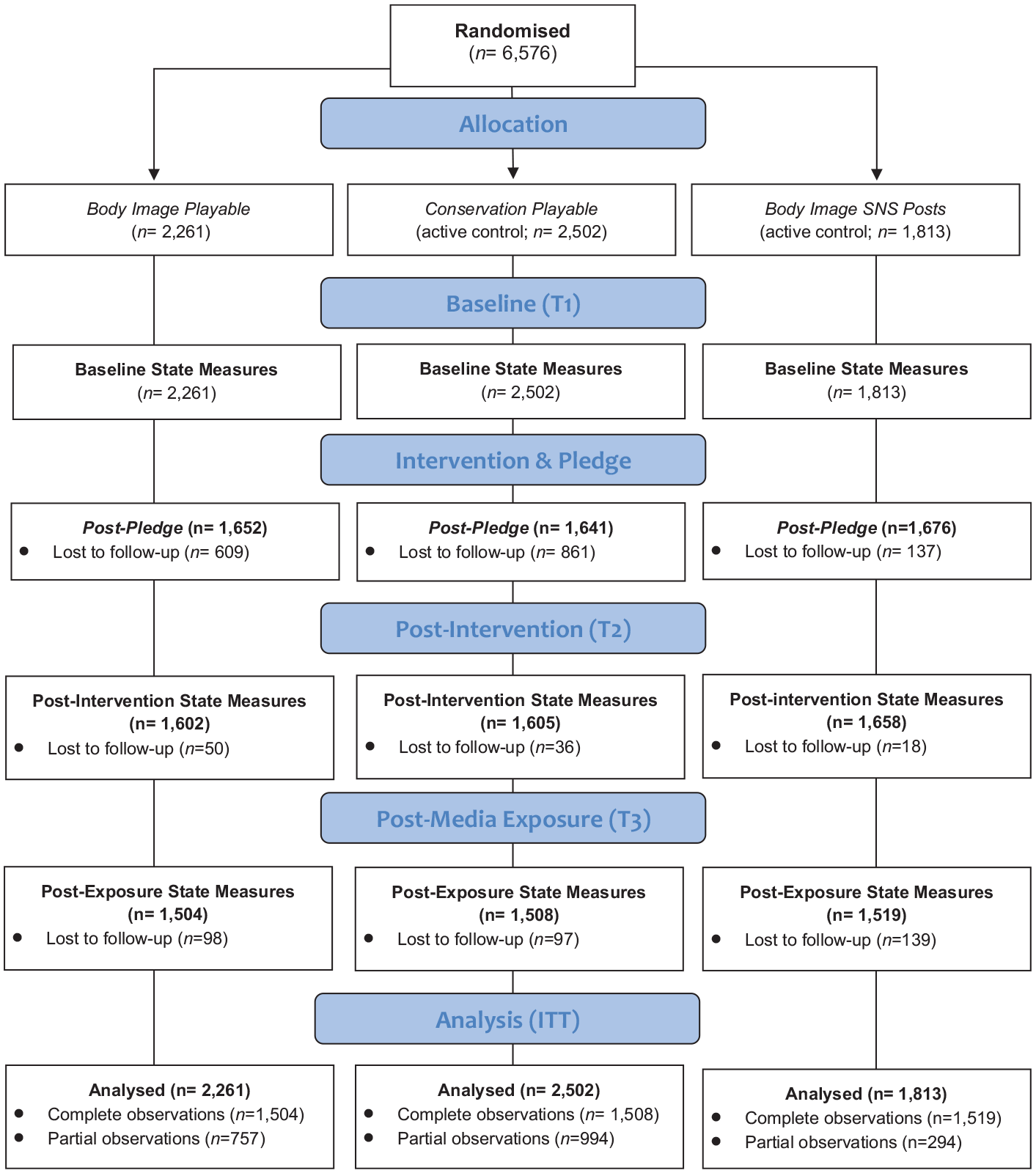
Research design and flow.
Participants
The sample consisted of 6576 British adolescents (51.6% girls) aged between 13 and 14 years with distribution of ethnicity representative of the UK population, recruited via a research agency. Inclusion criteria required participants to be aged between 13 and 14 years old, English speaking and have experience playing Internet games. Participants were blinded to study objectives, hypotheses and their condition. They were randomised to conditions by the research agency using a computer algorithm. On completion, participants were reimbursed with agency credit for their participation, which could be used towards redeeming gift products via the agency.
Materials
Micro-interventions
Body image playable
We adopted an etiological approach to micro-intervention development, by targeting body image risk factors identified in the well-established Tripartite Model of Influence for Body Image (Thompson et al., 1999a, 1999b). Thus, the body image playable titled ‘Self-Esteem Squad’, consisted of three levels, with each level designed to address a key risk factor for body dissatisfaction: Level 1: Internalisation of societal appearance ideals (i.e. the subscription to a particular beauty standard and engaging in behaviours in an attempt to achieve this appearance; Thompson and Heinberg, 1999); Level 2: Appearance investment (i.e. the degree to which body image concerns are important and influence thoughts about one’s self-worth; Cash, 2002); Level 3: Appearance comparisons (i.e. comparing one’s appearance to that of others, particularly those perceived as more attractive; Myers and Crowther, 2009). The playable used an animated cartoon format and interactive running style, used among popular games such as Donkey Kong and Super Mario Bros. The player was instructed to control their character (an animated teenager) using screen touch, swipe and tap, as they moved through a shopping mall and collected gold coins for avoiding obstacles (i.e. jumping over advertising billboards and knocking out magazine stands). As the player progressed, psychoeducational pop-up messages appeared, which highlighted the importance of (1) challenging idealised media messages ( ‘Don’t waste time trying to look like these unrealistic images. Be aware of the unnecessary pressure they put on you’), (2) disengaging from digital manipulation of social media images (‘Images on Snapchat, Instagram and YouTube can be altered using editing tools. Don’t feel pressure to edit images of yourself and show the real you instead’) and (3) avoiding appearance comparisons (‘When you compare your appearance to friends and celebrities in photos it can make you feel bad’). If successful in completing all three levels, the player was crowned a ‘Body Image Champion’. The playable was co-created by a professional gaming company that specialises in developing scientific games (PlayMob), body image experts (the third and last author) and the global education social mission initiative for a Unilever personal care brand (the Dove Self-Esteem Project). A preliminary gaming trial conducted with adolescents by PlayMob and Dove indicated that the game was completed (i.e. players overcame all obstacles and landed the body image messages) in an average of 120 seconds. See supplementary materials for screenshots of the player experience.
Body image SNS posts
The key psychoeducational messages from the body image playable were presented in a didactic, static image format using purpose-built captioned images designed by a professional graphic designer to represent Instagram posts (see supplementary materials). Three image posts per risk factor (i.e. internalisation, appearance investment and comparison making) were developed, resulting in a total of nine posts. The design and formatting of posts was standardised and depicted the same animated setting and characters used in the body image playable. Post one of each set included an image of a character engaging in an appearance-related behaviour (e.g. looking at idealised models), with an accompanying psychoeducational caption (e.g. ‘Comparing yourself to others is a waste of energy. Embrace your unique self and celebrate diversity instead!’). Post two of each set stated the implications of engaging in the behaviour (e.g. ‘Comparing your appearance to other people can make you feel bad’) and post three of each set included an image of a character engaging in adaptive dialogue and/or behaviour change (e.g. disengaging from their phone and stating ‘Keep it in mind, you’re one of a kind’).
Conservation playable
This playable was designed to promote environmental ocean conservation via reducing plastic consumption over three gaming levels. Using a similar animated cartoon setting and interactive running style, the player navigates a dolphin through the ocean to collect plastic straws for points while avoiding marine obstacles (i.e. coral reefs and nets). At the end of each level, players are presented with a conservation multiple-choice quiz, based on in-game pop-up messages (e.g. ‘How many millions of straws are used by the United States?’), with affirmative or corrective feedback provided if the player answered correctly or incorrectly, respectively. On completion, players were notified of the total number of pounds of plastics they ‘retrieved’. This playable was also developed by PlayMob, in collaboration with an environmental conservation organisation, and, based on prior user testing, was comparable to the body image playable in length, style and engagement.
Pledges
Two ‘call to action’ pledges were developed to resemble existing online body image (i.e. Be Real in the United Kingdom, which aims to promote positive body image) and environmental conservation (i.e. National Geographic – Planet or Plastic) campaigns. The pledges provided participants the option to commit to upholding the key messages of the campaigns, thus forming an assessment of prosocial behaviour. Pledging is indicative of a person’s commitment to behave in a manner that is aligned with a social movement designed to lead to improved well-being of another individual or group (Eisenberg and Miller, 1987). The calls to action in this study highlighted the relevant social issue (i.e. ‘Low body confidence stops people from taking part in activities and can seriously affect people’s physical and mental health’), campaign objectives (i.e. ‘It’s time to take back control of how we feel about our bodies’), a list of prosocial behaviours (i.e. ‘I will upload unedited photos to social media’; ‘I will have conversations about how the body functions rather than how it appears’; ‘I will hold brands accountable for not promoting appearance diversity’) and ended with two behavioural options (i.e. ‘I will pledge to the Be Real campaign’ or ‘I will not pledge to the Be Real campaign’). Intentions to pledge were accompanied with a space to enter one’s initials, as is traditionally done in call to action pledges.
Measures
Primary outcomes
State body satisfaction
Visual analogue scales (VAS; McLean et al., 2016) were used to assess state body satisfaction. Participants responded to four items by dragging a slider along a 101-pixel VAS, which was fixed with two extreme values (0 indicating extreme dissatisfaction and 100 indicating extreme satisfaction). Items included ‘How happy do you feel about your body weight, right now?’ ‘How happy do you feel about your body shape, right now?’ ‘How happy do you feel about your appearance, right now?’ and ‘How much do you feel like an attractive person, right now?’ A total mean score was calculated, ranging between 0 and 100, with higher scores indicating greater body satisfaction. Reliability and validity of VAS has been widely reported (Durkin and Paxton, 2002; Heinberg and Thompson, 1995). Internal consistency in the present study was excellent (Cronbach’s α = .94).
State negative affect
To assess the immediate impact of the conditions on state negative affect, four 101-pixel VAS were used (Heinberg and Thompson, 1995). Two items assessed positive affect (happiness, confidence) and two items assessed negative affect (sadness, anxiety; Slater et al., 2017). Happy and confidence responses were reverse-coded and items were summed and averaged, resulting in a total score of negative affect, with higher scores indicating greater negative affect. Internal consistency in the present study was good (Cronbach’s α = .74).
Secondary outcomes
Media exposure effects
To evaluate whether the micro-interventions protected adolescents from experiencing state-based declines in body satisfaction, which are typically found after exposure to idealised media images (e.g. Groesz et al., 2002), an experimental media exposure task was nested within the trial design. Post micro-intervention, participants were re-randomised to view one of two image sets each with 10 images of either advertisements featuring appearance ideal models or images of nature landscapes (i.e. appearance-neutral images).
To create the image sets, as per McLean et al. (2016), a pool of 50 (25 per gender) online advertisements were sourced from popular adolescent clothing and shoe brands, with each image depicting models that were representative of societal appearance ideals. Images were piloted with adolescent boys (n = 4), girls (n = 4) and body image academics (n = 9). Adolescents rated gender-congruent images on levels of model attractiveness and representativeness of society’s ‘perfect’ male or female body. Experts rated all images on representation of societal appearance ideals. The final set of images (10 per gender) used in the media exposure task were those rated highest on all three variables, across adolescents and experts.
Within the experiment, each idealised image was accompanied by six questions to ensure attention and processing (McLean et al., 2016; Tiggemann et al., 2009). This included three quality-related items (e.g. ‘How much does the image catch your attention?’) and three appearance comparison-related items (e.g. ‘How thin/muscular are you compared to the girl/boy in this image?’), with the latter shown to prompt comparison-making processes in adolescent and adult samples (McLean et al., 2016; Mills et al., 2002; Tiggemann et al., 2009). Landscape images were presented alongside six quality-related questions only. Responses were indicated on a 101-pixel VAS (Heinberg and Thompson, 1995), where 0 = ‘not at all’ and 100 = ‘very much’. The presentation of questions was randomised for each image to prevent order effects. Item responses were not analysed.
Prosocial behaviour
After viewing their respective ‘call to action’ pledges, participants selected from one of two actions: ‘I will pledge to the Be Real Campaign/ Planet or Plastic Campaign’ or ‘I will not pledge to the Be Real Campaign/ Planet or Plastic Campaign’. Responses were coded 1 = ‘unwilling to pledge’ and 2 = ‘willing to pledge’. Being willing to pledge reflected a commitment to engage in behaviours that would promote positive body image (e.g. uploading unedited images on social media) or environmental conservation (e.g. reducing plastic use).
Trait moderators
Body esteem
The Appearance Esteem (12 items) and Weight Esteem (6 items) subscales of the Body Esteem Scale for Adults and Adolescents (BESAA; Mendelson et al., 1997) were used to assess trait body image. Subscale items assess general feelings and satisfaction regarding appearance (e.g. ‘I worry about the way I look’) and weight (e.g. ‘I am satisfied with my weight’), respectively, using a 5-point Likert-type scale (never to always). A mean score was calculated for each subscale separately, with higher scores indicating greater body esteem. This scale has demonstrated reliability and validity and is widely used among adolescents (Mendelson et al., 2001). Internal consistency in the present study was poor for appearance esteem (Cronbach’s α = .56) and excellent for weight esteem (Cronbach’s α = .87).
Internalisation of appearance ideals
Internalisation of societal appearance ideals was assessed using the General Internalisation subscale of the Sociocultural Attitudes Towards Appearance Scale-3 (SATAQ-3; Thompson et al., 2004). This scale contains nine items (e.g. ‘I would like my body to look like the models who appear in magazines’). Responses were rated on a 5-point Likert-type scale (1 = definitely disagree, 5 = definitely agree), with higher scores indicating greater internalisation and endorsement of societal appearance ideals. Scale reliability and validity has been previously demonstrated in adolescents (Thompson et al., 2004). Internal consistency in the present study was questionable (Cronbach’s α = .65).
Media literacy
The revised Realism Scepticism subscale from the Media Attitudes Questionnaire (MAQ; Irving et al., 1998) was used to assess media literacy. The revised two-item subscale assesses participants’ scepticism that idealised media images are realistic representations of appearance (McLean et al., 2016). Based on the current sample, items were revised to be gender specific (‘Most boys/girls my age look like models in advertisements’; ‘Most boys/girls my age are as muscular/thin as models in advertisements’). Participants responded to items on a 5-point Likert-type scale (1 = completely disagree; 5 = completely agree). Prior to subscale calculations, items were reverse scored so that higher scores reflected greater scepticism of media images. Internal consistency in the present study was questionable (Cronbach’s α = .67).
Manipulation check
Attention to allocated micro-intervention content was assessed using a recall questionnaire. Participants were presented with statements relating to their allocated intervention and were asked to recall which items were true or false. There were three true statements (i.e. ‘The characters travelled up an escalator’) and three false statements (i.e. ‘The characters rode a bike through the shopping mall’), totalling six items per condition. Participants scored 0 for incorrectly recalling an item and 1 for correctly recalling an item. Higher scores indicated greater attention to content.
Intervention acceptability
Each micro-intervention was assessed on four acceptability factors: enjoyment, interest, likelihood to reengage and likelihood to share the material with friends. Responses were rated on a 5-point Likert-type scale (1 = Not at all/definitely would not, 5 = Very much/definitely would). A total mean score was calculated from all four factors, with higher scores indicating greater acceptance.
Procedure
The randomised controlled trial was conducted online in one sitting using secure survey software and consisted of six sequential phases (see Figure 1). Parents of participants were registered with the research agency and recruited via email, which contained a link to the survey. The survey commenced with an information and consent form for parents, followed by an adolescent participant information and consent form. Following parental consent and participant assent, participants completed demographic and pre-intervention VAS assessments of state body satisfaction and mood (T1). Participants were then randomised into one of three micro-intervention conditions (body image playable, conservation playable, body image SNS posts) and subsequently engaged with their intervention for 150 seconds. The gaming time frame was informed by the pilot study, which indicated that on average adolescents completed the game in 120 seconds. An additional 30 seconds was added to the game time, to account for varied reading and gaming abilities. Immediately after, participants completed post-intervention VAS assessments of state body satisfaction and mood (T2). Participants were then randomised into one of two image exposure conditions (idealised appearance media images or landscape images) and completed the nested experimental media exposure task. On completion of the media exposure task, participants completed a final VAS assessment of state body satisfaction and mood (T3), followed by assessments of trait measures of body image, internationalisation of appearance ideals, media literacy, manipulation checks and acceptability measures. Prior to commencement, ethics approval for the study was obtained from the Research Ethics Committee at the University of the West of England.
Statistical analyses
Changes in body satisfaction and negative affect between baseline, post-intervention and post-media exposure were assessed using a proportional odds cumulative link model, which accounts for ceiling and floor effects, using R (version 3.5.3) and the package RMS (version 5.1-3.1). A probit link function (Harrell, 2015) was chosen by inspecting the mean absolute error of predictions over different quantiles of body satisfaction and negative affect data. The effect of intervention on pledging behaviours was assessed using a logistic regression model. For all models, controls were made for gender, age, ethnicity, body esteem, internalisation, and media literacy, and attention and acceptability ratings. To assess for changes in state outcomes and pledging behaviour at post-intervention, baseline assessments
Data preparation
The total sample consisted of 6576 participants, of which 2045 partially completed the study and 4531 saw the study to completion (see Figure 1). Missingness was dependent on condition, gender and stage of survey, but not on baseline assessments of body satisfaction or negative affect and was therefore assumed as missing at random (MAR). Specifically, both playable conditions had high drop-out rates immediately prior to the call to action pledge, with drop-out significantly higher for girls than boys. The total proportion of missing data were 15% and 15 imputed data sets were created using type 1 partial mean matching for continuous measures, and logistic regression for the call to action. The imputed datasets recreated the observed marginal distributions and collinearity of the imputed variables.
Results
Baseline variables
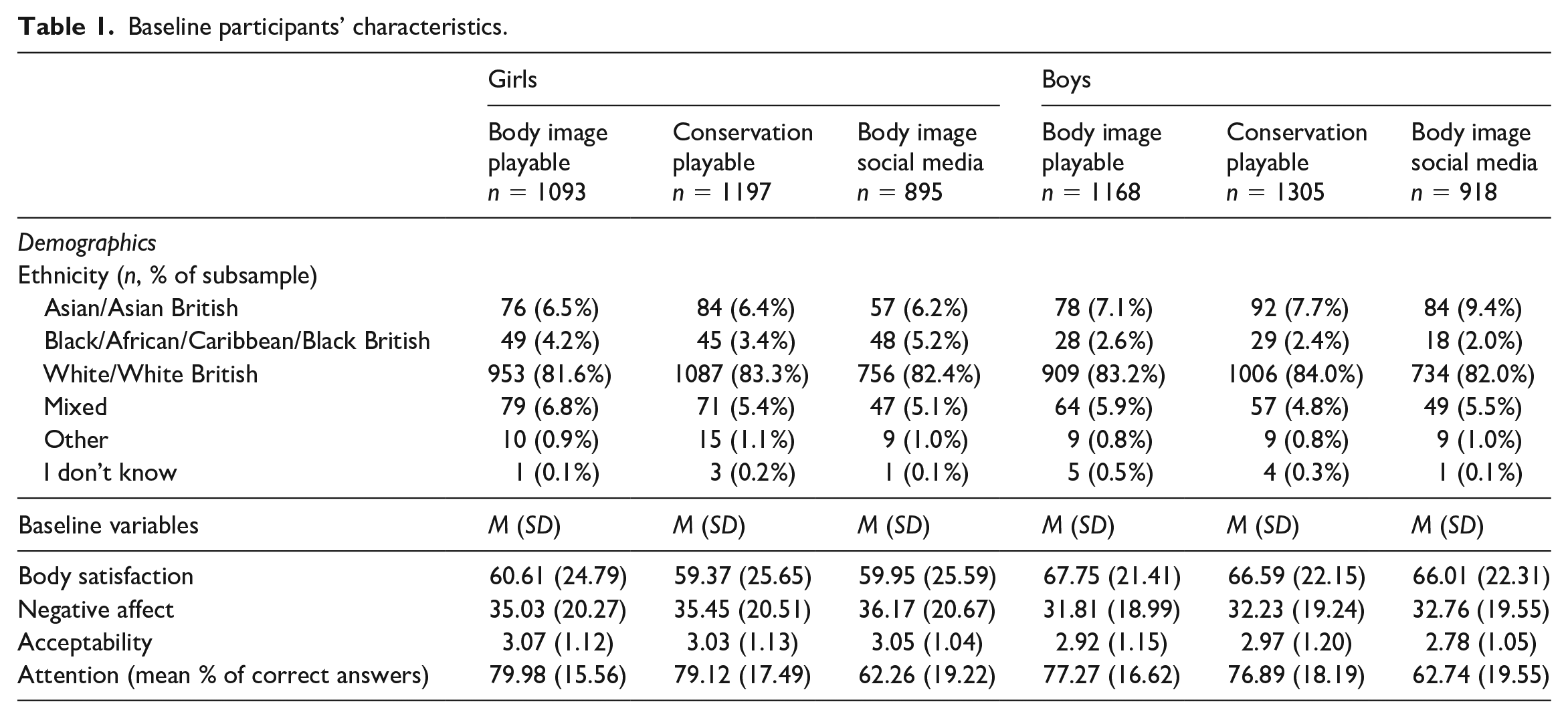
Participant characteristics are reported in Table 1. No group differences were observed on baseline assessments of body satisfaction, negative affect, attention to or acceptability of intervention content.
Baseline participants’ characteristics.
Effect of condition on body satisfaction
Participants in the body image playable and SNS conditions showed significant improvements in body satisfaction at post-intervention (β playable = .83, p < .001, 95% CI = [0.53, 1.13]; β SNS = .84, p = <.001, 95% CI = [0.51, 1.18]), relative to the conservation playable. A small significant difference in body satisfaction levels emerged between the two body image micro-interventions for boys, with those who viewed the SNS posts reporting greater body satisfaction, relative to those who engaged with the playable. No differences emerged for girls. Intervention effects were moderated by body esteem, with boys and girls with lower trait body esteem reporting significantly greater improvements in satisfaction, relative to those with higher esteem (β playable×bodyesteem = −.15, p = <.001, 95% CI = [−0.062, −0.23]; β SNS×bodyesteem = −.12, p = .01, 95% CI = [−0.03, −0.21]).
Post hoc analyses were conducted on the significant moderating interaction (see Figure 2(a)). For adolescents with low body esteem (score of 2.00), the body image playable and SNS post conditions increased adolescents’ odds of being in the high and very high body satisfaction outcome group, relative to the conservation playable. Furthermore, the two body image micro-interventions reduced adolescents’ probability of experiencing very low, low and neutral body satisfaction levels (i.e. odds ratio [OR] < 1). These effects were mirrored across moderate (3.28) and high (4.67) levels of body esteem.
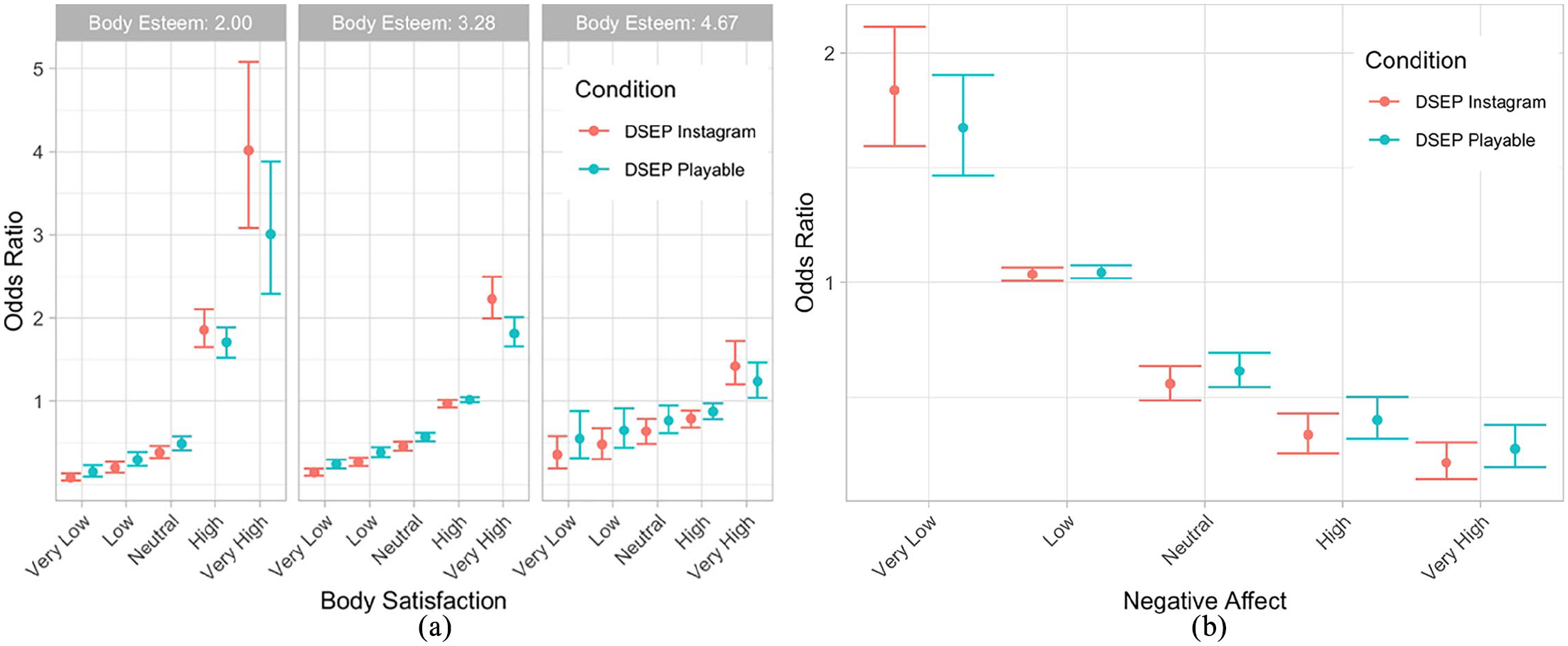
Odds ratios for the immediate impact of condition on (a) body satisfaction and (b) negative affect.
Effect of condition on negative affect
Participants in the body image playable and SNS post conditions showed significant decreases in negative affect (β playable = −.21, p < .001, 95% CI = [−0.11, −0.32]; β SNS −.311, p < .001, 95% CI = [−0.21, −0.42]), relative to the conservation playable at post-intervention. Affect scores did not significantly differ between those engaging with the body image playable and SNS posts. Intervention effects were not moderated by gender nor body esteem; thus, the body image interventions were equally effective at improving negative affect in boys and girls, of varying body esteem levels.
Post hoc analyses were conducted on the significant time × group interaction (see Figure 2(b)). The two body image micro-interventions increased adolescents’ odds of being in the low and very low negative affect groups, relative to the control condition. Furthermore, the two conditions reduced the odds of adolescents falling into the neutral, high and very high negative mood categories (i.e. OR < 1).
Effect of condition at reducing risk associated with appearance ideal media exposure
Body satisfaction
Participants across all three conditions who viewed the idealised media images reported decreased body satisfaction (β ideal = −1.32, p < .001, 95% CI = [−1.76, −0.88]), relative to those who viewed the landscape images. Media exposure effects were not moderated by gender, internalisation or media literacy, but were moderated by body esteem. Those with lower body esteem experienced a greater reduction in body satisfaction (β ideal×bodyesteem = .22, p < .001, 95% CI = [0.10, 0.34]), relative to those with higher esteem.
Post hoc analyses were conducted on the significant moderating interaction (see Figure 3(a)). For adolescents with low body esteem (score of 2.00), exposure to the ideal appearance condition increased adolescents’ odds of being in the very low, low and neutral body satisfaction categories, relative to the landscape condition (control exposure condition). These effects were mirrored across moderate (3.28) and high (4.67) levels of body esteem.
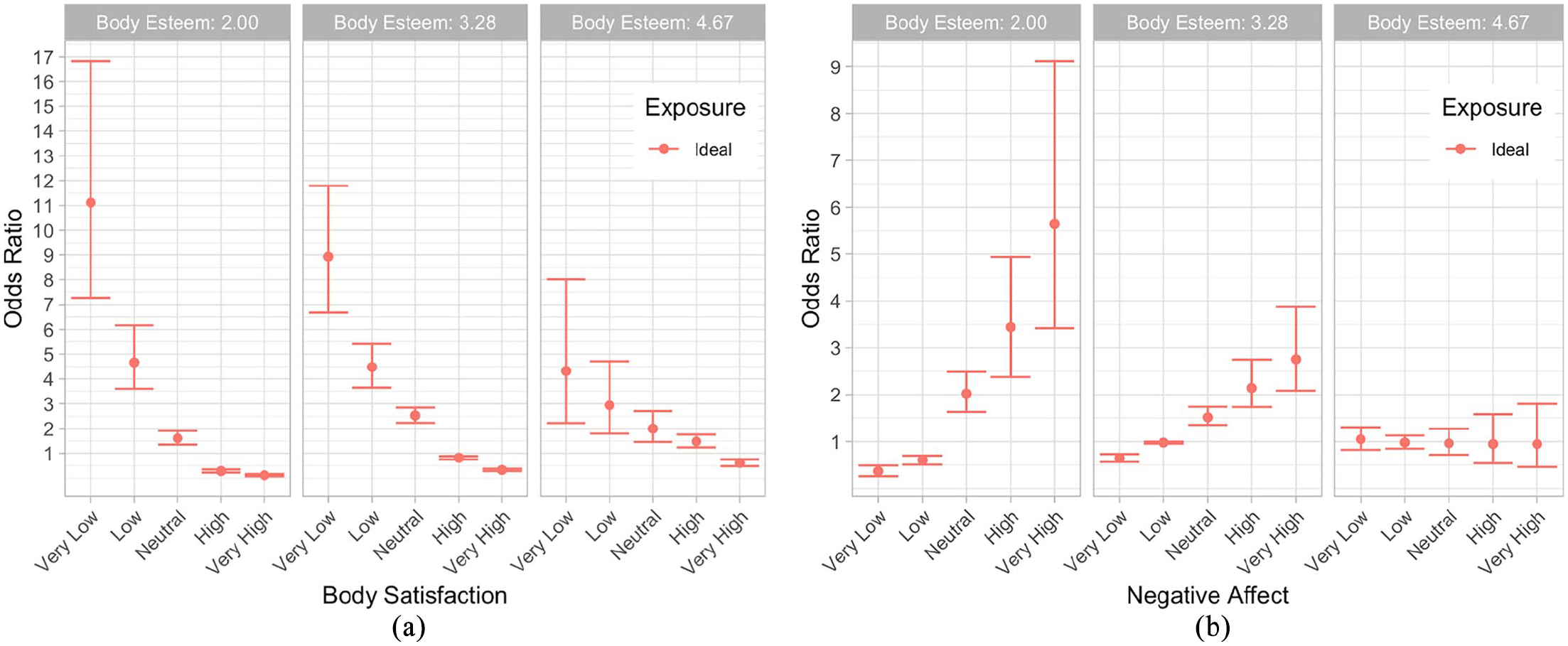
Odds ratios for media exposure effects on (a) body satisfaction and (b) negative affect.
Negative affect
Participants across all three conditions who viewed the idealised media images reported an increase in negative affect (β ideal = .89, p < .001, 95% CI = [1.28, 0.51]), relative to those who viewed the landscape images. Media exposure effects were not moderated by gender, internalisation or media literacy, but by body esteem. Those with higher esteem experienced less of an increase in negative affect (β ideal×bodyesteem = −.19, p < .001, 95% CI = [−0.08, −0.30]), relative to those with lower esteem.
Post hoc analyses were conducted on the significant moderating interaction (see Figure 3(b)). For adolescents with low body esteem (score of 2.00), exposure to the ideal appearance condition increased adolescents’ odds of being in the neutral, high and very high negative mood categories, relative to the landscape condition (control exposure condition). These effects were mirrored in adolescents with moderate body esteem (3.28), but not those with high levels (4.67).
Effect of condition on prosocial behaviours
A majority of children across the three groups pledged to take action: body image playable (78%), SNS (85%) and conservation playable (78%). Those who engaged with the SNS posts were significantly more likely to pledge to the respective social mission, relative to those in the two playable conditions (body image, OR = 0.536, p < .001; conservation OR = 0.547, p < .001).
Discussion
The primary aim of this study was to assess the impact and protective properties of a body image playable on adolescents’ body satisfaction, negative affect and prosocial behaviours. In line with our hypotheses, the body image playable was effective at eliciting immediate improvements in adolescents’ body satisfaction and negative affect, relative to a non-appearance related game (i.e. ocean conservation playable). However, contrary to our hypothesis, the body image playable did not protect against the negative effects associated with viewing idealised media images. Exploratory analyses indicated that the interactive (playable) and didactic (SNS posts) body image conditions were equally effective at enhancing body satisfaction and reducing negative affect, but equally ineffective at protecting against negative appearance ideal media exposure effects. Finally, while all three conditions were effective at eliciting online prosocial behaviours in a majority of participants (e.g. ⩾78%), the SNS posts were significantly more effective than the two playable conditions.
Immediate impact of body image micro-interventions
This study is the first to examine and demonstrate the positive impact of playable technology on adolescents’ mental health. As predicted, the body image playable significantly improved adolescents’ body satisfaction and negative mood, with intervention effects for body satisfaction moderated by body esteem. Our findings are consistent with previous research concerning gaming and mental health, where serious games (i.e. the primary aim extends beyond entertainment to education) and the gamification of interventions (i.e. the addition of gaming elements to interventions) have proven effective at engaging adolescents with health promotion material, in addition to improving their well-being (e.g. Lau et al., 2017). Second, this study is the first to examine and demonstrate that didactic micro-interventions (i.e. SNS posts) can positively impact adolescents’ well-being, with previous research focusing solely on adult populations (e.g. Bunge et al., 2016, 2017; Elefant et al., 2017; Fuller-Tyszkiewicz et al., 2019). This finding builds on the research examining the role of social media on individuals’ body image. Specifically, exposure to positive body image content (e.g. diverse body types) on SNSs has shown to improve body image and mood (e.g. Slater et al., 2017, 2019; Tiggemann et al., 2020). However, this study is the first to demonstrate that these platforms can be harnessed to deliver psychoeducational content and body image interventions among adolescents.
Protective properties of body image micro-interventions
Neither body image intervention protected against the negative exposure effects associated with viewing appearance ideal media. The protective properties of body image micro-interventions remain unclear, with prior research providing both support and contradictory evidence. Specifically, Halliwell et al. (2011) demonstrated that viewing a brief 75-second video that exposed advertising and digital manipulation techniques (Dove Evolution) immediately protected adolescent girls from negative exposure effects. These effects have been replicated among adolescent girls (Quigg and Want, 2011), but contradicted among adult women (Cragg et al., 2019). Study differences including demographics (e.g. age) and number of exposure sessions (once-off vs multi-viewing) were proposed to interpret mixed findings across studies (Cragg et al., 2019). The lack of protective properties associated with the present body image micro-interventions may be attributed to the use of text-based media literacy via pop-up messages in the playable or captions on SNS posts (i.e. ‘Images of your friends and celebrities on Snapchat, Instagram and YouTube can be altered using editing tools’), relative to the visual messaging used in Dove Evolution. This aligns with recent experimental research, which found that exposure to non-captioned images of average-sized models lead to greater state-based body satisfaction and appreciation, relative to viewing thin models (Tiggemann et al., 2020). However, no group differences emerged when these image types were accompanied with body positive captions; thus, further signifying the potent impact of visual imagery on body image, relative to text-based content. Collectively, these findings indicate that text-based media literacy within micro-interventions is not sufficient at counteracting negative exposure effects. Rather, explicit demonstrations of how idealised media is generated and perpetuated may be required. Nonetheless, it is important to note that unlike the present body image micro-interventions, exposure to Dove Evolution did not enhance body image among adolescents (Halliwell et al., 2011; Quigg and Want, 2011). Therefore, in order to develop potent micro-interventions, further research is needed to understand what mechanisms protect and/or enhance body image. For instance, this may involve developing and evaluating a video that explicitly demonstrates photo manipulation and enhancements, and juxtaposing this with images or footage of realistic representations of appearance.
The relationship between SNS and prosocial behaviours
All three conditions were associated with a majority of participants engaging in subsequent prosocial behaviour; however, this was significantly greater among adolescents in the SNS body image condition. These findings offer support to previous research exploring the use of SNS for disseminating content that promotes collective intent and action (Foster, 2015). A possible explanation for discrepancies between the two body image micro-interventions is the relevance of the intervention modality to the prosocial behaviours. That is, several of the behaviours outlined in the call to action were related to SNS engagement (e.g. upload unedited images to social media). Furthermore, a key element of SNS is users’ active participation in creating and sharing content (Kuem et al., 2017). Thus, applying the knowledge that is obtained from an SNS intervention to the platform itself may have been perceived as more realistic and therefore easier to execute. While promising, prosocial body image behaviours are grossly under-researched with a pressing need for further inquiry, including (1) identifying prosocial body image behaviours of strategic importance, and whether these differ between online and face-to-face environments; (2) developing validated measures to assess prosocial body image behaviours; and (3) developing a theoretical framework that identifies and explains the bidirectional, reciprocal, and causal relationships between body image and prosocial behaviours. Finally, a common concern raised among online prosocial behaviour studies is the distinction between activism (i.e. a direct, proactive and often confrontational action towards attaining a societal change) and slacktivism (i.e. low-risk, low-cost activity via social media, whose purpose is to raise awareness, produce change or grant satisfaction to the person engaged in the activity; Rotman et al., 2011). Specifically, Rotman et al. (2011) propose that while SNS provide an opportunity for wide-scale participation in social activism, it is unclear whether knowledge sharing on this medium (e.g. liking, posting, re-sharing) translates to meaningful and tangible social change. While the present micro-intervention approaches led to a majority of adolescents making a pledge to engage in prosocial behaviours, the degree to which these behaviours were executed and maintained is unknown; thus, further research is needed to understand the sustainable impact of SNS on prosocial body image behaviours.
Limitations and future directions
This study has limitations to consider, which in turn present avenues for future research, in addition to those already mentioned. First, although the current sample was representative of the distribution of ethnicity in the United Kingdom (i.e. comprised of a majority [81–84%] of White British girls and boys), the findings have limited generalisability with respect to non-binary and ethnic minority samples. Equally, it is unclear whether intervention stimuli within the playable and SNS are representative or relatable to those beyond the current sample. Despite these limitations, great consideration was given to stimuli development and selection to ensure that the imagery used throughout the playable reflected diversity in terms of ethnicity, body size, hair type, clothing and other appearance features (e.g. braces, glasses). To further enhance the representation and relatedness of intervention content and stimuli, researchers are encouraged to adopt patient and public involvement (PPI) practices, particularly during intervention development and adaptation (Greenwood et al., 1993). That is, prior to developing a new playable (e.g. for broader mental health concerns) or adapting the current version for other ages, genders, cultures and ethnicities, a small sample of the target audience should be invited to participate in key decision-making processes. Playable content and stimuli should be adapted according to the target audience’s feedback.
Second, the online design required participants in the playable conditions to exit and re-enter the survey when engaging with the intervention. Attrition rates indicate that the playable conditions were associated with significantly higher drop-out rates at immediate post-intervention than the SNS condition, which is likely attributable to this design element. This limitation relates to a larger design issue with online intervention studies, which are notoriously associated with low adherence and high attrition rates (e.g. Beintner et al., 2019; Linardon and Fuller-Tyszkiewicz, 2020). Given the need for online interventions (Kazdin, 2017, 2019), research focused on remedying attrition rates associated with these studies is imperative.
Third, the results of this study also highlight the need for further research into utilising micro-interventions among children and adolescent populations. This study explored the immediate impact of a single-session micro-intervention on adolescents’ well-being; thus, the sustained impact of regular engagement with micro-interventions is unknown among this population. Micro-intervention research among adult samples indicates that multi-activity and multi-session approaches (e.g. engaging in multiple activities on multiple occasions) are effective at eliciting sustained improvements in state and trait-based outcomes, particularly for those with greater psychopathology (e.g. higher weight and shape concerns; Fuller-Tyszkiewicz et al., 2019). Similarly, moderating analyses in this study indicated that the playable proved most effective among adolescents with poorer body esteem. This finding is worthy of noting, given the brevity of the approach and its ability to elicit attitudinal shifts among high-risk adolescents.
Collectively, the above findings present several avenues for future research, including (1) conducting PPI with new target audiences (e.g. older populations) or those for whom the intervention is being adapted and refined (e.g. high-risk adolescents); thus, allowing for the identification of content that needs creation or adaptation to increase the micro-intervention salience and potency; (2) modify the playable to remove or include additional content (e.g. extra gaming levels or hot spots) that is applicable to the target audience (e.g. body image risk factors that are prevalent among high-risk adolescents [i.e. body talk and weight management behaviours]) and (3) examine the immediate and sustained effects associated with multiple engagements with the revised playable. With that said, it is worth reiterating that the purpose of micro-interventions is not to replace more intensive interventions that are more likely to confer long-term benefits for at-risk populations, but to act as a brief ‘in the moment’ early intervention in a stepped care model.
Conclusion
In summary, this study provides preliminary support for the use of both playable technology and SNS posts in the development and dissemination of micro-interventions for mental health, particularly in relation to body image. Both the interactive body image playable and didactic SNS posts, which contained the same psychoeducational messages, were effective at immediately improving state body satisfaction and negative affect for boys and girls; and particularly so for those with low body esteem. This is of particular importance, given that research suggests that adolescents who spend more time on social media and consequently are exposed to idealised media are at greatest risk of experiencing body image concerns (Fardouly and Vartanian, 2016). Neither body image approach was effective at protecting against negative appearance ideal media exposure effects. The intervention mechanisms responsible for enhancing and protecting body image from idealised media exposure thus remain unclear and warrant further research. Young people frequently engage with digital environments, and therefore, identifying how new online technologies and platforms, such as playables, can be harnessed to influence young peoples’ attitudes and behaviours to promote health and well-being continues to be an imperative avenue of future research.
Supplemental Material
sj-pdf-1-nms-10.1177_1461444821993800 – Supplemental material for Game on! A randomised controlled trial evaluation of playable technology in improving body satisfaction and negative affect among adolescents
Supplemental material, sj-pdf-1-nms-10.1177_1461444821993800 for Game on! A randomised controlled trial evaluation of playable technology in improving body satisfaction and negative affect among adolescents by Emily L Matheson, Harriet G Smith, Helena Lewis-Smith, Robert E Arbon and Phillippa C Diedrichs in New Media & Society
Footnotes
Declaration of conflicting interests
The author(s) declared the following potential conflicts of interest with respect to the research, authorship and/or publication of this article: P.C.D. is an independent consultant to the Dove Self-Esteem Project global education initiative and was on the Dove Self-Esteem Project Global Advisory Board from 2013 to 2016. The authors declare no other conflicts of interest in relation to this work.
Funding
The author(s) disclosed receipt of the following financial support for the research, authorship and/or publication of this article: This study was funded by a research grant from the Dove Self-Esteem Project (Unilever). The funders had no role in data analysis, decision to publish or manuscript preparation. They were permitted to review the manuscript and suggest changes, but the authors exclusively retained the final decision on content.

Supplemental material
Supplemental material for this article is available online.
Author biographies
References
Supplementary Material
Please find the following supplemental material available below.
For Open Access articles published under a Creative Commons License, all supplemental material carries the same license as the article it is associated with.
For non-Open Access articles published, all supplemental material carries a non-exclusive license, and permission requests for re-use of supplemental material or any part of supplemental material shall be sent directly to the copyright owner as specified in the copyright notice associated with the article.
