



Abstract
Cross-sectional research suggests a small, inverse association between social media use and body satisfaction. However, less is known regarding prospective, bidirectional, or mediating effects. In line with sociocultural theory, this study used a three-wave design to examine direct and indirect effects between social media use and body satisfaction, via thin-ideal and muscular-ideal internalisation and social comparisons. Adolescents (n = 1911; Mage = 14.27, SD = 1.08) were invited to complete three surveys over 1 year. Cross-lagged panel models indicated acceptable fit for two social media use operationalisations, with better fit statistics for the appearance-focused use rather than photo-based activities model. Despite largely no direct effects, indirect effects were found. Social comparisons mediated the relationships over time, whereby higher social media use predicted higher comparisons, which predicted lower body satisfaction. The reverse direction was also found. Gender invariance indicates that prevention aimed at reducing comparisons may be suitable for boys and girls.
Introduction
Over the past decade, social media use has grown exponentially. Adolescents are the most prolific users, whereby 85% of adolescents aged 14 years report using social media (Odgers and Robb, 2020). Adolescence is characterised by specific developmental needs, including heightened importance of peers and social acceptance, and identity exploration and formation (e.g. Erikson, 1968). Social media provides an ideal platform for fulfilling such developmental needs. Furthermore, this environment is typically dominated by photos, which frequently present appearance-focused and idealised content (Bell, 2019). There is cross-sectional and prospective support for the relationship between social media use and poorer body satisfaction (e.g. de Vries et al., 2016; Saiphoo and Vahedi, 2019). Although it is also possible that the reverse is true, whereby body satisfaction impacts social media use, this has largely remained unexplored within the literature, particularly using prospective data to confirm directionality, with few exceptions (e.g. Rousseau et al., 2017). The current study will, therefore, use a sociocultural framework to examine the temporal relationship between social media use and body satisfaction among adolescents, and explore potential mediating mechanisms, namely, thin- and muscular-ideal internalisation and social comparisons.
Sociocultural theories of the development and maintenance of body image
According to sociocultural theories of body image, specifically the tripartite influence model, three primary sociocultural influences contribute to the development of body image concerns: media, peers, and parents/family (Keery et al., 2004; Thompson et al., 1999), with media the focus of the present study. In the model, relationships between sociocultural influences and body image are proposed to be mediated by appearance-ideal internalisation and social comparison. Appearance-ideal internalisation refers to the degree to which individuals assimilate socially defined appearance ideals as their own standard and strive to achieve those standards (Mingoia et al., 2017). Comparisons refer to the inclination to compare one’s physical appearance with that of others (Vogel et al., 2015). Specifically, the model proposes that greater exposure to sociocultural influences increases internalisation and comparisons, resulting in poor body satisfaction due to negative self-evaluation of one’s appearance against unattainable appearance ideals. The tripartite influence model has received substantial support among adolescent and adult populations (e.g. Papp et al., 2013; Schaefer et al., 2021; Shagar et al., 2019). Furthermore, some studies have established support for elements of the model with prospective data (e.g. Hoffmann and Warschburger, 2019; Rodgers et al., 2015).
Social media use impacts body satisfaction
Recent reviews and meta-analyses have demonstrated that higher social media use is associated with lower body satisfaction (Holland and Tiggemann, 2016; Saiphoo and Vahedi, 2019). To date, only a small number of cross-sectional studies have examined a sociocultural model of body image within the context of social media, whereby all elements of the model are included simultaneously for investigation (e.g. Jarman et al., 2021; Lee and Lee, 2021). We refer to this model as the social media influence model. This research has provided preliminary support for the indirect relationships between social media use and body satisfaction through appearance-ideal internalisation and social comparisons among adolescents. Yet, to date, no empirical research has examined the social media influence model prospectively (i.e. including both appearance-ideal internalisation and social comparisons as mediating variables). In their prospective examination of the direct relationship between social media use and body satisfaction, de Vries et al. (2016) found that higher social media use predicted lower body satisfaction 18 months later among adolescents. While a direct relationship was not found in the work of Rousseau et al. (2017) over 6 months, an indirect effect through comparisons was demonstrated, whereby higher social media use impacted lower body satisfaction through greater tendency to engage in comparisons (Rousseau et al., 2017). These findings provide support for elements of the sociocultural model in the context of social media; however, research is yet to examine the social media influence model prospectively among adolescents, a primary aim of this research.
Temporal direction of the relationship between social media use and body satisfaction
Although the tripartite influence model postulates that (social) media use predicts body image concerns directly and also indirectly through appearance-ideal internalisation and comparisons, some scholars have proposed that these relationships may work in the reverse or be bidirectional (Perloff, 2014; Rousseau and Eggermont, 2018). Such proposals are consistent with uses and gratifications theory (Katz et al., 1973) that postulates that individuals use (social) media as a means to fulfil individual psychological needs. In this manner, attitudes, desires, and motivations directly shape media consumption.
Applied to considerations of the social media and body image relationship, it is possible that body satisfaction may direct social media engagement. Specifically, individuals with poor body satisfaction may seek out distinct gratifications from social media, increasing frequency of use or engagement with specific activities (e.g. comparing oneself, viewing others’ profiles, or posting images to obtain appearance feedback), with the aim of self-improvement (Rousseau et al., 2017). This may also operate through mediation, whereby poor body satisfaction may promote increased desire to achieve appearance ideals and engagement in comparisons to determine physical attractiveness, resulting in increased use. Although prospective evidence regarding the direction of the social media and body satisfaction relationship is limited, empirical research does support bidirectionality among adolescents through direct and indirect effects, such as comparisons (Rousseau et al., 2017; Wang et al., 2019). However, this research has only collected data at two timepoints, limiting investigation of a temporal mediation sequence. The present study will extend the existing literature to provide a three-wave prospective examination of the direct and indirect relationships between social media use and body satisfaction, via thin-ideal and muscular-ideal internalisation and social comparisons.
Operationalisation of social media use
Earlier research has focused on, and operationalised, social media use as time spent, primarily on Facebook (Saiphoo and Vahedi, 2019). A continued focus on Facebook is likely to be limiting, as newer sites, such as Instagram and Snapchat become increasingly popular among adolescents (Anderson and Jiang, 2018). Subjective accounts indicate the relevance of these platforms for body image whereby adolescents consider Instagram and Snapchat to be especially damaging for body image, likely attributable to the platforms’ appearance potency (Royal Society for Public Health, 2017). These sites tend to provide an appearance-focused environment, with the addition of peer interaction through likes and comments likely to fuel the saliency of such content. In line with sociocultural theories, appearance-focused social media use, here defined and measured as Instagram and Snapchat use, likely influences body image by presenting and reinforcing the importance of appearance ideals and facilitating comparisons. Consistent with this, appearance-focused social media use, specifically exposure to fitspiration content on Instagram, appears to be more harmful for body image than general time spent on social media (Fardouly et al., 2017). This finding has been supported by a meta-analysis which demonstrated stronger effect sizes on body dissatisfaction for appearance-focused social media use than more general use (Saiphoo and Vahedi, 2019).
Although appearance-focused use appears important, social media use can encompass a range of activities. One of the most popular activities is photo-based use, defined as engagement with photos (e.g. viewing, posting, interacting with self, and others’ photos; Anderson and Jiang, 2018). The majority of images posted on social media contain people, including selfies and friends (Hu et al., 2014). Given this content typically depicts idealised self-presentations (Bell, 2019), it is likely that users will engage in upwards comparisons, resulting in diminished body satisfaction. In line with this proposal, photo-based activities have been found to be more detrimental for body satisfaction than general social media use (e.g. Holland and Tiggemann, 2016), a finding supported by a small number of cross-sectional studies among adolescents (e.g. McLean et al., 2015; Meier and Gray, 2014). Similarly, engagement with image-based Instagram activities involving the self and celebrities has been found to be associated with greater appearance comparisons and body dissatisfaction (Di Gesto et al., 2021). Furthermore, photo-based activities on Instagram have been found to predict lower body satisfaction through increased social comparisons (Hendrickse et al., 2017).
It appears then that both the broad social media environment (e.g. Instagram and Snapchat use) and specific online activities (e.g. photo-based) may play a role in body satisfaction. Indeed, operationalisations of both appearance-focused platform use and photo-based social media activities have been supported in cross-sectional investigations of the social media influence model among girls and women (Fardouly et al., 2017; Lee and Lee, 2021; Scully et al., 2020). However, it is possible that different operationalisations of social media use may be more or less relevant than others within such models. Comparing different operationalisations may offer a deeper, more nuanced understanding of the effect of social media use on body satisfaction. Specifically, it may clarify which aspects of social media use are more relevant to consider and assess in research in this context, with the possibility to inform future research and prevention efforts on specific types of use to target. In addition, examining these relationships prospectively would provide temporal understanding of these pathways over time. Consequently, a secondary aim of this research is to test social media use operationalisation within the social media influence model. Specifically, two models will be tested and compared; one with appearance-focused platform use and one with photo-based activities on social media as the measure of social media use.
The role of gender
Although girls typically report spending more time on Instagram and Snapchat than boys (Mingoia et al., 2019), both boys and girls experience concerns regarding negative evaluation and appearance pressures on social media (Verrastro et al., 2020). Therefore, the mechanisms in the relationship between social media use and body satisfaction likely operate in the same way, regardless of gender. A meta-analytic review of cross-sectional research found that gender did not moderate the relationship between social media use and body satisfaction (Saiphoo and Vahedi, 2019). Similarly, prospective research suggests that these relationships are largely equivalent in adolescent boys and girls (de Vries et al., 2016; Hoffmann and Warschburger, 2019). In relation to the tripartite influence model, empirical support has emerged among males and females (Girard et al., 2018; Rodgers et al., 2011). However, cross-sectional examinations of the social media influence model have largely included only female samples (e.g. Lee and Lee, 2021; Scully et al., 2020) or focused on young adult males (Fatt et al., 2019), to the exclusion of adolescent boys. A final aim of the current study was to examine whether the direct and indirect relationships between social media use and body satisfaction were consistent across gender, when explored prospectively.
The present study
The aim of the present study was to examine the temporal direct and indirect relationships between social media use and body satisfaction, via thin- and muscular-ideal internalisation and social comparison, at three timepoints over 1 year. The further aim was to explore the impact of operationalisation of social media use within the model, testing two models: appearance-focused use and photo-based activities. The final aim was to examine whether the direct and indirect relationships were consistent across gender.
Method
Participants
This study was pre-registered on the Open Science Framework (https://osf.io/f3cm5). Participants were recruited from two private, co-educational secondary schools in Melbourne, Australia. The total sample, who completed at least one timepoint, was 1911 eleven- to sixteen-year-olds (55.83% male; Mage at time 1 = 14.27, SD = 1.08). Participants either completed all three timepoints (n = 915; 47.9% retention), a combination of two timepoints (n = 667), or only one timepoint (n = 329). Most participants were born in Australia/New Zealand (85%). The Index of Relative Socioeconomic Advantage and Disadvantage (Australian Bureau of Statistics, 2018), based on participants’ home postcode, indicated that participants were socioeconomically advantaged, with a mean score of 9.30 (SD = 1.17, range 1–10). For participants who provided a self-reported estimate for their height and weight at baseline (n = 823, 47.87%), body mass index (BMI) was calculated (M = 19.42, SD = 3.67). In line with World Health Organisation cut-offs for BMI-for-age z-scores (de Onis et al., 2007), the majority of participants were classified as ‘normal’ weight (78.77% overall; 78.88% boys, 78.57% girls), with 10.43% (7.75% boys, 15.36% girls) ‘underweight’, 9.67% (12.02% boys, 5.36% girls) ‘overweight’, and 1.13% (1.36% boys, 0.71% girls) ‘obese’. A sensitivity analysis (Faul et al., 2009) demonstrated that the sample (n = 1911) had sufficient power (>80%) to detect small effect sizes (r = .06).
Measures
Demographics
Participants completed self-reported demographic information, including date of birth, gender, country of birth, and home postcode.
Social media use
Appearance-focused social media platform use
Participants completed two items to assess how frequently they use Instagram and Snapchat using a 5-point scale (1 = never, 5 = always). These items were averaged, with higher scores representing higher frequency of appearance-focused social media platform use. The Spearman–Brown coefficient was moderate over the three timepoints (rs = .58–.61).
Photo-based social media activities
Engagement in photo-based social media activities was measured using the Photo subscale of the Facebook Questionnaire (Meier and Gray, 2014). Given declines in adolescents’ Facebook use, participants were asked to report on social media use generally, rather that specific to Facebook. One item was omitted (‘Create a photo album with photos of yourself and friends/family’) as this feature is not available across platforms. The remaining modified six-item scale asked participants to report how frequently they engaged in photo-based activities (e.g. ‘post a photo’) on a 5-point scale (1 = almost never or never, 5 = nearly every time I log on). Item responses were averaged, with higher scores representing greater engagement with photo-based activities on social media. Internal reliability was high (α = .80–.83).
Internalisation of appearance ideals
Internalisation of appearance ideals were assessed using two measures: the five-item Thin/Low Body Fat subscale of the Sociocultural Attitudes Towards Appearance Questionnaire-4 (SATAQ-4; Schaefer et al., 2015) for thin-ideal internalisation and the four-item Muscular subscale of the SATAQ-4R-Male (Schaefer et al., 2017) for muscular-ideal internalisation. Participants indicate their agreement with items using a 5-point Likert-type scale (1 = definitely disagree, 5 = definitely agree). Each item was accompanied with text to specify appearance ideals which were being referred to (e.g. thin-ideal internalisation, ‘I want my body to look very thin [e.g. like celebrities and models]’; muscular-ideal internalisation; ‘It is important for me to look muscular [e.g. like sports stars and fitspiration posts]’). Item responses were averaged, with higher scores representing greater thin- and muscular-ideal internalisation, respectively. Internal reliability was high (thin-ideal α = .91–.92; muscular-ideal α = .93–.94)
Comparisons on social media
To capture the multifaceted nature of social media comparisons, three aspects were assessed (1) frequency of general comparisons, (2) social comparisons, and (3) appearance comparisons. To ensure the measures assessed comparisons on social media, the stem ‘On social media. . .’ was included at the beginning of each item. First, a single-item measure assessed frequency of engagement in social media comparisons (‘I think I often compare myself with others on social media’; Lee, 2014). Second, engagement in negative social comparisons on social media was measured using three items (e.g. ‘I often think that others are having a better life than me’; Frison and Eggermont, 2016; Lee, 2014). Finally, the five-item Upward Physical Appearance Comparison Scale (O’Brien et al., 2009) assessed the tendency to engage in appearance comparisons on social media (e.g. ‘I tend to compare myself to people I think look better than me’). Participants responded to all nine items using a 5-point Likert-type scale (1 = strongly disagree, 5 = strongly agree). A principal components analysis (PCA) with oblimin rotation confirmed a single component which explained 76.24% of the total variance, with all items demonstrating satisfactory loading (all > .70). Consequently, the regression score from the PCA was used as a scale score in all subsequent analyses, with higher scores representing greater tendency to engage in comparisons on social media.
Body satisfaction
Satisfaction with appearance was measured using a modified version of the Body Shape Satisfaction Scale (Pingitore et al., 1997). To ensure the scale was relevant for boys as well as girls, a number of additional items were added to the original 10-item scale; namely, chest, muscles, overall body fat, and hair. These items were chosen on the basis of having been used in the previous research (e.g. Cash, 2000; Puhl et al., 2017). Participants were asked to report how satisfied they were with the list of physical features using a 5-point scale (1 = very dissatisfied, 5 = very satisfied). Item responses were summed, with higher scores representing greater body satisfaction. Internal reliability was high (α = .95–.96).
Procedure
Ethical approval was obtained from the University Ethics Committee. Informed opt-out parental consent was used whereby parents were informed of the research and provided with the opportunity to opt-out their child, along with active participant assent from adolescents. Participants completed online surveys during class time on three occasions, approximately 6 months apart (2019–2020). Some participants completed the final survey during COVID-19 restrictions which meant that researchers were not able to attend schools to supervise data collection. However, these sessions were supervised by a classroom teacher and participants viewed a video of the lead author providing instructions to facilitate data collection.
Statistical analyses
A series of cross-lagged panel models (CLPMs) were conducted to examine prospective relationships between social media use and body satisfaction using MPlus 8.0 (Muthén and Muthén, 2017). Full information maximum likelihood procedure was used to account for missing data. Maximum likelihood estimation with robust standard errors was used to correct for skewness (Yuan and Bentler, 2000). Given scale scores used different response scales, all variables were standardised in Mplus. Age was included as a covariate in all models. Initial model statistics demonstrated poor model fit and therefore were not interpretable. As a result, a modification was made to the pre-registration to re-specify models as stationary CLPM. In addition, a more stringent threshold of p ⩽ .01 was used to reduce the likelihood of Type I error given the number of tests performed. The magnitude of the effects is described using Cohen’s (1988) d.
Two models were examined separately, whereby the only difference was the operationalisation of social media use: appearance-focused use versus photo-based activities. Model fit indices of each model were considered, alongside the Bayesian information criterion (BIC), to determine which model demonstrated better fit to the data. If one model had a BIC at least 10 units less than the alternative model, that model was considered preferable. However, if the models were within 10 units, the findings would be considered ambiguous (Kass and Raftery, 1995).
To examine gender invariance in the model, multigroup analyses were performed to test whether the strengths of relationships differed across gender (i.e. boys and girls) over the three timepoints. Participants who did not identify as male or female were excluded for these analyses (n = 45). These analyses were run on both models (appearance-focused use vs photo-based activities). Given the large number of effects, Benjamini and Hochberg’s (1995) approach for adjusted significance was used to reduce the possibility of Type 1 error.
Results
Attrition analyses
We conducted a Poisson regression using the demographic items of age, gender, country of birth, and socioeconomic status to predict the number of subsequent timepoints participants responded to. Analyses suggested that participants born in Australia/New Zealand were significantly more likely to complete more timepoints (β = –0.699, p = .002, 99% CI [–1.286, –0.112]), while all other predictors were non-significant.
Descriptive statistics
Table 1 displays the means, standard deviations, and correlations between variables across all three timepoints. In general, photo-based activities and, to a lesser extent, appearance-focused social media use, demonstrated a small, inverse association with body satisfaction. Overall, thin-ideal internalisation and comparisons were positively associated with social media use and inversely associated with body satisfaction, with small-to-medium and medium strength, respectively. Although muscular-ideal internalisation demonstrated small positive associations with appearance-focused social media use, it was inconsistently related to photo-based activities or body satisfaction.
Summary of means, standard deviations, and correlations between social media use, thin- and muscular-ideal internalisation, social comparisons, and body satisfaction over three timepoints.
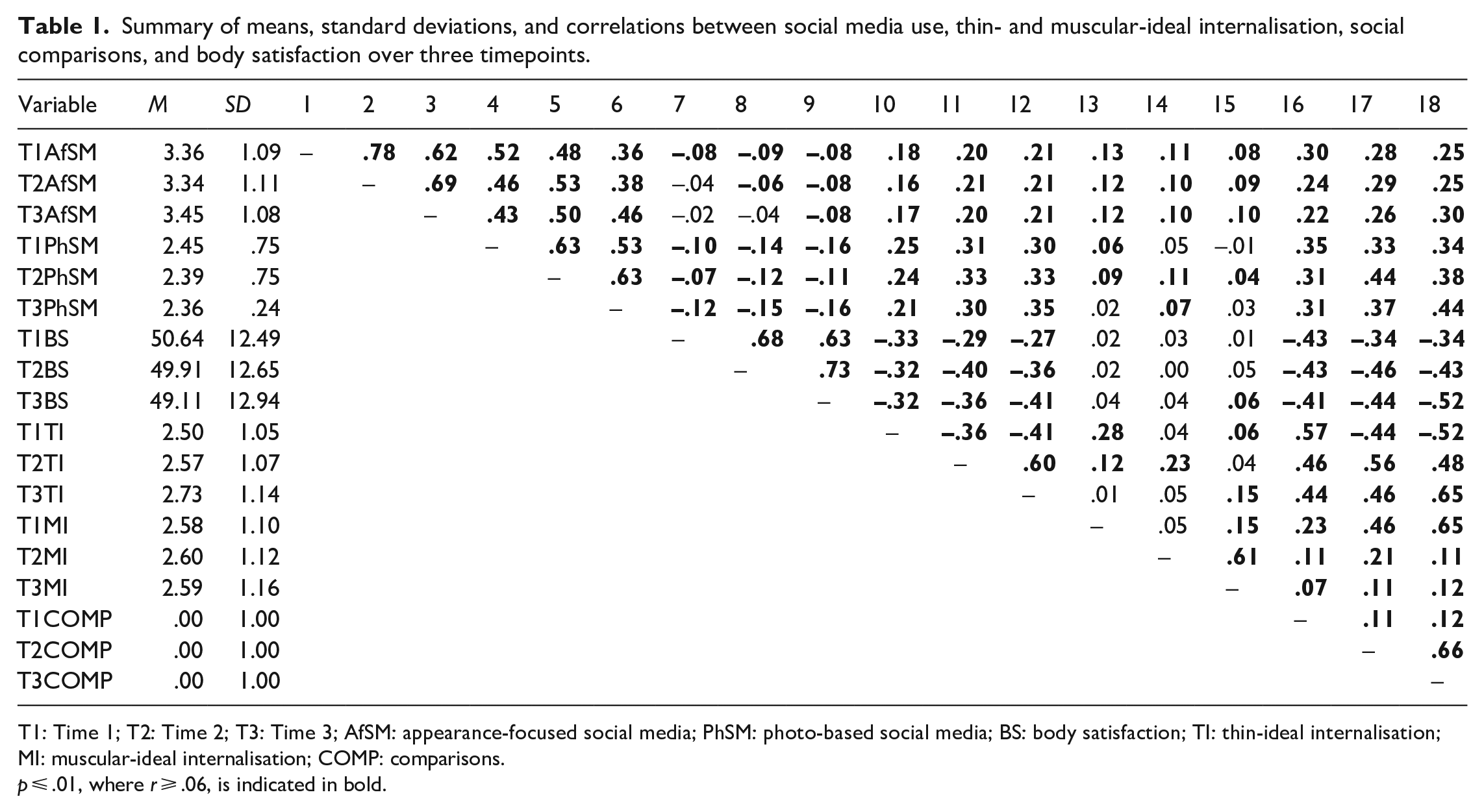
T1: Time 1; T2: Time 2; T3: Time 3; AfSM: appearance-focused social media; PhSM: photo-based social media; BS: body satisfaction; TI: thin-ideal internalisation; MI: muscular-ideal internalisation; COMP: comparisons.
p ⩽ .01, where r ⩾ .06, is indicated in bold.
Cross-lagged pathways between social media use and body satisfaction over time
For both appearance-focused use and photo-based activities, two stationary CLPMs were conducted separately to examine the bidirectional relationships between social media use, appearance-ideal internalisation, social comparisons, and body satisfaction (Figures 1 and 2, respectively). All path coefficients for each model are presented in supplementary materials. Contrary to our prediction that social media use would predict body satisfaction over time, and that body satisfaction would predict social media use over time (Hypothesis 1), no significant direct relationship was found in either direction in the photo-based activities model; social media use to body satisfaction (B = 0.007, p = .661, 99% CI [–0.036, 0.051]), body satisfaction to social media use (B = 0.038, p = .082, 99% CI [–0.018, 0.094]). In the appearance-focused use model, a unidirectional relationship was found, whereby greater body satisfaction predicted significantly greater social media use over time (B = 0.048, p = .006, 99% CI [0.003, 0.093]), but the reverse was non-significant (B = –0.002, p = .910, 99% CI [–0.042, 0.038]).
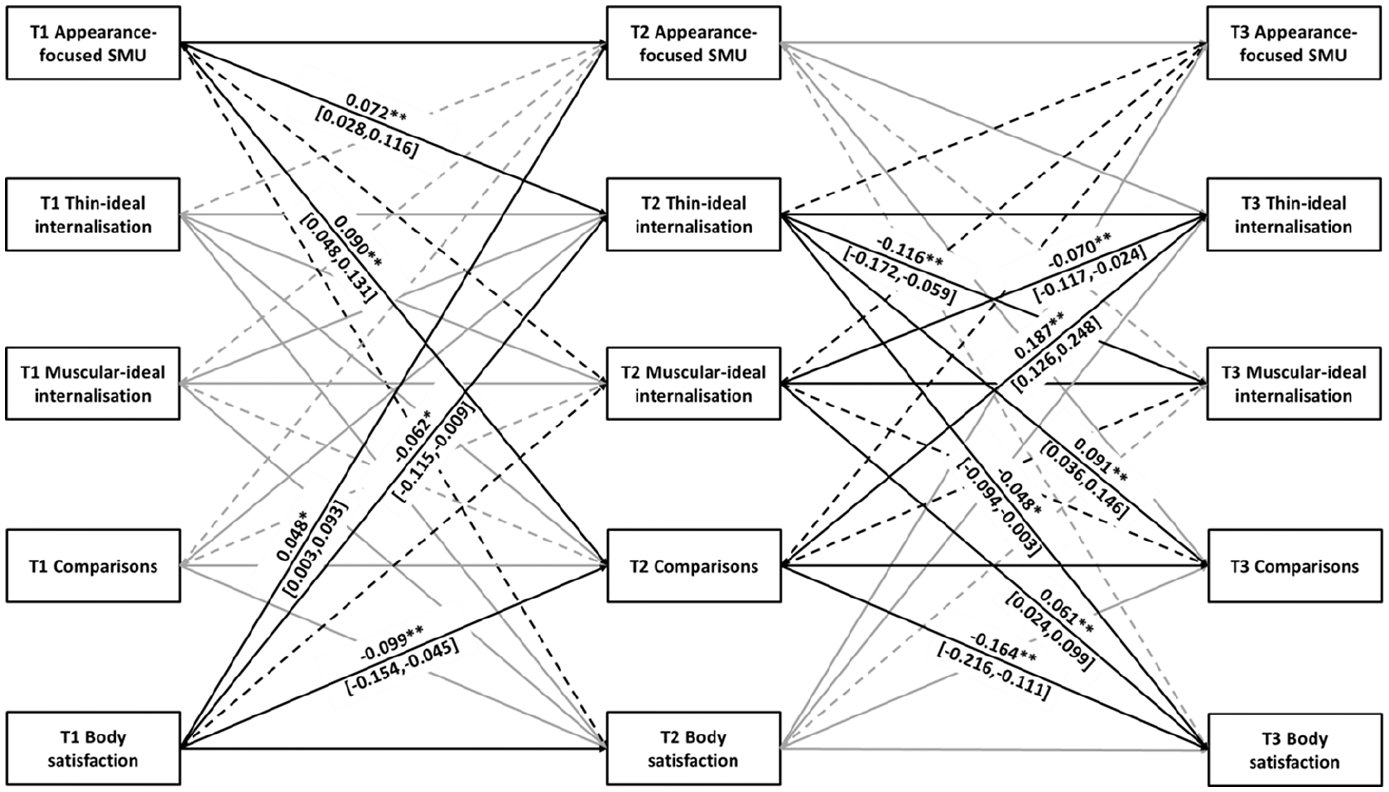
Stationary CLPM of the associations between appearance-focused social media use, thin- and muscular-ideal internalisation, social comparisons, and body satisfaction.
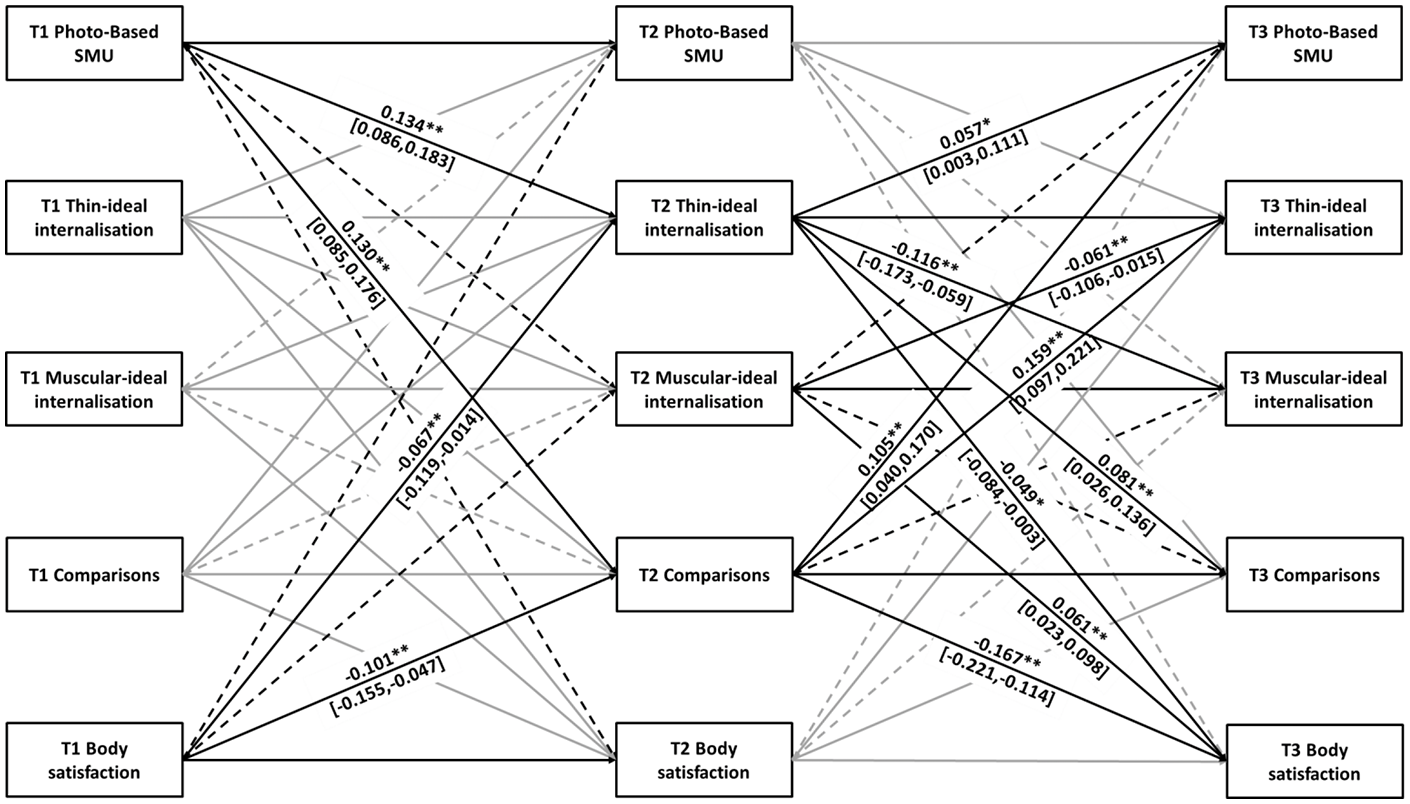
Stationary CLPM of the associations between photo-based social media activities, thin- and muscular-ideal internalisation, social comparisons, and body satisfaction.
Next, the mediating roles of thin- and muscular-ideal internalisation and comparisons were examined. Regarding the relationships from social media use to body satisfaction, in line with the social media influence model, thin-ideal internalisation and comparisons mediated the relationship from social media use to body satisfaction over time in both models (appearance-focused use; comparison: B = –0.015, p < .001, 99% CI [–0.023, –0.007]: photo-based activities; thin-ideal internalisation: B = –0.007, p = .010, 99% CI [–0.013, 0.000]; comparisons: B = –0.022, p < .001, 99% CI [–0.032, –0.012]), with the exception of thin-ideal internalisation in the appearance-focused use model (B = –0.003, p = .022, 99% CI [–0.007, 0.000]). Specifically, higher social media use predicted higher thin-ideal internalisation and comparisons which, in turn, predicted lower body satisfaction over time. These effects were small. In addition, the social media to body satisfaction relationship was not mediated by muscular-ideal internalisation in either model (appearance-focused use; B = 0.002, p = .042, 99% CI [–0.001, 0.005]: photo-based activities; B = 0.001, p = .532, 99% CI [–0.002, 0.004]).
Regarding the relationships from body satisfaction to social media use, in line with uses and gratifications theory, the prospective relationship from body satisfaction to social media use was mediated by comparisons in the photo-based activities model (B = –0.011, p = .001, 99% CI [–0.019, –0.002]), with small effects, but not the appearance-focused use model (B = –0.004, p = .039, 99% CI [–0.010, 0.001]). This relationship was not mediated over time by muscular-ideal internalisation (appearance-focused use; B = < 0.001, p = .567, 99% CI [–0.001, 0.001]: photo-based activities; B = < 0.001, p = .740, 99% CI [–0.001, 0.001]) or thin-ideal internalisation (appearance-focused use; B = –0.001, p = .336, 99% CI [–0.004, 0.002]: photo-based activities; B = –0.004, p = .039, 99% CI [–0.009, 0.001]) in either model.
Operationalisation of social media use
To examine the operationalisation of social media use with the better model fit, two models were compared (appearance-focused use vs photo-based activities). Model fit was examined using the following global indices: chi-square (χ2) test statistic with degrees of freedom, comparative fit index (CFI), standardised root mean square residual (SRMR), and root mean square error of approximation (RMSEA). Excellent model fit is indicated when CFI ⩾ .95, SRMR ⩽ .05, and RMSEA ⩽ .08 (Hu and Bentler, 1999). Both models demonstrated acceptable fit; appearance-focused use χ2 = 750.186, df = 60, p < .001, CFI = .900, RMSEA = .078, 90% CI = [0.073, 0.083], and SRMR = .045; photo-based χ2 = 808.171, df = 60, p < .001, CFI = .885, RMSEA= .081, 90% CI = [0.076, 0.086], SRMR = .047. To examine which operationalisation of social media use demonstrated better fit, BIC was considered. The appearance-focused use model demonstrated a smaller BIC value (sample size-adjusted BIC = 53,872.406) than the photo-based activities model (sample size-adjusted BIC = 54,475.791), indicating that the model with social media operationalised as appearance-focused use provided better fit than the model with the photo-based activities measure.
Multigroup analysis
Gender invariance within the two models was then assessed by examining the strength of relationships by gender (boys and girls). The model fit was acceptable for both models (appearance-focused use χ2 = 769.809, df = 118, p < .001, CFI = .886, RMSEA = .085, SRMR = .054; photo-based activities χ2 = 820.770, df = 118, p < .001, CFI = .868, RMSEA = .088, SRMR = .058). Supporting Hypothesis 3, none of the direct or indirect effects between social media use and body satisfaction were different by gender across the two models following Benjamini–Hochberg’s adjustment. Full multigroup results, which examined gender across all pathways within the model, can be found in the supplementary tables.
Discussion
Using a sociocultural perspective, the present study aimed to prospectively examine direct and indirect relationships between social media use and body satisfaction through thin- and muscular-ideal internalisation and social comparisons at three timepoints over 1 year. An additional aim was to explore the impact of operationalisations of social media use, as well as investigating whether relationships were consistent across gender. Contrary to Hypothesis 1, social media use did not directly predict body satisfaction over time. The same pattern of results was largely found for the reverse direction, with the exception of a unidirectional relationship from body satisfaction to social media use only in the appearance-focused use model. However, bidirectional mediation was found via comparisons. Specifically, higher social media use predicted higher comparisons, resulting in lower body satisfaction, and the reverse was also observed, providing partial support of Hypothesis 2. For the most part, thin- and muscular-ideal internalisation did not mediate the relationships between body satisfaction and social media use. Although both operationalisations of social media use had acceptable fit within the proposed model, the appearance-focused use model demonstrated better fit to the data than the photo-based activities model. Finally, in line with Hypothesis 3, the direct and indirect relationships within the models were equivalent among boys and girls.
Prospective modelling found that relationships over time from social media use to body satisfaction were present only when mediated through comparisons, and, to a lesser extent, thin-ideal internalisation. Higher social media use predicted greater thin-ideal internalisation and comparisons 6 months later, which in turn predicted lower body satisfaction at 1-year follow-up. These findings are theoretically consistent with the (social) media element of the tripartite influence model (Thompson et al., 1999). Importantly, social media use and body satisfaction were only related through thin-ideal internalisation and comparisons, suggesting indirect, rather than direct, effects (Lee and Lee, 2021; Scully et al., 2020). However, given the saliency of appearance-focused and idealised content portrayed on social media, and the seemingly endless opportunities for comparisons, it is likely that social media use will facilitate comparisons and reinforce internalisation, resulting in poor body satisfaction over time. These findings align with theoretical perspectives regarding the relationship between social media use and body satisfaction (Perloff, 2014), emphasising the importance of examining mediating psychological processes as proposed in sociocultural theories (i.e. thin-ideal internalisation and comparisons).
When the reverse pathways were examined, higher body satisfaction directly predicted higher social media use only in the model that contained the appearance-focused use measure of social media. Consistent with previous research (e.g. Rousseau et al., 2017), the relationship from body satisfaction to social media use was mediated by comparison in the photo-based social media model. Regarding the mediation, lower body satisfaction predicted higher comparison 6 months later, which in turn predicted higher social media use at 1-year follow-up. These findings suggest that adolescents’ body image may predict social media use over time, providing preliminary support for the application of uses and gratification theory (Katz et al., 1973) in this context. Furthermore, consistent with the previous research (e.g. Saiphoo and Vahedi, 2019), the effects found were small. However, the present research is the first that the authors are aware of which provides prospective support for these pathways, extending current theoretical knowledge about these relationships over time.
Interestingly, for the appearance-focused social media use model, direct and indirect pathways demonstrated different valence. In the direct pathway, lower body satisfaction predicted lower social media use. Whereas for the mediated pathway, lower body satisfaction predicted higher appearance-focused social media use through higher comparisons. The key element seems to be the effect of the mediating variable, comparisons. When the direct relationship is considered, lower body satisfaction may predict lower social media use as a means to avoid certain detrimental aspects of the social media environment (e.g. negative feedback). This might be analogous to self-preservation or selective avoidance (Rousseau and Eggermont, 2018). However, when low body satisfaction leads to engagement in comparisons, higher engagement with social media appears to follow, likely for gratification seeking, potentially as a drive for self-improvement (Rousseau et al., 2017). These findings highlight the complexity in the prospective relationships between social media and body satisfaction and emphasise the need to consider the role of mediating processes. Further research is needed to confirm the valence of these relationships and the applicability of uses and gratification theory within this context.
The indirect relationships between social media use and body satisfaction through comparison were found to be bidirectional, indicating the possibility of a feedback loop or spiral. Through greater comparison: (1) greater social media use predicted lower body satisfaction, and (2) lower body satisfaction predicted greater social media use, which, when operating in combination, might form a continuous loop over time. Social media appears to facilitate comparisons, thereby promoting the development of low body satisfaction and in turn, low body satisfaction prompts comparisons, thereby encouraging increased social media use. Social media, which often promotes appearance ideals, may be sought as a means to seek gratifications or cope with or alleviate appearance concerns, as previously mentioned. However, this appears a maladaptive coping mechanism when comparisons result. Although these findings provide the first prospective support of this relationship in three-wave data, replication is needed, including utilisation of more timepoints and extending the time period beyond 1 year. If these findings are reproduced, it would suggest that these relationships are not linear and theoretical frameworks should be modified to account for this feedback loop (Rodgers, 2016).
The observed relationships between muscular-ideal internalisation and other study variables were largely inconsistent with the study hypotheses. Inspection of the correlations indicated that muscular-ideal internalisation was generally not related to photo-based social media use or body satisfaction, and in CLPM, nor did it mediate this relationship. This finding is contrary to the tripartite influence model (Thompson et al., 1999) and empirical findings which have demonstrated cross-sectional multiple mediation whereby for boys and men greater social media use is associated with higher muscular-ideal internalisation and appearance comparisons which are then associated with lower body satisfaction (Fatt et al., 2019; Rodgers et al., 2020). However, given the cross-sectional nature of these studies, the different findings may be due to time effects. A negative association between muscular-ideal internalisation and body satisfaction, as found previously, suggests initial concerns about achieving this ideal. However, over time, adolescents may consider this ideal more attainable than others (e.g. thin-ideal), perhaps in particular for boys who move towards the muscular-ideal as they progress through puberty (Ricciardelli and Yager, 2015). These individuals may feel motivated by this appearance standard, rather than having a negative impact on their body image (Fardouly et al., 2021; Robinson et al., 2017). Alternatively, it is possible that a body satisfaction measure focused more specifically on elements of muscle satisfaction, drive for muscularity, or muscle building behaviours, rather than the more global body image assessment used in the present study, may indicate different results. For example, Rodgers et al. (2020) found that muscular-ideal internalisation was directly related to muscle building behaviours, but not body (dis)satisfaction, among adolescent boys and girls. However, additional research is needed with more nuanced assessments to dissect these relationships further.
Both models demonstrated acceptable fit with the data, supporting the role of both appearance-focused platform use and photo-based activities within the social media influence model. These results support previous research which has found that internalisation and comparison mediate the relationships between these operationalisations and body satisfaction (Fardouly et al., 2017; Lee and Lee, 2021; Scully et al., 2020). Furthermore, the findings extend knowledge by providing prospective support for these relationships over time, as well as the relevance among adolescent boys. When the models were compared, the appearance-focused use model indicated preferable fit in comparison with the photo-based activities model. Given that the social media environment is highly appearance-focused (Holland and Tiggemann, 2016), exposure will likely increase internalisation and comparison. It is possible that the social media environment, encompassing a wide range of interactions more broadly, is more strongly related to low body satisfaction than an operationalisation of social media use that focuses on a single type of activity, namely, photo-based activities. However, it is worth noting that the photo-based activities measure used in the present study did not differentiate between different types of use (e.g. passive [viewing or browsing photos] vs active [posting or uploading photos]). Some evidence suggests that these types of use may be differentially related to body satisfaction, with positive associations for active use and negative associations for passive use among adolescent girls (Chang et al., 2019). Therefore, combining these types of uses in the photo-based activities measure may have somewhat diluted or obscured the effects within the model. However, the present research demonstrates the first direct comparison of two operationalisations of social media use. Given the differential effects of these two models, future research which extends these comparisons within theoretical models would be fruitful.
When gender equivalence within both models was examined, gender invariance was found whereby none of the direct or indirect effects between social media use and body satisfaction were significantly different by gender. Overall, the current findings suggest that the mechanisms within the relationships between social media and body satisfaction are present in an equivalent manner, and to a similar extent, among adolescent boys and girls. This finding is consistent with previous research among adolescents (e.g. de Vries et al., 2016). Although the tripartite influence model was originally developed for females (Thompson et al., 1999), the results provide evidence that the social media influence model is also appropriate for males, specifically adolescent boys. Given the relatively limited research among adolescent boys, these findings extend theoretical knowledge to provide support for indirect bidirectional effects over time among boys as well as girls.
This research has a number of limitations. First, the social media measures relied on retrospective, subjective self-report data. Some research suggests that adolescents are not accurate in these estimates, therefore, these measures may be capturing perceived rather than actual use (Sewall et al., 2020). Relatedly, the measure of appearance-focused social media use did not explicitly examine content. Therefore, it may have also captured non-appearance-focused content present on Instagram and Snapchat (e.g. memes, travel). Future research should explore specific content with which adolescents engage to better understand the impact on body satisfaction. Second, participants were 11–16 years old, encompassing a somewhat broad developmental spectrum. Although age was included as a covariate within the models, the sample size was not sufficient to explore the role of age more specifically, a suggested direction for future research. Third, the samples were a homogeneous group of predominantly White adolescents from socioeconomic advantage. Therefore, findings may not be generalisable to other populations.
Several important implications arise from this research. First, findings extend theoretical knowledge in support of the tripartite influence model and uses and gratification theory within a social media context among adolescents, including understanding of the indirect bidirectional prospective relationships between social media use and body satisfaction. These results indicate that current aetiological approaches within prevention and intervention which target social comparisons and thin-ideal internalisation may be helpful and relevant within co-educational settings (Gordon et al., 2020). The indirect bidirectional relationships between social media use and body satisfaction indicate a feedback loop may be occurring whereby greater social media use may lead to poorer body image which concurrently reinforces greater engagement with social media. Consequently, it is imperative that theoretical models explore this notion and, if necessary, modify theories appropriately to account for new understanding. Finally, given the potential detrimental impacts of social media use on body satisfaction, these findings have implications for policies and practices of social media platforms. Companies could employ policies and implement technological modifications which discourage unhelpful behaviours, such as comparisons. In 2019, Instagram (2021) took measures to remove users’ ability to observe the number of likes on posts across a number of countries, although recent changes now make this an optional feature for all users. While no empirical research has examined the impact of removing the visibility of this feature, women report that removal will likely encourage fewer social media comparisons and improve mental health (Prichard et al., 2021). However, additional and more extensive policies should be considered and implemented by social media platforms to promote positive well-being among adolescents and young people.
Conclusion
The present findings provide valuable insights to the prospective direct and indirect relationships between social media use and body satisfaction across three timepoints. Although direct effects were generally not observed in the present study, indirect effects were found. Specifically, comparisons appear to be an important mechanism within the relationships between social media use and body satisfaction, with bidirectional mediation found over time. Furthermore, the present study demonstrates the possibility of a feedback loop occurring whereby, through comparisons, higher social media use predicts lower body satisfaction, which then predicts higher social media use. The present findings highlight the detrimental role of comparisons on social media. Interventions which attempt to interrupt this loop and prevent concerns from escalating are important for adolescent boys and girls. Intervention approaches drawing from aetiological data which target comparisons would likely be a fruitful direction for future research, particularly within a co-educational setting. Furthermore, working with social media platforms to identify and implement the best strategies to reduce engagement in comparisons and mitigate their harmful impact would also be fruitful to encourage community-level change.
Supplemental Material
sj-docx-1-nms-10.1177_14614448211058468 – Supplemental material for Direct and indirect relationships between social media use and body satisfaction: A prospective study among adolescent boys and girls
Supplemental material, sj-docx-1-nms-10.1177_14614448211058468 for Direct and indirect relationships between social media use and body satisfaction: A prospective study among adolescent boys and girls by Hannah K Jarman, Siân A McLean, Amy Slater, Mathew D Marques and Susan J Paxton in New Media & Society
Footnotes
Declaration of conflicting interests
The author(s) declared no potential conflicts of interest with respect to the research, authorship and/or publication of this article.
Funding
The author(s) disclosed receipt of the following financial support for the research, authorship and/or publication of this article: This research was supported by the Australian Research Council Discovery Grant [DP170100709] and La Trobe University, Melbourne.

Supplemental material
Supplemental material for this article is available online.
Author biographies
References
Supplementary Material
Please find the following supplemental material available below.
For Open Access articles published under a Creative Commons License, all supplemental material carries the same license as the article it is associated with.
For non-Open Access articles published, all supplemental material carries a non-exclusive license, and permission requests for re-use of supplemental material or any part of supplemental material shall be sent directly to the copyright owner as specified in the copyright notice associated with the article.
