




Abstract
Recent research by Taneja et al. suggested that digital infrastructures diminish the generational gap in news use by counteracting preference structures. We expand on this seminal work by arguing that an infrastructural perspective requires overcoming limitations of highly aggregated web tracking data used in prior research. We analyze the individual browsing histories of two representative samples of German Internet users collected in 2012 (N = 2970) and 2018 (N = 2045) and find robust evidence for a smaller generational gap in online news use than commonly assumed. While short news website visits mostly demonstrated infrastructural factors, longer news use episodes were shaped more by preferences. The infrastructural role of social media corresponded with reduced news avoidance and more varied news repertoires. Overall, the results suggest that research needs to reconsider commonly held premises regarding the uses of digital media in modern high-choice settings.
Keywords
What factors determine news use in the digital age? Most of the existing literature assumes that content preferences are the main determinant of online news use. Importantly, these studies typically rely on self-report data from surveys. By contrast, a recent study by Taneja et al. (2018: 1793) used tracking data to advance an alternative infrastructural perspective. Contrary to previous research, the authors concluded based on a comparison of US millennials and boomers that there is “a generational gap in using online news much smaller than commonly assumed.” Generational gaps have been a major area of contention in media research, especially with regard to concerns about younger people’s news use (Edgerly, 2015). More generally, the infrastructural view contextualizes recent debates on online news audiences and their fragmentation by building on the long tradition of scholarship on the role of structure and agency in media choice (Webster, 2009, 2014; Webster and Wakshlag, 1983; Wu et al., 2020).
The current research aims to consolidate and extend the infrastructural view on online news use. While we agree with Taneja et al. (2018) that the reliance on tracking data instead of self-reports is a crucial step toward a better understanding of news audiences, we also argue that some important theoretical challenges have remained unaddressed with the highly aggregated tracking data used so far. Instead of aggregated data on audience behavior that masks individual differences, our analysis relies on the browsing histories of two representative samples of German Internet users collected in 2012 (N = 2970) and 2018 (N = 2045). Using these data, our aim is to disentangle the generational gap in online news use with a dedicated emphasis on the intra- and interindividual differences in news repertoires that span distinct sources. 1 In order to further capture the effects of infrastructures on news audiences, we also extend prior tracking research by adding temporal resolution, both in terms of the duration of individual news use episodes and the long-term changes in the formation of personal news repertoires. On the more methodological side, the study we present here also is a response to work which has argued that tracking data, while avoiding the validity and reliability issues related to self-reports, comes with its own set of challenges and limitations (Fletcher and Nielsen, 2017; Stier et al., 2020; Taneja, 2016; Webster and Taneja, 2018).
Digital infrastructures and the generational gap in online news use
Scholars traditionally gravitate between two poles when it comes to explaining media use (Taneja et al., 2018). The preference perspective, in which most theorizing of news use resides, is grounded in the idea that recipients make active and purposeful choices. It assumes that recipients’ tastes, needs, or genre interests create enduring and self-conscious (dis)loyalties to specific types of contents (Prior, 2007; Stroud, 2011). The infrastructural perspective emphasizes the materiality of the media system, irrespective of particular content. For instance, it has traditionally identified program scheduling as a powerful driver of television viewing patterns (Webster and Wakshlag, 1983). Over recent years, a growing body of studies on the uses of news and other content types like entertainment have integrated both perspectives to often find that structural effects counteract the effects of disparate content preferences (Webster, 2014). The overarching conclusion that media use is less of a preference-driven activity than mostly assumed concerns the basic premises of various subfields of mass communication research (Wu et al., 2020). This critically includes online news research, as the infrastructural view challenges widely shared assumptions that in the digital sphere, preferences lead online news audiences to self-select into distinct niches (Taneja et al., 2018). The main arguments why the large-scale properties of digital media environments, as determined by platforms, algorithms, or access, have homogenizing effects on news use patterns can be summarized in the following two regards:
Webster and Ksiazek (2012) coined the notion of a persistence of popularity. Online audiences do not split into distinct niches, but few outlets continue to receive most of the attention. This is strongly connected to the social nature of media use. References to contents of popular media can, for example, serve as a “door opener” in interpersonal conversations; this also extends to the digital sphere of social media. Since people tend to equate popularity with quality, their news choices also often adhere to popularity cues (e.g. likes). Search and recommendation algorithms further proliferate centralization by steering audiences toward already popular offerings. Ultimately, this plays out as a “winner-take-all effect” (Nelson and Webster, 2017: 3) or, alternatively speaking, a “power law use distribution” (Taneja et al., 2018: 1794). In practice, this means that online users end up at the same news venues despite seemingly disparate content preferences.
Taneja et al. (2018) proposed the concept of social media curation. Social surroundings have famously been found to affect people’s news use since the early pioneering work by Lazarsfeld et al. (1968), but this mechanism has a different quality in the age of social media. Social media have empowered opinion leaders to spread information far beyond classic close-tie peer networks and led to the emergence of macro-influencers with millions of followers. In parallel, the followers’ networks have also gained in size and contain a greater diversity of weak ties, which are particularly effective in bridging otherwise disconnected social groups (Bakshy et al., 2012). The former adds to the power-law-like concentration of audiences. The latter complements that most users refrain from tailoring their social media contacts to similar others and, when selecting news, often pay more attention to social endorsements from heterogeneous ties than to the original sources of articles they encounter in their timelines (Bode, 2016; Messing and Westwood, 2014). Crucially, this implies that social media—contrary to the common conception—enhance rather than restrict the diversity in recipients’ news sources (Fletcher and Nielsen, 2018; Scharkow et al., 2020).
The infrastructural paradigm challenges common approaches in audience research both theoretically and methodologically. Much work following the preference paradigm has relied on media-centric approaches (e.g. long-tail distributions), which are of limited value in the new media environment, because they analyze the use of single media offerings in isolation. Although today’s recipients can combine different news sources in abundant ways, media-centric approaches only tell us
what is popular and what is not. We have no idea how consumers move across these options. It could be that fans of niche media only consume these specialized genres and little else, producing polarized audiences. It could also be that people consume a variety of genres. (Webster and Ksiazek, 2012: 44–45)
This drawback has, as we will further outline below, led some scholars to employ user-centric repertoire approaches that aim to capture individual user activity across different media. Others, including Taneja et al. (2018), have opted for a more high-level audience-centric approach based on network analyses of overlaps in the audiences of different media.
These different analytical approaches have also relied on different types of data. Many studies of media repertoires, and in particular news repertoires, have operated with survey data (e.g. Bos et al., 2016; Edgerly, 2015; Mangold and Bachl, 2018; Trilling and Schönbach, 2013; an exception is Taneja et al., 2012). Audience-centric work has almost exclusively used tracking data (Nelson and Webster, 2017; Webster and Ksiazek, 2012; Yuan and Ksiazek, 2015). The distinction is crucial, because surveys of media use suffer from the limited accuracy and reliability of self-report measures. People, and in particular younger people, notoriously overreport news use due to its social desirability (Prior, 2009). Self-reports are also biased toward active and regular news choices (Scharkow et al., 2020) and subject to the drawback that the answers to typical 4- or 5-point survey questions like “How likely are you to avoid the news?” are contingent on respondents’ varied preferences for extreme response styles (Johnson et al., 2005). The general restrictions of self-reports are aggravated in the digital sphere, because the relative ease with which people can switch among the various options online makes it particularly unlikely to accurately recall media use (Taneja, 2016). Crucially, tendencies to misreport also apply to situations when people arrive at news through intermediaries like social media (Kalogeropoulos et al., 2019). Moreover, it is virtually impossible to cover more than a handful of news sources with surveys, meaning that we specifically miss out on news use in the long tail of less popular online media (Fletcher and Nielsen, 2017).
Even if we ignore the various recent concerns that news use and, even more so, online news use cannot be adequately gauged by self-report measures, a central issue remains. As “for users, infrastructural aspects remain largely invisible or taken-for-granted,” they are “obscured in survey-based methods” (Taneja et al., 2018: 1793), most notably compared to self-conscious leanings. Consequently, infrastructural aspects have to be inferred from tracking data and, more specifically, from the structural commonalities in the news use patterns of people with seemingly disparate preferences. This is a central reason why Taneja et al.’s (2018) observational comparison of US millennials (born after 1981) and boomers’ (born before 1964) web use behavior is important for exploring the imprints of infrastructures vis-à-vis preferences on online news use. The preferences of these generations have often been found to profoundly differ in crucial dimensions (for the United States: Bennett, 2008; Castells, 2001; Edgerly, 2015 for Germany: Hölig and Hasebrink, 2014; Mangold et al., 2017). Overall, the findings from these studies indicate that millennials are more cosmopolitan in their news diets than boomers and less appreciative of regional (rather than national) news. They also have a weaker preference for general (rather than specialized) news and more information-oriented coverage (with a focus on hard rather than soft news).
Tracking the generational gap in online news use
For their study, Taneja et al. (2018) obtained web browsing data of US millennials and boomers collected by the media research company comScore in April 2015. They substantiated their criticism of an overstated generational gap in online news use with four media- and audience-centric empirical tests. These tests concerned the intergenerational homogeneity in (1) news outlet reach, (2) news outlet centrality, (3) news audience network structure, and (4) the effects of adding major social network sites (Facebook, Twitter) on the average centralities of these networks. In sum, their findings indicate that (1) similar outlets are popular among millennials and boomers, that millennials and boomers’ repertoires (2) converge to the same outlets and (3) contain the same combinations of outlets, and that (4) social media are similarly important news intermediaries in each age cohort.
As Taneja et al. (2018) used data from the United States, the specific attributes of the media landscape have to be considered when interpreting their results. Distinct characteristics commonly attributed to the United States are the wide supply of partisan media and comparatively high ideological selectivity among news users (Fletcher et al., 2020; Trilling and Schönbach, 2013). These characteristics are associated with a risk that US studies produce results that do not generalize well to other news environments (Bos et al., 2016). It is, thus, important to complement Taneja et al.’s (2018) generational comparison, so that we can clarify the range of possible results with tracking data from countries where prior research has found marked generational gaps and where news use is predominantly influenced by interest, not ideology.
One such country is Germany, where our study was conducted. In line with other European countries, the German media system is not only rather unconducive to ideological selectivity. It also differs from the United States in various other aspects like higher levels of state intervention, a broader appeal of the press to the general public, and so on (Fletcher et al., 2020; Fletcher and Nielsen, 2017). In spite of these differences, there are two main reasons to expect that the small generational gap found by Taneja et al. (2018) can also be found for Germany. First, when viewed through an infrastructural lens, any digital news environment has the same basic architecture: Legacy media, which started off as broadcasters or print publications, compete with each other and with newer digital-born alternatives, and social media constitute relevant indirect pathways to news (Fletcher and Nielsen, 2018). Second, previous research, which has looked beyond the domain of online news use and investigated infrastructural tendencies vis-à-vis preferences, has found these tendencies to play out quite consistently (Webster, 2014). This leads us to the following expectation:
H1. The intergenerational homogeneity in online news use found for the United States also applies to German millennials and boomers.
Another major issue of tracking research corresponds to Webster and Taneja’s (2018) recent argument that irrespective of which statistical test one uses, the substantive meaning of results critically rests on the underlying data. While the comScore samples typically used in tracking research allow for a much more detailed mapping of audience structures than the passive data collected through the application programming interfaces (APIs) of social media platforms (Taneja, 2016), this major advantage comes at a cost: The comScore (and related Nielsen) data by default count someone as having used a news website if they access the site for at least 3 seconds. This threshold is, arguably, too liberal for considering website visits as news use. In other words, the data potentially contain many false positives (from a substantive rather than a statistical viewpoint), because extremely short news website visits rule out any form of real engagement with the content (Fletcher and Nielsen, 2017; Scharkow et al., 2020). Prior tracking research has provided evidence why digital infrastructures can drive online news audiences toward the same venues. Whether they stay at these venues is a different matter that may closely align with preferences, even in the social media age. In line with the preference paradigm, this invokes variation in the relative degree of intergenerational homogeneity, such that
H2. The intergenerational differences in the online news use of millennials and boomers are more pronounced with longer thresholds for counting website visits as news episodes compared to the conventional 3-second threshold.
Most web tracking studies in this area (and other forms of news use research) investigate a single news environment at a single point in time. This design makes it difficult to study the imprints of structural factors, as it captures no (temporal) variation in macro-level environments. While some tracking studies have tackled this issue with cross-national comparisons of media environments (Mukerjee et al., 2018; Yuan and Ksiazek, 2015), this study compares the browsing behaviors of German Internet users in 2012 and 2018. The time frame captures crucial aspects in the transition of the German media system to a high-choice media environment. Germany’s online news ecology has traditionally been shaped by the (national) up-market and (regional) mid-market press which benefited from first-mover advantages by readily moving content as-is from print form to the Internet. Recent years have, in turn, witnessed an expansion in choice, such that more tabloid-like media have increasingly moved and expanded online, and the proliferation of digital-born outlets has gained momentum. At the same time, social media have become more popular as an indirect pathway to news (Hölig and Hasebrink, 2014). These general trends make studying generational differences especially interesting, as they have different implications from a preference versus infrastructural perspective. Research following the preference perspective invokes that the generational gap in online news use has widened over recent years. By contrast, the infrastructural paradigm emphasizes homogenizing effects attributed to the use of social media (Nelson and Webster, 2017; Taneja et al., 2018). This, in turn, implies that the generational gap has remained rather constant or even narrowed. In accordance, Taneja et al. (2012) have found macro-level repertoire formations to be rather consistent across time. Yet, this research has relied on data collected during the course of 1 year rather than engaged with more long-term transitions in media environments. Therefore, we refrain from formulating a hypothesis but ask the following research question (RQ):
RQ1. How has the generational gap in online news use of German millennials and boomers changed between 2012 and 2018?
Another issue related to extant web tracking research is that the data provided by comScore or Nielsen have only been available to researchers in the form of aggregate-level audience reaches and audience duplication scores (i.e. number of shared users for individual pairs of outlets). This limits the analytical choices to media-centric and audience-centric approaches (Taneja, 2016). As outlined earlier, a media-centric analysis cannot sufficiently account for differences in recipients’ news repertoires. Audience-centric networks are much more powerful but do not entirely solve the issue as they are, technically speaking, the one-mode projection of an underlying bipartite structure. The bipartite structure contains two types of nodes—media outlets and individual recipients—and links individuals with the outlets in their repertoires (see Figure 1). Audience networks abstract from the individual recipients, such that they contain media outlets as the only type of nodes and define the ties between these nodes based on the aggregate number of users that each pair of outlets shares.
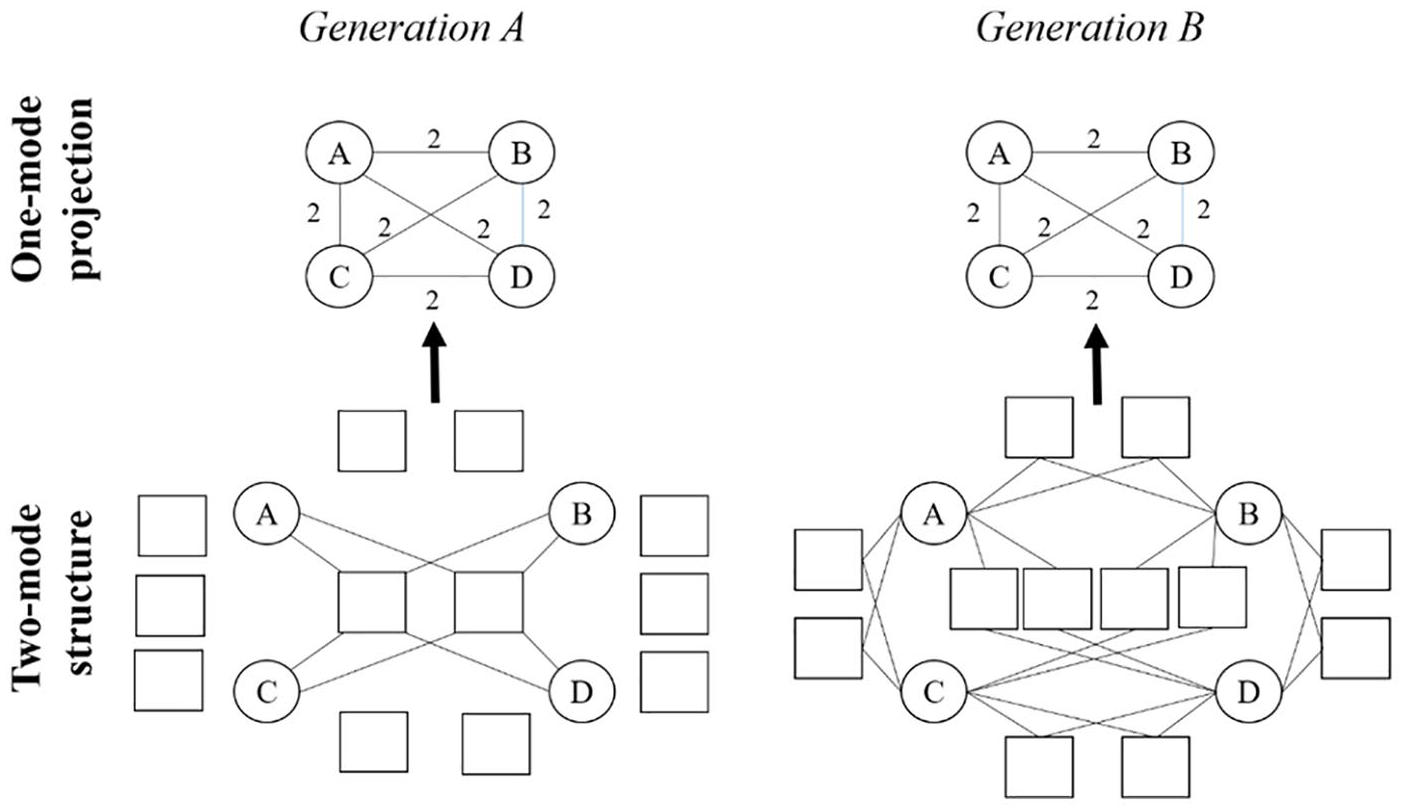
Hypothetical generational comparison of audience networks and bipartite structures.
The crucial point with the projection is that the same one-mode network may summarize different bipartite structures (Everett and Borgatti, 2013). To illustrate, consider the hypothetical generational comparison in Figure 1. Looking at the upper panels, we see identical audience networks, invoking a high intergenerational homogeneity in news use. Yet, when looking at the lower panels, we see fairly distinct bipartite structures. On the left hand side, news avoiders dominate over a small minority of omnivores whose repertoire contains all outlets. On the right hand side, we have no omnivores, but a larger share of users with smaller repertoires. This simple example should clarify the key point here: Because important audience features may remain hidden in audience networks, it is crucial to complement these networks with a closer look at the underlying bipartite structures or, less technically speaking, the varied ways that individuals integrate media offerings into distinct repertoires. Given that, to our knowledge, no previous web tracking research has directly tested how the results from audience-centric analyses correspond to results from user-centric repertoire analyses, we ask the following question:
RQ2. Do millennials and boomers have structurally similar news repertoires?
Methods
Samples and measures
Our analysis is based on two representative and independently collected samples of German Internet users aged 14–65 who agreed to use a tracking software that hooks into the web browsers on their desktop computers and/or smartphone. For privacy reasons, participants could temporarily disable the tracking. The 2012 data set was collected as part of a large, nationally representative household panel. It contains the desktop browser logs of N = 2970 participants from November 2012. In total, 53.1% of participants were female, the mean age was M = 44.6 years, with N = 523 millennials (born after 1981) and N = 1392 boomers (born before 1965). The 2018 data set was drawn from an online access panel, with browser logs (desktop and mobile) collected from N = 2035 respondents in December 2018. The proportion of female participants (50.6%) was a little lower in 2018 as was the average age (M = 41.6 years), with N = 809 millennials and N = 542 boomers. To facilitate comparisons across samples, the data sets were matched in terms of the participants’ age range.
Both the 2012 and 2018 data contain all logged visits from the participants’ web browser on the domain level (e.g. www.spiegel.de). For the purposes of this study, we defined news episodes with thresholds of 30 and 120 seconds consecutive exposure in addition to the 3-second threshold used in previous studies. This was done to take into account that active engagement with contents typically requires longer periods of website attendance (Fletcher and Nielsen, 2017). Since we expect diminishing returns for longer visits, we did not specify equidistant thresholds but, instead, set the intermediate threshold at 30 seconds (not 60 seconds). The 120-second threshold represents an estimate of the notion that users may spend several minutes on a website. News website visits accounted for only a small proportion of total visits in both 2012 and 2018 (see Table S1 in the Online Supplemental Appendix). Notably, the 2018 data comprised more news episodes than the 2012 data. Naturally, the 30- and 120-second thresholds substantively reduced the numbers of news episodes in both samples. The reduction was stronger in the 2018 data, indicating that the data included more short news website visits than those from 2012.
To identify news visits in our tracking data, we compiled a list of 768 news websites using data from the German Audit Bureau of Circulation (IVW) and an additional manual inspection to ensure all sites were relevant and adequately categorized. Few news websites commanded the vast majority of unique visitors (see Figure S1 in the Online Appendix). The centralization was more pronounced with the shorter temporal thresholds for news visits and in the 2018 data than in the 2012 data. Following recent news repertoire composition studies (Edgerly, 2015; Mangold and Bachl, 2018; Yuan, 2011), the websites were grouped into 18 categories which reflect different contents, forms, and attributes of news coverage as well as outlet heritages. Two interrelated main distinctions were (1) national versus local and (2) general- versus special-interest news, leading to three initial categories: general national news, general regional news, and special interest news. Following prior literature, special interest news were classified into eight subcategories: technology, celebrities, lifestyle, weather, sports, business and finance, science, and automobile (e.g. Taneja et al., 2018; Yuan, 2011). The distinction among national general news entailed a separation between (3) information-oriented versus entertainment-oriented coverage with a higher proportion of hard versus soft news (up-market newspapers, public broadcasters vs commercial broadcasters, tabloid press). An analogous distinction could be made for regional news with one notable exception. While Germany’s national press is shaped by tabloid and up-market quality newspapers, its regional press market is the domain of tabloids and mid-market papers (Mangold and Bachl, 2018). Digital-born news are a complementary category among both general national and regional news, as defined based on outlet heritage (Fletcher and Nielsen, 2017). Regarding social media, we covered the most dominant social networking site (Facebook), microblogging site (Twitter), and video platform site (YouTube) in Germany. Table S2 in the Online Appendix reports the reach of the 18 news categories and 3 social media sites. The shares of panelists who visited at least one website from a given news category is higher for almost all news categories in the 2018 than in the 2012 sample.
Analysis
Our research draws on recent analytical advances in two main regards. First, we replicate the media- and audience-centric analyses of intergenerational homogeneity in online news use by Taneja et al. (2018). This involves the construction of both weighted and stratified audience networks. Weighted networks better preserve the granularity in the tracking data compared to prior work which has dichotomized tie values. Unlike prior research that has constructed an aggregate network for all audiences, stratified networks allow us to map generational differences on audience structures. Second, we expand on news repertoire composition analysis by conducting a multi-group latent class analysis (LCA). LCA estimates a categorical latent variable whose categories (classes) in our case represent the news repertoires. The latent variable can reflect both quantitative (e.g. news avoiders vs seekers) and qualitative differences (e.g. local vs quality-oriented news use) that organize the underlying repertoires. Prior applications of (single-group) LCA (Bos et al., 2016; Mangold and Bachl, 2018) and related cluster analyses (Trilling and Schönbach, 2013) have rested on the assumption that only the prevalence of repertoires varies between generations, not their composition. A multi-group LCA relaxes this assumption by taking into account that both the prevalence and composition of repertoires may vary generationally. The data processing and the network analysis were performed in R. The LCA was conducted with MPlus 7.31. Concerning the replication of Taneja et al. (2018), we refer readers to the original publication for technical details. The procedure to identify the final LCA models is documented in the Online Appendix.
Results
The results presentation proceeds as follows: first, we replicate the media- and audience-centric analyses of Taneja et al. (2018: 1800). Second, we provide a complementary user-centric analysis of the varied news repertoires of German millennials and boomers.
Media- and audience-centric analysis
Table 1 summarizes the results of the media- and audience-centric analyses. The intergenerational homogeneity in outlet reach, outlet centrality, and audience network structure can be quantified by correlations, with higher positive values showing a higher similarity among millennials and boomers. The lower part cell entries are the changes in average network centrality scores when adding each social media site to the audience networks for millennials and boomers, with higher positive values indicating a more central role of social media as news intermediaries.
Media- and audience-centric intergenerational homogeneity.
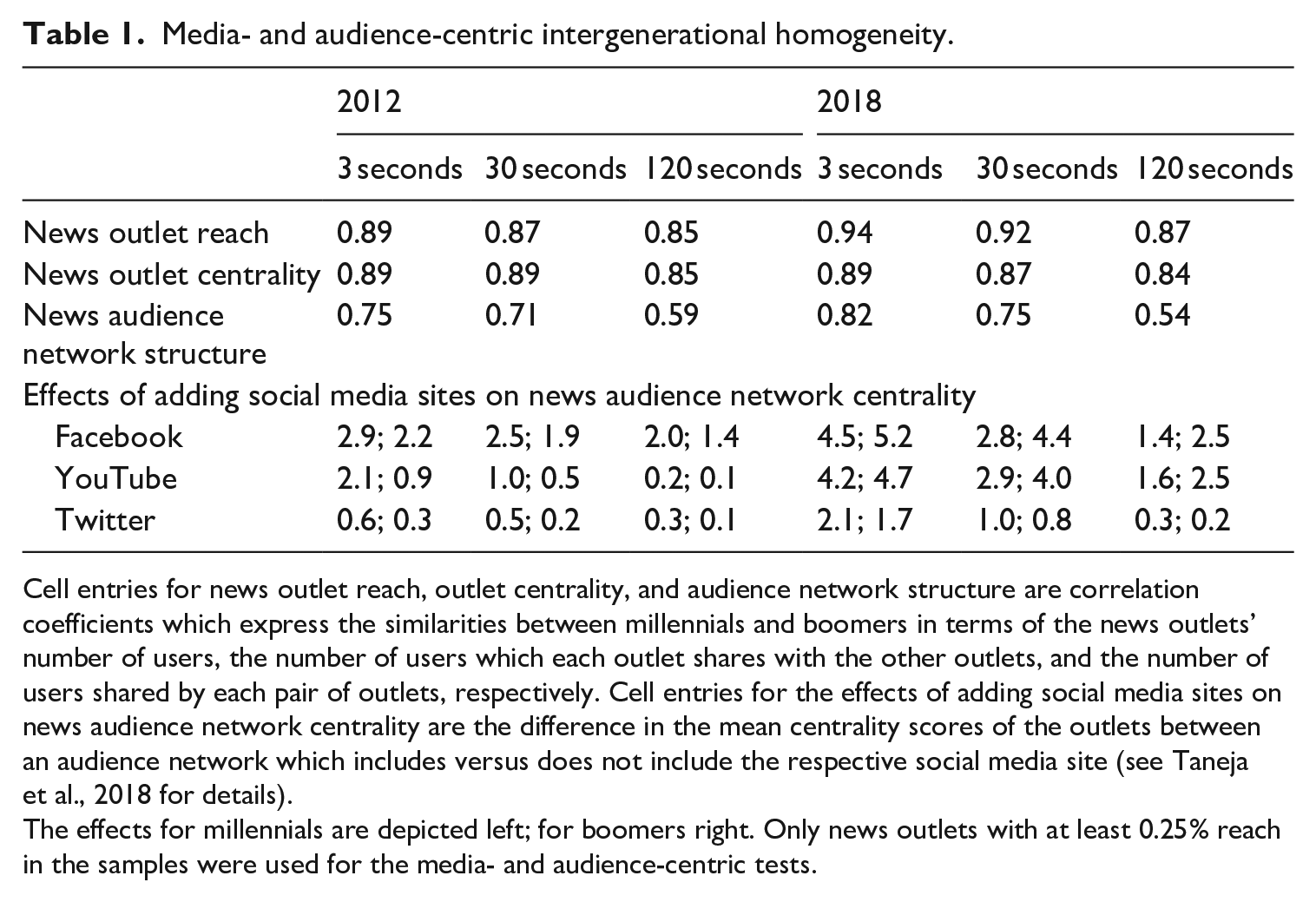
Cell entries for news outlet reach, outlet centrality, and audience network structure are correlation coefficients which express the similarities between millennials and boomers in terms of the news outlets’ number of users, the number of users which each outlet shares with the other outlets, and the number of users shared by each pair of outlets, respectively. Cell entries for the effects of adding social media sites on news audience network centrality are the difference in the mean centrality scores of the outlets between an audience network which includes versus does not include the respective social media site (see Taneja et al., 2018 for details).
The effects for millennials are depicted left; for boomers right. Only news outlets with at least 0.25% reach in the samples were used for the media- and audience-centric tests.
Looking at Table 1, we find consistently high to very high positive correlations. The effects of adding the social media sites were all positive as well. Especially with regard to the news audience network structure, the intergenerational homogeneity varied less across thresholds in 2012 than in 2018. It was more pronounced in 2018 for the 3-second threshold, but less pronounced for the 120-second threshold. The effects of social media were generally stronger in 2018 than in 2012, but not in a uniform manner. Social media had stronger effects for millennials in 2012 and for boomers in 2018. This indicates that social media have predominantly gained significance as news intermediaries among German boomers over recent years.
Overall, the results suggest the following preliminary conclusions: The media- and audience-centric intergenerational homogeneity found by Taneja et al. (2018) can also be found for German millennials and boomers (supporting H1) and, while being less pronounced for longer news episodes (supporting H2), appears to be principally stable across different temporal thresholds. With regard to RQ1, we found no uniform long-term change pattern. The generational gap was somewhat narrower for short news visits in 2018 than in 2012, but wider for longer news episodes. As indicated earlier, the former fits better with the infrastructural view, the latter is more aligned with a preference-based perspective.
News repertoire analysis
Figures 2 and 3 summarize the main results of the news repertoire analysis for 2012 and 2018. The columns differentiate between the 3-, 30-, and 120-second thresholds. The repertoires are represented by the lines within the rows. The number of rows corresponds to the number of latent classes, which—based on statistical criteria and additional substantive checks—best approximated the participants’ news use patterns (see “Documentation of the procedure to identify the final LCA models” in the Supplemental Appendix). The news categories are presented on the x-axis. The position of each news category on the y-axis quantifies the class-conditional probability that the category was contained in the repertoire. The corresponding captions denote the main structuring principle for each repertoire, its prevalence (P), and the mean number of news categories (C) and social media sites (S) included. We report the average numbers of news categories in a repertoire as a formal descriptor of repertoire breadth. This relates to repertoire variety since the categories capture different forms of news coverage. The correlations between the number of news categories and the number of social media sites in the repertoires can be found in the column heads, with a subscripted M for millennials and a subscripted B for boomers. To facilitate the interpretation, each row contains a specific pair of a millennial and a boomer repertoire. These repertoires were paired based on the similarities in the class-conditional probabilities. The more similar pairs are displayed at the top, the less similar ones at the bottom. To illustrate the rationale, consider the left-hand column of Figure 2. An initial look shows that for the 3-second threshold the number of social media sites used was positively correlated with the number of news categories within the repertoires for both millennials (rM = .46) and boomers (rB = .46). The left-middle panel reveals that the specific repertoires applied to 32.3% of the millennials and 15.0% of the boomers. The respective millennial class used, on average, 5.5 news categories and 1.6 social media sites, the boomer class 7.3 news categories and 1.3 social media sites. As revealed by the patterns in the class-conditional use probabilities, this corresponds with somewhat different repertoire compositions. While both recipient classes shared an inclination to use the quality-oriented offerings of the up-market press over other national news, the boomer class was more likely to use regional news in conjunction with national news.
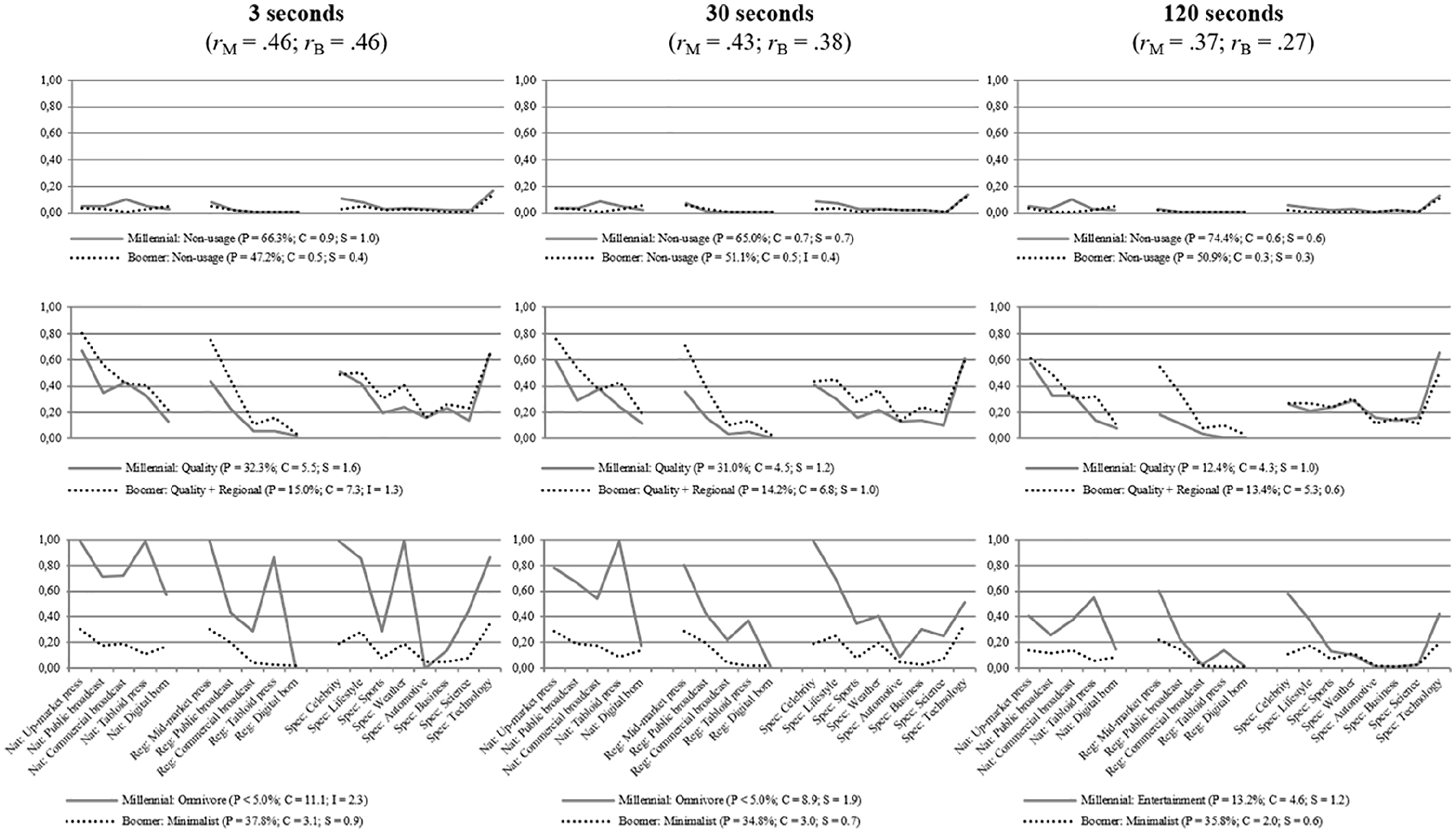
Online news repertoires of German millennials and boomers in 2012.
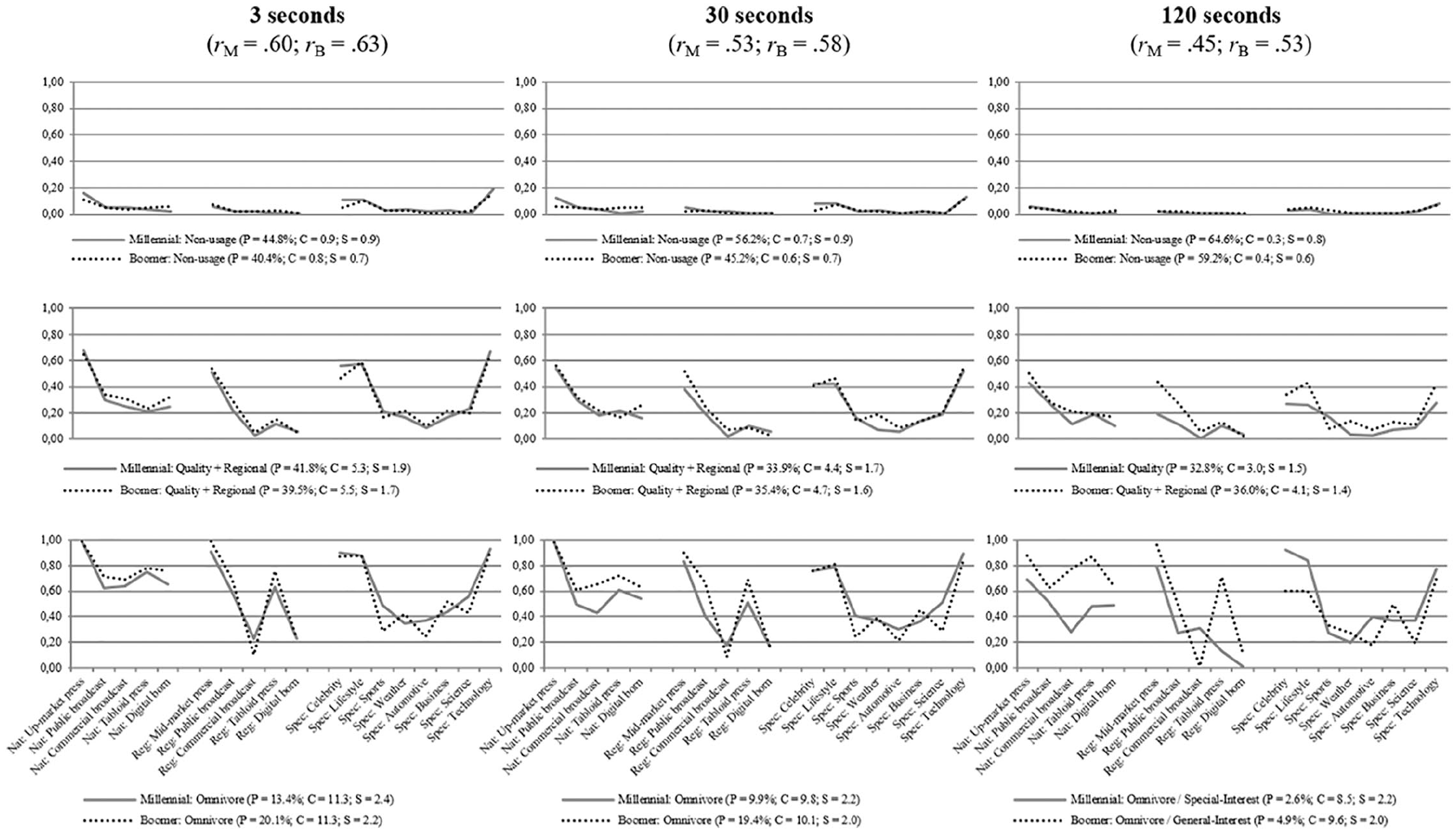
Online news repertoires of German millennials and boomers in 2018.
Looking at Figure 2 more holistically, the positive association between the number of news categories and social media websites used was robust against the various thresholds. Mutually exclusive repertoires that contained entirely different news items generally did not emerge, both inter- and intragenerationally. Regarding the individual news website visit repertoires (using the 3-second threshold), the multi-group LCA yielded three key findings. First, the largest share among boomers and, to an even stronger degree, millennials refrained from visiting all news categories. Moreover, the second pair of repertoires shared an inclination to visit the up-market and mid-market press over other national and regional news types. Quality-oriented boomers were, as indicated earlier, more likely to visit regional news in addition to national news, but less populated than the respective millennial class. Finally, the primary disparity in repertoire composition emerged between minimalist boomers and the non-trivial prevalence of millennial omnivores. Minimalists visited news in a punctual and sporadic fashion; they gravitated much less strongly toward the up-market and mid-market press than quality-oriented users. While restricted to a small minority of millennials, the omnivore repertoire included the largest number of news categories and showed the most ready social media use overall. It was also the only repertoire to include the national up-market and tabloid press, regional mid-market and tabloid press, and specialized celebrity, lifestyle, weather, and technology news with high to almost certain probabilities.
When considered across thresholds, the boomer repertoires showed a high degree of stability, both in terms of composition and prevalence. Differences emerged for millennials in three main regards. First, the 120-second threshold increased the share of news avoiders and, second, effectively reduced the share of quality-oriented millennials to the level of boomers. Third, it yielded a distinct repertoire emphasis that included much fewer news categories than the omnivore repertoires observed with the 3- and 30-second thresholds. The repertoire resembled the millennial quality-oriented repertoire in size but involved a unique skew toward entertainment-oriented news. It was less likely to include the up-market press, but more likely to include the national tabloid press than its quality-oriented counterpart.
Overall, taking into account news attendance by testing various exposure thresholds brought the results more closely in line with the common assumption that younger recipients have a weaker preference for news overall and, more specifically, information-oriented and regional news. This raises the question: Why did we find the media- and audience-centric intergenerational homogeneity to be rather consistent across thresholds in the first place? This is likely due to a suppression effect, because the above-mentioned heterogeneity across thresholds has opposite implications for the overall generational gap. While the increasing population of news non-users among millennials indicates a stronger gap in online news use, especially the reduction in the share of quality-oriented millennials suggests a narrower gap.
The 2018 sample (Figure 3) replicated the positive relationship between social media use and news source variety, with even stronger correlations across all three thresholds. Again, mutually exclusive repertoires did not emerge. The intergenerational homogeneity was particularly pronounced for news website visits (using the 3-second threshold). Millennials and boomers similarly exhibited a minimalist, quality-oriented, and omnivore repertoire with one notable exception: Omnivores were a substantive share of millennials (13.4%) but had even higher representation among boomers (20.1%). This stands in contrast to 2012, when omnivores were only a small minority of millennials and had not yet emerged among boomers. The shares of non-users were, in turn, smaller in 2018 for both boomers and millennials. Unlike 2012, quality-oriented boomers were also not more inclined to visit regional news in addition to national news than their millennial counterparts. Considering the repertoires across thresholds, we see that quality-oriented millennials were similarly likely to visit, but less likely to attend regional news compared to quality-oriented boomers. The 120-second threshold also yielded somewhat disparate results for the omnivore news use practices. Omnivore boomers more strongly prioritized general-interest news over specialized celebrity and lifestyle news. Finally, the more conservative thresholds increased the shares of news non-users among both millennials and boomers.
Overall, the 2018 results replicated the link between social media use and increased news repertoire variety. The more widespread use of social media compared to 2012 translated into larger shares of news omnivores and smaller shares of news non-users (and minimalists), most notably among boomers. The intergenerational homogeneity was particularly pronounced on the level of short news visits. It was less pronounced for longer periods of news attendance as the intensity of news use seems to be more affected by preferences (compared to infrastructural features). Still, the repertoires generally remained connected in the use of the most popular news categories.
Discussion
What theoretical implications for the generational gap in online news use can be derived from our empirical findings? Our first central result is that we can unequivocally confirm a generational gap in online news use much smaller than commonly assumed (Taneja et al., 2018). Most literature has seen reason for strong disparities in the digital news use of millennials and boomers. We observed, though varied, considerable intergenerational homogeneity across two samples, across various temporal thresholds for news episodes, and across different statistical tests. The finding, in line with H1, is noteworthy, as we studied the generational gap in Germany. Any single-country case study but also comparison of two or three countries naturally cannot replace cross-national tracking studies which further investigate online news audiences and repertoires across larger sets of media environments. In the meantime, the close correspondence of our results with both the conclusions derived by Taneja et al.’s (2018) US research and the main lines of prior infrastructural work more broadly (Webster, 2014) can nonetheless provide us with some additional confidence in the idea that digital infrastructures have a universalizing effect on media systems which have often been described as rather disparate (Fletcher and Nielsen, 2018). At the very least, it seems worthwhile further pursuing this idea alongside the historical, economic, and political factors traditionally accentuated in the comparative media systems literature.
A second main result of our study was the close correspondence of audience characteristics with the multifarious effects of digital infrastructures. In contrast to common concerns about fragmented niche audiences in a high-choice media environment, we observed sizable news audience centralization in both the 2012 and 2018 data. Despite, or precisely because of, the ongoing expansion in choice and the more widespread adoption of social media, the centralization was more pronounced in 2018. Notably, we did not only observe these mechanisms on the media-centric level, but also on the user-centric news repertoire level. Especially in 2018, all news repertoires demonstrated users’ inclination to visit popular offerings over others, which consistently played out across national general-interest news (i.e. quality press), regional general-interest news (i.e. mid-market press), and specialized news (i.e. technology, celebrity, and lifestyle news). This critically included news omnivores, such that their “exposure to a wide but rather unspecific range of sources” (Edgerly, 2015; Mangold and Bachl, 2018; Trilling and Schönbach, 2013: 946) did not resemble a haphazard tour through the whole online news environment, but was concentrated in the most popular news categories.
While the former findings refute concerns that increased media choice equals audience fragmentation in line with the persistence of popularity (Webster and Ksiazek, 2012), we also found strong support for Taneja et al.’s (2018) related, yet distinct notion of social media curation. Not only was the panelists’ social media use robustly associated with more varied news use on the individual level across samples, but the more pronounced social media use in 2018 also corresponded with, both, smaller shares of news non-visitors and larger shares of news omnivores. These findings contradict commonly held concerns that social media foster news avoidance. The link between social media use and omnivore news use is particularly crucial from a methodological point of view. Namely, prior survey-based evidence was subject to the suspicion that respondents overreport news use (Prior, 2009). Web tracking studies, so far, have only counted the number of news outlets in the recipients’ repertoires (Scharkow et al., 2020), which cannot rule out echo-chamber and filter-bubble effects, because these counts tell us little about the actual repertoire composition (Fletcher and Nielsen, 2018). Overall, the audience features related to the persistence of popularity and social media curation formed a coherent picture, such that we do not find any indication that social media specifically foster selective exposure and news avoidance by tailoring news repertoires toward recipients’ preferences or decreasing content diversity.
Much recent scholarship has cautioned against normatively undesirable implications of an increasingly fragmented news landscape shaped by an abundance of choice and audience self-selection (Pariser, 2011; Sunstein, 2009). Our study engaged with the complementary body of audience- and user-centric “first things first” (Bos et al., 2016: 2) studies which have warned that research should first reliably establish the extent and conditions under which audience fragmentation may occur before immediately theorizing about its outcomes (see also Edgerly, 2015; Nelson and Webster, 2017; Taneja et al., 2018; Trilling and Schönbach, 2013). In fact, we challenged these studies on various methodological grounds (e.g. biases in self-reports, artificially low thresholds for counting news contacts as news exposure, reliance on aggregate-level data). Nonetheless, our results aligned with the general conclusion derived by these studies: While the general public is clearly not homogeneous when it comes to news use, there is limited empirical evidence that expanding choice inevitably leads news audiences to segregate into distinct niches.
Although our results highlight the understudied role of structural factors in shaping online news use, they do not imply that preferences are irrelevant in a high-choice media environment. Recent developments specifically enhanced the intergenerational homogeneity in short news website visits, but the news repertoire structures converged toward the premises of preference-based work for longer periods of news exposure (in line with H2). This finding further contextualizes the widely held assumption that active engagement with contents takes time (Fletcher and Nielsen, 2017). It also suggests that vital aspects of online news use can be conceptualized along classic two-stage models of television viewing behavior (Webster, 2009). People often enter the digital and social media sphere without the intention to use specific news offerings or even to use news at all (Fletcher and Nielsen, 2018). Infrastructural factors pre-structure the relevant set of offerings that people visit and consolidate. Whether people eventually stay and actively engage with the contents is then more a question of preferences. In other words, our results do not rule out selective exposure online. Rather, they imply that selective exposure often does not operate at the level of initial news source selection. Future combinations of web tracking with experience-sampling methods are needed to better understand online users’ encounters with news on such grounds.
Conclusion
We addressed limitations of prior survey and web tracking studies to find robust evidence for a generational gap in news use that is much smaller than commonly assumed. Because audience structures manifested the multifarious effects of digital infrastructures, the findings add to the growing body of “first-things-first studies” which have called into question widely held premises regarding news use in a high-choice media environment. That being said, we showed that millennials and boomers navigate the digital news environment in structurally similar ways. Establishing whether these age cohorts move across the long-tail of niche media by combining exactly the same news outlets will require the observation of a much larger number of Internet users’ web browsing behaviors. Moreover, parsing out the specific topics and opinions encountered by news website visitors would require full-URL-level data and content analysis data. Finally, we urge readers to not mistake our research for causal evidence on the effects of social media. It amends the bigger research picture by showing how the mechanisms established elsewhere (Fletcher and Nielsen, 2018; Scharkow et al., 2020) scale into distinct repertoire formations. Future cross-national studies are necessary to properly establish the generalizability of the infrastructural effects on news repertoires and the small intergenerational gaps in online news.
Supplemental Material
sj-pdf-1-nms-10.1177_1461444821989972 – Supplemental material for The overstated generational gap in online news use? A consolidated infrastructural perspective
Supplemental material, sj-pdf-1-nms-10.1177_1461444821989972 for The overstated generational gap in online news use? A consolidated infrastructural perspective by Frank Mangold, Sebastian Stier, Johannes Breuer and Michael Scharkow in New Media & Society
Footnotes
Acknowledgements
The authors thank GfK Germany for providing survey and log data from their Media Efficiency Panel, as well as Pascal Siegers for his contribution to the collection of the 2018 data.
Funding
The author(s) received no financial support for the research, authorship, and/or publication of this article.

Supplemental material
Supplemental material for this article is available online.
Notes
Author biographies
References
Supplementary Material
Please find the following supplemental material available below.
For Open Access articles published under a Creative Commons License, all supplemental material carries the same license as the article it is associated with.
For non-Open Access articles published, all supplemental material carries a non-exclusive license, and permission requests for re-use of supplemental material or any part of supplemental material shall be sent directly to the copyright owner as specified in the copyright notice associated with the article.
