



Abstract
For decades, political activist groups have used humor for ridiculing their opponents and attracting media attention. This study analyzed the online presence of the Loldiers of Odin, a clown-disguised activist group created as a parody of the anti-immigration group Soldiers of Odin. By analyzing the rhetorical strategies of Loldiers’ performance, we show how absurd and naïve parody stunts were used to criticize anti-immigration street patrolling, distort radical right-wing discourses, and mobilize like-minded progressives. Furthermore, by analyzing Facebook commentary of the performance, we trace its communicative outcomes: support and legitimization, but also problematization and delegitimization. Our results highlight the unpredictable and ambivalent nature of humor in facilitating a political protest. We argue that while humor offers a compelling way for citizens to discursively engage with political issues such as the immigration question, the polysemic nature of parody paradoxically works to amplify and support existing polarized positions in online discussions.
Introduction
Online environments have offered new ways for citizens to participate in political activities, create collective action, and form social movements. Research has highlighted the communicative nature of digital collective action, from framing and disseminating messages to connecting people and coordinating their contributions (Bennett and Segerberg, 2013; Dahlberg-Grundberg, 2016). However, the actual effects and consequences of this online communicative action have been questioned, and such forms of activism have been disparagingly called clicktivism or slacktivism: forms of activism where people show support for an issue only virtually without any physical effects to satisfy their own urge to contribute and achieve visibility (Fenton, 2016; Halupka, 2014; Morozov, 2011). Indeed, it seems the Internet is particularly well suited for issue-based political movements seeking visibility in the hybrid media system (Chadwick, 2013).
In the hybrid media system, affect and affective forms of communication are intertwined with the mobilization of social action (Della Porta, 2018; Fenton, 2016; Persson, 2017). The capacity to maximize interaction and connectivity seems to be a requisite for successful digital activism; affect fosters interaction. One type of affect is amusement or mirth produced through humor. For decades, political activist groups have, more or less strategically, used humor for social critique and attracting the attention of the press and wider audiences. During the past 15 years, these humorous stunts—and discussions on their meaning—have expanded from the streets to the digital realm. Researchers have begun to analyze the motives and textual features of humorous political stunts (Cammaerts, 2007; Day, 2011; Sørensen, 2016) and political uses of humor in social media (e.g. Davis et al., 2018; Gal, 2019; Milner, 2013; Ross and Rivers, 2017; Shifman, 2014). However, citizens’ actual responses and the communicative outcomes triggered by humorous political performances have been less studied. Researchers of both political humor and digital activism have pledged to study how people respond to and participate in social media activism instead of relying on the traffic and numbers only (e.g. Cammaerts, 2012; Miller, 2017; Young et al., 2014). We aim to address this gap.
A recent political debate at the heart of political activism in Europe has been the so-called refugee crisis of 2015–2017. The increasing number of asylum seekers in the European Union gave rise to a plethora of social movements seeking to affect government policies, raise civic support, and influence the public discussion concerning refugees, both with liberal-humanitarian as well as nationalist and racist agendas (Della Porta, 2018). Online arenas proved central to these movements in terms of information dissemination, presence building, and member recruitment (e.g. Laaksonen et al., 2020; Neumayer et al., 2018). By building on the research outlined earlier, this study analyzes the rhetorical strategies and reception of Loldiers of Odin, a Finnish activist group born as a parody of the anti-immigration street-patrolling group Soldiers of Odin (SOO; Ekman, 2018). Loldiers always appeared publicly in disguise, dressed as clowns, with an overall attempt to hijack the roles and messages of the SOO by replacing them with an absurd, ironic performance. They began to patrol along with SOO in early 2016 by crashing their demonstrations to spread “love and joy” on the streets. For a short period, Loldiers attracted media coverage nationally and internationally.
We conceptualize Loldiers’ activities as humorous, intentionally naïve, and absurd political stunts (Sørensen, 2016) aimed to counter-frame the SOO and their claims. By analyzing Loldiers’ rhetorical strategies and user posts on their Facebook page, we trace the connective and communicative action generated by the performance. Specifically, we inquire what kinds of communicative aims and styles did Loldiers employ in their digital parody performances? (RQ1) and what kinds of political communicative outcomes are produced as a response to these parody performances? (RQ2).
This article proceeds as follows. First, we explain our theoretical framing by discussing the emphasis on communication in online protests, and further, by discussing the role of humor as a form of political critique and connective action. Next, we describe the case of Loldiers and our data in detail. In the “Results: performance and reception of Loldiers’ naïve and absurd clownery” section, we first describe Loldiers’ rhetorics and then analyze the forms of online discussion elicited by their stunt. We end by discussing the interconnection between the rhetorics and the resulting communicative action. We argue that while the parody performances by Loldiers offered a distinctive and compelling way for citizens to discursively engage with the immigration question, the polysemic nature of absurd and naïve parody, followed by Loldiers’ preference for sticking to their clown role, left the core message open for contestation and guided discussions to the performance itself instead of the topic of immigration. Paradoxically then, while their performance reinforced solidarity among like-minded individuals, it also reproduced existing cleavages and accelerated the polarized and affective political online discussion.
Communicative and connective nature of online protests
Social movements are a significant social and political force that transform societies through their engagement with new media, which makes communication essential for networking, sharing, and mobilization (Benford and Snow, 2000). The growing role of digital media in protests has been explored and emphasized by several authors (e.g. Bennett and Segerberg, 2013; Dahlberg-Grundberg, 2016; Milan, 2018; Neumayer et al., 2018), encompassing also critical views about the fundamental, long-term consequences of activism in digital media networks (e.g. Couldry, 2015; Miller, 2017; Morozov, 2011). Digital platforms offer a variety of mechanisms for taking part in political action and debates, from clicks and shares to profile picture frames and mobilizing people to take to the streets. Protests ranging from Arab spring to #metoo have increasingly relied on these mechanisms. Yet, researchers debate whether all these forms actually mobilize action and social change or merely raise awareness and generate false feelings of collectivity and impact (Couldry, 2015; Morozov, 2011), producing a spectacle of numbers for the press (Milan, 2018).
Other accounts, however, emphasize the role of communication in digital activism as production of digital artifacts that work to raise awareness and connect participants. Indeed, the main aims and outcomes of many digital movements are communicative. Through communication, movements make political statements, construct meanings, and share stories to shape public opinion (Fenton, 2016). These statements and stories are objects and protest artifacts that others can act on (Cammaerts, 2012), in more or less active ways. For example, Halupka (2014) argues that clicks and likes should also be regarded as a legitimate form of civic engagement: they are reactive and impromptu political acts, yet part of the participatory repertoire of citizens and activists. Therefore, digital forms of activism allow for more personal and flexible forms of collective action (Bennett and Segerberg, 2013). Instead of fixed membership and long-term commitment, connective movements offer symbolic inclusiveness and invite participants to connect with the protest for varying personal reasons.
The emphasis on connective communication and communicative outcomes requires that protest movements take advantage of the logics of the media system to leverage attention and generate action (e.g. Cammaerts, 2012). As their communicative outcome, protest movements produce new ideas and discourses for circulation in society. Movements need to appropriate both digital media platforms as well as journalistic media in media-savvy ways to gain traction for their messages in the mediated symbolic struggles taking place in society. Furthermore, the discourses and framings mobilized by the protest must offer compelling content that people want to engage with, often driven by affective language and invitations to experience emotions together (Laaksonen et al., 2020; Fenton, 2016; Persson, 2017). Playing with discourses and framings, however, is a risky game; while it might be easy to talk to like-minded individuals, it is more difficult to convince those who disagree or produce discourses and framings that resonate with outsiders or latent audiences (Day, 2011; Della Porta, 2018). This has led movements to experiment with various discursive and rhetorical strategies, including humor and parody.
Humor as political critique, connective action, and boundary work
Humorous political stunts and culture jamming commonly rely on figurative language, such as metaphors, hyperboles, lexemes, and irony (Burgers et al., 2016; Burke, 1969; Dynel, 2009; Sørensen, 2016). These figurative tropes are often used for persuasion, but also to parody genres, people, discourses, and cultural practices. Parody is a polysemic form of communication subject to multiple interpretations (Boxman-Shabtai and Shifman, 2014; Hutcheon, 2000). It is based on dramatic and/or verbal irony, which implies that the intention is contrary to the explicit expression. Thus, imitation or pastiche must include some cotextual or contextual irony markers (ironic transcontextualization) to be interpreted as parody (Gal et al., 2020; Hutcheon, 2000).
Parody performances have been theorized as carnivalesque (Boje, 2001), political/culture jamming (Cammaerts, 2007), and humorous political stunts (Sørensen, 2016). These conceptualizations highlight the critical yet humorous responses to prevailing discourses and practices. While witticisms, subversive characters, and carnivalesque festivities have centuries-long traditions (Bakhtin, 1984), digital media has made political humor a mundane activity that ranges from sheer entertainment to strategic counter-hegemonic practices (Davis et al., 2018). The dominantly visual environment of social media easily affords the creation, remixing, and sharing of political jams, often fostering a polyvocal interaction with political issues (Milner, 2013). From Adbusters to Yes Men, these tactics have frequently been applied by activists and citizens across the world to attract public attention and criticize political opponents (Day, 2011; Ross and Rivers, 2017; Sørensen, 2016). Sørensen (2016) has divided these stunts into five types: supportive, corrective, naïve, absurd, and provocative, depending on their relationship with the target of the protest. Researchers have suggested that political humor by activists can mobilize people and serve as a gateway to further civic engagement (Halabi, 2017; Reilly and Boler, 2014).
Despite such potential, humor can hinder the goals of activists as well (Sørensen, 2016). Nonliteral and polysemic forms of humor (i.e. irony, parody, sarcasm) are particularly ambiguous and open to multiple interpretations (e.g. Boxman-Shabtai and Shifman, 2014). Yet, people might misinterpret the irony especially on digital platforms, where contextual information might be lost due to the fragmented nature of the interaction (Gal et al., 2020). Paradoxically, the thrill of irony is partly in the feeling of superiority over those who do not get the joke (Friedman and Kuipers, 2013; Gal, 2019). Furthermore, there is a risk that audiences do not perceive activists as being serious about an issue if they use humor, because receivers might discount the message as “just a joke” (Sørensen, 2016). A creator can, though, design humorous political messages in a way that pressures receivers to take the messages seriously (Innocenti and Miller, 2016). Some scholars have also warned that satirical humor, which usually exposes unethical or irrational use of power, might make people passively cynical (Baumgartner and Morris, 2006).
While political humor can be ambiguous and controversial, it also generates meaningful political engagement on digital media (Davis et al., 2018; Ross and Rivers, 2017; Shifman, 2014). Most studies have measured the impact of political humor on traditional political science outcomes (e.g. knowledge acquisition, impact on opinion about politicians), but in recent years, researchers have suggested alternative ways of assessing political humor, including acknowledging the role of affect in meaning-making and understanding online sharing as a process of identity construction (e.g. Day, 2011; Young et al., 2014). For example, Shifman (2014) suggests that humorous, political memes play a significant role in modern protests by allowing individuals to participate through personalized messages. Through self-generated humor, citizens can express opposition and political identification (Davis et al., 2018; Milner, 2013) and legitimate or de-legitimate political practices and actors (Ross and Rivers, 2017). Indeed, political humor in social media often serves as a form of symbolic boundary work that, through ridicule, constructs boundaries among existing political groups (Bore et al., 2018; Davis et al., 2018; Gal, 2019; Phillips and Milner, 2017). Both liberal-progressive and radical-right activists (e.g. Greene, 2019; Hakoköngäs et al., 2020) have embraced humor in their online communication. One way to advance understanding of the functions and impact of political humor is to study the online responses and communicative action it fosters.
The curious case of soldiers and Loldiers of Odin
The number of asylum seekers entering the European Union more than doubled in 2015 compared to the previous year. These events, framed as a “crisis” in Europe, produced both liberal-humanitarian and nationalist-racist discourses and movements (Della Porta, 2018; Ekman, 2018). In Finland, the number of people applying for asylum increased from 3490 in 2014 to 32,150 in 2015. While small by international standards, the numbers were significant on a national scale, making refugee politics a key political issue. The “crisis” was covered and discussed widely both in journalistic media and on social media (Pöyhtäri et al., 2019), and several pro- and anti-immigration movements formed as a civic response to the refugee question (Laaksonen et al., 2020; Silvennoinen, 2016).
In the midst of these events, a group of people, some with criminal backgrounds and connections to the Finnish far right (Silvennoinen, 2016), began to patrol the streets in northern Finland under the label Soldiers of Odin (SOO) in late 2015. The group’s main activity involved patrolling streets to protect “fearful” citizens from migrant criminality (Ekman, 2018). SOO received national and international media attention, and national “chapters” were established in other countries. Loldiers of Odin was an activist group established in January 2016 as a counter-reaction to SOO. Loldiers parodied SOO’s appearance and activities using a naïve and absurd “identity nabbing” performance style (Day, 2011; Sørensen, 2016). Its members dressed as clowns and made disguised appearances at the patrolling events organized by SOO—perhaps inspired by The Clandestine Insurgent Rebel Clown Army in the United Kingdom (Cammaerts, 2012).
Loldiers used Facebook and a blog site to disseminate their messages, post stories, and images of their performances, and share press kit materials. The clowns received global media coverage, which they also actively shared on Facebook. Loldiers began patrolling in the city of Tampere but later expanded to other Finnish cities as well. After the discussions generated by the refugee “crisis” gradually diminished in 2017, the performances and posting activity also faded.
Data and method
Our primary data consist of all posts and comments published during the year 2016 on the Loldiers of Odin Facebook page, extracted using the Netvizz app (Rieder, 2013). The data include 138 posts, with 14,212 users liking, commenting, or reacting to the posts a total of 54,996 times. Of the page users, 1137 commented on the page. The data provide a chronological account of the group’s activities during its heyday. The materials are mostly in Finnish, with some posts in English and Swedish. Quotations in the analysis section have been translated from Finnish by the authors, unless otherwise marked.
Rhetorical strategies of Loldiers
We initially employed analysis to investigate the rhetorical strategies of Loldiers in their naïve and absurd parody performance, including the argumentative strategies and styles used in texts to persuade receivers (see Leach, 2000). Here, our focus was on the disposition and styles used by Loldiers.
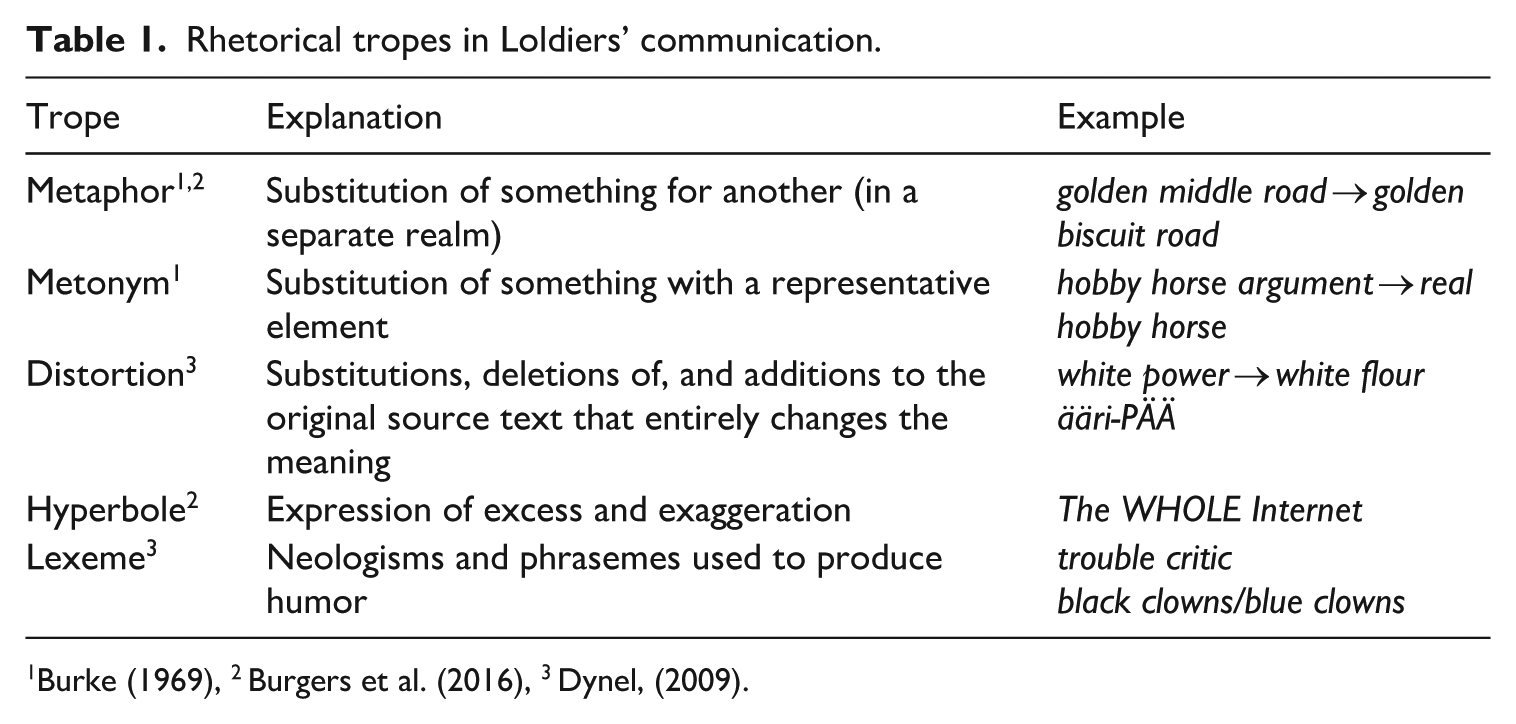
First, all authors read through the 138 posts published by the page to identify recurrent textual styles and patterns. We built on literature that explores figurative language and tropes as a form of public communication and persuasion. We focused on the tropes of metaphor, metonymy, distortion, hyperbole, and lexemes (Burgers et al., 2016; Burke, 1969; Dynel, 2009) and marked how they were used in Loldiers’ Facebook posts. Rhetorical analysis does not so much generate generalizable knowledge as study the particular and possible (Leach, 2000). Therefore, we did not divide each message into a particular category. Rather, we engaged in interpretative analysis to identify recurrent patterns illustrating the representative textual features of Loldiers.
Second, we focused on the communicative aims of digital performance. The first author analyzed all 138 posts using a qualitative, iterative approach by coding each post with keywords identifying the communicative aims of the post. Here, the analysis was based on the textual and visual content of the post as well as any linked external content produced by Loldiers themselves (e.g. videos, blog posts). The analysis was data-driven yet guided by the social movement and political humor literature referenced earlier. The aim was to identify (1) the main communicative aim, (2) the target of parody and the relationship between Loldiers and the target, and (3) potential calls for action or action frames offered in the post. The first round of coding revealed 26 different codes. The codes were then regrouped and combined in two rounds, of which the final round was done by the first and second authors together. The analysis resulted in a typology consisting of five overarching communicative aims: (1) parody of their antagonists SOO, (2) distortion and critique of radical right discourse, (3) mobilization of like-minded individuals, (4) promoting humanitarian clownery, and (5) affirmation by the media or supporters. These aims were somewhat overlapping, particularly in the case of longer posts, videos, and blogposts. Finally, we investigated how figurative language was used to pursue the communicative aims of Loldiers. Here, we compared how the Loldiers’ overall strategies reflect the types of humorous stunts proposed by Sørensen (2016). The findings of the rhetorical analysis are presented in the first section of the analysis and in Table 1.
Rhetorical tropes in Loldiers’ communication.
Outcomes of the performance
The second phase focused on the communicative outcomes and connective action elicited by Loldiers’ performance. We ordered all the posts according to the number of received comments and included the threads receiving the most comments until the total number of comments exceeded 1000. This generated a dataset of seven threads and 1044 comments (Table 2). All selected posts were published during the first month the group was active.
Summary of threads analyzed in the second phase (quotations are excerpts).
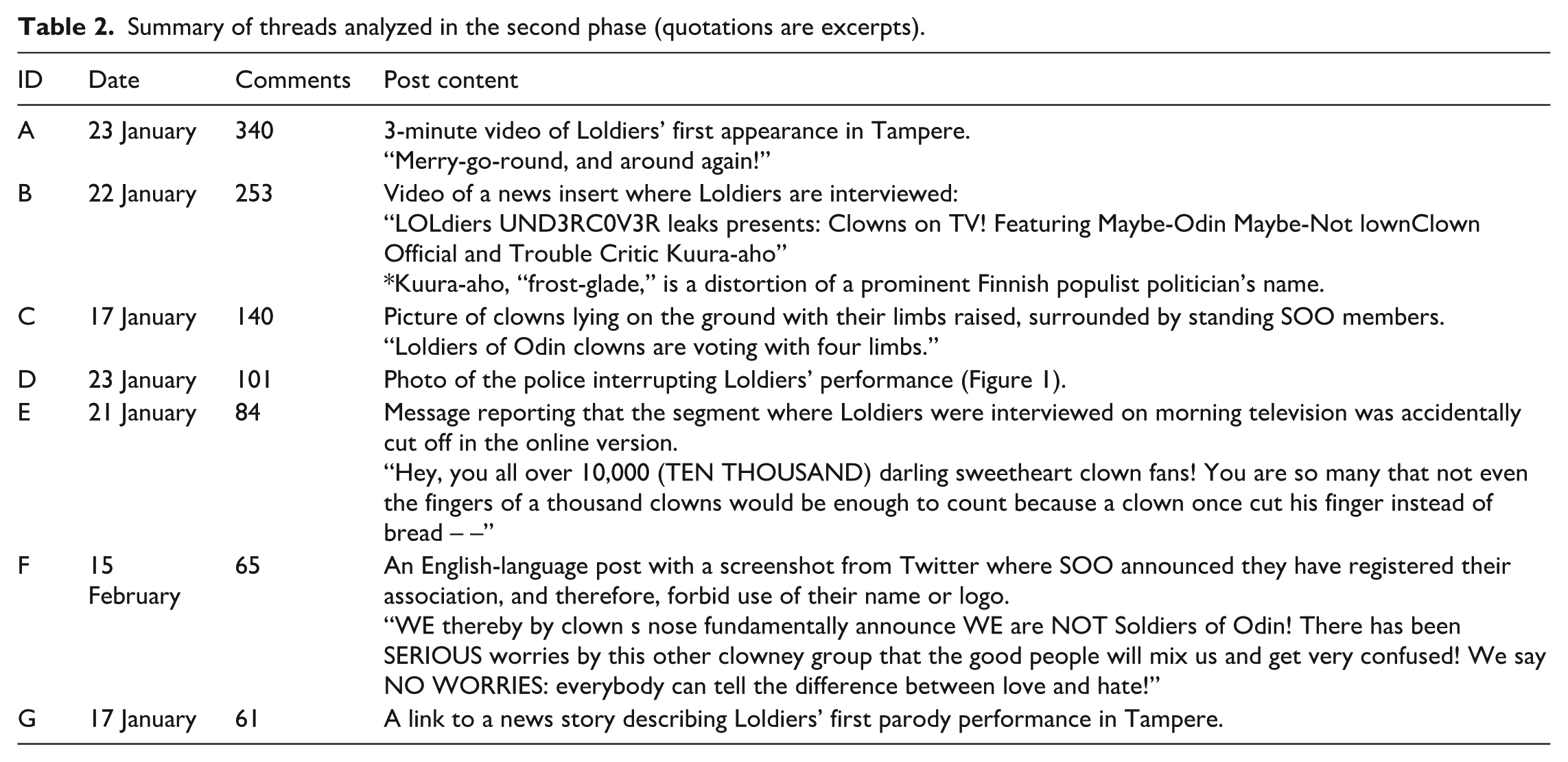
Guided by our second research question, our interest was in the ways in which people responded and expressed their views in connection with the humorous political stunts of Loldiers. Each of the authors read through all 1044 comments for the analysis. First, we searched for patterns, ideal types, and recurring arguments and discourses in the data, making notes while going through the material. When reconvening with our notes, we identified three types of communicative action: support and legitimization, problematization and delegitimization, and (political) contextualization. Accordingly, we coded messages that (1) contained legitimization, that is, expressed support and/or gave a rationale for the performances by Loldiers, (2) criticized or problematized the performance of Loldiers, that is, if they felt the protest was being handled in an incorrect, ineffective, or detrimental manner, (3) contained (political) contextualization, that is, reference to a party or political ideology or connection to societal power structures, political social action, or social/political dichotomies (see Davis et al., 2018). The unit of analysis was a single comment analyzed within the context of the discussion thread and/or sub-thread. Each author was responsible for tagging one of the three types of communication (legitimization, problematization, contextualization). Before going through all the data, we discussed the tagging criteria together by analyzing the first 100 comments in a peer briefing session to reach intercoder agreement and negotiate how we would apply our analytical framework (Kuckartz, 2014).
Results: performance and reception of Loldiers’ naïve and absurd clownery
We present our analysis by first investigating the performance of Loldiers in light of their rhetorical strategies, and then by focusing on reception and how the two are interconnected. Accordingly, the following section summarizes our results based on an analysis of 138 posts by Loldiers.
Parody of the antagonists and distortion of radical right discourse
Foremost, Loldiers of Odin offered a parodic counter-performance to SOO. This feature was present in their street performances and online communication and in their name, activities, and main tropes. In the streets, Loldiers followed dark-dressed SOO members in a happy and noisy procession mimicking their doings, singing, and dancing. Yet, instead of guarding citizens against allegedly dangerous immigrants, they claimed to “bring love and joy on the streets” and patrol against such “mundane trouble” as banana peels on the street. This ironic and metaphorical replacement of a military outlook and elements of anti-immigrant discourse with items from the realm of clownery was a recurrent feature of their rhetoric. Reading Sørensen (2016), Loldiers performed a corrective stunt that hijacked both the identity and the message of their target to propose a correction to their narrative: We brought safety to the night by collecting banana peels (2) from the streets so that no human, dog or clown would slip. Crossing zebra crossings worked out nicely and safely as the clowns were guiding the traffic. (January 13, original in English)
A central aim of the figurative language in Loldiers’ protest was to distort and critique the prevailing messages and rhetoric of the far-right actors. Loldiers used substitutions and lexemes to reclaim and modify words utilized within the contemporary discourse of racism and immigration to ridicule the actions of SOO as well as to point out problems in the more general discussion about immigration. Lexemes often include a metaphorical, metonymic, or synecdotal substitution that works to create irony, often emphasized by mixing lower and upper case letters. For example, “white power” is replaced with “white flour” and “golden middle road” (something sought in Finnish immigration politics) with “golden biscuit road.” Many of these words are context-sensitive and bear reference to Finnish politics. For example, certain Finnish anti-immigrant groups have resigned from racist speech and call themselves “immigration critics.” Loldiers refer to themselves and sometimes to their supporters as “trouble critics” who criticize and counter things that are marked with boredom or hatred. Another example is the concept “extreme ends,” which has been used extensively by anti-immigrant groups to call attention to the pro-immigration camp as the other, equally extreme actor. In Finnish, extreme end is “ääripää,” where the ending -pää translates to head. Loldiers deliberately used the word to concretely refer to the head and discuss, for example, the physical properties of the “ääri-PÄÄ.” In the example below, the ääri-PÄÄ lexeme is also used to target the media by highlighting how they reproduce the far-right discourse: Clown wonders: what does an extreme—end[head] look like? Seems to be full of love and joy! Wild—gotta go and tell the reporters! (May 30)
A frequently mobilized metonymy in Loldiers’ argumentation was that of a hobby horse: Loldiers talked about the concrete toy while simultaneously making a claim that the SOO used the safety of Finnish women as a rhetorical hobby horse argument. The clowns communicated this message concretely by bringing hobby horse toys to their demonstrations and morning television shows and by publicizing it online, for example by sharing instructions on how to make “a real hobby horse.” The hobby horse thus served as a protest artifact (Cammaerts, 2012) with a corrective function but utilized in a very absurd manner (Sørensen, 2016): This is how you make a real HobbyHorse! SPecIAL care should be taken with the MaTEriALs: there are hobby horses galloping around made of women’s rights or war veterans or whatever, but the right materials are in the sEWiNGbaSkEt! (March 17)
Promoting humanitarian ideology through clownery
Loldiers primarily built their movement identity around the idea of clownery and its related ideology, being intentionally naïve and promoting joy, happiness, equality, and solidarity. Clown suits were essential because they highlighted the visual and theatrical dimensions of the performance. Some clowns chose anonymity, but many adopted personas with names parodying known figures in SOO or in radical right-wing politics (e.g. Post A in Table 2). The group connected clownery with fun and laughter, associating some of the figurative elements with the broader solidarity movement: rainbows, colors, and hyperbolic talk of the galaxy and universe. Loldiers frequently used hyperboles to exaggerate their activities and achievements. Thus, the clown and clownery worked as a discursive metonymy to promote wider ideologies of inclusiveness and solidarity: Loldiers work day-and-night interGALACTICALLY because: in in-side every human there is a more-or-less tiny clown! Lets bring them out together! <3 <3 <3. (February 6, original in English)
Furthermore, Loldiers used the vocabulary of clownery to describe their allies and antagonists. They referred to various groups of people as “clowns,” with SOO being the other clowns, or “black clowns,” and the police being “blue clowns” (see Figure 1). Loldiers called themselves “real clowns,” actors who “SpreAD JOy LauGhter and LOve” (24 October), and supporters and collaborators “friends.” This rhetorical move highlights two aspects of humorous stunts (Sørensen, 2016): first, it allowed Loldiers to hide behind the innocent, naïve façade of clownery and pretend not to be protesting, and second, built a sense of absurdity that worked to refute any rationality in SOO’s activities. As our analysis of the responses next shows, the figure of a clown enhanced the polysemy of the performance since this popular archetype is associated with both fun and ridicule targeted at both the clown and others.
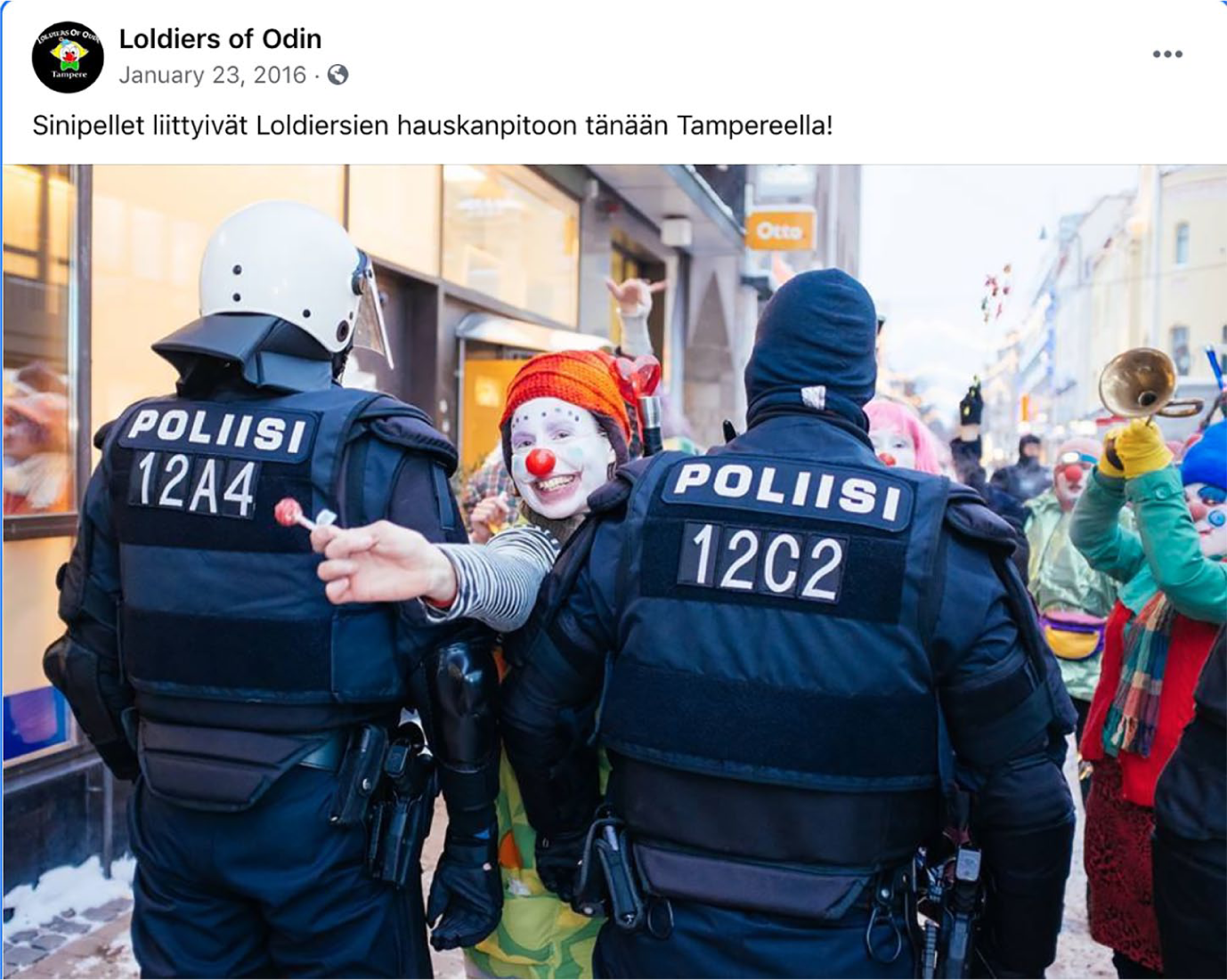
Loldiers’ post on 23 January 2016. “The blue clowns joined Loldiers for the ball today in Tampere!” Photo included in Loldiers’ press kit.
Mobilization of like-minded persons and affirmation by the media
While most of the communication by Loldiers focused on covering their performances, a few posts mentioned direct forms of mobilization, such as invitations to major solidarity demonstrations or a profile picture frame. Loldiers framed such calls to action with clownery: they built on the idea of real clowns spreading love and joy and acting as warriors of solidarity and humanitarian values: “Now iT Is yOuR cHanCe to aCt LIke a REaL cLOwn!” (27 October). This rhetoric also prevailed beyond the active street patrolling period, as the last few posts from October to December 2016 focused on mobilizing the clowns and clown-minded persons: Absolutely PeRfect time for all you clowns and clown-Minded to Raise your voices for InteRgalactic peace and colouRful stReets!! (27 January, original in English)
Throughout their performance, Loldiers remained in character and offered no rational explanations for their actions either in media appearances or on Facebook. Most of their posts included links to and quotes from media coverage. Loldiers used them as artifacts to affirm their protests and success and also borrowed the journalists’ words to explain their protests. Several times they participated in the discussion, mostly responding to direct questions, but sometimes by making ironic remarks to their critics: “Dumb<3. Thanks, maybe you are a little bit dumb too, silly you!” (Thread C). In other words, Loldiers themselves provided no rational justification nor ironic markers and cues that would make their critical intentions clear enough to render their protest monosemic. In light of Sørensen’s (2016) typology, Loldiers adopted a mixture of absurd, naïve, and corrective political stunts; they hijacked the identities of those they opposed, creating alternative versions of persons associated with SOO and the far-right movement, but also transformed the rules, roles, and rationality of the dominant discourse promoted by the anti-immigration actors through silliness and absurdity.
Communicative outcomes of the protest
Our second RQ asked what kinds of communicative outcomes are produced as a response to the Loldiers’ performance. We explored these outcomes in detail by analyzing a set of 1044 comments posted in response to the seven posts receiving the most comments on the Facebook page. Three of the posts were visual coverage of the performances, three promoted the received media attention, and one update was an indirect reply to SOO disputing the Loldiers’ name.
Support and legitimization
Support was expressed in simple statements like “Great work!” or positive emojis, and the clever use of humor by Loldiers was admired. The rhetorical strategy of distortion also proved contagious; some commenters engaged in banter that adopted the rhetoric and language of Loldiers, for example by using the metonyms of different clown characters when talking about police or SOO, or by mobilizing Loldiers’ lexemes and objects, such as the hobby horse or lollipops. One discussant, for instance, responded to critical commenters in the same thread as follows: A lollipop to Raimo, ice cream for Sirkka-Liisa. Strawberry ice cream. Thread A
The supporting comments can be understood as legitimizing the performance because they portray Loldiers’ actions as positive, rational, beneficial, ethical, understandable, or otherwise acceptable (Van Leeuwen, 2007). One response type that included legitimation was clarifying comments that explained how the performances were about political parody and art. Clarifications were especially offered as responses to the posts involving links to videos of Loldiers’ parodic performances (Threads A, B): figurative tropes such as the hobby horse, subtle irony markers, and specific background knowledge to decode irony were explained. Thus, the parody and related tropes of distortion generated online discussion about the problematic discourses they targeted. The comments gave the ironic means of Loldiers a rationale in relation to their aims: Actually, carnivalization has a long tradition, and in many countries it has been one of the only means for protesting in any semi-safe way against societal wrong-doings. Apparently in Finland not even laughing is safe, as one can be taken by the blue uncles [the police]. Thread A
The butt of the joke was another issue debated and clarified in the comments: Did Loldiers make fun of SOO, the police, the media, themselves, or everybody? While the ambiguous status of clownery empowered all interpretations, the supporting comments mostly emphasized how the activists made SOO and, at times, the media and the police look foolish. As one supporting comment put it, “Clowns against clowns, brilliant” (Thread A).
Another prominent way to legitimize Loldiers was to emphasize how their performances were fun and added a refreshing approach to the otherwise serious topic of immigration politics. These comments underlined the hedonic dimension of ironic humor: decoding parody requires spotting an intended incongruity (i.e. mimicking to criticize) and produces intellectual joy and feelings of superiority in relation to those targeted by the humor or those who do not get the irony (Friedman and Kuipers, 2013; Gal, 2019). Some comments also praised the performances as clever and highbrow, implying or explicitly suggesting that right-wingers or less-educated persons might not understand them. For instance, one commentator wrote, “scornfully giggles to these folks who don’t get these metaphors” (Thread B). In the case of Loldiers, the ironic cues (Gal et al., 2020; Hutcheon, 2000) varied from straightforward (e.g. SOO are clowns) to more subtle cues that require background knowledge about the Finnish far right (e.g. distorted names). These comments simultaneously legitimized the performance and constructed a symbolic boundary between the intellectually superior liberals and intellectually inferior right wing, who fail to grasp the irony or take the protest too seriously. Yet, in other contexts, this kind of boundary work through ironic online communication is also conducted by right-wing activists (Greene, 2019; Hakoköngäs et al., 2020): The clowns operate on such a level that the Nazi clowns don’t have enough wit to understand that everybody is laughing at them. Thread B
Problematizing and delegitimizing the performance
The rhetorical strategy of clownery and anonymity of the clowns elicited problematizing discourses in our data. Dislike toward Loldiers was expressed either in short judgmental messages, like “What a bunch of idiots,” direct criticism of their conduct toward authorities, or detailed discussions criticizing the performative protest style. As mentioned earlier, others saw their performance as a clever and refreshing way to oppose SOO and similar groups, who were frequently referred to as Nazis in the discussions. For others, the absurd clownery of Loldiers was a red flag: even if the commenters agreed with the main message, the humoristic, disguised protest was deemed unacceptable and illegitimate. Several comments judged Loldiers’ conduct as stupid, childish, and illegal, which was seen to diminish the relevance of the protest: I feel so terribly second-hand embarrassed for you “tree huggers” . . . You make finland [sic] look like an official clown. Thread C
In many of the longer comments, the discussants praised Loldiers’ idea, but disapproved of the implementation, considering it disrespectful toward the police or media. Several commenters indicated that Loldiers did not file an official notice about the demonstration, as required by law, and that it was Loldiers who “burdened the authorities with their heckling and jailing” (Thread F). These discussions arguably reflected the prominent Finnish informal convention of trusting and obeying authorities.
The problematization culminated in the juxtaposition of humor and seriousness. One persistent claim was that the parody approach undermined the message and sidetracked the ongoing conversation about the detrimental consequences of street patrolling. The opposing discussants argued that the correct manner of discussion is a rational one—perhaps as a response to the emotional recognition and collectivity shown by the supporters (see Persson, 2017). Humorous stunts often express criticism by being both amusing and serious at the same time (Sørensen, 2016). Based on our data, it is obvious that the link was not always established. Instead, discussants felt that the Loldiers’ intended message went undelivered, as it was masked by the performance and particularly by the naïve clownery. This criticism targeted especially the Loldiers’ television performance (Threads B, E). As one commenter put it, Loldiers missed the opportunity to make an argument in mainstream media: It might work to laugh [the issue] off on streets and squares, but not in a tv studio. I appreciate what you are doing, but the performance on the morning show did not go very well. Thread E
Broader context: polarized immigration discussion
From party politics to civic participation, the political underpinnings of the Loldiers’ protest were clarified and elaborated further by the discussants. Loldiers’ performance contributed to the ongoing political discussion on immigration through parodying the SOO and distorting radical right discourse. In threads A and B, comments focused on the accessibility and legitimacy of the actions of both the SOO and Loldiers and discussed the legitimacy of street patrolling and demonstration as forms of political participation. Some framed the Loldiers’ performance as a mere provocation that only served to accelerate the success of its opponents. First, their actions prompted arguments as to why SOO indeed were needed on the streets, thus indirectly supporting SOO’s cause. Second, when both Soldiers and Loldiers were portrayed together, it made the SOO look like calm and rational actors following the authorities’ regulations: There are people actually worried about the flood of immigration, and if you criticize these worries dressed as clowns, it’s wrong. Or that there are volunteers patrolling the streets and they are being disturbed and provoked. Thread A
The above quotation shows that many comments included general opinions about immigration or the potential problems it would generate, often undermining Loldiers’ cause of solidarity. The discussions frequently mentioned existing political groups connected with the immigration question and made references to certain parties, most often to the nationalist-conservative Finns Party or the “left-green” alignment, which the discussants treated as political opposites. Connections to Nazism were present but contested: some either suggested that SOO were representative of neo-Nazism or then questioned the connection: “—did you see any Nazis, swastikas, or hear any Nazi songs?”
Discussions constantly evoked the ideological dichotomy between suspected racism and excessive tolerance: Loldiers were deemed representative of more “tolerant” people and their agenda reflective of an overly tolerant attitude toward immigration—thus, bringing forth their significant role in the ongoing societal negotiation of it. Others gave legitimacy to Loldiers for opposing the far right or “Nazis,” viewing any means of countering such actors as being morally justified. On several occasions, most notably in Thread G, these discussions developed into heated quarrels, where both sides traded insults. In this vein, some commentators noted how this type of (political) mockery only strengthened the existing polarization instead of making the message of the tolerant (or even leftist or “leftist-anarchist”) side clearer to a larger audience. Thus, the carefully constructed distortions of the polarized discourse paradoxically generated more polarized discourse: You were given a chance to comment on the current situation from your point of view, and you used it to destroy all your credibility by literally clowning around. This summarizes Finnish immigration politics: both sides are unable to carry on fact-based and solution-oriented discussion. Thread B
Discussion and conclusion
This article used Facebook data to explore the rhetorical strategies of a political parody performance called Loldiers of Odin and the online communicative outcomes propelled by their stunt. We showed how the mainstay of Loldiers’ online and offline performance was figurative language and intentionally naïve and absurd clownery. Loldiers used clownery strategically to generate an absurd parody of their antagonists, but also to promote a humanitarian ideology, happiness, and solidarity and to mobilize their supporters. They used language filled with metaphors, hyperbole, and lexemes to parody SOO and the radical right by distorting and reappropriating their language. By using criticism in such a manner, their communication worked to counter-frame SOO’s narrative. Loldiers’ performance was a combination of physical and digital activities, and the street performances were essential in gaining media coverage and attracting online followers; the most commented posts in our data included media shares or visual coverage of Loldiers’ performances, often used to affirm the clowns’ message. Furthermore, in covering patrolling events involving both SOO and Loldiers, the press then replicated the main parodic metaphor of the Loldiers’ strategy: the analogy between SOO and clowns. This highlights the mediated, hybrid nature of Loldiers’ media-savvy protest (Cammaerts, 2012; Chadwick, 2013).
To explore the communicative outcomes of the performance, we qualitatively analyzed the seven most commented threads on Loldiers’ Facebook page. Existing studies have accentuated the importance of humor and parody stunts and their role in generating in-group solidarity and denigrating political opponents (Gal, 2019; Greene, 2019; Hakoköngäs et al., 2020; Halabi, 2017; Sørensen, 2016). Our study assessed the impact of political humor in ways that complement traditional outcome measures of political science (Young et al., 2014) by looking at the digital political participation and polyvocal expression it cultivates.
All the main rhetorical strategies of Loldiers identified in the first part of our analysis elicited both support and opposition, legitimizing and delegitimizing comments. The supporting comments illustrated how, for many, Loldiers’ clownery created an arena for expressing feelings of tolerance and public discontent with racism, thus giving space to the affective and social aspects of politics (Fenton, 2016). Thus, the parodic performance created everyday mobilization, affirmation, and senses of solidarity and belonging, which are all important building blocks for online activism (Day, 2011; Hatakka, 2019; Persson, 2017) and have potential consequences in the long term (Halabi, 2017; Reilly and Boler, 2014). Some commenters even adopted Loldiers’ language: both the promotion of joy and love, but also the distortions. Yet, Loldiers’ polysemic language and rhetorical strategies also sparked debates over the meaning of their performance. Those supporting Loldiers legitimized the clowns’ actions by explaining the ironic nature of the performance or the meaning of a particular metaphor. Within some of the supporting comments, ironic, and intertextual humor explicitly acted as a boundary between the “intellectual left” and the “stupid right,” thus strengthening existing communities (also Friedman and Kuipers, 2013; Gal, 2019; Greene, 2019; Phillips and Milner, 2017).
For many, Loldiers’ clownery was a reason to deny the credibility and legitimacy of the stunt. Thus, some audiences failed to see beyond the parody; they observed the absurdity and naivety of the stunt but refused the corrective dimension (Sørensen, 2016). Instead, the absurd and naïve dimensions were framed as a provocation toward SOO, and when combined with clownery, unintentionally made SOO seem rational and justifiable. Moreover, many felt that Loldiers’ refusal to give any rational justification for their deeds compromised their goal of criticizing anti-immigration activism. Indeed, researchers have suggested that stepping out of the parody role is a crucial move to establish credibility (Young et al., 2014). Within the context of a politically polarized topic such as immigration, Loldiers’ disguised parody proved to be an ambivalent strategy that generated a call for political identification and affirmation, but also objection and problematization—which illustrates the complexity of using humor to mobilize support. Some of the reflexive comments argued that ridiculing political opponents can enhance polarization, which to some extent was the case: discussions about Loldiers ended up reproducing existing cleavages. This occurred particularly in longer sub-threads involving disagreements among discussants. Such debates seem counterproductive for a protest aiming at solidarity and inclusion. Yet, perhaps more accurately, this represents the paradoxical nature of political humor as both unifier and divider (also Meyer, 2000).
Overall, our analysis suggests that, while polysemic humor and parody work well to attract media attention and reach like-minded digital audiences—forms some would call clicktivism—it easily fails to foster political deliberation or concrete action. Loldiers’ performance did evoke some wider discussions about immigration politics and contemplation about the existing political polarization in Finland, but mostly the absurd parody repelled topical discussion. Rather, we argue that absurd parody stunts that are performed only in character seem to summon meta-level discourses of legitimation and delegitimation of the performance itself and contribute to the construction of existing symbolic identity boundaries between us and them in the form of supportive and opposing argumentation. Thus, just as polysemic irony allows for multiple interpretations, it also works to amplify audience members’ political stands and existing alliances. While such an effect could be desirable for political activism, simultaneously it potentially bolsters the polarization of online discussion. We assert that this polarizing tendency is supported by the logics of the hybrid media system, where online parody stunts are easily covered by news media and activists often seek such coverage (Cammaerts, 2012) and where collective solidarity is intermingled with digital visibility (Fenton, 2016). As our analysis is limited to a single case in the political and cultural context of a Nordic country, we suggest future studies to explore the communicative outcomes and forms of connective action surrounding political humor in different national and transnational contexts, with a focus on the interplay between different media forms and logics.
Footnotes
Funding
This research was supported by the Academy of Finland research project HYBRA: Racisms and public communication in hybrid media system (grant number 295948/2016) and the Finnish Cultural Foundation under the grant 00180538; Suomen Kulttuurirahasto.
