




Abstract
Although some scholars have argued that social media provide opportunities for sportswomen to bypass mainstream media reporting, there is little existing research on how female athletes use, and experience, digital platforms. This article uses insights from studies of ‘gendered visibility’ alongside work on ‘closeness and distance’ in journalism studies to put forward the concept of ‘appropriate distance’ when trying to understand how these athletes manage their time and engagements online. Drawing on interviews with UK-based elite sportswomen, the findings not only show how distance is carefully managed to protect themselves from negative comments and over-exposure online, but also the significance of building connections with young female followers. Indeed, the athletes prize their status as ‘role models’ and seek to provide ongoing support and a sense of community in what is often an antagonistic online space.
Introduction
The impact of digital technologies has refocused attention on what was initially labelled as the sports–media complex (Jhally, 1989) over three decades ago. This more recent wave of research has pointed to the emergence of dispersed online fan communities (Rowe et al., 2010), the novel connections that social media has generated between clubs, players and journalists (Kassing and Sanderson, 2015; Price et al., 2013), and the challenge that digital piracy offers to sporting authorities and sports-rights holders (David and Millward, 2012). Relatively little of this work has explored the experiences of elite athletes and what research has been carried out predominately focuses on high-profile team sports (Lim et al., 2020) and events (Hayes et al., 2019, 2020) or tends to come from a marketing/branding perspective (Burch and Zimmerman, 2019; Geurin, 2017). This article, then, looks to fill an important gap by examining the experiences and attitudes of elite female athletes, operating in mid-level sports, 1 who are active on social media.
This group is of particular interest for two key reasons. First, as the mainstream media has often marginalised women’s sport, it represents an opportunity to explore the argument that social media platforms ‘allow women to express their gendered identities, network, and share their meanings about sport’ (Bruce, 2017: 34). Second, given the abhorrent abuse that high-profile women have suffered in the online sphere, including journalists (Eckert, 2018), political leaders and activists (Banet-Weiser, 2018), creative entrepreneurs (Duffy and Hund, 2019), and academics (Chess and Shaw, 2015), it is important to understand how elite female athletes navigate such spaces as well as the particular challenges they may face.
This article comprises three main sections. In the first, we briefly situate this study within wider debates around gender, media and sport, with a particular focus on the impact of digital technologies and the relatively small body of research on sportswomen’s use of social media. We then use insights from recent work on ‘gendered visibility’ (Duffy and Hund, 2019; Toffoletti et al., 2021) and research on ‘closeness and distance’ in journalism studies (Pantti, 2013) to put forward the concept of ‘appropriate distance’ as a means of understanding how elite female athletes manage their time and engagements on social media. Appropriate distance offers a useful heuristic for thinking about the different types of stakeholders that sportswomen come across in online spaces, in this case ranging from sponsors and fans to trolls and fellow competitors. It also points to the careful balancing act that such athletes must strike when it comes to accessing resources while also managing potential risks.
In the second part, we discuss the method and, in particular, how the data for this project were collected and analysed. It should be emphasised at this point that the qualitative nature of this work, and the small sample size, means that it should be viewed as an exploratory piece of research designed to highlight key themes in relation to a specific national context, the United Kingdom. Finally, in the third section of the article, we discuss the findings pointing to the tension between closeness and distance in relation to three key themes. The first offers a novel, and very positive, outlook on the topic and demonstrates the commitment female athletes have to being role models for younger (female) fans and the manner in which they use social media to develop a closer, more direct engagement as a means of encouraging and supporting participation in sport.
The second addresses a further potential benefit in terms of building relations with general fans of the sport and, in the process, making them more visible to sponsors. Here, while growing visibility is generally defined in positive terms, female athletes are concerned about the pressures that they are put under to present stereotypical (and often sexualised) images in order to boost their profiles and generate further interest in their activities. These discussions highlight, once again, the highly gendered nature of online spaces with female athletes often subject to unwanted scrutiny, some of it abusive, and forced to carefully manage how they present themselves. Leading on from this, the third theme shows the ambivalence elite athletes sometimes show towards social media not only in terms of inappropriate comments but also how it impacts on their training regimes and sporting performance. This, combined with a woeful lack of training and education, often means that keeping an appropriate distance from social media can be necessary to protect their physical and mental health.
Gender, sport and media
While coverage of major sporting events involving female athletes has improved in both scope and quality in the past few years (Bruce, 2017; Cooky et al., 2013), three decades of research on the relationship between gender, sport and media (Cooky et al., 2021; Godoy-Pressland, 2014) has consistently demonstrated the extent to which women’s sport has been marginalised, stigmatised and stereotyped.
In looking to understand these processes, Jennifer Hargreaves’ (1986) writing on ‘sporting masculinity’ (p. 117) shows how sport became a focus for the expression of male dominance and promoted idealised characteristics such as aggressiveness, assertiveness, strength and violence (Magrath et al., 2020). Therefore, this ongoing construction of sport as a ‘male domain’ can be used to explain resistance to women’s involvement in sport at all levels. Historically, mainstream media have been central to these processes, with research across the globe showing that only 5–10% of total sport coverage is devoted to women’s sport (Bruce, 2017; Godoy-Pressland, 2014). When the media do bother to address the subject, the coverage is often marked by two key processes: trivialization and sexualisation. In the first place, as Toni Bruce observes, sportswomen are often unfavourably judged in comparison to their male counterparts (2017). This means that the attributes and achievements of female athletes are downplayed or trivialised (Biscomb and Griggs, 2012) rather than being discussed or celebrated on their own terms.
Aesthetics over achievement
Another key feature of much media reporting of women’s sport is that it often promotes aesthetics over achievements assuming a heteronormative male gaze which views, and evaluates, sportswomen as objects of sexual desire, not as competent athletes (Cooky et al., 2013: 223, Godoy-Pressland, 2014; Vincent et al., 2007). Needless to say, the prioritisation of looks and style over performance rarely occurs in the coverage of male athletes
It is worth noting that while much of the extant literature tends to deal with ‘legacy’ media, more recent work shows that similar issues can be found on digital platforms. For instance, a study by Romney and Johnson (2020) that examined the Instagram feeds of four major American sports networks not only showed that ‘women’s athletic coverage lags significantly behind men’s’ but also that ‘females are more likely to appear alongside a male and are more likely be shown in culturally “appropriate” sports and in non-athletic roles’ (p. 738). Elsewhere, studies of Twitter by Hull (2017) and Adá Lameiras and Rodríguez-Castro (2020) indicated that less than 4% of tweets by the sports media involved female athletes.
Although this means that digital media cannot be seen as a simple panacea for the dismal representation of women’s sport, others have argued that such platforms do at least provide an opportunity for women’s sporting organisations, clubs and players to side-step dominant media organisations and discuss their own achievements and experiences (Vann, 2014). As Toni Bruce (2017) argues, ‘access to the Internet has created spaces for alternative voices on women’s sport to appear and even gain mainstream media attention’ (p. 34). This will be the topic of the following section.
Elite sportswomen’s use of social media
Early studies of female athletes online (self)presentation focused on Twitter and noted how most elite athletes focused on their personal lives, thus distinguishing their social media content from mainstream media reportage (Pegoraro, 2010). More recent work in this area has tended to focus on Instagram, which is particularly effective in allowing athletes to promote themselves through the sharing of images and videos (Toffoletti and Thorpe, 2018a). Here, there is a small but growing body of work which analyses online posts to explore how female athletes represent themselves. For instance, Reichart-Smith and Sanderson (2015) noted that while female athletes can be found in marginally more suggestive poses, most of the content was similar to their male counterparts and, as for Twitter, focused on their personal, rather than professional, lives. In contrast, Geurin-Eagleman and Burch’s (2016) study, which compared male and female Olympians’ self-presentation on Instagram, found that sportswomen focus on their personal life and non-sport-related posts were not mirrored by males, who posted more sport and training-related content. One final point to note here, given the interests of this study, is that although many athletes did post personal information about their lives, there was very little engagement with individual messages or comments (Toffoletti and Thorpe, 2018b: 308). This is something that we will pick up on later as the athletes we spoke to did make concerted efforts to engage with a particular type of online follower.
Economies of online visibility
Another key issue addressed by recent research concerns athletes’ use of sexually suggestive photos as although they are not common on sportswomen’s feeds, they were the most popular photos for fans in terms of interaction (likes, comments) (Burch and Zimmerman, 2019; Geurin, 2017; Geurin-Eagleman and Burch, 2016; Ramsay and Horan, 2018). This poses a particular dilemma for female athletes. As Toffoletti and Thorpe observe (2018a: 1), there are ‘economies of visibility’ operating across social media, and many sportswomen, notably those who participate in sports that are mid-level and/or not well-funded, may sometimes feel pressure to post sexually suggestive images of themselves in order to generate further interest in their activities, notably from sponsors.
In turn, many studies also noted that sportswomen continue to be subject to unwanted attention on their profile, usually private communication of a sexual nature (Geurin, 2017; Manago et al., 2015). In their analysis of the online abuse that Maria Sharapova suffered during Wimbledon 2015, Litchfield et al. (2016) found three main themes: admiration of physical beauty/sexualisation, threatening physical/sexual contact and emotional ridicule/aggression. These findings are supported by other work (Jane, 2016), which shows the extent to which online misogyny has become a frequent response to female generated content, especially for women in traditionally male dominated industries, such as sport.
Given this situation, it is important for high-profile sportswomen to have access to support and training to help them navigate the online sphere. However, Andrea Guerin’s (2017) research has shown that individual athletes in lower-profile sports receive very little training, guidance and support for using social media. This meant many sportswomen are forced to improvise their approach even as they are being encouraged to use social media in an attempt to boost their own profiles and the visibility of the sports they participate in
Appropriate distance
When levance of the extant literature to our own study, we became particularly interested in some of the key tensions that elite female athletes face when negotiating online spaces. On one hand, they wanted to engage with certain groups in a positive and proactive manner. On the other, they were wary of how others might respond to their posts or, indeed, about how much time they were spending on social media. In order to develop a unified framework for making sense of these tensions, we draw on insights from two different areas: work on ‘gendered visibility’ on Instagram (Duffy and Hund, 2019; Toffoletti et al., 2021) and studies of ‘closeness and distance’ in journalism studies (Pantti, 2013). In the first case, Brooke Erin Duffy (2017, Duffy and Hund, 2019) has written extensively about the challenges that women face in online spaces, subject to particular expectations about the way they should or should not behave and present themselves while at the same time also required to manage the potential risks of being ridiculed, harassed or abused. They argue that in negotiating this double bind of seeking visibility, in order to accrue economic and socio-cultural resources, while also managing vulnerability the content creators ‘engaged in strategic acts of revelation and concealment, a delicate form of self-promotion and self-protection’ (Duffy and Hund, 2019: 4977). While Duffy’s work on influencers tends to focus on visibility in more instrumental terms, engaging followers to build a more attractive brand, Kim Toffoletti and colleagues’ study (2021) of ‘ordinary’ Instagram users points to another feature of visibility that is used by women to manage vulnerability. This refers to the way that users seek to highlight their own activities as a means of foregrounding shared experiences and in the process creating a sense of community online. Such practices are designed to offer advice, inspiration and support and this very much mirrors some of our own findings with elite female athletes.
We believe that such approaches can be bolstered by work in the field of journalism studies, which is not so much about concealing or revealing but the related question of closeness and distance. Here we begin with Roger Silverstone’s (2013) work on ‘proper distance’ which was developed in relation to a very different issue: how journalists might look to engage news audiences with stories of distant suffering. As Mervi Pantti (2013) has argued, this means adopting a relationship with audiences that ‘needs to be close but not too close, distant, but not too distant’ (p. 213). In moving from the concept of proper to appropriate distance, we not only shift focus from news to sports coverage, but also wish to highlight two key conceptual points. First, proper distance deals with a ‘sweet spot’ (not too close, not too distant) while appropriate distance focuses on how social media users position themselves at particular moments and how the management of closeness and distance come to inform their activities, notably for groups for whom visibility matters but are also operating in a potentially risky environment. Second, we use the term ‘appropriate distance’ to highlight the extent to which online media users display agency in trying to manage these shifting, sometimes beneficial, sometimes troubling, relationships, even if they are not always successful in their endeavours. Having reviewed the literature and outlined our own conceptual framework, in the next section, we discuss how the data that formed the basis for this study was collected and analysed.
Method
As for many high-status groups, accessing elite athletes is often challenging due to both their busy schedules and the need for a trusted gatekeeper to explain the purpose of the research. Therefore, we were fortunate that the lead author was able to draw on her status as a national athlete to conduct semi-structured interviews with 12 elite sportswomen, all lasting 30–60 minutes. Due to COVID-19 restrictions, video interviews were used so geographical proximity was not an issue. The athletes involved were aged between 20 and 35 years and came from a variety of ethnic backgrounds. It should be noted that while an intersectional lens is absolutely key for a more complete understanding of how women from a range of backgrounds experience and navigate both sporting and online domains, our interviews featured very few mentions of racism with a much greater focus on sexism and misogynistic attitudes. Therefore, for the purposes of this article we have decided to focus on the latter.
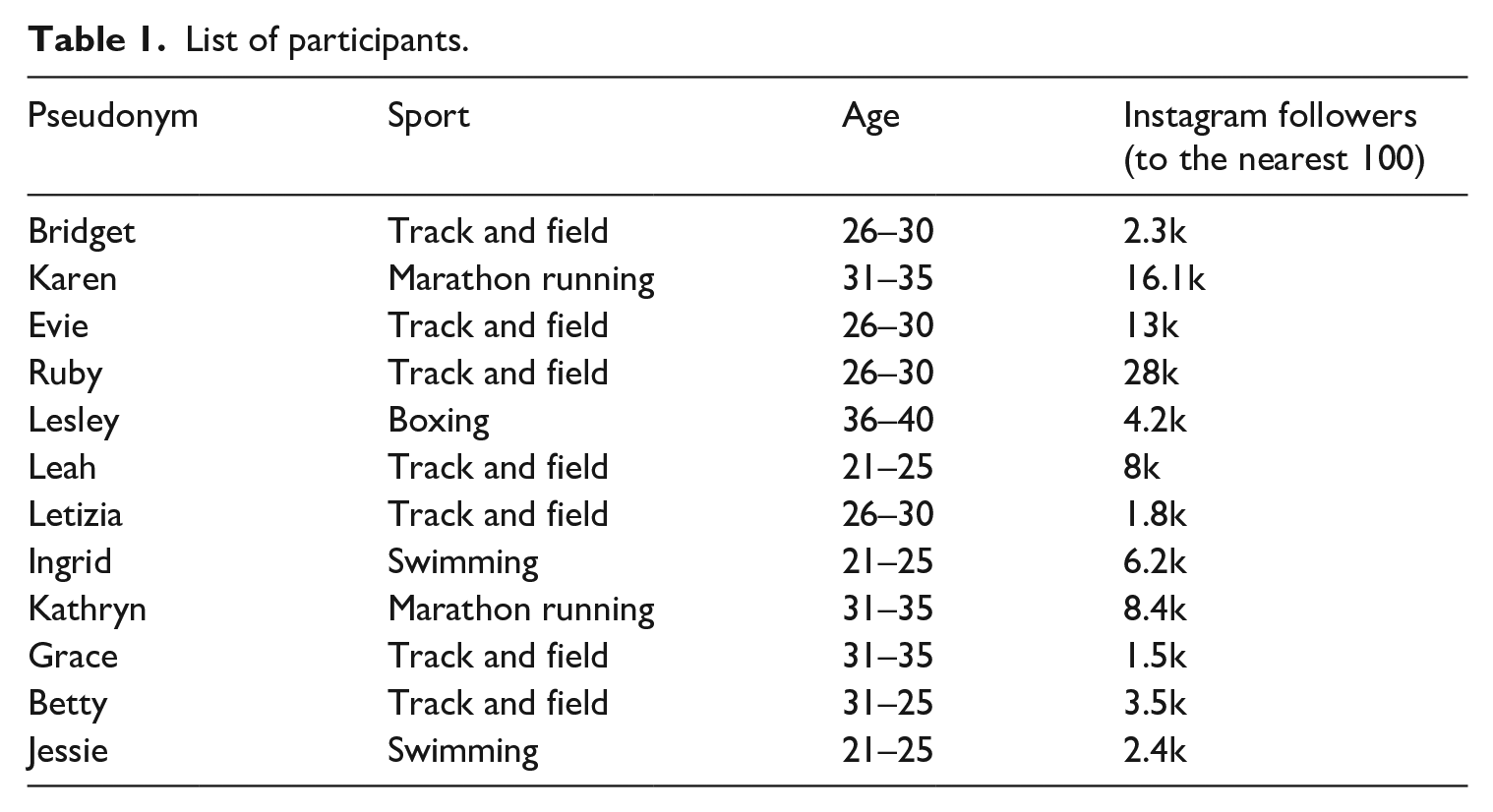
All participants competed in individual and mid-level sports, which are often overlooked by existing research (see Table 1 for a complete list of participants and their sports). Therefore, the study findings are not generalisable to the entire population of sportswomen but as much existing research tends to focus on the most high profile of elite athletes, this work offers a novel perspective on the lives and experiences of athletes participating in less visible and/or well-funded sports.
List of participants.
All participants were provided with details about the objectives of the research and signed an informed consent form prior to the interview starting. Given the ‘difficult’ nature of some of the discussions (around online misogyny) participants were reassured that if they felt uncomfortable at any time, they were free to change the subject, close the interview or withdraw from the research.
Questions explored the athletes’ experiences of mainstream media coverage of both themselves and their sports and their use, and experience of, social media, with a particular focus on Instagram. Participants were also asked to go through their Instagram feeds, discussing their thoughts on the content and any noteworthy posts. Interviews were conducted virtually via Zoom video calls and then recorded and fully transcribed.
A two-stage thematic analysis was conducted, first to identify broader patterns in the interview transcripts and links to existing research on the topic. Through an initial process of open coding, two key themes around opportunities and challenges were first identified and these themes were subsequently recoded and broken down into further sub-categories (sponsorship, visibility, role models and sexualisation/abuse, time/training). In the following section, we use illustrative examples from the interview to highlight some of these themes, which not only support some of the current findings but also offer new perspectives on the way in which elite athletes both understand their role and, accordingly, seek to manage ‘appropriate distance’ with sponsors, fans and followers.
In the next section, we first address one of the most novel themes that emerged from our data. This concerns the importance of social media in providing athletes with a platform to inspire young women and the manner in which they looked to create closeness and a sense of community with these followers.
Findings: role models and a duty of care
Many of the interviewees pointed to their status as a ‘role model’ and took it very seriously whether in more general terms or when thinking about particular groups who they might inspire and support: The aspect of being a female athlete and being a role model and things like that are, they seem to be part and parcel to what a female athlete is about for whatever reason and I think that’s been a real positive on social media as well. (Lesley) . . . whenever I post stuff of me training, I know that my club, and all the fourteen year old girls at clubs in [my country] are gonna be like ‘right *Jessie* is doing this so maybe I should do something’ in that kinda way. So, I feel like it was my duty to be doing that, almost. (Jessie)
Although there is a small literature concerning athletes as role models (e.g. Armour and Duncombe, 2012), very little research has discussed the role of social media as a tool for sportswomen to inspire a younger generation and, in particular, to offer guidance to young women in what is a highly gendered domain. Toffoletti and Thorpe (2018a: 1) found that sportswomen’s content on social media was sometimes accompanied with quite general captions encouraging followers to love or look after themselves, but our findings point to the ways in which social media allows elite athletes to articulate their duty of care to younger people through the way they represent themselves and make connections with those who follow them.
It is also worth noting that some athletes we spoke to were very aware of the challenge that much social media content, with its lazy stereotypes and sexualised tropes, represents to young women who are interested in sport (Mean and Kassing, 2008). For instance, Letiza points to the importance of maintaining her visibility in online spaces so that she can challenge many of the unrealistic expectations on social media which she believed can be used to partially explain the drop-out rate of young women in sport
2
: social media [has] . . . made staying in sport quite difficult for some girls, so I think that is really important to stay on top of it and be a good role model.
Adopting the position of ‘role model’ and inspiring young athletes took a variety of forms across the athletes’ social media pages. One notable feature was the way in which many of the athletes produced informative and educational content concerning sport and training aimed at young people. For instance, Evie made technical training videos over lockdown to educate and motivate young athletes who might have been without a coach, stating, ‘I like to be educational, I like to put out content that are useful to athletes, useful to kids.’. . . Producing this type of content is costly for the athletes in terms of time and effort, and not a part of their ‘job’ as an athlete, conveying the lengths they will go to try and build connections with younger followers.
Building connections
Another crucial way in which the athletes we spoke to sought to build connections with particular groups was through the use of direct messages (DMs). We noted earlier, when discussing the extant literature, that while many elite athletes used social media to provide insights into their daily lives, few moved beyond this to directly connect with followers. Alternatively, our study found that most of the athletes interviewed carefully monitored their profile’s inbox and made use of DMs to support, encourage and inspire individuals: . . . proper engagement definitely happens more in my inbox and I always reply, and as a result of that, it’s ended up with kids coming down to the gym with their parents coming to watch a training session and join in . . . that’s led to some . . . really meaningful interactions way beyond social media, but enabled by it. It’s been a fantastic platform for that. It’s led to some really key engagement, connections and networking. (Lesley)
It could be argued that these athletes have more opportunities to respond to DM requests because of their relatively lower profile. However, these are a group of elite professionals who have worked extremely hard to get to the top of their sport, have major training and other sports-related commitments and a developing media presence. Therefore, these additional online activities show the commitment they have to bridging the distance between themselves as elite professional athletes and the young women they actively look to engage with.
When it comes to developing these connections, one final point is worth noting. We asked our respondents to compare the responsibility they felt towards young women online, and the efforts they made to engage with them, with the actions of equivalent male athletes. The response was noteworthy and perhaps best summed up by Ruby: ‘I don’t feel like male athletes feel the need to do that’. The question of why female and not male athletes feel the need to take on this extra responsibility is, of course, tied to the gendered nature of both sport and online spaces and the very real risks that (young) women have to navigate in both domains (Kavanagh et al., 2019; MacPherson and Kerr, 2020). Social media to move ‘closer’ to younger fans and followers is then both an important means for elite female athletes to inspire and support but also build a more visible community of care (Toffoletti et al., 2021).
Sponsorship opportunities
A second area where managing ‘appropriate distance’ was discussed by those interviewed concerned sponsorship opportunities and the need to strike a balance between engaging the maximum number of followers and ensuring their own welfare and safety. Athletes that generate larger followings (i.e. 10,000+) on social media platforms tend to gain more attention from sponsors (Reichart-Smith and Sanderson, 2015), whether or not they regularly appear in the mainstream media. This can benefit sportswomen, in particular, who only appear in 7% of sport media reports (Women in Sport, 2017), and thus may not be able to rely on that coverage for sponsorship opportunities. This was said to have had a positive outcome for the athletes: I think for some girls it has really bolstered their career or sponsorship opportunities. (Karen) I mean not just for me, but I’ve experienced, it is quite important to upcoming athletes in terms of getting recognition and sponsorships that are hard to get otherwise (Betty) . . . applying for sponsorship, or getting approached by sponsors, or anything like that they want to know ‘do you have Instagram? How many followers do you have? Do you post a lot? Do you use it loads?’ (Jessie)
However, these more positive narratives of social media as a key element in building closer relations with sponsors overlies a more complex reality for female athletes online when it comes to both engaging with different stakeholders and managing their own welfare and safety. In the next section, we look at two related issues. First, how sportswomen try and balance this desire for (some degree of) visibility, in order to access both material and socio-cultural resources, with the demand for sexualised or ‘revealing’ content combined with the constant judgement of their bodies. Second, how this balance must be constantly managed in the face of very little formal training or support.
‘Sex does sell still on Instagram’
As we noted earlier, the mainstream media often framed sportswomen in terms of compulsory femininity, heterosexuality and sexualised disposition (Bruce, 2017). While social media has the potential to challenge ‘traditional’ gender identities in sport (Toffoletti and Thorpe, 2018a), existing research has shown (Burch and Zimmerman, 2019; Ramsay and Horan, 2018) that sexualised content from sportswomen is still preferred by online users, which, of course, also drives interest from potential sponsors who want to be associated with the most high-profile athletes.
Many of the athletes we spoke to not only recognised that power of sexualised content in relation to the growing visibility of competitors but also spoke about how these demands impacted on their own activities online: I tried to do that but I was cringing at myself a little bit – erm . . . like you know being frustrated that I can’t get a nice picture or just stuff like that. (Leah) I post a picture of me in a sports bra and running shorts on a track and of course the one where you’re flinging sweat and half naked [gets more likes]. And the more half-naked women you can get in that sort of post the better. (Grace) . . . it’s much worse than it used to be by TV and stuff because we do it to ourselves. It’s definitely there, but people don’t want to say it. But it’s now a part of us publicising ourselves. (Letiza)
These discussions partly link to Toffoletti and Thorpe’s (2018b) work on ‘the athletic labour of femininity’ (p. 298) and the manner in which the demands of followers and fans shapes and influences how sportswomen represent themselves online. They also support Geurin’s (2017) earlier study, which noted the struggles her interviewees had in ‘determining the line between what is acceptable and what might be viewed as sexually suggestive’ (p. 352).
While sexualisation is one key aspect of this tension between visibility and vulnerability (Duffy and Hund, 2019) that sportswomen must navigate online, another feature concerns striking the right balance between content that makes them seem open and accessible for fan likes and attention, while presenting their lifestyle and/or appearance as unattainable to gain attention from brands and potential sponsors. This is summed up rather well by Ingrid who explains this dilemma as ‘trying to get a mix between being relatable and also having that marketable aspect where you’re not quite relatable because of being a pro athlete’. The athletes made clear that this is a challenging task, as being seen as too relatable (close) or too unattainable (distant) can generate a negative response from their followers: they wanna know that you’re like them but not too much like them, they want you to be like them but with a performance element. So if you’re like too normal, I put up a load of pictures of like, I don’t know, of me eating a load of junk then I tend to get comments of . . . they don’t really like that, but then I think if I put up a load of pictures of salad then they would disengage with that as well. (Karen)
These balancing acts, what we have labelled as maintaining ‘appropriate distance’, are not only important in terms of attracting the fans and likes that will raise the profile of the athlete and her sport. They also matter for the athletes’ mental health and well-being. As we will see in the following sections, female athletes are – like so many high-profile women – particularly vulnerable to forms of online misogyny as well as the deleterious impacts that social media use often entails for overworked and under-funded users.
Abuse and misogyny
It is sad, though not perhaps surprising, to note that most of the athletes interviewed had experienced abuse or misogyny on their social media pages, which ties in with wider survey data (BBC Sport, 2020). These findings echo other research on elite female athletes, which note how such comments ‘objectified females in several ways, including, efforts to sexualize the athlete, use of perceived physical attractiveness as a point of forgiveness and/or consolation, and discussions of athletes’ specific physical attributes (e.g. body type, weight). [These] . . . practices rarely, if ever, reference the physical appearance of male professional athletes in the same manner’ (MacPherson and Kerr, 2020: 5).
One of the most common tropes has been labelled as ‘admiration of beauty/sexualisation’ (Litchfield et al., 2016), whereby athletes receive unwanted comments about their appearance on their posts and through DMs. In most cases, these comments are from unknown male followers and focus on particular body parts, ‘nice legs’ (Leah), ‘hello, nice bum’ (Bridget), and even ‘forty-something comments about the shape of my bottom and how this man was staring at it the whole way round my race’ (Bridget).
A second common trope concerns comments that again focus on appearance but in this case are designed to shame and ridicule: I’ve had a lot of messages telling me I’m too fat to be a runner, but you know, me and my sixty-two kilograms will keep running round anyway. (Bridget) I’d never really thought about my weight before. And there’s this one comment that’s like ‘the . . . woman . . . looked really out of shape, she wobbled and looked awful and had cellulite’. And I was like oh . . . (Betty)
As MacPherson and Kerr (2020) argue, ‘positioning women in this manner is a common tactic employed to relinquish the[ir] autonomy’ (p. 5) and re-establish ‘traditional’ gender hierarchies (Levey, 2018). Shaming elite female athletes, who have spent years training in order to rise to the top of their profession, might seem particularly egregious, but this is very much part of the process, noted earlier, designed to denigrate and trivialise sportswomen’s achievements (Bruce, 2017). Such public acts of shaming, then, become a way of trying to regulate women, whose success and skills, mark them out as particularly troubling transgressors in what is still considered to be a ‘male domain’ (Hargreaves, 1986).
The final theme concerns ‘threatening sexual contact’ (Litchfield et al., 2016), which is also designed to make women feel uncomfortable or afraid. For example, Lesley recalled when she was privately sent explicit images accompanied with ‘do you want to use this as a punch bag, can you fit this in your mouth with a gum shield’. Some of these comments are even made publicly, such as on Ingrid’s selfie post: ‘I captioned it “the longer you look the more you think that my right arm is not my own” and someone commented on it saying “the longer I look the longer my right arm wanders”’. Although disturbing, this type of unwanted attention doesn’t seem to be isolated, with Geurin’s (2017) study also noting that the athletes she interviewed ‘received a great deal of communication via private messages from men that made them feel uncomfortable’ (p. 351).
It is important to note how the athletes dealt with their online abusers. While some athletes are trained to deal with social media abuse, many (especially those in individual sports) are not. Moreover, the few athletes we interviewed who received social media training through governing bodies or event organisers recall it as more controlling than enabling, showing athletes ‘what to post and what not to post’ (Jessie), and only useful if ‘you’re a complete dumb-ass’ (Grace). The main take-away from the training is ‘don’t be racist, don’t be sexist, don’t post anything super controversial or offensive’ (Grace).
Therefore, the athletes in this study use their own initiative to tackle these instances. There are many cases of the athletes blocking the offending user or simply ignoring the comments. Others adopt a more active response to deter potential abusers. For instance, Karen said, ‘I’ve just screenshotted it and put it on stories before so actually I don’t really get them anymore’. Finally, others highlight the ‘double bind’ that many female athletes are subject to in online spaces as they look to balance visibility and vulnerability, with in Ingrid’s case, the former taking precedence: ‘I don’t block them because I still want the likes (laughs)’ (Ingrid).
In the final section, we switch focus to address another relatively under-researched issue, the extent to which female athletes seek to manage ‘appropriate distance’ when it comes to social media use, rather than communications and content.
Appropriate distance from social media
Without large mainstream media coverage, the athletes feel pressure to be very active on social media to stay relevant. As Bridget argues, There’s a lot more that comes with the sport now for women, like you feel a need to inspire and be active on these sites otherwise you’re forgotten about, and people won’t remember your name.
If the consequences of social media inactivity can have a detrimental effect on a sportswomen’s fanbase and sponsorships, it is no surprise that those interviewed believe an active social media presence is ‘part and parcel’ (Jessie) of being a successful professional athlete. With busy training and competition schedules, alongside other commitments, this added pressure is sometimes resisted by the athletes: I want to focus on other things . . . I don’t want to be thinking about saying to my husband ‘oh can you get down on the floor to take this shot’. It’s just not something that comes natural to me, that I’m good at or even what I want to do. (Evie)
As the athletes interviewed compete in individual sports, they are generally required to promote themselves without assistance from teammates or clubs. This leaves them at a disadvantage in comparison to those in professional team sports (Geurin, 2017). The lack of training, guidance and support means the athletes are largely left to get on with building their social media presence. In the words of Letizia, ‘I have to teach myself’. This becomes additional unpaid labour for the athletes, first training themselves to use social media effectively, then manage and maintain their profiles, which Duffy (2017: 46) states is similar to many non-sporting ‘Instagrammers’, who hope this unpaid work will benefit them professionally through sponsors and partnerships.
The pressures for sportswomen to be active on social media can become ‘damaging to performance’ (Grace). Although this is rarely mentioned in the literature (Hayes et al., 2020), it was a notable theme within this study. For many of those we spoke to, an active social media presence takes up much time and effort, which can impact training: ‘I know some people enjoy it, but I find it quite draining. You know, I want to focus on other things’ (Evie).
Furthermore, it can reduce concentration while competing during the season when people expect athletes to frequently post updates and results, despite their busy competition schedules. Betty stresses, ‘there are times during the season when I feel pressured to post because I haven’t posted anything. And I think like, I post quite a lot . . .’ Not only does the pressure of posting regularly affect the athletes, content posted by competitors can play a role in increasing stress and anxiety levels. Grace describes how athletes can become overwhelmed by comparison: the way something from Instagram can get into a girl’s head and they’re constantly thinking about it. Like, they watch their competitor . . . posting training on their feed on the long jump runway and they’re already doing their full stride sequence and they’re already jumping and they feel like they’re months behind and I think oh my gosh all this anxiety came from you watching this ten second clip. (Grace)
Anxieties and pressures amounting from social media use and content can result in a lack of concentration, impacting athletes’ training and performances. This finding is supported by Hayes et al.’s (2020) survey of Australian athletes, which found that many ‘reported . . . seeing their competitors’ content on social media sometimes made them rethink their own preparation, which . . . cause[d] attentional conflict’ (p. 863). Therefore, athletes are not only required to manage ‘appropriate distance’ when it comes to particular types of followers but also their interactions with social media as a whole.
Conclusion
This article has built on recent work looking at the gendering of online spaces and, in particular, how elite professional women attempt to manage the tension between seeking visibility, as a means of promoting their work and encouraging collaborators, and protecting themselves from (potential) attacks by online misogynists. The case of female athletes is noteworthy as these are highly skilled individuals operating in a competitive environment that has been popularly represented as a male domain with a concomitant lack of media and commercial interest in women’s sport. Therefore, social media, and Instagram, in particular, offer a means for sportswomen to bypass mainstream sports-media narratives and present their own achievements and narratives. Using insights from studies of gendered visibility (Duffy and Hund, 2019) in combination with work on ‘proper distance’ in journalism studies (Pantti, 2013; Silverstone, 2013), we have introduced the concept of ‘appropriate distance’ as a means of conceptualising the varied ways in which female athletes manage both their online relations with a range of groups (female sports fans, sponsors, male antagonists) as well as their overall engagements with social media platforms. We believe that the concept of ‘appropriate distance’ is useful for making sense of how such women, whose work is not primarily focused on social media as in the case of influencers or vloggers, look to navigate online spaces while receiving very little in the way of official training. On one hand, the concept is designed to emphasise the agency that individual women have in building connections with young followers so as to encourage and support female participation in sport. On the other, it first acknowledges the wider structural constraints that devalue women’s sport and force overworked and underpaid female athletes to turn to social media as a means of building visibility and branding themselves and their sport. It then points to the careful ways in which these athletes both represent themselves, in an environment that privileges sexualisation and aesthetics over achievements, and manage risky encounters with online (male) antagonists. Future research might benefit from applying the concept of appropriate distance in other spheres of public life and investigating the sorts of protections, and training that might benefit women, from a range of backgrounds, in managing their online engagements. We have also been unable to address the question of intersectionality in this article and this should be a key objective for any further work on the topic.
Footnotes
Funding
The author(s) received no financial support for the research, authorship and/or publication of this article.
