



Abstract
We investigate elevators as media. Our central argument is that elevators manipulate information in time. Time manipulation of elevators (movement data + genetic algorithms) produces temporal order. Elevators have become media objects because they produce data that are digitally manipulated to optimize movement. We conducted an empirical study in a multinational corporation that manufactures elevators, including 4 months of field research at multiple locations and interviewed 64 people. We show how time manipulation changes with the information architecture: first, time manipulation took place inside and during the movement of elevators by pushing the buttons. Second, time manipulation took place in the cloud by statistical mathematics. The latest development is toward decentralized social application where elevators as independent media objects manipulate time using genetic algorithms and communicate with each other. We reveal how largely hidden media affects our temporality and argue that media theory should study its implications in contemporary society.
Introduction
The central argument of this article is that elevators have become media objects because they can digitally manipulate information in time. When considered macrohistorically, elevators have always relied on mediations and abstractions of human movement. We want to clarify that there is no sharp historical break, from “not media” to “media,” but a historical transition where media has become more important due to new media technology that digitally manipulates time. In German media theory, time manipulation means that media that processes information can manipulate time (see Ernst, 2015, 2016; Kittler, 1999). Later in this article, we provide a more detailed account of this. From the perspective of media studies, elevators are not what they used to be. In many ways, they now resemble smartphones with many similar components. This has implications which often go unnoticed.
In Dick Maas’s (1983) horror film De Lift, the elevator mysteriously begins to function intelligently, suffocating its victims. As the film progresses, the technician from the elevator company discovers that the elevator company’s Japanese electronics partner has developed a bio-chip with malicious artificial intelligence (AI). When digital technologies come to define elevators, this can be elaborated through media studies. We argue that we are dealing with what Fuller and Goffey (2012: 1) call the “grey media,” the often overlooked “dull opacity of devices and techniques not commonly viewed as media.” Media theory states that media are devices of information and now agencies of order (Peters, 2015: 1). For Rossiter (2016), this aspect of media is an extension of the organizational paradigm of cybernetics: governance through applying technologies of measure and the database. The logistical technologies derive their power to govern as a result of algorithmic architectures. We agree with Peters (2015: 2) who argues that “understood broadly, [media] also enter into nature, not only society—and into objects, not only events.” These objects are what they are “because of how their being is altered by media, understood as infrastructures of data and control” (Peters, 2015).
We argue that with the shift to consolidated digital control elevators have indeed become media that can digitally manipulate time. Elevators have digitally manipulated time since the introduction of microprocessors and relays. We continue the Kittlerian tradition, where technologies are mediators that alter our relationship with the world. Therefore, the screens in elevators are only the surface that allows the visualization of elevators’ functionality. However, new types of media objects such as elevators have emerged and started to utilize AI. Elevator as a media object was born when independent capability of media to manipulate time was introduced together with AI to optimize the movement of elevators, which gave elevators as independent media objects the capacity to control time.
This article draws on fieldwork and access to KONE Corporation’s facilities. Elevators and escalators built by KONE have a significant role in urban mobility since, according to company estimates, they move approximately 1 billion people a day. KONE is an international engineering and service company employing some 55,000 personnel across 60 countries worldwide, a leader in the elevator and escalator industry. Digital technology in elevators has a history of 40 years. KONE is one of the pioneers in the field of group control research. During this time, elevators’ functionality has changed due to new media technology, with elevators emerging as media objects, and because of this, elevators themselves have changed radically. In the 1990s, information and communications technology (ICT) enabled the transfer of not only data but also information. The physical buttons of elevators have since been replaced with graphical user interfaces, where passenger can follow the elevators. The work at KONE provides us with a way to analyze what it means that the media concept is expanded. It also stimulates discussion around emerging questions that have often escaped the attention of traditional studies on media.
With new digital communication technology and genetic algorithms, elevators can now influence human temporality in the cities, and we have just begun to grasp its full implications. AI allows the media to operate independently and organize human temporality. We feel that if we do not study how this largely hidden media affects our temporality, media theory neglects important issues taking place in contemporary society. The genetic algorithms are used by KONE Corporation to optimize the movement of elevators using mathematical functions to generate high-quality solutions to optimize elevators (Sorsa et al., 2018). In other words: Media object = genetic algorithms (processing) + a data structure (archive). Our definition of media objects is similar to the definition of Manovich (2013: 207), where “a medium as simulated in software is the combination of a data structure and set of algorithms.” In elevators that are now media objects, genetic algorithms manipulate and process information (data structures) in time. Therefore, the data structures are modified in the desired direction. Elevator sensor data form data structures that allow establishing traffic profiles, which are manipulated by mathematical functions. Hence, elevators have become incorporated into the complex engineering of temporal realities that also relate to large-scale socio-economic issues about the management of time, because elevators now influence the mobility in cities and how business ecosystems and the work of people are organized. Elevators as media objects operate in different information architectures and provide sensor data for genetic algorithms for time manipulation. Later in this article, we illustrate how the evolution of information systems influence time manipulation in relation to media objects.
Elevators as media
Next, we provide a brief macrohistorical context of elevator’s development as media and connect the discussion more thoroughly to media studies. We also discuss the importance of time manipulation in media theory.
If described as purely mechanical devices, elevators 1 go up and down, and sometimes they stop (for a history of elevators, see Gray, 2002). When one reads magazines such as Elevator World, Elevator Magazine, or Lift and Access, one enters into the world of the international building transportation industry, underpinned by engineering. 2 In the Elevator Traffic Handbook by Barney and Al-Sharif (2016), tools are provided to solve vertical transportation problems from an engineering standpoint, where elevators and their associated technology play a role in organizing mobility. In his spatial analysis of grain elevators, Brown (2015) describes how they consume space and produce new spaces.
Earlier research on the cultural history of elevators has not focused on digital time manipulation but provides the macrohistorical context of elevators as media. Bernard (2014) has analyzed the cultural history of elevators that explains how they organize the vertical transport with new technology as part of a communication and transportation network, something what Gilbert Simondon (2017) called a network object that alters the sense of human agency. Bernard (2020) further pointed out that development of control systems played a significant role in the history of the elevator. Major step was when push-buttons were introduced to replace elevator operators. In Power Button, Rachel Plotnick (2018) explains that giving ON/OFF commands by pushing buttons gave rise to a new kind of controller who used fingers to delegate tasks. This digital command served as a precursor of how we think digital devices. Button-powered elevators were initially marketed by elevator companies like Otis as easy and safe to operate for all, providing control for their users (ibid.). However, as Farman (2018) illustrated, elevator engineers tried to optimize elevators to minimize waiting. However, people still experienced boredom and lack of feedback, the most problematic elements of waiting.
James Carey has inspired an interesting debate which has linked communication and transportation technologies, such as trains and telegraphs. He suggested that with space diminishing as an obstacle in communication, time becomes somewhat more important (Parker and Robertson, 2006). In new media, the value of information depends on timing (Chun, 2016). Indeed, elevators and trains both have an important role in urban transportation. The difference is that trains follow timetables, while elevators passengers’ commands where they want to go. Digital displays have been added to show where they move, which alter waiting experiences. An awareness of duration while waiting is linked to prevailing technologies that shape how we understand and experience time and make us further detached from the inner workings of our technologies (Farman, 2018). In addition, both elevators and trains have gained new sensors to monitor functionality and to help maintenance. Later, sensor information was used to manipulate time in urban transportation. In trains time manipulation is used to keep trains running in schedule, but in elevators time is manipulated to minimize waiting time.
Elevators are part of urban environment. In cities there have always been media technologies, but ICT has made media part of our infrastructure that allowed digital control in our so-called smart cities. Different media technologies now coexist and overlap; the urban environment is also a medium itself and increasing use of ICT has meant the mediation of the city (Mattern, 2017). In German media theory, Kittler (1996) focused on the hardware of the city, viewing the urban environment from the perspective of processing, storing and transmitting information. Contemporary media theory has paid increased attention to things not commonly viewed as media, including the technological infrastructures, devices, and techniques surrounding us (Mattern, 2017).
In our analysis of the conditions of the emergence of new media technologies associated with elevators, we agree with Peters (2015: 4), who observes that “[d]igital devices invite us to think of media as environmental, as part of the habitat, and not just as semiotic inputs into people’s heads.” In addition, networks of the information age must be described not simply in terms of infrastructure, but also in terms of information flows (Terranova, 2004). Media technologies seldom form a stable system since the technological elements Baudrillard (1968) dubbed as technemes are continually evolving. Elevators changed their functionality during the 21st century following the emergence of new media technologies that allowed digital time manipulation.
Innis (2008 [1951]) observed that the most profound media of control concerns the keeping of time. For Kittler, time was one variable that could be manipulated by media technology in what Kittler (1999) called time axis manipulation (Zeitachsenmanipulation) (see also Krämer, 2006). Kittler (1997) also showed data processing as the process by which temporal order becomes moveable and reversible in the experience of space. For Kittler, storing of data is connected to spatial order, materializing a temporal process in a spatial structure (Krämer, 2006). This can be labeled as the temporal turn of German media theory, where the implications of time manipulation by media technologies took precedence. For Ernst (2015), the archive is a factor that reverses time and transforms it into formative space, a medium for a detemporalized present of storage, seen cybernetically as a memory where information storage becomes technical. Ernst (2016) argued that the essence of technical media is revealed in the processuality of temporal operations, resulting in timing (machine) agencies.
For Ernst and other German researchers studying zeitkritische Medien, time-critical media are assemblages of media technologies, where time plays an important role; they create new temporalities because they are capable of time axis manipulation (see Volmar, 2009). Ernst (2017) focused on how digital signal processing unfolds delayed present in technologies, rather than showing how information systems organize information in time. The interest in signal processing in German media theory attuned it to the distinctive temporalities by different media technologies, but the approach to time-processing media has been criticized for ignoring content, human experience and promoting technological determinism (Krämer, 2015).
German media theory might also simplify how our media histories are deeply networked with our urban histories and our lives in the cities. After Kittler, crucial new ICT was also added to digital media. In the case of elevators, we show how data of movement in urban environment have become media, where AI independently manipulates time. In addition, our analysis reveals how genetic algorithms allow elevators to manipulate time independently of humans. These increasingly common machine learning algorithms are examples of weak AI that transform mundane objects like elevators into media objects that can manipulate time. The capability of autonomous time manipulation strengthens the actorhood of digital media (cf. Romele and Terrone, 2018). Therefore, we can now argue that in the case of elevators movement is media that changes urban temporality.
Overview of fieldwork
We studied the technological evolution of elevators, conducted fieldwork, and were able to study the elevators in the KONE Corporation. Our article is based on interviews and our ethnographic fieldwork, which permits us to interpret the technological evolution of elevators. The first step in commencing our research required gaining access to the multinational corporation (MNC), as research in there is usually conducted “by permission” (Buckley and Chapman, 1996). Our fieldwork in KONE lasted 4 months in 2018, and it involved continuous dialogue among our research team since we viewed our multi-sited approach as teamwork (Rouleau et al., 2014), shifting the focus between former objects and former subjects (Latour, 2014). Our research took place at three KONE sites: its seaside headquarters building with a glass façade in Keilaniemi, Helsinki, its global research and development center, and its elevator production site Hyvinkää in southern Finland. We observed the MNC’s daily working environment and attended meetings at KONE Corporation headquarters. In addition, we had access to KONE’s annual reviews, Urban Journeys, and KONE’s People Flow magazine.
To deepen our interpretation and to study the organizational role of elevators in related research, we also conducted interviews at different organizational levels, including executive board members, management, research and development managers, and research and development experts. The total amount of people interviewed in KONE was N = 64 and consisted of 28 individual interviews, 8 paired interviews, and 2 group interviews, with interviews at all organizational levels. Most people interviewed had a master’s level academic degree, although, in the research and development units, most people had doctoral degrees in technology. Gender devotion was evenly distributed. Interview subjects were selected based on their expertise and hierarchical level of organization to ensure the variety of research data collected from the MNC. We interviewed people with research, development, and innovation (RDI) expertise to form a holistic picture of the information architecture and its organizational role. The interviewees were experts on the Internet of things (IoT), big data predictive analysis, group management, people flow analysis, digitalization, and simulator development units. All the interviewed material was recorded and transcribed, with the total amount of transcribed material coming to 67 hours (Chart 1).
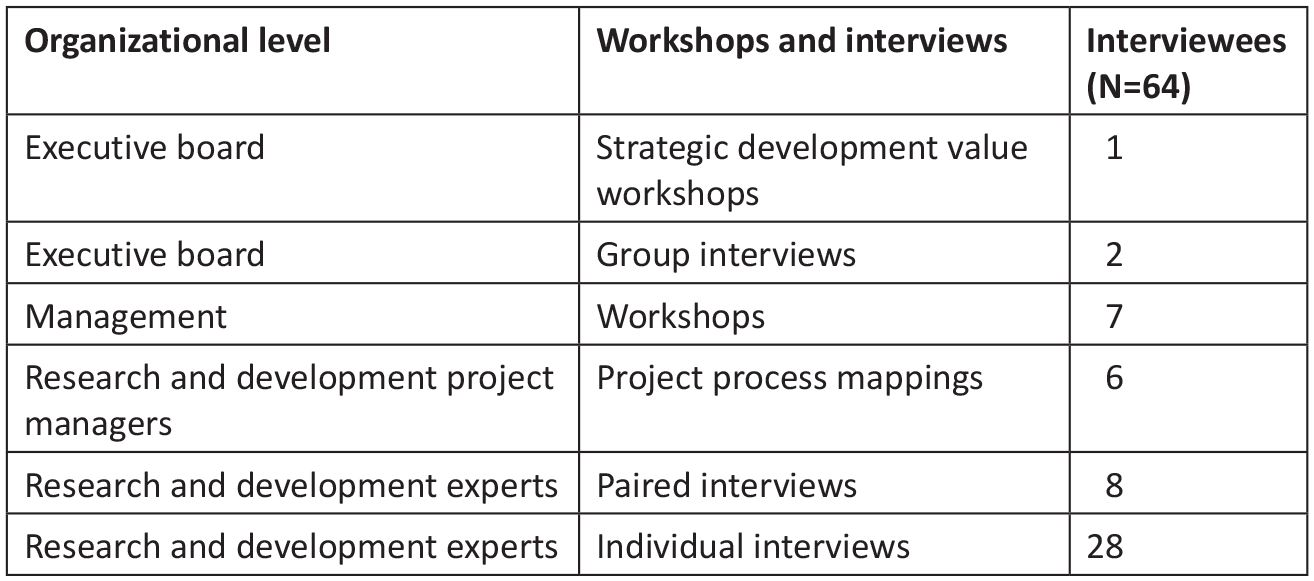
Conducted interviews.
Legal issues affected our research, as everyone had to be mindful not to violate the MNC’s intellectual properties, such as patents. These intellectual rights are sensitive information and have considerable business value; especially sensitive was information regarding algorithms that “optimize” people flows. As such, our research is restricted by an NDA (non-disclosure agreement). Before the individual interview, every worker signed the agreement stating not to harm KONE and that the information they provided could not be used against KONE. According to this agreement, statements expressed during the interviews were purely the interviewees’ personal views, not KONE’s official statement. Our research was controlled and evaluated by legal and technological specialists in KONE, meaning that it is possible to describe the results only at a general level.
Time manipulation in elevators information architectures
Next, we show how new media technology has been gradually added to the elevators and how each new generation creates its own temporal order. Our empirical research covered the period between 1970 and 2020, when new media technologies were added to elevators, which change the nature of media, compared with earlier periods. Media technology manipulates time in relation to its environment. The change of media technology in elevators and different components of information architecture all change time manipulation. Urban environments are complex because new and old technologies and different temporalities co-exist. For example, multinational elevator corporations have installed different generations of elevators for multiple different urban locations. Based on our results, we were able to identify three phases in the technological evolution of the information architecture with different ways of time manipulation (Table 1). These can be labeled as (1) I/O devices, (2) the centralized system (cloud), and (3) the decentralized system.
Time manipulation in elevator information architectures.
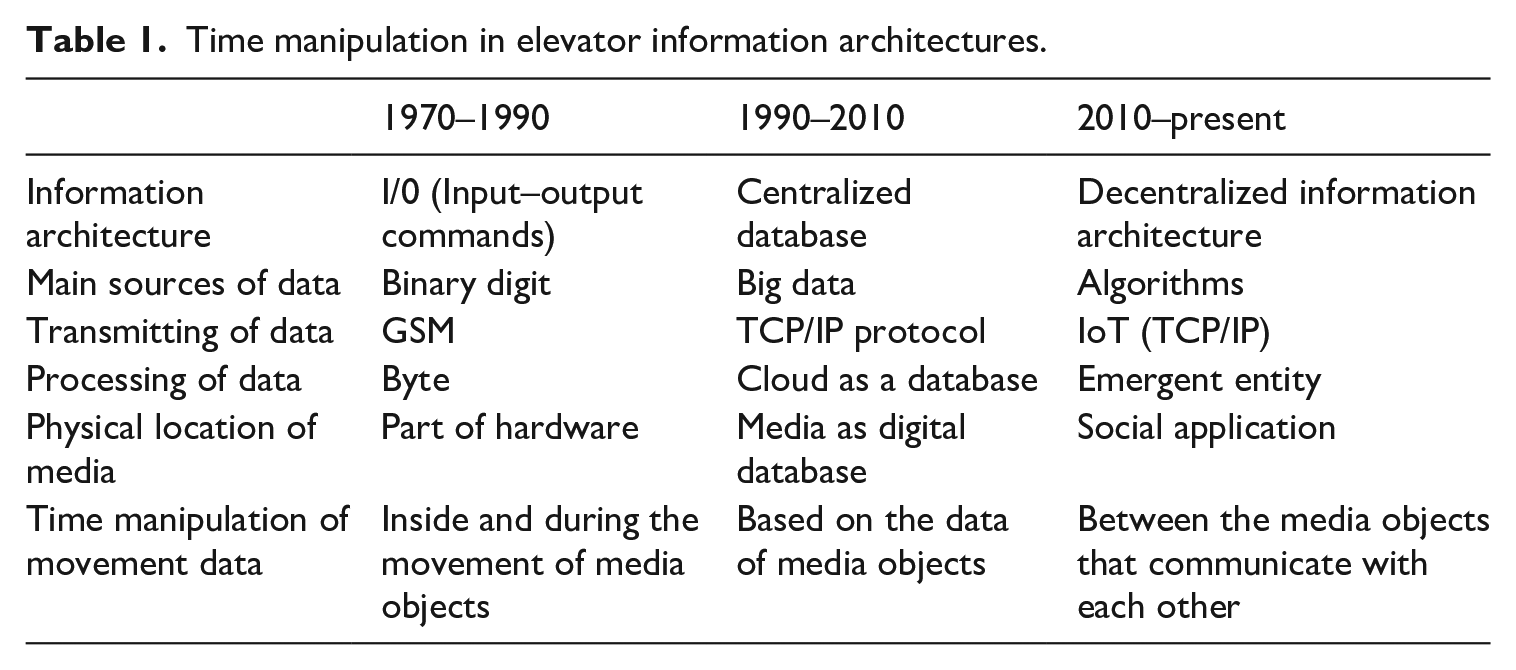
The dates of elevators generations are indicative, because there are different elevator models available in the market. Each generation of elevator processes data in a different way, because the following components of time manipulation change: (1) different sources of data, (2) different ways of data transmission, and (3) different ways of processing data. In addition, the physical location of media and time manipulation of movement data in each phase of the information architecture vary.
In old elevator systems, architecture was based on input–output devices (I/O), where media was part of the hardware, and time manipulation took place inside and during the movement of media objects. When information architecture is based on cloud technology as a centralized system, data are processed in a centralized database, and time manipulation in the cloud is based on the media objects’ data. When the information architecture becomes decentralized, the system produces information in the media system, and time manipulation takes place between the media objects that communicate with each other. The decentralization of digital media now allows simultaneous time manipulation in different but interconnected spatiotemporal contexts. In decentralized systems, machines now predict possible scenarios for humans, meaning that the technological media has considerable power to manipulate time, independently of humans (Picture 1).
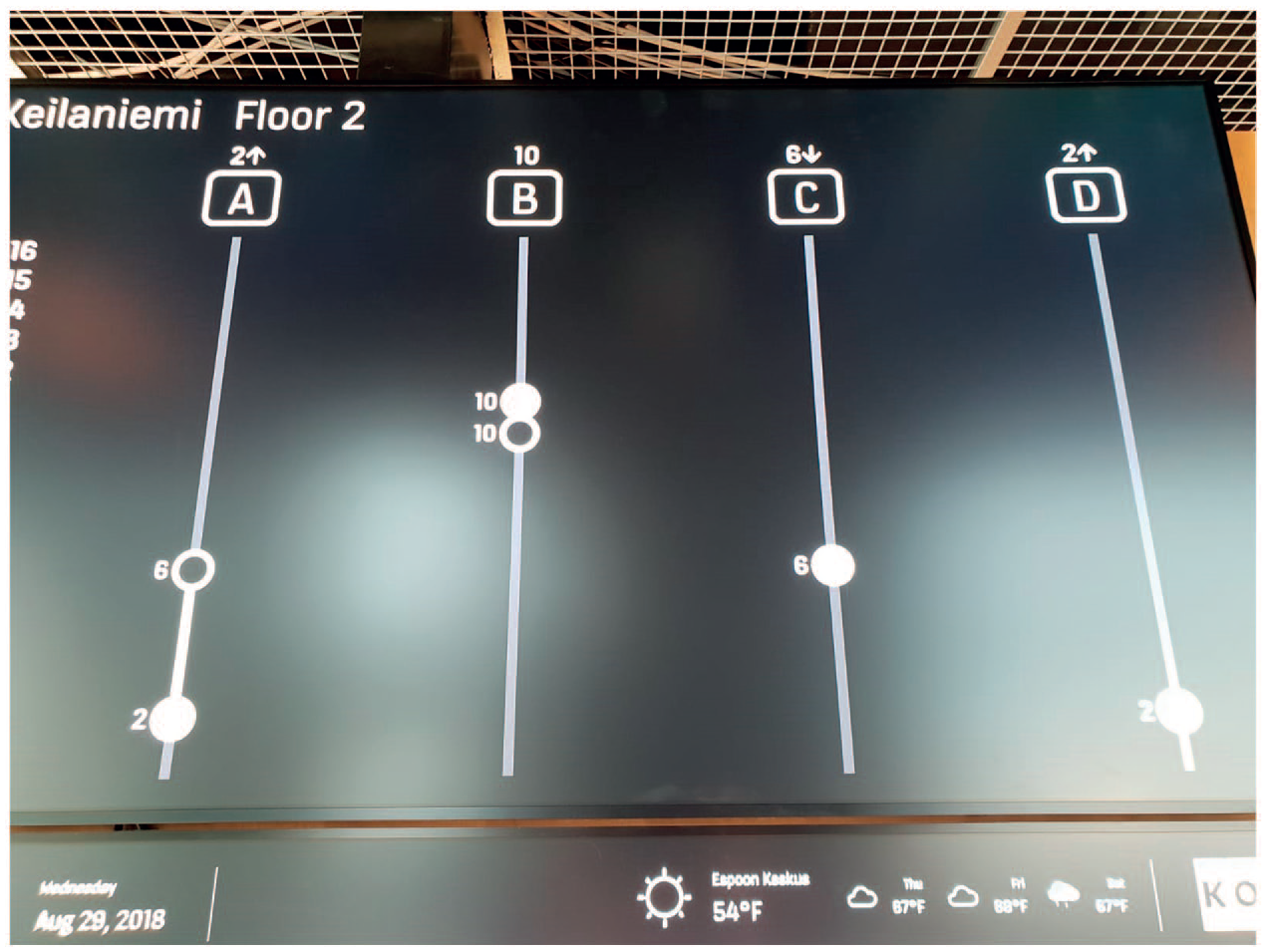
Visualization of elevators movements produced by the group control system.
Next, we illustrate the transition of elevators time manipulation from input–output (I/O) to centralized and then decentralized architecture.
Elevators time manipulation in I/O system
Elevators were originally equipped with ICT to make their maintenance more effective, and this also improved security. Traditionally, elevators utilized simple I/O devices. At the floor level, one would press the going up button to tell the elevator’s control system to go up and the going down button to go down. One could also control which floor the elevators would go to by pressing buttons inside of the elevator. I/O devices were relatively simple, humans had considerable control, and those elevators with I/O devices could not be called media objects. This means that in I/O commands, system time manipulation occurred inside and during the movement of elevators. The first electrical controls in elevators were realized by relay techniques using the same types of relays used in telephone exchanges. In the 1980s, elevators began to gain media-like qualities when KONE developed the first completely microprocessor-based control system (Picture 2).
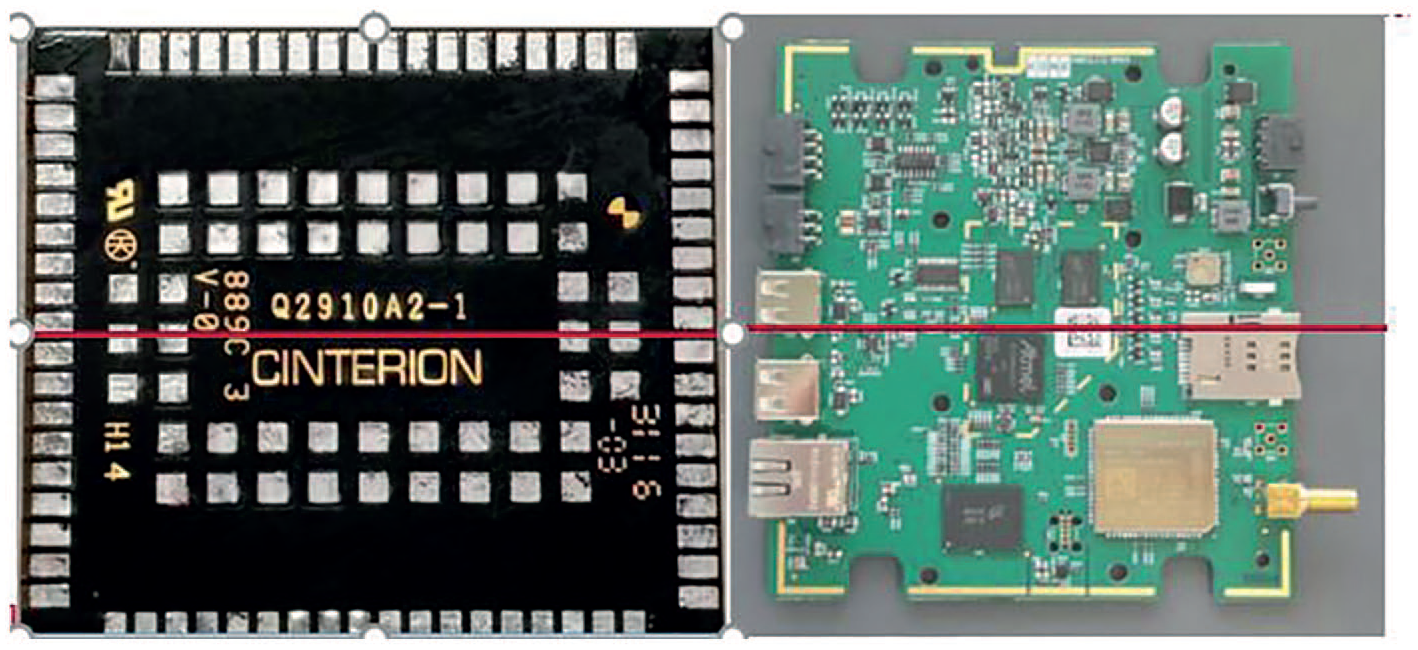
Accelerator sensor (KC120 GSM/WCDMA Module Teardown, Photo: KONE Corporation).
The control system also had memory, which allowed the use of mathematical-statistical methods and genetic algorithms to optimize the movement of elevators and manipulate time. At the time, elevators had their own banded microprocessor attached, such as MPF-1, that allowed steering and routing decisions based on predetermined rules. Due to the limited amount of memory in operating systems (2 Kbyte monitor ROM), and memory (RAM 2 Kbyte), and computational power (CPU 1.79 MHz), the centralized information architecture was the only way to organize information in time. In other words, in old elevator systems, architecture was based on input–output devices (I/O), where media was part of the hardware, and time manipulation took place inside and during the movement of media objects. Later when the ICT advanced, it became possible to add smart technologies directly to elevators, in the form of sensors in particular (Siikonen, 1997).
Elevators time manipulation in centralized information architecture
In the era of I/O systems, media was part of the hardware. This changed when elevators started to communicate, using the centralized database as a digital archive. However, before transmitting anything to the archive, the elevator needed sensors to collect the data to analyze and optimize the movement of elevators. ICT now generated data and allowed elevators to react to different conditions. In elevators, some sensors detect the conditions inside the elevators. Elevators/media objects also sense their functional surroundings to form the time manipulating framework for the elevators to function in the media system. The most important sensor is the accelerator sensor, which detects the elevator’s every movement, and its functionality is vital for optimizing the movement of elevators in time. The elevators’ spatiotemporal movements are based on historical data produced by the accelerator sensor. Optimization of the movement of elevators relies on Newton’s second law of physics, where the movement and time are inseparable. In brief, the data from the accelerator sensor are used to (among other things) determine elevator movements in time. The distributed media network data transfer is managed with traditional TCP/IP protocols.
Elevators as media objects contain both information and functionality. Elevators as media objects are not discrete entities where time manipulation can be done entirely independently of other such entities. Instead, we argue that elevators/media objects should be seen as part of a media system that dynamically manipulates information in time, predicting and constituting visual information via data. In the case of genetic algorithms, data structures are labeled and guided by data analytic specialists in KONE Corporation. Here we provide an example of time manipulation; load sensors are installed on the elevator car sling’s frame to measure the total weight of cabin content and transmit the output in mV to the elevator weight module controller. Measuring weight tells the system how many people are inside the elevator at any given time (see Figure 1).
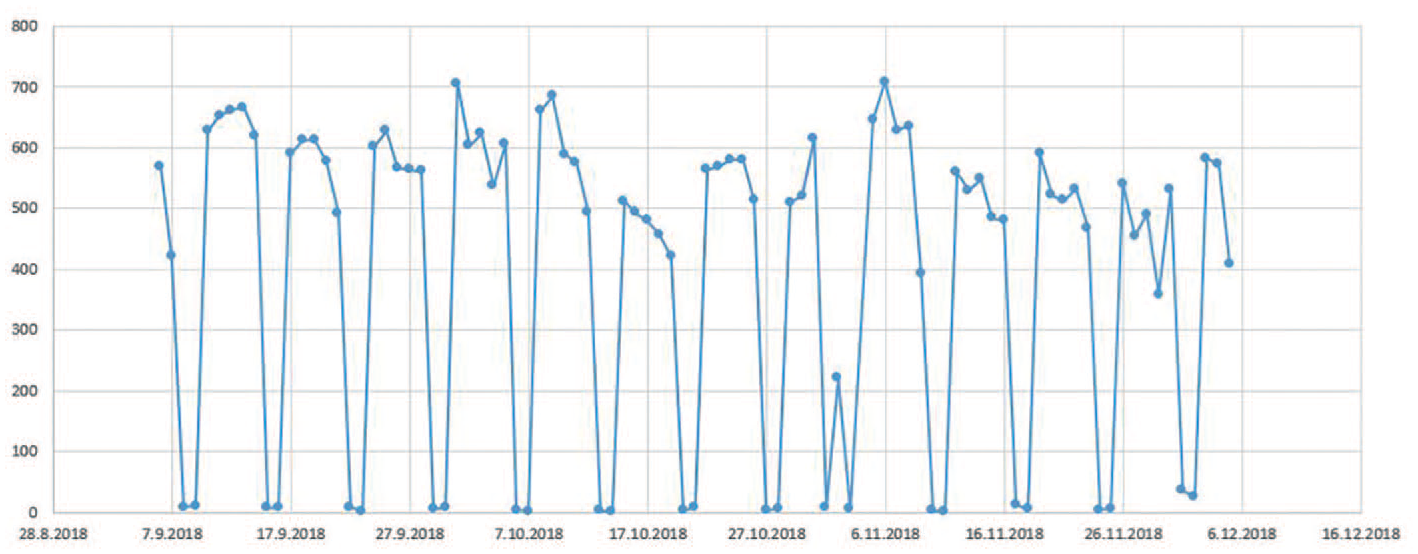
Sensor data from the accelerator sensor showing the number of movements of the elevator per day from 16 September to 5 December 2018.
However, the load sensing sensors also work together with the algorithm in the cloud that optimizes spatiotemporality, and together they determine the human flow in buildings. The calculation was performed in the cloud because the information architecture, where data, calculation capacity, and analyzing tools were only available there. In other words, the sensor data and algorithms in the cloud determine the movement of elevators. When elevators are operated, the system can identify when a person enters and exits the elevator based on stepwise change, which has enough precision to measure the people flow. Accelerator sensors only collect the information that determines in what direction the elevator moves from the floor. Based on these sensor data, it is possible to establish a house traffic profile, with calculations based on four variables: inbound traffic, outbound traffic, movement between floors, and total traffic intensity. The most common measurement unit is 5 minutes, as with the use of intervals smaller than 5 minutes, random factors complicate the statistics. In large shopping malls, more than 20,000 sensor data per day are sent to the cloud storing elevator movement data. This traffic profile is then used to manipulate movement and time.
In centralized information architecture, statistical and probabilistic mathematics are used to manipulate time in the cloud. The Poisson probability distribution of a discrete random variable express the probabilities for the number of events in a fixed time interval when the probability of the events is constant over time and independent of the previous event. The stochastic process that produces the Poisson distribution is called the Poisson process. In plain English, statistics is used to calculate how many elevators should move in certain time. Elevators’ time manipulation is based on a limited number of inner variables of elevators, the interaction with the outside world is limited and does not consider the importance of power received from outside (cf. Bateson, 1972).
The primary interfaces in elevators as media objects are people who use the elevators and the maintenance workers who control the elevators’ functionality. The user interfaces of centralized control group units in most elevators are now in the lobby instead of inside the elevator. The data that used to be stored in the individual sensors’ memory in the elevator themselves are increasingly being transmitted and processed in the cloud, where elevators send status report data every second. This allows for the performance of time manipulation of multiple elevators remotely and simultaneously, making elevator maintenance more efficient. Elevators as media objects are becoming connected to the network, and information is processed by analyzing big data available for cloud computing. In practice, these analyzing tools focus on optimally transporting humans in elevators, predicting consumer-based maintenance, and organizing the maintenance workers’ timetables. In the cloud, the data from elevators/media objects are processed using genetic algorithms of AI.
The data are also used in consumer-based maintenance as the system transmits the analyzed information directly to the maintenance worker’s mobile device. Thus, media has changed the nature of their work. As one sensor technology expert of the KONE Corporation we interviewed phrased it:
For service technicians, error data can be sent directly to the closest service technicians’ mobile phone: data from elevators help to organize the work. Hurry right away and worry about the annual maintenance later; we want to build a more dynamic system on this one.
The most significant changes during the development of elevators as a media object has been the following technological innovations: fast growth of memory capacity and central processing units (CPU), the increasing speed at which data may be transferred in networks, and scenario-based robust algorithm development to predict the time.
The introduction of a centralized database allowed for manipulating time in the cloud through tools for analysis and applications. In this centralized system, raw data from the elevator’s sensors is transmitted to the cloud for processing to the centralized group control units. These control units then work as an archive for individual elevators’ raw data and a place where data are processed. In substantial installations such as large buildings or public spaces, the media system’s graphical user interfaces are situated in the lobby, typically showing the locations of all elevators and their positions. The interfaces are designed to provide time for deep learning algorithms based on neural networks and genetic algorithms to solve the so-called optimal mode of transport in real-time.
The Kittlerian concept of “time manipulation” is useful here, because the algorithm models function based only on the way they are taught to perform. Media objects utilize re-enforced learning, where data are taught using the response–stimulus method. More specifically, media objects manipulate information in time because the program code of genetic algorithms statistically manipulates the data structures that contain raw data from the elevator systems. Elevator sensor data are manipulated to optimize the operations of elevators. The genetic algorithms manipulate information in time by relaying on biologically inspired iteration operations. Information is manipulated in time between raw input data and output data that provide optimization solution. The optimal solution the algorithms propose is not known before the light in the elevator is turned on, and the call data can be continuously allocated. The system is reasonably efficient in organizing urban mobility in time, although optimization is necessarily based on past data. By using historical statistics, it is possible to calculate how people are typically using elevators in various traffic situations.
Elevators time manipulation in decentralized information architecture
However, the centralized cloud-based system is fast becoming yesterday’s media technology. The KONE Corporation is now moving from centralized cloud-based systems to multi-centralized and decentralized systems. In the decentralized elevator system, time is manipulated with genetic algorithms. One of the founding developers of genetic algorithms (Holland, 1992) defines genetic algorithm as population-based, adaptive, and search algorithm. Genetic algorithms simulate Darwin’s theory of evolution. Technically speaking, time manipulations in genetic algorithms have the following phases: selection, fitness, reproduction, crossover, and mutation. Data-scientists call this optimization of time, but they also manipulate temporal order. The most common time manipulations in genetic algorithms are crossover and mutation. In crossover, the waiting time for elevators is minimized, and in mutation genetic algorithm tries to optimize the elevators in a larger search space. Iteration process of genetic algorithms continuously produces a new temporal order.
Now, elevators/media-objects inside the elevator group independently transfer data between other elevators and then exchange information with other elevator groups as an elevator group. On the multi-centralized system, elevators are arranged in multiple centralized group units. The most typical size is four to six elevators in the same centralized group unit, although the minimum size of elevators per unit is two, and the maximum size is currently 21. These multi-centralized group units are more effective since one cable connected to the group unit can allow maintenance workers to get statistical information and configurations for all of the elevators in the group unit (Kuusinen, 2015; Siikonen, 1997; Sorsa, 2017).
In decentralized information architecture, time manipulation was conducted between the media objects that communicate with each other; the decentralized elevator systems are often multi-centralized. In the multi-centralized architecture, the system immediately allocates elevators by organized elevator group units. Although there is more call data, and it is multi-centralized, time manipulation is not possible in the immediate allocation of elevator units. However, the advantage is that the system predicts where the users are going before they enter the elevator. In practice, this immediate allocation based on some common criteria (like waiting time) means that the media system can collect people who go to the same floor into the same elevator, thus shortening the lap times. However, the call cannot be changed once the elevator starts to move. Humans also try to improve their personal level of service, for example, by touching the destination call panel many times, so that the system interprets that there are more people waiting for the elevator, when in fact, there is only one person.
KONE uses genetic algorithms to calculate the optimal mode of transport in real-time. The algorithm tries to generate high-quality solutions to optimize elevators’ movement by relying on bio-inspired operations such as mutation, crossover, and selection. The more time the genetic algorithm has (number of iterations), the more precisely it optimizes time. In addition, the choices made by data scientist when choosing mathematical parameters influence time manipulation. The basic logic in time manipulation is to keep the elevators moving in optimal way in selected elevator population. In the end, it is not known beforehand what happens when the decentralized system receives input, but the new algorithms still attempt to self-organize time based on certain rules in a specific frame.
It can be said that elevators/media objects are not fully utilizing the existing rich media content, such as hotel booking systems and transport information systems, currently available. New media technology enables the use of their communication power and AI to manipulate information in time without human influence. Elevators can, therefore, create temporal order by manipulating the time of people using the elevators and the working time of maintenance workers. The system knows the location of all maintenance workers in real-time and can find the closest maintenance workers to repair the elevator—if the elevator cannot be fixed remotely via the network.
To summarize, inside the social applications there is a data structure, which tells the time and genetic algorithms, which manipulate time. Digital control has made elevators media and the movement of elevators is the media. However, independent capability of media to manipulate time was only introduced together with AI to optimize the movement of elevators, which made elevators media objects.
Conclusion
Before digital control of elevators, time was manipulated manually between human and machine. Now the elevators manipulate time digitally and independently of humans. The management of traffic flows in elevators has been a complex challenge since at least the mid-20th century, but genetic algorithms have brought a new dimension to time manipulation of elevators managing traffic flows. We have investigated time manipulation in elevators in different information architectures between 1970 and 2020. Our central argument is that elevators digitally manipulate information in time. Time manipulation of elevators (movement data + genetic algorithms) produces a temporal order. We have also shown how digital control has made elevator media and how elevators have become media objects because they produce data that are manipulated to optimize movement. Next, we reflect our findings, main arguments, and their implications in society.
It is fascinating that elevators as media objects are formed by the millions of elevators sending signals—1s and 0s—to the media system. Elevators as a part of time-critical media are assemblages of media technologies, where time plays an important role because they are capable of time manipulation and create new temporal order. However, some critics from the Left argue that commoditized time is mainly manipulated to increase efficiency (Virilio, 2008) in what Berns and Rouvroy (2013) call “algorithmic governmentality,” and what Crary (2013) labels as “24/7 capitalism.” Stiegler (2018: 124) claims that the product is an automatic performativity that channels, diverts, and short-circuits the individual. Whether one fully agrees with these arguments or not, introduction of new media technologies alters human perception in McLuhanesque ways. As such, the technological infrastructures of contemporary capitalism are more than neural mediating technologies; they change the underpinnings of the material agency and its objects that produce temporalities.
Toward understanding non-linear and relational time manipulation
We emphasize that the power of elevators to manipulate time depends on the information architecture that collects, process and transmits time manipulation information. In centralized information architecture time manipulation was based on statistical mathematics and its linear models which sought to limit the chaos. Time-series analysis (such as Poisson distribution models) in centralized information architecture estimates how elevators move over specific time. It helps to understand independent events that occur at a constant rate within a given interval of time. However, the Poisson process is a simple point process with stationary and independent increments. Only after the introduction of genetic algorithms in decentralized information architectures, time manipulation of elevators became communicative, non-linear, and relational. Communication between elevators in decentralized systems and AI now allow elevators independently optimize movement based on their own predictions. For example, the genetic algorithm searches for optimal and fastest route for humans moving in the cities.
We have suggested that elevator groups form Kittlerian discourse networks that emerge with technological media. They contain technological and institutional elements that can be analyzed by practicing technological media analysis that focuses on the operations of media structures in data processing. This is what Krämer (2006: 98) called “the material ‘carriers’ of information,” including, for example, the elevator control group that forms its temporal order with specific optimization in the spatiotemporal context with specific algorithms, databases, and applications, as well as its CPU processing information in time. From the perspective of information theory, the concept of predictability becomes vital in time manipulation because only non-predictable events that are random in time contain information, and information is a measure of order (Wiener, 1954; cf. Cooper, 2016: 137). From the perspective of information theory, KONE seeks to escape the hierarchical reductionist model with a distributed network and with a networked analysis that is both multi-centered and completely decentralized, not necessarily based on genetic or genealogical data, but rather on data from predictive scenarios (cf. Dahlberg, 2017; Lee, 2010).
The implications of non-linear and relational time manipulation call for a different mode of thinking about time. In his discussion of how order emerges from disorder, Serres draws from the information theory of Atlan (1974) and adopts a topological mode of thinking about time (Serres and Latour, 1992), arguing that time (temps) that “percolates” is an “aleatory mixtures of the temperaments, of intemperate weather, of tempests and temperature” (Serres, 1997: 7, see also Assad, 1999, 2011). This also resonates with some arguments about the layered multi-temporality of technological objects that media archeology has put forth. Indeed, as Parikka (2012, 2015) argues, media studies itself has actively been involved in the invention of new methodologies to deal with time in digital culture, including those related to the data-intensive forms of governance, or what Ernst coins “microtemporality.”
In philosophical terms, Serres (1997, 2018) and Whitehead (1948) suggest that every object is interactively defined by its temporal relationships to other entities, constituting multi-temporal relationships. Barker (2012) addresses the techno-temporal aspects of digital culture and positions the database as a multiplicity of actual entities from diverse temporal neighborhoods, where the different modes of organizing information afforded by the organizational and generative processes of the digital produce multi-temporality. When AI and decentralized information architectures enter urban environment, we must examine and theorize the multi-temporality of media systems to understand AI in urban settings.
Limitations and further research
Our empirical research is limited to one MNC and focuses on a single media object: elevators. Furthermore, German media theory and its attempts of opening the analytical domain to any kind of medial processes remain somewhat controversial (Horn, 2008). It could be that some readers unfamiliar with time manipulation in the German media theory might still not be totally convinced that the time manipulation described in our article renders elevators as media in the way they are used to define it. That can indeed be debated. However, our approach allows us to utilize media theory as an analytical lens to study algorithms and temporality.
German media theory has been criticized because it does not take human affects into consideration (Krämer, 2015). The problem in elevators is that humans do not experience the time manipulation; instead, we experience waiting and movement of elevators. However, from a philosophical perspective, it is complicated to perceive our experience of movement (Bachelard, 1972). The added problem is that perceived temporality is relational for us living in urban environment, like our analysis of time manipulation has shown. Merleau-Ponty (1976) pointed out that humans’ experience time that processes action in environment. In practice, this means that we cannot directly experience the relational temporality of media objects. However, analysis of time manipulation reveals the technological components of relational time manipulation.
Our article has shed light on how time manipulation in the case of elevators has evolved. We have shown how elevators now short-circuit humans, creating temporal order for us. They have become an extended media that organize the temporal frameworks for experience and economy, where media takes the role of humans in optimization and temporal ordering in the cities and societies. All in all, we argue that media studies should understand more deeply how largely hidden new media technology independently manipulates time. We propose that future media research should focus on how different types of AI in various media systems exactly manipulate time and then analyze its societal implications. Our research showed that time manipulation is now often performed by static algorithmic models that can be quite difficult for layperson to understand. However, things become even more difficult for everyone because of the inherent philosophical problems associated with the non-linear and relational time manipulation in the dynamic decentralized world of new media technologies. For us, it is shocking that we often live our lives without noticing or understanding how this largely hidden media affects our temporality.
Footnotes
Acknowledgements
The authors would like to thank professor Jussi Parikka for his insights and comments when editing the text, and Ms. Krista Korpikoski for providing invaluable assistance as she worked on the research project and took part in conducting interviews as part of her PhD research.
Funding
The author(s) disclosed receipt of the following financial support for the research, authorship, and/or publication of this article: This work was supported by Business Finland, the Finnish Funding Agency for Innovation (project code A73340).
