



Abstract
This article examines the growing influence of Informational Communication Technologies (ICTs) in less certain refugee contexts and the role of civil society groups. Drawing on an empirical case study of Somali refugees in Kenya, the article explores the grassroots use of ICTs by refugee women and local socio-economic dynamics in processes of inclusion. Adopting a micro-institutional perspective, the discussion looks at the emerging influence of mobile technology on refugee women’s precarious norms related to mobility and work, and the evolution of new digital norms. The article highlights the strategic role of women’s groups and proactive group members as ‘institutional entrepreneurs’, in aiding levels of ICT adoption among group members, motivated by connection, protection and collective enterprise, with potential effects far beyond the group. In a transitory and fragile refugee context however, constraints on civil society may lead to the exclusion of more isolated populations without formal institutional support.
Introduction
This article discusses the growing influence of Information Communication Technologies (ICTs), 1 in less certain refugee contexts. While potentially transformative, both access and the use of ICTs may be complex (Van Dijk, 2006), particularly in ‘fragile’ (Ritchie, 2018b) and challenging ‘refugee situations’ (Harney, 2013). In these contexts, concerns lie both in the physical ‘digital divide’ and the multi-layers of ‘asymmetry’ in ICT design, access, usage and adoption, leading to the exclusion of marginalised groups (Tsatsou, 2011), and the potential reproduction of existing structural biases.
Drawing on an empirical case study of Somali refugees in Kenya, the article specifically examines the grassroots use of ICTs by refugee women, building on earlier research on refugee women’s enterprise (Ritchie, 2018a). Adopting a micro-institutional perspective, with a focus on norms and change (Hodgson, 2004), the discussion looks at the emerging influence of mobile technology on refugee women’s socio-economic lives in an uncertain context, and the evolution of new digital norms. In particular, the article indicates that online communication platforms such as WhatsApp may permit a renewed sense of personal confidence and connection, as well as new forms of collective agency and economic coordination among semi-illiterate refugee women. At a deeper level, online technological platforms of this kind enable new forms of cultural solidarity among the refugee women, reinforcing identities and bolstering social relations and pro-social behaviour.
Yet with varied access and use of smartphones and apps, there may be emerging subtle digital divides between the women themselves. The article draws special attention to the strategic role of women’s groups and proactive group members, as ‘institutional entrepreneurs’, in aiding levels of adoption among group members, motivated by connection, protection and collective enterprise in a context of precarity (Wall, 2020). The article is based on qualitative field research that included a mix of participant observation, in-depth interviews, focus groups and locally adapted ethnographic tools. Shedding light on local complexity, this article argues that it is critical to appreciate links to social and cultural dynamics (Ter Haar, 2011), and the role of actors (Battilana et al., 2009) in the adoption of mobile technology in fragile environments. This may permit a more nuanced understanding of the digital and social inclusion of marginalised groups such as women refugees, and the impact of intersectional vulnerabilities, with implications for broader integration (Alam and Imran, 2015).
Theoretical background
Technology and innovation are argued to be playing ‘an increasingly transformative role’ across the humanitarian sector, accelerating new approaches to aid and opening up new pathways for refugee self-reliance and resilience (Betts et al., 2015: 3). A key area of attention is the existing and potential role of ICTs as a form of ‘frugal’ innovation (Bhaduri, Knorringa, Leliveld et al., forthcoming) i.e. technologies that are low-cost for the user and can reach scale in resource-scarce contexts, particularly mobile technology in both the delivery of aid (UNHCR, 2016), as well as in permitting self-help through digital communications (Leung et al., 2009).
The multi-layered ‘digital divide’
The term ‘digital divide’ has been coined to describe the gap between those who have access to and the use of digital technology, and those who do not have access (Van Dijk, 2005); or the disparity between technological ‘have and have nots’, often between geographical locations (Alam and Imran, 2015: 5). In recent years, the notion of the digital divide has been further elaborated to differentiate between physical access and practical use (Alam and Imran, 2015). Social inequities in usage are described as a ‘second level’ digital divide (Van Deursen and Van Dijk, 2013). Meanwhile, a ‘third level’ digital divide has been conceived and refers to varying skills levels, or digital literacy, creating new inequalities associated with knowledge gaps (e.g. Wei and Zhang, 2006). ICT participation and adoption are, thus, influenced by various factors, from access and affordability, to less tangible social barriers and the ability to use ICTs (‘e-skills’).
Specific groups, such as women, older people and those that are less educated, may be disadvantaged in ICT adoption and use (Kabbar and Crump, 2006; Van Deursen and Van Dijk, 2013). People’s access to and use of ICTs and the Internet may in fact be shaped by ‘multiple identities’ (IDS, 2017: 16), resulting in the co-existence of several digital divides (Alam and Imran, 2015). For refugees, this may include gender, as well as a broad range of social factors, including ‘culture and language, education level, age, language proficiency, socio-economic conditions, communication preferences, [and] familiarity with technology’ (Alam and Imran, 2015: 5). Leurs and Ponzanesi (2007: 633) highlight the notion of ‘intersectionality’ as referring to multiple layers of categorisation that ‘coexist and co-construct identity’, placing everyday digital practices in local contexts which both shape and reflect society and micro-politics.
From digital divides to social inclusion and layered realities
Mobile devices, and particularly smartphones, are indicated to be increasingly vital for refugees for digital documentation and identity (Gilliland, 2017), and for connecting with authorities and local services (UNHCR, 2016). Mobile devices have also been shown to be critical for refugees for access to information, language and knowledge enhancement (Caidi and Allard, 2005), as well as for interaction with businesses and economic activities (Benton and Glennie, 2016). Mobile phones may further be instrumental for ‘social connectedness’ for marginalised populations (Metcalf et al., 2008), including vulnerable refugees (AbuJarour et al., 2019; Leung et al., 2009). The use of social media, in particular, may facilitate connectivity to family and friends in their countries of origin, although this may inhibit local participation in host countries (Kutscher and Kreb, 2018). Context-related factors and geography (Hargittai and Shafer, 2006) are important considerations, however, for network access, as well as for trust (in cell networks); country-level registration requirements might also shape phone usage (Johnston and Bacishohga, 2013).
Digital inclusion – access to and use of technology – has been argued to be intricately linked to social inclusion (Clayton and Macdonald, 2013; Selwyn, 2004), with implications for refugee assimilation and social integration (AbuJarour et al., 2019; Alam and Imran, 2015). This shifts the discussion of the ‘digital divide’ from gaps in physical access to the incorporation of technology within communities, institutions and societies (Warschauer, 2003). ICT engagement can support the development of social networks (Broadbent and Papadopoulos, 2013), community participation (Clayton and Macdonald, 2013) and self-motivation (Cuban, 2016). In refugee camps, ICTs can also aid in access to information, improving local power relations (Currion, 2011). Yet, Helsper (2011) maintains that a lack of confidence can impact disadvantaged users from harnessing online opportunities; refugees may also be constrained by language and digital abilities (Lloyd et al., 2013; Bianco, Cunningham and McCombe, 2010). Individual ‘attitude’ may further influence participation and the value perceived in Internet use (Van Dijk, 2005), with positive attitudes towards technologies contended to be critical for Internet adoption (Reisdorf and Groselij, 2017).
A closer examination of local contexts and social realities may be particularly vital in low-income communities (Castells, 1999) to understand the ‘situated nature’ of how technology is used by marginalised groups (Mehra et al., 2004: 797). Migrant studies have pointed to the role of ‘intermediaries’ (including family members and peer groups) in the use and adoption of ICTs by immigrants (Diaz Andrade and Doolin, 2016). In more challenging settings, Wall (2020) highlights the concept of ‘precarity’, related to personal and contextual vulnerability, particularly affecting access to information. While perceived as a constraint, precarity may also be an ‘organising force’ for collective action, as actors are motivated to collaborate for change (Allison, 2012). Overall, Leung (2020) suggests that ‘simple dichotomies’ of digital divides are not appropriate for refugees, with contextual and community diversities. Towards appreciating local complexity, the incorporation of themes such as access to social justice and human rights may also permit a ‘more critical and layered understanding of digital migration across different contexts’ (Leurs and Smets, 2018: 12).
Incorporating a micro-institutional perspective
From an institutionalist angle, understanding ICT adoption and influence in the local context and beyond requires looking closer at the evolution and development of institutions. In less structured developing contexts, with a few formal institutions, informal institutions such as habits, customs and norms tend to guide socio-economic behaviour (Harriss-White, 2010). In exploring local dynamics, institutional change and development processes may involve the interplay of structure and agency (Hodgson, 2004). This advances Giddens’ theory of structuration (Giddens, 1984) by maintaining that agents and structure remain distinct and ‘casually interactive’, in an evolutionary ‘critical realist perspective’ (Hodgson, 2004: 435). At a micro-level, the interaction of actors warrants particular attention (Battilana et al., 2009; Ritchie, 2016), that is, how diverse actors may engage in change processes; and the role of strategic agency (Beckert, 1999), that is, how actors draw on their power to support or resist change. Close associations of new norms with ideology (Ter Haar, 2011) and culture, for example local beliefs and values, can facilitate adoption and transmission of new norms, influencing their diffusion (Redmond, 2003) and institutionalisation (Boettke et al., 2008). In refugee settings, new economic needs (or demands) can precipitate institutional change for migrant women, for example, prompting new mobility and work norms (Ritchie, 2018a). Civil society groups can permit social solidarity in the face of such changes, particularly in hostile displacement contexts (Ritchie, 2018a).
In summary, ICT practices are rooted in evolving norms shaped by local agents and structure, including cultural dynamics and pressures, and this is crucial to appreciating processes of change and ICT adoption, and local vulnerabilities in fragile refugee settings.
Method
The empirical research presented in this article explored refugee engagement in ICTs in challenging urban environments, drawing on a small case study of Somali women refugees in the context of Eastleigh in Kenya. Building on earlier research (Ritchie, 2018a), and refugee and migrant studies into ICTs and social media (e.g. Bock et al., 2020; Kutscher and Kreb, 2018), the inquiry specifically examined the growing interaction of refugee women in Eastleigh in mobile technology, and especially the use of WhatsApp. The research aimed to generate deeper contextual insights into the so-called ‘digital refugee’ as a ‘complex, multifaceted construct’ (Maitland, 2018: 241). The study drew on qualitative research, including ‘applied research’ over a 2-year period from the author’s own direct engagement in ICT platforms in the refugee case study (a project set up by the author), and observation of ICT use, in addition to follow-up interviews and focus groups.
Research context and background
Known as ‘Little Mogadishu’, the suburb of Eastleigh lies on the outskirts of the Kenyan capital Nairobi and is famous for its entrepreneurship and commercial growth, in large part due to its long-term Somali refugee population (Carrier, 2017). Yet, despite an apparently thriving context, outside of the Somali elites, the majority of poorer Somali women refugees struggle as petty traders in a hostile institutional environment with limited access to basic services, little security and no rights to work (Ritchie, 2018a). Police harassment is significant, particularly of male youths but also of women street vendors, with incidents of random arrest, detention and even deportation (Sturridge, 2011). The media’s framing of Eastleigh as a site for money laundering, illegal trade and terrorism (Manson, 2012) fuels local Kenyan aggression and xenophobia (Pavanello, Elhawary, and Pantuliano, 2010; Ritchie, 2018a).
The author initiated the refugee project in Eastleigh to promote the ‘well-being’ and leadership skills of Somali refugee women as a foundation to building resilient livelihoods and fostering community inclusion. Interested Somali refugee women were predominantly recruited at a local community event in Eastleigh, with a total of 25 refugee women joining the project directly and up to 100 women benefitting from outreach messaging and events. The majority of the women had been in displacement for 10 years, were in the age range of 23–55 years, and were illiterate or semi-illiterate, with just a few years of education in Somalia. The women tended to be single or divorced (often with children), poor and working as petty street traders, and living in rented rooms within Somali family apartments in Eastleigh. Refugee women faced both formal barriers in their work, without business licences, as well as social challenges in obtaining acceptance by the local Somali community due to prevailing conservative norms (Ritchie, 2018a).
A local Somali Kenyan was hired as the local coordinator to support translation, logistics and project administration, and the refugee women organised themselves into an informal group (self-named the ‘Sisterhood’ group). Training and empowerment-oriented activities included weekly or bi-monthly workshops on different aspects of wellbeing, predominantly led by the author (with translation). To deal with language and literacy constraints, flipcharts were used and visual diagrams were included on handouts. Practical economic initiatives were introduced including a savings scheme, and a tentative collective tie-dye business was set up. Additional ‘soldarity’ events were also organised including poetry circles and refugee walks. During the early phases of the COVID-19 pandemic, while major training activities and events were suspended, the group continued to meet weekly for the tie-dye business with the local coordinator and additional short training courses (such as literacy) were organised through local experts.
Exploring ‘connected life’ through WhatsApp
Smartphones are now considered ‘relevant tools in social science research’ for investigating today’s ‘mobile, connected life’ (Kaufmann, 2020: 2). In particular, mobile apps such as WhatsApp have been used as a medium for refugees to share their daily lives with researchers (Kaufmann, 2020); and both WhatsApp and Facebook have been explored in digital ethnography (Kutscher and Kreb, 2018). Motivated by strong research interest in refugee use of ICTs (Ritchie, 2018b), as well as in project efficiency and communication, the author set up a ‘trial’ digital messaging group with WhatsApp to facilitate digital coordination and information sharing with the refugee women. While smartphone ownership was fairly limited among the refugee women at the start of the project, there were anecdotal indicators of the growing popularity of smartphones in the community. The WhatsApp group mostly operated in Somali, with voice translation of English messages, as necessary. As a coordinating platform for the project, the author and local coordinator were both actively engaged in the online space alongside the refugees.
Research data collection: developing insights over time
Over the course of the 2-year study, the author observed the evolution of the WhatsApp group as a member of the group and a participant, but also as a researcher. To support the research and the light regulation of the group, the essence of various voice and text messages was translated by the local Somali Kenyan project coordinator. Ethnographic tools such as physical observation were also employed during the project workshops, events and activities (a total of over 70 contact hours). This included informally observing the use of phones by the women during workshop breaks (and pursuing clarification on evolving digital ‘habits’ with the local coordinator), in addition to engaging more broadly with the women (with translation) in informal dialogue and sharing life stories.
In later stages of the project, interrogating critical insights from the digital and physical observation, the author conducted 10 in-depth interviews (lasting between 1 and 2 hours per session) with interested and active women from the group (see Table 1 for a basic background of respondents). Two focus group discussions (including both interviewees and other group members) were then organised to probe key themes that were highlighted in the interviews. Relevant parallel discussions were also held with key local actors, including the project coordinator, literacy trainer and community activists, to explore and unpack the emerging themes. These various interviews and discussions investigated, in particular, refugee women’s experience in the Sisterhood group, and their use of mobile or smartphone technology and participation in social media, especially the group WhatsApp; and local perspectives on the influence of digital devices in refugee women’s lives.
An overview of Somali refugee women interviewees in study.
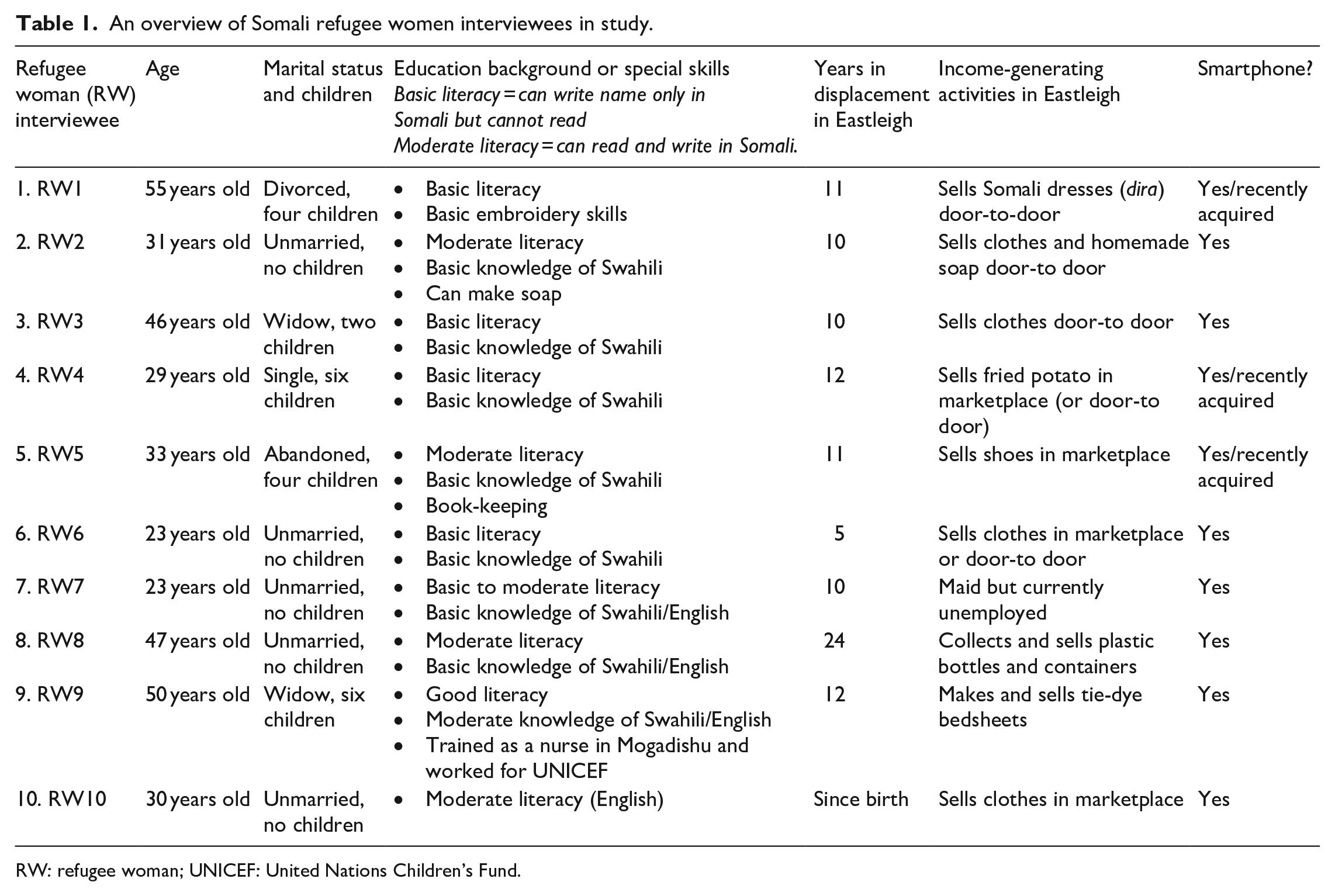
RW: refugee woman; UNICEF: United Nations Children’s Fund.
It is pertinent to elaborate on the use of ethnography in this study and the value of long-term and participative observation (Wasterfors, 2018). Such an approach can permit ‘priviledged access to “invisible” or difficult to access social phenomena’ (Buscatto, 2018: 331), allowing the researcher to appreciate how practices are socially produced in the setting and legitimated, and how they are transformed through negotiation, conflict and confrontation between actors. Drawing on an emic perspective, the research also deliberately employed ‘digital ethnography’ (Kaur-Gill and Dutta, 2017), monitoriing the WhatsApp discussion group as a group member, and observing the women’s virtual exchange and interaction.
Data recording and analysis
Analysis was ongoing throughout the study, as the author regularly reflected, re-interpreted and explored emerging insights. Field notes were taken as necessary during as well as following training and events. In making sense of qualitative data, the research process drew on techniques such as ‘memoing’ (including recording emerging thoughts, both orally and written) and sharing these evolving ideas with key actors in the field. In consolidating this analysis, the research employed an iterative approach, as articulated by Bygstad and Munkvold (2011). This included identifying key aspects of these ‘rich’ findings and descriptions; reflecting upon refugee discourse and emerging research themes; and identifying key dynamics and tendencies. Manual coding was used to analyse the in-depth interviews, and to draw out the dominant tentative themes and concepts. These were then further clarified and refined in the focus groups and through (informal) follow-up discussions with the local coordinator and active group members.
Methodological and ethical reflections
The case study drew on critical realism, to examine ‘less known social phenomena’ in institutional change processes and the interplay between structure and agency (Ritchie, 2019: 2). This exploratory approach necessitates a self-reflective and self-aware researcher, with flexibility to permit an open and adaptable inquiry, in line with grounded theory (Trochim and Donnelly, 2006). This meant that informal discussions, and later, in-depth interviews and focus groups were shaped by ongoing observations and insights. The relationship between the researcher and the refugee women was viewed as especially crucial for both the project success, as well as the realisation of the study. Gender played a notable role as a female researcher, enhancing the intimacy of the study discussions and dynamics of trust. Furthermore, to minimise potential cultural barriers and distrust as a foreigner and non-Muslim, the author drew on several years of experience in an Islamic context (Ritchie, 2016). This included deliberately dressing and behaving fairly conservatively, drawing on progressive references from the Koran where relevant, and ensuring critical reflexivity, that is, being ‘conscious’ of (author own) biases (Ritchie, 2019).
Findings
Growing use of smartphones among refugee women in Eastleigh
Earlier research on Somali refugee women entrepreneurs in Eastleigh indicated that mobile phones were already highly prevalent among the refugee women and were being used to manage their personal and business lives (Ritchie, 2018a). This included, for example, keeping up with relatives in Somalia and organising women’s networking and work activities. Most of the refugee women also participated in digital mobile money services (such as MPESA 2 ), often using their mobile account as an online savings account, a critical facility as none of the women had formal bank accounts due to their refugee status.
At the start of this study, while all the refugee women who participated possessed mobile phones, only an estimated third of them had smartphones. Yet, it emerged that over two-thirds were successful in connecting to the group WhatsApp through their children or a neighbour’s devices. Later in the research, over 90% of the refugee women in the project indicated owning a smartphone, and all were participating in the WhatsApp group. With the growing local popularity and availability of cheap Chinese phones, smartphones were viewed, according to the words of the women in the group, as ‘fundamental’ and ‘an investment for life and business’. Motivated by other members of the project group and their own growing experience in the WhatsApp platform, refugee women in the project contrasted themselves with other women refugees whose smartphone ownership was still considerably low, particularly among poorer or older women refugees. It is worth noting that many poor refugee women in the region do not pay for an Internet connection but are able to access Wi-Fi for free (or for a small fee) in their rented apartments.
Evolving digital interaction and exchange on WhatsApp
Many of the refugee women in the project struggled to read and write (in Somali), and as a result, were initially resistant to join the WhatsApp group. Yet, during the interviews with the author, there was palpable enthusiasm related to the online group, and women highlighted using voice messages and pictures to communicate on the WhatsApp platform. Refugee women emphasised the importance of being connected to one another (for free!), hearing other women’s voices in the messages and not feeling so isolated. The literacy trainer underscored the importance of the technology for both group coordination and staying in touch in a difficult environment. Online coordination was even cited to ‘strengthen’ the bonds between the refugee women in the WhatsApp group as an alternative ‘family’ (RW7, 23 years old), with women looking out for each other virtually and reaching out as needed. One of the older members of the group mentioned purchasing a smartphone only recently after encouragement by the other group members, and was now participating in online communications, much to the delight of the rest of the group: My new smartphone has become my ‘lifeline’ and I love the WhatsApp group . . . I can record my voice so that everyone can hear me. It makes me feel connected to people and I don’t feel alone [anymore]. We can tell each other stories as if we were next to each other. (RW1, 55 years old)
The local coordinator emphasised the ‘remarkable’ nature of the online group, with women accounting for other women’s whereabouts, particularly if they were absent from physical meetings. Notably, participation in the WhatsApp group has demonstrated the broader value of smartphones and platform-based communications for refugees despite limited education. This has encouraged women to communicate more extensively through such mediums with family in Somalia, sharing their life through pictures, voice messages and videos: Before, despite having smartphones, some of the refugee women said to me, ‘don’t add me to the [WhatsApp] group as I am illiterate’ but I persuaded them to join, even the older ladies . . . (Local coordinator)
Later in the project, as refugee women began the small tie-dye business, progress and designs started to be shared on the platform, boosting economic coordination and motivation. During the COVID-19 pandemic, the WhatsApp group took on a vital health and safety function, supporting information dissemination and alerts in the group and beyond, as women passed on ‘critical’ health messages to family members and neighbours. This not only enabled the women to access the correct health guidance and directives as ‘no-one [else] was giving us this information’ (RW8, 47 years old), but also provided them with a point of contact for security updates, which was crucial given the increase in local police harassment and street violence. One of the women that did succumb to the virus emphasised how assured and supported she felt during her illness and how she ‘could keep up with the progress of the group and their business activities’ (RW3, 46 years) through the WhatsApp group.
New sense of connection and increased self-belief
While participation in the WhatsApp group varied among its members, there was a strong sense of the evolving impact of the group in terms of the refugee women’s enhanced feelings of connection, belonging and inclusion but also self-pride in being able to use new technologies. This was indicated to be boosting women’s confidence, self-esteem and legitimacy. The WhatsApp group was cited to even reduce stress levels among its members, refugee women, who live in a challenging physical environment, with many emphasising ‘feeling calmer’ due to access to instant exchange and dialogue. As reiterated by the participants during the study, the Nairobi district of Eastleigh is a volatile and uncertain place where gender-based violence is rife. Access to social support for refugee women also remains limited, with women often reporting loneliness and alienation and having few social or economic prospects, as they are ‘non-Kenyans, without education and without connections’. This was emphasised particularly during the COVID-19 pandemic: The WhatsApp group helps us with everything. Through the device, somehow, I now feel part of the educated world and I feel a sense of achievement in this. It has made all of us [refugee women] equal, whether you are young or old, literate or illiterate. All of us can participate on an equal footing . . . Before we felt that we had to be (formally) educated to be part of something but [as a result of this new skill] my children now look up to me . . . Being part of the WhatsApp group has made me feel included and has led my children to have a newfound respect for me. (RW1, 55 years old)
Deeper spiritual inspiration and cultural dialogue
Initially conceived as a means of simple coordination, the WhatsApp group has provided an increasingly important socio-cultural dimension to the studied refugee women’s lives, with some women sharing supportive, funny or inspirational Islamic messages or video clips during special religious days (e.g. on Fridays, Eid and Ramadan). These religious messages were especially popular and valued, strengthening a sense of ‘connection’ and common ‘identity’: The Islamic videos keep your faith strong and boost your spirits. This has been particularly important to me during lockdown as it has been very isolating. I share such inspirational videos [electronically] with my neighbours too. (RW5, 33 years old) My life is lonely and hard but inspirational videos make my day. The best pictures and videos [on the group] are the religious and the funny ones, particularly if they relate to my own life. (RW2, 31 years old)
The local coordinator elaborated that the women shared speeches on WhatsApp by Islamic leaders in Somalia (sheiks) or recitations from the Koran from YouTube. These lectures and verses have enabled women to make sense of their daily lives, the trauma they have faced, and the stress that they continue to endure, for example, as street workers. In particular, after weekly meetings, a ‘religious dialogue’ was reported to often ensue on the WhatsApp group, as the group members shared religious inspiration and wisdom relevant to the group discussions of the day. This religious dialogue was often linked to human rights and gender-based violence, prompting interest among more charismatic members to campaign for social change, particularly through the Sisterhood group, and report concerning situations as relevant to local activists (including sexual abuse).
Digital gaps, but women helping women
In Eastleigh, it is clear that subtle digital divisions exist between variously ‘connected’ technologically engaged refugee women (often younger) and less technologically inclined refugee women (often older and poorer), particularly those without smartphones and access to Wi-Fi. Within the refugee group participating in the study, similar dynamics were observed in the early phases of the project. Yet, women with smartphones actively shared their devices with women without such phones to help them stay updated on the WhatsApp group. In some cases, refugee women even borrowed a neighbour’s phone to participate in the WhatsApp platform. While refugee women were participating in the WhatsApp group directly and indirectly, there were lingering divides related to the scope of their usage. Some of the older women in the group admitted to still being ‘nervous’ to actively engage in the WhatsApp group. They felt shy with their ‘lack of experience’ on the Internet and on public platforms: Being part of this group is great and it really connects everyone. We know when we are meeting next, if there is an emergency and what needs to be done [in the business]. I also share my [work] progress with my family in Somalia . . . Some women however still need encouragement to be active in the group i.e. to share information including personal updates, safety tips and coordination information. These women are often scared and private people. But [I believe that] once you let people in, they can help you and you can share your problems . . . (RW2, 31 years)
Besides occasional short voice messages, around half of the women in the group had not yet posted messages on the platform. Yet, those women (of diverse ages) who were technologically savvy were actively encouraging more inhibited members to engage, often drawing on their own children to show less confident women how the platform worked. Those women offering assistance and encouragement were motivated by their own experience on the WhatsApp group and the prospect of transnational family communications ‘for free’. Beyond trivial exchanges, they urged all women in the project to participate for the ‘good of all’, including for local protection, social support and collective work (or social purposes) in Eastleigh. Less confident women reported being galvanised by the close relations, trust and friendship they experienced within the ‘Sisterhood’ group, alongside ‘connected’ members’ enthusiasm for the online platform.
Some younger women started to use their smartphones to access information and ‘new knowledge’ on the Internet and share YouTube videos, often with the help of their children. This has inspired older members to also explore online platforms for developing new vocational skills, for example, henna drawing, cooking, sewing and perfume making skills, as well as for learning English. Access to virtual demonstrations and instruction was highlighted by confident group members as opening up new possibilities for self-empowerment and skills development in a challenging physical and social context. This is boosting potential income generation opportunities and enhancing home life, leisure and even local integration: I feel empowered as a woman to learn new skills on YouTube including traditional skills from Somalia such as perfume making . . . I can [now] do things for myself . . . [And] I feel a sense of accomplishment. (RW3, 46 years old)
Emerging socio-economic aspirations for the ‘connected’ woman refugee
The interaction in digital technology and the WhatsApp group is shaping and inspiring refugee women’s work lives in terms of the nature of their existing ventures, for example, in both seeking and developing new skills, as well as prompting women to re-imagine their individual and collective work. Among confident women, there is a growing interest in exploring online platforms for business development and marketing, especially after the clamp down in trading during the COVID-19 pandemic. Yet for less literate and technologically inclined women, such opportunities in either online skills development or digital business remain more remote, particularly for those outside of established community groups.
Discussion
Shedding light on the ‘Digital Refugee’ (Maitland, 2018), participation in smartphones and social media such as WhatsApp is proving to be instrumental in the socio-economic lives of vulnerable groups such as Somali refugee women in the displacement context of Eastleigh in Kenya. The diffusion of smartphone technology has been in part galvanised by the urban Somali community that has been a keen adopter of mobile technology for maintaining family and business linkages in Somalia. Yet, the research highlights the crucial role of women’s civil society groups in fostering participation in online platforms and digital life. Emphasising heterogeneity within groups (Davis, 2008), however, and local complexity (Leung, 2020), there are persisting dynamics related to the second-level digital divide, linked to ‘social inequities’ (Van Deursen and Van Dijk, 2013) and the tertiary-level digital divide, linked to ‘digital literacy’ (Wei and Zhang, 2006).
ICTs fostering connection and coordination, and boosting evolving norms
Refugee women’s experience in an online refugee group through WhatsApp has led to new forms of social coordination and cooperation, as the group members use the app to arrange meetings through voice messages and post relevant updates. In a challenging physical context, where security is poor, this has permitted a virtual safe space for refugee women to connect and support each other. On a personal level, WhatsApp has provided a stronger sense of ‘social connectedness’ (Metcalf et al., 2008), assurance and acceptability. This has contributed to refugee women’s self-motivation (Cuban, 2016), a crucial much-emphasised dynamic, as many of the women were single mothers and feeling depressed and isolated without family support. Going beyond social media for maintaining transnational ties (Kutscher and Kreb, 2018), this points to the role of social media as an enabling platform for growing new ties and friendships in displacement settings. Communication through WhatsApp has also permitted new means of online economic coordination. With the recent establishment of a small tie-dye business, women started to use the app to update each other on designs and engage in further coordination for production and marketing.
At a more profound level, the participation in WhatsApp has enabled new forms of social and cultural solidarity between refugee women through the exchange of pictures or uplifting YouTube clips and religious dialogues. This reinforces shared identities and permits improved spiritual practices in a hostile context. The nurturing of common religious beliefs, values and ideals may have a strong influence on trust and social relations (Ter Haar, 2011), contributing to the development of collective capital (Broadbent and Papadopoulos, 2013) and influencing women’s community participation (Clayton and Macdonald, 2013). The sharing of content related to Islamic ideology and beliefs through WhatsApp has also boosted refugee women’s confidence and sense of acceptability in both the social and economic realms. While subtle, this has strengthened socio-economic norms related to women’s mobility and work (Ritchie, 2018a), aiding their stability (Boettke et al., 2008) and broader processes of resilience (Aligica and Tarko, 2014).
New digital norms, but bridging the divide through new structures?
Taking it a step further, the usage of smartphones and participation in WhatsApp appear to generate new digital norms and increased digital literacy (Wei and Zhang, 2006), influenced by evolving gender norms and social networks. This is enhancing feelings of belonging both within the community, but also, poignantly, within the modern and ‘educated’ world, with a perceived elevation in social status. New digital practices also trigger new entrepreneurial aspirations for engaging in online business activity. Yet, highlighting the importance of context (Hargittai and Shafer, 2006), there may be diverse realities within and across social groups. Access and adoption of ICTs may be both moderated and shaped by co-existing divides including gender, language, education and culture (Alam and Imran, 2015), as well as individual traits such as self-confidence (Helsper, 2011). The study acknowledges the potential reinforcement or even creation of social divisions through ICT adoption and usage, influencing potential dynamics of social inclusion and exclusion (Foster, 2017). In particular, this includes divisions between younger and older women; between those that are confident and entrepreneurial and those that are anxious and risk-adverse; and between smart phone owners (with access to the Internet) and those without such devices, creating new layers of possible inequalities and power relations (Van Deursen and Van Dijk, 2013).
Traditional Somali culture emphasises conservatism and constrains women’s public roles and behaviour (Ritchie, 2018a). This conditioning influences refugee women’s self-belief and (initial) interactivity on mobile devices, hindering potential engagement in online social and economic opportunities. In the case study tackled in this article, emerging digital divides have been gradually minimised through deliberate support between the women themselves and the sharing of devices and, in some cases, by borrowing a neighbour’s phone to participate in the WhatsApp platform. Eventually, women were persuaded to purchase smartphones by their peers in the group, emphasising the strategic role of ‘intermediaries’ (Diaz Andrade and Doolin, 2016) in ICT adoption and participation. Going beyond the narrative of the passive helpless refugee, the case study draws attention to refugees’ own agency and the role of social networks in their digital and social inclusion, influencing both real and virtual life domains (Halilovich, 2013). Evolving digital inclusion further challenges gender divides and power dynamics (Currion, 2011) related to women’s roles in private and public spaces, particularly as women acquire new knowledge and skills for self-development.
It is instructive to further examine the refugee women’s group and the varied adoption of smartphones by its members. Redmond (2003) differentiates between ‘early adopters’ (minority) of innovations, characterised by venturesomeness, intelligence, ability to cope with uncertainty, and willingness to accept risk (Rogers, 1962/1995) and ‘followers’ (majority) that are later adopters. In this case, ‘early adopters’ relates to those refugee women that were the first to purchase and engage in digital technology and new platforms, often enabled by higher levels of disposable income (Lengsfeld, 2011). Early refugee adopters were also typically younger with higher levels of education (Kabbar and Crump, 2006), but they were also, importantly, more enterprising. ‘Followers’ included poorer and older refugee women that participated in the technology later and suffered a lack of ‘confidence’ in the online world (Helsper, 2011).
A closer look at institutional dynamics (Hodgson, 2004) can shed light on the process of adoption of smartphones and the participation of the different women in the WhatsApp group. The group may be considered a bounded context for institutional entrepreneurship, shaped by ‘social individuals . . . which motivate, inspire, and enable their engagement’ (Dorado, 2013: 534). Drawing on the notion of ‘strategic agency’ (Beckert, 1999), Battilana et al. (2009) defined ‘institutional entrepreneurs’ as those that introduce or influence ‘divergent changes’ in practices. In the refugee women’s group in focus, more technologically savvy and assertive members have acted as ‘institutional entrepreneurs’ in actively supporting older, illiterate and more cautious members to engage in the new smartphone technology. These proactive women were motivated by their positive experience on WhatsApp, a keenness to be connected locally and abroad (Leung et al., 2009; Vertovec, 2009) and a growing recognition of the importance of online communication in a volatile setting for security, protection and support. They were also galvanised by the strong relations and friendship within the ‘Sisterhood’ group itself, a new ‘family’ in displacement, enabling solidarity and permitting a collective ‘organizing force’ to cope with precarity (Wall, 2020). The encouragement of these members has shifted attitudes and the perceived value in Internet use (Van Dijk, 2005), leading to the broad adoption of smartphones within the group (Reisdorf and Groselij, 2017).
Conclusion
Embracing a critical but hopeful approach to innovation and technology (Knorringa et al., 2016), the notions of digital inclusion and digital literacy are central to a deeper understanding of refugee engagement in ICTs, and the potential uptake and usage of smartphones by vulnerable refugee groups. In fragile environments, ICTs can present new opportunities for cooperation and networking of refugee and migrant women (Cuban, 2016). But the growth of ICTs can simultaneously exacerbate social exclusion (Foster, 2017; Van Dijk, 2005), with the Internet acting as a potential accelerator of social inequality (Witte and Mannon, 2010). Refugee communities in Kenya still contend with ‘challenging information landscapes’ (Lloyd et al., 2013: 121) due to language, education, economic and cultural barriers. Emphasising a micro-institutional perspective, however, with a focus on norms and change, the article highlights the strategic role of civil society groups in bridging the divide and fostering the digital inclusion of vulnerable groups such as refugee women. This is particularly motivated by cultural exchange, support and protection, and economic opportunity.
It is worth reflecting more broadly on the role of culture and ICTs in women’s self-development. Studies have indicated the influence of cultural or parenting resources on the effective and meaningful use of ICTs (Yeun et al., 2018). While subtle, ICTs themselves may also influence cultural resources with implications for women’s social and economic life. In particular, the digital sharing of cultural messages can boost refugee women’s identity, solidarity and initiative and can have knock-on effects to other dynamics of their broader inclusion. For example, a stronger cultural identity and self-assertiveness may further prompt informal social support among refugee women through, for example, improved local exchange including basic compassion and warmth, information and guidance (Knoll and Schwarzer, 2005). This may strengthen emerging social relations and networks, enhancing potential collective action (Granovetter, 1978) and entrepreneurial intentions (Klyver and Schott, 2011). Such dynamics can impact social initiatives and group enterprise development (Ritchie, 2018a).
As the digital landscape grows and presents new opportunities for both refugee self-reliance and human rights (Leurs and Smets, 2018), the incorporation of more marginalised groups, such as women, the disabled and elderly, continues to require crucial consideration (Warschauer, 2003; Helsper, 2008). With conscious support and design that fosters both social inclusion and refugee agency (Bock et al., 2020; Papaioannou, 2014), the use of online tools and apps has the potential to transform the lives of vulnerable groups such as refugees and boost broader processes of re-settlement and integration (Alam and Imran, 2015). Yet equally, if left unchecked, without careful outreach and community engagement, the digital world may foster deeper inequalities (Witte and Mannon, 2010), with implications for human wellbeing and sustainable development (The Earth Institute and Ericsson, 2016).
Footnotes
Funding
The author received no financial support for the research, authorship and/or publication of this article.

Notes
Author biography
Based in Kenya,