



Abstract
This study examines the global diffusion of Black Lives Matter (BLM) as digitally networked connective action. Combining social network analysis with qualitative textual analysis, we show that BLM was hybridized in different ways to give voice to local struggles for social justice in Brazil, India, and Japan. However, BLM’s hybridization stirred right-wing backlash within these countries that not only targeted local movements but BLM too. Theoretically, we argue that both transnational contiguities and intra-cultural tensions shape the construction of meanings—or “action frames”—as connective action crosses cultural borders. Resonant frames, which are in harmony with the values of the movement, amplify the features of the global movement that resonate with local concerns or hybridize it with a local struggle. Reactionary frames, which are hostile to movement values, may also target the global movement or its hybridization. We theorize the different roles of global and local crowd-enabled elites in transnational connective action.
The killing of George Floyd by a White police officer in the summer of 2020 inspired a spate of Black Lives Matter (BLM) demonstrations around the globe. From Kingston to Kyoto, Cape Town to Copenhagen, millions spilled into the streets holding BLM placards, demanding “Justice for George Floyd.” Although this was not the first time that BLM had found support outside the United States, the scale of global action was unprecedented (Kirby, 2020). This moment offers an opportunity to better understand how and why a social movement that emerges within a particular cultural configuration can transcend borders to become a universal rallying cry—and the role that digital technologies play in this process.
It is important to remember that BLM started life as a Facebook post and Twitter hashtag in 2013. Its impact on American culture, social life, and politics, sustained over years, suggests that digital technologies do not simply facilitate conversations about social movements—which may or may not lead to “real-world” action. Instead, digital networking for political objectives itself constitutes a form of material action—or connective action, as Bennett and Segerberg (2012) have called it. However, as a movement that resolutely and unapologetically concentrated on racism against Black Americans (Garza, 2014), BLM’s appeal largely remained restricted to the United States. Floyd’s killing, though, galvanized it into a global groundswell.
In this study, we turn our attention to BLM’s diffusion into different cultural contexts. Specifically, we look at BLM as connective action on Twitter and examine how people from three dissimilar countries—Brazil, India, and Japan—engaged with it and created their own meanings from it. Brazil is home to the world’s largest Afro-Black population outside of Africa and anti-Black racism is one of the country’s biggest sociopolitical concerns. Although India does not have many Afro-Blacks, people with relatively darker skin tones often face social discrimination and cultural marginalization—or “colorism.” Religious and caste-based discrimination is also rife in India. Japan is much more homogeneous than Brazil and India, but “colorism”—typically directed against immigrants and foreigners—is on the rise. Despite these differences, there are two important similarities among these countries. Each of them has witnessed the rise of populist politics in recent years and has come to be governed by democratically elected far-right “nationalists.” In addition, Japan, India, and Brazil, in that order, have the world’s highest number of Twitter users after the United States (Statista, 2020).
The purpose of our study is to understand how the cultural politics of Brazil, India, and Japan leads to distinct interpretations and reinterpretations of BLM. To do so, we first identify what we call crowd-enabled elites—individuals or institutions that organically rise to dominant positions in the process of network formation—within the digital BLM networks of each country. Next, we examine how their influence shapes the reproduction of “meanings” of BLM as a social movement. Our empirical analysis draws on tweets mentioning BLM and related hashtags from each country, posted over a 15-day period following Floyd’s killing. We rely on a mixed-methods research design. Using social network analysis, we identify crowd-enabled elites in the BLM retweet network of each country. Next, we employ qualitative textual analysis to examine the original tweets of these elites and expose the relations of power they signify.
Our study reveals that both transnational contiguities and intra-cultural tensions shape the construction of meanings—or “frames” (Benford and Snow, 2000)—as connective action crosses borders. We show that such diffusion can take two forms. Resonant frames are in harmony with the values of a global movement. They could either amplify those features of a global movement that resonate with local concerns or they could hybridize it with a local cause that resonates with the values of the global movement. Reactionary frames, in contrast, are hostile to the movement and its message. Such frames, too, have both global and local dimensions: they could target the global movement itself or its hybridization.
Our research has both theoretical and social significance. We develop an analytic framework—comprising resonant and reactionary frames across global and local dimensions—that improves our understanding of the form and character of globalized networked action (see Figure 1). Its novelty lies not only in being sensitive to the diverse action frames that emerge contextually and the role that different types of crowd-enabled elites play in the process but also in recognizing the hostility that the global diffusion of a social movement can spark. Our framework thus draws attention to how transnational flow of ideas and meanings intersects with subnational fault lines of power—triggering cross-national alliances that social justice movements can benefit from and the cross-national antipathies they may have to contend with.
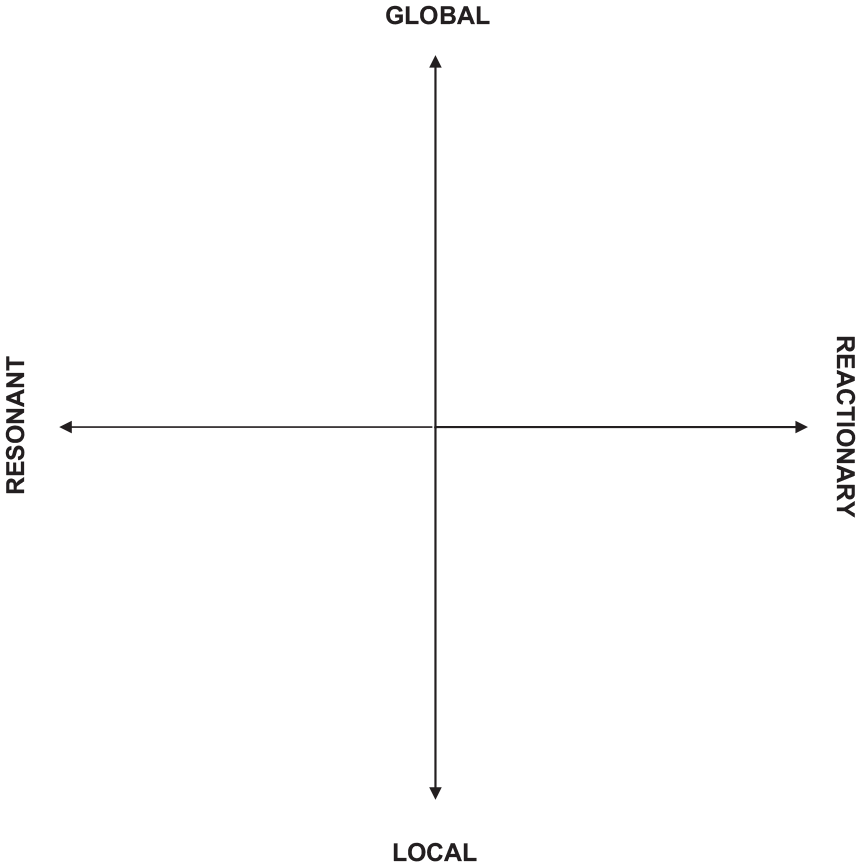
Analytic framework of resonant and reactionary frames across global and local dimensions.
BLM as connective action
When George Zimmerman was acquitted in July 2013 of murdering Black teenager Trayvon Martin, an “incredibly enraged” Black community organizer by the name of Alicia Garza penned a Facebook post while sitting inside a bar in Oakland, California. This “love note” ended with the message: “Black people. I love you. I love us. Our lives matter” (Day, 2015: paragraph 5). Garza’s friend Patrisse Cullors read the post later that night and shared Garza’s words on Twitter with the hashtag #blacklivesmatter. As the hashtag began to go viral, a movement was born. In the following months and years, Garza, Cullors, and a burgeoning rank of supporters and activists started building a coalition of Black-led organizations nationwide. By 2016, their network included more than 50 organizations under the BLM banner (Newkirk, 2016).
The movement prides itself in being decentralized and leaderless—or “leaderful,” implying it has many leaders networked in a horizontal organizational structure (Cobb, 2016). Comprising overwhelmingly of Black activists, most of whom are millennials and many who identify as LGBTQ, it especially rejects the sort of “charismatic leadership”—typically male—that was characteristic of, for instance, the 1960s’ civil rights movement (Smith, 2014). In addition, BLM “relies primarily on direct action and disruptive tactics, and most of its activists disdain mainstream politics” (Milkman, 2017: 23). Social media have been central to spreading its story of police violence against Black people and circulating the narratives of Black activists and their allies, sidestepping mainstream news media and their frequently delegitimizing narratives (Freelon et al., 2016; Kilgo et al., 2019).
Foust and Hoyt (2018) have identified three research traditions in the scholarship on social media and social movements. The resource mobilization tradition adopts a functional approach and focuses on how social media “help or hinder” a movement’s objectives. The collective identity tradition adopts a constitutive approach, looking at how communicative processes unfolding on social media lead to the emergence of collective identities that bind the members of a movement together. Finally, the network tradition pays attention to how information circulates horizontally across interconnected “nodes”—such as the members of a social networking platform—and leads to social mobilization.
The scholarship on BLM illustrates all of these traditions. In line with resource mobilization, Mundt et al. (2018) have examined the significance of social media as tools for “scaling up”—expanding BLM externally and strengthening it internally. Meanwhile, Van Haperen et al. (2020) have paid attention to how communicative rituals on Instagram enable identity construction and affirmation among users posting with the #blacklivesmatter hashtag. Finally, Cox (2017) reports on how BLM activists and supporters use social networking platforms as tools for information seeking.
Reliance on social media is not unique to BLM but characteristic of social mobilization in the 21st century. Bennett and Segerberg (2012) argue that proliferation of digital technologies, especially personal devices, such as tablets and mobile phones through which people are constantly interconnected, has altered the logic of social mobilization—as evident in movements ranging from Put People First and Occupy to Indignados and the Arab Spring. The ability to start or join a movement by posting on social networking sites has significantly reduced the “costs” associated with traditional forms of mobilization, such as the personal risk involved in demonstrating against a government (Olson, 1965).
Movements in the latter half of the 20th century—from civil rights to women’s rights to gay and lesbian rights—often relied on the construction of a collective identity, which led members to value the good of the collective over personal interests and be willing to make sacrifices on its behalf (Melucci, 1995). However, by reducing the time, money, and risk involved in political mobilization, digital technologies have, according to Bennett and Segerberg (2012), obviated the need to forge collective identities. As a result, digitally networked movements are more individualized and bottom up in character. Individuals are motivated to express opinions, emotions, and stories about an issue they personally care about—and are easily able to do so through online social networks. As more individuals connect with each other through such “personal action frames,” a social movement begins to emerge. Movements created by the logic of connective action “have frequently been larger; have scaled up more quickly; and have been flexible in tracking moving political targets and bridging different issues” (Bennett and Segerberg, 2012: 742).
That is not to suggest that other kinds of social movements have stopped forming. Bennett and Segerberg (2012, 2013) identify three types of social action along a continuum in the emerging media ecology. Crowd-enabled connective action takes up one end of the continuum, comprising “networks that self-organize largely without central or ‘lead’ organizational actors, using technologies as important organizational agents” (Bennett and Segerberg, 2012: 755). At the other end is organizationally enabled collective action, or traditional social movements that “depend on brokering organizations to carry the burden of facilitating cooperation and bridging differences when possible” (Bennett and Segerberg, 2012: 755). In between lies organizationally enabled connective action, a hybrid form in which social movement organizations change their traditional tactics and instead deploy “social technologies enabling loose public networks to form around personalized action themes” (Bennett and Segerberg, 2012: 756).
Various empirical studies have found evidence of crowd-enabled connective action in contexts ranging from celebrity fandom (Fuller, 2018) to disability rights (Trevisan, 2018). Zeng (2020) studies the spread of #MeToo on Chinese social media as connective action, illustrating how the digital movement “emerged, adapted, and grew within an authoritarian context” (p. 171). Shahin and Ng (2021) argue that a digitally orchestrated movement against a government biometric ID project in India had the “hallmarks” of connective action, but they blame the movement’s individualized nature as a key reason for its failure.
Indeed, several critics have questioned whether such movements can be as effective or even sustainable over long periods (Servaes and Hoyng, 2017). Some scholars have argued that collective identity—rather than ephemeral connectivity—remains key to mobilization online (Gerbaudo and Treré, 2015; Shahin and Ng, 2021). Treré’s (2015) ethnographic account of the #YoSoy132 movement—which examined both the digital frontstage (comprising social media posts meant for the public) and the backstage (private messages and chats among movement participants)—demonstrates how Mexican students appropriated social media channels to “reclaim their role as heirs of a long tradition of rebellion, generate collective identification processes, and find ‘comfort zones’ to lower the costs of activism, reinforcing their internal solidarity . . . ” (p. 912).
In addition, there are gaps in the “logic” of connective action itself, especially when considering mobilizations that are transnational in scope. First, connective action movements, too, come into being “for contesting a situation that needs to be changed” (Bennett and Segerberg, 2012: 744, our italics). However, citizens situated in one country would have few personal stories to share about the situation in another country—perhaps little personal interest in changing it anyway. That does not mean it does not happen, but the logic of connective action does not quite explain why it does.
Second, Bennett and Segerberg (2012) draw their argument about personal action frames from the underlying processes of “structural fragmentation and individualization” that have “trended in the more economically developed industrial democracies” (p. 743). However, one of their own examples of connective action—the Arab Spring—did not emerge in such a society. Since then, we have witnessed digitally orchestrated movements, such as #MeToo, diffuse to countries around the world—developed and developing, democratic and autocratic, individualist and collectivist (Zeng, 2020). The differences between such societies are crucial: for instance, posting insurrectionist messages on social media can be much more risky in autocratic societies, undermining the principle of reduced cost of participation that propels the logic of connective action.
A third problem emerges from empirical studies of online social movement networks. While Bennett and Segerberg (2012) expect crowd-enabled connective action networks to be horizontal and decentralized, empirical evidence suggests that they are “highly centralized and fragmented, far from the horizontal and fluid structures they are often assumed to be” (González-Bailón and Wang, 2016: 96). They add that “a minority of users bring online networks together and facilitate global dissemination in protest communication” (p. 96). In other words, networked interactions enable a small number of users to influence networked discourse. In this study, we call such accounts crowd-enabled elites, as their influence is not a priori but emerges as a consequence of the networking practices of the crowd.
Cultural hybridity in transnational movements
The production of hybridity in encounters between the global and the local—or the West and the East—is a key concern in cultural and postcolonial studies (Bhabha, 1994). For many scholars, hybridity represents a disruption of the hegemonic process of modernization, the latter understood as the wholesale adoption of a “modern” West’s political ethos, economic systems, and cultural practices by a “primitive” East. Hybridity, by contrast, implies the reconfiguration of Western ethos, systems, and practices as they encounter the East, the reinterpretation of the global when it meets the local. Viewed in this manner, hybridity is a celebration of local agency and particularly its capacity to create something new and different: the “glocal” (Robertson, 1995). Joseph (1999), thus described hybridity as “a disruptive democratic discourse of cultural citizenship” (p. 1).
Still other scholars are, however, skeptical about hybridity’s disruptive potential (Kraidy, 2006). They view hybridization as little more than “what a dominant culture permits in the interest of maintaining its own equilibrium” (Chow, 1993: 35). The surface commingling of cultures masks a deeper capitulation to the Western cultural values—consumerism, for instance. Hybridity thus serves only to lend legitimacy to what is ultimately a cultural takeover: the transformation of local ethos, systems, and practices as they are exploited by transnational centers of power (Ahmad, 1995). For such scholars, hybridity does not imply any agency or creativity; it instead represents the “implicit collaboration of the postcolonial in the service of neocolonialism” (Spivak, 1999: 361).
Important as this debate is, it can also tend to unwittingly essentialize cultures. Even when rejoicing in cultural “contamination,” hybridity paradoxically assumes an initial state of “purity” that a culture never possesses—for all cultures are born out of the negotiation of differences, negotiations that are never quite complete (Baumann, 2017; Spivak, 2003). Terms, such as global and local, West and East, even “American,” “Brazilian,” “Indian,” “Japanese,” and so on, eradicate fluctuations and distinctions—immanent intra-cultural tensions that are not just matters of history but remain active and, in many cases, have become still more pronounced on account of changes wrought by globalization.
However, transnational connective action movements, such as BLM, offer us a site to study cultural hybridity without essentializing “national” cultures and remaining cognizant of their inherent tensions and asymmetries of power. First, such movements typically bring to light the concerns of marginalized communities in the nation where they originate. Second, their action frames are likely to resonate with, and be adopted by, communities at the margins of the nations in which they gain traction. At the same time, they have the potential to stir reactionary reinterpretations by the dominant culture that seeks to silence the voices from the margins. Examining these interpretations and reinterpretations can allow us to better understand what drives the transnational appeal of such connective action movements—and the crowd-enabled elites who “translate” their action frames into different cultural contexts.
Discriminatory practices in Brazil, India, and Japan
This study focuses on the diffusion of BLM as digitally networked connective action into three cultural contexts: Brazil, India, and Japan. Brazil has the world’s largest Afro-Black population outside of Africa. Nearly 97 million Brazilians are estimated to be either preto (Black, 15 million) or pardo (mixed, 82 million) in the 2010 census—comprising a little over half the national population (BBC News, 2011). Despite claims that Brazil is a “racial democracy,” Black Brazilians are socially and politically marginalized (Alfonso, 2020), subjected to state violence (Muñoz, 2020) and frequently the target of racism on social media (Trindade, 2020).
Diversity—and discrimination—takes different forms in India. The country is home to the world’s largest Muslim religious minority—nearly 200 million people in a predominantly Hindu nation (Maizland, 2020). They are politically underrepresented, face discrimination in education and employment, and are also disproportionately the victims of state violence (Bhatia and Gajjala, 2020; Saaliq, 2020). Anti-Muslim sentiment is also rife on Indian social media (Basu, 2019). A second concern is caste-based discrimination, which remains a key driver of social and economic inequality (Borooah et al., 2015). Finally, although India does not have a significant Afro-Black population as a racial category, people with relatively darker skin tones face social discrimination and cultural marginalization—a problem known as “colorism” (Parameswaran, 2015).
Japan’s population is much more homogeneous than either Brazil or India. However, discrimination against a small ethnic minority and immigrants is a significant concern—and has grown in the last 15 years (Shibuichi, 2016). The country has about 2.7 million foreign citizens, mostly from China, Korea, and other parts of East Asia. They are frequently the target of hate speech and violence, particularly from far-right “hate groups” but also, increasingly, from the state (Siripala, 2020). Much like Brazil and India, online bigotry is rampant in Japan too (Park, 2017).
These three countries thus offer very different cultural contexts for examining BLM’s appeal as a globalized social movement. At the same time, Japan, India, and Brazil have the world’s highest number of Twitter users, respectively, after the United States (Statista, 2020). Our study, therefore, focuses on the diffusion of BLM in these countries over Twitter and poses the following research questions:
RQ1. What types of (a) crowd-enabled elites and (b) action frames dominate Twitter conversations about BLM in Brazil, India, and Japan?
RQ2. How do relations of power in Brazil, India, and Japan shape their respective action frames?
Method
BLM protests were held around the globe following George Floyd’s killing on 25 May 2020. To sample the data for our study, we identified a series of hashtags related to the protests that were being commonly used on Twitter, including #BlackLivesMatter, #BLM, #GeorgeFloyd, #GeorgeFloydProtests, and #ICantBreathe. Next, we searched for tweets that included at least one of these hashtags from the Twitter Firehose using the Crimson Hexagon social data mining platform.
We specifically searched for tweets posted outside the United States. A total of 49.6 million tweets were posted between 26 May and 9 June 2020. Their volume surged in the immediate aftermath of Floyd’s killing, reaching a high of 8.1 million on 28 May 2020 before subsiding gradually to just under 1 million by 9 June 2020. So, we decided to concentrate on this 15-day period. A total of 1.4 million tweets were posted from Brazil, 321,117 from India, and 301,354 from Japan. The Crimson Hexagon platform allowed us to download random samples of 10,000 tweets from each of these countries for analysis.
RQ1a asks what types of crowd-enabled elites shaped the Twitter conversations in each country. We conceptualized such elites as individuals and institutions who were contextually situated and whose influence derived from engagements within our network of actors. “Influence” was operationalized in terms of retweets: the more a Twitter account was retweeted, the more influential it was deemed to be (Jackson and Foucault Welles, 2015). To answer RQ1a, we carried out social network analysis of each country’s sample, treating Twitter accounts as “nodes” and retweets as “ties” between the nodes. This allowed us to distinguish the most influential nodes in each network in terms of “indegree”—representing the number of retweets of each node. The analysis was conducted using the open source software, Gephi.
All three country-wise networks followed the “power law distribution” (Barabási, 2010): a small number of nodes had high indegrees while the rest had low to very low indegrees. We identified the top 20 accounts from each country as crowd-enabled elites as this allowed us to have similar cut-off indegree levels everywhere. The indegrees of crowd-enabled elites ranged 384–40 in Brazil, 150–36 in India, and 311–36 in Japan. These accounts were subsequently coded for five variables: Location (US, Local [Brazil/India/Japan], Third Country, Not Specified); Type (Activist/NGO, Political Leader/Party, Government Official/Agency, Journalist/News Organization, Celebrity, Individual, Other); Following (number of accounts); Followers (number of accounts); and Verification (Yes, No). Coding was based on the information available on each account’s Twitter profile.
RQ1b asks what types of action frames were dominant in each country. To answer this question, we analyzed country-wise samples comprising all the tweets from their respective elite accounts (2065 tweets from Brazil, 1159 from India, and 2033 from Japan). That is to say, our purposive sample from each country included all the tweets from the top 20 most influential accounts in that country. This approach allowed us to concentrate our analysis on tweets that represented the dominant tropes of conversation in Brazil, India, and Japan, respectively—and were, according to Barabási’s (2010) power law, likely to become even more dominant over time. To better understand the “meanings” of these tweets with regard to their specific cultural contexts, we relied on qualitative textual analysis.
Textual analysis was carried out by the three authors, who are either native or fluent speakers of Portuguese, Hindi, and Japanese, respectively, and also speak English fluently. The analysis was inductive and proceeded in two stages (Babbie, 2021; Glaser and Strauss, 1967). In the first stage of open coding, each author individually coded their respective country sample, drawing on a close reading of the tweets to come up with a series of emergent coding categories. These categories included the specific causes the tweets were about (BLM, local issues); the language the tweets were written in; normative positions the tweets adopted vis-à-vis these causes (support, oppose); and the specific aspects of these causes the tweets highlighted (anti-racism, police brutality, call for action, spreading awareness, news about protests, resource generation, and so on). The reading of a tweet included examining any photos, videos, or hyperlinks accompanying it when the meaning of the tweet was not evident from the text alone. In the second stage of axial coding, the three authors collectively compared the coding categories and memos from all three countries to distinguish convergences and divergences across countries. This process enabled us to identify common axes along which similarities and differences among the tweets from Brazil, India, and Japan could be analyzed in terms of the power relations within each of these countries (RQ2).
Resonant and reactionary frames
Our analysis of the most influential accounts in Brazil, India, and Japan, and the tweets that made them influential in these countries, respectively, distinguished two intersecting axes of BLM as globalized connective action (see Figure 1). The first axis was normative, relating to the value position adopted in a tweet. Two distinct value positions were evident: resonant, which was in harmony with BLM’s core value of social justice for the marginalized, and reactionary, which opposed or challenged this message. The second axis was spatial, referring to the cultural location of the issue the tweet focused on. Adopting a perspective situated in our sites of inquiry, we classified tweets into two cultural locations along this axis: global for tweets that were about the globalized movement itself, which in our case meant BLM; and local for tweets that shifted the focus to a local cause or struggle.
Resonant frames
Global
In all three countries, we found tweets supportive of BLM and its cause per se. Solidarity with BLM emerged as a key resonant frame. One such tweet, which was retweeted hundreds of times across Brazil, India, and Japan came from the Korean music band BTS (@BTS_twt). It read, “We stand against racial discrimination. We condemn violence. You, I and we all have the right to be respected. We will stand together. #BlackLivesMatter.” BTS was a common elite in all three countries. Several other tweets also expressed the sentiment of solidarity with BLM and with Black Americans in general. For instance, Masayoshi Son (@masason), CEO of Japan’s SoftBank, tweeted, “We stand in solidarity with the Black community during this time of injustice.” Multiple tweets made note of protests taking place in different cities across the United States and around the world in “solidarity” with BLM.
Beyond straightforward expressions of solidarity, we found tweets drawing attention to particular aspects of BLM that resonated with local concerns: Police Brutality, for instance. Violence committed by the police, especially against minorities, is a significant issue in Brazil (Muñoz, 2020), India (Saaliq, 2020), and Japan (Siripala, 2020). Tweets about BLM that emphasized the culpability of cops in the death of George Floyd and other Black Americans were therefore heavily retweeted in all three countries (see Table 1).
Examples of resonant and reactionary frames from Brazil, India, and Japan.
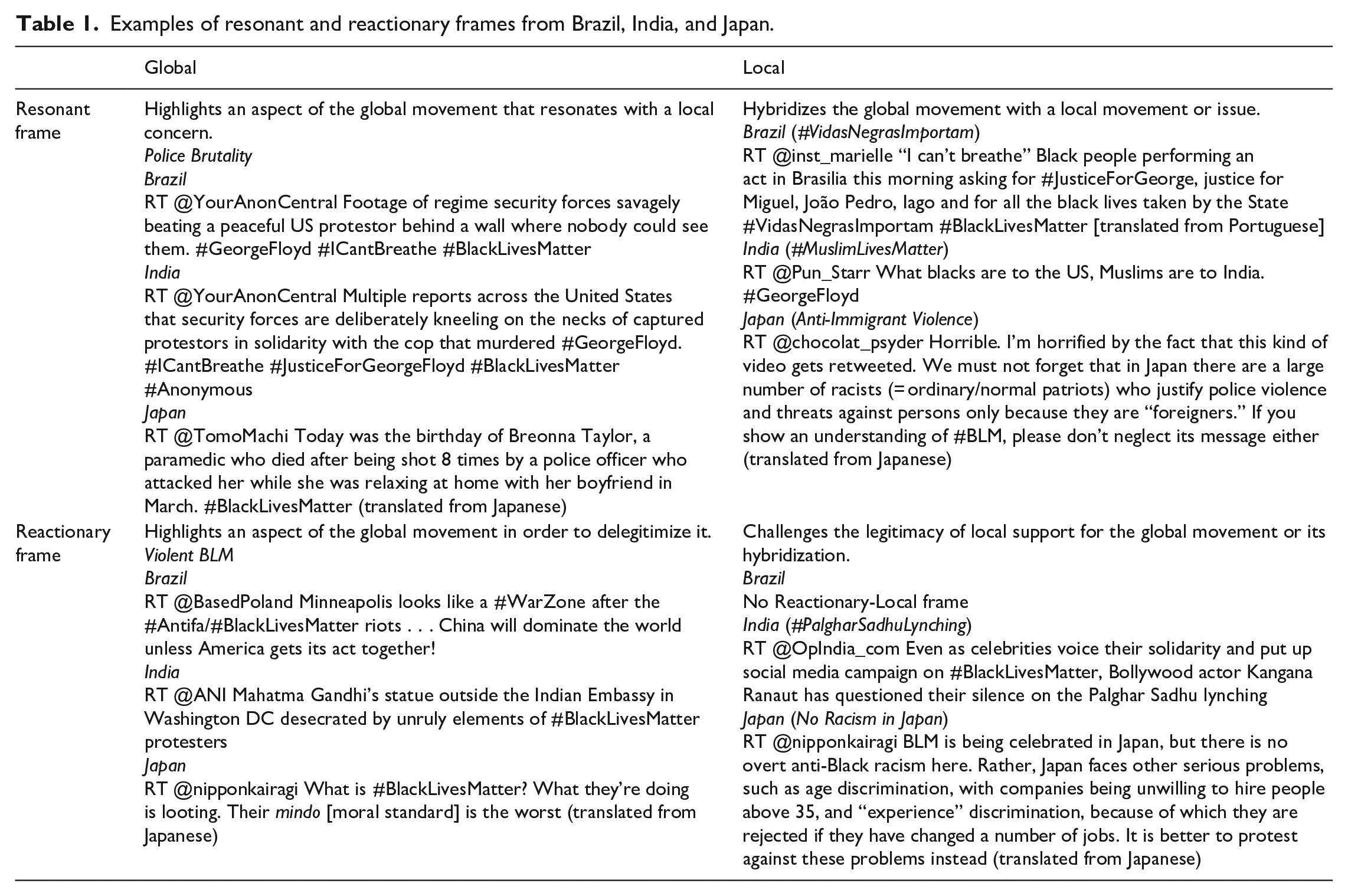
A number of such tweets came from Anonymous (@YourAnonCentral), which was the single most influential account in Brazil and India—where police violence is particularly high—and sixth most influential in Japan. As one Anonymous tweet that was retweeted in Brazil read, “Footage of regime security forces savagely beating a peaceful US protestor behind a wall where nobody could see them.” The text was followed by a video depicting the beating. Another Anonymous tweet that found resonance in India said, “Multiple reports across the United States that security forces are deliberately kneeling on the necks of captured protestors in solidarity with the cop that murdered #GeorgeFloyd.” Other elites also tweeted about police brutality against Black Americans. For instance, Tomohiro Machiyama’s (@TomoMachi) tweet, retweeted in Japan, read, “Today was the birthday of Breonna Taylor, a paramedic who died after being shot 8 times by a police officer who attacked her while she was relaxing at home with her boyfriend in March. #BlackLivesMatter” (translated from Japanese).
Of the 20 crowd-enabled elites in the Brazilian sample, 5 primarily tweeted resonant-global frames—compared with 7 in India and as many as 15 in Japan. All 5 elites in the Brazilian sample were located outside the country and mostly included global celebrities, such as BTS, or activists, such as Anonymous. India and Japan had a mix of local and global elites in this category; most of them were activists, celebrities, or news accounts (see Supplemental Material).
Local
Resonant action did not stop at highlighting those aspects of the global movement that were resonant with local concerns, such as police brutality. In all three countries, tweeting went a step further and used BLM hashtags to draw attention to particular local issues that were deemed to resonate with BLM’s key message: social justice for minorities. However, the local issues varied across countries—along with the definition of minorities.
In Brazil, which has a substantial Black population, several BLM tweets demanded justice for João Pedro, a teenager who was killed weeks earlier in a police raid—one among thousands of local Black victims of police violence (Phillips, 2020). Tweets calling for justice for João Pedro and other often used the hashtag #VidasNegrasImportam, a straight translation of #BlackLivesMatter into Portuguese. As one such tweet read, “‘I can’t breathe’ Black people performing an act in Brasilia this morning asking for #JusticeForGeorge, justice for Miguel, João Pedro, Iago, and for all the black lives taken by the State #VidasNegrasImportam #BlackLivesMatter.” The original tweet was from Marielle Franco Institute (@inst_marielle), founded by the family of Marielle Franco, a local human rights activist who campaigned against police brutality and was gunned down in 2018.
In India, resonant hybridization took two forms. First, many local elites tweeted about violence against Muslims, especially in the context of protests against a new citizenship law that was deemed to discriminate against the country’s large Muslim minority (Maizland, 2020). The hybridized version of #BlackLivesMatter was #MuslimLivesMatter. One elite, Kakavani 2.0 (@007AliSohrab), simply tweeted the two hashtags together to make an association between Blacks in the United States and Muslims in India. Another elite, ASIF (@Pun_Starr), wrote, “What blacks are to the US, Muslims are to India. #GeorgeFloyd.” Still other elites saw parallels between Floyd and Faizan, a Muslim youth killed by the Indian police.
There was a second form of hybridization too, although not quite as pronounced. One elite associated BLM with Caste Violence in India. Prashant Kanojia (@PJkanojia) said, “What happened to #GeorgeFloyed happens every day in India. But Dalits/Backwards/Adivasis [different groups of lower caste] are busy performing rituals and building temples” (translated from Hindi). Some other tweets by Kanojia drew attention to Colorism, calling out a well-known Indian cricket player who had been revealed to use a color-based slur against another player from the Caribbean.
Hybridization took still more diverse forms in Japan. Tweets rued the Japanese ignorance of bias in their own society—and unwillingness to face up to it. In such tweets, BLM became a means of drawing attention to the Silence about Racism. As an elite by the name of Uncle Seyarogai aka Emoyan (@emorikousuke) tweeted, “Indifference and silence are the same as being complicit in racism. I hate it! I shouted [in a video accompanying the tweet] in order to propose a stance ‘to have a sense of responsibility and not to remain silent’” (translated from Japanese).
Some other tweets focused on Anti-Immigrant Violence faced by people from different parts of the world, from the Kurdish region to Korea. Chocolat. (@chocolat_psyder), for instance, tweeted the video of a far-right Japanese leader rationalizing police brutality against a Kurdish resident. The tweet read, “Horrible. I’m horrified by the fact that this kind of video gets retweeted. We must not forget that in Japan there are a large number of racists (=ordinary/normal patriots) who justify police violence and threats against persons only because they are ‘foreigners’. If you show an understanding of #BLM, please don’t neglect its message either.”
Brazil had as many as 12 crowd-enabled elites in this category (2 suspended since data collection), while India and Japan had 6 and 3, respectively. Almost all these elites, in all three countries, were locally based—except 1 for Brazil, a US-based ballerina who nonetheless tweeted in Portuguese. Interestingly, there were few NGO accounts in this category. Five of the elites in Brazil were classified as journalist/news accounts. However, these were not mainstream but “alternative” news sources that focused on pop culture, music, and infotainment. Many of the Indian and Japanese elites in this category were also alternative news sources or described themselves as journalist-cum-activists.
Reactionary frames
Global
Not all tweets in Brazil, India, and Japan were supportive of BLM or hybridized its message to highlight struggles in their own societies. In varying degrees, tweets also opposed BLM and questioned the tactics of BLM protesters. A common reactionary frame across the three countries was BLM Violence, which attempted to delegitimize the movement by calling attention to violence at BLM protests and blaming the protesters for it. In Brazil, for instance, retweets of @BasedPoland (an account that was later suspended but has since been recreated as @BasedPoland2) repeatedly referred to BLM protesters as “Antifa” (or anti-fascist) rioters. As one tweet said, “Minneapolis looks like a #WarZone after the #Antifa/#BlackLivesMatter riots . . . China will dominate the world unless America gets its act together!”
Similarly, India’s ANI news agency (@ANI) tweeted, “Mahatma Gandhi’s statue outside the Indian Embassy in Washington DC desecrated by unruly elements of #BlackLivesMatter protesters.” Later, a tweet from the news website OpIndia.com (@OpIndia_com) claimed, “After Washington, #BlackLivesMatter protestors vandalize Gandhi statue in London’s Parliament Square, injure 35 police personnel.” Gandhi remains one of India’s most revered historical figures who led the nation’s anti-colonial struggle against the British: such tweets attempted not only to discredit BLM as a social movement but also to spark outrage against it. In Japan too, anti-BLM tweets focused on violence at the protests. As a tweet from Sea Demon (@nipponkairagi) observed, “What is #BlackLivesMatter? What they’re doing is looting. Their mindo [moral standard] is the worst” (translated from Japanese).
In both India and Japan, but not in Brazil, another reactionary frame was Black-on-Black Violence, which blamed Black Americans themselves for the violence they suffered. One such tweet, retweeted in India, went, “Historical fact checked data in the US states 93% of black homicides were carried out by blacks. I wonder if #BlackLivesMatter would care to explain why they don’t seem to matter to some black people?” The tweet came from @DVATW, an account that has since been suspended. On similar lines, a tweet from Japan’s Sea Demon read, “Black people have killed heroes while ‘giving birth to’ Black heroes such as 2PAC, Notorious B.I.G, BIG L, and Nipsy Hussle in the ghetto. Nothing will change unless the black people themselves consciously make efforts to change the environment” (translated from Japanese).
The lone crowd-enabled elite for Brazil in this category, @BasedPoland, has been suspended—although it has re-emerged as Based Poland Return (@BasedPoland2), which describes itself as a conservative individual based in Poland. There were two elites for India in this category: one of them has been suspended. The other, ANI, is a local wire service. The only elite in Japan that mainly tweeted in this category, Andy Ngô (@MrAndyNgo), is a local journalist.
Local
Reactionary frames also had a local dimension, challenging the legitimacy of the local resonant frame. Specifically, this framing called into question the motives of local voices that were supporting BLM or hybridizing BLM to highlight local instances of violence and discrimination. In India, Bollywood actress Kangana Ranaut (@KanganaTeam) claimed it was hypocritical of her fellow celebrities to speak up for BLM while endorsing “fairness creams” and staying silent on the murder of two local Hindu priests, using the hashtag #PalgharSadhuLynching. The tweet was part of a right-wing effort to fan rumors that the Hindu priests had been killed by Muslims, which in turn would instigate violence against the country’s Muslim minority (BBC News, 2020). Later investigations revealed local vigilantes, who were also Hindu, had killed the priests after mistaking them for thieves (Singh, 2020). Ranaut is a well-known right-wing voice in India; her claims were repeated by several other elites, including OpIndia.com, ABP News (@ABPNews), and Swarajya magazine (@SwarajyaMag).
Similarly, Japan’s Sea Demon said there was little need for Japanese people to support BLM or its hybridization because racism was not an issue in the country: BLM is being celebrated in Japan, but there is no overt anti-Black racism here. Rather, Japan faces other serious problems such as age discrimination, with companies being unwilling to hire people above 35, and “experience” discrimination, because of which they are rejected if they have changed a number of jobs. It is better to protest against these problems instead. (Translated from Japanese)
There were no such tweets from Brazil—and so no Brazilian elites in this category. India had four crowd-enabled elites who mainly posted reactionary-local tweets. One of these, Ranaut, was a celebrity; the other three were news sources. Japan’s only elite in this category, Sea Demon, was a conservative “micro-celebrity”—someone with a large online following.
Conclusion
Digital technologies, especially social networking sites, have enhanced the potential for social movements emerging in one society to diffuse beyond its borders. Such mobilization has gathered pace in recent years, as the Internet spreads to the furthest corners of the planet and seeps into the most intimate crevices of our private lives (Arora, 2019; DeNardis, 2020). This study has examined how BLM transformed into global social action through Twitter. Our analysis of BLM tweets from three different nations—Brazil, India, and Japan—leads to several important conclusions.
First, while the global reach of social technology makes global solidarity possible, the emergence of such solidarity relies on a movement’s resonance with local concerns. Specifically, when people in other parts of the world join digitally networked connective action (Bennett and Segerberg, 2012), they amplify particular action frames that resonate within their own societies. In our study of BLM, it was the frame of police brutality, especially against minorities and immigrants—a deep-felt concern across Brazil, India, and Japan—that found resonance in these societies and became amplified as a result.
Second, digital diffusion leads to cultural hybridity. The global movement is associated with local causes and struggles that resonate with its core values. However, such hybridization is culturally particular. In Brazil, which has a significant Afro-Black population, BLM became a means to protest the killing of Black Brazilian youth by the local police. The #BlackLivesMatter hashtag’s hybridized version, #VidasNegrasImportam, was its literal translation into Portuguese. However, in India, which does not have a large Afro-Black population, BLM was mainly used to highlight violence and discrimination against the local religious minority—Muslims—and was hybridized into #MuslimLivesMatter. Hybridization was still more different in Japan, a more homogeneous society than Brazil or India. BLM was used to call attention to violence against immigrant groups and as an opportunity to break the silence on domestic racism. The analysis suggests that in the context of a global social movement from the margins, cultural hybridity can indeed reflect local agency and creativity rather than capitulation to hegemonic Western values (Bhabha, 1994; Kraidy, 2006).
Third, resonant action can also spark a reaction across the fault lines of local culture. When a global social movement, such as BLM, gives voice to marginalized groups in other societies, a narrative of agency for them to subscribe to, it simultaneously reactivates hegemonic counternarratives that seek to reinforce asymmetries of power. In our study, reactionary frames emerged in all three countries, but there were differences among them. In India and Japan, the reactionary frames countered both resonant-global and resonant-local frames; in Brazil, only the resonant-global frame was targeted. This may have happened because Brazil’s resonant-local frame, #VidasNegrasImportam, was a straight translation of the resonant-global frame. Delegitimizing BLM therefore also implied delegitimizing the local movement for Black lives. In India and Japan, hybridization took BLM further afield. Their resonant-local frames, such as #MuslimLivesMatter and Silence about Racism, therefore needed to be challenged for what they were by reactionary-local frames.
Fourth, resonant and reactionary frames indicate that relations of power within particular nations are increasingly becoming transnational in scope and character. Partly thanks to digital technology, disadvantaged groups in one nation—Blacks in Brazil, Muslims in India, and immigrants in Japan—can find affinity with voices from the margins in another nation, namely Blacks in the United States. At the same time, and partly in reaction to the counterhegemonic transnational alliances, hegemonic groups in different nations are also willing to close ranks and reinforce one another. Reactionary-local elites in India, for instance, did not just point fingers at local activists hybridizing BLM they also attempted to delegitimize BLM protesters in Washington DC and London. Transnational connective action, while empowering marginalized communities, thus also escalates the hostility they face.
Finally, crowd-enabled elites play a powerful role in enabling social movements to diffuse globally over digital networks. Our study found that a few Twitter accounts, including Anonymous and BTS, were influential in all three countries. However, these accounts only proffered resonant-global frames. All other types of frames—resonant-local and reactionary-global and reactionary-local—were typically produced by elites based locally. This implies that global and local elites serve different functions in globalized connective action.
Global accounts, because of their enormous following that transcends national borders, made BLM “available” as an action frame worldwide. However, it was local accounts that ultimately transformed BLM into a global movement by “translating” its meaning in ways that resonated with local issues and struggles. It was also local accounts that mostly produced reactionary responses to such translation—targeting the hybridized local frames and the global frame. In line with the expectations of the logic of connective action, we did not find too many NGOs or organized activist groups among the elites. At the same time, it also was not just atomized individuals spreading the movement through personal action frames. Crowd-enabled elites tended to be celebrities, alternative news organizations, and journalist-cum-activists—both liberal and conservative—typically with large online followings.
Our study, therefore, has significant theoretical implications for the logic of connective action (Bennett and Segerberg, 2012). Transnational connective action takes place not through personal action frames but as a result of culturally resonant reinterpretation. Those aspects of a global movement that find resonance in local cultures are the ones that become amplified; in addition, the global movement can become a vehicle for amplifying causes and struggles particular to the local culture that resonate with its values. However, resonant frames can, in turn, stir up reactionary frames in a feedback loop that challenge both the global movement and the local struggles they bring to light. Finally, a small number of crowd-enabled elites—global and local—enable the transnational diffusion of connective action.
The analysis also contributes to our theoretical understanding of cultural hybridity. While theories of hybridity tend to focus on the global–local dichotomy (Bhabha, 1994), we show that tensions not only exist across but also within cultures. All cultures are born out of struggles and the negotiation of differences; in many instances, these struggles are not just matters of history but are active and ongoing (Baumann, 2017; Spivak, 2003). Encounters between the global and the local even have the potential to widen these intra-cultural chasms. Our analysis distinguishes affinities that transcend national boundaries and lead to transnational alliances across subnational fault lines of power.
Global connective action movements are a useful “site” for examining and understanding such tensions. By lowering the costs of participation, such movements allow voices from the margins to surface and produce non- and even counterhegemonic forms of hybridity. At the same time, they bring to light the transnational network of alliances that emerge not only through hybridization but also in reaction to it. This was evident, for instance, in the tweets of Brazilian, Indian, and Japanese elites who not only attacked BLM’s hybridization with local movements but BLM as well—in ways quite similar to right-wing critics of the movement in the United States.
The limitations of our study can serve as avenues for future research. Although Twitter is the platform most closely associated with social movements and online political participation, it is hardly the only one. Future research can extend our analytic framework of resonant and reactionary frames by examining the globalization of social movements on platforms, such as YouTube, Reddit, Facebook, and so on. Researchers could also compare different platforms to distinguish the role different types of platform affordances play in enabling resonant and reactionary frames. Another line of research can employ ethnography and in-depth interviews to investigate resonant and reactionary frames in offline action—for example, in BLM street protests around the world.
Supplemental Material
sj-docx-1-nms-10.1177_14614448211057106 – Supplemental material for Black Lives Matter goes global: Connective action meets cultural hybridity in Brazil, India, and Japan
Supplemental material, sj-docx-1-nms-10.1177_14614448211057106 for Black Lives Matter goes global: Connective action meets cultural hybridity in Brazil, India, and Japan by Saif Shahin, Junki Nakahara and Mariana Sánchez in New Media & Society
Footnotes
Funding
The author(s) received no financial support for the research, authorship, and/or publication of this article.

Supplemental material
Supplemental material for this article is available online.
Author biographies
References
Supplementary Material
Please find the following supplemental material available below.
For Open Access articles published under a Creative Commons License, all supplemental material carries the same license as the article it is associated with.
For non-Open Access articles published, all supplemental material carries a non-exclusive license, and permission requests for re-use of supplemental material or any part of supplemental material shall be sent directly to the copyright owner as specified in the copyright notice associated with the article.
