



Abstract
I examine a 2-week window into an environmental movement trying to gain traction in the public sphere, centered on a transnational day of action calling for a ban on the drilling technology, high-volume hydraulic fracturing, the Global Frackdown. Twitter serves a different purpose for the anti-fracking Global Frackdown movement than other Internet-based communications, most notably email listservs. Findings show that Global Frackdown tweeters engage in framing practices of movement convergence and solidarity, declarative and targeted engagement, prefabricated messaging, and multilingual tweeting. In contrast to Global Frackdown tweeters’ use of the platform for in-the-moment communication, Global Frackdown activists report in in-depth interviews that they place more emphasis on private (i.e., listservs) communication channels for longer term, durable movement building. The episodic, crowdsourced, and often personalized, transnational framing practices of Global Frackdown tweeters support core organizers’ goal of promoting the globalness of activism to ban fracking. This research extends past scholarship on socially mediated activism by providing a case study of how environmental activists use Twitter for ephemeral movement communication during a pre-planned transnational day of action, blurring internal movement collective identity-building and affirmation with publicly enacted strategic framing.
In this article, I examine a 2-week window into an environmental movement trying to gain traction in the Twittersphere, centered on a transnational day of action, the Global Frackdown, calling for a ban on the oil and natural gas drilling technology, high-volume hydraulic fracturing, commonly referred to as fracking. As I will show, Global Frackdown tweeters use the platform as a tool to advance a transnational anti-fracking movement and to bolster its moral authority, as well as to forge linkages between local groups on a transnational scale in-the-moment during coordinated events taking place in 27 countries. Twitter, as a broadcast-like medium (Murthy, 2013), helps this diffused, loosely coordinated transnational social movement bring together localized environmental concerns within globalized organizing. My research shows that Twitter enables activists in diverse geographical locations to connect and feel part of something larger.
Global Frackdown tweeters’ Twitter usage enhances the globalness of the day of action, allowing both individuals integrated into the movement and audiences who are not, to quickly learn what is happening or has already happened in other locales and engage with the day of action. These practices foster a sense of solidarity that is enhanced by the medium’s publicness. Such “socially-mediated publicness” (Baym & boyd, 2012) supports the development of a movement collective identity centered around banning fracking in local communities on a global scale. I contrast Global Frackdown tweeters’ use of the platform for in-the-moment communication with Global Frackdown activists reporting in in-depth interviews that they place more emphasis on private (i.e., listservs) communication channels for longer term movement building and to advance globalized organizing against fracking over social media channels.
This research builds on previous scholarship dealing with social movement uses of Twitter addressing large-scale movements, such as the 2011 Arab Spring revolutions (Meraz & Papacharissi, 2013; Papacharissi & de Fatima Oliveira, 2012; Parmelee & Bichard, 2012). In the case of social movements that do not reach a wider tipping point, I argue Twitter can function as a performative, identity-building space, more than as a means to reach external audiences. Global Frackdown tweeters integrate personal action frames (Bennett & Segerberg, 2013) with collective action frames, as well as engage in hybrid framing practices. The episodic, loosely coordinated and often personalized, transnational framing practices of Global Frackdown tweeters support core organizers’ goal of promoting the globalness of activism against fracking. This research extends past scholarship on socially mediated activism by providing a case study of how environmental activists use Twitter for ephemeral movement communication during a pre-planned transnational day of action, blurring internal movement collective identity-building and affirmation with publicly enacted strategic framing.
Social Technologies, the Networked Society, and Political Action
Social media applications are making possible reconfigured social relations (Rainie & Wellman, 2012). New media can enhance individual autonomy and enable collaboration between individuals across wide geographical distances (Benkler, 2006). Social networking sites allow individuals to construct self-representations in reflexive interaction within their social networks (Papacharissi, 2011). Additionally, social networking sites afford both development of communities and identity expression (Papacharissi, 2011). These changes underlie what Benkler (2006) has termed the “networked public sphere” (p. 10) and Castells (2009) calls the “network society” (p. 70). Both formulations of this phenomenon are predicated on the fundamental shifts in social relations and systems enabled by new and social media tools toward more personalized, grassroots-driven communication ecologies.
Twitter is a broadcast-like microblogging platform, as opposed to social networking sites such as Facebook where individuals generally know their contacts in the offline sphere and posts are usually to some degree private (Murthy, 2013). The platform is similar to older broadcast communication technologies, but according to Murthy (2013), it has the following characteristics: public, multicast (many-to-many), interactive, and networked (p. 16). Twitter users can tweet to people they do not know offline, for example, US President Barack Obama (@BarackObama), in the hopes of getting their attention. This type of public communication, which Murthy (2013) has termed “directed interaction” (p. 4), makes Twitter distinctive from other forms of Internet-based communication (e.g., email).
The Twitter hashtag function, along with retweeting as a social practice, enables conversations (boyd, Golder, & Lotan, 2010; Honey & Herring, 2009). Retweeting allows users to share messages originating from others, allowing frames to potentially gain traction in the Twittersphere (Murthy, 2013). Retweeting can help to “raise global awareness” of collective actions (Murthy, 2013, p. 113). Hashtags, marked by the “#” symbol, allow for indexing of content, what Zappavigna (2012) calls “searchable talk” (p. 13), so that users can follow discourse about specific topics and see what other users they do not themselves follow are saying about an issue. According to Baym and boyd (2012), the “networked publics” empowered through social media applications are as follows: scalable, searchable, replicable, and can persist over time (p. 326).
Mass media gatekeeper roles shift with social technologies. Twitter permits users, including activists, to challenge mass media gatekeeper functions (Meraz & Papacharissi, 2013; Papacharissi & de Fatima Oliveira, 2012). Individuals can gain prominence through what Meraz and Papacharissi (2013) term “networked gatekeeping” (p. 141), the networked framing processes within hybrid and fluid information streams and with the collaborative crowdsourcing of information. Papacharissi and de Fatima Oliveira (2012) find that Twitter hashtag indexing (e.g., #egypt) functions as “affective” news streams (p. 276), characterized by a mixture of emotion and opinion combined with often personalized information sharing. Christensen (2013) finds that in the case of the 2012 US presidential election, the third-party candidate for the Green Party, Jill Stein, engaged in a practice he labels “hashtag jumping” to draw on the hashtag frames of preexisting social movements in an effort to build on preexisting discourses and conversations in disseminating a related message (p. 663).
Within this context of “socially mediated publicness” (Baym & boyd, 2012), social media are enabling a shift from traditional forms of collective action to what Bennett and Segerberg (2013) term “connective action” (p. 13). While organizations are still important, they are now less so (Bennett & Segerberg, 2013). Rather they conceptualize “organizationally-enabled” connective action with loose coordination in diffused networks, with individuals able to customize social technologies for their own purposes, and personal action frames (Bennett & Segerberg, 2013, p. 12). In research on two climate change protests, Segerberg and Bennett (2011) show how Twitter feeds reflect the “crosscutting networking mechanisms” of protest ecologies, “crowd-as-gatekeeping” processes in real-time Twitter streams, and evolve over the course of protest events (p. 203). They suggest that social media can serve internal organizing functions for movements and also function as reflections of organizational progresses.
In this study, I build on past social media and social movement scholarship by examining activist Twitter practices in a movement centered on a pre-planned set of loosely coordinated protest events and that is explicitly transnational in nature. Furthermore, through this case study, I address an issue that integrates local and global aspects of a controversial environmental issue, that of the use of the drilling technology fracking in the oil and natural gas industry. Thus, I ask the following question:
RQ1. What Twitter strategies do Global Frackdown activists use to mobilize for the 19 October 2013 day of action?
I conceptualize of Global Frackdown activists as core organizers working in a sustained manner, beyond episodic participation in Global Frackdown day of action events, at the local, national, or transnational level to promote moratoria or bans on the use of hydraulic fracturing in the fossil fuel industry. In order to gain a holistic understanding of the broader communication strategies used by Global Frackdown activists and the ways in which the movement’s Twitter practices support, or do not, sustained organizing, I also ask,
RQ2. How do Global Frackdown activists see social media platforms as functioning in conjunction with other Internet-based communication strategies?
Social Movement Framing in Digital Networks
Part of the power of advocacy networks and movements derives from their ability to draw on themes of justice and develop a sense of moral authority (Beck, 2011). Activists build movements based around common, shared collective action frames (Gamson, 1992). Frames are interpretative devices that give meaning to situations and make certain elements of a narrative more prominent (Entman, 1993; Goffman, 1974). These shared meanings provide a framework for movement activities (Benford & Snow, 2000). Collective action frames help movements construct collective identities, which Melucci (1995) defines as the outcome of interactive processes through which groups of individuals co-construct shared definitions of social relations and actions. Olesen (2011) defines “transnational activist frames” as those concerning transnational topics (e.g., climate change), issues in nation-states other than that of the one promoting a given frame, or those that explicitly call on the attention of activists in other countries (p. 14).
With the rise of digitally mediated activism, recent scholarship has examined the shift to more personalized forms of political action (Bennett & Segerberg, 2013; Castells, 2012; Papacharissi, 2011). Horizontal, multimodal communication networks allow for individuals to engage in autonomous forms of “mass self-communication,” outside of the control of governmental and corporate actors (Castells, 2012, p. 70). Bennett and Segerberg (2013) propose the concept of “personal action frame,” with the dimensions of technological openness and spreading through social media, symbolic inclusiveness (e.g., the Occupy movement’s “We are the 99%” meme), inclusive and easy to share (p. 37). These personalized frames do not require an individual to buy into an in-group collective identity, but rather they are action-centric (Bennett & Segerberg, 2013). Within this reformation of activist framing processes, organizations take a backseat to individuals. Even in cases of organizationally propagated frames, frames are often personalized.
This shift presents a fruitful area of research in which to examine the relationship between collective and personalized framing practices with the messages activists put forth within the Twittersphere. Thus, I additionally ask the following question:
RQ3. How do Global Frackdown tweeters frame protest against fracking?
Distinguishing from core activists, I define Global Frackdown tweeters as individual and organizational Twitter users who tweet at least once in the Global Frackdown dataset in favor of the movement, for example, by sharing information about events, declaring support for the movement, and calling on others to join the movement in general or specific events.
Methods
Twitter Data Collection
The social media data for this project come from a dataset of 9,449 tweets containing the main Global Frackdown movement hashtag #globalfrackdown. The tweets were collected between 13 October 2013 and 27 October 2013, using the software DiscoverText. Data collection was restricted to publicly available Twitter posts for a 2-week time period, spanning 1 week before and 1 week following 19 October 2013, the day of action. DiscoverText contracts with GNIP. This enables researchers to collect data from Twitter’s firehose. Thus, the dataset of #globalfrackdown tweets can be considered comprehensive for the time period under study.
Data Analysis
Texts need to be studied with attention to the sociocultural context and practices in which they were created. The iterative nature of qualitative research gives a more nuanced understanding of the communicative processes embedded within content. My grounded-thematic analysis coding was rooted in a rich understanding of the movement developed through a year and a half of background research, including review of publicly available websites and online documents, as well as in-depth interviews with three key transnational movement organizers and two representatives of an early anti-shale organization in Europe, which had signed on to the 2012 and 2013 Global Frackdown days of action as a partner organization. Interviews were conducted between June and August 2013. Interviewees are individuals involved in anti-shale activism on a transnational level operating within the European Union from Brussels, those involved with early opposition to shale development within Europe, and a transnational organizer for the main US civil society organization coordinating anti-fracking activism in the United States and internationally. I examined commonalities in how activists frame the shale-related issues and their organizational communication strategies. I transcribed each interview and then coded them thematically, iteratively developing a set of working themes employing a grounded theory approach (Saldaña, 2009).
To analyze the Twitter data, I went through a two-step qualitative textual analytic coding process. I first coded the full dataset for language. Within the dataset, 79% of tweets are in English, followed by 14% in Spanish. The remaining 7% of tweets are in Basque, Bulgarian, Catalan, Dutch, French, German, Polish, Romanian, Russian, Swedish, and Turkish. After coding for language, I restricted my subsequent analyses to the English (n = 7,678) and Spanish (n = 1,314) language tweets. Following Gamson (1992), in the second step of the coding process, I iteratively developed a set of working frames for content and process. I paid particular attention to patterns in the data and then derived the frames discussed below (Saldaña, 2009). The unit of analysis is the individual tweet. Each tweet could be coded for more than one frame. In order to analyze Global Frackdown Twitter content accounting for its full reach, as a casual non-movement affiliated user might encounter #globalfrackdown tweets on the platform, retweets are included in the corpus of data.
While my study is primarily qualitative in nature, in order to assess the validity of the coding method, I created a random sample (n = 250) of the English language tweets and employed a second coder to independently code the sample, in addition to myself. While there is not a definitive standard for acceptable levels of intercoder reliability, levels above .80 are generally considered sufficient (Lombard, Snyder-Duch, & Bracken, 2002). Two measures of intercoder reliability were used to assess agreement. The scores for both measures were slightly lower than desired, Krippendorff’s alpha (.749) and Fleiss’ kappa (.73). The problematic category was that of “multilingual tweeting.” This is partly because of a low occurrence of this frame in the English language tweets (one coder coding 1 item in this category and the other coder 3). In order to resolve this issue, I created a new random sample of the English language tweets (n = 200) and provided the second coder with clarification on what constituted “multilingual” text. For the second round of intercoder reliability coding, the scores for Krippendorff’s alpha (.78) and Fleiss’ kappa (.87) improved. For the individual items, the Krippendorff’s alpha scores were movement convergence and solidarity (.74), multilingual tweeting (.89), and targeted engagement (.82).
In the following sections, I first provide an overview of the movement and its overall communication strategies as reported in in-depth interviews with five transnational and local activists from organizations that took part in the Global Frackdown. I then summarize the results of my analysis of the #globalfrackdown hashtag for a 2-week period before and following the 2013 day of action. Finally, I discuss the major Global Frackdown Twitter frames in greater detail. User names for accounts held by individuals have been redacted. User names for organizational accounts are included, for example, @350 and @foeeurope, in the subsequent discussion.
Global Frackdown Goals, Tactics, and Communication Strategies
The Global Frackdown mission statement reads, in part, “We stand united as a global movement in calling on governmental officials at all levels to pursue a renewable energy future and not allow fracking or any of the associated infrastructure in our communities or any communities” (Global Frackdown, n.d.). Activists’ rationale for organizing an international day of action against fracking is that given that the shale industry and its major players are international, they perceive the need to share experiences and tactics in order to confront the industry (personal communication, June 14, 2013). As a European activist from a local group endorsing the 2013 Global Frackdown stated on their motivations, What we feel is a solidarity with all the people who are affected and we really try to share the information when something is going on like in Poland. We know how important it is if people from abroad all of the sudden see that you have a problem and they tell other people about it. Just this is a help that is incredible. (Personal communication, June 18, 2013)
The day of action has been loosely coordinated by the civil society organization, Food and Water Watch, based in Washington, DC, with a satellite office in Brussels. Organizers have focused on starting at the local level and then building the movement at the regional and national levels (personal communication, August 8, 2013). Transnational organizers purposefully keep messaging fluid and open so that local groups can define goals and messaging that make sense for their circumstances, for example, calling for moratoria versus a ban on fracking (personal communication, August 8, 2013). A challenge for activists, even at the local level, is organizing across wide geographical areas (personal communication, June 18, 2013). Thus, the focus at both local and transnational scales is on relationship building, starting through preexisting interpersonal networks (personal communication, June 18, 2013; personal communication, August 8, 2013).
The communication tools activists reported using varied across movement scale and target audience. The website globalfrackdown.org serves as an organizing platform for the movement, as well as a Global Frackdown listserv (personal communication, August 8, 2013). In a toolkit available on the Global Frackdown website, organizers suggest planning events that target elected officials, build the movement around the goal to ban fracking, and raise the visibility of the movement, such as collecting petitions and photo petitions, passing out flyers, hosting a potluck, holding a rally or flash mob, or screening the movie Gasland (Global Frackdown, 2013). Movement tactics include advancing ballot measures, advocating for bans, moratoria, and local referenda, as well as pressuring policymakers to study the impacts and risks associated with the shale industry.
The use of specific communication tools reflects the preferences of individual activists, movement scale, and resource constraints. On the local level, face-to-face organizing, facilitated through the use of social media tools to make initial connections, is the most important method for mobilizing. Regardless of movement scale, activists reported using traditional methods of press work to reach policymakers and other institutional actors, such as press releases and efforts to get radio and television coverage, along with the use of new media tools, such as posting videos on YouTube, to reach local populations.
The most useful tools for internal movement communication, as reported in interviews, are ones that facilitate interpersonal information exchange more directly, as well as those which help activists generate new ties upon which they can then build sustained relationships online, and offline in the case of local groups, rather than more episodic, externally focused ones. Activists reported that the most important communication tools on a transnational scale are closed listservs. Listservs enable activists to connect with experts, as well as share information and tactics. According to a local European activist, We have these experts in all the countries and as you can imagine it is a flood of mails that is coming in but I know exactly if there is a mail from [U.S. activist] I just need to see what she is writing and by now I know I can rely upon her information. (Personal communication, June 18, 2013)
In the words of one regional European activist, as echoed by other interviewees, listservs are more important than social media, Honestly, I do not see it [social media] as the most powerful tool of communication in that campaign. I mean the best way we have to share information is mostly to use internal listservs that representatives of national groups have joined over the last two years. So it is a really good way, and a really efficient way, to share information that we don’t necessarily want the industry to be aware of. (Personal communication, June 17, 2013)
It is likely that since fracking has become such a highly controversial issue, activists pay heightened attention to private means of internal movement communication.
As I have discussed, the movement’s overarching goal is to build a global anti-fracking movement and global solidarity across widely dispersed local anti-fracking groups. This raises questions about how the movement’s specific Twitter practices do or do not move them toward achieving that goal. As I will show, Global Frackdown activists’ emphasis on listservs as closed, or semi-private, forms of internal movement communication contrasts with the movement’s use of Twitter for episodic, in-the-moment communication as day of action events took place.
The Global Frackdown on Twitter
Tweet Language and Frequency
For Global Frackdown tweeters, English is the lingua franca, or bridging language, used to share information transnationally, followed by some degree to Spanish (see Figure 1). The vast majority of tweets in the dataset are in English, even tweets about events in non-English speaking countries. For example, tweets about a protest of reportedly around 1,000 people in the Romanian village of Pungesti against plans by Chevron to start shale gas exploration in the area are predominately in English (AFP, 2013).

Global Frackdown tweet language.
In terms of the tweet frequency, the volume of tweets is low until 17 October 2013, 2 days prior to the main day of action. On this date in New Brunswick, Canada, arrests took place in a regional dispute over shale gas exploration. The Royal Canadian Mounted Police (RCMP) enforced an injunction by Southwestern Natural Resources against a blockade by members of the Elsipogtog Mi’kmaq First Nations tribe. More than 40 people were arrested. The blockade had been ongoing for several months prior to the Global Frackdown day of action (see Howe, 2015). There is another jump in the tweet volume on the official day of action, 19 October 2013, followed by a steep drop-off. This pattern holds for both languages (see Figure 2), although the Twitter discourse about the #Elsipogtog blockade and subsequent arrests is restricted primarily to the English language tweets. The trend toward mobile, on-the-go communication is changing activism, further enabling connective action and sharing from demonstrations. According to Twitter, 80% of the platform’s users are active on mobile devices (Twitter, Inc., 2015). This is particularly relevant for a diffused movement like Global Frackdown with more than 200 events planned to take place in 27 countries across time zones and continents (Food and Water Watch, 2013).

Global Frackdown tweet frequency.
Tweet Content Type
In terms of content, there are differences between the English and Spanish language tweets (see Figure 3). In the case of the English tweets, there is a higher volume of in-the-moment event reporting. In addition, there are a few (less than 1%) tweets refuting Global Frackdown. Of tweets refuting the movement, the majority of them call attention to the size of individual demonstrations. This suggests that movement size is a key point of contention between Global Frackdown activists and supporters, who have a vested interest in the movement appearing large, and shale industry proponents, who seek to show the movement as marginal. In the case of the Spanish language tweets, 20% are multilingual, especially those from Spain, where drilling projects are centered in Basque- and Catalan-speaking regions. A tweet could, for example, have text in Spanish but include the hashtag #frackingEZ, which means “No Fracking” in Basque. The Spanish tweets are also higher in informational content, as opposed to event reporting. This is likely because the majority of events took place in English-speaking locales.
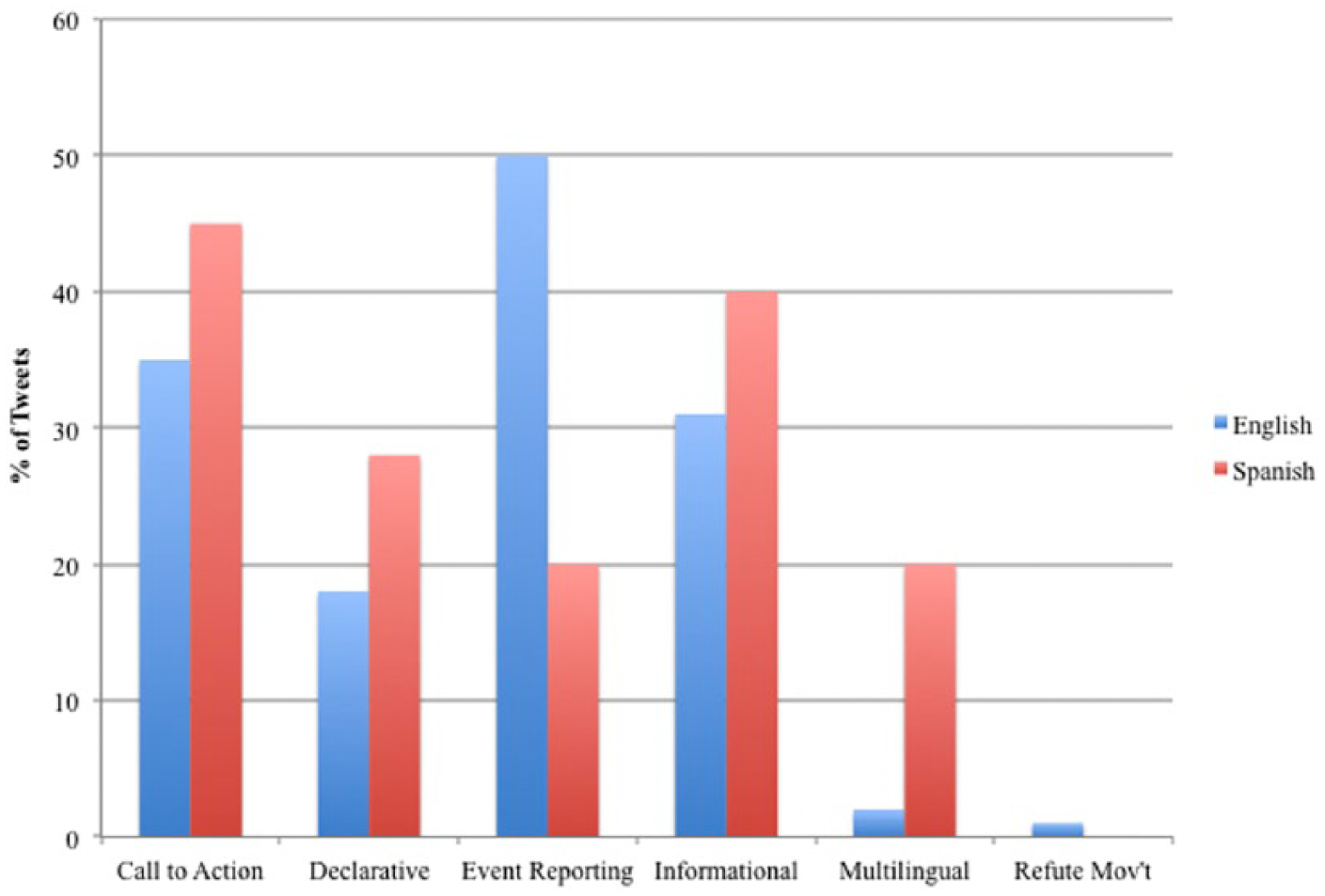
Global Frackdown tweet content type.
#GlobalFrackdown Frame Analysis
In the final part of this study, I analyzed the #globalfrackdown Twitter data from a transnational social movement framing perspective. My goal was to discern the collective and personal action framing practices of Global Frackdown tweeters and to what extent these practices may support core organizers’ goal of developing a globalized movement to ban fracking. Five broad frames emerged in the data in terms of collective action frames, personal action frames, and hybrid framing practices: (1) movement convergence and solidarity, (2) declarative engagement, (3) targeted engagement, (4) prefabricated messaging, and (5) multilingual tweeting. The tweets included in the following sections are presented as exemplars of each frame.
Collective Action Framing
Movement Convergence and Solidarity
The data suggest that Global Frackdown tweeters use the platform to promote global solidarity and to forge linkages with like-minded social movements. They use Twitter to enhance the sense of globalness of the day of action and to quickly learn what is happening, or has happened, in other participating locales. This sense of solidarity supports the development of a movement collective identity centered on banning fracking and promoting alternative energy. This frame focuses on the cross-flow of information between aligned movements, with an emphasis on commonalities, and is often engaged in during moments of crisis. Tweeters from each movement utilize the hashtags of both movements.
In the case of Global Frackdown, as discussed above, a series of events starting with the arrests of First Nations demonstrators on 17 October 2013, 2 days before the official day of action, in New Brunswick, Canada, galvanized the two movements’ convergent Twitter activity. Global Frackdown and Elsipogtog tweeters alike used the hashtags of both movements to spread information with a sense of urgency about the events as they unfolded. For example, @NoTarSands: Live updates—tense standoff btw #Elsipogtog FN #AntiFrackers & RCMP follow @XXXX reporting from front line #INM #globalfrackdown (9:29 a.m., 17 October 2013)
The data suggest that repression of the movement promotes tweeting. Based on breaking events, Global Frackdown tweeters appropriated and adapted #Elsipogtog as a frame to promote the Global Frackdown day of action along with showing solidarity with the First Nations demonstrators. For example, @RisingTide604: 16+ #Elsipogtog #fracking blockade solidarity actions planned! http://www.wearepowershift.ca/stand_with_elsipogtog_actions . . . #climatejustice #climate #350ppm #GlobalFrackdown (4:50 p.m., 17 October 2013) @XXXX: #Elsipogtog protest adds fuel to #GlobalFrackdown fire http://www.canadians.org/blog/elsipogtog-protest-adds-fuel-global-frackdown-fire . . . #banfracking (5:43 p.m., 23 October 2013)
As shown by the tweets above, movement convergence emphasizes mutual support. Elsipogtog supporters also took advantage of the proximity of the arrests to the pre-planned Global Frackdown events, using the #globalfrackdown hashtag to spread information about the events in New Brunswick and branch out seeking solidarity and support. For example, @lastrealindians: Mi’kmaq lawyer XXXX showing bruises inflicted on her by RCMP during their raid on #Elsipogtog #GlobalFrackdown (7:31 a.m., 21 October 2013)
This use of the two movements’ hashtags by tweeters from both movements facilitated the cross-flow of information between the movements. Tweeting is also a way to cross-promote movements and engage in solidarity. For example, @XXXX: Let’s get #Elsipogtog #mikmaqblockade #mikmaqblockde #IdleNoMore #GlobalFrackdown trending. Don’t RT. Steal and repost to trend. #redrising (1:09 p.m., 17 October 2013)
Furthermore, Global Frackdown tweeters used the platform to spread information about events, show support for the First Nations demonstrators and the Global Frackdown movement itself, and spread calls to action. For example, @XXXX: Heading back to the #Elsipogtog protest site. Happy day of #GlobalFrackdown! Support support support! (7:07 a.m., 19 October 2013)
The examples above suggest that Global Frackdown tweeters use Twitter as a tool to advance the transnational anti-fracking movement and to bolster its moral authority, as well as to forge linkages between localized groups. In this way, tweeting itself can function as a form of diffused political action. Next, I describe the personalized framing practices of Global Frackdown tweeters and the ways in which they support Global Frackdown activists’ goal of fostering a globalized anti-fracking movement.
Personal Action Framing Practices
Declarative Engagement
This frame centers on individuals’ personal declarations of support for the movement and day of action. It embodies the act of making public the action an individual, or collective of individuals, plans to engage in, or is engaging in, to support the movement. For example, individuals tweeted, @XXXX: Putting the final touches to our drilling rig today ahead of #GlobalFrackDown day tomorrow at 12 prompt Perth Concert Hall (3:35 a.m., 18 October 2013) @XXXX: In Cape Town to join various organisations in opposing #fracking #GlobalFrackdown (3:45 a.m., 18 October 2013) @XXXX: Off to Blackburn for the first of many fracking events happening in the north west this weekend #GlobalFrackdown #FrackFreeLancashire (11:14 a.m., 18 October 2013)
As the tweets above show, individuals can personalize their involvement with Global Frackdown day of action events by publicly stating what they are doing in support of the movement. The anti-fracking movement has been successful in gaining celebrity support. For example, Maggie Grace, best known for her role as Shannon Rutherford on the television series Lost tweeted, @MaggieGrace: I’m from Ohio, so #globalfrackdown day means protecting home to me! Good job today guys! #banfracking http://www.globalfrackdown.org/events/#ohio (9:33 p.m., 19 October 2013)
In this form of personal action framing, Global Frackdown tweeters announce the action that they personally are taking part in and their support for banning fracking. This can be considered a form of expressive political participation. As Baym and boyd (2012) note, as individuals—Global Frackdown tweeters in this case—share content about a political issue, they grow increasing self-aware of belonging to, and co-creating, more abstract networked publics. Publicly sharing content conforming to one’s values is a form of empowerment, helping individuals construct their public identity (Hermida, 2014). In this sense, action is performative in digital spaces, while often being simultaneously enacted in physical places.
Targeted Engagement
Global Frackdown tweeters used the Twitter @mention function for two purposes. On one hand, they attempted to gain traction in the public sphere, functioning as what Fraser (1992) refers to as a “subaltern counterpublic,” trying to reach external audiences in addition to using the platform as a space to share information among movement supporters (p. 123). The data suggest that the goal is to reach beyond core activists and movement supporters. For example, in a form of directed interaction (Murthy, 2013), Global Frackdown tweeters made appeals to elected officials to take action to ban fracking. For example, @XXXX: Overwhelmed by the worldwide activity today for #GlobalFrackdown and you should be too @BarackObama #banfracking NOW! (6:53 a.m., 19 October 2013) @foodandwater: We’re sending a message to you, @JerryBrownGov—ban fracking now! #globalfrackdown Oakland (3:16 p.m., 19 October 2013)
There is little evidence within the dataset that the targeted elected officials, either in the United States or internationally, responded via Twitter to calls for them to take action to ban fracking. Global Frackdown tweeters also used @mentions to appeal to media outlets to cover the day of action. For example, @XXXX: Guess you missed it? @bbcnews @skynews @Channel4News #skynews #bbcnews #c4news #Fracking #GlobalFrackdown http://on.rt.com/x8910f (11:09 a.m., 19 October 2013)
It is likely that these forms of targeted engagement would be most effective as part of a combined advocacy campaign utilizing multiple channels, rather than a stand-alone strategy. As I discussed above, Global Frackdown activists also engage in traditional media work in order to target elected officials. Second, Global Frackdown tweeters make use of @mentions to make contact with other movement activists and supporters, for example, by sharing information about specific events and to request retweets from other Twitter users. In an example of targeted engagement from one environmental non-governmental organization (NGO) to another, @FOEYoung: @ukycc Please RT! #GlobalFrackdown action with @FOEYoung —meet by Next by Bond Street tube station, London at 11am on Saturday (4:03 p.m., 17 October 2013)
Building on the discussion in the previous section on declarative tweeting, individual tweeters also made use of @mentions to express their support directed toward specific organizational users. For example, @XXXX: @EnvNY Can’t wait for the #GlobalFrackdown! #ohfrackno (11:54 a.m., 18 October 2013)
In this way, @mentions can serve as endorsements of those mentioned.
In addition, several individual Global Frackdown tweeters in the dataset engaged in the practice of correcting the tweets of other users. For example, a tweeter based in Sweden, who was also one of the most prolific within the dataset, is shown in the exchange below adding the #globalfrackdown hashtag to a tweet about the day of action, @YYYY: 2013-10-19—GLOBAL FRACKDOWN, WORLD PREPARES FOR PROTEST AGAINST SHALE GAS PRODUCTION @XXXX: @YYYY use the hashtag #GlobalFrackdown please. The world has started since long (6:07 a.m., 19 October 2013)
The data suggest that individual Global Frackdown supporters filter activism through their personal identities and engage in a merging of expressive online participation in digital spaces, like Twitter, and in physical places simultaneously. Global Frackdown tweeters use the platform as a mechanism to affirm and build both personal identities and also a sense of in-group affirmation and collective identity of a movement aimed at banning hydraulic fracturing. Thus, tweeting can be considered an emerging and distinctive form of mediated and personalized political action.
Hybrid Framing Practices
Prefabricated Messaging
Political organizations can use narratives, which are somewhat distinct from individual frames, as networking devices by propagating “gatekeeper stories” within their social networks in order to generate new social ties (Bennett & Toft, 2009). Within “person-to-person networks” of what Rainie and Wellman (2012) term “networked individualism” (pp. 123–124), this practice could serve as forms of both social and strategic information curation (Thorson & Wells, 2015). In the case of the 2013 day of action, Global Frackdown activists provided a set of prefabricated tweets on the “Social Media” page of the main website globalfrackdown.org prior to the day of action and encouraged supporters to spread the word. The suggested tweets included, On 10/19 I’m joining the #globalfrackdown to secure a future free from #fracking and dirty fossil fuels. Get down with the #globalfrackdown! Join us on October 19 at an event near you by signing up here: http://bit.ly/1esBsZ9
There is a mixed history of advocacy groups employing pre-prepared messaging, most notably in the form of template letters, for supporters to send to public officials or newspaper letter to the editor sections. By the early 2000s, the term “astroturf,” originally used to describe artificial grass in sporting fields, was being applied to this type of messaging on the part of advocacy and public relations campaigning, either paid or often unpaid in the case of grassroots advocacy groups (Reader, 2008). Recent research has documented this phenomenon in social media environments, and in some cases spam messaging, particularly in the electoral contexts (Metaxas & Mustafaraj, 2012).
Global Frackdown activists’ prefabricated tweets were similar to astroturfing in the sense that they appear personalized but are organizationally promoted frames, in the sense of what Bennett and Toft (2009) term “gatekeeper stories” (p. 258) as a form of “centralized strategic management” (p. 252). The prefabricated tweets were made available on the Global Frackdown website and amplified through organizational and individual supporter accounts, as well as the crowdsourcing application, Thunderclap.it. In addition to providing a list of suggested tweets on the Global Frackdown “Social Media” page, the coordinating organization Food and Water Watch used the online “crowd-speaking” application Thunderclap.it on 17 October 2013 to promote Global Frackdown with the personalized message, “I’m down with the #GlobalFrackdown. Join me on 10/19 to call for a ban on #fracking + a future lit w/clean energy!” The frame was shared 138 times via social media, with an estimated social reach of 219,282 people (Thunderclap, 2013).
The impact of this type of hybrid framing appears to be mixed. The prefabricated messages were often personalized, yet at the same time generic in nature. The effort by Global Frackdown activists to frame conversation on fracking surrounding the day of action raises the issue of distinguishing between who is generating the social frames versus how they are spread, for example, through social curation (Thorson & Wells, 2015). In the case of Global Frackdown prefabricated messages, those generating the frames, that is, core activists, appear to overlap with the population of Global Frackdown tweeters strategically spreading the frames through social curation.
Multilingual Tweeting
Global Frackdown tweeters engaged in a hybrid framing practice of multilingual tweeting and hashtag indexing, which has the potential to facilitate the cross-flow of frames between linguistic spheres and enhance a sense of solidarity and globalness of the movement. For example, the following tweet is in English but also includes the Basque hashtag #FrackingEZ, @XXXX: The Basque Country is also taking part in the #GlobalFrackdown initiative. #FrackingEz (7:11 a.m., 19 October 2013)
In this subsequent example, the text of the tweet is also in English and the tweet includes the hashtag of the location of the Romanian demonstration, as well as a hashtag in French, #gazdeschiste, for “shale gas”, @XXXX: #GlobalFrackdown MT @Kowalski_Lech: #fracking #occupychevron #pungesti #balcombe one bus made it through and is 20 minutes away #gazdeschiste (7:17 a.m., 19 October 2013)
Global Frackdown tweeters also included translations of content, along with multilingual hashtagging, as the following example from Spain shows, @AntifrackingCom: #19oct Día Internacional contra la Fractura Hidràulica #stopfracking “@gaslandmovie: The #GlobalFrackDown is Global! http://youtu.be/wDH9ghBtV3I” (12:38 a.m., 19 October 2013)
The use of multilingual hashtag indexing facilitates the cross-flow of information between multiple languages. So, For example, a local organization that is promoting its own event can at the same time contextualize the “local” within what is happening concurrently in other countries and world regions. I term this process transnational frame jumping. Given activists’ focus on promoting global solidarity, while frame jumping is not actively coordinated, the crowdsourcing of frames, along with the emergent practice of their transfer between linguistic spheres, supports this movement goal. Interestingly, the proportion of tweets with multiple languages is more than double for the Spanish tweets than for the English language tweets. This could indicate that activists in Spanish-speaking locales are more outward looking or by necessity feel a need to share information beyond their linguistic sphere. Furthermore, many of the local events in Spain took place in Basque and Catalan regions of the country, so the Spanish multilingual tweets were not always in the “Spanish–English” language combination.
On the whole, my findings suggest a high level of uniformity between the framing of Global Frackdown tweeters in the English and Spanish language tweets. My findings show that Global Frackdown framing practices are both collective and personalized. Thus, as a diffused transnational movement, as I have shown, Global Frackdown on the social media platform Twitter included both newer forms of connective action while at the same time supporting activists’ goal to develop a sense of collectivity based around the shared goal of banning fracking.
Discussion
I have discussed five major frames in the #globalfrackdown data: movement convergence and solidarity, declarative engagement, targeted engagement, prefabricated messaging, and multilingual tweeting. I have shown that Twitter serves a different purpose for the anti-fracking Global Frackdown movement than other Internet-based communications, most notably email listservs. Twitter’s real-time curated and episodic news feed functionality, through #globalfrackdown hashtag indexing, allows both core activists and more casual Global Frackdown tweeters to engage with the day of action in-the-moment as events took place in widely disparate geographical locations on a transnational scale. This contrasts to Global Frackdown activists reporting in in-depth interviews that the most important communication tools for sustained, more durable longer term, organizing structures are closed listservs. Listservs can help movements to persist over time and space by enabling activists to enhance trust in diffused networks. In particular, listservs are a space for Global Frackdown activists to mediate and make sense of complex scientific and technical information, as well as to connect with experts.
Global Frackdown on Twitter is a synergy of local-global framing, transnational but also localized. #Globalfrackdown frames are transnational, personalized, and draw on local concerns. As echoed in interviews with Global Frackdown activists, locality and place are very important within the anti-fracking movement. My analysis suggests that the diffused, episodic, and often personalized transnational framing practices of #globalfrackdown tweeters support the core organizers’ goal of promoting the globalness of activism against fracking. Twitter enables movement supporters in diverse geographical locations to connect episodically and feel part of something larger. As a networked hashtag public (Hopke, 2015), following a specialized topic, such as #globalfrackdown, in the Twitterverse can give individuals not physically present at a demonstration a sense of being there. For those attending a physical demonstration, a feeling that others know that it is happening, in other words, an embodiment of the popular movement refrain “the whole world is watching.” The #globalfrackdown hashtag is fluid and event-driven, its use peaking on the day of action.
Global Frackdown tweeters, as a networked hashtag public coming together through the #globalfrackdown hashtag, use the platform for an externally focused function (as opposed to closed email listservs used by activists to sustain transnational organizing), as a tool to bolster the moral authority of the movement, as well as to forge linkages between loosely affiliated localized groups backing the Global Frackdown mission. This sense of solidarity supports the development of a collective identity centered on banning fracking and supports Global Frackdown activists’ efforts to bring together local environmental issues and global concerns. These practices are enabled through the usage of mobile phones and applications. For both the English and Spanish tweets, more than 40% of the tweets were sent from mobile devices and/or applications. Individuals share information about events as they happen, and for movements like Global Frackdown where events are simultaneously taking place, or nearly simultaneously taking place factoring in time zone differences, the use of mobile phones allows individuals to both quickly share what is happening where they are and learn quickly in real time about events going on in other locales.
My analysis suggests that Global Frackdown Twitter frames vary in their strategic function, with convergence and solidarity, as well as multilingual tweeting, serving to bolster intra-group collective identity during the international day of action with events taking place in disparate locations and to link up with aligned movements. Declarative and targeted engagement frames, along with prefabricated messaging, were more conversational and personalized, what Bennett and Segerberg (2013) term “personal action frames.” However, they could still serve strategic functions, such as coordination between individual activists and organizations or applying political pressure to elected officials to ban fracking.
While this study is limited in its generalizability, it provides a detailed case study of the ways in which a transnational day of action, with events in more than two-dozen countries, is framed on Twitter and contrasts movement supporters’ Twitter practices with the ways in which core activists employ other Internet-based communication tools. A methodological challenge to applying frame analysis to social media is removing posts from their contextual material. Twitter users do not see tweets singularly as 140-character units. Rather, they are embedded within fluid hashtag streams or an individual’s own news feed and often inclusive of visual imagery. In fact, activists interviewed cited visual imagery as an important component in their mobilization against fracking and its possible environmental impacts (e.g., changes to landscapes, water usage). Future researchers should more fully account for activist usage of social media within comprehensive communication ecologies, such as by comparing social media framing to movement emails, as well as images in relation to textual material. Future research into which frames and types of messages are more likely to be amplified (i.e., retweeted) and shared is needed.
In the case of Global Frackdown, Twitter functions less as a singular “networked public sphere” as theorized by Benkler (2006). Rather, Twitter serves to bolster in-group affirmation among supporters as “counter-publics” (Fraser, 1992) and what in other work I have termed “hashtag publics” (Hopke, 2015). Twitter usage can serve as a form of political action and amplify an individual’s actions in the physical realm. With mobile technologies, there is a blurring of offline–online forms of action. The action takes place simultaneously in both digitally mediated and physical spaces. Global Frackdown’s Twitter frames indicate that the movement is based on a form of “organizationally-enabled connective action” (Bennett & Segerberg, 2013), but integrates a hybrid of personal action framing and collective action framing practices.
Global Frackdown is a social movement trying to gain traction in the public sphere as a networked hashtag public centered on a particular hashtag, or narrow set of oft-ideologically and politically defined hashtags, that brings together individuals around a shared collective identity, a goal of banning fracking in this case. In this way, in the case of the 2013 Global Frackdown day of action, Twitter served as a performative, identity-building space, more than a mechanism to reach external audiences. However, as a public medium, the hashtag stream is open and accessible to external audiences. In this sense, the #globalfrackdown Twitter stream is public communication but serves a primarily niche internal movement function to crowdsource a transnational collective identity.
Footnotes
Acknowledgements
The researcher would like to thank Patricia Loew, Hernando Rojas, Larry Meiller, Pamela Oliver, and Erica Halverson for helpful feedback on this study, as well as Molly Simis for assistance coding.
Declaration of Conflicting Interests
The author(s) declared no potential conflicts of interest with respect to the research, authorship, and/or publication of this article.
Funding
The author(s) disclosed receipt of the following financial support for the research, authorship, and/or publication of this article: This research was supported through a Louis and Elsa Thomsen Wisconsin Distinguished Graduate Fellowship from the UW-Madison College of Agricultural and Life Sciences, as well as research travel grants from the Robert F. and Jean E. Holtz Center for Science & Technology Studies and the European Union Center of Excellence at the University of Wisconsin-Madison.