



Abstract
Adopting the activity-audience framework, this study examined how different social media activities among a group of ethnic minority students associated with acculturation. It took a Qual-Quant sequential design by interviewing 44 secondary school ethnic minority students in Hong Kong first to conceptualize the potential relationships and then surveying 565 students to test the conceptual model. It found that different social media activities associated differently with acculturation; in contrast to the weak association of communication with friends and schoolmate, consuming mainstream culture-related information and interacting with strangers from the mainstream culture were the important determinators of the students’ bicultural competence and bicultural identity. Cognitive appraisal positively mediated the contribution of information consumption, whereas communication with strangers was mediated positively by behavioral appraisal but negatively by affective appraisal. The findings advocate a differentiated approach toward utilizing the affordances of social media activities for acculturation.
Keywords
Introduction
Acculturation refers to “changes in an individual’s ‘cultural patterns’ (i.e., practices, values, identities) resulting from sustained first hand intercultural contact and subsequently affecting the individual’s psychological well-being and social functioning” (Ward and Geeraert, 2016: 98). The changes in cultural patterns derive from a process of acquiring, maintaining, and changing cultural values, identities, and practices of both the mainstream culture (i.e. the predominant or majority culture within a society, the cultural and linguistic practices of which are dominant in the society’s structures and practices and carry the most political and economic power) and the ethnic culture (i.e. the shared values and practices of one’s ethnic origins; Sam and Berry, 2010; Ward and Geeraert, 2016). Social media, the “internet-based applications” that “allow the creation and exchange of user generated content” (Kaplan and Haenlein, 2010: 61), may influence the acculturation process (Lai, 2019; Mitra and Evansluong, 2019). Empirical studies have reported both positive influences, such as enhanced social opportunities and social ties with people from the mainstream culture, strengthened connection with ethnic cultures, and the provision of a safe and hybrid place for identity experimentation and performance (Alencar, 2018; Lai et al., 2020; Marlowe, 2020), and negative influences, such as amplified cross-cultural differences and misunderstanding, acculturative stress, and unrealistic acculturation expectations (Dayani, 2017; Veronis et al., 2018).
The inconsistent findings suggest that a more granular view into the relationship of social media and acculturation is needed. Studies on the psychosocial impact of social media in general have identified various factors that might mediate the impact, including the purpose and goals of social media use, the types of social media interactant and activities, and users’ abilities to interpret the complex cultural meanings implied in social media interaction and to regulate the negative emotions that may arise during the interaction (Kraut and Burke, 2015; Veronis et al., 2018; Yang and Lee, 2020). Thus, the direction and degree of the influence of social media on acculturation may very likely be contingent upon the nature of the experiences that individuals construct and undergo on social media (Lai et al., 2020; Dayani, 2017). How different social media experience might influence acculturation is a research issue that deserves attention because insights into the issue may help clarify some inconsistent findings in the field and identify the underlying mechanisms (Mitra and Evansluong, 2019).
Hong Kong is a multicultural society with around 8% of its population being ethnic minorities. The majority of the ethnic minority population is south and southeast Asian immigrants, who have strong in-group cohesion and well-preserved ethnic cultural norms but are socially and economically disadvantaged. Although Hong Kong is multilingual (i.e. English and Chinese are the official languages, and Cantonese and Mandarin are the two Chinese dialects), Cantonese is the dominant language in both daily life and social media communication (Kapai, 2015). Ethnic minority people face strong social discrimination and uncertain academic and professional upward mobility in Hong Kong (Kapai and Singh, 2018). Ethnic minority students tend to mingle mostly with peers from the same or similar cultural backgrounds due to social exclusion and discrimination. Social media use is prevalent in Hong Kong and constitutes a context of socialization with the local Chinese.
This study examined how different social media activities related to ethnic minority students’ acculturation in Hong Kong. This study adopted a two-step design to shed light on the issue; first, a small group of adolescent ethnic minority students were interviewed to identify the key social media activities and the key acculturation indicators that were related and how they were related, and then a questionnaire around the key variables revealed through the interview was developed to survey a larger group of ethnic minority students to test and validate the relationships. By differentiating types of social media activities and their associations with different aspects of acculturation, the study helped to provide nuanced insights into the relationship between the two, which is lacking in current literature (Yang and Lee, 2020).
Literature review
Social media and acculturation
The term acculturation is coined to describe the process of changes taken place as a result of prolonged interaction between individuals from different ethno-cultural groups (Berry, 1992). Acculturation research has primarily examined the changes minority groups go through in the process of intergroup contact. By prioritizing cultural groups with inherent values, interests, ways of life, and practices, highlighting the concomitant group memberships and identities and cross-group differences, and using terms like mainstream culture and ethnic culture that indicate unequal powers, discourses around acculturation may, according to some scholars (e.g. Brewer, 1997; Brubaker, 2002), arouse the concern of cultural essentialism. Namely, it runs the risk of setting rigid boundaries of groups with a set of uniform and static defining cultural properties that may lead to simplified and homogenized views of ethno-cultural groups and the reification of static group-based identities that are imposed on individuals, which may induce damaging cultural stereotypes and separatism (Schlesinger, 1992). However, others scholars (e.g. May, 1999; Phillips, 2010) argue that individuals are situated within wider communities, and thus communally shared goods (e.g. language, culture) and values are central to people’s identities. According to May (1999), “individual and collective [identity] choices are circumscribed by the ethnic categories available at any given time and place” (p. 27). Scholars further argue that methodologically, a certain level of abstraction and generalization is needed for theoretical analysis (Phillips, 2010), and ethnicity remains a powerful concept at the collective level (Smith, 2002). Thus, Phillips (2010) argued that “what is wrong with [essentialism] is often a matter of degree rather than categorical embargo” (p. 11). Namely, what researchers need to ward off is not the categories per se, but rather the degree of over-generalizations that lead to claims about the unity of experience and identity and views of thinking that confine individuals to fixed group memberships. To avoid potential cultural essentialism in discourses around acculturation, May (1999) suggested acknowledging and critically analyzing cultural and linguistic distinctions across ethno-cultural groups in the nexus of power relations in the society, recognizing “both the limits and the hybridity of all cultures—what distinguishes and conflicts, as well as what intersects” (p. 33), and embracing individual cultural autonomy and identity choice. This study adopted such a view to understand ethnic minority adolescents’ acculturation.
Acculturation takes shape through intercultural contact, which influences psychological and sociocultural adaptation (Berry and Sam, 2006; Ward et al., 2001). Psychological adaptation refers to an array of psychological outcomes, including feelings of well-being and psycho-cultural orientations and cultural identities (Ng et al., 2017; Tropp et al., 1999). Sociocultural adaptation refers to culture-specific competence in managing everyday social situations and relating to the people in the new cultural context (Bierwiaczonek and Waldzus, 2016; Ward and Rana-Deuba, 1999). The transition from intercultural contact to psychological and sociocultural adaptation is mediated by individuals’ affective, behavioral, and cognitive appraisal (CA) of the intercultural experience (Ward et al., 2001). Affective appraisal (AA) is the emotional responses to intercultural encounters (i.e. how people feel), behavioral appraisal is social knowledge and skills essential to intercultural encounters (i.e. how people behave), and CA is perceptions and interpretations of intercultural encounters (i.e. how people think and perceive).
Social media provide intercultural contact experiences that may drive affective, behavioral, and cognitive changes among ethnic minorities, and ultimately shape their psychological and sociocultural adaptation. On one hand, social media may connect ethnic minorities with diverse social ties (Alencar, 2018; Veronis et al., 2018), and the broadened and intensified intergroup engagement on social media is found to foster intergroup cohesion and social capital (Alencar, 2018; Dayani, 2017; Peeters and D’Haenens, 2005). The enhanced bonding and social capital may reduce acculturative stress and engender optimistic cognitive and affective judgment of one’s life situations and feelings among immigrant adolescents (Arpino and De Valk, 2018; Bae, 2020; Dayani, 2017). Moreover, migrants often form online deterritorialized diaspora communities to maintain relations with co-ethnics, garner emotional support, and build transnational social connections (Keles, 2016; Laguerre, 2010). These communicatively integrated online social spaces may reinvigorate ethnic identity for diasporas dispersed around the world, and invoke “nomadic, multifaceted and problematized” virtual ethnicities that are both shaped by preexisting elements of ethnicity and constantly open to construction and change (Diamandaki, 2003: 9; NurMuhammad et al., 2016). Thus, social media experience may shape ethnic minorities’ AA of daily intercultural experience, and thus strengthen perceived harmony between the mainstream culture and their own ethnic culture (i.e. bicultural harmony) and boost the feeling that the two cultures are mixed inside them as part of who they are (i.e. bicultural blendedness; Lai, 2019; Dayani, 2017; Raman and Harwood, 2016). For adolescents, belongingness and sense of identity are cherished and thus are essential to their psychosocial well-beings. Social media interaction, impacting social connection and inducing social comparison, is an important socialization experience that significantly shapes, positively or negatively, adolescents’ sense of belonging and identity (Allen et al., 2014; Reid and Weigle, 2014). On the other hand, social media provide both vicarious learning and low-risk experiential learning opportunities to enhance ethnic minorities’ acquisition of essential culture information that facilitates adaptation (Lai et al., 2020; Raman and Harwood, 2016). Acquiring the cultural norms and skill repertoire may enhance minorities’ competence to thrive in both the mainstream culture and their ethnic cultures (Ward et al., 2001). Hence, ethnic minorities’ social media experience may enhance migrants’ bicultural competence (BC).
But at the same time, scholars are pointing out that people may identify selectively with like-minded others and prioritize their in-group affiliation to the exclusion of out-groups and the renunciation of personal identity, and hence, consciously engage in hemophilic social interactions and relations, and attune narrowly to potentially biased opinion-congruent information on social media (Flanagin, 2017; Guo and Li, 2016). The tendency of selective online engagement with social media may lead to psychosocial bubbles that lead to closed social clusters and limit the diversity of people’s experiences on some social media platforms, induce fragmented and distorted views of social reality, and reinforce antagonism across online groups (Kaakinen et al., 2020; Keipi et al., 2017; Marlowe, 2020). Thus, social media may shape acculturation, for better or worse, depending on the nature of the interaction. Moreover, social media cover a wide array of platforms, and afford the formation of different online communities and cyberspaces. The associated social activities in these cyberspaces are pluralistic and may vary in composition, goals, and evolutions. Online social spaces vary in the potentials of enriching or constraining social experience, hence feeding into acculturation differently. Thus, the singularity and uniqueness of these activity spaces need to be taken into account when understanding virtual ethnicities among digital diasporas (Diamandaki, 2003). Scholars hence alert the importance of investigating the differential influences of specific social media activities (Pang and Wang, 2020).
Different social media activities and acculturation
Kraut and Burke (2015) argued that examining the overall psychosocial impact of the Internet might be misleading and often yields inconsistent findings. They proposed the activity-audience framework to shed light on the mechanisms of the impact. According to this framework, the impact of the Internet is contingent upon both the specific activities individuals do online and the types of communication partners they come across. This framework has been applied to uncover the unique contribution of different social media experiences. In the activity dimension, two types of social media use are differentiated: interactive communication and content consumption. Interactive communication, targeted one-on-one communication with specific interlocutors in particular, is found to contribute the most to perceived social support and psychological well-being, whereas content consumption is associated negatively with social adjustment (Burke and Kraut, 2016; Liu et al., 2019; Yang and Lee, 2020). As for the audience dimension, Yang and Lee (2020) identified two types of interactants or audience on social media that may carry different psychosocial impacts—strangers versus friends or family. Interaction with friends or family is found to contribute positively to psychosocial adjustment, but a negative association is found for interaction with strangers (Burke and Kraut, 2016; Yang and Lee, 2020).
Focusing specifically on acculturation, studies have shown that frequenting social media that are populated by people from the mainstream culture is associated with a strong orientation toward the mainstream culture and reduced acculturative stress, whereas frequenting social media populated by one’s ethnic people predicts an orientation toward the ethnic culture and perceived social support (Li and Tsai, 2015; Park and Noh, 2018). Moreover, active sharing of social media contents is found to facilitate acculturation into the mainstream culture, whereas passive consumption of news and information contributes more to social-coping abilities and psychological well-being (Mitra and Evansluong, 2019; Yang, 2018). Thus, examining the differential impact of different social media activities provides nuanced insights into the relationship between social media usage and acculturation. However, these studies have been primarily conducted with sojourners, university international students, in particular. Given that the acculturation pressure, needs, and process may differ for sojourners and immigrants (Chen et al., 2008; Ward et al., 2001), research is needed to examine the issue among immigrants, especially ethnic minority adolescents (Croucher, 2011). Moreover, existing studies have examined either the ethnic backgrounds of the migrants’ social media interactants or their active versus passive social media usage, without considering the interface of activities and audience. Research on the activity-audience interface may provide new insights.
This study aimed at filling the research gaps by adopting the activity-audience framework to understand the mechanisms behind the relationship between social media usage and acculturation among a group of ethnic minority secondary school students. It addressed the following research question:
How do mainstream-culture related social media activities relate to ethnic minority adolescents’ acculturation?
Method
Due to the limited conceptualization and empirical studies on the relation between social media activities and ethnic minority adolescents’ acculturation, this study adopted an exploratory sequential design that consisted of two phases. A qualitative phase was conducted first, from November 2018 to January 2019, to elicit interview responses from 44 ethnic minority students in Hong Kong on the nature of social media activities they engaged in and perceived relationship with acculturation. Based on the patterns emerged from the interview responses, a conceptual model was developed that conceptualized the relationship of the reported key social media activities and acculturation indicators. Afterwards, a quantitative phase was conducted subsequently, from April 2019 to June 2019, to elicit survey responses from 565 ethnic minority students to empirically test and refine the conceptual model.
The qualitative phase—developing a tentative conceptual model
Research participants
The participants were 44 ethnic minority students recruited from 12 local secondary schools, some with a predominant ethnic minority student population and others with a predominant Chinese student population. The participants were Forms 3–5 (equivalent to grades 9–11) students who self-reported as active social media users in daily life, which was the sole criterion given to the teachers when asking for their help in recruiting the interview participants. This selection criterion was adopted because only when the participants were active users of social media, would we be able to delve deeper into the potential relations between different social media activities and acculturation to achieve the goal of the interview study—to devise a conceptual model on the relations. The majority of the participants were between 15 and 16 years old, and 45% of the participants were female. They were from a variety of ethnic backgrounds including Pakistani (27 participants), Philippine (5), Indian (5), Nepalese (6), and Thailand (1). The majority of them had been either born in Hong Kong or living in Hong Kong for more than 10 years. The participants self-assessed their Chinese language proficiency as of intermediate level. Most of them reported limited interaction with local Chinese, except Chinese classmates and teachers.
Data collection and analysis
An individual semi-structured interview was conducted in person with each participant, after school hour, either at an office or a classroom in his or her school, each lasting around 30–45 minutes. Interviews were conducted either in English or Cantonese based on the participants’ preference. The researcher was of Chinese ethnic background who migrated to Hong Kong for work around 10 years ago, and had been working on research and teacher training projects related to ethnic minority students in Hong Kong. The researcher had accumulated an understanding of issues related to ethnic minorities’ acculturation in Hong Kong from her previous research projects and her personal experience as an immigrant. This understanding informed the construction of the interview protocol and data collection procedure, and helped her to stick to neutral questions and tap deeper into the participants’ thought during the interview. Prior to the interview, each participant was asked to write down the social media tools they used in daily life. During the interview, in reference to the activity-audience framework (Kraut and Burke, 2015), each participant was asked to go through his or her list one by one to elaborate on the different activities they engaged in on each platform, with whom they engaged in each activity, what they gained from each activity, and the perceived impact, if any, on acculturation into Hong Kong society.
The interview responses were recorded and transcribed word for word, and were double checked for accuracy. Since the interview phase aimed at developing a conceptual framework of the relationships between social media activities and aspects of acculturation, thematic analysis was conducted to analyze the interview responses because this analytic technique helps identify patterns across the perspectives of different participants (Braun and Clarke, 2006). For interview segments on the participants’ experience on each social media platform that gave them access to the mainstream people and culture and perceptions thereof, both semantic codes (i.e. summary of the exact terms the participants used) and latent codes (i.e. interpretation of the concepts and underlying assumptions) were used to code the activity type (e.g. “view daily life updates of people I know”) and the perceived impact of the activity on acculturation to the mainstream culture (e.g. “get closer to friends”). Codes that convey similar meanings (e.g. “we get very close”; “we are closer now”; “we can comfort them”) were clustered into preliminary themes (e.g. “emotional bonding”). Hierarchies of themes and subthemes were then formed to capture the relationship of themes, and contrasted across different social media activities to reveal how different social media activities might relate similarly and/or differently to aspects of acculturation to the mainstream culture. The themes were checked across interviewees to see whether they were evident across different data items, and were examined in reference to the relevant literature to form the overarching themes that illustrate the association of different social media activities with different aspects of acculturation. Pseudonyms were used when presenting the results.
Results—a conceptual model of relationships
Analyses of the interview responses revealed a set of potential relationships between social media activities and different dimensions of acculturation, which helped generate some hypothetical pathways of the interactions as the preliminary answer to the research question.
Relationship of different social media activities with acculturation appraisal
Consistent with previous research (Chen et al., 2019; Li and Tsai, 2015), the interview responses revealed that consuming information enhanced some participants’ perceptions and knowledge about the local Chinese culture and people. They reported acquiring information that was often inaccessible in daily life, such as the local Chinese’s likes and dislikes, their perspectives and viewpoints, and their cultural norms and leisure life. They felt that this social media experience brought both new knowledge (e.g. “I got to know how local Chinese communicate and behave in daily life”) and renewed insights (e.g. “I got to know that they actually had balanced meal”; “Hong Kong girls were actually quite open”). The participants also reported enhanced perception of the harmony between their ethnic culture and the mainstream culture out of information consumption. Seeing YouTube videos about the local Chinese treating migrants nicely made Bano, a Pakistani girl, feel that the two cultures were closer than she used to think: “They [the local Chinese] really care[d] about us, and they wouldn’t be like, ‘no they are different from us’ and they wouldn’t, like, always discriminate us.” Similarly, seeing some local Chinese’s posts on activities they did with Pakistani or Indian friends made Nayab see the potential harmony between the two cultures: “They’re friendly together. They can be friends.” Thus, the data suggested the following hypothetical pathways of relationships:
H1. The frequency of searching and consuming information (SCI) on social media may positively predict perceived impact on CA.
H2. The frequency of SCI on social media may positively predict bicultural harmony (BIIH).
The interview responses also showed that interaction with local Chinese friends and schoolmates increased knowledge about their friends and the cultural context. Some participants shared that chatting with friends on WhatsApp exposed them to colloquial communication conventions, such as adding an affix “lah” at the end of the sentences and adding some synonyms to make jokes. Other participants shared that chatting on social media gave them access to intimate things and personal feelings that their Chinese schoolmates were normally “not willing to share”; Joshua, a Filipino boy, found that his Chinese classmates would “share [their] feelings” when they chatted about school matters and personal issues, which they seldom did in daily school interaction. Thus, the data revealed the following hypothetical relationship:
H3. The frequency of direct interaction with local Chinese friends and schoolmates (DCF) may positively predict perceived impact on CA.
In contrast, interaction with local Chinese strangers on social media was found to relate with the behavioral and affective dimension of acculturation. Quite a few participants commented that they were more willing and confident to interact with local Chinese strangers on social media because local Chinese strangers seemed to be nicer online than in daily life, due to the masked nature of the interaction which made the participants’ migrant identity less salient (e.g. “on Instagram, they wouldn’t care where I come from; but in real life, they would easily tell that I am a Pakistani”), or to the visibility and permanence of the online interaction which made the local Chinese more cautious about making remarks online (e.g. “people would comment more about how they think and not how they feel”). For instance, Remon, an Indian boy, felt more at ease when interacting with the local Chinese online because he would not see their facial expressions. For Aminah, a Pakistani girl, the ease of communication on social media encouraged her to reach out to the local Chinese “to give each other a chance to get in touch in daily life.” Thus, directed communication with local Chinese strangers on social media impacted behavioral appraisal positively, as manifested in increased intercultural interaction online and beyond. The participants also talked about how communication with local Chinese strangers influenced AA. For some, the influence was positive. Saima, a Pakistani girl, shared that enhanced communication with local Chinese strangers on social media made her develop positive feelings toward them: “I just get to like them more, now that I know they are actual people that I like. I feel they are very open and friendly. So I like them more.” For others, the influence was rather negative. Joshua talked about coming across online comments from the local Chinese that were “very mean and cruel,” which gave him “a bad impression” of them. Singh shared how discussion with local Chinese strangers around social news exposed him to some local Chinese’s negative stereotypes against migrants, which made him feel sad and worried about Hong Kong society. Moreover, interacting with the local Chinese strangers to discuss current Hong Kong news on social media gave Bano a stronger sense of Hong Kong identity, which she desired so dearly but in vain in daily life due to her physical appearance. The increased interaction with the local Chinese on social media also made Soneya feel more strongly that she had both a Hong Kong and Nepalese side of her. Thus, communication with strangers on social media might be related to the participants’ perception of the blendedness of their ethnic culture and the mainstream culture. Thus, the following hypothetical pathways of relationships were suggested:
H4. The frequency of direct interaction with local Chinese strangers (DCS) may positively predict perceived impact on behavior appraisals (BA).
H5. The frequency of DCS may predict perceived impact on AAs.
H6. The frequency of DCS may positively predict perceived bicultural blendedness (BIIB).
Relationship of acculturation appraisal with adaptation outcomes
The participants reported that knowledge about the local Chinese obtained on social media boosted their BC directly by making it “easier to communicate with Chinese people,” giving them “more topics to discuss with the local Chinese” and knowledge about “what [the local Chinese] feel comfortable with,” and helping them “easily understand what [the local Chinese] were talking about.” A Pakistani girl, Anadaleeb, recounted that insights into the viewpoints of Chinese people through viewing local news and Chinese documentaries helped her avoid miscommunication and offensive behaviors when interacting with them. Discovering shared values and beliefs may enhance perceived communal potential (Braxton et al., 2014; Yang and Lee, 2020). The participants shared that the increased knowledge influenced perceived harmony between their ethnic culture and the mainstream culture (e.g. “It made me think that even though we are people from different parts of the world, we are still the same”; “They are just like us. They use bad words. Their English is good. They watch the same YouTubers as us. So we are closer now”). Seeing similarities with her Chinese schoolmates made Sesema feel that it was possible to fit in the mainstream culture. Shakir, a Pakistani boy, felt that social media interaction with local strangers enabled dialogues about each other’s cultures, which made the local Chinese culture and their ethnic culture closer. Some participants, such as Sai, an Indian boy, also shared that increased cultural knowledge induced positive AA of the culture and people (e.g. “I feel closer to Chinese people because I know more about who they are and what they do”). The positive interpersonal emotions may enhance the participants’ perceived BIIH between the two cultures (Benet-Martínez, 2012; Huynh et al., 2011). Positive AA may also induce greater engagement in intercultural experience. For instance, Sai found himself interact and bond more with the local Chinese both on social media and in daily life. Similarly, Joshua shared how learning about his Chinese schoolmates’ feelings through WhatsApp chat made him feel “more connected” with them and interacted with them more at school: “when we see each other at school, we would start talking and be friends.” The increased intercultural experience may give the participants a stronger sense of having both ethnic culture and the mainstream culture intermingled inside them (Benet-Martínez, 2012; Huynh et al., 2011). BIIH and BIIB, as suggested by previous literature, may contribute to social and cognitive flexibility and cultural frame switching, and hence, facilitate BC (Cheng et al., 2014; Tadmor et al., 2009). Thus, the interview responses indicated the following hypothetical pathways of relationships:
H7. CA may positively and directly predict perceived BC.
H8. CA may positively and directly predict perceived BIIH.
H9. CA may positively predict perceived BIIH indirectly through AA.
H10. AA may positively predict BIIB indirectly through behavioral appraisal (BA).
H11. BIIH may positively predict BC.
H12. BIIB may positively predict BC.
Thus, patterns that emerged from the interview responses, in reference to the relevant literature, helped construct a conceptual model of the relationship between different types of social media activities, associated cognitive, behavioral, and AAs of the social media experience, and the participants’ perceived BC and bicultural identity integration (BIIH and BIIB; see Figure 1).
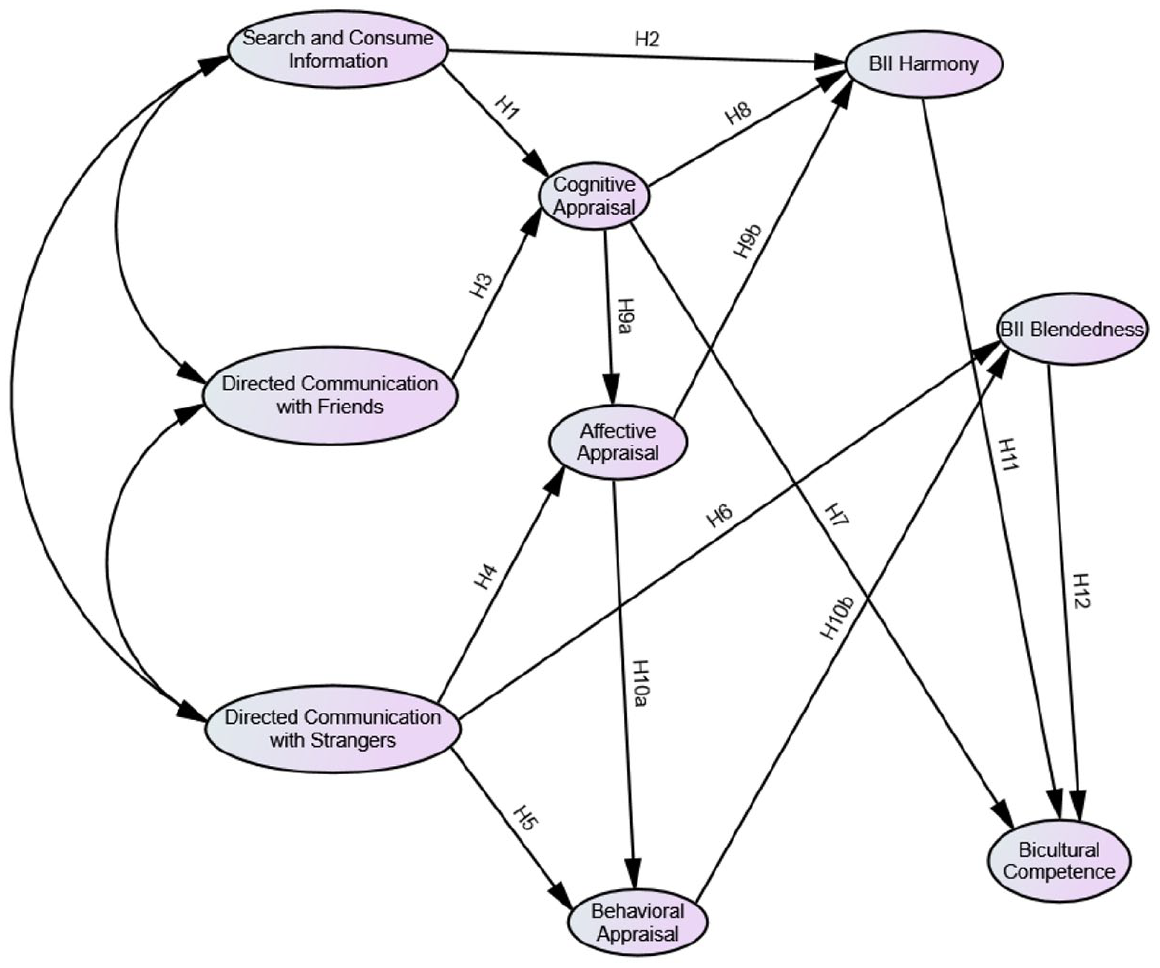
The conceptual model.
This conceptual model provided some precursory answers to the research question, and suggested a nexus of hypothetical relationships between different types of social media activities and aspects of acculturation. The preliminary answers were then tested quantitatively through validating and refining the conceptual model with questionnaire responses from a larger sample so as to provide more robust insights into the research question.
The quantitative phase—testing and refining the conceptual model
Research context and participants
The survey participants were recruited from 24 schools, 7 having a high proportion of migrant students (50% and above), six having a medium proportion (between 20 and 49%), and 11 having a low proportion (between 1 and 19%). Around 600 upper secondary school students of South and Southeast Asian backgrounds (Grades 9–12) who were taking Chinese as a second-language classes were recruited with the help of school teachers. After discarding incomplete surveys, 565 valid questionnaires were retained. The average age of the participants was 16 years, and 47% of the participants were male. In total, 96% of the participants were Hong Kong citizens (62% born in Hong Kong), and the average length of residence in Hong Kong was 12 years. They were from different ethnic backgrounds, including Pakistan, Indian, Filipino, Nepalese, and Indonesian, with Pakistan and Indian being the majority. Although 78% of the participants reported attending schools with primarily migrant students, 73% of them reported living in neighborhoods with local Chinese community. Among the three languages they spoke, the participants self-assessed their English proficiency as the highest (M = 4.14 out of 5, SD = 0.71) and their Chinese proficiency as the lowest, between fair and good (M = 3.18, SD = 0.94). Accordingly, they reported using English the most frequently in daily life (M = 4.29 out of 5, SD = 0.81) and using Chinese the least frequently, between sometimes and often (M = 3.21, SD = 0.97). They reported limited interaction with the local Chinese in daily life, between little and somewhat (M = 2.79 out of 5, SD = 1.06). Their access to Chinese media was also very limited (between seldom and sometimes): Chinese newspaper (M = 2.13 out of 5, SD = 1.02), the Internet (M = 2.26, SD = 1.13), and TV (M = 2.47, SD = 1.17).
Data collection and analysis
A survey questionnaire was constructed based on the participants’ interview responses and with reference to the relevant literature.
Social media use
Items constructed from interview responses and adapted from Zhang (2012) were used to measure the frequency of three types of social media activities that gave them access to Chinese people and culture: (a) searching and consuming information (three items, α = .76; for example, “keep updated with social news in Hong Kong on social media”); (b) directed communication with local friends or schoolmates (three items; α = .90; for example, “interact with Chinese friends or schoolmates (e.g. chatting, commenting) on social media”; and (c) directed communication with local Chinese strangers (three items; α = .91; for example, “interact with Hong Kong Chinese people met online on social media”).
Perceived impact of social media experience
Self-developed items based on the interview responses were used to measure the following three components of acculturation (Ward et al., 2001): (a) cognitive appraisal, that is, perceived increase of knowledge about the Chinese culture and people (five items; α = .91; for example, “I learn more about Chinese people’s lifestyle”); (b) behavioral appraisal, that is, perceived increase of interaction with the Chinese people (three items; α = .82; for example, “I interact more with my Chinese schoolmates at school”); and (c) AA, that is, positive perceptions of the Chinese culture and people (three items; α = .80; for example, “I like Chinese people more”).
Bicultural competence
Six adapted items (α = .89) from David et al. (2009) (e.g. “I can communicate my ideas effectively to both Hong Kong people and people from the same heritage culture as myself”) were used to measure the six dimensions of BC conceptualized by LaFromboise et al. (1993).
Bicultural harmony and bicultural blendedness
Adapted items from the BIIS-2 questionnaire (Huynh et al., 2018) were used; the four items on cultural harmony were included as indicators of BIIH (α = .82; for example, “I do not feel trapped between my ethnic culture and Chinese culture”) and the five items on cultural blendedness were included as indicators of BIIB (α = .88; for example, “I feel [ethnicity]-Chinese (e.g., Nepalese-Chinese)”).
The items on social media activities were measured using 1–5 Likert-type scale (1 = never; 5 = very often), and the items for the other constructs were measured using 1–6 Likert-type scale (1 = strongly disagree; 6 = strongly agree).
The questionnaire was administered in English, the strongest and most commonly used language for South and Southeast Asian migrants in Hong Kong (Kapai, 2015). The questionnaire items were pilot tested with five participants who were not included in the main study to help rectify potential confusing or misleading wording. Paper questionnaire was administered in the participants’ classrooms in the presence of class teachers and research assistants. Structural equation modeling (SEM) was conducted to analyze the survey data, using BC, BIIH, and BIIB as the endogenous variables and the other constructs as the exogenous variables. Amos 26.0 was used to estimate the model, using Maximum Likelihood Estimation as the estimation method. The following indices and threshold values were used to assess the model fit; the absolute goodness-of-fit indices (insignificant χ2 statistic and CMIN/DF < 3), the parsimonious indices (RMSEA < 0.05), and the incremental fit indices (CFI and TLI > 0.95; Tabachnick and Fidell, 2013). As the data were self-reported questionnaire responses by a single cohort of participants at a single point of time, we checked the data for potential common method bias using full collinearity variance inflation factors (VIFs) and Harman’s single factor test (Kock and Lynn, 2012; Podsakoff et al., 2003). Harman’s single factor test was conducted using principal component factor analysis, which revealed that the general construct accounted for 37.4% of the variance (<50%, the threshold value). The VIFs for all the constructs were smaller than 3, below the threshold value (<5), which ruled out potential multicollinearity issues. Both measures showed that the data did not suffer from common method bias.
Results—a refined model of relationships
Measurement model
Confirmatory factor analysis yielded satisfactory fit indices for the measurement model; CMIN/DF = 2.15, CFI = 0.96, TLI = 0.95, RSEMA = 0.045(0.042, 0.049). The unidimensionality test was also satisfactory, as all the factor loadings were above 0.60 (Hair et al., 2014). The construct validity was tested through both the convergent validity (AVEs > 0.50) and the discriminant validity (the square roots of the AVEs > inter-construct correlations). Table 1 showed that both convergent and discriminant validity were satisfactory. Internal reliability (α > .7) and composite reliability (CR > 0.7) were used to measure construct reliability, and both yielded satisfactory results.
The measurement model.
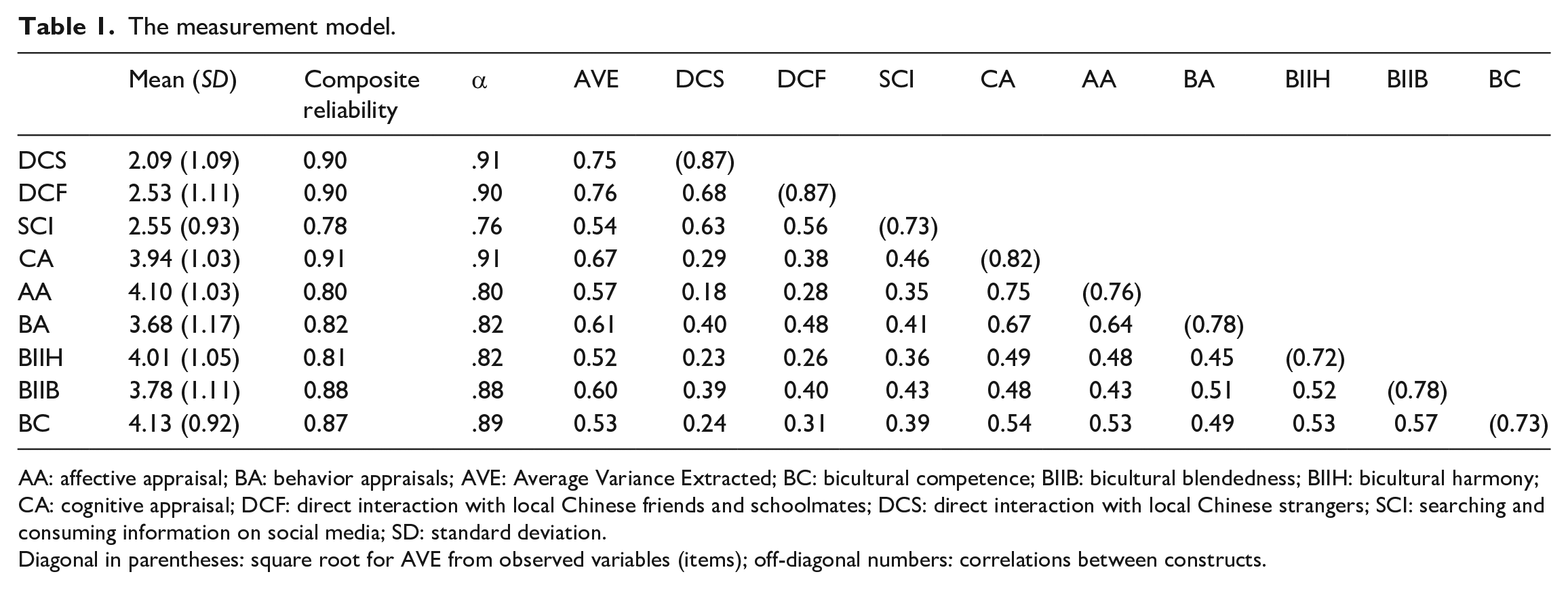
AA: affective appraisal; BA: behavior appraisals; AVE: Average Variance Extracted; BC: bicultural competence; BIIB: bicultural blendedness; BIIH: bicultural harmony; CA: cognitive appraisal; DCF: direct interaction with local Chinese friends and schoolmates; DCS: direct interaction with local Chinese strangers; SCI: searching and consuming information on social media; SD: standard deviation.
Diagonal in parentheses: square root for AVE from observed variables (items); off-diagonal numbers: correlations between constructs.
The participants used social media to access information (M = 2.55, SD = 0.93) and communicate with local Chinese friends and schoolmates (M = 2.53, SD = 1.11) more often than to communicate with local Chinese strangers (M = 2.09, SD = 1.09), although all three were limited, between seldom and sometimes (see Table 1). They perceived the impact of social media activities on AA the most positively (M = 4.10, SD = 1.03), followed by the impact on cognitive appraisal (M = 3.94, SD = 1.03) and behavioral appraisal (M = 3.68, SD = 1.17). They also reported positive BC (M = 4.13, SD = 0.92) and positive level of BIIH (M = 4.01, SD = 1.05) and BIIB (M = 3.78, SD = 1.11).
Structural model. SEM analysis yielded partially satisfactory model fit results (CMIN/DF = 2.34, CFI = 0.94, TLI = 0.94, RMSEA = 0.049). Following the modification indices, we added one path that had theoretical support: BIIH → BIIB (Huynh et al., 2011), and deleted the insignificant path from cognitive appraisal to BII harmony to keep the model parsimonious. The model fit results for the final model were satisfactory, CMIN/DF = 2.18, CFI = 0.95, TLI = 0.95, RMSEA = 0.046 (0.042, 0.049). The model (Figure 2) explained 56% of the variation in BC, 52% in BII blendedness, and 40% in BII harmony.
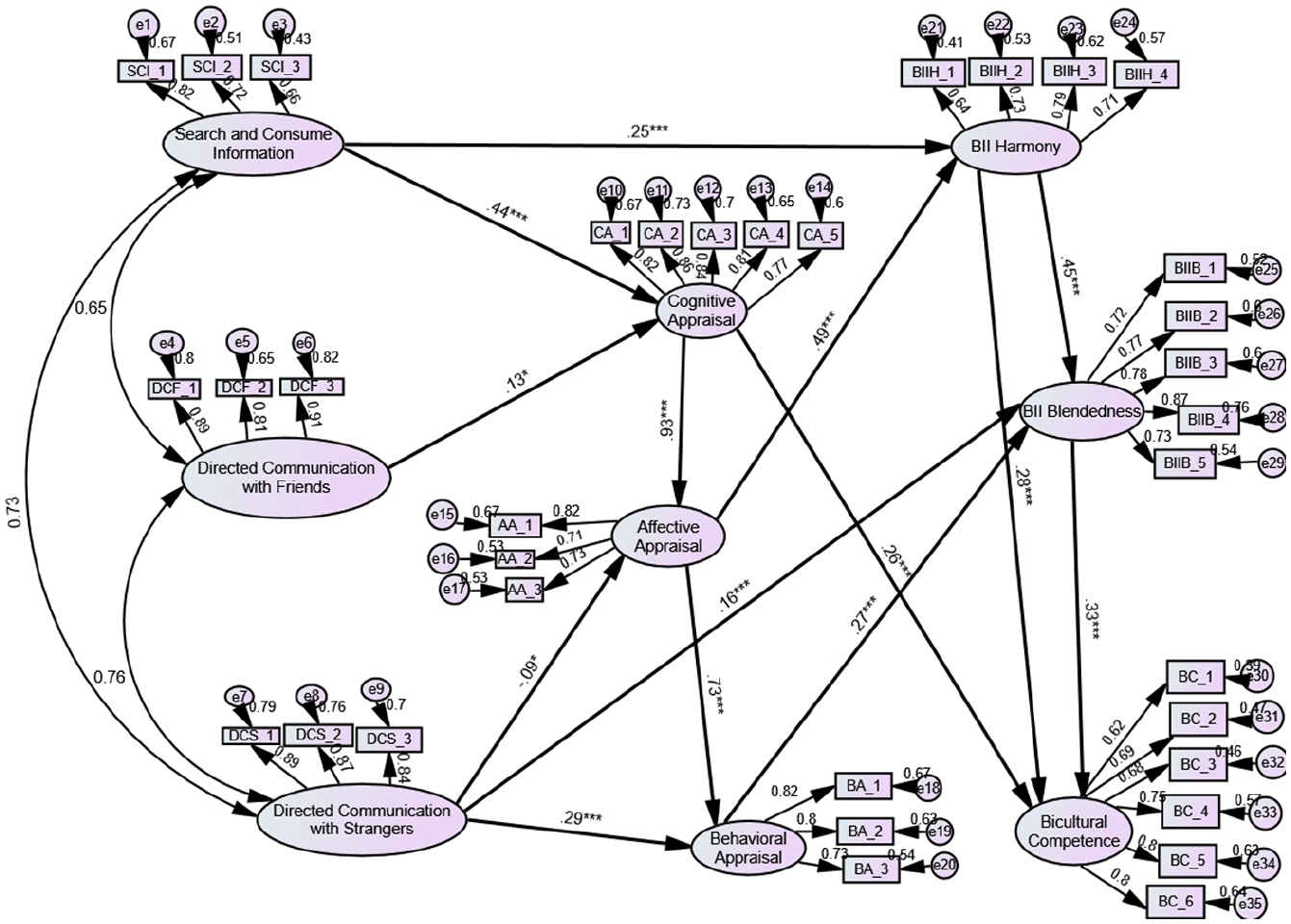
The final model.
Table 2 showed that all the hypothesized paths were significant, with the only exception of the path from cognitive appraisal to BIIH. Cognitive appraisal did not predict BIIH directly (β = .03, p > .05) but rather indirectly through AA (β = .46, p < .001). The non-significant direct association could be explained partly by the mixed positive and negative information about the Chinese culture and people that the participants received on social media and partly by the cautious attitudes some participants adopted toward information acquired on social media (e.g. “I can’t trust people’s behavior on social media wholeheartedly. Even though he acts nicely on social media, he may act differently in daily life”). Thus, only when the cognitive appraisal was accompanied by positive AA, would the enhanced cultural knowledge correlate positively with perceived BIIH. Consistent with the hypothesis, directed communication with local Chinese strangers was a significant predictor of the participants’ AA, but the association was a negative one (β = –.09, p < .05). These ethnic minority teenager participants might lack the linguistic and social capacities to engage in effective interaction with local Chinese strangers, a communication context where the participants reported encountering derogatory comments and discriminatory interaction. Unpleasant experiences on social media may undermine peoples’ attitudes about other groups (Raman and Harwood, 2016), and the prominence of such experiences may tip the “social media see-saw” toward the negative side (Weinstein, 2018: 3618).
Hypothesis testing results.
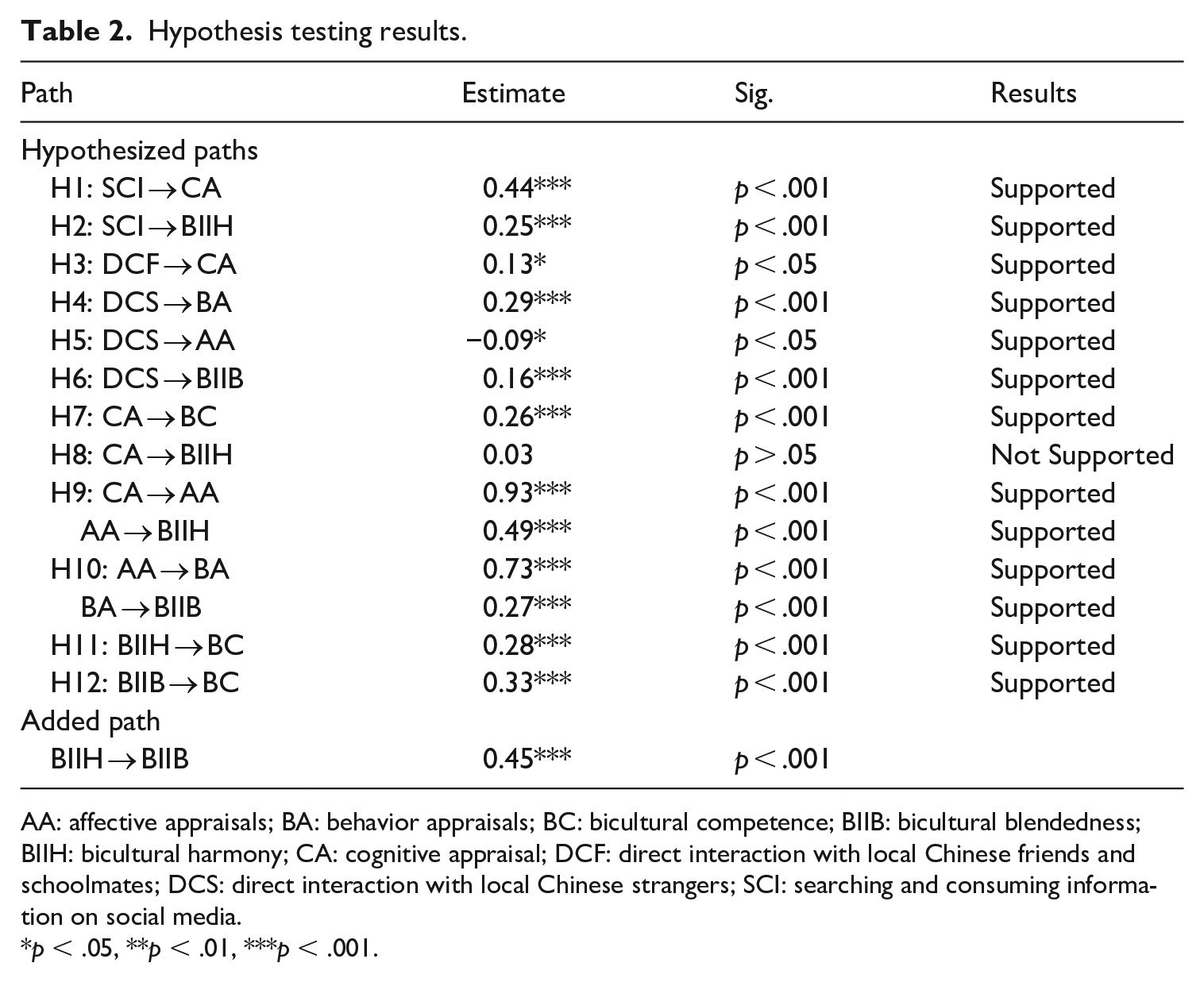
AA: affective appraisals; BA: behavior appraisals; BC: bicultural competence; BIIB: bicultural blendedness; BIIH: bicultural harmony; CA: cognitive appraisal; DCF: direct interaction with local Chinese friends and schoolmates; DCS: direct interaction with local Chinese strangers; SCI: searching and consuming information on social media.
p < .05, **p < .01, ***p < .001.
Association of social media activities with bicultural competence
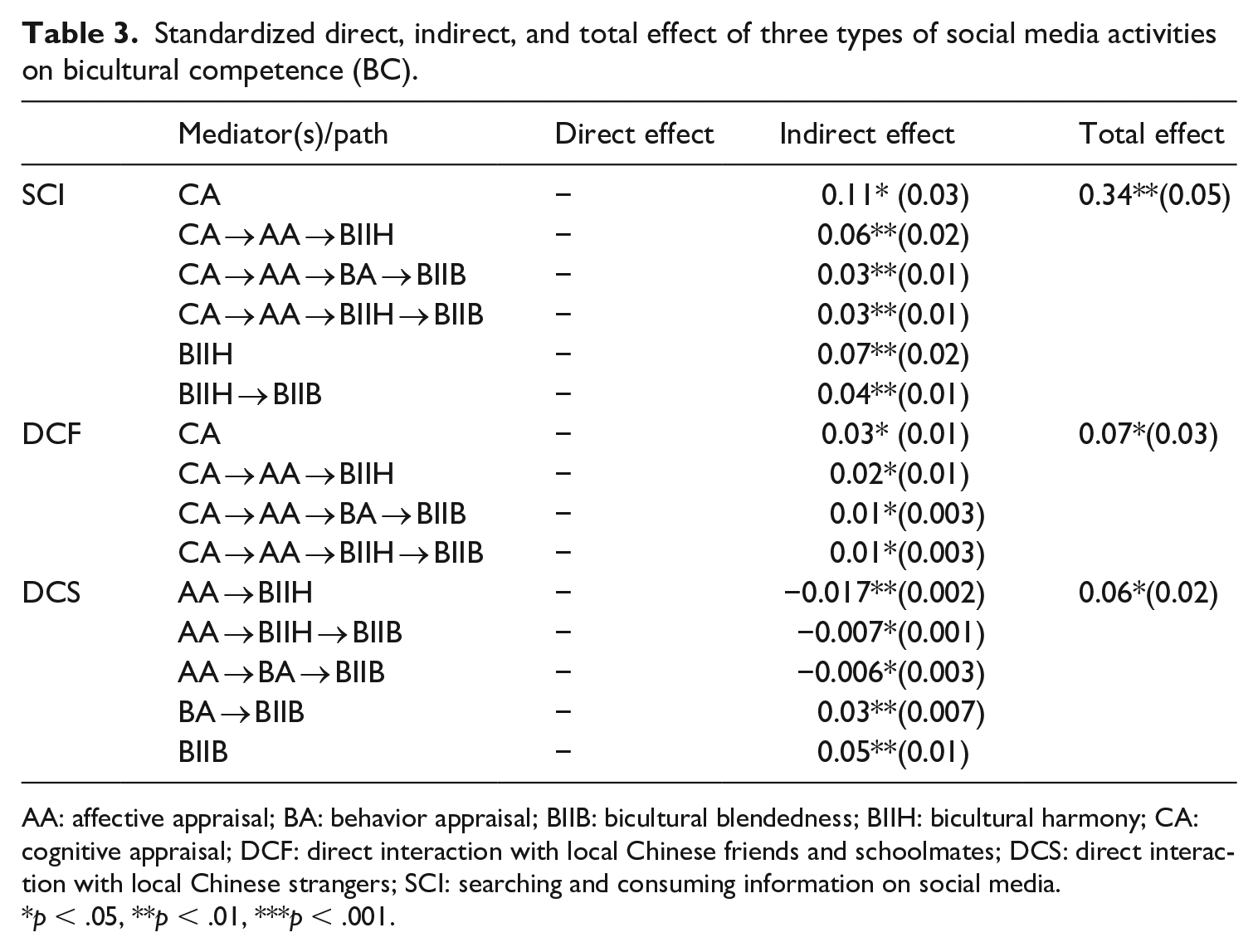
All the three types of social media activities were found to significantly predict BC: consuming mainstream culture-related information had the strongest association (β = .34, p < .01); whereas directed communication with friends (β = .07, p < .05) and with strangers (β = .06, p < .05) both had a small effect size (see Table 3).
Standardized direct, indirect, and total effect of three types of social media activities on bicultural competence (BC).
AA: affective appraisal; BA: behavior appraisal; BIIB: bicultural blendedness; BIIH: bicultural harmony; CA: cognitive appraisal; DCF: direct interaction with local Chinese friends and schoolmates; DCS: direct interaction with local Chinese strangers; SCI: searching and consuming information on social media.
p < .05, **p < .01, ***p < .001.
Moreover, cognitive appraisal, with associated affective appraise, was the primary mediator of the associations of consuming information and communication with friends with BC. This finding aligns with the conceptualization that culture-specific learning is the core that connects intercultural contact and acculturation adaptation (Ward et al., 2001). Instead, AA and behavioral appraisal were the primary mediators of the association between communication with strangers and BC. LaFromboise et al. (1993) conceptualized that BC consisted of the cognitive dimension (i.e. knowledge of cultural beliefs and values), the affective dimension (i.e. positive attitudes toward both groups), and the behavioral dimension (i.e. communication ability and culturally appropriate behaviors or roles). The findings suggested that the three types of social media activities were associated with different dimensions of BC: consuming social media information and communication with friends contributed to the cognitive and affective dimension of BC; whereas communication with strangers contributed to the affective dimension, although negatively, and the behavioral dimension of BC.
Association of social media activities with bicultural identity integration
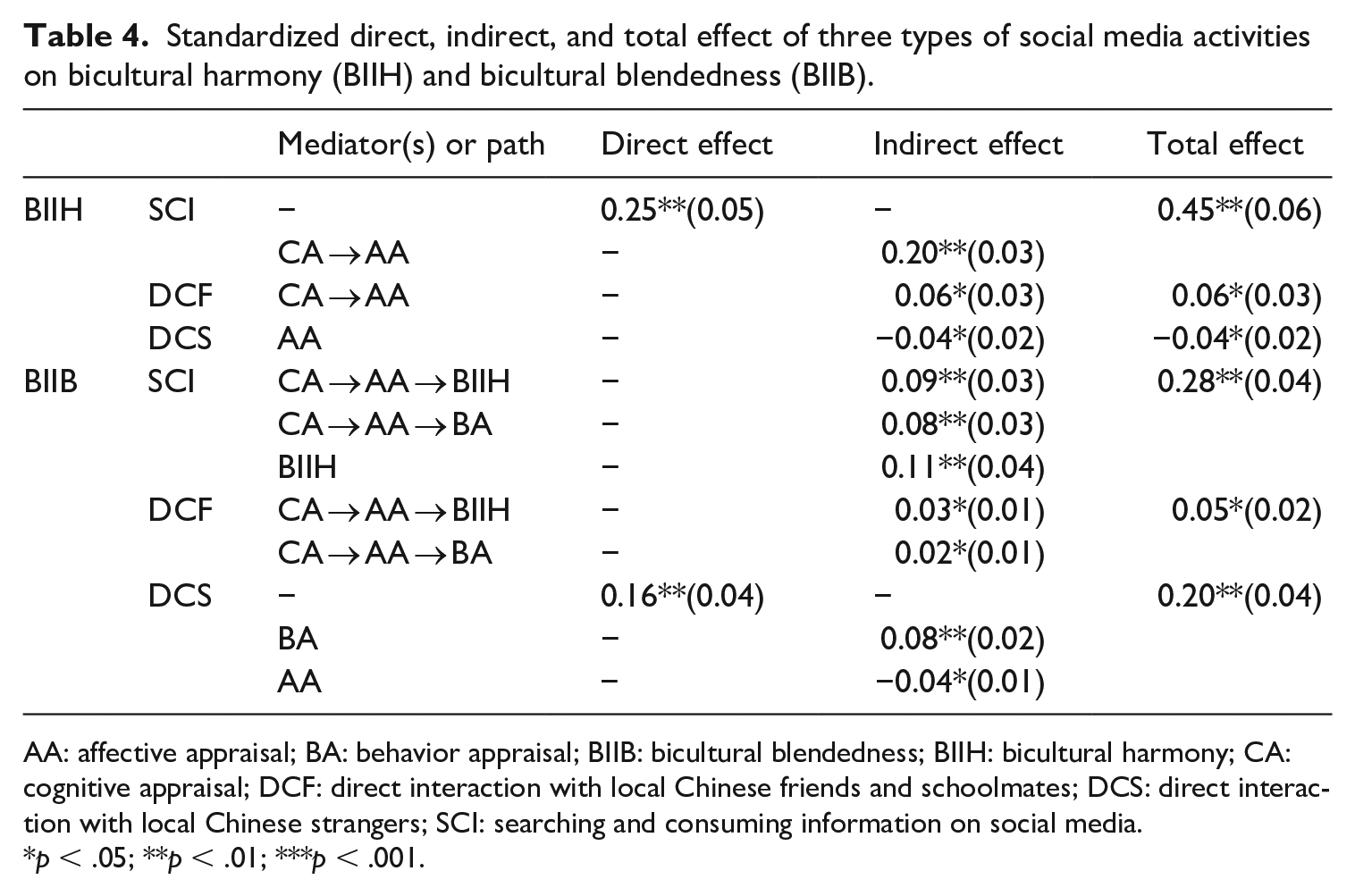
Consuming information was the strongest determinant (β = .45, p < .05) of BIIH, influencing it both directly (β = .25, p < .01) and indirectly through cognitive appraisal and AA (β = .20, p < .01). Communication with friends or schoolmates had a weak but positive association (β = .06, p < .05). In contrast, communication with strangers contributed negatively to BIIH (β = –.04, p < .01). AA was the primary mediator for all three types of social media activities (see Table 4). This finding makes sense in that BIIH is the affective dimension of bicultural identity integration, and is influenced the most by interpersonal factors and emotions (Benet-Martínez, 2012; Huynh et al., 2011).
Standardized direct, indirect, and total effect of three types of social media activities on bicultural harmony (BIIH) and bicultural blendedness (BIIB).
AA: affective appraisal; BA: behavior appraisal; BIIB: bicultural blendedness; BIIH: bicultural harmony; CA: cognitive appraisal; DCF: direct interaction with local Chinese friends and schoolmates; DCS: direct interaction with local Chinese strangers; SCI: searching and consuming information on social media.
p < .05; **p < .01; ***p < .001.
Consuming information again showed the strongest association (β = .28, p < .01) with BIIB and directed communication with friends the weakest (β = .05, p < .05). Directed communication with strangers was a strong and positive determinant of BIIB (β = .20, p < .01), contributing to it both directly (β = .16, p < .01) and indirectly through behavioral appraisal (β = .08, p < .01) and AA (β = –.04, p < .05). BIIB is the behavioral dimension of bicultural identity integration and is influenced the most by the performance factors, such as the intensity of intercultural exposure and contact (Benet-Martínez, 2012; Huynh et al., 2011). Consuming mainstream cultural information might have contributed to it by increasing the participants’ intercultural exposure, and directed communication with the local people by enhancing intercultural contact. The stronger effect of communication with local strangers than communication with local friends or schoolmates indicated that communication with acquaintances on social media might have limited add-on value to migrants’ BIIB.
Discussion
This study examined the relations of a group of ethnic minority adolescents’ social media use with acculturation, and found that three different social media activities, namely consuming information, directed communication with friends, and directed communication with strangers, contributed differently to their BC and bicultural identity integration (i.e. BIIH and BIIB). It further showed that the contributions were mediated differentially by the participants’ cognitive, affective, and behavioral appraisal of this intercultural contact experience. Although previous studies have examined differential associations of different social media activities with acculturation, they have reported either the impact of accessing different cultural groups (e.g. one’s ethnic culture people vs the host culture people) or that of the nature of engagement (e.g. passive consumption and active participation), and have primarily focused on one type of sojourners—international students studying abroad (Li and Peng, 2019; Li and Tsai, 2015; Park and Noh, 2018). This study extended this line of inquiry by expanding both the immigration context studied (i.e. ethnic minorities) and the nature of social media activities investigated (i.e. activities arising from the interface of what people do with social media and with whom they interact with, Kraut and Burke, 2015). Findings from the study support a nuanced approach toward understanding and utilizing the relations of different social media activities with acculturation among ethnic minority adolescents.
This study found that consuming mainstream-culture information was the strongest determinant of both the participants’ BC and bicultural identity integration. The consistent positive contribution of this social media activity contradicts with previous research findings on the negative psychological effects of passive social media use during college transition (e.g. Liu et al., 2019). The oft-reported negative effects are often attributed to the displacement problem, that is, the time spent on browsing took away potential time for quality interactions. However, in the case of the socially disadvantaged groups, such as ethnic minorities who live in migration contexts with prevalent social discrimination, the displacement issue may not be as detrimental since they do not have access to quality intercultural contact anyway in daily life. Instead, as Burke et al. (2011) identified, for individuals with low social communication skills, passive browsing on social media may facilitate bridging social capital. Bridging social capital brings essential informational and emotional support (Ballantine and Stephenson, 2011; Chen et al., 2019) and may even foster interpersonal attraction because of enhanced knowledge about the others (Orben et al., 2018). Thus, for migrants who are challenged linguistic- and culture-wise in social communication with the mainstream culture, passive consumption of mainstream culture-related information on social media may contribute positively to their acculturation. The findings suggest that the psychosocial impact of passive consumption of social media information is contingent upon specific research contexts.
This study further found that communication with local Chinese friends on social media had a rather weak association with the participants’ acculturation, but communication with local Chinese strangers had a strong positive association with perceived BIIB. The finding supports previous research findings that interaction with strangers and interaction with friends had differential psychosocial impacts (Liu et al., 2019; Yang and Lee, 2020), but contradicts the commonly observed strong positive effects of communication with friends and negative effects of communication with strangers on psychological and sociocultural adaptation (Kraut and Burke, 2015; Liu et al., 2019). The weaker association for communication with local Chinese friends might be due to the fact that communication in this context primarily centered around chitchats on personal and school-related issues, which might carry limited influence on learners’ acculturation orientations (Cao et al., 2018). Rather, establishing connection with people from the unfamiliar social circles may carry greater weight in supporting migrants’ integration into the mainstream society (Zhao et al., 2021). Moreover, communication with local Chinese strangers was the most contested activity in that, despite associating positively with BC and BIIB, it contributed negatively to BIIH. The positive associations might have come from its affordance in enriching migrants’ access to diversified cultural information, engaging them in social participation, and linking them to external assets; whereas, the negative association could be attributed to its constraints in establishing emotional closeness due to the relatively low frequency of occurrence and the limited social-context cues available in the interaction and the synchronicity of the medium that this type of communication often takes place (Kim and Shen, 2020; Liu et al., 2019). The participants in this study also reported encountering negative social messages and discrimination in this communication space, which might have further contributed to its negative association with BIIH. The findings suggest that for migrants, social media interaction with strangers may play a more important role than social media interaction with friends or schoolmates. Nevertheless, this activity runs the risk of inducing negative emotions and perceptions among the migrants. Thus, it is important to, on one hand, encourage ethnic minorities to engage actively with strangers from the mainstream culture online, and, on the other hand, strengthen their socio-emotional and linguistic capacities to communicate effectively with local strangers and to cope with potential derogatory messages.
The findings from this study might be biased by its research context, namely ethnic minority adolescents who had limited interaction with the mainstream culture in daily life due to linguistic, religious, and social reasons. The findings might be different in immigration contexts with less social discrimination and for migration populations with greater linguistic, social, and cultural resources. Moreover, the participants were “established” residents in the migration context, and had access to local Chinese friends or schoolmates. The observed small effect of communication with Chinese friends and schoolmates might show up differently among immigrants who are in the early stage of integration (e.g. Tong, 2014). Moreover, the participants were from south and southeast Asian cultural backgrounds. As social media practices and perceptions vary across cultures, the nature of essential social media activities and their associations with acculturation might vary for immigrants from different cultural backgrounds. Thus, more research studies are needed to explore the issues in various immigration contexts and with various migration populations.
Conclusion
This study examined, through a sequential research design, the association of secondary school south and southeast Asian ethnic minority students’ social media experiences with their acculturation in Hong Kong, and the mechanisms behind the association. It identified three types of social media activities that contributed differently to these students’ acculturation, and thus, advocates diversifying migrants’ social media activities. The study further revealed that consuming mainstream culture-related information and engaging in directed communication with the mainstream culture strangers were important venues of acculturation, and thus need to be encouraged and supported. Given the contested nature of the influence of social media communication with strangers, it is important to equip ethnic minority adolescents with the necessary skills and mindsets to benefit from this communication context. The different profiles of the relationship between the three types of social media activities with acculturation revealed in this study, in contrast to those reported in existing literature (Liu et al., 2019; Yang and Lee, 2020), suggest that more research is needed to examine the psychosocial impact of the activity-audience interface of social media experience in different acculturation contexts to achieve an elaborated view of the relationship.
Footnotes
Funding
The author(s) disclosed receipt of the following financial support for the research, authorship, and/or publication of this article: The research is funded by Hong Kong Standing Committee on Langauge Education and Research [Grant number AR180009].
