



Abstract
Private security companies (PSCs) blur the lines between the public and the private sector through the provision of services to state militaries. Based on a multi-modal qualitative content analysis of YouTube recruitment videos aimed at veterans, we show how PSCs also challenge these boundaries through their hiring practices. By relating to veterans’ past as hero warriors and by envisioning their future as corporate soldiers, the companies appear as ‘like-military’ and as allowing ex-militaries to ‘continue their mission’. The findings contribute to scholarly debates about the privatization of security. They illustrate that similarly to the public sector, the private is also re-constituted through the military values that veterans introduce. The study adds to the literature on the visualization of war showing how video-based platforms allow security actors such as PSCs to construct their corporate identity in ambivalent ways by appealing to different emotional levels and by giving rise to different narratives.
Keywords
Introduction
Since the end of the Cold War, Western militaries increasingly contract private security companies (PSCs) for the provision of services ranging from people and compound protection to reconnaissance or rescue and humanitarian missions as well as combat. This privatization of security, as it is often referred to, has sparked a debate in and beyond social science disciplines about the likely ramifications. Contrary to especially policy-makers who conceive of PSCs as important force multipliers allowing states’ armed forces not only to concentrate on core tasks related to security provision (Singer, 2003), but also to address the ‘recruitment crisis’ (Jester, 2021) many of them are currently faced with, scholars most often point to the risks associated with contracting security companies. In addition to problems of accountability as well as the potential loss of states’ control over the monopoly of force (Abrahamsen and Williams, 2011; Owens, 2008), they have drawn attention to the blurring of lines between the public, military and the private, civilian security sectors.
According to Leander and van Munster (2007) as well as Krahmann (2013), for example, the public sector already shows signs of ‘privatization’. Because of the neo-liberal norms which PSCs introduce, security policies are no longer subject of public deliberation about the societal ramifications, but instead are increasingly depoliticized through the ‘economic calculus’ (Leander and van Munster, 2007: 204) and a cost-efficiency logic on the basis of which they are decided (Krahmann, 2013: 174). Others, by comparison, argue that it becomes increasingly difficult to distinguish between public and private because of the mingling of personnel. Examining the implications of PSCs contracted by Swedish state security forces, Berndtsson (2012) found companies’ staff to be quite frequently treated and perceived as ‘quasi-state’. Since many of them had worked for the Swedish military prior to their employment in the private security sector, they displayed in the eyes of civil servants ‘. . . a considerable degree of “publicness”’ (Berndtsson, 2012: 318) with ‘the difference between “private” and “public” security actors [being] essentially non-existent’ (Berndtsson and Stern, 2013: 65). Scholars observed a similar confluence in conflict zones where PSCs often work side-by-side with armed forces and also increasingly provide protection for humanitarian aid agencies as well. Because these ‘security assemblages’, as Abrahamsen and Williams (2011) refer to them, make it gradually more difficult for locals to discern who is military and who is not, they have been found to impede the efforts of armed forces to win locals’ hearts and minds (Singer, 2007: 111) though also to be one of the contributing factors for the increasing attacks on humanitarian aid workers (del Prado, 2008: 5).
While scholars have amply discussed the likely consequences of the privatization of security for the public sector, they have, however, largely ignored developments in the private sector. We account for this gap in the literature based on a multi-modal qualitative content analysis of YouTube recruitment videos primarily aimed at veterans and produced and published by two major US-based PSCs – DynCorp International and CACI. We show how lines of authority are also and further ‘. . . contest[ed] . . ., renegotiate[ed] . . . and recast’ (Berndtsson and Stern, 2011: 408) because of personnel flows from states’ armed forces to PSCs and the virtual corporate identity these companies construct of themselves on the basis of these flows as quasi-military (for exceptions, see Jackson et al., 2021; Joachim et al., 2018). By (re-)visioning veterans as ‘hero warriors’ and by envisioning them as future ‘corporate soldiers’, the YouTube videos suggest that the private and public security sectors are indifferent. Ex-militaries can ‘[c]ontinu[e their] mission’ (CACI, 2020a) when working for these PSCs and are hired precisely for the skill and value set which they acquired in the military. Acknowledging that the blurring of lines between public and private is not as such a novel idea or unique to the security sector and that neither of the respective domains resembles an ‘uncontaminated’ space, the analysis conducted here nonetheless suggests that social media adds a new dimension since it allows actors such as PSCs to challenge and reconstitute demarcations in more sophisticated and subtle ways; it therefore adds to several bodies of literature, including that on the privatization of security.
The examination of CACI’s and DynCorp’s YouTube recruitment videos makes apparent that the blurring of lines is not occurring in a unidirectional manner as scholars have previously suggested. At the same time as PSCs contribute to ‘shifting norms or “mentalities”’ (Abrahamsen and Williams, 2009: 3) in the public domain through the services and the personnel they provide to states, ‘military institutional cultures’ are introduced and recreated in the private sector through the employment of veterans (Higate, 2012: 187). Nor is the vanishing of sectoral lines the result of only direct interactions of individuals of the private and public security as has been a prevalent assumption in the literature (Abrahamsen and Williams, 2011). Instead and as we show in this article, the obfuscation is increasingly reinforced through virtual identity assemblages with potentially more far-reaching implications. Given the circularity of social media and the speed with which information can be shared through them, PSCs may not only shape how they are perceived by an extensively wider public, but by linking previously unrelated identity layers in new and different ways online, make it also ostensibly more difficult for states to control their own strategic narrative.
In addition to the literature on private security, the study contributes to the works of critical security scholars who in recent years have paid more attention to the ways in which security actors promote themselves and legitimize their actions using visual-based social media, including armed forces (e.g. Crilley et al., 2020; Jester, 2021; Mann, 2018; Shim and Stengel, 2017), terrorist networks (Heck, 2017) or humanitarian organizations (Waters and Jones, 2011). Yet, because of their almost exclusive focus on imagery, scholars fail to capture how especially video-based online platforms are real game changers for political actors to ‘enhance the appeal of . . . their identity’ among different audiences (Van Noort, 2020: 735). By departing from this trend and by analysing sound and text in addition to visuals, we show that is precisely the different platform features and their ‘distinctive vernaculars’ (Pearce et al., 2020: 162), which enable security actors to construct their corporate identities in variable ways. As we illustrate with the exemplary case of PSCs, because they appeal to different emotional levels and help to give rise to different narratives, these features allow these companies to present themselves at once as similar to and distinct from armed forces. Therefore, these findings are relevant beyond the security realm. As communication is moving increasingly to the ‘visual web’ (Hand, 2017) and online reputation management is significantly gaining in importance, more generally (Yang et al., 2017), the analysis conducted here provides important new insights with respect to the precise mechanisms of how identities are virtually (re-)constructed and the political implications when previously taken for granted lines of authority are being challenged.
This article is structured as follows. In the first section and on the basis of the respective literatures, we theorize the role of corporate identity and video-based social media for recruitment. In the second section, we turn to the methods and a discussion of the multi-modal qualitative content analysis we conducted of the YouTube recruitment videos of DynCorp International and CACI. The results of the empirical analysis are presented in the third section where we detail how the two PSCs blur the boundaries between the public and private sector through their video-based hiring. We conclude with a discussion of our findings and their limitations as well as a reflection on their implications for existing literature and future research.
Re-constituting the public–private divide through corporate identities and visual social media
The public–private divide has been subject in diverse bodies of literature for quite some time. However, the growing involvement of commercial actors in the provision of public security has sparked scholars’ renewed interest in the subject, especially with respect to the United States where the reliance on private contractors was particularly high during the wars in Iraq and Afghanistan (Commission on Wartime Contracting in Iraq and Afghanistan, 2011) and continues to remain significant. In the fiscal year 2018, the US Department of Defence (DOD) spent $360 billion for private contractors, which is more ‘than all other government agencies combined’ (Congressional Research Service, 2020: 1) and during the first quarter of 2020, the DOD contractors alone had about 13,518 US citizens working for them in Afghanistan, Iraq and Syria (Congressional Research Service, 2020: 2). Although this type of governing arrangement has in and of itself been interpreted as an indication that sectoral lines become blurred, recent scholarship points to a further explanation. It suggests that these boundaries are also re-constituted discursively and through the practices of the contracted PSCs (Berndtsson and Stern, 2011: 408; Joachim and Schneiker, 2019). We build on this line of argument focusing, however, on two thus far underexposed dimensions: the recruitment of veterans and the corporate identities of PSCs that play a critical role in hiring (Balmer and Gray, 2003: 973).
Conceiving of these identities as socially constructed, plural in character and malleable (Hopf, 2016: 5), we posit that at the same time as they serve promotional purposes, they are constitutive and political. Through them companies not only define who they are and how they are distinct from or similar to others. Yet, they also shape the perceptions of others, including those of prospective employees, that is, veterans, and the latter’s previous employers and the companies’ potential clients, that is, state militaries. This is consequential beyond the recruitment that PSCs engage in. Domestically and through their institutionalization, the identities that these companies publicly fashion are likely to alter the relations between the state, the citizen and the soldier more generally (Van Gilder, 2019: 153). At the international level, the self- and other-constructions of PSCs are apt to matter for the ‘nation-state building processes and other activities of international relations’ through which ‘. . . the military, defense and [private] security sectors have been connected centrally’ (Kronsell, 2005: 282).
Corporate identities exhibit ‘sets of characteristics [. . .] thought to be typical of members of the category, or behaviours expected or obliged of members in certain situations (roles)’ (Fearon and Laitin, 2000: 848). Through them companies define themselves, demark their membership in groups, though also relate and identify with others (Ashforth et al., 2011: 1145). While comprised of ‘central, distinctive, [and] continuous’ attributes (Ashford et al., 2011: 1145), corporate identities are neither fixed nor permanent. They differ depending on the interaction with others (Hopf, 2016: 5) and always are defined with a view to referential others (Wendt, 1994: 389). In the case of recruitment, this implies that companies frame their identity with their ‘target audience’ in mind (Jensen, 2011: 195): their prospective employees, their needs and perceptions of them (Gromark and Melin, 2013).
Defining oneself in relation to others affords companies, according to Wæraas (2008), a paradoxical move of ‘differentiation and identification’ (207). At the same time as companies ‘as entities in a social space want to see themselves – and to be seen by others – as similar to relevant members of a category or industry [they want to be (perceived) as] [. . .] somehow distinctive from [. . .] other members’ (Gioia et al., 2013: 126). To accomplish this move, corporate actors, according to the organizational studies scholars Albert and Whetten (1985), quite often employ a strategy which they refer to as ‘addition’ whereby the original identity is joined with another giving rise to dual or multiple corporate identities (Albert and Whetten, 1985: 275). PSCs can be assumed to behave in an equal manner when seeking to attract veterans by branding themselves as similar to and yet also distinct from veterans’ previous public employer, the armed forces, adding to their own corporate identity that of state militaries. Video-sharing platforms such as YouTube allow companies today to more easily curate their corporate identities, which is why, according to marketing scholars, they have become important tools for recruitment purposes (Schwemmer and Ziewiecki, 2018: 1).
Videos offer companies a broad range of possibilities to relate to prospective employees compared with other online media (e.g. Twitter, Facebook or LinkedIn) or more traditional print-based forms of recruitment. Because of their often visual, sound and textual features (Schwemmer and Ziewiecki, 2018), video-based platforms permit for corporate identities and their constitutive elements to be conveyed in a much more vivid, variable manner, to appeal to different emotional layers and to blend past and future (Waters and Jones, 2011). Hence, when seeking to attract veterans, PSCs can identify with them not only on the basis of values they acquired in the military (e.g. patriotism, heroism, loyalty or comradeship) or the benefits they are likely to enjoy once employed (e.g. opportunities for upward mobility or a more flexible and positive working environment). Instead, these companies can communicate their corporate identity also in a more subtle manner and with reference to less tangible aspects (Barnett et al., 2006: 34). They can, for example, display symbols generally associated with either the military (e.g. flags, uniforms or military equipment such as tanks or weapons) or the private sector (e.g. black suits, high rises, computers or meeting rooms). Yet, they may also relate to potential recruits through testimonials of employees who speak from a position to which those looking for a job can relate to (Oladipo et al., 2013). In addition, through YouTube videos, companies can appeal to recruits through ‘different layers of emotion and loyalty [which] reinforce and fortify one another . . .’ (Åse and Wendt, 2018: 36).
At the same time as they can convey what Park and Kaye would deem ‘rationality’ messages (Park and Kaye, 2019: 3) which create ‘. . . an impression of “realness”’ (Cotter, 2019: 897) and of ‘objective knowledge’ (Saugmann Andersen, 2017: 357) through factual information, the different platform features allow as well for more subjective, ‘emotionalizing’ messages (Park and Kaye, 2019: 3) which are more ambivalent articulations and leave room for interpretation (Krahmann, 2021). Furthermore, employers can relate to recruits in a very personal, intimate and ‘powerfully, emotionally connecting way’ (Park and Kaye, 2019; Waters and Jones, 2011: 253) or as ‘. . . an esteemed member of [a . . .] group’ and thus satisfy the need of potential applicants ‘for belongingness and uniqueness’ (Shore et al., 2011: 1265).
While serving ‘as a strategic resource and source of competitive advantage’ (Melewar and Jenkins, 2002: 76) for recruitment, corporate identities as well as the videos they are conveyed through have a productive quality and are constitutive (Bleiker, 2015; Krahmann, 2021). They ‘shape the perceptions of the organization and create a brand that helps cement the organization in the public’s mind’ (Waters and Jones, 2011: 251). Corporate identities and their visual representations are therefore also always political (Bleiker, 2015: 874). With companies stating or leaving ambivalent what they are about, how they are distinct or similar from others, and how prospective employees and their prospective future are conceived, they contribute to the (re-)classification and the (re-)constitution of boundaries. In the case of the PSCs we examined, and as we show below following the discussion of methods, their recruitment videos not only give rise to a new cast of soldiers, that is, corporate ones, but they also further blur the line between the private and public security sectors.
Case selection and methods
For this analysis, we examined two YouTube recruitment videos primarily aimed at veterans and respectively issued by CACI and DynCorp International. We conducted a multi-modal computer-based qualitative content analysis of visuals, sound and text.
The two companies and their respective YouTube recruitment videos were selected for the following reasons. With respect to the PSCs, both companies are major contractors of the US government and similar to competitors of their size, they offer a broad range of security services including people and compound protection, reconnaissance as well as combat (CACI, 2020b; DynCorp, 2020). Although many of these companies still recruit through also more traditional channels and especially word-of-mouth (Petersohn, 2018), they increasingly rely on social media as well (Joachim et al., 2018). Yet, opposed to PSCs’ homepages or their Twitter accounts, the videos many of these companies meanwhile produce for purposes of self-promotion and share through YouTube have thus far received surprisingly little attention even though they are powerful tools for reputation management (Van Noort, 2020). DynCorp and CACI have each produced several recruitment videos of which we chose to analyse those aimed at veterans as opposed to the more general ones since ex-militaries comprise a substantial part of the workforce of the two companies, in particular, but also many other PSCs, more generally. Half of DynCorp’s employees (5352 of 10,614) and a quarter of CACI’s workforce (4524 of 18,870) are estimated to be veterans (Military Times, 2017) who bring with them a skill and value set that PSCs appreciate (Ramos, 2013; White, 2017).
Entitled ‘Deploying Talent – Creating Careers’ (CACI, 2013) and 4.46 minutes long, CACI’s video includes next to stills and text banners also personal accounts of veterans and now CACI staff members regarding their past and present employment: Denyse, a recruiting manager and a woman of colour; Jared, a field engineer; and Stan, a hiring manager, both of whom are white men. Titled ‘Proudly Employing Those Who Served’ (DynCorp, 2012), DynCorp’s video lasts 3.41 minutes and comprises visual passages as well as longer sequences with Clint, an ex-military and now company employee, who shares about his time in the armed forces and since he is working for DynCorp. Although already produced in 2013 and 2012 respectively, the videos of CACI and DynCorp continue to remain accessible through the YouTube archive and still form an integral part of the companies’ homepages where they are linked to and pushed through other social media platforms, including Facebook, Instagram or LinkedIn.
Of both recruitment videos, we conducted a multi-modal computer-assisted qualitative content analysis using the software MAXQDA. Following their transcription and for purposes of manageability, we divided the script of each video into sequences, whereby the appearance of a new image in the video, the sound and text accompanying it, indicated a new sequence. Three trained individuals coded all sequences several times and visuals, text as well as sound comprising them separately based on an inter-coder agreement that contained elaborate rules on how to code (for an example of the coding, see Table 1).
Description and example of the coding of the PSCs’ virtual corporate identities.
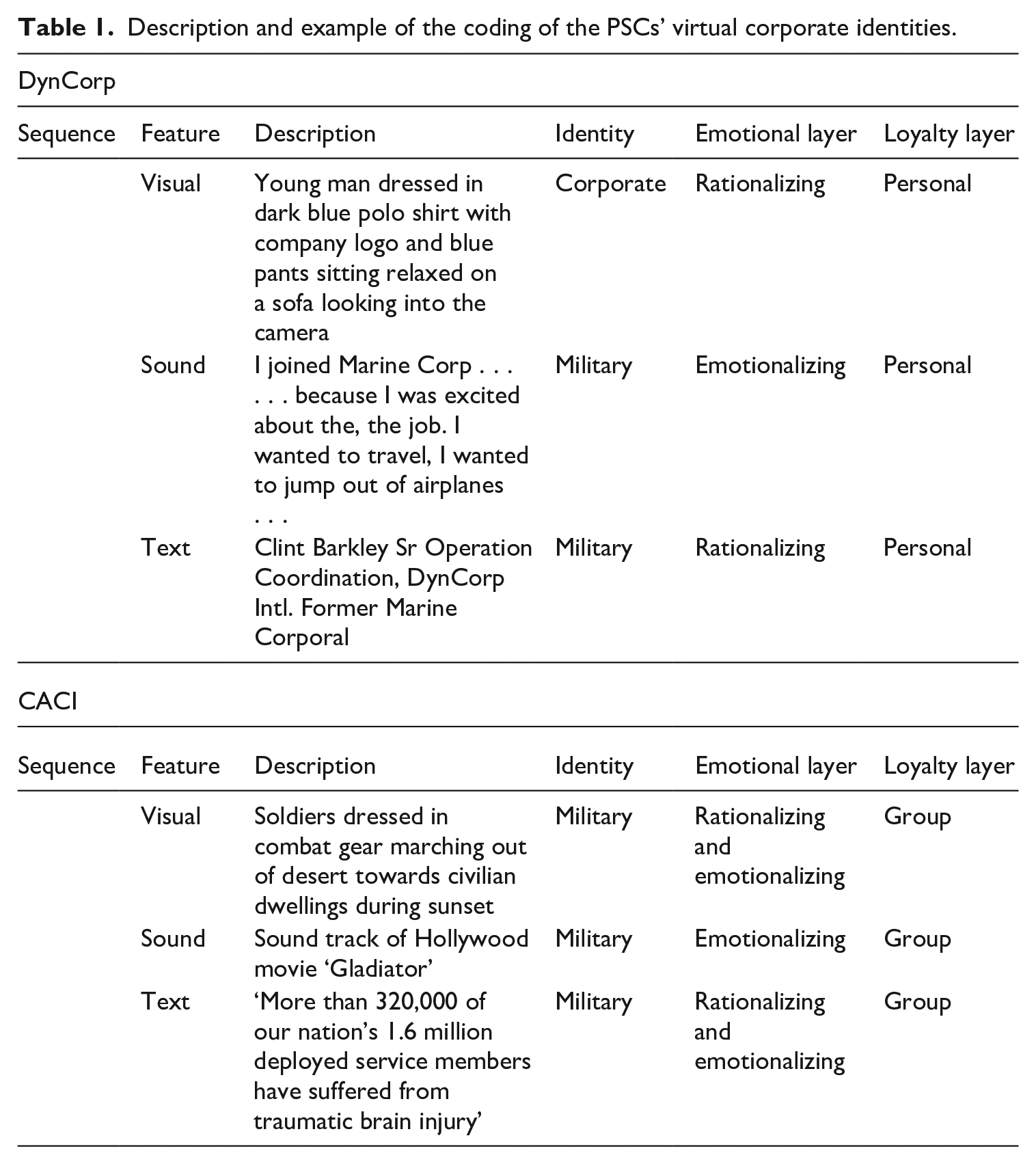
With the help of the literature, we developed codes on the basis of what scholars considered to be constitutive elements of corporate identity, in general, and that of the military and the corporate sector, in particular. Regarding the military identity, our codes included values such as ‘patriotism’, ‘comradeship’, ‘adventure’, ‘common experiences’, ‘resolve’, ‘courage’, ‘heroism’ or ‘honour’ (Joachim and Schneiker, 2019: 19–24; Johansen et al., 2014: 523), which we assigned if these values found explicitly or implicitly mentioning in the following cases: first, were referred to by the narrators or insinuated through background music; second, were invoked in textual passages or, third, were communicated visually through, for example, the display of symbols associated with the military, such as combat clothing, tanks, armament or the US flag. For the corporate identity, we proceeded in a similar fashion. We assigned codes to visuals, text and sound if values associated with the corporate sector such as ‘benefits (e.g., salary, pension, etc.)’, ‘upward mobility’ or a ‘positive working environment’, ‘diversity’ or ‘flexibility’ (e.g. Joachim and Schneiker, 2019: 24–27; Strand and Berndtsson, 2015) were either communicated directly or in a symbolic fashion through, for example, clothing (e.g. suit and tie or clothing with a corporate logo) or the setting (e.g. meeting rooms or high rises).
In addition to codes pertaining to the military and corporate identity, we also assigned ones pertaining to, on one hand, the emotional layer in the case of which visuals, sound and text were coded as either ‘emotionalizing’ when the content was affective in nature or ‘rationalizing’ when it was factual in kind. On the other hand, codes related to the level of loyalty were assigned. ‘Personal’ was used if, for example, the narrators spoke about their own personal experiences, addressed the viewers in a personal manner referring to him or her as ‘you’, when they directly looked into the camera or used colloquial or familiar language. By comparison, ‘group’ was used when narrators conceived of themselves as part of a team or referred to their company as family, when groups of individuals were displayed or when veterans were addressed as group who, for example, suffered an equal lot. We supplemented all of these deductively generated codes inductively throughout the qualitative content analysis. This elaborate method allowed us to capture not only the messages conveyed by the different platform features, but also how these features interact, co-constitute or are in tension with each other and give rise to particular narrative patterns (Pearce et al., 2020: 165; Russmann and Svensson, 2017: 1).
Subsequent to each coding phase, the results of the different coders were discussed and a decision reached where disagreement existed. It should be noted here that since we coded visuals, text and sound separately and paid attention to the identity, emotional and loyalty layers, the aggregate codes were rarely unidimensional as, for example, either military or corporate. Instead, they were more often multi-dimensional and reflective of the ambivalent manner in which the two PSCs projected their corporate identities throughout the videos.
From wounded warrior to corporate solider: PSC recruitment, veterans and YouTube
Both CACI and DynCorp relate their corporate identities to veterans in a similar fashion. They present employment with their companies as a continuation of rather than a break with military service. Using imagery, text as well as personal accounts of ex-militaries and now company employees, the two PSCs reinforce the blurring of lines between public and private, by not only making the boundaries between the security industry and the military appear as translucent, but also respective emotional and loyalty layers.
(Re)visioning the wounded warriors’ military past
DynCorp and CACI bridge the divide between their corporate and the military sector by identifying with veterans based on their military past and two different narratives: the ‘wounded hero’ warrior myth and romanticism that surround (ex-)militaries as well as the ‘rescue narrative’ which constructs veterans as injured, traumatized, handicapped and needy job-seeking individuals (Åse and Wendt, 2018; Kronsell, 2012). In addition to visuals, these narratives are conveyed through, especially in the case of the former, personal accounts which create a sense of intimacy and uniqueness on the part of recruits and, in case of the latter, through text banners which lend public recognition to veterans’ lot and create a sense of group belonging.
In DynCorp’s video, it is especially the narrator Clint, who already blends the distinction between private and public by identifying with both his past as a marine corporal and his current employment as the company’s senior operation coordinator. Furthermore, through his personal recollections, he recreates and signals the continued relevance of the ‘wounded hero’ warrior myth in the private security sector. Similar to war memoirs that form important parts of our collective imagination (Dyvik, 2016), he relates his experiences from his deployment in Iraq when he and his buddies got hit by a blast: ‘We ran over a landmine, and as result, I lost my left leg. Another marine lost both of his feet below the knee. And another marine, sitting next to me, was killed in the blast’ (DynCorp, 2012: 0.58–1.15). These memories are brought to life through images that are interspersed while Clint speaks and which depict scenes we would associate with military deployment such as, for example, soldiers somewhere in the desert carrying away a wounded comrade on a stretcher (DynCorp, 2012: 3.04–3.05) or military symbols, as, for example, a coffin partly covered by a US flag (DynCorp, 2012: 1.14–1.15). However, his recollections are also substantiated and contribute to the blurring of boundaries between public and private through the bodily enactment (Davis and Chansiri, 2019; Dyvik, 2016) Clint himself engages in. Dressed in civilian clothing and wearing a polo shirt with the company’s logo, he shows the injuries he incurred during his deployment – an amputated leg and a prostheses – while recollecting how he ‘had a total of ten surgeries to heal my leg and my hand’ and ‘after that it was about three more months of physical therapy’ (DynCorp, 2012: 1.15–1.30).
First-person accounts, such as these of Clint, help stories according to Lund et al. (2018), ‘. . . gain traction’ (p. 17) and provide a basis for identification. Compared with, for example, a company’s homepage, employees are deemed as a more credible and trustworthy source of information (Oladipo et al., 2013). According to Cotter, who studied social media influencers (Cotter, 2019: 897), personal testimonies create ‘. . . an impression of “realness”’ and ‘a sense of intimacy, accessibility, and relatability, which forms the basis of affective relationships with followers’ (Cotter, 2019: 897). At the same time as Clint relates to potential recruits on a personal level, he, however, also provides them with a sense of ‘[p]ublic recognition, respect, and remembrance . . .’ (Strand, 2018: 2), which plays a ‘vital aspect[ ] of selling military careers to young individuals . . .’ (Strand, 2018: 2; see also Basham, 2016).
Paired with the images, his personal recollections convey, ‘collective gratitude’ for the soldiers who have ‘sacrificed [their lives] to protect and sustain the nation’ (Åse and Wendt, 2018: 23). In the videos this public recognition and gratitude is linked to and blended with veterans’ private lives, and more specifically their ‘reproductive/domestic family [. . .] and the military family’ (Åse and Wendt, 2018: 36), which, as a recent Rand study on social media and recruitment found, play ‘a key role as influencers’ (Wenger et al., 2019: 23). In DynCorp’s video, the military family is evoked primarily through images suggestive sometimes of an understanding of family in a more immediate and private sense, as, for example, when a man with crutches wearing a T-shirt with ‘Army’ printed on is shown with, what probably should symbolize his wife and daughter, a woman and a girl standing on either side of him (DynCorp, 2012: 3.06–3.07). At other times, however, the images blend this with a broader meaning and one which equates family with the state, the public or the nation as in the cases when showing kids and women sitting on a tribune and waving the US flag during what appears a military parade (DynCorp, 2012: 0.37−0.39) or when displaying returning officers dressed in combat uniforms, some with crutches as they walk passed by a group of people in civilian clothing, presumably family members, who applaud them (DynCorp, 2012: 1:31–1:35). Contrary to DynCorp’s video that gives rise to the hero warrior myth through primarily personally shared experiences that are interspersed with images, CACI’s also draws on popular culture.
The video begins with solemn marching background music from the Hollywood blockbuster ‘Gladiator’, a commercially produced movie which evokes loss and bravery, that is, sentiments generally associated with the military. Simultaneously, a still is shown which too blurs public and private and reminds one, as the music itself, of the return from the battlefield. It depicts soldiers dressed in combat gear and carrying heavy backpacks with all their belongings as they walk towards civilian dwellings while the sun is setting (CACI, 2013: 0:03−0.14). Hollywood movies in which war and heroism have not seldom figured prominently, provide often a common reference point in US society (Sachleben and Yenerall, 2003). Even if the viewers of CACI’s recruitment video are not intimately familiar with the movie Gladiator itself, the soundtrack may nonetheless remind them of norms and values they can identify with based on their military training and, in turn, may project onto the company and their future career in the corporate security sector. In addition to the hero warrior myth, both YouTube videos also give rise to the rescue narrative surrounding veterans, which in CACI’s case is constructed through primarily text captions.
Crafted onto the already above-mentioned image of soldiers returning home (CACI, 2013: 0.03−0.14), these captions draw attention to the problems many veterans are faced with after having been discharged from military service (Junger, 2017; Sherman, 2015; Zogas, 2017, 2018): the ‘more than 320,000 of our nation’s 1.6 million deployed service members have suffered from traumatic brain injury’ (CACI, 2013: 0.02–0:10) and ‘more than 300,000 suffer from post-traumatic stress disorder and depression’ (CACI, 2013: 0.10−0.15). Text-based messages of this kind differ from personal accounts which ‘create a sense of proximity to and parity . . .’ (Cotter, 2019: 897) such as those of Denyse of CACI who based on her own experiences ‘understands the vulnerabilities many service members feel when they realize that the transition from the military to the civilian sector becomes a reality’ (CACI, 2013: 1.00–1.15) or of Clint from DynCorp who asked himself after ‘. . . about another six months before [he] was officially discharged out of Marine Corp. . ., what next? Where am I gonna fit in?’ (DynCorp, 2012: 1.36–1.42). Nonetheless, the text banners also are indicative of the conflation of different emotional as well as loyalty levels.
At the same time as references to the ‘[o]ver 850,000 veterans [who] were unemployed as of October 2011’ (CACI, 2013: 0.52−0.56) or such that the ‘unemployment rate for wounded warriors is 50% higher than the average citizen’ (CACI, 2013: 0.15−0.20) create an objective reality and convey a sense of public recognition to veterans as a group, they also emotionalize through the sheer numbers of veterans they refer to who incurred psychological impairments in the armed forces as well as by assigning responsibility for the situation that many ex-militaries face.
In CACI’s video, it is the ‘61% of [corporate] employers [who] do not understand the qualifications of military service’ (CACI, 2013: 0.56–1.00) and who are to be blamed. This text message is reinforced visually through the image on which it appears. Showing the silhouette of soldiers dressed in combat gear with a helicopter in the background, it suggests that veterans have been trained in public military institutions for exceptional situations – the control and the use of violence – which is why their skill set is therefore often considered as incompatible with the requirements of the private corporate sector. According to Gustavsen (2016: 21), who conducted a study of Norwegian veterans returning home from Afghanistan, ‘[a]fter deployment, the veterans return to a society where most people do not share th[eir] unique experience and may have difficulty relating to what the veterans have been through’ (Gustavsen, 2016: 32). Opposed to ‘settled cultures’ in which war or wartime experience is ‘a normal part of existence’ and where veterans are offered ‘a distinct repertoire of established cultural resources to frame the[ir] experiences’, many Western societies are ‘unsettled cultures’ (Gustavsen, 2016: 32). They do ‘not offer an established manner of assessing the veteran experience in union with civilian society’ (Gustavsen, 2016: 23). PSCs such as CACI and DynCorp appear to be an exception in this respect.
They claim to be both corporate and military and therefore to be able to lend ‘positive meaning to veteran’s [personal] experiences’ (Gustavsen, 2016: 23) in conflict zones. Contrary to other employers, PSCs assert of themselves that they value veteran’s uniqueness and to be able to satisfy their need for belonging (Shore et al., 2011). This is why, and as we will illustrate below, CACI ‘Reach[es] out to support our nation’s wounded warriors’ (CACI, 2013: 0.01) and DynCorp is ‘Proudly Employing Those Who Served’ (DynCorp, 2012: 0.01).
Imagining veterans future as corporate soldiers
At the same time as the recruitment videos of CACI and DynCorp obfuscate the line between public and private by identifying with veterans’ pasts on the basis of narratives as well as myths otherwise associated with the military, sectoral boundaries are also blurred by visualizing for ex-militaries their future ‘rewarding careers’ (CACI, 2020a) as corporate soldiers. Both PSCs promise to help veterans resettle in the private sector and ‘to turn the page [and] start a new chapter’ (DynCorp, 2012: 1.31–1.34). However, they also underscore that working for their companies is comparable to a continuation rather than a radical break with veterans’ past in the public military sector. Ex-militaries can carry on as usual and are wanted precisely for the skills and values they acquired in the armed forces. This is conveyed through a blend of personal accounts, imagery as well as language and text.
In the case of DynCorp, it is the narrator Clint who stresses what the company also states on its homepage, that the PSC ‘recognize[s] the experience and dedication that veterans contribute to our business as employees, business partners and suppliers’ (DynCorp, 2020) and that they will be ‘vital’ (DynCorp, 2012: 2.17–2.18) for the country’s military and national security (DynCorp, 2012: 2.59–3.02). For CACI it is Jared, who had been deployed in Iraq and joined the company as field engineer because he was ‘. . . looking for a place that [he] could go to that would hire military people’, that had ‘a good reputation for hiring military people’ and ‘would be able to meet [his] needs and grow with [him]’ (CACI, 2013: 0.20−0.52). In addition to such testimonials of employees, the seemingly unproblematic coupling of military and corporate identities is also communicated through symbols generally associated with the two sectors.
Sociologists have drawn attention to the role of clothing in the constitution as well as the blurring of identitary boundaries (Pratt and Rafaeli, 1997: 862). In the case of the recruitment videos, attire serves a similar function. On one hand, it signals that the PSCs are similar to military as, for example, in the images referred to in the previous section and throughout the video depicting individuals dressed in combat clothing and with or in front of military equipment. On the other hand, the narrators who appear in between these and their attire impress on the companies’ corporate character. Jared of CACI is dressed in suit and tie and speaks as if he was in a job interview only that the interviewer cannot be seen, while Clint of DynCorp as already mentioned above, is shown in more casual clothing though nonetheless business wear as the company logo and name on his dark blue polo shirt make unmistakeably clear. Denyse and Stan, also CACI employees and both hiring managers, convey corporate values in addition to the business suits they both wear, through their own identities. Her being black and a woman and him grey-haired and older could be interpreted as sign by viewers that CACI adheres to equal opportunity and diversity policies. This impression is reinforced throughout the video with images displaying individuals of different colour, gender, age and abilities as well as Denyse who stresses that her company has ‘successfully hired hundreds of . . . disabled veterans and wounded warriors into the organization’ (CACI, 2013: 2.23–2.25) though also Clint of DynCorp. He attests his company’s self-professed commitment ‘. . . to support[. . .] wounded warriors’ based on his personal experience of being ‘welcome[d . . .] with open arms’ (DynCorp, 2012: 2.56–2.57) and appreciated despite ‘[his] limitations’ (DynCorp, 2012: 2.50–2.51). These employees furthermore highlight how their company is unique and corporate in terms of the benefits it offers to ex-militaries.
According to Denyse, CACI helps veterans among other things, ‘. . . through mentoring, through development, through career development, and [by . . .] pair[ing them . . .] with an individual within the company who has also served’ (CACI, 2013: 1.00–1.15). In addition, working for the company also promises a positive environment which Denyse alludes to when referring to a company initiative. Called ‘Hired Vet Today’, it is ‘designed to encourage [. . .] internal CACI employees to become more involved in actively recruiting, actively engaging and to help spread the word about CACI as a viable and a great choice to work’ (CACI, 2013: 02.25–03.03). Taken by themselves, statements such as these appeal to the need of belonging on the part of recruits and suggest that being employed with CACI or DynCorp is like working for a regular company. Yet, this is only one impression. It is blended with another as the videos continue which carries a different message: rather than uniquely corporate, the two PSCs are also like-military and value the skill and value set that veterans acquired in the armed forces.
According to Jerold Ramos (2013), a US Navy veteran working in the private security sector, there are, as the title of an article he published in the magazine Security suggests, ‘10 Ways Military Veterans Are Ideal for Physical Security Sector’. These include their ‘training’, their ‘high-tech experience with sophisticated systems and software’, their ‘adaptability’ in regard to ‘evolving circumstances’, their ability to ‘transition quickly from one assignment or focus to another’, their ‘leadership qualities’, their ‘commitment to service’ and their ‘dependability’ (Ramos, 2013). Furthermore, ex-militaries also are deemed reliable since many of them have undergone ‘extensive background checks for various levels of security clearances’ (Ramos, 2013) prior to joining the army (White, 2017: 400), something which is also stressed in the CACI video through a text caption (CACI, 2013: 2.24). In addition, companies associate reputational benefits with ex-militaries given the ‘significant status’ that society still attaches ‘to those who have served (honorably)’ (Dandeker et al., 2006: 164). Veterans’ ‘supposed moral superiority’ (Basham, 2016: 260) is often attributed to their military service where they learned to ‘elevate the collective good over individual needs’ and ‘cleave to higher moral standards than civilians’ (Strachan, 2003: 50). That it is also appreciated by and even essential for PSCs finds expression in the recruitment videos.
With respect to CACI, it is Denyse who underscores that her company’s ‘[c]ontinued growth and exceptional customer support’ is ensured ‘by employees who embody the core values of integrity, service and commitment’, values which they have ‘learned in uniform and [. . .] and master[. . .] during their career with CACI’ (CACI, 2013: 1.53–2.20). A nearly identical message, albeit in a more personal manner, is conveyed by Clint of DynCorp who values his company precisely because it allows him to ‘continue with that same dedication to service, honour and values’ (DynCorp, 2012: 3.08–3.09). In addition to statements of employees, both companies’ videos suggest the fluidity between the military and the corporate sector also in visual ways.
Clint’s personal accounts are interspersed with images which convey in various ways that working for DynCorp and the armed forces is the same. For example, at the same time as they display a corporate setting – a meeting room – they also suggest the importance of military values including ‘duty . . . accepting authority . . . be patriotic . . .’ (DynCorp, 2012: 2.26), which in addition to a US flag are projected onto the presentation board a company employee stands next and points to. The indifference between the public and private sector conveyed through such images is reinforced through testimonials which imply that once employed, veterans will be doing the same things and experience what Clint of DynCorp, when joining the Marine Corps, ‘. . . excited [him] about the, the job . . .’. He ‘. . . wanted to travel, [. . . and] jump out of airplanes . . .’ (DynCorp, 2012: 0.10−0.17). Simultaneously, scenes are shown from military missions which further impress that the companies are like-military, including ones of soldiers dressed in combat gear and looking out of an open flying air carrier (DynCorp, 2012: 02.14–02.16), rows of khaki-coloured tents set up in the desert (DynCorp, 2012: 02.00–02.02), soldiers being given out meals in what looks like a make-shift tent-kitchen (DynCorp, 2012: 02.05–02.06) or military equipment, such as a plane or a tank either by itself or displayed in the background (DynCorp, 2012: 02.17–02.19). Together with the statements of Clint and Denyse, the images also appeal to what military scholars take to be the interests of individuals who nowadays join the armed forces. These include next to what has been traditionally associated with the military, such as ‘mental and physical challenge, opportunities to travel’, ‘excitement’, ‘taking risks’ and ‘wanting to make a difference’ or ‘doing something good’ (Strand and Berndtsson, 2015: 243), a career similar to one in the corporate sector, ‘grow[ing] professionally and personally’ and ‘assum[ing] responsibility’ (Strand and Berndtsson, 2015: 239). Yet, the overlap in the job profiles of the corporate security and military sector is transported through company employees as well who relate to ex-militaries in a very personal, intimate and graspable manner how the value and skill set that they acquired in the armed forces can be applied in the PSC they potentially work for.
Clint of DynCorp, while leisurely sitting on a leather bench shares with viewers as if he was talking to a buddy or friend, how he can attest that having been ‘a former war fighter . . .’ himself ‘has a tremendous impact on your moral and you focus your ability . . . . . . to stay focused on the mission’ (DynCorp, 2012: 2.07–2.13) or that when there is ‘talk about leadership in DynCorp [which is . . .] part of our corporate dialogue’, he can relate because of my experiences in the Marine Corps [where] it’s all about principle and order and values and dedication’ (DynCorp, 2012: 2.26–2.37). Similarly, Stan of CACI, who based on his personal experience, compliments veterans as being ‘incredible team mates and team members . . .’ At the same time as ‘. . . [t]they can provide a cohesiveness . . .’, an asset which is associated with the corporate world, they also can provide what is characteristic of the military sector, ‘a sense of mission to a team that is trying to accomplish anything’ (CACI, 2013: 1.33–1.53). This combination is, as Stan impresses upon the onlooker in a very direct manner, exceptional in ‘[t]hat you don’t find [it] in another workforce’ (CACI, 2013: 1.33–1.53).
The impression that employees at CACI relate in the same way as in the armed forces where soldiers bond with and help one another like brothers, is also communicated through the military-style language that, for example, Denyse uses. With reference to ‘Check 6! Who has your back?’, she explains ‘You know, if you’ve served, you understand what it means to have somebody’s back. So imagine that, you know, a veteran is now a CACI employee – that person has your back. You know? They do!’ (CACI, 2013: 3.55–4.15). At the same time as these phrases and codes convey to veterans that they will fit in and be surrounded by employees who share the same language, they also signal that ex-militaries are unique since only they truly understand and have experienced what these phrases mean. Jared’s statement is exemplary in this respect. While assuring the onlooker ‘That’s a very valuable experience that you’ve had. Use it!’ (CACI, 2013: 4.15–4.29), he reminds them as well that ‘You are not the first one down this path. You have got somebody else who did, because you have that brother mentality. They’re gonna help you. They’re gonna help you with it’ (CACI, 2013: 3.45–3.55). The DynCorp video transports the same message, albeit more subtle and through images. By depicting, for example, male soldiers dressed in khaki-coloured overalls hugging and high-fiving one another (DynCorp, 2012: 2.53–2.58) or company employees working closely and in unison with soldiers (e.g. DynCorp, 2012: 1.49–1.51, 1.56–1.58, 2.23–2.24, 2.27–2.28), the video suggests that veterans will be surrounded by like-minded individuals or as Clint of DynCorp reassures that ‘employees are right there alongside . . .’ (DynCorp, 2012: 1.56–1.58) ‘. . . men and women in uniform’ (DynCorp, 2012: 1.52–1.53).
In contrast to other civil sectors where ‘[veterans] often need a “military or civilian decoder” system to help explain the significance of their military skills and how they translate to the general employment landscape’, the private security sector, according to industry members, ‘[has] experience hiring military personnel and better [understands] the language of the military resume’ (Ramos, 2013). Like in the military, where ‘how to command authority while still maintaining proper protocol’ is ‘critical’, ‘security officers [in the private industry] must be’, according to Ramos, ‘strong leaders’, and given the ‘nature of their position’, be willing to ‘complete assignments beyond expectations and proactively seek out improvement opportunities’ (Ramos, 2013). This is contrary to elsewhere in the corporate world where the social identities of the business manager and the soldier are decoupled (Bulmer and Eichler, 2017).
Discussion
The multi-modal qualitative content analysis of the YouTube videos of DynCorp and CACI reveals that in addition to the services that they provide to states and their armed forces, these companies obfuscate the lines between the public and private sector further through the ex-militaries they recruit and the corporate identity which they construct and project virtually on the basis of narratives surrounding them. By, on one hand, (re-)visioning their past as hero warriors though also as needy individuals, and, on the other hand, envisioning their future as corporate soldiers, the two PSCs shape an image of themselves as being both like-military and corporate. This hybrid identity is reinforced through the simultaneous use of different video features which allow these companies to relate to ex-militaries on different, sometimes also conflated, emotional and loyalty levels.
At the same time as, for example, the personal accounts of veterans and now company employees of CACI and DynCorp create a sense of intimacy and subjective reality, the text captions referring to, for example, the high numbers of unemployed and traumatized among veterans, convey public recognition to the personal lot of ex-militaries through the objective reality they establish and by depicting them as a group. Finally, images which show interchangeably scenes as well as material and behavioural symbols associated with the military and the corporate sector, contribute to an impression of realness that the line between the public and private sector is seamless and that working for either of the PSCs is like a continuation of military service. These findings contribute to debates with respect to the literatures on privatization of security and critical security studies though also are of relevance to scholars interested in social media and online reputation management, more generally.
With respect to private security, the analysis shows that authoritative demarcations are not only eroded through material flows from PCSs to states’ armed forces, as has been a common assumption in the literature. Instead and as we show here, they are further challenged through personnel flows in the other direction with the recruitment of former state servants by PSCs and the like-military identity these companies can construct, in turn, and on the basis of the ‘military institutional cultures’ they introduce and recreate in the private sector (Higate, 2012: 187). Hence, the privatization of the public security sector and security assemblages which scholars have claimed to exist because of the actual interaction of PSCs and armed forces on the ground and in conflict zones (e.g. Abrahamsen and Williams, 2011), are paralleled by a militarization of the private sector and virtual identity assemblages which have potentially more far-reaching political consequences.
Given the encompassing nature of video-based platforms such as YouTube and the auto-control they allow for by users, PSCs can through their online communication publicly fashion how they themselves as well as state institutions and the ex-militaries they hire are perceived by diverse groups of anonymous users. Considering that PSCs – owing to the involvement of individual companies in scandals – are still viewed with suspicion and quite frequently referred to by traditional media as ‘modern mercenaries’ or ‘dogs of war’, being able to shape their image independently, constitutes a powerful tool for these companies. While in the most immediate sense, they may only influence with their online representations the decisions of individuals who seek employment with PSCs, in the long run, however, their impact may be more fundamental. As social media form an ever more integral part of our social life, the self- and other depictions of these companies may reshape or reinforce the understandings of citizens of the private and public security sector or soldiers (Van Gilder, 2019: 153) and, in turn, provide further arguments for both companies as well as policy-makers to justify and legitimize the increased involvement of PSCs in military missions.
In addition to debates related to the privatization of security, the analysis conducted here contributes to the works of critical security scholars who have begun to examine the virtual self-promotion of security actors, including that of armed forces, terrorist networks or humanitarian organizations, though until now focused almost exclusively on images. Based on the multi-modal qualitative content analysis conducted here of the YouTube videos of PSCs, we illustrate the merit of also examining other platform features, such as sound and text. First, we obtain a much more comprehensive picture of the online persona of security actors. Rather than static and monolithic, this kind of analysis exposes that the virtual selves of these actors are in fact multiple and ambivalent. Moreover, examining the different platform features and the interaction between them shows that visual-based social media are not just yet, as is often argued, another means for security actors to display themselves, but that they substantially change the game of strategic reputation management. Depending on the audiences and their aims, these actors can project their own identities as well as those of others in variable, malleable and more or less agreeable ways. These insights are therefore of value beyond security studies and to also social media scholars, more generally, who are increasingly interested in virtual image-building (Yang et al., 2017), but who debate the role different identities play in this respect. While some suggest that traditional identities are reproduced and reinforced online (e.g. Emmons and Mocarski, 2014), others, by comparison, suggest that they are transformed and substituted through new ones (Davis, 2018). Our analysis suggests that existing identities are neither only amplified nor entirely replaced. Instead, social media and their different features hold many and sheer endless possibilities for users to build an image of themselves by blending and assembling identities in such a way that they appear all at once new and different though also familiar, personal and unique while also reflective of those of a group.
Conclusion
The analysis of PSCs’ recruitment videos sheds light on a thus far underexposed dimension of the privatization of security: how PSCs themselves blur further the already ambivalent lines between the public and private security sector through their recruitment of veterans and the virtual identity politics that video-based platforms such as YouTube and their different features allow these companies to engage in. We conclude by drawing attention to some of the study’s limitations and future venues for research.
Despite of its obvious merits and knowledge-enhancing potential, the qualitative multi-modal method we conducted is demanding with respect to the resources it affords for coding, but also limited in terms of generalizability given the context-boundedness of our interpretations. Although ensuring inter-coder reliability, we examined the recruitment videos from a Western vantage point and as scholars of the privatization of security. The associations we had with the images, personal accounts of PSC employees or text may or may therefore not be equally shared by others. Nonetheless, we find a multi-modal qualitative content analysis rewarding because it allows us to study the virtual identity politics of different types of actors in new and more encompassing ways. Future research may examine online platforms other than YouTube and in comparative perspective to determine whether and how their unique features affect the construction of virtual identities and to what extent they are more or less coherently displayed across the different social media channels.
Furthermore, the recruitment videos of CACI and DynCorp have been the focus of this analysis. How their content is perceived by the addresses, that is, ex-militaries has been beyond the scope of this study, but should be the subject of future investigations. Assuming that the boundaries of public and private more generally are not fixed and that viewers may therefore conceive of them already as elusive, the effects of the videos can be expected to vary. At the same time as it is conceivable that the projected virtual identities of these PSCs may only reinforce already existing perceptions with respect to the (in)difference between private and public security, it is equally plausible that they contribute to the revision of previously held assumptions concerning these.
In addition, the PSCs we selected for this study are representative of the upper segment of what admittedly is a quite heterogeneous industry where companies range from large corporations such as CACI and DynCorp to smaller-size companies and even more dubious firms which fit more closely with the ‘war profiteers’ and ‘mercenary’ labels which sometimes are used as a descriptor for the entire branch. While previous research based on companies’ homepages (e.g. Joachim and Schneiker, 2012) shows that PSCs independent of their size and services strive to appear as ‘normal’ and ‘legitimate’ corporations, it would be interesting, though, to determine whether this finding translates as well to also recruitment efforts and companies’ self-promotion across different social media channels or whether we see variation among high- and low-end PSCs with respect to the platforms they use and how they represent themselves.
Finally, the unit of analysis of this study have been PSCs. Yet, the insights gleaned from the analysis could also engender research regarding veterans where scholars increasingly concern themselves with the moral injuries soldiers suffer during deployment and possible ways of healing from them (e.g. Molendijk, 2021; Zogas, 2017, 2018). While much emphasis has thus far been placed on the role that armed forces, the medical profession, military and civilian courts, victims or the general public play in this respect, the private security sector remains underexposed. Yet, and as we illustrate in this study, it warrants greater attention as veterans are an attractive pool of prospective employees for many PSCs who are hired precisely for who they are or what they have done in the past.
Footnotes
Funding
The author(s) disclosed receipt of the following financial support for the research, authorship, and/or publication of this article: The author(s) received financial support for the research from the Swedish Research Council (Vetenskapsrådet) VR dnr 340-2012-5990.

Author biographies
In addition to their numerous publications including single and co-authored books, articles in international peer-reviewed journals and contributions to edited volumes, Jutta Joachim and Andrea Schneiker have co-authored Private Security and Identity Politics: Ethical Hero Warriors, Professional Managers and New Humanitarians (Routledge Press, 2019).