




Abstract
The focus of this study are the blurring boundaries between journalism, PR and advertising from the perspective of journalism. The results of 27 semi-structured interviews with journalists, journalists/content producers and former journalists in Austria show that the blurring boundaries are a fact that is unlikely to go away. The use of social media is the driving force, but the lack of financial and human resources in journalism are also reasons for this. The blurring boundaries are transforming journalism, partly even disrupting and raising the question of journalists’ self-concept. What is journalism and who is a journalist today are questions that are not easily answered anymore.
Following the advent of the Internet, journalism across Europe slid into a crisis (e.g., Macnamara, 2016). Some even claimed “[j]ournalism as it is, is coming to an end” (Deuze, 2008: 4), as boundaries between journalism, public relations (PR) and advertising (as part of marketing) became increasingly “porous” (Baines and Kennedy, 2010: 97), blurring (Gonser and Rußmann, 2017) or even “vanishing” (Deuze, 2008: 4). The collapse of traditional media business models forced media companies and journalists to transform and adapt to the digital environment: Media companies were actively seeking additional forms of paid content such as advertorials and sponsored content, sometimes even producing publications under client control (Macnamara, 2016: 134; see also Franklin, 2014). While these developments made news providers “less dependent on any one form of funding” (Picard, 2014: 500), many journalists turned to PR or marketing to make a living (Kirchhoff and Renger, 2019; Koch and Obermaier, 2014). This development is also evident for Austria, which is in the focus of this study, but at the same time stands as an example for (Western) Europe. For instance, the number of full-time journalists decreased from 7067 in 2007 to 5346 in 2019 (Kaltenbrunner et al., 2007, 2019). Today, many of these former journalists work in PR, advertising or marketing communication (Kirchhoff and Renger, 2019).
This study addresses the perspective of the profession on the blurring boundaries. Using the blurring boundaries and professional theory as the theoretical lens, it asks how journalists, journalists/content producers and former journalists perceive journalism today and focuses on journalists’ perceptions of the blurring boundaries in their (daily) work and the challenges that come with it for the profession. In doing so it seeks to grasp the status quo of journalism after about 20 years of blurring boundaries between the communication professions, at a time when the starting adoption of new technological developments such as artificial intelligence (AI) seem to further impact the communication professions. The findings of this paper are based on 27 semi-structured interviews with (i) journalists, (ii) journalists/content producers, who are doing work as journalists and work in PR or advertising (e.g., producing advertorials and content marketing), and (iii) former journalists who have switched sides and are today working in PR or advertising/marketing entirely.
Convergence of professions: Blurring boundaries between professions
The blurring of boundaries between journalism, PR and advertising are described by the concept of media convergence (e.g., Latzer, 2013). Media convergence, first and foremost, refers to the evolving interaction between old and new media forms, and is largely driven by digital technology and economic interests (Flew, 2023; Latzer, 2013). Specifically, social media is one of the driving forces in the convergent media sector (Flew, 2023). Digitalization has enabled the emergence of entirely new forms of media content. For instance, news organizations nowadays provide material through podcasts. Furthermore, daily routines and practices increasingly overlap, and, the ways in which media content is produced, created, managed, and framed show growing convergence between journalism and PR (Weder et al., 2023). The digital platforms through which content is distributed also increasingly overlap.
Through these processes media convergence transforms established industries and work practices (Flew, 2023) and hence, professions. Over the past years, with the growing work pressure and constant adaptation to new channels and formats, concerns about the future of the profession of journalism are growing (Gonser and Rußmann 2017). For instance, this is evident in journalism training in Austria, increasingly questioning the certainties that had been valid for many decades regarding business models and working practices (Kirchhoff and Renger, 2019). A current study by Bernhard and Russmann (2023) indicates a blurring of boundaries between work in journalism, PR and marketing by analyzing the skills demanded in job postings. The results show that, today, similarities in skills demanded in job postings in journalism as well as in PR and marketing in Austria and Germany are greater than the differences. With the emergence of shared forms of content through convergence processes this does not come as a surprise (Flew, 2023; Latzer, 2013). The analysis of 336,629 job postings published between 2015 and 2020 further emphasizes that the boundaries between the communication professions are becoming increasingly blurred as the demand of (the same) digital skills is increasing (Bernhard and Russmann, 2023).
Media convergence is not only about overcoming the boundaries caused by technical, economic, political and socio-cultural factors, but also about significant and lasting changes in the characteristics of communication (O’Sullivan and Fortinati, 2021; Weder et al., 2023). The manifold processes of change described by the concept of media convergence can also lead to contradictory convergence processes resulting in divergences and disturbances of the journalistic profession (Latzer, 2013).
Journalistic profession and blurring boundaries
According to Larson’s (1977) theory of professions, professions evolve over time due to changes in the conditions and structures of society, such as those triggered by digitalization. Digitalization has given rise to global players such as Google and Meta. These companies have developed rapidly, along with innovative products, platforms, and practices that now dominate information and communication processes (Bruns, 2014), and the advertising market. These triggers for developments are often described as “disturbances” (Abbott, 1988: 115) that influence conditions and structures, because they “undermine the balance between work and professions and lead to a variety of readjustments” (Abbott, 1988: 115) or transformations. In this sense, digitalization has destabilized journalistic business models, which “were based on high market power over distribution platforms, mass audiences, and mass advertisers“ (Picard, 2014: 500).
Journalism is facing a significant decrease in economic and editorial resources. McChesney (2003) and Pickard (2020) emphasize that journalism’s structural problems mainly stem “from the collapse of its advertising dependent business model to the dominance of platform companies like Facebook and Google” (Pickard, 2020: 705). These economic difficulties, and particularly the reduction in the number of journalists (McChesney, 2003), have led to a greater reliance of PR and the development of new forms of advertising to ensure a “sustainable journalism for the future” (Franklin, 2014: 481). News organizations justify merging commercial and editorial content as a means of securing higher advertising revenues (Ferrer-Conill et al., 2022). Thus, the structure of refinancing and the limitations of advertising markets for media companies are thus important drivers of the blurring of boundaries between journalism, PR and advertising. McChesney (2003, 2016) and Pickard (2020) advocate for systemic interventions to change media policies and structures, removing commercial pressures from media outlets. In Austria, such interventions exist in the form of the Austrian Press Subsidy and, since 2023, the Digitization Subsidy, which supports the development and expansion of digital offerings in the domestic media landscape. However, state funding remains limited and its distribution among various media outlets is frequently criticized. Consequently, journalism has expanded to encompass various types of news and information, including podcasts, social media, advertorials and content marketing (Picard, 2014). For example, Der Standard, Austria’s leading quality newspaper, was the first German-language daily newspaper to go online. In 2011, Der Standard acquired Egger and Lerch, an agency active in corporate publishing and content marketing (Der Standard, 2022). While larger news organizations like Der Standard can afford to operate a separate business for promotional content, smaller news organizations may be inclined to do such content inhouse, which raises severe conflicts of interest.
According to Abbott (1988), a profession reacts to disturbances to restore balance. In this process, journalists are confronted with “old virtues representing apparent certainties and a rapidly shifting working environment” (O'Sullivan and Heinonen, 2008). This often results in “increasing specialization in working life” (Rosén, 2014: 16). This process is referred to as professionalization, understood as the process through which the identity and the status of a vocational field are negotiated (Rosén, 2014), thereby transforming the practices and values of working life (O'Sullivan and Heinonen, 2008). Carlson (2015), as well as Carlson and Lewis (2015), emphasize that in this process, basic questions of definition become central themes, such as “What is journalism?” and “Who is or counts as a journalist?”.
These are key questions of definitions when it comes to the identity and status of a profession. As noted by Fredriksson and Johansson (2014), professional identity and status are flexible and multiple. It is about the self-concept of individuals, which is strongly influenced by the demarcation of norms, practices and professional ideology from other professionals. Studies emphasize that the distinction between what is and what is not journalism, as well as who is and who is not a journalist strongly rests on high ethical standards and practices (Coleman and Wilkins, 2004; Singer, 2015). Journalists perceive their work as balanced, neutral and independent. They follow moral reasoning and are accountable for the consequences of their own work, as well as for the public interest. In contrast, journalists consider PR practitioners’ work to be driven by self-interest, and to be inherently manipulative and unethical (e.g., Coleman and Wilkins, 2004; Fredriksson and Johansson, 2014).
In general, journalism is defined as editorially independent and balanced research, that involves selecting, verifying and editing information in order to distribute current, factual and relevant information to a dispersed public (e.g., Kaltenbrunner et al., 2007). In contrast, both PR and advertising are interest-driven and not always transparent. PR involves strategically managing the communication between an organization and its various internal and external stakeholders (Grunig and Hunt, 1984) and advertising involves communicating to influence attitudes and opinions about products or services through specific means of communication (Kroeber-Riel and Esch, 2004). In PR and advertising, content creation is at the heart of the practice, just as it is in journalism, but the objectives differ. In PR, corporate publications such as customer magazines have a long tradition. Because consumers often avoid traditional advertising, advertisers increasingly use native advertising. This is promotional content that resembles the non-advertising content (often editorial) published on the same platform. These practices blur the boundaries between PR, advertising and journalism by using similar techniques on the same platform, making it difficult for recipients to identify the promotional intent behind the content.
The boundaries of journalism have always shifted. Some authors argue that journalism has never been a “stable entity” (Carlson and Lewis, 2019: 125) or a “clearly bounded universe of actors” (Carlson and Lewis, 2019: 126). The profession always reacted to newly emerging technologies such as photography and film (e.g., TV) in earlier decades, just as with digital technologies today. Based on existing work on boundaries of journalism and cultural boundaries, Carlson (2015) presents a matrix that illustrates the forms of boundary work in journalism. Boundary work occurs in three generic types: expansion, expulsion, and protection of autonomy. These types occur in three areas of journalism: participants, practices, and professionalism. In the context of the ongoing digitalization, journalism expands by incorporating new participants such as citizen journalists; accepting and adopting new media practices as journalistic forms such as tweeting and creating short videos on TikTok, and absorbing new media, such as podcasting as professional journalism. Conversely, journalism has to expel deviant actors (participants) such as bloggers and influencers, and dismiss deviant practices, such as advertorials and corporate publishing, to define those forms and values as outside of journalism. Thus, the profession’s autonomy is protected by defining correct practices, keeping out non-journalistic actors such as PR practitioners and advertising agencies, preventing non-professional outsiders, such as management, from controlling the editorial process. Nevertheless, digitalization has caused journalism to lose its dominant role in information and communication, and it is increasingly competing with PR and advertising for resources. Its occupational boundaries are being challenged (Fredriksson and Johansson, 2014), and journalism is in a constant state of boundary work to maintain them (Carlson and Lewis, 2019).
Transformations are often influenced by the interrelationships among professions, academic knowledge and its practical application (Abbott, 1988; Larson, 1977; Rosén, 2014). Digitalization is a disturbance, or better to say, a transformation that influences all communication professions, which are (more or less) constantly in a state of flux. There is an antagonistic relationship between journalism on the one side and PR and advertising on the other side. As they seek balance, it is not unusual for the professions to blur, along with their practices and working-life values, because they share knowledge, understandings and experiences (see also Verčič et al., 2017). Bakker (2014), for instance, emphasizes that journalism is today a more technical job than ever before, with journalists blogging, editing videos, programming and performing search engine optimization (SEO). However, when journalists get too close to PR or even do PR work, it is negatively perceived by journalists, as shown by the 2011 Swedish Journalist Survey (Fredriksson and Johansson, 2014). According to most Swedish journalists “it threatens the trust in journalism if journalists work with PR” (Fredriksson and Johansson, 2014: 590). Journalism must remain independent, and its demarcation from other communication professions is vital. Against this background, we pose the following research question:
Research design
Semi-structured interviews: Sample, method and data collection
To gain an in-depth understanding of journalists’ perceptions of journalism in Austria amid blurring boundaries with PR and advertising/marketing, semi-structured interviews were conducted with three groups of professionals: (i) ‘journalists’ (n = 9), (ii) journalists that are affected by the blurring boundaries in their daily work, because they are doing classic journalistic work as well as PR or advertising/marketing (e.g., producing advertorials and sponsored content)—we will refer to them as ‘journalist(s)/content producer(s)’ (n = 9), as well as (iii) ‘former journalists’ now working full-time in PR or marketing (n = 9). Participants were classified by self-identification, organizational affiliation, and job title. The sample included 16 women and 11 men, with professional experience ranging from one to 40 years. Participants were contacted through personal and professional networks.
Austria is categorized as having a democratic corporatist media system (Brüggemann et al., 2014), characterized by strong journalistic professionalism, early emergence of mass-circulation press, strong public service broadcasting and state support for media pluralism. Since the early 2000s, however, increasing media concentration has driven many journalists toward PR, advertising, or marketing. Moreover, scandals such as the Inseratenaffäre —in which favorable coverage of former Chancellor Sebastian Kurz was exchanged for government advertising—illustrate journalism’s financial dependence and vulnerability to political and business influence.
Qualitative interviewing is about encouraging participants to share detailed insights into their work practices, beliefs, and meaning systems (Brinkmann, 2014). This method is therefore well suited to exploring journalists’ perceptions of blurred boundaries between journalism and other communication professions. Semi-structured interviews are built on a set of predefined questions based on the theoretical and conceptual frameworks of the study, while allowing participants to introduce new themes or experiences and, in doing so, refer to their personal situation (Brinkmann, 2014).
The pilot-tested interview guide, developed by the authors, comprised two parts: (1) Field of activity and changes, and (2) challenges. Part 1 addressed participants’ daily work, required skills, goals, and experiences with different interests of the communication practices. It also asked them to describe their understanding of journalism, PR, and advertising, and to reflect on perceived status, norms, and values. In part 2, participants discussed and reflected on dilemma-like situations from their professional practice.
All interviews were conducted by two of the authors between November 2021 and May 2022, lasting 27–95 minutes. Eight interviews were held in person and 19 via Zoom or MS Teams. All interviews were audio-recorded and fully transcribed. Interviewees were granted anonymity, and the project received IRB approval from the University of Vienna.
Qualitative text analysis
To analyze the interviews qualitatively we used MAXQDA 2022. Thematic qualitative text analysis (Kuckartz, 2014) was applied to identify and conceptualize relevant content, following a seven-step process. Step 1 (initial text work) involved highlighting important passages and writing memos. In Step 2, the main categories were developed deductively from prior research, the research interest, and the interview guide. These include categories such as ‘tasks of one’s own role‘, ‘perception of blurred boundaries’ and ‘evaluation of blurred boundaries’ as well as ‘overlaps with other communication areas’ and ‘challenges in daily work’. After the initial coding (Step 3), all text passages within a main category were compiled (Step 4), forming the basis for inductively developing subcategories (Step 5). Based on this coding system, two authors coded all interviews (Step 6), resolving ambiguities through ongoing discussion and occasionally adding subcategories during the process. Finally (Step 7), data were analyzed and interpreted in line with the research questions, and results were presented accordingly. The authors translated all quotes presented in the following sections from German into English.
Results
First, it is important to examine the extent to which journalists, journalist/content producers, and former journalists acknowledged the blurring boundaries between communication professions. As expected, our interviewees acknowledged and emphasized that the blurring boundaries have become entrenched, yet continue to increase “exponentially” (journalist, IP6), primarily driven by social media developments such as TikTok (see below). A common theme across interviews was that clear distinctions between journalism, PR, and advertising/marketing have largely disappeared. As one journalist (IP2) noted, “these very strict divisions that used to exist, about 20 years ago, which degenerated into downright religious wars, they are simply no longer there.” However, perceptions of the blurring boundaries varied across groups: journalists and some former journalists viewed them very critically, whereas journalists/content producers and other former journalists assessed them more neutrally or even positively. Figure 1 summarizes the findings, which are discussed in detail below. Summary of the findings.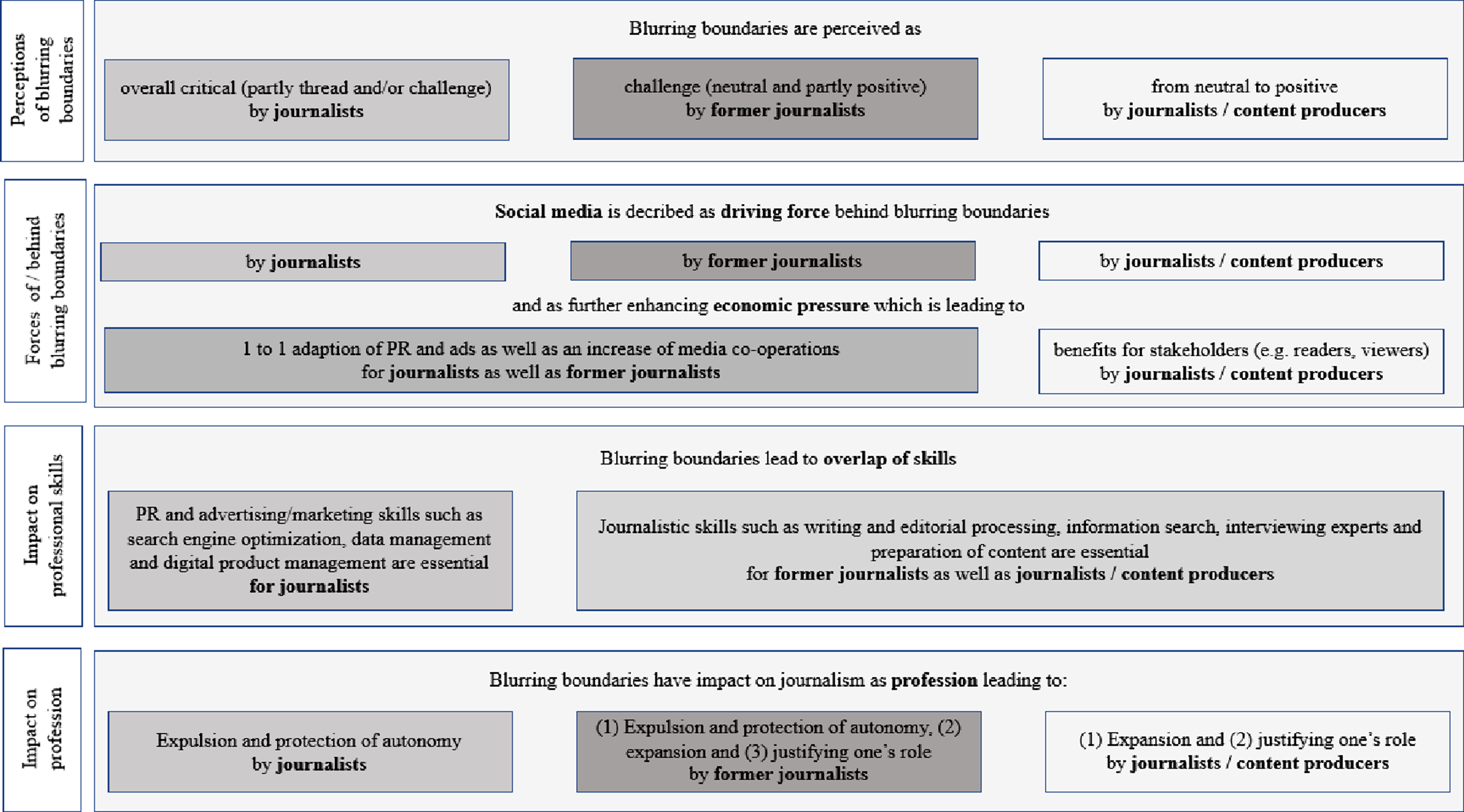
Critical assessment: Expulsion and protection of autonomy
The critical assessment of mainly journalists echoes what McChesney (2003, 2016) and Pickard (2020) describe as structural problems of journalism. Interviewees emphasized that media outlets, and consequently journalists, have increasingly limited financial and human resources. Over the past two decades, the Austrian news media market has shown strong concentration tendencies and has been heavily influenced by profit-driven German media co-operations. This growing economic pressure is one of the profession’s greatest challenges, transforming both journalistic practices and values.
Several examples illustrate this: so-called media cooperations, where organizations partner with media outlets to cover events. In these cases, “placing [ads] and editing” is part of the marketing for the event, and reporting on it is part of the paid cooperation package. Journalists have no choice but to cover these events as part of the media cooperation. Loosen (2014) already emphasized that structural changes also occur on the level of working routines. Advertisers also exert growing influence on editorial decisions. Surreptitious advertising (Schleichwerbung) is a term that some interviewees used in this context of deviant forms that journalists are not able to expel anymore. The findings show that there is a desire for the media to be more critical. In this context, five of the nine interviewed former journalists (IP19, 6, 7, 16, 40) highlighted the widespread adoption of press releases, often used verbatim. Their insider knowledge of crafting “perfect” press releases is professionally useful, yet ethically troubling: “My greatest success as a press spokeswoman is when something I prepare is adopted one-to-one. My heart bleeds as a journalist every time that happens, though, because that really shouldn’t be.” (Former journalist, IP26). Verčič and colleagues (2017) have previously underlined that the distinction between journalism and PR becomes less clear when PR practitioners supply the media with “information subsidies” (p. 528), which they define as low-cost, easily accessible information intended to influence media agendas and, in turn, public opinion. Journalists increasingly rely on these subsidies to reduce costs and improve efficiency. Verčič and colleagues (2017) conclude that this mutual dependence influences how news content and public agendas are formed at the national and local levels.
In this context, interviewees also mentioned ethical challenges. Both journalists and former journalists should be “rethinking our area of responsibility” (former journalist, IP22) and what happened to the “journalistic ethos” (former journalist, IP19). One journalist (IP1) warned that the profession risks losing audience trust, which, once “squandered,” is difficult to rebuild and could have serious social consequences. Ethical concerns have become particularly salient in Austria amid recent political scandals, such as the ‘Inseratenaffäre’, which exposed journalism’s financial and political dependencies.
Overall, journalists and some former journalists described the blurred—or increasingly absent—boundaries between communication professions as pivotal for understanding the development and identity of journalism itself.
Neutral to positive assessment: Expansion
Journalists/content producers and some former journalists emphasized that everyone has to be aware of the fact that the boundaries are blurred. However, this is not necessarily viewed negatively. Since—in the eyes of our interviewees—these boundaries cannot be reversed, the professions must learn to adapt: “The blurring boundaries, they ARE. It is like this. It is neither good nor bad. That’s just important for me to say. Yes, it is so. And that, I think, is the most important thing. (….) It doesn’t help us to know if it’s good or bad. It is. The question is, how do we deal with it?” as noted by a journalist/content producer (IP11).
Positive assessments of the blurring boundaries often highlight benefits for readers or stakeholders. For instance, the convergence of journalism, PR and advertising/marketing practices has increased practices such as corporate publishing and native advertising for which corporations provide considerable resources to communicate about issues that they want their stakeholders to know about. PR and advertising/marketing have less time pressure and more resources to elaborate on stories. At the same time, providing well-researched and elaborated information to stakeholders is used to justify these PR and advertising/marketing products that however lack the journalistic norms of balance, transparency and independence.
It seemed as if these neutral and positive assessments of the blurring boundaries often reflect journalists/content producers’ and former journalists’ need to legitimize their new roles, which follow different norms and values from journalism. Many still identify with the values and norms of journalism, as expressed above by the press spokeswomen (IP26), whose ‘journalistic heart’ bleeds when her press releases are adopted by journalists. This dual identification can create role conflicts, as shown in prior research on former journalists in PR (Viererbl and Koch, 2021) and practitioners working in both fields (Fisher, 2015; Fröhlich et al., 2013).
Social media as driver
Our data show that the internet and social media, in particular, are drivers of the blurring of the boundaries between the communication professions. Fifteen of the 27 participants extensively discussed social media as a driving force, while all others mentioned it at least once. As one journalist (IP7) observed: “I think social media in particular has caused a lot of change in both areas, whether it’s PR or journalism. Not only in the form of communication, but it made these gray areas where something is PR and where something is journalism bigger. There’s insanely good journalism on Instagram and social media.” However, journalists were particularly critical about so-called ‘journalism’ on social media, where everyone thinks they are ‘journalists’: “And this also leads to a complete blurring of advertising, PR, journalism, because this is suddenly being done by people in all areas who have no training for it, who have no awareness of it at all.” (Journalist, IP2).
The interviewees are separating journalists from non-journalists (e.g., Carlson, 2015). On social media everyone can become a sender of information and communication – “non-journalistic informational actors” (Carlson, 2015: 10) are partly taking over. “[T]hrough Facebook or whatever else there is, Twitter and so, everybody can communicate everything to everybody, and it doesn’t need professional communicators”, as one journalist (IP2) put it.
The multiplicity of channels has increased pressure on journalists, who must now perform tasks once outside their job descriptions. Journalism, PR, and advertising/marketing have become so intertwined on social media that journalism increasingly resembles what McChesney (2016: 131) calls a “commercial undertaking.” To be read, heard or viewed online, i.e. to have a certain reach, marketing or self-marketing is essential. Journalists have to tease their articles on Twitter, share them on Facebook, and “you now also have to be on TikTok“ (journalist/content producer, IP14). As Christin and Petre (2020) note, audience metrics have become central to newsroom practices. Social media is so omnipresent that, at large media outlets such as the Austrian public broadcaster ORF, traditional journalism and social media promotion are now divided between separate units. Thus, social media also drives “changes in structure” (Loosen, 2014: 77). Loosen (2014) emphasizes that journalism is differentiating into more categories. This is also driven by the expanding workload of journalist. As one interviewee (IP1) put it, being a good radio journalist who also writes and promotes online is too much to ask of one person. Monitoring and moderating user comments, especially on controversial topics, adds further challenges. This finding echoes Weder et al.’s (2023) emphasis on the convergence of PR and journalism practices. We need to learn more about the new roles and responsibilities that emerge from this convergence (see also Seiffert-Brockmann et al., 2024).
Some of our interview partners highlighted that, today, to reach the younger generation journalism has to be on TikTok; certainly, journalists have to face the same ‘struggles’ on other social media when adapting content to the specifics of the platform. Yet, on TikTok content needs to be presented in a very compact and entertaining way as videos of more than 30 s are not viewed. Journalism in 30 s is however difficult. A former journalist (IP25) mentioned: “The media are all going to TikTok now. I have recently (…) looked at all the ZIB reports [news format of the Austrian public broadcaster ORF]. And the exciting thing was that every third one was actually ‘unjournalistic.” Journalism on TikTok more and more resembles PR and marketing. Our interviewees were rather critical of this development bringing changes to the profession that are yet hard to grasp: “This form of journalism does not exist yet. (…) It’s all new in a way that lifts my skull after 18, 19 years in the industry”, a journalist (IP8) said.
Overlaps between journalism, PR and advertising
The blurring of boundaries between the communication professions is particularly evident in terms of competencies and skills (see also Bernhard and Russmann, 2023). Journalistic competencies and skills, such as writing and editorial processing, searching for information, interviewing experts and preparing content, are also important in PR and advertising. Weder et al. (2023) highlight this aspect when discussing the curation of information, by which they refer to the management and organization of content, which, today, is important for all communicators working in digital environments. A journalist/content producer (IP13) put into words the sentiments of many participants: “I can’t afford to do bad research, because then I’ll have an online firestorm. Readers online are no less critical than those of any newspaper. So I need to do research just like journalists.” Ultimately, the goal of all communication professionals is to increase their reach and connect with their audience – to reach the “readers”, the “consumers”, the “people”.
Several companies and political organizations have set up ’corporate newsrooms‘. One journalist (IP9) mentioned that these corporate newsrooms are more sophisticated than most media outlets’ newsrooms in Austria, because PR has much better human and financial resources than journalism does: “That’s where they sit, poaching good journalists with good salaries and building newsrooms that media could never afford.”
However, the findings reveal that, today, PR and marketing skills have also entered professional journalism, particularly, when it comes to communication tools. Journalists must now master certain online techniques and metrics originating from PR and advertising/marketing, such as SEO, data management and digital product management, as well as “knowing how a text preview looks like on social media.” (Journalist/content producer, IP14). A journalist (IP7) said: “Every now and then I do think, tonight our show is on, so I share that on Instagram, and of course, I say, ‘Hey, guys, tune in’ and tag everybody so that it’s shared even more. Strictly speaking, theoretically, I am doing PR and advertising.”
What is journalism, who is a journalist?
Similar to the scientific community (e.g., Carlson and Lewis, 2015; Singer, 2015), the data reveal that practitioners have fundamental questions about definitions. It is important to note that the study did not ask the interviewees to define journalism. Rather, it asked them to describe their understanding of the profession. Journalists, journalists/content producers and former journalists often ask themselves what journalism is today and who is a journalist. “What is journalism, and when is one a journalist? Is one a journalist because one has a degree, or is one a journalist when one practices journalism?” (Journalists/content producers, IP11).
Only the journalists who work for quality newspapers or who have been in the industry for many years clearly defined their role. They mostly perceive themselves as journalists, without any overlap with other communication fields. A clear understanding of their role was less prevalent among the other interviewees. One journalist/content-producer who worked in lifestyle journalism for many years and is now an online chief editor at a content marketing agency, where she is responsible for a corporate publishing magazine, first described herself as a journalist. However, during the interview, while reflecting on her self-perception, she became unsure about her role and work: “This really is a lifestyle journalism topic. From that point of view, we also do advertising, but I was actually referring more to the technical aspects. My work and skills differ from those of an advertiser. But, of course, at the end of the day, I’m also advertising a product.” (Journalist/content producer, IP26). Another journalist/content producer (IP11) put into words the sentiments of many journalists/content producers working at the intersection of professions, noting that self-classification is often difficult: “I always say: I do communication or I work in communication, because it’s a bit of everything.” Particularly when working online there is so much more to the job than just writing. For example, another journalist/content producer (IP14) described how journalists need to know how to optimize search engines and what their text will look like as social media preview.
In practice, today, the term ‘journalist’ is much broader than it was 15 years ago or even before that time. One interviewed journalist (IP2) defined a journalist as “someone who works for a daily newspaper, for a weekly newspaper, for a monthly newspaper or for an electronic medium. Nowadays, a journalist is actually someone who makes a living from writing. As long as they don’t write in a literary way, because then the person is a writer. According to this modern definition, then, corporate writing is also a kind of journalism, and I don’t know if that’s an adequate definition anyway, because things are changing today.” Some of our interviewees expressed concern that “journalism” on social media “is done by people with no training or awareness of journalism.” (Journalist, IP2). What they call journalism is actually a complete blurring of the lines between journalism, PR and advertising. Bloggers, podcasters and influencers were given as examples. For some interviewees, this situation raises further questions about what journalism is. Specifically, in the online sector, and hardly any professional works exclusively offline in today’s hybrid media system, the question becomes, “What constitutes quality journalism and what are journalistic products that provide a certain level of performance?” (Journalist/content producer, IP21). A journalist (IP7) working for a quality newspaper emphasized that reach and awareness objectives are becoming increasingly important. “The goals are actually the same, because in editorial work, you want to reach many people, you want to fulfill just as much of a certain quota as in public relations and on social media. The overall goal is actually almost the same in all three areas.” According to our interviewees the specific question of ‘What is quality journalism’ may be easy to answer in theory, but difficult in practice.
Discussion and conclusions
In short, the ongoing processes of media convergence and digitalization have resulted in blurred boundaries that are now the norm. There is no indication that this will change in the near future. Rather, our interview partners expect the boundaries to continue to blur and possibly even “vanish” (Deuze, 2008: 4). Journalism as a profession is in a state of flux and has lost its ’old’ identity and continues to do so. This goes a step further than Loosen’s 2014 statement that journalism constantly moves between two poles—sometimes more strongly differentiated (differentiation) and sometimes more strongly mixed with other areas (dedifferentiation). Therefore, it is not a clear, linear change, but rather a continuous back-and-forth between differentiation and blending. Our results suggest that, in practice, there is a stronger tendency toward blending, despite journalists constantly emphasizing the importance of differentiation.
Following Carlson (2015), the boundary work of the interviewed journalists and of some former journalists revolves around expulsion and protection of autonomy. This involves distinguishing journalism from PR and advertising/marketing (e.g., Singer, 2015). Even though, in practice, it is almost impossible to expel ‘old’ actors such as PR practitioners and advertisers, who increasingly influence editorial content through media collaborations and surreptitious advertising. Similarly, it is difficult to exclude ‘new’ actors, such as influencers, who produce content under the guise of journalism on platforms like YouTube, Instagram, and TikTok. These non-journalistic actors use journalistic practices and forms that are crucial to the development of the journalistic profession’s identity (Abbott, 1988). Journalism has lost its dominant role, and with it, its autonomy, when it comes to information and communication (Frederiksson and Johansson, 2014).
Journalists are also adopting practices used in PR and advertising/marketing. By incorporating skills, tools, and practices from these fields, such as SEO, data management, and digital product management, journalism is expanding and absorbing new competencies. The profession is transforming and widening its boundaries (Abbott, 1988). By adopting new practices such as producing TikTok videos and gradually accepting new platforms as legitimate sources of journalism (Carlson, 2015), the profession can survive in a world where the majority of online users in Austria accesses news via a news website app (38.7%) or a social media platform (29.0%) since 2020 (Gadringer et al., 2021). Christin and Petre (2020) point out that SEO and audience tracking help journalists to focus more on their audience’s needs by showing them which stories are read and which are not. However, at the same time, journalism is losing some of its autonomy and status, because “metrics clearly exemplify commercial pressures, and, relatedly, that journalism is a business” (Christin and Petre, 2020: 145).
Interrelations between the communication professions are constantly increasing (Abbott, 1988; Larson, 1977; Rosén, 2014) as the professions share more and more skills and practices (Bernhard and Russmann, 2023). Latzer (2013), who emphasizes that with technological convergence there is economic convergence, provides the experimentation with integrated multimedia newsrooms as an example of organizational convergence, which demands for changes in skills and practices (see also Loosen, 2014). While the adoption of journalism in PR and advertising/marketing in the form of corporate newsrooms in companies and political organizations can be viewed critically, it can also serve the public interest by providing quality information and communication in these fields—if the journalistic ethos can spill over. The question remains, however, of how the journalistic ethos can spill over to other actors, particularly given that corporate and political communication are always interest-driven and that, on social media, “non-journalistic informational actors” (Carlson, 2015: 10) are partly taking over.
The ongoing process of digitalization is spawning new practices, skills, forms, and values. For most journalists, this makes professional identity and status more flexible and multifaceted (Fredriksson and Johansson, 2014). This flexibility enables professionals to adapt to changing work environments. Certainly, the interviews partially reveal uncertainty and a sense of wide-ranging consequences for communication professions in the future because the boundaries between journalism, PR and advertising/marketing are still perceived as a “constructive, productive force” (former journalist, IP24).
Although journalism has never been a “stable entity” (Carlson and Lewis, 2019: 125), the blurring of boundaries has critical and ethically questionable consequences. If the difference between journalism, PR, and advertising/marketing cannot be distinguished, audiences will be vulnerable to manipulation by commercial or political actors and will lose trust in journalistic products. Content produced using journalistic techniques that resembles journalism but is driven by a company’s or organization’s self-interest (e.g., advertorials and native advertising) is often difficult to identify as PR or advertising. Here, the audience is deceived (Ferrer-Conill et al., 2022). Second, when economic pressures drive journalists to produce engaging content rather than informative content, the depth of information available to audiences shrinks. Third, when journalists or media outlets become dependent on revenue from commercial sources, real or perceived conflicts of interest arise. This may lead to self-censorship and the suppression of critical or investigative journalism, especially when powerful stakeholders are involved.
This has important implications for practice. Although hybrid content, such as advertorials and native advertising, is a valuable source of income for media companies, it is crucial to ensure that such content is clearly labeled as PR or advertising/marketing and not mistaken for journalism. If paid content is produced in-house, it must be kept strictly separate from the editorial team. Trust is considered “the lifeblood of journalism’s role in and contribution to people’s sense-making” (Brants, 2013: 17). Trust is important not only for the survival of media outlets but also for facilitating democratic conversation and societal cohesion (Moran, 2022). To maintain trust, journalism must be independent and distinguish itself from other forms of communication and professions. People can only trust information and communication that is not self-serving, manipulative, or unethical (Coleman and Wilkins, 2004; Frederiksson and Johansson, 2014). Thus, despite the blurring of boundaries, it is the responsibility of the profession to define correct practices (Carlson, 2015)—not only for itself, but also for other actors encroaching on the territory of journalists. Therefore, it is crucial to reinforce ethical codes and transparency policies in both journalism and public relations.
This study comes with limitations: First, we only focused on one country. To make broader generalizations, other countries with different media systems and cultures must be studied. As mentioned above, the Austrian news media system is heavily influenced by concentration tendencies, as well as political and business influences on the media system and journalism in Austria. Verčič and colleagues (2017) had already shown that the perceptions of journalism as a profession held by Croatian and Serbian journalists and PR practitioners are influenced by specific historical and political reasons. Nevertheless, since Austria is an example of a democratic-corporatist or central (Brüggemann et al., 2014) media system, and given the blurring of boundaries being observed in other countries, our findings can be generalized beyond Austria. Ideally, however, future research will take place in contexts that differ radically from those of the countries studied so far. It might also be beneficial to include freelance journalists because a study by Marín-Sanchiz et al. (2021) showed that freelance journalism is a key employment alternative for Spanish news organizations with reduced budget. Furthermore, the data is based on the self-reported perceptions of the interviewees, which may be influenced by the normative discourse surrounding the blurring of boundaries. To get the full picture, research should broaden its perspective to include the perceptions of PR practitioners and marketers on the blurring of boundaries (for a similar approach see Seiffert-Brockmann et al., 2024). This would also allow for a more in-depth analysis of how the structure of the different professions changes in times of increasing dependence on one another (e.g., Loosen, 2014).
The blurring of boundaries between communication professions is a longstanding reality and, as our study shows, it is becoming more prevalent. For the professional identity of journalism (as well as those of other communication professions), this means it is in a constant state of negotiation (e.g., Frederiksson and Johansson, 2014; Rosén, 2014). It is important to emphasizes that the very discussion of blurring boundaries suggests that the underlying boundaries remain to be relevant (Loosen, 2014), especially since professional identities are constructed “through a strong differentiation, or divergence, from ‘the other’ (Weder et al., 2023: 170).” However, the issue under discussion concerns not only the profession itself; but also society and the democratic function of journalism. McChesney (2016: 128) emphasizes that “journalism is a requirement for a democratic society or a free society; any sort of quality society requires credible, independent, powerful journalism.” Journalism initiates and facilitates public conversation, while PR as well as advertising/marketing only react to them (Weder et al., 2023). From a political economic perspective, good journalism requires infrastructure and policies that allow it to flourish (McChesney, 2003; Pickard, 2020). Future debates must address this issue because “there really is a societal need, because, in fact, all of these issues that we have now discussed have incredibly far-reaching implications for the functioning of societies” (journalist, IP2).
Footnotes
Declaration of conflicting interests
The authors declared no potential conflicts of interest with respect to the research, authorship, and/or publication of this article.
Funding
The authors disclosed receipt of the following financial support for the research, authorship, and/or publication of this article: This work was supported by the Wissenschaftliche Senat des Public Relations Verband Austria (PRVA).
Ethical considerations
The project received IRB approval by the lead university, the University of Vienna.
