



Abstract
Featuring a longitudinal, structural study of European party and citizen activity on Instagram between 2012 and 2018, this article outlines the overarching changes in the ways that Instagram has been employed for political party communication. Differentiating between populist and non-populist political parties, the results indicate that much like for other platforms such as Facebook, the former category of parties enjoy higher amounts of citizen engagement than their non-populist competitors. Detailing the uses of different types of posts by the two types of political actors, the study provides insights into how political parties have adopted and used Instagram from 2012 and onward.
Introduction
The bulk of our knowledge of how political parties, politicians, and the citizens who potentially vote for them make use of social media for electoral and similar purposes is largely based on studies of Twitter (Enli, 2017; Hemsley et al., 2018; Jacobs et al., 2020; Jungherr, 2015) and to some extent on research looking into Facebook (e.g. Larsson, 2016; Ceccobelli, 2018; Nave et al., 2018; Nitschke et al., 2016; Sorensen, 2016; Stetka et al., 2019). As such, it would seem that our understanding of the online engagement of such actors needs to expand beyond the two mentioned platforms, detailing activities undertaken on other social media as well. This appears as a suitable way forward for at least two reasons. First, as each medium “invites particular social behaviors” (Papacharissi, 2015b: 1), we should expect behavioral norms regarding the provision of feedback (where users employ functionalities such as commenting and liking) to differ between platforms (Bastos, 2015; Bene, 2017). Thus, researchers might find it useful to further nuance our understanding by investigating how such use patterns play out in relation to different types of political actors on platforms other than those already mentioned. Second, the online prioritizations of political parties, politicians, and staffers often appear to be more diverse than the empirical foci typically employed by scholars. For instance, Kreiss et al. (2017) found that US political practitioners identified platforms like Snapchat and Instagram as important venues for campaigning efforts—especially to reach potentially younger voters (see also Muñoz and Towner, 2017). Indeed, the tendency for scholars to emphasize Twitter and Facebook over other platforms is likely related to the relative ease with which data can or indeed could (Bruns, 2019; Freelon, 2018; Rieder, 2015) be gathered from these platforms in comparison with others (Lewis et al., 2013; Lomborg and Bechmann, 2014). Such technical developments and opportunities for data collection have thus served to further the prominence of studies featuring Twitter and, to a somewhat lesser extent, Facebook data.
While further insights into the uses of Twitter and Facebook are nevertheless necessary, our focus in the study at hand lays on another social media platform—Instagram. Launched in 2010 and currently owned by Facebook, Instagram is perhaps best known for its “visual-centric” (Muñoz and Towner, 2017: 2) or indeed “image-based” (Dimitrova and Matthes, 2018: 336) focus on images and video clips. Given the importance of audiovisual content in political communication and campaigning that has been evident at least since the popularization of television (Blumler and Kavanagh, 1999; Strömbäck, 2007), it is indeed curious that “there is very little research on Instagram within the social sciences in general and political communication in particular” (Russmann and Svensson, 2017a: 50). Our current efforts, then, provide a structural study of how party and citizen engagement has evolved on Instagram during a 6-year period. Using data from a series of European countries, the work presented in the article at hand features an overarching longitudinal approach that assesses the changing nature of Instagram as a tool for political communication. Given the rising interest in activities of populist political actors (e.g. Engesser et al., 2017), we apply a differentiation between populist and non-populist political actors (as defined by Rooduijn et al., 2019). This will allow us to identify any overarching differences in the Instagram use of the identified actor types—suggested differences that will be further discussed in the subsequent section. Besides such forays into the supply side of political communication on Instagram, the selected approach will also allow for insights into the demand side of the political communication process as played out on Instagram—the engagement patterns left by the followers of parties as they like and comment on the posts made available (e.g. Gibson, 2012; Nielsen and Vaccari, 2013; Xenos et al., 2015).
Literature review
While social media like the one under scrutiny here were typically initially intended for individual use (e.g. boyd and Ellison, 2008)—consider, for example, YouTube’s previous slogan “Broadcast Yourself”—a series of professional actors quickly saw the potential in curating a presence on such venues where potential customers or supporters created profiles and networked among themselves (e.g. Castells, 2007; Iosifidis, 2011; Moe, 2008). With Instagram being a relative newcomer to the social media landscape, its strong focus on visual and indeed audiovisual content is nevertheless mirrored in studies detailing so-called “YouTube Elections” that took place during the first decade of the 2000s (e.g. Carlson and Strandberg, 2008; Dylko et al., 2011; Gibson and McAllister, 2011; Gueorguieva, 2008; McKinney and Rill, 2009; Towner and Dulio, 2011). Indeed, the previously mentioned increasing importance of images and videos for the purpose of political campaigning is evident also in relation to Instagram (e.g. Enli, 2017; Russmann and Svensson, 2017b). Yet, we know rather little about how parties have made use of the service at hand during its first years of existence.
Regardless of what platform is studied, it is difficult to make any precise conclusions about the effect of party social media use on outcomes such as election results (e.g. Koc-Michalska et al., 2020). Nevertheless, gaining engagement—typically measured on Instagram as the number of likes and comments per post made—must be considered as important. Indeed, gaining engagement is likely to increase the visibility of posts by means of influencing the algorithms that guide much of social media traffic (Ceccobelli et al., 2020). As such, maintaining an online presence on services like the one studied here is of the utmost importance for parties seeking to spread their messages wide and far.
Patterns of party use
At the time of this writing, Instagram offered its users four main categories of posts that could be made to the platform—photos, videos, albums, and IGTV (Instagram Television). Users can indeed also use the stories functionality (launched in 2016), but because such stories are ephemeral by design, they could not be included in the study at hand. While the ability to post photos has been part of Instagram functionality since the launch of the platform, the opportunity for users to uploading Video content was included in 2013. Since 2017, up to 10 photos or videos can be included in what is referred to as an album, which to the viewing Instagram user appears as a browsable catalog of the content made available. Finally, while the allowed video length has varied between 15 and 60 seconds since 2013, the possibility to use the IGTV functionality launched in 2018 (as a separate service and as part of the main Instagram platform) and allowed for up to 60 minutes of video to be shared to the platform.
Given our interest in the potential differences in populist and non-populist party use of Instagram, it is important to note that previous research looking into party use of other, similar services suggest limited ideological influence (e.g. Klinger, 2013; Lilleker et al., 2011; Schweitzer, 2008; Vergeer and Hermans, 2013). Curiously, relatively old (e.g. Gibson et al., 2008; Vaccari, 2008) as well as more recent (Larsson, 2017a; Jacobs et al., 2020; Koc-Michalska et al., 2020) scholarship has suggested that such de-ideologized tendencies might need to be reassessed. Research specifically focusing on Instagram, then, provide a somewhat clearer picture in this regard. Findings from Norway, for instance, suggest that at least before the 2013 national elections, Instagram was “barely used for political purposes” (Kalsnes, 2016: 29). With regard to political party activity, this inactivity appeared to have changed before the regional elections in 2015, where supporters of the populist Progress Party were reported as among the least active on the platform under scrutiny—instead, the “catch-all” social democratic Labour Party emerged as yielding the most activity (Larsson, 2017b). A similarly inactive Progress Party is evident also in later studies from the same context (Larsson, 2019b; Larsson, 2019c). Similar findings have been reported from Sweden, where the populist Sweden Democrats hosted a private—as in not accessible to all other users—Instagram account in the time period leading up to the 2014 national elections (Filimonov et al., 2016; Russmann and Svensson, 2017a). Indeed, such privacy settings must be considered a more conservative attitude toward the platform under investigation. Similarly, Ekman and Widholm (2017) found that the Instagram activity by Sweden Democratic representatives was characterized by “low or moderate connectivity” (p. 28).
In sum, while populist parties appear to prioritize Facebook (Kalsnes, 2016), Instagram appears as less important for them. While patterns of Facebook party use have been found to be rather similar for both types of parties (Larsson, 2020), previous research suggests rather dissimilar usage patterns when differentiating between populist and non-populist political parties. In line with the research reviewed above, our first hypothesis reads as follows:
H1: Party use trajectory will differ between populist and non-populist parties.
Patterns of user engagement
Before social media such as the platform studied here, online user engagement could—and indeed can still—be gauged by the extent to which varying functionalities like comment fields or “e-mail a friend” links were used—the “bells and whistles” (Deuze, 2003: 214) of web pages. While these and similar varieties of web traffic data sources remain important measures of activity also today, the influx of social media has added another dimension of audience engagement possibilities as visitors have the possibility to involve themselves on Instagram by means of liking and commenting on the posts made by Instagram account holders such as the parties studied here. With this in mind, Hayes et al. (2016: 171) point out that “lightweight signals” such as these opportunities to engage are used in a variety of different ways. For instance, while a comment can readily express a certain sentiment, a “like” can take on a plethora of meanings based on the original intent of the engaging user, expressing support or critique alike (see also Driscoll and Walker, 2014; Gorrell and Bontcheva, 2015; Lomborg and Bechmann, 2014). Regardless of the uncertainties regarding the precise, situated, and indeed individualized meanings of these modes of engagement, pronounced levels of likes and comments are likely to influence the algorithms that “shape the visibility of content and therefore public attention” (Kreiss and McGregor, 2017: 4) on the platform studied here.
The question is, then, to what extent populist and non-populist parties succeed in engaging potential voters on the platform at hand. While previous scholarship has indicated a late start on social media for the former of the two types of parties (e.g. Larsson, 2020), the latter half of the 2010s brought with it the rise of populist party popularity identified in a series of countries not only in Europe but across the globe (Moffitt, 2016; Oliver and Rahn, 2016). This observation mirrors the findings of Gil de Zúñiga et al. (2020: 585) who suggested “a reinvigorated political populism trend has taken place across different latitudes in the world” during latter years. Perhaps as a result of their prevalent use of rhetorical devices such as negative campaigning (Nai, 2018) and emotionalization (Hameleers et al., 2017), populist actors emerge as more authentic (Enli, 2017) and more in touch with “the people” (Jagers and Walgrave, 2007) than their non-populist competitors. Based on the often-reported online success of populist actors (Engesser, Fawzi and Larsson, 2017; Larsson, 2019a; Gil de Zúñiga et al., 2020), our second hypothesis is expressed as follows:
H2: Instagram engagement will be more pronounced in relation to posts made by populist parties in comparison with posts made by their non-populist competitors.
User engagement across post types
In their study of user engagement with the Facebook activity of 52 party leaders during national election campaigns held in 18 Western countries between 2013 and 2017, Ceccobelli et al. (2020) suggested that the “formal nature, that is whether they are photos, links or videos” of posts “may predict modes of interaction with them” (p. 9). Indeed, Vaccari (2012) points out that while comparably early online political campaigning efforts tended to be text-oriented, the growing use of audiovisual content as evident in a variety of contexts may function to democratize political expression as it supposedly creates “a new grassroots outlet for the affective dimensions in politics” (Chadwick, 2008: 32; see also Papacharissi, 2015a). This potential for audiovisual content to go “viral” (e.g. Klinger and Svensson, 2015; Nahon and Hemsley, 2013) supposedly builds on its “spreadable” (Jenkins et al., 2013) and “emotionally rousing” (Rieder et al., 2015: 12) qualities, making the online provision of photos and perhaps especially videos a top priority for political actors on the campaign trail (e.g. Kreiss and McGregor, 2017). A study similar to the one presented here indicated that on Facebook, political party posts featuring videos were indeed more engaged with than posts that did not showcase such content (Larsson, 2020). With the popularity of audiovisual content in mind, our third and final hypothesis reads as follows:
H3: Instagram engagement will be more pronounced in relation to posts featuring audiovisual content in comparison with posts featuring other types of content.
Method
Data collection
Data were collected using the CrowdTangle service, which offers full historical access to public Instagram accounts such as those studied here (e.g. Larsson, 2019a; Fraser, 2020). It is similar to the InstaR package for the R software environment, which previously allowed for the structured, “tidy” (Wickham and Grolemund, 2016) archiving of meta-data (such as the post text, the time of posting, the number of likes, and the number of comments) for public Instagram account posts (Barbera, 2016). Given the research topic featured here, CrowdTangle was used to archive the meta-data for the full history of Instagram posts from each party that was represented in the national parliaments of all European Union member states (with the addition of Iceland, Norway, and Switzerland) at the end of 2018. In total, this process of data collection yielded a total of 186,405 posts that were posted by 285 parties. Posting activity reached back to 3 January 2012 and the data collection process ended on 31 December 2018.
Data analysis
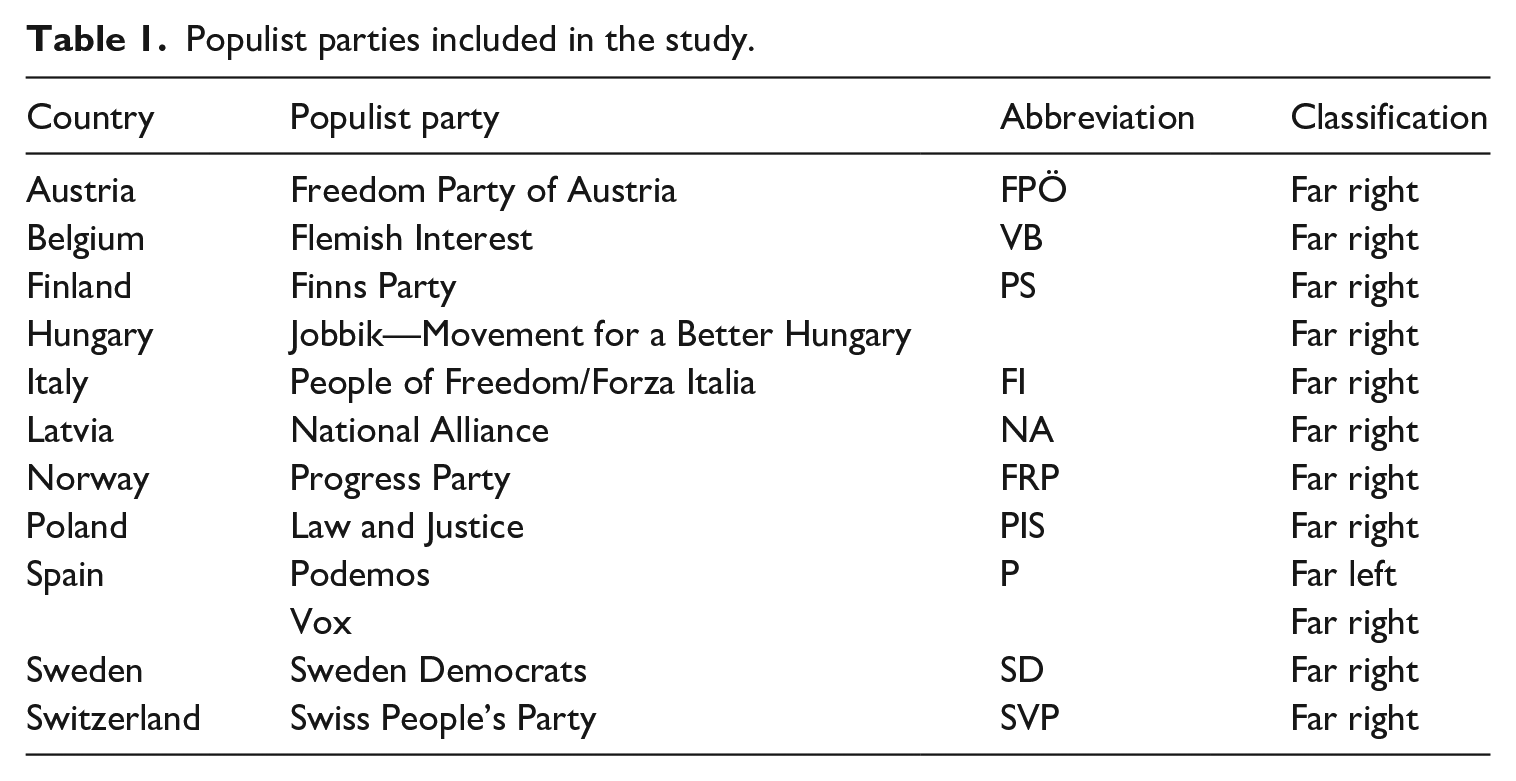
Populism can be defined in a myriad of ways, all with their advantages and drawbacks (de Vreese et al., 2018). The literature suggests two main approaches to the term—one “actor-centered” and one “communication-centered” (e.g. Jacobs et al., 2020; Stanyer et al., 2016). While the latter approach considers populism a style of communication that frequently refers to dichotomies between “the people” and “societal elites” and then attacks elites using often simplistic and emotional arguments and language, the former classifies political actors as populist or not based on some specific criteria or definition. Studies following the “actor-centered” approach will then typically use this classification to “compare the communication strategies of populists . . . with those of non-populists” (Jacobs et al., 2020: 613). The study at hand, then, follows an actor-centered approach and understands parties as belonging to one of two categories: populist or non-populist. The process of classification was guided by the work of Wilke et al. (2019) who employed three different sources to define the concept—the populism party scale developed by Inglehart and Norris (2016), ratings from the 2017 Chapel Hill Expert Survey (Polk et al., 2017), and the PopuList, which, as the name implies, provides an updated, annotated lists overview of European populist parties based on expert consultancies (Rooduijn et al., 2019). While the three identified sources all differ somewhat in how they operationalize the concept of political populism, they all emphasize the “the ‘pure people’ versus the ‘corrupt others’” narrative suggested by Mudde (2004) and mentioned above. Following previous scholarship in using the PopuList for classification purposes (Larsson, 2020; Rooduijn et al., 2019), 11 of the 285 parties were classified as populist. Table 1 details the populist parties included in the study at hand.
Populist parties included in the study.
To investigate the aforementioned hypotheses, the analyses will focus first on the assessment of supply side activities—showing activity undertaken by political parties—and second on the demand side, detailing activities undertaken by party followers in relation to party posts. For the supply side, the internal structure of Instagram allows us to discern between four major types of post—Photos, Albums (essentially the ability to feature several Photos in the same post, launched in 2017—see PNDPulse, 2017), Video (which appears to have launched in 2013—see Taylor, 2013), and IGTV posts, which emanate from the separate Instagram-operated app with the same name launched in 2018. This final category of posts, then, allows for longer videos to be uploaded—up to 1 hour in length (Constine, 2018). It is worth noting that CrowdTangle does not capture Instagram Stories (Constine, 2016) because they “are ephemeral and thus disappear after 24 hours” (Fraser, 2020).
For the demand side, engagement with different types of posts is understood here as the ways in which Instagram users are allowed to provide feedback to content made available by some other user. While such options for engagement tend to change over time (e.g. Driscoll and Walker, 2014; Jungherr and Theocharis, 2017), the offering of likes and comments as possibilities for engagement appears to have been stable throughout the existence of the studied platform. While the precise meaning of such engagement options does indeed vary based on the intent of the partaking user (e.g. Gorrell and Bontcheva, 2015; Hayes et al., 2016; Lampinen, 2015), we can nevertheless think of these measures as representations of user attention. Specifically, they should be considered as imperfect representations, as we cannot readily assess the situated intention of these engagement forms at scale. Regardless, the number of likes and comments provided in relation to a specific post gives us some indication as to the popularity of said post (Barnhart, 2020).
Much like for other studies using social media data, the data analyzed here were characterized as highly skewed (e.g. Hanusch and Bruns, 2016; Jungherr, 2014). Thus, the analyses featured median comparisons of the levels of engagement enjoyed by populists and non-populist parties. Non-parametric Mann–Whitney U tests were used to assess the statistical significance of the uncovered differences (Field, 2018).
Results
Turning first to the supply side of our analyses, Figure 1 shows the number of posts per year and type for both categories of parties.
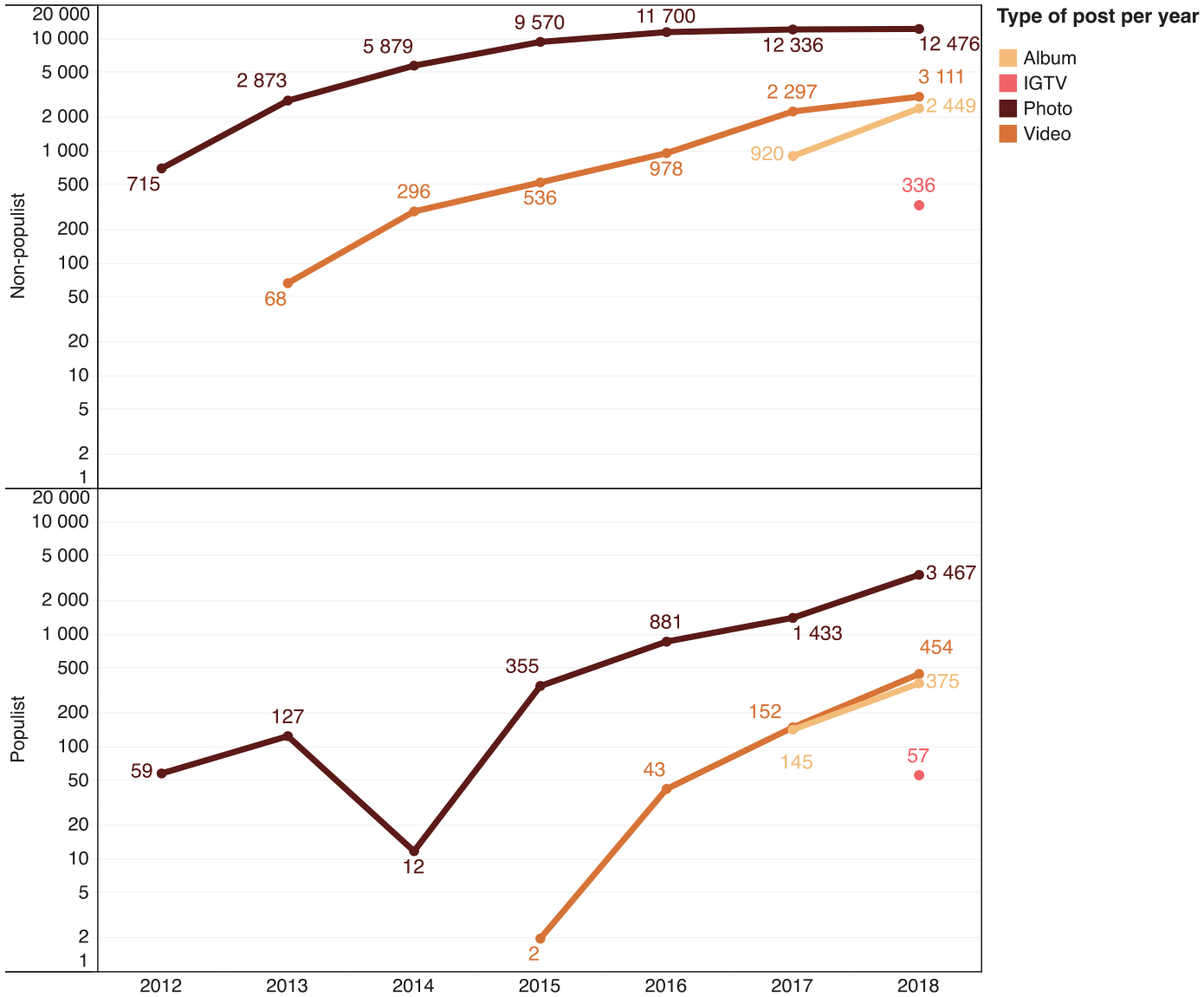
Type of post per year for populist (lower half of figure) and non-populist (upper half) parties.
Perhaps unsurprisingly, the photo variety of Instagram post comes out on top for both categories of parties. Similarly, the relative level of use for the other three post varieties emerges in a comparable descending fashion for populists and non-populists. Beyond these parallels, Figure 1 also reveals some contrasts with regard to Instagram prioritizations across the two party types. For the aforementioned photo variety, we can see that while the activity for non-populists appears to have plateaued from 2016 and onward, the corresponding line for populist parties shows a comparably fluctuating historical trajectory and ends up with what could be characterized as an ascending trend. While we cannot make any precise conclusions from these data, it nevertheless seems likely that such an upward trend for populist actors is related to the increased popularity that many such parties enjoyed following the 2015 refugee crisis—an influx of refugees which was indeed palpable in a series of European countries.
With regard to the specific types of posts used, Figure 1 shows that non-populist parties incorporated video in their Instagram strategies starting in 2013—the year that the specified functionality was launched—with 68 such posts. Two years later, we see a modest at best start for populist usage of video type posts with two such instances—only in 2016 (with 43 posts) can we see the previously mentioned increasing focus on audiovisual formats supposedly yield influence the Instagram activity of populist parties. Taking all types of posts into account, the lines featured in Figure 1 show how the two different parties have curated their Instagram presences following differing trajectories. While we cannot be sure based on the data analyzed for the study at hand, the literature reviewed earlier suggests that the uncovered differences are likely a result of the disinterest in Instagram expressed by populist parties. In sum, our results support our first hypothesis, which suggested differing patterns of use for the two party types.
Shifting to the demand side, Figure 2 provides insights into year-by-year Instagram engagement from followers of populist and non-populist parties.
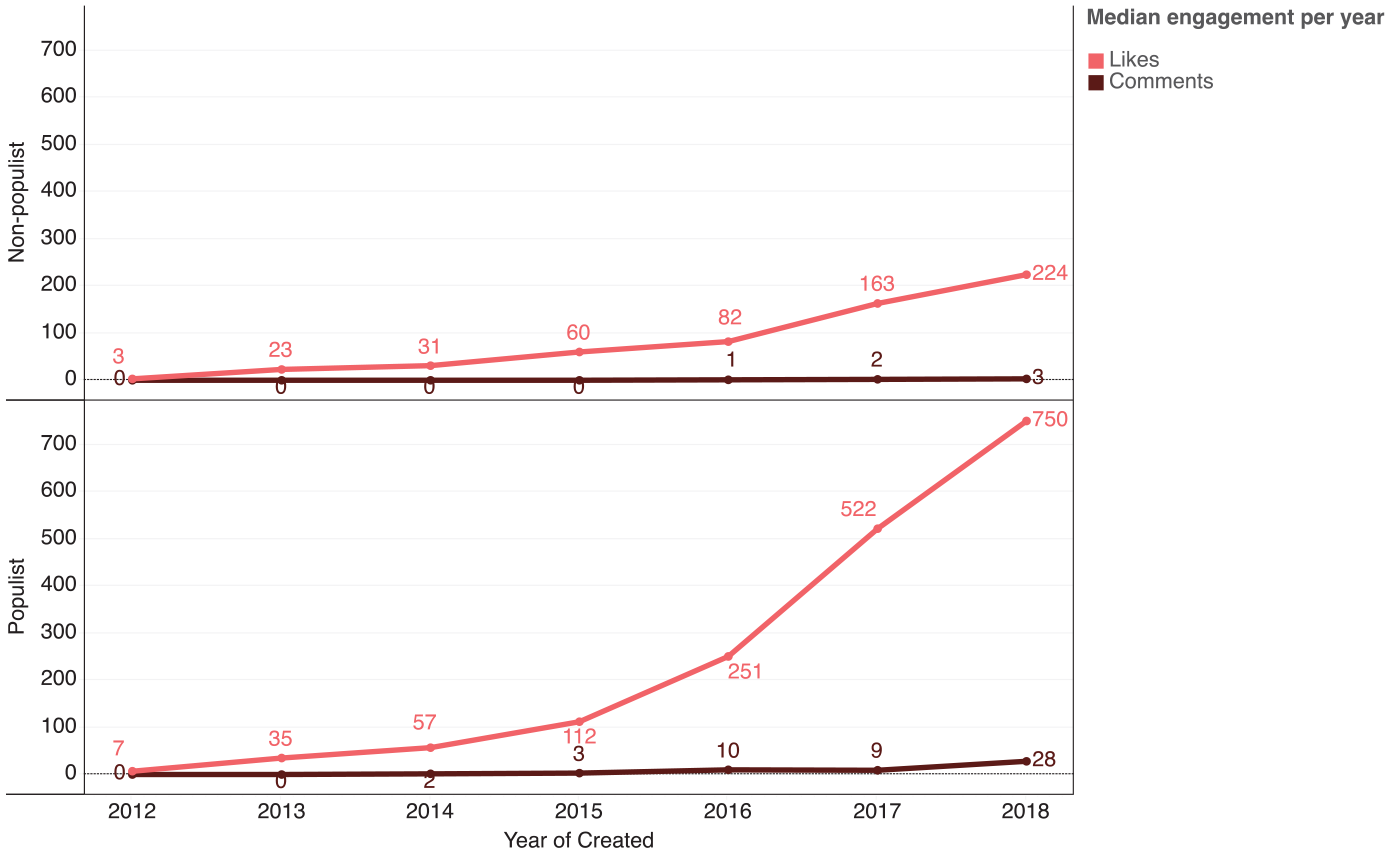
Median likes and comments per post and year for populist (lower half of figure) and non-populist (upper half) political actors.
While the lines depicting the engagement activity undertaken in relation to party posts indicate clear differences between the two party types, a series of Mann–Whitney U tests were performed to check for statistical significance of the uncovered differences. For Likes, the differences between populist and non-populist parties emerged as statistically significant across all studied years (p < .000 for all years). For comments, the performed analyses indicated that the differences shown in Figure 2 were non-significant for 2012 (p = .092) and for 2013 (p = .072). From 2014 and onward, the differences pertaining to comments emerged as significant (p < .000 for all years between 2014 and 2018). Thus, we can conclude that with a few exceptions in the earliest phases of the studied time period, populist parties succeed in gaining more engagement on Instagram—regardless of feedback type. These results could be seen as a stark contrast to the level of activity undertaken by the successful populist actors—especially if one considers their relative tardiness to fully incorporate the platform under scrutiny. As a similar study detailing the Facebook engagement enjoyed by the two party types provided similar results to those presented here, so is the aforementioned “rise of populism” (e.g. Moffitt, 2016; Oliver and Rahn, 2016) visible also in relation to Instagram. As such, we can confirm our second hypothesis, which suggested that Instagram engagement would be more pronounced in relation to posts made by populist parties in comparison with posts made by their non-populist competitors.
Our third hypothesis emanated from previous findings regarding the role of audiovisual media in political campaigns, suggesting that Instagram engagement would be more pronounced in relation to posts featuring audiovisual content in comparison with posts featuring other types of content. Figure 3, then, details the median likes (upper half of the figure) and the median comments (lower half) for post types and party category (left side for non-populists, right side for populists).
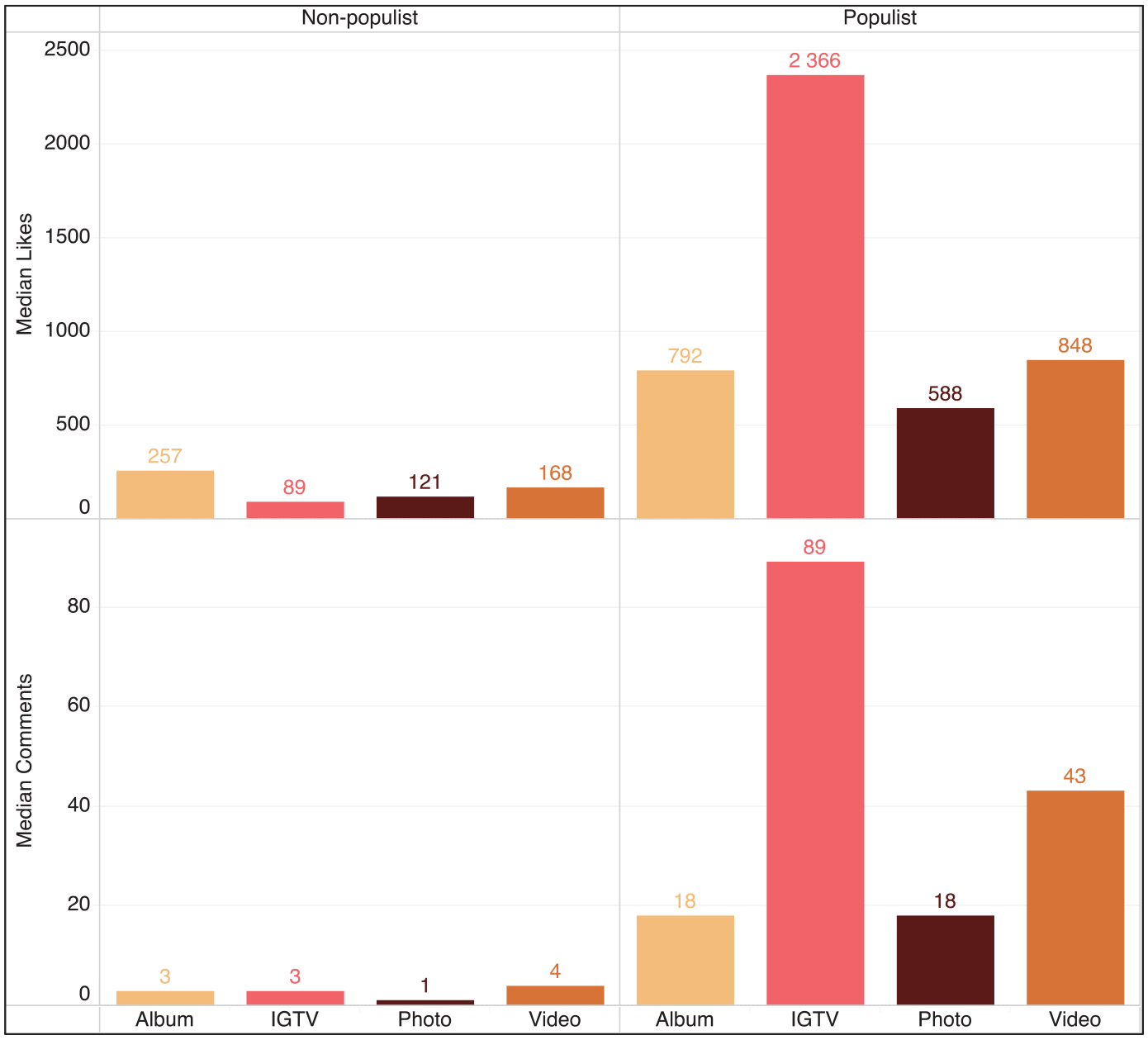
Median likes (upper half) and comments (lower half) received per post type for populist (right side of figure) and non-populist (left side of figure) actors.
The left-hand side shows engagement enjoyed by post type by non-populists, while engagement undertaken in relation to posts made by populist actors is shown on the right-hand side. Median amounts of likes per post type are shown in the upper half of the figure, while the same statistic for comments is shown in the lower half. Mirroring the results presented in Figure 3, a series of Mann–Whitney U tests indicated that the differences of engagement between party types across post types all emerged as significant (p < .000) for both likes and comments.
Focusing specifically on non-populist actors, the album post variety emerged with a significantly higher median of likes (257, p < .000) when compared with the other post types. For medians of comments, video post types had the highest median (4) across all four types—however, the difference between this category is statistically significant when compared with the photo type of post (p < .000).
A rather different set of results emerge for the populist parties under scrutiny. Indeed, the Mann–Whitney U tests indicate that the IGTV category of posts—allowing for comparably longer audiovisual content to be uploaded—yields higher medians for both likes and comments. As mentioned previously, IGTV was launched in the final year of the studied time period. Thus, in a short period of time, this category of post has risen to the heights of popularity among the followers of populist parties on Instagram—perhaps reflecting the need for populist parties to use social media such as the platform studied here to “uncontestedly articulate their ideology and spread their messages” (Engesser et al., 2017: 1110). Save for the likes enjoyed by non-populists, the findings offer support for our third hypothesis as recounted previously.
Discussion
With the spread of social media employment in political campaigns across the globe starting in the early 2010s, comparably recent scholarship has suggested the need for longitudinal insights into the uses of platforms like the one under scrutiny here. For instance, Kreiss et al. (2017: 2) suggested “the rapid changes of the Internet mean we cannot presume continuity” in the ways that social media platforms are used by politicians and citizens alike. Indeed, Karpf (2020: 2) provides a succinct summary of the field when he suggests that “political use of Facebook and Twitter in 2019 is not generally placed in comparison to how the two platforms were used in 2014.” The study presented here, then, provides over-time insights into a platform that has not seen as much academic attention as the two mentioned previously—Instagram. In detailing the structure of the activity undertaken by European parties and citizens from 2012 until 2018, the study presented has focused especially on detailing the prowess of populist political actors when it comes to levels of citizen engagement. This final section of the study discusses some of its key findings and places them in the context of previous, similar scholarship.
While Instagram was launched in 2010, the first instances of use of the platform among the European parties included in the study at hand were found in 2012. On the one hand, such relative slowness to make use of the then-new platform could be ascribed to time lag between introduction and use (e.g. King, 1982; Wohlers, 2009) or to difficulty in adopting and adapting novel technologies to differing political systems (e.g. Karlsen, 2013). On the other hand, these results could also be related to the supposed prioritization of other platforms over the one studied here. Twitter, for instance, has long been seen as a useful tool for “political marketing and image control” (Tromble, 2016: 8), while Facebook has been attractive for an extended period of time due to its large user base (de Best, 2018). As such, political actors might have been better off by focusing their online endeavors elsewhere than Instagram.
The relative tardiness of political parties to adopt Instagram does not appear to be matched with audience engagement, however. Comparing the results presented here pertaining to the median likes and comments per post and year with similar results reported for audience engagement on European political party Facebook pages over a similar time period (Larsson, 2020), the year-by-year engagement statistics for Facebook (i.e. the median and amount of likes, shares, comments, and reactions) clearly surmounts the corresponding Instagram measurements—save for the final two years scrutinized in both studies. For these two years (2017 and 2018), platform popularity among the European citizenry appears to switch as median amounts of Instagram engagement supersedes the same measurements as detailed in the aforementioned Facebook study. We might expect that such increased popularity would lead to an influx of Instagram use by political actors—however, such a shift of attention seems unlikely at this point. Indeed, Facebook offers highly adaptable tools for electioneering that Instagram does not (e.g. Kreiss and McGregor, 2017). Moreover, while Facebook is clearly integrated into the hybrid media system identified by Chadwick (2013), Instagram has so far not been associated with public debate in ways similar to Facebook and indeed Twitter. As such, the combined advantages of prioritizing Facebook over other platforms are likely to maintain the status quo of Facebook dominance. Nevertheless, the increased engagement visible on Instagram needs to be taken into account by parties in some way—future research might be able to delve deeper into party prioritizations as platform engagement dynamics change.
Finally, while populist parties appear to have been slower to adopt the service under scrutiny when compared with non-populists, the results presented concerning Instagram engagement show that much like for other platforms (e.g. Larsson, 2020), populist actors clearly surpass their non-populist competitors. Thus, the rhetorical devices employed by populists on other platforms appear to translate well also when they take to a clearly image-based platform like Instagram. Given the steadily increasing professionalization of (Lisi, 2013; Tenscher et al., 2015) and the “analytics turn” in Chadwick and Stromer-Galley (2016) campaigns, parties are likely to have reached similar conclusions to the ones presented here in their respective analyses of online performance. The question is, then, what repercussions these conclusions might have for the communication prioritizations of parties. Indeed, preceding changes and trends in media formats have previously influenced such priorities (Blumler, 2016; Blumler and Kavanagh, 1999). Given the rise of Instagram, we can expect parties regardless of ideological persuasion to adopt the structural tendencies identified here, prioritizing audiovisual content over other types. While such changes in format is likely to influence the ways in which political issues are communicated, this does not necessarily mean that the populist style is likely to spread widely beyond the parties classified as such in the present study. However, seeing as this way of communicating supposedly yields hefty amounts of engagement, future work might nevertheless find it useful to study whether and how the phrasings and rhetoric often associated with populist actors are somehow adopted and adapted by other parties.
While the study presented here has provided useful insights into the growth of the political uses of Instagram, it has limitations that should be duly addressed. First, it does not seem unreasonable to expect that several parties who did not enjoy parliamentary status could have been active on Instagram during the studied time period. Future work might find it suitable to cast a wider net, encompassing parties in- and outside of parliament. Second, while our focus here was placed on parties, the supposed individualized (Larsson, 2019b) and personalized (Kreiss et al., 2017) nature of Instagram suggests that inquiry into the over-time activities of individual politicians could be a suitable step forward in understanding how political actors communicate online. Third, remembering that populist expressions are indeed sometimes used by actors that are not necessarily considered populist, future work might find it useful to adopt a “communication-centered” approach to populism as mentioned earlier and to look into the post content—and how the different topics dealt with have influence on post popularity. Performing such analysis in a comparative fashion brings with it the challenge of correctly interpreting the many languages, tropes, and cultural codes featured across a wide selection of countries. A suitable starting point could be to use subset of countries—perhaps inspired by principles of most similar systems design—and to subsequently expand to larger samples. Relatedly, while the choice to focus on Europe in the study at hand was motivated by suggestions from previous scholarship (Dimitrova and Matthes, 2018; Lilleker et al., 2017), there is a dearth of studies that detail these issues outside of what could loosely be referred to as Western contexts. Thus, future scholarship should make attempts to broaden the empirical scope to include a wider array of countries and contexts. Finally, a fourth suggestion revolves around explanatory variables. While the structural focus employed in the study at hand has looked at the influence of ideology, several other research designs can indeed be imagined. Such designs could, for instance, encompass the number of Instagram users per country and year, or the number of users who had seen (but not necessarily interacted with) each post. Combined with the more overarching insights presented here, variables like these would indeed help to gain more insights into the mechanism behind the uses of Instagram. As of this writing, however, the type of access that can be gained to the Instagram API does not allow for the procurement of such data. Comparably recent initiatives from social media services themselves (Fraser, 2020) and from the scholarly community (Puschmann, 2019) might help to broaden our analytical possibilities in the hopefully not too distant future.
Footnotes
Funding
The author received no financial support for the research, authorship, and/or publication of this article.
