



Abstract
Science is of crucial importance in contemporary societies. Concurrently, legacy news media outlets are losing their position as the main fora for discussing and providing information on science and politics. In the hybrid media system, a broader range of news media have emerged. Among them are alternative news media, which position themselves as corrective voices to “mainstream” news media—including when it comes to reporting on science. In this context, our focus is on individuals who come into contact with science-related information via alternative news media. We draw on the “Science Barometer Switzerland,” a nationally representative online survey of attitudes, beliefs, and knowledge about science and research in Switzerland conducted in 2022 (n = 1,122), to investigate science- and media-related predictors of the use of alternative news media to access information about science. Our results indicate that the clear majority—more than two-thirds—of the Swiss population do not use alternative news media as sources of science-related information. Respondents who do use alternative news media were more confident about their scientific and media literacy and viewed themselves as information elites who are highly skeptical of established societal elites. However, they do not seem to reject the scientific system in principle.
Recently, scholars have discussed the notion of an epistemic crisis (Neuberger et al., 2023), which was previously described as a “post-truth society” (Lewandowsky et al., 2017). This crisis reflects a growing skepticism toward scientific authority, challenging the conventional belief in the superiority of scientific knowledge over other forms of understanding (Hoggan-Kloubert & Hoggan, 2023; Schetsche & Schmied-Knittel, 2018). In this context, science populism (Mede et al., 2023; Mede & Schäfer, 2020) has gained traction. In science populism, populist movements reject or reinterpret scientific knowledge in favor of more supposedly accessible or politically convenient narratives. So-called alternative news media are defined as a “proclaimed and/or (self-)perceived corrective, opposing the overall tendency of public discourse emanating from what is perceived as the dominant mainstream media in a given system” (Holt et al., 2019, p. 862). This definition is based on a relational understanding that highlights the self-perception of alternative news mediamedia providers as contributors to the public sphere of additional information that legacy news media (allegedly) do not provide (Frischlich et al., 2023). In research, types of alternative news media have been differentiated such as left-wing and right-wing news outlets, or elite-critical and foreign-based news media, as well as individual channels on messaging apps (Schwaiger, 2022).
In terms of content, studies have investigated how alternative news media report on political issues or legacy news media (Figenschou & Ihlebæk, 2019), the presence of populist elements in their coverage (Boberg et al., 2020), diversity among speakers and topics (Freudenthaler & Wessler, 2022), and the relationship between alternative news media and mainstream news media (Ihlebæk et al., 2022). On the user level, studies have explored how political identity, attitudes toward politics (Funk et al., 2023), and sociodemographics (Lorenz et al., 2023) influence alternative news media use, as well as the factors that predict the use of political (right-wing) news media (Leung & Lee, 2014; Macková et al., 2023; Müller & Schulz, 2021; Noppari et al., 2019; Puschmann et al., 2024; Schulze, 2020; Schwarzenegger, 2023).
However, alternative news media not only cover originally political issues; they also explore other topics, such as scientific matters (Rooke, 2021) that might be politicized as in the case of COVID-19 or climate change but are not inherently political. Also for these topics, alternative news media developed as a relevant communicator in the hybrid media system (Chadwick, 2013). Therefore, it is important to investigate the use of alternative news media for accessing information about science, along with predictors of this usage. More specifically, research on alternative news media has shown that predictors related to media can be distinguished from predictors related to a given topic (in this case, science) (Müller & Schulz, 2021). To explore the factors that influence individuals’ decisions to seek information about science from alternative news media, we analyze how demographics, attitudes toward science reporting, behaviors pertaining to science-related information, and engagement with science can predict such decisions.
Specifically, our study describes the extent to which the Swiss population uses alternative news media to access information about science and the degree to which this use can be predicted by sociodemographic characteristics, attitudes toward and involvement in science, and attitudes toward science reporting and information behavior. To address our research question, we draw on findings from a survey of a nationally representative sample of the population of Switzerland.
Alternative News Media in the Hybrid Media System
Early conceptualizations of alternative news media portrayed them as counter-media that foster an alternative public sphere (Downey & Fenton, 2003). This understanding of alternative news media as an entity separate from legacy news media has been challenged, however, in more recent conceptualizations of a hybrid media system in which both media logics exist on a continuum and form different types of information channels (Chadwick, 2013). Alternative news media, one such type, claim to correct the “mainstream” and to draw attention to facts that do not appear in established news media or are deliberately omitted (Frischlich et al., 2023). This contribution was initially thought to enrich democracy because the emergence of alternative news media was said to heighten the pluralism of voices in the public discourse (Buyens & van Aelst, 2022) and to represent a form of resistance against authoritarian regimes (Goh, 2015; Selvanathan & Lickel, 2021) or dominant economic forces in media landscapes (Bailey et al., 2008). Also with regard to scientific topics, alternative news media can contribute to more engagement of the public with issues such as climate change (O’Neill & Boykoff, 2011). However, many scholars have become skeptical about whether alternative news media can, in fact, offer valuable content—or whether they are better understood as a risk to democracy (Strömbäck, 2023; Sunstein, 2002). These concerns are mainly grounded in the fear that radical websites and news media encourage people to bypass the more balanced opinions expressed in legacy news media to instead access false or misleading information. This fear is backed up by research suggesting that alternative news media do not adhere to established journalistic standards, such as objectivity and impartiality (Atton, 2003), and instead assume the role of activists following the logic of a movement (Mayerhöffer & Heft, 2022). This distinguishes them from traditional media, which, while not consistently adhering to journalistic quality standards, often reference objectivity as a core journalistic norm, albeit with varying degrees of commitment and implementation (Kovach & Rosenstiel, 2001).
Notably for our study, the content of alternative news media has also been described as alternative in its epistemological foundations (Holt et al., 2019), which is particularly relevant to the coverage of scientific issues. In the context of scientific information, alternative interpretations of facts raise doubts about the nature of knowledge itself. The implication is that scientific knowledge is not a superior form of knowledge with a special claim to the truth, as there are other forms of equally legitimate knowledge (Hoggan-Kloubert & Hoggan, 2023; Schetsche & Schmied-Knittel, 2018). Neuberger et al. (2023) speak of an “epistemic crisis,” while others conceptualize a post-truth society in similar terms (Lewandowsky et al., 2017). In this context, alternative news media present themselves as providers of alternative explanations while often promoting populism and the narrative that established societal elites cannot be trusted (Marwick & Partin, 2024; Müller & Freudenthaler, 2022).
The Use of Alternative News Media in the Realm of Science
In general research on alternative news media, user-centered approaches have only recently become an area of focus (Frischlich et al., 2023). There are two strands of research on alternative news media use: One identifies the role of alternative news media use in people’s news diets (e.g., Schwarzenegger, 2023); the other tries to identify reasons why users are exposed to alternative news media content (e.g., Müller & Schulz, 2021; Puschmann et al., 2024). Both strands, thus far, have largely focused on political content. In contrast, we examine scientific content. Our goal is to characterize users of alternative news media and determine which factors predict the frequency of alternative news media use.
Switzerland, the country under study here, has been categorized as a “democratic-corporatist” media system (Hallin & Mancini, 2004, 2012). It has a strong, publicly funded public broadcasting sector and a commercial and free press (Humprecht et al., 2022) that has been diverse historically but became less diverse and more concentrated in recent years (Forschungszentrum Öffentlichkeit und Gesellschaft, 2020). Politically, Switzerland has a multi-party system with a strong populist presence in the “Swiss People’s Party” (Swiss Volkspartei, SVP) that has repeatedly supported initiatives critical toward public service broadcasting and so-called “state media” (Schulz et al., 2020). The country has several news outlets that claim to present “alternatives” to allegedly hegemonic worldviews and narratives presented by “mainstream” media (Porlezza, 2024), both on the left and the right of the political spectrum (Schwaiger, 2022). These outlets cater to non-mainstream political and epistemological positions—a relevant point for our study (Baumann & Humprecht, 2024). However, there is no robust data available regarding how many people in Switzerland use alternative sources of science-related information.
Studies of political social media use, which have surveyed participants about specific outlets, have found that between 12% (Hölig et al., 2020; Wintterlin et al., 2023) and 15.3% (Müller & Schulz, 2021) of the population in other European countries, such as Germany, use alternative news media. Meanwhile, when researchers asked people whether they self-identified as alternative news media users, they found that, in European countries (including Switzerland) and the United States, 50.1% said that they did (Steppat et al., 2023). At the same time, however, Steppat et al. (2023) found that half of alternative news users consider sources that researchers would not classify as “alternative” to be so, such as social media, internet search engines, and websites of certain organizations. Therefore, it is important to study not only self-perceived alternative news media use but also specific channels for measuring such use. In our study, we examine self-perceived alternative news media use in the context of science, as well as the use of specific channels defined as “alternative” by researchers. We aim to establish the prevalence of both measures in the Swiss population. Therefore, we pose the following research question:
Predictors of Alternative News Media Use in the Realm of Science
We examine factors that influence the frequency of alternative news media use. To do this, we go beyond studying users who self-identify as alternative news media users; we also take into account specific channels of alternative news media use. Previous research on predictors of alternative news media use suggests that there are media-specific influences on alternative news media use as well as factors related to the topics that people use these media for (Müller & Schulz, 2021; Puschmann et al., 2024). Therefore, in this study, we distinguish between media- and science-related predictors and consider how they predict the frequency of the use of specific alternative news media.
Media-Related Predictors
Research on users of alternative news media in the political context has highlighted the significance of users’ perceptions of legacy news media in influencing their resort to alternatives (e.g., Schulze, 2020). A lack of trust in traditional news media, in particular, has been identified as a predictor of the use of alternative news media (Noppari et al., 2019; Štětka et al., 2021). Indeed, being skeptical about (Tsfati & Cappella, 2003) and having low levels of trust in (Fletcher & Park, 2017; Macková et al., 2023) legacy news media are positively associated with alternative news media use. The connection between low trust in legacy news media and a more frequent use of alternative news media is theoretically grounded in the rational choice assumption—that people who feel inadequately represented in legacy news media (Harcup, 2016) or who are mistrustful of legacy news media (Holt et al., 2019) will seek alternatives that are critical of traditional news media practices and institutions (Ladd, 2012; Tsfati & Cappella, 2003). In previous research, this connection has only been applied to the use of alternative political news media. We suggest that it also applies to the use of alternative news media for scientific purposes.
This reasoning implies that individuals turn to alternative news media due to an awareness of their distinct, often subversive perspective, which sets them apart from traditional news outlets. However, people may not be solely driven by a desire to seek out alternative viewpoints; they may also be motivated by a feeling of uncertainty about the accuracy of scientific information, prompting them to cross-validate by consulting multiple sources (Mourão et al., 2023). Therefore, uncertainty regarding scientific information might be decisive for how people navigate information on science (Gustafson & Rice, 2020). We suggest that people who think that they do not know enough to judge the accuracy of scientific information are more likely to consult other sources of knowledge, such as alternative news media.
Studies have shown that using social media to access news is associated with a higher level of exposure to alternative news (Leung & Lee, 2014). One possible explanation for this is that people who regularly browse social media are incidentally exposed to alternative news content without explicitly seeking it out (Müller & Schulz, 2021). Contrarily, using qualitative interviews, Schwarzenegger (2023) found that alternative news media users perceive themselves as information elites who, rather than incidentally stumbling across alternative news media stories, actively seek out such news media in an attempt to form the most complete picture possible of the respective issue. We test the two explanations against each other to determine whether alternative news media users passively receive scientific information (via social media) or whether they actively seek out such information and deliberately access alternative news media.
Studies have found that the use of social media to access news is linked to greater exposure to alternative news (Leung & Lee, 2014). Jackob (2010) shows that alternative news media users also frequently use legacy news media. This finding is corroborated by Hameleers et al. (2017), who state that the usage of tabloid news media and private television is high among alternative news media users. However, other researchers have come to a different conclusion, finding that right-wing alternative news media audiences tend to intentionally avoid mainstream news sources (Benkler et al., 2018; Rauch, 2023).
In the post-truth narrative, users of alternative news media have been stereotyped as misguided and as possessing insufficient media literacy (Noppari et al., 2019) based on the assumption that they are not aware of the partisan nature of alternative news media and not able to distinguish them from legacy news media. Contrary to this, researchers who empirically examined alternative news media users concluded that such users make a conscious choice to consume alternative news media (Noppari et al., 2019) and (sometimes) closely engage with legacy news media as well (Schwarzenegger, 2023). To evaluate which argument holds, we examine how media literacy is connected to alternative news media use. Media literacy is defined as a “set of knowledge, skills, and habits of mind required for full participation in a contemporary media-saturated society” (Hobbs, 2019, p. 1). Most scholars agree that literacy is built on two key components: knowledge and skills (Potter, 2022). To be literate, individuals must not only understand the essential functions of media but also develop the skills necessary to effectively apply this knowledge to use news media with greater self-awareness (Martens, 2010). We are interested in how these two components of media literacy relate to alternative news media use. Although both belong to the same construct of media literacy, the finding that (missing) knowledge of the media system or (missing) skills to navigate the media system are responsible for alternative media use is quite different. We therefore empirically differentiate between two types of media literacy—knowledge- and skill-related media literacy—and ask the following question:
Science-Related Predictors
Theoretical approaches that focus on the predictors of news media use highlight the importance of predispositions. Following explanations based on selective exposure (Stroud, 2008) and motivated reasoning (Kraft et al., 2015), it is suggested that today’s high-choice environment prompts people to turn to specific news media outlets according to their predispositions. Although longitudinal research is scarce, attitudes toward politics or science appear to act as predictors rather than outcomes of news media use. In the political context, there is evidence that populist attitudes might be a key predictor of the use of alternative news media as a source of information (Müller & Schulz, 2021; Stier et al., 2020). The assumption is that people with populist attitudes hold critical views about societal elites and the scientific system, making them likelier to access alternative sources that offer content congruent with their predispositions (Funk et al., 2023).
A similar argument has been made and empirically investigated by researchers focusing on populist attitudes toward science. They maintain that support for “science-related populism” (Mede & Schäfer, 2020)—that is, beliefs that the scientific knowledge of academic elites is allegedly inferior to the common sense of ordinary people—causes people to refrain from using traditional news media and opt for alternative news media as sources of information about science (Mede et al., 2023). This argument can be adapted to people who are skeptical that science can deliver “true facts” about the world (Brossard & Nisbet, 2006; Howell et al., 2020). People who do not defer to the epistemic authority of science, have low levels of positivistic attitudes (Wintterlin et al., 2022), or have different conceptualizations of the nature of science itself (Furnham, 1992; Höttecke & Allchin, 2020) may also be skeptical about traditional providers of scientific information and choose alternative channels for acquiring information. Similarly, people who have little trust in science and are skeptical about its problem-solving competence might consult alternative news sources because they offer alternative explanations and a different form of epistemic authority (Neuberger et al., 2023).
Thorbjørnsrud and Figenschou (2022) identify an evolving role for audiences in the hybrid media system, which they categorize as the alarmed citizen. In contrast to the ideal of informed citizens, who are expected to trust elite institutions to act on their behalf, the alarmed citizen is characterized “by low institutional trust and a belief that both the governing elites and the established news media fail to keep them safe and informed” (Thorbjørnsrud & Figenschou, 2022, p. 1021). Such citizens actively search for alternative news sources, thereby creating personal media repertoires. Although this connection has primarily been examined in the context of politics, we hypothesize that attitudes toward science influence alternative news media use:
In models of information processing, an individual’s level of involvement with a particular topic is crucial in determining how they cognitively engage with the information they receive via the media (Petty & Cacioppo, 1986). The greater the interest an individual has in a topic, the more deeply they tend to process related information, and the more likely they are to use different information sources, such as alternative news media. In the context of political issues, Tsfati and Cappella (2003) show that political interest influences the use of both mainstream and non-mainstream news. Other studies similarly describe users of alternative news media as politically interested (Leung & Lee, 2014; Macková et al., 2023; Reiter & Matthes, 2023) and observe that being interested in a topic seems to be a basic prerequisite for consulting media that provide information on that topic (Schulze, 2020; Strömbäck & Shehata, 2010). We ask whether this principle also applies to the scientific context:
Qualitative studies show that alternative news media use is usually a conscious choice and not the result of accidental consumption due to a lack of literacy (Noppari et al., 2019; Schwarzenegger, 2023). In alternative news media users’ understanding of their own choices, at least, it requires knowledge and skills to look beyond the alleged lies spread by established institutions. Evidence from studies in the Asian context points to a positive relationship between alternative news media use and knowledge of opposition parties, as well as facts and concepts that are instrumental in the formation of critical attitudes toward dominant power (Goh, 2015; Lee, 2015). A panel study conducted in Austria by Reiter and Matthes (2023) failed to find a connection between alternative news media use and factual knowledge about the political system. In the context of science, the extent to which individuals who utilize alternative news media perceive themselves to be more knowledgeable than the general population, and whether this perception is accurate, has not been empirically investigated. Therefore, we pose the following research question:
Methods
Procedure and Sample
We drew on data from the “Science Barometer Switzerland,” a nationally representative survey of attitudes, beliefs, and knowledge about science and research in Switzerland (N = 1,122; age: M = 47.70 years; SD = 18.05; gender: 49.2% female; education: 58.2% post-secondary education). The survey was conducted from August–September 2022 by a professional survey company using computer-assisted web interviews (CAWI) in German, French, and Italian. The survey was introduced to respondents as “part of the Science Barometer Switzerland, which investigates media and information use among the Swiss population.” After completing the survey (M = 17 min), the respondents were debriefed and remunerated with coupon points. We obtained ethical approval to use these data from the Institutional Review Board of the Faculty of Arts and Sciences at the University of Zurich (reference number 22.6.14) and preregistered the study prior to data collection at the Open Science Framework (OSF). 1 To determine the predictors of using alternative news media for information on science and research, we conducted a multiple linear regression analysis using R, with alternative media use as the dependent variable and several science-related and media-related variables as independent variables. The analysis was performed using the stats package, unstandardized coefficients were exported with the stargazer package, and standardized coefficients (β) were computed using the lm.beta package.
Measures
For descriptive statistics and inter-correlations of all variables, please see Table A2 in the Supplemental Appendix.
Alternative News Media Use
To identify respondents who use alternative news media, we introduced this concept as follows: “Some people are dissatisfied with the reporting of traditional news media. They feel that certain topics are neglected or that information is presented incompletely, one-sidedly, or distortedly. This is why people use alternative sources of information that they feel report more impartially than traditional news media.” We then asked, “How frequently do you encounter science and research information through alternative sources?” with answers scored on a scale from 1 (never) to 5 (very frequently). Of those surveyed, 25.3% reported never having been exposed to alternative sources of science and research and were subsequently assigned a value of 1 (never), which served as the dependent variable for alternative news media use. This query acted as a filter question.
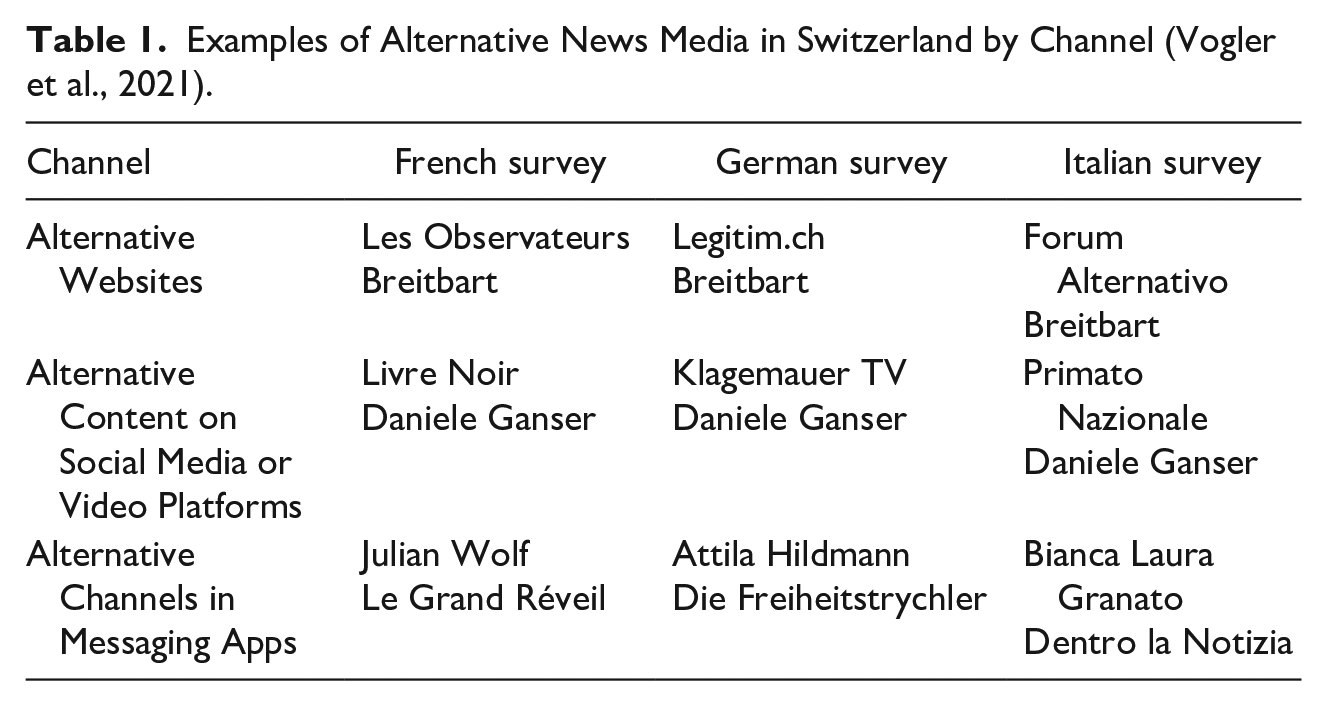
We then evaluated the frequency of alternative news media use based on three items. Each item inquired about the frequency of use of a particular channel on a 5-point scale: (a) alternative websites, (b) content on social media or video platforms, and (c) alternative channels in messaging apps. Following the approach of Andersen et al. (2016), we also employed a list-frequency technique, which involved providing examples of alternative news media channels that are popular in the three principal linguistic regions of Switzerland (i.e., the German-, French-, and Italian-speaking areas; Vogler et al., 2021; see Table 1). The participants were asked how often they encountered information on science and research across these channels on a scale ranging from 1 (never) to 5 (very frequently).
Examples of Alternative News Media in Switzerland by Channel (Vogler et al., 2021).
We adhere to the assumption that using a specific alternative news media outlet does not necessarily imply a high level of usage across other or all alternative channels. Relatedly, someone who frequently uses only one alternative channel can still be considered a heavy user of alternative news media if that channel is their sole alternative news media source. Furthermore, it can be assumed that there is some overlap in the content distributed through alternative media channels (e.g., websites and social media). We further assume that users do not necessarily actively employ different channels to view the same content. Hence, to mitigate the risk of misrepresenting the value of alternative news media use due to a user’s focus on a particular channel, we used the maximum value from the three channels surveyed as the value of the dependent variable “alternative news media use.” If, for example, a participant reported a use frequency of 5 for social media as an alternative news media source but a frequency of 1 for alternative websites and messaging apps, we assigned a code of 5.
In accordance with our hypotheses, we include a range of science- and media-related predictors as independent variables.
Science-Related Factors
The participants’ interest and trust in science were measured on a 5-point scale ranging from 1 (not at all) to 5 (very much). We asked, “How interested are you in science and research?” (M = 3.45; SD = .98). Trust in science was measured using two questions—“How high is your trust in scientists at universities?” and “How high is your trust in science in general?”—scored on a 5-point scale ranging from 1 (very low) to 5 (very high). A mean index was computed (M = 3.77; SD = .83; Cronbach’s α = .73).
The participants’ positivistic attitudes toward science were assessed using seven statements that captured positive perspectives on science and its benefits for individuals and society (e.g., “Science and research can solve any problem”) 2 and were scored on a 5-point scale ranging from 1 (completely disagree) to 5 (completely agree; Pardo & Calvo, 2002; Prpić, 2011; Von Roten, 2009). To facilitate further analysis, a mean index was computed (M = 3.01; SD = .63; Cronbach’s α = .62). These items have undergone testing and validation in numerous large-scale survey studies across various countries and are established measures in survey research on science communication and public perceptions of science and research (e.g., European Commission—Directorate General for Communication, 2021; Wintterlin et al., 2022).
To investigate each participant’s science-related populism, we used the SciPop scale, an eight-item survey scale, and calculated their SciPop score, which is a continuous score that quantifies support for science-related populism (Mede et al., 2021). The eight-item measurement we employed covered four dimensions: demands for decision-making sovereignty (M = 2.41; SD = 1.14; Cronbach’s α = .68), demands for truth-speaking sovereignty (M = 2.57; SD = 1.14; Cronbach’s α = .80), conceptions of the academic elite (M = 2.26; SD = 1.09; Cronbach’s α = .69), and conceptions of ordinary people (M = 2.99; SD = 1.21; Cronbach’s α = .66). The participants were asked to rate their agreement with statements relevant to each dimension on a 5-point scale ranging from 1 (strongly disagree) to 5 (strongly agree). We calculated a mean index for each dimension and subsequently computed the SciPop Score in line with the Goertz approach (Wuttke et al., 2020) (M = 1.81; SD = .80).
To measure self-perceived knowledge, we surveyed respondents regarding two dimensions: “I am well informed about science and research” and “I know a lot about science and research.” Respondents rated their agreement on a 5-point scale ranging from 1 (do not agree at all) to 5 (fully agree). Subsequently, we calculated a mean index for further analysis (M = 2.58; SD = 1.00; Cronbach’s α = .84).
Knowledge about science—or scientific literacy (Kawamoto et al., 2013; Miller, 1983)—refers to one’s knowledge of scientific findings and procedures. We administered 11 questions to test scientific knowledge (e.g., “Electrons are smaller than atoms”) and scientific procedures (e.g., “Scientific theories never change”). To ensure that respondents did not have a 50% chance of randomly selecting the correct answer (Pardo & Calvo, 2002), we used a modified quiz format that permitted them to indicate their level of certainty in their responses (Schäfer et al., 2018). Hence, statements could be answered with “true,” “likely true,” “likely false,” or “false.” We combined the answers into an index: 0 points for no response or an incorrect response, 1 point for a correct “likely” answer, and 2 points for a correct “definitely” answer. To ensure comparability, we multiplied the index by 2.5 (M = 3.03; SD = .91).
Media-Related Factors
Using a 5-point scale from 1 (never) to 5 (very frequently), we asked respondents how often they come into contact with science and research news via traditional news sources through various channels (TV, radio, printed newspapers, science magazines, news websites/apps from traditional news sources, and on-demand TV/radio; M = 2.51; SD = 1.15; Cronbach’s α = .67) and via social media (social networking sites, such as Facebook; video platforms, such as YouTube; blogs/forums; and instant messaging platforms, such as WhatsApp; M = 2.38; SD = 1.21; Cronbach’s α = .74) and calculated their mean scores.
Respondents’ knowledge-related science media literacy, which is similar to scientific literacy, was measured using a quiz format that allowed the respondents to indicate their level of certainty in their answers (Mede et al., 2025). We asked a total of three questions that inquired about each participant’s knowledge of media (e.g., “News is more likely to be trusted if it is based on a single scientific study rather than multiple ones”; M = 3.12; SD = 1.14). Respondents’ skill-related science media literacy was assessed using three items that measured the use of digital media to obtain information on scientific subjects (e.g., “When I encounter scientific information, I consider where that information comes from”). We asked respondents to indicate their level of agreement (1 = do not agree at all to 5 = fully agree) and computed a mean index (M = 3.28; SD = 1.18; Cronbach’s α = .67).
The uncertainty about scientific information was measured by one query: “When encountering science and research-related information, how frequently do you experience uncertainty as to its veracity (e.g., during discussions with acquaintances, in media, online, or via messaging)?” Responses were scored on a 5-point scale ranging from 1 (never) to 5 (very frequently) (M = 3.48; SD = 1.16).
Active information-seeking related to science and research was assessed using a 5-point survey measuring respondents’ agreement (1 = do not agree at all to 5 = strongly agree) with the statement “In general, I specifically look for information about science and research” (M = 2.93; SD = 1.20).
We examined trust in the science coverage of legacy news media by using the following five-scale single item: “What would you say is your level of trust in science reporting by traditional media?” (1 = very low to 5 = very high) (M = 3.03; SD = .91).
Covariates
The study incorporated well-established (e.g., Müller & Schulz, 2021; Puschmann et al., 2024) political and sociodemographic constructs: gender (49.2% female), age (M = 47.70; SD = 18.05), level of education (1 = compulsory school, 2 = secondary education, 3 = post-secondary education; 58.2% post-secondary education), and political orientation, the last of which was scored on a 7-point scale from 1 (very left) to 7 (very right) (M = 3.69; SD = 1.34).
Results
Alternative News Media Users and Non-Users
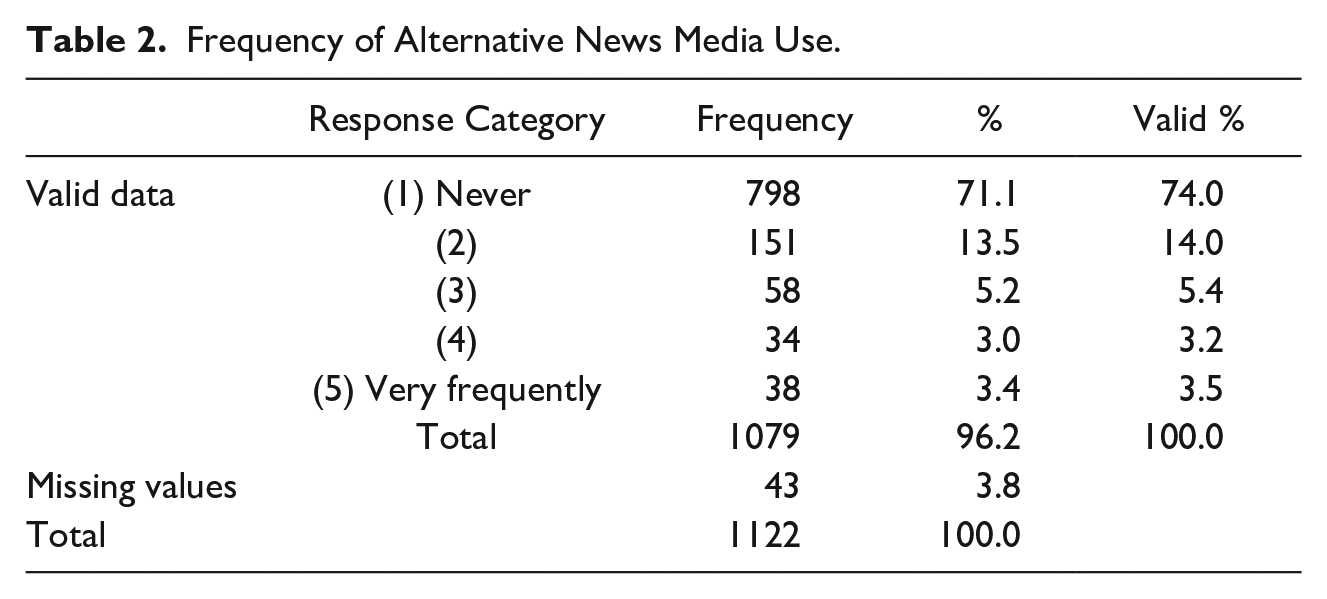
To address RQ1 (which was preregistered)—“How prevalent is the use of alternative information sources among the Swiss population?”—we asked respondents about their use of alternative news media in the context of science without predefining the precise meaning of “alternative news media.” Out of the sample, 69.5% (n = 780) reported consulting what they perceive to be alternative news media for scientific information. When asked for examples, only 25.0% (n = 281) of the respondents claimed to use alternative news media (see Table 2). This discrepancy suggests that respondents may have different understandings of what constitutes “alternative news media” compared to those within the scientific community. The prevalence of self-defined alternative news media use was much higher than that of specific channels defined by research. When asked about specific channels, on average, social media or video platforms were the primary source for receiving alternative news media on science and research (M = 1.46, SD = 0.95), followed by messenger apps (M = 1.40, SD = 0.92) and alternative websites (M = 1.36, SD = 0.84).
Frequency of Alternative News Media Use.
The multiple linear regression analysis (see Table 3) reveals the predictors of using specific alternative news media channels for information on science and research.
A Linear Multiple Regression Model of Alternative News Media Use.
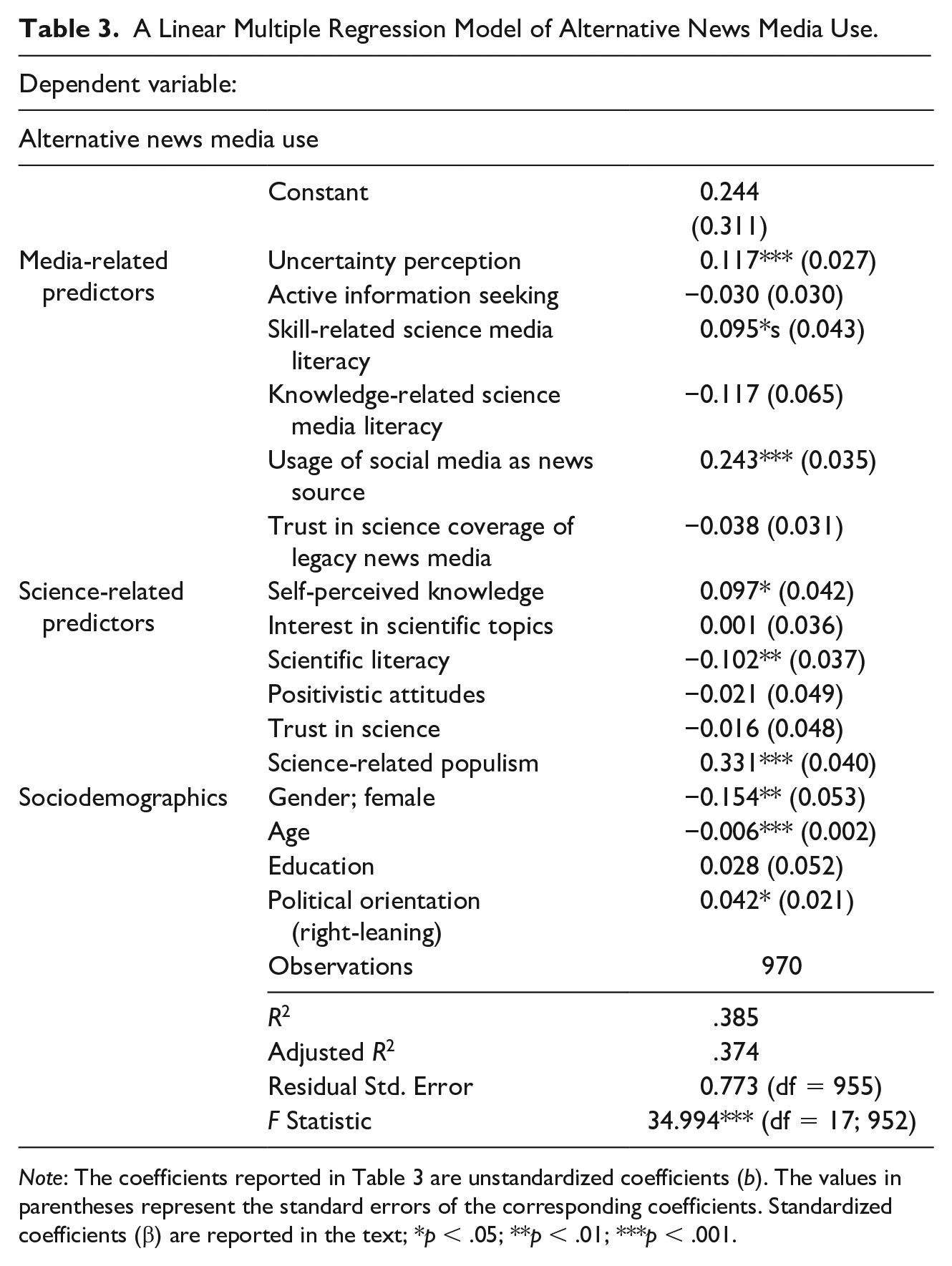
Note: The coefficients reported in Table 3 are unstandardized coefficients (b). The values in parentheses represent the standard errors of the corresponding coefficients. Standardized coefficients (β) are reported in the text; *p < .05; **p < .01; ***p < .001.
Media-Related Predictors
We hypothesized (H1) that “Low levels of trust in legacy news media predict higher levels of alternative news media use,” but respondents with less trust in science coverage by legacy news media did not appear more likely to turn to alternative news media (β = −.04, p = .230).
H2, “High levels of uncertainty regarding scientific information are associated with increased use of alternative news media,” was supported. The analysis showed that high levels of uncertainty regarding scientific information are significantly associated with an increased use of alternative news media (β = .12, p < .001).
Moreover, based on the analysis of RQ2—“How is actively seeking science-related information connected with alternative news media use?”—there appears to be no significant correlation between actively seeking science-related information and alternative news media use (β = −.04, p = .321).
Meanwhile, the analysis of RQ3—“How is using traditional news sources connected with alternative news media use?”—indicates that both high levels of traditional news use and the use of social media as a news source predict alternative news media use. The use of traditional news sources (β = .09, p = .005) serves as a stronger predictor than the use of social media as a news source (β = .23, p < .001), suggesting that alternative news media users generally consume a large volume of news media and tend to favor social media as a source of news.
Finally, the analysis of RQ4—“How are knowledge- and skill-related media literacy connected with alternative news media use?”—revealed a positive and statistically significant correlation between skill-related science media literacy and alternative news media use (β = .09, p = .028). While these self-assessment scales suggest that alternative news media users possess higher skill-related media literacy, no substantial relationship was detected between quiz-tested knowledge-related science media literacy and alternative news media use (β = -.05, p = .07). Hence, it seems that while alternative news media users may feel confident in their media skills, their actual knowledge-related media literacy is not significantly linked to alternative news media use.
Science-Related Predictors
There was a significant positive correlation between high levels of science-related populism and higher levels of alternative news media use (β = .26, p < .001), which suggests that the use of such media sources is indeed encouraged by a populist worldview, confirming H3 (which was preregistered), “High levels of populist attitudes predict higher levels of alternative news media use.”
Meanwhile, respondents who lack trust in science (β = -.01, p = .73) and hold non-positivistic attitudes toward science (β = -.01, p = .66) do not turn to alternative news media for research and science content. Thus, H4, “Low levels of trust in science predict higher levels of alternative news media use,” and H5, “Low levels of positivistic attitudes predict higher levels of alternative news media use,” were not supported. In addition, we found no significant association between high levels of interest in science and alternative news media use (β = .001, p = .97), meaning that H6—“High levels of interest in science predict higher levels of alternative news media use”—was not supported either.
Regarding RQ5—“How are self-perceived knowledge and scientific literacy connected with alternative news media use?”—our findings indicate that alternative news media users may perceive themselves as being well informed about scientific topics due to a positive correlation between self-perceived knowledge and alternative news media use (β = .92, p = .02). However, there is also a negative correlation between scientific literacy and alternative news media usage (β = -.09, p = .005), suggesting that alternative news media users are less informed about science and research. Therefore, our results suggest that alternative news media users tend to overestimate their understanding of scientific topics.
Covariates
Our examination of sociodemographic predictors revealed that men are more likely than women to use alternative news media (β = -.08, p = .004), that older individuals are less likely to do so (β = -.10, p < .001), and that people with more right-leaning political positions are more likely to do so (β = .05, p = .04). These findings suggest that, when it comes to scientific content, alternative news media users tend to be slightly younger, male, and politically right-leaning. Level of education, however, did not significantly contribute to the model (β = .015, p = .60).
Discussion
Our findings, which are based on the analysis of survey data from Switzerland, indicate that only a minority of the Swiss population uses alternative news media to gather information on scientific topics. These users are more critical of science and traditional news media in general. They tend to overestimate their competencies in science and news media. They also tend to be male, younger, and politically further right.
High usage of alternative news media can be predicted by media- and science-related behaviors. While low reliance on legacy news media for policy coverage is commonly considered a predictor of high levels of alternative news media use (Noppari et al., 2019; Štětka et al., 2021), we were not able to confirm this for the field of science. Furthermore, our model did not validate the notion that alternative news media users actively seek out such information. Instead, the use of traditional news media served as a predictor of alternative news media usage in the scientific domain. Thus, exposure to alternative science-related news does not appear to be the result of an active decision to deliberately seek out alternative news to bypass (Holt et al., 2019) or avoid (Benkler et al., 2018; Rauch, 2019) traditional news media or to obtain the most complete picture possible of the facts (Schwarzenegger, 2023). Instead, the turn to alternative news media use in the field of science seems to occur relatively passively. This notion is supported by the analysis of news sources, which indicates that alternative news media users rely on social media as a news source (Leung & Lee, 2014), including in the realm of science. Thus, it is possible that, rather than actively seeking out alternative news sources, individuals are exposed to them incidentally (Müller & Schulz, 2021). In this context, the role of algorithms must be considered. Although exposure to alternative science-related news may be passively initiated, algorithms that rely on content curation can promote further exposure. Once individuals are exposed to such content, even without actively searching for it, they may continue to encounter similar information in the future if they engage with it.
Our findings also underscore the ambivalent state of existing research on alternative news media users and their levels of media literacy. We found that alternative news media users consider themselves competent and superior. However, we did not find media literacy to be a predictor of alternative news media use. Therefore, our research findings do not align with alternative news media users’ self-assessments. Our model produced similar results for the domain of scientific literacy. That is, although alternative news media users are more likely to rate themselves as well informed about science and research, low scores on the scientific literacy quiz were actually predictors of higher alternative news media use. Users of alternative science-related news media thus seem to overestimate their competencies in the domains of media and science. From an epistemological point of view, this demonstrates a lack of what scholars describe as epistemic humility, which denotes “that subjects acknowledge the limits of their knowledge in the manner that unknown, uncertain, ambiguous and uncontrollable dimensions are accepted as relevant parts of consideration” (Parviainen et al., 2021, p. 240). Alternative news media users in this study did not seem to acknowledge to a large extent that their knowledge about science, and about media, may be limited.
While several studies suggest that political interests predict the use of alternative political news media (Leung & Lee, 2014; Macková et al., 2023; Reiter & Matthes, 2023), we were unable to demonstrate a similar relationship in the scientific domain. This supports the aforementioned theory that alternative news media users tend to come into contact with alternative science-related news media by chance—for instance, through social networks—rather than deliberately searching for them based on their specific interests. This observation, however, should not invalidate the need for further studies on the topic of alternative news media and science. This is because, unlike in cases of political interest, where alternative news media users may form a specific interest group, in the realm of science, all citizens have the potential to come across alternative news media about science and research via social media platforms.
Our model also confirms the assumption that people who hold populist attitudes are more likely to use alternative news media (Müller & Schulz, 2021; Stier et al., 2020). Accordingly, one could assume that alternative news media users in the field of science are also critical of social elites and science as a system (Funk et al., 2023). However, our analysis revealed no correlation between levels of trust in science or levels of positive attitudes and the use of alternative news media. While variables such as trust in science and positivistic attitudes tend to concern attitudes toward science as a whole, the Science-Related Populism Index focuses more narrowly on the perception of scientists as social elites. This suggests that the use of alternative news media is primarily driven by a pronounced criticism of elites, which may be more associated with individual scientists, particularly those who are more “visible” (Goodell, 1977), rather than the entire scientific system. This ambivalence provides a promising avenue for further research.
Finally, our analysis shows that users of alternative news media in the realm of science and research perceive their information environment as rather uncertain. This may be encouraged by the consumption of alternative news media. However, when news media, acquaintances, or friends contribute to an individual’s uncertainty about their information environment, this can also lead to alternative news media use. This is especially interesting in light of ongoing discussions in the field of science communication about whether to communicate uncertainty about scientific processes (Bolsen & Druckman, 2015, p. 746; Dworok, 2019, p. 21; Neuberger et al., 2023).
The findings of this study should be considered in light of certain limitations. First, it must be emphasized that our study relies on data from only one country: Switzerland. This reduces the generalizability of our results, particularly because Switzerland is unique in that its system of direct democracy may increase its vulnerability to populist sentiments. Indeed, the Swiss population, empowered by the principles of democracy, is likely to be more skeptical of the notion that authority should be centralized among social elites (Ernst et al., 2016). This sets them apart from citizens of other political systems. As such, further studies that explore different national and political contexts, or adopt an international comparative approach, would be beneficial.
In addition, we included self-report questions regarding news usage behavior in our survey, which may have introduced inaccuracies. Alternative news media users are aware that they are part of a minority that deviates from the norm (Herkman, 2017; Müller & Schulz, 2021), so social desirability may influence media use estimation, which could lead to overreporting or underreporting. Another challenge involved in self-assessing the use of alternative news media lies in discerning the distinction between alternative and traditional news media. Survey respondents may have interpretations of what constitutes alternative news media that differ from the scientific perspective. While we attempted to address this by providing examples of alternative news media on specific channels (see Table 1) and making our selections based on a scientific report (Vogler et al., 2021), the selection was ultimately constrained by space and may have influenced the participants’ understanding of alternative news media, introducing potential biases into their self-assessment of usage frequency. One avenue for future research could be to explore what people actually mean by “alternative news media.” It is possible that individuals categorize certain sources as alternative sources that researchers would not typically consider as such. For example, in the survey, some respondents identified academic journals as alternative sources of information, which would not be classified as alternative news media according to common definitions (e.g., Frischlich et al., 2023).
Furthermore, due to the use of cross-sectional data, it was impossible to establish causal relations in our data. For example, on the one hand, it is possible that a low level of scientific literacy leads to a high level of alternative news media use, but on the other hand, it is possible that the use of alternative news media decreases scientific literacy. This may be the case for all media- and science-related predictors in our analysis.
It is also important to mention that the news media surveyed using the list-frequency approach do not exclusively deal with scientific topics. It is much more common for alternative news media to primarily address highly politicized scientific topics. Therefore, the extent to which reporting on scientific topics can be separated from political content in an era of “post-normal science” (Funtowicz & Ravetz, 1993; Scheufele, 2014) is questionable. The question we asked explicitly targeted scientific content in alternative news media. The fact that the respondents recognized the science-related context of the question was also confirmed by responses in an open field of the survey. Within this open field, respondents were able to specify sources besides those surveyed that they use to learn about science; most of the sources mentioned were science-related.
Nonetheless, despite its limitations, our study fills two important research gaps. First, we broaden the scope of research on alternative news media use to include the topic of science. Users of alternative news media in scientific settings do not explicitly reject the scientific system and the scientific way of gaining knowledge as a whole, but they are highly suspicious about the notion that scientists are social elites. This differentiates them from those who use alternative news media in political contexts. Second, we provide insights into the under-researched role of literacy and knowledge in alternative news media use. Alternative news media users perceive themselves to be highly knowledgeable about science but score lower than average on science literacy scales.
As for the practice of science communication, our findings highlight that we need to be aware that alternative perspectives on science are important to some individuals—a development that we need to be conscious of when claiming that certain scientific knowledge is infallible (Fischhoff & Scheufele, 2013). Furthermore, our findings indicate that users of alternative news media do not have a one-sided (alternative) information repertoire and seem to be exposed to a highly uncertain information environment.
We interpret the frequent use of social and traditional news media, the fact that users of alternative news media are not completely averse to the scientific system, and the uncertain outlooks of alternative news media users in the realm of science and research as opportunities for science communication efforts.
Supplemental Material
sj-docx-1-scx-10.1177_10755470251323525 – Supplemental material for Literate and Critical? Characterizing Users of Alternative Scientific Media
Supplemental material, sj-docx-1-scx-10.1177_10755470251323525 for Literate and Critical? Characterizing Users of Alternative Scientific Media by Lena Zils, Florian Wintterlin, Julia Metag, Niels G. Mede and Mike S. Schäfer in Science Communication
Footnotes
Declaration of Conflicting Interests
The author(s) declared no potential conflicts of interest with respect to the research, authorship, and/or publication of this article.
Funding
The author(s) received no financial support for the research, authorship, and/or publication of this article.
Ethical Declarations
Our study included human research participants. Accordingly, the project was approved by the ethics committee of the Faculty of Arts and Social Sciences of the University of Zurich, Zurich, Switzerland (approval number: 22.6.14). Informed written consent to take part in the research was obtained prior to the commencement of the study through the first question of the survey.

Data Availability Statement
The survey data and additional materials (e.g., the questionnaires and a methodological report; the former is in German, French, and Italian, while the latter is only in German) are publicly available in the online repository SWISSUbase (doi: 10.48573/wpf5-hf36).
Notes
Author Biographies
References
Supplementary Material
Please find the following supplemental material available below.
For Open Access articles published under a Creative Commons License, all supplemental material carries the same license as the article it is associated with.
For non-Open Access articles published, all supplemental material carries a non-exclusive license, and permission requests for re-use of supplemental material or any part of supplemental material shall be sent directly to the copyright owner as specified in the copyright notice associated with the article.
