



Abstract
In this article, we argue that offline inequalities, such as core–periphery relations of the music industry, are reproduced by streaming platforms. First, we offer an overview of the reproduction of inequalities and core–periphery dynamics in the music industry. Then we illustrate this through a small-scale network analysis case study of Hungarian metal bands’ connections on Spotify. We show that the primary determinant of a given band’s international connectedness in Spotify’s algorithmic ecosystem is their international label connections. Bands on international labels have more reciprocal international connections and are more likely to be recommended based on actual genre similarity. However, bands signed with local labels or self-published tend to have domestic connections and to be paired with other artists by Spotify’s recommendation system according to their country of origin.
Keywords
Introduction
The reproduction of structural inequalities and center–periphery power relations is a determinative factor in the operation of cultural industries, including the music industry. The unequal distribution of resources, income, and potentials found in the dimensions of ethnicity, nationality, geographical location, and gender, among others, all contribute to shaping the music industry’s center–periphery structure. Inequalities created and reproduced affect all elements of the music industry’s value chain: the production process, the musicians’ career, creators, distribution networks, and the consumers.
The advent of the Internet was accompanied by the expectation that the network will moderate offline inequalities with the digitalization of cultural industries. The notion that the music industry would become more level, equal, and democratic and all the geographic inequalities would slowly disappear in a hyperconnected global network emerged. The first music-centered social platforms offered similar hopes. The MySpace-boom was fueled partly by the faith that the platform will open up unprecedented opportunities for everyone, regardless of location, ethnicity, or nationality. Later on, streaming platforms and recommendation systems were also expected to become revolutionary social equalizers. However, a review of the data and analyses regarding the platform-centered cultural industries’ current state reveals that democratization and equalization did not happen. Instead, a reorganization of power structures and hierarchies took place. Online networks and algorithmized ecosystems are still deeply connected to the given social and geographic circumstances and localities and tend to reflect offline patterns, such as inequalities and center–periphery constellations.
This article examines this issue and demonstrates how center–periphery dynamics and geographical power relations are represented on the leading digital music streaming platform’s recommendation system. We illustrate this phenomenon through a small-scale network analysis case study, applied to a particular, well-defined part of the music industry, the (extreme) metal music genre. This article explores how the peripheral position of Central and Eastern European (particularly Hungarian) extreme metal scenes are represented and reproduced by the related artists feature of Spotify’s recommendation system. We argue that by mirroring the music industry’s center–periphery dynamics, digital music platforms represent and reproduce existing power dynamics and inequalities through their (mainly) algorithmic distribution and decision-making processes.
Core–periphery dynamics and geographical inequality in the music industry
Location is a decisive economic or cultural factor in the music industry (Raibaud, 2014), mainly due to center–periphery relationships and the resulting geographical inequalities (Stokes, 2004; Taylor, 2015). As Scott (1999a) emphasized, global cities as economic and cultural hubs are the centers of the creative and cultural industries because that is where the economic resources, potentials, and social networks are located (Florida and Jackson, 2010; Florida et al., 2010; Scott, 1999b). Localities of centrality thus are highly intertwined with the hierarchies of industry power. Major record labels (currently the “big three,” Sony, Universal, and Warner) are based in the global centers of the cultural industries, controlling 69.2% of recorded music revenues in 2018 (Mulligan, 2019). The flow of music distribution is mainly one-directional: musical content produced in the centers is distributed toward and consumed by the peripheries. However, peripheral cultural productions rarely find their way to audiences of the centers, or if they do, it often happens by cultural appropriation (Stokes, 2004; Taylor, 1997). Also, in the United States, which is the most significant geographical hub of the global music industry and the biggest music exporter, the percentage of non-domestic music consumption is the lowest (Laing, 2008). This asymmetry applies to the Hungarian music industry as well, where major labels entered through their local subsidiaries after the regime change to create new markets for globalized musical products (Barna, 2021). In addition to the power relations of the economic organization, the role of location is important because of music’s cultural and historical characteristics. These include how networks of creativity are formed in various music worlds (Crossley et al., 2014) and local scenes (Cummins-Russell and Rantisi, 2012), how spatial proximity contributes to knowledge exchange (Watson, 2008; Watson et al., 2009), and how musical tastes are distributed (Mellander et al., 2018). Each genre has its own centers and peripheries. French (2017), studying the diffusion of rap music in the United States, found that three major rap centers emerged: New York City, Los Angeles, and Atlanta. The francophone branch of rap formed its own international hubs, with Paris in its center (Hammou, 2014). The world of metal music has its own inequalities and center–periphery dynamics.
Core–periphery dynamics in metal music
The picture of the geographical inequalities and core–periphery dynamics in metal music is two-layered. On the one hand, the metal music world reflects the Anglo-Saxon dominance of the overall music industry. The genre originated in the United Kingdom in the 1960s and grew to a global scene (Brown et al., 2016; Kahn-Harris, 2006; Wallach et al., 2012) by being disseminated mainly through the United States and Western Europe. The global language of metal (as of the global popular music, see Rutten, 1999) is English. Most bands have English names and lyrics, even in local, non-Anglo-Saxon scenes (in Hungary too, as shown in the sample of bands). Also, the language of global metal-related media and journalism is English (Brown, 2007).
On the other hand, metal music has its own socio-cultural trajectories that formulated its centers and peripheries beyond the Anglo-Saxon cultural domination. Besides the United States, Germany, the United Kingdom (all are centers of the global music industry), three Nordic countries—Finland, Norway, and Sweden—are considered global centers (DeHart, 2018; Maguire, 2015) of metal music. This position stems from the sheer number of bands originating from these countries and their influence on the genre’s formation. For instance, most subgenres that have influenced the evolution of the genre originated from localities in metal’s global centers (Harris, 2000). These include the “Bay Area” thrash metal, the Tampa, Florida death metal, the Stockholm and Gothenburg death metal styles, and the Bergen black metal in Norway. All of these have spread globally and are played by bands in the peripheral regions as well.
Emms and Crossley (2018) found a geographically anchored core–periphery structure in the networks of the UK underground metal scene. Teemu Makkonen (2014, 2015, 2017) studied various aspects of Finnish metal “superstar” bands’ networks. Makkonen (2017) found that the language was a significant factor in explaining international connections or the lack thereof. While the bands singing in English had relatively large numbers of international collaborative links, the superstars performing in Finnish had practically no global connections in terms of foreign-born musicians or playing in international bands.
How do the Internet and the new platform ecosystem affect the music industry’s core–periphery structure and dynamic? Are online networks diminishing geographical inequalities, or on the contrary, representing, or even facilitating them? Mayer and Timberlake (2014) hypothesized that the advent of the Internet and digital technologies might have contributed to the diffusion of metal music and helped bands from the peripheries join the genre’s global flow. However, apparently, the power relations between the global centers and peripheries of the genre remained intact. We argue that locality still plays a role in forging networks of inequality in the age of online connectedness and platforms. First, we provide an overview of the literature on the prevalence of existing power structures on the Internet and the digital music industry and platforms. Next, we outline the mechanisms by which algorithms contribute to the online reproduction of offline conditions. Finally, we present our small-scale network analysis case study.
The online reproduction of offline core–periphery dynamics
The concept that new technologies would act as social equalizers and facilitate a more equal and democratic society emerged with the diffusion of new communications and media technologies (Gillespie, 2018; Gillespie and Robins, 1989; Lessig, 2006). In addition, the inequalities rooted in geographical location and distance would be minimized. However, as studies have shown, the embeddedness of social networks and online locality patterns remained significant even in the Internet age. As Alexander Halavais (2000) demonstrated in his widely cited work, country borders did not disappear with the Internet’s ubiquity. More recently, research continued to focus on the prevalence of locality in online interactions. According to Chang et al. (2009) and Cerina et al. (2014), country borders still matter in the organization of online social networks and international information flow. Goldenberg and Levy (2009) argue that the importance of geographical proximity increased with the spread of the Internet.
Similar notions concerning the music industry’s organization and music scenes arose, suggesting that the digitization of music would diminish or even erase various kinds of inequalities and differences resulting from locality. These included, among others, the possible disappearance of sounds and scenes rooted in the locality (Kruse, 2010), and the decrease of the volume difference between niche, underground, and mainstream music (Tofalvy, 2020). Furthermore, the music industry might become a more leveled field and more democratic space (Hesmondhalgh, 2019), offering a more direct relationship between artists and fans (Kjus, 2016). The first music-centered social networks, such as MySpace, were expected to produce similar results. However, they did not live up to these expectations either (Beuscart, 2008).
Allen Scott (1999b) correctly predicted that major production clusters would remain as centers of creative production. Analyzing iTunes sales charts’ spatial networks, Allan Watson (2012) found that “the spatial agglomerations of music industry firms, studios and creative labor in particular key cities remain central to the music recording process in the age of digital music markets” (p. 18). Geography of networks in defining online developments continues to be important, as Andrew Leyshon (2014) put it: “networks of creativity appear to be reasonably resistant to electronic disintermediation” (p. 37). The dominant power relations and center–periphery dynamics of distribution and control have not changed: relatively few actors dominate the market (Hesmondhalgh, 2019), only the nature of the players changed with the arrival of platforms. The leading major labels are still on the top of the pyramid (McLean et al., 2010), and the disproportionate distribution of revenues still stands (Azenha, 2006). Instead of a disintermediated industry, we see the prevalence of mediation (Galuszka, 2015) in an oligopolistic market. Digital distribution forms its centers and regional peripheries (Szczepanik et al., 2020), and artists operating from a center still have way more opportunities to distribute and communicate their work (Verboord and Noord, 2016). This tendency can be observed in the contemporary platform ecosystem as well.
Digital music platforms and recommendation systems as spaces of inequality reproduction
Digital platforms are the definitive entities of the cultural industries (Srnicek, 2016). Platforms (such as Google, Facebook, Amazon, Apple, Microsoft) are digital interfaces operated by “tech” corporations in order to act as “matchmaking” spaces, intermediaries between producers and users (Poell et al., 2019; van Dijck et al., 2018). The process of the platforms becoming more significant is called platformization, “the penetration of economic, governmental and infrastructural extensions of digital platforms into the web and app ecosystems” (Nieborg and Poell, 2018: 2). In digital media and the cultural industries, platforms aggregate and distribute digital content, typically not produced by the platforms themselves. Combined with extensive user and content data collection, they sell targeted advertising based on user behavior (Gillespie, 2018; van Dijck et al., 2018). At the heart of all their operations lie the algorithmized recommendation systems, which, occasionally combined with human intervention, governs the distribution and consumption of content. “Platforms are not merely neutral conduits through which content flows, neither are they empty sites upon which conflicting markets do battle. Platforms exert their own agency in various ways, such as through ‘curatorial power’” (Prey, 2020: 8).
Streaming platforms and platform logic dominate the music industry too (Tilson et al., 2013). Besides the leading global platforms specializing in music distribution (such as iTunes by Apple and YouTube premium by Google), the most significant streaming platform is Spotify (Prey, 2020; Prey et al., 2020). According to the company, it has “320 million users, including 144 million subscribers, across 92 markets” (Spotify, 2020). Some smaller providers share the remaining part of the market, such as Deezer, Soundcloud, Pandora, Bandcamp (Hesmondhalgh et al., 2019), and Tidal (Kjus, 2016). The prevalence of streaming platforms changed the place and ways of music consumption. Instead of owning recorded music in material formats, immaterial music formats are not owned but accessed by listeners through the cloud (Burkart, 2014). Streaming services offer music as a service, as a “utility” (Goldschmitt and Seaver, 2019) rather than selling individual music tracks. The platform ecosystem reproduces the inequalities and center–periphery dynamics of the cultural industries through their central position in the economy, the content distribution and consumption patterns they facilitate, and recommendation systems that manage the content flow and the user–interface interaction.
Today, 5 out of the 10 biggest companies based on market capitalization are tech companies behind platforms (Statista, 2020). Most of the major global platforms are headquartered in California (Nieborg et al., 2020) and are in oligopolistic positions in their respective markets. One major music streaming platform, Spotify, is European. It is headquartered in Sweden, the largest per capita pop music exporter in the world (Feeney, 2013). Spotify holds an oligopolistic position and represents 27% of global recorded music revenues in this concentrated market. As Prey (2020) observed, “Spotify is assuming an increasingly central role in the market for recorded music” (p. 2). Spotify reproduces the music industry’s pre-digital concentration as well, as major labels receive between 52% and 54% of the net revenue generated by their artists on the platform, while independent record labels are paid between 50% and 52% (Prey, 2020).
Algorithms and recommendation systems
Another important field of reproducing structural inequalities in digital music is curating the catalog (Jansson and Hracs, 2018). Consistent with all other branches of the contemporary media industries (Barzilai-Nahon, 2008; Wallace, 2018), in the streaming ecosystem, gatekeeper decisions continue to determine musical content selection; only the nature of those gatekeepers has changed radically. Digital platforms (Hesmondhalgh, 2019) assumed the role of the previously reigning big publishing companies. They became the new gatekeepers in the cultural industries by aggregating content from various sources and building on the wealth of data collected from their users’ behavior (Vonderau, 2019). On streaming platforms, algorithm-driven recommendation systems play a central role in shaping music listening and discovering new music (Aguiar and Waldfogel, 2018).
Streaming platforms often employ both human and robotized curators, for instance, Spotify for compiling playlists (Bonini and Gandini, 2019; Eriksson, 2020; Prey, 2020), and Pandora for analyzing and coding musical, aural traits (Fry, 2019; Morris, 2012). Managing millions of users’ choices and assumed preferences with human operators exclusively is practically impossible, so this task is outsourced to the non-human algorithmic agents (Ricci et al., 2015). However, algorithmic recommendation systems are not purely robotic agents, as they are designed, coded, run, and maintained by human beings. Thus, the difference between human and non-human agents should not be radicalized. As Goldschmitt and Seaver (2019) put it, “. . . these music discovery tools should not be understood in terms of the popular opposition between people and algorithms, but rather as sociotechnical systems that rely on and reinforce particular ideas about human and machine capacities in relation to music” (p. 65).
Algorithmic recommendation systems are programs that make automated decisions based on the incoming data feed, according to the optimal outcome specified by their code, on various levels of complexity (Li and Karahanna, 2015). Pandora uses such recommendation algorithms built upon their Music Genome Project (Fry, 2019; Morris, 2012; Prey, 2018) and The Echo Nest, which is a part of Spotify’s hybrid algorithmic recommendation system (Prey, 2018). However, collaborative filtering, probably the most ubiquitous filtering algorithm type, does not make its decisions based on the traits of the songs themselves. Instead, it monitors the behavior of users’ past interactions on the given platform and predicts their probable preferences (Prey, 2018).
However, professional and academic access to their operation is highly restricted. Therefore, code audit methods (see Bodo et al., 2017) cannot be used to monitor and evaluate those algorithms. In most cases, the only alternative is deducting the algorithms’ probable guiding principles based on their output (often called reverse engineering). We used this approach. The obscurity of the codes; and the values, policies, and strategies behind recommendation systems also contribute to the reproduction of inequalities. Algorithmic opacity (also known as the “Black box”) contributes to reproducing and maintaining inequalities in at least two ways. First, by making markets, competition, and consumption non-transparent: users and costumers have no knowledge of the principles and operations of the services they use and depend upon. How platforms use algorithms for gatekeeping is unknown to the audience. This is different from the past when gatekeepers such as DJs, journalists, and music critics were identifiable. Second, denying access to the code makes the audit and control of algorithms almost impossible (Eriksson et al., 2019).
The superstar effect
Initially, there were hopes that the disproportionate difference between the reach of superstars and lesser-known performers would decrease over time, and music consumption would diversify (Celma, 2010) in the long tail economy (Anderson, 2006) of streaming, offering theoretically limitless options on the “infinite shelves.” However, several studies have shown that instead, the opposite happened: limitless choices in the perception and reality of the user appear as “the tyranny of choice” (Barna, 2017), and the long tail is not facilitating the discovery of less popular, niche content (Napoli, 2016). One of the music industry’s major characteristics has been the “superstar-effect” (Coelho and Mendes, 2019)—the most popular performers garner the biggest share—since the beginning, and it continues to shape the industry in the digital era. For instance, in 2007, 844 million digital tracks were sold, but only 1% accounted for 80% of all track sales. Furthermore, 1000 albums accounted for 50% of all album sales. As Celma (2010) concluded, “music consumption based on sales is biased towards a few popular artists” (p. 4). The concentration of exceptionally successful artists even increased with the prevalence of online music distribution. As Ordanini and Nunes (2016) observed, the number of superstars decreased with the growing number of blockbusters. Looking at the available data concerning Spotify, as the largest streaming platform (almost) exclusively dedicated to music streaming, we can discover an array of similar tendencies. The platform seems to reproduce the existing superstar effect in the music industry. According to Alpha Data, 10% of Spotify streams belong to the top 1% of artists on the platform (Blake, 2020). In addition, Spotify released an overview in 2018, based on the data aggregated from the first decade of the service, which revealed that Anglo-Saxon artists had the most exposure (Snapes, 2018). Furthermore, Prey et al. (2020) found that Spotify’s playlists show a bias toward major label content.
Algorithmic bias or unfairness (Speicher et al., 2018) could contribute to such unequal distribution of music. This is especially true for the popularity bias, one of the most common algorithmic bias patterns. In this feedback loop, those items get better positioned, which are already in a better position. This tendency is partly rooted in collaborative filtering’s inherent nature, which primarily weights the user interactions rather than the content itself. As a result, a certain Matthew-effect occurs in the recommendation system, putting aside the less popular creators and pushing forward, even more, those who already reached a certain level of popularity (Bauer, 2019).
These mechanisms represent and reinforce the music industry’s existing offline core–periphery relationships and inequalities. With our case study, we wish to illustrate that online networks on music streaming platforms are related to the music industry’s offline localities and structures, thus reflecting unequal distribution patterns. We are taking a position in the debate regarding the Internet’s role in reducing versus reproducing core–periphery power relations of the music industry from its offline structure.
Case study
To understand better the patterns of the reproduction of geographical inequalities in recommendation systems, we conducted an empirical case study based on the network analysis of a sample of Hungarian extreme metal bands’ connections with other bands through Spotify’s “related artist” feature. We complemented the network analysis with a qualitative examination of two bands’ individual networks. In the following, we will present the main research questions, the data collection method, and the case study results and discussion.
RQ1A. How do the Hungarian source bands’ outward connections (weighted by their position on the related artists tab) to non-Hungarian bands correlate with the Hungarian source bands’ label background (international vs Hungarian) and language of lyrics?
RQ1B. What is the country of origin of those non-Hungarian bands, to which the highest number of outward ties goes from the Hungarian source bands?
RQ2A. How do the Hungarian source bands’ reciprocal connections with non-Hungarian bands correlate with the Hungarian source bands’ label background (international vs Hungarian) and language of lyrics?
RQ2B. What is the country of origin of those non-Hungarian bands, with which Hungarian source bands have the highest number of reciprocal ties?
RQ3. What are the main differences between the networks of two “typical” bands: one with international reciprocal connections and one with only domestic connections?
RQ1A and RQ2A are related to the international and Hungarian label background and the language of the bands’ lyrics. Several studies showed that labels play a major role in maintaining the structure of the music industry. Publishers operating in the global centers dominate the flow of music from the centers toward the peripheries, and publishers still matter in the era of digital platforms (Hesmondhalgh, 2019; McLean et al., 2010). Thus, we can expect that the type of label of a Hungarian band strongly affects the number of its international contacts and even its reciprocal international connections. As discussed above, English is the dominant language of the metal scene (Brown et al., 2016), and the language of a band’s lyrics can influence its international connections. These results suggest that the language also creates a dimension of inequality, which we found important to examine in our case study.
RQ1B and RQ2B are about the national background of those non-Hungarian bands, with which Hungarian bands have reciprocal connections. We also analyzed the Hungarian bands’ connections to examine inequalities from a geographical point of view. Each music genre has its own centers, including metal music. In our analysis, we used the metal genre–related centers (Brown et al., 2016; DeHart, 2018; Kahn-Harris, 2006; Maguire, 2015; Wallach et al., 2012).
RQ3 is a qualitative illustration of two extreme cases: one Hungarian band without international connections and another one with only international ties.
Data and methods
The sample of bands
The sample of source bands consists of 23 leading Hungarian extreme/modern metal bands as significant representatives of their respective subgenre (black metal, death metal, industrial, metalcore, etc.). We selected the bands based on their position in the Hungarian scene: most of them have been on stage for more than a decade and have a loyal regional, nationwide, or international fan base, and their work is acknowledged by critics. We included 20 currently active and 3 broken-up bands. They are on either Hungarian or international record labels.
The related artists page
Digital platforms play a major role in reproducing inequalities, which have already existed in the offline music world through several mechanisms, partly through their recommendation systems (Bauer, 2019; Celma, 2010; Goldschmitt and Seaver, 2019). For this very reason, we concentrated on one of the recommendation types of Spotify. Spotify’s recommendation system offers a wide range of recommendation tabs based on different logics, but they are all based on the connections between bands. The related artists tab (as it is called in the desktop app and the browser, as opposed to “fans also like” in the android app, for instance) is only one out of many output versions of the recommendation system. Some of the other versions are the “More like . . .,” “Because you listened to . . .,” “Similar to . . .,” “Suggested for you based on . . .” variations that can be found in different parts of the service. (The same recommendation system contributes to the compilation of more complex, algotorial playlists, such as Discover Weekly or New Music Friday as well). We selected the related artists tab for two reasons. First, as opposed to the other features, which differ from user to user (as each user sees their own “personalized” recommendation feed), the related artists tab is not personalized. It is “fixed,” which means that the same content appears for everyone, regardless of their past music listening behavior.
Furthermore, neither the featured bands nor the end users can change its content. Second, connections listed on the related artists tab are relatively constant and stable over time. To make sure this list is objective and truly not personalized, we checked the related artists tab of different user accounts at different timepoints. In our small-scale pilot study conducted in February 2019, we recorded the related artists on a smaller band sample with logging in from different user accounts and compared them to the latest data collection results. Regardless of the user account, the related artist tabs of a given band were the same. According to the time comparison, for the two bands whose network we analyze in depth, on the related artist tab of the band Ektomorf, only 1 band changed out of 20, and for Apey & the Pea (who recently changed their name to Lazarvs), only 5 changed out of 20. Compared to these changes, other recommendation possibilities are more volatile.
Data collection
The data collection was conducted between 4 February and 9 February 2020. We chose this time of the year because, traditionally, it is one of the relatively uneventful periods in the music industry—as opposed to, for example, the summer festival season or the release sales peak before Christmas. The main method of data collection was desktop research. Research assistants collected and structured the selected Hungarian bands’ related artist tabs. Then they checked the related artist tabs for those bands that appeared on the selected band’s related artist tabs looking for reciprocal listings. We did not have to control for any bias given that the related artist tab is not personalized and is the same for everyone. We did not use Spotify application programming interface (API) for the data collection because we aimed to conduct a smaller scale case study focusing on a selected scene and gain a more in-depth understanding of its mechanisms, rather than create a large-scale data analysis. We collected background information and data regarding the attributes of the bands. We collected information through the user interface for the related artists tabs of the bands. The result of this data collection is 23 edgelist tables, which also include the “monthly listener” number and the countries of origin of all connected bands. This latter characteristic is especially important in the analysis of core–periphery structures. We also collected all the relevant attributes related to the source bands of our sample. These attributes are the source bands’ monthly listeners on Spotify; data regarding other platform activities such as Facebook likes and YouTube views; biographical data including years active, current status; English or Hungarian lyrics; the label of the latest and the previous album; and the country of origin of the publishers. The last three played an important role in our investigation.
Structure of the data
The network is similar to a bipartite network, where one set of the nodes are the 23 Hungarian source bands, and the other set of nodes consists of those bands who appeared on the related artists page of the selected 23 Hungarian bands. However, it is not fully bipartite, as source bands could also appear on other source bands’ related artists pages, so there could have been (and were) connections between the first set of nodes too. Because of the logic of data collection, no connection was recorded between the nodes of the second set. A one-way (outward) tie was recorded from the source band to another band if the other band appeared on the source band’s related artists page, but the source band did not appear on the other band’s related artists page. A reciprocal tie was recorded between the source band and the other band, if not only the other band appeared on the source band’s related artists page, but also the source band appeared on the other band’s related artists page. Ties were weighted with the rank on the related artists page with an integer between 1 and 20. Higher weights denote greater importance. For instance, if a band appeared first on the source band’s related artists page, the tie from the source band to that band had a weight of 20. If a band was the last on the related artists page, the weight to that band was 1. We applied the same measure to calculate the weights from non-source bands to source bands.
Figure 1 shows the analyzed network of bands: a tie was created if a given band appeared on the related artists page of another band.
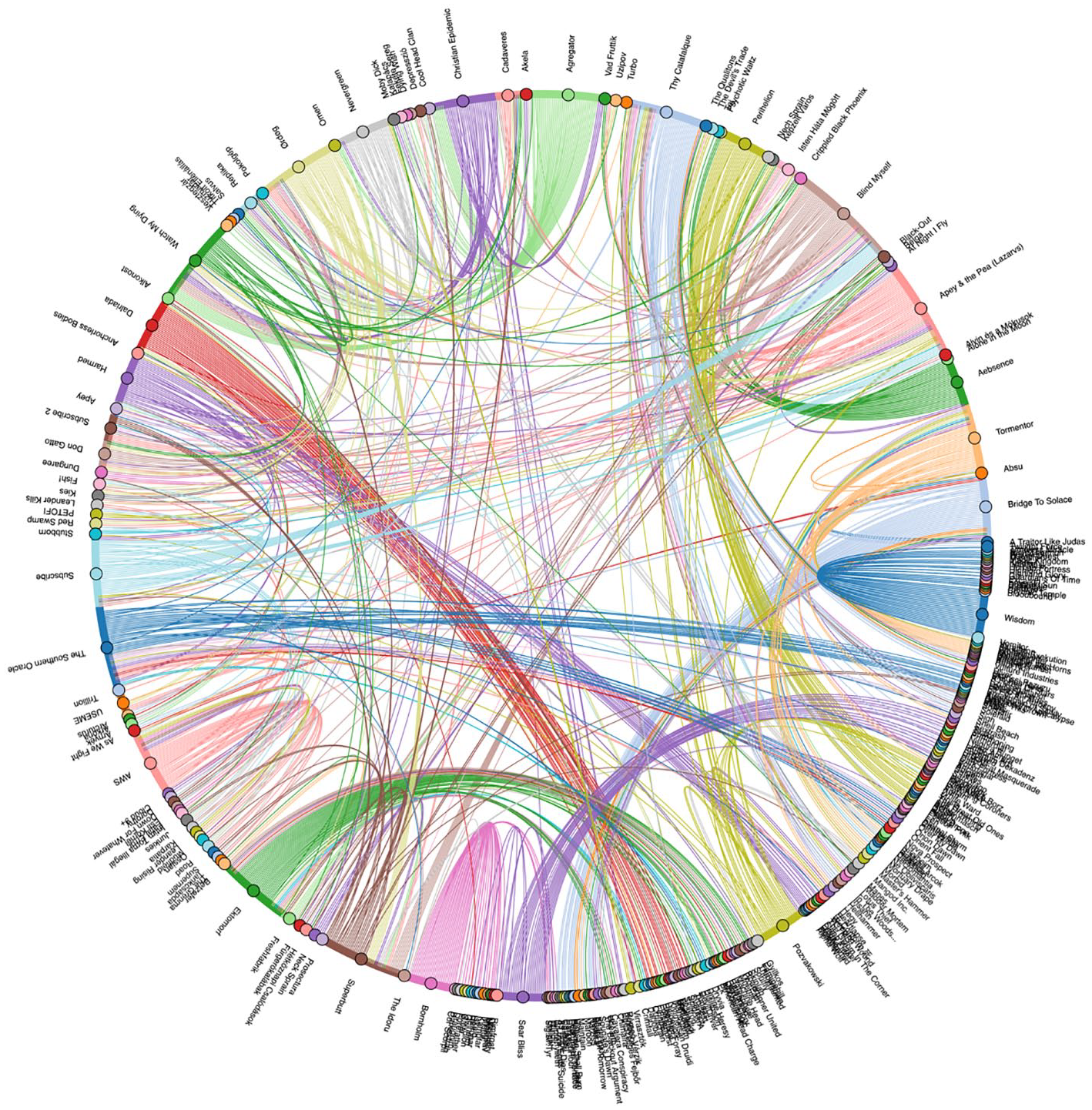
Illustration of the analyzed network.
Measures
Based on our research questions, the nodes’ (bands) main attributes were the following: label background of the source band (Hungarian vs international), the language of lyrics of the source band, country of origin of all bands. To determine if a source band was signed with a Hungarian or international record label, we looked at the publisher of their last (current) and next-to-last (penultimate) albums. If at least one of the two last albums were published by an international label, we recorded the band as having an international publishing background. If none of their last two albums were published by international labels (or were self-published), we considered them as having Hungarian publishing background. We classified the source bands’ lyrics into three categories: only Hungarian, only English, both. For this, we took into account all the band’s lyrics from the time the band was founded.
Results
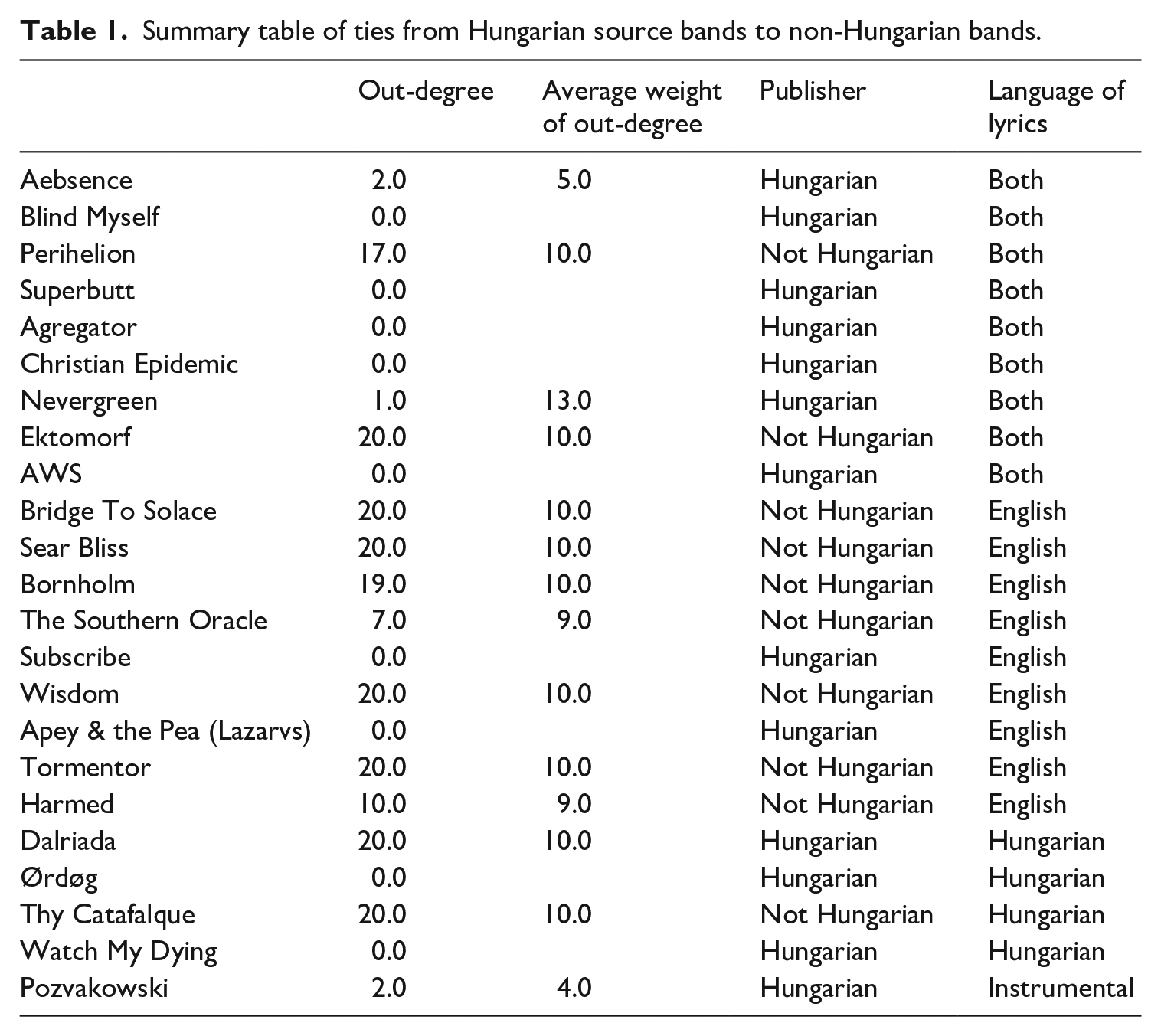
Our first research question focused on the number and importance of ties from the Hungarian source bands to the non-Hungarian bands. Table 1 shows a summary of these connections. The column out-degree denotes the number of ties going from the Hungarian source band to any non-Hungarian bands. The number shows how many non-Hungarian bands appeared on the given Hungarian source band’s related artists page. The average weights of out-degree were calculated only for those source bands, who have at least one tie to non-Hungarian bands, so those having at least one non-Hungarian band on their related artists page. We calculated the weights as described above; thus, the average weight shows the average importance of ties from the given source band to the non-Hungarian bands.
Summary table of ties from Hungarian source bands to non-Hungarian bands.
RQ1A. How do the Hungarian source bands’ label background and language of lyrics correlate with their weighted outward connections to non-Hungarian bands?
Hungarian source bands with Hungarian publishers connect to 1.9 non-Hungarian bands on average on their related artists page. In contrast, source bands with non-Hungarian publishers have 17.3 non-Hungarian bands on average on their related artists page. If we also factor in the importance of these connections, we can observe similar patterns. Hungarian source bands with Hungarian publishers and at least one connection with non-Hungarian bands also have the least important connections with these non-Hungarian bands. The average weight of these ties is 8.0 (on the 1–20 range). The same value for those Hungarian source bands who work with non-Hungarian publishers is 9.8.
If we consider the language of the lyrics of the Hungarian source bands, we can see similar tendencies in the out-degree of the bands. Those Hungarian source bands, whose lyrics are only in Hungarian, have 10.0 connections to non-Hungarian bands on average. The same number is 12.9 for those bands, whose lyrics are only in English—and interestingly even lower, 4.4 for those singing in both languages. It suggests that those who only sing in English have more non-Hungarian bands on their related artists page than those singing only in Hungarian or in both languages.
However, these tendencies do not apply to the importance of the connections. If we only take into account those Hungarian source bands, who have at least one connection to non-Hungarian (so have at least one non-Hungarian band on their related artists page), we can observe that the average weight of the connections is the highest (10.0) among those singing only in Hungarian, and slightly lower (9.7) among bands singing exclusively in English or in both languages (9.5). Both groups of bands have more important connections on average compared with those bands who sing both in English and Hungarian. These results suggest that the language of the lyrics matters in the number of connections with non-Hungarian bands, but not in the importance of these connections. However, it is considering the ratio of bands having non-Hungarian connections in the group of those singing in Hungarian: it is 50% (two out of the four Hungarian singing band), while the ratio in the group of those singing in English is 78% (seven out of the nine bands).
RQ1B. What is the country of origin of those non-Hungarian bands, to which the highest number of outward ties goes from the Hungarian source bands?
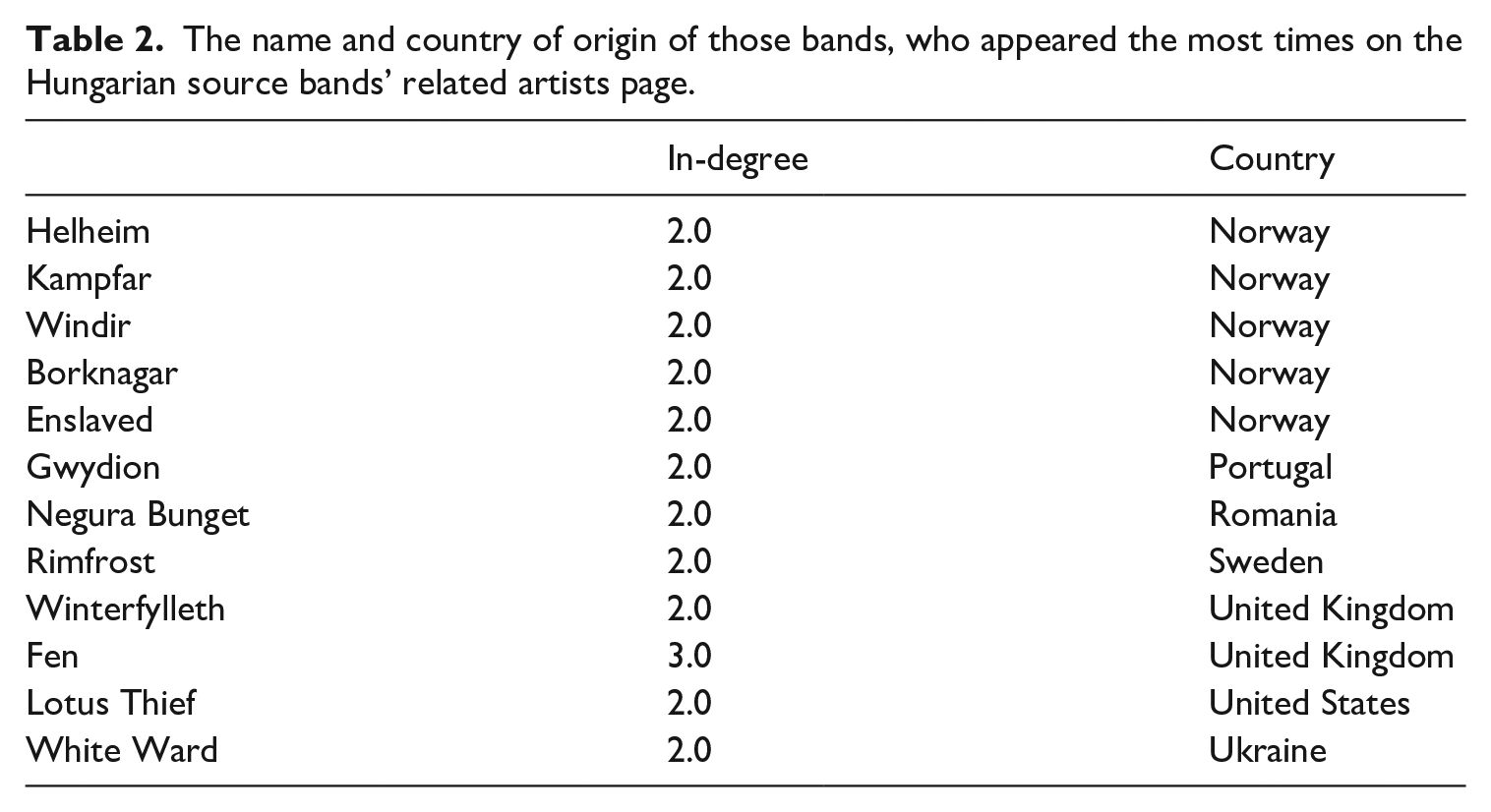
Of the 185 non-Hungarian bands recorded in our network, the vast majority (173) appeared in only one Hungarian source band’s related artists page. Eleven non-Hungarian bands appeared on two different Hungarian source bands’ related artists pages, and there was only one non-Hungarian band that appeared three times. Table 2 shows the name and country of origin of those bands that appeared at least on two different related artists pages. The column in-degree denotes the number of Hungarian source bands on whose related artists page the given non-Hungarian band appeared. One can observe that the most common country of origin among these bands is Norway, but we can find two bands from the United Kingdom in this list of 12 bands. The one band that appeared in three different related artists page of Hungarian source bands is a UK band called “Fen.”
The name and country of origin of those bands, who appeared the most times on the Hungarian source bands’ related artists page.
RQ2A. How do the Hungarian source bands’ label background and language of lyrics correlate with the number of their reciprocal connections with non-Hungarian bands?
Based on the definition above, a reciprocal tie is present between a Hungarian source band and a non-Hungarian band if the non-Hungarian band, which is present on the related artists page of a given Hungarian source band also lists the Hungarian source band on its related artists page. For instance, if Ektomorf (a Hungarian source band) has Chimaira (a non-Hungarian band) on its related artists page and Chimaira also has Ektomorf on its related artists page, then the tie between them is reciprocal. Reciprocity is calculated by the number of reciprocal ties divided by the number of all ties of a given band. In this case, for each Hungarian source band, reciprocity is calculated by the number of reciprocal ties with non-Hungarian bands divided by the number of all ties with non-Hungarian bands. Thus, the indices of reciprocity can only be calculated if the Hungarian source band has at least one tie to a non-Hungarian band.
Table 3 shows the summary of all Hungarian source bands’ characteristics regarding their reciprocity value, the number of reciprocal ties, their publisher (Hungarian or not Hungarian), and the language of their lyrics. Nine out of the 23 Hungarian source bands do not have any connections with non-Hungarian bands based on their related artists page. Eight of the 14 bands having at least one non-Hungarian connection have no reciprocal ties. All in all, six bands had reciprocal ties with non-Hungarian bands out of the examined 23. Among those where it was possible to calculate (where the Hungarian source band had at least one tie to a non-Hungarian band), the average reciprocity was 0.24, and the average number of reciprocal ties was 2.17.
Summary table of reciprocal ties between Hungarian source bands and non-Hungarian bands.
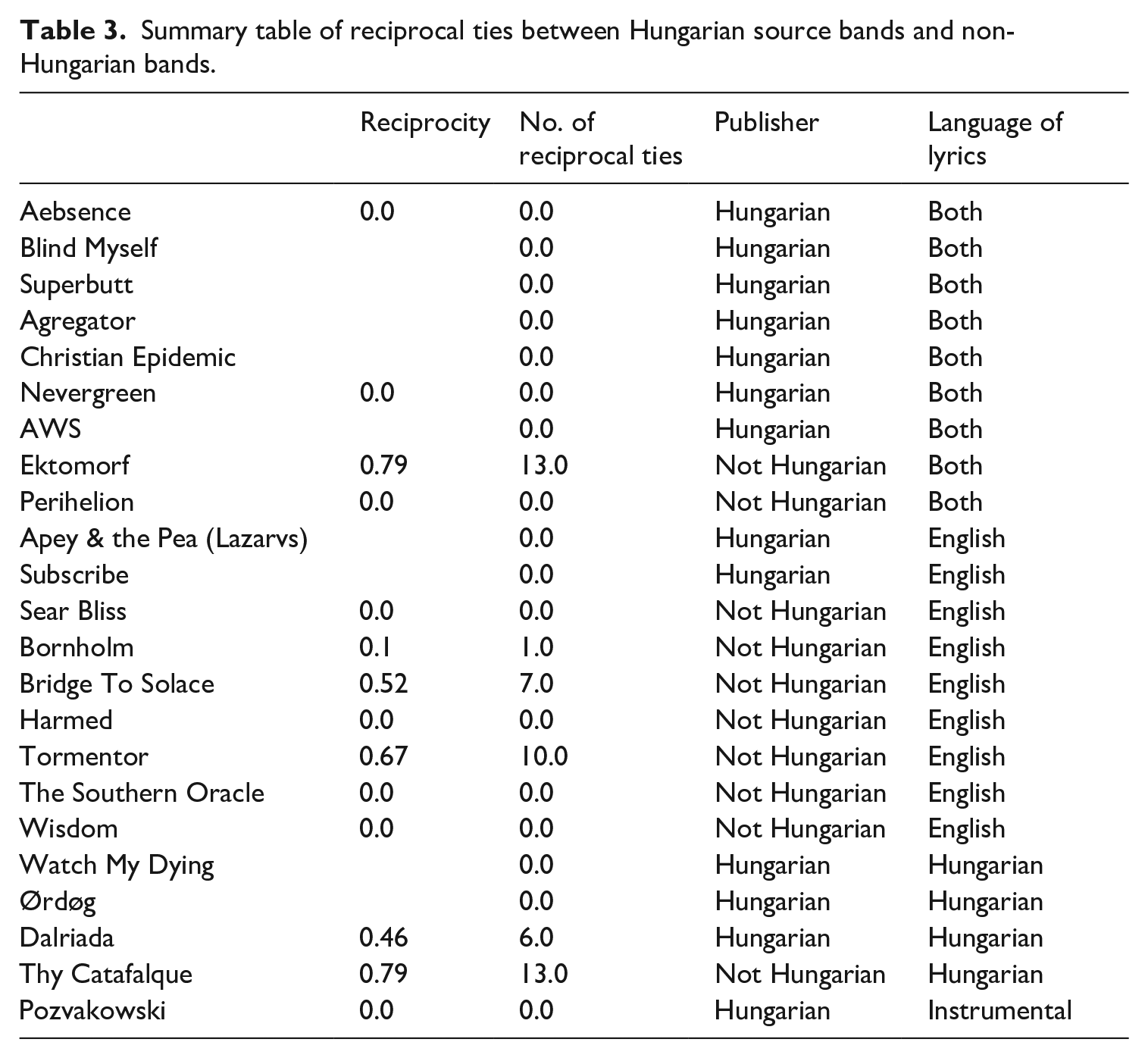
RQ2A focused on reciprocity and its correlation with the publisher and the language of lyrics of the Hungarian source band. We emphasize that calculations could only be made for those bands with at least one tie to non-Hungarian bands. Those Hungarian source bands, which have Hungarian publishers, had an average reciprocity of 0.11 with non-Hungarian bands, while the same number of those bands with a non-Hungarian publisher was 0.29. If we focus on the number of reciprocal ties between the source Hungarian band and the non-Hungarian bands, we can see an even larger difference. The average number of reciprocal ties is 0.46 among those with Hungarian publishers and 4.4 among those with non-Hungarian publishers. Both results suggest that a non-Hungarian publisher makes the presence of reciprocal ties with non-Hungarian bands more likely.
If we take the language of the lyrics into account, we can observe contradictory tendencies. Among those bands singing only in Hungarian, the average reciprocity is 0.62, while among those singing only in English or in both languages, it is much less (0.18 and 0.20, respectively). The same trend showed up in the number of reciprocal ties. The average number of reciprocal ties is 4.75 for source bands singing in Hungarian, but the same number is only 2.0 among those bands, which only have English lyrics and 1.44 among those singing in both languages. To understand these seemingly contradictory results, it is worth looking at the number of source bands in the different groups. There are only four source bands that sing only in Hungarian. Out of these, two of them have non-Hungarian connections, and these two bands are both reciprocal connections. Nine bands are using only English lyrics. Of these, all nine bands have at least one connection with a non-Hungarian band. Of these nine bands, three have reciprocal connections. Thus, the bases of the calculations—namely the number of those bands with at least one tie to a non-Hungarian band—are different in the two groups.
RQ2B. What is the country of origin of those non-Hungarian bands, with which Hungarian source bands have the highest number of reciprocal ties?
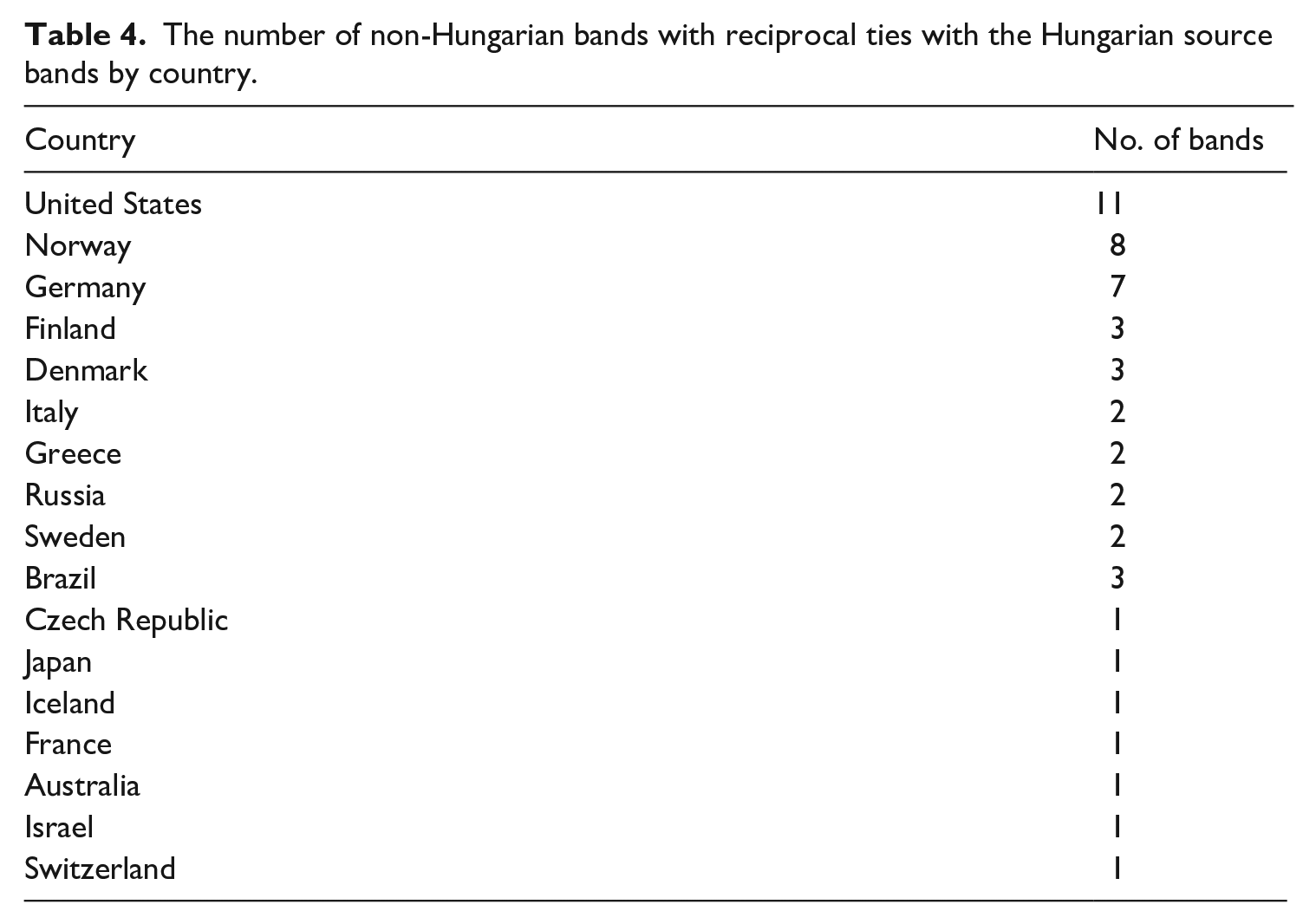
Altogether, we found 50 bands that had reciprocal connections with at least one Hungarian source band. As Table 4 shows, the relative majority (11) of these bands are from the United States, 8 are from Norway and 7 are from Germany, and 3 bands each from Finland, Denmark and Brazil. There are at most two bands from other countries, which have reciprocal connections with the Hungarian source bands.
The number of non-Hungarian bands with reciprocal ties with the Hungarian source bands by country.
RQ3. What are the main differences between the networks of two “typical” bands: one with international reciprocal connections and one with only domestic connections?
The third research question was related to two extreme cases of source bands. We present two case studies of the bands. The first Hungarian source band is called Apey & the Pea (Lazarvs) and has only Hungarian connections. The second band is called Ektomorf, and it has only non-Hungarian connections. Figure 2 shows the network of these two Hungarian bands. It illustrates several characteristics of the network. The middle node is the selected Hungarian source band. The closer another band is to the source band, the stronger the relationship between them (according to the weight of the tie from the source band). Green ties denote reciprocal connections, black one-direction connections from the source Hungarian band to the other band. The width of green ties is proportional to the weight of the tie from the band to the source band. The size of a band’s node is proportional to the number of the band’s monthly listeners on Spotify.
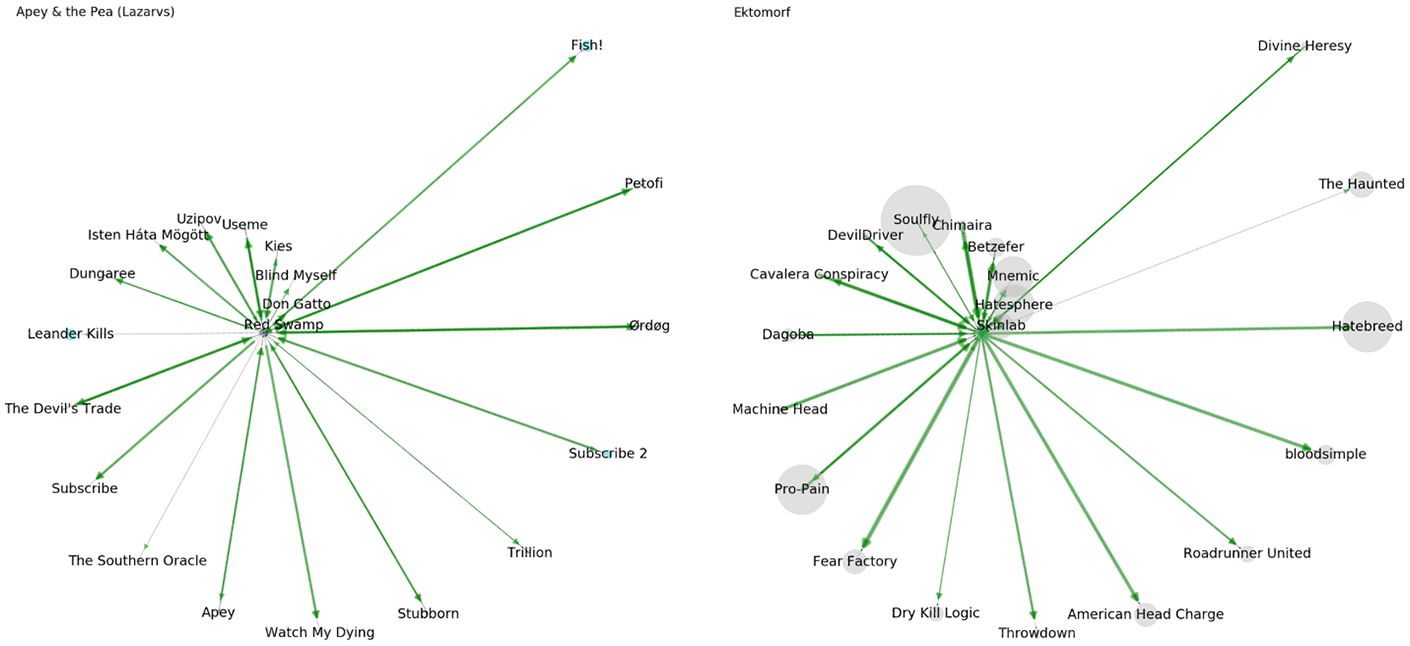
The network of two extreme patterned Hungarian source band: Apey & the Pea (Lazarvs) and Ektomorf.
Discussion
Based on our results, we can state that Spotify’s recommendation system mirrors offline inequality patterns. We examined the label background of Hungarian bands and the correlation with their international connections. In our case study, those Hungarian metal bands with international label backgrounds had way more international bands on their related artist page than those with Hungarian labels. This result is true for all types of connections, including reciprocal connections. It suggests that the origin of a band’s music publisher has a strong effect on the band’s international connections and thus access to wider audiences.
The metal music scene mirrors the music industry’s Anglo-Saxon dominance in general, and English is its most important language (Brown, 2007; Brown et al., 2016; Kahn-Harris, 2006; Wallach et al., 2012). An earlier study showed that the language of the lyrics of a band strongly affects the band’s international connections: those bands who sang in English had much more international connections than those who sang in other languages (Makkonen, 2017). From the point of outward connections, we found similar trends, and our results strengthen that of Makkonen’s. Bands’ English lyrics had a slightly higher number of international connections than those with exclusively Hungarian lyrics. Interestingly, a smaller number of international outward connections were detected for those bands who mix English and Hungarian in their lyrics. However, in the analysis of reciprocal connections between Hungarian and non-Hungarian bands, we found the opposite. Hungarian bands singing in Hungarian had the most (4.8) reciprocal connections with non-Hungarian bands on average. Those singing only in English had fewer (2.0) reciprocal connections on average, and we found the least number (1.4) of reciprocal connections for those who sing both in English and in Hungarian. As explained earlier, this seemingly contradictory result arose from our calculation method: reciprocity is calculated only among those bands which have at least one international connection. Of those bands singing in Hungarian, only a smaller portion had any connections with an international band, while of those singing in English, most bands had connections with international ones. Thus, there are big differences in the basis of the calculation between the two groups.
In addition to the label and language of lyrics, we examined the geographical background of the non-Hungarian bands, with which the Hungarian bands had outward or reciprocal connections. In extreme metal, traditionally, the United States, Germany, the United Kingdom, and three Nordic countries—Finland, Norway, and Sweden—are considered global centers (DeHart, 2018; Maguire, 2015). We found that if a connection is formed between a Hungarian and non-Hungarian band, it is very likely that the connected bands are from the global centers of the genre: 9 out of 12 in the case of outward connections, and 31 out of 50 bands in the case of reciprocal connections. Reciprocal connections are especially important in this case, as earlier studies showed that in most cases, the music of the centers is distributed to the periphery, but not the other way around (Stokes, 2004; Taylor, 1997). Related to our results, it means that a reciprocal connection helps bands get closer to the center and to have more people listen to them. What is even more striking, there are almost no ties between the former socialist countries in the Eastern part of the European Union (EU), which share geographical proximity and history: local bands are most likely isolated, but even if not, they are more likely connected to the global centers directly (we found 2 regionals out of 12 most frequent outward connections, and 1[!] out of 50 regional reciprocal connections), mirroring the offline regional dynamics (Tofalvy and Hagen, 2012). This matters as Hungary is on the periphery of the metal music scene, so the possibility of having a connection with a more centered band could open large opportunities for Hungarian bands.
We illustrated this by answering our third research question. We analyzed two bands of extreme values (one with only Hungarian and another with only non-Hungarian connections). The band with international reciprocal connections is more likely recommended based on actual similarity within the genre, but the band with only domestic connections tends to be paired by Spotify’s algorithm according to their country of origin. As it can be seen by comparing the networks of the bands Apey & the Pea (Lazarvs) and Ektomorf, the stronger the international relations are, the more genre-based are the recommendations. For example, Apey & the Pea (Lazarvs) have only Hungarian bands on their related artists page. However, the listed bands are very heterogeneous, representing various subgenres; the only commonality in the enlisted bands is that they are all Hungarian. As a contrast, Ektomorf’s international connections are very genre-specific, and even more importantly, they have a very strong presence on the related artists pages of leading bands of the genre. Another important difference between the Hungarian-only and the international network is the number of potential users who might click through to visit the source band’s page. For Apey & the Pea (Lazarvs), the sum of the monthly listeners of the bands they have reciprocal connections with is 11,037, with an average of 920. The same values in Ektomorf’s network are 3,059,658 and 235,358. This means that Ektomorf has a much bigger network involving a 255 times larger audience to potentially interact with their music.
Conclusion
This article explores the inequality fostered by streaming platforms through a small-scale network analysis case study. Unequal distribution patterns of music consumption and discovery did not disappear with the advent of the algorithm-driven digital space but rather reappeared and reformulated in the digital cultural industries (Hesmondhalgh, 2019). In the realm of digital music, bands operating from a central geographical location still have way more opportunities to distribute and communicate their work (Verboord and Noord, 2016). Under the auspices of the ubiquitous recommendation practices (Prey, 2018), controlled by platforms acting as the new gatekeepers (Aguiar and Waldfogel, 2018), practicing their newfound “algotorial power” (Bonini and Gandini, 2019), algorithmic bias and inequality (Bauer, 2019; Goldschmitt and Seaver, 2019) foster unequal music consumption and discovery patterns in the streaming ecosystem.
How could recommendation systems in a particular music scene reproduce such patterns of inequality? To understand this phenomenon, we posed the following question: how might Hungarian extreme metal bands’ geographic isolation be represented by the related artists feature of Spotify’s recommendation system? Using the tools of network analysis, combined with qualitative methods, we mapped out the connections between a sample of selected bands (n = 23) and those bands that were featured on their related artists page (n = 20 per band). We distinguished three levels of connectedness: on level 1, no international connections were suggested on the related artists page; on level 2, there were one or more international connections; on level 3, one or more of the international connections were reciprocal—meaning that the “source” band was featured on the related artist’s “related artist” page too.
From the results, it can be seen that the way bands are represented in the recommendation system—the way they are connected to other bands—significantly overlaps with their offline connections in the music industry. Those bands signed with international labels have more level 3 connections and are more likely to be recommended based on genre similarity. However, bands published by Hungarian labels or are self-published tend to have level 1 connections and tend to be paired with other artists by Spotify’s recommendation system according to their country of origin. Also, the stronger the international connections are, the more genre-based are the recommendations. Based on that sample, it seems like the primary determinant of outward and reciprocal connections in the recommendation system is label connections. This way, the streaming platform replicates and reproduces local industry patterns, as the recommendation system represents and reproduces the bands’ geographical (dis)advantage at the same time.
We emphasize that algorithms are not the only ones to blame for reproducing inequalities in the music industry. As part of the “black box” problem, we have scarce information on how the ratio of algorithmic and human curatorial decisions is distributed on the platform and exactly which decision- making mechanism is dedicated to human or automated agents (as described in detail by Bonini and Gandini, 2019). However, most probably, the decisions regarding related artists tabs are outcomes of automatized mechanisms mainly because of the sheer amount. Hundreds of thousands of artists’ connections cannot be managed by human agents. Yet, even this process might include a certain amount of direct human intervention too. Besides the ultimate human design of algorithms and various human interventions in their functioning, human listeners signal and share their decisions via the interface while interacting with algorithms. By unearthing such invisible patterns of a particular recommendation system, we aimed to understand better how the sociotechnical system of music recommendation works and reproduces existing music industry inequalities in the streaming ecosystem.
Supplemental Material
sj-html-3-nms-10.1177_14614448211022161 – Supplemental material for “Splendid Isolation”: The reproduction of music industry inequalities in Spotify’s recommendation system
Supplemental material, sj-html-3-nms-10.1177_14614448211022161 for “Splendid Isolation”: The reproduction of music industry inequalities in Spotify’s recommendation system by Tamas Tofalvy and Júlia Koltai in New Media & Society
Supplemental Material
sj-png-4-nms-10.1177_14614448211022161 – Supplemental material for “Splendid Isolation”: The reproduction of music industry inequalities in Spotify’s recommendation system
Supplemental material, sj-png-4-nms-10.1177_14614448211022161 for “Splendid Isolation”: The reproduction of music industry inequalities in Spotify’s recommendation system by Tamas Tofalvy and Júlia Koltai in New Media & Society
Supplemental Material
sj-png-5-nms-10.1177_14614448211022161 – Supplemental material for “Splendid Isolation”: The reproduction of music industry inequalities in Spotify’s recommendation system
Supplemental material, sj-png-5-nms-10.1177_14614448211022161 for “Splendid Isolation”: The reproduction of music industry inequalities in Spotify’s recommendation system by Tamas Tofalvy and Júlia Koltai in New Media & Society
Supplemental Material
sj-png-6-nms-10.1177_14614448211022161 – Supplemental material for “Splendid Isolation”: The reproduction of music industry inequalities in Spotify’s recommendation system
Supplemental material, sj-png-6-nms-10.1177_14614448211022161 for “Splendid Isolation”: The reproduction of music industry inequalities in Spotify’s recommendation system by Tamas Tofalvy and Júlia Koltai in New Media & Society
Research Data
sj-csv-1-nms-10.1177_14614448211022161 – Research Data for “Splendid Isolation”: The reproduction of music industry inequalities in Spotify’s recommendation system
Research Data, sj-csv-1-nms-10.1177_14614448211022161 for “Splendid Isolation”: The reproduction of music industry inequalities in Spotify’s recommendation system by Tamas Tofalvy and Júlia Koltai in New Media & Society
Research Data
sj-csv-2-nms-10.1177_14614448211022161 – Research Data for “Splendid Isolation”: The reproduction of music industry inequalities in Spotify’s recommendation system
Research Data, sj-csv-2-nms-10.1177_14614448211022161 for “Splendid Isolation”: The reproduction of music industry inequalities in Spotify’s recommendation system by Tamas Tofalvy and Júlia Koltai in New Media & Society
Footnotes
Acknowledgements
The authors wish to thank the comments of the anonymous reviewers and the help of the research assistants, Szabolcs Bodri, Márton Kovács and Tamás Somogyi.
Funding
The author(s) disclosed receipt of the following financial support for the research, authorship, and/or publication of this article: The work of Tamas Tofalvy was supported by the János Bolyai Research Scholarship of the Hungarian Academy of Sciences. The work of Julia Koltai was funded by the Premium Postdoctoral Grant of the Hungarian Academy of Sciences.

Statement on research materials
All underlying research materials are available for further research purposes upon request.
Supplemental material
Supplemental material for this article is available online.
Notes
Author biographies
References
Supplementary Material
Please find the following supplemental material available below.
For Open Access articles published under a Creative Commons License, all supplemental material carries the same license as the article it is associated with.
For non-Open Access articles published, all supplemental material carries a non-exclusive license, and permission requests for re-use of supplemental material or any part of supplemental material shall be sent directly to the copyright owner as specified in the copyright notice associated with the article.


