




Abstract
This article examines how practices of family photography are being transformed in the digital sphere, specifically on Instagram. While research on ‘digital intimacies’ focusses on romantic or peer interactions, the digital practices of families – especially intergenerational interactions – remain understudied. We use Janet Finch’s notion of ‘family display’ to consider how Instagram affords new modes of performing and sharing family life. This concept has exciting potential for media-rich online spaces, but so far, only a few studies examine how social media platforms extend the display of family practices. To explore family photography on Instagram, we analyse a sample of 200 Instagram posts. We argue that features specific to photo-sharing in digital spaces, such as hashtags, emojis and captions, open up new aspects of and audiences for family display. Our analysis paves the way for future research about how relationships are displayed across a range of digital platforms.
Keywords
Introduction
This article examines how practices of family photography operate in the digital sphere, specifically on the image-driven Instagram platform. Where families once took photographs of special events and pasted them in albums to be taken out occasionally to reminisce or show visitors, family photographs are now often shared and archived online. On Instagram, family images can be hashtagged, geo-coded and potentially viewed at any time by family and friends, and also much wider publics. In this article, our objective is to use Janet Finch’s (2007) notion of ‘family display’ in tandem with an empirical study of a sample of Instagram posts to consider how Instagram affords new modes of performing and sharing family practices and intimacies. Finch’s concept has been used to explore how families make their ‘family-ness’ visible to others (Dermott and Seymour, 2011). This idea has exciting potential for media-rich online spaces, but so far few studies examine how digital photography and social media are used to display family practices (Cabalquinto, 2019; Shannon, 2019; Share et al., 2018). An apt arena for such a study, Instagram is a popular photo- and video-sharing social media platform, having reached 1 billion monthly active users in June 2018 (Statista, 2019c). The platform combines a user-friendly interface with features that enhance its social affordances, such as hashtags and emojis. The hashtag is a core feature of the platform as users employ it to characterise photographs and share them with other (private or public) users (Sheldon and Bryant, 2016). We argue that these features extend the public life of intimate moments and open up new aspects of family display.
To study family photography on Instagram, we conducted a qualitative analysis of a sample of 200 Instagram posts that are hashtagged with family themes and depict interactions between grandparents, parents, children and/or wider kin. The contribution of the article is twofold. First, we contribute an analysis of what is specific to family posts on Instagram and foreground the normative implications of how family is practised visually on the platform. This addresses an existing gap in ‘digital intimacies’ research, which has primarily focussed on non-familial relations. Second, by drawing out the relevance of the sociological concept of family display, we demonstrate the value of this extended framework for scholars of digital media and visual culture. While we focus on Instagram, our analysis paves the way for future conversations about how family relationships are displayed across digital platforms and through a range of practices.
We begin by situating our study within existing work on digital intimacies. To extend this field, we outline and develop Finch’s concept of family display for analysing how familial intimacies are represented and shared on Instagram. After an overview of our methodology, we analyse representations of three central intergenerational relationships. We conclude with a discussion of how family photography as a mode of displaying intimacy endures and changes in concert with the social and technical affordances of social networking sites (SNSs).
‘Digital intimacies’ and the intergenerational family
In contemporary sociology and media studies, studying ‘digital intimacy’ is often equated with studying romantic or peer relationships, online dating, sexting and so on. But intimacy was not always seen this way. According to Lynn Jamieson (1998), contemporary studies of intimacy and personal life are defined, to an extent, against a prior dominant focus on ‘the family’ or household. Following a postmodern shift, ‘intimacy’ was refocussed, locating ‘one or more good relationships (ideally encompassing a good sex life) [. . .] at the centre of personal life, not “the family”’ (Jamieson, 1998: 19). Thus, contemporary studies of intimacy – both on- and offline – have sought to explore intimacy beyond the family, including friendships, nonmarital romantic and sexual relationships, and non-traditional kinship (Chambers, 2012; Roseneil and Budgeon, 2004). While it is clear that widening the scope has been productive, this is somewhat at the expense of insights into contemporary family life (Attwood et al., 2017; Edwards et al., 2012; Gilding, 2010). We argue that it is worth revisiting the intergenerational family – as a social unit and set of practices – in the age of social media to examine how it operates in a world of diverse connections and relationships, and between increasingly blurred public and private spheres. As sociologists of the family and personal life have argued (Dempsey and Lindsay, 2014; May and Nordqvist, 2019; Smart, 2007), it is important to critically examine how family kinships have waned, persisted, or been refigured. In this tradition, we see family as a set of practices rather than a pregiven form and study how people actively do and display family (Morgan, 2011).
By returning to a study of family intimacies, we open new ground for research on digital intimacy. Setting the scope for the ‘digital intimacy’ field, Dobson et al. (2018) argue that the aim is to move beyond the sphere of the heteronormative family, and to examine less conventional forms of intimate life in online spaces, very often expressions of sexuality and community within the frameworks of queer theory (p. 7). As Dobson et al. explain, ‘social media figures in processes of [. . .] ordering relationships and shaping what appears as intimate [. . .]’, especially in relation to ‘(hetero) normative notions of intimacy [. . .]’ (p. 4). We argue that there is value in looking again at how more ‘traditional’ sites of intimacy, like the family, are ordered and displayed as intimate lives online. By returning to familial intimacies, we challenge the notion that ‘the family’ sits as a static concept for contemporary studies to work against. Locating family as a site of digital intimacy we can examine how representations of ‘the family’ might be transformed by inclusive expressions of intimacy, as well as how they enlist people into enduring models of what intimacy should look like. As shown by a rich body of sociological knowledge, families can have a ‘double life’: they can offer love and support, but also exclusion and violence (Bittman and Pixley, 2020 [1997]). This article takes an inductive approach to family and aims to explore how users in our sample display their families rather than offering a corrective. As we return to later, we acknowledge that Instagram posts of families, in line with traditional family photography, are often positive and do not necessarily capture difficult aspects of familial intimacies or represent diverse kin structures.
Our intergenerational focus takes a wider demographic of users into view. This shift answers calls from scholars of generations and media, where Göran Bolin (2016) argues that intragenerational analyses of media cultures shared by people of specific age cohorts have rarely been put in their intergenerational context. Similar to current theory on intimacy, research on relationships and social media has focussed on horizontal connections, and particularly young people’s peer interactions (e.g. Berriman and Thomson, 2015; boyd, 2014). While young people are most likely to use SNSs, use among other groups is increasing – for example, 67% of older Australians (aged 65 +) used SNSs in 2018 (Statista, 2019a). SNSs are part of the social routines of an increasing number of people across age groups in contemporary society (Perrin, 2015). Our focus on the intergenerational family is useful because it captures how users display the value of family bonds across generations and how they represent times spent with family as important practices within the broader ecology of their intimate lives. As we will discuss, specific relationships – such as those between parents and children or between grandparents and grandchildren – are attended by a set of normative concerns about how to depict family intimacies in digital spaces.
Family practices and display
To open the scope for visual analysis, we enlist the sociological concept of ‘family display’ as a framework for analysing how family lives are represented and shaped online as ‘digital intimacies’. We demonstrate family display’s value for drawing out the visual dimensions of how intimacies are worked through in the ‘intimate publics’ of social media, where only a few studies have applied it (Cabalquinto, 2019; Shannon, 2019; Share et al., 2018). In his seminal book Rethinking Family Practices, David Morgan (2011) challenges the idea of ‘the family’ as an entity, and instead defines family as a set of practices. For Morgan, family is created in practice rather than being a pre-established unit to which we intrinsically belong. With relevance to our study, Janet Finch develops Morgan’s concept, adding ‘family display’ to ‘family practice’ and contending that we also need to ‘show’ what we ‘do’. A practice in itself, display functions as a means to share everyday activities with wider publics to affirm our practices as specifically ‘family’ ones. Finch (2007) explains: By ‘displaying’ I mean to emphasise the fundamentally social nature of family practices, where the meaning of one’s actions has to be both conveyed to and understood by relevant others if those actions are to be effective as constituting ‘family’ practices. (p. 66)
The way families display then, while emphasising creative agency, is still part of a social field where ideals about family life – or what qualifies as ‘good’ intimacy – can significantly shape representations.
Displays of family become important ways for people to brand their relationships with a particular quality, character, or identity (Finch, 2007), such as a ‘fun’ style of parenting or a ‘best friend’-like sibling relationship. An important consideration is who displays are for – ‘whose recognition of the family-like quality of relationships is important, and how that recognition is conveyed’ (p. 74). Finch explains that the recognition sought and given can be from a family member or by the public, which in our study might be the user’s Instagram followers. Finch (2007) theorises that ‘tools’ for family display, include family photography and domestic artefacts, gift-giving, and making phone calls, but she does not include digital tools (p. 77). Hence, our use of the display concept extends its capacity and location into social media, and explores specific forms of digital display that reflect and refigure traditional modes of composing and consuming family photography. In the next section, we discuss this reconfiguring of photography.
Family photography in the digital age
The practice of posting family photographs on SNSs calls for attention to how the platform mediates and changes the established family practices of taking, archiving and sharing photos and what this means for family display. Gillian Rose (2010 and 2014) has argued that digital technologies have not changed family photography but rather intensified it – in terms of an increase in the number of photos taken, how they are organised and how they are shared. However, we contend that at least two aspects of family photography do seem to change when moved to an online social media platform, such as Instagram.
First of all, the audience changes. Rose defines family photos as ‘photos that get taken by a member of a family, that show members of that family, and that are viewed mostly by other members of that same family, and often by a few close friends’ (2014, p. 71, our emphasis). Yet on Instagram users can choose to have a public profile and to caption their photographs with certain hashtags that make them visible and searchable, meaning that the audience is extended to potentially all Instagram users. One question that arises from this is whether it alters the type of photos, and the type of family display, posted online. While in Rose’s study the quality of the photos was less important than simply ‘confirming the event as memorable’ (p. 80), we wonder if the different and wider audience creates a ‘filter’, so only ‘quality content’ is posted.
Second, the notion of the photo album changes on Instagram where it is possible to merge the photo album(s) of the individual user with collective albums created under specific hashtags or for specific geo-locations. When using hashtags in an Instagram post, the user not only adds a photograph to their own online archive of photographs, but also adds to hashtag ‘albums’, or what Thimm (2015) refers to as ‘mini-publics’, where other users, unknown to the user, can view the photograph (Thimm and Nehls, 2017). Hashtagging contributes to social engagement within the site and to the construction of a community around themes (Sheldon and Bryant, 2016), and we contend that this is core to how Instagram makes ‘family display’ more public. Thimm and Nehls (2017) argue that the role and use of the hashtag has developed over time, from ‘merely’ being a way of linking one’s own Instagram post into existing hashtags, to containing distinct semiotic meanings despite the apparent lack of structure. They termed this the ‘hashtag narrative’ – a central part of the Instagram post. Taken together, these differences suggest that using Instagram as a platform and tool to display family photography goes beyond the purposes of traditional family photography – beyond ‘merely’ sharing memories between family members. Indeed, Julia Hirsch’s (1981) classic definition of family photography, as showing a relationship or resemblance between kin (p. 3), gets complicated on Instagram where not only the image itself can depict kin relations, but also captions, hashtags or emojis. This requires a sophisticated analytical approach, where we attend to the unity of image, caption, hashtags and emojis to explore what the affordances of Instagram as a platform mean for family display. Davis and Chouinard (2016) define affordances as ‘the range of functions and constraints that an object provides for, and places upon, structurally situated subjects’ (p. 241). We draw on this sociological approach to affordances, which considers the interplay between human agency and sociotechnical structures in enacting particular uses of technology. Thus, we seek to explore the links between the visual, textual, and interactive affordances inscribed into the platform and how users enact and employ those affordances to display and do family. We return to this below.
Image-driven sites, such as Instagram have been framed as more intimate than other SNSs (Hart, 2015; Kanai, 2019; Miguel, 2016; Serafinelli, 2018). Instagram has emerged as a unique platform to (a) share images and (b) study family-related topics due to its strong visual affordances but also textual capabilities (Locatelli, 2017). Studies of how families are represented on this platform are limited, though notable exceptions include explorations of family snapshots (Cabalquinto, 2019; Le Moignan et al., 2017; Shannon, 2019), breastfeeding and motherhood (Locatelli, 2017; Zappavigna, 2016), and death and grieving (Gibbs et al., 2015; Leaver and Highfield, 2018; Thimm and Nehls, 2017). Here, we detail the two studies that most relate to our own. First, Locatelli’s (2017) study of breastfeeding images on Instagram showed how parents (mainly mothers) posted photographs to ‘tell, save, and share’. Instagram was mostly used in two ways: (1) to document their breastfeeding journey through ‘brelfies’ (a selfie of breastfeeding) and provide a visual diary of early parenthood and infancy and (2) to share practices and inform a discussion on public breastfeeding since most mothers were also ‘breastfeeding advocates’/‘lactivists’ (Locatelli, 2017). These types of family photographs are at the intersection of public and private spheres. Second, Le Moignan et al. (2017) large-scale study of 4000 Instagram posts investigated parents’ use of Instagram to document and share family life. They found that the change of medium to Instagram did not alter the composition of the photos, or the tendency to privilege a positive image of family life (Le Moignan et al., 2017). They further noted a performative trend, ‘the good parenting selfie’, which depicts the parents as good parents.
We refer to these findings when analysing our data below as we contribute to existing discussions about the sociological dimensions of Instagram use. In our analysis, we show how the affordances of Instagram, especially hashtags and captions, allow users to display the ‘family time’ they spend together in new ways that both draw on and modify existing scripts of family practices. We are interested in how normative ideals and broader narratives about family life influence users’ depictions, and also how SNS users challenge scripts of what a family or family time should look like. First, we introduce our methods and sample.
Methods and data
To explore different family representations on Instagram, we carried out a qualitative study of a purposive sample of posts (pictures and text) related to family relationships from users with public profiles. This study was approved by the XX University Ethics Committee prior to commencement. Data collection and sampling was based on a three-stage sequential approach. First, using hashtags to determine the scope of research (Highfield and Leaver, 2014), we looked at the main trends associated with family. We started with #family and then identified the most used family-related hashtags at the time of data collection, such as #familymemories (> 130,000), #motherdaughter (> 2,000,000), #fatherson (> 600,000), #fatherdaugther (> 900,000) and #motherson (> 270,000). To maximise diversity in our sample, we included other hashtags, such as #modernfamilies and #gayfamilies, and hashtags associated with intergenerational relationships (e.g. #grandmatime), special family moments (e.g. #mothersday), and memories (e.g. #throwbackfamilyphoto). These hashtags were identified through a ‘snowballing’ process, exploring related hashtags on posts with the ‘most used’ hashtags. Table 1 shows the hashtags included in our analysis. Our sample is limited to users employing the English versions of the hashtags.
Examples of hashtags.
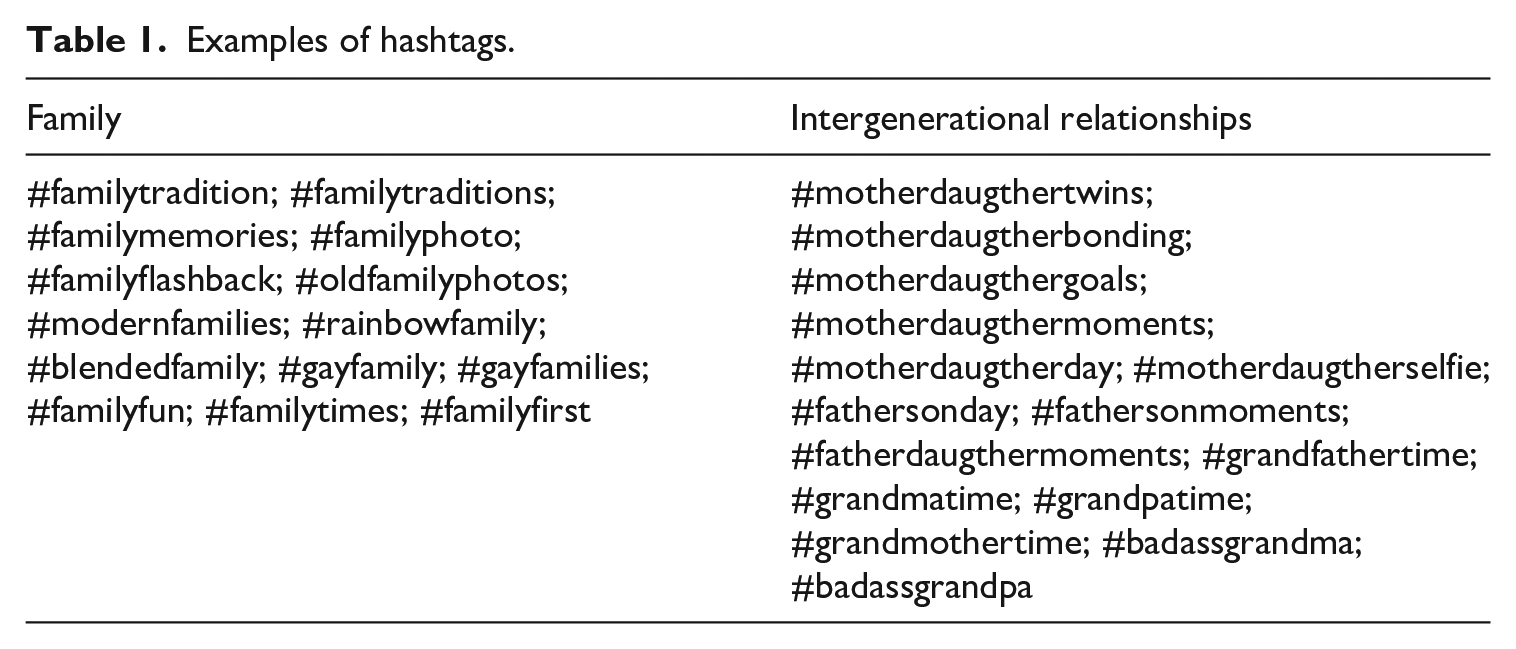
Second, we worked together to familiarise ourselves with the selected hashtags and identify main trends to inform the sampling selection criteria. For example, #motherdaughtertime focussed on self-improvement, beauty and fitness, whereas #fathersontime featured a different genre of leisure – videogames, cars and hunting. This helped us get a sense of the diversity within and between each hashtag to inform our sampling.
Third, to define the final sample and our data collection process, we applied a number of selection criteria. We conducted this iteratively and collectively. To avoid ‘reading too much into’ posts (and potential bias), we selected those that were most relevant based on the following: pictures should depict (a) people, (b) intergenerational relationships and (c) diverse family representations, including blended families and rainbow families. This meant that if there were five heteronormative parenting images and one queer parenting image, we always included the minority image for diversity. We excluded pictures of landscapes or objects not directly portraying family themes and where the caption did not elucidate the use of the selected hashtags. To include these would have required speculation. We restricted the number of pictures depicting similar events, such as getting facials or manicures/pedicures. We found these photographs to be uniform in composition, and we therefore chose illustrative examples privileging those with detailed captions, emojis, and hashtags. Finally, we excluded posts where the profile was clearly for commercial purposes rather than a social user, for example, one profile was a gym. This follows research that foregrounds ethical issues around examining posts that are relational and also commoditised (Locatelli, 2017; Reade, 2020).
In August–September 2017, we collected 150 public posts, which included images, user data, text and comments. However, during the preliminary analysis stage, we realised that around 50 of the posts were no longer available publicly. For ethical reasons, we decided to replace them. This led to supplementing the dataset with 100 new posts. Thus, the total database consists of 200 posts. Due to Instagram’s recent changes to their application programming interface (API) and terms of use, data collection was manual. We did, nonetheless, use a Chrome extension developed by a colleague to facilitate data extraction.
Considering the importance of both institutional ethics and ‘ethics-in-practice’ (Guillemin & Gillam, 2004), and although the images and captions posted on Instagram are public, we asked users permission to reproduce the content included in this article (for a detailed discussion of our ethical approach see Ravn, Barnwell and Barbosa Neves, 2020). We removed usernames to minimise identification and only included quotations that were authorised by users who were made aware of the study and related privacy issues. During the ongoing data analysis process, we removed posts from our sample that were no longer available online. These procedures align with the best practices in the field (Highfield and Leaver, 2016; Locatelli, 2017).
To analyse the posts in the sample we looked at content, audience, context, authorship of each picture, caption and hashtags. Adding to images and captions, digital ethnographer Haidy Geismar (2017) underlines the importance of the hashtag as a site of social analysis, as ‘users cluster around hashtags to share their communal experience’ and ‘the clustering of images around hashtags also generates a shared visual sensibility’ (p. 336). Methodologists agree that conventional methods used to analyse text have proven fruitful to also analyse images and visual data (Saldaña, 2015). With our overarching framework in mind – family display – we combined image and text (including hashtags) as analytical units and used thematic analysis to identify patterns within and across posts. For this, we followed the six steps of thematic analysis (Braun and Clarke, 2006), namely: first, getting acquainted with the data and noting preliminary ideas; second, generating initial codes through an analysis of the data; third, grouping codes into possible themes; fourth, developing a thematic diagram; fifth, refining themes and their meaning and sixth, collating and connecting all themes back to our research aims.
Benefitting from the flexibility of this approach, we drew on a combined visual and textual analysis to provide a rich understanding of the data. We coded the picture first, followed by the text and then brought them together to ensure a holistic approach to the multimodal data. The three authors coded the data collectively, which enabled us to discuss and address any discrepancies dialogically on the spot and to come to an analytical consensus. Discrepancies were few, but mainly concerned different readings of the intended audience and what specific hashtags might mean or allude to, for instance, whether a given post was intended for family and friends only, or if the imagined audience was broader. As clarified in the analysis, the hashtags were central in determining this. When analysing the posts we kept Finch’s concept in mind to ask: what is specifically ‘family’ about the post? And how does the family use the post to document and share their practices with others? We also looked at what Instagram made possible for users in terms of recording and sharing their familial activities and relations. How did this replicate, extend or differ from traditional modes of photographing the family and curating a family album?
In the following section, we report on the overall themes identified in the thematic analysis of our sample and use illustrative posts to look in-depth at how Instagram is used for family display. Digital ethnographers have noted the importance of supplementing analysis of larger samples of Instagram posts with close analysis of specific images – or a ‘small data’ approach – to bring out the ‘rich layers of meaning to users’ content’ (Utekhin, 2017: 185). We explore three main types of intergenerational family photographs that we found on Instagram. These photographs depict time spent as an intergenerational family group and in more specific intergenerational relationships – parent/child and grandparent/grandchild. Our analysis shows how each of these forms of intergenerational family relationships are attended by a set of trends, for example in their differing focus on gender, age and so on, and also by common tropes, such as the use of positive and affectionate hashtags, language and emojis.
Analysing family lives on Instagram
Family time
This theme captures the diverse ways that users display how they spend family time together and depict their bonds as intimate and familial. Clear patterns among these posts included a majority of events, such as family holidays, birthday celebrations or family reunions. A common trend was families wearing matching clothes. In addition to these ‘special occasion’ posts, and in line with the findings of Le Moignan et al. (2017), there were a few posts that depicted more ‘everyday’ family time, including cooking meals or brushing teeth together. One image also depicted a transnational family talking over Skype.
Many of these posts used the popular hashtags #familytime and/or #familytradition. Displaying intimacy, the captions often marked the posts as ‘family’ and included emotive and affectionate language, such as ‘love’, ‘gratitude’, ‘thankful’, ‘miss you’ and ‘happy’. Family monikers were also present, with posts referring to people pictured as ‘mum’, ‘dad’, ‘uncle X’ and ‘grandfather’, and users often used collective pronouns, such as ‘our’ or ‘we’, for example, ‘our favorite place!’ or ‘we share stories’. Finally, posts also commonly represented the time displayed as light-hearted, with big smiles and reference in captions to ‘laughter’ and ‘fun’ and ‘happy place’.
Offering an illustrative example of the images using general family hashtags, such as #family and #myfamily, the image in Figure 1 depicts a family gathering celebrating Eid. Family members from several generations wear traditional batik fabrics with a shared colour scheme of blue and yellow. They pose and smile for the camera. People stand closely and are touching in some cases.
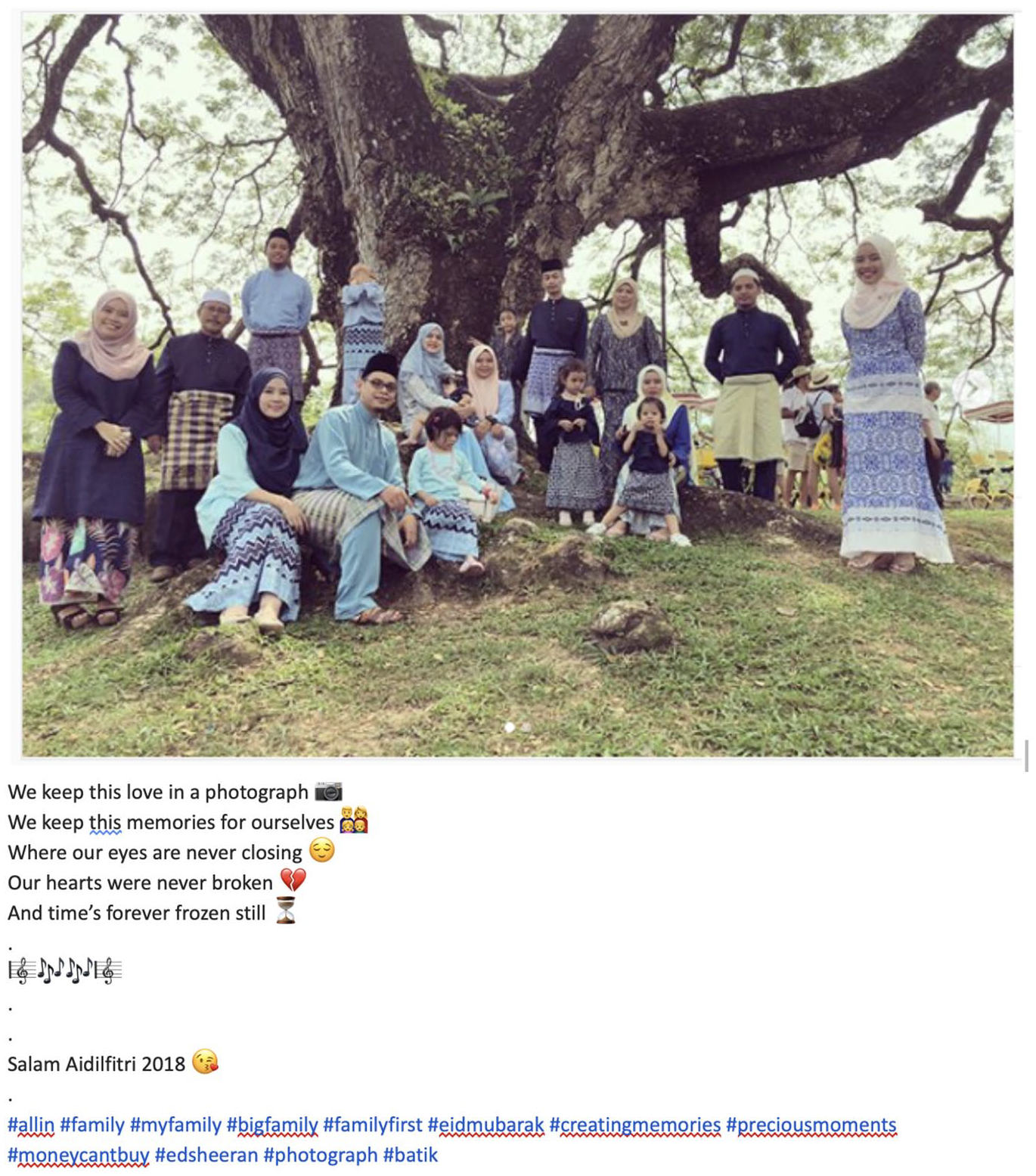
The image displays family resemblance in the clothing and colours, and the tree evokes the symbology of family, roots and genealogy. The hashtags identify the occasion, #eidmubarak, and the value of family, #familyfirst and #moneycantbuy. Practices of photography are also explicitly referenced with #photograph, #creatingmemories and the camera emoji. The caption quotes from a popular song by singer Ed Sheeran, released in 2014 (#edsheeran is also hashtagged, indexing the image to his fanbase). The song is about how photographs capture loving moments, allowing them to endure. Brought together, the image, caption, emojis and hashtags mark the post as family photography and index the family’s practices within wider cultural frameworks with references to the celebration of Eid and popular music about memory and sentimentality. Celebrating together and posing for a family photograph, explicitly to ‘create memories’, are both practices that are displayed via Instagram for an audience wider than the family, as determined by the hashtags. Here, we see how the use of hashtags is useful for addressing and extending Finch’s (2007) questions about ‘how display is done’ and also ‘who display is for’ (p. 67), as in this example hashtags potentially link to family, and also the wider religious community and even a musical taste/fan community.
Figure 2 similarly uses #family and #familytradition, but illustrates a different aspect of how users display time spent as a family. The caption and the hashtags emphasise the labour of ‘doing family’ and offer insights into the intimate ‘behind-the-scenes’ effort and emotions of composing the family photograph. Two images are collaged together. Both depict the family – mum, dad, and three children – gathered around a cake at the dinner table. One image is taken before and one is taken after the candles have been blown out. The mother writes the lengthy, narrative caption and explains that she dropped the cake and reassembled it haphazardly for the photo, then in a comedy of errors, ‘Chad’ burns himself on the candles. Both events show the work that goes into performing family life for each other and for the camera. Family is represented as forgiving and resilient in the face of falling short of perfect. After the cake falls apart, ‘Sam said, “Don’t worry, Mom. It’s just a cake. It [sic] know if you just do your best it will be perfect”’. The majority of the hashtags underline this theme of family as not perfect but ‘making do’ – #seethegood #keeptrying #makingthebestofit #justgowithit #tendermercies. Fulfilling both an indexing and a narrative function, these hashtags play an integral part in shaping and sharing the story, as they capture the ‘perseverance’ and ‘frontstage/backstage’ themes of the family post.
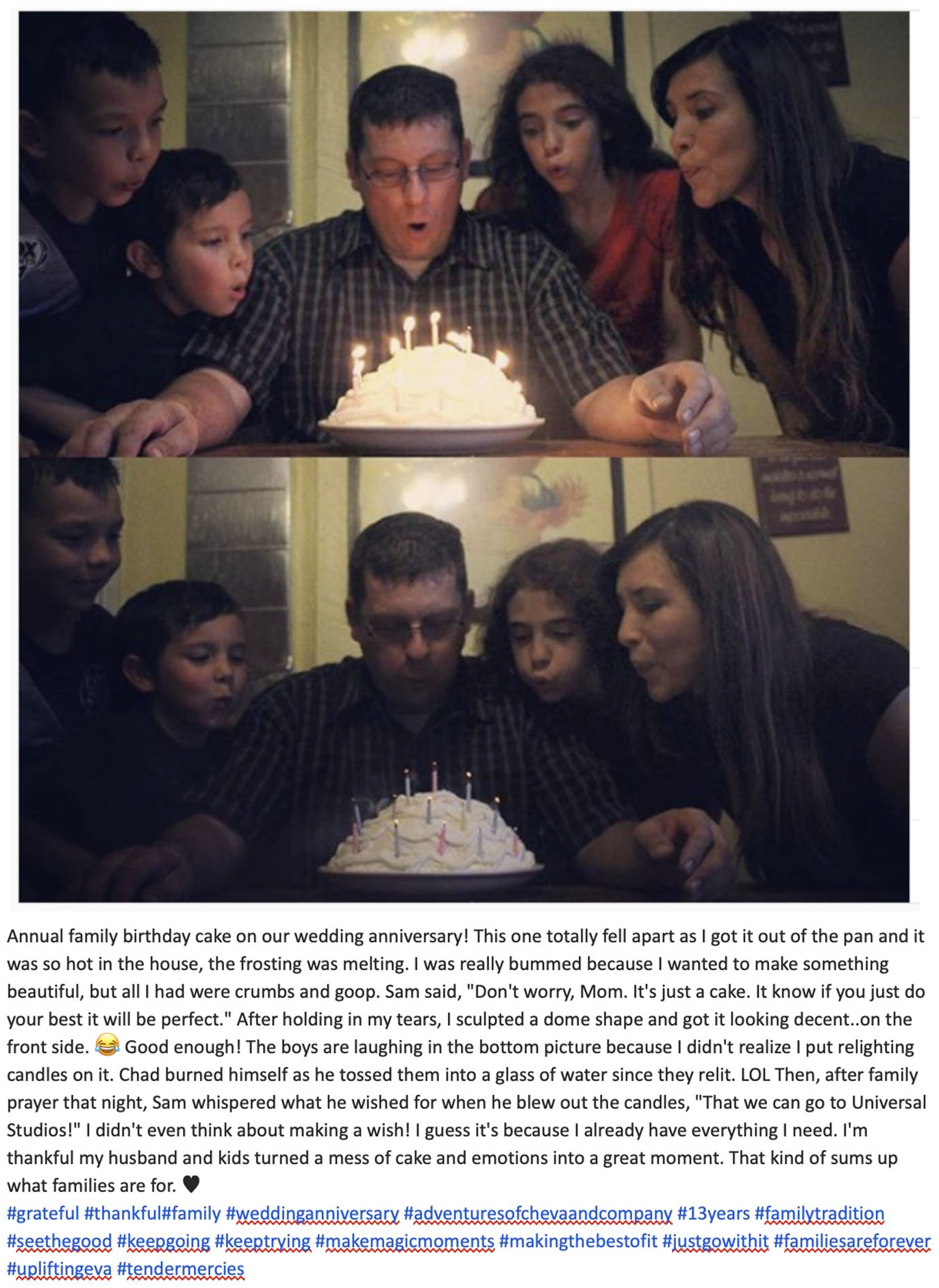
The complex audiences for display are also captured in the shift between personal names, ‘Chad’ and ‘Sam’ and impersonal pronouns ‘my husband and kids’. The first implies speaking to the family, to viewers who know the people in the photographs by name and character. The second addresses a wider audience, where the mother posts about ‘her family’ as a way to post about family generally, and what it means, ‘That kind of sums up what families are for. ♥’. In this representation of family time, the user explicitly unpacks the practical and emotional effort that goes into both family practices and family display. Here family is what happens in the process of creation, not the end product of the photograph. The combination of text and image allows this ‘backstage’ story to be shared, and for a complex mode of display to take place. This post fits with a genre that Shannon (2019) found in her study of how users represent their family leisure time on Facebook and Instagram, the ‘keeping it real’ genre, where users aim to share ‘real’ or ‘authentic’ stories and not just the ‘highlights’ or ‘good times’ of spending family time together (p. 11). It should be noted though that this post, while ‘real’, is still ultimately positive and sentimental in tone, subscribing to social ideals of family intimacy as nourishing. This mix of sincerity and positivity demonstrates how a post like this composes and performs what Finch (2007) describes as ‘the core message of displaying’, that is, ‘These are my family relationships, and they work’ (p. 73).
Next we outline two other central themes that captured specific intergenerational relationships, that is, parent/child and grandparent/grandchild, and we analyse the trends emerging within these modes of family display.
Displaying parenting: cool dads and fun mums
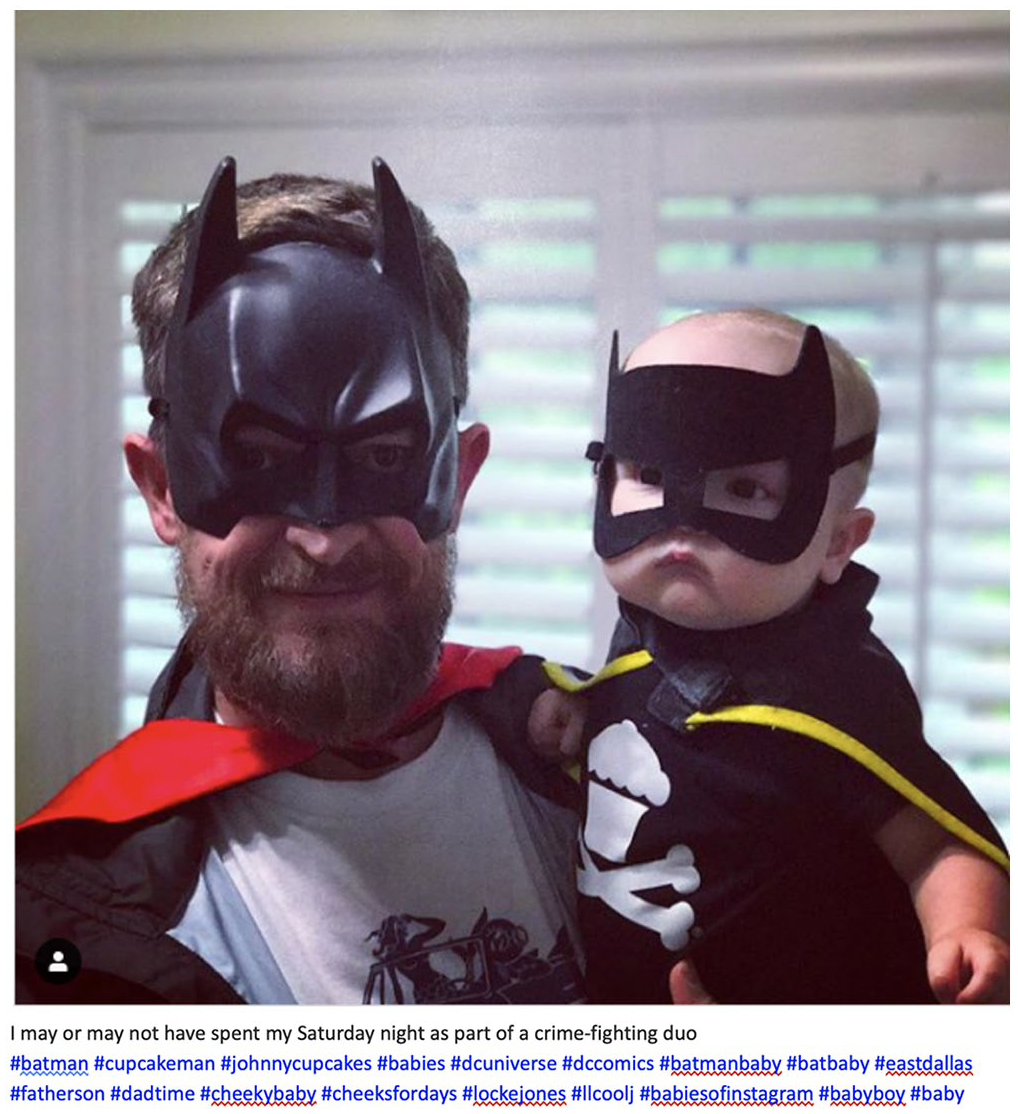
Mirroring Le Moignan and colleagues’ study, a significant theme in the data was parenting and parent-children ‘family time’. In our data, however, there was a clear gendered pattern within this theme. The posts with fathers and their children (predominantly fathers and their boys, sometimes using the hashtag #fatherson or some version of this) were often taken in outdoor settings outside of the domestic sphere, for instance, going swimming, sailing or hunting. They adhered to relatively new ideals of ‘involved fatherhood’ (Wall and Arnold, 2007), that is, that fathers are involved in their children’s life and take part in childcare. Figure 3 illustrates this. Posted by a father, the post depicts him and his baby dressed up in Batman costumes. This photo is accompanied by a humorous caption, ‘I may or may not have spent my Saturday night as part of a crime-fighting duo’. This post depicts him as a man who is not only comfortable in his role as a father, but also with playing with his child instead of going out with friends on a Saturday night. This displays an intimate relationship between parent and child. The hashtags add to the ‘cool’ vibe by acknowledging his subcultural interest in comic books (#dcuniverse, #dccomics), and also confirms the humorous tone through a hashtag like #cheeksfordays, referring to the baby’s big cheeks (Figure 3).
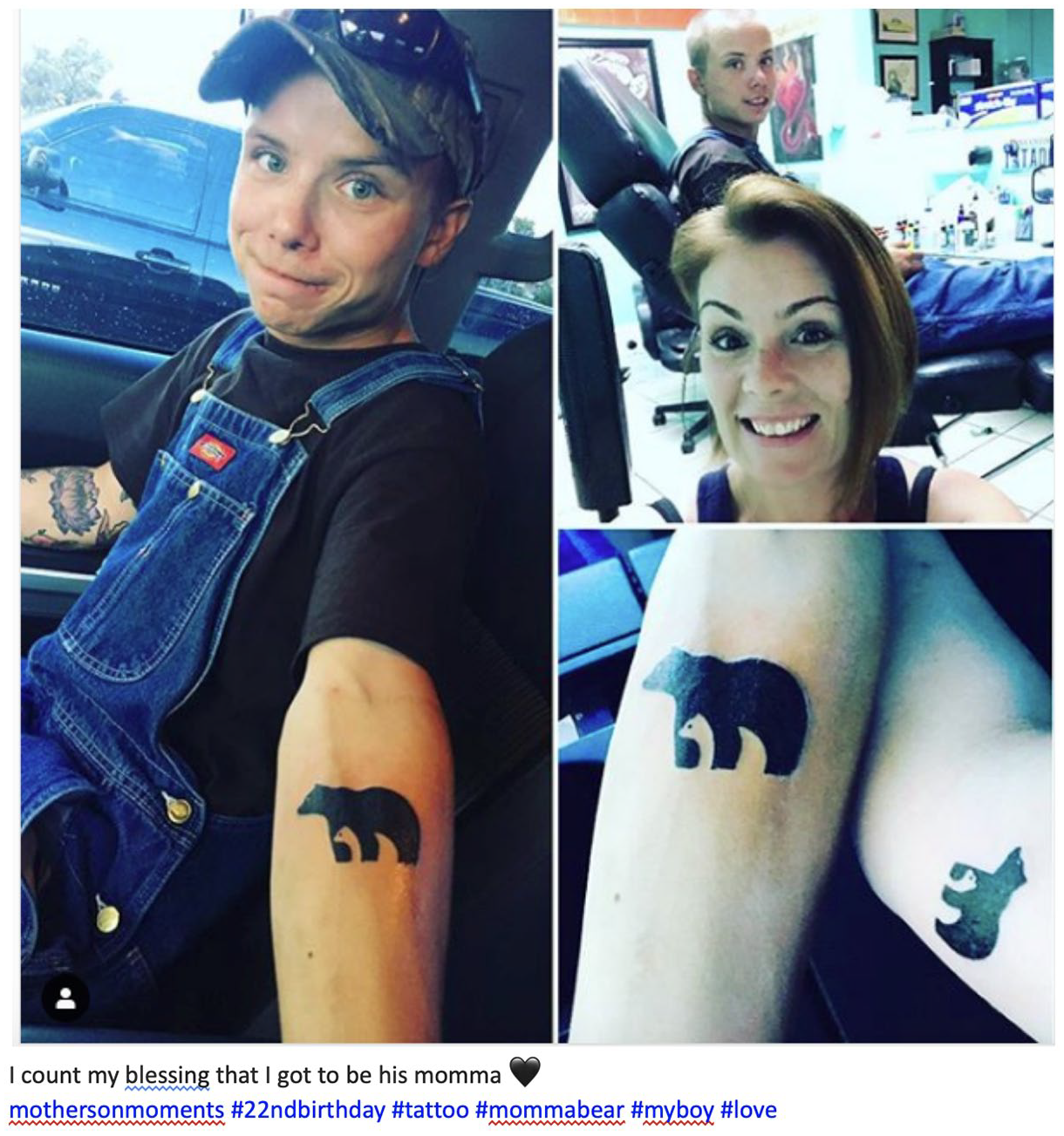
The mothers in the posts in our sample are also to a large extent depicted doing activities with their children, though predominantly daughters, and like the involved fathers, these posts are about being ‘good mothers’. However, in contrast to the fathers, the majority of these photos are either taken at home, in a beauty salon (getting facials, having nails done, etc.) or doing yoga together. In that way, the displays of ‘good parenting’ are highly gendered in terms of which activities are seen to be ‘ideal’ for fathers and sons, and mothers and daughters, respectively, to count as ‘family time’ and to display as intimacy. These posts are reproducing stereotypical ideas of what constitute ‘male’ and ‘female’ hobbies. In contrast to the involved and ‘cool dads’, many of the mothers were displaying themselves as ‘fun mums’, for instance by pulling faces, dressing up or doing various poses together with their child. This depicts them as women who are not taking themselves too seriously and are not afraid of looking ‘silly’ or even ‘unattractive’, thereby defying ideas about traditional femininity. A distinct trend in the posts with mothers is the concept of ‘twinning’, that is, both mother and daughter attempting to look the same, either by dressing up, or by doing the same activity. A somewhat atypical example of this is seen in the post below, posted by a mother and displaying one of the few ‘motherson’ days.
This post depicts a mother and her son getting the same tattoo, a more unusual example of the efforts made to emphasise family resemblance, whether curated or ‘natural’. The chosen tattoo is a bear with a baby bear, matching the accompanying hashtag #mommabear. The occasion for getting the tattoos is seemingly the son’s 22nd birthday, and like the posts analysed in the section on family time above, the post is brimming with warm emotions and the hashtags #myboy and #love. The intended audience for this post is unclear as the caption is not relaying any information that requires knowledge of the family, and neither is it tapping into specific audiences as the post above referring to comic books. It appears as a general post displaying the intimate relation between this mother and her son.
The gendered politics of the relationships displayed in our sample reproduced fairly conservative gendered roles, very often with fathers and sons spending #familytime outdoors and mothers and daughters spending #familytime indoors. In contrast to the ‘fathering’ posts, the posts with mothers and their daughters often saw captions that spoke about their strong relationship. Such captions emphasised mothers and daughters as ‘best friends’, as sharing womanhood and/or learning from each other and overcoming challenges together. In this theme we also see how the Instagram users navigated a key aspect of ‘display’ as theorised by Finch (2007), where personal identities and family intimacies are balanced to show how people choose the way they ‘do’ family (p. 71), here being a ‘fun’ mum or a ‘cool’ dad. The resemblances depicted in the posts – the Batman costumes and bear tattoos – do not simply show a likeness in facial features, but in a deliberately chosen and fun way of displaying how the family connects.
#grannytime: representing grandparents
The last theme within #familytime relates to the representation of triadic intergenerational relationships, namely, between grandparents, children and grandchildren. The content is mostly posted by children or grandchildren, illustrating everyday life moments and ‘doing family’ in generational contexts. Activities depict leisure time, from playing sports to trips as well as household chores, such as cooking together. As shown by Le Moignan et al. (2017), online family depiction and display encapsulates mundane moments that would not be usually enclosed in traditional family albums. None of the posts analysed tagged grandparents’ accounts, suggesting that they are not using Instagram or, at least, had no individual presence there. This matches the available data on global Instagram usage: 2.8% of users are people aged 65 + (Statista, 2019b). Posts under this theme also capture identity performances by both children and grandchildren, similar to the previous sub-theme – what we would term as good ‘grand-childrening’. The display of intimacy and emotional connections within the family context draws on these practices that affirm and reaffirm family relations and memory-making (Rose, 2014).
We further observed gender differences, perhaps as a reflection of the differences noted above in relation to parents. The display of grandfathers – and even great-grandfathers – seemed to convey a sense of ‘involved grandfatherhood’, by sharing interests and events regardless of age differences. As noted by Ducu (2020), because of intimate interconnections between doing and displaying grandparenting and families, it is not always possible to neatly separate them. Grandmothers were depicted in more diverse ways. Overall, we identified two main opposing grandmother tropes: on one hand, the cool grandma, countering stereotypes and discourses about women in general and older women as frail, dependent, or conservative; on the other hand, the frail and sick grandmother being cared for by children and grandchildren (‘good childrening/grand-childrening’) as a nuance to the more positive and empowering posts. This is not to say that the ‘cool grandma’ is not sometimes pictured in relation to being sick – but the focus is on their unique strength, ability to overcome it in remarkable ways, and ‘badassness’.
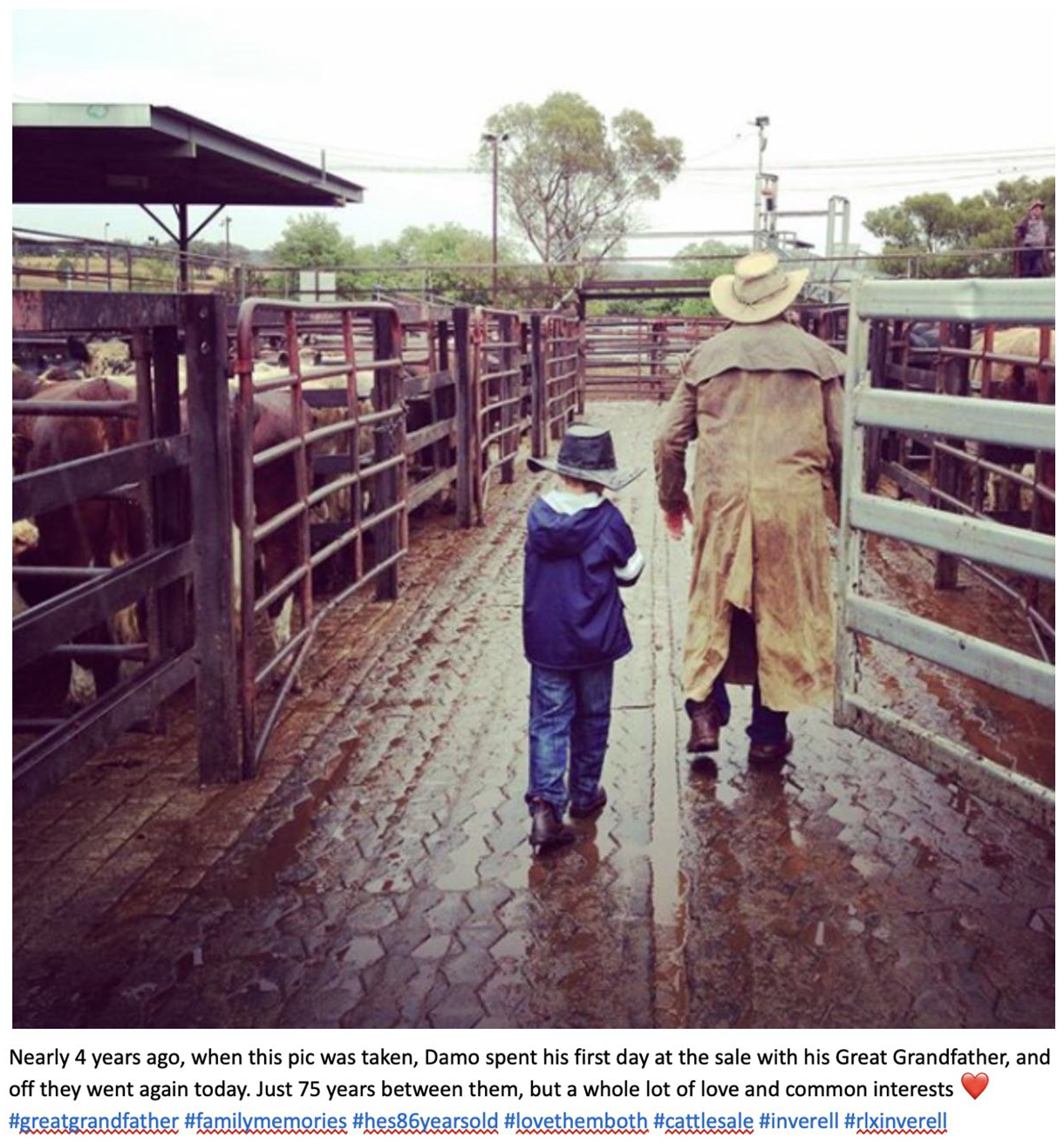
We illustrate this theme with two examples. The first (Figure 5), posted by the grandchild, shows the great grandfather and great grandchild sharing what seems to be a family business activity: a cattle sale. The picture shows them walking off together, in similar attire, in a shared moment reinforced by ‘common interests’ and family contexts, as established in the caption. The narrative function of family resemblance (from clothing to interests) is also evident here. The caption further explains that it is an old picture, taken almost 4 years ago to mark the first time this pair went together to a cattle sale. The picture is used to reminisce and also to mark a continuing family relationship, as captured in the ‘involved grandfatherhood’ theme. In addition, it opens the boundaries of family intimacy to demonstrate its diverse forms. Furthermore, the caption notes different dimensions of temporality, from the great grandparent’s age to the time the picture was taken, which is emphasised by the use of hashtags such as #familymemories and #hes86yearsold. The hashtags emerge as a form of family display to both a personal and collective audience.
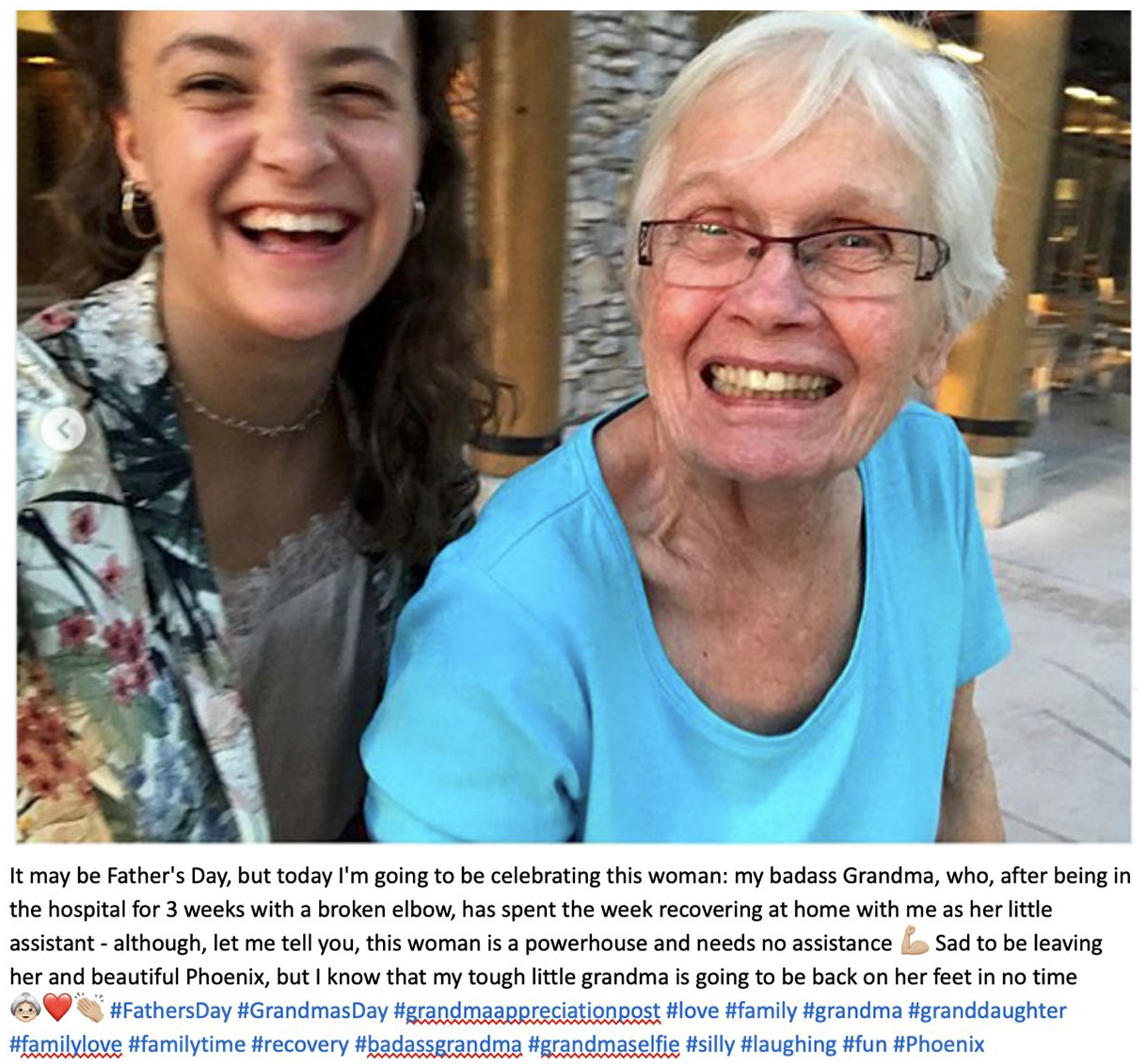
The second example (Figure 6) is posted by a granddaughter in celebration of a ‘badass’ grandmother, who recovered from an injury. This fits with the ‘cool grandma’ trope, although it does describe health issues that seem more prominent in relation to the sick grandmother trope. But there is no pathologising of the older woman in the description; just a recognition of her strength and resilience. The post includes two pictures of them smiling for the camera in a group selfie. The post does not tag the grandmother. However, the pictures are not enough to provide context of this family relationship. The caption explains the circumstances of the grandmother’s health problem and that despite a week of recovery assisted by the granddaughter, the grandmother requires no assistance since she is a ‘powerhouse’ and a ‘tough little grandma’. The granddaughter presents a case of ‘good grandchildrening’; the granddaughter that spends a week in a different city to provide assistance to a grandparent. Interestingly, the post is uploaded on Father’s Day and mentions the ephemeris–but the granddaughter opts to celebrate the grandmother. As with the parenting theme described in the previous section, the familial and personal identities are balanced in what the user ‘chooses’ to depict. The hashtags further support this choice: alongside #FathersDay, there is #GrandmasDay and #grandmaappreciationpost. As a mode of ‘family display’ the image addresses what Finch (2007) marks as an important question underpinning display: ‘What forms of direct social interaction are used to convey the meaning that this is a “family-like”’ relationship? (p. 75). In Figure 6, the user’s caption explicitly describes travelling to care for her grandmother, an interaction characterised as #familytime and expressing #familylove. The ‘family-like’ relationship is also captured in the description of their dynamic–the granddaughter describes her role as a ‘little assistant’ and thus demonstrates the respect for her grandmother as the family matriarch.
Discussion and conclusion
Our analysis shows that the users in our sample turn to Instagram to capture and share photographs of time spent with family in ways that reconfigure the traditional family album. Studies of digital intimacies have focussed primarily on romance and youth. However, we show how digital intimacies, at least on Instagram, also encompass intergenerational family relationships that are inclusive of diverse age groups and family forms. With close attention to exactly how the ‘family-ness’ of posts is constructed – through the use of image, captions, hashtags and emojis and audience – we have demonstrated the complexity with which users are employing the visual and social affordances of Instagram to affirm the intimacy and value of their familial relations.
Our focus on family display is an opportunity to revisit understandings of what/how intimacies are practised in digital spaces. We examined how Instagram users in our sample mark familial relationships as valuable and, in doing so, navigate normative ideals of what family life should look like. As we discussed earlier, the digital intimacies field has so far focussed on non-familial intimacies. But returning to family intimacies shows us how traditional practices of affirming intimacy, such as family photography, are being refigured and sustained in the digital sphere. We found that despite changes in how photography is displayed online, ideals of family life hold strong (see also Le Moignan et al., 2017). This finding provides an important insight into the normative pressures families may feel to display themselves online and reveals how the users in our sample respond to existing social scripts in their posts.
The family posts we examined respond to and reproduce tropes of what qualifies ‘a good family’ or positive family roles, such as being a ‘fun mum’ or ‘good grandchild’. This focus on positivity comes through in the images, captions, emojis and use of affectionate language. While some posts sought to tell a ‘real’ story of family time or deconstruct the act of display, they nonetheless maintained an overall positive image of the family and used language and emojis that emphasised familial love and intimacy. Even in the post depicting the ruined cake, the mother ultimately reaffirms the intimacy of the family and the strength of a bond that can weather injury and stick together.
Focussing on ‘display’ as a family practice draws out how users in our sample utilise image-based SNSs to share their family photographs with a perceived or actual audience of ‘mini-publics’ (Thimm, 2015; Thimm and Nehls, 2017). Instagram is heralded as a more intimate space, and thus conducive to displays of private or home life (Miguel, 2016; Serafinelli, 2018). And as Locatelli also found, our study shows that users seek to display their family practices publicly to have them affirmed as familial and intimate. As Finch (2007) writes, ‘displaying’ emphasises ‘the fundamentally social nature of family practices, where the meaning of one’s actions has to be both conveyed to and understood by relevant others if those actions are to be effective as constituting ‘family’ practices” (p. 66). Our analysis demonstrates that there are nuances to the audiences users in our study seek on Instagram, as posts often contain language that addresses those ‘in the know’, by mentioning family nicknames and other intimate knowledge, as well as a more general public, by describing more impersonal roles and showing that they ‘fit’ these roles well. This is also done via the selection of hashtags that index the post among other families engaged in similar practices, creating a social field of intimate display.
Where family photographs have always followed shared ‘genres’ of how the family ‘should’ look (‘smile for the camera’, ‘stand in close together’), the use of hashtags, in particular, makes the social scripts that users subscribe to or challenge more evident. As the posts included in our study indicated, the most popular family-related hashtags were quite traditional in terms of gender and age-norms and in terms of positive and sentimental affects. Our analysis shows how families can map themselves onto existing hashtags with quite normative formats. This was especially notable in the gender-stratified activities we observed in the parenting posts archived under #motherdaughtertime and #fathersontime, which were uniform in composition and content, signifying a popular visual style to these posts. But we also saw how users play with these forms, making up and adding their own hashtags as part of a narrative. Other users opened audiences even further, using hashtags to link their family time with other non-familial interests and communities. Via an analysis of the practices collected under specific family-related hashtags, our study suggests that users can create posts that address the family, and also communities united by interests in comic books, tattoos, popular music, and so on. Some hashtags become mainstream and their ‘mini-publics’ are heavily populated, while others carve off niches for smaller collectives and ways of displaying family.
Naturally, this study also has limitations. As an exploratory, qualitative study it cannot generate a comprehensive or generalisable account of how users beyond our sample deploy social media platforms to display family. To this end, large-scale and mixed methods studies could extend our analytical approach to representative samples of families to help better understand how users construct their familial identities in a socially networked context. Our study was limited to available posts and did not engage with users. Further qualitative research could capture the ‘behind-the-scenes’ work that goes into constructing family posts: for example, what motivates users to post certain practices, and what might they choose not to post and why. Interview-based research could explore a fuller context for how users navigate the norms on Instagram and position their family posts within their broader SNS profile and activity. Furthermore, interviews could elicit varied perspectives on family intimacies. Online self-presentation efforts paired with Instagram’s affordances and terms of use might contribute to mostly positive depictions of family on Instagram (Pearce and Vitak, 2016). But more research is needed to understand why positive posts dominate family-focussed hashtags, despite well-documented critiques of normative family models.
Another limitation of our study that could be addressed in future research is specific attention to how LGBTQ families engage with the heteronormative family scripts that seemed to dominate our findings. We included hashtags such as #rainbowfamilies in our study to reach a diverse sample, and found that such posts often made extensive use of related hashtags, such as #gayfamilies, #gaydads and so on, arguably to connect with like-minded Instagram users. However, our sample of LGBTQ families was too limited to allow for a dedicated or comparative analysis of their family practices. This is an important area for further study and an analysis of family display online could build on qualitative studies of offline family practices, such as research on ‘family display work’ in lesbian families (Almack, 2008).
In conclusion, despite the limitations mentioned here, the article demonstrates how family practices and intimacies displayed on Instagram share some of the characteristics of traditional family photography while also drawing on the affordances of the platform (such as hashtags), thereby transforming the practice of family photography and display. We also showed how this practice is to a large extent guided by existing cultural norms (heteronormativity), although the specific affordances of the platform also enabled some variations. By extending Finch’s notion of family display into the digital sphere, we have offered both theoretical and empirical starting points for future research into how Instagram and other visual SNSs afford modes of sharing family photographs that are both intimate and public. We hope that other researchers will take up the task of continuing this work.
Footnotes
Funding
The author(s) received no financial support for the research, authorship and/or publication of this article.
