




Abstract
Over the past decade, data journalism has received considerable attention among scholars, pointing to novel forms of investigative reporting as well as new daily practices of news production. This study contributes to existing scholarship by conceptualizing data journalism through distinctions between hard and soft news in relation to service journalism. We analyze news produced by specialized data desks in Swedish public service organizations over a 5-year period (2015–2019) and propose a model for how service journalism attributes can be used as a bridge between the binary categories of hard and soft in data journalism. With this model, we point to how data journalism in public service organizations challenges established notions of soft and hard news and how hybrid production practices open up new research trajectories concerning the societal significance of news in the digital age.
Keywords
Introduction
Over the past decade, data journalism has become widely established in legacy media organizations, blending traditional practices of news production with statistical analysis, computer science, visualization techniques, and web design, forming a specialized subdomain of journalism characterized by “hybridization” (Bradshaw, 2014). In order to understand these hybrid practices, many journalism scholars have chosen to study best practice examples of investigative data reporting (Gray et al., 2012; Gynnild, 2014; Karlsen and Stavelin, 2014) or how cutting-edge working methods spark organizational and epistemological change through computational cross-boundary thinking in media organizations (Appelgren et al., 2020; Borges-Rey, 2016; Hermida and Young, 2019). Furthermore, data journalists combine values from open-source culture with traditional journalistic values, as they have aspirations of both being facilitators (enabling others to take action) and gatekeepers (being impactful and steer debates) (Baack, 2018). Many of these studies have foregrounded a positive or at least hopeful view of data journalism based on its ability to illuminate wrongdoing and provide a deeper and more nuanced picture of complex realities. However, a number of recent studies have also questioned such notions of excellence, pointing instead to data journalism’s “daily,” “conventional,” or “general” characteristics (Stalph, 2018; Uskali and Kuutti, 2015; Zamith, 2019). Studies have also found that advanced interactive features in data journalism tend to be scarce (Anderson and Borges-Rey, 2019; Appelgren 2018; Loosen et al., 2017), and that many data journalism projects are dependent on public data (Parasie and Dagiral, 2013; Knight, 2015; Stalph, 2018). Some scholars implicitly position data journalism within a hard rather than soft framework, pointing, for example, to a dominance of political topics (Loosen et al., 2017; Stalph, 2018). However, to date, there are no studies that explicitly analyze data journalism in relation to hard and soft news beyond the topic dimension.
This article contributes to existing scholarship by conceptualizing data journalism content through diverse theoretical distinctions between hard and soft news (Boczkowski, 2009; Reinemann et al., 2012) and in relation to some of the core concepts in research on “service journalism” (Eide, 2017; From and Nørgaard Kristensen, 2019). We make the case that such an analytical approach can broaden the scholarly discussion around the hybrid practices of data journalism and provide a more nuanced understanding of their societal significance.
According to Witschge et al. (2018), a wider “hybrid turn” in journalism studies has contested long-used binary categories in journalism studies, such as hard/soft, fake/real, and professional/amateur, resulting in suggestions of “blurred” categories marked by flux, in-betweenness, the interstitial, and the liminal (see also Chadwick, 2017). They argue, however, that while hybridity is suitable for addressing rapid change in the digital, social, and economic aspects connected to journalism, it only partly explains the complexity of the reduced stability and homogeneity that has occurred among news professionals, institutions, technologies, and practices. They call for new research to trace the interplay between norms and practices. Mast et al. (2017) suggest that hybridity is neither positive nor negative but can be viewed as a driving force for innovation and linked to such notions as “bridging” and “evolution.” Studying the boundaries of hard and soft news in data journalism is thus important, not only because there are few studies that explicitly analyze data journalism in relation to hard and soft news, but also in order to better understand the perceived professional role of data journalists in relation to what they actually produce. The article also contributes to the literature in a more specific sense by scrutinizing data journalism produced by specialized data desks in Swedish public service radio (SR) and television (SVT) over a 5-year period (2015–2019). Digital renewal has been increasingly central in the development of public service broadcasters as they strive to reach a new generation of distinctly digital news consumers (Shagrir and Keinonen, 2014; Van Dijck and Poell, 2015). An important contextual factor for this study is also that public service organizations, due to their specific remits, usually include a higher degree of hard news than commercial news organizations do (Aalberg and Curran, 2012; Cushion, 2019; Esser et al., 2012). However, to date, we do not know whether the strong position of hard news in public service news also applies to data journalism produced by such organizations.
The boundaries of hard and soft news
In a critical assessment of the normative foundations of journalism studies, Hanitzsch and Vos (2018) conclude that hard news has had a prioritized position in the field, while soft news has been marginalized or deemed unimportant. Soft news has often been used as a derogatory term and implies an emotional, sensational, and personality-centered journalism that is incompatible with established ideals of what constitutes high-quality or even real journalism (Patterson, 2000; Plasser, 2005). As such, soft news also often appears in scholarly discussions on commercialization, tabloidization, and infotainment, denoting a dumbing-down type of journalism that does not meet the informational needs necessary for a sound democracy (Anderson and Ward, 2007; Karlsson, 2016; Otto et al., 2017). However, romanticizing hard news is problematic, not only because soft forms of journalism such as culture, lifestyle, and service journalism can contribute alternative angles on and interpretations of current events that hard news does not cover (Widholm et al., 2019; Fürsich, 2012; Örnebring and Jönsson, 2004), but also because genres and news styles are increasingly mixed and hybridized in the current era of networked journalism and multi-platform media production (Deuze and Witschge, 2018; Hermida and Young, 2016).
An early influential example of the distinction between hard and soft news can be found in the work of Gaye Tuchman (1973). She found that journalists used these two metaphors as a way of pinpointing differences between reporting on scheduled and unscheduled events, and between stories that allowed accompanying commentary and analysis and stories that were related to gossip, local (non-political) scandals, and human-interest topics. Since then, the rich body of research on the traits of hard and soft news contains numerous conceptualizations, but here we will pay special attention to topics, the relationship with temporality/timeliness, and various style and focus characteristics.
Several scholars have pinpointed certain topics that are central for the division between hard and soft news (Boczkowski, 2009; Karidi, 2018; Lehman-Wilzig and Seletzky, 2010). Topics such as politics, the economy, international conflicts, and social issues are usually associated with hard news, while soft news is instead connected with lighter topics, such as culture, entertainment, lifestyle, and celebrity news. However, the lists of topics vary slightly between scholars, partly due to not only different research interests but also whether the conceptualization is part of a broader set of attributes.
Besides news topics, one important attribute that scholars have used to distinguish between hard and soft news is temporal relevance, or, in essence, the distinction between timely (hard) and non-timely (soft) news stories. Using such an approach, Shoemaker and Cohen (2006: 8) have defined hard news as “urgent occurrences that have to be reported right away because they become obsolete very quickly.” In a similar vein, Boczkowski (2009: 98) has connected timeliness to hard news by pointing to the role of publication rhythms and a “growing separation in the temporal patterns of hard and soft news.” In the print and broadcast era of journalism, the so-called news cycle played a central role in the selection and construction of stories because journalists worked under tight and fixed deadlines. In the present digital media environment, however, strict deadlines have been supplanted by liquid news flows, where journalistic items are in constant motion and thus both editable and replaceable (Widholm, 2016). This underlines that timeliness is constructed through temporal style conventions that can vary depending on different decisions made in the news process (Boczkowski, 2009).
While topic and timeliness have had an important role in forming ideas of hard and soft news, scholars have also pointed to broader sets of characteristics that define hard and soft news in terms of “degree rather than kind” (Baum, 2002: 92). Multiplicity of factors is key in an analytical model proposed by Reinemann et al. (2012), where the soft/hard distinction is conceptualized as a relationship between three analytical dimensions: topic, focus, and style. The topic dimension is related to “political relevance,” reflecting a different conceptualization of “topic” than the definitions we refer to above. Political relevance, in this context, is “the extent to which the content of a news item deals with norms, goals, interests, and activities related to the preparation, assertion, and implementation of authoritative, generally binding decisions about societal conflicts” (Reinemann et al., 2012: 233). The focus dimension, however, refers to the societal relevance of the story, including its temporal scope. The more a story focuses on the private or personal sphere and episodic framing (as opposed to the public/societal sphere and thematic framing), the softer it is according to this model. Finally, the style dimension measures whether the journalist expresses personal experiences or interpretations and the extent to which the news draws on strong emotions among depicted actors. The more personal, interpretative, and emotional a news item is, the softer it can be said to be. Although the three dimensions are treated as separate qualities in texts, it is how they interrelate that is most relevant. Events such as elections, catastrophes or terror attacks may be typically hard topics, especially in their direct aftermath, yet it is fully possible for a journalist to also explore them through softer approaches and include a focus on emotions, personal experiences, or a subjective voice (cf. Riegert et al., 2015). Hence, the central idea in the model presented by Reinemann et al. (2012) is to provide a whole set of characteristics enabling analyses of soft/hard news content in terms of a continuum rather than as clear-cut news categories. Factorial survey research in Germany also revealed that the model is relevant in a professional journalistic context: All dimensions except emotionality proved to be valid indicators of hard and soft news among the surveyed journalists (Glogger and Otto, 2019).
As mentioned at the outset of this article, data journalism has not yet been systematically analyzed in relation to hard and soft news. However, there are some relevant studies that address the question of hard news in terms of topics covered. In an analysis of data journalism in Germany and the United Kingdom, Stalph (2018) stressed that a majority of the content was hard news and that this focus depended on the story formats of data journalism as well as the agenda of the analyzed media companies. Loosen et al. (2017) found that award-winning data journalism projects tend to be dominated by news about politics, with the majority of stories focusing on elections. Furthermore, political pieces took a critical watchdog role, sometimes calling for public intervention (Loosen et al., 2017: 9). There are also relevant studies pointing to the day-to-day aspects of data journalism. Zamith (2019) analyzed two US newspapers, The New York Times and The Washington Post, and found that a considerable portion of the content consisted of non-complex data visualizations on a broad spectrum of topics. However, due to a heavy reliance on governmental sources, he was able to categorize most articles as political stories, that is, hard news (Zamith, 2019: 13).
As illustrated in this literature review, hard and soft news are terms that are used differently by different researchers. For some scholars, hard news denotes news associated with certain topics or timeliness/immediacy. Other researchers use it more as a multifaceted concept encompassing various attributes. It is also evident that few researchers have tried to apply the soft/hard news dichotomy to new hybrid forms of news production such as data journalism (Hermida and Young, 2016). Hence, using a multifaceted approach to soft/hard news (see also the “Study Design” section), and with data journalism in Swedish public service organizations as our object of study, we ask the following research questions:
Service journalism and/as hybridization
Research on service journalism, or “news you can use,” usually points to three key content attributes: (a) a unique mode of audience address, (b) a strong focus on personal guidance, and (c) a willingness to solve problems for the reader in everyday life. According to Eide and Knight (1999), these attributes can be viewed as an expression of the individualized society. Individualization in this context is the broad process of change emanating from the increased autonomy and reflexivity of late-modern life which have unembedded the individual from social stability factors such as cultural tradition, class structures, and religious beliefs. In individualized societies, people are drawn to pursuing various forms of reflexive self-fulfillment where they become “actors, builders, jugglers, stage managers of their own biographies and identities and also of their social links and networks” (Beck and Beck-Gernsheim, 2002: 21). With this comes pressure on individuals to be successful and take personal responsibility for misfortunes and unexpected events, or as Beck and Beck-Gernsheim (2002: 22) continue, “Your own life—your own failure.” To meet new public needs originating from the individualized society, such as guidance with regard to career paths, lifestyles, products, and political views or active problem-solving associated with risks, crises, and health challenges, service journalism is emerging in a variety of topics. Unlike traditional news, which addresses the audience members indirectly in their capacity as citizens, service journalism addresses the audience members directly as a “hybrid social subject” in their capacity as consumers, private persons, or clients (Eide and Knight, 1999: 525). The prevalence of such content in subfields such as lifestyle and fashion journalism has led many researchers to conceptualize it through references to soft news. From and Nørgaard Kristensen (2019: 13), for example, argue that service journalism is “an umbrella term for softer types of journalism introduced in the 1980s and 1990s,” pointing to various ways in which journalism institutions blend news with guidance and advice. Similarly, Usher (2012: 112) mentions service journalism as news presenting “a softer side,” with the goal of empowering members of a community by helping them make decisions through enhanced audience interaction and participation. Hence, service journalism can appear as an opposite to hard news because it partly abandons established journalistic norms such as objectivity and distance in favor of a more active, personal, and engaged journalistic role. Its tendency to address the personal life of readers rather than the political life of broader society has also led researchers to categorize it as soft (Hanitzsch and Vos, 2018). However, recent research suggests that it is better to understand service journalism in terms of genre mixing, blurring the boundaries between hard and soft news, and a “hybrid social role for journalists,” which increasingly serves “both the consumer and the citizen as a continuum rather than as distinct or separate categories” (From and Nørgaard Kristensen, 2019: 17). This is because service journalism appears in a variety of topics, and it also has a potential to acknowledge “subpolitics,” for example, the type of politics that takes place outside traditional bureaucratic, state-bound politics harbored by hard news genres (Eide and Knight, 1999; Usher, 2012).
Although service journalism has been an absent concept in previous data journalism scholarship, there are a number of studies that illustrate similarities between data journalism and the core attributes of service journalism identified here. The direct address, for example, is reflected in the prevalence of what Anderson and Borges-Rey (2019) call “find-yourself-in-the-story” features of data journalism, where users are called to add and sort data and thereby tailor the news experience and generate “unseen stories” that are relevant for them on a personal and individual level (Engebretsen et al., 2018). Problem-solving and guidance also seem to be at the heart of data journalism, seen, for example, in projects designed to help individual users in consumer issues, or when data journalists use a guiding logic through individualized news designs to help people make informed and relevant decisions (Appelgren, 2018). While service journalism has a tendency to “individualize problems” (Eide and Knight, 1999: 525), the same can be said about data journalism, although the techniques and forms of representation might be different. Thus, we ask the following research questions:
Specificities of public service journalism
In order to be able to place our research questions in context in the analysis, it is imperative to briefly address the specific role of public service organizations in Sweden. In contrast to commercial media, public service organizations in Sweden rely on public funding through a separate tax, and they are not dependent on market revenues. With this comes certain responsibility: local and national journalism should not only demonstrate independence and integrity but also be available for everyone and in different languages. This leans on the idea that journalism can be seen as a form of public good, especially when it is free from market pressures and political influence (Allern and Pollack, 2019). The development of public service media has in this sense also been understood as a key dimension of the “media welfare state” that characterizes primarily the media systems of the Nordic countries (Syvertsen et al., 2014).
Multiple international studies have shown that public service broadcasters have a greater proportion of hard news compared to commercial broadcasters (Aalberg and Curran, 2012; Cushion, 2019; Esser et al., 2012). This has also been the case in Sweden, although the differences have become less distinctive over time due to growing competition, digitalization, and a strengthened position of interpretative forms of journalism (Jönsson and Strömbäck, 2007; Waldahl et al., 2009). For data journalism, the picture is less clear. A comparative study in the United Kingdom found that public service data journalism does not differ much from that produced by commercially driven news outlets (Cushion et al., 2017). There is also research suggesting that service journalism, which first appeared in the press, have been expanded into public service organizations (Eide, 2017).
Study design
The study builds on a quantitative content analysis (Krippendorff, 2013) of data journalism stories produced by journalists and developers working at the specialized data desks at Swedish public service radio (SR) and television (SVT). Because of the lack of distinct labels or tags in local or national news flows that indicate which stories are the product of data desks, data journalism is a tricky phenomenon to analyze. In order to collect a reliable sample, we therefore chose to focus on the production blogs of the specialized data desks at SR and SVT. 1 Both desks presented their daily work in these blogs, with links to articles, videos, audio, and various forms of visualizations. Blog posts were not analyzed as such. Instead, we use them as sources that allow us to identify data journalism items published in the regular online news flows of SVT and SR. The unit of analysis is the individual article (including video, audio, and various forms of visualizations). We draw on a census (N = 215) of articles published during the period 2015–2019 (e.g. all articles that were possible to identify through the blogs during this period). It should therefore be emphasized that the sample is not representative of data journalism in the larger news flows of SVT and SR. Furthermore, due to both the long shelf life of online news and de-bundling, published data journalism might over time appear without anecdotal information and separate from narrative stories they once accompanied (Lowrey and Hou, 2018). This represents a potential challenge in detecting the timeliness of a news item. The sample can provide insights into what kind of journalism that these specialized desks wanted to promote internally and externally during the selected time period. In that sense, it can also reveal interesting aspects of how public service values in a data journalism context relate to the hard/soft news distinctions addressed in the theoretical framework.
With broad inspiration from the literature, and especially Reinemann et al. (2012), we constructed a set of dichotomous variables to analyze the presence of common attributes connected to hard/soft news and service journalism. To address the question of topic (RQ1), we used an established categorization used in a series of previous studies of Swedish journalism where hard/soft news plays a central role (cf. Truedson and Karlsson, 2019). Previous studies have defined data journalism as hard mainly due to a strong focus on politics and economy, and in order to facilitate comparisons, we chose to code topics on the basis of specified themes (e.g. politics, economy, and culture) rather than in relation to political relevance as suggested by Reinemann et al. (2012). To operationalize the question of soft/hard news attributes (RQ2), we coded for style (descriptive vs interpretive), focus (societal vs individual), emotionality (emotional vs unemotional), and timeliness (whether or not the news is driven by immediacy or based on current events). The reason we chose to include timeliness is because it has historically been defined as a key hard news attribute (Boczkowski, 2009; Tuchman, 1973) and there is a lack of research on data journalism’s relationship with immediacy. In this respect, the analysis differs from Reinemann et al. (2012), who only partly captures this through a more detailed style categorization (e.g. episodic vs thematic framing), which we have excluded here.
Attributes of service journalism (RQ4) were coded in terms of audience address (direct or indirect), problem-solving (yes/no), and guidance (yes/no). We also coded individualized design (the possibility to sort, filter or add data based on individual preferences). This is not a service attribute per se, but it contributes to the individualization of the news experience and is a trait of data journalism, thus making it fruitful to analyze in relation to the service variables that capture other dimensions of individualization. A condensed version of our codebook with the instructions for each variable is available in the Supplemental Appendix.
We started the research process by developing a code book that was tested on a small, random sample of texts after which we carried out two rounds of coding. In the first round, one of the authors coded the entire material and the other author double-coded a sub-sample for testing inter-coder reliability. The test showed high levels of percentage agreement between the coders, but the more demanding Krippendorff’s alpha test was not satisfactory for all variables. We therefore chose to revise the code book and add more detailed instructions. The second round of coding was carried out by both authors, and the subsequent inter-coder reliability test based on 25% of the sample (54 items) and Krippendorff’s alpha (α) showed high or satisfactory levels of reliability for all variables as follows: topic (α = 0.81), focus (α = 0.71), timeliness (α = 0.76), style (α = 0.82), emotionality (α = 0.76), audience address (α = 0.87), guidance (α = 0.85), problem-solving (α = 0.87), and individualized design (α = 0.77). The limit for acceptable inter-coder reliability is usually set at 0.70 (cf. Lombard et al., 2002), with coefficients as low as 0.67 for tentative conclusions in research of a more explorative nature. Alpha coefficients over 0.8 reflect high reliability (Krippendorff, 2013). Since the study is based on a census, results will not undergo statistical significance tests.
Results
Much of the previous scholarship on the distinction between hard and soft news has focused on news topics. Table 1 below displays the main topics in the data journalism flow from the data desks at SVT and SR. During the selected time period, the desks covered a relatively broad spectrum of issues, spanning from traditional hard news topics such as politics, crime, and accidents to softer areas such as culture, sport, and entertainment.
Balance between hard and soft news topics (in %).
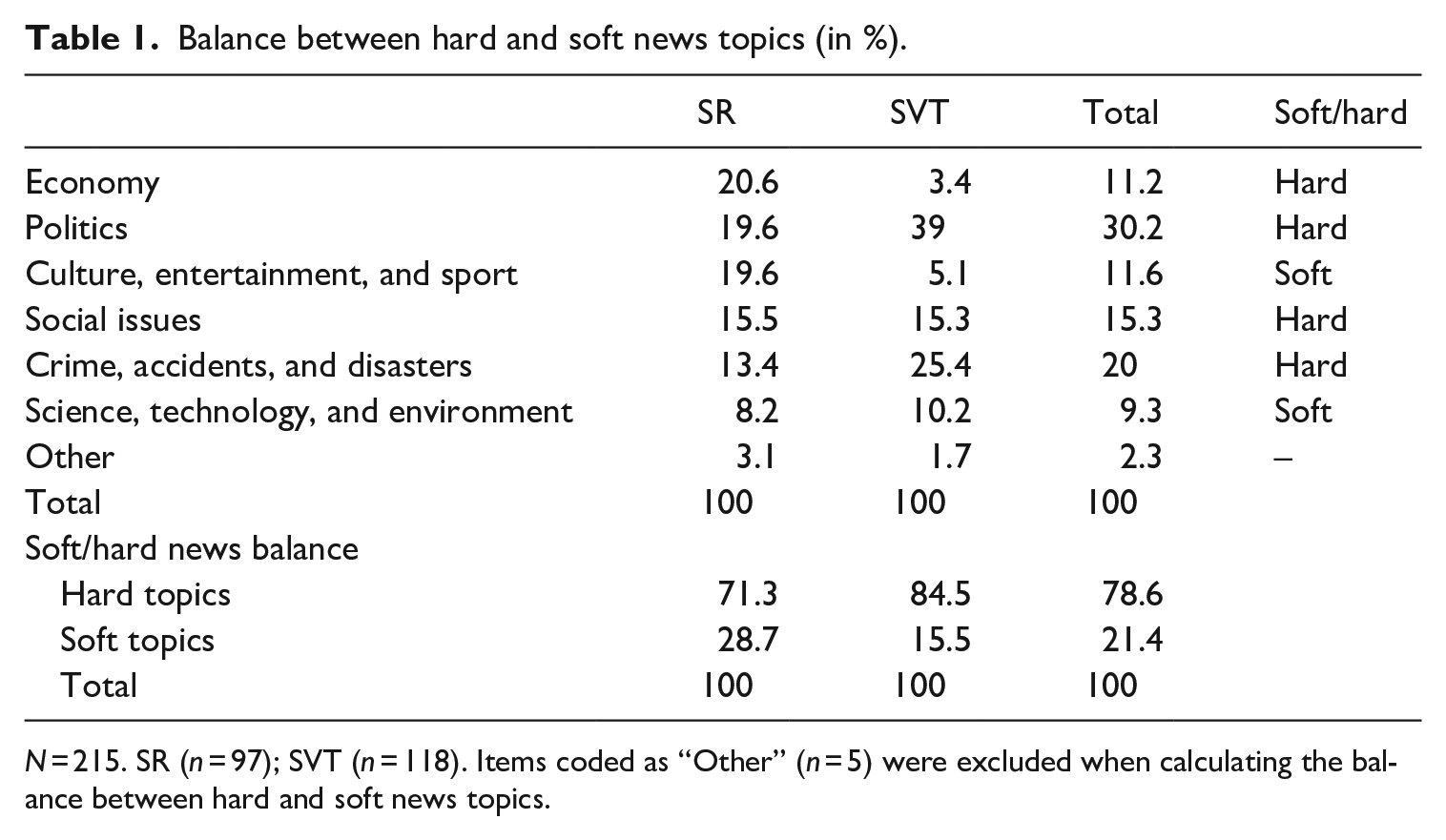
N = 215. SR (n = 97); SVT (n = 118). Items coded as “Other” (n = 5) were excluded when calculating the balance between hard and soft news topics.
SVT published more stories on politics and crime, while SR had a stronger emphasis on the economy and culture/sport/entertainment. If we consider the entire material, politics is by far the most covered topic, paralleling results in studies of data journalism in other countries (Loosen et al., 2017; Stalph, 2018). Social issues such as a growing housing shortage and problems associated with the health and education system in Sweden also received attention from both desks. To address RQ1, for example, whether hard news topics are more salient than soft topics, we clustered economy, politics, social issues, crime, accidents, and disasters as hard topics and culture, entertainment, sports, science, technology, and environment as soft topics. There is no single gold standard for evaluating topics in terms of soft/hard news, and any categorization involves a certain degree of arbitrariness. Some topics, like environmental issues, could indeed be seen as hard due to the salience of this theme in global debates, but following Karidi (2018), we categorized environmental issues as soft to facilitate comparisons with findings in international news media research. Bearing this complexity in mind, it is nevertheless clear that hard news topics do dominate the data journalism content of SR as well as SVT. As displayed in Table 1, 71.3% of SR’s data journalism coverage dealt with hard news topics compared to 84.5% of SVT’s coverage, revealing a notable difference between the two organizations. The overall share of hard news topics for the entire material was 78.6%.
The attributes of hard and soft news
As noted in the theory section, relying only on the topic dimension in an assessment of hard and soft news can be problematic since it does not say much about how news is presented for the audience. Table 2 displays the degree to which the items gravitated toward hard news in terms of four key attributes: timeliness, societal focus, lack of emotionality, and descriptive style in addition to the topic dimension. Data journalism seems to be produced without strong pressure to be timely. Timeliness, in this context, should be understood as news anchored in recent, ongoing, or upcoming events such as elections, ceremonies, and releases of products. Producing data journalism takes time, which obviously makes it difficult for data desks to contribute to the daily and immediacy-driven news flow of media organizations. The relatively weak numbers for societal focus (62.4%) also reveal that data journalism includes personal forms of storytelling that break with established ideas of typical hard news. An attribute that does align with hard news, however, is the obvious lack of emotion in the texts. This is no surprise, given that data journalism’s core—the factuality—can be questioned when facts are mixed with emotional or dramatized language (cf. Schudson, 2001). The importance of factual reporting is also visible in terms of style: 71.5% presented the news through a descriptive style, meaning that less than one-third were interpretative. By interpretative, we mean news items that go beyond mere numbers; stories that seek to explain the why and how aspects of visualized data or items predicting the future based on current knowledge. Such items do appear frequently in our material (28.5%), but the descriptive material is still dominant. Overall, attributes associated with hard news (RQ2) tend to be more salient than those associated with soft news, but the lack of timeliness and the relative prevalence of personal storytelling and the interpretative style show that data journalism is multifaceted and far from fixed in hard news formats.
Attributes of hard news and service journalism within different topics (in %).
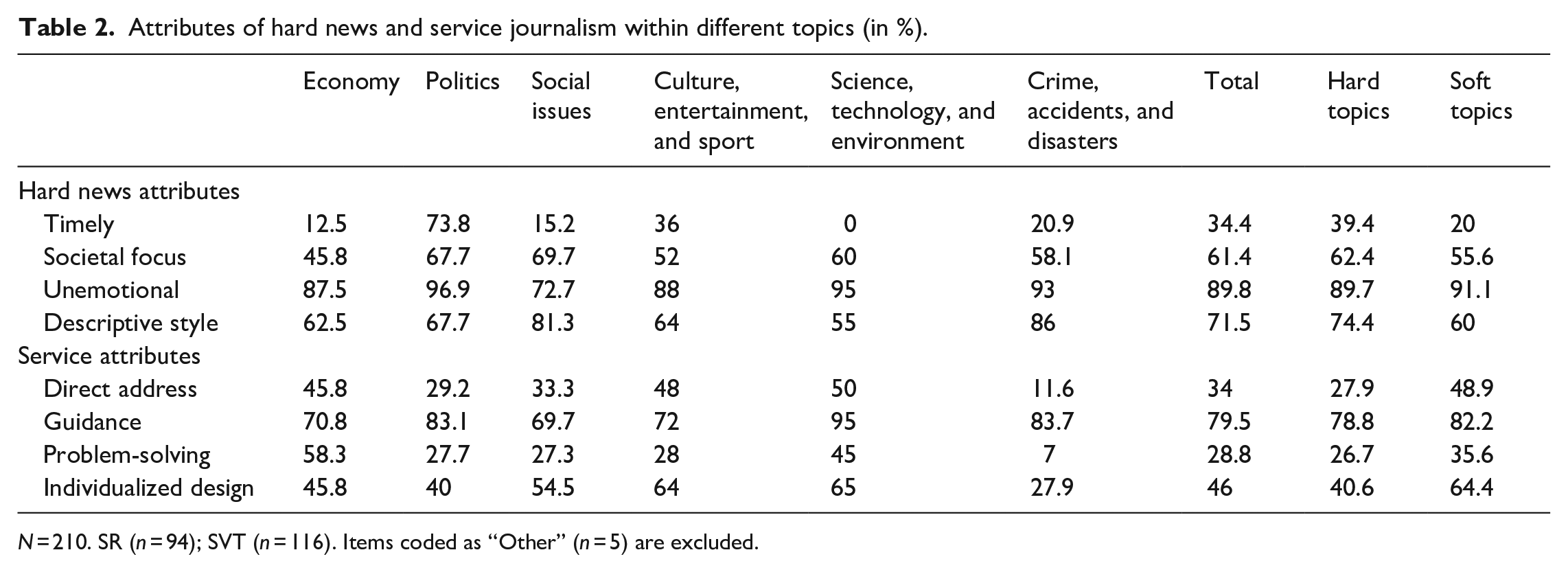
N = 210. SR (n = 94); SVT (n = 116). Items coded as “Other” (n = 5) are excluded.
The multifaceted character of data journalism becomes even more visible when attributes are assessed in relation to the topic dimension of the news (RQ3). Attributes associated with hard news tend to be more salient in hard news topics, but the differences are small. Even soft topics include hard attributes such as a societal focus (55.6%) and the descriptive style (60%). Large differences can also be seen when topics are assessed on a more detailed level. Politics, for example, stands out as strongly associated with timeliness (73.8%), while a typical hard news topic such as economy most often lacks such a feature (12.5%).
Attributes of service journalism
Turning to RQ4, to what extent are attributes associated with service journalism present in the content, and are these attributes more salient in hard or soft news topics? The most important and indeed defining feature of service journalism is the direct mode of audience address, which was present in 34% of the items (Table 2). Service journalism has been conceptualized as a soft type of journalism in previous research, and, as shown in Table 2, the direct address is salient in soft news topics (48.9%), but it is also relatively common in coverage of hard topics (27.9%). In fact, the direct address appeared across a wide spectrum of issues, seen, for example, in headlines on politics (“How close to the average elector are you?”), economy (“What would you gain from moving to another Nordic country?”), culture (“How long is your favorite TV series?”), security issues (“Find your nearest bomb shelter”), and crime (“Reported crimes where you live”). The focus on individual experiences for the news user is also reflected in individualized news designs (RQ5) through which users can sort, filter, or add data based on personal preferences. Forty-six percent of the items drew on such a design, and it was slightly more common in soft news topics, particularly science, technology, and environment.
The most salient attribute we found was guidance (79.5%), which appeared consistently across the entire material and irrespectively of hard/soft news topics. By acting as guides through a pedagogical style, data journalists create a more intimate relationship with the audience, inviting them to develop new knowledge or learn new skills through, for example, quizzes and tests. The relative commonness of solutions (28.8%) to proposed problems is a further indication of how data journalists position themselves as helpers or friends in everyday matters. Problem-solving was particularly salient in news on economic issues, emphasizing the problematic aspects of a strictly topical understanding of soft news and service journalism. Hence, data journalism appears to not only represent actual societal problems but also provide practical advice on how to understand and respond to them, accentuating its strong connection to classical service journalism and “news you can use.”
Discussion
While much data journalism scholarship has focused on the democratic promises and professional potentials of data journalism, often as a specialized domain of investigative reporting, the aim of this study has been to broaden the scholarly outlook and assess data journalism content in light of various distinctions between hard and soft news and service journalism. We have found that hard and soft news attributes in data journalism often appear close together in hybrid forms, which accentuates that processes of innovation within journalism institutions are often amalgamated with genre hybridization: the mixing of news styles and journalistic artifacts characterized by categorical “in-betweenness” (Deuze and Witschge, 2018; From and Nørgaard Kristensen, 2019; Witschge et al., 2018). With reference to Baack (2018), our findings also reflect that hybridity is manifested in the way data journalists oscillate between different professional roles in their work. On one hand, they seem to act as detached gatekeepers, informing citizens about issues of public concern and revealing misconduct through hard news. On the other hand, they act as engaged facilitators by helping individual users take action and offering personal guidance and decision-making tools in both hard and soft news topics. As Baack (2018) notes, these roles should not be understood as opposites, but as mutually reinforcing—accentuating a hybrid social role that has also been ascribed to service journalism (From and Nørgaard Kristensen, 2019). In view of this, the concept of service journalism can be used to expand on the dichotomies of hard and soft news, revealing new analytical dimensions that otherwise may be excluded (Witschge et al., 2018). In Figure 1, we propose a model for the relationship between hard and soft news topics and attributes in data journalism.
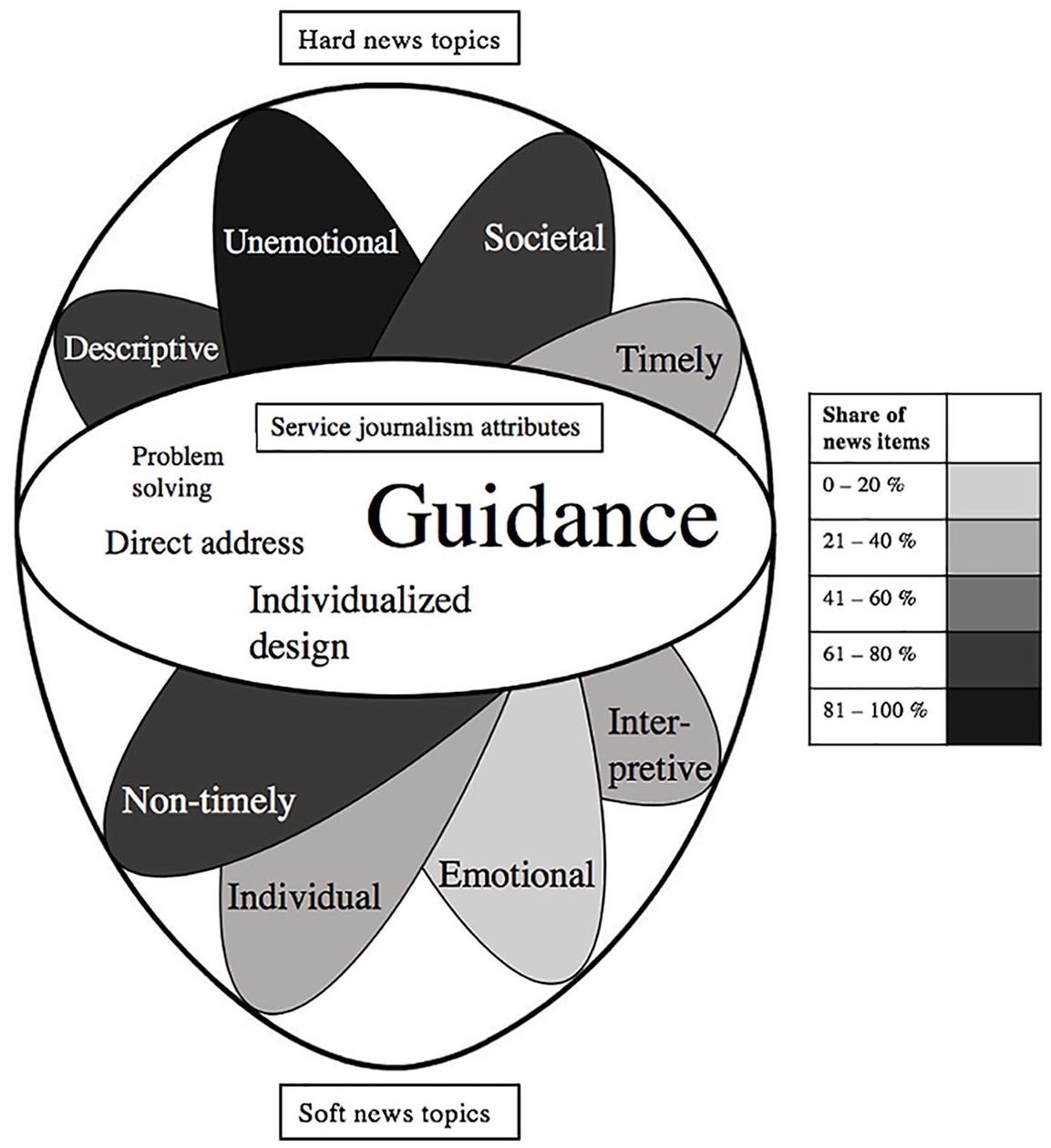
A trinity of service journalism, hard and soft news attributes and topics (n = 215).
In the model, we shaded our results on a gray scale in accordance with the share of news items for each analyzed hard/soft news attribute. The model is egg-shaped to illustrate the difference in the representation of hard versus soft news topics in the sample. The size of the font of the four service journalism attributes illustrates the frequency with which they were found in our sample, from the most common, guidance, to the least common, problem-solving. The soft news attributes do not have to be aligned with soft news topics but can be also found in hard news topics.
In the topic, style, and emotional dimensions, data journalism appears hard, gravitating toward political, economic, and social issues expressed through a descriptive style and a language free from emotion and dramatization. In terms of timeliness, however, data journalism appears softer, although the way political issues were dealt with stood out from this pattern. Overall, we have also shown that hard news attributes, except for lack of emotionality, were more salient in hard news topics, but the differences were often very small. In addition, hard attributes were also significantly present in soft topics, and soft attributes appeared relatively often in hard topics.
Because service journalism attributes, and especially guidance, were salient across the entire sample—irrespective of topic and attribute—we propose that they may function as a bridge (Mast et al., 2017) between various dimensions of hard and soft news. Examples of such bridging can be seen in the way data journalism softens seemingly hard topics such as politics and the economy. Through individual design, direct address, and problem-solving, the coverage gravitates relatively often toward soft news in, for example, the focus and style dimensions, meaning that complex issues are framed and interpreted in such a way that they become relevant and usable to each reader individually. Signs of this in our material are stories focusing on how to vote in elections, find the cheapest broadband, avoid parking fines in Swedish cities, or find the nearest shelter in case of a crisis. This, we argue, also reflects a growing need for guidance and risk management in times marked by “reflexive self-fulfillment” and increased pressure on individuals to take personal responsibility for misfortunes, global risks, and unexpected events (Beck and Beck-Gernsheim, 2002: 21). Hence, data journalism contributes to the discursive construction of the contemporary risk society while also providing interpretations and personal solutions for the problems accentuated by it.
Individualized news angles stand in sharp contrast to the ideals of investigative reporting, where readers are addressed collectively as citizens and powerful actors are held accountable for their actions. This brings us to a journalistic paradox. For Reinemann et al. (2012), catering to individual needs will make journalism softer. Yet, at the same time, it could also actualize classical democratic functions of journalism in new ways. Personalization and individualization introduce new ways to frame issues that can help people understand the relationship between their immediate locale and the larger national or global dynamics at play in political discourse. A powerful example of this in our sample is data journalism coverage of the environment, which to a great extent presented an individual focus by means of service attributes such as direct audience address, personal problem-solving, and individualized user design (see Table 2). Accentuating the individual usability of the news can therefore strengthen journalism’s commitment to “provide the citizens with the information they need to be free and self-governing” (Kovach and Rosenstiel, 2001: 12). It can also be seen as a journalistic practice that calls for public deliberation and participation.
While service attributes can support soft constructions of hard news topics, this does not necessarily mean that the news is less valuable from a democratic point of view. In addition, bridging can also work in the opposite direction; it can make seemingly soft topics such as sports, culture, or entertainment distinctly hard in the focus and emotionality dimensions. This is largely due to the prevalence of guidance, which in data journalism supports holistic and societal narratives that go beyond single events or emotions connected to individuals. Data journalism in Swedish public service is in fact dominated by guidance, and it can therefore be seen as constituting its inner core (Figure 1). Guidance can be traced back to the roots of Swedish public service broadcasting, where a prominent ideal was to educate people to become good citizens (Djerf-Pierre and Weibull, 2001). This suggests that data journalism is more than a critical watchdog and its “facilitative” (Baack, 2018) role is clearly manifested in the content.
Given that hard and soft news are hybridized in data journalism, this article points to a new direction in the study of public service organizations since previous research tends to see them as remedies to the softening of news discourse in market-driven news media organizations (Aalberg and Curran, 2012; Cushion, 2019; Esser et al., 2012). In a digital world, constructive dimensions of journalism might become increasingly important for how audiences perceive social conflicts and democratic issues (McIntyre, 2019), and it is important to remember that while data journalism obviously is not a hard news practice, neither is journalism in general. In our sample, we found an abundance of political data journalism pieces that focused on, for example, upcoming elections or the differentiation of political agendas. However, this information did not come in the shape of traditional news items, but rather as interactive card games, clickable and fluid charts, or quizzes complete with journalistic interpretation and gentle judgments that educate and guide the user. We therefore argue that the service journalism bridge opens up new research trajectories concerning the societal significance of news in the digital age. Future research should look closer at the consequences of guidance and the direct address, particularly when it moves into harder news topics, since these aspects may impact how journalism’s public mission and credibility are perceived by audiences.
The results presented in this study are a snapshot of how data journalism was represented between 2015 and 2019 at SVT and SR, and they cannot be used to describe data journalism in general. It is also important to emphasize that both of the data desks studied have had a special mandate to develop new journalistic formats. This is an important contextual factor, given that hybridization often takes place as a result of innovation and technological change (Deuze and Witschge, 2018; Witschge et al., 2018). During the studied period, the projects in our sample mainly consisted of standard formats that often were re-used over the years, suggesting a rather stable representation of content. Furthermore, while the two data desks were testing new digital formats, other studies of these desks show that they rarely consulted audience studies and almost never collected metrics (Appelgren et al., 2012). To emphasize educative dimensions, the data desks also sought to design the projects to be simple, fun, and playful (Appelgren and Jönsson, 2020). In order to learn more about the various dimensions of hard/soft news in the production and presentation of public service news, future research should investigate data journalism within and in comparison with the general news flow.
Supplemental Material
sj-pdf-1-nms-10.1177_1461444820975411 – Supplemental material for A softer kind of hard news? Data journalism and the digital renewal of public service news in Sweden
Supplemental material, sj-pdf-1-nms-10.1177_1461444820975411 for A softer kind of hard news? Data journalism and the digital renewal of public service news in Sweden by Andreas Widholm and Ester Appelgren in New Media & Society
Footnotes
Acknowledgements
We would like to offer our special thanks to Megan Owens for proofreading and the anonymous reviewers for their detailed and useful comments.
Funding
The author(s) received no financial support for the research, authorship and/or publication of this article.

Supplemental material
Supplemental material for this article is available online.
Notes
Author biographies
References
Supplementary Material
Please find the following supplemental material available below.
For Open Access articles published under a Creative Commons License, all supplemental material carries the same license as the article it is associated with.
For non-Open Access articles published, all supplemental material carries a non-exclusive license, and permission requests for re-use of supplemental material or any part of supplemental material shall be sent directly to the copyright owner as specified in the copyright notice associated with the article.
