




Abstract
Several digital spaces are now archiving artifacts from the first 1980s home computer boom. These spaces are not only storages but also social venues and “memory banks,” and thereby depend on several concurrent practices: software and hardware developed to read, run, and preserve computer code; archiving of old software, magazines, and personal stories; contemporary conferences dedicated to retrocomputing; and making artifacts, which used to be private, publicly available. The article argues that retrocomputing can be seen as a foreshadowing in terms of managing collective digital archives, memories, and relationships to digital material. Taking the Commodore 64 Scene Database as a case, this article (1) engages with both users and cultural techniques in order to (2) theorize collective digital archives as “performative in-betweens” and (3) discuss how retrocomputing may become a default mode for people seeking access to their digital pasts in a time when planned obsolescence is rampant.
Introduction
As digital culture and technological development persistently progresses, retrocomputing is becoming an increasingly prominent cultural phenomenon. Generally speaking, retrocomputing entails contemporary use of old computer hardware and software (often from the 1980s and earlier), either as physical machines or through so-called emulators. While it can be categorized as a culturally marginal hobby for computer nerds, the consumer market is currently going through a revival of old platforms (e.g. the Nintendo Entertainment System [NES] classic edition) and old applications on new platforms (e.g. on smartphones, gaming consoles or media players) as a way for users to relive old computer-supported experiences and recall obscured, but affectionate memories. Arguably, as digital culture matures, an increasing amount of people will be facing issues similar to those existing in retrocomputing culture (i.e. when attempting to access their digital pasts). While the market is only now beginning to respond to this cultural phenomenon, retrocomputing has a long history as an amateur community, with its connected practices. Acknowledging the history of the growing public interest in retro technologies, this article explores the informal cultural memories and storage practices comprised by amateur archives dedicated to preserving, remembering, and sharing retrocomputing culture. That is, currently there is a range of digital spaces that archive digital artifacts from the 1980s home computer boom. This makes them not only digital storages, but also social venues for people seeking access to memories. This dual function is reflected, on the one hand, by Apperley and Parikka (2018) who argue that audiences (“gamers, enthusiasts, hobbyists, and, in general, amateurs” [p. 356]) are central to how a particular archive is produced. On the other hand, we may turn to Ernst (2013), who argues that the technical structure of archives is fundamental in transforming the dynamics of mediated memories: With digital archives, there is, in principle, no more delay between memory and the present but rather the technical option of immediate feedback, turning all present data into archival entries and vice versa. The economy of timing becomes a short-circuit. Streaming media and storage become increasingly intertwined. (p. 98)
Archives are increasingly mediated through their computational conditions, such as specific database formats (Berry, 2017), and this is particularly true for retrocomputing archives dealing with much born-digital material. Seeing the importance of both audiences and underpinning computational diagrams in these practices, this article analyses one of the biggest retrocomputing archives on the Internet, the Commodore 64 Scene Database (CSDb). This archive, contrary to one of Apperley and Parikka’s general claims, puts a large emphasis on the context in which the software was produced; the so-called “scene.” This is both of historical as well as of contemporary significance since the “scene” is an ongoing phenomenon, and has been for several decades. As such, the database that forms one hub of the scene documents both a historical as well as living culture, challenging the notion of the archive as pure storage for the fixed past (Fuller et al., 2017). Consequently, this study is based on interviews with lay-archivists, holding key positions as moderators and administrators in the CSDb, as well as an analysis of database functionalities that, in many ways, set the affordance repertoire of the emergent archiving practices. The rationale behind the chosen methodological combination is the notion that material operations of technologies are as important as the cultural practices making use of them, and that a combined perspective has the potential to generate new insights. As such, this article examines a form of everyday relationship with our digital pasts. Arguably, retrocomputing culture can be seen as a foreshadowing in terms of how a growing number of people will (have to) relate to their past and their mediated memories—through outdated material technologies or emulated technical support. Moreover, the article examines the tensions that emerge when managing an archive of collective memories. We aim to show how archiving, in its essentialist aims for authentic and complete descriptions, can paradoxically also transform previously established conceptualizations of people, machines, and digital artifacts.
Background: retrocomputing today
This article centers itself around one of the largest current retrocomputing archives, the CSDb, which focuses on people and software connected with the Commodore 64 (C64). The C64 was a home computer introduced to the public in 1982 and which held a prominent place in the low-end computer market throughout the 1980s and even into the 1990s. Its importance in computer culture can be seen not only from historical sales figures but also from the many contemporary websites devoted to it, a growing number of books concerned with its cultural relevance, the amount of new software and hardware released, and perhaps most relevant to this article, also from its ongoing revival as a retro technology: It’s 1982 and a new home computer graces the scene. Out goes the silent black and white experience and in with 64KB of RAM, colour graphics, and synthesizer sound. Roll forward 35 years and kick nostalgia into overdrive with the release of THEC64 MINI. A tiny but perfectly formed 50% scale replica of this much loved machine. (https://thec64.com/, accessed 2018-02-07)
Naturally, retrocomputing archives have been around for much longer than the current retro technology trend, and in terms of archiving, large personal collections were established long before these platforms were considered as retro. While there are examples of public memory, or research, institutions hosting retrocomputing or retrogaming archives (Stuckey et al., 2015a), many predecessing online archives are maintained collectively by “fans” and enthusiasts (Deeming and Murphy, 2017; Navarro-Remesal, 2017). Together they choose which artifacts are worthwhile to include and which should be excluded, how to categorize them, and what types of metadata are relevant for each “entry” in the archive. This means that what these communities choose as significant (and not significant) will become both mnemonically and historically momentous through the resources created, and connections made, in the archive (Kraus and Donahue, 2012). Notably, the, sometimes intense, debates that occur around these significances reveal a myriad of interesting positions toward memories, rituals, technicity, authenticity, and originality.
The practice of retroarchiving is also concerned with eliciting and storing personal memories from the initial heyday of the culture by including idiosyncratic stories and interviews. This memory-work simultaneously creates a narrative context as well as an arena for personal boasting. Old forgotten conflicts about, for example, who was first to invent a new programming trick can resurface and provoke surprising amounts of tension. In all, these activities make up a fascinating discursive-material network of skills, persons, and digital artifacts, engaged with a number of cultural practices and techniques:
Software and hardware developed in order to read, preserve, execute, and remember media-specific computer code (emulators, for example);
Archives of old games and programs, and information about the collective processes that produce them;
Meta-archives of old machinery and media and their owners;
Archives of (digitized) fanzines, magazines, and articles;
Archives of personal stories and interviews with “people active in the scene”;
Contemporary conferences, parties, and convents dedicated to retrocomputing;
Creative archival maintenance, such as fixing old games and re-releasing them, or making new crack-intros;
Making a digital artifact (e.g. a crack-intro, demo, interview, or game) that used to be private, public, and the consequent social, legal and memory-triggering issues that may arise.
Interestingly (and somewhat paradoxically), emulators are also vital tools for artists and hackers who use the machines for creative, and more progressive, purposes. The emulators offer faster and more convenient functions compared to the original hardware, which makes it possible to discover new programming tricks with the original hardware. As such, the development of these mnemotechnologies (Stiegler, 2010) becomes necessary partly for reading, preserving, and remembering the digitally virtual that otherwise runs a risk of being “out of file and thus out of mind” (Vismann, 2016) and also for developing tools that constitutes platforms for new and progressive works of art.
Although many entries in retrocomputing archives focus on games, the concept of retrogaming (Suominen, 2008) does not cover all the practices engaged with; however, as shown by Švelch (2013), older hobbyist-developed games can also envelop much more than pure entertainment, including display of skill, in-group communication, and societal critique. Rather than just providing an opportunity to replay a game of yorn, retrocomputing archives also display resistance against planned obsolescence, black-boxing, and outright trashing, as well as function as a stage to release new software made for old technologies. This is particularly true for the archive studied in this article, CSDb, because it puts significant emphasis on newly produced software, and not just bygone productions. This indicates an intricate relation between creation and preservation, individual and collective, and recollection and projection. Retrocomputing enthusiasts keep older technologies alive, and even extend them to fit better with contemporary media ecologies, long after the original designers, engineers, and marketers moved on. Lindsay (2005) suggests that, over the life-cycle of media technologies, moving from a hyped new media phase to a mainstream obsolescence phase (Hertz and Parikka, 2012), user roles are changing. Starting out as stereotyped (and often gendered) end-users, they gradually move toward more pro-active roles, as engineers, software developers, graphic designers, musicians, vendors, and as individuals who provide the residual community with (often very detailed) technical support. Thus, when technologies travel across its life-cycle phases, so do users. And while most users forget, discard, and move on to the next shinier, faster, and more black-boxed technology (see Swalwell, 2012 for an insightful perspective on this), others take responsibility for maintaining, and developing, the “contemporary presence” of “obsolete” technologies. Some of these aspects are further highlighted in a thorough and open-minded paper by Takhteyev and DuPont (2013), where the authors make a compelling argument for learning from retrocomputing preservation practices in museal curation and digital preservation and in general. Moving beyond strict issues of preservation and gaming, and in an effort to widen retrocomputing studies and its potential implications for current digital culture, this article seeks to (1) engage with retrocomputing archives and databases as cultural techniques, (2) theorize collective archives and collective archiving as such, putting a bigger emphasis on the paradoxes, tensions, and in-between positions that characterize them, and (3) discuss how retrocomputing may become a more widespread practice for an increasing amount of people, seeking access to their digital pasts in a time when planned obsolescence is rampant.
Theoretical framework: the in-between archive
The archive is a technology which enables the production, storing, and sharing of mediated memories (Fuller et al., 2017). However, as mentioned previously, in retrocomputing culture, this is not only done for sentimental or nostalgic purposes. Van Dijck (2007) effectively illustrates the position that archives of this kind occupies (Figure 1).
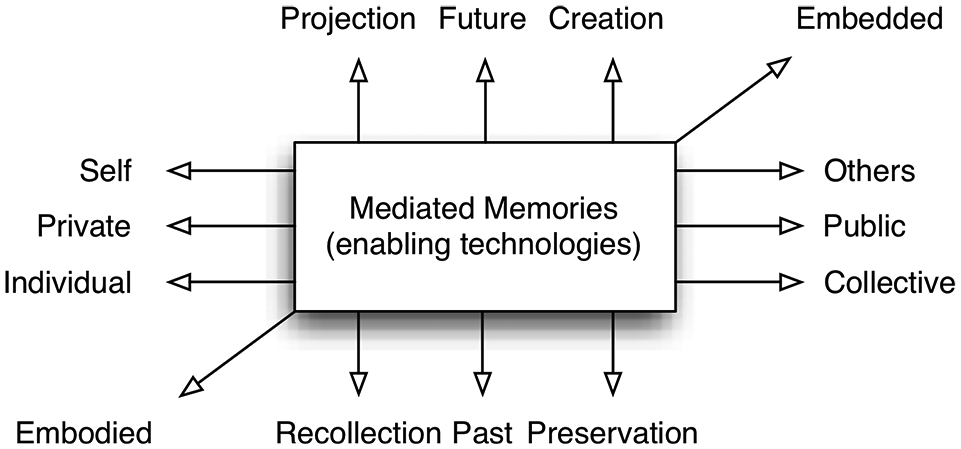
Mediated memories.
While comprehensively situating our study of CSDb in digital memory studies would require more space than is provided in this article, we could say that, in this model, memories are both stable and evolving. That is to say that they are not the exact same each time we remember them. They rely on cultural, material, and corporeal changes as well as the technological conditions of the surrounding media ecology. Remembering is thus more of a reconstruction, or a re-presencing, rather than a pure recall of a clean memory (Garde-Hansen et al., 2009). Consequently, memories are not only located in the brain or in our bodies. Nor are they only located in the physical or digital memory objects we make use of. Rather, there is an interplay between body and technology—an interplay which is also contingent on past and present anchoring in the place, time, media ecology, and culture we happen to exist in. As van Dijck (2007) summarizes it, mediated memories are simultaneously “embodied in individual brains and minds, enabled by instruments, and embedded in cultural dynamics” (p. 49).
Located in the middle of these processes, the enabling technology (in this case, the archive) is a dynamic site of negotiation between relational identities and temporal dimensions. In van Dijck’s model, the dimensions transversing the archive are of course interesting, but the model also seems to leave the enabling technology of the model black-boxed (i.e. how the archive is produced, or enabled). These archives are interweaving the computer’s unique possibilities to produce, store, process, and disseminate data, and the cultural intricacies of human documentation practices. While a database structure can certainly promote more inclusive, fragmentary, and plural retroarchiving practices (Stuckey et al., 2015b), the in-between position of the database can also be the foundation for many demarcating practices in such archives (e.g. distinctions between authentic and inauthentic entries as grounded in software archeology). As such, this article wants to extend the issue of performativity inherent in the archival relation between code, object, and interaction (Gazzard, 2019; Lowood, 2002), to also include the processual performativity of the database itself (or the “algorithmic dynamics of the differential archive” as Ernst [2013] puts it): [. . .] the externalization of memory in social and spatial media can also enforce a structured and calculative ordering of time, space, and experience through the ways that databases and software store, retrieve, and organize information. (Elwood and Mitchell, 2015: 151)
The approach proposed in this article answers Berry’s (2017) call for “critical approaches that contest and make visible archival systems and their embedded logics” (p. 119). Leaning on Birkin (2015), we could, somewhat provocatively, argue that the central artifact of the digital archive is not the object (or code, or interaction connected to it), but the database. When operating at the center of the archive, databases shape and transform knowledge and social memory. In an archive of software, the contained documents are also processual and executable in themselves, adding another layer of computation, as well as potential for new analyses and archival connections. Nevertheless, the machine operations of the archive, in itself, often remain somewhat secluded (Røssaak, 2017). In order to dig deeper into the enabling technology of the archive, this article proposes the application of the theoretical concept of cultural techniques. Put succinctly, cultural techniques are the “basic operations and differentiations that give rise to an array of conceptual and ontological entities which are said to constitute culture” (Winthrop-Young, 2013: 5). Elaborating a bit more, cultural techniques are, by Siegert (2015), characterized by five theoretical features:
Cultural techniques are conceived of as operative chains that precede the media-theoretical concepts they generate.
Cultural techniques are agential, but also act differently in (relation to) different cultures, which is because
Cultural techniques are oscillating between material and symbolic operations.
As such, cultural techniques produce (non-anthropocentric) distinctions through ontic operations (e.g. between real/virtual, inside/outside, human/animal, man/machine).
As epistemic interfaces between the real and the symbolic, cultural techniques have the capacity to both stabilize, as well as destabilize, culture.
Based on this conceptualization of cultural techniques, it is possible to suggest that a material substrate for the archive, operating as an enabling technology, is the database (and its interface), which effectively provides the conditions of representation on which higher level meaning-making is based. Stuckey et al. (2015b) argue that archives and collections of artifacts often have a tendency to give privilege to its included objects and their technical evolution, and that cultural significance tends to be overlooked. This article further argues that in examining the cultural techniques of the database itself, we are not focusing on the objects of the collection as such, nor is the focus only on dynamic memory cultures. Paraphrasing Siegert, we could say that the examination of the database as a cultural technique puts focus on its ontological status as an “in-between.” That is, it can then be revealed how it oscillates between first-order and second-order techniques, between the technical and the artistic, between object and sign, between the natural and the cultural, and between the operational and the representational. As such, the notion of cultural techniques opens up to questions of how media and things operate, and what epistemic conditions they generate (Vismann, 2013). The database is both a material object and a symbolic thing. Through various chains of material and symbolic operations, the database produces ontological statuses (e.g. in terms of what a specific piece of code “is,” its origin, authenticity, and popularity; or what the correct way of archiving is) in the archive at large. Thus, ontologies are not prearranged, but produced—through ontic operations: Within the context of cultural techniques, the production [of ontology] occurs via what we call ontic operations, or chains of operations. [. . .] So the operation of a door or a switch—these are all techniques that are producing a difference and thereby creating what they differentiate. It’s not given before, but it’s created by these techniques. (Siegert in Winthrop-Young, 2015)
In relation to van Dijck’s model above, a focus on cultural techniques would be the equivalent of examining the middle box, the enabling technology and its material operations, in more detail. This article will do this, by directing attention to the database—the ontic operations it enables and the formats it dictates—and how these impact on the representation and construction of meaning in the archive. In summary, we end up with a theoretical framework, which conceptualizes the archive as an enabling memory technology situated between several important tensions, including social relations, temporalities, and materialities.
Method and material
Based on the theoretical conceptualization of the archive as “in-between,” the study will utilize an intertwined combination of two methods. The approach includes an acknowledgment of the archive, and its database and interface in particular, as a cultural technique. As mentioned, this analysis relies on Siegert’s (2017) conceptualization and description of the approach: The approach of the study of cultural techniques does not a priori distinguish between object and meaning, represented reality and image, medium and form, but questions the ontologies that dominate a given culture by focusing on the technical and practical processing of those distinctions. (p. 21)
Because the retrocomputing archive in this study is completely mediated by digital technologies, the database becomes its operational hub, and it is thereby interesting to understand how distinctions between, for example, signal and noise, real and fake, open and closed, and pure and impure are produced in that hub. Based on the theoretical framework, we attempt to put a bigger isochronous emphasis on the deeper layer of the archive—its design, ontic operations, and agency in terms of structuring praxis and drawing boundaries (Cole Young, 2015).
In parallel, data from three interviews with prominent archivists, acting as moderators and administrators in CSDb, will be analyzed in order to get coextensive insights directly from experts into the maintenance of chains of operations relating to archiving. As Stuckey and Swalwell (2014) emphasize though, referring to such individuals as enthusiasts or passionate hobbyists does not really do justice to them—they are extremely attentive, knowledgeable, and professional (except in the sense that they usually do not get economic compensation for their work in CSDb). These fundamental administrative lay-archivists have ambitions to move archival practices in desired directions, and as such maintain chains of operations that will shape the archive at large. However, as we shall see, unforeseen consequences are inevitable, meaning that maintenance is also a constant process of negotiation between, for example, operation and representation and technical and artistic.
Two of these respondents were interviewed during the fall of 2016 using a semi-structured interview guide, and conducted via Skype. Both of these interviews lasted approximately 90 minutes. The third respondent was interviewed in January 2018, using the same interview guide, over text chat. This interview lasted for 95 minutes. The respondents have themselves decided on their preferred appellation: Respondent 1: Hedning, male, 40, living in Lund, Sweden. Moderator of CSDb and a major contributor to the database. Returned to the C64-scene in 2009 after a long break and started to upload absent material to CSDb. Primarily interested in the archiving aspects of the CSDb. Sees it as “the world’s most complete perspective on how all things C64 fit together. That’s what it is. That’s what is most important.” Respondent 2: James, male, 42, living in Malmö, Sweden. Involved in the C64-scene as a pixel artist since the 1980s. As one of the top voters on CSDb, he has voted on ca 25,000 entries in the archive as a form of creating deeper meaning to a, sometimes flat, database ontology. Regards the structure of CSDb as unnecessarily complex and “internal.” Respondent 3: Zyron, male, 46, living in Karlsborg, Sweden. A moderator of CSDb that has been active in the C64-scene since the 1980’s. He is involved in numerous projects to preserve the C64-scene, such as the c64intros.org database, which operates on a more restrictive basis than CSDb.
Case: the CSDb
The CSDb is a website where members collectively manage a database of software artifacts, people, and events surrounding the Commodore 64. CSDb was officially launched in 2002 and the purpose of the site is “[t]o gather as much information as possible about the C64 scene. The sceners, the groups, the releases and events, and as much information about these as possible.” 1 The concept of “the scene” is, like in many other popular cultures, well established in retrocomputing culture and should here be understood as a particular area or sphere of activity and all the people and things connected with it. In this specific context, it is also an umbrella term covering a number of subscenes, where two are particularly salient, the cracking scene, and the demoscene. The cracking scene is centered around removing the copy protection from games and tools, improving them, and ideally releasing these “cracks” before any competing cracker group. The demoscene revolves around so-called demos, which are audiovisual demonstrations of creative skills (in both programming, music, and graphics) relating to a specific platform (Carlsson, 2009). The cracking scene and the demoscene both emerged in the 1980s and developed terminology and practices that are still embedded in CSDb. Earlier on, sceners exchanged software via postal mail or modems in what Alf Rehn (2001) has called a competitive gift economy, and several large personal collections started to form. These collections have been vital in supplying CSDb with content, and enthusiasts are still going through these collections, adding software that is not already archived on CSDb. The competitive spirit of the scene is mirrored in this archival work, by presenting charts of the top contributors to CSDb.
The C64 has a relatively large retrocomputing scene surrounding it. CSDb alone has about 1600 active members 2 and over the 10 past years, 300–400 users have been logged in on any given day. 3 In an average year, there are approximately 1500 releases—many of which are completely new productions—and around 100 events. 4 Notably, CSDb has, over time, taken over archival and social functions previously scattered around various FTP-sites, bulletin boards, personal floppy disk collections, events, disk magazines, IRC, and other media. Although these media are still in parallel use, CSDb is now the dominant medium not only for archiving past materials, but also for launching new releases and socializing between sceners.
The cultural techniques and ontic operations of the retrocomputing archive
As argued in the theory section, the archive often holds an in-between position, and this goes for CSDb as well. Its underpinning cultural techniques stand in relation to a continuous negotiation of human–machine practices. In this article, we will highlight how people and artifacts are being arranged in terms of ontological status in CSDb, through a number of ontic operations. The agency behind these ontic operations is muddled, however, constituting chains where links are both machinic and human. So, while cultural techniques often tend to emphasize basic “intellectual skills,” such as reading, writing, and counting—often referred to as elementare Kultur-techniken (elementary cultural techniques)—corporeal (walking and cooking [see Winthrop-Young, 2014]), and sociopsychological practices (such as describing, delineating, assessing, and hierarching), also precede the media-theoretical concepts they generate. By that we want to emphasize how ontic operations are not fixed—the underlying cultural technique can be redesigned, or even just reinterpreted, altering the repertoire of (potential) ontic operations and the praxis and statuses emerging from it.
Defining scene material and members
CSDb’s formal purpose is to gather “as much information as possible about the C64 scene.” It also curates entries according to the principle “scene releases only.” 5 Demos, intros, songs, and pictures are generally included when they are either made by sceners or released at scene events. But the borders between the scene and other computer cultures are fuzzy, which requires decisions about what to include or exclude.
One moderator (Hedning) finds the largest gray areas in cracks, specifically concerning the quality of the cracks. For example, in a procedure called “freezing,” a user can freeze programs running, and save the memory contents to disk. If a game has been frozen and saved to disk, it is not regarded as cracking. Instead, sceners frown upon this practice and do not consider it as a part of the scene, and therefore not part of CSDb. This may seem trivial, but effectively creates practices of delimitation that help to disconnect the history of freezing from the history of the scene (and the craftsmanship it favors).
There are similar qualitative judgments for inclusion when it comes to demos, albeit less explicit. There are no formal definitions of what counts as a demo, but productions made in simple programming languages (i.e. BASIC) or made using streamlining tools for producing demos (so-called demomakers) are more likely to be excluded from CSDb, particularly if they cannot be connected to a known scener.
Commercial products are not part of the scene by CSDb’s definition. 6 For example, CSDb will not archive games or tools until they have been cracked (and through that computational-cultural process become part of the scene). While most games are cracked, tools are not necessarily cracked if they are irrelevant for sceners (e.g. business or science software) or if they are already in the public domain. However, there are also 3500 non-cracked games in CSDb, cataloged in eight different categories. One moderator explains that “game productions are not really scene related, but since most game producers are also active in the scene, CSDb has opened up more for that, I suppos,” (Hedning).
There is also software archived on CSDb that was not made by sceners, and not cracked. Compunet was a UK online service provider where demo-like C64-productions were released during the 1980s. They are not considered to be scene material per se, but they are included in CSDb since “Compunet is integral to the scene’s history.” 7 There are music collections by non-sceners such as Rob Hubbard, early audiovisual works such as Piccolo Mouso and several ones by Jeff Minter, and demo-like productions released on commercial disks such as Magic Disk. Their presence on CSDb is disputed 8 but nevertheless they remain. Another interesting example is Tubular Bells, a commercial demo-like promotion software for Mike Oldfield’s music, which is included on CSDb because it was cracked. 9
Definitions of the scene also include ontic delimitations of users, as included or excluded. When CSDb was launched, anyone could become a member of the site and edit the database. “There were many fake accounts created just to downvote [entries] or troll the database” (Zyron), which led the moderators to delete such accounts, and adopt a slightly more restrictive membership policy. With the key requirement for membership being to have, or have had, some kind of involvement with the C64 scene,
10
moderators have since 2007 approved individuals who have, in some way, contributed to the scene. Non-members can access most of the material on CSDb, but only members can comment, vote, or add new information to the database: That’s the first thing I notice when I log in—this big red square that says I need to approve or deny a certain person who wants to become a member. I have to make a choice. The red box won’t go away until I have voted “yes” or “no.” It is a pain, but also really good. (Hedning)
Between 2016 and 2019, CSDb has had a steady membership count of around 1650 active members. If a member is inactive for 6 months, the account gets temporarily suspended until the member applies for a reactivation. These examples of delimitation practices show how ontic operations of CSDb are often negotiations between human and machinic agency, something this article will come back to.
Authentic or inauthentic
CSDb collects, connects, and catalogs information about sceners (persons), groups, events, bulletin boards, and releases (software) connected to the C64 scene. It hosts the material either on its own servers or links to external (FTP) sites. CSDb currently catalogs more than 165,000 releases, 24,000 people, and almost 9000 groups. Each entry in the database normally has some basic information, download links, an image, as well as internal links to events, groups, and people in CSDb. It is also common to identify the songs in the release and create a link to each song’s entry in the High Voltage SID Collection, another database that focuses on C64-music. This connectivity separates CSDb from many other retrocomputing archives, which usually archive only files and information, but not hyperlinked connections. CSDb also catalogs personal information about sceners such as name, postal address, phone number, and e-mail addresses, which are accessible to CSDb-members only. In a way, this has also formalized the scene and “the underground atmosphere once inherent to the scene is pretty much gone” (Zyron).
Each entry is tagged with one or more categories. A group can be one or more of 11 group types, and each scener can have up to 33 specific functions. For releases, CSDb uses 42 categories, and each release (i.e. entry) has one exclusive category, where the uploader decides which category fits best. The database of CSDb forces the archiver to assign one single category to each release in the archive. Although many categories have a long history in the scene, they were not as strictly enforced as they are now in the CSDb database. It was easy to release an audiovisual release without defining it as a demo, an intro, a one-file demo, or a dentro, whereas on CSDb, one of these categories has to be assigned. The database is not designed to represent any ontological ambiguities of releases, which was arguably more common in the past. A seemingly straight-forward category such as “C64 Music” can lead to disputes about whether a song is accompanied by “too much” animated graphics, causing some people to see it as a demo or intro instead. The fact that sceners devote time to these issues of delimitation indicates that there is a cultural (and ontological) importance to these distinctions, which is also prompted by the database of CSDb.
Ambiguity is perhaps even more salient in the CSDb categories that take a more normative stance. “Fake Demos” and “Fake Games” are categories for releases that the community considers to be inauthentic, for some reason, but still regard as part of the scene. On CSDb, “fake” usually refers to a release that a person or group makes under a different alias than usual, that uses humor, and which does not adhere to the traditional qualitative norms of the scene. This opens up for new forms of experimentation, and one scener describes the Finnish “fake group” ISO as using “a true ‘avant-garde’ approach by turning nearly every traditional demoscene value upside down. For me, ISO is the punk and dadaism of the Finnish demoscene” (Heikkilä, 2009). Thus, if someone releases something anonymously or under a temporary pseudonym, it will sometimes be archived as a “fake” production and sometimes not. A “fake” pseudonym is sometimes linked to the more well-known alias of the author on CSDb. This can be done by looking into the code of the release, comparing it to other code, and then deducing who the most likely culprit of the “fake” release is (and subsequently link their name to the release on CSDb). So CSDb is not only reproducing and connecting already known information and facts, but also creating new knowledge through a form of “software archaeology.” In this case, CSDb can reveal something that was perhaps not meant to be publicly available, and which was only known to a few sceners. The underpinning rationale is a strive for completeness in the archive, which is arguably performed at the expense of the ambiguity of the original scene production and context. The database entries formalize and make static that which used to be unknown or ambiguous.
The formalization of ambiguities can be forced upon the archiver, as in choosing one single category for every release, but it is also more common with a softer encouragement to supply information, such as memberships in groups (which is not always clear), dates for events or releases, a scener’s function in a group, the nationality of a scener, and so on. Again, this is a chain of ontic operations, which defines the status of certain artifact or person.
Another interesting aspect concerning authenticity has more of a technical angle. Preservation of digital art requires a balance between fidelity and ease of access (Espenschied et al., 2013). For high fidelity, the artwork should be presented as close to its “authentic being” as possible, in line with the artist’s intention. For ease of use, however, it might suffice to present a video documentation for someone to experience the same artwork. CSDb offers the original software for download, and the user decides whether to run the software on the original C64 or in an emulator. CSDb often contain video links as well, and there is always a screenshot of the artifact. These screenshots have caused debates about whether they should show the pixels strictly as they are represented in the data, or if they should add visual effects to emulate the media specificity of the CRT screens normally used to display the graphics. 11 This clearly relates to the tension raised by Stuckey and Swalwell (2014), in whether to emphasize the archiving of artifacts or of experiences. CSDb now operates according to the “emulation of medium specificity” practice, which is interestingly something of a compromise between artifact and experience, with PAL specificity for European releases and NTSC specificity for American releases. This illustrates how sensory and tactile aspects of media specificity are seen as integral to the experience of the digital artifact.
Another instance of attempting to document and convey a “correct” representation is that CSDb adds information that is not necessarily present in the original artifact. This is made in a spirit of attempting to strengthen the original context by adding correct credits (which are also linked to their entries on CSDb) where further information can be found. As such, an archived entry becomes part of a network of additional information, where CSDb can reveal new connections and new information. Whether this strengthens the authenticity is a matter of whether one takes the perspective of the pure preservation of the static archive or the progressive creation of the dynamic scene.
Pure preservation or progressive creation
CSDb is curated to contain only scene members and scene releases. There is no single agreed upon definition of what the scene is and what belongs to it, but since CSDb has become such an important hub for the scene, it also functions as an authority on what the scene is and is not. In practice, as an archive that strives for completeness and accuracy, CSDb needs to decide what gets archived and what does not. Most of the time this works fine, and conflicts rarely manifest themselves. The moderators take these decisions, on a case to case basis, without formal rules. 12 Effectively, this means that they are negotiating between the archive and the scene. This can become a problem when ideals are confronting each other. For example, our interviews indicate a discourse of “archive purism” where ideally, CSDb should not be actively involved in the scene: “CSDb wasn’t meant to be a place to release things, or to be a community. It’s supposed to be an archive, but now it’s more of a community than it was from the beginning” (Hedning). Instead CSDb should be an independent actor that, according to its own rules and visions, only documents the scene. At the same time, CSDb is also used as a kind of social media, where people socialize around common memory objects, as well as release newly produced artifacts. This occurs by discussions in the forums as well as in the comment section for each release, and by voting on entries in the database.
One moderator expresses a clear frustration about how people use CSDb today: CSDb is not the scene, it’s an archive of the scene. It’s absurd to release things straight into an archive, the point is to release it somewhere else, and then for us to find it and archive it. It’s not right to use CSDb as a release site. (Hedning)
Perhaps the view of “releasing something into the archive” as a malpractice can be traced back to how the archive is both a site of restriction and delineation, as well as a dynamic site of meaningful contextualization. When the archive becomes the scene, it takes on a double role. Many sceners consider CSDb as an integral part of the scene, or even as the main hub and definition of the scene. For moderators leaning on an ideology of “archive purism,” however, it is necessary to emphasize CSDb as a detached institution which purpose is to uphold a coherent archive and nothing else. So, when an object is “released” into the archive, it becomes immediately restrained (by human–machine cultural techniques). Paradoxically, if something is later de-archived, it becomes decontextualized and loses its cultural significance and connections, previously provided by the archive (Birkin, 2015). This is another sign of the living, dynamic, and operative archive fulfilling its in-between position, actualizing the scene, while at the same time seeking to detach itself from it.
Conclusion
Retrocomputing can, in many ways, be seen as a forerunner in terms of managing collective digital memories, and CSDb is an interesting example of a commonly maintained and negotiated digital archive. The socio-digital practices that emerge in CSDb can be taken as examples of how an increasing number of groups and organizations will have to deal with the management of collective digital memories and cultural artifacts in the future. This includes delimitations of who and what belongs to the archive; culture-technical issues of how the archive, and underlying database, mediates between embodied and embedded (cultural) memories; and negotiations between whether the archive should only document and reflect certain historic accomplishments, or if it should also provide an arena for ongoing activities. As such, moderating archivists are central, as they perform much of the labor-intensive cultural techniques that are describing and delineating ontological statuses. The importance of these individuals to CSDb also means that there is certain vulnerability present. That is, motivations and machinations in fan archives are not easily replicable by other institutions, and archives thereby run the risk of becoming dying, rather than living, archives, should only one cog in the machinery break. As moderator James puts it, But who will take care of it later? When we pass away? That’s the big issue. It is not about how archiving and preservation takes place today, but in the future. [. . .] If the people involved in CSDb die, and there is no one with enough experience or health, to take their place, then there is no administration.
In CSDb, “the archive” (including the ontological status of users and artifacts of the archive) emerges as a product of historically and culturally contingent cultural techniques of identifying, categorizing, and moderating the entries in the database. This also stresses our previous claim that ontic operations are not fixed—the underlying cultural technique can be redesigned, or even just reinterpreted, altering the ontic operations and the praxis emerging from it. Archiving is both a material and a symbolic cultural technique, which defines, and differentiates between, specific cultural and social domains. Collective archiving adds yet another layer of complexity including joint culture-technical negotiations of inclusion/exclusion, authenticity/inauthenticity, and preservation/creation. With a growing range of everyday memories being recorded and archived, we therefore argue that we must pay more attention to the cultural techniques and ontic operations that are embedded in the archives themselves as this is crucial to understand the joint and collective human–machine chains of material and symbolic operations that ultimately determine the ontological status of the entries of the archive (and the potentiality of memories evoked by them). It is very much a recursive connection between archivists and operative databases that continuously (re-)perform the archive. In this process, cultural techniques will delineate, and as such also amalgamate, certain entities. These entities will often be regarded as the sources of these operations, but rather, it is the preceding chains of human and machinic operations that “give rise to notions and objects that are then endowed with essentialized identities” (Winthrop-Young, 2013: 15).
As seen from the study, there is a conflict between CSDb’s strive to collect and categorize as much information about the C64 scene as possible, and the messy social nature of the scene, including its tendencies to experiment with identities, formats, and trolling. We have identified a number of gray areas where decisions need to be made about if and how to incorporate information into the database. While there can be heated arguments on these topics in the forums, there also seems to be a general acceptance toward incoherencies in the archive. It is not perfect, but it is good enough for most sceners. Even if the archive purists desire a perfect archive and believe that it is possible to create it, they do not have the time or resources to actually make it happen. Still, the moderators and other active users are decisive in maintaining the database and in performing ontic operations when the database categories do not suffice. Without their work, CSDb would be a gigantic archive of data, impenetrable for most users (which is also the case with many other retrocomputing archives). As Berry (2017) warns us: “[. . .] the possibility of ‘infinite archives’ creates a new set of problems, particularly in born-digital and digitized collections [. . .]” (p. 107). In CSDb, the archive’s accessibility comes at the price of formalizing ambiguities, curating artifacts, defining the limits of the scene, and thereby also skewing future memories of the scene. Still, for most members, this is likely a price worth paying in order to create an archive of something that would otherwise not be remembered very well at all (what Berry [2017] refers to as a “generalized condition of forgetting” [p. 104]): When it [CSDb] is incomplete, as it still is and probably always will be, there are certain things that are missing and [. . .] that incomplete archive is like having a gap in your memory (James)
As such, retrocomputing archives provide us with certain guidance on managing the pasts and futures of collective digital memories and culture. We could even ask, could retrocomputing be the future of sharing and storing our relationships with/through (bygone) digital material? The argument for this is compelling. A re-presencing of memories relies (partly) on an archival re-presencing, which is, in turn, constituted by chains of human documentation practices and machine operations (forming a non-neutral praxis). Not only are memories triggered by, and mediated by, specific, progressively obsolete, physical machines, but also by performative databases, structuring material according to cultural-technical logics. This article departed from van Dijck’s conceptual model of mediated memories, delving deeper into the enabling technologies of the model. While it is clear that social memory is dependent on both human and non-human operations in interaction, the notion of cultural techniques can help us further unpack this relation. Putting an analytical focus on the in-between database as a cultural technique reveals both cultural-technical as well as pragmatic necessities to delineate. That is, in the face of ubiquitous accessibility, malleability, and reconfigurability, some delineation and curation seems to become necessary for archives to not become infinite and meaningless storages. You could argue that the archive comes into being through processes of structural differentiation and delineation (Fuller et al., 2017). The archive thus envelops the constant (co-)interruption and (re-)negotiation between machine logics and shifting forms of sociality and modes of sharing (Røssaak, 2017). Retrocomputing archives are, in a very practical manner, working with issues of storing and sharing collective memories and technologies, that otherwise run a risk of becoming buried under a landslide of planned obsolescence. Most likely these are issues that have a general implication for users of contemporary media technologies, who may face similar dilemmas when trying to make sense of the huge archives of information gathered over bygone decades, scattered social groupings, and defunct media formats.
Footnotes
Funding
The author(s) received no financial support for the research, authorship, and/or publication of this article.
