



Abstract
Journalists frequently turn to Twitter for quotes from elite and non-elite sources to include within their online news articles. While recent research has found that including posts from ordinary people can influence news consumers’ issue perceptions, there is limited research on the impact of including politicians’ posts. We conduct two similar survey experiments, with Republican and Democrat respondents, to test the relative impact of including Donald Trump’s tweets in a news article either in embedded format, quoted in plain text, or quoted in paraphrased format. Among Republicans, embedded tweets were unique in eliciting positive emotions which mediated higher ratings of Donald Trump’s warmth and competence. Among Democrats, no significant differences were elicited by tweet format on perceptions of Trump. However, Democrats rated articles containing verbatim Trump tweets as significantly lower in journalistic quality. Results are discussed in relevance to journalist–politician power relations and perceptions of journalistic quality.
Keywords
News journalism is fighting for its soul, fending attacks from all sides: vocal anti-establishment leaders accusing journalists of bias; financial demands pushing the need for news with audience appeal; pressure for around-the-clock reporting; and the meteoric rise of social media platforms that compete for attention and give politicians unprecedented opportunities for unmediated expression. In a move toward a hybrid media system (Chadwick, 2013), and to respond to such pressures, journalists have taken to social media as a form of “beat” where they not only pick up tips and leads for stories, but also find quotes to include within their news articles (Metag and Rauchfleisch, 2017).
Given today’s confluence of media and political factors, what are the effects of news journalists including social media posts as sources and evidence? Research points to a growing reliance in news reporting on tweets from political leaders, along with posts from ordinary citizens (Brands et al., 2018; Broersma and Graham, 2012). Less well understood, however, are the effects of including tweets on online news readers. While recent work has shown that embedding tweets from ordinary people in news stories can influence audience perceptions of public opinion on the issue at hand (Ross and Dumitrescu, 2019), there is little such research that investigates the impact of politicians’ tweets in online news.
Investigating the embedding of political leaders’ tweets is of interest, not simply due to their increasing usage but also as they constitute a new way that journalists can incorporate quotations. As with traditional media formats, journalists writing for online formats are similarly faced with the choice of including such elite quotes directly (i.e. verbatim) or paraphrasing the quote to retain the same meaning while substituting in their own style and removing grammatical anomalies. However, by embedding tweets from Twitter, journalists are engaging in a new and unique form of quoting: this not only reproduces the quote verbatim but it also offers substantial other levels of potentially newsworthy information (such as the level of public support for the statement, the amount of debate it has stimulated, and the politician’s photo).
While research has taken place into the effects of direct quotes on audience perceptions of journalistic quality within traditional news media (Gibson and Zillmann, 1998; Weaver et al., 1974), this evolved format of embedding tweets may have new ramifications in the current hybrid media environment, both for perceptions of quality and readers’ appraisal of the quoted political leaders’ personal characteristics. First, there is wide awareness of the potential spill-overs from tweets into the traditional media’s agenda (Parmelee, 2014; Seethaler and Melischek, 2019). In this respect, the journalistic practice of embedding tweets may be particularly consequential for populist politicians who routinely court scandals and controversies (Wodak, 2015), many of which originate on social media before being catapulted into the traditional media spotlight (Hatakka et al., 2017). Second, incorporating politicians’ social media posts may provide them with free advertising (Francia, 2018), opening the possibility that, by including tweets in news, journalists may inadvertently play into politicians’ electioneering tactics.
Our research examines the effects of this largely unstudied, but growing current practice, with a focus on the reporting of tweets by one of the most currently prominent populist politicians (Gonawela et al., 2018), US President Donald Trump. Trump’s prowess in delivering effective messages on the Twitter platform has been amply documented (e.g. Francia, 2018; Karpf, 2017; Ott, 2017) and his antagonistic style of tweeting shares similarities with prominent right-wing populist political leaders in the Netherlands, Britain, and India (Brands et al., 2018; Gonawela et al., 2018). We explore how the format in which journalists report Donald Trump’s tweets in their news articles—whether verbatim (embedded or quoted in plain text) or by paraphrasing—may influence citizens’ political perceptions of the President and impact their opinions of journalistic quality. Using two similar online survey experiments with US Republican and Democrat respondents, we find evidence that, compared to paraphrasing, including Trump’s tweets in verbatim format affects readers’ perceptions both of Trump, and of the news article itself, suggesting that this journalistic practice should be used with care and scrutinized through further research.
Literature review
The presence of tweets in news
More than any other social media platform, Twitter has rapidly risen to prominence in journalists’ political reporting toolkit (McGregor and Molyneux, 2018; Metag and Rauchfleisch, 2017; Parmelee, 2014). As Metag and Rauchfleisch’s (2017) survey of journalists shows, journalists working at the political desk are more likely than those working on other topics to use tweets in their reports, particularly if they can use them as news sources or quote them.
This journalistic practice, has, in turn, opened the door for strategic political actors to influence the media’s agenda, by crafting quotable tweets (see Kreiss, 2016; Parmelee, 2014; Seethaler and Melischek, 2019; Skogerbø et al., 2016). Influential tweets, that can shape the attention of the press, are easy to read, plainspoken, and come from actors who are otherwise unavailable for contact (Parmelee, 2014); moreover, research shows that journalists are also more likely to cover tweets in connection to negativity, conflict, and scandals (Ekman and Widholm, 2015: 86). In this respect, journalists may just follow what generates activity on Twitter as existing analyses of the popularity of politicians’ tweets find that retweet likelihood increases with the size of the politician’s network and with the negative emotional content of the tweet (Walker et al., 2017). At the same time, this also suggests that strategies prominently used by populist politicians—such as cultivating a large online followership network, courting scandals, using simple language, restricting one’s availability for regular contact by journalists (Brands et al., 2018; Gonawela et al., 2018; Wodak, 2015), not to mention the high frequency of negative posts (Gonawela et al., 2018: 309)—may be particularly effective in allowing politicians to influence the media’s agenda, while at the same time, heightening “the salience of attributes that are favorable to the leader who is tweeting” (Parmelee, 2014: 443).
In line with this body of research, analyses of President Trump’s media coverage during the 2016 US election cycle illustrate both the agenda setting and the persuasive potential of tweets in news. Studies suggest that the coverage of Trump’s tweets played a central role in generating billions of dollars of free media advertising (Francia, 2018; Stewart, 2016). In fact, insiders to the campaign credited Twitter as “one of the ‘reasons we won this thing’” (Francia, 2018: 441). Moreover, Trump’s tweets continued to be highly prevalent in US news: in the first 4 months of his administration, one of five stories that used his administration as a source cited his tweets (Mitchell et al., 2017: 69, 71).
The persuasive potential of tweets in news
Despite the recent evidence that the coverage of tweets can increase a politician’s visibility, agenda-setting power, and persuasiveness, little is known about the process underpinning the public’s reaction when exposed to them in the news context.
Becker’s (2017, 2018) experiment-based research looking at Trump’s Twitter reaction to the Saturday Night Live satirical show examined the effects of exposure to Trump’s tweets compared to other types of information. While Becker did not vary the format in which the tweets were presented, her results suggest that exposure to Trump’s Twitter reaction embedded in an article can directly increase perceptions of his authenticity, his experience, and level of information, irrespective of how one feels about him (Becker, 2018).
These character traits correspond to two general dimensions identified by social psychology research as universally important in evaluating others: warmth and competence (Fiske et al., 2007). According to Fiske et al. (2007), “the warmth dimension captures traits that are related to perceived intent, including [. . .] sincerity, trustworthiness and morality, whereas the competence dimension reflects traits that are related to perceived ability, including intelligence [and] skill” (p. 77). Research also shows that perceptions of traits subsumed by these two dimensions predict candidate evaluations and office longevity in US electoral politics (e.g. Laustsen and Bor, 2017; Mondak, 1995). In view of Becker’s (2017, 2018) results, we expect the following:
H1. Exposure to verbatim Trump tweets in news will positively influence his perceived warmth.
H2. Exposure to verbatim Trump tweets in news will positively influence his perceived competence.
Emotional activation as a potential mechanism of influence of tweets in news
Ott (2017) deplores the effect that Twitter’s constraints on the length of characters has had on political messages, as they leave little room for long explanations or for nuanced positions. Instead, to generate attention in an overcrowded communication environment, he argues that tweets must be simple and emotional. As Ott and others have noted, such simplicity matches Trump’s communication style, as he ordinarily uses simple, impulsive, and oftentimes uncivil language (Kreis, 2017; Ott, 2017).
Emotional activation can provide an effective pathway to persuasion, with recent research finding that positive and negative emotions mediate the effects of populist communications (Wirz, 2018). Brader’s (2005) seminal work on the impact of candidate ad-generated emotions showcases the power of positive emotions to strengthen citizens’ allegiance for a candidate they already support. In Brader’s experiment, individuals made to feel enthusiastic and hopeful were significantly more likely to rely on their previous political predispositions, and these effects have been replicated elsewhere (e.g. Just et al., 2007). Moreover, arousing negative emotions can also facilitate persuasion. Feelings of anger reduce the amount of cognitive effort one is willing to put into processing a political message and strengthen mobilization along partisan lines (Marcus et al., 2000). Fear, on the other hand, can bias information processing by increasing the focus on and agreement with negative information (Gadarian and Albertson, 2014).
In short, political leaders have strong incentives to provoke emotional reactions in viewers through their unmediated communications. However, since previous research has not tested the emotional pathway to persuasion in the context of tweets included in news, we ask,
RQ1. Is the impact of exposure to Trump’s tweets mediated through emotional activation?
The impact of quoting versus paraphrasing on perceptions of news quality
Coming at a time when the news media is under significant pressure, Donald Trump’s fractious relationship with the press and his preference for Twitter as a platform (e.g. Francia, 2018; Karpf, 2017; Ott, 2017) has further exacerbated the difficulties many US outlets face. Indeed, as Karpf (2017) notes, Trump’s choice to consistently shun traditional press conferences has meant that reporters have been compelled to “[adjust] their news routines in response to Trump’s headline-grabbing behavior” on Twitter (Karpf, 2017: 3).
While Trump’s communication strategy may pressure journalists into covering his tweets, they still have a choice over the format in which these tweets are reported. Previous studies conducted in the United Kingdom and the Netherlands found that journalists are significantly more likely to include them in verbatim format (Brands et al., 2018; Broersma and Graham, 2012). Broersma and Graham (2012: 414), for example, found that 90% of the tweets included in UK news articles during the 2010 election campaign were being fully quoted. Writing on the drive for objectivity in everyday journalism, Ward (2008: 80) draws a close connection between objectivity and accuracy of reporting, understood as the “[need] for accurate quotations and paraphrases of statements.” The choice of direct tweet quotes, as opposed to paraphrasing, may relate not just to accuracy, but also to transparency, and to source credibility (which adds to the credibility of the news itself), and may be justified to avoid accusations of potential bias by misrepresentation (Duncan et al., 2019).
The available evidence as to audience perception of article bias when using paraphrasing as opposed to quoting indicates a limited effect, as audiences apparently fail to pick up on the credibility, objectivity, and accuracy aspects which journalists may regard as being related to using direct quotes (Duncan et al., 2019; Gibson and Zillmann, 1998 ; Weaver et al., 1974). At the same time, the extant literature leaves much room for further exploration. First, with the exception of Duncan et al.’s (2019) research, studies have relied chiefly on student samples and non-political topics. It is possible that in the political domain, and among a more diverse population, direct quotes may be perceived as being more objective and trustworthy than paraphrasing. Duncan et al.’s (2019) study does use stimuli containing a politician source; however, they do not analyze how audience ideology influences credibility perceptions and do not use tweets that may enhance journalistic credibility (see Gearhart and Kang, 2014). Given the available estimates (Mitchell et al., 2018: 5, 17) that only about 47% of the US public thinks that the media is reporting political issues fairly and only 58% think that they cover the government well, the overall public distrust in this regard might make the audience more unfavorable of paraphrasing. This motivates our second research question:
RQ2. Will the difference in the format of tweet content presentation result in significant differences between participants’ perceptions of the journalistic quality of the article?
The method
We investigate these hypotheses and questions by means of two online studies using the same posttest-only between-subjects experimental design. The studies were conducted separately for two samples of adult US citizens, one for Republicans and one for Democrats in October 2018.
News article story
Since emerging as a credible presidential candidate, Donald Trump has strongly divided public opinion along partisan lines. A report issued a few months before our studies showed that about 80% of Republicans agreed with Trump on many issues; conversely, 88% of Democrats agreed on few or no issues (Pew Research Center, May, 2018). The one area suggesting Republican divisions was Trump’s morality, as a subsequent Pew Research Center report published in August 2018 found that about 40% of registered Republicans doubted he had set a “high moral standard” for his presidency (Tyson, 2018). We therefore decided to focus on an ethical issue facing the President, namely Special Counsel Mueller’s investigation into Russia’s interference in the 2016 elections. The investigation had been high on the public agenda since May 2017 and, by October 2018, the debate heated up on whether Trump’s former personal lawyer, Michael Cohen, could provide evidence to incriminate him in connection with the investigation. Given the public doubts over the moral character of Trump’s presidency, we decided to use Cohen’s collaboration as the subject of our news story.
Stimuli
In order to provide our respondents with a credible-looking news story, but also to avoid contaminating the effects of the experimental manipulation with their pre-existing opinions about the media source, we built on a Business Insider report on Michael Cohen’s cooperation in September 2018. 1 Business Insider is a lesser-known publication in the United States, ranked 38th in terms of visitors. 2 Its low visibility meant that it had escaped the public spotlight in Trump’s conflict with the media, and, moreover, its title suggested a non-political focus. We adapted the original story to emphasize the neutrality of tone when setting out the factual state of affairs regarding Michael Cohen’s testimony, as well as added, at three points, content related to Donald Trump’s tweets on the topic. The format of this content was varied by condition, whereby: in one condition, these three tweets were presented in embedded form with the entire tweet visible along with profile picture, likes, and discussion indicators (Embedded Condition); in another condition, the same tweet contents was written out verbatim in speech marks (Quotation Condition); and in the other condition, the same tweet content was paraphrased by the researchers in a neutral way, trying to retain the meaning of the tweet as much as possible while writing it to appear as if put in the journalist’s own words (Paraphrased Condition).
As can be seen in Supplemental Appendix A, all three tweets were impassioned and antagonistic in nature. As has found to be commonplace in Trump’s Twitter repertoire (Gonawela et al., 2018), across our selection of tweets were examples of criticism, labeling, as well as personal and group insults. The three Trump tweets were 47 words, 45 words, and 46 words respective of the order in which they appeared. In the Embedded Condition, there were an additional 16 words per tweet due to the information about his name, Twitter handle, the date and time of posting as well as number of likes and how many “people are talking about this.” This brought the length of the Embedded Condition to a total of 540 words. In the Quotation Condition, given the lack of embedding, each tweet took up 16 fewer words, thereby bringing the total length to 492 words. In the Paraphrased Condition, the three paraphrased tweet sections were 48 words, 67 words, and 54 words respective to the order in which they appeared, bringing the total number of words to 526. Apart from the tweet manipulation, the articles were identical in text and visuals (each featured one image, of Michael Cohen, placed below the headline). Figure 1 gives an overview of the three tweet manipulations. The full article versions are available in Supplemental Appendix A.
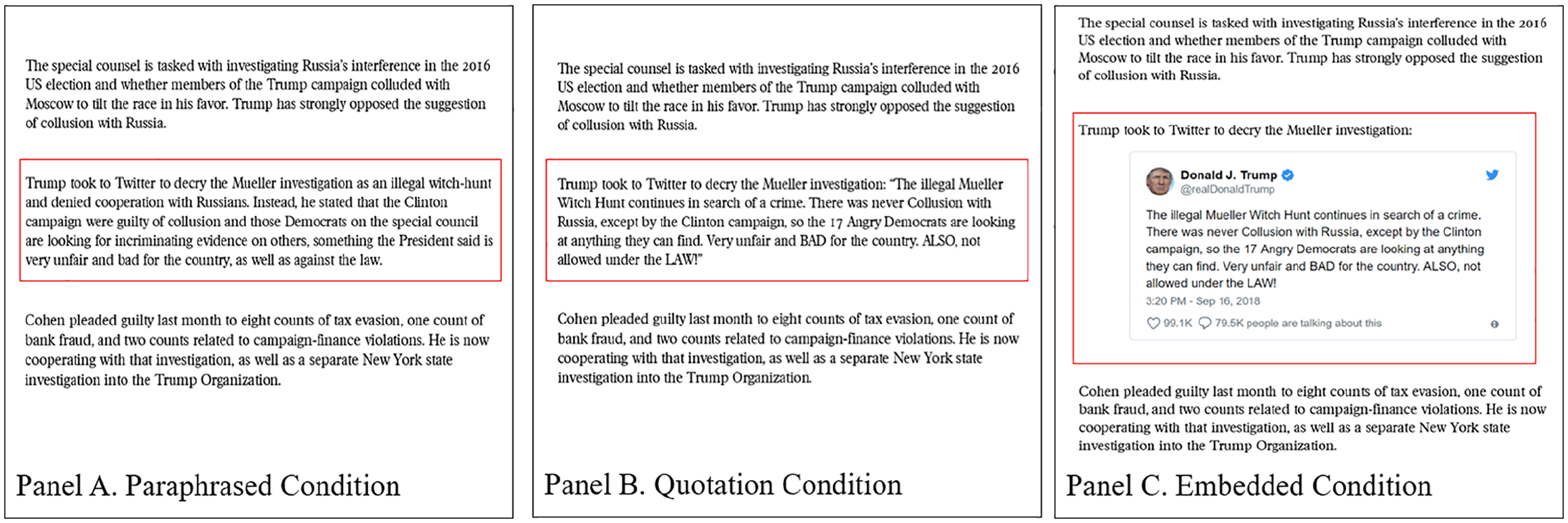
Excerpts from the stimuli by experimental condition.
Recruitment, sample, and procedure
Participants were recruited online using a company called Prolific. The survey was distributed to US citizens, currently residing in the United States, with either Republican party affiliation (first study, 18–19 October 2018) or Democratic party affiliation (second study, 22 October 2018). 3 To standardize the stimuli exposure across participants and to remove potential confounding factors such as large differences in screen size, the surveys could only be taken using desktop or laptop computers. After having been randomly allocated to read one of the three versions of the online news article, participants answered a questionnaire, were debriefed and paid. To ensure that every participant had the time to read the stimuli, they could only move on to the questionnaire section after spending a minimum of 90 seconds on the news article. 4 The questionnaire contained, in order, questions about emotions while reading the article, evaluations of Trump’s character, evaluations of the article quality, manipulation check, and questions on the respondents’ political and media consumption background. The initial samples were N = 290 Republicans and N = 238 Democrats.
The manipulation check item asked, As far as you remember, how was Donald Trump’s reaction reported in the article you have just read . . . (1) ONLY through his own words from Twitter; (2) MOSTLY through his own words from Twitter; (3) MOSTLY through the journalist’s words; (4) ONLY through the journalist’s words.
We coded as correct those who answered (2), (3), or (4) in the Paraphrased Condition, and those who answered (1), (2), or (3) in the Embedded and Quotation Conditions. The final samples for analysis are N = 275 Republicans and N = 210 Democrats.
Variables
Emotional activation was measured by combining the answers of two batteries of questions. The first battery, immediately following the exposure to the stimulus, was adapted from Harmon-Jones et al.’s (2016) discrete emotions questionnaire. It asked “While reading the article to what extent did you experience these emotions? Hopeful/Optimistic/Proud/Anger/Worry/ Nervous/Revulsion/Sickened (in random order).” Respondents were asked to report about each emotion on a 7-point scale, labeled from “Not at all” to “An extreme amount” (numerically coded 0–6). We combined the self-reports of “hope” and “optimism” into an overall measure of Respondent Hope Feeling (alpha = .89 for Republicans and .87 for Democrats). We followed a similar procedure for the negative emotions. We combined the self-reports of “worry” and “nervous” into a measure of Respondent Anxiety Feeling (alpha = .85 for both partisan samples), and “sickened” and “revulsion” into an index of Respondent Disgust Feeling (alpha = .88 for both partisan samples).
The second battery of questions aimed to identify the source triggering these emotions. It asked, “While reading the article, who made you feel MOST . . . Hopeful/Proud/Angry/Anxious/Disgusted (in random order),” with respondents being able to choose one of four options: the journalist/Donald Trump/Robert Mueller/Michael Cohen (presented in random order).
Trump-generated positive emotions
We constructed a Trump-Generated Hope variable, by combining the answers to the two emotions batteries. The variable took the value of the Respondent Hope Feeling if respondents identified Trump as the main source for their feeling hopeful, and zero otherwise. In a similar manner, we constructed a Trump-Generated Pride variable, which took the value of the self-declared level of pride if respondents indicated that Trump was responsible for their feelings, and zero otherwise. Consistent with previous research (e.g. Brader, 2005), we combine the two Trump-Generated Hope and Pride feelings into an aggregate measure of Trump-Generated Positive Emotions, but only for Republicans (alpha = .84). In the Democrat study, we only had six respondents who expressed feeling positive because of Trump.
Trump-generated negative emotions
In a similar manner, we constructed three additional variables: Trump-Generated Anxiety, Trump-Generated Disgust, and Trump-Generated Anger; each took the value of the corresponding self-declared feeling on the discrete emotions battery if respondents chose Trump as the main source of the emotion, and zero otherwise. Finally, we combined all the Trump-related negative emotions into one single index, Trump-Generated Negative Emotions (alpha = .76 for Republicans and .77 for Democrats)
Trump evaluations
We then asked respondents to report “What impression did YOU personally get of Donald Trump as you were reading the article?” on a scale ranging 0–10, for each of the items (displayed in random order): Sincere/Trustworthy/Knowledgeable/Intelligent. We combine the values for “sincere” and “trustworthy” into a Trump Warmth Rating (alpha = .97 for Republicans and .77 for Democrats), and similarly, the values of “knowledgeable” and “intelligent” into a Trump Competence Rating (alpha = .96 for Republicans and .89 for Democrats).
Article evaluations
Respondents were asked to “describe the article you have just read” on five different semantic differential scales, ranging from −5 to 5: “Unfair/Fair”; “Does not tell the full story/Tells the full story”; “Inaccurate/Accurate”; “Cannot be trusted/Can be trusted”; “Opinionated/Factual.”
Controls
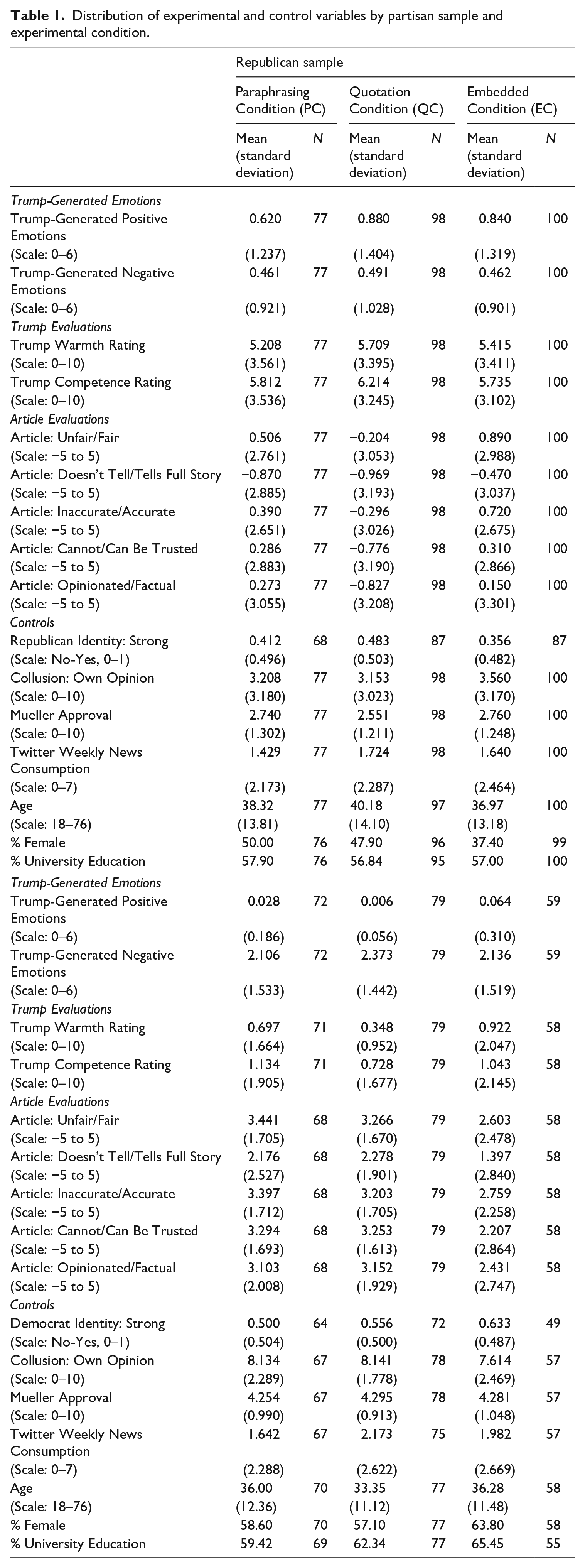
In all our analyses, we control for demographics, political attitudes, and media habits. In the first category, we account for respondents’ age, gender, and formal education (6-point variable, ranging from none to doctoral and above). In terms of political attitudes, we control for strength of partisanship (dichotomous variable coded 1 for strong partisan), opinions about the Mueller’s conduct in the investigation (0–10 scale), and opinions about whether the Trump campaign colluded or not with Russia (on a 0–10 scale, with 0 indicating the respondent is sure of no collusion). 5 Finally, social media consumption has been shown to influence citizens’ perceptions of politicians’ character (e.g. Dimitrova and Bystrom, 2013). We therefore control for the number of days respondents reported following news on Twitter (ranging 0–7). Table 1 presents the distribution of the variables by condition.
Distribution of experimental and control variables by partisan sample and experimental condition.
Results
The effects of verbatim tweet exposure on Trump evaluations (H1, H2, RQ1)
We begin by considering the direct impact of exposure to the verbatim tweets on readers’ perceptions of Donald Trump’s warmth and competence, with the full analyses presented in Supplemental Appendix C. Overall, compared to paraphrasing, we find limited to nil direct effects of the tweet embedded or quoted format on both competence and warmth, among both Republicans and Democrats. None of the pairwise between-group differences reaches statistical significance at the conventional p = .05 level.
A more thorough test of our hypotheses requires us, however, to examine the possibility that tweets might affect readers via an emotional activation mechanism (RQ1). Figure 2 presents the distribution of Trump-generated emotions for both Republicans (left-side panel) and Democrats (right-side panel). While the modal category is “no emotion,” there are significant variations across the two partisan samples and by emotional valence. Among Republicans, the percentage of respondents reporting some level of Trump-generated positive emotions increases in the Quotation and Embedded Conditions compared to the Paraphrasing Condition; conversely, as already noted, virtually no Democrats reported feeling positive due to Trump. In the realm of negative emotions, Democrats report stronger emotional intensity on average than Republicans, but there is no significant experimental effect for either group.
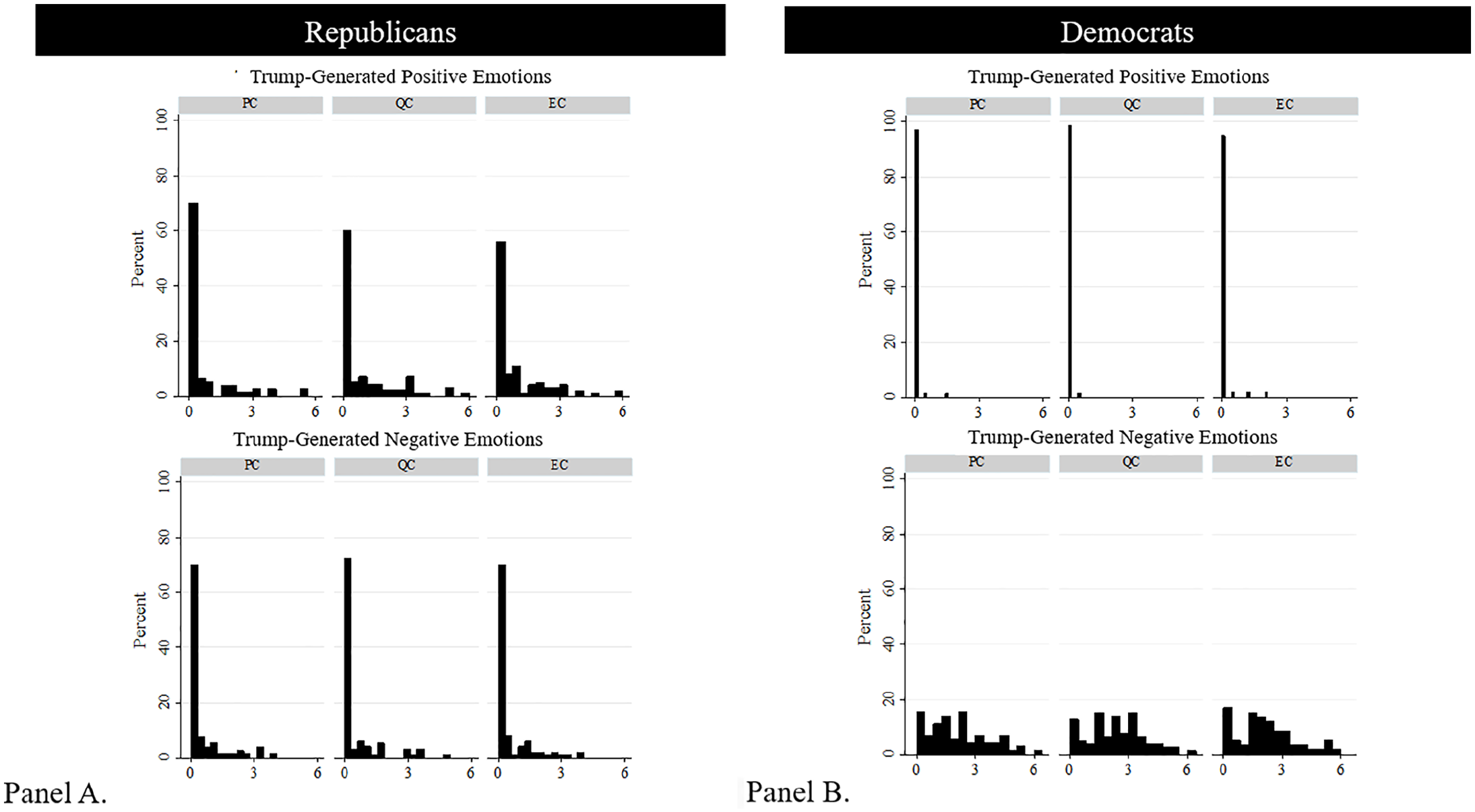
Distribution of Trump-generated emotions among Republicans (Panel A) and Democrats (Panel B).
Our next step is to test the statistical significance of the difference in the distribution of positive emotions among Republicans. The Shapiro–Wilk test revealed significant deviations from normality in the distribution of residuals (W = .862, p = .000), thereby preventing a linear regression analysis. Consequently, we re-coded the Trump-Generated Positive Emotions measure into a binary variable, with the value of “0” reflecting no emotional activation, and “1” representing positive emotional activation, irrespective of the intensity. We then re-ran the model using a logit regression analysis (see Supplemental Appendix D). The results confirmed a difference between conditions in the Republican sample, with a significantly higher likelihood of feeling positive because of Trump for those in the Embedded Condition than in the Paraphrasing one (p < .05).
To test the mediating role of Trump-generated positive emotions among Republicans, we next ran two mediation models, as illustrated in Figure 3 for Trump’s Warmth Rating, and in Figure 4 for Trump’s Competence Rating (with full results in Supplemental Appendix E).
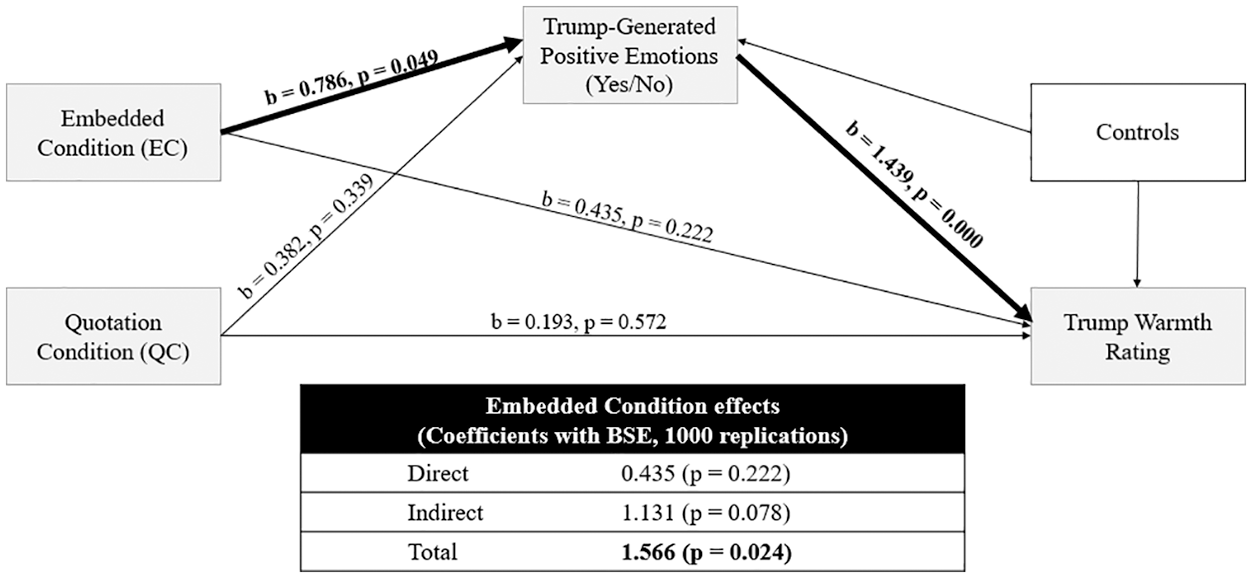
Mediation model results and effects of the Embedded Condition on Trump Warmth Rating in the Republican sample.
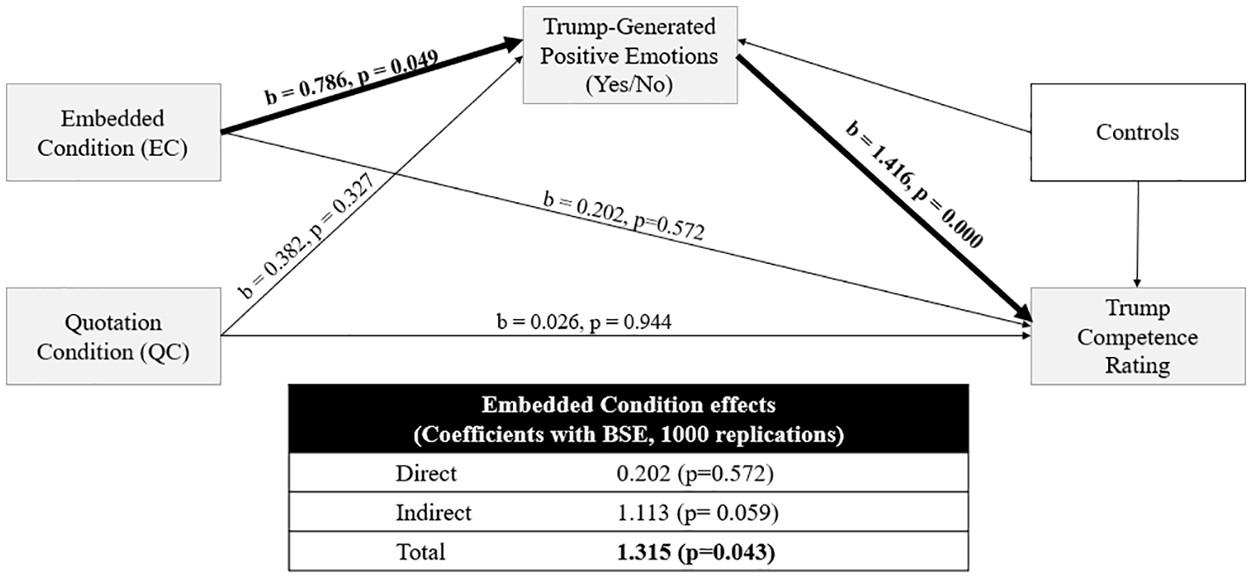
Mediation model results and effects of the Embedded Condition on Trump Competence Rating in the Republican sample.
The pattern of results is similar for the two ratings—the Embedded Condition has a statistically significant total effect on perceptions of his warmth and competence (p < .05). When considering the total effect, Trump’s Warmth Rating increases on average with 1.57 on the 0–10 scale in the Embedded Condition, compared to the Paraphrased Condition, while his Competence Rating increases on average with 1.31 on the same scale. We observe no difference between the Paraphrased Condition and the Quotation Condition. These results provide, therefore, partial support for both our H1 and H2, and suggest a positive answer to our RQ1, as in the case of the Republican sample, we find that including the tweets in the article in an embedded form does indeed affect their opinions about the US President, through the mediating role of Trump-generated positive emotions.
The effects of verbatim tweet exposure on perceptions of the journalistic quality (RQ2)
Figure 5 provides the distribution of opinions on our article evaluation variables. The distributions showcase a Republicans’ and Democrats’ perception gap: whereas Republicans tend to be critical on average, most likely because the article itself discussed the topic of collusion between Russia and the Trump campaign, Democrats are mostly positive about it, perhaps for the same reason. The distributions suggest, however, that there may be variations in evaluations as a function of the format of the tweets.
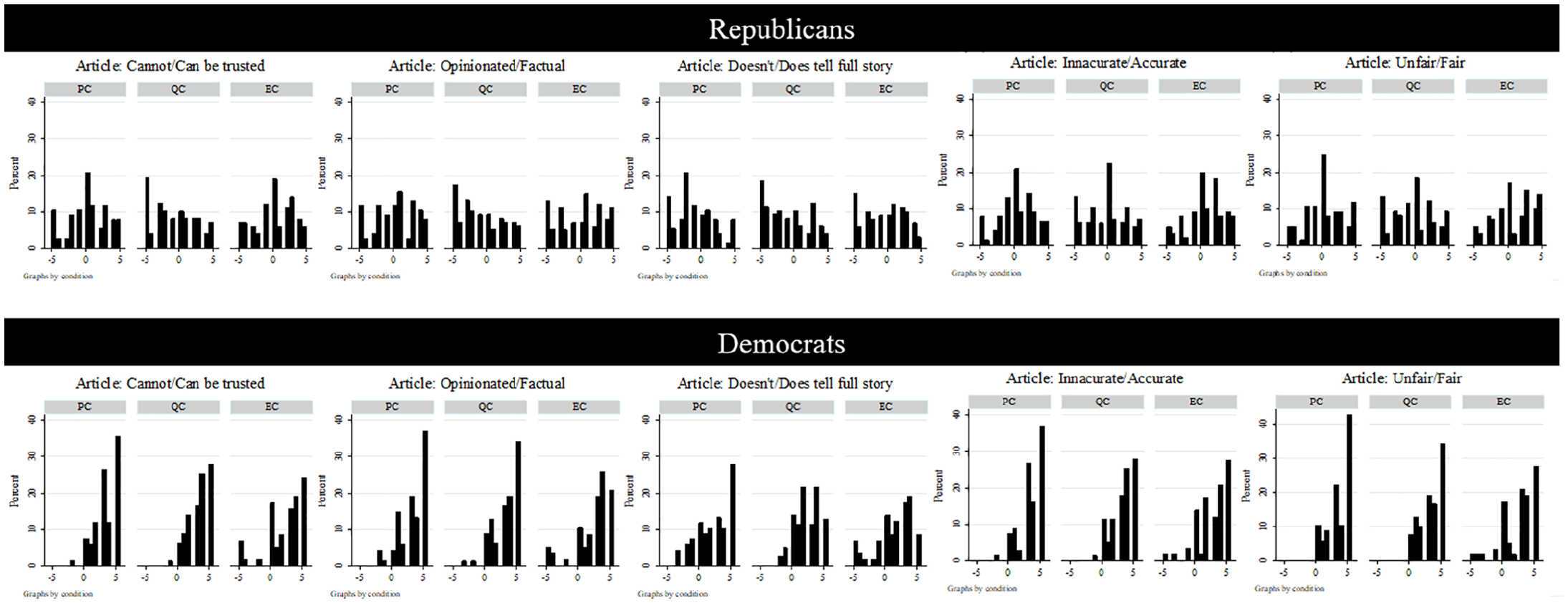
Distribution of article evaluations by variable and partisanship.
To test the significance of differences between conditions, we again look at the distribution of residuals to decide for the best method of analysis. Whereas for Republicans we observe no significant departures from normality, allowing us to use linear regression, for Democrats, the Shapiro–Wilk test produces again statistically significant W values (W > .90, p < .003 for all five article evaluation variables). Consequently, we recode the Democrat measures into three-level variables, so as to achieve an as even split as possible: Low (evaluations lower than or equal to 2), Medium (evaluations of 3 and 4), and High (evaluations of 5), 6 and use ordered logistic regression to analyze the differences. We find significant experimental effects on Republicans’ trust in the article, and on four Democrat article evaluation items. The predicted values by experimental condition are graphically presented in Figure 6 (with full results in Supplemental Appendix F).
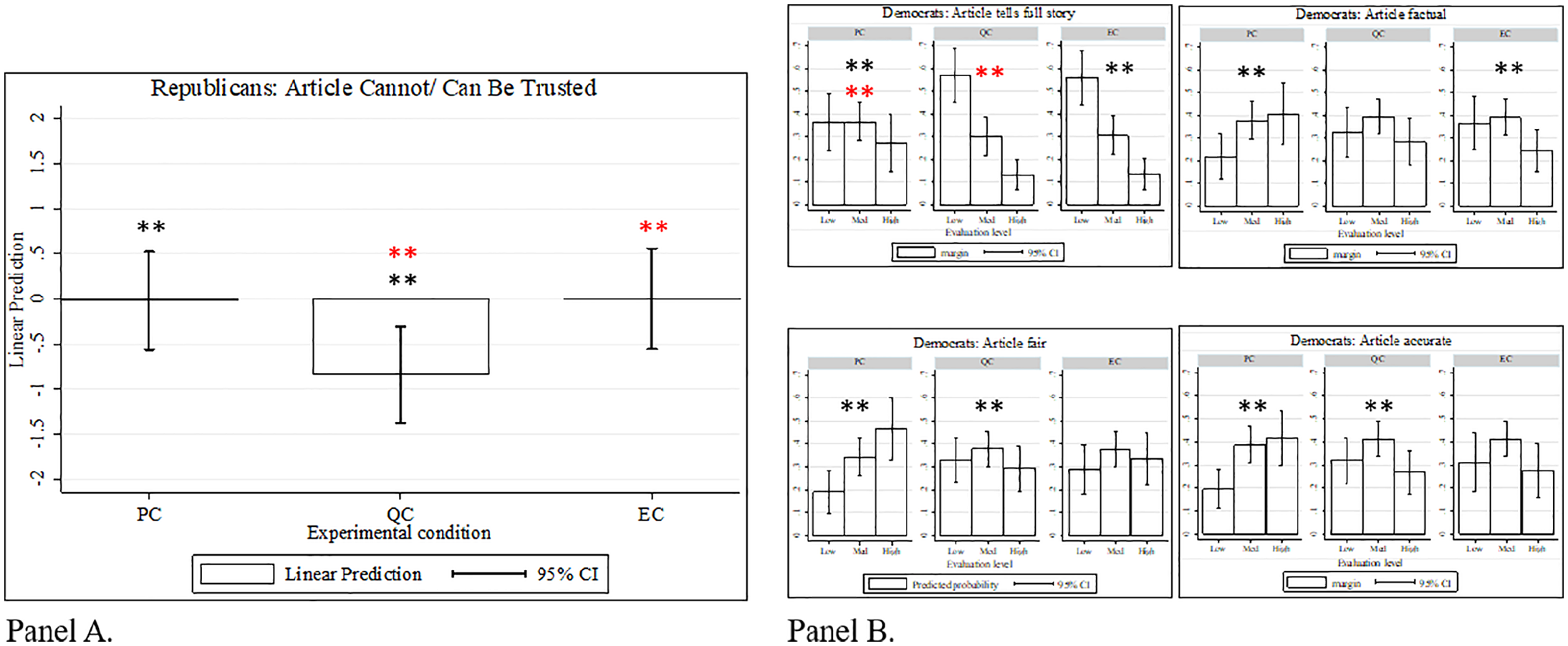
Experimental effects on article evaluations by article trait for Republicans (Panel A) and Democrats (Panel B).
The results suggest that Republicans express similar levels of trust in the article when tweets are paraphrased and when tweets are embedded, but they are significantly more likely to distrust the article when the tweets are quoted in plain text. On the Democrat side, respondents rate the article higher for telling the full story and for being factual in the Paraphrased Condition than the Embedded Condition. Democrats also express greater appreciation of the article’s accuracy, fairness, and are more likely to believe it tells the full story in the Paraphrased Condition, compared to the Quotation Condition.
Discussion
Against a backdrop of mounting pressures on their time, finances, and reputation, journalists are frequently turning to social media as a source of quotes. Evidence from several countries shows that these quotes are not neutral—those that make it in the news are often simple, easy to read, and relate to scandals and controversies (e.g. Ekman and Widholm, 2015; Hatakka et al., 2017; Metag and Rauchfleisch, 2017; Parmelee, 2014). Thus, populist politicians who thrive on controversies, like Trump (but also others who share his tweeting style, for example, Gonawela et al., 2018), can avail themselves of this practice to increase their agenda-setting power and gain additional means of disseminating their message to the wider public. While recent research has found that including tweets from ordinary people as vox populi in online news can impact readers’ issues perceptions (Ross and Dumitrescu, 2019), there has been little in the way of exploring the impact of political elites’ tweets. This study brings evidence that embedding or quoting politician tweets can have important consequences.
First, we found that Republicans are influenced in their evaluations of the President by the format of tweets, specifically by their embedded form, as compared to their paraphrased form. The effect of tweets is primarily indirect, as Trump is able to use them to generate positive emotions, which in turn favorably mediate the effect on ratings of his character after seeing the tweets.
The finding that the impact of the exposure to Trump tweets is channeled through emotional activation adds to the current scholarship on emotional political discourse. Specifically, it suggests that politicians’ emotional appeals can be effective even when presented within a larger context of a news article, and not just in the form of politician-controlled political ads, or direct social media communications with the public. The finding also strengthens the case that populist political communication draws its effectiveness from successful emotional activation (e.g. in line with Wirz, 2018).
In addition, the fact that embedded tweets (compared to paraphrasing) lead to higher politician evaluations, through the emotional impact of the embedded tweets, is an important finding in light of existing scholarship on character appraisals resulting from quoting practices in the media. Notably, Weaver et al. (1974) found that, for print news stories, whether personal testimony was presented in paraphrased or quoted form made little difference to the student participants’ perceptions of the personality of the individual giving the personal testimony. Our finding is additionally intriguing given that significant differences were only present for the Embedded Condition compared to the Paraphrased Condition and not for the Quoted Condition. Indeed, this may imply that the unmediated communicative value of the embedded tweet goes beyond the text. Embedded tweets also reproduce the image of the poster, and citizens have been shown automatically to infer politician competence from very limited face exposure (see Dumitrescu, 2016, for a review). Moreover, by embedding the tweet, journalists may signal importance of the tweet in two additional ways. First, they might signal that there is community support for it, as tweets in embedded format also provide information about the number of people who “like” it and who “are talking about this” (which, in our case, was in the thousands for any of the three posts included). Second, the embedded version of the tweet will inevitably take more space on the page than the quoted version, thereby potentially signaling importance in the news story. Although beyond the scope of these experiments, isolating the effects of these factors (which are unique to the embedded format) should prove fruitful in further research.
The effects of exposure to tweets, as opposed to a journalist rendition of the content, extend beyond political evaluations. We find that both Republicans and Democrats integrate the way tweets are presented into their judgments of the journalistic quality of the article. Within the Republican sample, we find that the article with paraphrased tweets and the article with embedded tweets are seen as being of similar quality. However, when the tweets are quoted in plain text, Republicans are significantly more likely to distrust the article compared to embedded and paraphrased versions. This surprising finding may be due to the fact that whereas paraphrasing is part of journalists’ established toolkit, and therefore, a generally acceptable practice, by not reproducing the tweet in full (i.e. by not including the picture and the tweet popularity statistics that come with the embedded tweet) journalists may be seen as directly editing the intervention while all the while claiming to report it in full. It also suggests that the tweet text, more than the ideas it contains (which can be paraphrased), may in itself be associated to the specific context it appears in.
Within the Democrat sample, the perceived quality of the article decreases with the inclusion of verbatim tweets, compared to the Paraphrased Condition. Democrats find that including the tweets in either format makes the article less likely to tell the full story. They also penalize it for being opinionated (as opposed to being based on facts) in the Embedded Condition and lower their evaluations of the article’s “accuracy” and “fairness” in the Quoted Condition. This suggests that including the tweets is perceived as giving too much voice to opinions, but also that the practice of quoting a tweet, that is, actively removing the Twitter handle and the information that comes with it, can be seen with suspicion.
The fact that we see significant differences at all in these circumstances is in contrast to previous research on perceptions of article quality which investigated direct quotes compared with paraphrasing (e.g. Duncan et al., 2019; Gibson and Zillmann, 1998 ; Weaver et al., 1974). This raises the prospect that Twitter has unique effects when used as a source for politician quotes, and points to the need of further research to better understand what readers regard as acceptable journalistic practices in this respect.
In short, the sum of our findings suggests that journalists should approach including political leaders’ tweets in verbatim format with caution.
Limitations
As with Weaver et al. (1974), our articles contained personal testimony from a single person with the format being altered between conditions. Future research should look at including more politicians within the same article and presenting different points of view.
In addition, President Trump is undoubtedly exceptional in his tweeting frequency. But his political conduct, both on and off Twitter, is similar to other populist politicians, thereby potentially expanding the generalizability of this study. Trump not only shares many tweeting style similarities with other right-wing populist leaders (see Gonawela et al., 2018), but he also thrives on scandals, more often than not using Twitter to defend himself, while cultivating a confrontational relationship with the professional press. His behavior matches Wodak’s (2015) “right-wing populist perpetuum mobile” populist strategy. In essence, Wodak argues, populist politicians make the most of being accused in a controversy by ultimately protesting that they are the victim, often attacking the accuser and the media as being biased. Indeed, just as in the case of Trump, other populist politicians rely on social media in these scandals (e.g. Hatakka et al., 2017: 270). Since journalists are attracted to scandal and negativity when it comes to tweets (Ekman and Widholm, 2015), it is likely that more often than not, populist politicians’ antagonistic tweets outside the US context will also turn up in the news. Our study sheds some light on the public’s reactions to this journalistic practice, but future empirical explorations outside the US context would provide further valuable insights into its effects on readers’ perceptions.
Our research focuses only on Trump’s tweets, but the attention given to any politician tweet (through likes and retweets) hinges on its emotional content and on the politician’s large followership (Walker et al., 2017). Thus, the effects we observe in our studies should extend to other popular non-populist politicians whose emotional persuasive tweets end up in the news. Moreover, it may be that even with a less inflammatory message, simple exposure to a politician’s Twitter profile image or discussion and popularity metrics, may also successfully activate positive emotions. Pursuing these research directions is of timely importance given the increased frequency of tweets in news.
We purposely chose a little-known online news outlet for our studies, to minimize the confounding impact of respondents’ prior opinion about the media source on the experimental effects. However, tweets are an integral part of news reports across the media landscape. Future research should explore their effects when embedded or quoted in other more popular news outlets, together with how these effects are impacted by readers’ prior media beliefs.
Finally, our study examines the impact of exposure to tweets in news on larger screens, but mobile news readership is rising. Current research finds that displaying political news on smartphones may inhibit information processing (Dunaway et al., 2018), while others find that mobile viewers are disproportionately exposed to entertainment as opposed to policy news (Santana and Dozier, 2019). While to our knowledge, no study has tested attention to tweets on different screen sizes, taken together, these different research strands suggest that, if viewers are used to seeing softer news on their mobiles, then, tweets may be equally if not more eye-catching on smaller than on larger screens. Thus, measuring the impact of tweets on different devices is an important topic for further exploration.
Conclusion
Our findings demonstrate how—within the hybridized news media environment—newly developed and proprietary affordances offered by social media platforms are able to reframe traditional verbatim quoting practices and affect audience perceptions as a result. For journalists, the results strongly suggest that a recurrent practice, that of quoting politicians’ tweets, should be used with caution given the impact on readers’ perceptions not just of those quoted, but of the news quality itself. For the community of scholars, the results provide ample impetus for further explorations of the integration of populist and non-populist political leaders’ social media messages in the news media.
Supplemental Material
EQP_paper_appendices_RR10_02_02 – Supplemental material for Embedding, quoting, or paraphrasing? Investigating the effects of political leaders’ tweets in online news articles: The case of Donald Trump
Supplemental material, EQP_paper_appendices_RR10_02_02 for Embedding, quoting, or paraphrasing? Investigating the effects of political leaders’ tweets in online news articles: The case of Donald Trump by Delia Dumitrescu and Andrew R N Ross in New Media & Society
Footnotes
Funding
The author(s) received no financial support for the research, authorship, and/or publication of this article.

Supplemental material
Supplemental material for this article is available online.
Notes
Author biographies
References
Supplementary Material
Please find the following supplemental material available below.
For Open Access articles published under a Creative Commons License, all supplemental material carries the same license as the article it is associated with.
For non-Open Access articles published, all supplemental material carries a non-exclusive license, and permission requests for re-use of supplemental material or any part of supplemental material shall be sent directly to the copyright owner as specified in the copyright notice associated with the article.
