




Abstract
Networks are almost ubiquitous in the social sciences, in terms of method and structure. Dominant discourses around networks–concerning their purported democratic, progressive values and capacities–also impact how they are approached in research. This article illustrates the potential of this impact by tracing the trajectory and findings of a project focused on networked discussion of an Internet privacy debate. Using mixed methods—hyperlink network mapping, textual analysis (qualitative and quantitative), and semi-structured interviews—I examine online framing of a controversial data protection concept, the Right to be Forgotten. Initial, more “traditional” research approaches allowed for insight only into the most central and visible frames and sources. This led to a reorientation of research approach. In attempt to diversify sources and framings, I began focusing on the margins and off the “networked public sphere.” This article thus also recounts the significant empirical findings that resulted from such reflexivity and reorientation.
Keywords
Introduction
The Right to be Forgotten
In 2014, a “new” privacy debate hit the stands—or rather, the web pages of many mainstream news sources. A court had ruled that European citizens had the “right to be forgotten” (RTBF) online. The RTBF allows individuals “[T]o ask search engines to remove links with personal information about them . . . where the information is inaccurate, inadequate, irrelevant or excessive for the purposes of data processing” (European Commission, 2014). In other words, Europeans could request search engines to de-link results associated with their personal information.
Despite media framing of the RTBF as shockingly out of the norm (Arthur, 2014; Peston, 2014), the RTBF had been under regulatory consideration for years prior. In addition, certain frames were already in place for its coverage. A year previously, American whistleblower Edward Snowden had revealed the existence of extensive global surveillance systems tied to several governments, making privacy a hot news topic in terms of geopolitics; some framed the RTBF in terms of an ongoing EU versus US economic power struggle (Ball, 2013). Other framings came from existing debates concerning online privacy. This included sensationalized predictions of pedophiles, criminals, and politicians abusing the right (Curtis, 2014); relatedly, others framed the RTBF as infringing on freedom of the press and the public’s “right to know” (Miller, 2014; Streitfeld, 2014).
Notably, in the eyes of the law, the RTBF is not an absolute right; it must always be balanced against “other fundamental rights,” including freedom of expression, as a crucial public interest safeguard (European Court of Justice, 2014). Much RTBF discussion centered on a perceived balancing act between public and private; generally, the RTBF was portrayed as an affront to the public. This is because privacy is a social concept—it is about appropriate information flow, depending on context (Nissenbaum, 2009). Thus, privacy is notoriously difficult to define, and the ability to pin down a publicly accepted definition via the media is evidence of significant power (Hall, 1997; Solove, 2009; Thompson, 1995).
The RTBF touches upon aspects of what it means to live in a “network society.” It is about the development of rights at the intersection of technology, personhood, and the public/private divide. The RTBF involves contemporary questions of what it means to be “human” in a digital, networked age. Who controls or benefits from networked, personal data? Relatedly, who draws the line between what is public and what is private online? The stakes are high for many actors in answering these questions. Social media platforms, individuals, search engines, governments, regulatory bodies, and traditional news outlets are all affected by how the RTBF is defined and implemented. These actors are thus all involved in shaping discourse, and the RTBF has generated much media attention as a result (Interview with Chris Moran, Editor—Strategic Projects, The Guardian).
For the purposes of this article, the RTBF is topically productive for three main research reasons. First, it has sparked prolific discussion on the “networked public sphere,” making it a good candidate for issue or topic network methods (Benkler, 2006; De Maeyer, 2013). Second, it represents a heated ongoing negotiation of modern roles and responsibilities in a “network society” around personal data, with very real implications for its future shape (Xue et al., 2016). Third, it provides an important empirical, timely contribution to discussions of the politics of knowledge production via digital methods (Rogers, 2013). The interrelation of methods and topic around networks allows for greater reflexivity on hegemonic discourse (Kitchin, 2014). Delineating the boundaries of a topic network is an act of both “mapping” and “doing” politics (Rogers, 2012). One way to understand this is in terms of the politics of knowledge production, where academics can contribute to the defining of a topic—to ruling in and ruling out of different perspectives or concepts. The RTBF is the type of topic that allows researchers a better chance to reflect on this process of mapping and doing, and indeed, this is one of the focuses of this article.
Regarding the RTBF, what is being said, by whom, and with what kind of discursive, definitional power? These are research questions, applied to an ideally situated case study regarding the nature of networks, that I was sure could also be answered using a network-centric approach. I expected that in mapping networked discussion of the RTBF, I would have a comprehensive view of every perspective on this highly contested privacy concept. This was predicated on assumptions of the pluralistic, “democratic” nature of such information networks and the comprehensive nature of network methods. Instead, as this article aims to show, research concerning public discussions and knowledge creation in the digital age must take into account the impact of such assumptions.
Network concepts: framing and discourse
The social sciences are enamored with networks—as concept, as data, and as structure. Networks are used to represent, understand, and shape the “social,” particularly in the digital age. Manuel Castells has approached networks as the “social structure of everything” (Castells, 2000, 2011). Actor-Network Theory is a staple of sociological theory, extolling the social as comprised of changeable networks of relationships (Latour, 2005). In terms of publication counts, there has been a veritable “explosion of interest” in network research (Borgatti et al., 2009).
Networks are generally framed, implicitly and explicitly, as holding inherent values for the betterment of society. Framing, following Entman’s (1993) widely accepted definition, is “to select some aspects of a perceived reality and make them more salient in a communicating context, in such a way as to promote a particular problem definition, causal interpretation, moral evaluation, and/or treatment recommendation for the item described” (p. 52). Dominant discursive approaches to networks thus affect the frames present in emergent news events about networks, and vice versa. For example, in framing privacy issues such as data protection in a certain way, media shape “attitudes and behaviors” of those using or researching those networks (Chong and Druckman, 2007; Teutsch and Niemann, 2016).
Thus, framing, as a discursive act, impacts how researchers approach networks, topically and methodologically. As information technologies, networks are deeply influenced by the “information society” discourse. This discourse is part and parcel of a “wave of technological enthusiasm” (Webster, 2005). Framings that connect to this discourse are often of a utopic flavor, associating information technologies with enormous social and economic benefits (Mansell, 2010). For example, communication networks are consistently, discursively promoted in frames of valued affordances for social movements (Tufekci, 2017), of innovation and greater wealth (Benkler, 2006), and most significantly, of increased pluralism and democracy (Shirky, 2008). According to Castells (2000), with the rise of access and usage, the Internet “becomes the fundamental basis of our lives,” a networked public sphere.
Notably, there has been a recent rise in important critical scholarship surrounding networks and related revolutionary discourse (Morozov, 2013; Mosco, 2005). Tufekci (2017), drawing from ethnographic work on diverse social movements, implores researchers to approach network technologies in terms of “continuity rather than change.” Hindman (2009) provides powerful empirical evidence of how Internet infrastructure can concentrate elite power, rather than increasing pluralism and democracy. Zuboff (2019) approaches the Internet as an arena of significant capitalist accumulation, strikingly free of oversight through the discursive efforts of surveillance capitalists. Over the last two decades, there has been a shift in general research inquiry toward reflection and recreation of hierarchies via the “online world” (Rogers, 2012).
However, network approaches, both within and outside academia, are still very much influenced by dominant utopic discourse and framing. There is an ongoing need for more empirically based, reflexive research into networks. This article aims to address that need with a case study, exploring how different network approaches to the RTBF revealed different insights. When researching the RTBF, I initially conceived of linked, open web data as representing an ideal “networked public sphere.” I made assumptions about pluralistic participation in online discussions and overestimated the ability of network data to capture it all. My approach was based on optimistic readings of existing Internet and link studies (De Maeyer, 2013), but also on an internalization of dominant network discourses. This approach made for less probing and nuanced findings—but also findings that further existing arrangements of power. This article maps frames, actors, and their relative symbolic power in the discursive space surrounding the RTBF. Such mappings allow for exploration of a power/knowledge connection. They can illuminate how network discourse impacts conceptualization and development of networks by illuminating the relative visibility, or power, of different perspectives. By approaching networks as inherently inclusive and pluralistic, researchers can circumscribe their findings while also contributing to the amplification of certain voices over others.
I aim not to discount network methods with this article, but to encourage researchers toward more self-reflective, critical approaches. I do so by tracing my own network-centric research approach. First, I give more background on two network discourses particularly prevalent and influential in the case of the RTBF: the “information society” and networks in terms of human rights. After an overview of methods (centering on hyperlink network mapping) and initial findings, I then compare and contrast two related framings, one which is centered on rights to information (e.g., freedom of the press) and the other centered on the Right to Remember (RTR). One framing is more visible in networked public discussion, but both benefit from a more critical, contextualizing approach.
Contextualizing the RTBF
Discourse, framing, and media power
The RTBF did not arise in a vacuum, without script. Outlines of a primary definition were in place well before 2014 (Hall et al., 1978). Established framings of digital networks and privacy—as discursive acts—affect not just research but implementation of the RTBF. By discourse, I refer to a Foucauldian system of representation key to construction of knowledge, “ruling in and out” ways of conceptualizing a topic (Fairclough, 2001; Hall, 2001). Influential discourses, such as those that connect networks with progress, are implicated in existing power structures (Foucault, 1980). “Knowledge linked to power, not only assumes the authority of ‘the truth’ but has the power to make itself true. All knowledge, once applied to the real world, has real effects, and in that sense at least ‘becomes true’” (Hall, 2001).
This is one reason why there is a strong tradition of media research in terms of power and meaning creation (Freedman, 2014; Herman and Chomsky, 2002). The media are a key source of knowledge dissemination and creation. Mills and Miliband noted that the media play a “central role in the nurturing and production of elite power” (Freedman, 2014: 35). Couldry (2000) states that the media serve to “naturalize” other social, economic, and regulatory frameworks. Thus, media can be both mechanism and source of representation; as such, it is doubly discursive (Hall, 1997). In taking this approach to power and knowledge, it becomes clear how deeply dependent this process is on discursive context.
Influences on the RTBF framings: technology and human rights
As described earlier, the information society or “Western digital” discourse asserts “technological innovation necessarily leads to new historical and political possibilities” (Barassi, 2016). It often has a “sublime” flavor, associating Internet technologies with incredible economic and social progress (Mosco, 2005). This discourse has become so widespread and dominant (as evident in the framing of the RTBF) that it is now what social theorists might call hegemonic—unquestioned to the point of common sense and bolstering certain arrangements of power (Fairclough, 2001; Gramsci et al., 2005). The network concept often falls under the umbrella of this discourse—framed both in terms of technology (e.g. the Internet) and desired results of technology usage (e.g. increased connection, fewer barriers to movement, being synonymous with progress).
This discourse impacts study of the Internet as a social space. Despite recent critical scholarship, digital positivism is still a dominant Internet research approach (Fuchs, 2017). Digital positivism advances an “absolutism of pure methodology,” usually privileging quantitative data derived from digital technologies. When working solely within a digital positivistic paradigm, researchers often believe they are “conjuring wisdom not from the flawed intelligence of humans, with all of our well-known limitations, but from the pure data stored in the cloud” (Mosco, 2016). According to Fuchs (2017), this approach’s dominance is bolstered by significant amounts of directed research funding with a neoliberal flavor; messy social realities can be administrated more efficiently when oversimplified and made predictable in representations. For example, when I first examined hyperlink network mappings of the RTBF from the open web, I mistakenly considered these data as wholly representative of a pluralistic networked public sphere.
There is another dominant, related discourse that deeply affects RTBF framing: a contemporary, powerful version of human rights—one that is folded into the neoliberal project of expansion, free markets, and deregulation (Moyn, 2014). It often intersects with the information society discourse. Internet-related rights can be discursively tied to freedom of information—and oft in opposing privacy (Zuboff, 2019). Unsurprisingly, one biting critique of this version of human rights points at substantial connections between technology, capitalism, neoliberalism, and rights in discourse (Mutua, 2013). For example, discussions concerning privacy online have been replete with metaphors of “data as the new oil” (Pfeifle, 2013), as well as “free flow of information” (read: open data markets) being necessary for democratic and economic development. Thus, entities such as powerful tech companies and governments with strong neoliberal tendencies tend to urge for free flows of data and information, and discursively equate privacy with an incursion on “free speech” rights (Streitfeld, 2014; Zuboff, 2019).
These related discourses create a setting and script for RTBF developments and framings. They affect which perspectives are visible. They contribute to reproducing existing inequalities via knowledge construction in a “network society.” If researchers approach networks as de facto pluralistic, comprehensive representations of the social, then less visible, less powerful perspectives can become even less visible and powerful. This article represents a case study of what can be found via triangulation of diverse methods with a concomitant commitment to seeking out the less visible and less powerful.
Methods and research design
I employed mixed methods in identifying RTBF framings and their relative visibility, hoping to allay bias inherent in a single method. This entailed an inductive approach fixed in a qualitative paradigm; I used a “computer-assisted approach,” as described by Matthes and Kohring, to map frames across a wide corpus after having generated a set of working frames via qualitative analysis of purposively and randomly sampled texts (Matthes and Kohring, 2008). Entman (1993) describes frames as manifested by the use of specific words; this description influenced my approach to qualitatively identifying frames, then more quantitatively mapping them via keywords and natural language processing.
More specifically, I focused on hyperlink network mapping, which served as a means of data collection and a guide for sampling texts for qualitative analysis. These methods in turn informed a series of semi-structured interviews, conducted with informants who variously participated in public discussion of the RTBF. Altogether, these methods allowed for identification of a diverse range of frames and actors, in addition to providing insight into the visibility and relative power of each.
Hyperlink network mapping
Hyperlinks are the “basic structural element of the Internet,” linking websites and informing search engine rankings (Park, 2003). Following traditions of citation and social network analysis, hyperlink studies are used to denote social phenomena online; they indicate influence, reflect political authority, suggest academic performance, and/or signal political connections (De Maeyer, 2013). Hyperlink mapping is sometimes associated with earlier eras of Internet research (Rogers, 2013), but this method still provides important insight into the dynamics of online topics (Graeff et al., 2014). On the open web, hyperlinks can be common and forceful directors in framing a topic: The number of links pointing to a site correlated with both its ranking in search engines and the number of visitors the site ultimately receives. The link topology of the Internet thus allows us to draw a rough map of how the attention of citizens is distributed across different sources of online information. (Hindman, 2009: 40)
More hyperlinks can mean more visibility via search engine rankings, with directed hyperlinks (in-links) also serving as pathways for readers to stories. Hyperlink mapping thus provides insight into the visibility, dynamism, and positionality of different actors and frames online (Rogers, 2012).
I used Media Cloud to map RTBF discussion online via hyperlinks. An open-source platform for studying media ecosystems, Media Cloud collects and scrapes millions of stories and related metadata on the open web (Marres and Weltevrede, 2013). It allows researchers to aggregate, analyze, and visualize maps of texts and actors. To begin mapping a topic, one must know key identifiers—referential words and phrases. I created a comprehensive list of RTBF identifiers via qualitative review of a number of academic, court, and media publications. The resultant parameters for scraping included English terms specific to the concept such as “right to be forgotten,” “right to delist,” “right to erasure,” and “right to oblivion”. The results were also restricted to a two-year period immediately following the controversial 2014 ruling.
Following approaches described in other Media Cloud publications (Benkler et al., 2013; Graeff et al., 2014; Roberts et al., 2017), I curated a seed set of 500 stories from the Media Cloud database. 1 I also supplemented the seed set with sources I found through running the same search query via Google. I then used a webcrawler to follow the hyperlinks in each story onto the open web. The texts found at the end of each hyperlink were then compared to the query: if a text matched in terms of content and date, it was added to the growing network of stories. This process ran through 15 iterations until saturation, when few-to-no new stories were being discovered via the webcrawler. Cleaning the subsequent data entailed manually de-duplicating and merging certain texts and sources, deleting off-topic stories and correcting metadata. The result was a network of 5233 English-language texts, 837 sources of those texts, and 3310 links between these texts. 2 I initially approached this network (Figure 1) as representing English-language discussion of the RTBF in the “networked public sphere.”
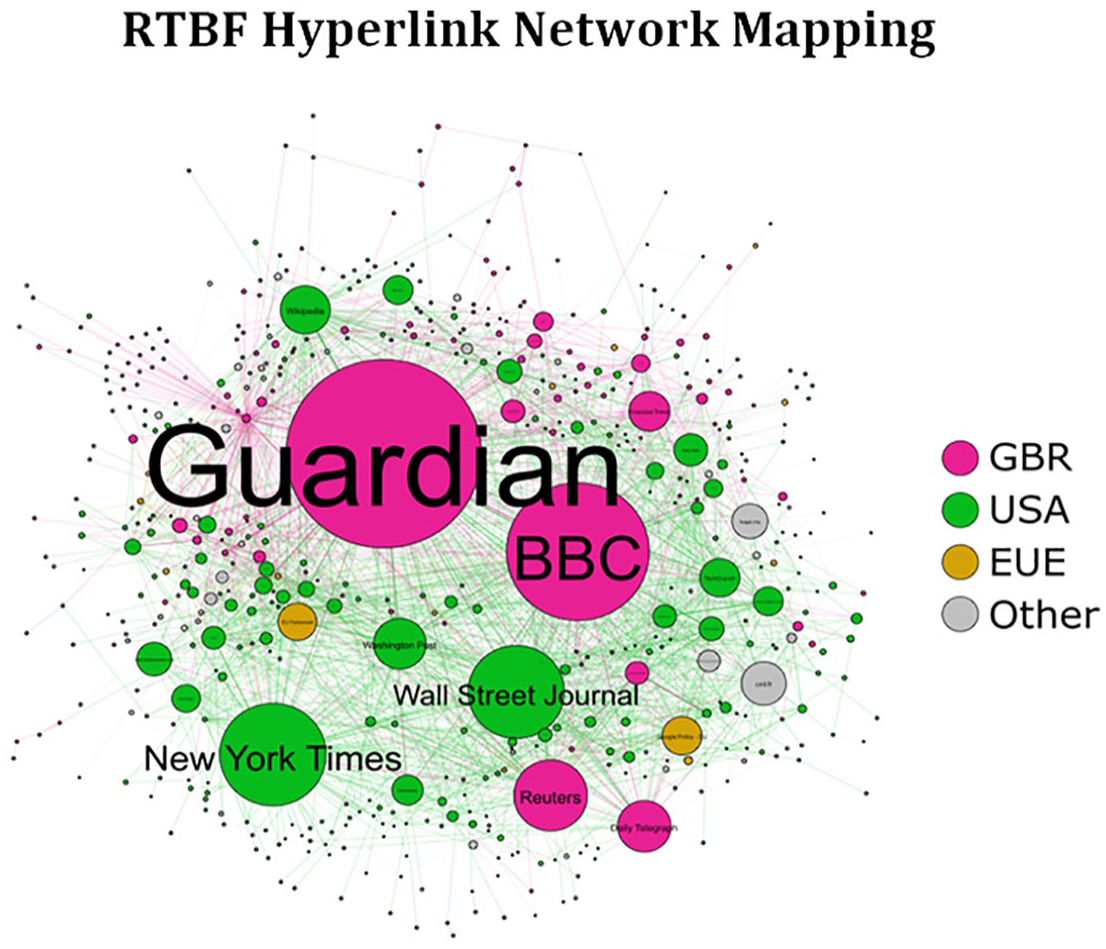
This mapping of the RTBF topic network represents the top 220 in-linked (most visible or central) sources between 2014 and 2016 on the open web. The color of the node and the link indicates country of origin. The size of the node is based on number of in-links, or the relative “authority” and visibility.
Initial textual and frame analysis
This RTBF network allowed for purposive sampling of texts for qualitative analysis. While the network mapping provided information on relations and hierarchies between different sources, a close reading of the texts was still necessary to identify and situate frames (David et al., 2011). I qualitatively coded a selection of 200 stories that were the most central, or visible, in the network; these stories had amassed the highest number of directed in-links. After realizing that these texts came from a small subset of powerful sources, and were framing the RTBF similarly, I also coded a random sample of 200 texts from the network for comparison. After reviewing and collating hundreds of codes, I created an initial list of frames and associated keywords using a grounded theory approach (Bernard and Ryan, 2009). This initial assemblage was grouped into seven working “umbrella” frames. I was then able to use these frames and their related keywords to guide and substantiate identification of frames via interviews, and via automated categorization of network texts (see Supplemental Materials for more background on frames and categorization).
Interviews
Semi-structured interviews provided necessary insight into RTBF framings employed by actors with differing amounts of power (Conti and O’Neil, 2007; Philo, 2007). Both the mapping and textual review informed choice of interviewees. I initially sampled individuals and institutions central to the network and consistently using certain frames. I spoke with individuals who were either deeply embedded in dominant media sources (e.g. editors at The Guardian) or authors whose publications were relatively highly visible (e.g. prestigious academics with highly cited op-eds). I realized over time that a focus on the most visible was limiting; I would be publishing findings that would only further a particular arrangement of power around the RTBF. I focused on uncovering frames that were less visible in the hyperlink network mapping. I pursued interviews with those whose voices and views were less powerful. I employed a snowball sampling approach to interviews, leading outside the confines of the hyperlink network, pursuing perspectives that were not as dominant in network or textual data. The resultant interviewee list included journalists, editors, lawyers, academics, and non-governmental organization (NGO) representatives (see Supplemental Material). Each had some familiarity with the RTBF, having written about or discussed it in his or her respective field.
State of the RTBF network: sources and frames
Using these methods, I constructed a comprehensive view of the most visible, central sources in the RTBF hyperlink topic network. Specifically, I found that certain source types, regions, and identities—and thus particular framings, associated with these sources—were overrepresented. For example, sources with enduring power “offline” were also those most visible in the online mapping.
The types of sources mapped included blogs, issue groups, and forums. But these were rarely visible, given their relatively lower numbers of in-links. The most visible types of sources were legacy media outlets. Of the top 10 most visible sources in the network, only two fell outside this categorization—Wikipedia and the French data protection authority (see Supplemental Material). The rest were well-known British and American news organizations such as The New York Times, The Guardian, and the BBC. Figure 1 illustrates the relative visibility of these Western legacy media sources, given the size and centrality of their nodes. This finding empirically supports a challenge to pluralistic discourse surrounding information networks: not only are existing symbolic power distributions recreated online, but they are arguably strengthened through distributions of visibility (Hindman, 2009).
The relative visibility of sources by region also contradicted pluralistic network discourse. The 837 sources were assigned to 81 countries; more than half (57%) were from the United States or Great Britain (Figure 2). American sources represented over 40% of the network, despite the topic’s European origins. Many American sources framed the RTBF as detrimentally impacting US tech companies as well as the open Internet. Sources from non-EU countries tended to have historical, colonial ties to Europe, particularly the United Kingdom. Other top sources, from Russia and China, often framed the RTBF in economic terms, speculating on financial and geopolitical impacts. Of course, in these findings, there is a skew toward English-language countries, given that the dataset was comprised of mostly English-language stories. 3
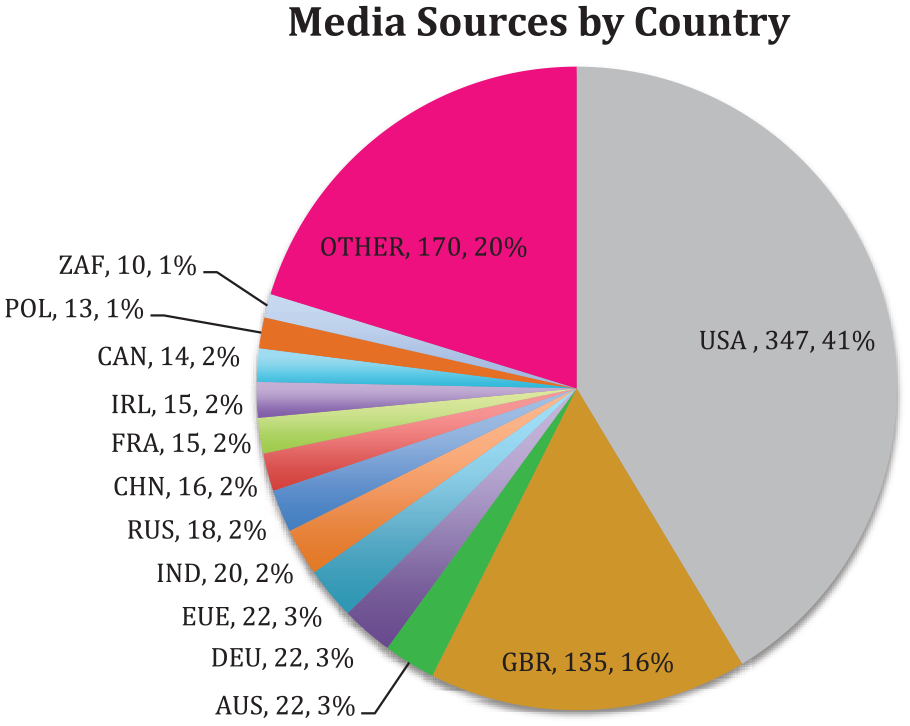
This pie chart shows the proportions of sources in the complete RTBF hyperlink network in terms of their respective countries and regions, as identified from qualitative review. The first three letters identify the country or region of the source; the value stands for the number of total sources from that country; the percentage refers to what fraction of the whole network came from that particular country or region. Classification was based on the publicized location of the source or audience to which the content was directed. EUE stands for European.
The high visibility of certain countries was part of a trend whereby power in other fields seemed to correlate with greater visibility online. For example, samples of the most visible sources showed overrepresentation correlated with historical symbolic power; this meant traditional media outlets, companies, and governments were the most visible source types. Random samples of sources consistently contained more blogs and forums. The more visible sources came from spaces wherein positions of power (and participation in the public sphere) have historically been lacking in diversity (European Journalism Observatory, 2018; Zweigenhaft and Domhoff, 1998). This was also the case for the RTBF. I realized that an overrepresentation of White, male, Western, and institutionally affiliated views was being replicated in my initial interviewee lists and text samples.
The dominance of powerful sources in RTBF discussions has an undeniable impact on the content of those discussions. The inclusion of multiple perspectives in a space of discussion increases diversity in conceptualization of issues (Carter et al., 1998). Dominant network discourse, which assumes plurality, can thus be critiqued in terms of visibility: a power law distribution of links, of connections between pages, is evidence that visibility online is generally afforded to the powerful few (Hindman, 2009). This power was reflected in the most visible, dominant framings of the RTBF.
Highly visible framings of the RTBF
Via qualitative analysis, I found highly visible framings of the RTBF were focused particularly on human rights concepts, the roles of media companies and the press, and economic impact. In an effort to map the relative positioning of these frames in the network, I began assisting in development of a machine-learning categorization tool being built into the Media Cloud platform. The process consisted of training an algorithm, sorting through un-curated stories, and then testing a sample of the results with manual coding. 4 Using this process, I categorized all of the networked stories in terms of three particular dominant framings.
Figure 3 illustrates that there were differences, in frequency, in how media sources employed frames in the two years following the RTBF ruling. The above three sources contained the most in-links, and also higher counts of stories than most other sources. Qualitative review of these stories revealed more insight into differences in framing by source. For example, the BBC rarely employed an economic framing. However, it framed the RTBF in terms of press impact comparatively more than most sources in the network; interestingly, the BBC stories with press impact framing often also contained human rights framings. This is because the BBC framed the RTBF as impacting freedom of expression and information through the press. In terms of framing analysis, this finding was consistent with Goffman’s approach to frames: that they come in an “assembly,” fitting within and adding to each other (Scheff, 2005). The New York Times, an American publication, framed the RTBF economically comparatively more than similar UK sources. Qualitative review showed that US sources often framed the RTBF as a European attack on American companies (Google) and American Internet “values” (e.g. the “free flow of information” or open Internet) (Dewey, 2014; Vincent, 2015).
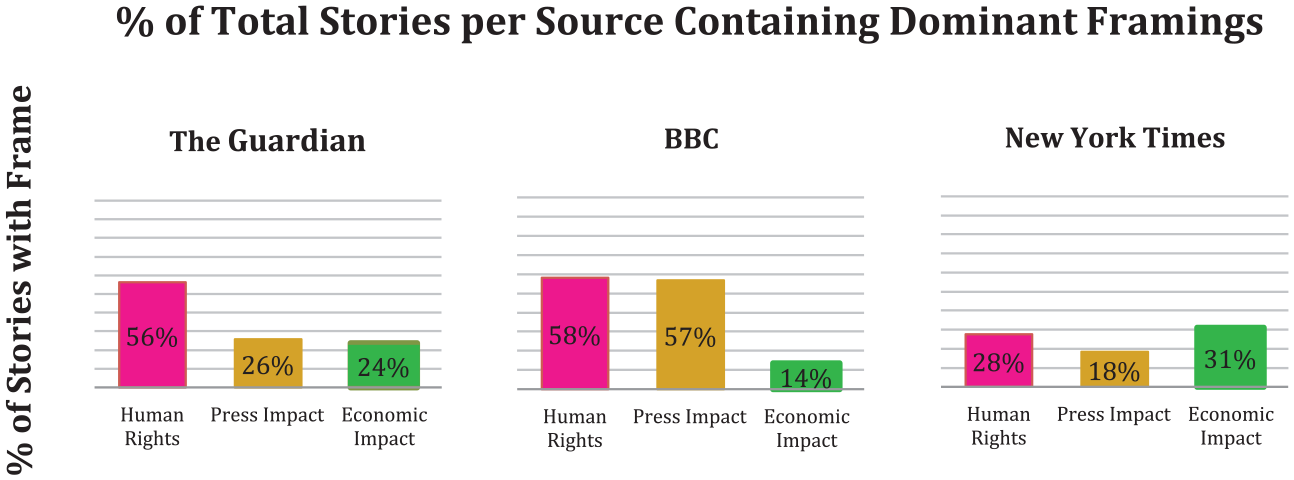
The percentage of each source’s published stories between 2014 and 2016, reviewed via automated categorization, that contained Economic Impact, Press Impact, and Human Rights framing. Each bar represents the percentage of that source’s reviewed stories containing that framing. The coding was not mutually exclusive; a story could contain multiple frames or none.
Getting beyond the visible in the hyperlink network
It became increasingly clear, as analysis progressed, that the RTBF network map was not perfectly, pluralistically representative of many perspectives. This was evident via the skew toward the most visible sources and framings, which were mainly from elite European or American institutions. Automatic categorization of stories with other framings (e.g. focused on gender or non-EU/US contexts) produced no results. There simply were not enough stories with such framings to create training sets. The tools I was using were built so that a visibility threshold had to be met for framings to be analyzed. This particular methodological issue again illuminates the play of power in knowledge construction. In continuing such an approach to my data, there would be a continued lack of representation and understanding of marginalized perspectives in any work I published. As such, I would be, in some ways, contributing to rather than critiquing existing power/knowledge dynamics around networks. Along these lines, I needed greater insight into why certain framings were so prolific. In contrast to similar privacy developments, why had the RTBF continued to appear in news cycles for years? Relatedly, why was the RTBF repeatedly framed by news sources as a threat to freedom of the press?
To answer such questions, I began directing my research efforts to the margins, to sources less visible, less connected, and even off the hyperlink network—those historically marginalized in terms of gender and region. I coded texts purposively sampled at the margins of the network, which included personal blogs, proceedings from meetings, and conference reports. The interviewee sampling had previously privileged visibility and centrality (see the “Methods” section); I began purposively interviewing informants who were less central and outside the hyperlink network, employing snowball sampling through the personal networks of my informants (Goldstein, 2002). This article will now focus on two subsequent findings. The first unveils reasons behind a dominant framing, and the second concerns the existence yet continued invisibility of an important set of framings. Each illustrates the power–knowledge connection surrounding RTBF in a different way.
Behind a framing: freedom of the press and information rights
In an attempt to understand why certain framings were employed more than others, I interviewed several journalists and commentators featured prominently in the network. This section explores a narrative around the press impact framing that I subsequently pieced together from these conversations, and from triangulating the different datasets.
After the RTBF was codified, Google quickly implemented a system in compliance. Before the EU released official guidelines, Google created a removal request form for individuals and implemented a closed system to decide which requests were legitimate—or what information belonged in the public sphere (Powles and Chaparro, 2015). The search engine giant began publishing limited information on removals, giving an initial (incorrect) impression to news outlets that the RTBF was being nefariously used to remove information belonging in the public sphere (McCoy, 2014). One interviewee, a former The Guardian editor, argued this impression was purposeful: In the aftermath [of the RTBF ruling], it was interesting to see stories pop up which I could see had been planted by Google’s PR. So the stories about the delisting of applications . . . could only have come from Google—applications which had come from politicians or pedophiles or criminals . . . (Interview with Charles Arthur, former technology editor at The Guardian)
In addition, Google began notifying publishers when delinking their articles, but without context or explanation. The press cried foul, using rights language to situate the RTBF in opposition to freedom of the press. Robert Peston, former BBC economics editor, penned the most visible story in the RTBF hyperlink network. He was reacting to a delisting notification about his 2007 story, which concerned reckless investments at financial services giant Merrill Lynch. He queried, “Why has Google killed this example of my journalism?” (Peston, 2014).
Peston’s was one of a slew of initial reactionary articles released by news outlets receiving similar vague delisting notifications. Many quickly published lists of links that had been “delisted,” in an attempt to thwart any removal from the public record. These outlets included The Guardian (Ball, 2014), The BBC (McIntosh, 2015), The Daily Mail (Watson and Greenhill, 2014), and The Telegraph (Williams, 2015). Most representation of the RTBF was fixed in this initial flurry of coverage; some commentators came to view Google as manipulating the press against the RTBF: Nine months after the European ruling, it is clear that Google’s implementation has been fast, idiosyncratic, and allowed the company to shape interpretation to its own ends, as well as to gain an advantage on competitors and regulators forced into reactive mode . . . (Powles and Chaparro, 2015)
By speaking to several involved journalists and editors, I thus gained a very different perspective on the prolific framing that the RTBF was damaging press freedoms. It was a framing that several of these journalists wished they could now push back against, but they did not have the time, resources, or power. For example, one frequent academic contributor to The Guardian described her frustration at stagnant coverage, poignantly calling attention to a disjunction in discourse and reality so central to dominant understandings of the RTBF: We haven’t really moved beyond [initial reactions], and probably we’ve regressed to some extent. And this is so funny—when we talk about technology and the relentless pace of progress, and so on—that nuanced ideas don’t progress. (Interview with Julia Powles, Cambridge Academic and Guardian Journalist)
Invisible Frame: Latin America and the Right to Remember
In 2017, having spent the previous year mapping the RTBF hyperlink network and the most visible components, I took a different tack. I began reading stories on the margins of the network—the less visible also in a geopolitical and structural sense. I sought out interviewees who were not White, not male, and not affiliated with powerful European or US institutions. This led to the identification of other framings of the RTBF. This section outlines resultant findings, particularly regarding certain RBTF framings in Latin America.
Insight came from the original RTBF network mapping (see Figure 1). For example, two sources, whose nodes were marginalized in terms of visibility and framing, provided a new avenue of inquiry. Both The Association for Progressive Communications and The Internet Governance Forum had few links, and their framing of the RTBF was rare. They were linked together because both sources noted participation in “offline” discussion of Latin American data protection development. During this discussion, they tied the RTBF to ongoing discussions of coloniality and a “right to remember (RTR)”.
Insight also came from outside informants whose areas of expertise and experience were marginalized in the network. One particular interviewee outside of the hyperlink network but within my professional network served as a “known sponsor” or “orienting figure” (Monahan and Fisher, 2015). Through her, I accessed interviewees in the Latin American digital rights community. She had sat in on closed regional discussions about the RTBF, where gender activists debated its merits and oppositional framing with the RTR. According to her, and subsequent interviewees, in Latin America, the RTBF has been primarily framed as a danger to the RTR, to the public memory of state-sanctioned violence (Interview with Amalia Toledo, Project Coordinator and Researcher at Fundación Karisma). This framing has become particularly powerful in Latin American countries with recent histories of dictatorships, and it shares elements with a neoliberal network discourse valuing free flow of information (Marino et al., 2017).
I had previously uncovered nothing about the RTR in the hyperlink network mapping. This was unsurprising, as online discussion was, according to one informant, “Hashtag so privileged! So white!” (Interview with Mariel García-Montes, MIT Center for Civic Media). Another interviewee noted that “The way that the RTBF is being debated and being decided . . . do[es] not take into consideration . . . our realities in Latin America or the Global South” (Interview with Erika Smith, Coordinator for Association for Progressive Communications). To investigate further, I interviewed a loose network of women involved in discussions of Latin American digital rights. They had various organizational affiliations in Colombia, Chile, and Mexico. Many similar frames were at play in their discussions around the RTBF as in the US and Europe. For example, many framed the RTBF as dangerous to democracy because of its potential use by corrupt elite, particularly governments. One interviewee, based in Mexico, noted, When you begin to hear this discourse of the RTBF, it really touches the buttons of people who have struggled for so long to make sure that history is heard. Here we’re talking about the disappeared. Here we’re talking about torture, state control, state violence, over the years, and keeping the record straight . . . So there’s a lot of alarm around the right to be forgotten, and it’s counterposed with this right to memory. (Interview with Erika Smith, Coordinator for Association for Progressive Communications)
This widespread “counterposing” thus deeply shaped civil society’s approach to the RTBF in Latin America. Some activists saw the RTBF as detrimental to a long-standing campaign for public consciousness around the RTR—even if only in terms of optics. This framing served to structure their advocacy practices. For example, one Mexican interviewee noted that the difficulty of advocating with this extra work of untangling the counterposition meant less engagement overall from activists: So, if for a long time, you’ve been trying to build the importance of memory and get people to recognize why memory matters and why remembrance matters, it’s like telling them . . . “oh, it’s also good to forget!” Then, people will be like, “how can you hold those two things in your mind at once?” Which I guess you can, but from a communications perspective, from an advocacy movement, you’d be like . . . argh! (Interview with Mariel García-Montes, Student at MIT Center for Civic Media)
Many of these interviewees were involved in gender rights advocacy; they had initially viewed the RTBF as a “tool” to empower women online. One described how her “eyes shone” at the prospect of the RTBF to promote gender equality and address revenge porn (Interview with Erika Smith, Coordinator for Association for Progressive Communications). But in the end, the RTBF was not taken up by these advocacy groups because of its “counterposition” to a more powerful discourse. For some, it was a battle not worth limited resource expenditure. This is another potent example of the interconnection between power/knowledge, where knowledge regimes are unchallenged because of long-standing power imbalances, even in terms of resource distribution.
However, not all Latin American interviewees held the same views on the RTBF and RTR—particularly when it came to reasons behind framings. One interviewee, a Chilean activist, focused on how the RTR was co-opted by interested actors against stricter data protection regimes: [Google and Facebook] are adapting the language of human rights for their business model. So I would say that in a way, the Latin American organizations working on digital rights are more influenced by the US model, not because of the money, necessarily . . . In Latin America, you have some right to memory, no? I think that memory is a battlefield. It’s not . . . “we have this thing that is memory, and it’s great in all the countries of Latin America!” That is not how memory works! [P]rivate companies like Google or facebook use the language—the right language—the right discourse to convince people. (Interview with Paz Peña, former Advocacy Director for Derechos Digitales)
To this interviewee, a “Latin American” RTR discourse has been seized upon by tech companies to promote their own ends in defining the RTBF. She sees colonial power being reproduced in this state of affairs. She identified human rights discourse (via the RTBF) as being employed by colonialist actors (the US and Europe) as a weapon against each other—to re-colonize or maintain colonial power. Her frustration was such that at the time of the interview, she was trying to organize like-minded Latin American advocacy organizations to push back against such powerful actors specifically in the arena of data protection framework exportation (Interview with Paz Peña, former Advocacy Director for Derechos Digitales).
Revisiting the “networked public sphere”
With this newfound perspective on the RTBF and its juxtaposition to the RTR, I checked for more instances of this framing in the network data. Perhaps the “networked public sphere” was inclusive on this front, along the lines of my original pluralistic assumptions.
Comparing the frequency of RTR terms (‘right to remember’ and ‘right to memory’) to information rights terms (‘right to information’ and ‘freedom of information’), it was unsurprising that the latter framing not only occurred more often, but in more visible sources. For example, there were eight times as many inlinks for stories containing information rights terms. Of the top ten most visible sources in the RTBF network, six used information rights terms multiple times; two used RTR terms, and only once each.
However, what was surprising was the appearance of a RTR term once in the text of the BBC—one of the most powerful, central sources (see Figure 1). Was the network illustrating a redemptive pluralistic tendency? A qualitative dive revealed that the BBC had not used the RTR in reference to Latin America. Instead, the BBC used the term “right to remember” exactly once in two years, in reference to a perceived threat to its press freedom (Lee, 2014). This is a fitting final example of the power/knowledge connection being explored in this article: a powerful source could arguably begin the rewriting of a particular concept because of its visibility, given its position in a power-concentrating global network.
Conclusion
Networks have captured the imagination of the public as well as researchers. We frequently use them to understand the social in the digital age. We engage in network analysis; we conceptualize social life as fundamentally networked. Indeed, so deeply has the concept of networks informed our shared maps of meaning that dominant discourse surrounding networks can be described as hegemonic. Such dominant discourse—which connects networked technologies with the promise of inevitable progress, insight, and pluralism—influences the inherently political process of knowledge creation, and thus, related concentrations of power. It is one thing to understand this in the abstract; it is another to see it play out over the course of a research project. In this article, I have tried to illustrate through the particulars of findings and process how imperative it is that we self-reflect about networks, discourse, and power. It is imperative not just because a lack of reflexivity inhibits deeper understanding; it can also contribute to existing structural inequalities bolstered by hegemony.
Thus, one of the key contributions of this article is a multi-leveled empirical account of how dominant network discourse can impact knowledge production via framings in the digital age. I have tried to show how network discourse can impact both how we develop communication networks (in the case of the RTBF, what mechanisms are implemented around personal data flows) and how we study them (what assumptions are made in network-related methods and approaches). The first half of this article is thus dedicated to positioning the RTBF within an established discursive constellation (connecting human rights, networks, technology, and neoliberalism). It also reviews the network-centric methods I initially employed to study dynamic online topics, and some of the resultant findings. The second half of this article shows the type of findings that can be uncovered—richer, more nuanced—when network methods are employed in a more critical and mixed manner. By identifying views that were overrepresented in the “networked public sphere,” I was able to reorient my research focus. I was able to use network methods in uncovering and exploring more marginalized framings. The empirical contributions of this article—the relative visibility and power of different RTBF framings; the opinions of frustrated, pressured journalists; the perspectives of activists in Latin America struggling against ubiquitous colonialist frameworks—would not be the same without this reorientation.
When we approach networks as inherently pluralistic, we can contribute to the amplification of certain voices and the marginalization of others. In doing so, we can circumscribe our understanding of the social in the digital age. On the other hand, network methods can be invaluable tools when employed “within a framework that is reflexive and acknowledges the situatedness, positionality and politics of the social science being conducted” (Kitchin, 2014). If we do not employ network methods with such awareness, we as researchers run the risk of furthering existing inequalities in the digital age.
Supplemental Material
Percentage_of_Stories_Using_Certain_Rights_Terms – Supplemental material for Mapping Right to be Forgotten frames: Reflexivity and empirical payoffs at the intersection of network discourse and mixed network methods
Supplemental material, Percentage_of_Stories_Using_Certain_Rights_Terms for Mapping Right to be Forgotten frames: Reflexivity and empirical payoffs at the intersection of network discourse and mixed network methods by Zoetanya Sujon, Harry T Dyer and Rebekah Larsen in New Media & Society
Supplemental Material
Supplementary_Material_-_Automated_Categorization_Process – Supplemental material for Mapping Right to be Forgotten frames: Reflexivity and empirical payoffs at the intersection of network discourse and mixed network methods
Supplemental material, Supplementary_Material_-_Automated_Categorization_Process for Mapping Right to be Forgotten frames: Reflexivity and empirical payoffs at the intersection of network discourse and mixed network methods by Zoetanya Sujon, Harry T Dyer and Rebekah Larsen in New Media & Society
Supplemental Material
Supplementary_Material_-_Figure_1 – Supplemental material for Mapping Right to be Forgotten frames: Reflexivity and empirical payoffs at the intersection of network discourse and mixed network methods
Supplemental material, Supplementary_Material_-_Figure_1 for Mapping Right to be Forgotten frames: Reflexivity and empirical payoffs at the intersection of network discourse and mixed network methods by Zoetanya Sujon, Harry T Dyer and Rebekah Larsen in New Media & Society
Supplemental Material
Supplementary_Material_-_Qualitatively_Identified_Frames_(1) – Supplemental material for Mapping Right to be Forgotten frames: Reflexivity and empirical payoffs at the intersection of network discourse and mixed network methods
Supplemental material, Supplementary_Material_-_Qualitatively_Identified_Frames_(1) for Mapping Right to be Forgotten frames: Reflexivity and empirical payoffs at the intersection of network discourse and mixed network methods by Zoetanya Sujon, Harry T Dyer and Rebekah Larsen in New Media & Society
Supplemental Material
Supplementary_Material_-_Table_of_Interviews – Supplemental material for Mapping Right to be Forgotten frames: Reflexivity and empirical payoffs at the intersection of network discourse and mixed network methods
Supplemental material, Supplementary_Material_-_Table_of_Interviews for Mapping Right to be Forgotten frames: Reflexivity and empirical payoffs at the intersection of network discourse and mixed network methods by Zoetanya Sujon, Harry T Dyer and Rebekah Larsen in New Media & Society
Supplemental Material
Supplementary_Material_-_Top_News_Sources_(1) – Supplemental material for Mapping Right to be Forgotten frames: Reflexivity and empirical payoffs at the intersection of network discourse and mixed network methods
Supplemental material, Supplementary_Material_-_Top_News_Sources_(1) for Mapping Right to be Forgotten frames: Reflexivity and empirical payoffs at the intersection of network discourse and mixed network methods by Zoetanya Sujon, Harry T Dyer and Rebekah Larsen in New Media & Society
Footnotes
Funding
The author(s) disclosed receipt of the following financial support for the research, authorship, and/or publication of this article: This research was funded by the Cambridge Political Economy Society and from the Cambridge Trust International Scholarship scheme.

Supplemental material
Supplemental material for this article is available online.
Notes
Author biography
References
Supplementary Material
Please find the following supplemental material available below.
For Open Access articles published under a Creative Commons License, all supplemental material carries the same license as the article it is associated with.
For non-Open Access articles published, all supplemental material carries a non-exclusive license, and permission requests for re-use of supplemental material or any part of supplemental material shall be sent directly to the copyright owner as specified in the copyright notice associated with the article.
