




Abstract
Recent publications question the public visibility of communication science as a discipline and its relevance for the broader society. To address this issue, we analyze the public engagement of communication scientists by using the example of their Twitter activity. We theoretically distinguish eight types of engagement and explore their empirical prevalence. The results show that a large share of communication is between peers, fulfilling social networking functions. Nevertheless, more than a quarter of the tweets are on political and social topics. In this way, communication scientists bring society into their scholarly community and thus act as bridge builders. They also reach diverse publics outside of science, such as followers from the field of economics. Our study thus highlights the diversity of connections between science and society and can offer a starting point to further research other fields of public engagement and the impact of the discipline on the public discourse.
Keywords
Introduction
Recent publications question the public visibility of communication science as a discipline and its relevance for the broader society (Nielsen, 2018). This diagnosis is surprising with regard to the latest public debates, for example, about fake news and other developments of digitization and media, about which communication science as a discipline has a lot to say. Moreover, engaging with lay publics is of rising importance for scientists and even for their academic careers (Bauer and Jensen, 2011). The microblogging service Twitter is one of these means for public engagement and is used by numerous academics from all disciplines (Ke et al., 2017). Twitter is used in the context of certain crises, when scientists turn into activists (Jangh and Lee, 2018; McCormick, 2009). But it is also used in the day-to-day communication of scholars, who can thus actively engage with diverse publics and influence their perceptions of science (Dudo and Besley, 2016). On Twitter, the boundaries between internal and external science communication dissolve as communication can reach peers and the broader public, including opinion leaders such as journalists and politicians. Therefore, the question over the extent to which the social media communication of scholars leads to a greater social opening of science remains vital (Yang et al., 2016).
Today, it is a “commonplace argument that science needs to be made publically accountable in order that its accomplishments will be viewed as more socially acceptable” (Chilvers and Kearnes, 2016: 2). Wynne (2016) even argues that scientists’ communication plays a crucial role in public, and societal communication as scientists not only provide the best available knowledge but also “impose [. . .] the meaning of public issues involving science” (Wynne, 2016: 103). They act as important opinion leaders who can impede the framing of public debates on science-related issues (Pielke, 2007). This should also be the case for the communication science discipline. However, Nielsen (2018) argues in his recent opinion piece in Political Communication that particularly political communication research has been largely marginal to public and political debates. He contends that no one would care what scholars from the field know and even assumes the societal irrelevance of political communication research. Despite this critical diagnosis, the public appearance of social scientists has been understudied in science communication research (Cassidy, 2014; Fähnrich and Lüthje, 2017). In accordance, empirical evidence for the relatedness of communication science to society is sparse (Brandtner and Huber, 2013). The constellation becomes even more complex when considering that the overall concept of public engagement with science (PES) is diffuse and that its definition as well as its application and effectiveness have been critically discussed in recent years (Bauer and Jensen, 2011; Bucchi and Trench, 2016; Irwin and Horst, 2016; Wynne, 2016).
Our article investigates how communication scholars engage with the broader society in their day-to-day communication by using the example of their Twitter communication. We ask the following:
How can the public engagement of scientists in the context of online communication be conceptualized?
Which types of engagement occur in the Twitter activity of communication scholars?
The article begins with an overview of the state of the art on public engagement as a certain mode of science communication, on scientists as actors of public engagement, and on their online and Twitter activity. Based on this outline, we propose a conceptual framework to distinguish eight different types of engagement. The empirical study explores how prevalent different engagement types are on Twitter. On the basis of the results, the conclusion indicates prospective avenues of research on communication scientists’ public engagement.
State of the art
Public engagement as a mode of science communication
In recent years, science communication has received the increasing attention of politics and society and has developed into a vital activity of academia (Bauer, 2017). Science communication refers to communication on scientific topics. That involves such diverse fields as science journalism, the strategic communication of universities, and popular science communication (for an overview, see Davies and Horst, 2016). In contrast, peer-to-peer communication is often referred to as scholarly communication (Lüthje, 2017). Over the last decades, different modes of science communication have developed in a dynamic interplay of science governance, science communication practice, and academic research (Bauer, 2017). Whereas in previous decades a rather informational and unidirectional communication approach was applied to transfer scientific knowledge from science to the lay public and to foster the public understanding of science (PUS), more recent approaches focus on the democratization of science and science communication, respectively (Kahan et al., 2017). Today, science communication practice and research are dominated by the PES perspective, which is considered to be “more appropriate for the present day” (Bucchi and Trench, 2016: 154) than previous science communication approaches. Accordingly, public engagement has advanced from science governance rhetoric into a “mushrooming area of interest and activity” (Chilvers and Kearnes, 2016: 4).
Davies (2016: 163) defines science communication in a contemporary conception as “organized processes that seek to engage lay publics with scientific knowledge.” Science communication in the public engagement mode is related to different goals, such as disseminating information, changing attitudes, or mere entertainment (Bucchi and Trench, 2016). Specific forms such as citizen science even aim at integrating lay people into scientific knowledge production (Riesch et al., 2013). In this context, the boundaries between science communication and scholarly communication are blurring; there is “no clear ‘cut’ where ‘science’ ends and ‘popularization’ or PE begins” (Bauer and Jensen, 2011: 4; Hilgartner, 1990).
Moreover, public engagement can encompass not only a variety of different actors, such as science organizations, museums, and science centers but also individual scientists (Fähnrich, 2017). Public engagement activities often are embedded in science organizations’ communication activities, where they are considered as a part of the universities’ third mission (Entradas and Bauer, 2019). When considering science communication as “organised actions” (Davies and Horst, 2016: 4), it can be assumed that the involvement of different actors goes along with different degrees of organization. Public engagement activities that involve individual scientists can be professionally organized by their universities, for instance, in the context of science festivals or university blogs. However, scientists can also communicate independently from their organizations when they give interviews, take part in science slams, or use social media (Bauer and Jensen, 2011; Dudo and Besley, 2016). Moreover, forms of public engagement vary: “the creation of public engagement has not been a homogenous move but one that brings together discrete practices and motivations under what happens to be the same banner” (Davies, 2013: 690). Public engagement is thus considered as a catch-all term that includes not only diverse online and offline formats, such as science cafés, scenario workshops, consensus conferences, science festivals, and children’s universities, but also online competitions, games, and videos (Davies, 2016).
Overall, the concept of public engagement is closely linked to the concept of dialog (Bauer and Jensen, 2011: 3). The participation of and interaction with lay—and thus nonscientific—audiences are central elements of the concept and perceived as quality criteria (Bucchi and Trench, 2016). However, the academic debate on public engagement and its overall assessment is divided (Fähnrich, 2017). Whereas a great share of the literature holds a rather normative perspective and adapts to the political conception of public engagement, dialog, and participation as the “gold standard” (Felt and Fochler, 2008: 489), other perspectives are rather critical as they question the effects of public engagement for the democratization of science (Kurath and Giesler, 2009). It is also argued that a great share of initiatives under the label of public engagement sticks to traditional, hierarchical, and unidirectional modes of communication (Irwin and Horst, 2016).
Scientists as actors in public engagement
Today, both scholarly communication and public engagement are of high importance for scientists (Davies, 2013). When communicating beyond their community, scholars appear as representatives of their science organizations, their disciplines, and science in general (Horst, 2013). Moreover, they are called upon to actively engage with lay people, mass media, and societal elites as it is assumed that positive beliefs about science are rather developed on the basis of “high quality interactions with likeable and engaging scientists who are willing to listen” (Dudo and Besley, 2016). Accordingly, their initiative and their willingness to engage are regarded as decisive factors for science communication effectiveness (Davies and Horst, 2016).
Research shows that many scientists accept and support the abstract (politically fostered) ideal of public engagement and the democratization of science or at least are aware of the push toward public communication (Felt et al., 2012). For Bauer and Jensen (2011), public engagement has turned into a “normative feature” of the job (Bauer and Jensen, 2011: 11). They, however, show that the actual engagement of scholars varies. With regard to political communication, Nielsen (2018) argues that public engagement is not always in line with the disciplines’ scientific culture, which strongly refers to a field-internal academic audience and not to a broader lay public. Moreover, it is argued that (political) communication research is “a hard sell to most of the public” and thus remains at the periphery of public attention (Nielsen, 2018: 146). Overall, it seems that the ambivalence of the public engagement concept “allows scientists to police the boundaries of science/society flexibly and with their own interests in mind” (Bauer and Jensen, 2011: 10).
Accordingly, scientists see very different roles for themselves in public engagement. They consider themselves as experts, mediators, service providers to the public (Felt et al., 2012: 17), gate keepers, and also multipliers (Mohr, 2011). In addition, the media roles of social scientists include those of experts who inform about scientific evidence and public intellectuals who comment on societal and political developments (Fähnrich and Lüthje, 2017). Further concepts refer to the honest broker (Pielke, 2007), the politico-scientist (McCormick, 2009), or the activist scientist (Isopp, 2015; Jangh and Lee, 2018) but so far have merely been analyzed for journalistic media, within the framework of specific political events and for specific issues such as climate research or political communication (Nielsen, 2018; Walter et al., 2018).
Public engagement online
It is widely assumed that online communication is of rising importance for science to engage with the public (Davies and Hara, 2017; Metag and Schäfer, 2017). However, public engagement online is not only considered as a mere add-on to previous forms of public engagement. Instead, it is argued that digitalization has brought about profound changes in scientific culture (e.g. in the context of scientific publishing) and the relationship between science and society (Chilvers and Kearnes, 2016: 4). Online media have expanded possibilities for scholarly work and facilitated scientific exchange within the so-called invisible colleges, a term used for informal networks of scholars who share common interests and thus are more likely to cooperate or to refer to each other in their formal communication (e.g. in publications) (Crane, 1972; Paisley, 1972). Moreover, alternative metrics (“altmetrics”) to measure research output and public visibility have been developed as reputation indicators (Priem and Hemminger, 2010; Sugimoto et al., 2016). Scholarly reputation is regarded as one of the main objectives of scholars when communicating about their research (Schimank, 2010). With social media communication, however, the dynamics of reputation building in science have been changing (Chilvers and Kearnes, 2016). In addition, online media facilitate public engagement as they allow individual scholars to address a broader lay public (Peters et al., 2014). Social media offer many opportunities for scientists to actively participate in public discourse and to make their positions on socio-politically relevant issues visible (Jangh and Lee, 2018). Social media, such as Twitter, Facebook, and YouTube, are generally associated with a simplification of scientists’ public engagement as they “open up science, enable dialogue, and create a digital public sphere of engagement and debate” (Davies and Hara, 2017: 565).
Particularly the microblogging service Twitter is used by numerous scientists from all disciplines (Ke et al., 2017). Twitter as a social networking site can be defined as a web-based service that allows individuals to (1) construct a public or semi-public profile within a bounded system, (2) articulate a list of other users with whom they share a connection, and (3) view and traverse their list of connections and those made by others within the system. (Boyd and Ellison, 2007: 211)
In contrast to social networking sites such as Facebook, publicly accessible messages are at the core of the service. Twitter thus allows scholars to publicly communicate independently from their organizations, scientific publishers, or journalistic media and to connect and exchange with other users. In terms of overall reach, Twitter is rather insignificant, especially when compared with traditional mass communication and other social media channels. However, very diverse types of actors, especially social elites such as journalists and politicians but also corporate actors use Twitter and thus can also be reached by scientists (Yang et al., 2016).
Scientists’ use of social media has been the subject of various analyses. A study by Dudo and Besley (2016) among 390 members of the American Association for the Advancement of Science (AAAS) found that scholars use online media to defend science and to inform about science. The authors also show that scholars largely oriented toward their peers’ online behavior and “were considerably more likely to prioritize specific online communication objectives when they believed that their colleagues also prioritized these same specific objectives” (Dudo and Besley, 2016). A survey on the motives (Collins et al., 2016) of scientists to use Twitter found that the service is primarily used for scientific exchange. However, Côté and Darling (2018) analyzed the followers of scientists from various disciplines and were able to show that particularly scientists with more than 1000 followers reach very different audiences. Even if followers from the science realm are the largest group, a significant proportion of nonscientific followers come from the media, politics, or civil society. From a science communication perspective, Twitter seems to have established itself as a hybrid medium. The channel is used by scientists not only to reach their own peers in the context of scholarly communication but also to go beyond the scientific community and thus to communicate publicly (Côté and Darling, 2018).
Analyses of tweets and linked content strengthen this perspective. They indicate that scientific content constitutes only a part of the tweets of scientists—besides content from politics, society, and personal contexts. With regard to their topical foci, scholars thus engage in different societal fields. Ke et al. (2017) examined the disciplinary backgrounds of 45,867 tweeting scientists and their networking within the microblogging service. They showed that scientists from all disciplines use Twitter quite equally. In relation to their share in the entire scientific system, social scientists are very active. In terms of content, the investigated scientists often communicate on socially and politically relevant topics. This focus on topics outside of science is indicated by the analysis of links in the tweets, which by comparison lead more to news sites such as the Guardian or the New York Times and less to science sites. However, the results do not give further information on the concrete fields of interaction, for example, with regard to topics of articles shared on Twitter.
Types of engagement
Based on the literature, public engagement in a narrow sense refers to participatory communication about science topics directed at nonscience actors. However, the concept is not coherently defined, and many related phenomena can occur, especially in online communication. On Twitter and other social media, the boundaries are not easily drawn, leading to hybrid forms of communication and complex intersections of scholarly exchange, science communication, and even private conversation. Against this backdrop, we propose to use the term public engagement in a broader sense as an umbrella term that encompasses very diverse phenomena of scientists’ communication. Public engagement of scientists in this broader sense refers to all kinds of publicly accessible communication carried out by people presenting themselves as scientists. This includes scholarly communication directed at peers as well as science communication directed at lay publics. In order to handle the diversity, we propose a differentiation and systematization of different types of engagement based on the following three main dimensions that integrate the most important aspects of the previous debate:
Directions of engagement: Scholarly communication is usually contrasted with science communication. While the former addresses peers, the latter is directed to publics outside of science (Davies and Horst, 2016; Lüthje, 2017). Therefore, we ask to what extent communication scholars on Twitter are connected to people in different societal fields. These directions of engagement can be analyzed on the basis of Twitter followers. The followers of communication scientists’ accounts on Twitter are most likely to receive their messages. With an analysis of the followers’ backgrounds (e.g. science, politics, media, economy), we can see whether communication scientists interact merely with their academic community or whether communication via Twitter can “really capture broader social impacts of science” (Ke et al., 2017: 1). This dimension of scholars’ activities is the one that is least controllable by the scholars themselves. But still, it indicates their potential influence to reach certain publics in science and beyond on Twitter.
Topics of engagement: The notion of dissolving boundaries between scientific and other issues leads to the question of the extent to which the content of communication scholars’ messages relates to different societal fields. Research on public roles of social scientists indicates that these actors also refer to political and societal issues and thus often appear as public intellectuals and not only as experts for their research areas (Albæk et al., 2003; Fähnrich and Lüthje, 2017). It is thus expected that communication scientists not only communicate on science-related issues but show a broader range of topical fields, such as politics, economy, or education. It is difficult to draw a demarcation where science communication ends and other forms of communication begin. However, when presenting themselves as scientists in their Twitter profiles, communication scholars might be perceived as experts or intellectuals commenting on societal developments and thereby influence public discourse (Wynne, 2016). Moreover, it can be argued that the communication of communication scientists on societal issues may impede the academic discourse as issues and ideas might be noticed and picked up by other scholars. This, in turn, might broaden the understanding on the public engagement of scientists as this is not restricted to science-related information but can include communication on political, economic, societal, and other issues.
Modes of engagement: The conceptual shift from a PUS to a PES leads to the question of which form communication on Twitter takes and the extent to which it is dialogue-oriented. Social networking sites not only allow the dissemination of information but also enable networking and more interactive ways of relationship-building. Following Ellison and Boyd (2013: 159), we assume that communication on social networking sites can be more content-centric or more user-centric. These modes of communication can be analyzed on the basis of speech acts that communication scientists carry out on Twitter. From the perspective of speech act theory, every use of language has a performative function (Klemm, 2000; Searle, 1990). On one side, there are purely cognitive acts without references to other users, such as when reporting on events. These speech acts disseminate information and thus are less dialogic. On the other side, more dialogic tweets address other users, such as by congratulating someone or by inviting someone to join an event. In between there are speech act patterns that refer to other users in the propositional act without calling for interaction in the illocutionary act, such as when commenting on the work of others.
Based on these three dimensions, the combination of criteria allows a theoretical systematization of eight types of engagement, as follows (see Table 1):
Types of engagement, depending on directions, topics, and modes of the communication of scholars.
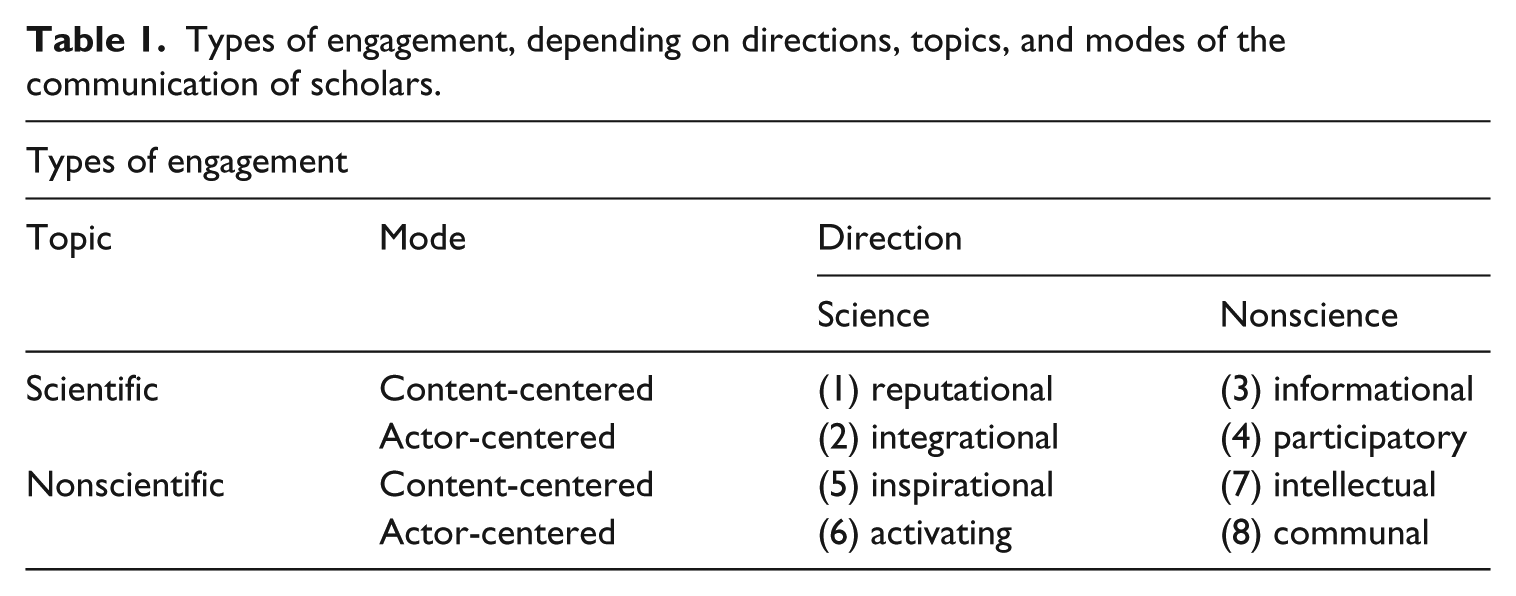
- (1) Reputational and (2) Integrational: The first type of engagement refers to scholarly communication that comprises content-centered messages (mode) about scientific issues (topic) that are received by other scientists (direction). This includes information about publications, presentations, collaborations, funding, and other achievements. We assume that this type of communication basically helps to gain reputation (Priem and Hemminger, 2010). We thus label the first type reputational engagement. However, scholarly communication can also be actor-centered, fostering networking and integration within the scientific community. Albeit assuming that these modes of exchange are also relevant for reputation building, we also assume that they fulfill further functions in academia. Especially, they foster the integration of invisible colleges (Crane, 1972) and the community at large. We thus label this type integrational.
- (3) Informational and (4) Participatory: Messages about science topics that are consumed by nonscientific followers constitute science communication in the narrow sense. Here again, different modes of engagement are possible, from very informational forms of knowledge distribution to interactive forms of exchange on scientific issues. By distinguishing two types of engagement, we build on the conceptual shift from PUS to PES and thus from disseminating information to more participatory or dialogic communication. We use the label informational for forms that do not actively promote dialog and exchange but rather disseminate knowledge. In contrast, the participatory type encompasses communication activities that actively stimulate dialog and interaction on science-related topics.
- (5) Inspirational and (6) Activating: We assume that the communication on topics that are not related to science can also be regarded as a form of scholars’ engagement. For instance, communication on topics such as politics, the economy, and society that is consumed by peers from communication science can help to link science and society. In this way, new topics can be imported into communication science and may contribute to the agenda building of the discipline. Again, we distinguish two types depending on the mode of communication. The mere information on topics beyond science might inspire peers and their research; we thus call this type inspirational. However, communication about society-related topics can also encourage scholars to actively intervene in certain areas. Activating engagement thus calls for scholars’ societal responsibility.
- (7) Intellectual and (8) Communal: Communicating about nonscientific topics with people outside of science is usually not considered as science communication, especially when it is not content-centered but focuses on managing personal relationships. But even here people can present themselves as representatives of science or be perceived as such by others. The communication might profit from the scholars’ authority. Therefore, we still include these types of communication in our systematization. Deriving from the concept of the “public intellectual” (Fähnrich and Lüthje, 2017), we propose to call these forms of engagement intellectual when they rather inform, assess, or even patronize without calling for exchange or action. However, engagement in the wider sense can also help scientists build relationships and integrate into communities outside of science. We thus label this type of Twitter activity as communal.
To sum up, we use the term public engagement of scientists in a broad sense for all kinds of publicly accessible communication, for example, on Twitter, carried out by people presenting themselves as scientists. This includes not only public engagement in a narrow sense, referring to participatory communication about science-related topics with lay publics, but also informational science communication directed at nonscience actors and scholarly communication directed at peers. Thus far, these types of engagement are theoretical constructs or ideal types, labeled according to the science communication discourse. On this basis, we empirically investigate the prevalence and the content of these types in the Twitter activities of communication scientists.
Method and operationalization
To answer the question as to how communication scholars engage on Twitter in terms of directions, topics, and modes, we analyzed a sample of tweets and followers belonging to the Twitter profiles of communication scientists. As a starting point, we retrieved a list of all the followers of the International Communication Association (ICA) (@icahdq), which is one of the leading scientific associations of the discipline. 1 In the first step, we checked whether all of the 7500 accounts are actively used by scientists. An account was considered active if there were at least 10 tweets in total, at least 10 followers in total, and at least one tweet in the last month. The restriction to scientists was based on the analysis of self-descriptions. Profiles that were not tweeted via Twitter’s own applications or apps were excluded. For practical reasons, we included only German- and English-speaking users. This resulted in a sample of 1835 accounts from communication scientists.
A typical account comprises about 1400 tweets, has about 450 followers, and follows about 600 other users (see Table 2). About half of the tweets are embedded in communication sequences as replies or quotes (47%; n = 855). Most of the messages contain links or media-like pictures or videos (66%; n = 1215).
Attributes of the accounts in our sample of Twitter users.
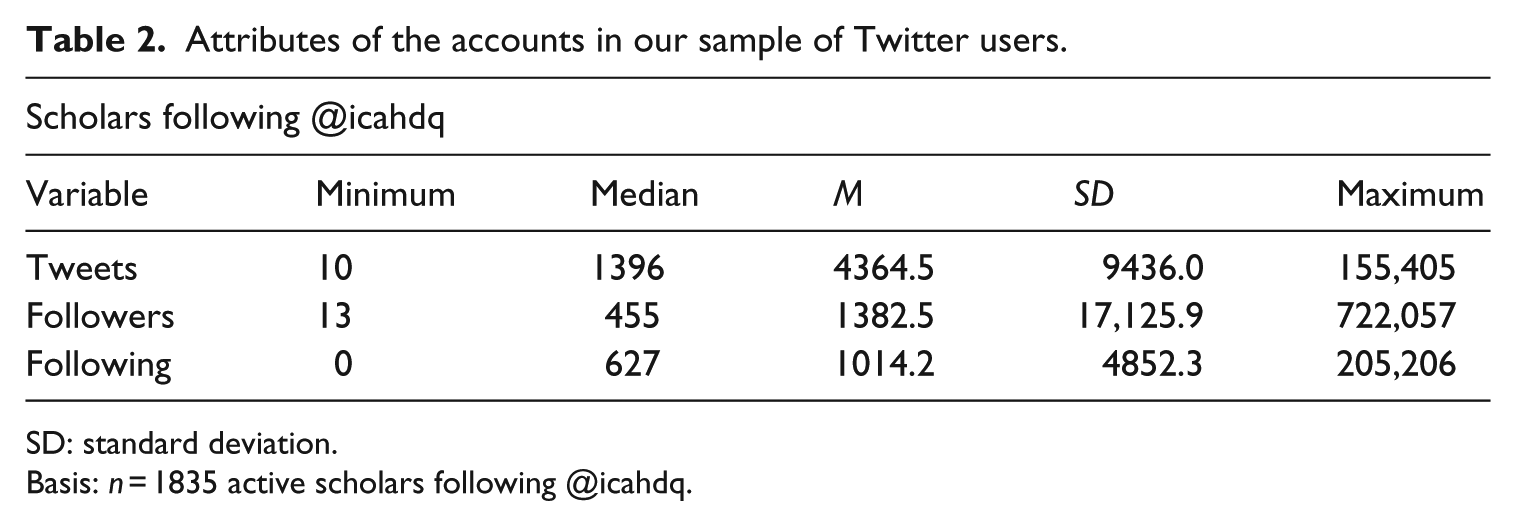
SD: standard deviation.
Basis: n = 1835 active scholars following @icahdq.
For the 1835 accounts, the individual’s last own tweet was fetched (i.e. we skipped retweets). Finally, follower data were collected for a random subsample of 100 accounts. After downloading the complete list of followers, we randomly chose 10 followers for each account for further analysis. After removing duplicates, this resulted in a sample of 980 followers.
All data were collected in September 2017 with Facepager (Jünger and Keyling, 2017) using the Twitter application programming interface (API). This kind of data collection typically comes with two main obstacles. The first obstacle limits the generalization of findings because the users of social media sites do not necessarily represent the whole group of interest (Hargittai, 2018: 11). Furthermore, the processes behind the communication are not always transparent since automatically produced message content and strategic communication by organizations may mix with messages from individuals (Pfaffenberger, 2018: 64; Woolley, 2016). The second obstacle adds to this on the level of research methodology because the “question of how smaller collections relate to the entirety of activities of the platform is quite unclear” (Gerlitz and Rieder, 2013). These limitations arise from the collection process itself, such as by dropout due to privacy restrictions or other sampling problems. Moreover, the operationalization of research concepts is limited because only indicators provided by the platform can be used (Jünger, 2018b; Keyling and Jünger, 2016).
These issues partly affect our study. The sample clearly does not represent science as a whole but rather stands for a specific part of communication science. With deliberately choosing the profile of the ICA as starting point we circumvent problems arising from random sampling strategies. We address a subgroup of potential actively engaged and concerned scholars. For seven profiles, no last tweet could be fetched. While the reasons remain open, this dropout rate is low compared to social science standards. A practically more obstructive issue was the rate limit of the standard API (15 requests per 15 minutes). We thus decided to focus on a subsample of the followers. In all, instead of aiming at large datasets we decided for a dataset where every case could be manually checked and coded. This decision is in line with our goal to not only quantify the field but to further develop concepts of science communication.
We developed a coding scheme to identify directions, topical fields, and modes of engagement. The scheme was iteratively refined by coding random samples with two coders, calculating intercoder reliability, discussing coding decisions, and revising the coding instructions. With regard to coding topics, we oriented toward basic sociological conceptions of action systems, such as science, politics, or the economy. However, since there is no complete list of fields, we conducted an inductive coding of 100 tweets. Not all tweets clearly represent fields of action on the level of society, such as when talking about different personal interests. These cases were classified as belonging to the personal sphere. After extensive testing on additional samples, the coding scheme consisted of 10 topical variables. Intercoder reliability was checked for 100 tweets with two coders. Gwet’s agreement coefficient for the topic variables ranges from 0.71 to 1.00, with only two variables below 0.80.
The same procedure was carried out to identify the fields of followers. Inductive coding of 85 self-descriptions was performed. 2 In the end, the coding scheme consisted of 14 categories describing followers. In addition, we coded whether a follower is an individual or organizational actor. The reliability scores for the two variables describing the followers were .81 and .89, respectively. In order to match the fields and directions, categories were grouped together. This resulted in six broader categories of science, media, politics, economy, other, and personal.
To analyze the mode of engagement we focused on speech acts. Categories were again developed by the inductive coding of 100 randomly selected tweets, which resulted in nine variables. The speech act measurements reached reliability scores between .76 and .93. The patterns were grouped together to match our theoretical distinctions. Content-centered patterns on one side comprise the more cognitive illocutionary roles of reporting and commenting. For a more fine-grained picture, we further recorded whether or not these reports and comments include references to other actors or to one’s self. Actor-centered speech acts, on the other side, are in principle based on direct interactions. This category includes discussing (e.g. question and answers), activating (e.g. call for participation), and socializing (e.g. congratulations).
To estimate the overall proportion of different types of engagement, we projected the findings in the subsample of followers. The combination of the last tweets of the scholars with the respective followers constitutes potential communications. We only used cases with complete data for direction, topic, and mode. This resulted in 768 communications between 85 scholars with their last tweet and 768 followers. To compensate for the clipping of the sampling procedure (10 random followers maximum), we projected the fields of the followers to the total number of followers for each scholar, which resulted in 74,937 potential communications as a basis for calculating the proportion of different types of engagement. We validated our estimates by calculating the expected amount from the marginals of topic, mode, and direction. The differences were small and the overall interpretation remained stable. Thus, the values may not be exactly true, but we have confidence in the general tendency of the estimates. While we do not know whether the followers actually read the tweets, the exploratory procedure gives us a baseline, which has to be validated in future studies.
Results
Directions of engagement
The least surprising finding is that communication scientists communicate to other scientists (see Figure 1 and Table 6 in the Appendix 1). Nearly one-third of the followers disclose themselves as scientists (31%). Moreover, more than one-third of all tweets are about research or teaching (34%). This shows that the biggest share of the Twitter communication of communication scholars can be considered as some kind of scholarly communication.
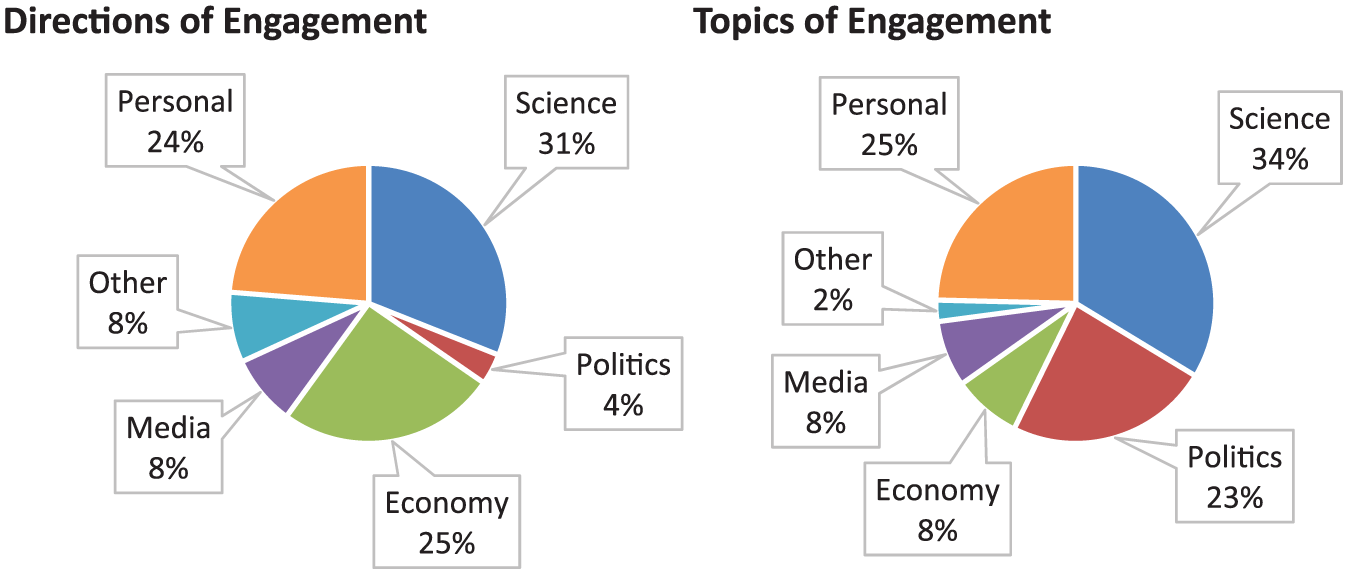
Directions (biography of followers) and topics (content of tweets) of engagement of communication scholars on Twitter. Basis: n = 737 followers where a field could be recognized; n = 1624 tweets where a topic was recognized.
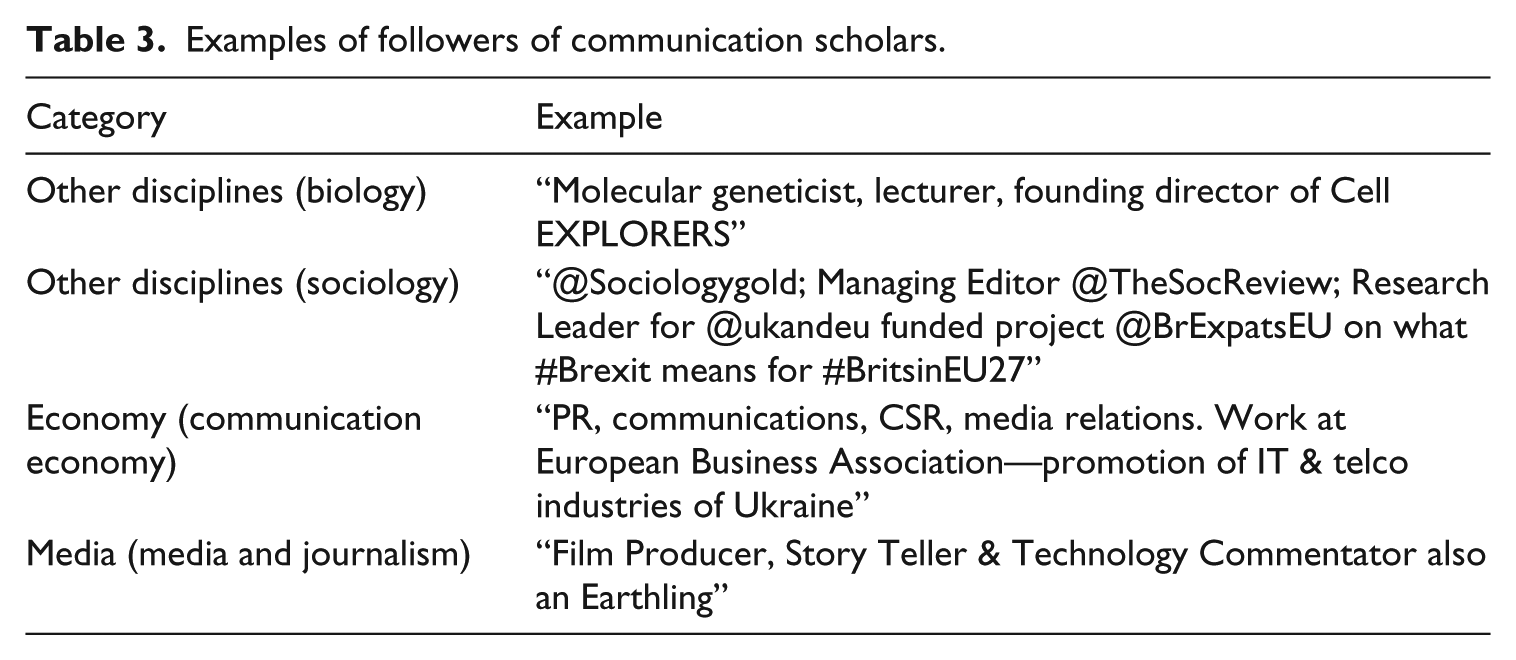
However, the followers are not from communication science only (10%) but also from other fields of science (14%) or from multidisciplinary contexts (6%). This includes a broad range of other disciplines—followers present themselves as biologists, sociologists, or other researchers, to name but a few (see Table 3). Accordingly, scholarly communication on Twitter seems to deal with diverse internal publics.
Examples of followers of communication scholars.
Most of the nonscience followers come from economics, which includes communication economy (25%). Other followers come from quite different fields, such as from the health sector, education, or the arts (8%). Another prevalent category is media (8%). This is not surprising as media are a core subject of communication scientists’ investigations and also a typical prospective professional field for their students. Furthermore, a large share of followers does not act as representatives of a specific field but rather highlight personal interests in their self-descriptions (24%). Taken together, we see opportunities for intersections of communication scientists with other societal actors on Twitter. Communication scholars seem to attract followers from diverse societal areas and thus might reach an audience beyond their peers.
Topics of engagement
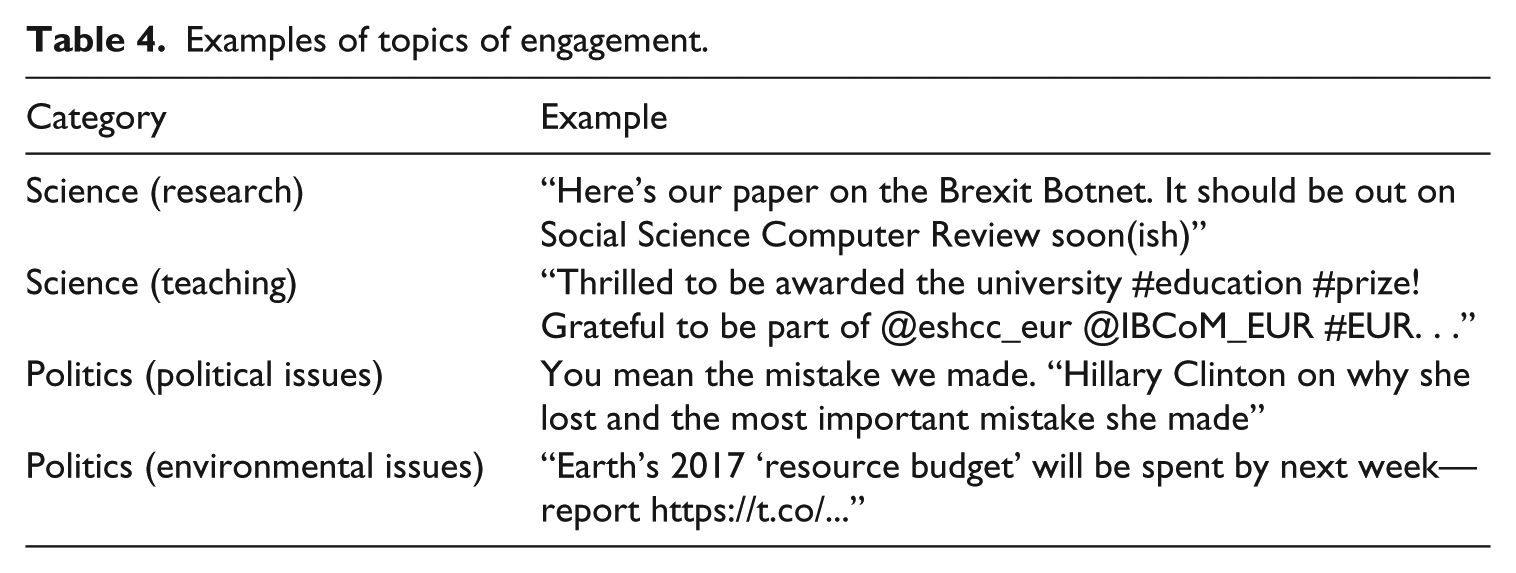
In looking at the message content, it is apparent that a great deal of tweets refers to science (34%) and talk about new publications, conferences, and projects as well as teaching-related content (see Table 4 and Table 7 in the Appendix 1). Moreover, a relevant proportion of tweets contain propositions about politics, society, and the environment (23%). Communication scholars thus show political and societal interests. Interestingly, there is a sharp contrast between the content of tweets and the types of followers. Only about 4% of the followers are political actors. While communication scientists thus engage politically on twitter, they do not seem to reach the institutionalized sphere of politics through this medium. However, their engagement could be influential for the discourse in (communication) science. Communication on nonscientific issues that is directed at actors from science could inspire peers and impede the academic agenda-building. Aside from communication about science and politics, a great deal of personal communication is going on. About one-fourth of the tweets are about personal interests (25%).
Examples of topics of engagement.
Modes of engagement
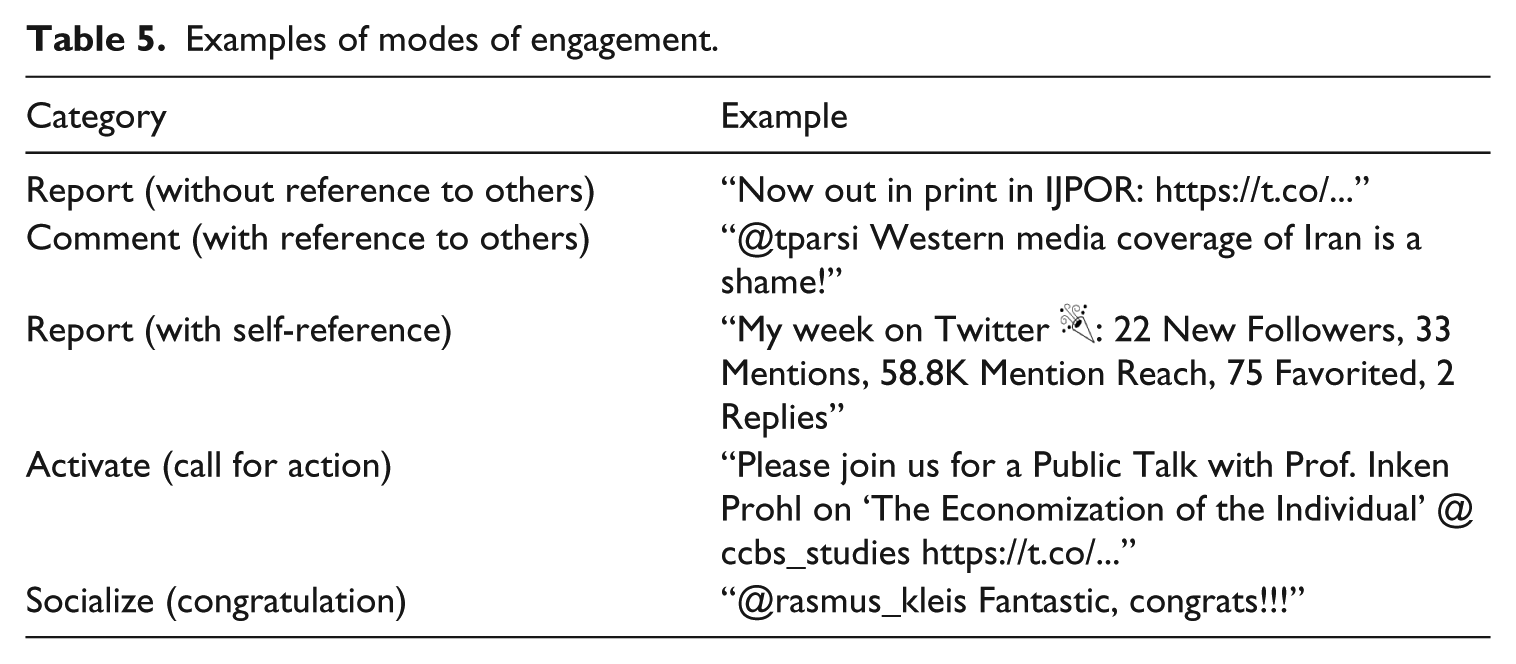
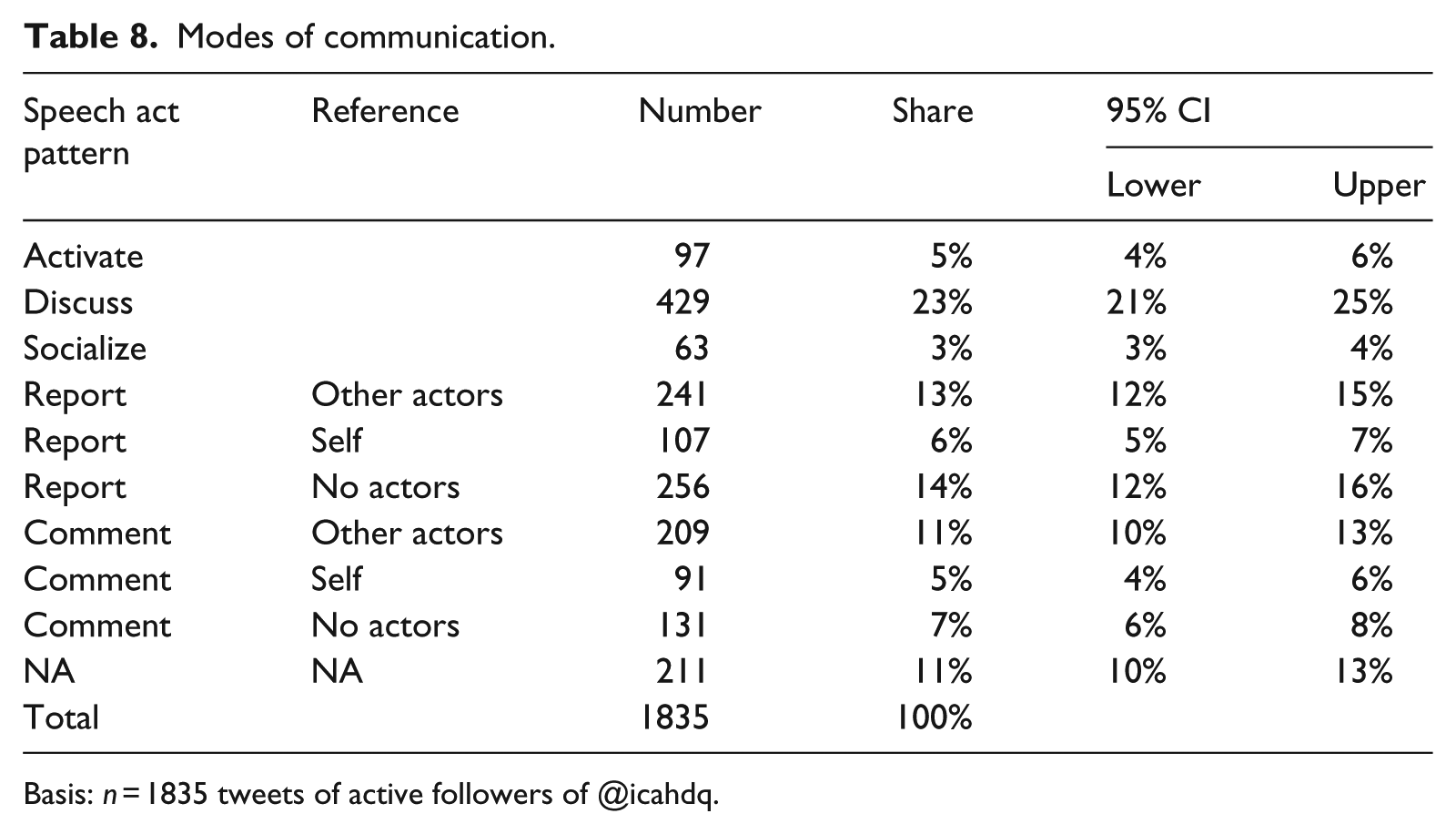
The personal content backs up the assumption that Twitter is used for maintaining personal relationships, and the analysis of modes of communication points in a similar direction (see Figure 2 and Table 8 in the Appendix 1). More than one-third of tweets merely point out some kind of information such as about upcoming events or media content (37%) (see Table 5). Almost another third not only raise issues but also comments on them (27%). But even when only pointing out or commenting on events, the tweets are inherently social most of the time. While some of the content-centric tweets refer to no actors at all (37%) or to the authors themselves (19%), the largest share refers to other people (43%). In addition, more than one-third comprise user-centric acts (36%). This encompasses ritual speech acts such as greeting or congratulating as well as calls for action or discussion.
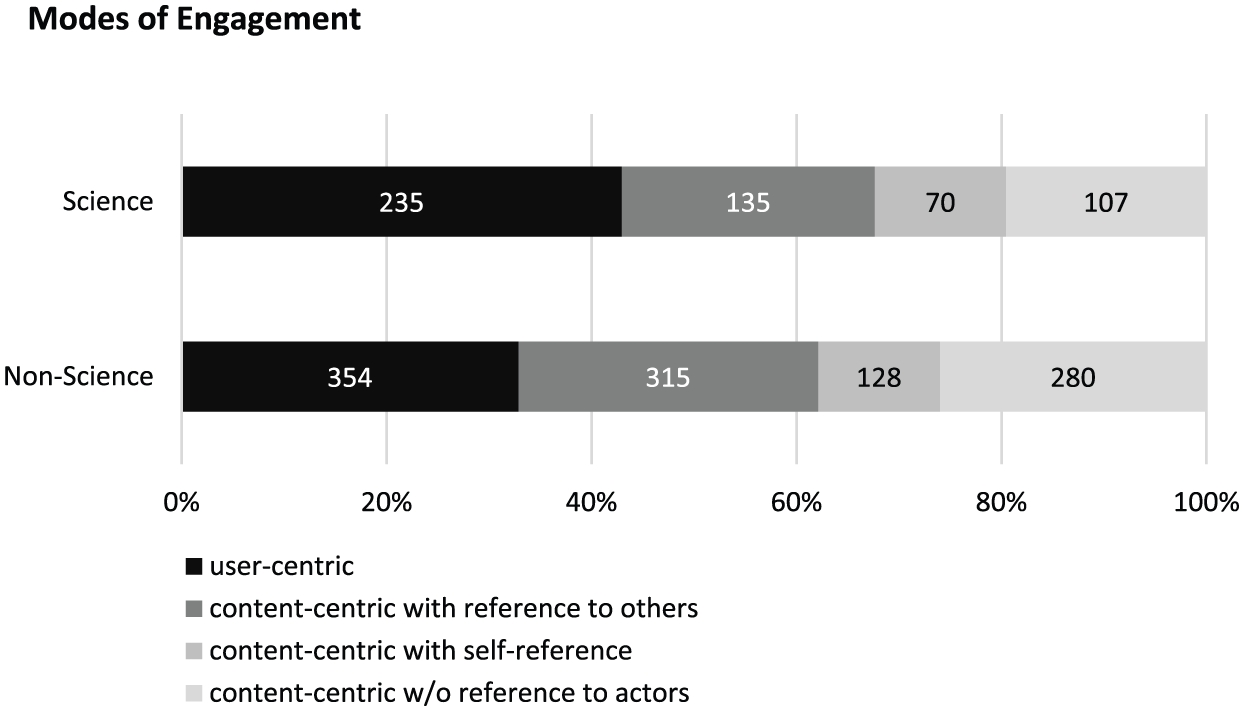
Modes of engagement in the field of science and outside the field (number of tweets). Basis: n = 1624 tweets where a topic was recognized.
Examples of modes of engagement.
The user-centric acts refer more frequently to scientific issues than to topics outside of science (Fisher test; p < .001): 43% of tweets with science topics are user-centric compared to 33% of tweets containing other topics. Moreover, the followers from science are more likely to be individuals and not organizations. The share of organizational accounts for nonscientific fields (34%) is twice as high as for science (17%). Obviously, Twitter is used for community-building.
Types of engagement
Taken together, all ideal types of engagement are highly likely to occur. Based on the combinations of topic and mode of scholars’ tweets with the origin of the followers for a sample of communication (see Figure 3), we estimate intellectual and communal engagement to be the most prevalent type (40%). This type is least related to science but undoubtedly connects communication scholars to people outside of science and vice versa. Compared to this, purely scholarly communication falls behind, whether reputational (7%) or integrational (9%). This is to be expected since the nonscientific category comprises many different fields.
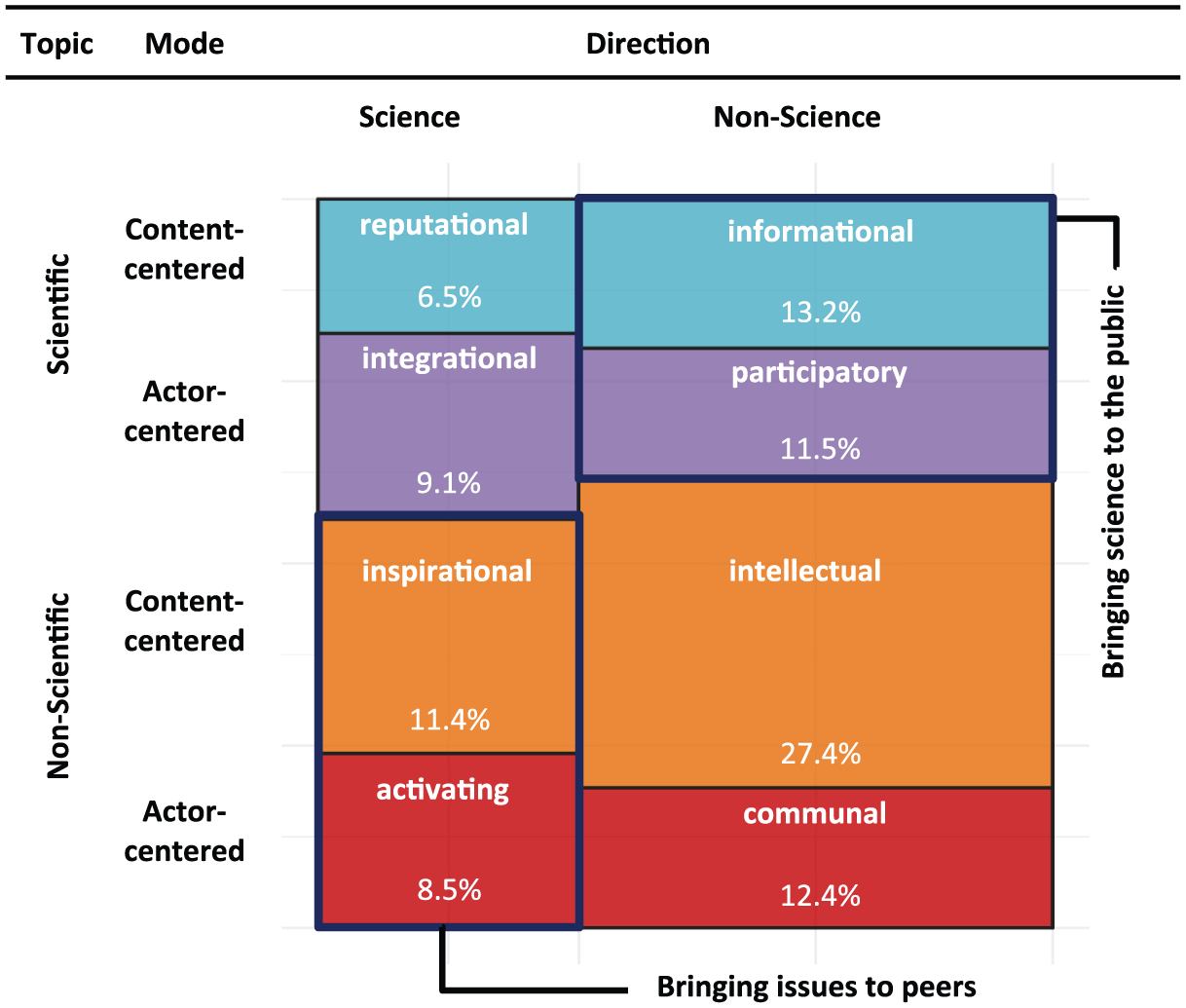
Estimated sizes of different types of engagement. The size of the boxes equals the share of all communications. Basis: random sample of 732 followers of 85 communication scholars following @icahdq on Twitter projected to 74,937 potential communications with all followers.
Very relevant in terms of public engagement and the interconnectedness of communication science with the broader society (Nielsen, 2018) are the transversal types, in which scientific topics are communicated to the broader society (25%) or where nonscientific topics come in (20%). Both can be assumed to be important types of communication on Twitter, each being slightly more content-centric than user-centric. Comparing these types highlights a sharp contrast. While one of the most prevalent topics of communication is politics, only a small share of the audience comes from this field. Communication scientists are concerned with political and societal issues, but compared to other directions it is unlikely that they reach political actors on Twitter. However, science communication in the sense of bringing science issues to the attention of lay publics is more likely to happen.
Conclusion
Our study explored the public engagement of communication scholars on Twitter as one field to assess the relatedness of the discipline to the broader society. We investigated the directions, topics, and modes of communication. Starting from these three dimensions, we differentiated eight ideal types of engagement on Twitter.
Our conceptual framework expands previous perspectives on public engagement as we focus our research on communication science as a discipline, which has scarcely been addressed in the context of science communication research. Moreover, we dealt with online communication in respect to Twitter communication, which has not been in the core of public engagement research on scholars, either. Finally, we tried to combine different tracks of previous public engagement approaches, arguing that different types of public engagement should be distinguished to be able to assess the relatedness between (communication) science and society.
To empirically investigate the relationship between communication science and other fields of society, we analyzed the Twitter communication of 1835 communication scholars and their followers. Based on the results of our analysis, we conclude that communication scientists on Twitter participate in public engagement in diverse ways. Their biggest contribution to bridging the gap between the discipline’s agenda and the societal discourse is that they bring political and societal topics into the view of their peers. However, it seems that—at least on Twitter—communication scholars do not reach decision makers from politics; their political influence or even activist potential seems to be limited. However, most of the audience consists of actors outside of science. Communication scholars potentially reach people in economics or from diverse societal areas and thus might make their voices heard in these fields. Moreover, the science communication community can be observed on Twitter as an active and connected community with several links to other disciplines. Particularly when it comes to science topics, the share of user-centric communication such as discussion or ritualized communication increases. Here, Twitter seems to fulfill typical social networking functions when it is used for scholarly relationship management. Overall, public engagement always depends on the individual choice of scholars (Bauer and Jensen, 2011). Whether we as a “community of inquiry” are happy with the situation requires further discussion of scientific norms and reward systems (Nielsen, 2018: 147).
As a limitation of our study, we cannot say anything about the effects of the scholars’ Twitter engagement. However, we cannot agree that—at least on Twitter—no one would care about communication science and its scholars. Whereas, in accordance with the state of the art, Twitter is often used for scholarly communication, followers and issues relating to other societal fields indicate a relevant level of interrelatedness of communication science and society. The different types of engagement might appear in other settings, too—for instance, in the context of events, interpersonal communication, or via other forms of online communication. Against this backdrop, future research could contribute to our understanding of public engagement by applying the systematization of engagement types to other contexts. We based our analysis on the potential audience, which needs to be complemented by an analysis of the actual and the addressed audience (Jünger, 2018a). In addition, researching the motives of communication scholars to apply different types of engagement could be instructive. Moreover, it would be interesting to compare our findings with the public engagement of scholars from other disciplines. Prospective studies could also investigate the impact of scholars’ engagement on different audiences and on the scholars themselves. In this context, the modeling of engagement types can be seen as a process: problems come into the view of scientists and, after processing the results, are communicated back to society. If problems are normalized, communication stays outside of science until new demands for scientific processing arise. We need a better understanding of this process. The distinction of different engagement types and thus a clearer conception of what public engagement might entail offers a starting point for prospective research in the field.
Footnotes
Appendix 1
Modes of communication.
| Speech act pattern | Reference | Number | Share | 95% CI |
|
|---|---|---|---|---|---|
| Lower | Upper | ||||
| Activate | 97 | 5% | 4% | 6% | |
| Discuss | 429 | 23% | 21% | 25% | |
| Socialize | 63 | 3% | 3% | 4% | |
| Report | Other actors | 241 | 13% | 12% | 15% |
| Report | Self | 107 | 6% | 5% | 7% |
| Report | No actors | 256 | 14% | 12% | 16% |
| Comment | Other actors | 209 | 11% | 10% | 13% |
| Comment | Self | 91 | 5% | 4% | 6% |
| Comment | No actors | 131 | 7% | 6% | 8% |
| NA | NA | 211 | 11% | 10% | 13% |
| Total | 1835 | 100% | |||
Basis: n = 1835 tweets of active followers of @icahdq.
Funding
The author(s) received no financial support for the research, authorship, and/or publication of this article.
