



Abstract
Sex-for-rent schemes have emerged on online sites as rental options. We analyzed 583 advertisements that were posted on Craigslist in London and Los Angeles and interviewed 34 women who were or had been in these arrangements. This research yielded four key tensions: (1) navigating innuendo (mis)interpretation versus preserving arranged ambiguity, (2) the guise of amateurism and romance versus persistent specificity, (3) calculated sacrifice versus narrative of a better life, and (4) consent versus consensual non-consent. Findings attest to the affordances online platforms offer by connecting geographically dispersed parties in a low risk, anonymous forum. Furthermore, present research joins discourses on the commercialization of intimacy and forms of precarious, gendered labor while asserting Internet features are pivotal in facilitating these arrangements. We propose gendered affordances to conceptualize how individual aspirational labor efforts, combined with platform affordances, commodify intimacy for sale on the moral marketplace.
Keywords
When Ella
1
was 18, she moved from her family’s farm in Idaho to California to pursue her dreams of a Hollywood acting career. The star of every school play, Ella planned to attend as many casting calls as she possibly could, but rent in Los Angeles was hardly affordable to an 18-year-old whose only source of income had been from working on her parents’ farm. She had all but given up on her plan when an advertisement on Craigslist caught her eye: “Free Rent, Downtown, For Young Woman.” Intrigued, she clicked the advertisement: “It really wasn’t clear what my obligations would be, but the rent was not actually free,” Ella later reflected in an interview. The advertisement boasted a gorgeous, central apartment that the landlord would share with a young woman in exchange for “favors.” Over many emails and an eventual Skype call, Ella discovered that she would be provided with a bed, food, and living stipend if she performed various sexual favors for her landlord whenever he desired. “He would come into my bed when he got home. Late usually, he worked long hours. I was not allowed to say no. Even if I was tired.” After nearly 7 months of countless auditions, Ella landed work in a national commercial. After that, she moved out and continued to secure acting roles: I look back at those months and wonder what I was thinking. But I really had no other choice. I guess I am actually sorta thankful, like [I] couldn’t have managed to do it otherwise. Just had to loan out my body … Is that really the end of the world?
Advertisements for sex-for-rent schemes like Ella’s are on platforms such as Craigslist, Gumtree, and Airbnb. We define sex-for-rent arrangements as when a landlord advertises housing in exchange for a sexual relationship with the tenant, although the terms of these arrangements vary widely. The majority of documented sex-for-rent instances surface in cosmopolitan hotbeds like Los Angeles and London where creative industries’ promise of “cool jobs in hot industries” (Neff et al., 2005) meets the reality of tight urban housing markets (Savin, 2017). We borrow the term commercialized intimacy from Hochschild (2003) to refer to the market-like exchange for emotional, sexual, and domestic relationships. While such exchanges are not new, they highlight how social media platforms afford users different capacities for participating in them, what we term gendered affordances.
Sex-for-rent arrangements provide a lens onto how social media affordances shape people’s capacities to act within creative and digital economies and platforms’ role in maintaining the social structures of gendered inequality. Scholars have not yet empirically studied sex-for-rent arrangements. We aim to rectify this with an analysis of 583 sex-for-rent ads posted on London and Los Angeles Craigslist sites and of 34 qualitative interviews conducted with current or former tenants in sex-for-rent arrangements in those two cities. Our analysis yielded four key tensions in sex-for-rent arrangements afforded by the platform. First, potential tenants must navigate innuendo, while platforms afford landlords the ability to preserve ambiguity in the offer terms. Second, the legal and governance structures of platforms encourage a guise of amateurism in these ads, while allowing landlords to specify desired physical traits, particular racial and gender characteristics, and behaviors required of their potential tenants. Third, ads present seemingly glamorous alternatives to potential tenants’ calculated sacrifice for their careers in creative industries. In such, the arrangements lend flexibility to potential creative workers to pursue employment in the sector without immediate financial constraints. Fourth, the explicit language of exchange, coupled with landlords’ vague terms, complicates notions of consent in an era of digitally mediated commodified intimacy. Thus, platform affordances for sex-for-rent schemes provide continuity with the status quo of highly gendered social structures. This article identifies the “imagined affordances” (Nagy and Neff, 2015) of platforms that allow strangers to conduct personal, potentially risky exchanges. While appearing to facilitate neutral bargaining between consenting adults, Craigslist preserves highly gendered unequal power in society, even as landlords and tenants alike in this arrangements exercise agency, albeit enabled in different ways by the platform affordances.
Sex-for-rent arrangements rely on the twinned platform affordances of anonymity and visibility to connect tenants and landlords in ways that give them the ability to assess their risks before revealing their identity or meeting in person. Sex-for-rent ads reproduce traditional, gendered economic and relational patterns, and Internet platforms play novel roles in facilitating these exchanges. Online platforms neither caused the commodification of intimate life nor gave rise to the conditions that shape their prevalence. However, social media platforms enable actions that suggest some categories of behaviors to some users, replicating the social configurations that reproduce structures of sexual inequality and gendered divisions in society. We hope to use our empirical work to extend theories of technological affordance, and in particular what Davis and Chouinard (2016) have termed the condition of “cultural and institutional legitimacy,” which is how technological affordances facilitate different actions for different users laboring under unique circumstances. We take an expressively feminist approach to the mutual constitution of social structure and social media, and extend literature from feminist technology studies and feminist labor approaches in creative industries and “commoditized intimacy” (Zelizer, 2012). In particular, we show how platforms enable tenant and landlord actions through sex-for-rent schemes that maintain gendered and sexualized power hierarchies.
Our article proceeds as follows. After we introduce the sex-for-rent phenomenon, we discuss the relationship between technological affordances and social structure. Next, we briefly review feminist literature on creative work and the commodification of intimacy to build out the social structural components of our argument. We describe our data collection and analysis methods, before presenting our empirical material through four key themes that emerged from our analysis of landlords’ ads and interviews with tenants. In the discussion, we construct a conceptual model that we hope can extend theories on how social media platforms enable users’ behaviors through the mutual constitution of social affordances and social structures.
The sex-for-rent phenomenon
Sex-for-rent ads operate in legal and moral gray areas. Formal legal policies have emerged to crack down on soliciting sex online via platforms like Craigslist. The UK Ministry of Justice has recently stated that offering accommodation in exchange for sex counts as inciting prostitution (Jones, 2018). The regulatory environment in the United States and the United Kingdom creates ambiguous enforcement standards and challenges platforms that permit certain performances of gendered and sexualized behaviors. Jim Buckmaster, CEO of Craigslist, is on the record saying that the company cannot police every posting, even as it forbids ads that break the law (NBC, 2006). Craigslist, like many other social media companies, relies heavily on users to “flag” objectionable ads, although research has shown how flagging is a contested, “complex interplay between users and platforms, humans and algorithms, and the social norms and regulatory structures of social media” (Crawford and Gillespie, 2016: 411). The interplay of values policed by the community and the purported technical neutrality of the flagging process may create an environment that works in practice to control women “ideologically and sexually” and direct them to perform gender and sexuality more conventionally in line with these norms (White, 2012: 212).
Affordances for gendered action
Theory helps explain how social media affordances might be gendered (Bucher and Helmond, 2017; Davis and Chouinard, 2016; Evans et al., 2017; Nagy and Neff, 2015). Marwick (2014) has suggested examining social media as gendered to reveal patterns across particular environments. One example from the early World Wide Web showed how “camgirls” who performed sexual acts were afforded visibility, but were discouraged by the community from being too visible, even as they were afforded a good deal of agency (Senft, 2008). “How artifacts afford, for whom and under what circumstances” are always a part of social structure and rest “at the intersection of history, biography, and culture” (Davis and Chouinard, 2016: 246). Regimes of “cultural and institutional legitimacy” make artifacts’ social affordances both possible and variable over time, in different situations, and for diverse subjects (Davis and Chouinard, 2016: 241).
These affordances designed into technology not only shape individual capacity to act but also have implications for structuring interactions and society. Light (2011: 431), for instance, writes that technologies are “genderizing” identity “by bringing technology into such intimate relations and equipping it to act on our behalf we implicate it in helping us develop our social structures with a knock-on effect on how we understand and manage ourselves as a world.” Feminists called for more attention to the design of technologies, as when Bardzell (2010) issued a call to stop prioritizing so-called “real-world computing needs” over the more urgent problem of avoiding “perpetuating the marginalization of women and indeed any group in technology.” Many have rightly pointed attention to the problem that seemingly neutral approaches to technology design come instead with socially embedded assumptions about gender, race, and sexuality that become encoded and perpetuated into hardware and software (e.g. Broussard, 2018; D’Ignazio and Klein, 2018; Marwick, 2014; Massanari, 2017; Nakamura, 2014; Noble, 2018; Rosner, 2018).
Building on this long tradition of feminist technology studies, we define gendered affordances as social affordances that enable different users to take different actions based on the gendered social and cultural repertories available to users and technology designers.
Gendered labor in creative and sexual markets
Another feminist concern has been the commodification of intimate life, the “outsourcing” of the activities of the self, which Hochschild (2012) called “the great unnoticed trend of our time.” Social conventions about who should provide care and the rules that govern how care may be legitimately acquired, what Zelizer (2005) termed “purchase of intimacy,” are changing. This commodification is not new, as “every relationship of coupling, caring and household membership repeatedly mingles economic transactions and intimacy” (Zelizer, 2005: 288). This commodification of relationships and care work, however, is perhaps newly central in contemporary society as there is an intensification of the crosscutting between the professional/market and the intimate, domestic spheres. Might this commodification of intimacy also be afforded different scales of reach and scope with Internet technologies and platforms?
Illouz (2007) argues that the Internet intensifies the process of “emotional capitalism,” or this fusion of market and self, “because it is fraught with ambivalence and contradiction, for it is the same language and techniques which make relationships accountable and open to scrutiny that have also made possible the commodification of selfhood.” (p. 108) In this environment, emotions are not simply to be “managed” by workers in their workplaces as Hochschild (2003) described, but are instead themselves “entities to be evaluated, inspected, discussed, bargained, quantified, and commodified” (Illouz, 2007: 109). While emotional and affective labor is central to the functioning of the economy and increasingly central to the economies of the Internet and Web 2.0, such work is undervalued and often not compensated, leading Jarrett (2015) to use the apt metaphor of the “digital housewife” to describe the gendered nature of this digital era division of labor. Whereas engagement in public life formerly met professional goals and presence in private households addressed interpersonal desires, Gregg (2011) describes the “presence bleed” of the market impinging on spheres that were once deemed personal or private. As Gregg (2011) argues, the corporatization of intimacy has blurred lines between personal and professional aspiration, emotional and temporal investment, and even coerced versus freely chosen labor.
Commercialized intimacy structures participation in sex-for-rent arrangements, while another strand of theory helps to explain people’s participation as tenants. “Hope,” “aspirational,” and “venture” labor describe how people rationalize personal sacrifice for future potential professional gains (Duffy, 2017; Kuehn and Corrigan, 2013; Neff, 2012). The blurring of personal and professional boundaries is common in creative industries where compulsory nightlife becomes part of the requirements for new gigs (McRobbie, 2002; Neff et al., 2005). This work is gendered, as Mears (2015) writes about the fashion models whose after-hours labor as “VIP girls” in nightclubs was compensated in gifts and cab fare to “obfuscate what is essentially the exchange of girls’ bodies for money” paid by the male clients to the nightclub.
As we will see below, while not all tenants in sex-for-rent whom we interviewed aspired to creative industry jobs in acting or modeling, all shared creative industries’ required ethos of sacrifice now for fame and fortune later. Several interviews described how they exercised agency in these arrangements and in their calculation of performing sexual favors in the present as an investment or hopeful penance for creative glory in the future. The strategic ambiguity and gendered affordances of Craigslist advertisements for sex-for-rent arrangements afford landlords and tenants different things for these exchanges.
Methods
From March to May 2018, we monitored Craigslist’s London and Los Angeles “rooms / shared” section and cataloged every post that could be reasonably construed as offering a sexual arrangement in lieu of payment for rent. We selected London and Los Angeles for their prevalence of sex-for-rent ads previously identified in popular press articles and confirmed our selection through initial analysis. The sex-for-rent phenomenon, however, is apparent throughout Europe and North America, with ads emerging on nearly all metropolitan area Craigslist sites. The 580 unique ads that we collected varied in their degree of explicitness, from straightforwardly proposing housing in exchange for sex to offering discounts for “household favors.” The ads in our sample share similar characteristics: impossibly low rent, accommodation offered in exchange for an arrangement, vague tenancy terms, specified tenant and landlord attributes, sexual innuendo, or other techniques for highlighting a shared hidden meaning, such as a winking emoji.
We recruited tenants in sex-for-rent arrangements for qualitative, semi-structured interviews by placing posts on Internet forums catering to aspiring models and actresses and by advertising on Craigslist’s housing forums. We interviewed 16 people in London and 18 in Los Angeles. Our recruitment posts stated the purpose of our research to understand the sex-for-rent phenomenon and required all participants to be 18-years old or older, current or former tenants in arrangements procured through Craigslist, and willing to give a 30-minute anonymous interview. Ethical concerns for our participants’ security, privacy, and safety significantly shaped our interview methods. The interviews posed a series of deeply personal questions that could arouse discomfort, anxiety, or stress and re-identification of our participants could potentially cause significant reputational harm. We conducted online audio, but not video, interviews and took detailed notes on each interview rather than fully transcribing our conversations. We never had real names for our participants and we contacted them using anonymous methods. We allowed participants to remain anonymous by not collecting names, by omitting demographic questions that could have elicited attributable responses, and by striking responses that could have lead to identification. In three interviews, we shared helpline numbers for local groups that address domestic violence.
Our calls for research participants were only answered by people identifying as women. 2 Despite the presence of ads seeking men in both London (53 out of 233 ads or 23%) and Los Angles (27 out of 350 ads or 8%), we did not oversample men to correct for the heteronormative bias in the popular press reporting on sex-for-rent. We oversampled creative industries by posting ads for interview participation on casting call sites, and all interviewees were employed in creative industries or aspiring to be. These factors are a limitation of our research design.
Table 1 shows the current city, age, occupation, region or country of hometown, and status in a sex-for-rent arrangement. Geography plays a role in sex-for-rent arrangements, as almost all participants were far from their hometowns. In many interviews, participants said that they had few or no personal connections in their new city.
Summary of interview participants and their demographic characteristics.
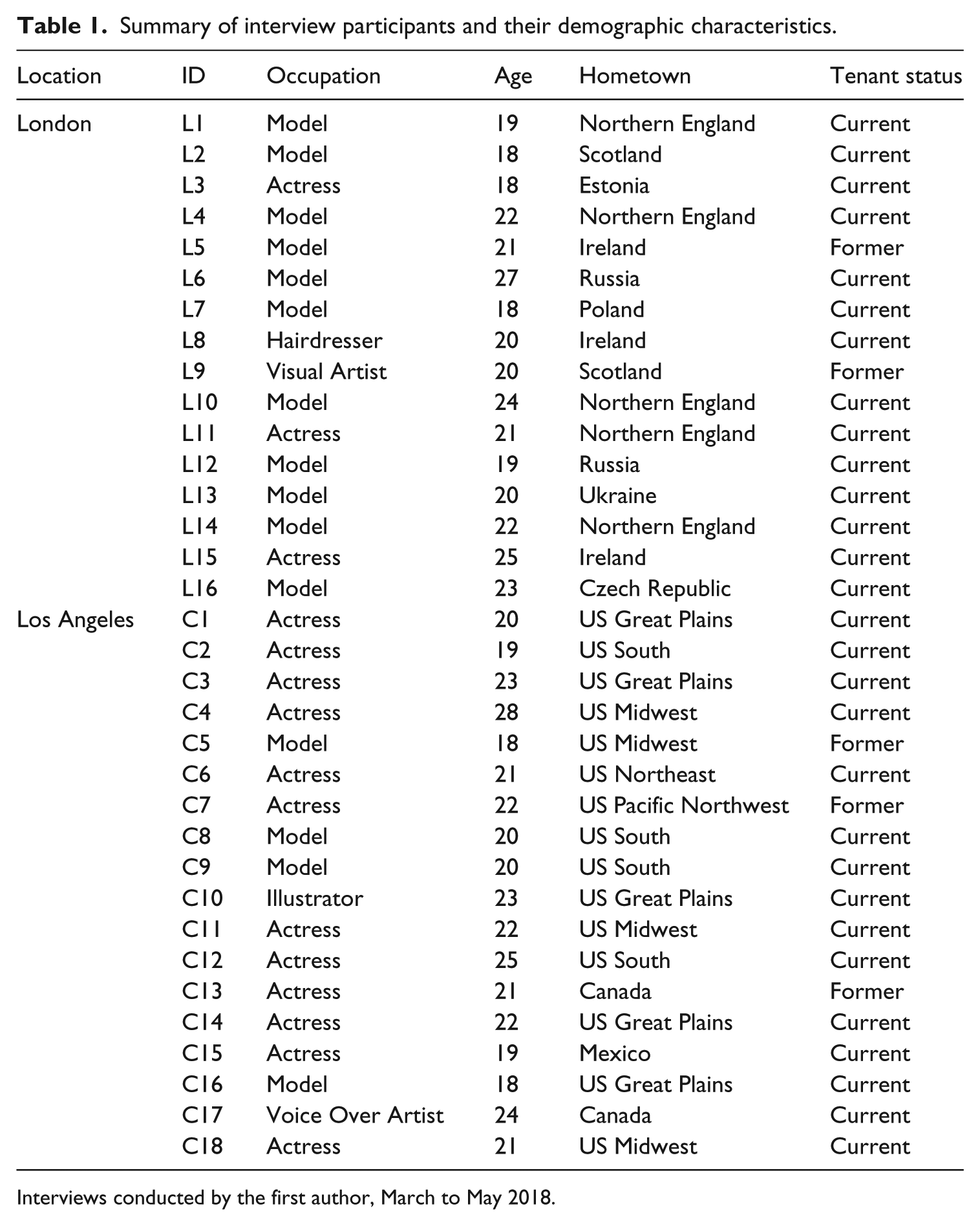
Interviews conducted by the first author, March to May 2018.
Results: gendered affordances for gendered labor
Our research shows four key tensions in how features and affordances of the platform seed ambiguities; provide a buffer that allows interpersonal interaction to evolve in a low risk, relatively anonymous forum; and helps both parties maintain a veneer of amateurism in sex-for-rent arrangements.
Navigating innuendo versus preserving arranged ambiguity
First, ads help landlords and tenants alike preserve what we call “arranged ambiguity,” while suggesting an arrangement to readers. Landlords skirt the scrutiny of flagging using vague language. This affords landlords the ability to preserve a wide breadth of interpretation about what they expect from tenants in exchange for housing. The socio-technical norms and affordances of the practices on display in the sex-for-rent ads we analyzed afforded landlords more visibility for their requests. Tenants were afforded less power in their negotiations with prospective landlords as a result.
The feature of anonymity on Craigslist affords users the ability to test potentially risky interactions in a low-risk setting. Craigslist mail disguises identities behind alias email addresses, and thus prospective tenants and landlords may start negotiations without disclosing their real-world identities. Several interviewees indicated emailing using this alias for weeks prior to revealing any personal data to landlords. Thus, responding to an ad does not seemingly pose any immediate threat to privacy. Most interviewees indicated how they judged which ads to respond to and what clues they looked for in email exchanges to move forward to face-to-face deliberations. Tenants said they had to determine if the landlord was a “creep,” including looking for ads that seemed genuine; not too desperate; indicated a high quality of living or perks; were well written and grammatically correct; seemed respectful; and assumed a blunt, not evasive tone. If an ad passed a tenant’s scrutiny, she evaluated the email exchange with the same degree of care and attention to her privacy. Multiple interviewees shared instances of responding to an ad, deciding against that arrangement, and still being inundated with messages from the landlord.
Ads and subsequent platform-based anonymous email exchanges must establish the authenticity of their poster, verify intentions, and escape flagging. Establishing authenticity requires proving the content of the ad is legitimate. As one interviewee lamented, “Some are too good to be true and they were often not. Just some bored kid.” As a result, landlords often include specific claims such as, “I know this sounds strange but it’s serious. No time wasters please and no men” (London, Ad #114). Ads often imply that an explanation of why landlords resort to these arrangements is necessary. Ads frequently cited a lack of time for a girlfriend, a failed romance, or a stressful job, as motives for the arrangement. For example, one ad included, “I really feel alone, that’s why I decided to post this ad and hopefully to find that roommate who I can trust” (Los Angeles, Ad #331).
Sex-for-rent housing posts often include a summary of the landlord that would not be out of place on dating apps. The majority of the ads (334 or 57%) included physical and social descriptions of the landlord, like the following: [I am a] 26 m athletic/ slim, girls love me, I was born and raised in LA, I’m usually either invited to a birthday or busy with work stuff girls usually want a relationship and I’m too busy to have a gf but I think it be fun to have a live in cuddly buddy as weird as it sounds lol. (Los Angeles, Ad #34)
Ads ask potential tenants to respond explicitly with a similar level of disclosure, as with this ad from LA (#167): “Please send a photo and describe yourself. Tell me what you want/need … Please be serious and reliable. In return, I shall make you the most special person in my life.” In return, many ads asked potential tenants to respond with specified keywords, pictures, bodily descriptions, and other mechanisms of confirming their authentic interest and ability to engage in the arrangement.
Users must navigate Craigslist regulations that technically prohibit sex-for-rent ads. Site visitors can flag posts as inappropriate or as posted on the wrong board. Numerous classifieds we opened in the morning disappeared hours later, and one of our calls for interview participants that we posted on Craigslist was removed. Recognizing that removal is a common practice, landlords included instructions for continued contact with respondents should the original posts disappear. Ads show landlords’ strategies for avoiding the filters. The quickest way to identify sex-for-rent ads is scanning for ones that do not include a rent amount in the title. In order to avoid flagging and removal, ads frequently include low monetary amounts to signal openness to a non-financial contract. One post even recognized this necessity professing, “NB: The site requires that a figure above the value of £0 be placed in the price area—hence the £1pcm; but for that one ideal person out there, the accommodation, would of course be free” (London, Ad #61). Ambiguity affords landlords visibility for their ads, while affording differing interpretations of arrangement terms and plausible deniability for both parties as they begin negotiations.
Most ads (483, 81% of the sample) featured sexual innuendo. Landlords used “favors,” “tit-for-a-tat,” and “payback methods” to suggest sex and intimacy in accommodation ads. As one tenant described her reading of the ad, “I had assumed he meant sex, obviously, but like once a week. In practice, the demand was more like every day.” Only 35 ads explicitly referenced sex. Landlords are deliberately evasive, hardly providing a contract that covers tenant obligations. Durable ads, the ones we could still see after weeks, relied on allusion to avoid filters and flagging. One ad that remained visible online for weeks offered “Free rent in exchange for attacking me down there” (London, Ad #114). “Companionship” and “housekeeping duties” could be read in different ways. One interviewee complained that “Even with our ten emails exchanged before meeting I really didn’t get just what and how much he required until I moved in,” and when asked about required, she responded, It wasn’t optional or didn’t feel like it. Once I told him I was sick and he basically told me to get on my knees and blow him or he would kick me out. I didn’t realize I had to do it whenever he wanted.
While such ambiguity helps afford landlords visibility for their ads, the lack of clarity may shift the bargaining power between potential tenants and landlords. Different social contexts mean such power might be afforded differently to different users.
For instance, some ads presented a pricing structure as an alternative to sexual relations. One landlord was “open to suggestions and special arrangements or can rent for £1000pcm” (London, Ad #16). Landlords structuring ads this way signal that they are open to bargaining for compensation that is sexual, financial, or a combination of the two. Some ads, like the following one from Los Angeles (Ad #12), were more explicit: “In lieu of rent, I require only three things. You must share in cooking and cleaning. You must be artistically productive daily. You must be open to a romantic relationship, or to helping me find someone” (Los Angeles, Ad #12). Others left open for discussion the terms of “fair exchange and mutual convenience” (London, Ad #93), but seemed nonetheless concerned with reaching a mutually acceptable arrangement such as a “mutual understanding of a fun sleepover;)” (London Ad #77). Most interviewees indicated that what “fair” meant was negotiated at the beginning and sometimes not revisited. While tenants barter terms with landlords the ads’ ambiguity leaves them with incomplete information for these negotiations.
Even as negotiations between tenants and landlords ensued, sex-for-rent arrangements often maintained a degree of arranged ambiguity. Terms were not completely or concretely specified in order to allow for a range of plausible interpretations. Landlords, who used innuendo to avoid filters and flagging, could preserve ambiguity throughout negotiations and their arrangements as a way of maintaining power to set the terms of the relationship. Meanwhile, ambiguity affords tenants the burden of dissecting the imprecise language that landlords use on Craigslist and less power when negotiating and entering these arrangements.
Amateurism versus persistent specificity
Sex-for-rent solicitations prize amateurism and ads frequently reference romance. However, ads also frequently specify tenants’ physical features, psychological traits, and sexual preferences. Of the ads sampled, 267 or 46% included a description of the ideal tenant’s physical or personal traits. For example, “You should be below 28 but be LEGAL. I like a lady to be between size 6–12 Under 5ft 8 Blonde is perfect I also very much like Asian, Latina, and black ladies” (London, Ad #4). Others incorporated more elusive requirements. One ad entitled, “James Bond / Christian Grey type seeking young Money Penny/Anastasia type assistant to offer Free Accommodation in London,” specified that potential tenants must be willing to “undertake aptitude tests under strict examination conditions (including verbal reasoning, numerical reasoning, logical reasoning, temperament and other tests; including practical tests) as part of the consideration process.”
Once in arrangements, landlords coach tenants how to meet their demands. Thus, a confusing rhetoric emerges: tenants should be amateurs, open to romantic relations, while also fitting specific characteristics and catering to landlord demands. Women are expected to be novices, selected for their traits, yet subsequently groomed to meet the needs of their landlord.
Landlords navigated expectations through the guise of amateurism, but with very specific requests for tenants and often shared hopes for romance to develop out of the arrangement. Ads expressed the image of a live-in girlfriend, for example, “[I] hope that the excitement of the initial setup will evolve into something equally fulfilling but perhaps on a more conventional footing—without necessarily losing the deeply satisfying undercurrents of the unorthodox initial arrangement however …!” (London, Ad #61). Many ads used traditional forms of dating as the ultimate goal of the relationship. For example, This is NOT an ad for prostitutes or solicitation of any kind nor should you be one. This is also NOT for those of you just looking for a quick free hotel or rent, place to stay or any quick or easy free benefits. There is NO “quick” live-in arrangement or benefits. This is a “step-by-step” relationship process with the “long-term goal” being a live-in situation or domestic partnership. (Los Angeles, Ad #66)
As one interviewee explained her relationship, “Sex, that was simply what he wanted. It wasn’t anything too kinky. But he wanted to look into my eyes, always,” and a number of other interviewees echoed that landlords expected new tenants to be complicit in creating an image of authentic intimacy. A London-based tenant we interviewed said that her landlord told her that “he doesn’t like prostitutes because they are too stiff. He knows they are watching the clock waiting for the hour to be up.” Landlords expect tenants to be authentic amateurs, and yet still embody their desired physical and personality characteristics, and, in some cases, believably perform romance.
Calculated sacrifice versus narrative of a better life
People in sex-for-rent relationships enter their arrangements carefully and with negotiation, and their negotiating abilities are shaped in part by larger macrosocial forces. Thus, the platform affordances for negotiation depends, at least in part, on users’ differing social contexts and how those shape their reception of the potential opportunities advertised. One of the contexts for the women whom we interviewed was the economic and social context of breaking into paid work in cultural industries. Ultimately, the decision for the majority of the women we interviewed came down to weighing the opportunity to pursue their dreams against the tolls that the arrangement would take on them. One woman described making several lists of “pros and cons.” The women we interviewed varied in their degree of satisfaction with the arrangement, from being extremely content to actively looking for a way out, and all carefully weighed their options—and exercised agency—before entering into an arrangement. Women looking for work in cultural industries read ads as offering a better life and they calculated the personal costs of the arrangements alongside the sacrifices that they felt they had to make for their careers.
Problematically, “making it” in creative industries often requires physical presence for “go-sees” and auditions, and landing a first paid role demands numerous unpaid hours of work. Many of the women we interviewed were young with little work experience or savings. However, both London and Los Angeles both have high costs of living compared with other cities. The average one-bedroom apartment in Los Angeles in 2018 was $1949 a month, more than double the national average (SmartAsset). This poses a dilemma: how can one break into creative industries when its geographic epicenters are such expensive places to live?
One of the benefits of sex-for-rent arrangements for the women whom we interviewed was flexibility while they looked for work. Most interviewees described their landlords as older men with full-time, lucrative careers. They frequently worked late hours and traveled for business. This freed entire days for tenants to audition for roles. Some arrangements also offered stipends, shopping budgets, lavish gifts, and employment leads and opportunities. Often, posts promise tenants a better life, seeking “Someone who wishes to explore the high end entertainment, such as gourmet restaurants, cocktail bars and a five star hotel room. All paid for all night by myself” (London, Ad #4). Such perks beyond free accommodation were mentioned in 23% of ads. A young woman in Los Angeles explained how her landlord communicated these benefits to her: When we first met, at a local coffee shop, he immediately gave me a necklace. He told me he studied the photos I sent and thought it would go well with my eyes. When I was with him, I got to eat out six nights a week, vacation in Mexico, and drive his spare Beamer.
Beyond offering free accommodation, arrangements often included perks that would make young women’s lives easier, more glamorous, and seemingly more upwardly mobile in their industries.
Numerous LA ads offered assistance for breaking into the film industry. For example, one LA ad included the following: I work in the entertainment industry shooting feature films commercials music videos and tv shows i also do promotions. am currently looking for young attractive pretty single fun girl/woman any race 18 to 30 in Los Angeles or moving to Los Angeles to date live together and enjoy life. if you are also interested in working in the entertainment industry or love what i like it will be a plus. (Los Angeles, Ad #238)
Several interviewees credit their arrangement for helping them to land their first acting or modeling gig. As this woman puts it, I swear modeling is Russian roulette or like rolling the dice. I went to hundreds of auditions and just wasn’t right—you know, my hair, skin, eyes … And then, bam! Got one and once I was cast and every casting after that [with experience] became so, so much easier. I seriously have no clue how I could have managed the audition schedule with a job.
Two participants entered into sex-for-rent arrangements under the guise of inside connections. One interviewee told us that her landlord said that “he knew all the industry big-shots and that I’d be auditioning every day. That he’d be shocked if I didn’t have a deal within a month.” She said after 6 months, she had attended two auditions that she called “sketchy” and that did not yield paid work.
The risky work of cultural industries shapes some people’s reception to these ads. While tenants deliberately calculate the costs and benefits of these arrangements, the benefits that readers read into the ads are shaped by the political economy of, in this case, women’s work in cultural industries.
Consent versus consensual non-consent
Sex-for-rent arrangements blur the line between consent and an ongoing sexual exchange that is at turns both explicit and tacit. People explicitly agree to sex-for-rent arrangements, and several interviewees were satisfied with their arrangements. Two factors, however, complicate notions of consent in these arrangements: the skewed power dynamics between landlords and tenants and changing arrangement terms.
In the first aspect, women in these schemes frequently come from positions of diminished power. Several were desperate to find housing or support. “I was homeless,” one interviewee expressed. “I had been in foster care and then I turned 18 and bam I was out. I didn’t really have skills and was hungry. This felt like my only choice and at the time a good one.” Another woman told us her story of moving to London to work at a modeling agency, which turned out to be a sham that actually expected her to perform prostitution for clients. Having moved across Europe, she could not afford to return home and had promised to send wages back to her family. She found a sex-for-rent arrangement that offered her safe accommodation and a stipend she could funnel home. “It felt dirty, I felt dirty. But it was just one guy instead of a new one each night and the twenty quid a day went a long way.”
A second aspect complicating consent is the fluctuating, imprecise nature of arrangement terms. Almost all interviewees expressed some deviation from their initial negotiations and what occurred in practice in their arrangement with their landlords. Landlords commonly request different types of sexual favors and increase sex frequency as arrangements progress. Ads afford landlords this gap by both leaving specific terms intentionally vague, while allowing them to assert that tenants’ subordination is essential. “Following my directions is most important,” as one Los Angeles put it (Ad #30). With incomplete terms, tenants are at the mercy of their landlords, and tenants feel they have no choice but to oblige if they want to keep their accommodation. One tenant told us that her landlord would remind her that she was not special and that “he could always find a new girl.”
Vague terms in ads help to afford unequal power in the negotiation and maintenance of the terms of the arrangement. Despite a large number of sex-for-rent ads, tenants felt they had low bargaining ability. Interviewees described eager landlords rapidly trying to move online chatter to offline coffee dates. This would indicate there may be more willing landlords than willing tenants. However, once the arrangement was in place, the landlord had significant bargaining power because of the control of accommodation. One tenant described how her landlord likened her “not having sex with him one night would be like him kicking me to the curb one night just because he didn’t feel like letting me stay in his space.” Many landlords explicitly expressed to their tenants because they give access to accommodation for the duration of the agreement, so they expect sexual favors to be unlimited and continual.
Landlords consent to share housing while tenants seemingly give irrevocable consent to perform sexual acts. While both parties ostensibly agree, the power imbalance between them complicates this arrangement. Autonomy refers to the ability to make choices from a position free from the threat of retribution or other adverse social or economic consequences. In a new city, away from family, and faced with the choices, the choice is pressured by extenuating circumstances.
Features of Craigslist shape the affordances for consent in two ways. First, by establishing these relationships as exchanges in the housing offered category, they play directly into the commodification of intimate and domestic life that feminist scholars theorized. Second, these arrangements offer little protection to tenants who may way to renegotiate terms, but the ads afford a power imbalance in the terms of consent. The terms of the exchange are not frictionless market exchanges of free choice, but based on differences in information and power afforded by the ads and the arrangements themselves.
Discussion
The prevalence of sex-for-rent ads relies on a thriving platform for intimate work and willing and active participants in the market. Our interviewees were young women who weighed the potential personal costs of this arrangement versus the potential gains the arrangements offered for their careers. Aspirational, hope, and venture labor in the cultural industries thus shaped the sex-for-rent arrangements that we found in Los Angeles and London. At least in those cities, sex-for-rent markets rely on people who need flexibility in order to seek out work in the cultural industries, but cannot afford to live in the cities where these jobs are concentrated.
Yet, sex-for-rent arrangements are hardly free for their tenants. Accommodation is exchanged for hopeful, emotional labor. Tenants must dissect layers of innuendo, calculate what seems to them be a fair exchange, curate their sexual and personal styles and characteristics in order to meet landlords’ specific requests, and navigate the changing terms of the agreements.
Platform affordances are essential in shaping how users approach these arrangements. Platform affordances allow relationships to incubate in low-risk anonymous settings before progressing toward higher risk in offline contexts for negotiation. Thanks to the platform affordances of anonymity, tenants can begin to assess the intentions, identity, heteronormativity, and authenticity of the posters before negotiating the terms of the living situation. Identity hashing obscures risky disclosures on both sides, allowing potential landlords and tenants alike a mechanism for seeking out an arrangement at little cost to their privacy or risk of “context collapse.” The same strategically ambiguous phrases that afford ads their durability against flagging mechanisms also obscure arrangement details, affording different power to landlords and tenants in the negotiations due to information asymmetries. The language of a better life in the ads connects the sex-for-rent arrangement to the aspirations of work in cultural industries, appealing to people who need to make unpaid investments in their careers while living in the world’s most expensive cities. Even the notion exchange on platforms affords landlords and tenants different conceptions of fairness and consent, as when many of the women we interviewed reported feeling landlords’ continual sexual requests were unfair and yet they felt powerless to renegotiate their terms.
Craigslist structures the opportunities and the market for these interactions, including who can and cannot exert individual agency within them. The platform affords different categories of action for tenants and landlord, not unlike Uber drivers and riders who are subject to obscured surge-pricing metrics and matching algorithms. With repercussions for what Hochschild (2012) termed the “outsourced self,” the platform afforded different actions to men and women in the heteronormative exchanges that we studied here.
Sex-for-rent arrangements require tenants performed commoditized intimacy under the guise of preparing the entrepreneurial self. Entrepreneurial workers are always encouraged in their industries to combat work insecurity by going above and beyond job requirements. Typically, this means working long hours, aptly managing emotions, and sacrificing personal life in the name of future economic gain. In modeling and acting, these preparations include the “glamour labor” (Wissinger, 2015) of the proper subjective comportment on and off the screen to make the right image affectively ready for work. Sex-for-rent ads thus do more than support a market for commodified intimacy. The resulting arrangements help to fuel the reproduction of creative labor and use the notion of entrepreneurial sacrifice and the subjective management of the emotional and affective self as resources for the entrepreneurial labor in creative industries.
A conceptual model for gendered affordances
Based on this case, we can show how affordances can have differential capacities for use for men and women. First, gendered affordances may suggest different actions to different users patterned on variation across gender. In this case, landlords and tenants navigated the strategic ambiguity of the ads in different ways and the ads afforded different actions in their negotiations. Second, gendered affordances may pattern the variability in how users take up affordances. We see such patterning in this case of younger women as tenants and older, wealthier men as landlords, and in the seeming convergence of similarity of arrangements. Third, gendered affordances draw on the cultural and institutional repertoires and social and cultural macro relations between users and their social structures of gender. Sex-for-rent arrangements could not happen without the existing cultural and economic frameworks for them. In this, gendered affordances may, fourth, strengthen the social structures of gendered inequalities. The affordances of the platform for sex-for-rent arrangements contribute to reproducing and normalizing exchanges for commoditized intimacy and the current status of women in society.
Conclusion
Our work contributes to growing research on the dark side of platform economies. Our findings illustrate that while users can be afforded anonymity for buffering high-risk interactions, the affordances that we studied here also systematically reproduced a gendered patterning of actions and strengthened gendered social structures. Our work extends work on social affordances as a case study in how users are afforded different actions based on cultural repertoires and social institutional factors.
While answering questions about the structure, prevalence, and vocabulary of sex-for-rent ads, this project has also raised questions for further research. First, the recruitment methods used in this project targeted women aspiring to careers in creative industries. Future research may benefit from broadening the scope of the focus on these arrangements. We exclusively analyzed Craigslist sites in London and Los Angeles. Additional work may include a wider variety of cities and platforms, such as Gumtree and Airbnb. Our analysis found a significant number of ads soliciting same-sex arrangements. Interviews with tenants in same-sex arrangements could explore similarities and differences with the heteronormative ones we studied here. Finally, landlords could be interviewed to elicit their views in general, how they view fair exchanges and how they understand platform affordances for the arrangements.
Gendered affordance gives scholars a conceptual tool for studying how technologies participate in the structuring of social life. As feminists, our normative position is that the concept of gendered affordance can help scholars and practitioners alike understand how technologies may 1 day be designed to help afford more emancipatory practices.
Footnotes
Acknowledgements
We are indebted to the reviewers of this journal whose careful attention to our article greatly strengthened it. The Oxford Internet Institute’s Research Facilitator Tim Davies helped us think through the research ethics of a complicated interview project. Mostly, we would like to thank the women in our study for their bravery and insights.
Authors’ Note
All authors have agreed to the submission, and the article is not currently being considered for publication by any other print or electronic journal.
Funding
The author(s) received no financial support for the research, authorship, and/or publication of this article.
