




Abstract
Many claims have been made regarding the influence of social media like Facebook on activities undertaken by political actors. While the study of online political communication provides several different perspectives, few studies have attempted to uncover tendencies of so-called permanent campaigning in online environments. The term signifies campaign-like activities at the hands of politicians also during non-election periods and has spawned a number of conceptual discussions. This article presents an exploratory effort, studying traces of permanent campaigning in two similar countries—Norway and Sweden. As the former of these countries underwent a parliamentary election during the studied period, the study provides insights into “the election effect”—heightened levels of online activity among the Norwegian parties and politicians that can perhaps best be understood in relation to an ongoing election.
Introduction
The suggested democratic and parliamentary-political aspects of so-called new media are recurring themes in the literature on online political communication. As the Internet has “vexed academics and commentators” (Wright, 2011: 245) since its popularization in the mid-1990s, mixed results and interpretations regarding the role of the online for political purposes have been put forth. Indeed, in an early study from 1996, Margolis et al. (1996) suggested that “the Internet may have the potential to change the nature […] of world politics, but we doubt that it will” (p. 75). While many such claims of unearthed potentials seem to hold true also in later studies (e.g. Dahlgren, 2005; Karpf, 2012; Larsson, 2013a), echoing the often-discussed normalization hypothesis, scholars have also found support for what is sometimes referred to as its antithesis—the equalization hypothesis, suggesting traces of the Internet functioning as some form of political engagement panacea, “allowing new forms of political participation which previously did not exist” (Anduiza et al., 2009: 862).
The study of citizens online has been complemented with scrutiny of the Internet activities of those holding or seeking parliamentary power—that is, politicians up for election. While hosting your own web site has become “virtually mandatory” (Druckman et al., 2007: 426) for those seeking office, recent developments toward a supposed 2.0 paradigm of web publishing have reinstated the necessity to maintain an active online presence. This time around, the focus lays not on self-hosted web pages, but rather on so-called social media like Facebook or Twitter—ready-made platforms where users supposedly come to socialize and communicate. Moreover, while the notion of the permanent campaign, suggesting blurred lines between campaigning and governing, was first coined in the 1970s (e.g. Blumenthal, 1980), the “always-on” logic of social media has led to suggestions that such continuous endeavors by politicians might be on the rise (e.g. Klinger, 2013; Tenscher, 2013; Vergeer et al., 2011). Employing an overarching, structural approach, this study employs a series of quantitative analyses in order to assess the degree to which political actors make use of their Facebook Pages outside of as well as during election periods—and how this use is reflected in their online following. Taking the aforementioned normalization and equalization hypotheses as conceptual starting points, this exploratory study traces tendencies for both hypotheses with specific regard to the issue of permanent campaigning in a data set which encompasses empirical material from two similar countries: Norway and Sweden. As the former of the two case countries underwent an election during September of 2013, the longitudinal focus of this study will allow for assessment of what this article tentatively labels as the “election effect”—structural patterns of activity that can perhaps best be understood as traces of electoral campaigning.
While case study–type research settings have provided important insights regarding the Internet use of politicians, the article at hand seeks to lessen the suggested dearth of comparative studies on the present topic (e.g. De Vreese, 2009; Enli and Skogerbø, 2013; Lisi, 2013; Vaccari, 2008a; Vergeer et al., 2012). Moreover, the design employed not only permits the measurement of Facebook Page activity as a continuous variable rather than a dichotomous one (Strandberg, 2013), but it does so in a setting that allows for comparison between individual politicians and the party organizations to which they belong (Klinger, 2013). This is done outside a US/UK context (Hermans and Vergeer, 2013), in two countries characterized by high numbers of voter engagement as well as Internet penetration and use (Gustafsson, 2012; Karlsen, 2011).
Permanent campaigning: traces of normalization or innovation?
The debate regarding the political consequences of Internet use at the hands of politicians has largely circled around a series of dichotomies, denoting similar themes of optimistic or pessimistic approaches to these ongoing developments. Indeed, the pairing of innovation (sometimes equalization) and normalization is used quite often to denote different views on the topic at hand (e.g. Gibson et al., 2008; Larsson and Svensson, 2014; Margolis and Resnick, 2000). The former of these terms suggests that as the Internet allows politicians to “communicate directly with citizens without direct interference from the mass media” (Hermans and Vergeer, 2013: 74), such possibilities for increased interaction would be incorporated by those seeking public office. Given the lack of resources often found among smaller or fringe parties, the Internet was often thought of as providing an “opening for the outsiders” (Strandberg, 2009: 835). Specifically, the proposed low cost and potential broad reach of the new medium was seen as especially interesting for such smaller actors, who would supposedly be able to level the political playing field through supposed innovative use of new technology. While such largely conceptual musings did indeed come to fruition in at least a few instances, suggesting equalizing tendencies related to the employment of online techniques by comparatively diminutive political actors (e.g. Gibson, 2004; Gibson et al., 2008; Strandberg, 2009), empirically based research have largely suggested otherwise. Especially for comparably later scholarly efforts, innovation in terms of the utilization of novel online practices is largely found among more established actors such as larger parties (e.g. Strandberg, 2013; Tenscher, 2013) or incumbents (e.g. Williams and Gulati, 2013)—findings that instead suggest a normalization of the online. While we should be wary to draw any firm conclusions, it would seem that while innovative practices can certainly be noted among actors big and small, the actual use of social media such as Facebook by politicians is often characterized as a “Web 1.5” approach—suggesting a hybrid of top-down “Web 1.0” approaches and interactive “2.0” advances (Jackson and Lilleker, 2009; Larsson, 2013a).
In sum, then, the empirical evidence regarding differences between minor and major political actors and their online conduct is inconclusive. One way forward could be to apply these broad hypothetical designs in more focused conceptual setting. This is what this article seeks to do.
The concept of permanent campaigning was touched upon previously, and while it is difficult to provide precise metrics regarding what such permanence would entail in an empirical setting, the study presented here employs the innovation and normalization hypotheses to guide a series of quantitative analyses in this regard. As such, our focus here goes beyond a dichotomous approach—detailing whether or not politicians had adopted the technology at hand or not (e.g. Gulati and Williams, 2013). Instead, we mobilize an exploratory approach, mapping the degree to which politicians make use of their Facebook Pages. In so doing, we can say very little about the actual content being posted—but all the more about how often such postings are taking place, and what effects these uses appear to have in terms of audience engagement.
The idea of the permanent campaign, denoting a blurring of the lines between time spent on the campaign trail and in the governing office, appears to have first been coined in 1976 by Patrick Cadell, advisor to president-elect Jimmy Carter in order to describe the necessity for campaign-like efforts to take place also outside traditional election periods (Blumenthal, 1980; Noguera and Correyero, 2009). Such schemes for political activities have arguably only grown more common since the late 1970s—perhaps in some part due to the technological developments that today provide the infrastructure necessary to procure such efforts of online permanent campaigning (Cook, 2002; Sparrow and Turner, 2001). Indeed, Vergeer, Hermans and Sams (2011) suggest that “with the advent of the Internet, permanent campaigning […] to build public support becomes easier” (p. 485). While previous studies have shown that the online efforts of politicians and parties are largely centered around election periods, scholars, pundits, and practitioners insist that online environments built or hosted by political actors are “maintained for extended periods and long-term objectives” (Vaccari, 2008b: 6) or that “campaigns are permanent, although with varying intensity” (Strömbäck, 2007: 54)—claims that resonate well with the aforementioned always-on social media logic and that is often associated with services like Facebook. By tracing tendencies of the innovation and normalization hypotheses in the empirical material collected, the study at hand furthers our understanding of online permanent campaigning in two modern democracies—Norway and Sweden.
Research setting: Norway and Sweden
The adopted analytical setup follows a “most similar cases” strategy, studying comparable cases that share basic characteristics, but vary concerning dimensions of specific interest (e.g. Ragin, 1987). For this study, such dimensions concern elections—specifically the fact that while one of the case countries—Norway—underwent a parliamentary election during the time of data collection, the other did not. Both countries are characterized by high levels of general Internet use—a claim that holds true also with regard to the uses of the specific service under scrutiny here, Facebook (e.g. Karlsen, 2011; Nordicom, 2013). As for the use of Internet technologies at the hands of political actors, parties in both countries have utilized the new medium for a long time—however, they “have not necessarily been trailblazers in campaigning online” (Gibson, 2004: 104). More recent studies tend to at least partially confirm such claims, also finding that political “underdogs” appear to be more active in fora like these (Larsson and Kalsnes, in press). Nevertheless, the effect of the Obama election in 2008 has been felt also in these contexts, while such employments have had to be adapted to local characteristics (Karlsen, 2009, 2011).
Both Norway (approximately 4.9 million inhabitants, parliament with 169 representatives) and Sweden (9 million, parliament with 349 representatives) represent the Nordic welfare state model (Hilson, 2008). As such, both countries can be likened to what Sartori (1990) labels a parliamentary system characterized by moderate pluralism—multiple parties and limited centrifugal forces. Moreover, while individual politicians can play important parts in these political systems, both countries can be described as party-centered rather than candidate-centered (e.g. Enli and Skogerbø, 2013). Inspired by Kalnes (2009), Table 1 presents the basic characteristics of the main political parties in Norway and Sweden, including results from the latest elections to have taken place at the time of data collection.
Characteristics of Norwegian and Swedish political parties.
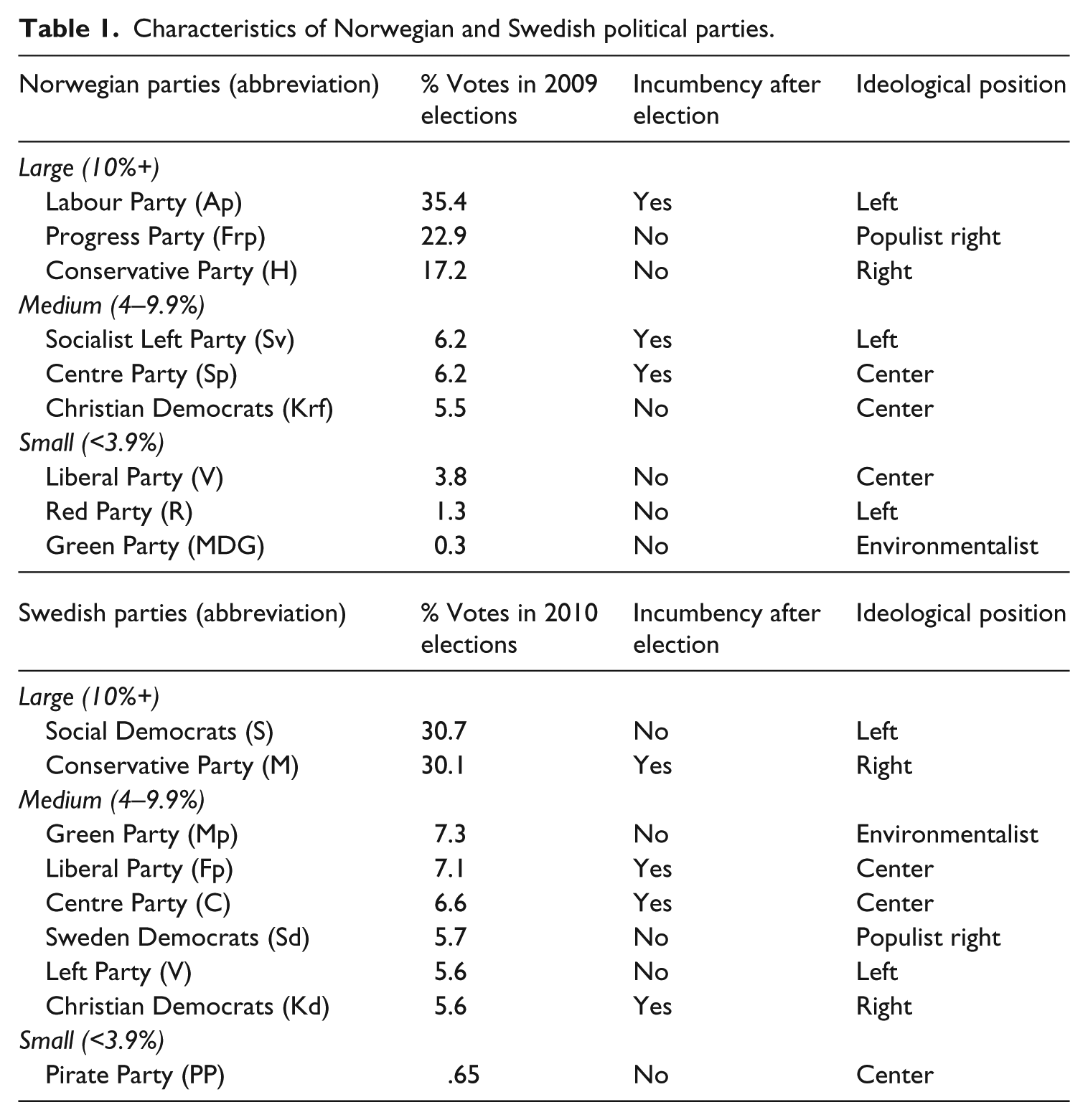
As indicated by the penultimate column in Table 1, the 2009 Norwegian elections resulted in a victory for the ruling Left-Centre coalition, while the 2010 Swedish elections saw a Right-Centre union taking office. Indeed, while ideological classifications like these might simplify the complex nuances of political environments, this type of presentation does indeed make the type of comparative efforts undertaken here easier.
Method
Collection and analyses of online data bring a number of different ethical challenges to the fore, especially when the research to be performed deals with issues of political preferences (Moe and Larsson, 2012). Contrasting with Twitter, while the “generally public nature of tweets and replies” (Bruns and Highfield, 2013: 671) makes research on that particular platform somewhat less problematic, approaching Facebook for purposes like these appears a bit more complicated. While our focus here lay on the Facebook activities of political parties and politicians seeking office, the need to protect their specific ideological persuasions could be seen as superfluous. Nevertheless, the privacy of each included politician must be respected. With such precautions in mind, the study focused on the Facebook Pages related to each politician rather than their corresponding personal Profiles. While the former of these types of Facebook presences are geared toward “public showcase”–type activity, the latter is more focused on activities related to a specific user’s private sphere. Beyond ethical considerations, the focus of Facebook Pages has been encouraged by previous research (e.g. Gulati and Williams, 2013), supposedly because the uses of the service at the hands of politicians could serve as an indicator of political professionalization (e.g. Vaccari and Nielsen, 2012). By focusing on Facebook Pages, the results presented here can be compared with previous research findings.
While more or less manual rationales for data collection have been successfully employed to gather content from Facebook (e.g. Williams and Gulati, 2013), this study opted for an automated approach. Although automated approaches to various forms of analyses are associated with certain difficulties (e.g. Lewis et al., 2013), similar approaches to data gathering allow for considerable ease in this stage of the research process (Stieglitz and Dang-Xuan, 2013). Given the exploratory quantitative outset of the study, such an approach seemed appropriate. Specifically, data collection was performed by means of the Netvizz service (Rieder, 2013). In short, Netvizz allows for archiving of Facebook Page activity. Of specific interest here was the ability to gain access to all posts authored by the Page owner, as well as the associated meta-data, such as likes and shares, during a specific time period. While such meta-data are the product of the clicks and actions by other Facebook users, the internal mechanisms of the platform at hand and the previous choices made by account holders could also be expected to play a part in how content is presented to each individual user (Bucher, 2012). In order to provide a comparably neutral starting point, a separate Facebook account was created for the purposes of data collection only.
The sample for the study consisted of all major Norwegian and Swedish parties and politicians who operated a Facebook Page at the time of data collection—28 September 2013. Guided by Table 1, the sample included parliamentary seat holders, as well as those politicians and parties seeking such offices. Following Klinger (2013), the selection process was guided by selecting only those Facebook Pages that were officially sanctioned by each respective party or politician. In order to cover a sufficient period of time, data were archived from 1 January 2013 until 27 September of the same year. As the Norwegian elections were held on 9 September, the longitudinal data collected should provide a suitable starting point for comparing the effect of an election year in one of our two case countries.
Results
With regard to political parties, all identified actors—both in- and outside of parliament—had adopted the Pages feature at the time of data collection. As for individual politicians with seats in parliament, 24% (N = 46) of Norwegian politicians had adopted, while data for the Swedish context indicated that 19% (N = 71) had taken similar measures. No significant relation could be found between country and rate of Facebook Page adoption (Cramer’s V = .06, p > .05). As such, this very basic introductory notice indicates that if there indeed is an election year effect at work, it cannot be gauged by focusing solely on adoption rates.
As an attempt to assess the permanence of activity undertaken by politicians on their Facebook Pages, Figures 1 and 2 present data from 1 January 2013 through 14 September of the same year. The figures feature a series of timelines denoting the number of posts made on Pages operated by parties (represented by the black line), party leaders (gray line), and other politicians (dotted black lines) in Norway and Sweden, respectively. By distinguishing between different types of actors, we can gauge the relative homo- or heterogeneity of Page activity throughout the examined period.
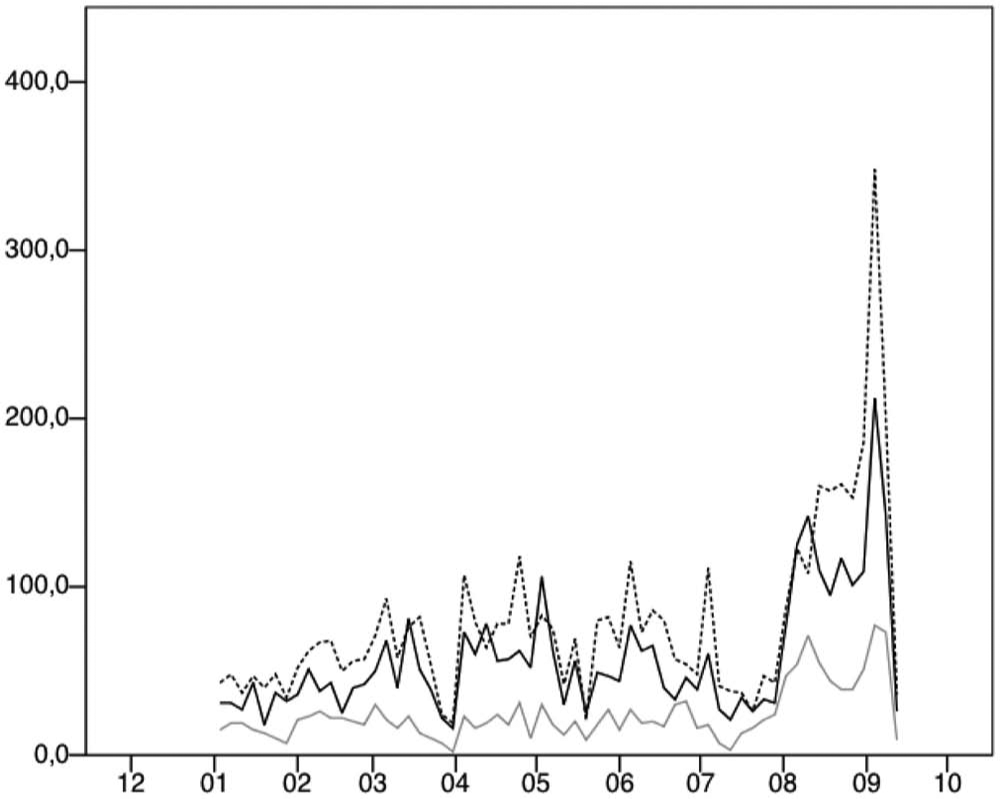
Timelines representing Facebook Page posts by parties (black lines), party leaders (gray lines), and politicians (black dotted lines) per month in Norway.
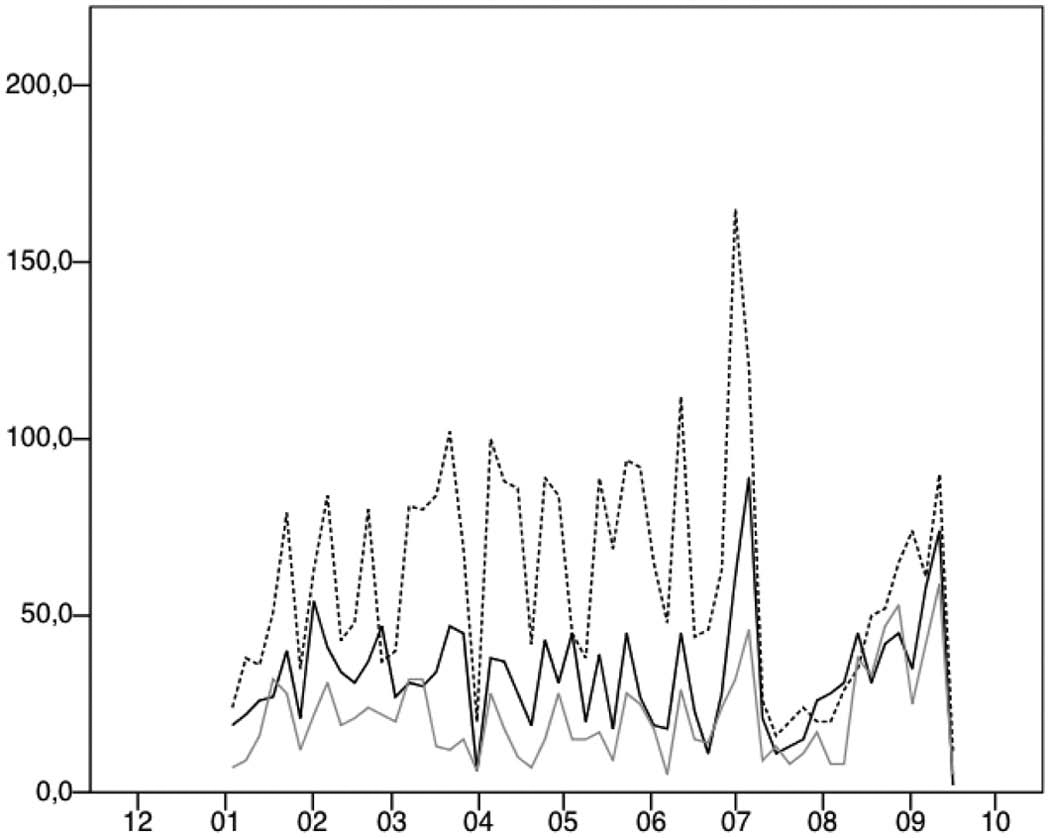
Timelines representing Facebook Page posts by parties (black lines), party leaders (gray lines), and politicians (black dotted lines) per month in Sweden.
While the obvious quantitative differences between the categories of political actors found in Figures 1 and 2 should be taken into account, this mode of presentation allows us to assess the degrees of interdependence between these different actors. As social media services like the one under scrutiny here supposedly allow individual politicians to maintain a media platform of their own, different line shapes could indicate diverging online endeavors. As the lines for both countries imply, such varying tendencies are rather limited. While the lines for the Swedish context appear shaped in a slightly less similar manner than for Norway, the general trend must be said to be one of similarity. Parties, their leaders, and elected parliamentarians generally appear to follow the same rationales with regard to activity on their individual Facebook Pages—a result which begs the question: what influences those rationales?
As research on Twitter has found that political (e.g. Aragón et al., 2013; Bruns and Burgess, 2011; Larsson and Moe, 2013) as well as other uses (Larsson, 2013b) are often related to events in mainstream media, such tendencies are apparent also for Facebook Pages. For Norway, the activity visibly increases as the month of August indicates the start of the “short campaign”—the final weeks before Election Day on 9 September. From there on, we can identify at least three clear rises in the lines—each corresponding to debates (held on 12 and 20 August and 6 September, respectively) broadcast on the Norwegian public service broadcaster. Election day sees the absolute peak of use, after which the activity clearly diminishes.
For Sweden, the period leading up to July is not marked by any specific outbursts of activity. As for Norway, the month of April features the Easter holiday, characterized by a considerable decrease in activity. The month of July is of specific interest here, as this time period features the Almedalen week. This annual event sees political elites gather in the Almedalen park in Visby on the Gotland island right of Sweden’s east coast. A staple in Swedish politics and societal debate since the 1960s, the event features debates, discussions, and essentially serves as a meeting place for those holding power (e.g. Wendt, 2012). This event yields the highest amount of activity for the Swedish case—after which the summer holidays appear to have a decreasing effect on the uses of Facebook. The official opening of the Parliament at the beginning of September sees another high point in the data, after which our collection period comes to a halt.
On a final note regarding the line graphs, we can note the difference in scale for the two countries. As previously mentioned, Sweden boasts a larger parliament in terms of representatives than Norway. However, the intensity with which posts were made was arguably more tangible in the Norwegian context. As the scale for Norway appears as double (maximum value is 400 posts) than that for the country which does not (maximum value for Sweden is 200 posts), we can postulate an election year effect at work—indeed, as Election Day drew closer, this effect for Norway becomes even more tangible in comparison to Sweden. As such, permanence in campaigning appears as clearly related to an electoral event.
We turn now to look at the individual parties and politicians who distinguished themselves as being particularly frequent posters throughout the studied time period. Figures 3 and 4 introduce bar charts featuring those users whose median number of posts per day was at least 0.5. While this demarcation could certainly be put into question, expanded or diminished, it was deemed suitable in order to focus on those users who made a clear mark in the political Facebook spheres in the two countries. By focusing on these high-end users, we are able to tell if more established actors—such as incumbents—or challengers—such as those seeking office—appear as more permanent in their uses of the Facebook platform.
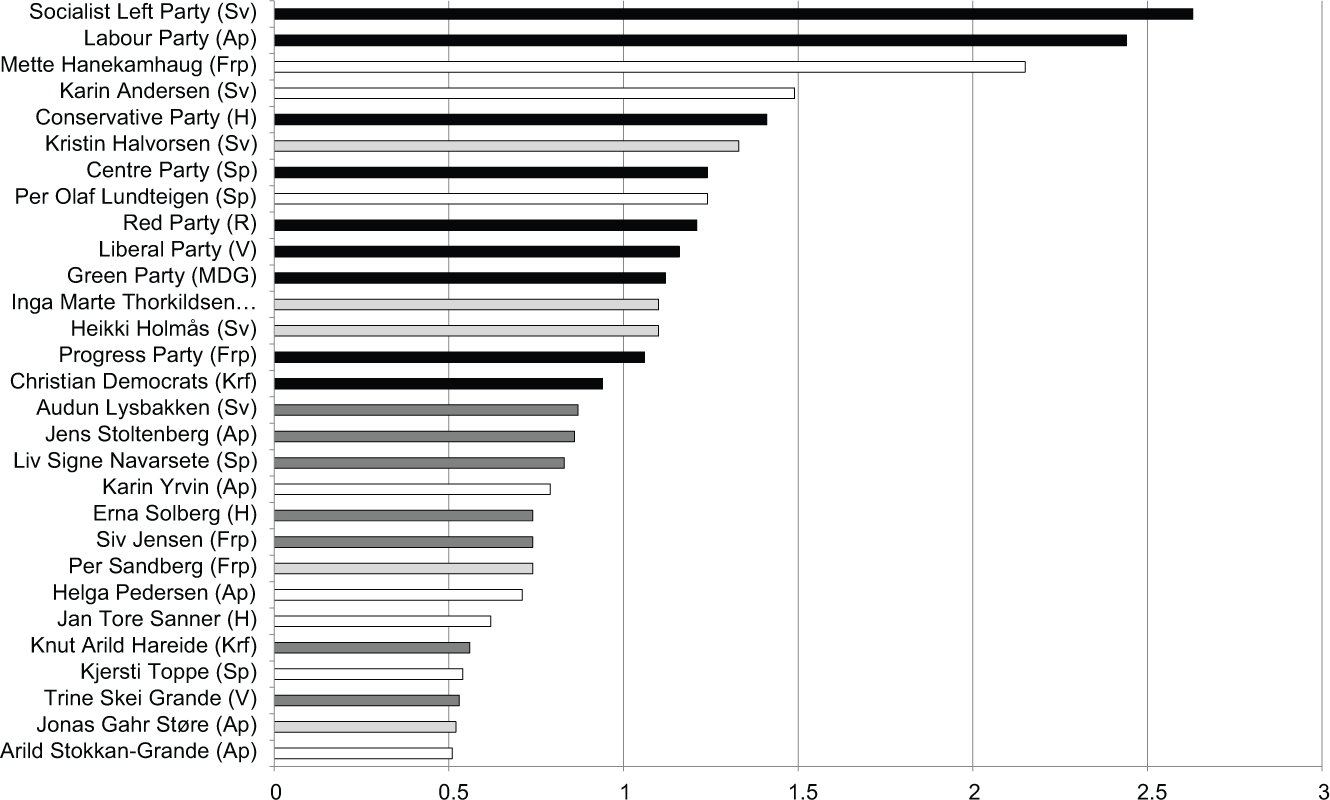
Norwegian political actors with a median of posts per day reaching at least 0.5.
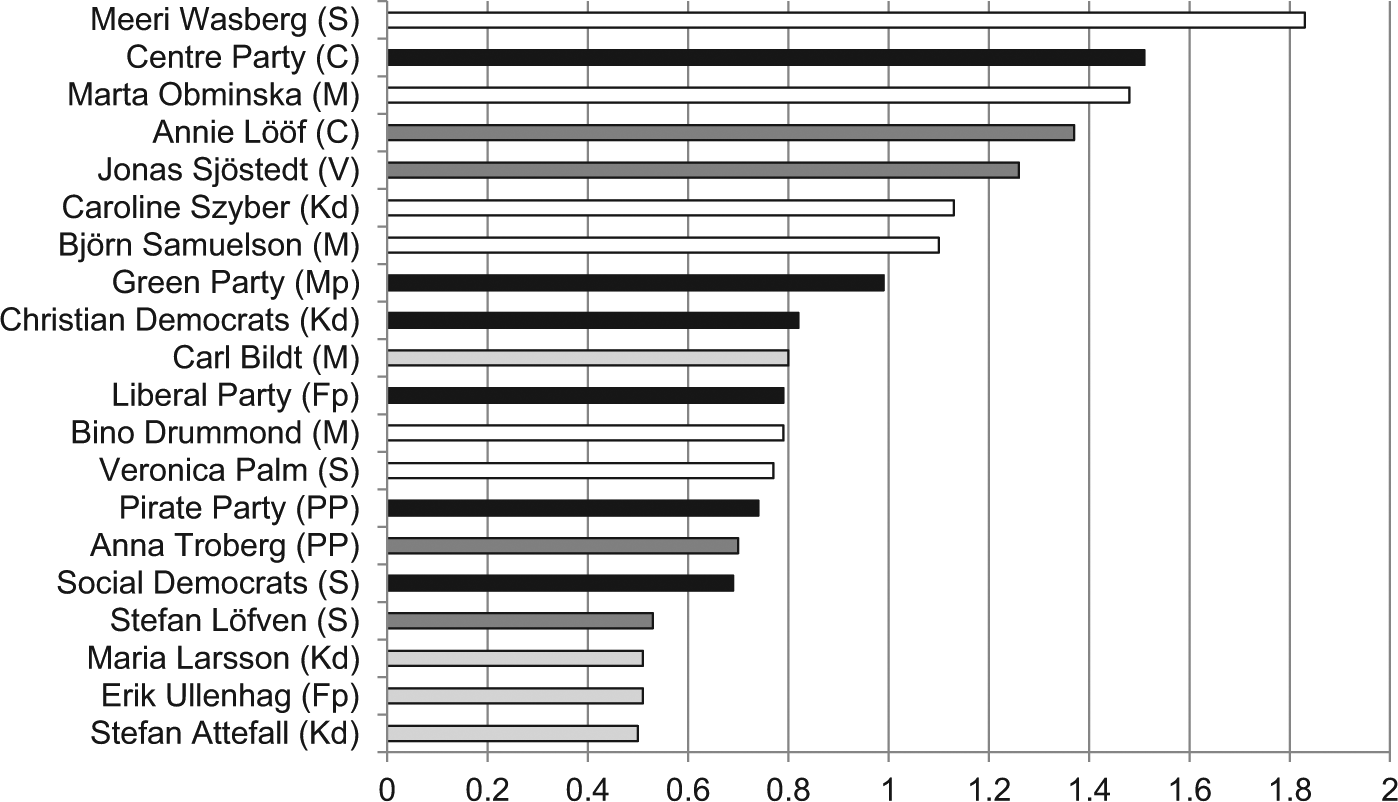
Swedish political actors with a median of posts per day reaching at least 0.5.
Much like for Figures 1 and 2, a color scheme is employed in order to differentiate between the types of actors identified in the bar charts. Black bars represent parties, dark gray bars denote party leaders, light gray bars identify ministers and “celebrity politicians” (e.g. Van Zoonen, 2005), whereas white bars show activity undertaken by members of parliament without specific portfolios or public profiles. Each actor is identified with name and party abbreviation (please refer to Table 1 for key) on the vertical axis, while the horizontal axis features a gauge for the medians measured.
With these guidelines for interpretations in place, we can notice a few differences between the case countries. First, scale size again appears as more far-reaching for the Norwegian case (Figure 3) than for the Swedish (Figure 4), reaching a maximum value of 3 Page posts per day (2 posts per day in Sweden). Moreover, while 29 Norwegian political actors emerge as highly active using our current rationale, the number for the Swedish context is 20. As such, while the differences pertaining to scale might not be as evident as in Figures 1 and 2, this could be interpreted as yet another sign of the suggested “election year effect.”
Second, focusing on Norway, the accumulation of black bars—indicating the activity of political parties—in the top half of Figure 3 suggests the need for parties to mobilize during an election year. While sizeable organizations like the Labour Party and the Conservatives clearly make their mark on Figure 3, we can also discern smaller parties—both those who enjoyed seats in parliament (such as the Socialist Left, Liberal or Center Parties) and those on the outside (such as the Red and Green Parties). As such, Figure 3 shows that while large political actors are making their presence felt, we can also discern representatives of comparably small political actors among these ardent Page users.
Third, if the bars in Figure 3 are slightly tinted toward black and dark gray, indicating the activities of parties and their leaders, a somewhat dissimilar tendency can be discerned when focusing on the Swedish. Specifically, while all Norwegian parties placed themselves in upper part of the corresponding graph, their Swedish equivalents appear dispersed throughout Figure 4. Moreover, while all Norwegian parties made marks in the results, three parties with representation in the Swedish parliament—Left Party, Conservatives, and the Sweden Democrats (Sd)—did not make use of the Pages feature to such a degree. As such, the trends of election year influences are visible also here.
As permanence does not necessarily equal influence, we need to assess the reach of the Facebook Page activities undertaken. For these purposes, we focus on the median shares and likes per post by each actor. As both measurements individually provide insights into the relative popularity of posts, the combination of the two should be helpful in this regard. The results are presented as two scatter graphs—Figure 5 (Norway) and Figure 6 (Sweden).
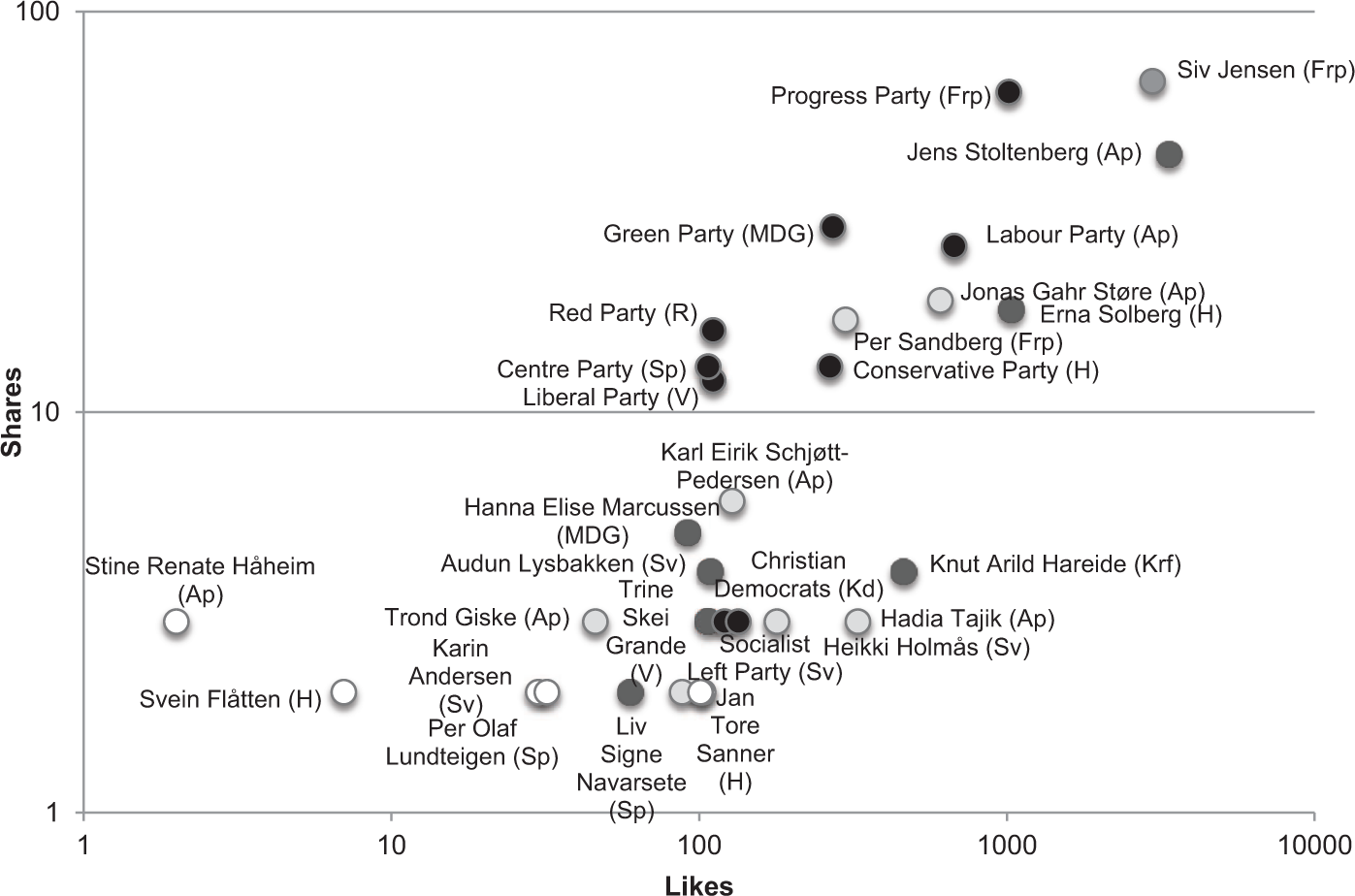
Relationship between median shares (vertical axis) and median likes (horizontal axis) per post for Norwegian Political Facebook Pages. Logarithmic scales are presented.
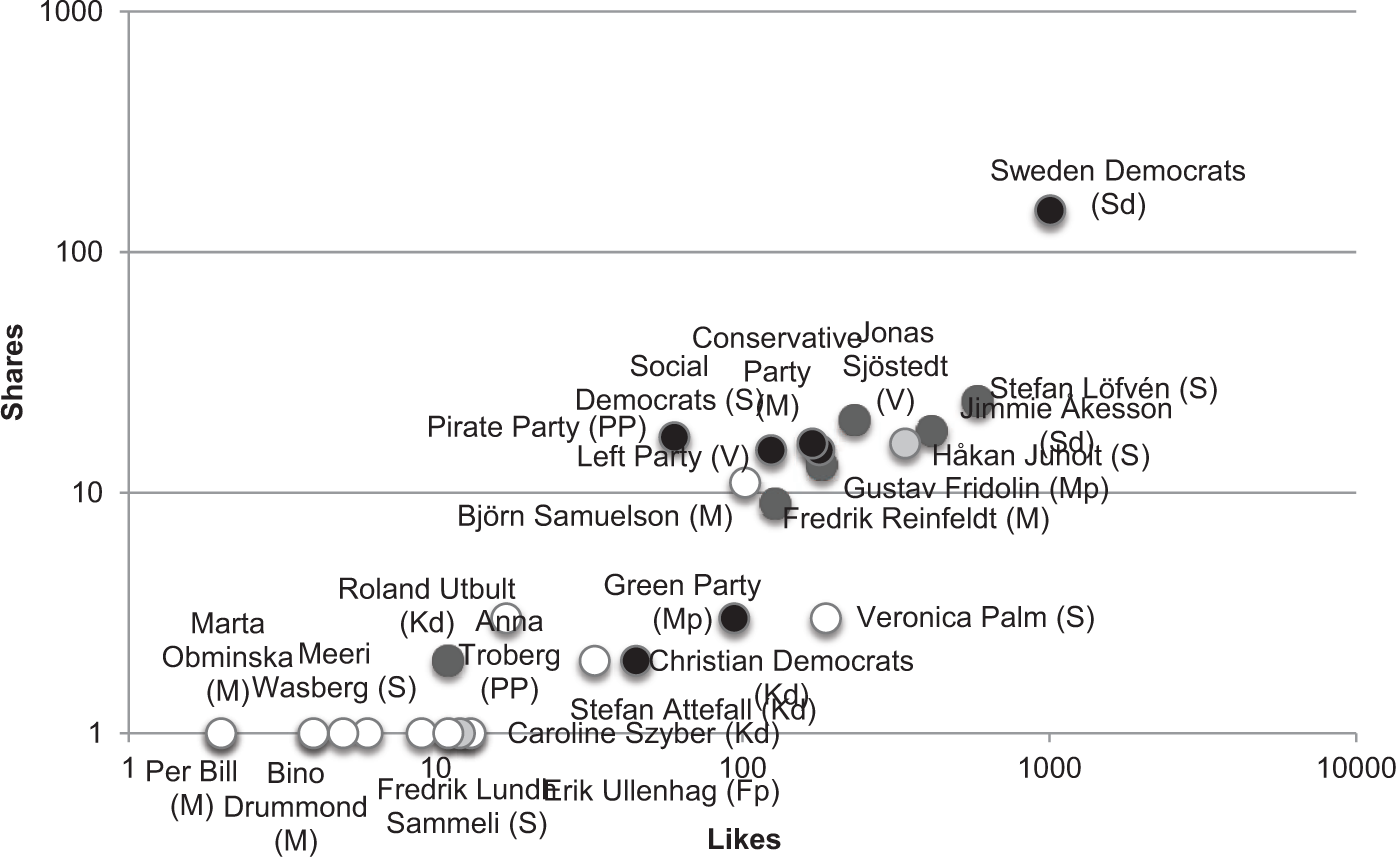
Relationship between median shares (vertical axis) and median likes (horizontal axis) per post for Swedish Political Facebook Pages. Logarithmic scales are presented.
The color scheme used previously is employed also for Figures 5 and 6. Starting with the Norwegian case, Figure 5 finds the node representing the official party account for the right-wing populist Progress Party (Frp)—as well as the node corresponding to their party leader, Siv Jensen—to be among the political actors enjoying the highest medians of likes and shares per Facebook Page posts. While a more rigid evaluation of the contents of the posts made is not possible within the article, Jensen’s most popular posts tend to focus on so-called negative campaigning—critiquing her peers as well as certain media outlets, who she claims misrepresent the agenda championed by herself and her party. The posts made by PM Jens Stoltenberg, who likewise enjoys a sizeable amount of popularity, are typically geared toward more traditional campaigning materials. For example, a staged campaign commercial featuring Stoltenberg as an undercover taxi driver, chit-chatting with unsuspecting passengers, gained an especially large amount of traction in terms of shares and likes.
Moving on, all political party accounts save for two (Socialist Left and Christian Democrats) are positioned above the horizontal dividing line. As for the two parties below the horizontal line, these are both small parties in terms of voter share. This suggested that relationship between ballot recognition and Facebook Page post popularity is perhaps particularly interesting when considering the case of the Socialist Left Party. As shown in Figure 3, their official party account produced the highest yield of Page posts during the studied period, while Figure 5 shows that their reach in terms of Likes and Shares was comparably limited. While party size probably plays a role here, a quick glance at their most popular posts reveals that they can mostly be characterized as providing information on policy issues—perhaps not the type of content most likely to “go viral.” As a small Party, albeit with seats in government and a role as incumbents going into the 2013 elections, the Socialist Left Party appears to have had some difficulty in getting their messages across on Facebook.
This finding on the activities of an incumbent but small party on the left side of the Norwegian political spectrum can be contrasted with the spread that other accounts, operated by somewhat similar parties, appear to have enjoyed. Consider the nodes representing the Green and Red Parties—both without representation in parliament. As visible in Figure 5, these parties appear to have hosted comparably popular Facebook Pages, resulting in corresponding nodes placed in the middle of the figure. Furthermore, both parties seem to have utilized the platform primarily with mobilization in mind—their respective posts largely urge followers to vote green or red, or for them to convince others to do the same. Taken together, this indicates that while party size appears to hold explanatory power regarding the online coverage enjoyed by parties, smaller, non-incumbent parties are indeed able to get their message across on Facebook.
This tendency of comparably popular non-parliamentary parties is discernible also in the Swedish case, as depicted in Figure 6. Consider the node representing the Pirate Party, whose placement in the graph indicates a median of shares per post on par with major parties like the Social Democrats or the Conservatives. The most popular posts made by the two latter parties typically feature quotes from party leaders or comments on various current events. In contrast, the Pirate Party appears as more thematically focused in the postings made, mainly discussing their key issues—such as online integrity and copyright law. The findings that two of the parties in the right-wing coalition governing Sweden (the Liberal Party and the Centre Party) are not present in Figure 6 could be another indication of the previously mentioned election year effect—especially when considering that all Norwegian parties were present as visible in the corresponding figure. With regard to the most popular Facebook Pages, we see another tendency repeated from the Norwegian context. Much like the Frp appears to have produced a series of posts yielding high amounts of both Likes and Shares, so do the right-wing populist Sd seem to enjoy a similar status in the Swedish context. However, when one considers the change in scale on the vertical axis, representing the median of shares per post—0–100 shares for Norway, 0–1000 shares for Sweden—the dominance of the Sd in this regard is further affirmed. With regard to the content, their most shared and liked posts commonly deal with their controversial stance on immigration and suggestions regarding the supposed “Islamization” of Sweden and various Swedish practices. As such, far right parties appear to have succeeded in getting their message across through Facebook in both countries, while this tendency is arguably more affirmed in the Swedish context.
Discussion
The results presented in this exploratory study have provided important insights into how an impending parliamentary election influences the permanence of social media activity at the hands of political actors—and the reach that this activity appears to have among Facebook users. By utilizing a comparative effort between two similar countries—Norway and Sweden—the study has attempted to uncover what has been tentatively labeled as the “election year effect.” While the intricacies of intra-Scandinavian relationships can surely offer up a selection of societal or systemic discrepancies, the argument is made here that the political systems of the two case countries are similar enough to be meaningfully included in a comparative study such as the one presented in this article.
The uncovering of differences and similarities with regard to the permanence of political campaigns can be operationalized in different ways. This study employed a structural quantitative approach, opting for three main modes of structural analyses of patterns of communication presented in Figures 1 to 6. First, for the line graphs presented in Figures 1 and 2, the suggested election effect is discerned as the scale needed to fit the Facebook Page activity undertaken by the smaller Norwegian populace of politicians is double the size of the scale representing the activities of their more plentiful Swedish colleagues. While differing scales were perhaps probable, the difference in size between the two parliaments might have been expected to provide a potential balancing influence. Instead, the members of the smaller Norwegian Stortinget made extensive use of their Facebook Pages when compared to those politicians holding seats in the larger Swedish Riksdag. Furthermore, as pointed out previously, while Figures 1 and 2 do not present comparable data between each identified group in both countries, the shapes of the lines can tell us something about the degree to which Page activity by parties, party leaders, and other politicians is symbiotic—or if it differs in ways that would indicate dissimilar online agendas of different types of actors. Such divergent modes of use must, however, be described as limited. Tendencies from similar studies of Twitter use (e.g. Aragón et al., 2013; Bruns and Burgess, 2011; Larsson and Moe, 2013) are repeated also for Facebook, indicating that political content in the mainstream media produces clearly visible activity “spikes” in the timelines. As suggested by Lilleker and Jackson (2010), such a finding implies that social media services largely take on a role that “reflects and amplifies other events […] rather than start[s] them” (Lilleker and Jackson, 2010: 93). As line patterns are characterized by differing scale sizes between countries, as well as internal resemblance for each country viewed in isolation, this is interpreted as strengthening for the normalization hypothesis with regard to permanence of campaigning. Specifically, the findings presented in Figures 1 and 2 indicate that Facebook activity by political actors can largely be described in terms of “politics as usual” (e.g. Margolis and Resnick, 2000)—the activity appears as closely related to broadcast media programming in general and to preparation for political events (such as the Norwegian elections or the Almedalen week) in particular.
Differing scale sizes again come into play when assessing the bar charts representing highly active political actors presented in Figures 3 and 4, uncovering common characteristics of such zealous users. The color scheme employed suggests a limited tendency for relatively lesser-known politicians to be more active in this regard. Moreover, influences of age can be discerned—comparably younger politicians, such as Mette Hanekamhaug (Norway) and Marta Obminska (Sweden) make use of the service at a level that in some cases parallel party accounts (see also Larsson and Kalsnes, in press). Another trend suggests that smaller political parties make use of their Facebook Pages at levels that sometimes match the activity of more sizeable competitors. Indeed, while representatives from major parties can likely rest assure that mainstream media attention will be directed toward them (e.g. Vergeer and Hermans, 2013), smaller parties can attempt to compensate for their comparably limited access to such media outlets by utilizing online services to higher degrees (e.g. Bruns and Highfield, 2013). In so doing, they would hopefully harness the “new media logic” (e.g. Klinger, 2013)—the successful application of which supposedly results in reinforced ties between parties and presumable voters. For permanence of campaigning, the results presented must be described as mixed—although perhaps slightly geared toward affirmation of the equalization hypothesis, as comparably less established actors appear to be more ardent in their applications of the platform at hand—a finding especially valid, it seems, for the Norwegian context.
The ways in which these activities—be they permanent or not—spread and gain momentum also need to be taken into account. Attempts to assess these qualities as played out on Facebook were presented in Figures 5 and 6. The results suggest that minor parties and actors were not only comparably more ardent in posting to their Facebook Pages—it would also appear that they succeeded in gaining online support as their posts were shared and liked at levels sometimes corresponding to the spread enjoyed by more established political actors. As such, it seems that much like political actors representing minor parties are resolute in using their Facebook presences, so do their supporters make clear efforts to spread the word on the platform at hand. While studies have attempted to relate social media activity by parties with received vote share (e.g. Tumasjan et al., 2010), the findings presented here suggest that these relationships are too complex to be understood in such terms. While minor parties are seeing their messages being spread across Facebook in both countries, this tendency is arguably clearer in the Norwegian context, where both the Red and Green Party, respectively, take their places among those parties enjoying considerable amounts of redistribution.
The popularity of the Norwegian Green Party can be seen as a case in point. Indeed, previous scholarship often suggests that environmentalists took to the web earlier and to higher degrees (e.g. Strandberg, 2009)—perhaps as a result of such parties catering to their mostly “educated and middle class” (Gibson, 2004: 109) voters. While the medians of shares and likes per post by the Swedish Green Party (Mp) as pictured in Figure 6 must be described as limited at best, their Norwegian counterpart (MDG) appears as more popular in Figure 5. However, while the former of these two parties was firmly seated in parliament with a large share of the vote at the time of data collection, the latter did not enjoy such status. As such, the aforementioned suggested influence of party size must not be forgotten.
For both case countries, the parties whose messages enjoy the widest range are the right-wing populist Frp and Sd. As Frp turned out to be part of the right-wing coalition winning the 2013 Norwegian elections, and as Sd enjoy a sizeable share of the Swedish vote, these parties cannot be understood as minor actors. Nevertheless, the activity undertaken by the parties themselves is shown here to be rather restricted. Referring back to Figures 3 and 4, while the activity undertaken by the Frp places them in the middle of the figure, their Swedish counterpart did not make use of their Facebook Page to degrees that would even include them in this display. Nevertheless, the comparably few posts made by these parties—especially the Sd—appear as among the most popular ones in the results presented in Figures 5 and 6. While the design of this study does not allow for any qualitative analyses as to why these comparably controversial parties enjoy such immense popularity on Facebook, a tentative starting point from which to investigate further could be the positioning of both parties in their respective political context. While the previously discussed smaller parties could be described as marginalized in terms of size, these two populist right-wing parties could be seen as marginalized in terms of being proponents of stigmatized ideology. The policy issues favored by both parties often challenge the popular consensus held around matters of immigration, foreign policy, and the rights of religious minorities. With no other apparent similarities at hand, the results presented here suggest that marginalization of different kinds would lead to a highly active voter base. While political actors who are in some way marginalized might not be among the more permanent users of Facebook, they appear as comparably more successful in having their posts redistributed throughout Facebook than their more established or mainstream counterparts.
In sum, then, it would seem that while the longitudinal distribution of Facebook posts largely corresponds to the curriculum set by the mass media and the “congressional calendar” (Golbeck et al., 2010), detailing the actual users—and their apparent supporters—behind these time-spanning data paints a more detailed picture. While the methods employed for data collection and analysis employed in this article can provide a structural overview of Facebook Page use at the hands of politicians, this article suffers from two main limitations that need to be duly addressed. First, the utilized design does not allow for insights regarding the contents of the Pages studied. As this article provides “the bigger picture” of events like these, future studies might find it useful to employ a variety of qualitative methods in order to provide researchers and practitioners alike with richer insights into the uses of social media for permanent—or maybe not so permanent—campaign efforts. Second, as already mentioned, the inner workings of the Facebook platform need to be assessed more clearly in relation to how content is shown differently for different users. For example, the ever-changing popularity of the pages themselves could be expected to have influence over the degree to which certain posts are made visible on the timelines of platform users. As such, while the “snapshot” design of the study at hand could prove useful for comparative efforts with future elections, a focus on the algorithms guiding Facebook content flows could also be feasible.
Footnotes
Funding
This research received no specific grant from any funding agency in the public, commercial, or not-for-profit sectors.