




Abstract
This article investigates the daily travelling practices that are related to mobile-only, fixed-only and combined mobile/fixed use of the Internet, and the social differentiations that are related to these three ways of accessing the Internet. Survey data (N = 612) collected from Finland in 2011 are analysed. The article shows that mobile-only Internet use is not associated with particularly diverse or frequent daily travelling practices, whereas combined mobile/fixed use is. Mobile-only Internet users are, in fact, in a relatively disadvantaged position – compared with other users, they are more typically unemployed and their household income is lower. The mobility of Internet access as such does not guarantee a safe social position in society. Mobile Internet use must be complemented with fixed use, which brings about more versatile and frequent travelling. The finding suggests that the ‘mobile-rich get richer’ when it comes to Internet use and daily travelling practices.
Introduction
Among the key affordances of the Internet are that it enables physical distances to be overcome and is increasingly mobile (Wellman et al., 2003). However, it is only recently that the Internet has become truly portable. First of all, the mobility of the Internet has followed from the spread of the mobile phone, under the auspices of which mobile Internet connections have evolved and spread rapidly (Fortunati and Contarello, 2002; Fortunati and Taipale, 2014). In particular, the smartphone has transformed the use of Internet by making the Internet available to people on the move. Despite this great affordance of mobility, studies from Finland and other European countries indicate that a majority of smartphone users utilize only a small number of the functions on their smartphones (Fortunati and Taipale, 2014; Sell et al., 2012). The Internet-enabled smartphone is clearly an under-utilized multi-functional device. Second, separate mobile solutions, such as USB data sticks, SIM card slots in laptops and tablet personal computers (PCs) have added substantially to the portability of the Internet. This category of solutions also includes Wi-Fi hotspots, which allow access to the Internet when 3G or 4G networks are not available or roaming costs are high.
The main research problem of this study pertains to these latter ways of connecting to the Internet. The study investigates how mobile-only Internet use, when compared with fixed-only and combined mobile/fixed Internet use, is related to daily travelling practices. Furthermore, the study clarifies the type of social differentiations that are related to these three ways of accessing the Internet. The rationale for this study design is based on two key observations. First, although there are a few studies on Internet use based on mobile phones (e.g. Brown et al., 2013; Cheong and Park, 2005; Donner et al., 2001; Okazaki, 2006), it is still unclear how people use other mobile ways (e.g. USB data sticks) for connecting to the Internet, and how such use is socially differentiated when compared with the use of fixed Internet connections. Second, it is also unclear whether or not different methods of accessing the Internet are differently intertwined with people’s travelling practices. In this study, travelling practices are defined as forms of daily spatial mobility. By daily spatial mobility, Kellerman (2012) means two-way movement (e.g. journeys to and from work, school or shopping), rather than one-way movement (e.g. change of residence), that takes place regularly (so this does not include, for examples, vacation journeys). Ordinary means of transportation, such as cars, buses, trains and walking, are typically used for daily spatial mobility. Such ordinary two-way forms of travelling are central to this study, which exploits a sociological theory of mobilities, as presented by Urry (2000, 2007), to have a good grasp of the research problem.
In this article, Finland serves as an example country for investigating whether mobilities, both various forms of Internet connection and daily travelling practices, accumulate and reflect social differentiations between various socio-economic groups. The study by DiMaggio et al. (2004) suggests that such socio-economic differences represent constraints that are reflected in the use of digital devices (as well as in travelling practices) in developed countries and elsewhere. Previous similar studies consider countries such as Armenia (Pearce and Rice, 2013) and the United States (Brown et al., 2013; Smith, 2012), while Finland represents a quite different country context. Finland has a high level of gender equality and a relatively homogeneous population structure (e.g. in terms of religion, race and language minorities), and its income differences are relatively low. Although income equality has recently shown signs of growth, the redistributive tax and welfare system has remained effective in maintaining a good material living standard across the social strata (Organisation for Economic Co-operation and Development [OECD], 2010). Previous studies on the adoption and use of new information and communication technologies (ICTs) in Finland have also reflected these relatively small inequalities, as will be demonstrated later in this article.
It is against this backdrop that this article aims, first, to outline how different modes of physical travelling are related to (1) mobile-only, (2) fixed-only and (3) combined mobile/fixed Internet use. Second, the study aims to clarify whether these three methods of connecting to the Internet are socially differentiated in Finland. In fact, while the adoption of the Internet in general has received much scientific attention (e.g. Kiiski and Pohjola, 2002; Rice and Katz, 2003), the adoption of mobile Internet use in particular has largely been investigated (1) separately from fixed Internet use and (2) by focusing on cognitive motivations for adoption rather than socio-economic factors (e.g. Kim and Garrison, 2009; Shin 2007). The most relevant studies on social differentiation, in which different ways of connecting to the Internet are studied side by side, have chiefly focused on teenagers as a special group of Internet users (Brown et al., 2013), and on developing countries (Pearce and Rice, 2013). Considering these limitations of previous studies, this study adds to the body of literature by investigating nationally representative survey data (N = 612) drawn from Finland in 2011.
The rest of the article is organized as follows. First, theoretical starting points for the study will be presented. Then the article will show how previous studies have addressed the relationship between travelling practices and Internet use, as well as social differentiations concerning these mobilities. Based on these considerations, hypotheses will be defined for the study. The data and methods will be introduced to the reader before the results are presented. The article will end with discussion and conclusions.
Literature
Mobilities theory
This study is grounded on the mobilities paradigm, largely formulated by the British sociologist John Urry (2000, 2007). This paradigm underlines the fact that the ‘social’ is not constituted only by dense, bodily, face-to-face interactions, but that travelling and communication technologies also function as cement, binding together people who live apart. The paradigm claims that different mobilities are tightly interconnected and interdependent (Büscher and Urry, 2009: 102). Five mobility categories are typically presented: (1) physical travelling of people, (2) physical movement of objects, (3) imaginative mobility (e.g. movement of images and ideas through means such as television, radio and newspapers), (4) virtual mobility (real-time communication through the Internet) and (5) person-to-person communication (e.g. through emails, mobile phones, letters etc.). (For more background, see, for example, Larsen et al., 2006: 47–48; Urry, 2007).
Mobility scholars also argue that a wide and diverse arsenal of mobility tools is a key asset in a modern networked life. Mobility tools contribute to the building of one’s networking capacity, or so-called network capital (Elliot and Urry, 2010; Quan-Haase et al., 2002; Wellman and Frank, 2001). At times, network capital has been viewed as a variant of social capital, which emphasizes the role of personalized social networks that are based on person-to-person communication (e.g. Quan-Haase et al., 2002; Wellman, 2001; Wellman and Frank, 2001). At the same time, the literature from previous research is clearly insufficient in terms of understanding how different ways of accessing the Internet (e.g. mobile, fixed and combined) are connected to travelling practices, and what kind of social inequalities are related to the different methods of accessing the Internet (Taipale, 2014). This inadequacy is partly due to the qualitative and ethnographic methodologies widely applied in mobility research, which have stressed the need for researchers to follow and study movement up close (Büscher and Urry, 2009: 111–112), without also underlining the need for a systematic and statistical modelling of the relationships between the various forms of mobility.
One way of understanding mobility-related inequalities is the Matthew effect approach. The concept was originally used by Merton (1968), who argued that in science an eminent scholar gains more credit than a comparatively younger researcher, even if their contributions to science are basically the same. In a similar vein, Internet scholars have argued that the Internet stimulates more usage among those with greater resources, skills and know-how, whereas those whose resources are scarcer benefit less (e.g. Chen and Wellman, 2005: 533; Pearce and Rice, 2013: 722). According to this theory, mobile-rich people thus get richer and those with fewer mobility tools and less networking capital remain disadvantaged (Hampton, 2010; Hargittai, 2003; Helsper, 2012). Among mobility scholars, this virtuous circle of mobilities is also acknowledged. For instance, Urry (2007) writes that ‘There are then positive feedback mechanisms whereby the network rich get richer and the network poor poorer, so producing greater social inequalities between people’ (p. 231). Nevertheless, attempts to model statistically whether or not physical and digital means of mobility tend to accumulate for some individuals have so far remained rare.
The interconnections between travelling and Internet use
Before the Internet, many communication technologies, such as the television and the landline phone, had already occasionally been considered threats to travelling and meeting other people in person (e.g. Putnam, 2000). When the Internet was introduced, it was perceived as a vehicle to reduce travelling and travel-related risks, as it made it possible to experience life at-a-distance (cf. Castells, 2001: 235; Gillespie and Richardson, 2000). Concerns were raised that mobile communication technologies would replace traditional forms of social interaction with others and make travelling redundant (Gergen, 2008: 301–302). Empirical research has, however, provided scant support for these views. It has been argued, for instance, that Internet use may lead to less use of traditional media but that Internet usage does not influence the amount of time spent on social activities (Peng and Zhu, 2011). Others have firmly argued that Internet use adds to socializing and travelling (Ishii, 2006; Wellman, 2001; Wellman et al., 2003).
In reality, the relationship between the Internet and travelling is complex. As Mokhtarian (2009) argues, it is difficult to improve the Internet to reduce physical travelling without using the same technology to increase travelling and make it a more pleasurable experience. In fact, studies from North America point out that Internet use complements face-to-face interaction rather than functions as a substitute for it (Koku et al., 2001). Mok et al. (2010) have also reported that the frequency of face-to-face contacts did not really change from the 1970s until the first decade of the 21st century, and that encountering others still entails physical travelling. Fortunati et al. (2013) have found that, while the use of the mobile phone was connected to face-to-face (or body-to-body; see Fortunati, 2005) sociability in Europe towards the end of the 1990s, by 2010, it was mainly the Internet that was related to sociability. This indicates that technologies that support meetings in person change over time. All in all, the literature shows that the Internet promotes rather than reduces personal interactions.
Mobile communication studies have shown results similar to those concerning the Internet: mobile communication either has a neutral effect on physical travelling or it modifies travelling patterns and routes. For example, Ling and Haddon (2003) show that, while calls made via fixed phone lines caused car trips to increase in number rather than to decrease in number or be modified, calls from mobile phones have a more balanced outcome. The effect of mobile calls was evenly balanced between causing, preventing and changing car trips. In the same spirit, Ling and Donner (2009) later argued that mobile communication technologies increase the efficacy of travelling by enabling a flexible coordination of travel-related issues. In Sweden, Thulin and Vilhelmson (2007) found that people who frequently use a mobile phone also travel and socialize with other people face to face more often than those who use a mobile phone less frequently. However, all these studies have focused on mobile phone use. Other devices that enable one to access the Internet on the move have not been studied so thoroughly.
Based on the key theoretical proposition of mobility researchers and on the above review of the somewhat diverse previous findings, the first three research hypotheses for the study are defined. Using the theoretical idea of the Matthew effect, the following hypotheses are framed to test whether the ways and amount of travelling gradually increase as the ways of accessing the Internet become more mobile (the shift from fixed-only to mobile-only) and numerous (the shift from mobile-only to combined mobile/fixed use of the Internet).
Hypothesis 1 (H1). Fixed-only Internet use is associated with the least diverse and frequent physical travelling practices.
H2. Mobile-only Internet use is connected with relatively diverse and frequent physical travelling practices.
H3. Combined mobile/fixed Internet use is associated with the most diverse physical travelling practices.
Social differentiation and Internet usage
The second aim of the study is geared toward analysing whether or not ways of accessing the Internet are socially differentiated in Finland and, if so, whether the differentiations can be understood using the idea of the Matthew effect. Two main lines of research can be identified from previous studies that have analysed the socially differentiated use of the Internet by statistical means. First, the adoption and non-adoption of the Internet have been investigated with the purpose of understanding digital gaps within and between countries. The diffusion theories (e.g. Rogers, 1983) and uses and gratification theories (e.g. Katz et al., 1973–1974) have been widely applied in these inquiries. Gaps have been detected in relation to both technology adoption and patterns of use (e.g. Brown et al., 2013; Hargittai, 2003; Katz and Rice, 2002; Pearce and Rice, 2013; Rice and Katz, 2003). Although these studies on the socially differentiated use of the Internet have provided many important results, they have not elaborated on the different ways in which different Internet users access the Internet.
Second, the Technology Acceptance Model (TAM) and similar approaches have been employed to understand the take-up of the Internet, both wired and wireless (e.g. Cheong and Park, 2005; Kim and Garrison, 2009; Shin, 2007). These studies have in common that they reduce Internet adoption to the level of cognitive processes. Internet adoption is measured by using indicators such as perceived usefulness, perceived ease of use and behavioural intentions towards the technology being studied. Some studies have extended the TAM to cover predictors that are seen as peculiar to mobile Internet use (e.g. perceived access barriers, Portera and Donthub, 2006), perceived ubiquity and perceived reachability (Kim and Garrison, 2009) and cognitive absorption (Saad and Bahli, 2005). All in all, TAM research has made only a little effort to comprehend the role of socio-demographics in the adoption of wireless communication technologies.
The TAM directs the focus of research to the motivational aspects of adoption, not to actual use. As such, the TAM clearly serves the purposes of consumer and business studies, which provide information on the appropriate targets for new technologies and services when they are introduced to the market. The limits of this approach become evident when the technology under investigation becomes extremely widespread, which is the case for Internet use in many countries. For example, in Finland the use of the Internet could only increase among people aged 65–74 years between 2011 and 2012 (Statistics Finland, 2012). For this reason, it makes increasingly good sense to explore how the actual patterns of Internet use are differentiated among users and, as this study does, to analyse more specifically whether modes of accessing the Internet differentiate users and their travelling practices.
In fact, there is increasing awareness that social differentiation, which ultimately means either social inclusion or social exclusion, also includes ‘spatial’ and ‘mobility’ aspects (Cass et al., 2005; Kenyon et al., 2002). There are thus good reasons to think that the portability of the Internet could also be a socially differentiating factor. As the core functions of social life (family, work, leisure time, etc.) are spatially dispersed in today’s industrialized societies, accessing a variety of activities, goods and social relationships progressively takes place through communication technologies, such as the Internet. If people are categorically excluded from these new means of mobility, they face the risk of becoming socially excluded. Hence, it is important to have a better understanding of whether the digital exclusion that follows from the rich-get-richer cycle (the Matthew effect) reflects offline exclusion and restricts physical travelling (Helsper, 2012).
Studies from the United States show that mobile devices are increasingly used to access the Internet, yet they still clearly differentiate between socio-demographic groups of people. More than half of all Americans (55%) reported that they had used a mobile phone to access the Internet in 2012 (Smith, 2012). Of these people, 31% had used their mobile phones as the primary way of accessing the Internet. Brown et al. (2013) have further argued that US teenagers living in low-income families use their mobile phones for accessing the Internet more frequently than their more affluent counterparts. For these teenagers, mobile Internet access offers a way to bridge a ‘digital gap’ even if their financial resources are constrained (see also Donner et al., 2001). In Brown et al.’s (2013) study, however, only mobile Internet users were investigated, and they were not compared with other groups of Internet users. The study by Pearce and Rice (2013) is one of the few that makes comparisons between mobile-based and fixed PC-based Internet users. These authors found that Armenians who mostly use a mobile phone to access the Internet are younger than those using a PC or both a PC and a mobile phone to access the Internet. Armenian PC-based and combined mobile/PC-based Internet users were more likely to have higher education, to have better economic standing and to live in towns than mobile Internet users.
In Finland, only a handful of studies have tried to investigate social differentiations in accessing and using ICTs. The studies carried out show that socio-economic differences concerning ICT evened out between 1999 and 2004 (Räsänen, 2008). The statistics show that there is no longer any room for growth in Internet use as a whole in Finland (Statistics Finland, 2012). This finding indicates that accessing the Internet by the most common means, such as dial up, asymmetric digital subscriber line (ADSL) or cable, which allow the fixed use of the Internet, is perhaps no longer socially differentiated in Finland. Based on this knowledge, the following hypothesis is defined for the study:
H4. Fixed-only Internet users are found evenly in all different socio-demographic groups.
Accessing the Internet using mobile phones and other mobile devices (e.g. laptops and tablet computers) is rapidly increasing in Finland, in the same way as in the United States (e.g. Smith, 2012). According to Statistics Finland (2012), men more than women, and those under 45 years of age more than older people, use mobile Internet access in Finland. Taipale (2014) has shown that the use of small transportable digital tools in Finland is associated with male gender, young age and being a student, whereas income is not a predicting factor and area of residence (whether urban or not) is only a predicting factor to a small extent. More generally, there is evidence that between 1999 and 2004, income and education lost their predictive capacity in Finland for the perceived importance of mobile phones, PCs, and the Internet (Räsänen, 2008). This can be explained by looking at the reduction in the prices of new technologies, but is also likely to relate to the relatively small income inequality and high material living standard of Finland compared to other countries worldwide (OECD, 2010). This overall picture contrasts with recent studies from Armenia and the United States in which it was found that mobile use of the Internet is related to low income (Brown et al., 2013; Pearce and Rice, 2013). Based on this country-specific knowledge, the following hypothesis can be defined:
H5. Mobile-only Internet use is related to male gender, young age and being a student, while other socio-economic factors are weakly connected or not connected at all.
Due to the lack of knowledge about the number of Internet connections in Finland, the last hypothesis is the most difficult to formulate. Although the use of basic new ICT is no longer strongly related to income, official statistics show that the total number of Internet connections has increased along with household income in Finland (Statistics Finland, 2013). Nevertheless, people living in the region of the capital have, on average, more Internet connections (three or more) than people living in other major cities, towns and villages. There is also evidence that the accumulation of Internet-related technologies in Finland, such as the parallel use of an Internet connection and an additional wireless network in the home, is related to high income and to living in an urban area (Statistics Finland, 2012). Thus, the following hypothesis is defined:
H6. The combined mobile/fixed use of the Internet is associated with high income and urban places of residence, while other socio-economic factors are weakly connected or not connected at all.
Finally, the ways of connecting to the Internet are not only related to demographic or socio-economic factors. A mobile and a fixed connection also have different affordances, such as functions, attributes and physical properties, that affect their usability. Pearce and Rice (2013) show that, while PC-based Internet allows a larger display and a complete keyboard, mobile-based Internet might require more compromises in terms of usability and functionality. The affordance of mobility is the most evident. While a fixed Internet connection allows mobility only at the communicative level, a mobile Internet connection also means that the device is portable. The advantages of mobile Internet connections have also affected their popularity (Finnish Communication Regulatory Authority, 2013). In Finland, the number of mobile Internet subscriptions first exceeded the number of fixed subscriptions in around 2011 (FinCom, 2014).
Data and methods
Data
The data (N = 612) were collected in Finland in May and June 2011, using a structured postal survey. The Population Register Centre of Finland carried out the nationally representative sampling. The sampling frame consisted of Finnish-speaking citizens aged between 15 and 65 years. The survey was pre-tested with 10 individuals. The data were weighted to correct for the skewed gender and age distributions that resulted from the higher non-response rates of men aged between 25 and 34 years and women aged between 35 and 44 years when compared with other groups. A response rate of 24.4% was reached without reminders. The subsample of Internet users (n = 475) drawn from these data was used in the analysis. The design of the questionnaire benefited mainly from two earlier survey studies, the first conducted in five European countries (Fortunati, 1998) and the second in the United States (Department of Communication Studies, University of Michigan, 2006).
Measurements
The dependent variable indicating the way a respondent accessed the Internet was based on the following question: ‘Which of the following do you use at least sometimes to connect to the Internet from home?’ The answer choices were (1) fixed broadband (ADSL, cable, fibre, etc.), (2) mobile Internet connection (USB data stick, etc.) and (3) dial up. The answers were then recoded into (1) mobile-only (n = 87, 18.3%), (2) fixed-only (n = 231, 48.6%) and (3) combined mobile/fixed (n = 158, 33.3%) Internet use.
Independent variables measuring daily travelling practices were derived from the question: ‘How often do you use the following types of transport for any kind of journey?’ (Stradling, 2003). The following modalities were presented: car driver, car passenger, motorbike, bus, train, taxi, bicycle and on foot (at least 10 minutes). The answer choices were (1) most days, (2) once or twice a week, (3) about once a fortnight, (4) about once a month, (5) several times a year, (6) about once a year or less and (7) never. The answer choices were recoded into two: ‘at least once or twice a week’ (answer choices 1 and 2) and ‘less frequently’ (choices 3–7).
Socio-demographic variables were chosen according to the relevance shown by previous research. Gender was measured with fixed categories, ‘Male’ and ‘Female’. Age was determined by asking for the respondent’s year of birth. Years were recoded into three categories (17 years or under; 18–44 years; and 45+ years) to ensure a sufficient number of responses in each category. Education level was measured by using the International Standard Classification of Education of 1997 (ISCED). Three categories were constructed for the study: low (ISCED levels 1–2), middle (ISCED levels 3, 4 and 5b) and high education (ISCED levels 5a and 6). The indicator for main economic activity included the following answer choices: employee, housewife/husband, unemployed, pensioner and student. The level of urbanization was measured through the respondents’ estimate of the size of the place in which they lived. Three distinct categories were created, as outlined by the OECD: essentially rural (less than 5000 inhabitants), relatively rural (5001–100,000 inhabitants) and essentially urban (more than 100,000 inhabitants). Annual household income was measured by eight answer categories ranging from ‘Less than 20,000 Euros’ to ‘More than 80,000 Euros’.
Methods
Both descriptive and multivariate statistics are employed. The socio-demographic profiles of Internet users and their travelling practices are explored by using cross-tabulations with the chi-squared test and analysis of variance (ANOVA). Logistic regression analyses (LRAs) are used to test how daily travelling practices and socio-demographic factors are associated with the different ways of accessing the Internet. Nagelkerke statistics are applied to identify the overall proportion of the variance explained by the model, and the total percentages of correctly predicted cases are supplied (Tabachnick and Fidell, 2007: 459–461, 491).
Results
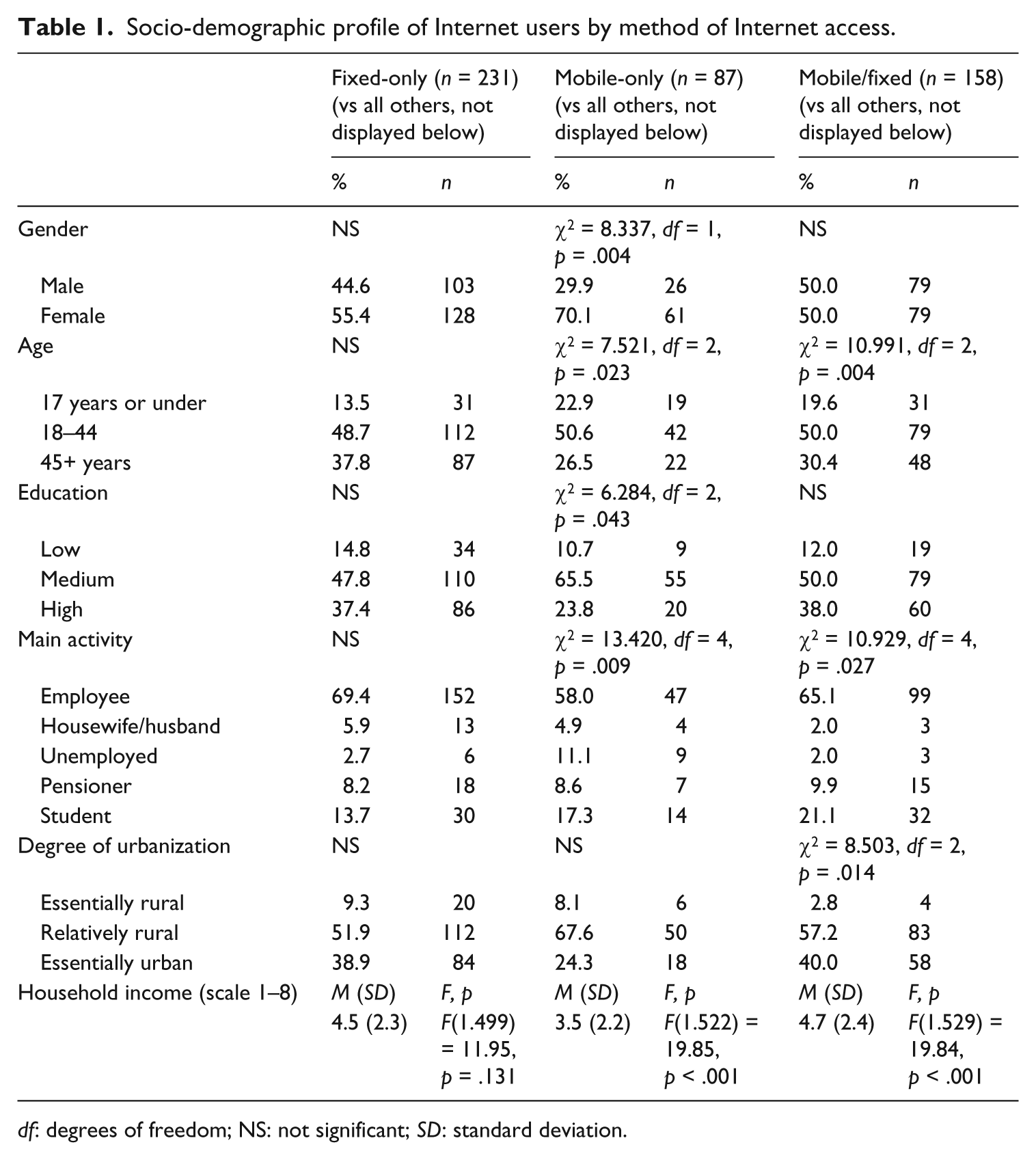
This section begins with descriptions of the main characteristics of mobile-only, fixed-only and combined mobile/fixed Internet users. In Table 1, each of these Internet user groups is compared with ‘All other users’, one at a time (descriptive statistics for ‘All other users’ are not presented in Tables 1 and 2). Table 1 shows that people who access the Internet via fixed means only do not differ from other Internet users regarding any of the studied characteristics. By contrast, the group of mobile-only Internet users contains a higher proportion of women (70.1%) and a lower proportion of men (29.9%) than other Internet users. Mobile-only Internet users more often have a medium level education, and are more typically unemployed than other Internet users. The average household income of mobile-only Internet users is also lower than the average income of other Internet users. Regarding the background characteristics of those who access the Internet by means of both fixed and mobile connections, Table 1 shows that they are often young and students. It is characteristic of these Internet users that they live in essentially urban areas and in households with high income.
Socio-demographic profile of Internet users by method of Internet access.
df: degrees of freedom; NS: not significant; SD: standard deviation.
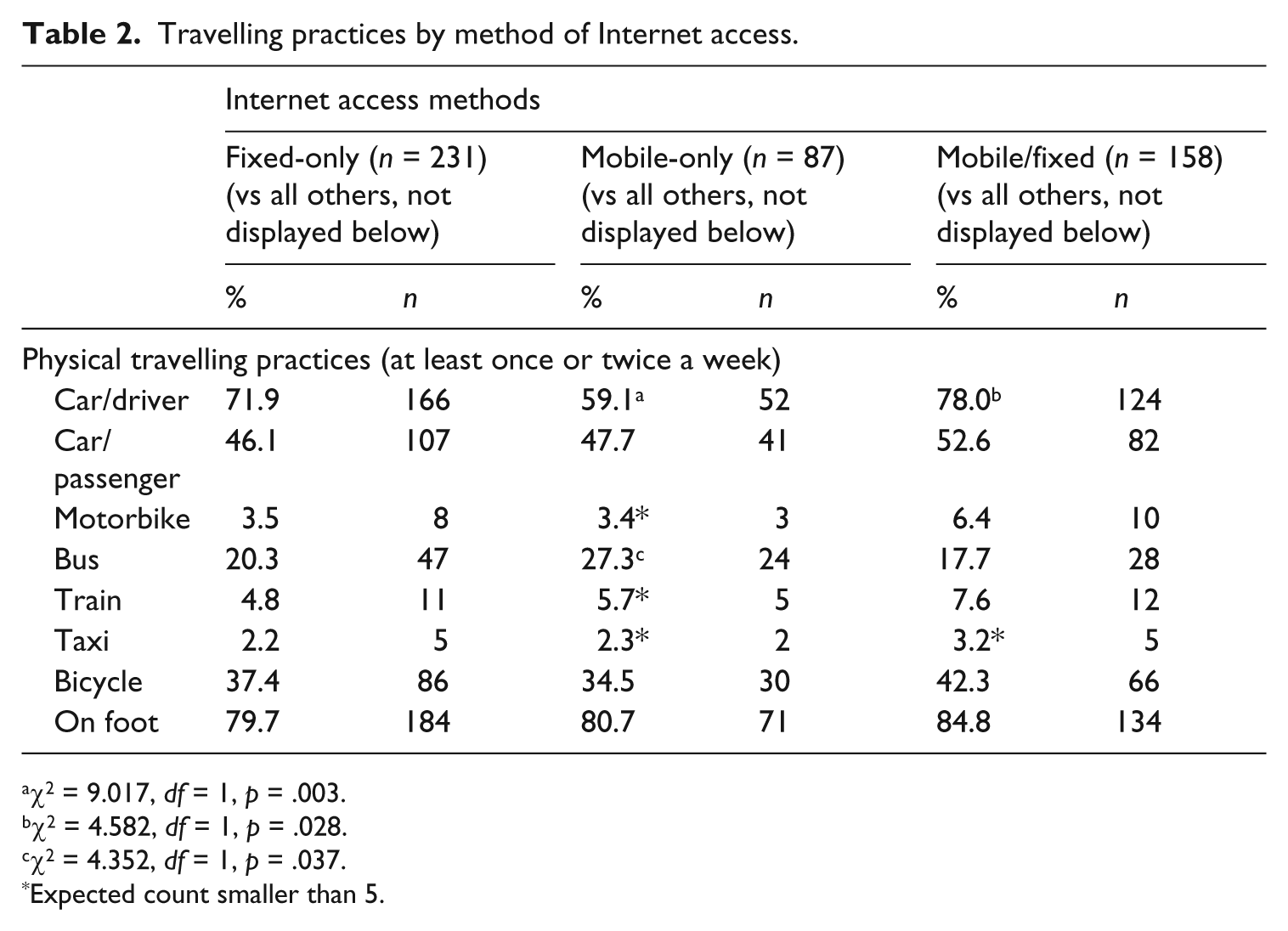
Travelling practices by method of Internet access.
χ2 = 9.017, df = 1, p = .003.
χ2 = 4.582, df = 1, p = .028.
χ2 = 4.352, df = 1, p = .037.
Expected count smaller than 5.
Table 2 presents descriptive information on how frequently and by what means Internet users, using the different ways of accessing the Internet, travel physically. Again, fixed-only Internet users do not statistically differ from other users with regard to any of the studied means of transport. Mobile-only users, on the other hand, drive a car less frequently and use the bus more regularly than other users. Those who access the Internet by using both wireless and wired connections can be labelled private motorists. More than three-quarters of these Internet users drive a car at least once or twice a week. Some travelling practices are so infrequent among these three categories of Internet users that they must be dropped from further multivariate analyses. These cells are marked with asterisks in Table 2.
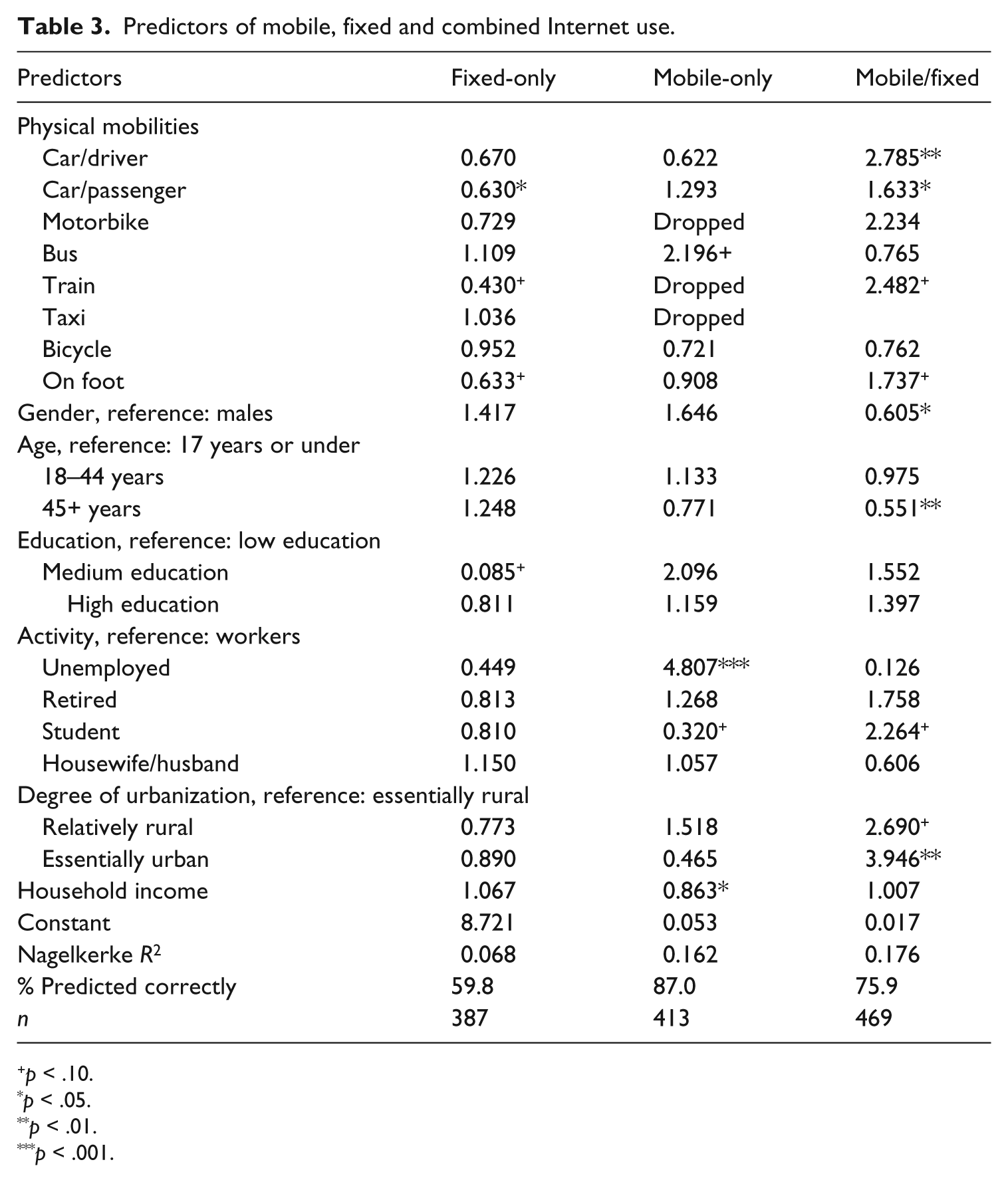
After this descriptive analysis, three logistic regression models were executed to test the hypotheses. The models are presented in Table 3. The predictors of travelling with small frequencies were dropped from the analysis. Nagelkerke R2 for the fixed-only Internet use model was .068, indicating that the model explains only a small part of the total variance. The same R2 for the mobile-only method was .126, and for the mixed Internet access method it was .176. The percentages of correctly predicted cases were 60%, 87% and 76%, respectively.
Predictors of mobile, fixed and combined Internet use.
p < .10.
p < .05.
p < .01.
p < .001.
The analysis does not provide support for H1, which claims that fixed-only Internet use is associated with the least diverse and least frequent physical travelling practices. Fixed-only users do not differ from others, except that they are less frequently car passengers. The statistical model also hints that they are likely to walk and travel by train less frequently than others, but these findings are significant only at the .10 level. In addition, the model for mobile-only Internet users does not provide support for H2, that mobile-only Internet use would be connected to relatively diverse and frequent physical travelling practices. The only mode of travelling that is used more frequently by mobile-only users compared with other users is the bus, but this is also significant only at the .10 level. Hence, this hypothesis is also rejected.
H3 posited that people who access the Internet using both mobile and fixed connections would also have more diverse and frequent travelling practices. The right-hand column of Table 1 reveals that this hypothesis can be confirmed. These Internet users not only drive a car and travel as a car passenger more often than others, but they also travel by train and walk more habitually than all other users. As this finding reveals, the strong accumulation of mobilities for those who use both mobile and fixed ways of connecting the Internet, it also provides support for the Matthew effect of mobilities.
Hypotheses H4, H5 and H6 addressed the issue of social differentiation in ways of accessing the Internet. The analysis provides strong support for H4, which proposed that fixed-only Internet users include people evenly from all socio-economic groups. There is no social differentiation between fixed-only and other Internet users as far as the socio-demographic variables used in this research are considered. Thus, H4 can be accepted. H5 proposed that mobile-only Internet users would be male, young and students, which would be a sign of more notable social differentiations in Internet access. In this respect, the results are somewhat counter-intuitive. First, in this model, gender is not a significant predictor, indicating no statistically significant gender differences. Previous research indicates that the gendered patterns of mobile communication technology use may relate more to differences between various family types and woman’s role within these families (Fortunati and Taipale, 2012). Second, young age is also not connected with mobile-only use, and mobile-only users are less likely to be students than to be employed. Instead, the analysis shows that mobile-only users are 4.8 times more likely to be unemployed than to be workers (being a worker serves as a reference category in the model). Third, what was less expected is that mobile-only users live in families with a lower household income than those who access the Internet by using other methods. H5 is thus rejected.
H6 suggested that people accessing the Internet through both a mobile and a fixed connection have a higher income and live in urban areas, and are hence in a relatively secure position in society. The regression analysis clearly confirms only that the combined mobile/fixed Internet users live in essentially urban areas, while income is not associated with this combined method of accessing the Internet. In addition, the analysis shows that the combined mobile/fixed Internet users could be more typically men than women, as well as more commonly 17 years of age or under 45 years of age or older. It follows from this that they are also more typically students than employees. H6 is thus only partly confirmed. The combined mobile/fixed Internet users are perhaps not wealthy and in a secure social position in classical terms, but they can be considered among the new vanguard of mobile-rich people (Fortunati and Taipale, 2014).
Discussion and conclusion
The aim of this study was to investigate, first, which daily travelling practices are related to mobile-only, fixed-only and combined mobile/fixed use of the Internet, and second, what kinds of social differentiations are related to these three methods of accessing the Internet.
Regarding the first aim, the results clearly show that the modes of physical travelling used are no more diverse among mobile-only Internet users than they are among fixed-only Internet users, although the theory of mobilities would suggest that the portability afforded by a mobile Internet connection should be reflected in a more lively and mobile lifestyle. In fact, these two methods of accessing the Internet are not strongly intertwined with any of the forms of daily travel in the study. More interestingly, the results reveal that it is only when mobile Internet use is combined with use from fixed locations that people begin to utilize multiple modes of physical travelling. This suggests that it is the combined mobile/fixed Internet use, not the use of mobile Internet alone, that adds to widely interconnected and complex mobility systems and network capital. This interconnectedness thesis is a much-discussed topic in the theoretical and qualitative literature (e.g. Elliot and Urry, 2010; Urry, 2002, 2007), and this result provides support for it by utilizing nationally representative quantitative data.
The same results also make apparent the Matthew effect of mobilities. While mobile-only Internet use as such is not enough to translate into a mobile-rich lifestyle, when taken together with the use of fixed Internet access, it facilitates mobile ways in everyday life. Although this study cannot provide one solid explanation for this observation, one answer might deal with the different affordances of fixed and mobile Internet use. A fixed connection is usually faster and more reliable, and such Internet use is also typically supported by hardware with a higher specification, such as a large screen and complete keyboard, which allows full-scale utilization of the Internet (Pearce and Rice, 2013). These affordances of a fixed, and especially a PC-based, Internet connection may better serve the need of those planning a route and making travel arrangements in advance (e.g. printing out maps and downloading travel music). Furthermore, these results support the previous findings that mobile communication adds to rather than substitutes for immediate ways of interacting (e.g. Koku et al., 2001; Mok et al., 2010).
In response to the second aim, the study shows that mobile-only Internet users, in contrast to what was hypothesized, belong to a socio-economically less advantageous part of society in Finland. This result appears surprising as income differences in general have lost their relevance as the predictors of basic ICT use from Finland (e.g. Räsänen, 2008; Taipale, 2014). Hence, this result is more in line with previous research from the United States (Brown et al., 2013) and Armenia (Pearce and Rice, 2013), societies that, in terms of their social, economic and cultural structures, are different to Finland. In these other two countries, Internet use based on a mobile phone is largely related to low income. This similarity in results, irrespective of the fact that mobile Internet was conceptualized and measured differently in all the studies, can be seen as an indication of a more international phenomenon that deserves more scholarly attention.
The results also revealed socio-economic factors that differentiate between combined mobile/fixed and other Internet users. It is young people, men, students and those living in urban areas, who are most likely to utilize both mobile and fixed ways of accessing the Internet in Finland. Considering that daily travelling practices were also most diverse among this group, it appears that various means of mobility accumulate for this rather well-defined group of Internet users. Although the Matthew effect proved to be valid here, it is worth reminding that the combined fixed/mobile use was not associated with household income. These Internet users do not have higher household income than other users, but their average income does not prevent them from using a wide array of both physical and digital mobilities. In this sense, high income is not a strong precondition for extensive mobility in Finland.
The implications of these findings for the theory are twofold. First, the study clearly provides reasons to think that the mere possibility of digital mobile connectivity through mobile-only Internet is not a sufficient key to success in increasingly mobile and technology-saturated societies. Even in developed countries like Finland, mobile-only Internet presents relatively constricted possibilities for going online. Second, the study provides support for the Matthew effect on mobilities, although only if one specifies that it is not mobile-only Internet use alone but mobile Internet use accompanied with fixed Internet use that leads to the accumulation of mobilities.
Besides the fact that this article deals with only one country, the study also has another limitation that is worth discussing. It is not clear whether mobile-only users really go online if they utilize, say, a USB data stick. It is likely that a certain proportion of them use a data stick to connect their fixed desktop computer to the Internet, and use it only occasionally with their laptop or other mobile device. However, even if not continuously utilized, the possibility of accessing the Internet on the move is an untapped resource that can be exploited when the need arises. Thus, a more careful study of why people purchase USB data sticks and similar products (whether due to their transportability, low price or the possibility of tethering the stick to many devices) would help us to specify further how mobile Internet use is embedded in mobile lifestyle and daily travelling practices.
Footnotes
Acknowledgements
An early version of this paper was presented at the ‘10 Years On: Looking Forwards in Mobile ICT Research’, ICA Preconference, in London, UK, 16–17 June 2013.
Funding
This work was supported by Academy of Finland (265986 and 137446).