



Abstract
This article analyses qualitative data collected as part of a survey using scenarios to discover what respondents thought about certain behaviours and potential misbehaviours carried out by police officers and staff. The data are drawn from a survey that included quantitative and qualitative data collection. We have published the quantitative findings and explored the data in more depth previously. In this article, we concentrate on a specific aspect of the data collected as part of the study; namely, two scenarios from an online survey that have sexual dimensions/connotations. The first scenario asks about unwanted touching and attention, the second about a police officer who has a romantic relationship with the victim of a burglary that he investigated. The discussion poses some questions, and possibly a few tentative answers, about why police officers engage in the types of misconduct that have come to light in recent years and why this misconduct remains hidden in many cases. Increasing amounts of research, and the introduction of police misconduct hearings in public throughout England and Wales, have revealed instances of these types of misbehaviours. The outcomes and penalties involved are also publicly available and some of these are discussed.
Keywords
Introduction
As the Editors of this Special Issue point out, police abuses of position and power have made headlines across the world in recent years. In the United Kingdom (UK) in 2021, the rape and murder of Sarah Everard by London police officer Wayne Couzens, closely followed by the discovery of rapes and partner violence committed by PC David Carrick, caused widespread public outrage and shock. Here we argue that one of the problems of investigating, catching or even researching these perpetrators and their behaviours is the ‘blue code’ or curtain of silence. Although we acknowledge Sweeting et al.'s findings that this may be different in cases of sexual misconduct (2022), it seems that, as with other scandals that have come to light, colleagues had their suspicions and worries about Couzens and Carrick, but were afraid to report them, or perhaps did so and no one listened or acted. In effect, police officers often have the means to commit various abuses via the power and status that the role provide. They also have motive, in this case sexual gratification, and are often alone with victims whom they can identify as vulnerable, meaning that they also have the opportunity. Officers often spend time on duty with very little close supervision. Recent analyses (2024) show that, of around 1500 misconduct cases since 2022, more than 441 UK police officers were accused or found guilty of sexual or related offences, with a 92% conviction rate (Misconduct999). Data on sexual misconduct in the police is difficult to disaggregate and identify through official channels, but we attempt some analysis of these statistics in this article.
Our own research has investigated police misconduct at various junctures over the past 20 years, using different versions of scenario-based questionnaires (Westmarland, 2025; Westmarland and Conway, 2020; Westmarland and Rowe, 2018), first developed by Klockars and his team in the US in the early 2000s. We feel that use of these anonymised surveys can yield results that would otherwise be difficult to achieve in a power-centred, closed and allegedly secretive police culture. As a result of our findings, and those of the international community (Klockars et al., 2004; Kutnjak Ivkovic, 2005; Kutnjak Ivkovic and Haberfeld, 2019), we have a growing body of evidence suggesting the sorts of behaviours/misdemeanours committed by a colleague that police officers would or would not report. The pressing questions we now need to ask are how officers make the decision to either to keep quiet or report, and why they decide to on this course of action. The qualitative data we analyse here, gathered from free-text boxes included in a survey of 1509 UK officers and support staff, attempts to provide some answers. The data reveal insights around internal misconduct processes and police and institutional understandings of sexual misconduct and abuse of position.
From Couzens to Carrick: Condoned or kept silent?
As Sweeting and Cole note in their exploratory analysis of police officers who abuse their position for a sexual purpose (2023), this type of behaviour may lie undetected for many years. Some of it may never come to light and we will never know the full extent of the problem. As the authors point out, cases they researched revealed that officers were able to conceal their behaviour, and in some cases, use the excuse of ‘banter’ to justify it (Sweeting and Cole, 2023). What has come to light, however, via recent public inquiries, reports, scandals and tragedies, is that the outcome of such behaviour can be devastating for victims and their families, damaging for public trust in the police, and difficult for managers and legislative initiatives to address. These issues and difficulties, such as the blue code of silence, police solidarity and general issues around police culture, are well known – but are discussed in this article by focusing on the formation of inappropriate romantic relationships and sexual abuse, drawing on free-text responses to our survey. The behaviour of Cousens and Carrick may have been exposed as a result of their terrible actions, but as the Casey Report into the culture of the London Metropolitan Police discovered, it is not simply a case of a few bad apples (Casey, 2023).
We argue, therefore, that the difficulty in preventing future cases similar to those of Couzens and Carrick is partly due to the scope to conceal misbehaviour, due to often working alone, but also that certain behaviours are justified and condoned by some officers. This is combined with a lack of willingness on the part of colleagues to report behaviour that could indicate problematic attitudes and actions. There may also be a general lack of recognition that sexualised violence occurs on a continuum (Kelly, 1988) and that inappropriate behaviours in the workplace can be linked to wider forms of violence against women and girls (VAWG). Bradford (2024: 470) describes ‘the often-abject failure of police to deal appropriately with crimes of sexual violence’, as identified by Stanko in her report in 2022 into the way the police investigate rape. Most recently, evidence of a lack of ability to detect warning signs in cases such as the behaviour of Couzens and Carrick has come to light by way of a non-statutory public inquiry. The Inquiry was set to have three parts, and was established in 2021 by the then UK Home Secretary, and chaired by Dame Elish Angiolini KC. The Angiolini Inquiry's Part One Report was published in February 2024, runs to nearly 350 pages and aimed to investigate how an off-duty police officer, Couzens, was able to abduct, rape and murder Sarah Everard. One of the many findings was that, despite allegations that he was part of a WhatsApp group described as ‘offensive and discriminatory’ by the Inquiry's report, police colleague witnesses claimed that Couzens did not display any unusual behaviours and that they had no suspicions. It should be noted, however, that although 144 witnesses, a mix of police and the public, gave evidence to the Inquiry, 15 invitees did not attend and 6 refused to do so.
Similarly, Baroness Louise Casey's Report into the culture and practices of the Metropolitan Police and found that ‘female officers and staff routinely face sexism and misogyny’, stating that ‘The Met has not protected its female employees or members of the public from police perpetrators of domestic abuse, nor those who abuse their position for sexual purposes’ (Casey, 2023: 16). One of her findings was that ‘speaking up is not welcome: keeping your head down, looking the other way, and telling people – especially senior officers – what they want to hear is the way things are done in The Met.’ (Casey, 2023: 13). Her analysis of the occupational culture, especially in some specialist teams, was eviscerating. Another report by a groundbreaking team of researchers and lawyers at the London-based Centre for Women's Justice (CWJ, 2024) described a catalogue of ongoing abuse and lack of accountability or punishment. The CWJ provide a timeline from 2021 since when more than 20 initiatives have been recorded to prevent VAWG. Many refer to police-perpetrated abuse, including domestic abuse (PPDA) and culture. The CWJ report on asks ‘whether the new initiatives really represent a commitment to effective change, or are just examples of police “initiative-it is”’ (CWJ, 2024: 68).
Tip of the iceberg?
The CWJ report calls for more independent investigators, increased independent scrutiny and further recording and monitoring of complaints against the police for PPDA. Some guidance on police misconduct proceedings – the means by which police officers are held to account and can be dismissed – was published in 2022, and is prefaced by the College of Policing's CEO, Andy Marsh saying: Officers who commit violence towards women and girls should expect to be sacked and barred from re-joining the police. There is no place in policing for anyone who behaves in a way that damages the public's trust in us to keep them safe…We need a misconduct system which is transparent, timely and isn’t afraid to show the door to officers who betray our values (College of Policing, 2022).
The Home Office now collects data on instances of police misconduct, with the earliest available data concerned with the year from March 2020. At the time of writing, the most recently available data cover the year ending 31 March 2023. The Home Office (2024a, 2024b) have provided a report detailing some key findings relating to misconduct, which is summarised below. During the year covered by the data, ‘1300 individuals were referred to formal misconduct proceedings as a result of all cases’, comprising 972 officers and 328 police staff (Home Office, 2024a, 2024b). The Home Office data record three different forms of misconduct proceedings to which an individual can be subject. First, of the 972 officers referred to misconduct proceedings during this period, 519 were subject to a ‘misconduct meeting’. For this group, misconduct was proven in the case of 409 officers (79% of cases). The second type of misconduct proceeding is a ‘misconduct hearing’. Of the 972 officers covered in this period, 266 (27%) were subject to this type of proceeding. Of these 266 individuals, gross misconduct was proven for 207 officers (78%). Third, 187 individuals were subject to an ‘accelerated misconduct hearing’, with gross misconduct proven in all but 1 case. (Home Office, 2024a, 2024b). It is difficult, however, to link these data to the proceedings we describe below, or to cases of VAWG. The best approximation we can find is provided by the UK Home Office (Home Office 2024a, 2024b, 2025a, 2025b) for the year ending 31 March 2023 and the year ending 31 March 2024 (Table1).
PC3: police complaint allegations, handled under schedule 3, by Independent Office for Police Conduct allegation type and worker type, English regions and Wales, cases finalised in the year ending 31 March 2023 and 2024 respectively.
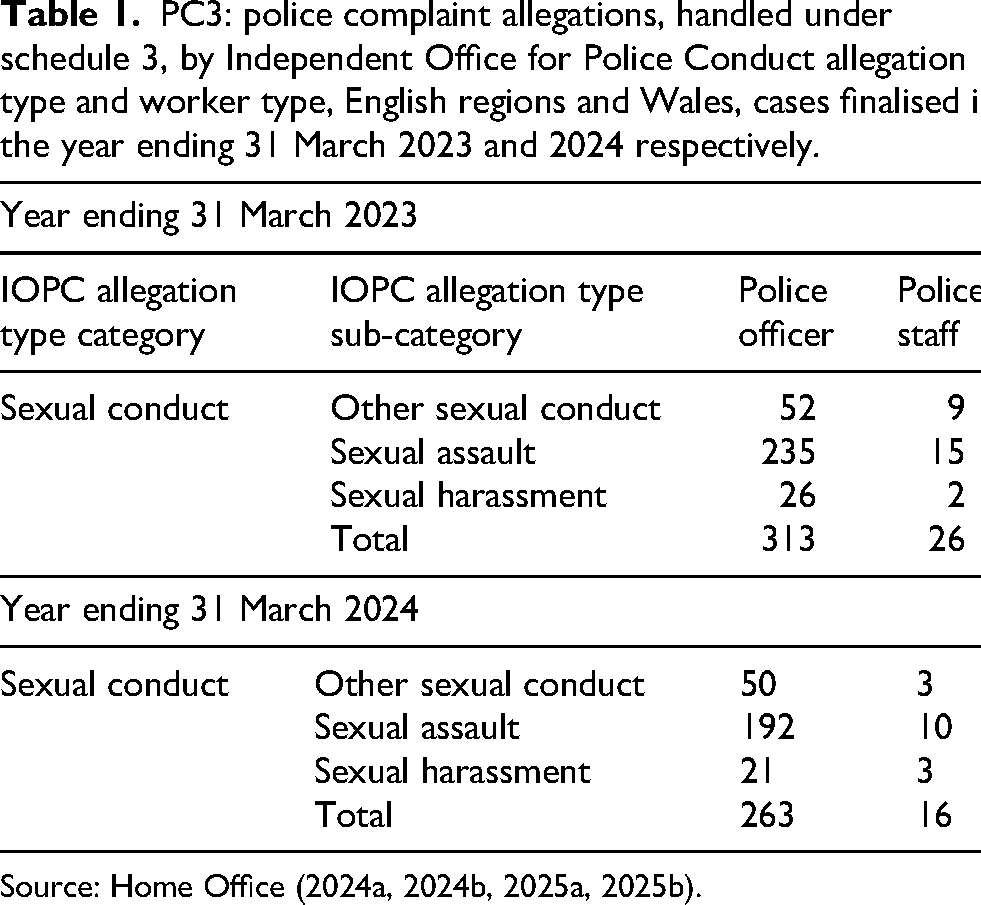
Source: Home Office (2024a, 2024b, 2025a, 2025b).
Police misconduct is, of course, newsworthy and recently, under the headline ‘Record 600 police sacked in drive to win public trust’ (Woode, 2024) The Times leading news item reported that dismissals increased by ‘50 per cent’ in the year to March 2024. Woode says these included 20% for dishonesty, 18 officers sacked for being in a ‘discriminatory’ WhatsApp group and a further 18 sacked for possessing indecent images of children, with 33 dismissed for ‘abusing their position for a sexual purpose’. In total then the 33 officers dismissed in 2023–2024, were quite a small percentage of the 593 mentioned in The Times report. This does represent a 50% increase overall, as the headline states, but not necessarily in sexual misconduct or offences. In fact, a public website that claims to record all cases (Misconduct999.com) from all forces across England and Wales suggests that there have been 1786 misconduct hearing since records began 1 January 2022; between 2021 and 2024 there were 1350 outcomes, with 544 criminal hearings. A search using the word ‘sexual’, cross-referenced under the category of ‘outcomes’ brings up a total of 40 cases (accessed 10 and 11 December 2024). Some examples of these are outlined briefly below.
Case 1: An officer accused of using his position as to contact a member of the public in order to form a relationship. Sanction: Dismissal without notice. Case 2: An officer who met a woman on a dating app, and then kept messaging her after she said she no longer wanted contact. He delivered her a handwritten letter casting ‘aspersions on her sexual conduct’. He then logged onto the Police National Computer on two occasions and looked up names linked to the victim. Sanction: Dismissal with notice. Case 3: Sending an unsolicited sexual message to a colleague. Sanction: Resigned – would have been dismissed. Case 4: Various allegations around sending sexual text messages to female colleagues and staff, as well as sending messages to a vulnerable domestic abuse victim and instructing her to delete them (seen as abusing their position and interfering with a criminal investigation). Sanction: Resigned – would have been dismissed. Case 5: Officer accused of inappropriate sexual touching of female office colleague. Sanction: Resigned – would have been dismissed. Case 6: Officer attended road traffic accident, where he met a woman that he began messaging, sharing pictures of a sexual nature. Sanction: Final written warning. Case 7: Inappropriate sexualised comments to a junior female colleague and unwanted touching. Sanction: Dismissal without notice. Case 8: An officer attended a nightclub while off duty and behaved in a sexually inappropriate manner towards a woman. Sanction: Dismissal without notice. Case 9: Involved a work party and the unwanted sexual touching of two female colleagues. Sanction: Resigned – would have been dismissed.
Not all of these cases or the reports and public inquiries mentioned above focus specifically on the misuse of powers for sexual-related offences. However, some can be understood as relating to the power and ability officers have to cover up their actions, and if caught, to offer justifications. This does not refer to all officers, of course, and as our evidence later in this article suggests, many would find the behaviour abhorrent, but not always be willing to report it. Where cases come to court for criminal proceedings, there is further data from the Home Office (Tables 2 and 3), but again, this is difficult to link to individual cases.
CR1: criminal proceedings related to cases finalised in the year ending 31 March 2023, by court charge category, charge result and worker type, England and Wales.
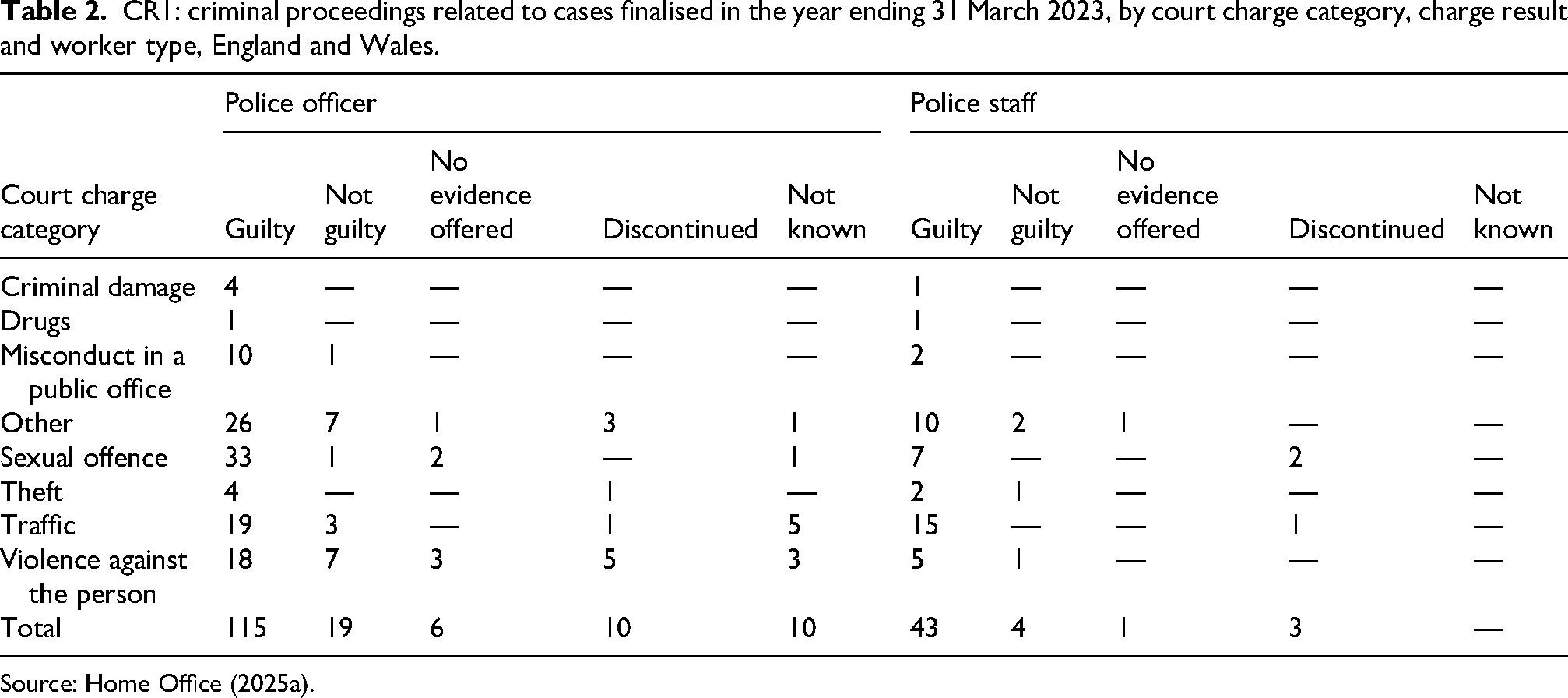
Source: Home Office (2025a).
CR1: number of criminal proceedings, by court charge category, charge result and worker type, English regions and Wales, related to cases finalised in the year ending 31 March 2024.
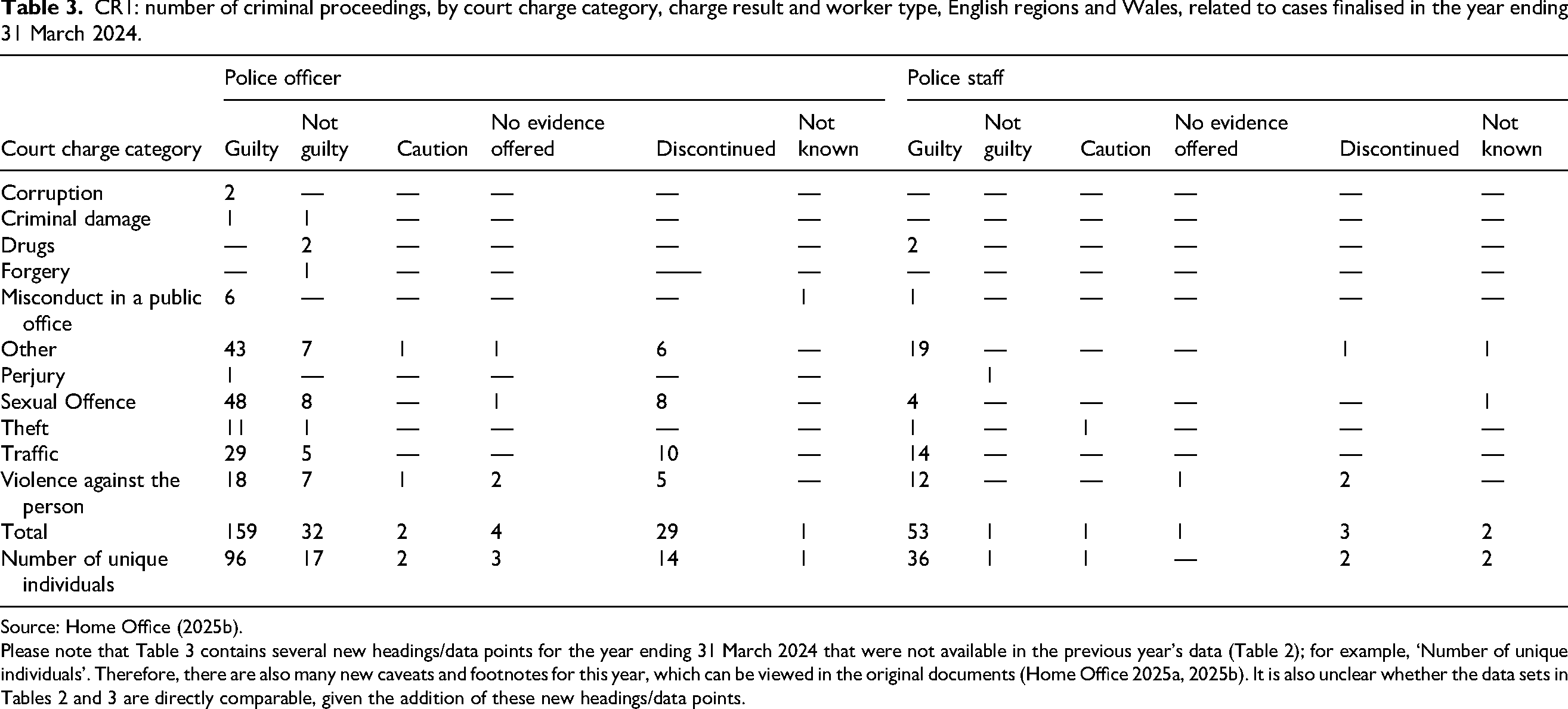
Source: Home Office (2025b).
Please note that Table 3 contains several new headings/data points for the year ending 31 March 2024 that were not available in the previous year's data (Table 2); for example, ‘Number of unique individuals’. Therefore, there are also many new caveats and footnotes for this year, which can be viewed in the original documents (Home Office 2025a, 2025b). It is also unclear whether the data sets in Tables 2 and 3 are directly comparable, given the addition of these new headings/data points.
Survey results
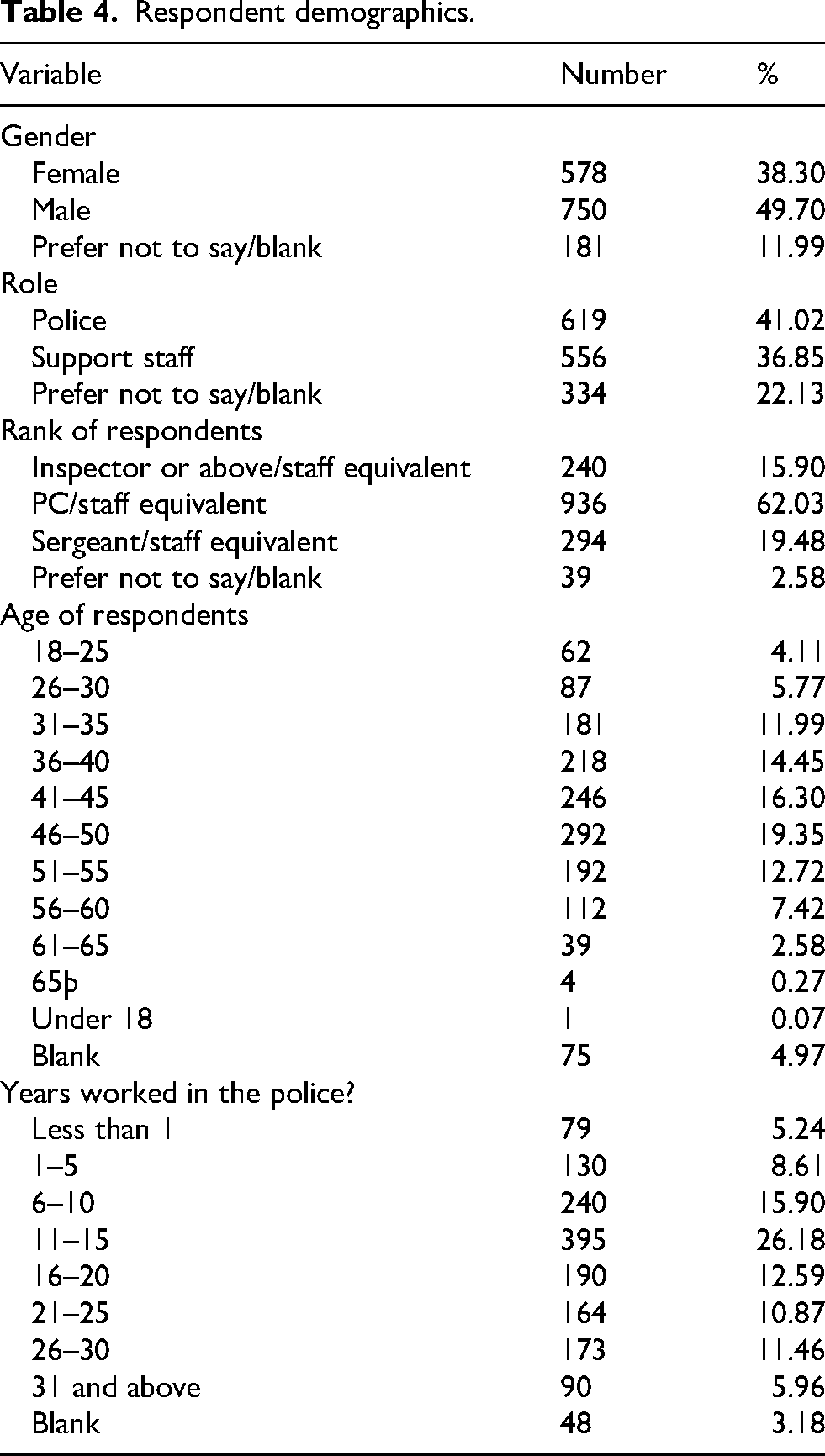
We now turn to some research findings from our more general study of police attitudes towards misconduct and the reporting, or non-reporting, of colleagues’ behaviours. The overall focus of the study was the ‘blue code’ or ‘curtain’ of silence. We are interested in why police officers feel that even quite serious misdemeanours would not be reported. In 2016, we carried out an electronic survey and received 1509 responses in the form of completed questionnaires (Table 3). One article and a chapter in an edited volume have already been published, drawing largely upon the quantitative data from this survey (see Westmarland and Conway, 2020 and Conway and Westmarland, 2021). For the purposes of our analysis here, some responses were removed from the data set used for the final analysis – most prominently those respondents who decided not to complete the survey. The reason for excluding these responses was twofold. First, we felt that including partial answers would add an element of ambiguity to the final analysis – with a gradually diminishing total as the survey questions progressed. Second, and more importantly, we made a deliberate decision in designing the survey to allow respondents to skip questions that they did not – for whatever reason – wish to answer. We informed respondents in the preamble to the survey that ‘you can decide to stop at any time by closing your browser and we will not use any of the information that you give us’. The final data set of 1509 responses therefore comprises those individuals who completed the survey 1 – but may have deliberately skipped one or more questions; we excluded those who decided not to complete the survey. Further details about the respondents are given in Table 4.
Respondent demographics.
We decided to include police community support officers (PCSOs) and support staff for three reasons. First, the anonymous research partner force, the only one with which we were engaged, requested this inclusion, making it clear that they valued the views of all employees. This inclusive attitude is reflected in growing use of the term the ‘police family’ – a concept that can be interpreted as recognising that the work of officers, PCSOs and support staff frequently overlaps in multitudinous and frequently subtle ways. Research undertaken by Millie and Hirschler (2018) found that a motivation for some new police recruits related to the sense of identity bestowed upon those who joined this wider ‘police family’. A further reason for extending the survey beyond officers, was that all police employees are expected to conduct themselves in an ethical manner. The Code of Ethics is explicitly phrased as applying ‘…to every individual who works in policing, whether a warranted officer, member of police staff, volunteer or someone contracted to work in a police force’ (College of Policing, 2014). In short, there is ample scope for misconduct and corruption among police staff and PCSOs. The final reason for extending the scope of the survey beyond officers was that support staff and PCSOs are an integral part of the wider policing infrastructure. This group both informs – and is informed by – the culture of policing, which is the fundamental focus of our wider research. We therefore felt it was vital that the views, experience and insights of this group were captured.
The scenarios
The scenarios used in the survey were based on three distinct sources. Two were retained from earlier iterations of the survey by the lead author (Westmarland 2005; Westmarland and Rowe, 2018). These related to the use of excessive force against a suspect; and encountering an intoxicated driver who turns out to be an off-duty police officer. A further three scenarios refined and updated general themes addressed in the lead author's previous research. For example, previous iterations of the survey (Westmarland, 2005; Westmarland and Rowe, 2018) included a scenario involving an officer keeping money from a wallet that he found in a car park. In the current survey, this scenario was updated to involve an officer taking money while undertaking a house search of a known organised criminal. The remaining five scenarios were substantively new and were developed based on an overlapping combination of discussions with the professional standards department (PSD) of the research force and the interest of the authors. These new scenarios focus on issues such as officers entering into romantic relationships with people they have met in a professional capacity, misuse of the police database, and sexual misconduct. In practice, there was frequently not a clear distinction between the inspirations for these new scenarios. For example, a new scenario may have been developed based on the interest of the PSD, which also overlapped with the authors’ research interests, and echoed a theme addressed in an earlier iteration of the survey.
The nature of the scenarios varied considerably, with six distinct categories addressed:
whether the behaviour was against force policy; acquisitive corruption (such as theft); ‘noble cause’ corruption (rule-bending for the good of others); the ‘blue code’ of silence (prohibiting snitching on colleagues); reputation damage (of self or the organisation); sexual misconduct (related to the workplace or role).
Scenario 1 addressed relatively innocuous forms of police misconduct. It considered a staff member supplementing his income by running a side-business baking cakes for weddings and birthdays. Scenarios that may be conventionally considered more ‘serious’ involved acquisitive crimes, such as taking cash from a crime scene or keeping a watch accidently left in a bag. A distinct set of scenarios looked at practices that may sometimes be overlooked by officers under the auspices of the ‘blue code’. The scenarios provided to respondents are reproduced in full in Table 5, along with the average seriousness and (where asked) the likelihood of reporting. This article concentrates primarily on scenarios 8 and 9.
Qualitative data: How did they qualify their responses?
Having explored the quantitative data from this study at length in other publications, we turn to the qualitative comments that respondents wrote in the online survey in which we asked ‘Anything else to add?’ We received a large number of comments; some extended to long and very considered sets of opinions, which we explore in more depth elsewhere (Westmarland, 2025). Only the two scenarios relevant to the discussion here are presented – the sexual-related scenarios and respondents’ opinions are considered in terms of the focus of this article – police as perpetrators of sexual abuse.
In one of the scenarios, scenario 8 (Table 5), we asked about a situation in which a colleague was being touched and potentially sexually harassed in an office. In scenario 9 we asked about a situation in which an officer had developed a romantic relationship with a victim of a burglary that he had dealt with in the past. Placing the qualitative findings from each scenario together, it is clear that respondents viewed the offence of ‘sexual touching’ of a colleague much more seriously than forming of a romantic relationship with a former victim.
Survey scenarios used as online questionnaire.
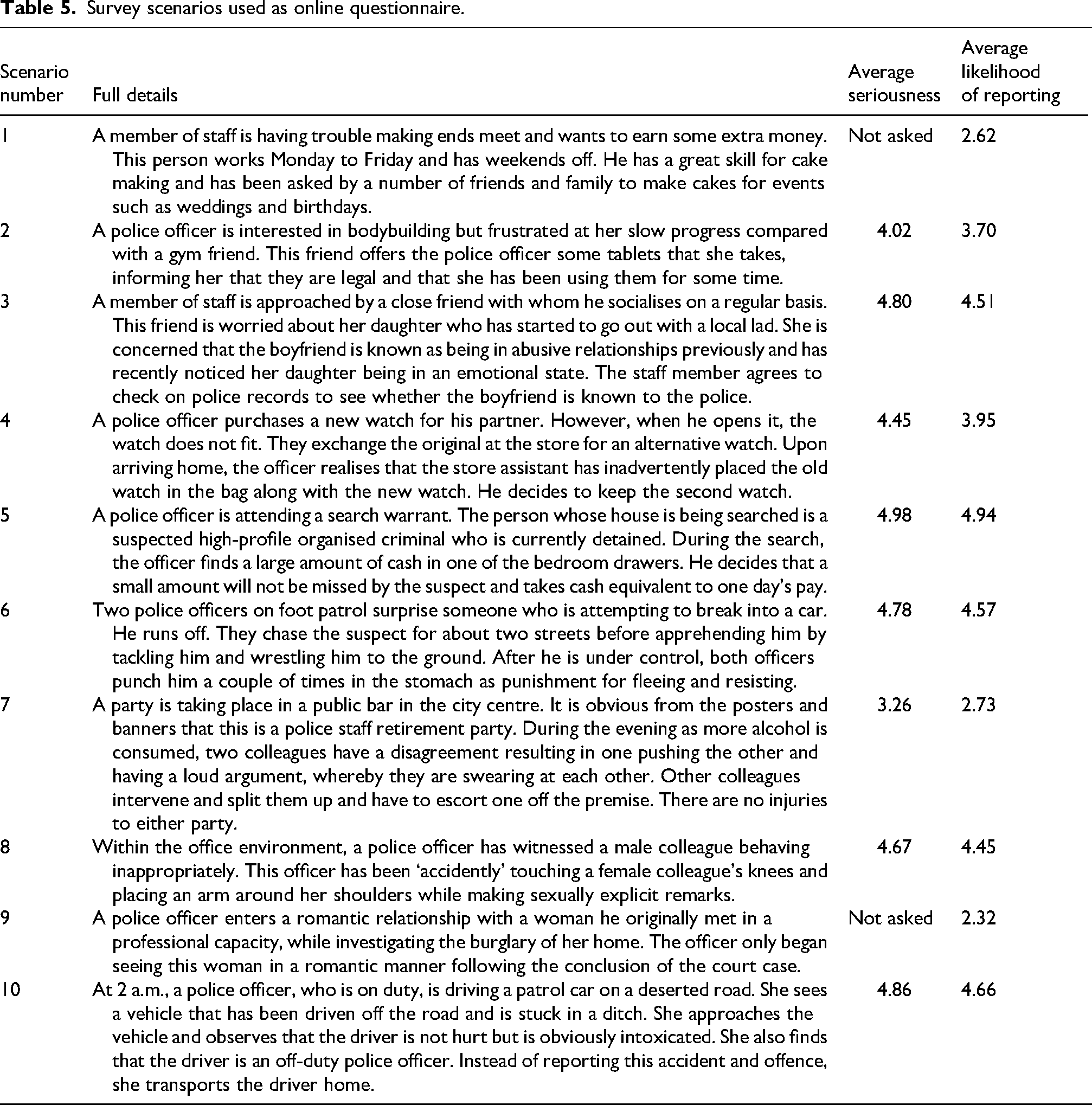
In the case of the ‘sexual touching’ scenario in the office, 73% of the respondents thought it ‘very serious’; 64% said they were ‘high likely’ to report this, with a further 21% selecting 4 or 5 on the seriousness scale. This compares with scenario 9, in which respondents were asked whether they thought forming such a relationship was acceptable (Table 6): 26% responded in the negative, 34% were unsure and 39% responded in the positive. Only 11% thought it ‘highly likely’ that they would report the relationship and 40% selected 1 on the likely to report scale (‘unlikely’). The difference between these two sets of responses is quite stark and we have reflected on various potential explanations for this. One explanation could be that the touching of a colleague in the police, at work, and ‘on duty’ contrasts sharply with off-duty behaviour. There is also some convincing evidence from Sweeting et al.'s study (2022) of police misconduct using scenarios based on sexual activity that the behaviour could be ‘minimised’. They argue that a potential reason for this could be police culture, often described as aggressive, competitive and predominantly masculine. Sweeting et al.’s evidence also points to an attitude that ‘off-duty’ time, such as lunch breaks, are the officer's own to carry out whatever activities he wished. This included a scenario involving sexual activities with colleagues in one instance. We would like to look further into our own qualitative responses to try to unpick the reasons for potential discrepancies between on- and off-duty activities and attitudes towards sexual activities.
Comparisons of seriousness of ‘on duty’ and ‘off duty’ behaviours.
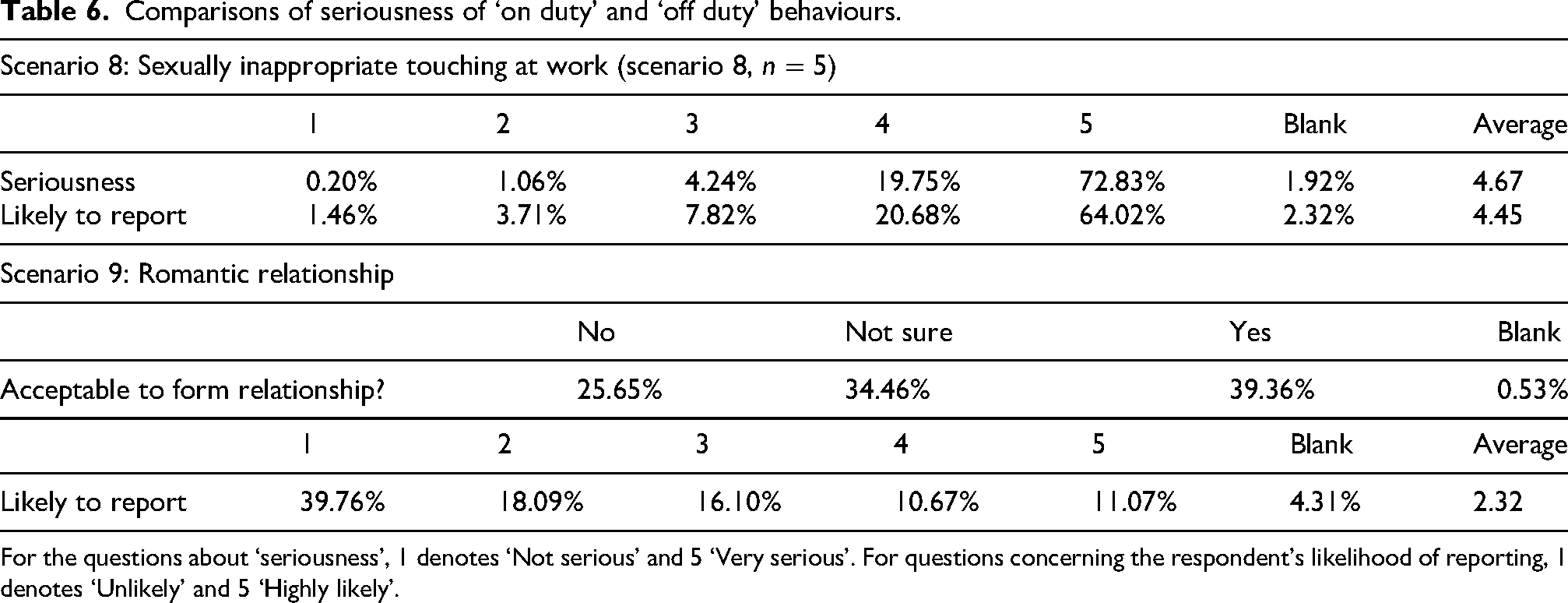
For the questions about ‘seriousness’, 1 denotes ‘Not serious’ and 5 ‘Very serious’. For questions concerning the respondent's likelihood of reporting, 1 denotes ‘Unlikely’ and 5 ‘Highly likely’.
Inappropriate touching
There were five qualitative responses referring to this scenario, although there were also responses that addressed the issue obliquely with respondents mentioning whether they would or would not report behaviours in a more general sense. Across many of the responses to the survey there was a general sense of respondents expressing that they were ‘wanting to know more’ before they would proceed to report anything, despite the high levels of those who had said they would take action. Responses included: For example, inappropriate behaviour/comments – was the officer upset? Didn't personally witness so how can I judge? I might encourage them to report if they disclose to me, however, or it is obvious that there is more to it. (Respondent 37) Many of these questions I would be inclined, as a police officer, to find out more information before making the judgement whether to report a person or not. Breaking the law, stealing money, sexual harassment needs addressing; however, I would want to make sure I knew all the facts before reporting anything. (Respondent 1089)
As trained police officers they are obviously cautious about checking their facts and the how the victim of assault might want to proceed. Some of the other responses shed light on opinions about what might happen to them or the alleged perpetrator: It is much easier to report inappropriate behaviour to a manager who embraces the force values, and is effective in their role; eg, it would be hard for a woman to report sexual harassment to a male boss who they know to be unsympathetic, it would just make their life harder. (Respondent 658) I reported a member of staff who had committed a misconduct offence bordering on gross misconduct who had acted inappropriately… I reported the matter to my supervisors who later involved the HR department who quickly tried to resolve the matter informally. Only due to the intervention and representation of staff union representatives was the matter considered further. Unfortunately, no proper formal investigation of the matter was carried out as the matter had ‘been dealt with’ by a quick word in their ear and a warning about their behaviour. The individual was allowed to continue in their position of superiority despite physically touching (redacted), in the workplace, in a sexual manner. (Respondent 1566)
Romantic relationship
We received nine comments specifically referring to scenario 9. Question 26 asked whether respondents thought it is acceptable to form a romantic relationship with the victim of a burglary who the officer had met when investigating the incident. One of the respondents pointed out that the question around the romantic relationship was ambiguous, one said that it could be acceptable if the case had been concluded. Q26 is a little ambiguous so I have answered unsure – if the officer has informed his supervisor (since the relationship formed after the conclusion of the case) I would not be concerned as long as it was very clear that the officer had acted appropriately during the period of professional contact and the relationship formed completely outside of this contact. (Respondent 428) The question regarding the relationship, there isn't enough information to give a full decision. It may have been sometime after the court case that they met. (Respondent 1525)
An example of this type of case, reported by the Independent Office for Police Conduct (IOPC) in 2019 resulted in the officer being given ‘management action’ and it was acknowledged that the guidance needed to be made clear. A Metropolitan Police Service (MPS) officer was alleged to have had a sexual relationship with a victim of domestic abuse with whom they had come into contact during their duties as a police constable. Our investigation obtained evidence that suggested that the police officer formed a friendship with the victim before encountering them as a victim of domestic abuse. The officer took a statement, conducted an initial risk assessment, created a computer record for the suspect, created a report and filled out a domestic abuse form in relation to one incident, and took a statement in relation to another incident involving the same victim. This occurred during a period in which they had expressed interest in one another but had not yet gone on a date. The evidence we obtained suggested that although the officer took initial actions and a statement on two different incident dates, the officer formed a relationship with the victim when they were no longer involved in the victim's investigation. During the investigation, we interviewed witnesses, invited the officer in for an interview but received a written response to the misconduct caution and reviewed force policies and legislation. Following the investigation, our opinion was that the officer had a case to answer for misconduct but that it could be dealt with through management action. The MPS agreed and arranged for the officer to receive management action in the form of reflective practice, to ensure the officer is aware of the policies and guidance in relation to relationships with people that they meet during their work. We also identified organisational learning around the need for the MPS to have clear guidance on police officers taking reports or investigating crimes, which relate to family members or partners.
The UK College of Policing's guidance on ‘Maintaining a professional boundary between police and members of the public’ begins by being very definite, but then slips into more ambiguous language. (2021) Items 6 and 7 from the document containing 18 items in total, state that: Interactions with members of the public involved in a current incident or investigation 6. Do not engage in, or pursue, a sexual or improper emotional relationship, on or off duty, with any member of the public who you have come into contact with during the course of your current work or duties. 7. While you may find yourself attracted to a member of the public, or find yourself in a situation where someone is attracted to you, it is your responsibility not to act on these feelings. This is to prevent any harm that such actions may cause and to maintain the integrity of the policing profession.
This all seems to begin by being very straightforward, but then, it seems to become more vague: Relationships with members of the public where there was previous professional contact 11. Depending on the circumstances, developing a sexual or improper emotional relationship with a member of the public with whom you have had former professional contact may also amount to an abuse of your position. Factors that may be relevant when assessing whether the relationship would represent an abuse of position include: – degree of previous professional involvement – length of previous professional involvement – vulnerability of member of the public currently and when professional contact took place – period since cessation of professional contact.
In fact, it does seem that the College of Policing's guidance is open to wide interpretation, because ‘Factors that may be relevant’ implies that there could be other potential reasons or circumstances that mean the relationship could be sanctioned, or at least not prohibited. Turning back to our own data, regarding the scenario we posed about a romantic relationship, one respondent thought it ‘unprofessional’: … relationships with complainants, victims, witnesses and the like are unprofessional to say the least. Where staff have been adjudged to use their influence or position of office to promulgate such a relationship, they have breached ethical standards and should be dealt with accordingly. Again, this question does not provide enough information to offer a definitive answer. (Respondent 712)
Other respondents thought that the potential vulnerability of the victim could be an issue: The officer meeting a victim of burglary is she vulnerable? If she is a professional person who has only been burgled I can’t see the problem, but knowing the new PSD standards I would say definitely not. (Respondent 978) A lot of the situations described would be assessed on an individual basis. The example of the officer dating a burglary victim would need reporting if the victim was vulnerable, or if details were taken from information the officer gained as a result of the investigation. If the officer met the victim by chance ‘naturally’ (and without using details obtained via the investigation) I think this would not need reporting. (Respondent 1218)
Other respondents thought that the situation, was unproblematic, if a little ambiguous, noting: Anything of a criminal nature is straightforward, however the relationship one for example could vary, whilst I disagree with it in general if it was a one off for the officer and genuinely happened after the court case and it was ‘love’ then I wouldn't be as concerned, whereas if this was a regular thing or the officer was actively seeking out victims of crime then I would of course have issue. (Respondent 1371) I have no conflict with the Q's however romantic relationship following investigation of burglary is intriguing. I married my wife 25 years ago in similar circs! (Respondent 276)
For this scenario we had slightly fewer specific responses than for some of the other questions we posed, with nine respondents referring specifically to the ‘relationship’ question, although some were quite fulsome. Where vulnerability is mentioned, one respondent pointed out that ‘it seems OK on the surface but there is an action of trust between the OIC and the victim and was the victim vulnerable?’ (Respondent 1979). This important point raises the issue of victim vulnerability and how it could be judged. Given the power to carry out the abuses mentioned in the introduction to this article, it raises the issue of how to measure it and how to know whether someone does fall into that category. It should be noted that the data were collected before the recent scandals, Couzens and Carrick, mentioned earlier.
Discussion and concluding thoughts
Policing in the UK seems to be going through yet another crisis of confidence. The numerous scandals and reports of cases of sexual impropriety discussed in the first part of this article lead us to think that these may not be the last. Recent history also suggests that we may be waiting for another series of scandals, due to the inability to deal with the issue of police having the means, motive and opportunity to abuse their position. This potential for repetition is illustrated by a case in 2012, cited in a report published by the Independent Police Complaints Commission (IPCC, now IOPC), in partnership with the UK's Association of Chief Police Officers (now The Police Chiefs’ Council). Their report, ‘The Abuse of Police Powers to Perpetrate Sexual Violence’ (IPCC, 2012) has strong echoes of the current situation. As Dame Anne Owers, the then Chair of the IPCC noted, ‘their report was initiated party due to a former Northumbria police constable being jailed for life, for a number of serious sex attacks against women he met through his job’ (IPCC, 2012: ii). Using a series of case studies from the time, the report observes that despite warnings, previous indicators and in some cases written warnings, numerous officers were placed in roles where they could abuse their position and took advantage of vulnerable victims. A lack of supervision and inadequate checks on police computing systems were also identified as problems leading to the ability to perpetrate sexual abuse.
The ongoing nature of this problem is also summed up in an excellent, yet somewhat depressing chronology prepared by the London-based CWJ. In their most recent report, focusing on PPDA, the CWJ ask whether ‘anything has really changed as a result of their previously enacted super-complaint about PPDA’ in 2020. The CWJ give 20 examples of policy initiatives and government legislation since that date. They list instances of ‘police and government VWAG initiatives’ between 2020 and 2022, such as: The Domestic Abuse Act (April 2021); a new police framework (December 2021) to review VAWG offences perpetrated by officers and staff; a new unit in the Metropolitan Police to investigate PPDA; sexual offences and misconduct allegations ‘DASO’ (January 2022); ‘Updated Guidance on Outcomes in Police Misconduct Proceedings’ (College of Policing, August 2022); and in October 2022, a report entitled ‘Themes, learning and next steps following police forces’ reviews of police-perpetrated violence against women and girls’ (CWJ, 2024: 43–48). Part 2 of the Angiolini Inquiry is to establish whether there is a risk of recurrence across policing, investigate police culture, and address the broader concerns surrounding women's safety in public spaces. Following the sentencing of former police officer David Carrick in February 2023, Part 3 of the Angiolini Inquiry was established to examine Carrick's career and conduct.
In addition, at the time of writing (December 2024) another initiative has been announced by the College of Policing, providing guidance as to whether people with a conviction or caution for a sexual offence should be automatically barred from joining the police (personal communication with Home Office expert, December 2024). As with domestic abuse, and all sorts of VAWG, many policies do not seem to make it into practice, or have any sort of effect. We feel that, as we have argued here and elsewhere, that a culture underpinned by a blue code of silence is not helping this process. Despite numerous reports, scandals and the ongoing destruction of people's lives, it still seems from the evidence that attitudes towards the issue are, at best, puzzled as to solutions, and at worst, accepted. There have been numerous inquiries, reports and initiatives, but the numbers of officers being sacked for misconduct soars, according to some of the statistics presented here. However, as the College of Policing's statement suggests, perhaps this is not only rooting out people who should not be in the police, but also preventing them from joining in the first place. Parts 2 and 3 of the Angiolini Inquiry and subsequent reports seem to have a lot of work still to do.
Footnotes

Funding
The authors received no financial support for the research, authorship, and/or publication of this article other than a small amount for travel expenses.
Declaration of conflicting interests
The authors declared no potential conflicts of interest with respect to the research, authorship, and/or publication of this article.