




Abstract
Police-perpetrated domestic abuse refers to a range of abusive behaviours – such as violence, sexual assault and coercive/controlling behaviour – committed by serving police officers or police staff members towards intimate partners or family members over the age of 16. This article presents qualitative findings from a small-scale exploratory study, to understand how police-perpetrated domestic abuse is experienced from the perspective of the intimate partner. A sample of ten women in England and Wales took part in in-depth, semi-structured online interviews. Interpretative phenomenological analysis was used to analyse the data, to fully explore the unfolding experience of the relationship from the participants’ perspective. Women detailed escalating control and violence, with perpetrators using the techniques, knowledge and resources afforded by their job. Their accounts suggest that police perpetrators were enabled by workplace camaraderie and networks, and that the ‘policing identity’ had elevated symbolic importance to these officers. Reflecting across the findings, we observe how police perpetrators are trusted professionals who may leverage positional and charismatic authority, and thereby ‘mobilise bias’ to conceal or minimise their offending. We suggest that policing organisations draw on the experiences of victims–survivors and counter-mobilise a strategy of connecting ‘low-level concerns’, which may be reported over time by colleagues, family and members of the public. This could help reduce the potential for serious harm by police perpetrators and contribute to rebuilding trust in the police institution.
Study context and existing research
Police-perpetrated domestic abuse is a troubling and still under-addressed issue. Scholarship has predominantly been focused on the United States (Goodmark, 2015; Klinoff et al., 2015; Russell and Pappas, 2018; Stinson and Liederbach 2011, 2013) but has garnered increasing attention among scholars internationally following ‘signal events’. In England and Wales, this included the conviction in 2023 of Metropolitan police officer, David Carrick, for 49 offences including rape, coercive and controlling behaviour, sexual assault and false imprisonment of 12 women. Although police perpetrators may draw on the same range of physical, psychological, sexual, financial and coercive tactics as non-police perpetrators, the combination of their position as representatives of the state and the resources at their disposal, can make them particularly dangerous offenders (Garvey, 2015). Significant barriers exist to reporting police perpetrators, both as a ‘civilian’ (Mulvihill and Sweeting, 2024; Reeves et al., 2025) and as a police officer or member of police staff (Couto et al., 2023). These include shame (Couto et al., 2023), fear (Pidel, 2022), poor handling of disclosures (Mulvihill and Sweeting, 2024) and low levels of sanction (Stinson and Liederbach, 2013).
In terms of prevalence, there is currently no survey that captures victimisation or offending rates of police-perpetrated domestic abuse within the general population, either in England and Wales or (to the authors’ knowledge) elsewhere. Since 2021, the National Police Chiefs Council (NPCC) and the College of Policing in England and Wales have started to report police-perpetrated offences against women and girls. Domestic abuse allegations against an officer are reported under the broad category of ‘discreditable conduct’. Between 1 October 2021 and 31 March 2022, 444 allegations of discreditable conduct were recorded, representing 0.2% of the total policing workforce employed on 31 March 2022 (College of Policing and NPCC, 2023). Non-representative samples in previous studies have suggested that police perpetration rates are higher than those found in the civilian population (Valentine et al., 2012; see Mennicke and Ropes, 2016, for an overview). This would parallel findings in the military, which shares with policing a culture of ‘militarised masculinity’ (Goodmark, 2015), loyalty (Coleman, 2009; Westmarland and Conway, 2020) and command structures. For example, a 2022 UK study published in The Lancet found that, compared with the civilian population, adjusted odds (95% confidence intervals) of experience and perpetration of domestic abuse were higher in the military by 2.94 (2.15–4.01) and 3.41 (1.79–6.50), respectively (MacManus et al., 2022). However, recent weighted survey data from forces across England and Wales suggests that 22% of police officers report a lifetime experience of domestic abuse (Brennan et al., 2023), which is broadly equivalent to the national average lifetime victimisation (Office for National Statistics, 2024).
Existing research has explored why police officers, who are meant to be the guardians of society, perpetrate domestic abuse. Explanations are offered at the individual level [for example, whether potentially abusive individuals self-select violent or dangerous occupations (Klaas, 2021; Stergiou-Kita et al., 2015)]; at the organisational level [for example, unique workplace pressures and traumas facing police officers (Cross and Ashley, 2004; MacQuarrie et al., 2020; Oehme et al., 2012) or the risk of occupational violence ‘spillover’ (Melzer, 2002) or institutional enculturation (Crawford and Dacin, 2020)]; and at the social level [most notably, the broader context of gender based violence (Ammons, 2005; Wetendorf, 2000)].
There is an additional question of separating out police perpetration in general and police perpetration of domestic abuse towards partners who are also either police officers or police staff. In the Brennan et al. (2023) study of English forces, 27% of individuals who had experienced domestic abuse identified their perpetrator as working in policing. Yet it is important not to over-interpret the perpetrator occupation here, because work is a key factor in bringing partners together and same-profession couplings are not uncommon (Priceononmics, 2015). Although studies of sexual violence or sexual misconduct perpetrated by police officers have tended to identify victim positionality more clearly (Bikos, 2023; Khoury et al., 2025; Maher, 2010; Miller et al., 2022), this is less often the case in studies of police-perpetrated domestic abuse.
In a scoping review of police-perpetrated domestic and family violence, Anderson et al. (2024) find that survey and mixed-method approaches – including secondary source case data analysis – appear to be the most common methods used for this topic, followed by policing policy and practice evaluations. Interviews form a small subset of the research and tend to be conducted with police officers or support services (Gerelt-Od, 2023), rather than those affected directly by abuse. This reflects the challenges and sensitivities of seeking to talk to victim–survivors (see a useful methods discussion in Maher, 2010). It is more commonly the media or campaigning organisations, rather than academics, that have solicited directly the experiences of police-perpetrated domestic abuse victims–survivors (Centre for Women's Justice, 2020, 2024; Gleeson, 2020) and these are most often in relation to reporting experiences (Mulvihill and Sweeting, 2024; Reeves et al., 2025).
The significant gap in the international literature, addressed by this article, is victim–survivors’ experience of being in a relationship with a police perpetrator. These narratives are critical to hear. Being heard can be part of a process of reclaiming agency; fostering solidarity with others affected; and speaking truth to changemakers (Hesse-Biber, 2013). It is through their testimony that researchers and police institutions can materially and affectively grasp the behaviour of perpetrators; specifically here, how police perpetrators act within a relationship and how they may leverage their particular professional resources to abuse, coerce and conceal. This insight can inform prevention, intervention and justice responses. For police officers faced with a reporting victim–survivor, it communicates something of the trauma they may have experienced before making that decision to disclose, and such awareness could improve the police response (Mulvihill and Sweeting, 2024).
Theoretical framework
There are two elements that inform the theoretical framework for this article. First, we recognise the coercive potential of professional authority (Mulvihill, 2022) and the ways in which police perpetrators may derive positional power from their role, which enables them to exercise abuse while ‘hidden in plain sight’ (Erooga et al., 2019). Whereas Erooga and colleagues’ analysis focuses on perpetrators of child sexual abuse within and through an organisation, with a particular eye to how perpetrators circumvent safeguarding rules, we see applications to police perpetrators of domestic abuse. Specifically, we recognise officers’ positional role as affording them coercive resources that they can apply in the domestic and the work sphere. Across both domains, the congruence of practices (for example, surveillance, physical restraint, interrogation) and attitudes (for example, casual misogyny, suspicion, being in control) means, we suggest, that abuse can be misperceived by colleagues, family and other observers.
Second, but relating also to the ‘charismatic authority’ highlighted by Erooga et al. (2019), we are interested in the extent to which workplace popularity and perceived effectiveness on the job, can help police perpetrators to deflect scrutiny of their behaviour in intimate relationships. In 1962, Bachrach and Baratz published a now seminal study on organisations and power. They coined the term ‘mobilisation of bias’, to explain how institutions may systematically favour the dominant values, myths, rituals and interests of certain groups over others. We are interested in whether police perpetrators may draw on their personal charisma and positional authority to ‘mobilise bias’ in their own favour and against the victim, such that colleagues, family and other observers are primed to disbelieve allegations of abuse. The risks around charismatic authority have been more frequently articulated in relation to religious leaders (Zeller and Chryssides, 2014), although there is some adjacent discussion of ‘police hero’ constructions (Terpstra and Salet, 2019) and the personal power that officers exercise in civilian encounters (Bielejewski, 2022). We suggest that charisma and the mobilisation of bias may be particularly salient in identifying officer perpetrators. As Erooga and colleagues (2019: 64) presciently note: While these powerful individuals may be some of an organisation's greatest assets, they may also present one of its most significant risks.
Although domestic abuse can occur between intimate partners or family members of any gender or sexuality, we focus here on the most prevalent configuration in England and Wales (Hester, 2013), which is men abusing women intimate partners within a heterosexual relationship.
Research questions
Given the gaps identified in the literature and our theoretical framing, our research questions are:
What is the experience of women who are in an abusive intimate relationship with a male police officer perpetrator in England and Wales? What does this tell us about the modus operandi of police perpetrators of domestic abuse and how could this inform police practice?
Method
To understand the qualitative experience of victims–survivors, we sought to interview women who had been in relationships with, and experienced domestic abuse by, serving police officers in England and Wales. Ethical approval for the research was obtained from the Bournemouth University Ethics Committee, under reference 46414.
Given our interest in documenting individual women's experiences and perceptions, we chose to conduct semi-structured interviews and to use interpretive phenomenological analysis (IPA) to explore the transcripts produced. This was a small-scale qualitative study, conducted with a view to developing a wider body of work on police-perpetrated violence and abuse. The sample size of ten participants reflects this, but was also well suited to the purpose of gaining in-depth insight.
Sampling, recruitment and ethics
Our inclusion criteria were women who had been in relationships with, and experienced domestic abuse by, serving police officers in England and Wales. The participants were referred to the authors by a gatekeeper, who had contact with a number of potential participants and was known to the first author. The gatekeeper circulated brief details of the study to potential interviewees, who then made direct contact with the first author if they were interested in taking part. Interested individuals were sent a detailed information sheet and consent form. They were invited to ask further questions, as needed, and it was clarified that they were under no obligation to take part. Once consent forms were completed, the authors arranged a suitable time and date for interview.
Owing to the geographic spread of the participants, and to enable participants to choose (should they wish) ‘camera off’, all interviews were conducted using Zoom video-conferencing software and conducted online during January and February 2023. Interviews were audio-recorded only, and the audio was transcribed as soon as practicable after recording and the interviews transcribed verbatim, and any identifying details permanently redacted (names of individuals, locations, forces, policing units, etc.). The anonymised transcripts were stored in a secure University OneDrive, accessible only to the co-authors, and the audio deleted. Ten interviews were completed in total and participant transcripts labelled ‘P’ plus a number. The first author conducted interviews with P1–P5 and P10; the second author conducted interviews with P6–P9.
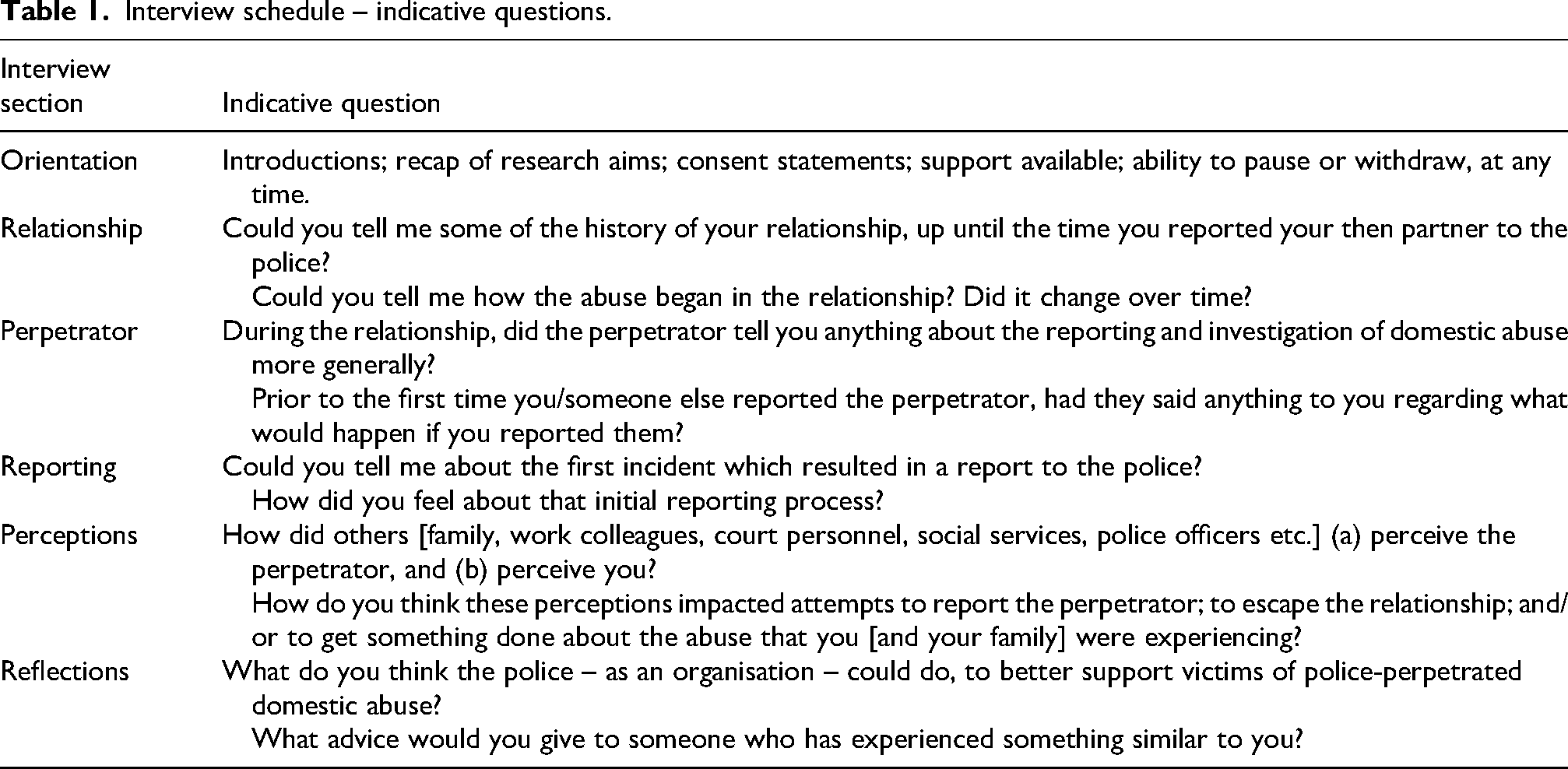
The interview schedule was designed using a semi-structured approach with core questions relating to the history of the relationship and the experiences of disclosing to others or reporting (if applicable). This approach elicited rich and detailed accounts (Smith and Osborn, 2015) (see question schedule in Table 1). Each interview lasted between 1 and 3 hours. For longer interviews, the participants were offered or provided comfort breaks and the authors checked for assent before continuing. Participants were reminded of the list of support agencies, provided in the information sheet. The first author received external supervision as part of their academic role and the second author arranged ensured breaks between interviews, to maintain well-being. The participant consent forms clarified that participants had a right to withdraw their data during or subsequent to the interview, which none exercised. All participants were keen to see future publications so, although original contact details and exchanges were deleted at the end of the research, to protect their confidence and safety, the authors could share outputs with the gatekeeper.
Interview schedule – indicative questions.
Participants
The participants were all women who resided within the UK and were aged between mid-20s and early 50s. All but one participant described their ethnicity as white British. Each participant had experienced domestic abuse from a former male partner who served in a policing role. To protect the identities of the participants, the dates of commencement and ending of the relationships are not provided here. However, it is possible to say that, for all participants, issues related to justice-seeking, child contact or recovery from trauma were ongoing at the time of interview.
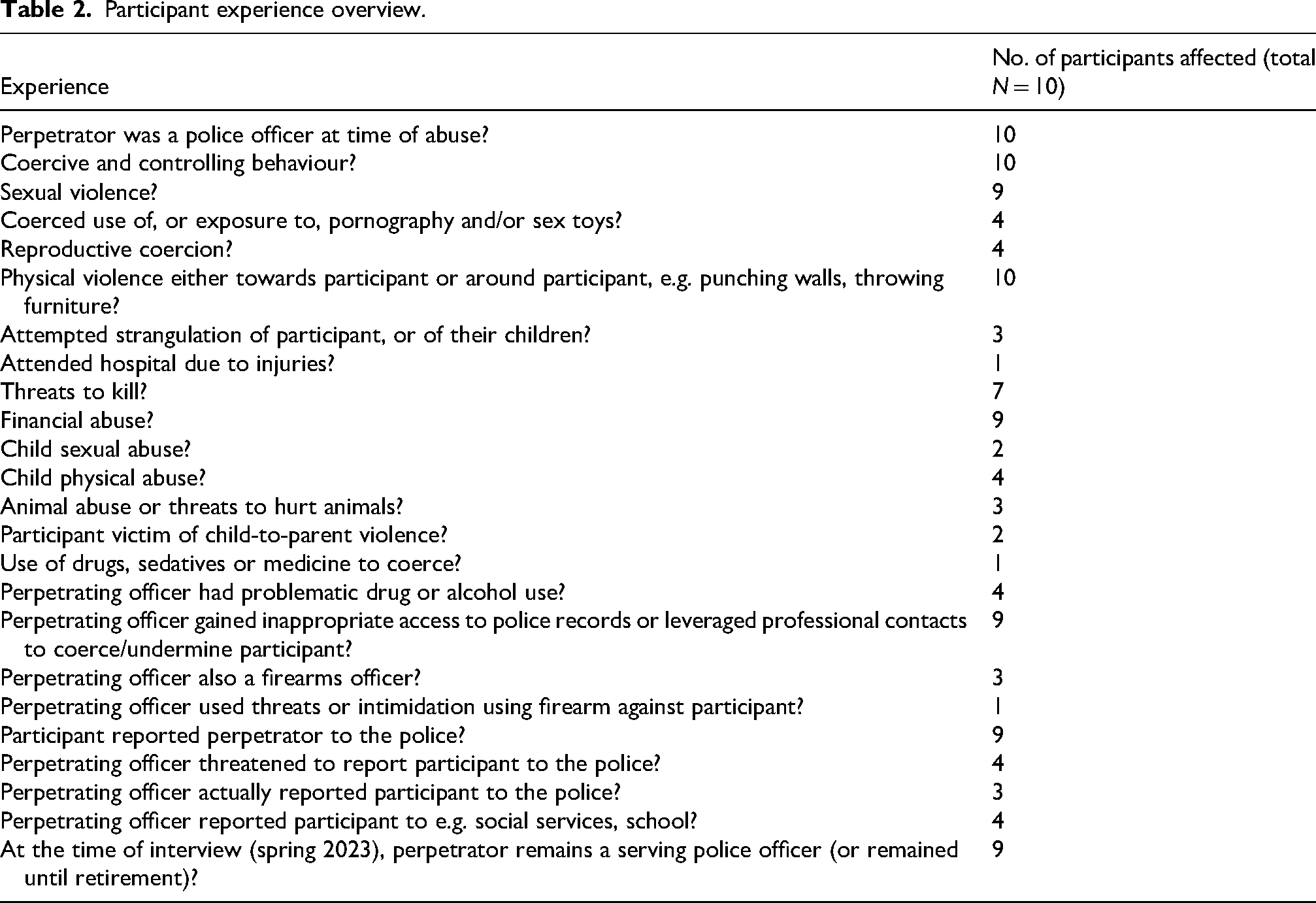
As Table 2 demonstrates, the participants (and in some cases, also their children, companion animals and wider family) experienced serious abuse across a number of dimensions: physical, sexual and psychological. In nine of the ten cases, the events described fell within the period 2018–2023. Nine participants reported their perpetrator to the police. This resulted in only one perpetrator receiving either a disciplinary or criminal action. In this case, the perpetrator resigned from the force prior to a misconduct outcome and was convicted, receiving a 2-year suspended sentence. The remaining nine perpetrators continued to hold a policing role at the time the interviews were conducted. Of the ten participants, four were officers within the police (either warranted constable or higher rank; or non-warranted police community support officer).
Participant experience overview.
This was a small-scale in-depth study and we recognise that the data does not allow either for intersectional analysis, or to compare meaningfully the experience of victims–survivors who are police officers (warranted or non-warranted), and those who are not. It also means that we cannot compare across forces: indeed, given the sensitivities of our participants’ accounts, the anonymity of force areas and geographical location was imperative. This limitation should be addressed by future research, but reflects also the additional challenges of pursuing an interview, rather than a survey method.
Data analysis
IPA was used to analyse the accounts of the participants. This approach was well suited, first, because IPA requires small samples (n < 12) for close analysis (Pietkiewicz and Smith, 2014) and second, because we were trying to convey the original, unique, as it was lived experience of our participants (Eatough and Smith, 2017). In contrast with approaches which start from, and are anchored around, the academic literature or theory (Biggerstaff and Thompson, 2008; Smith and Osborn, 2015), our approach here is to forefront our participants’ voices and to provide a detail-rich foundation for understanding (Smith and Osborn, 2015). As identified in the literature review, academic interviews with victims–survivors of police-perpetrated domestic abuse are rare, and IPA is particularly useful for communicating ‘less known or less understood’ issues (Tuffour, 2017).
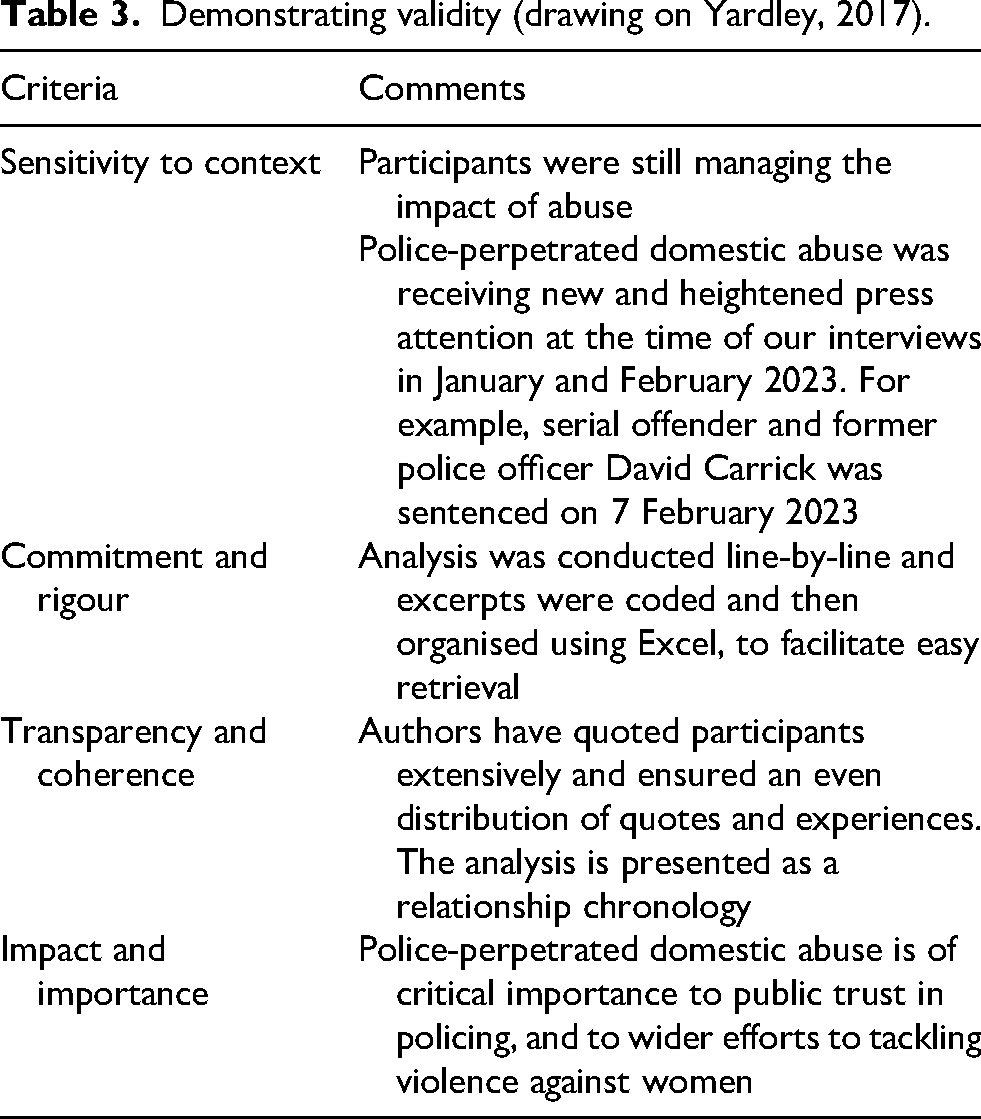
The analysis procedure followed guidance provided by Smith and Osborn (2003). The audio files were transcribed verbatim, preserving accurately the participants’ own use of language. The first phase of the analysis consisted of reading and re-reading the transcripts in number order, to familiarise the authors with the transcripts that they did not complete themselves. Phase two was to re-read the transcripts again, making notes for each line. This included descriptive comments of participant's lived experience but also their use of language and their perceptions. The two researchers completed note-taking on one transcript together and the remaining independently. The second author then shared their annotations with the first author, who looked across the collective notes for each individual transcript to identify potential themes and then clustered these into cross-transcript themes. The authors came back together to go through this work, to discuss and iteratively agree a final set (Morgan and Nica, 2020), around which the article is structured. Thematic analysis was also conducted for a separate article on participant experiences of reporting to the police (Mulvihill and Sweeting, 2024). Table 3 summarises efforts to ensure research validity (Yardley, 2017).
Demonstrating validity (drawing on Yardley, 2017).
We acknowledge here our academic and employment background and how this informs our analysis. The first author is a former police officer of 17 years’ service who moved into academic psychology, with a particular focus on sexual misconduct. During her time in the police, the first author attended and dealt with many cases of domestic abuse and therefore has a good working knowledge of relevant law and risk assessment, as well as lived experience of police culture. The second author is a criminologist, whose early work focused on the sex industry. She has extensive experience conducting interviews, mainly with women who have experienced domestic abuse and sexual violence as adults, and as children. More recently, she has written about coercive control and is leading a mixed methods research project looking at sexual misconduct by high-trust professionals. Our positionalities as researchers – interested in gender and violence, familiar with the dynamics of coercion and abuse, and committed to facilitating victims–survivors voices – frame our choice of research questions and our analysis (Galdas, 2017). However, our different disciplinary and employment backgrounds also allowed for mutual reflexivity and mutual challenge as we interpreted the data. We quote extensively and verbatim from participants to enable readers to better assess the interpretation provided.
Results
The analysis generated five main themes and associated subthemes (Figure 1), which mirrored the unfolding chronology of the relationship.
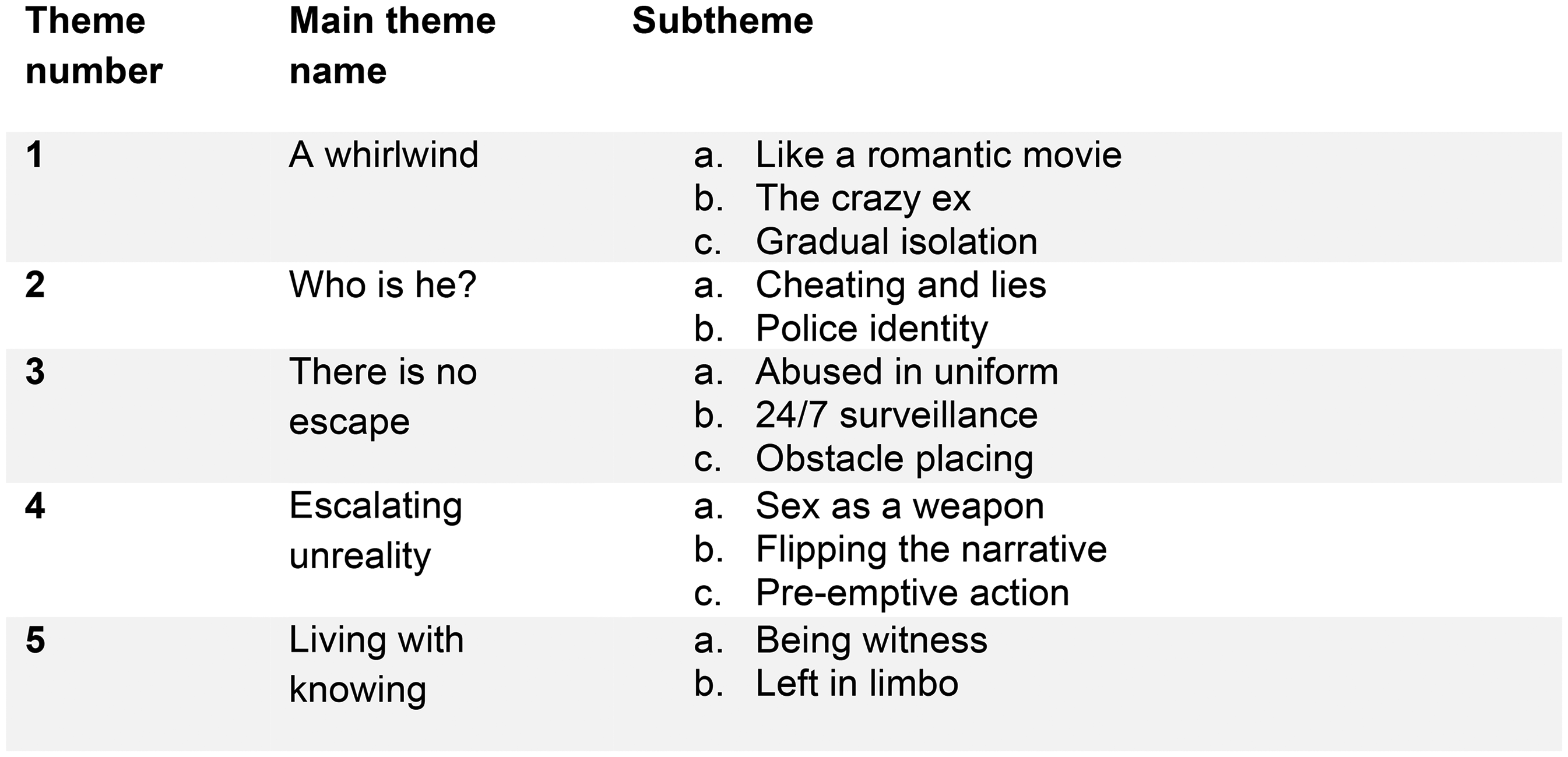
Analysis themes.
In relation to the use of quotes, the authors were concerned that, despite rigorous anonymisation of the transcript, tagging quotes with participant codes could lead to fuller accounts being pieced together and potentially lead to identification (see also Mulvihill and Sweeting, 2024). We had to be especially careful to protect the anonymity of our participants (and their perpetrators) in this work, because the experiences relate to officers currently serving in England and Wales and to recent and ongoing family court cases. For this reason, we do not attribute participant codes to each quote but simply provide a quote number. However, we do provide the code ‘P’ to indicate that the participant is a police officer or police community support officer, and the code ‘C’, to indicate that they are a civilian. Throughout the findings and analysis sections, we use the terms ‘former partner’ or ‘perpetrator’ to refer to the abusive police officer, with whom participants were in a relationship.
Theme 1: ‘A whirlwind’
The interviews started with participants recounting how they had met their former partners and also, their own positions about being in a relationship at the time. Some participants were openly seeking a relationship and using dating sites; others were newly single and felt that they were not ready for anything serious. Participants commonly described their former partner's entry into their life as being ‘like a whirlwind’. The pace of the relationship was set by their former partner and generally progressed from first dates to intense commitment within a short period.
Like a romantic movie
For most participants, the early stages of the relationship were described as being very romantic, with their former partner being attentive and loving. However, looking back at this experience, the participants now viewed this stage as being more akin to grooming through the use of ‘love-bombing’ behaviour (see Strutzenberg, 2016 for explanation of the genesis and application of this term). Comparable with the plot of a romantic movie, their former partner's motives were – upon reflection – just as fictional. I look back now and there was an absolute, a grooming mentality, where he saw my vulnerability and he just jumped in there. […] When you start looking at sex offenders – well it was all that kind of thing. (Quote 1, P) [Context: Met when young – initially the relationship did not work out] And then he kept pursuing me, so he was writing to me, trying to get messages through friends, which all felt terribly romantic. Which is why those romcoms are so dangerous. (Quote 2, C) I think they used the term ‘love-bombing’, which didn’t really occur to me at the time, but it was lots of fancy dates and outings. Fancy restaurants, things like that. Day trips to the beach. He just seemed nice and really lovely. (Quote 3, C) I was doing response
1
and this guy [the perpetrator] – his manager was looking around for anybody else that wasn’t partnered up with somebody, because he didn’t want him going on shift with any specials.
2
I didn’t ask anything about that until later, but that was a red flag. (Quote 4, P) His colleagues, and all the people at the [police] station, would be like, ‘I’m so glad that he is dating a nice person, and you know he's been so unlucky in love and you’re so nice and he's such a nice guy. He's gonna make you really happy’. And I kept thinking he seems like a nice guy, but there is something that I’m not happy with. It was very confusing for me, and I was quite naive at the time. (Quote 5, P)
The crazy ex
The majority of participants reported that their former partners made them aware at an early stage about their own relationship history. They were told, in no uncertain terms, that former partners were mentally unstable: ‘crazy’, ‘insane’. Furthermore, some former partners would claim that this ‘crazy ex’ had in fact abused them. I can see how he pitted me against his former partners. He would say that they were crazy and controlling; that they would never let him see his friends and family, which I always thought was really weird. (Quote 6, C) He told me a sob story, about how badly he was treated by his ex-girlfriend, that I felt like I was the only one who could save him. (Quote 7, C) He was always putting them [perpetrator's ex-partners] down and calling them names and things. I did think at the time, ‘It's not going to be long until you start calling me names like that as well’. (Quote 8, P)
Gradual isolation
Most participants described how their former partners isolated them from family, friends and support networks, once the relationship was established. For relationships that began at the start of the Covid-19 lockdowns in 2020, participants felt that the contact rules in place at the time assisted the perpetrator in achieving this. They explained that, although they now understood this to be coercive behaviour, they did not recognise at the time the intention to isolate and restrict. I have done like all these training courses since, about how to spot the signs of abuse and now, when I say like, he isolated me from my friends and you know, like, classic, why did I not, you know? He isolated me from my friends, and we moved to a house where I was really far from my family and a lot closer to his [family]. (Quote 9, C) And I see it now, however, I didn’t see it at the time: very early on, he alienated me. He got me to quit my job, where I was. I went and worked near where his house was. I moved away from my parents, my friends. Yeah, very quickly became alienated. (Quote 10, P) I became more and more isolated from my friends and my family. Even when lockdown lifted, I wasn’t allowed to see them without him there. He didn’t trust me, he said, so I lost most of my friends. (Quote 11, C)
Theme 2: ‘Who is he?’
As the relationship progressed, participants gradually became more aware of the negative aspects of their former partner's personality and behaviour. In many cases, this new identity was a clear and marked difference from both the perpetrator's public-facing behaviour, and their behaviour at the beginning of the relationship.
Cheating and lies
Five of the participants suspected, or had firm evidence, that their former partner was cheating on them throughout the relationship. In hindsight, this awareness started early in the relationship, but the effective gas-lighting and deception used against them was enough to abate their suspicions and discourage them from probing further. This was another example of participant instincts or inner voice being suppressed. When I was still healing [after giving birth], he gave me STDs because obviously he was sexually active elsewhere. But he blamed it on me; that I must be sexually active with other people, so I must have got [it] off them. (Quote 12, C) So he was cheating on me, and I suspected it, and when he messaged me on Facebook, he forgot to turn off his location and it said he was somewhere else, when said he was going to buy a car or something like that. The more he gets caught, the more forensically aware he becomes, in order to get away with it. He perpetrated all sorts of abuse, physical, financial, sexual: you name it, he did it. (Quote 13, P)
‘Forensically aware’ is a notable choice of phrase that links to the police officer role. The majority of participants described in the interviews that perpetrators displayed concealing and defensive behaviours over the course of the relationship (such as evidence tampering, evidence removal or witness intimidation), which drew on their professional knowledge. One participant described her former partner switching relationships, which she believed was strategic, in order to generate a good character reference: [Context: Perpetrator was accused of rape by an ex-partner, previous to the research participant, whom he had already abused]. What happened was, after we broke up, he started dating somebody else while this rape investigation was going on. And I think that's his pattern. When he gets in trouble for things like that, he’ll go and find a clean slate, with somebody else, relationship-wise. This [new] person will say, ‘He's an angel’ [or] ‘Oh no, he couldn’t do that he's lovely’ […] and then he'll dump them right after the investigation is finished, [which is what he did]. (Quote 14, P) He accused me of sleeping with somebody, when I was away once. But I couldn’t possibly have done it, because I wouldn’t have ever been in that place. He would be so convinced of it. But I couldn’t win, because if I said it happened, I’d get assaulted; and if I said it didn’t happen, then I was lying, and would get assaulted. (Quote 15, P)
Police identity
Participants illustrated the contrasting ways in which their former partners viewed their status as a police officer. Some described how perpetrators placed a great importance on their role within the police: this meant, for example, they were permanently ‘on duty’. And he really identified as being a copper, so he was never off-duty. So the number of times that I would have to say to him, ‘You are not on duty’. Because we were driving, I don’t know, to the shops and he would say, ‘That car doesn’t look right’ or ‘What are they up to?’ (Quote 16, C) He used to turn up to work drunk – he’d still be over the limit that you’re meant to be, when you're in charge of a vehicle. He used to nick the breathalysers from the back of the van. (Quote 17, P) [Context: In relation to a complaint case involving the police perpetrator] He copied and pasted an unofficial email into a Word document and tried to make it look like an official police document. All the logos looked clearly copied and pasted. It was not an official document – it was not even signed by this police officer. But he still got the police officer to lie in court. (Quote 18, C) I was lying down, obviously I was awake – and he used to stand at the bed. Remember, he's armed to the teeth, and thought it was funny to stand there and put a gun to my head. He thought it was funny. (Quote 19, C) I can remember him coming home and saying that he’d, in the process of arresting somebody, this, whoever he had arrested had called him the ‘c’ word. So, he had got annoyed and he had [violently assaulted arrestee, causing fracture]. And he said he had had to be interviewed by, I don’t know, somebody, and he was like, ‘Everyone at the station was laughing about it and patting me on the shoulder, like I have finally got my stripes because I have hurt someone…’ (Quote 20, C) And in uniform, I wasn’t allowed to wash his uniform or touch his uniform: he had to do it himself. It was all like, ‘This is so important to me’. (Quote 21, C) [Context: Perpetrator had reported participant to children's social services]. The social worker, who was assigned to us, knew him anyway. [Interviewer: Knew him through work?] Yes, through work. Knew him anyway. But I think, by the end, even she was like – because she made a point of saying to me, ‘He came into the office in his uniform’ – and she said it like that, ‘in his uniform’ – like she really emphasised, ‘in his uniform to make, to complain about you’. And I thought, ‘Ah, maybe she is getting it. Maybe she gets what he is doing’. So she said, ‘I have got to tell you that he has done this and that it happened, but that we are not taking it any further’. And she said, ‘I have got no concerns about your child’. (Quote 22, C) The first time I called the police was when he physically assaulted me. My friend said you need to call the police, so I called the police. Then I immediately regretted it because he [the perpetrator] walked in, as I was talking to the police, and he got really angry. He said, ‘Well done, you’ve just ruined my career. That's gonna go on my record now’. I said, ‘I don’t know what you’re talking about’. He said, ‘You know I’m applying for promotion; you know that vetting is coming up; and you just ruined it. You’ve just fucked it up’. He said, ‘DV [domestic violence] is really hot right now – you’ll have two police officers come through the door if you don’t sort it out. I’ll make sure that you lose your job and you lose your career’. So, two police officers came. The female officer came and took me to the kitchen, shut the door and the male officer went with [perpetrator], and they were just chatting. I just said [to the female officer], ‘I’m really sorry, I’ve made a huge mistake’. I had to lie to the police. (Quote 23, C)
Theme 3: ‘There is no escape’
This theme explores the coercive and controlling behaviours shown towards the participants by their former partners. It demonstrates participants’ feelings of despair that they might never be free from the abuse, including after the relationship had ended.
Abused in uniform
Participants from a police background described how their former partners were able to abuse them both on- and off-duty. They explained that this made them feel there was no escape, as they were subject to harm at home and at work. I was crying and begging him to stop shouting at me – I’m in full uniform, in a police car, on duty for goodness’ sake. And there is him, sitting next to me in his uniform, turned in his seat to face me and screaming and screaming at full pitch in my face. It was eery because the radio went off, and he literally switched off to become Mr Calm Professional Officer. And as soon as he’d ended the exchange, it was back to screaming at me. (Quote 24, P) I would be supposed to be sleeping after a night shift, and he wouldn’t let me sleep because he would just be on at me for hours. I was surviving on like, an hour or two hours’ sleep, and I would then be going to work, and he would be watching me the entire time. (Quote 25, P) He kind of made it clear that there would be ramifications for me if I did call them, and very much that, his greater experience would override mine, and no one would really take me seriously. (Quote 26, P)
24/7 surveillance
Further to this, and expressed by seven participants, was the presence of surveillance and stalking, both during the relationship and after it. This behaviour was underscored by the suggestion that perpetrators were using their police knowledge, police systems or training to facilitate this behaviour. He had said to me, ‘I can find you anywhere. I can track you down anywhere. I can put a flag on your car so you can be stopped. Basically, there is nowhere that you can go, that I can’t find you’. So, I am going to have to deal with this forever. (Quote 27, C) I was walking to school – and he had done it loads of other times – I was walking to school […] and, as I was walking along the road, I notice a car and he was sat in his car filming me. (Quote 28, P) [Context: Participant had been staying with family after escaping abusive partner but then moved into new accommodation]. He tried to find out where I was: he knows how to use the police system. He managed to find the school that my [child] went to. (Quote 29, C)
Misuse of police privileges and system access enabled the perpetrator to survey and monitor former wives and girlfriends, as well as the participant. When I was crewed up with him, in the initial stages, we would just chat about random stuff, and it was all good. But later when I was crewed up with him, he was stalking his ex-wife. With me in the car! I’d say, ‘Where we are going?’ and he said, ‘Yeah, we’re going down here to see what she's up to, and to make sure that my [child] is safe’. He knew where her new boyfriend lived and we pulled up on that road – he’d say, ‘That's where he lives – that's where they are’. He used to do that all the time, drive by her house, to see what she was up to. (Quote 30, P)
Obstacle placing
Participants spoke about actions taken by the perpetrator to prevent them from leaving the relationship and/or to severely restrict their freedoms. These could involve physical assault, as well as controlling behaviours. In some cases, this was a response to an immediate request to leave: for example, following an argument. For others, the perpetrator utilised more medium- to long-term strategies to maintain control. He stood in my bedroom door, and he blocked me [from leaving]. I said, ‘If you don’t get out of my way, I’m going to call the police’. He said, ‘If you do that, I’m going to have to hurt you’, then he used a police takedown technique to get me from a standing position to being on the floor. (Quote 31, P) I tried to get a job, so he got a puppy. He told me I had to stay at home and look after the puppy. I was really angry because although I’m a big animal lover, I couldn’t love the dog like I wanted to, because I had resentment towards it. It symbolised to me that I was very trapped. (Quote 32, C) What he also did was to make sure that I didn’t leave the house. So he took a month off work sick, because he said that he was feeling depressed. So, he stayed in the house for the whole month, to make sure that I didn’t leave the house – then I felt like I was a prisoner. (Quote 33, C) [Context: Participant has a social activity with friends planned] It was just scaremongering so then I’d say, ‘Well okay, maybe I should miss it’. So, I had to cancel many plans with my friends, purely because he was suicidal or where I was going was too dangerous, or something else. (Quote 34, C) So, he got signed off for work for, I think it was 6 months. Over 6 months. He only went back because he was worried about his money going to half pay. But he was flagged at that point, as being a high risk of suicide. […] So, I tried to have the whole conversation about, ‘Why don’t you leave the police?’ And he wouldn’t have any of that because it was so part of who he was. ‘Well then [I said], why don’t I leave my job…?’ (Quote 35, C) He was really angry. And that was what I was always worried about, that if I did officially report him, it's going to escalate it. And because of that very initial response I had had from the police, I thought, ‘Do I really want to risk that? Risk his anger?’ Maybe being quiet and just going along with it … I don’t know … it sounds daft, like, ‘It's all going to go away’. (Quote 36, C) I said [to them], ‘Tomorrow, you are reporting this to your teachers what's happened, and hopefully they’ll get the police and everyone involved. I can’t do anything now because he's in the house, I can’t risk anything’. (Quote 37, C)
Theme 4: Escalating unreality
This theme explores how the relationship entered peak disorientation, as the participant struggled to negotiate the unreality of coercive control (Williamson, 2010). Elements of the relationship – such as intimacy – became weaponised, and others were ‘flipped’ to position the participants as responsible. Perpetrators engaged in pre-emptive actions, reporting the participants for abuse.
Sex as a weapon
Where sex was discussed, most participants described that physical intimacy at the start of the relationship was generally enjoyable, and that any boundaries set by them were respected. However, as the relationship became abusive, the boundaries of sexual consent were manipulated and overridden. Participants would be harangued, blackmailed or physically coerced into sexual acts. Women recounted sexual abuse and violence, which contained unique and exceptionally distressing details, so we have limited here what we reproduce. Two participants described their partner raping them while asleep: one has no memory of it and wonders if she was drugged. I would say 95% of the sex was coerced. [Participant describes an episode where perpetrator had tried to force anal sex after they had been drinking alcohol, and she had managed to stop him]. On the next day or two after – I was making a cup of tea in the morning for him, and he tells me, ‘I fucked you up the arse last night again, but you didn’t wake up’. (Quote 38, P) And he – apparently, I didn’t even realise, till [told by a professional domestic abuse worker], apparently if you have sex with someone when they are asleep, that's rape. And he used to do that all the time. All the time. And at that point, he was working in the DA [domestic abuse unit], so he would have known very well that that was rape. (Quote 39, C)
Flipping the narrative
All but one participant reported the perpetrator to the police, at some point during the relationship. Typically, the perpetrator responded by flipping the narrative to portray their partner as suicidal, unstable, paranoid or abusive. [Context: Participant describes recently being in the family court]. [Former partner] represented himself. You know what he did, in the statement he was writing? Oh, [name of participant] is insane, even her family have turned against her, she's lost the plot, and the children think she's mad as well, and [they] want to be with me. […] No acknowledgement about what he’d done at all, because he thinks he's done nothing wrong. (Quote 40, C) [Context: Participant has reported her perpetrator to the police and is awaiting an outcome.] On his rest days, he began to insist on driving me to work to talk to me about the case – he told me that he had looked up coercive control and didn’t feel that he did any of those things to me. He would say things like ‘I don’t do this to you, do I?’ or ‘If I was really this bad you would just leave me, wouldn’t you?’ He did this in the car because I couldn’t escape the conversation, and if I refused to talk about it then he would lock the doors of the car until I responded. (Quote 41, C) It's very quickly apparent that they [police officers] are like a ‘unit’. And he would say things like, ‘I talk about you at work, you know. I tell them what you are like. I tell them that you have got mental health problems’. So, it's not just, ‘I am a police officer, and no one is going to believe you’; but it was like he had already sowed the seed of doubt in everyone's mind about me. Because he would say [to them]: ‘She's crazy. I have got this crazy wife at home.’ (Quote 42, C) [Context: Participant is telling her perpetrator's colleague about his abuse] I said to the police officer [that] I used to beg, beg, beg for [the perpetrator] to go to counselling. And [the perpetrator] said that, ‘Only nutters go, like you’ [i.e. the participant]. ‘[He] never would go to counselling’, the detective said, ‘because he thinks he's done nothing wrong. He's not going to admit his abuse because then he knows he’ll, you know, his life will crumble. We know him, we’ve dealt with him.’ (Quote 43, C)
Pre-emptive action
Research suggests that primary aggressors of domestic abuse may make counter allegations of abuse against the victim (Myhill, 2017). These allegations may be unfounded; may occur in the context of defensive violence by the victim (e.g. pushing the perpetrator away), or (less often, according to Johnson, 2006) where couples are mutually violent (see Hester, 2013 for a detailed analysis). In this study, participants recounted their former partners pre-emptively reporting them for criminal offences to the police and reporting their parenting competence to social services. He went to the police and reported that I had sexually assaulted him and that I was coercive and controlling and abusive. I didn’t get arrested but that's what he wanted, and this was during lockdown. (Quote 44, C) Every time he saw me, he would film me. Then he reported me for stalking even though I was in full uniform and [had been] sent to a job. (Quote 45, P) I got a telephone call at 7.30 a.m. in the morning from a DCI. Requesting that I attend a police interview for coercive behaviour. I said, ‘Sorry?’ And I thought, I thought it was a joke. So basically, my ex [partner], I didn’t realise at the time but when he was out, he was at the police station reporting me for coercive behaviour. I hadn’t even heard of that word before. I didn’t even know what it was. So I had to go to the police station and be interviewed for 2.5 hours. And it was, I just couldn’t believe it, I mean, I got the questions before, what the accusations were. It was ridiculous. He accused me of controlling what clothing he wore. (Quote 46, C)
Theme 5: Living with knowing
This final theme signals the participants’ position having secured separation from their partner; although for some, the abusive behaviours continued. In terms of the relationship, participants had moved from a place of unknowing to knowing. Through that journey, they had experienced the tumult and terror of escalating control and efforts to upturn their sense of reality. Two subthemes capture this new position of ‘living with knowing’. The first is living as witness to their own experience, but also knowing that, both their former partner and other officers continue to abuse. The second is being left in limbo, because their former partners continue to leverage policing resources and systems against them.
Being witness
Participants described having a new understanding and outlook on the police, on domestic abuse, and on the prospects for institutional and social change to keep women safe in future. I am worried about this guy [the perpetrator] … I know how things escalate with coercive control to rape, murder and things. He's going to be hurting a lot of other women and they’re not stopping him. They are re-vetting him instead. He is still serving. (Quote 47, P) So, it's a … it seems to me, what's happening, and this shouldn’t come as a surprise to anyone, that the techniques that the police use, which were positive, to defuse situations, to stop situations from escalating – they use in the domestic sphere. And you can’t expect someone to use those tactics day in and day out, and for it not to bleed into the domestic sphere. And they also use that in terms of dealing with complaints. So they just want to you to basically, ‘shut up’ and ‘go away’. ‘Calm down’, ‘go away’. And they are using all those techniques to do whatever they wish, because their job is to dominate people and to control a situation, by just making other people ‘shush’ and comply. (Quote 48, C) [Context: Participant is a police employee and is reflecting on the impact of recent high-profile cases of police misconduct and violence] We are going through quite a difficult phase – well a lot of police forces are – because we are failing inspections left, right and centre. The morale is quite low. But actually, now morale is quite low, people are listening more. When your colleague says, you know, ‘How did this happen?’ ‘Well, actually now I can see how it happened. Because the force isn’t listening to us’. (Quote 49, P)
Left in limbo
The parental, legal, career, financial or emotional consequences of the abusive relationship were, for all participants, ongoing. One aspect of this was the lack of an institutional or justice remedy (see also Mulvihill and Sweeting, 2024): all perpetrators, apart from one, were still serving officers. Because the threat presented by the perpetrator had not been substantively removed, some participants felt they were left in limbo. And when [the police representative] came out and she said, ‘That's it, no further action’, obviously I was upset and I was like, ‘I can’t – he's the father of my child, so I am going to have to deal with him forever – how am I supposed to deal with this?’ Knowing he could come … And she was like, ‘Well,’ she said, ‘I am sorry that you feel that way’. Which is, as we all know, a non-apology. She just said, ‘I am sorry that you feel that way’. (Quote 50, C) Even this week, for example, I had the local police phoning up, saying that he was making complaints that I had been hacking into his [online] account – which I haven’t. He's told the local police that there are court orders against me, that don’t exist. And the local police just jump to it, just jump to it. So, he's still got a vice-like grip on everything that I do or say. (Quote 51, C) Knowing that he is still out there. Knowing that he is still dealing with people. Knowing that he can turn up – he can turn up whenever he wants and do what he likes to me, and nobody is going to do anything. (Quote 52, C)
Discussion and recommendations for practice
Women in abusive relationships with police officers have experiences in common with victims–survivors of domestic abuse in general (Barlow and Walklate, 2022; Monckton-Smith, 2021). In our study sample, the relationship start was characterised often by romance, extravagance and attentiveness. This was followed quickly by a push for exclusivity and commitment. The perpetrator then isolated the participant from family and friends, which made the ensuing abuse and surveillance harder to disclose. Gradually, the participants experienced an escalating unreality (Williamson, 2010), as perpetrators manipulated their everyday perceptions and undermined their sense of self. Attempts to leave the relationship, or speak out about the abuse, were characterised by heightened threats, risk and sometimes physical violence.
Although this coercive control arc is familiar (Stark, 2007; Williamson, 2010), the status of the perpetrator as a police officer meant that there were additional and unique elements to women's experience. Specifically, perpetrators used techniques in restraint, and access to police systems and records, to control and survey victims. They used an understanding of forensics and evidence-gathering to conceal their activity. They positioned their victims as ‘crazy’ and they leant into their colleague networks and the implicit ‘blue code of silence’ (Skolnick, 2002; Sweeting et al., 2022; Westmarland and Conway, 2020) to ensure that potential reports of abuse did not lead to sanction. Perpetrators also used their knowledge of the law, their trusted public status as an officer and their wider connections to statutory agencies, to pre-emptively report their partner to the police (Hester, 2013; Myhill, 2017). Notably, this was for offences that they themselves were perpetrating: sexual and violent crimes; stalking and harassment; hacking and online monitoring. They also made referrals to children's social services or disputed their partner's mental stability in court (see Epstein and Goodman, 2019 for an analysis of how court staff may be complicit in discrediting women).
This placed our participants in an exceptionally dangerous position of being abused by somebody embodying the authority and protection that they sought. It meant that the already steep barriers to leaving an abusive relationship (Saunders, 2022) were heightened further, and that the expectations or ‘moral order’ that women may have been socialised to expect – that police are good and will protect you (Herbert, 1996) – were upended. This further amplified the unreality of their situation. Perhaps the starkest example was where victims–survivors were also police officers. In interviews, police officer participants described being harassed, verbally abused and physically assaulted while in uniform, including within the confines of a patrol car. In the workplace, participants witnessed first-hand the seamless switching between public ‘popular officer’ persona and private abuser. For this group of participants, the experience of abuse continued unbroken through home and work, and speaking out threatened to undermine their physical safety and their career (Mulvihill and Sweeting, 2024).
An additional element that surfaced in participant accounts was that perpetrators appeared to attach excessive symbolic importance to the police identity. More than one woman described their partners as ‘never off-duty’. For all participants, the police officer identity would intrude into the relationship and underscore threats (‘they’ll never believe you’; ‘I can find you anywhere’). For these perpetrators, the uniform in particular – but also the badge and warrant card – appeared to be totemic: an emblem of the group to which they belonged (Joseph and Alex, 1972). The border between workplace and home was additionally breached where police documents were removed or doctored, and one perpetrator found it amusing occasionally to point their work-issued gun at a participant's head. As well as abuse towards the participant, there was distressing evidence in the interviews, which we did not disclose here, of previous (physical and sexual) violence towards children, animals and wider family members. These individuals were also workplace boundary-breakers: arriving on shift over-the-limit in alcohol; assaulting suspects; and persuading colleagues to lie for them. Overall, the participants presented a picture of officers who were engaged in harmful behaviours on- and off-duty (Feigenbaum and Weissmann, 2020; Reid and Porter, 2024) yet were often – simultaneously – a popular and charismatic member of their unit.
It is likely that the findings presented here simply confirm, rather than add to, the knowledge base for domestic abuse services. Informal conversations with domestic abuse professionals in England and Wales known to the authors suggest that their work supporting police-perpetrated domestic abuse survivors long pre-dates the recent public spotlight. Our focus here then is on the implications for policing, and how to recognise domestic abuse perpetrators who may be ‘hidden in plain sight’ (Erooga et al., 2019). The first possible avenue for impact is in training around biases. Looking across our participant accounts, and drawing on Bachrach and Baratz (1962), we reflect how police perpetrators are adept at mobilising the social and organisational biases that denote charismatic, admired, fearless and committed colleagues – often working in public protection roles – must necessarily be good officers and good people. Where there is some doubt about their behaviour, these biases seem to endure, sufficient for problem officers to ride out scrutiny. A 2024 national survey of police sexism and misogyny (England and Wales), completed by the lead author (Sweeting et al., unpublished), suggests that officers who are considered popular and charming are also described by their colleagues as ‘bullet proof’. Survey respondents reported that, despite repeated allegations, there was a reluctance to believe victims–survivors, and such officers tended to sidestep investigation. This highlights that perpetrators are often known tacitly. More work is needed to understand whether failure to act against police perpetrators is primarily attributable to the ‘blue code of silence’, or to lack of effective institutional response to reports that are being made – or both. The relative impact of each factor may vary between forces and even teams.
Within the child safeguarding literature, where ‘grooming’ is better theorised, perpetrators are noted for their popularity, charisma and competence (Eastman et al., 2024). Erooga et al. (2019: 62) define powerful perpetrators who abuse children as those who ‘use position, reputation, wealth and/or power, to become influential members of their organisation’. It is important to recognise that the grooming process extends beyond the victim and includes all those whose favour the perpetrator feels it is important to cultivate. Developing this in relation to public-facing and high-trust roles, Mulvihill (2022) demonstrates the coercive potential of professional authority – both sexual and interpersonal. Professionals are able to provide authoritative versions of events (undermining accounts submitted by more junior or non-professional victims–survivors) and draw on work networks to ‘manage down’ allegations (Mulvihill, 2022).
One way to disrupt these perpetrators is to foster a culture that flags ‘low-level concerns’ (LLCs) (Cave and Gregory, 2024). These include relatively minor safeguarding issues or allegations (physical, sexual or emotional). They should also include the (sometimes extremely serious) behaviours, which we observe are effectively designated ‘low-level’ because they occur in the off-duty and domestic sphere. Critically, Cave and Gregory (2024) write that, within organisations: ‘it is rare to find cases where serious abuses occur in the absence of previous LLCs’. In other words, LLCs can be the early warning. Applying this to police-perpetrated domestic abuse (or indeed, other forms of misconduct), it suggests that police co-workers, civilians, family and friends, individually hold LLC jigsaw pieces that, if combined, would reveal the full picture of a problem officer. There are parallels here with the idea of discerning the ‘golden thread’ that links isolated coercive behaviours in risk assessing for domestic abuse (Myhill and Hohl, 2016), and it is a connection-making mindset that police will be primed to do in their ordinary investigative work.
The importance of factoring in external reports is echoed in a 2019 US study by Rozema and Schanzenbach, who found a strong relationship between allegations of police–civilian misconduct (for example, wrongful arrest or excessive force) and future civil rights litigation. This relationship strengthened exponentially among the top 5%, and then top 1%, of officers who received the highest allegations. The authors observe that ‘the institutional disregard for civilian allegations is at odds with the finding that civilian allegations can predict serious misconduct’ (Rozema and Schanzenbach, 2019: 258). We suggest that women reporting domestic abuse may be met with similar institutional disregard (Mulvihill and Sweeting, 2024), yet their experience is a critical part of the intelligence picture on problem officers.
Overall therefore, we strongly encourage measures that draw on the expertise of domestic abuse victims–survivors; that challenge potential biases among colleagues and investigating police officers; and that seek to identify, document and challenge LLCs, reported internally and externally, given their potential salience in preventing more serious harm. This is critical in ensuring the safety and well-being of domestic abuse victims–survivors, but also for police colleagues and the wider public.
Limitations of this study
We acknowledge that general insights cannot be assumed from small, self-selected samples. We recognise our study does not allow, either for intersectional analysis, or to compare meaningfully the experience of victims–survivors who are police officers and those who are not. It is recommended that future qualitative work develop larger samples, reflecting diverse positionalities in terms of the victim–survivor and also the perpetrator (including, for example: gender, age, ethnicity, rank, rural versus urban, or police team type).
Footnotes
Acknowledgements
The authors would like to thank the participants for sharing their experiences with us.

Ethical approval
Ethical approval for the research was obtained from the Bournemouth University Ethics Committee, under reference 46414.
Funding
The authors received no financial support for the research, authorship, and/or publication of this article.
Declaration of conflicting interests
The authors declared no potential conflicts of interest with respect to the research, authorship, and/or publication of this article.
Data availability statement
The data for this study is not available, given the risk to the participants.