




Abstract
Police agencies continue to use social media platforms as part of their operations. Although previous research has explored the police's use of Twitter (now referred to as X), Facebook, and other platforms, no known research has explored the police's use of TikTok. As part of the present research, we conducted a content analysis of all TikTok videos posted by the Vancouver Police Department (VPD) between January 2022 and June 2023 (N = 96 videos). Our findings reveal that the VPD focused more on community-oriented content than law enforcement-oriented content in their videos. Our findings also reveal that many videos emphasized a networking strategy. Our research provides an empirical snapshot of how one police agency with a particularly popular TikTok account uses the platform. We highlight the relevance of our findings for research regarding policing and social media as well as policing practice.
Social media has become a powerful tool for communicating and sharing information with—and among—the public. Police agencies worldwide have been using social media to promote community engagement, enhance public–police relations, alert the public to safety concerns, and gather evidence for criminal investigations for more than a decade. In response to social media's popularity among the police, a growing body of criminological literature has analyzed how police agencies use social media platforms, such as Twitter (now referred to as X), Facebook and YouTube, to engage with the public (Bullock, 2018; Crump, 2011; Dai et al., 2017; Hu et al., 2018, 2021; Huang et al., 2017; Jungblut and Jungblut, 2024; Lieberman et al., 2013; Meijer and Thaens, 2013; O'Connor, 2017; Schneider, 2016; Walsh and O'Connor, 2019). This research has revealed considerable variability among police social media practices. Whereas some police agencies use multiple different social media platforms, other agencies use only a single platform. Whereas some police agencies use social media for many different purposes, including crime investigation and community policing, other police agencies use social media for only a single purpose. Although this research has been instrumental for understanding how the police use many different social media platforms, no known research has explored the police's use of TikTok.
With more than one billion monthly users, TikTok is now one of the world's leading social media platforms (Shewale, 2024). As a dynamic social media application centered around creating, sharing, and watching short videos (McLachlan, 2022), TikTok has rapidly ascended the ranks of social media platforms. In 2022, TikTok received 672 million downloads worldwide—surpassing Facebook, Instagram, and WhatsApp (Ceci, 2023). Like related social media platforms, TikTok uses algorithms to cater content to users’ interests (Newberry, 2023). This arguably “individualized approach”, in combination with the application's ability for anyone to become a content creator, creates an experience that appeals particularly to younger users (Montag et al., 2021). As of April 2023, approximately 71% of TikTok users fell within the 18–34 age range (Ceci, 2023). In addition to its use among the general population, police agencies have recently begun to use TikTok as well.
For example, the Vancouver Police Department (VPD)—located in British Columbia, Canada—created a TikTok account in April 2022. Since creating its account, the VPD has gained significant popularity on TikTok: with more than 55,000 followers and 913,000 likes across all of its videos as of January 2024 (VPD, 2024). Given its significant following and activity on TikTok, the VPD's approach—as one approach—warrants a comprehensive analysis to determine how TikTok functions in the policing context, including with respect to other social media platforms.
We begin our article by describing existing literature regarding social media and policing. We then introduce the current research, which examines how the VPD—a police agency with a popular TikTok account—uses TikTok in terms of themes and messaging. Next, we review our findings, which collectively suggest that the VPD primarily uses TikTok for networking purposes and posting community-oriented content. Finally, we discuss our results in relation to policing scholarship and practice.
Background
Police agencies frequently use social media as part of their outreach efforts. One advantage of using social media is that it allows the police to reduce their reliance on traditional media by permitting them to converse directly with the public (Lieberman et al., 2013). In this way, social media affords the police a greater ability to control their own narrative. For example, rather than issuing a press release about a missing person, which would then be received and reported via traditional media outlets (e.g., newspapers, televised news), the police could simply post their own message on their social media platforms about such missing person and disseminate it widely without delay.
As a function of posting autonomy, social media allows police agencies to potentially enhance their relationships with the public—or at least, that is what motivates many police agencies to use these platforms (Beshears, 2017; Bullock, 2018; Grimmelikhuijsen and Meijer, 2015; O’Connor and Zaidi, 2021). For example, Beshears (2017) found that sheriffs’ offices in Arkansas adopted social media as a means to enhance their community relations and crime-solving capabilities. In the Canadian context, O’Connor and Zaidi (2021) argued that police agencies use social media to foster positive portrayals of police and build trust with communities. These studies reveal insight into why the police might adopt social media as part of their communication strategies. They also raise questions about how police agencies use social media platforms to achieve their goals. Questions of how can be subdivided into two main categories: the orientation of posts and the engagement style of posts. We describe each of these in the sections that follow.
Law enforcement- versus community-oriented content
Police posts on social media exhibit much heterogeneity: not all posts by all police agencies, or even within agencies, feature the same characteristics. One dimension in which heterogeneity can be assessed is via the orientation of posts. In light of the different motivations for using social media, it is possible that police agencies may adopt different posting strategies. On the one hand, posts may be conceptualized as law enforcement-oriented. Law enforcement-oriented posts emphasize crime control, public order, and proactive enforcement strategies (Dai et al., 2017). On the other hand, posts may be conceptualized as community-oriented. Community-oriented posts emphasize community engagement, problem-solving, partnership building, and community representation (Skogan et al., 1999). Whereas law enforcement-oriented posts may reflect more of the warrior philosophy that has consumed much of policing—at least historically—community-oriented posts may reflect more of the guardian philosophy (for a related discussion, see McLean et al., 2020).
Previous research has assessed the prevalence of different orientations of police posts among social media platforms. For instance, consistent with the law enforcement orientation, Heverin and Zach (2010) found that almost half of the tweets made by their sample of 30 American police agencies were related to information about crimes and investigations. Similarly, Lieberman et al. (2013) found that approximately half of Facebook posts made by the largest police agencies using the platform in the USA focused primarily on crime-related information. By contrast, Mayes (2021) observed a greater emphasis on community-oriented content among their sample of 12 American police agencies’ Facebook and Twitter pages. It is possible that these more recent findings reflect a move among American police agencies toward a more community-oriented model of policing. Regardless of the explanation, however, it is evident that variation exists among the nature of social media posts made by police agencies—part of which may be explained by the intent of posts.
Push, pull, and networking strategies
In addition to variation among the orientation of posts, there is also variation among the intention of posts made by the police. Thus, a second dimension that can be examined is engagement style. When posting via social media, police agencies typically adopt one of three strategies: push, pull, or networking (Mergel, 2013). Each strategy serves its own purpose and exhibits its own mechanism to achieve a desired outcome.
The push strategy involves the unidirectional distribution of information from the police to the public. For example, a police agency may announce a recent crime that occurred in the community. By contrast, the pull strategy involves the solicitation of information from the public to the police. For example, a police agency may request that witnesses to a crime come forward to the police. Finally, the networking strategy fosters two-way communication by emphasizing community building and active engagement. For example, a police agency may invite the community to participate at police events or even participate in the operations of the police agency. That being said, the nuance of the networking strategy may vary as a function of social media platform. In other words, networking—as a strategy—may manifest differently on a video-centric platform, like TikTok, than on a textual-based platform, like Twitter and Facebook. What remains important is the intent behind the content.
Not all strategies are employed equally by the police. Much past research has found that police agencies predominantly use social media to push information without actively engaging with the public (Crump, 2011; Heverin and Zach, 2010; Jungblut and Jungblut, 2024; Lieberman et al., 2013). For example, Crump (2011) found that police agencies in the United Kingdom primarily utilized Twitter for announcing police activity and one-way broadcasting. Similarly, Jungblut and Jungblut (2024) found that German police agencies predominantly shared unidirectional information via Twitter.
Nonetheless, some variation still exists in engagement style. For example, Hu et al. (2018) examined 14 of the most popular police Facebook pages in the USA and found that some police agencies primarily used Facebook to push content, whereas others used it to pull information or network with the public. Meijer and Thaens (2013) examined patterns in social media use by the police in Boston, Washington, DC, and Toronto, and found variation among police agencies as well—with Boston primarily using a push strategy, Washington, DC primarily using a push-and-pull strategy, and Toronto adopting a networking strategy. In other Canadian research, O’Connor (2017) found that police agencies primarily used Twitter for image management and interacting with the community; and Kudla and Parnaby (2018) observed a focus on the promotion of public image and legitimacy among the Toronto Police Service's tweets.
Case study approaches
As highlighted throughout the previous sections, much past research has employed case study approaches to examine the use of social media by different police agencies. In addition to posing questions about the orientation and engagement style of posts, existing research has also looked more broadly at the popularity of police social media accounts and/or the role of social media in responding to significant events, such as riots and shootings (Hu and Lovrich, 2021; Schneider, 2016; Trottier, 2012; Wood and McGovern, 2021).
With regards to popularity, Hu and Lovrich (2021) conducted an analysis of 591 posts from the Brimfield Police Department's (BPD) Facebook page to try and make sense of the BPD's popularity. Hu and Lovrich's (2021) findings revealed that two approaches employed by the BPD—an otherwise small police agency—helped to achieve their high levels of success: using the Facebook page as a personal account and crafting Facebook posts in a humorous manner with slang terms. Wood and McGovern (2021) also examined how police employ practices such as memes in their social media portfolios.
With regards to significant events, Schneider (2016) analyzed the VPD's use of Facebook during the 2011 Stanley Cup Riot. Schneider's (2016) findings revealed that although the VPD monitored the situation via Facebook, they were ill-equipped to engage with the public during the riots using the platform. However, Trottier's (2012) study examining the aftermath of the 2011 Stanley Cup Riot found that following the riot, the VPD made changes in their approach to social media. Specifically, Trottier (2012) found that the VPD began to use social media platforms to receive investigational information from the public about events like the riot. This demonstrated how social media had influenced the police's approach to engaging with the public and handling investigations.
These case studies all uniquely demonstrate the benefits of analyzing specific police agencies and/or police events in detail. They also demonstrate how case studies can give rise to important follow-up research that can test the ideas and questions identified by case studies. As part of the current research, we analyze the VPD's use of TikTok—an understudied but potentially influential social media platform now used by the police.
Overview of the current research
Past research has analyzed how police agencies use social media platforms, such as Twitter and Facebook, to convey messages to the public. Past research has also assessed the types of content posted by police agencies via their social media platforms. However, to date, no known research has analyzed how police agencies use TikTok, which is now one of the world's leading social media platforms. To fill this gap in the literature, we conducted a content analysis of all videos posted by the VPD on its TikTok account during our 18-month study period. Using a detailed codebook, we coded each video along numerous variables, including video characteristics, officer characteristics, role orientation, and engagement style. In light of our results, we theorize about the implications of the police's use of TikTok for both scholars and practitioners.
Method
Data
When selecting a police agency to examine for the current research, we considered two factors. First, we had to assess a police agency that actively used TikTok. Given its novelty, TikTok is not as widely used among police agencies as older platforms, such as Twitter and Facebook, and hence this criterion excluded many agencies from potential study. Second, among police agencies that actively used TikTok, we wanted to assess an agency that was popular on the platform. Given that the VPD actively uses TikTok and has one of the most popular TikTok accounts among police agencies in Canada, we selected it as our study site. 4
The VPD is the municipal police of jurisdiction in Vancouver, British Columbia, Canada. It is the largest municipal police agency in the province—with more than 1400 sworn officers and 450 civilian employees—and houses many specialty units, including the public affairs unit. The VPD polices an area of approximately 115 km2 and a diverse population of approximately 660,000 residents (Statistics Canada, 2023).
Following selection of the VPD, we collected all 97 of the publicly available videos that were posted on the VPD's TikTok account between 27 January 2022 and 30 June 2023. Recognizing the possibility of duplicate videos, we examined all videos for similarities in content. We located one duplicate video, which we removed from our sample. This resulted in a final sample of 96 videos for analysis. The average length of videos in our sample was 43 s, with a range of 9 to 217 s.
Coding
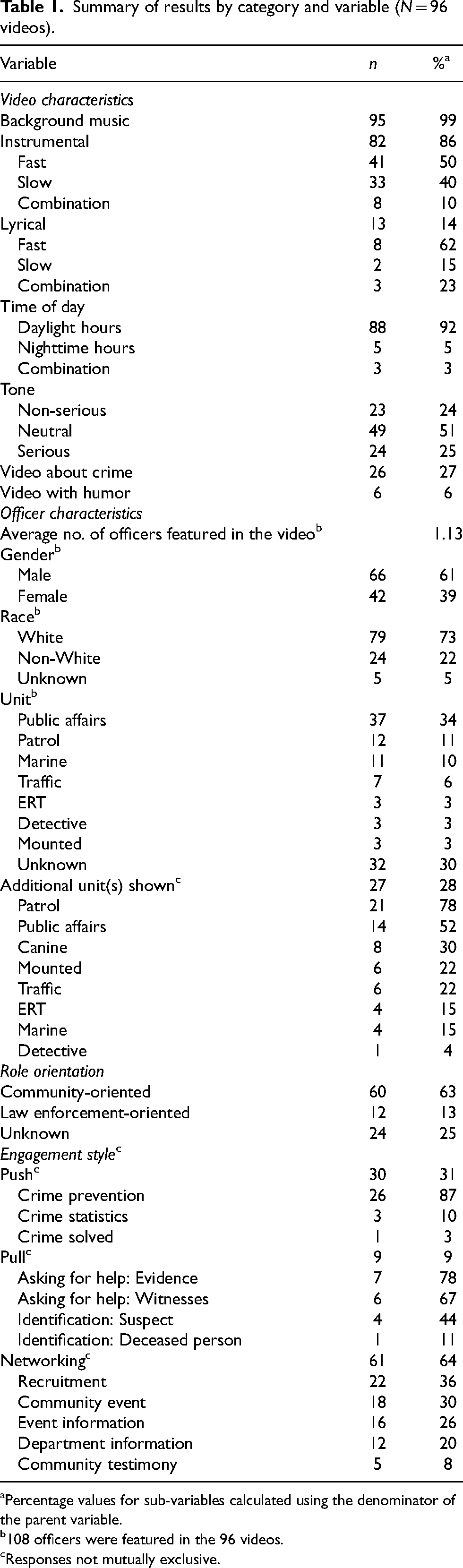
Once we had compiled our final sample of videos, we next developed a codebook to use when coding each video. Our approach to coding was similar to that of previous research (Huang et al., 2017; Lieberman et al. 2013; Simpson, 2023). We collectively identified a list of all relevant variables that could be coded in each video and then grouped them into four categories: (1) video characteristics, (2) officer characteristics, (3) role orientation, and (4) engagement style (Table 1). Although some of our variables allowed open-ended responses, most were dichotomous to promote greater efficiency and reduced subjectivity. From our codebook, we then created a spreadsheet that we used to carefully code each video.
Summary of results by category and variable (N = 96 videos).
Percentage values for sub-variables calculated using the denominator of the parent variable.
108 officers were featured in the 96 videos.
Responses not mutually exclusive.
To ensure precise and systematic coding, the lead author reviewed each video a minimum of three times during the coding process. This triple-viewing approach helped to ensure rigor as well as allow for a comprehensive understanding of the video content. Familiarity with the video content was necessary to ensure that all relevant information was appropriately coded for analysis. During the coding process, both authors regularly communicated about coding decisions. To enhance intra-rater reliability, the lead author also completed the above coding process for each video twice (on two different occasions) and rectified any discrepancies.
Before proceeding to the results, we note that the focus of our research was on the VPD's use of TikTok rather than the public's engagement with the VPD's TikTok content. From this perspective, examining specific metrics of user engagement, such as “likes” on videos, was outside the scope of the current research. We hope that our research will serve as a catalyst for future studies in this domain, including those which will examine user engagement.
Results
Video characteristics
Several patterns surfaced as dominant during the analyses of video characteristics. First, nearly all videos included background music. Of these videos, 86% included an instrumental track, whereas 14% included a lyrical track. Concerning tempo, half of the instrumental tracks had a fast tempo as did approximately two-thirds of the lyrical tracks. Upbeat music was thus prevalent in many of the VPD's TikTok videos. This trend in music is consistent with findings regarding police recruitment videos (Simpson, 2023), and may be a way of drawing attention and excitement toward the content of videos.
Different activities correlate with different times of day. Here we find that the majority of videos appear to have been filmed during the daylight hours (92%), with 5% filmed during the nighttime hours and 3% filmed during a combination of daylight and nighttime hours. Regarding tone, 24% of videos were relayed in a non-serious tone (i.e., lighthearted, informal), 51% were relayed in a neutral tone, and 25% were relayed in a serious tone (i.e., urgent, formal). Across all videos, approximately 27% were specifically about crime. Only 6% of videos included humor, with the intent to be funny. These findings suggest that humor—in particular—may not be the driving factor for popularity among the VPD's TikTok videos, despite past research finding that humor is a means for enhancing popularity on police social media (Hu and Lovrich, 2021; Wood and McGovern, 2021).
Officer characteristics
The average number of officers featured per video was one, with a range of zero to four officers—noting that “featured” implies that the officer was made salient within the video (i.e., they were not simply present in the background). The majority of featured officers appeared to be male (61%) and White (73%).
In terms of units, 34% of the featured officers appeared to be from the public affairs unit, 11% from patrol, 10% from the marine unit, 6% from the traffic unit, and 3% from the emergency response team (ERT), detective, and mounted units, respectively. Interestingly, no officers from the canine unit were explicitly featured in the videos, despite their common use in public relations efforts (Sandrin et al., 2023). We could not assess the specific units for the remaining 30% of featured officers due to a lack of information. The emphasis on spokespersons within these videos as well as the characteristics of officers featured in such videos reflects findings from recent research regarding police spokespersons in the USA (Simpson and Wetherell, 2020).
Across all videos, 28% displayed additional officers in the background of the video (i.e., ancillary to the video's main focus). The majority of these officers appeared to be patrol officers (78%). In addition to patrol officers, officers from the public affairs unit (52%), canine unit (30%), mounted unit (22%), traffic unit (22%), ERT unit (15%), marine unit (15%), and detective unit (4%) were also sometimes included. The inclusion of these officers arguably emphasizes the nuance in policing responsibilities and the potential diversity inherent to police career paths. The limited inclusion of detectives, who traditionally conduct their work from inside the police station as opposed to out on the streets, may speak, again, to a focus on the proclaimed excitement of police work.
Role orientation
We classified the role orientation of videos into two categories: law enforcement-oriented and community-oriented. Across all videos, 63% were coded as community-oriented and 13% were coded as law enforcement-oriented. This finding suggests that TikTok may be used less for traditional law enforcement purposes when compared with other social media platforms as historically studied. This finding also suggests that the police's approach to TikTok videos may be different from their approach to other kinds of police videos, such as recruitment videos, which often highlight traditional law enforcement functions (Simpson, 2023). The role orientation for the remaining 25% of videos was coded as unknown given that they did not fit clearly into either the law enforcement- or community-oriented category. Most often, these videos featured a single officer discussing their career as a police officer, making it challenging to assign them to a specific orientation type.
Engagement style
As introduced earlier, social media posts can reflect three strategies: push, pull, and networking. Across all videos, 31% represented the push strategy. Within this category, 87% of videos were dedicated to crime prevention, providing education to the community about safety measures and proactive approaches for reducing crime. In addition, 10% of videos included crime statistics and 3% of videos depicted crimes solved by the police. Consistent with previous research, the VPD thus uses TikTok to push information, although at a lesser frequency than has been observed among other police agencies and/or social media platforms.
Less common than push videos were pull videos. Only 9% of videos represented the pull strategy—the least of any of the three strategies. Among videos in this category, 78% requested evidence about a crime, 67% requested witnesses for a crime, 44% requested identification of a suspect, and 11% requested identification of a deceased person.
Most common across all videos were networking videos. Approximately 64% of videos represented this strategy. Although TikTok is not necessarily known for textual-based interaction, which would be more traditionally associated with networking, we recognize that the police can still engage in the principles of networking via TikTok by facilitating two-way engagement and collaboration via their video content. Most videos classified as networking targeted recruitment (36%). These videos aimed to entice potential candidates to join the VPD and directly participate in the pursuit of policing. Following videos regarding recruitment were videos regarding community events (30%), which served to promote public–police engagement. A further 26% of videos provided information about upcoming events and 8% of videos featured community testimony, emphasizing the impact of the VPD's efforts on persons and communities. Of note, most community-oriented videos (60%) emphasized the networking strategy, whereas most law enforcement-oriented videos (83%) emphasized the push strategy.
Discussion
Social media permeates many elements of contemporary society, including policing. Police agencies employ social media for a variety of reasons, including to disseminate information to—and collect information from—the public. Most existing research in this domain has explored the police's use of Facebook and Twitter—in large part because these social media platforms have existed for longer and hence have been adopted by more police agencies over time. However, new social media platforms are continuously being adopted by the police and potentially for new purposes. As part of the current research, we explored one such emerging platform: TikTok. Specifically, we assessed the content of all TikTok videos posted by the VPD during an 18-month period for their themes and messages.
We found numerous patterns in the characteristics of the VPD's TikTok videos. For example, most videos included background music, typically of the instrumental variety with fast tempos. Most featured officers in the videos were from the public affairs unit, although officers from other police units—such as patrol, the marine unit, traffic unit, and ERT unit—were sometimes featured as well. In terms of characteristics, most featured officers appeared to be male and White.
Contrary to the findings of some related research, most videos did not regard crimes. Instead, most videos were classified as community-oriented and emphasized a networking strategy. Although some characteristics of these videos were similar to those of other types of video content produced by police agencies, the focus on networking and community-oriented content among TikTok videos was quite novel. Indeed, what these results suggest is that the VPD—as one example—may be using TikTok differently than other social media platforms as historically studied.
Nonetheless, two themes (or “groups”) of videos emerged as particularly salient within the VPD's TikTok portfolio: videos regarding crime prevention and videos regarding recruitment. Videos regarding crime prevention comprised nearly all those classified under the push strategy. These videos generally provided tips for viewers to avoid being the victim of crime. For example, one video depicted a hypothetical elderly scam, aiming to educate the public about how to protect the elderly from fraud. They typically were filmed during daylight hours, featured a single officer (often male) from the public affairs unit, and exhibited a neutral tone with a mix of music types. Videos regarding recruitment 5 comprised roughly one-third of all those classified under the networking strategy. These videos generally provided information about the VPD's recruitment process and/or offered reasons for prospective applicants to apply for careers with the VPD. These videos were generally quite diverse across all of the variables examined. For example, they contained a mix of female and male officers of a variety of different racial backgrounds. They also highlighted officers from many different police units and included instrumental music tracks with fast tempos.
Our work exhibits several important implications. From a scholarly perspective, our work suggests that researchers should consider the nuance among social media platforms when discussing the use of social media by the police. Different platforms cater to different populations of users and—for such reason—may be used by the police for different purposes. Different platforms also facilitate different forms of content. Although the police can technically still post a video on Facebook, all posts on TikTok would be videos as a function of TikTok's structure. Unpacking the nuance among platforms may provide more informed insight into police practices than treating the police's use of social media as homogenous.
From a practitioner perspective, our work suggests that police agencies should remain intentional in their use of different social media platforms—assessing needs and addressing said needs via careful implementation and application of social media. Because of the different functionalities of different social media platforms, police agencies may maximize engagement with their communities of interest by meeting such communities on the platform they most often frequent. For example, whereas Facebook may be a more appropriate platform for reaching mature populations, TikTok may be a more appropriate platform for reaching younger populations, recognizing that different age groups exhibit different policing needs. 6 Police agencies may also better communicate messaging by choosing platforms that best facilitate the delivery of their message. For example, whereas Facebook and Twitter are more textual-based, with Facebook allowing lengthier posts than Twitter, TikTok is video-centric. As but two examples, police agencies may use Twitter to announce crime investigations and TikTok to demonstrate crime prevention techniques (although we recognize that the police could also link to and/or post such videos via Twitter, albeit a redirect would be ancillary rather than focal to the Twitter post).
Police agencies that do not use social media, or at least not TikTok, may also wish to consider whether TikTok would be helpful to add to their social media portfolio. With that being said, we recognize that the addition of a new social media platform adds new responsibilities for content creation and user engagement, which may not be feasible for all police agencies. We also acknowledge that rules and regulations may affect the police's ability to even use different social media platforms. Most relevant here, the Canadian government has banned the use of TikTok on government-issued mobile devices (Granados, 2023).
Limitations
Several limitations should be acknowledged in the interpretation of our study's findings. First, we only examined one police agency's TikTok account, which limits the generalizability of our findings. Second, and consistent with related research, there may be some unintentional error in the coding of our variables. For example, it is possible that the lead author may have accidentally missed certain elements during the coding process. Although we made efforts to enhance the reliability via our coding procedures, the inherent subjectivity in some of our variables, such as humor, 7 posed additional challenges for objective assessment. Because of our specific focus on the VPD's use of TikTok, we also did not examine the nuanced ways in which viewers may have internalized the content of each video. For example, we did not analyze “likes” or other forms of user engagement as part of the current research. We also did not survey potential viewers of videos about what they thought was salient in each video. Future research should consider how viewers internalize the content of police TikTok videos as well as how perceptions may differ by the type of audience.
Conclusion
Our exploratory study delved into largely unchartered territory by empirically examining the VPD's use of TikTok: a social media platform centered around creating, sharing, and watching short videos. Our findings not only provide valuable scholarly and practical insights into the police's use of TikTok, but also encourage new lines of research related to policing and social media. Indeed, our findings regarding TikTok reveal a noticeable departure from traditional law enforcement approaches to social media. Unpacking whether this departure may be unique to the VPD as a police agency, TikTok as a social media platform, and/or part of a broader change over time in police use of social media will be important moving forward. As police agencies begin to use new social media platforms, research should examine police practices and assess their implications for policing outcomes.
Footnotes
Declaration of conflicting interests
The authors declared no potential conflicts of interest with respect to the research, authorship, and/or publication of this article.
Funding
The authors received no financial support for the research, authorship, and/or publication of this article.
