




Abstract
Although literature on police use of social media is expanding, almost all previous research has focused on police services. Existing literature has not examined the social media communications of multi-jurisdictional police unions and other associations. Unions represent police members during collective bargaining. Multi-jurisdictional police associations represent a specific issue or demographic within policing. We examine Twitter use by multi-jurisdictional police unions and associations in Canada. Although we demonstrate that there is variation by type of organization, we nevertheless contend the central aim of these union and associations communications is to provide horizontal legitimacy spillover, legitimizing not only police officers across Canada but the police institution itself. In conclusion, we reflect on what these findings mean for literatures on police social media communications and police unions and associations.
Introduction
Public police use social media for everything from emergency alerts to public relations management (Van de Velde et al., 2014; Procter et al., 2013). They also curate images and rhetoric to foster positive representations of police in the social media landscape, meaning that police social media communications are a form of image management (Wood, 2020; Ellis, 2019; Bullock, 2018). Police respond to social and political issues on social media in ways that deserve academic inquiry because these communications can shape criminal justice responses and public views of criminal justice institutions.
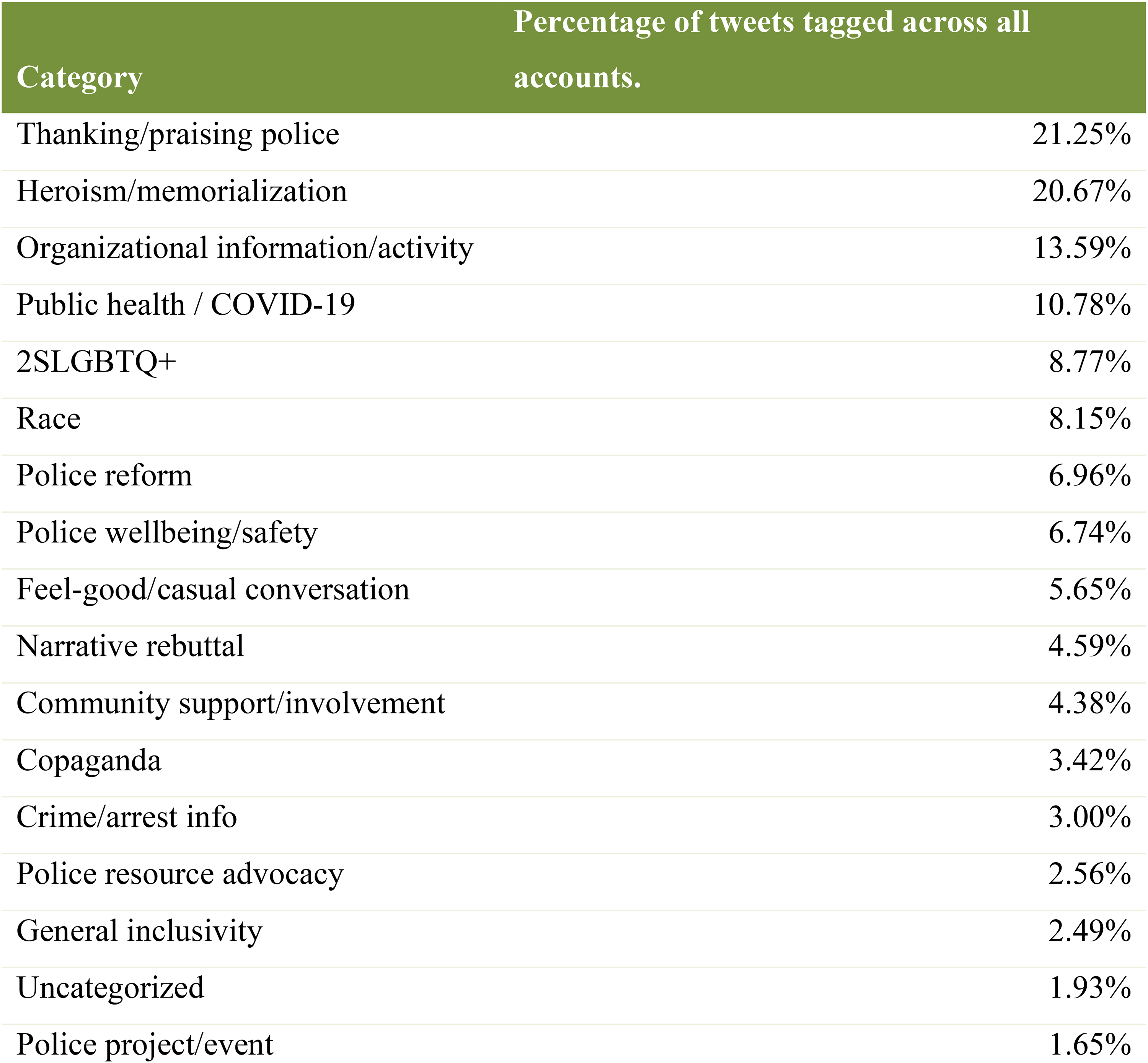
Percentage of tweets tagged under each category across all accounts.
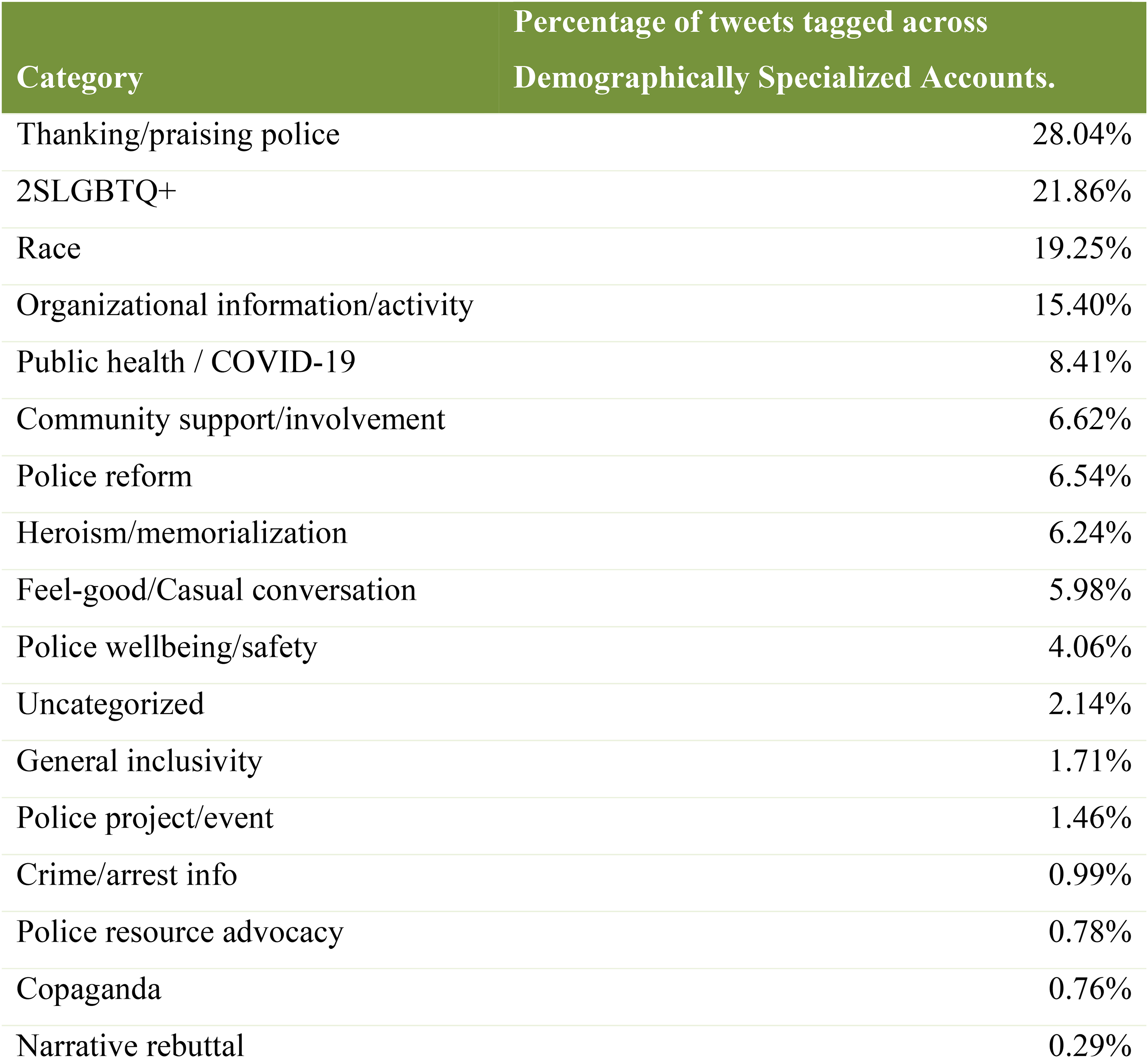
Percentage of tweets tagged under each category across all demographically specialized accounts.
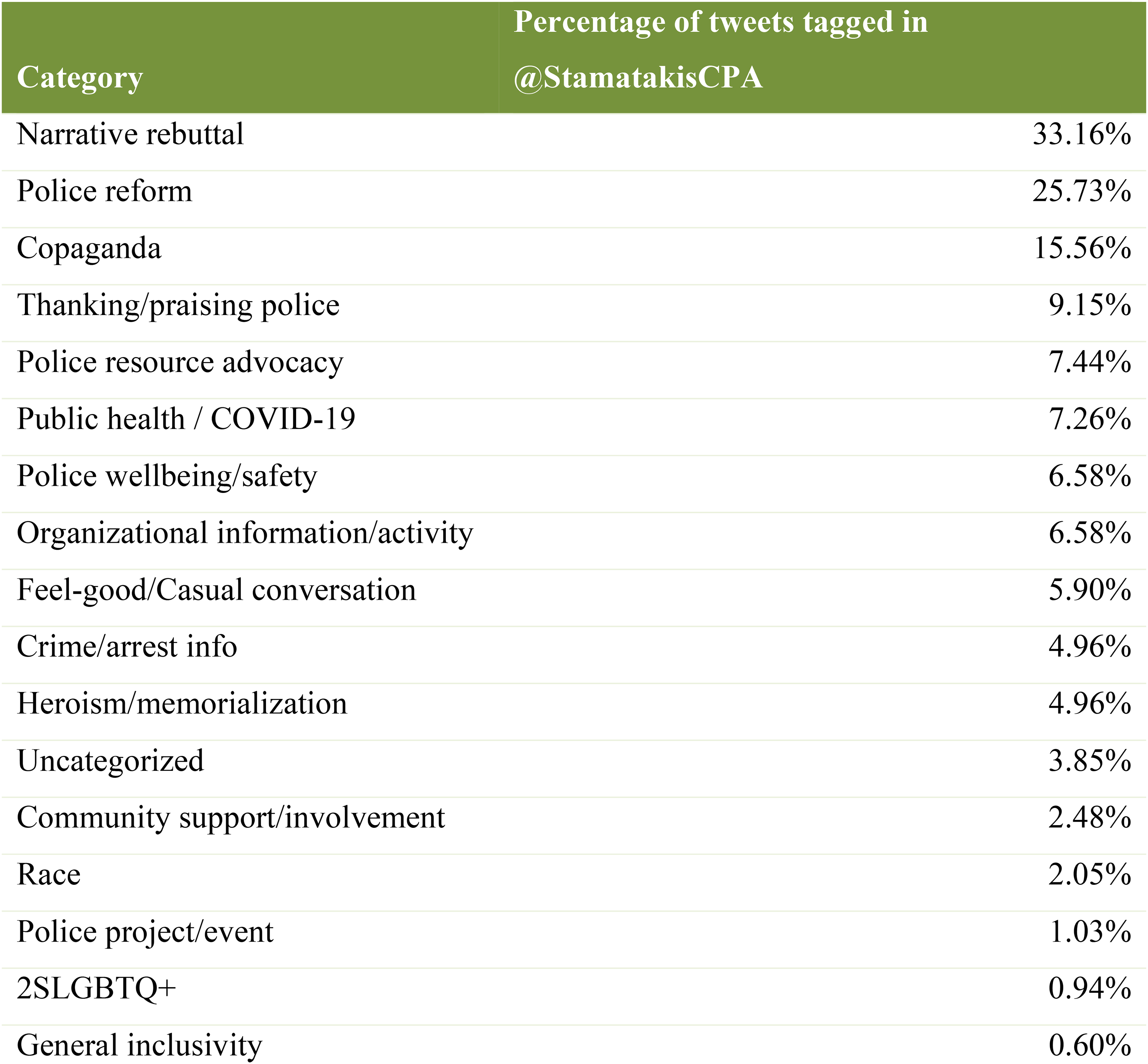
Percentage of total tweets tagged under each category in @StamatakisCPA.
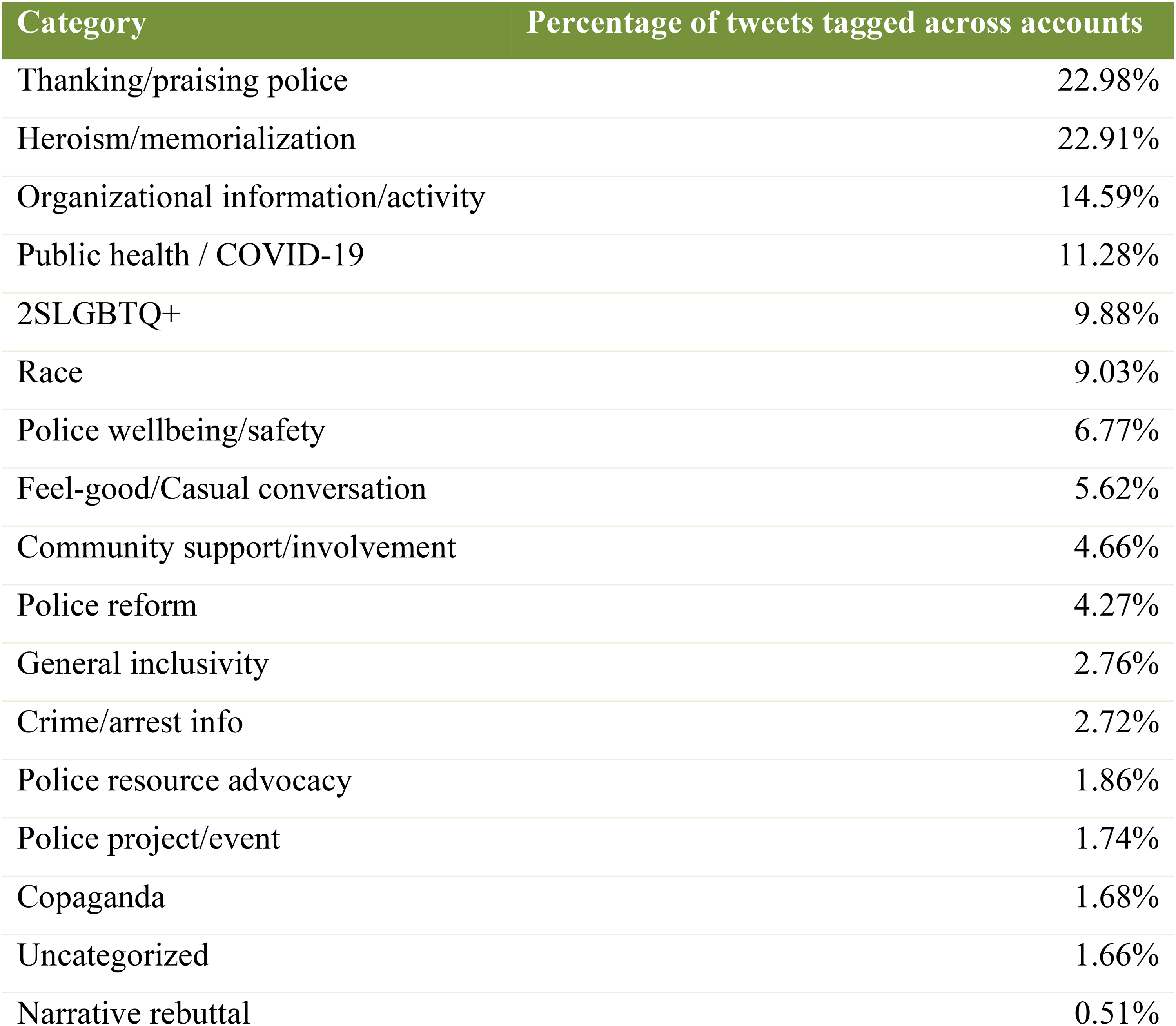
Percentage of each category found across all accounts except for @StamatakisCPA.
To date, most literature on police social media use has focused on police services. This literature has not examined the online communications of multi-jurisdictional police unions and associations. We examine Twitter use by Canadian multi-jurisdictional police unions and associations. In Canada and in other countries, police unions are often called associations (e.g., Toronto Police Association). These unions represent police members during collective bargaining (Berry et al., 2008; Fleming et al., 2006; Finnane, 2000) and are involved in municipal or local politics. However, there are entities that span jurisdictions often referred to as police associations that represent the voice of police from more than one police service or agency. For example, Black police associations represent the interests of Black police officers from multiple police services (O’Neill & Holdaway, 2007). These multi-jurisdictional police associations represent a particular issue or demographic within policing. These police networks are akin to lobby groups that represent the interests of police on a state, provincial, regional, or federal level (Savage et al., 1996). We focus on a sample of both types of organizations to assess how they communicate using social media. It is important to examine the social media use of these organizations because they are often explicitly political at the municipal, provincial, state and federal levels of government. Additionally, little is known about the social media use of such organizations in Canada or elsewhere. To examine issues of police image management and legitimacy, our analysis investigates the frequency and content of messaging from a sample of these organizations from across Canada. Examining these communications contributes to literature on police image management on social media as well as literature on police associations and unions. Moreover, we offer a typology of police association social media communications that adds to literature on police social media use (Crump, 2011).
First, we review the literature on police communications, police social media use, and police legitimacy. Second, we provide a note on our research methods. Third, we offer our findings. We find that while there is variation by type of organization, the primary intent of these online communications is to enhance police legitimacy among the public as well as boost morale and solidarity among officers. Based on these findings, we argue these social media communications provide horizontal legitimacy spillover (Wood, 2020), legitimizing not only police officers across Canada but the police institution. Finally, we reflect on what our findings mean for literature on police social media use and police image management.
Literature Review and Conceptual Framework
Police social media use reflects a mix of crime-related and public relations-oriented messaging (Walby & Wilkinson, 2022; Van de Velde et al., 2014; Procter et al., 2013; Lieberman et al., 2013). To make sense of this variation, Crump (2011) provides a typology of police social media users including broadcasters (trying to reach as many as possible), knowledge gatherers (monitoring the police profile but also conducting surveillance), and community facilitators (networking) (also see Meijer & Thaens, 2013). Adding to this view, Hu et al. (2018) draw from literature on policing styles to make sense of police social media use in the United States. They find some police services are more crime focused in social media use, whereas others are more focused on local neighborhood relations (also see Hu & Lovrich, 2019). Wood (2020) examines the use of memes by public police on social media, finding that police use humor and images of animals to expand their list of followers and to make more affective connections with the public. In Canada, literature to date has similarly observed that police use multiple strategies on Twitter and other social media sites to curate their image and to manage public views of police work (Walby & Joshua, 2021; Walby & Gumieny, 2020; O’Connor, 2017; Schneider, 2016). Public police communicate and create their own images online in part because of ongoing tensions with news media (Duncan & Walby, 2022; Ellis & McGovern, 2016).
This variation in social media use raises the question of whether police Twitter and Instagram communications replicate traditional police culture. De Graaf and Meijer (2019) found that social media use by police may create contradictions as well as role and value conflicts. Although social media is associated with visualization and transparency, police culture is largely based on secrecy and control. Social media use by police might create expectations for them to be more open and transparent. Schneider (2016) revealed that some police members continue to post institutionally aligned content even while off-duty, which further softens images of police and may improve police legitimacy.
The power to represent police practices can shape public views of social control. All social media users generate content, though this does not necessarily diminish social hierarchies as large organizations have more resources to generate and circulate their communications. Police services have communications teams that undertake the work of social media messaging. To this end, police manage and release information based on what they internally refer to as the social media test (Ellis, 2021), leading to a more careful curation of the police image. However, not all police associations have communications teams, shaping the types of messaging we examine below.
It follows that police social media use must be evaluated as part of police efforts at image management (Ellis, 2019; Mawby, 2013). For Lee and McGovern (2013b), police social media use follows three main logics: (1) improving the image of police, (2) downloading risk and responsibilization, and (3) boosting trust and legitimacy. In one sense, police social media use is an expression of what is called police voice (Charman, 2011; Loader & Mulcahy, 2001), which has implications for improving the image of police. However, literature on police social media use to date has tended to focus on police voice as communicated by police executives and managers. Police voice is a discourse that police communicate across jurisdictions and conveys a sense of police expertise, bravery, heroism, and authority. However, this literature has not explored how police voice is communicated in the online social media posts of police associations and unions. The tone and content of police association and union communications also vary from what police services post, thus it is key to investigate this corpus of online communications.
Given this focus on communications and digital culture, viewing police through a law enforcement lens alone provides an impoverished view of police as a political and economic institution. Their communications and public relations work are deserving of investigation. As attempts to influence local governments and municipal budgets (Duncan & Walby, 2022), police communications are political (Walby & Joshua, 2021; Wall, 2020). These communications may also be attempts to garner legitimacy or boost trustworthiness, meaning that research on police social media use also has implications for literature on police legitimacy (Tankebe, 2013; Tyler, 2004). The focus on improving legitimacy is a consistent finding in literature on police media communications and police public relations management (Ellis, 2019; Lee & McGovern, 2013a; Mawby, 2013). For example, Grimmelikhuijsen and Meijer (2015) found police social media use can enhance perceived legitimacy and trustworthiness. Intravia and colleagues (2020) found negative messaging about police online decreases perceived legitimacy and trustworthiness. These findings demonstrate the importance of social media for police as a realm of meaning making and framing. Wood (2020) argues police social media use is curated to promote police legitimacy. They argue this takes two forms: “horizontal engagement spillover, in which increases in social media engagement driven by one form of post lead to increases in engagement with other content posted by an organisation, and vertical legitimacy spillover, in which legitimacy generated by one unit of an organisation is transferred into the organisation in general” (p. 42). We examine the extent to which the communications in our sample represent forms of legitimacy spillover by assessing the frequency and content of messaging on social media made by police associations and unions.
Research Design and Methods
Online communications are a domain of connotations and denotations deserving of scholarly inquiry (Stratton et al., 2017). It is essential to examine these communications over time to assess whether patterns exist. We collected Twitter communications from multiple police organizations over a seven-month period (January 1, 2020 – July 6, 2020). In addition to quantifying the communications on these pages and cataloging the form and content of these communications (see Valverde, 2006), we followed the pages for five months to gain a better qualitative sense (speed, tone) of how they responded to other posts and to be informed on their activities (Murthy, 2008). In other words, we immersed ourselves in these online communications to locate trends and patterns (Coleman, 2010). Beyond trends that become visible through quantification, we are also interested in the discursive patterns (Altheide & Schneider, 2012) that appear in these communications.
We focused on multi-jurisdictional police organizations. After reviewing our data, we decided these organizations could be sorted into three types: general, demographically specialized, and personalized. In the general category, we include the National Police Federation, the Ontario Association of Chiefs of Police, the Canadian Association of Chiefs of Police (CACP), and the Ontario Provincial Police (OPP) Association. The National Police Federation represents 20,000 RCMP members. The Canadian Association of Chiefs of Police was founded in 1905 and created a permanent secretariat in Ottawa to lobby the federal government (Marquis, 1993). The Canadian Association of Chiefs of Police represents Chiefs, Chief Constables, and other police executives and managers. The Ontario Association of Chiefs of Police is similar to the CACP but for the province of Ontario. The Ontario Provincial Police Association represents OPP members. In the specialized category, we include the Ontario Women in Law Enforcement, Serving with Pride, and the Association of Black Law Enforcers. Ontario Women in Law Enforcement represent women in policing in Canada’s most populous province. Serving with Pride represents gay, lesbian, bisexual, and trans law enforcers across the country. The Association of Black Law Enforcers represents Black law enforcers across the country. In the personalized category, we include the Canadian Police Association. The Canadian Police Association represents over 60,000 public police across Canada. Due to the content on the Twitter page, we describe the type of forum as a personalized social media page.
Only English tweets have been tagged in this study. Of the French language tweets reviewed, the majority appear to be French translations of existing English tweets, meaning few communications have been missed by excluding the French tweets. Those that were not direct translations were often retweets from a French-language account and not original messaging from the account. Excluding French tweets prevents these translated communications being counted twice and doubling the tags attributed to these communications. Assessing the social media use of police in the French-speaking province of Quebec remains an important topic of study for future research.
Communications were collected from Twitter using vincinitas.io, which is a tool that directly scrapes data from Twitter through the Twitter API and exports them into an excel document. Scraping is a technique of gathering a corpus of texts using automated computer tools (Marres & Weltevrede, 2013). From these data, seventeen categories were generated using inductive, thematic coding and analysis techniques (Hsieh & Shannon, 2005; Attride-Stirling, 2001). This included one “uncategorized” classification meant to include atypical communications that did not fit in the others. Uncategorized communications account for 1.93% of all data and is the only category that does not overlap with another. Communications tagged under any other category could be simultaneously categorized under any number of additional categories to best represent the multiple themes a communication may interact with.
Each category was created inductively to represent its subject matter as narrowly as possible while still identifying commonalities. Multiple revisions were made to confirm consistent coding applications. This resulted in the creation of 17 categories in total, titled by a prevailing theme or subject matter contained within the communications of that category. Communications were included in a category if they engaged with the category theme, described by the title. Communications could interact with the category directly or indirectly, positively, neutrally, or negatively. “Retweets” were included in these communications and were interpreted alongside any additional caption created by the host account. If an account reposted a communication without adding their own comments, the communication was considered an original communication from the account. Images, “hashtags,” and links to outside material were assessed during the coding process to represent the messaging as holistically as possible.
The content of these online communications of multi-jurisdictional police unions and associations is discussed further in our findings below. Our findings are organized by account category, which allows us to assess trends within these categories and compare them against other account types. By taking this approach, we describe how each account works in its own way to promote the legitimacy of the police institution within Canada.
Research Findings
Police association accounts do not seek to represent specific police in certain cities. Instead, they represent certain policing demographics as a whole at a national or provincial level. The demographics that these associations purport to represent position these associations as uniquely able to advocate on behalf of policing as an institution across Canada. Despite not accounting for all of policing within Canada, nor having any governmental or judicial authority, these accounts all have large audiences and influence among police. Following Wood’s (2020) description of “vertical legitimacy spillover,” where one police officer’s social media account works to legitimize an entire precinct, we argue that these accounts similarly perform horizontal legitimacy spillover. The supra-jurisdictional form of these associations broadens the scope of their legitimizing efforts far beyond a regional chain of command and toward a national, institutional representation of police. Here, the legitimacy and image work that they perform permeates horizontally and “spills-over” to bolster not only uniformed officers across Canada but policing as an institution itself.
The contextual period of communications (spanning the summer of 2020) that we have examined is significant for the large-scale protests leveled at police during this time. Despite social unrest, not all accounts directly engage with many of the parties or critiques involved. The key activist group, Black Lives Matter, is only mentioned once while the counter-movements of Blue Lives Matter and All Lives Matter are not mentioned in these communications despite their prominence in other police social media (Brock & Figueroa, 2017). However, topics associated with these movements are engaged with to varying degrees, most prominently among the specialized accounts.
Each account is ubiquitously positive in regard to policing. Many focus on highlighting the achievements and recent milestones of various officers across the country as well as commemorating those who have died or suffered the injury. Among the General Police Accounts, there is an emphasis on “safe” positive communications and neutral information-based communications about public health or events. There was also a high number of communications regarding mental health. These communications were mostly directed toward police officers, but many expressed concerns over the general public as well.
Lee and McGovern (2013b) describe the central logics of police engagement with media that are reflected within our findings. The information-based communications about public health orders, crime statistics, or event updates represent a focus on the management of public risk and responsibilizing the public. Communications that feature praise and memorialization represent image management while depicting police officers as heroic. The third logic described by Lee and McGovern, increasing trust and legitimacy of policing, also exists in our data, but this logic becomes more pronounced for accounts such as @ABLE_org, @LGBTQ911, and @StamatakisCPA as they engage with critiques of policing more heavily than other accounts.
General Police Accounts
The accounts included within this category include the accounts from the National Police Federation, the Ontario Association of Chiefs of Police, the Canadian Association of Chiefs of Police, and the Ontario Provincial Police Association. These represent what we have termed “General Police Account” as, in contrast to other accounts, their communications are relevant to a broad selection of police officers. Although no account claims to represent all police personnel across Canada, their respective scopes are broad enough to be considered “general.” Such communications serve the function of managing the general image of police (Mawby, 2014; Lee & McGovern, 2013b).
Among these accounts, there is an emphasis on image management as these communications are heavily focused on publicly commemorating and praising police officers. Posts expressing ideas of police heroism or memorialization were the most common and were present in approximately 35.4% of all communications made by these accounts. Posts publicly thanking or praising officers comprised approximately 19.2%. The presence of these two categories demonstrates a primary goal among these accounts to honor and praise rank and file police personnel, building broader public awareness and potentially generating stronger solidarity among officers.
The high average of 35.4% for the category Heroism and Memorialization is skewed due to two of the accounts. The National Police Federation’s account was almost entirely devoted to these types of communications with 83.1% of all communications being tagged as such. This was in large part due to their response to the mass shooting that occurred in Nova Scotia during April 2021, which claimed the life of responding RCMP officer, Constable Heidi Stevenson. In the days following the attack, the National Police Federation retweeted hundreds of tweets (660) from other accounts offering their condolences and support for those affected. These retweets were often accompanied by a simple message added to the original tweet: “Thank you. #WearRedFriday.” #WearRedFriday was a prominent hashtag campaign promoted by the National Police Federation which encouraged Canadians to wear red clothing on the Friday following the attack to honor the death of Cst. Heidi Stevenson.
The Ontario Provincial Police Association also devoted a significant amount of content to the category Heroism and Memorialization. Tweets in this category comprised of 45.7% of all communications from their account—approximately half as much as the National Police Federation. Comparatively, the Canadian Association of Chiefs of Police, as well as the Ontario Association of Chiefs of Police, shared significantly fewer communications that dealt with heroism or memorialization of police personnel, with 7.1% and 5.8%, respectively. A similar decline in the Thanking and Praising Police category was not observed, as that was one of the most frequent categories across all accounts except for the National Police Federation.
These positive communications that praised police officers are equally emphasized across each account. Highlighting these positive accomplishments helps portray the police as competent and efficient, strengthening their public image. Heroism and memorialization posts, however, evince a clear split in usage across these accounts in their image management. This difference between the chief of police associations and the more rank and file associations is perhaps a result of a difference in mortality rates between the demographics they intend to represent. After all, the majority of heroism and memorialization tweets came after the death of Cst. Heidi Stevenson. Perhaps this signals a hesitancy to depict the tragic aspects of policing on their media pages, although there is a dimension of solidarity-building with this messaging as well.
Image management, however, is not the only focus of these communications. Each account within this category made an effort to provide information to the public. Communications discussing aspects of public health, including COVID-19, as well as organizational information and updates each comprised approximately 13.5% of all communications. This secondary emphasis on information-based communication shows that these accounts engage with responsibilization messaging not only around COVID-19-related public health but also mental health. Many of these communications were directed toward connecting people with the mental health support they may need. Other communications explained the need for increased attention to mental health issues by highlighting the risk of mental health trauma that policing personnel face. This understanding of mental health carried over into police reform/defund discourse. Many concerns about the risks posed by having police officers respond to civilian mental health crises were raised during the summer of 2020. However, police unions and associations diverged from their critics and called for increased police funding to mental health support for officers. 1
These General Police Accounts display a focus on two of the three logics described by Lee and McGovern (2013b): image management and responsibilization of the public. Messages of praise depict the police as efficient and effective, strengthening public perception of their utility. Mental health and COVID-19 communications demonstrate efforts by these associations to provide information and utility to the public as well. Responsibilization of the public in this way is less connected to crime statistics (though they are present) and more with public health. Although COVID-19 communications are not surprising considering the significance of the pandemic, the emphasis on mental health demonstrates a concern among these associations. Communications regarding trust and legitimacy are limited, and this logic is only engaged with passively as these communications build awareness and social media awareness of the police. Contrary to the specialized accounts, trust and legitimacy are secondary concerns for these accounts.
Demographically Specialized Accounts
Three of the associations targeted the non-geographical or occupational demographics of policing personnel. These are the Ontario Women in Law Enforcement, Serving with Pride, and the Association of Black Law Enforcers. These associations aim to represent women, 2SLGBTQ + , and Black police personnel, respectively. The development of these organizations has been necessary due to sexism and heterosexism faced in policing (Yu, 2015; Cordner & Cordner, 2011; Shelley et al., 2011) as well as racism (Jordan et al., 2009). The communications made by each of these accounts differ from one another as each focused on communications relating to the demographic they represent. Communications that addressed aspects of race, gender, or the 2SLGBTQ + community were made by these accounts primarily. Communications relating to the associations represented demographic often amounted to 55–65% of all communications made by that account. In contrast, the General Police Accounts rarely exceeded 3% for any one of these topics. These demographically focused communications and their representation demonstrate an effort to build trust and legitimacy in these marginalized communities. Contrary to the General Police Accounts, trust and legitimacy are actively boosted across demographically specialized accounts (also see Lee and McGovern, 2014).
Communications from @ABLE_org recognized the painful history of Black people in the Americas related to both the police and their experience of racism. This included the perception of Black police officers as traitors within their communities. One tweet from @ABLE_org linked a BBC article discussing this issue and included the caption “Black and in the police: ‘I’ve been called a traitor’.” 2 In the wake of protests across Canada and the United States, one article by the CBC was retweeted by @ABLE_org which highlighted the conflicting nature of being a Black police officer. “‘I recognized that they were chanting at my uniform and what my uniform represents,’ said Stacey Clarke, one of the highest ranking Black police officers in Canada.” 3 Contrasting with other accounts, @ABLE_org demonstrates a more holistic engagement with contradictions within policing and signals an earnest attempt to bolster trust and legitimacy.
Further engagement with the public critiques of policing are shown in a tweet posted June 29, 2020: “The implementation of true “Change” will allow for all in our society to feel safe, which will commence the return of societal Trust.” This accompanied images detailing the time and location of a protest advocating for “real action” in policing, law enforcement, and the justice system in Toronto. 4 @ABLE_org acknowledges that change must happen before societal trust can be restored in policing. In contrast to other accounts, this shows an effort by the Association of Black Law Enforcers to confront the issues presented by the public rather than deflecting responsibility for them. Each of these examples reveals an attempt to confront the history of the Black community and the police and emphasizes the need to build trust and legitimacy.
Chan and Lee (1984, cited in Bock & Figuroa, 2018) use the term “protest paradigm” to describe efforts to present protest as deviant and anarchistic. The careful engagement of criticisms by @ABLE_org demonstrates a reluctance to engage with this paradigm. Although not fully legitimizing all aspects of anti-policing discourse, there is an effort to engage with select aspects of it. Other accounts only briefly engaged with any critique or demonstrated increased hostility toward this discourse.
Serving with Pride also made some effort to engage with the history between the 2SLGBTQ + community and policing. The clearest example of this was a retweet of a video describing police raids on numerous Toronto bathhouses in 1981, which they captioned “We take from our history knowledge and understanding; and a resolve to inspire change from the inside, out.” 5 Bringing up this painful history reminds their audience of 2SLGBTQ + persecution carried out by police and, as mentioned earlier, signals an effort to rebuild trust between the communities. Apart from this tweet however, acknowledging past conflict was rare and communications instead focused on the present by praising the many 2SLGBTQ + law enforcement officers across Canada.
During Pride Month, Serving with Pride became very active and challenged other police-run social media accounts to post their own messages and pictures celebrating the 2SLGBTQ + community. Many accounts responded to this challenge and @LGBTQ911 retweeted them, often adding a caption thanking them. Despite Pride Month’s connection to the 1969 Stonewall Riots where New York City police officers violently attacked the 2SLGBTQ + community, Serving with Pride made no connection to this history in their messaging (unlike the 1981 bathhouse raids). Instead they opted to focus on the positivity that Pride Month brings and the representation they have today within policing. This messaging strategy extended beyond Pride Month as well. On April 5, 2020 @LGBTQ911 tweeted “We are asking those who served as a Police Officer to join the challenge of posting a pic of yourself in uniform. A pic, no description. Goal is to flood with positive photos and rid the negativity #PositivePoliceChallenge #InThisTogether.” 6 Participation in efforts such as these to drown-out any negativity shows their dedication to prioritize positive messages.
This strategy reflects a strong focus on image management and explicitly attempts to combat criticism by flooding social media with pictures of smiling police officers. This tendency demonstrates Ellis’ (2019) description of police legitimacy as being “dynamic” and in flux due to online engagement and discourse (also see Ralph, 2021). To combat the apparent decrease in trust and legitimacy of police especially after the police shooting of George Floyd in the United States, Serving with Pride attempted to overwhelm the negativity with these positive messages. Building networks of self-reinforcing positive messages such as these works to both boost morale among officers and build solidarity between them as they cooperate in this messaging strategy.
Ontario Women in Law Enforcement also had a positive messaging strategy. Communications from their account were positive, focusing on celebrating women in law enforcement rather than bringing up any troubled past. The only reference to police reform was a retweet to an hour-long video on the need for gender reform in policing. 7 In response to the protests over police brutality, @OWLECanada participated in the social media trend #BlackOutTuesday where accounts posted a black square for one day in solidarity with the victims. 8 Apart from these two instances, @OWLECanada made tweets thanking or praising female officers and honoring those who had passed, including Cst. Heidi Stevenson. During this period, the association held their 22nd annual OWLE awards where female officers from across Ontario were nominated for exceptional performance in a number of areas. OWLE tweeted updates and the results for each of the categories, sending out a tweet for each of the winners. They frequently tweeted or retweeted congratulatory messages for retirees or women who had reached a career milestone, another tactic for improving morale and solidarity. These communications show career-oriented positivity. Here @OWLECanada engages with image management to depict policing as a career in which women can thrive and makes almost no mention of the barriers they may face.
Personalized Police Account
The Personalized Police Account category only includes the Canadian Police Association’s account @StamatakisCPA. Rather than an account that reflects the association broadly, the Canadian Police Association has instead opted to use the personal Twitter account of their president as the official account for the association itself. This dynamic between personal and institutional communications creates a unique case study as each official communication becomes personal. Police websites and communications may vary, and research has shown police websites often communicate different roles and identities (Sillince & Brown, 2009) through such communications. What has not been explored is the crossover into personal social media accounts that appears to be happening with this type of account as represented by the case of @StamatakisCPA.
The messaging from this account was categorically supportive of the police. Many of the communications from this account appear to be written to emphasize transparency unlike any other account we examined. @StamatakisCPA appears eager to engage with various actors and narratives in order to “set the record straight.” @StamatakisCPA presents itself as a staunch defender of police legitimacy and practice against police reform advocates.
Accusations of systemic racism within police were acknowledged but rebuked with the claim that reform cannot happen so long as societal change has not occurred. @StamatakisCPA retweeted one tweet which read in part: “…Police are hired from their communities…representative of their communities! Problems in policing are representative of society….most tragedies are other systemic societal problems dropped at the feet of the police…last line of defense/support!” 9 This content mirrors thin blue line ideology, which suggests police are the last barrier between order and chaos (Bock & Figueroa, 2018). Wall (2020: 319) notes that to invoke the thin blue line “is to articulate the police as the primary force which secures, or makes possible, all the things said to be at the core of “human” existence: liberty, security, property, sociality, accumulation, law, civility, and even happiness.” This thin blue line trope ignores community and social development, housing, education, and poverty reduction as the variables that can improve citizen well-being. However, in this context, these communications are not only about enhancing police legitimacy but intermittently heightening morale and solidarity among officers whom are members of these associations ostensibly.
In response to calls for the removal of police presence during mental health crises, @StamatakisCPA asserted that police want an alternative, but the funding does not exist and that the responsibility to respond inevitably falls to the police. 10 This appeared to be the area of reform that was most commonly accepted. Many of @StamatakisCPA’s communications and other associations frequently brought attention to mental health issues among police officers. As it was put, “Given the current conversation and largely uninformed or poorly thought out focus on police, does anyone actually care about police officer stress and well being?” 11 This utilization of transparency is strategic as it serves to reframe and recenter the narrative back onto the police as victims, deflecting criticisms.
The extent to which @StamatakisCPA engaged with topics of police reform was far beyond any other account we examined and demonstrates a unique social media strategy. Engagement with these topics focused on the active refutation of the ideas, facts, or figures presented within. These communications made up the largest category, with 33.1% of all communications being engaged in a form of narrative rebuttal, and 25.7% directly regarding police reform. Many of these tweets related to statistics on police violence or injury during police-civilian interaction: “Officers respond to roughly 2.8 million calls for service each year and, on average, 2,215 encounters have involved what’s known as police intervention—less than one per cent of the total.” 12
Other tweets show that @StamatakisCPA is not hesitant to engage in partisanship by directly calling out media or politicians, a strategy unseen with the other accounts. This is seen in tweets such as the following: “Media, critics, & pundits often ignore data/evidence or don’t include as context to any story criticizing police or where police misconduct/excessive force alleged…” 13 @StamatakisCPA’s combative nature extends beyond police matters. Several communications demonstrate that @StamatakisCPA is opposed to the current municipal government in Vancouver, going so far as to retweet a message calling for a snap election. 14 @StamatakisCPA frequently engages in combative rhetoric with journalists (also see Duncan & Walby, 2022). 15 The partisanship shown by these tweets demonstrates an indiscretion similar to what was described by Goldsmith (2015) on the mishandling of police data. Although not disclosing the details of police investigations, @StamatakisCPA is indiscreet in their confrontational and partisan engagement with other actors.
This attitude toward competing narratives is similar to the protest paradigm described by Chan and Lee (1984). It constructs the opposition as deviant and as acting in bad faith. @StamatakisCPA positions critics of the police as misleading. With the legitimacy of policing under threat during this time, this account demonstrates a strategy to fight fire with fire by undermining the legitimacy of critics. Unlike other accounts, such as @ABLE_org, who engaged in a more constructive approach to rebuild trust, this account works to drive partisanship during this time.
The language and topics discussed on this account creates an image of rugged authenticity. Such social media accounts begin to resemble the personal social media accounts of individual officers, which can bring the status of the police institution into disrepute (Goldsmith, 2015). The combative and partisan nature of the @StamatakisCPA account demonstrates a shift toward the active undermining of other media outlets and even politicians. This combined approach serves to legitimize their own account while delegitimizing critics, signaling deteriorating police and community relations. This strategy serves to fulfill two of the logics described by Lee and McGovern (2014), most especially improving the image of police and boosting legitimacy. Image management occurs as critiques are dismissed and recentered onto the police as victims, which secondarily may resonate with officers themselves and boost morale. The public are encouraged to ignore media narratives and look for “the facts” from police sources.
Discussion and Conclusion
Existing literature on police social media use examines the communications of police services. Adding to this area of research, we have investigated the social media communications of a number of police associations and unions in Canada. Although these police associations and unions communicate positively about police, there is variation in the content conveyed. In terms of a methodological contribution, scraping this data using computational techniques allowed us to assemble a large corpus of communications that would not be possible through conventional approaches such as discourse analysis (Marres & Weltevrede, 2013). Computational approaches should be used more in future research on police communications and records, especially as digital culture and policing overlap to a greater degree (Stratton et al., 2017).
In terms of an empirical contribution, this is one of the first investigations of the social media communications of multi-jurisdictional police associations and unions. We suggest these communications fall into one of three types: general, demographically specialized, and personalized. We derived this typology inductively from an assessment of patterns in our data. Despite the variation in content, we argue these communications represent an attempt to boost the legitimacy of the organization representation and the police. Wood (2020) has referred to this phenomenon as legitimacy spillover (p. 42). Some of this legitimacy spillover is occurring for the organization itself, and some is happening more horizontally for all police members across jurisdictions. Police use multiple strategies to achieve legitimacy and we have identified police association and union social media use as another such strategy. We have found these strategies are consistent with the major forms of police social media usage described by Lee and McGovern (2014). However, there is variation. Some of the communications are broad in their approach and attempt to enhance the image of public police generally. We have identified that some accounts engage in forms of legitimization such as “dynamic” legitimization (Ralph, 2021; Ellis, 2019) by focusing solely on positivity while downplaying negativity. We have also identified strategies that are more personalized and use colloquial discourse and transparency to undermine the legitimacy of critics or opponents in the media and politics. Some of the communications are also aimed at heightening morale and solidarity among officers whom are members of these associations. The widespread concern about mental health across these accounts of different types is definitely meant to encourage support for officer well-being/morale.
Within the three categories in our typology—general, demographically specialized, and personalized—we have observed distinct characteristics beyond their representative audiences. General accounts focused on image management through celebrating and honoring various policing personnel across Canada, performing image management to project a depiction of a successful and efficient police force. Among the specialized accounts, there was more nuance and grace. @ABLE_org’s communications demonstrated an active engagement to rebuild trust between communities, while the other accounts, such as @LGBT911, relied on positive image management. The personal account, @StamatakisCPA, adopted a unique strategy. Communications from this account were combative and defensive, regularly interacting with other accounts and members of the public and media to correct them and posting overtly partisan commentary. This activity demonstrated a method to reframe discourse entirely and fulfill all three logics of police media engagement described by Lee and McGovern (2014). Among our surveyed accounts, this account was the only one to demonstrate this re-imagined police-media relationship. However, a number of these communications were retweets from other policing accounts outside of our survey. The presence of these communications originating from other policing accounts may signal the normalization of this relationship between police and the media. Further research is necessary to determine the scope of this trend.
Without explicitly working in tandem, the strategies of these accounts function to build up police legitimacy across Canada. The variation we have identified between these accounts shows the asynchronous fashion in which this legitimacy is assembled (also see Ralph, 2021; Ellis, 2019). Both the broad demographic base represented by these accounts and the communication strategies increase the appeal of this rhetoric to a Canadian audience. Each takes a different approach while indirectly supporting the others as they work toward the shared goal of improving the public image of policing. This mutually reinforcing array of police legitimization permeates horizontally across all levels of policing in Canada, improving the image of local police and the image of policing in general.
Finally, there are several limits to our research design. The efficacy of these strategies to reach the public and the effects of these communications is unexplored here. An analysis of user engagement with these tweets has not been considered. This would require a different research design drawing from audience studies. Given the engagement-driven dissemination of tweets on Twitter, some communications may have reached more users than other tweets. Retweets could cause one user to see a single communication multiple times, reinforcing the message. Evaluating the engagement of these tweets could provide insight into which communications are better received by the public or by other policing accounts. Future research could also explore whether audience engagement is supportive of these communications or whether these communications face resistance from activists and advocates of police defunding (see Jackson & Foucault Welles, 2015). We have not examined the social media communications of other police unions and associations across Canada. Researchers could compare these trends with police associations to patterns in social media use for municipal police unions. Finally, future research should compare these communications in Canada to those of police associations and unions in the United States to assess whether there is further variation.
Footnotes
Notes

Declaration of Conflicting Interests
The author(s) declared no potential conflicts of interest with respect to the research, authorship, and/or publication of this article.
Funding
The author(s) disclosed receipt of the following financial support for the research, authorship, and/or publication of this article: This work was supported by the Social Sciences and Humanities Research Council of Canada, (grant number 430-2019-00089).