




Abstract
In many countries, the right of police to unionise has still not been achieved or has only recently taken place. After decades of pressure, Portuguese police gained the right to unionise in the 21st century. Following legislation in 2002, several national police unions appeared and, in 2019, they had reached a disproportionate total of 19 unions, while working conditions were deteriorating and a Facebook-organised protest started gaining relevance. Through interviews with every police union and the police administration, complemented by secondary data, we first demonstrate how the 2002 law was a structure of opportunity enabling the proliferation of unions driven by individual motivations. Second, we portray how fragmentation of unions contributed to deadlocked negotiations leading older unions and mass media to demand new legislation. We conclude with the relevance of organisational and institutional processes into the provision of objective, predictable and proportional criteria for union representativeness.
Introduction
In some countries, including developed western states, the right of police 1 to unionise has still not been achieved or has taken place only recently (Andreescu and Keeling, 2012; Jauregui, 2018; Marks and Fleming, 2008). The main argument for this police union status quo is a union’s potential to jeopardise security (Adams, 2008; Marks and Fleming, 2006). Nevertheless, the only known cases of public order disturbance are a few historical wildcat strikes in the first half of the 20th century. A second reason for resisting the advance of police unions stems from the police’s commonly conservative stance towards reform (Fisk and Richardson, 2017; Steden and Melhbaum, 2019). However, not all police unions are defensive. There is evidence of police unions taking leading roles in implementing reforms (Fisk and Richardson, 2017), in addition to contributing towards improving police working conditions and relations between police forces and communities (Berry et al., 2008). Despite the controversy, there is little existing research regarding the conditions under which police unions might best develop their potential and make a valuable contribution to policing governance (Henry et al., 2019). Furthermore, research has tended to focus on the Anglo-Saxon context (Berry et al., 2008; Marks and Fleming, 2008; Reiner, 1978), thus not providing much variety in cases.
This article aims to contribute to the literature with evidence on both how the institutional design might be shaped by the unions themselves (Eleveld and Van Hooren, 2017) and the mass media (mainly the press), and how institutional design lead to organisational fragmentation rather than an efficient system of representation. Furthermore, this article advances findings on how one preliminary condition stems from the need for trade unions to hold an influential and plural voice. Our research demonstrates how police unions, associated with different careers, locations and gender among other features (Sklansky and Marks, 2008), may emerge with legitimacy; although objective, predictable and proportional criteria of representativeness must be settled to prevent the dispersal of collective interests.
Within this scope, our article has three specific goals. First, it demonstrates in depth how organisational and institutional processes have a crucial role in fairly shaping the representation function (Guillaume and Pochic, 2011) while pointing out how certain criteria need to be settled for unions’ success and for more rational collective bargaining and coordinated action (Molina, 2007). Second, police forces are among the institutions that are more difficult to reform (Cerezales, 2010). This article, therefore, seeks to draw attention to the role of police unions, namely to the need for effectively representative unions. Trade unions are widely envisaged as democratic organisations (Guillaume and Pochic, 2011) but that is an assumption (Dufour and Hege, 2010), and police unions in particular have received little attention in the literature. Bearing in mind that police unions have yet to be founded in many countries, and in many other countries whether they provide a ‘voice’ to police is under question, it is clearly worth deepening our knowledge about them. Third, the article highlights a national case, Portugal, which follows the general European trend for a centralised police administration (Eurofound, 2016; Recasens et al., 2013), but where a fragmented system of unions, a common feature in other Southern European countries (Larsson, 2014; Molina, 2007; Stoleroff, 2005), has increased tension and even led to conflict. In fact, the recent Portuguese experience with Public Security Police (PSP) unions takes on paradigmatic relevance.
The article is organised into four main sections. We first present a review of the literature on police unions, drawing attention to the trend towards police union conservatism alongside their need to embrace plurality. We subsequently introduce Portugal, a latecomer in terms of police achieving the right to organise, and convey how the Portuguese law from 2002 enabled police union fragmentation that reached a critical point in 2019. In a second section, we describe our method, which focuses on the Portuguese case of the PSP, a non-military police, and incorporates 16 semi-structured interviews as well as secondary data analysis. The third section presents the results of our research, specifically on Portuguese police union fragmentation, the motivations behind and impact of collective bargaining. Finally, we discuss our findings, portraying the opportunity handed down by the institutional process, which seems to foster a Facebook-based protest group, Movimento Zero, and has implications both for (police) union regulation and for the research agenda.
Literature review
From struggling for the right to organise to conservative police unions
According to the International Labour Organisation, unionisation of the police (and the armed forces) is determined by national regulation and police forces have no universal right to unionise. 2 In this sense, this right became generalised in the European Union only this century, with Portugal among the last European countries to concede this right, much later than its neighbour Spain (Cerezales, 2010).
Although police unions might not be universal, they are certainly not recent. Some of the oldest police representative associations date back over a century. Australia has had police unions for around 100 years, reflecting how the context, especially the political regime, plays a crucial role in their formation. According to Finnane (2008), sympathy with the Bolshevik revolution and the ascendant Labour Party in Australia had a role in the emergence of the first unions. A second example is found in Scandinavia. Police unions have existed since the beginning of the 20th century in Norway and Sweden where they had important roles and influenced the centralisation of policing (Furuhagen, 2017).
Indeed, police unions seem quite influential in many locations (Berry et al., 2008) in part due to high unionisation rates of around 70% or above (Bargeau, 2015; Berry et al., 2008; Fisk and Richardson, 2017; Fleming and Peetz, 2005). The high density of unionisation cannot be unlinked from, on the one hand, the broader relevance of unionisation in the public sector when compared with the private sector (Visser, 2019) and, on the other hand, the existence of ‘selective incentives’ (Olson, 1971) as is the case with union health insurance policies and discounts on different services, particularly when low wages and other poor working conditions prevail. This trend may also help explain the general lack of attention paid to police unions because they run counter to the unionism in crisis narrative (Gumbrell-McCormick and Hyman, 2013; Hofmann et al., 2019; Visser, 2019).
The leading argument deployed against police unions is that they pose a threat to internal security and encourage insubordination (Adams, 2008; Jauregui, 2018; Marks and Fleming, 2006). However, as Adams (2008) points out, no systematic empirical evidence has been provided against the right to organise and such assumptions are based only on conjecture and fears. There remains no evidence for the trouble police unions may supposedly cause. The problematic cases recorded hold little merit, as Adams (2008) concludes. In fact, such cases are only ever sporadic, date from long ago and were triggered by factors beyond the control of board members, through so-called wildcat strikes.
The literature provides evidence on police unions having both positive and negative effects on policing governance. Research based on the French (Bargeau, 2015) and Australian cases (Fleming and Peetz, 2005), for instance, highlights how police unions generally play positive roles. Besides promoting solidarity between workers (Hofmann et al., 2019), one of the leading effects of police unions stems from the right to a voice and bargaining power, thereby avoiding the unilateral imposition of working conditions, and deemed a path to dignity and emancipation, increasing empathy with citizens (Adams, 2008; Bargeau, 2015; Hunter, 2003). Involving workers in such changes represents the best way to implement them effectively. However, many police unions remain conservative and are not always favourable to police reform, especially on issues surrounding the use of surveillance to enforce police officer discipline (Doerner and Doerner, 2010; Finnane, 2008; Fisk and Richardson, 2017; Steden and Melhbaum, 2019). Some authors have identified police unions as resistant to organisational change (Fisk and Richardson, 2017; Kadleck, 2003). Steden and Mehlbaum (2019), for instance, analyse how police unions in the Netherlands are reluctant to accept police volunteers and unpaid jobs on the grounds of defending the labour rights of police officers and how they then seek to influence the political agenda against this type of informal work.
In this sense, Fisk and Richardson (2017) attribute importance to empowering minority membership of trade unions, especially among identity-based groups. Although this proposal does not solve the inequality in leadership (Guillaume and Pochic, 2011), according to the authors, identity-based groups would not call into question economic contracts signed by dominant unions while empowerment would increase their sense of belonging. The authors note how dominant unions often neglect minority interests and the involvement of identity-based groups can combat this. Moreover, the involvement of these minority groups would also enrich the diversity of opinions around reforms and provide increased legitimacy to the administration (Fisk and Richardson, 2017).
Career, location, ethnic and gender issues are some of the key reasons for launching identity-based unions, but union fragmentation is most frequently due to competing and overlapping unions having ideological differences (Sklansky and Marks, 2008). There is an inherent need for employees to work together if they intend to put pressure on employers (Offe and Wiesenthal, 1980). Two main solutions may be adopted to overcome union fragmentation: organisational restructuring or establishing intermediary organisations (structures between unions and national institutions).
Organisational restructuring arises as a defensive solution in hard times, often reflecting a response to falling membership numbers and consequently seeking out organisational efficiency. In many European countries, including the UK, Germany and Scandinavia, for instance, organisational restructuring has reshaped labour relations and contributed to the existence of mega-unions, which tend to use their political influence (Waddington, 2005). However, organisational restructuring is challenging for participants: first, greater membership heterogeneity requires increased efforts at coordination and encouraging participation within the union; second, economy of scale outcomes may increase resistance to implied staff cuts and potentially some membership losses (Waddington, 2005).
Unions react differently to the need to unite depending on both internal (leadership) and external (the business cycle's impact on bargaining positions) factors. Therefore, restructuring is difficult to attain in some labour relations systems; this is the case of Southern European countries where labour relations have a reputation for being conflictual and politicised (Stoleroff, 2005; Waddington, 2005). Although these countries have also experienced rationalisation of their union structures, especially through mergers (either amalgamations or acquisitions) (Waddington, 2005), this seems overshadowed by the formation of new unions (Stoleroff, 2005). Therefore, in countries like Portugal, unions more often adopt the second solution, establishing intermediary organisations, thus assuring union independence, specifically through federations or union cartels.
In short, there seems to be evidence for police unions having both positive and negative effects, with concerns remaining over police union resistance to reform. Evidence also tends to show that police union resistance is influenced by dominant unions. The diversity of interests must therefore be assured while, at the same time, keeping fragmentation under control.
Portuguese police unions as a 21st century latecomer and the permissive 2002 law
During the past century, the Portuguese police resolved their difficult relationship with political institutions as well as with the general population, which helps explain why they failed to keep pace with other European countries (Gonçalves and Durão, 2017). During the first quarter of the 20th century, the police became involved in violence that extended throughout the troubled period of the Republic, which was declared in 1910. At the end of this period, the gendarmerie in particular, but also the civil police, were forced to disarm and reduce their contingents. Thus, according to several authors (Gonçalves and Durão, 2017), the police were able to easily adapt to the subsequent regime. Although the political police was developed by the regime as a distinct branch, the Portuguese police more generally served the interests of the dictatorship for almost 50 years. Thus, when the democratic regime came to power, following the Carnation Revolution of 1974, the police felt the need to distance themselves from their former image (Gonçalves and Durão, 2017). Police unions, as 21st century latecomers, must be understood in the light of this.
Portuguese police unions remain rooted in the transition from dictatorship to democracy (Bernardo and Gomes, 2001; Cerezales, 2010). Although free democratic trade unions and the first union confederation became legal in the mid-1970s, PSP demands to receive the same rights still had a long way to go. 3 Police reform was slow in Portugal, or at least was slower than in Spain which was undergoing a similar political transition. At first, ‘the civil rights frame did not recognise the existing police as a member of the new democratic polity’ (Cerezales, 2010: 434). However, once a democratic constitution was approved, police forces had a new role: they were no longer required to defend the state, but rather to act ‘in the defence of citizens’ (Cerezales, 2010). Despite this, the police plan barely changed with the transition to democracy, although the police underwent a process of professionalisation (Cerezales, 2010) and emancipation. Furthermore, this permitted the police to express their desire to organise and express an institutional voice.
One special event on this long journey attracted the attention of the mass media, the so-called ‘dry and wet’ PSP protest in 1989. This street demonstration resulted in on-duty police using water canon to break up police protesters in front of the Ministry of Home Affairs in Lisbon city centre, and became a milestone in defence of the right of police to organise. The impact of the protest led to legislation being passed in 1990 authorising the police to form voluntary and private occupational associations (Law no. 6 1990). This law recognised the right of PSP associations to participate in co-designing official police documents, to establish connections with international police associations, and even to make functional suggestions to the National Police Board. However, the status of these associations is not comparable with that of a trade union (Reiner, 1978). Furthermore, not only was the context adverse to police unions, but the National Police Board (Direcção Nacional da Polícia de Segurança Pública) was unwilling to listen to police occupational associations. Social dialogue remained rare.
The campaign by the Portuguese PSP to set up trade unions continued to receive support from national and European labour organisations, such as the main Portuguese union confederation, CGTP-IN, and the European federation, the Conseil Européen des Syndicats de Police (CESP), which Portuguese police helped found in 1988. For instance, in 1993, the CESP participated in a demonstration in Lisbon before later lodging a complaint against Portugal with the Council of Europe, Collective Complaint no. 11/2001 4 (CESP, 2008), for not respecting the European Social Charter. Although the Council of Europe did not condemn the Portuguese state, this event was a particularly relevant milestone for Portuguese police unionism and for the CESP itself. 5 The transnational action was, in short, of particular relevance for the evolution of police organisational claims, following a wider trend in Southern European countries to which Portugal belongs (Larsson, 2014).
The first PSP union legislation finally came into force in 2002. The law stipulated the right to collective bargaining for all police unions, while clarifying that other rights were unattainable, such as the right to strike (Stoleroff, 2013) or to become affiliated in cross-sector and umbrella organisations. As in other sectors, police unions had to register with the Ministry of Labour to become legal before being eligible to engage with the National Police Board for the purposes of collective bargaining. Furthermore, the law provided exceptional conditions for working on union issues. In fact, Law no. 14/2002 provided board members – without stipulating a maximum number – with specific leave of absence days for union activities: 4 days of paid leave for union activities per month, 2 days of prior notification for days spent on union activities, and the scope for accumulating union activity days. Union delegates also hold the right to 12 paid hours of union activities per month, and establishments with up to 50 unionised police can have one union delegate, meaning that a union delegate might end up representing him/herself.
Five police unions emerged in 2002, organised not only around different occupational categories, but also vertically, and thus competing with each other. By 2018–2019, the Portuguese PSP unions had become prominent in the national media because of both to the exceptional number of unions 6 and the hours taken up by union work. 7 Furthermore, reports of police racism 8 and police violence also received media coverage and criticism. One of the most striking events was the first ever conviction of a group of police officers for violence. 9 Malaise seemed to prevail in the police and police unions were apparently unable to take a clear position because they were also experiencing difficulties. This case drew our attention given the contrast with the role Portuguese police unions might play after decades of fighting for the right to organise and given that Portugal is one of the safest countries in Europe.
In short, the Portuguese PSP saw the 2002 law as a window of opportunity (Kriesi, 2005) for founding and running police unions. Portugal therefore offers a useful case by which to understand the role of legislation in shaping police unionism; it certainly contributes to thoughts about emerging cases in other countries and trade union proliferation in general.
Method
Almost 20 years on from the first police union legislation in Portugal, union fragmentation became particularly salient while the federations remained ineffective. Our research focused on how the number of unions was interrelated with their respective interests and on the consequences for the police’s voice and their bargaining power. Some questions guided our research. Is the proliferation of Portuguese police unions a sign of differing interests? How are so many police unions approached in the bargaining process? What effects does union fragmentation have on the police’s voice?
To understand the fragmentation of police unions, we based our fieldwork on interviews with union board members and police administration (Rego et al., 2021). Interviews took place between June and December 2019 in the two main Portuguese cities, Lisbon and Oporto, where unions have their headquarters or their board members could be found. Archive data from the Ministry of Labour helped identify all the active unions and the names of their board member, because this information is compulsory registered at the Ministry of Labour. We then searched the internet for their addresses and contact details, which enabled us to undertake semi-structured interviews with all police unions; that is, with 1 representative of each union board for the 15 active and contactable police unions of the 19 unions identified (Table 1). 10
Portuguese police trade unions by name, year of foundation and type (2019).
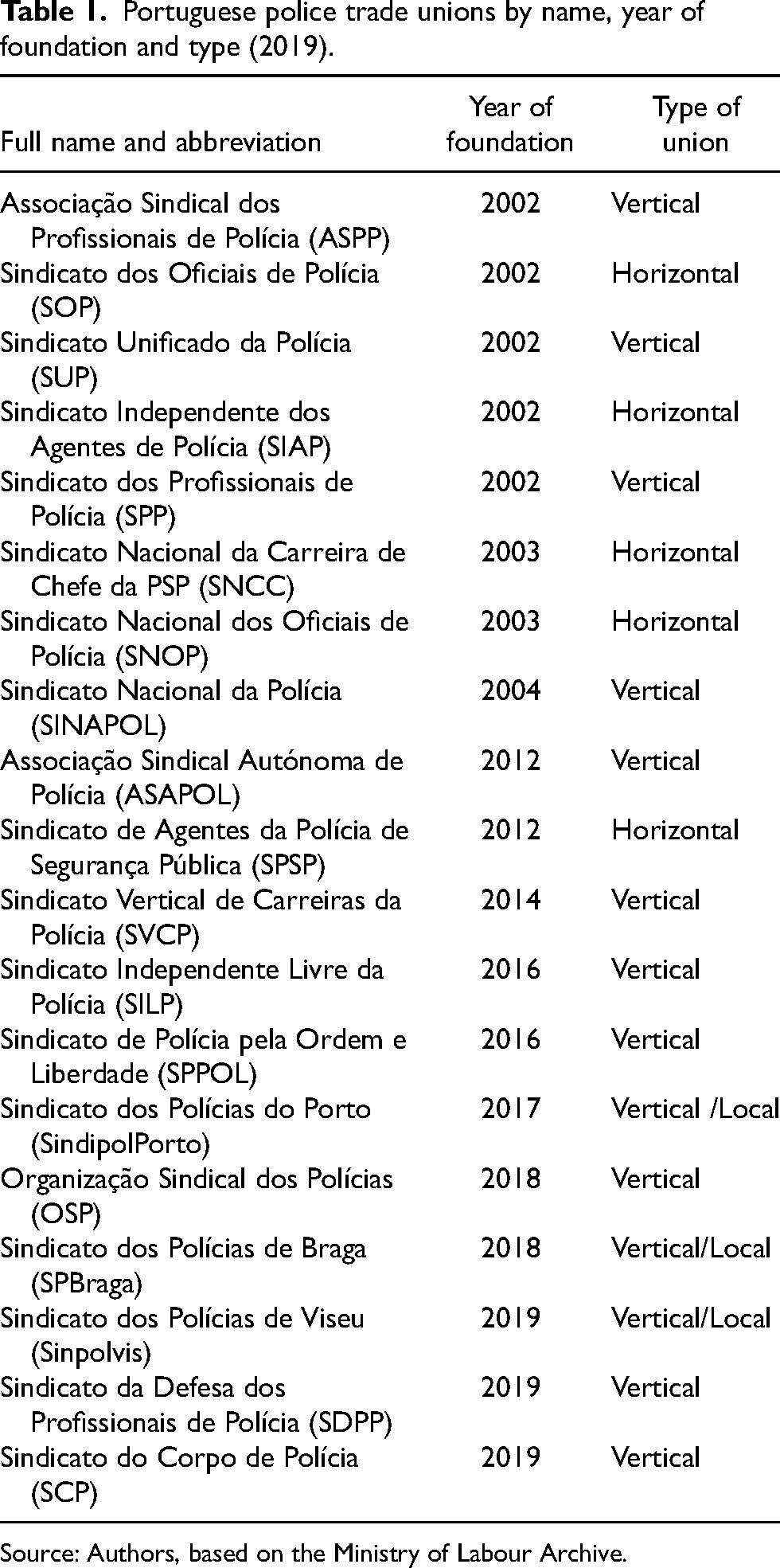
Source: Authors, based on the Ministry of Labour Archive.
The interviews took at least 1 hour. The interview grid was organised in five sections: context and legal framework, union history, internal representation of interests, external representation of interests, social composition of members and board members. To obtain a complementary perspective, we carried out an additional interview with an advisor from the Ministry of Home Affairs in charge of police union negotiations. All interviews were transcribed and analysed thematically using MaxQda software. An informed consent document was completed by each interviewee, who also had the opportunity subsequently to revise the interview transcription, following the scientific ethic good practices, as well as current European General Data Protection Regulation. Although all police unions agreed to be identified, some of the information collected may be sensitive for trade union relationships and we thus opted to keep the unions anonymous. Portuguese police unions are randomly allocated letters from A to Z in this article. The audio recordings and interview transcriptions are archived with the Portuguese Archive of Social Information, in accordance with standard scientific best practices of open access.
Whenever possible, we collected secondary data to prepare and complement information covering the period 2002 to 2019, the entire period during which the police trade union legal framework has been in effect. We combined different data sources, including legislation on police unions and associations, annual reports issued by the National Police Board, union histories, newspaper articles and social media posts on police unions.
Results
Portuguese police force profile
The number of Portuguese police members decreased slightly over the period from 2003 to 2018 (from around 24,000 members to 21,000), 11 particularly following the beginning of the economic crisis in 2007–2008. This decline was also marked by an ageing police force (the 45–59 age group increased). Although the police are ageing and decreasing in number, their qualification levels have increased. In 2009, the number of police with a university qualification stood at around 1%, reaching 10% in 2018. Women accounted for an average of 10% of the police force over the period 2002–2018 with no data available on the ethnic composition of the police. Ethnic diversity may be expected to be even lower than the level of women in the police force. There is very limited official data on police working conditions, with remuneration data reporting no change over the 2003–2018 period. Other information concerning a deterioration in facilities and equipment, or the police workload, has mostly been reported by the press and trade unions.
Police union fragmentation across three generations
The Portuguese police force is a very highly unionised occupational group (Figure 1). This aligns with trends in police unionisation in other countries, but contrasts with national figures more generally; police unionisation stands at an average of about 65%, exceeding the average national union membership rate by 50 percentage points (Visser, 2019).
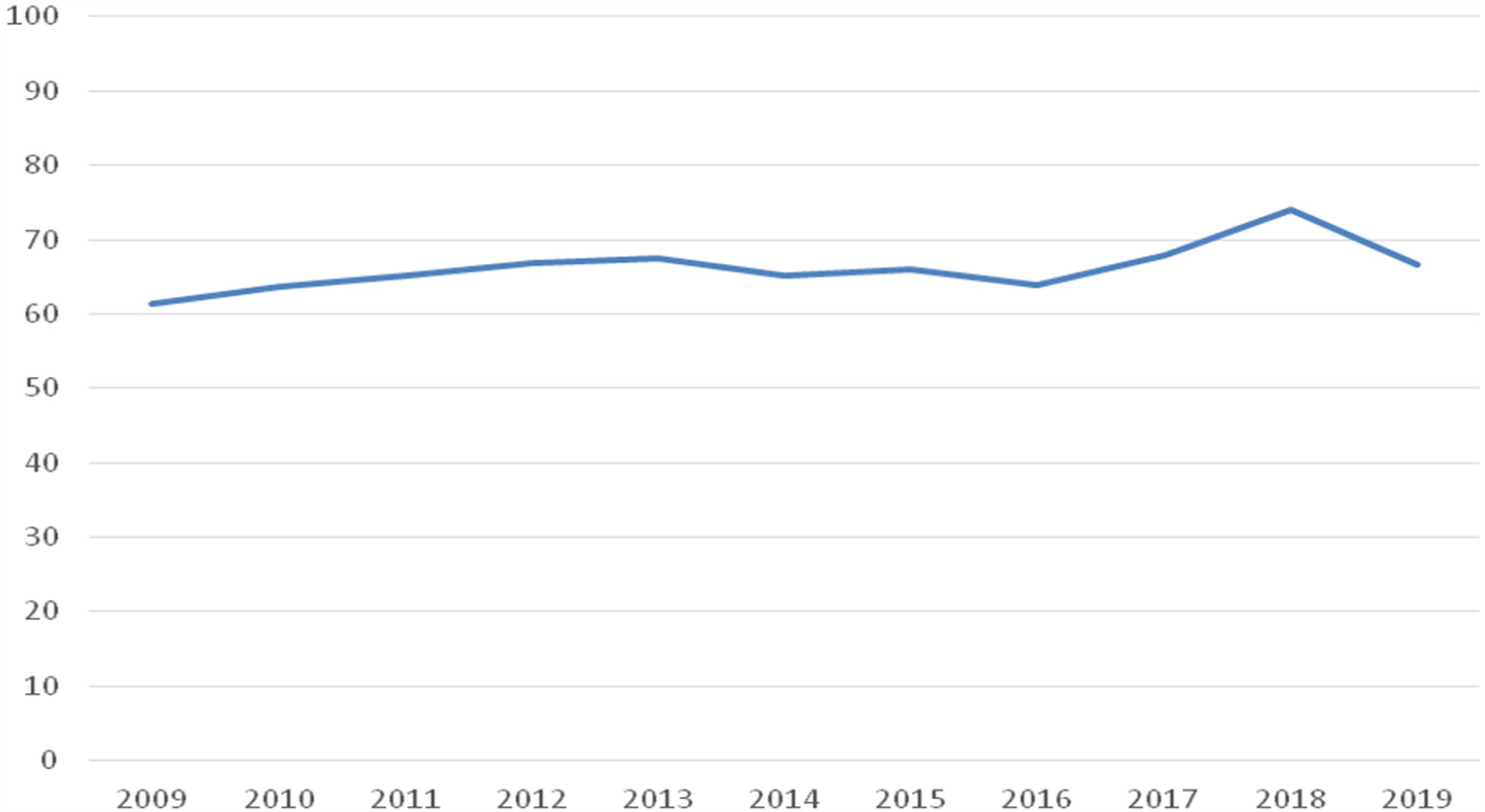
Evolution of police force affiliation (2009–2019) (%). Source: Authors’ calculations based on Balanço Social PSP, 2009–2019 (Rego et al., 2021).
The trend in police membership appears relatively stable over the past decade and in keeping with overall evolution in the number of police officers until recently.
This trend seems interrelated with evolution of the organisation although we lack more accurate evidence. Based on data collected by the Ministry of Labour from 2002 to 2019, we provide an overview of the founding of police unions since the first law was passed to authorise and regulate police unions in 2002. As shown in Figure 2, we clearly identify different waves of union launches leading to what we term three generations of police unions.
The founder generation (2002–2004) with eight unions set up in the immediate wake of authorisation. These unions are organised vertically and horizontally (according to different professional careers or a single). The second generation (2012–2014) consists of three unions launched during the mid-point of the observation period. There are two vertical unions and one horizontal union. The third generation (2016–2019) contains eight unions. In this generation, in addition to vertical unions, there are also the first three local unions (representing for the Braga, Oporto, and Viseu municipalities).
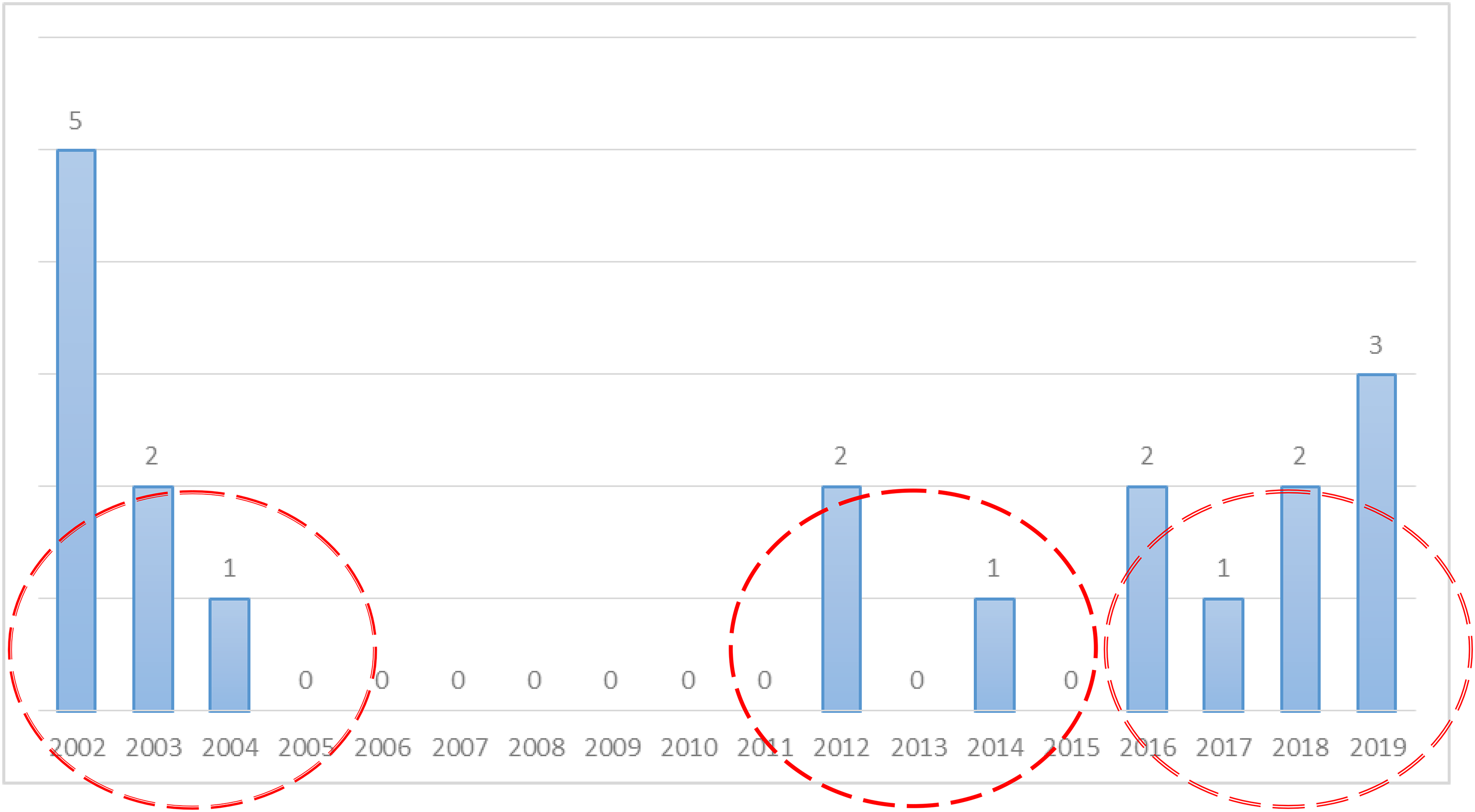
Number of Portuguese police unions by year of creation (2002–2019). Source: Authors’ calculations based on Boletim de Trabalho e Emprego from Direção Geral de Emprego e Relações de Trabalho-Ministério do Trabalho, Solidariedade e Segurança Social (Rego et al., 2021).
Fragmentation has clearly been a characteristic of Portuguese police unions ever their initial founding. Supra-associative structures often provide a means of overcoming dispersal and there have been two initiatives to bring small unions together. Nevertheless, these have never been able to establish a relevant role. 12
Analysis of the scant official data enables the identification of some important differences between what we term the generations of unions over almost two decades. The second and third union generations co-occur with a very significant increase in the number of union board members; in 2019, we identified 1,694 board members 13 of a total of 20,769 police force members. 14
In the first generation, the average number of board members was 34, which does not significantly differ from the second generation with an average of 35. However, the average number first-generation board members is a fraction below half the average number of third-generation board members at 67. Looking beyond averages, the highest number of elected board members is found in a third-generation union with 345, whereas the lowest number of elected board members is 4 in a first-generation union; both numbers were recorded in 2018. Some of the older unions seem to have adopted this same trend, boosting the numbers of board members towards the end of our period of observation (Figure 3).
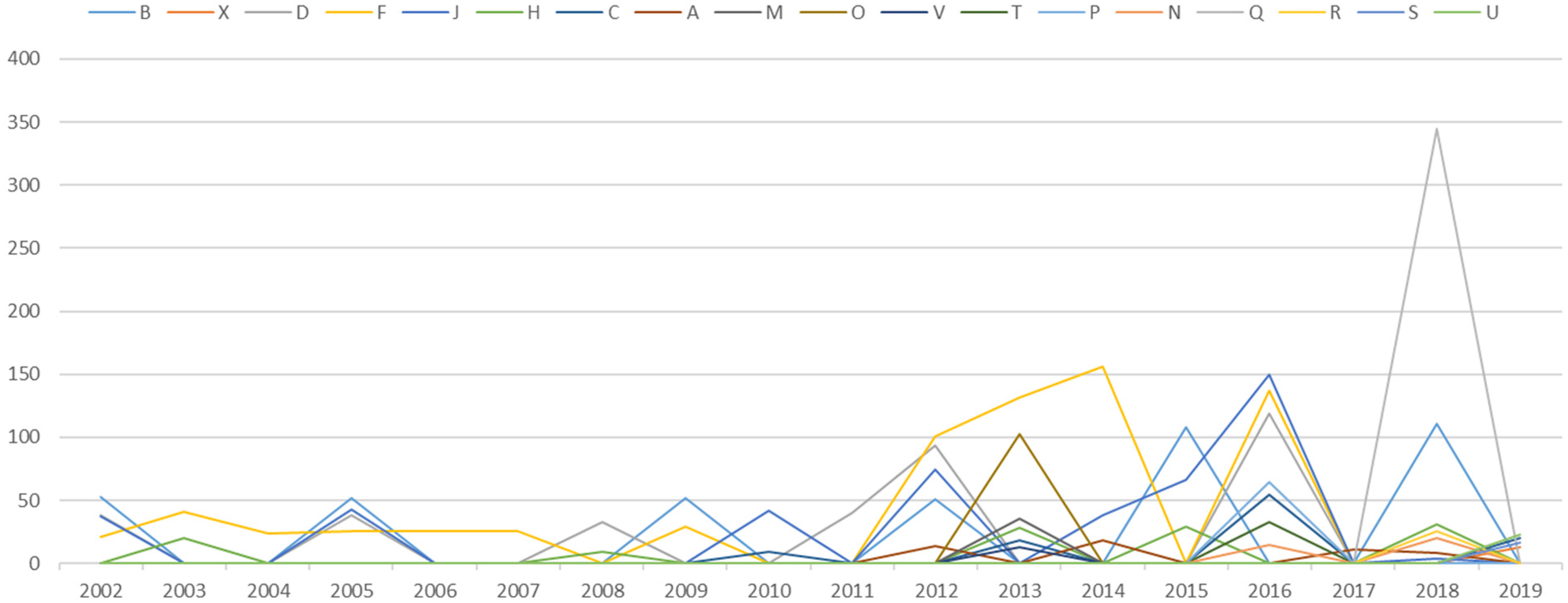
Number of board members per police union (2002–2019). Source: Authors’ calculations based on BTE from DGERT-MTSSS. Note: Police unions are identified randomly by letters (Rego et al., 2021).
The proportion of trade union members to board members shows a downwards trend. According to data from the Ministry of Home Affairs provided to the authors in a working document, in 2018 some unions had as many board members as regular members. Figure 4 shows this distribution across the three generations of unions identified, with the most recent generation standing out for containing cases in which there are more board members than regular members. 15 In the latter case, there is no longer a representation function because the police force members are representing themselves directly.
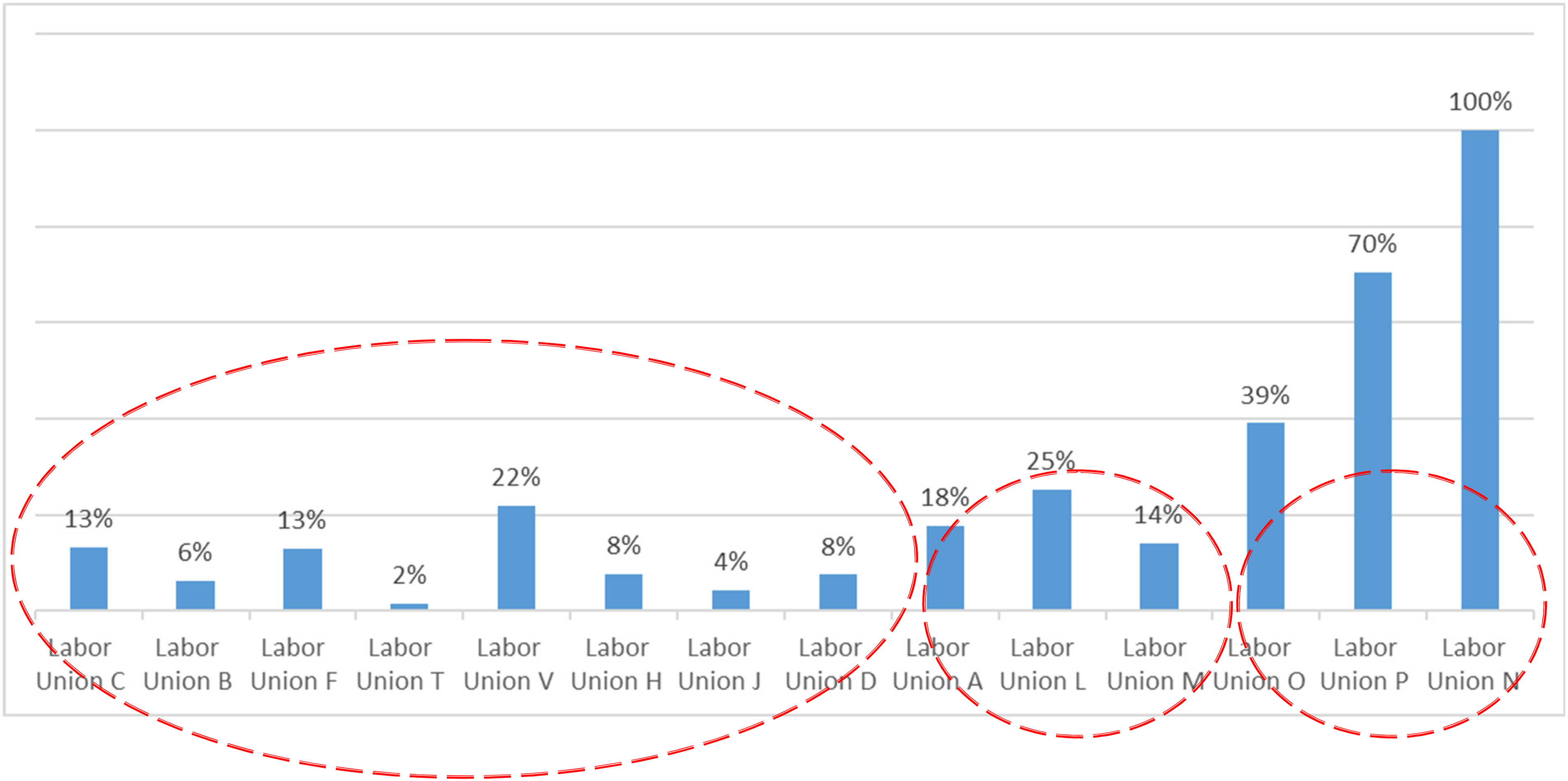
Proportion of board members per union (2018). Source: Ministry of Home Affairs (Rego et al., 2021). Note: The average number of votes for elected union board members in each union's last election. No data is available for police unions X, S and U.
Different motivations for unionisation
A common motivation for launching a police union extends across each of the three generations of police unions: the need to improve police working conditions, especially remuneration, hardship allowances, individual equipment and police facilities. All these motivations were referenced by every police union interviewed, even if in different ways.
However, there are also motivations differentiating each generation (Rego et al., 2021). Immediately after enactment of Law no. 14/2002, the founding generation of unions was motivated by the possibility of gaining a voice for the first time after campaigning for this goal for decades. As one of our interviewees explained, the police wanted the same rights as other workers: … the earlier years were very hard and culminated in the ‘dry and wet’ protest. In other words, it was police against police. The police consider the 21 April 1989 (‘dry and wet’) the [national revolution] of 25 April 1974 for the police (…); between 1999 and 2000; we did a lot of work which helped [police union B] influence political parties, from the left-wing to the right-wing, to accept union rights. (Police union B, first generation)
Particularly in the first generation, some unions emerged with the stated objective of defending a specific occupational career within the police force. In fact, we can identify four of these so-called ‘occupational unions’ in 2019. These unions remained concerned with broader working conditions, especially with those impacting on their specific group. Class unions, such as officer unions, I get why they happened. In our case, we did not feel represented and defended within a larger union such as [police union B], which is basically an officer union. Our problems with careers and other situations that have arisen over time were not addressed by these unions. (Police union C, first generation)
As the unions proliferated, some emerged as a result of splits due to differing types of disagreements with some triggered by personal divergences. However, they generally derive from more substantial issues, such as problems with financial management and policy-related issues. We arose when still attached to another union. There were some financial problems, gaps in the accounts…, we denounced this situation and reported it to the court. We didn’t see any changes in the board members and so we then set up a new union with ideas and a structure that we think is more correct. (Police union O, third generation)
Within this framework, more recent, second- and third-generation trade unions also stress the need to solve problems that were not being dealt with by the existing police unions, such as the long working days, especially due to increasing numbers of officers taking extra jobs in the private sector;
16
and cuts in days off due to staffing shortages, particularly in big cities, alongside the discretionary management of human resources. We had cuts in days off without any need and, according to the legislation on days off, we needed a very important social event with a very high social interest to cut (…) Since April, there have been critical situations that have not yet been answered (…) we’ve reported it to union structures and without any answer; the strength was not proportional to the issue. A group was started inside the police station to get these problems heard. I was in another union then but I left because I didn't want to identify myself with this situation. Other colleagues were also disappointed. So, we held an assembly, did the labour code bureaucracies and finally set up the union. (Police union X, third generation)
Proximity between colleagues also fostered the launching of unions in keeping with the greater perceived trust in colleagues than in large, distant structures. Colleagues often share the same discomfort towards police management in a particular administrative unit. Whether talking to the President [of the police union] or the Vice President, the President is also [a law graduate], it is very easy and we handle issues on a familiar basis. (…) Direct and immediate contact (…) means the capability to help immediately, to give social, psychological, or legal support (…) and this is what distinguishes [police union A] from other associations. (Police union A, second generation)
Finally, some motivations clearly relate to the privileges provided to union board members and delegates. These police have direct (and informal) access to positions of power with the ability to directly contact the advisor to the Ministry of Home Affairs, as our interviewees stressed, as well as longer periods of working without any assigned duties. As mentioned earlier, the conditions granted by Law no. 14/2002 became salient after a 2018 newspaper article alleged that thousands of hours were being spent in supposed union activities.
17
According to some interviewees, some unions were motivated by the opportunity for board members to take advantage of the free working time. These individual – and even selfish – motivations for launching unions were denounced by some of the older unions, who claim to have pressured for legal reform. [The goal was]: ‘You come to my union, we are going to create a union to have days off.’ This is not unionism. This is why unionism has become discredited in the police. Because the law allows for having days off. Most of these unions do not have lawyers, legal or public services or facilities and I don’t even know the presidents. (…) What motivated me to support a change in the law was to try and make unionism more credible. (…) We don’t have hours or days off in our union at night, on weekends, holidays, Christmas, New Year, Carnival, unless there is a very special situation…. (Police union J, first generation)
Collective bargaining (in)activity
In accordance with Law no. 14/2002, Portuguese police unions have the right to negotiate with the National Police Board on various issues, including remuneration structure, fringe benefit payments, terms of employment, careers, working hours, workplace health and safety, principles included in the disciplinary statutes, recruitment and selection. However, police unions gained no specific advantages in practice because no negotiations with the National Police Board were held over the entire period of observation, as all our interviewees confirmed. 18
In fact, when police unions sought a hearing with the police administrative authorities, they usually contacted the Ministry of Home Affairs rather than the National Police Board. Moreover, according to our interviewees, there were no regular, prescheduled meetings until 2019 when the ministry's representative provided a meeting timetable that was due to start just before the end of the year. National elections in October 2019 led to a review of the ministry's staffing. However, with police union protests on the increase and media coverage of cases of police violence, and against a broader increase in other police union-related news, new representatives and negotiators at the Ministry of Home Affairs (albeit under the same minister) publicly presented a plan for regular meetings. 19
Throughout our observation period, no process took place that could be accurately considered collective bargaining (Rego et al., 2021). Furthermore, some union board members complained about the poor quality of bargaining. We sometimes have [meetings with the Ministry of Home Affairs], but they’re at our request. It shouldn’t be necessary. They should be at least on an annual basis and the National Director has told us that one way to deal with us would be permanent dialogue and quarterly meetings but this never happens. They happened only when we had several problems. We requested a meeting with the institution as well as asking for the ministry to clarify those doubts and only then did we get a delayed answer. There are meetings when all we do is submit demands. (Police union T, first generation)
That there are 19 police unions seems to be an obstacle to negotiating with the ministry. Every time the minister invites a union to talks, he then has then an obligation to invite the remaining 18; so, this made it completely unworkable and was weakening the institutional dialogue between unions and the Ministry of Home Affairs. Thus, this was clearly a situation we could not tolerate. (Ministry of Home Affairs representative)
Discussion
Police unions have existed for over a century in developed countries and different national cases demonstrate how they may play a very positive role in policing governance, particularly in improving police working conditions through collective bargaining. However, police unions are not yet classed as a universal right and some national decision-makers still perceive them as a threat to security. Moreover, in countries with long-established police unions, there are concerns over their negative influence, especially regarding disciplinary reforms. In this sense, recent research proposes that the involvement of minority identity-based groups might act as a balance to police union resistance to reforms (Fisk and Richardson, 2017). Although the representation of different groups is important from the pluralist voice perspective and the need for unions to reduce inequalities in representation (Guillaume and Pochic, 2011), paying greater attention to these identity-based groups does not in itself prevent fragmentation, which may represent a serious obstacle to achieving the missions of police unions in particular and trade unions in general. This becomes especially important when police union federations seem as ineffective as they do in the Portuguese case, as confirmed by both our documental search and interviewees.
Our research reaches further back and focuses on the process of regulating the existence of police unions by means of an institutional framework. Drawing attention to a European fragmented/state-centred regime of labour relations (Costa, 2004; Larsson, 2014; Molina, 2007), our research studies the requirements for interest representation, which might enable effective union positive action, solidarity (Hofmann et al., 2019) and coordination of social dialogue (Molina, 2007). This is of greatest interest to countries discussing the rights of the police to unionise, as well as countries reviewing the institutional framework of police unions, especially when concerned with the representative system of unions and, in particular, reconciliation between plurality and action unity.
In their earliest days, Portuguese police unions emerged in fragmented structures, following the trend Portuguese labour relations (Costa, 2004; Larsson, 2014; Molina, 2007). These unions were established around career identities, but first and foremost overlapped in their representation. There remains a total absence of unions representing women, for example; perhaps because of the conservative nature of the police force, with women still accounting for fewer than 10% of police and being barely visible in police work (Durão, 2021).
Competing police unions emerged in different periods, which we term generations, over these almost two decades, campaigning for improved police working conditions; however, younger unions, in particular the third generation (2016–2019), provide evidence that individual – and even selfish – motivations prevail. Board members started to use union activity days to extend public holidays and their privileged personal contact with the administration to solve individual issues. Unions with the same number of board members as regular members also appeared, thus providing an inverted representation system in considering all their members to be board members; meaning there is no collective representation but rather a direct representation of individual interests. This analysis is supported both by official data, which reports a very high proportion of police union representatives compared with membership numbers, and by the interviews we carried out with representatives of the different union generations. We can conceive of distinct factors driving the fragmentation of police unions, ranging from more collective or altruistic motivations (holding the same right to organise and negotiate as other workers) to more individual level motivations (benefiting from paid time off or direct contact with the police administration for resolving personal problems).
The emergence of a significant number of competing unions in this Southern European country must be positioned within the existing structure of opportunities (Kriesi, 2005) constructed, first and foremost, out of the 2002 police union law. The lack of formal constraints is in keeping with the special working conditions attributed to board members and union delegates. The permissive law also allowed broad union eligibility for collective bargaining and consultation. The 2002 law provides every union with the right to be heard and to negotiate, which renders the process inherently inefficient because there are 19 unions. Although the lag between the first police union law, in 2002, and general Portuguese trade union legislation, in 1975, might reinforce the idea that the police are an exceptional case, this proliferation of unions became a publicly noted problem, leading the older and large police unions, together with press coverage, to call for a review of police union legislation.
‘It takes two to tango’, and we note that the bargaining process was stuck, not only because of the disproportionate number of police unions with a right to a seat at the negotiating table, but also because no bargaining initiatives were forthcoming from the police administration. This effectively conveys how the strategic stance adopted by police unions was not the only reason for the lack of collective bargaining. In fact, the lack of any formal and systematic collective bargaining reflects a problem that police unions have had to cope with since their foundation. Although there was some social dialogue, and this may assume exchanges of information (Costa, 2020), there were barely any negotiations or even consultations. In any case, we wish to underline how police union regulations allowed both collective and individual interests to gain the same status, thus jeopardising the potential for trade union action.
Deteriorating working conditions, together with a lack of effective negotiations between police unions and the police administration (National Police Board and Ministry of Home Affairs), was identified by various interviewees as a reason behind the emergence of a social media police protest movement. The ministry representative we interviewed accepted that pressure to change and begin proper negotiations had increased since emergence of the Movimento Zero (Zero Movement). The Zero Movement 20 is Facebook-based protest group that resulted in the mass media becoming concerned about the likelihood of episodes of violence, especially attempts at violence, carried out by a movement made up of police force members. 21 The appearance of non-institutionalised protests such as this, without any spokesperson or internal democratic functioning, seems to have contributed to revision of the 2002 police union law. Compared with these groups, trade unions perform a role in ‘excluding a more radical claims’ society’ (Eleveld and Van Hooren, 2017: 596), which proliferate in the digital age and challenge democratic regimes through their lack of spokespersons, internal elections and accountable processes, and are thus devoid of any democratic functioning.
The Portuguese parliament has concluded that police unions hold legitimacy but need to follow objective criteria for determining their representativeness. In fact, new legislation regulating police unions, Law no. 49/2019, came into force in October 2019, 22 with the approval of both the left and the right in parliament. This law prohibits multiple union affiliations, which were also an effect of the preceding law, limits working absence on the grounds of fulfilling union functions, imposes minimum membership levels to assess the representativeness of board members and union delegates, and determines that the collective bargaining interlocutor, and effective decision-maker, is the ministry (no longer the National Police Board). Only a few unions are now expected to be able to negotiate with others set to eventually disappear.
The Portuguese case suggests that interest representation must be regulated to strengthen unions as democratic organisations participating in police governance (Henry et al., 2019) while being challenged by non-accountable voices emerging in the digital era. If there may be a consensus around the need to redesign unionism to minimise risks of ‘irresponsible’ union behaviour (Offe and Wiesenthal, 1980), our case study demonstrates how the trend ‘to curb the freedom of action of unions’ (Offe and Wiesenthal, 1980: 100) may result from the unions themselves (as well as the mass media). However, this also determines the need for objective, predictable and proportionate official criteria of representativeness.
Our study provides at least two challenges for future research: first, to deepen knowledge on the ‘structure of opportunities’, including exclusion of the police voice from important sector debates as a political strategy; and second, to verify the impact of the 2019 law on reconfiguring the union voice.
Footnotes
Acknowledgements
The authors are grateful for the contribution of the Editor Dina Kapardis and of the three anonymous referees to improve a previous version of this article.
Declaration of Conflicting Interests
The authors declared no potential conflicts of interest with respect to the research, authorship, and/or publication of this article.
Funding
The authors disclosed receipt of the following financial support for the research, authorship, and/or publication of this article: This work was supported by the Foundation for Science and Technology, I.P., under Grant PTDC/SOC-SOC/29207/2017.
