



Abstract
As policing develops into a more professional, evidence-driven and technical endeavour, heightened public concern regarding organizational competence and police culture-related fallacies have become augmented, especially in the case of officer-involved shootings. Introduction of body-worn cameras, increased CCTV coverage, vehicle dashcams and the advent of social media, have provided avenues for investigation into misconduct, but institutional and individual failings such as racism, sexism and other forms of discrimination remain a concern. Technical innovations like smart guns, smart targeting and programmable projectiles have instigated conversations about traditional firearms and whether alternatives using cutting-edge technology could address some of these shortcomings. This article examines existing policing technologies, providing an overview of advanced computational and sensor systems, the risks and dangers of these mechanisms, as well as their potential benefits and drawbacks. It conceptualizes whether existing technologies can be transformed into a smarter, more efficient firearm, powered by artificial intelligence (AI). The premise of the AI-assisted firearm being the promise of a future in which unwanted outcomes in officer/citizen encounters can be counteracted through AI assisting in better decision-making. The article considers hardware and software, policy issues, associated risks and potential advantages of the firearms system, providing a wider perspective on the increasing use of computational technologies in policing practice, and highlighting areas for further research and discussion.
Keywords
Introduction
Technologies such as robotics and artificial intelligence (AI) have entered the policing discourse in recent times, mainly due to the potential benefits that implementation of the same can have on the vocation. With the adoption of such technologies into western law enforcement practice, questions of ethics, public safety, privacy and civil liberties have also entered arisen (Hayashi et al., 2012; Joh, 2016, 2019; Lin et al., 2017; Turner, 2018). These have been accentuated by a wider conversation about police culture and bias driven by contemporary and historical dissent against racism, sexism and the use of excessive force that had for years been associated with policing (Noriega, 2020; Osoba and Welser, 2017). It has led to questions such as ‘Do police need guns?’ (Farmer and Evans, 2021) and whether a firearms-free future could be extrapolated from law enforcement's contentious past and self-reflective present (Evans and Farmer, 2020; Lindgren, 2014).
Future policies are likely to be shaped by a variety of social, cultural and political factors, including social justice and equity movements, which may call for reforms to address systemic racism and other forms of discrimination within law enforcement (Bass, 2001; Carter, 2016; Hough, 2012). This would likely lead to changes in the way the police interact with diverse populations, as well as efforts to diversify police forces to reflect better the communities they serve (Ba et al., 2021; Brown and Benedict, 2002; Sklansky, 2007; Walker, 2001). Demographic changes, such as population growth and ageing, would also likely affect the types of crimes and incidents that the police are called to address, as would political and economic shifts, such as changes in government policies or funding priorities (Beck, 2020; Lewis et al., 2013; Sklansky, 2005).
Any changes would, however, be dependent on the correlated variable of technological advancements, likely to drive transformations in policing practice (Hummer and Byrne, 2017; Koper et al., 2014). These could involve the increased adoption and use of robotics (Royakkers and van Est, 2015), AI (Joh, 2017; Surden, 2018) and other advanced computational methodologies (Nissan, 2012; Vestby and Vestby, 2021), potentially improving efficiency and effectiveness. However, as with every technological advancement and its use in a service likely to affect a significant section of society (such as policing), external concerns about privacy, bias, surveillance, along with internal fears of human workers being replaced by thinking machines, remain at the forefront of the debate (Chowdhury, 2022; Joh, 2019).
These anxieties are heightened by a robust pushback from society on the values and culture within front-line law enforcement personnel, and organizations deferring their responsibilities of fairness and due process in favour of hard-line policies to clampdown on target groups and further an executive agenda (Braithwaite, 1999). These concerns have involved uncomfortable subjects such as racism, sexism and institutional prejudice within policing across jurisdictions since the 1990s, culminating in protestation(s) in the years that followed, mainly aimed towards demands for a more accountable police force (Lebron, 2017). Body cameras worn by front-line police personnel, targeting the risk of prejudicial conduct, overlapping with the advent of social media and internet-magnified misconduct reporting, have become a mechanism for accountability (Carney, 2016).
Instances of police misconduct around the world have continued to show a significant overlap with and links to the routine arming of law enforcement and the use of firearms, where the use of weapons has led to injustice (Bayley, 1996; Hope, 2018; Iwuoha and Aniche, 2022; Oluwaniyi, 2011). This is evident in law enforcement's contentious history of fatal shootings; none more so than in jurisdictions such as the Philippines, which has seen some of the highest numbers of officer-involved shootings (OIS) (Amnesty International, 2017; Jensen and Hapal, 2018; Tusalem, 2019), and Brazil where shooting figures have remained high (United Nations, 2022). Much of the criticism of such practices originates in Europe (European Parliament, 2016) and the United States (US State Department, 2023a, 2023b) where OIS incidents have been linked to institutional racism (Mesic et al., 2018; Shrikant and Sambaraju, 2021). In 2022, statistics for the United Kingdom (UK) indicated that its officers were three times more likely to use force on Black people than on any other race (Home Office, 2022), and in 2023 the UK’s premier police force was found to be institutionally racist, sexist and misogynistic (Baroness Casey Review, 2023). Rather than merely being an isolated instance confined to a specific jurisdiction, such issues have been found to transcend borders (Peeples, 2019).
Mistakes in OIS can be influenced by stress and fear, biases and stereotypes, a lack of training and experience, communication breakdown, poor tactical decisions, a lack of situational awareness and environmental factors (Correll et al., 2014). OIS, among other incidents of misconduct, can have significant and far-reaching consequences for the community, law enforcement and individuals. Shootings can lead to loss of life, injury or trauma; fuel distrust between the police and the communities they serve; and increase the risk of criminal charges for officers and lawsuits for forces (Engel and Smith, 2009).
As a result, technical innovations have continued to emerge in recent years that promise to curb potential incidents of misconduct (Byrne and Marx, 2011). As part of this push for modernization (Allen and Karanasios, 2011), police forces have adopted performance monitoring and enhancement tools such as body and dashboard cameras, CCTV, drones and smart technologies like global positioning systems (GPS) and radiofrequency identification (RFID). Notably, alternatives perceived to be less lethal than firearms such as electronic control devices, colloquially known as Tasers, have been introduced to reduce the possibility of fatal shootings (Chowdhury, 2022; Hummer and Byrne, 2017; Merola et al., 2019; Ready and Young, 2015).
An increased awareness around gun safety has led to questions about the design of firearms, and the quality and availability of training in their safety and use (Paradis and Hendrick, 2001; Reid, 2022), leading to a novel supposition – whether an alternative to the traditional firearm, one powered by modern technology, could tackle some of policing's historical failings. Algorithm-driven firearms have been a staple of cyberpunk media from its inception (Wood, 2019), and the genre's popularity can only drive innovation in the real world.
This article provides a brief overview of police use of advanced computational and sensor technologies, the risks and dangers of these mechanisms, and their potential benefits and drawbacks. The article also introduces and discusses through thought experiments, the culmination of existing technologies into a smarter, more efficient firearm, powered by AI, and its promise of a future in which fallacies related to police culture, such as racism, sexism and prejudice, can be addressed. By examining the available literature, the article conceptualizes, with consideration of hardware and software, policy issues and the associated risks and rewards of the firearms system. Areas for further research and discussion are also explored through examination of relevant computational technologies in law enforcement.
Background
Historical underpinnings
Weapons have been a staple of the state security apparatus from antiquity, dating back to ancient Rome where city-watch ‘Vigiles Urbani’ units tasked with maintaining public order carried clubs and other melee weapons (Elliott, 2020). Medieval constables were known to use swords, spears and even bows and arrows in the line of duty (Cornell, 2017). The use of modern firearms is, however, a more recent innovation, with the United States and Great Britain responding to separate incidents of armed violence against constables with the introduction of weapons as police equipment (Phillips, 2021). Throughout the 20th century, most countries around the world adopted the use of firearms into policing practice, with differing scope and scales.
Commentators have acknowledged that the history of police use of firearms and other weapons is a complex and multifaceted issue, guided by a variety of social, cultural, economic and political factors (Kraska, 1996; Waddington and Wright, 2012). The specific types of weapons issued or available to officers and the policies governing their use vary between countries and jurisdictions, influenced by aspects such as the backdrop and historical precedents, levels of crime or violence in the areas governed, the resources and training available, and the legal and regulatory frameworks in place (Evans and Farmer, 2020; Fyfe, 1988; Kivisto et al., 2017).
Approaches and philosophies
Policing practice across jurisdictions is exemplified by two broad philosophies concerning the use of force in the line of duty. These include the minimum force doctrine and the maintenance of an armed tradition (Farmer and Evans, 2021; Prenzler et al., 2013). The former is typified by the idea that firearms should only be accessed when necessary, and the use of lethal weapons should be a last resort. Prominent among the countries adopting this policy are New Zealand, Great Britain, Ireland, Iceland, Norway, Botswana, Malawi and a number of island nations such as Samoa, Nauru, Tonga and Fiji (University of Sydney, 2019). Japan, which records some of the lowest OIS figures in the world (Gan, 2022), has one of the most stringent laws concerning the use of firearms in policing with a majority of officers relying on less-lethal means to maintain public order (Masters, 2017; Morillo, 1995).
This can be contrasted with the armed tradition of policing, which is underpinned by the assertion that the routine arming of police enables and ensures both community and police officer safety. The United States, Canada, Australia, Brazil, Philippines and South Africa are examples of the vast array of nations ensuring that their officers are routinely armed (Morton, 2006), with shootings and deaths caused by police consistently higher than in those countries where officers are not routinely armed (Evans and Farmer, 2020).
The routine arming debate
Public opinion is known to drive debate about whether to arm police officers, because the topic of guns has historically reflected strong views in societal discourse (Cukier, 2005; Punch, 2010). Jurisdictions are often governed by laws, regulations and precedent that restrict or prohibit the arming of police officers (Barry et al., 2015; Evans and Farmer, 2020).
The current debate around police carrying guns as standard equipment involves a number of arguments, including the assertion that it can enhance officer safety by allowing them to defend themselves and others in dangerous situations, especially when responding to violent or armed suspects, or enable officers to protect the public from active shooters or threats (Carriere and Encinosa, 2017). A further argument involves the notion that guns can have a deterrent effect on potential assailants or perpetrators, who may be less likely to attack an officer if they know the latter is armed (Bove and Gavrilova, 2017).
Conversely, arguments against police carrying guns relate to fears that it can increase the risk of violence, because officers may be more likely to use their firearms in situations in which other options might be available (Brandl and Stroshine, 2012; Reaves, 2015). It may potentially lead to more fatalities and injuries, particularly among minority communities or those with mental or physical disabilities (Frederick and Shifrer, 2019). There have been arguments that it may increase the risk of accidental shootings (Knutsson and Strype, 2003) because officers may inadvertently discharge their firearms or confuse innocent individuals with suspects (Squires and Kennison, 2010). It also can be expensive and logistically challenging to equip and train officers to carry and use firearms, potentially leading to the diversion of resources from other important areas, such as community policing or social services (Bove and Gavrilova, 2017).
Other considerations
Several considerations also continue to fuel the conversation about arming officers; for example, the role of non/less-lethal options, such as pepper spray, Tasers or rubber bullets, which can be used as alternatives to guns in some situations and may be less likely to cause serious injury or death (Lewer, 2003; White and Ready, 2007). De-escalation techniques, such as verbal communication, body language and emotional intelligence, can also be used by police officers to defuse potentially violent situations and avoid the need for the use of force (Engel et al., 2020a). Community policing, involving trust and partnership-building between law enforcement agencies and the communities they serve, can also be an effective means of reducing crime and violence, and may lessen the need for the use of force by police officers (Ortmeier, 2002; Prenzler et al., 2013). In recent years, such techniques have gained traction and are likely to be at the forefront of modern policing (Ciavaglia et al., 2021; Home Office, 2019).
Innovation trajectory
Much like other innovations in policing, the introduction of firearms and subsequently their non-lethal alternatives depended on a number of factors encapsulated by the concept of technological determinism, namely that technology can be the driving force behind social and cultural change (Nogala, 1995). According to this perspective, technology shapes the way that society functions and evolves, and humans are largely passive in the face of technological change (Jordan, 2008). In the context of policing, technological determinism can be seen in the way that law enforcement agencies embrace and use new technologies.
Imagine that it in the near future, the police have adopted a new type of gun equipped with a range of technologies such as sensors, projectors, flood illuminators and an array of cameras to detect whether a suspect poses a threat using AI. These guns have been designed to improve officer safety and reduce the risk of wrongful shootings by providing officers with real-time information and alerts about potential threats.
One day, a group of protesters are demonstrating in a park when a police officer confronts a suspect who is acting suspiciously. The suspect begins to reach for something in his pocket, and the police officer draws his new AI-powered gun. The gun's infrared sensor detects the suspect's body heat and the camera captures images of the suspect's face and the object in his pocket. The AI algorithms analyse these data and determine that the suspect is holding a knife and poses a threat to the officer. The gun's LED indicator blinks a red light alerting the suspect that the officer has a target lock and that he should relinquish the knife. On the other side of the park, another officer manages to avert a wrongful shooting by relying on the gun correctly identifying a protester's mobile phone, which to the naked eye may have appeared to the officer at first glance to be a weapon.
In both instances, the new AI-powered smart(er) gun helped prevent potentially dangerous situations from escalating. The gun's sensors and AI algorithms were able quickly and accurately to assess the threat posed by the suspect, and the sensors were able to scan and document them, with the system then communicating a warning to the suspect and alerting the officer. However, for such a weapon to exist, a number of current policing technologies need to improve drastically, and each independent system has to work in unison, providing a seamless and intuitive, fit-for-purpose device.
The smart(er) gun: AI-assisted firearms
The viability of such technologies in policing depends on a variety of factors, including their effectiveness, cost, and ethical and social implications. A firearm equipped with sensors, cameras, AI object detection and an advanced warning system would need to be designed to maximize accuracy and effectiveness while minimizing the risk of harm to innocent bystanders. The specific design of the firearm would depend on careful consideration of fit-for-purpose sensors, cameras, and algorithms built on accurate and well-trained data sets. More importantly, for AI-assisted firearms (AAFs) to be a practical and sustainable alternative to the traditional firearm, the technologies detailed below which are already in police use will need improvement not just in efficiency and performance, but also in cost-effectiveness and feasibility.
Wearables
Wearable technologies have been widely adopted by law enforcement agencies, for example body-worn cameras (BWCs), which are designed to improve accountability and transparency by recording interactions between officers and the public. BWCs have been shown to be effective in reducing the use of force and complaints against officers (Ariel et al., 2017; White et al., 2018), although it has also been argued that they could lead to an increase in deadly shootings (Pang and Pavlou, 2016). Research has suggested that the effectiveness of BWCs is deeply rooted in activation of the cameras, as opposed to their mere presence (Hedberg et al., 2017). It has also been suggested that wearables be used for police-officer stress monitoring (Gonzalez et al., 2019) and augmentation technology be used to enhance patrols (Healey and Stephens, 2017). It has been noted that such technologies, especially those with potential for surveillance, have ethical and political implications, which either stunt their adoption, or dampen their effectiveness (Hood, 2020).
Three-dimensional and 360-degree imaging
The use of three-dimensional (3D) imaging and 360-degree photographs and videos in policing is becoming increasingly prevalent (Buck et al., 2013). 3D imaging can assist officers in reconstructing crime scenes and create detailed 3D models to better understand and visualize crime events, which can aid in investigations and the prosecution of suspects (Raneri, 2018). Moreover, 3D imaging can be used to create virtual mock-ups of crime scenes for training purposes and to monitor crowds at public events (Galanakis et al., 2021). 360-degree photographs and videos, also known as immersive media or virtual reality (VR) content, have potential for training and simulation, enabling officers to practise responding to various types of incidents, such as active shooter situations or natural disasters, leading to better officer preparedness and effectiveness in real-world encounters (Caserman et al., 2018). VR can also be used for crime scene reconstruction, creating virtual mock-ups of crime scenes, and visualizing and understanding physical evidence (Chowdhury, 2016, 2017).
Facial recognition and tracking
Facial-recognition software has been used to identify suspects or potential witnesses in photographs or videos (Purshouse and Campbell, 2019), improving the efficiency of investigations to identify suspects who may be attempting to evade capture (Bouras and Michos, 2022). However, there are concerns about the accuracy and bias of the software, which has been shown to be less accurate for people of colour and women (Garvie and Frankle, 2016), and the potential for the technology to be used for surveillance, which could infringe on privacy rights (Crawford, 2019; Rezende, 2020).
Smart guns
Smart guns have become a topic of conversation among stakeholders in recent years. Smart guns are firearms that are designed to be fired only by authorized users, and typically use technology such as biometrics or RFID (McMillan and Bernstein, 2022; Metzler, 2018). The potential benefits of smart guns for the police are numerous. For example, smart guns could help to reduce accidental shootings and suicides, as well as the risk of firearms being stolen and used in crimes (Kessel, 2021). However, without smart targeting and failsafe mechanisms, smart guns may not be smart enough to be a viable tool in the fight against fallacies related to police culture such as bias, racism and sexism, which have historically affected the targets of lethal violence, especially those from marginalized communities (Washington Post, 2023).
Smart targeting
Smart targeting is part of an advanced suite of technologies in development for use in policing and military contexts to improve the accuracy and effectiveness of weapons systems. These mechanisms have been designed to enhance the ability of law enforcement and military personnel to identify, track and engage targets, and are typically based on advanced sensors, algorithms and AI (Russell et al., 2015). Combined with weapons that are designed to operate without human intervention, using advanced sensors and AI systems to identify and engage targets, and advanced munitions built to improve accuracy and effectiveness by enhancing the ability of projectiles to seek out and engage targets, these could prove useful in reducing human error during citizen–law enforcement encounters (de Ágreda, 2020; Liu et al., 2021).
Programmable projectiles
Programmable bullets are another class of emerging technologies, designed to change course, or explode on impact, they allow the shooter to control the trajectory of the projectile and the type of damage it causes (Voynov, 2020). They have the potential to improve the accuracy and effectiveness of firearms, but they also raise concerns about their potential misuse, such as their use to cause more harm or destruction than traditional bullets (McMahan, 2013). There are also self-guided bullets, which use sensors and algorithms to guide themselves, potentially boosting the accuracy and effectiveness of firearms, particularly in situations where the shooter may have a limited view of the target or may be shooting from a distance (Barrett, 2014; Lin et al., 2008).
Smart targeting and programmable technologies like these have typically used sensors such as lasers, radar or infrared, and can be integrated with AI systems to improve target recognition and tracking capabilities. Although most research and development has been in a military context, the potential use of these technologies in policing cannot be ignored because of the increased militarization of law enforcement and equipping of police with military-grade arsenals (Balko, 2014).
Themes
Increased surveillance, better data collection and analysis, a reduction in the use of force, improved training and simulation, and efficient crime scene outcomes are consistent themes in these technical innovations. Use of these technologies also has significant shared implications for policing modern society, including impacts on police–citizen interactions, ethical and legal consequences, policing strategies, cost and resourcing implications, and the effects on public perception and trust.
Whereas the motivation behind the police adopting new technology has historically been driven by a need to improve efficiency, safety and trust, concerns about dehumanization, overreliance, and a lack of personal contact have emerged in contemporary discourse. Ethical and legal concerns, such as potential bias in facial recognition and balancing benefits with protection of civil liberties, are also common. However, with the promise inherent in such technical innovations, the question arises of whether harnessing their soundest characteristics into a tool (while alleviating the concerns) that officers can carry as standard equipment, could potentially address the anxieties, and live up to the ambitions of both the technology and its users.
Conceptualizing the future police firearm
The first challenge of conceptualizing any instrument for use in the field involves the formulation of a compact and user-friendly platform. It is supplemented by the need to ensure the quality of the machine-learning algorithms that will power the device. Therefore, not only must hardware and software requirements be precise, but the design philosophy should also acknowledge and address the problems that have triggered the weapon's inception.
Design
The design philosophy must reflect an objective to enhance safety and security by preventing unauthorized use or tampering. Improvement of the accuracy and effectiveness of the shots, with or without smart munitions, should be a priority, with a guidance and assistive system that can seek out and engage targets. Because AAFs and the like require complex human–machine interaction(s), it is vital that designers and developers consider how shooters/users will interact with the gun, and ensure that the interface is intuitive and easy to use and understand. Practical considerations such as weight distribution, recoil and muzzle-flash compensation, magazine geometry and polymer choice are also key (Heard, 2011; Kopel, 2015; Locatelli, 2021).
Because the firearm will generate and store large amounts of data, including audio and video footage, sensor information and a host of diagnostic readings, designers need to be wary of data protection policies. Consideration of privacy and the security implications of this data, ensuring that it is handled and stored in a responsible and secure manner should, therefore, be at the forefront of any design decisions. These will likely also raise a number of ethical and legal considerations, including issues related to accountability, transparency and the potential for misuse or abuse. Firearms users will need to undergo specialized training to use the technology effectively, requiring formulation and implementation of training and maintenance regimes for the system, to ensure that operators have the skills and resources needed to use the gun safely and effectively. Many of these considerations will depend on the central premise that technology of such complexity may be expensive to develop, manufacture, and maintain, requiring exhaustive deliberations on the cost and affordability of the system, so that budgets can be drawn, and the firearms are accessible to law enforcement (and military) agencies that may use them.
Hardware
To improve target recognition and tracking capabilities, AAFs require a range of sensors such as cameras, lasers, radar and/or infrared to gather data about their environment and identify, track and engage targets. Ideally these sensors would be integrated with AI systems, utilizing hardware similar to modern mobile communication and imaging devices.
To ensure user authentication and security, the system should include biometric sensors (palm and fingerprint) and an RFID-chipped handle grip, with a smart-tagging system that emits a secure Bluetooth signal for quick and easy tracing of lost/misplaced guns. For accurate positioning of the gun and shooter, the system must have built-in GPS and gyroscopic sensors that record the angle and position of the gun when drawn and holstered.
In terms of imaging and documentation, laser scanners capable of capturing high-quality 3D images with flood illumination, a finely tuned laser array with wide coverage, and a 360-degree camera that takes multiple images every second should be included. The system should also be able to carry out automatic in-gun stitching of the 360-degree photographs and videos to capture as much data as possible about the environment.
To provide users with essential information, LED displays mounted on the gun should indicate critical read-outs, such as the number and type of bullets in the magazine and any diagnostic data pertaining to gun maintenance. The system should also have a notification light panel to inform users of the presence of a weapon or obvious threat, as well as a target-facing notification panel that tells the person in front of the barrel to surrender or that the officer has a target lock.
Additional quality-of-life improvements such as a robust vibration motor that can alert officers and assist in aiming, and illumination panels to assist cameras and sensors when capturing images in low-light environments should be included. An intelligent, adaptive charging system that utilizes replaceable and repairable batteries, ideally powered by sustainable means such as solar cells, is crucial.
Finally, the entire system must be seamlessly integrated into a low-cost microcontroller that processes information from the hardware, allowing for quick and accurate recording of the events during a shooting or encounter, while providing valuable insights and assistance to the firearm user.
Software
A software platform based on machine-learning architecture and driven by AI principles that mimic human intelligence to learn not only from data fed into the system, but also real-time data is the ultimate goal of the AAF. These systems could improve target recognition and tracking capabilities to analyse data from sensors and other sources (Yi et al., 2021), and make decisions about when and how to engage targets. The system should be able to accomplish the following basic functions:
authenticate whether the person holding the gun is authorized to use it, and if not, lock the weapon while sending out an unauthorized use warning to the relevant authorities; track the position of the gun using GPS, gyroscopic data and Bluetooth; record the basic characteristics, body position, actions and non-verbal cues of the target; measure the height of the target, the distance from the shooter and the trajectory of projectiles (whether smart ammunition or traditional); record, detect, identify and label every object in its field of view; stitch together 360-degree images and video inside the gun to prevent tampering; use advanced threat-detection algorithms, such as real-time emergency detection models built on machine-learning infrastructures; efficiently process data and determine outcomes with the ability to display information swiftly in a readable and understandable format; smartly integrate battery-saving features, such as sleep mode (when idle; holstered) and quick wake (drawn); monitor ammunition and alert when the firearm needs reloading.
A conceptual drawing of an AAF is presented in Figure 1.
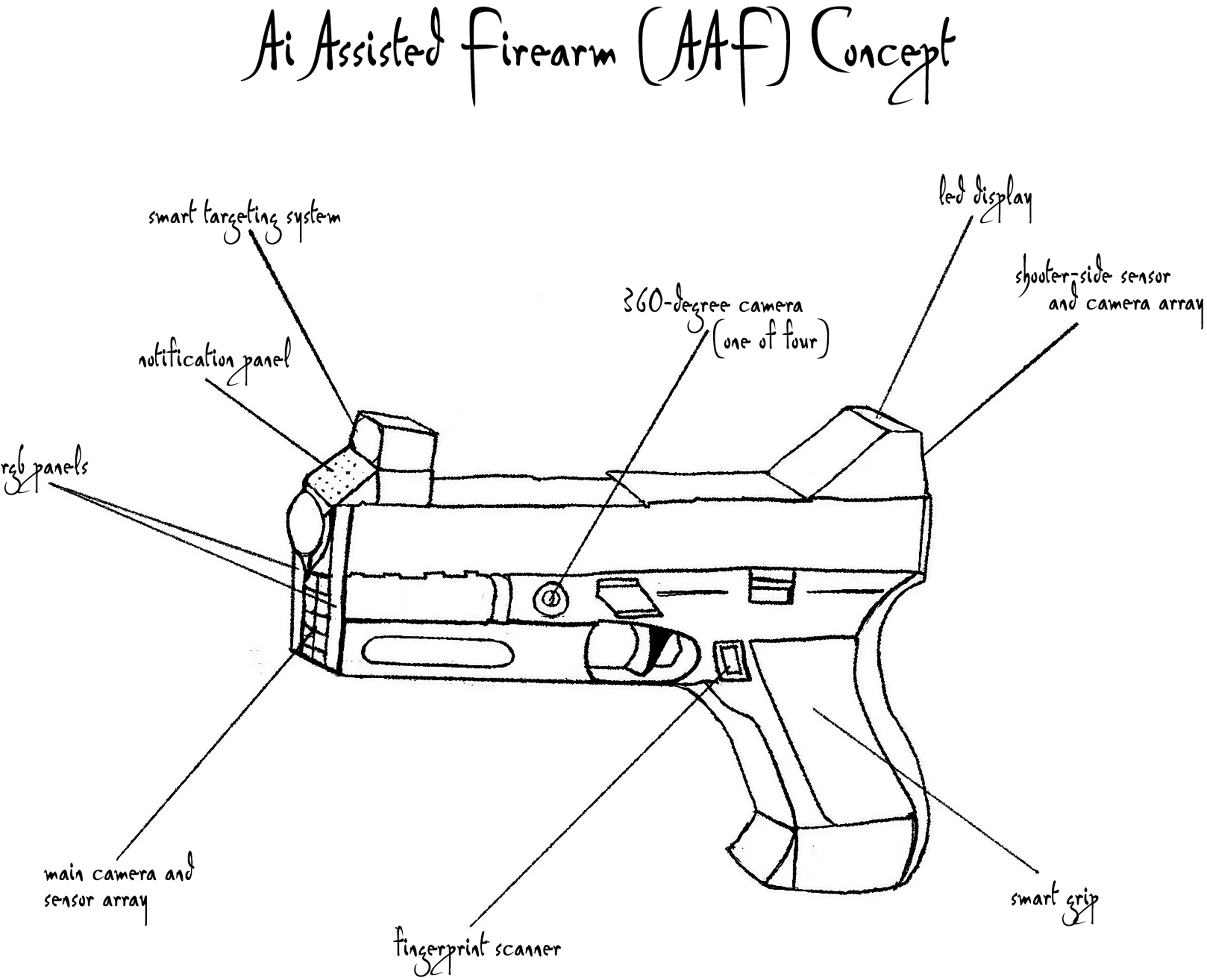
Concept drawing.
Discussion and conclusions
The practice of policing has evolved over the years with a plethora of innovations that have fundamentally changed the character and scope of the vocation (Kelling and Moore, 1989; McQuade, 2001). The vision of an ever-present police force whose omnipresence acts as a deterrent to potential offenders (Moore and Kelling, 1983) was realized with the introduction of CCTV cameras in the 1980s and has become a staple of policing all over the world. Forensic science, especially DNA-typing, led to a paradigm shift in investigations, and with the advent of smart technologies and AI, law enforcement stands on the precipice of another revolution (M Lynch et al., 2010; MD Lynch, 2015).
Much has been discussed about the potential of these technologies and the risks that they pose (Haggerty and Ericson, 1999; Haberfeld et al., 2012). Since the end of the 2010s, smart firearms have increasingly entered the public discourse, with private contractors advertising an alternative to the traditional gun, which has largely remained unchanged since its inception (Taylor, 2000; Zeitchik, 2022). Equipped with biometric grips, fingerprint scanning and RFID chips, the technical innovations of the smart gun are promising, yet they do not address long-running issues such as racism, sexism, discrimination based on socio-economic status, the use of excessive force and brutality that have epitomized the discourse surrounding policing around the world, and the proliferation of citizen demands for a system to stamp out these historical frailties (Chowdhury, 2022). It has thus become vital for law enforcement agencies to consider the effectiveness of less-lethal weapons in different scenarios, and to develop policies and procedures for their use (Gurr, 1997; Lewer, 2017).
Although education programmes and training, especially in de-escalation and diversity, can be useful in this regard (Oliva et al., 2010), technology has the potential to be assistive in addressing the same (Barbosa et al., 2021; Woods, 2019). Body-worn and dashboard cameras have already seen a ‘contagious’ effect in police forces, where officers have shown more restraint and provided better service, even when not wearing BWCs themselves (Ariel et al., 2017).
Increased CCTV coverage also provided a means for misconduct to be evidenced (Goold, 2003), with the internet providing citizens with a way of capturing and revealing any conduct unbecoming of officers in the line of duty (Chowdhury, 2022). Although these are welcome additions, they only offer recourse after the fact, and have been shown to be ineffective when cameras are either switched off (Forliti, 2022) or CCTV coverage is patchy (Siddique, 2020). It is therefore advisable to adopt a position in which training is prioritized, but also supplemented by assistive technologies such as AAFs, which can not only be a preventative mechanism, but also one that documents officer–citizen encounters to ensure accountability.
Emerging technologies like these are, however, likely to see pushback from within police forces. For years, change has been a precursor to anxiety and fear in law enforcement, especially when instigated by automation, leading to increased strain on personnel burdened with new compliance and accountability requirements, losing autonomy and discretion because of a data-driven decision system, and setting boundaries and requirements that would keep staff from performing their duties in a timely and effective manner (Chan, 2001; Chowdhury, 2022). These tie in with concerns that changes in law enforcement may not be sufficiently contextualized to take account of the complexities of policing culture and the role of the police in society (Cockcroft, 2012).
Lessons should also be taken from the historical and mistaken belief that scientific analysis is infallible (M Lynch et al., 2010; Thompson, 2013), or the more current misconception that AI cannot fail or make mistakes (Helbing et al., 2019). The efficiency and accuracy of intelligence systems are critically dependent on the quantity and quality of the data provided (Oliveira, 2019). Faulty information or data without context can have potentially disastrous consequences, particularly with strategies that aim to predict crime (O’Neil, 2017). The reliability and accuracy of sensors and AI algorithms, application of officer judgement and strict adherence to established protocols are therefore key to AAF's success.
Concerns about AI and machine learning also include job displacement, autonomous decision-making and the potential for misuse and abuse (Chowdhury, 2022). Algorithmic mechanisms are prone to bias and discrimination much like human criminal justice actors (Zou and Schiebinger, 2018). A reliance on targeting data without the contextualization of socio-economic factors and their intersection with race can lead to racial discrimination, despite the algorithm's marketed inability to be prejudiced. Gendered media coverage and societies’ often archaic and reductionist construction of the sexes (Walklate, 2013) can have a significant effect on AI training data, leading to biased outcomes (Perez and Klein, 2020). Software solutions and algorithms must, therefore, be wary of these complex and dynamic issues, where necessary integrating failsafe mechanisms to prevent injustices.
Increased integration of machineries into the human body have led to other concerns about the potential future implementation of cybernetics and mechanical implants, including potential loss of autonomy, privacy and security (Thacker, 2003). Officers may resist machine-integration for fears of losing control of their equipment or being vulnerable to hackers who could gain access to the same. There may also be social and economic concerns, such as creating a divide between those who can afford the technology and those who cannot (even between police forces) (Andreas, 2012), and the potential for discrimination against individuals with/without the enhancements. In addition, there are ethical and philosophical concerns, such as the implications of merging human biology with technology and the potential for loss of humanity or identity (Lepskiy, 2018). However, such concerns have been around for as long as technology has existed and were a particular worry at the beginning of the smartphone revolution (Rafael, 2003); despite becoming ‘almost a new limb’ that particular technology has continued to grow in development and stature in modern society.
The way forward, therefore, could be careful design, robust training and considered data integration. In the same way that having robust driving examinations can yield better drivers, specialized training has been evidenced to produce more knowledgeable and less trigger-happy officers (Engel et al., 2020). Collision-detection systems and vehicle safety mechanisms have, however, continued to be developed, driven by technical innovations and acknowledging human fallibility (Wang et al., 2021). Self-driving cars already use advanced imaging techniques to identify and avoid objects in their path, making intelligent decisions that provide an added level of driver safety even when a vehicle is under human control (Badue et al., 2021; Yaqoob et al., 2019).
These concerns should not detract from the potential benefits of innovations such as the AAF. It could help improve the accuracy of shootings and reduce the risk to bystanders, provide real-time information and data about OIS incidents, facilitate better organizational and individual decision-making, prevent the use of firearms by unauthorized individuals, and potentially enhance public safety. It is worth imagining a future in which an officer makes an incorrect call, driven not by an error of officer judgement, but by prejudice, and the weapon the officer is wielding stops that injustice. AAFs can be the bridge between current smart gun technology and that future. Future predictions are too often seen as dystopian, and the police thought to be bad actors. Therefore, working towards mechanisms to weed out policing's systemic problems, and recording officer actions and inactions in a manner that provides the most robust levels of accountability can not only produce officers that the community trusts and wants to work with, but also a police force of the future.
Footnotes
Declaration of Conflicting Interests
The author declared no potential conflicts of interest with respect to the research, authorship, and/or publication of this article.
Funding
The author received no financial support for the research, authorship, and/or publication of this article.
