



Abstract
There is a growing tendency toward the introduction of Big Data in police departments to improve the prevention and investigation of crime. However, there is little systematic knowledge about the perspectives of professionals in police forces regarding this technology. This article fills this gap by presenting a scoping review that systematizes empirical studies of the views of professionals in police forces about Big Data in the field of policing and criminal investigation. Fourteen articles were analyzed following a descriptive–analytical method. Optimistic and oppositional views about Big Data among professionals in police forces were then described. Optimistic views focused on the potential of Big Data to improve the objectivity and efficiency of policing and better manage police resources by providing new capabilities and strategies by which to perform crime predictions, risk assessments, criminal investigations, crime analysis, risk management, cooperation and data exchange. Oppositional views related to the police's awareness of Big Data's biases, the lack of a regulatory landscape, misuse of data, privacy threats, data security, misplaced trust in technology, the absence of major changes in work practices, and practical barriers. Analysis of the co-presence of optimistic and oppositional views adds a comprehensive and interpretative argument that might contribute to critical reflections on the technological feasibility, societal usability, and desirability of Big Data technologies in police departments.
Introduction
There is a growing tendency toward the introduction of Big Data technologies 1 in police departments, with the aim of preventing crime by generating predictions of where crime is likely to occur and the suspects are likely to be located (Brayne, 2017; Moses and Chan, 2014) or supporting criminal investigations after a crime has occurred (Joh, 2014; Lei, 2019; Pramanik et al., 2017; Simmler et al., 2022). As Rowe and Muir (2021: 254) stated “the police have begun to develop their capability to exploit Big Data in a number of ways”. However, there is little systematic knowledge of the perspectives of professionals in police forces (hereafter “police professionals”) about Big Data technologies. This scoping review fills this gap by systematizing and analyzing empirical studies on the views of police professionals 2 regarding the use of Big Data in the field of policing and criminal investigation.
In this context, Big Data has applications ranging from predictive policing and mass surveillance to risk assessment. Regarding predictive policing, based on existing data, Big Data technologies make probabilistic inferences about the place and time that a crime is most likely to occur (Joh, 2014; Miró-Llinares, 2020; Moses and Chan, 2018; Shapiro, 2019), and which people are most likely to be involved (Hardyns and Rummens, 2018; Meijer and Wessels, 2019; Sandhu and Fussey, 2021). Big Data might also be used in mass surveillance to detect criminal threats in real time by combining digital data from various sources, such as video surveillance systems, facial recognition technologies, and electronic communications (Brayne, 2017; Hu, 2015; Joh, 2014, 2016). Finally, Big Data technologies are used in risk assessment to analyze different data sets related to prosecuted offenders in order to calculate their level of individual risk and the likelihood of their committing other crimes (Berk, 2021; Brayne, 2018; Hannah-Moffat, 2019).
Big Data applications are expected to make policing more cost-effective and productive (Hu, 2019; Joh, 2016; Kubler, 2017; Ridgeway, 2018), support more efficient criminal justice decisions (Brayne, 2017; Hu, 2019; Joh, 2014, 2016), and reduce crime rates (Marciani et al., 2017; Plaksiy et al., 2018; Pramanik et al., 2017). However, critical studies, mostly in the fields of law and other social sciences, have highlighted concerns about the potential impacts of Big Data on human rights, privacy, and data protection (Miller, 2014; Richardson et al., 2019; Rowe and Muir, 2021). In addition, there is a lack of an adequate regulatory framework on the use of Big Data for security and law enforcement purposes (Joh, 2014; Lei, 2019; Moses and Koker, 2017), and existing legislation reveals inadequacies in handling the complex challenges to the criminal justice system generated by Big Data technologies (Babuta, 2017; Ferguson, 2018; Henderson, 2017; Rich, 2016; Yang and Feng, 2021). Finally, some studies provide evidence that Big Data does not produce the expected benefits in terms of more efficient policing (Babuta, 2017; Moses and Chan, 2018; Browning and Arrigo, 2021; Chan and Moses, 2017), and has the potential to reproduce social inequalities and racial bias (Brayne, 2017; Johnson and Rostain, 2020; Rowe and Muir, 2021).
Inspired by studies on the sociology of expectations toward innovation processes (Borup et al., 2006; Konrad, 2006; Van Lente, 2012), this scoping review develops an analysis focused on expectation dynamics evidenced in empirical studies on the views of police professionals regarding Big Data technologies. We assume that imaginings, expectations, and visions shape the potential of innovative technologies by guiding and motivating activities (Borup et al., 2006), with the power to inform the development (or not) of technologies in policing and criminal investigation contexts. Although much of the work in this area has focused on optimistic future abstractions (or hype), other studies have examined less-promissory visions of the future (or small expectations, see Gardner et al., 2015; Tutton, 2011) and critical studies have drawn attention to the need to consider cautionary principles.
This scoping review explores the co-presence of optimistic and oppositional views in empirical studies on the views of police professionals regarding how Big Data technologies apply to the field of policing and criminal investigation. Using this analysis, this article critically reflects on the technological feasibility, societal usability, and desirability of Big Data technologies in police departments.
Methods
To develop this scoping review, we followed the guidance for descriptive reviews by Levac and colleagues (2010) and adopted the methodological framework for scoping studies proposed by Arksey and O’Malley (2005).
Stage 1: Identifying the research question
The research question of this scoping review is: What are the optimistic and oppositional views about Big Data in the field of policing and criminal investigation of professionals of police forces?
Stage 2: Identifying relevant studies
A search of the publications on three electronic databases (Web of Science, Scopus, and Annual Reviews) and via Google Scholar was undertaken in June 2022, with no restriction set for time of publication. We used the following search expressions to identify relevant studies on the topic: “Big Data” AND (“police” OR “policing” OR “crime analys*”) AND (“views” OR “perspectives” OR “expectations” OR “opinions” OR “attitudes” OR “perceptions” OR “understandings” OR “discourses” OR “culture”). In addition, this search was followed by backward reference tracking, examining the references in the selected publications based on full-text assessment.
Stage 3: Study selection
The inclusion criteria allowed only original empirical studies written in English reporting data on police professionals’ views about Big Data. Non-original full-length studies (commentaries, editorials, notes, newspaper articles, conference proceedings, and reports) were excluded. The titles of 384 records were retrieved. After removing duplicates, 378 articles were screened and assessed for eligibility. The first two authors independently screened all the papers based on the title and abstract, and subsequently based on the full text. This was cross-checked and discussed in both phases, and perfect agreement was achieved. The screening process is shown in Figure 1. Based on the title and abstract assessments, 344 records were excluded because they were not related to the research question (n = 53) or not empirical studies (n = 291). Of the 34 fully read articles, 12 met the inclusion criteria. Two articles were included following backward reference tracking, and the final scoping review was composed of 14 articles.
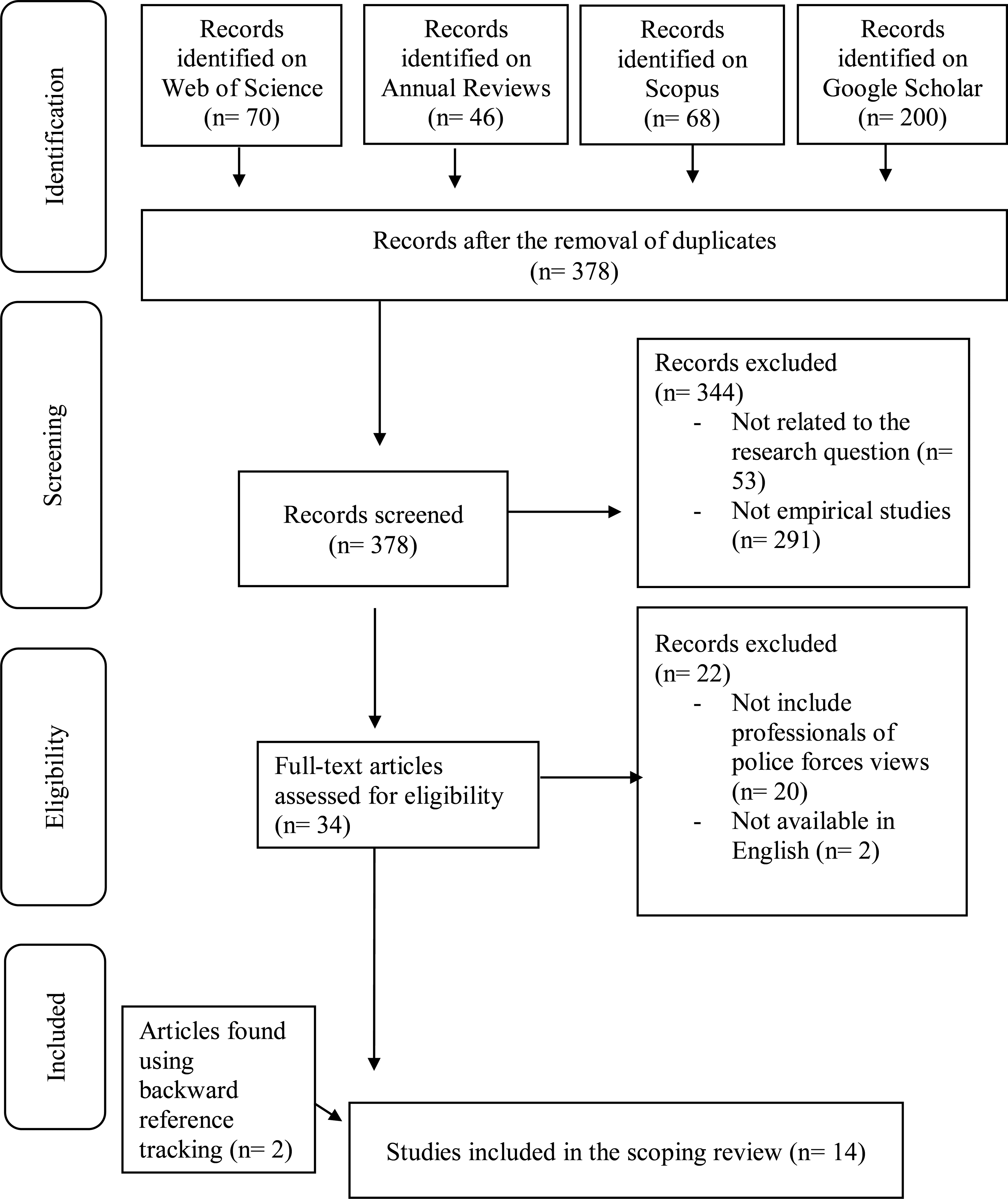
Flowchart for the search and screening process of the scoping review.
Stage 4: Charting the data
From the primary research, we developed a data charting form to organize and synthesize all the relevant data. Specifically, we created a document with descriptive data to characterize the empirical studies included in this scoping review. This document aggregates information about the author(s), year of publication, country of study origin, study aim, methods of data collection, participants and sample.
Afterwards, we followed the “descriptive–analytical” method (Arksey and O’Malley, 2005) to report information from all the included articles. In particular, we mapped the key findings presented in the selected studies in terms of positionings of optimism or opposition by police professionals regarding Big Data technologies, applying the frames suggested by Lavorgna and Ugwudike (2021) in their review of multidisciplinary academic abstracts on data-driven technologies in criminal justice systems. According to the authors, “optimistic frames endorse tools and their ostensible status as the panacea for cost-effective and efficient crime control” (Lavorgna and Ugwudike, 2021: 2), sharing positive arguments about datafication tools by encouraging their implementation as sustained in ideas of efficiency and effectiveness. By contrast, “the oppositional frames emphasize several harms of datafication and reject the view that data-driven tools constitute the panacea for crime control” (Lavorgna and Ugwudike, 2021: 2), and are focused on the threats, harms, and consequences of data-driven technologies.
The views of police professionals were considered optimistic when the author(s) described their findings in terms of police forces perceiving Big Data technologies as an opportunity to enhance efficiency and effectiveness, showing positive arguments for its application, and the overall results conveyed views on the potential utility and capabilities of Big Data. Oppositional views referred to the results of empirical studies showing the concerns of police professionals about the social impacts of Big Data technologies, and views focusing on consequences, harms and risks.
Stage 5: Collating, summarizing and reporting the results
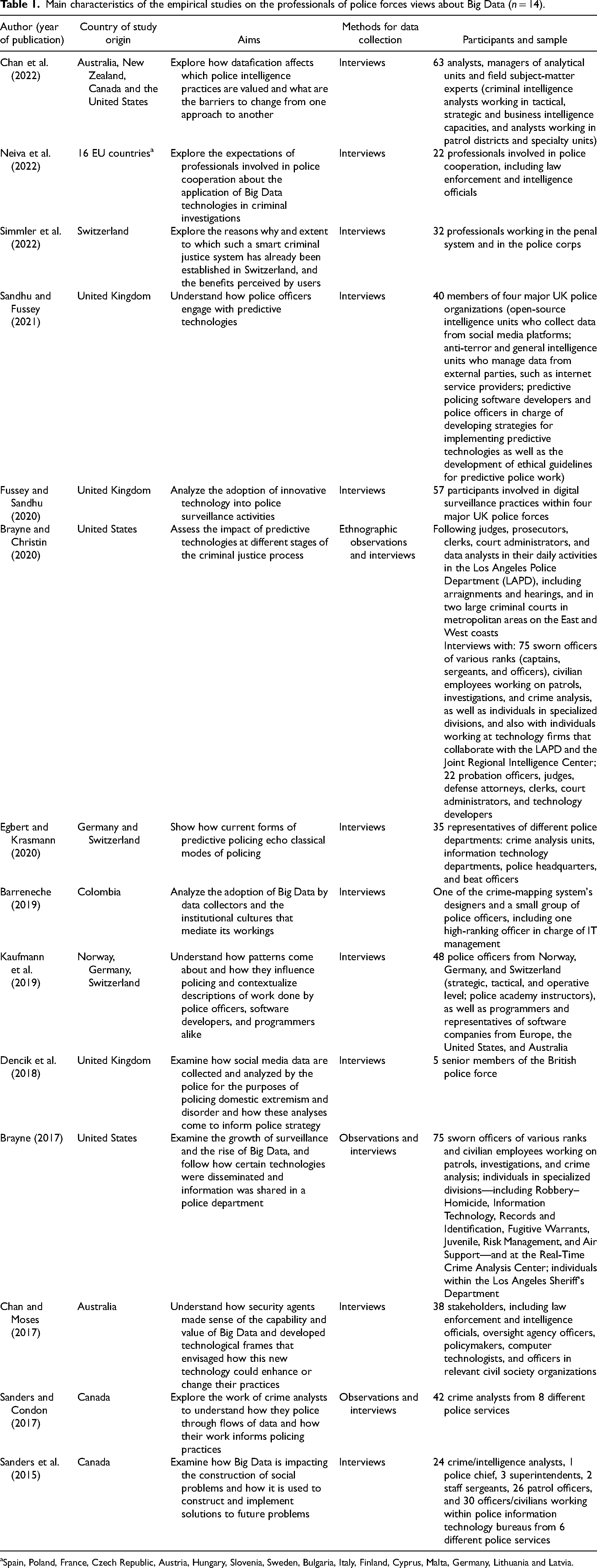
Table 1 presents information about the main characteristics of the 14 included studies, ordered by year of publication. The main empirical achievements of the studies on the optimistic and oppositional views of police professionals regarding Big Data are discussed in the second part of the Results section.
Main characteristics of the empirical studies on the professionals of police forces views about Big Data (n = 14).
Spain, Poland, France, Czech Republic, Austria, Hungary, Slovenia, Sweden, Bulgaria, Italy, Finland, Cyprus, Malta, Germany, Lithuania and Latvia.
Results
Study characteristics
The studies were published between 2015 (Sanders et al., 2015) and 2022 (Chan et al., 2022; Neiva et al., 2022; Simmler et al., 2022). Ten of the fourteen studies were conducted in a single country, namely the United Kingdom (Dencik et al., 2018; Fussey and Sandhu, 2020; Sandhu and Fussey, 2021), Canada (Sanders et al., 2015; Sanders and Condon, 2017), the United States (Brayne, 2017; Brayne and Christin, 2020), Colombia (Barreneche, 2019), Australia (Chan and Moses, 2017), and Switzerland (Simmler et al., 2022). The others four studies derived from several countries: sixteen European Union (EU) countries (Spain, Poland, France, Czech Republic, Austria, Hungary, Slovenia, Sweden, Bulgaria, Italy, Finland, Cyprus, Malta, Germany, Lithuania and Latvia) (Neiva et al., 2022); Norway, Germany and Switzerland (Kaufmann et al., 2019); Germany and Switzerland (Egbert and Krasmann, 2020); Australia, New Zealand, Canada, and the United States (Chan et al., 2022).
All studies used a qualitative methodology, relying on interviews; three studies also collected data by observation (Brayne, 2017; Brayne and Christin, 2020; Sanders and Condon, 2017). Beyond police professionals (i.e., professional agents engaged in policing and criminal investigation activities, intelligence officials and agents working in information technology departments oriented to crime analysis), samples were also composed of professionals from technical organizations (Barreneche, 2019; Chan and Moses, 2017; Kaufmann et al., 2019; Sanders et al., 2015; Sandhu and Fussey, 2021), criminal justice officials (Simmler et al., 2022), court professionals (Brayne and Christin, 2020), and officers in relevant civil society organizations (Chan and Moses, 2017).
Optimistic and oppositional views about Big Data among professionals in police forces
The selected publications presented diverse framings of the views of police professionals, suggesting the coexistence of optimistic and oppositional positionings. These framings were classified as techno-enthusiastic and techno-skeptic (Simmler et al., 2022), permissive and cautious (Fussey and Sandhu 2020), optimistic and skeptical (Sandhu and Fussey, 2021), and perceived benefits and perceived risks (Neiva et al., 2022).
Optimistic views
Police professionals who expressed optimistic views about Big Data considered that it improved the objectivity and efficiency of policing and allowed better management of police resources by providing new capabilities and strategies to perform crime predictions, risk assessments, criminal investigations, crime analysis, risk management, cooperation and data exchange (Barreneche, 2019; Brayne, 2017; Brayne and Christin, 2020; Chan et al., 2022, Dencik et al., 2018; Fussey and Sandhu, 2020; Neiva et al., 2022; Sanders and Condon, 2017; Sandhu and Fussey, 2021; Simmler et al., 2022).
According to Simmler and colleagues (2022: 4), although Big Data was seen as a “no novelty” in the field of criminal investigation and crime analysis by the police professionals interviewed, they considered that this technology anchored some positive changes in their work practices. For example, the police professionals interviewed stated that Big Data supports the “pattern identification and plan processes”, adds “value to structured approach and standardization”, encourages “further reflections on cases” because the results obtained by these technologies (for example, risks assessments) required a justification to be considered, so it promotes deeply reflections, and allows the “linking of cases and series identifications” (Simmler et al., 2022: 14).
These optimistic views were also described in the study developed by Brayne and Christin (2020) where, in addition, police professionals emphasized that Big Data can be used at different times, both following investigations and in predicting crime. Further, in other three studies (Brayne, 2017; Fussey and Sandhu, 2020; Sanders et al., 2015) Big Data technologies were perceived by participants as providing new possibilities to carry out risk assessments, merge data sources from different institutions, create new guidelines to include more information in police databases, develop predictive policing, and increase policing power surveillance.
Regarding the capabilities of Big Data to improve traditional methods of policing (Barreneche, 2019; Chan and Moses, 2017; Dencik et al., 2018; Sanders et al., 2015; Simmler et al., 2022), police professionals in the study conducted by Barreneche (2019) in Colombia conceived this technology as a benefit because it equipped them with geographic system information that enables access to statistical information on crime, improving and transforming their work practices. A positive change from reactive to proactive practices is also described by the participants in Dencik and colleagues’ (2018) study. Because Big Data allows the use of big social media data for policing purposes in the United Kingdom, police professionals note that it changes police practices to strategies that are focused more on the prediction and prevention of social problems, as well as real-time responses rather than reactive practices, applied after the occurrence of a crime.
Police professionals mentioned other opportunities to improve their work that were enabled by Big Data. First, Big Data allows the construction of centralized databases and the harmonization of previously different systems (Sanders et al., 2015). Second, the integration of Big Data technologies is seen as a signal of the scientification of police work (Kaufmann et al., 2019; Sanders et al., 2015), providing new tools to analyze large amounts of data and predict social problems (Kaufmann et al., 2019). For example, in research conducted by Kaufmann et al. (2019), police professionals stated that police departments are now working with small data sets (for example, their criminal databases used for particular purposes such as investigation of a specific crime in some areas), Big Data and information from themselves and other databases, such as public administration. In addition, they buy commercial data to improve their analyses, revealing that calculation is the new way of operationalizing policing, given that all the information is converted to numbers to inform police decisions (Kaufmann et al., 2019). Third, police professionals included in the studies of Brayne (2017), Sander and colleagues (2015), and Sanders and Condon (2017) perceived Big Data as helpful in understanding and evaluating policing strategies by aggregating and analyzing digital police practices. In addition, some professionals in the studies by Brayne (2017) and Sanders et al. (2015) considered that Big Data may confer legitimacy to change in police departments (Brayne, 2017), given emerging concepts about the implementation of Big Data as a signal of increasing efficiency and accountability (Sanders et al., 2015). Finally, participants in the study of Egbert and Krasmann (2020) considered that the inclusion of algorithmic processing of crime data engenders feelings of productivity, as well as the legitimacy of policing among the general population.
The study by Neiva and colleagues (2022) also found that police professionals’ cooperation in the EU showed promising expectations about the role of Big Data in criminal investigations by making use of DNA databases; namely, in terms of its perceived capability to advance cold criminal cases and strengthen the interoperability of multiple data sets in ways that produce intelligence valuable for criminal investigations. Chan and colleagues (2022) draw similar conclusions: the interoperability of databases enhanced by the integration of technological platforms was conceived by the police professionals as an upgrade to their work. Participants’ views were focused on the benefits of Big Data in improving their intelligence work given its capabilities to enhance access, storage, analysis and sharing of different data.
Oppositional views
In addition to optimistic views, police professionals in the included studies also revealed oppositional views related with their awareness of Big Data's risks, fallibilities, errors, and biases; the lack of a regulatory landscape; the misuse of data; privacy threats and data security; misplaced trust in technology; the absence of major changes in work practices; and some practical barriers.
Most empirical studies showed that participants were aware of Big Data's risks, fallibilities, errors, and biases (Barreneche, 2019; Chan and Moses, 2017; Dencik et al., 2018; Neiva et al., 2022; Sanders et al., 2015; Sandhu and Fussey, 2021). According to the selected studies, police participants recognized that Big Data is not an objective technology for two main observations. First, when Big Data technologies guided their activities, police were continuously patrolling the same areas, so the likelihood of finding a suspect or crime in these areas was higher (Chan and Moses, 2017; Sanders et al., 2015; Sandhu and Fussey, 2021). Second, data used to make future predictions are based on police officers’ past categorizations, potentially producing biased predictions (Chan and Moses 2017; Sanders et al., 2015; Sandhu and Fussey, 2021). Participants assumed that crime classifications are human constructs resulting from the interaction between themselves and the technology (Dencik et al., 2018; Sanders et al., 2015).
Police professionals also emphasized the importance of human decisions, not only to interpret the data that emerge from crime analyses, but also to verify errors produced by the software (Barreneche, 2019; Chan and Moses, 2017; Dencik et al., 2018; Egbert and Krasmann, 2020; Kaufmann et al., 2019; Sanders et al., 2015; Sandhu and Fussey, 2021; Simmler et al., 2022). For example, the professionals interviewed by Simmler and colleagues (2022) were aware of the validity of the results produced by analyzing large amounts of data. Furthermore, they were not convinced about the utility of these technologies in policing and criminal investigation activities, asking for empirical evidence that proves the added value that Big Data may have in their work activities.
Other studies indicated that police professionals were concerned about the lack of a regulatory landscape addressing Big Data (Fussey and Sandhu, 2020; Neiva et al., 2022; Sanders and Condon, 2017). They often considered that this lag produces news dynamics in which they act as essential mediators in data applications, being obligated to combine their interpretation of existing law, the management of institutional aims, and their surveillance practices (Fussey and Sandhu, 2020). In the absence of specific rules, some professionals consider that applying Big Data technologies may have unintended social consequences (Sanders and Condon, 2017).
In some studies, police professionals mentioned concerns in terms of the misuse of data, privacy threats, data security, and misplaced trust in technology (Chan and Moses, 2017; Neiva et al., 2022; Sanders et al., 2015). Neiva and colleagues’ (2022) study revealed perceived difficulties associated with investigating large sets of data and the potential to reinforce genetic discrimination; i.e., the potential to reproduce wrong conclusions that may accuse innocent individuals based on their genetic predisposition to criminal behavior.
A less-frequent argument used by those with oppositional views is the absence of major changes in their work practices with the incorporation of Big Data. Some of the police professionals considered that Big Data is not pushing new policing practices, but only intensifies previous and traditional pre-emptive strategies (Brayne, 2017) by amplifying surveillance and control (Egbert and Krasmann, 2020). They argued that the utilization of Big Data is shaped by historical policing norms and values (Sanders and Condon, 2017), and current Big Data analysis applications in predictive policing echo classical policing strategies based on past crime patterns (Egbert and Krasmann, 2020). Other participants mentioned that any significant changes occurred in work practices with Big Data (Chan et al., 2022; Chan and Moses, 2017; Sanders and Condon, 2017; Sandhu and Fussey, 2021), basing their perceptions on three main arguments: first, the belief that they do not have enough analytical knowledge on this topic (Chan and Moses, 2017; Sanders and Condon, 2017; Sandhu and Fussey 2021); second, officers’ awareness of the limitations of predictive policing technologies sustained their “reluctance” to use them (Sandhu and Fussey, 2021: 66); and third, perceptions that Big Data is not used and/or is not well integrated by their professional organization (Chan et al., 2022; Chan and Moses, 2017; Sanders and Condon, 2017; Sandhu and Fussey, 2021). Further, the interviewees involved in the research undertaken by Brayne and Christin (2020) perceived the implementation of Big Data as an answer to technical and political pressures to use the latest technological innovations in policing in order to maintain legitimacy among the population, rather than an improvement in their work practices because, in their view, the implementation of Big Data has no practical effects on policing.
Lastly, practical barriers were also pointed out as elements of concern by police professionals involved in some of the studies, in particular: (a) scarce economic resources for implementation of the technologies, and the non-interoperability with different databases (Chan et al., 2022; Chan and Moses, 2017; Sanders and Condon, 2017); (b) a lack of professional training for police officers (Chan and Moses, 2017; Sanders and Condon, 2017); and (c) conflict and political tension between analysts and police managers, as well as difficulties in accessing data and resources (Chan et al., 2022).
Discussion
This scoping review analyzed existing empirical studies focused on police professionals’ views about Big Data. Overall, the analyzed studies revealed the co-presence of optimistic and oppositional views which convey a broader techno-optimism that Big Data will advance and improve society, by ensuring public safety and improving the fight against criminality. This techno-optimism is entangled with oppositional views that serve to perform optimism as a form of attachment to an object of desire offering a set of promises that may or not be realized (Quinlan, 2020).
Oppositional views reported in the selected empirical studies, expressed an acknowledgment, by police professionals, of the potential of errors of Big Data, the lack of a regulatory landscape, the misuse of data, privacy threats, data security, misplaced trust in technology, an absence of major changes in work practices, and practical barriers to the successful implementation of Big Data technologies also served to protect and legitimize police work, in ways similar to those that studies of the sociology of expectations towards innovation processes have shown in other areas (see, for example, Tutton, 2011). The views of police professionals reported in the empirical studies collected for this scoping review reveal how the participants engaged in anticipatory regimes “forced to tack back and forth between pessimistic and optimistic forecasts of equally conditional futures” (Tutton, 2011: 419).
Police professionals’ oppositional views have a performative effect (Kerr et al., 2020), because articulation of the hopes and fears around Big Data allows police professionals to deal with future situations tainted by uncertainty. Simultaneously, it demonstrates engagement with social repertoires adopted by a larger collective (Konrad, 2006) to narrow or limit capacities for critique or resistance. These views are accorded a “shared narrative of the future” (Sartori and Theodorou, 2022: 6) and “commonly mirror those of academics” (Burrell and Bull, 2011: 13) because, as Neiva and colleagues (2022: 10) stated in their study of police expectations of Big Data, “the recognition of potential risks posed by Big Data are constitute of the social repository on the subject”. In particular, the selected empirical studies showed how police professionals reflected on the lack of regulation of Big Data in law enforcement contexts, such as policing (Fussey and Sandhu 2020; Neiva et al., 2022; Sanders and Condon, 2017), and expressed concerns regarding Big Data’s risks of data misuse, privacy and data security (Chan and Moses, 2017; Neiva et al., 2022; Sanders et al., 2015).
Although police professionals expressed an awareness of human rights challenges, privacy and data protection issues, adopting values and normative positionings performing ethical principles that Kerr and colleagues (2020) found in their analysis of formal reports, public consultations and research programs in the area of artificial intelligence, the professionals’ views came from “a certain instrumental conception of the goal of criminal justice that, in essence, agrees with the culture of control” (Miró-Linares, 2020: 16) that it is the “police subculture” (Javaid, 2015: 85). The emergence of oppositional views from the police professionals is a way of co-producing the implementation of future applications of Big Data technologies, because they only moderate the desirous visions of a promising future for these technologies in policing and criminal investigation.
The coexistence of optimistic and oppositional views is in line with previous studies showing that feasibility and utility statements about innovative technologies are frequently quite futuristic. By contrast, the claims on desirability often display a conservative, more skeptical stance towards the future (Lucivero et al., 2011). The combination of optimism and opposition has the potential to do “recalibration work” (Gardner et al., 2015: 1005); for example, managing the tensions between the highly optimistic and hyped visions of the future and the exigency in delivering those innovations in concrete work settings within police organizations.
This scoping review also highlights potential areas of research that may address gaps in the literature, and some methodological features. Only a relatively small number of empirical studies conducted in few countries are available. White Western countries are over-represented in this review sample, although police professionals use Big Data in many countries worldwide. Regulations and concrete work settings within police organizations vary widely in issues such as cultural context, jurisdiction framework, economic resources, technological systems, and institutional conditions that may impact the views of police professionals. It will be interesting to explore police perspectives in other understudied countries. Furthermore, the assessment of views about Big Data in policing and criminal investigations activities among police professionals is centered on the predictive aims of this technology, before a crime has been committed. Literature about the police professionals’ views around the use of Big Data in a post crime context remains scarce. Finally, a dynamic analysis of interactions between qualitative and quantitative data would lead to a wider understanding of the factors influencing optimistic and oppositional views about Big Data.
Conclusion
Considering the speed with which Big Data is advancing in the field of policing, and with police professionals increasingly being asked to use such technologies, this scoping review provides a timely and unique overview of the co-presence of optimistic and oppositional views about Big Data held by police professionals. This comprehensive and interpretative line of reasoning helps us to critically reflect on the feasibility, societal usability, and desirability of Big Data technologies in police departments. Police forces combined recognition of the societal usability of this technology with limitations in its feasibility and desirability. Mentions of the added value of Big Data technologies and their benefits in promoting the common good are articulated with two main concerns. First, police forces are aware that less is known about Big Data's effectiveness in the prediction and investigation of crimes. This argument can be understood as part of a process in which police forces want to attract investment and economic resources to the innovation in their work settings. Second, police forces revealed concerns with human rights breaches. The adoption of normative positionings (i.e., expression of an awareness of Big Data's biases, the lack of a regulatory landscape, the misuse of data, privacy threats, and data security) allow them to perform ethical principles to sustain the social image of police forces as sensitive to data security and privacy threats, which serves to recalibrate the desire to adopt recent innovations in policing and the criminal investigation field.
Footnotes
Declaration of Conflicting Interests
The author(s) declared no potential conflicts of interest with respect to the research, authorship, and/or publication of this article.
Funding
The author(s) disclosed receipt of the following financial support for the research, authorship, and/or publication of this article: This work was supported by national funds through the Foundation for Science and Technology (FCT) I.P., under a PhD Research Studentship with the reference 2020.04764.BD (attributed to Laura Neiva), and under the project UIDB/00736/2020 (base funding) and UIDP/00736/2020 (programmatic funding).
