



Abstract
We analyzed police shootings in Canada (except Québec) between 2017 and 2019. Drawing upon media reports and information provided by police oversight agencies, we attempted to identify all incidents where on-duty police officers discharged their firearm with the intent to strike a person. Findings indicated that such incidents occurred an average of 58 times per year. Approximately 39% of police shootings were fatal, 48% were non-fatal, and 12% were non-injurious. Most occurred in public spaces and were initiated by civilian requests for police service, typically for crime-related reasons. We discuss our findings with respect to both research and practice. We also call for official, incident-level data regarding police shootings to address concerns that otherwise exist about these incidents among civilians, practitioners, researchers, and policymakers.
Introduction
In many countries, including in Canada and the USA, police officers are authorized to use deadly force in circumstances that present grievous bodily harm or the risk of such harm to officers and/or civilians (Stoughton et al., 2021). With such authority comes great expectations—perhaps none less controversial than simply tracking incidents that involve the use of deadly force by officers. Each year in the USA, for example, we have learned that police officers kill—regardless of justification—roughly 1,000 people by gunfire (Edwards et al., 2019; Schwartz & Jahn, 2020). 1 Understanding how often such deadly force occurs, as well as when and where it occurs most frequently, are critical first steps toward understanding potential patterns among these incidents (Schwartz & Jahn, 2020). Understanding these details is also an important step toward holding police agencies accountable, and, ideally, implementing evidence-based policies and practices to minimize the rate at which police-citizen interactions turn deadly (Fyfe, 1981; Jennings & Rubado, 2017).
Yet, while public outrage over high-profile police shootings in the USA have prompted the creation of new and improved databases tracking police shootings (Alpert, 2016), there has been less traction in Canada (Bennell et al., 2022). This leaves even the most basic questions unanswered. For example, how often do Canadian police officers shoot at people? How often do these shootings result in injuries and/or death? To what extent is there meaningful variation across provinces/territories and/or police agencies?
Given the differences between Canada and other countries, such as the USA, and the policing contexts therein, we must be cautious in generalizing findings from the mostly USA-based research literature on police shootings to the Canadian context (Fyfe, 1988; Sherman, 2020). 2 Whereas there are approximately 17,500 state and local police agencies in the USA (Gardner & Scott, 2022), there are roughly 175 police agencies in Canada (Conor et al., 2020). Canada exhibits a lower rate of gun violence than the USA (Gabor, 2016; Newman & Head, 2017) and Canadians generally exhibit more confidence in the police than Americans (Ibrahim, 2020). As a function of its large landmass and small population, much of Canada is policed under very rural and remote conditions. Finally, most of Canada’s police officers are subject to oversight by external, independent agencies. Canada thus warrants some of its own attention in the context of police shootings.
As part of the present research, we sought to empirically explore police shootings in Canada. We attempted to locate information on all police shootings (i.e., fatal, non-fatal, and non-injurious) that occurred between 2017 and 2019 in all Canadian provinces and territories except Québec (because of logistical barriers, see our methods section). We defined a “police shooting” as any incident where an on-duty police officer discharged their firearm with the intent to strike a person. With our self-generated dataset, we then answered several important and untested questions, including how often police shootings—regardless of justification—occurred and where they occurred most frequently. We also explored some basic characteristics about these shootings before making a call for official, incident-level data regarding police shootings.
Background
The Prevalence of Police Shootings
Neither Canada nor the USA maintain a comprehensive, government-compiled database of police shootings. In the USA, the Federal Bureau of Investigation (FBI) and the National Vital Statistics System (NVSS) have been attempting to do so for decades, but both databases are woefully incomplete (Finch et al., 2022; GBD 2019 Police Violence US Subnational Collaborators, 2021). Fortunately, American journalists, private citizens, and researchers have begun compiling more comprehensive—albeit unofficial—data (e.g., Fatal Encounters, Mapping Police Violence, The Washington Post’s Fatal Force database, Gun Violence Archive, and the Cline Center’s SPOTLITE database). Since 2012, these databases have consistently tracked more than twice as many police shootings as the FBI or NVSS. Unfortunately, each of these unofficial databases uses different inclusion criteria, and so their prevalence estimates vary (Comer & Ingram, 2023). They also often exclude variables that are of interest to researchers, including officer- and civilian-level information. Nonetheless, we now know that police officers in the USA fatally shoot about 1,000 people each year.
Missing from official and most unofficial databases is information about police shootings that do not result in injuries and/or death. This is problematic, because “the true frequency of police decisions to employ firearms as a means of deadly force . . . can best be determined by considering woundings and off-target shots as only fortuitous variations of fatal shootings” (Fyfe, 1978, p. 32). In other words, all police shootings—fatal or non-fatal—constitute uses of deadly force: “physical force capable of or likely to kill” (Fyfe, 1978, p. 32). A recent epidemiological analysis of Gun Violence Archive data identified 4,743 people who sustained non-fatal injuries from police shootings between 2015 and 2020 (in addition to 5,874 people who suffered fatal injuries) (Ward, 2023). This was the first study of its kind in the USA—a national analysis which indicated that approximately 45% of civilians struck by police gunfire over a 6-year period did not die. It is imperative that research account for these non-fatal outcomes given that failure to do so may produce skewed estimates of demographic and geographic disparities among police shootings (Nix & Shjarback, 2021).
Methods and Challenges of Identifying Police Shootings
Why have both the American and Canadian governments failed to compile comprehensive data on police shootings? In the USA at least, part of the answer is the daunting task of requesting data from approximately 17,500 state and local police agencies that are under no legal obligation to share information about their shootings. Hypothetically speaking, any interested person could submit a Freedom of Information Act (FOIA) request to every police agency in the country—or at least a well-defined sample of agencies. This is precisely the approach that VICE News took for its analysis of the 50 largest jurisdictions in the USA. Yet, even with this much more manageable sample, they were only able to obtain data from 47 agencies (McCann et al., 2017). The problem, in addition to this methodology being too cost-prohibitive and time-consuming for most, is that agencies are often able to deny such records requests (DuPey et al., 2018).
Fortunately, because police shootings are newsworthy events, it has become much easier in recent years to track these incidents as media report on them. For example, Brian Burghart, the creator of Fatal Encounters, got started in 2012 by setting up a Google Alert for the string “police shot killed.” 3 Using a similar methodology, as well as pulling information from data collection programs in states like California and Texas (Nix & Shjarback, 2021), Mapping Police Violence estimates that their database captures “92% of the total number of police killings that have occurred since 2013.” 4 Using media to track police shootings presents a practical benefit: news articles offer a public medium for researchers to retrospectively track incidents that receive news attention without manually soliciting such information from all respective agencies.
There are, of course, drawbacks to relying upon media for data regarding police shootings. The first and most obvious is that if the media do not report on a police shooting, that shooting will not make its way into the database (Baćak et al., 2021). Moreover, even if the police shooting receives some media coverage, if it is not enough to compete with the attention provided to other events, it may not be readily discoverable using search queries. More newsworthy incidents are more likely to receive news coverage (Boukes et al., 2022). Given that heterogeneity exists among the salience of police shootings, including with respect to injuries, this could complicate one’s ability to identify non-fatal and non-injurious shootings for inclusion in a crowdsourced database.
Second, the data that we ultimately compile via media sources are only as complete as the information gleaned from what gets written in news articles and/or investigative follow-ups with the police agencies involved in the shootings. If certain situational features of a police shooting lead the media to deem it more/less newsworthy or to write about it differently—for example, if they involve Black (Zuckerman et al., 2019), Native American (Schroedel & Chin, 2020) or unarmed civilians (Moreno-Medina et al., 2022)—the resulting data could be systematically skewed. Relatedly, details about the officer(s) and/or civilian(s) involved in the shooting are typically much more difficult to discern than merely determining that a police shooting occurred. As but one example, preliminary reporting may be so vague as to say “a shooting occurred following a traffic stop” with no clear indication of whether an officer shot a civilian and/or vice versa, or whether the shooting resulted in any injuries and/or deaths.
Third, when multiple police agencies are involved in a police shooting, it can be difficult to determine which agency was responsible for the shooting. If, for instance, a federal agent assigned to a local task force shoots a civilian, should the shooting be attributed to the federal or local agency? A similar challenge applies if multiple officers—even from the same agency—are involved in the shooting. Deciphering which reported characteristics of officers apply to which specific officers at the shooting can be challenging.
Fourth, and finally, police accounts may differ—sometimes in significant ways—from witness accounts. When there is no video of the incident, it is impossible to determine what really happened. As the statement initially released by the Minneapolis Police Department following the murder of George Floyd reminds us, not all police accounts can be taken as fact in the absence of additional information (Bump, 2021). Thus, to be sure, this is also a limitation of official databases.
The Limited Research on Police Shootings in Canada
Policing, as a core pillar of the criminal justice system, has received much less empirical attention in Canada than in other parts of the world, including in the USA. Police shootings—in particular—have received even less attention among the Canadian policing literature. Nonetheless, a few studies have taken aim at these incidents. For example, Parent (2011) drew upon various sources of data to narratively describe 30 fatal police shootings that occurred in British Columbia between 2000 and 2009. He found that many shootings were civilian-initiated and involved both male officers and male civilians. He also observed that in many shootings, the civilian had just committed a criminal offence, was in possession of some kind of weapon, was under the influence of an illegal substance, and/or was experiencing mental illness.
In a later analysis, Parent and Parent (2023) compared police shooting rates between Canada and the USA, finding that the police in Canada fatally shoot fewer people per capita than the police in the USA, with an estimate of approximately 15 fatal police shootings per year in Canada between 1990 and 2014. Parent and Parent (2023) also argued that the number of fatal police shootings trended upward over this time period. Finally, Carmichael and Kent (2015) examined patterns in the number of fatal police shootings among Canada’s largest cities between 1996 and 2010, finding that gender and ethnic representation among police and communities were related to the number of such shootings (e.g., greater female representation among police agencies was associated with fewer fatal police shootings).
Other Canadian research has explored the implications of race in the shooting context in more laboratory-style settings. As one case in point, Andersen et al. (2023) tested the effects of racial bias on Canadian police officers’ decisions to shoot in a shoot/no-shoot scenario. Andersen et al. (2023) observed no significant differences in error rates for shooting/not shooting Black or White suspects and that lethal force errors were not predicted by scores on the Implicit Association Test. Related work has explored other forms of force by Canadian police more broadly (see Boivin & Lagacé, 2016; Wortley et al., 2021).
These studies all exhibit a similar consensus: studying the use of force by police is important but difficult because of the absence of official, publicly available information. These challenges have led some policing scholars to call for a national use of force database to track uses of force across the country (see Bennell et al., 2022). Without such a database, crowdsourced databases, such as the Canadian Broadcasting Corporation’s Deadly Force database 5 and the Tracking (In)Justice project, 6 have become the mainstay for studying fatal incidents involving police in Canada.
Policing in Canada
There are approximately 69,000 police officers employed by roughly 175 police agencies in Canada, representing a policing strength of 183 officers per 100,000 population (Conor et al., 2020). Although the tiered model of policing in Canada may be similar to other countries, the distinctions among tiers of policing are rather muddy in the Canadian context, in large part because so much of the country’s policing is administered by a single police agency: the Royal Canadian Mounted Police (RCMP).
The RCMP is Canada’s national police force and also its largest police force, employing approximately 19,000 police officers nationwide (RCMP, 2021). The RCMP provide the country’s federal policing services as well as provincial policing services in all provinces and territories except Newfoundland and Labrador, Ontario, and Québec (which each have their own provincial police agencies). In addition, the RCMP—via their approximately 675 detachments—provide municipal policing services in nearly all communities that do not self-administer their own police services outside of the aforementioned provinces (they also provide policing services to communities in Newfoundland and Labrador which are not policed by the Royal Newfoundland Constabulary). In Ontario and Québec, communities either contract with their provincial police agencies or self-administer their own police services. Indigenous communities may contract the services of existing police agencies, including the RCMP, or self-administer their own police services.
The dominance of the RCMP in Canada’s policing landscape helps to explain how such a large country by landmass can have a relatively small number of police agencies. It can also provide an interesting case study to examine policing given the standardization that a single police agency provides. In addition to sharing the same Criminal Code of Canada and same Canadian Charter of Rights and Freedoms, much of the country receives policing from the same police agency and adheres to the same use of force model. Moreover, all officers employed by the RCMP are trained in the same curriculum at the same training facility and expected to adhere to the same set of policies and standards, regardless of where they work in the country. In this respect, any officer employed by the RCMP should theoretically behave similarly. Given that the context where RCMP officers work can vary so widely—including geographically, socially and politically—such standardization at the organizational-level presents much interest.
Outside of the RCMP, most police officers in Canada are employed by the Ontario Provincial Police (OPP), the Sûreté du Québec, and a select number of large municipal police agencies that are responsible for policing Canada’s largest cities, including Toronto (Ontario), Montreal (Québec), Calgary (Alberta), Winnipeg (Manitoba), and Vancouver (British Columbia). These cities, which are geographically small relative to the size of Canada, house most of the country’s population. Exclusive of them, most communities in Canada are considered small, rural, and/or remote, as suggested by the country’s population per square kilometer of approximately four. Canada’s rural and remote communities are generally policed by contract, often via the RCMP, and exhibit unique challenges for policing. For example, these communities exhibit higher crime rates than their urban counterparts (Perreault, 2019). Residents of these communities also express less favorable views of police than their urban counterparts (Ruddell & O’Connor, 2022). Finally, as a function of their small population, these communities are typically allocated few police resources—both in terms of personnel and specialty expertise—and offer much less in the form of community resources than their larger and more urban counterparts (Ruddell & Jones, 2020).
Overview of the Present Research
Differences among policing contexts aside, the discharge of a firearm by police against a civilian represents the most serious level of force available to officers. The violence inherent in the act makes police shootings salient and consequential from both practical and scholarly perspectives. Understanding how often, when, and under what circumstances police shootings occur is vital for understanding policing and the implications of police for society. These contributions are especially relevant in the Canadian context, which exhibits a unique policing framework and has been historically understudied by criminologists. Through the use of a systematic search strategy, we attempt to identify all police shootings—regardless of justification—that occurred in Canada (excluding Québec) between 2017 and 2019. Drawing upon a detailed codebook, we then analyze the basic characteristics of such shootings to assess our research questions. We also discuss the challenges of studying police shootings in the absence of official databases and the associated implications for both research and practice moving forward.
Data and Methods
As part of the present research, we sought to construct and then analyze a primary dataset of police shootings in Canada (excluding Québec) between 2017 and 2019. For the purposes of our research, we defined a “police shooting” as any incident where an on-duty police officer discharged their firearm with the intent to strike a person. We note several caveats about our definition. First, we note that our definition only includes incidents where a person was the intended target of the shooting. We did not include incidents where an officer discharged their firearm with the intent to strike an animal given that the context and rationale for such shootings did not align with the theoretical interest of our research. Second, we note that our definition does not differentiate between legally justified versus unjustified shootings, but rather includes all police shootings that we were able to identify which met our definition. For practical and empirical reasons, our intent was not to assess the reasonableness of police actions, but rather the prevalence of police shootings and their basic characteristics. Third, we note that our definition includes non-fatal and non-injurious police shootings, which have received even less attention among previous research than fatal police shootings.
We further note that our study period is limited to 2017 to 2019. Limiting our study period was necessary to manage the volume of work required to compile this dataset. Nonetheless, we wanted to collect enough data to allow for the calculation of averages across years, which can account for irregularities among annual count data. We also wanted to select a meaningful study period that would exhibit as few analytical and social complications as possible. By binding our study from 2017 to 2019, we were able to avoid conflation with national and global events that could have systematically affected the prevalence of police shootings, including the COVID-19 pandemic and the civil unrest induced by the murder of George Floyd in the USA (Sierra-Arévalo et al., 2023).
Finally, we note that we were unable to compile data regarding police shootings in Québec, where French is most often spoken. Neither author can speak French, and, therefore, neither author was able to complete/verify the identification and coding of incidents reported in French. We acknowledge that excluding Québec imposes several constraints on our conclusions and suggest that future research pay particular attention to Québec.
Procedure
As noted earlier, research must rely on unofficial counts of police incidents (of any nature, police shootings included) in the absence of official databases regarding such incidents. Consistent with both previous and ongoing efforts to document police shootings, we drew upon publicly available information obtained from news articles and police oversight agency reports to systematically identify and then code police shootings during our study period.
Identification
In order to identify police shootings in Canada (excluding Québec) between 2017 and 2019, we employed two different search strategies: (1) Internet search engine queries and (2) reviews of reports from police oversight agencies. Both strategies were completed by a team of independent coders who were trained extensively in the search procedures. 7 Both strategies were completed with the intent to identify as many police shootings that met our definition as possible.
As part of the first search strategy, coders conducted keyword searches for the following terms: (1) “officer-involved shooting,” (2) “ois,” (3) “police dead,” (4) “police death,” (5) “police fatal,” (6) “police kill,” (7) “police shoot,” and (8) “shot by police.” Each keyword was followed by the province/territory and year associated with the search. For example, searches for British Columbia in 2017 would have included: “ois British Columbia 2017,” “police dead British Columbia 2017,” and “shot by police British Columbia 2017.” Given that the RCMP polices such a large proportion of Canada, all coders conducted specific keyword searches for the terms: (9) “shot by RCMP” and (10) “RCMP shoot.” Because the OPP polices such a large proportion of Ontario, all coders also conducted specific keyword searches for the terms: (11) “shot by OPP” and (12) “OPP shoot.” No other police agency-specific searches were conducted as no other police agencies (outside of Québec) are responsible for policing such large proportions of the country.
Coders used multiple search engines to conduct their keyword searches. Coders also used multiple browsers when conducting their searches and regularly cleared their cookies and cache to ensure consistent application of the search strategy. Given that search results often began to repeat after the third page of the search, all coders reviewed—in detail and at minimum—the first three pages of results for each search. If the search results were not repetitive or irrelevant by the end of the third page, coders continued reviewing additional pages of search results until such repetition or irrelevance was achieved. We note that our search results included a combination of traditional print media in digitized form as well as other forms of online and digital media. Coders used the search results to assess incidents for inclusion in our dataset.
As part of the second search strategy, coders identified the police oversight agency in each province/territory, if one existed, and then reviewed the reports produced by such agency for any incidents that involved a police shooting. Although these reports included greater information than the aforementioned news articles, they were less exhaustive given the restrictive criteria of many police oversight agencies in Canada. Police oversight agencies generally only investigate police incidents that result in serious injuries and/or death. If a police shooting does not result in either outcome, then it would not likely be investigated and thus reported by these entities. Given that we employed a more liberal definition of police shootings—which included non-fatal and non-injurious police shootings—we could not rely solely on this source for data collection.
In order to establish inter-rater reliability, three independent coders conducted searches for all police shootings in each province/territory (except Québec) in all three years of our study period. In total, the coders identified 173 police shootings that met our definition. Of such shootings, 82% 8 were identified by all three coders. An additional 13% were identified by at least two coders, for a total of 95% identified by two or more coders. This overlap in coding indicates strong inter-rater reliability. We manually reviewed all discrepancies in the coders’ work to make final assessments before beginning coding.
Coding
Once we identified our sample of 173 police shootings, we next coded each shooting for their characteristics. Of interest here are six variables: (1) the police agency involved in the incident, (2) the time of the incident (i.e., daytime [07:00–18:59] or nighttime [19:00–06:59]), (3) the location of the incident (i.e., public, semi-public, or private), (4) the context of the incident (i.e., crime- or non-crime-related), (5) the initiator of the contact (i.e., civilian or officer-initiated), and (6) the outcome of the incident (i.e., fatal, non-fatal, or non-injurious). We acknowledge that our variable list is not exhaustive, but rather only targets the basic characteristics of each police shooting. Our rationale for this decision was three-fold. First, information regarding incident characteristics was most readily available among our data sources, and hence was most readily accessible to be coded for analysis. Second, information regarding incident characteristics is theoretically less subjective to code than information about involved persons. 9 Finally, given the infancy of research in this domain, specifically as it relates to the Canadian context, as well as the challenges regarding data collection as noted earlier, we felt as though we must first answer basic questions about police shootings before we delve into more nuanced questions about them.
In order to establish inter-rater reliability, at least two of the three independent coders coded each of the police shootings. Before beginning coding, all coders were trained extensively in the coding procedures (similar to the identification process). Both coders provided the same coding responses for 91% of the police shootings. This overlap in coding indicates strong inter-rater reliability. We manually reviewed all discrepancies in the coders’ work to make final assessments before conducting our analyses.
Results
We identified 173 police shootings that met our definition between 2017 and 2019. As shown in Figure 1, the annual number of police shootings nationally trended upwards over time, with 52 in 2017, 56 in 2018, and 65 in 2019. In terms of months, the highest numbers of police shootings nationally occurred in September 2017 (14) and December 2019 (10). There were no police shootings identified in April 2017. Among all identified police shootings, 39% were reported as fatal, 48% as non-fatal, and 12% as non-injurious 10 (we could not ascertain the outcome in the remaining 1% of shootings).
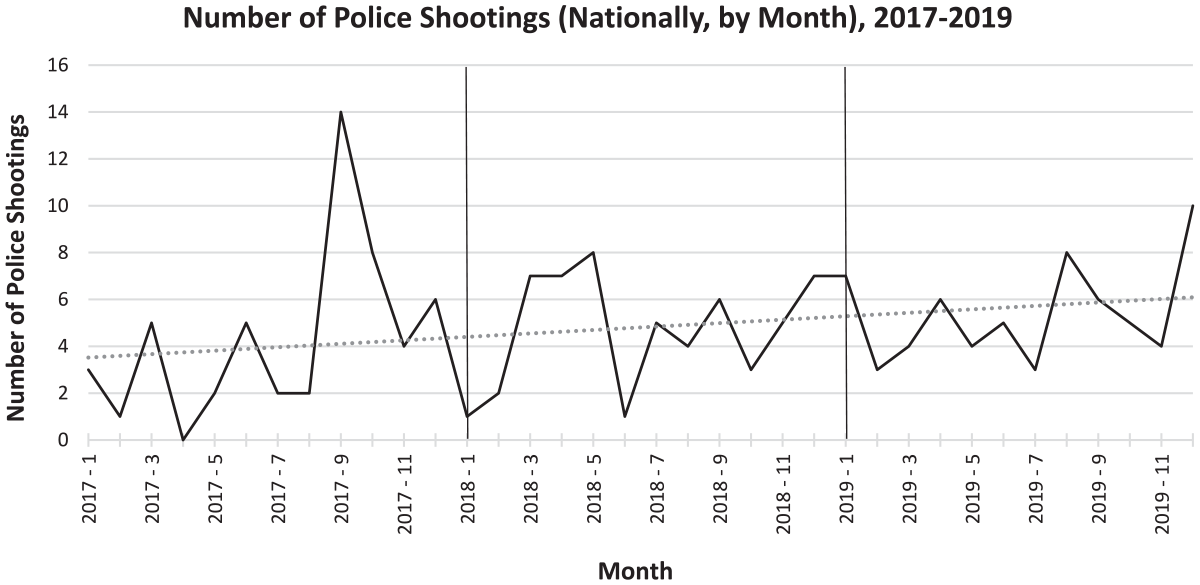
The Number of Police Shootings Nationally by Month, 2017 - 2019 (Excluding Québec).
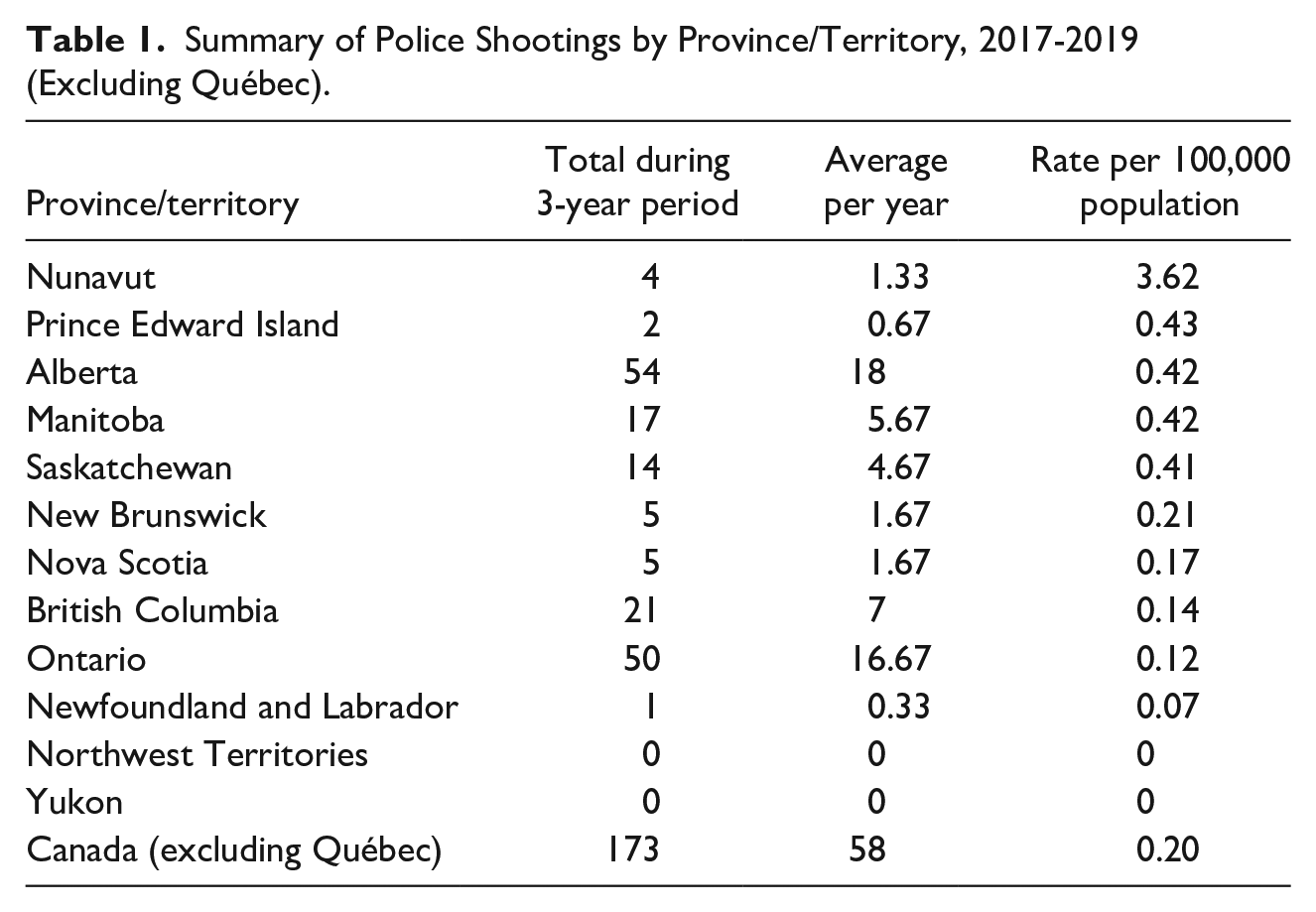
As shown in Table 1, the number of police shootings also varied by province/territory. Whereas Alberta (54) and Ontario (50) exhibited the highest number of police shootings during this 3-year period, the Northwest Territories and Yukon exhibited zero police shootings. There was also some variation in the number of police shootings within provinces/territories across years. For example, there were more police shootings identified in Alberta in 2018 than 2017 or 2019. In contrast, there were fewer police shootings identified in British Columbia and Manitoba in 2018 than either 2017 or 2019. There was little variation identified in the number of police shootings by year in Saskatchewan.
Summary of Police Shootings by Province/Territory, 2017-2019 (Excluding Québec).
This initial description highlights two important considerations when using raw counts for analyses of police shootings. First is the issue of the denominator. One would theoretically expect more shootings in more populous places as a function of more police officers to discharge their firearms and more civilians to be shot. Second is the issue of single-year fluctuations. In the absence of significant environmental- or organizational-level changes, one would not theoretically expect dramatic changes in the number of police shootings by year.
Moving forward, we thus employ two techniques to help mitigate these challenges. First, for all analyses of prevalence, we present rates of police shootings per 100,000 population alongside raw counts. We obtained the population values to use in these rate calculations from Statistics Canada’s 2021 Census of Population. We note that other research has employed different denominators, such as the number of arrests or police-civilian contacts (Tregle et al., 2019) as well as the number of incidents wherein officers pointed but did not shoot their firearms (Wheeler et al., 2017); however, these data were not readily accessible in our context. Second, we analyze averages calculated using counts from our 3-year period in lieu of single year information. Using averages helps to smooth out random year-to-year fluctuations in the number of police shootings and thus helps to account for potential idiosyncrasies in the data.
Police Shootings by Province/Territory
Canada (excluding Québec) exhibited a police shooting rate of 0.20 per 100,000 population between 2017 and 2019. As shown in Table 1, sizeable variation exists among the rates of police shootings by province/territory. Nationwide, Nunavut exhibited the highest rate of police shootings, with a rate of 3.62 police shootings per 100,000 population. Nunavut is the smallest province/territory in Canada by population, with approximately 37,000 people, and the only territory where we identified any police shootings between 2017 and 2019. In terms of provinces, Prince Edward Island (0.43 police shootings per 100,000 population), Alberta (0.42 police shootings per 100,000 population), Manitoba (0.42 police shootings per 100,000 population), and Saskatchewan (0.41 police shootings per 100,000 population) shared the highest rates of police shootings. Prince Edward Island is the smallest province in Canada, with approximately 155,000 people, located in Atlantic Canada. Alberta, Manitoba, and Saskatchewan are all considered prairie provinces, known for their grasslands. The territories and prairie provinces exhibit the highest rates of violent crime and firearm-related violence in the country (Cotter, 2022).
Of any provinces, Newfoundland and Labrador exhibited the lowest rate of police shootings, with a rate of 0.07 police shootings per 100,000 population. Newfoundland and Labrador is the country’s second smallest province by population, with approximately 510,000 people, located in Atlantic Canada. Subsequent to Newfoundland and Labrador, Ontario (0.12 police shootings per 100,000 population) and British Columbia (0.14 police shootings per 100,000 population) shared the next lowest rates of police shootings. In contrast to Newfoundland and Labrador, Ontario and British Columbia are two of Canada’s largest provinces, with Ontario being the largest (approximately 14 million people). Both of these provinces also exhibit some of the lowest rates of violent crime and firearm-related violence in the country (Cotter, 2022). Unpacking mechanisms that might explain some of this geographic variation within Canada will be an important area for future research.
Police Shootings by Police Agency
As described at the outset of our article, the RCMP is Canada’s largest police agency, employing approximately 19,000 police officers. Consistent with its sheer size, we find that the RCMP accounts for the largest number (69) of police shootings in Canada: 23 in 2017, 21 in 2018, and 25 in 2019. 11 Given the complexity of the RCMP’s policing structure, including much of its municipal policing work that extends beyond traditional city boundaries, we could not calculate a police shooting rate for standardized comparison with the municipal police agencies that police more clearly defined cities.
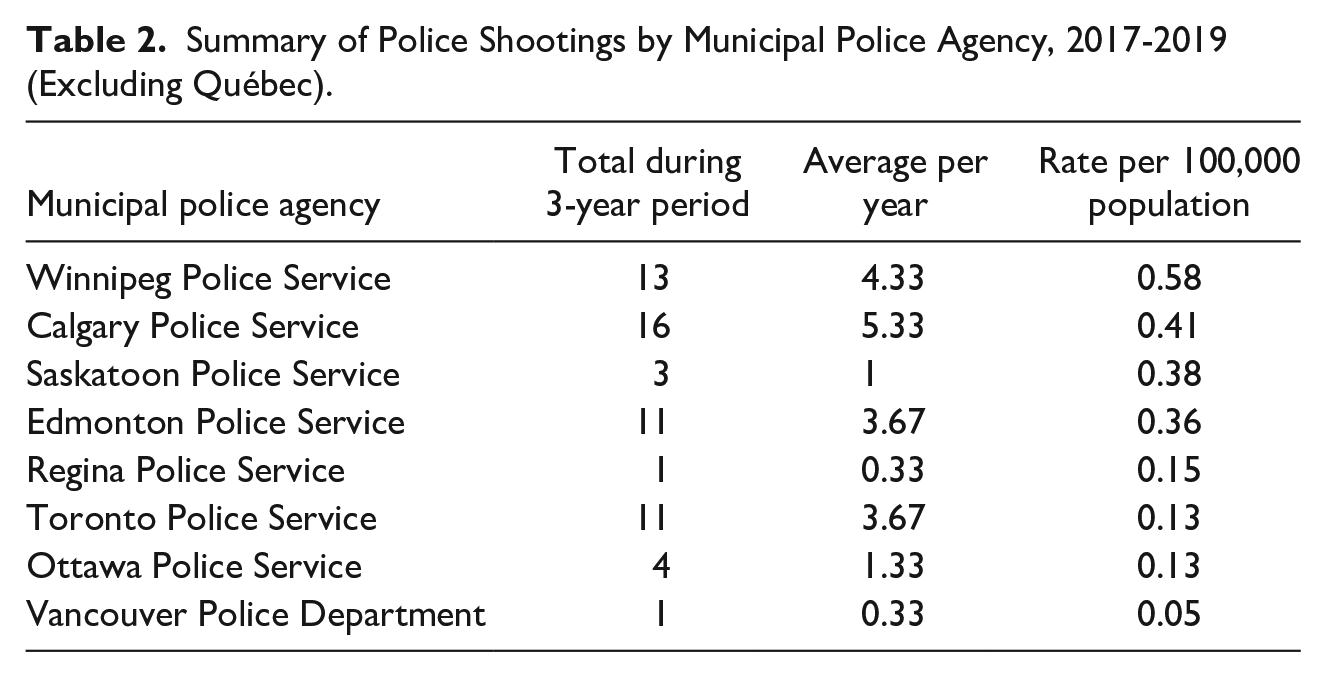
In terms of rates of municipal police agencies policing Canada’s major cities, the Winnipeg Police Service (Manitoba) exhibited the highest rate of police shootings, with a rate of 0.58 police shootings per 100,000 population. Subsequent to the Winnipeg Police Service, the Calgary Police Service (Alberta; 0.41 police shootings per 100,000 population), Saskatoon Police Service (Saskatchewan; 0.38 police shootings per 100,000 population), and Edmonton Police Service (Alberta; 0.36 police shootings per 100,000 population) exhibited the next highest rates of police shootings. The data for the remaining police agencies that we specifically analyzed are presented in Table 2. These findings reaffirm the need for research to explore why officers from some police agencies may be discharging their firearms at greater rates than others.
Summary of Police Shootings by Municipal Police Agency, 2017-2019 (Excluding Québec).
Characteristics of Police Shootings
In addition to providing information about the prevalence of police shootings, our data also provide some descriptive insight into the characteristics of such shootings. As shown in Table 3, these characteristics include the time and location of police shootings as well as the context and initiators of incidents that led to police shootings.
Characteristics of Police Shootings (N = 173).
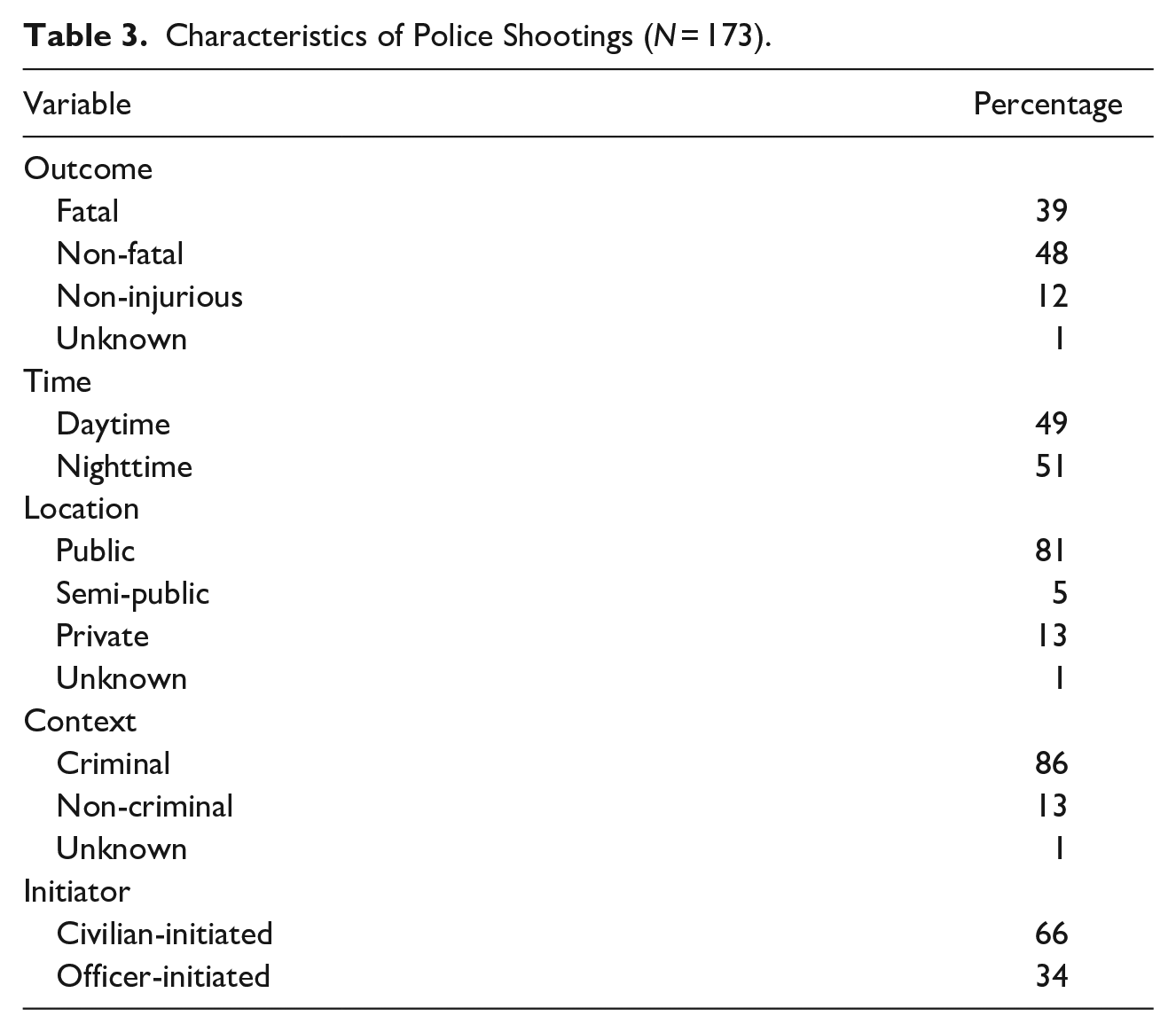
First, we examine time of day. Time of day may be important for several reasons. For example, time correlates with visibility, 12 which could affect officers’ safety and risk assessments as well as shooting accuracy (Donner & Popovich, 2019). Time also correlates with the routine activities of people and the associated size of ambient populations (Hipp et al., 2019). Indeed, public spaces are generally busier during the daytime hours given that most businesses operate during these hours. Officer activity can vary as a function of time as well (Simpson & Bell, 2022). In terms of police shootings, though, we observed an almost even split between the percentage of incidents that occurred during the daytime (49%) versus nighttime (51%).
Second, we examine location. Whereas much police work occurs in public spaces—which would be considered in purview of the public—some police work happens in private spaces (Nix et al., 2021). For the purposes of our research, we classified a police shooting as “private” if it occurred inside of a residence, “semi-public” if it occurred inside of a place other than a residence, and “public” if it occurred in an outdoor environment. 13 Consistent with the argument that most police work occurs in public spaces, we observed that most police shootings occurred in public spaces (81%) as opposed to semi-public (5%) or private (13%) spaces.
Third, we examine context. Much modern police activity does not regard crime, but rather service work (Lum et al., 2022). It is possible that the reason(s) for a police call for service could affect the likelihood of a police shooting. On the one hand, police shootings may be more likely to occur when officers are responding to crime-related incidents. Crime presents the potential for a person to be arrested, which generates the opportunity for resistance, including aggressive behaviors that could increase the likelihood of a police shooting (Worrall et al., 2021). On the other hand, non-crime-related incidents, including those involving persons in mental health crisis, may present similar or greater risks for officers (Pearce & Simpson, 2022). In these cases, violence and/or weapons—such as those intended to be used for self-harm—may be present and could contribute to a police shooting. It is also possible that a person may intend to commit suicide by police, which could make this type of incident susceptible to a police shooting. When we analyzed our data, we observed that the overwhelming majority (86%) of police shootings occurred in a criminal context.
Fourth, and finally, we examine initiators. Whereas most police work (regardless of context) is civilian-initiated, some police activities, including traffic stops and other forms of proactive policing, are officer-initiated (Simpson & Bell, 2022). Initiation may correlate with crime: much officer-initiated work is crime-related, in large part because of the legal grounds required to self-initiate police activity. Moreover, officers observe civilian behavior themselves when conducting self-initiated work, whereas they must interpret civilian behavior through the lens of dispatchers—who have interpreted such behavior through the lens of callers—when responding to civilian-initiated calls for service (Simpson, 2021; Simpson & Orosco, 2021; Taylor, 2020). Our results revealed that among incidents in our dataset, most were civilian-initiated (66%). 14
Discussion
Policing in Canada has been the subject of much recent discussion. However, in light of the dearth of Canadian policing research, much of this discussion has been informed by policing elsewhere, especially in the USA. This may be problematic given that the Canadian policing context exhibits at least some uniqueness relative to other countries, such as the USA. For example, not only are there far fewer police agencies in Canada than in the USA, but much of Canada is policed by the RCMP. In addition to a shared Criminal Code and Charter, much of Canada’s police share the same training standards and policies and benefit from support by Canadians. Much of Canada’s police are also overseen by external oversight agencies that investigate officers’ most serious uses of force. Even though the concern about police violence—and especially police shootings—may be similar across countries, policing is unique enough in Canada to warrant its own research on the subject.
The absence of an official Canadian database that comprehensively tracks police shootings is surprising given the consequences of, and public interest in, these incidents. The limited police shooting-related research in the Canadian context also poses challenges. To help fill this void, we endeavored to collect detailed information about all police shootings—regardless of justification—that occurred in Canada (excluding Québec) between 2017 and 2019. Using a rigorous strategy, we systematically identified and then coded 173 police shootings that occurred during this time period. Of such shootings, approximately 39% were reported as fatal, 48% as non-fatal, and 12% as non-injurious. Nearly equal proportions of police shootings occurred during the daytime and nighttime, although most were reported to have occurred in public spaces and were initiated by civilian requests for police service, typically for crime-related reasons.
In addition to frequency patterns, we also noted variation in police shooting rates across places in Canada. At the provincial/territorial level, the police shooting rate in Nunavut was over 8x higher than the police shooting rate in Prince Edward Island, which exhibited the second-highest rate. At the municipal police agency level, the Winnipeg Police Service’s police shooting rate was nearly 12x higher than the Vancouver Police Department’s police shooting rate. Future research should seek to explain these differences. For example, do they primarily stem from environmental differences (Keller et al., 2023), police culture (Ingram et al., 2018), or some combination of both? Differences in firearm ownership and associated firearm use (Nagin, 2020) as well as population density (Sherman, 2018) could also be key correlates to consider.
Before we proceed to our associated call for data, we revisit four key caveats regarding our research. First, we exhibit a necessary level of skepticism about our data given that they are unofficial: our data have not been audited by any police or government representatives. We acknowledge that despite an exhaustive search strategy, we may have missed some police shootings that met our definition and/or inadvertently included police shootings that did not meet our definition. We also acknowledge that despite a thorough coding process, we may have miscoded some of the variables for some of the police shootings, especially those that received limited media coverage, did not result in serious injuries/death, and/or were not investigated by police oversight agencies. These concerns are consistent with the limitations of other crowdsourced datasets on the topic (Bennell et al., 2022; Klinger & Slocum, 2017; Lozada & Nix, 2019).
Second, we were unable to analyze police shootings that occurred in Québec. When calculating national rates, we thus removed Québec’s population from the denominator. Third, we remind readers that we did not assess the legality, reasonableness, or ethics of any police shootings. Doing so would have required a level of data that we could not access at this time. Instead, we simply documented police shootings. Fourth, and finally, we remind readers that our intent was to descriptively report police shootings as opposed to thoroughly analyze the mechanisms that may contribute to them. We point to possible considerations and areas of future exploration throughout our article, however further examining them was not possible here.
Call for Data
In the absence of official, incident-level data, civilians, practitioners, researchers, and policymakers are often offered little option but to rely upon unofficial data (if any data at all) when evaluating police shootings, assessing police performance, and crafting policy, which can create challenges for all parties.
For civilians, the absence of official, incident-level data can create frustration and confusion. In an era of transparency, public demands for police-related information are immense. Without data about police shootings, the public must guess. Guessing can create a cascade of potentially problematic and misinformed conversations that may affect public-police relations as well as public rhetoric and sentiment.
For practitioners, the absence of official, incident-level data can create frustration as they must combat potentially inaccurate narratives about police shootings that may otherwise derive from public guesswork (Nix, 2023). The absence of such data may also prevent police agencies from understanding the correlates of police shootings as well as assessing and/or comparing trends in their performance against other agencies.
For researchers, the absence of official, incident-level data negatively impacts the ability to empirically assess these salient and consequential events. It is difficult to understand what contributes to police shootings, and hence what might be done to reduce them, if we cannot study them as a consequence of data limitations (Alpert, 2016).
Finally, for policymakers, the absence of official, incident-level data hinders the development of evidence-based policy. In light of the consequences of police shootings, there is a need to address them. Although some actions can be taken at the police agency-level, there may also be the potential for the law to intervene as it relates to police shootings: legislation may be helpful and/or necessary to further standardize practices, train police officers, and document police shootings (Tregle et al., 2022).
Official, incident-level data would thus help to address these challenges, especially if such data were comprehensive, standardized, and verified. The latter point is particularly important. Without verification, there exists a perceived or potential risk that incidents may not be reported by police with complete accuracy. With that being said, there exists the possibility in Canada to systematically engage in such verification through the use of police oversight agencies.
In many places in Canada, police oversight agencies operate with the mandate to investigate incidents of serious injury and/or death by police. This would encompass many police shootings, including those where a bullet strikes a person. It is plausible that communication between police and these oversight agencies could allow for the compilation and verification of data as it relates at least to injurious police shootings in places where oversight agencies presently exist. These oversight agencies operate independently of police, and thus would allow external verification of information provided by police.
If understanding police shootings is a socio-political priority in Canada, it is possible that these oversight agencies’ mandates could be expanded to investigate all police shootings—regardless of injury—so that such verification could include even non-injurious police shootings. In places without police oversight agencies, oversight agencies could be established. As we demonstrate via our data, the number of police shootings each year in Canada is small. Reviewing each one would undoubtedly require more resources than currently allocated, but such review may still be manageable if, as a collective, society wishes to compile data on police shootings. Moreover, even when police shootings do not result in injuries, the intent of the officer was still to eliminate a threat, which—in the context of a firearm—involves injury by default. From this perspective, this solution may be a practical means to address a growing desire for data.
Conclusion
Police shootings are rare incidents in many parts of the world, including in Canada. Police shootings are also the subject of enormous scholarly attention across the world, including in the USA (e.g., Sherman, 2018), Australia (e.g., Saligari & Evans, 2016), England and Wales (e.g., Hendy & Walton, 2023), and elsewhere (e.g., Hirschfield, 2023). Despite some similarities with respect to policing and the use of deadly force, including the absence of official, incident-level data, each country exhibits its own policing nuances, and Canada is no exception. Studying police shootings within the context of each country is thus important.
Our analyses of our self-generated dataset suggest that on-duty police officers in Canada (excluding Québec) discharged their firearm with the intent to strike a person—regardless of justification—an average of 58 times per year between 2017 and 2019 (rate of 0.20 police shootings per 100,000 population). We find that most police shootings were non-fatal, and that the number and rates of police shootings varied by year, location, and police agency. These findings advance our scholarly understanding of police shootings in Canada, which have otherwise received very little empirical attention to date.
With energy and synergy, there exists the possibility for producing official, incident-level data for all police shootings in Canada. The compilation of such data would present a plethora of benefits for Canadians and actively satisfy the needs and demands of stakeholders from coast to coast. With interest continuing to amass regarding police shootings, the time may be now to consider ways to document all such incidents in Canada.
Footnotes
Acknowledgements
The authors would like to thank N. Twa, A. Ciesielska, and C. Maguire for their assistance with this project.
Declaration of Conflicting Interests
The authors declared no potential conflicts of interest with respect to the research, authorship, and/or publication of this article.
Funding
The authors received no financial support for the research, authorship, and/or publication of this article.
