




Abstract
Previous surveys have demonstrated that not all police professionals are open to the idea that research can play an important role in policing. To examine how Canadian police professionals view this issue, we conducted a survey of 598 civilian and sworn police professionals from seven Canadian police services. The survey responses allowed us to gauge receptivity towards research and determine what factors predict receptivity. We also examined factors that differentiate the most receptive police professionals from others. Compared with previous surveys, our respondents were more receptive to research. Furthermore, having higher education, holding a more senior rank, and being exposed to research (e.g., attending conferences) were associated with higher levels of receptivity to research. The results from this study can potentially be used to increase receptivity to research among police professionals, which may help police services become more efficient and effective.
In Canada, the rising cost of public policing has led to discussions about how to increase efficiency within the policing sector (Duxbury et al., 2018). In 2013 and 2015, two Summits on the Economics of Policing were held in Canada. During these summits, the importance of research and academic–police partnerships were emphasized as an important step in ensuring that policing strategies are informed by research (Public Safety Canada, 2013, 2015), thereby helping to improve efficiencies and reduce expenditures (The House of Commons Standing Committee, 2014). The current article addresses this issue by examining factors that predict Canadian police professionals’ openness to the role of research in policing.
For some, relying on research within policing is synonymous with the field of evidence-based policing (EBP). 1 As originally conceptualized, EBP relates to the use of research to develop policing practices, programs, and/or policies that are efficient and effective (Sherman, 1998). Consistent with this particular conceptualization, a cornerstone of EBP is what is known as the “triple-T strategy” (Sherman, 2013: 379). Essentially, this involves “targeting” important problems within policing, “testing” strategies designed to tackle those problems, and “tracking” these strategies over the long term to ensure they remain effective and to make necessary modifications to strategies as needed (Sherman, 2013).
According to many advocates of this form of EBP, one important reason for relying on research to guide police practices, programs, and policies is that, without it, practitioners might “come up with their own ‘facts’, which often turn out to be wrong” (Sherman, 1998: 4). Although lived experience is an essential element of policing and is recognized as such by EBP advocates (Huey and Ricciardelli, 2016), relying solely on lived experience is likely to lead to misguided judgments and decisions that are potentially biased by subjective experience, limited reasoning abilities, and various other influential forces (e.g., groupthink) at play in policing organizations (Rossmo, 2008).
Although some question the value of this original conceptualization of EBP—based on debates over the relative role that research versus experience should play in policing (Moore, 2006), the weighting that should be placed on different types of research evidence (Thacher, 2001), or whether research can ever be conducted to demonstrate conclusively that a police practice or program “works” (Wood et al., 2018)—many still believe, as we do, that there is value in assessing the role that research might play in policing. Given this, the current article seeks to shed light on this issue by building on previous research to examine receptivity to research in policing within a Canadian policing context, and to explore factors that are associated with receptivity. We discuss previous research that has examined these issues in the sections that follow.
Examining factors that are associated with receptivity to research
Lum et al. (2012) have argued that conducting research on officer receptivity to research may be just as important as conducting studies that examine whether a given policing strategy is effective. Key questions that researchers in this area have asked are: (a) whether officers understand the concept of EBP, (b) what information officers extract from research, (c) whether officers are open to using research and being involved in research, and (d) what factors predict whether an officer might be receptive to research (Telep and Lum, 2014).
The first study to examine these issues was conducted by Telep and Lum (2014). In their study, a survey was distributed to officers and civilians within three American police agencies: 523 police officers participated in Sacramento (of approximately 675 officers in the agency), 343 civilians and police officers participated in Richmond (of approximately 230 civilians and 730 officers in the agency), and 94 civilians and police officers participated in Roanoke County (of approximately 16 civilians and 140 officers in the agency). Researchers began surveying participants between 2011 and 2012. In Sacramento, the survey was distributed during a mandatory in-service training course; in Richmond, participants were surveyed online or at roll calls; and in Roanoke County, participants were emailed the link to the survey. The researchers found that many participants had never heard of the term “evidence-based policing”. In addition, most participants had not read any of the publications they were asked about in the survey (e.g., police trade magazines and academic journals), nor had they read any research on the effectiveness of certain policing strategies (e.g., hotspots policing) 2 in the six months leading up to the survey. Participants’ abilities to identify more effective and less effective policing strategies for reducing crime were also inconsistent, and participants tended to believe that personal experience was more important than science for day-to-day decision-making. However, most participants believed that collaboration with researchers is necessary to help police departments reduce crime.
A similar study was subsequently conducted in Canada by Blaskovits et al. (2018), who observed that Canadian police professionals were familiar with EBP, tended to find the work produced by crime analysts or researchers within their service as useful, valued scientific knowledge, used or were willing to use research in their day-to-day work, and were generally open to implementing new policing practices. It is unclear why higher levels of receptivity were found by Blaskovits and her colleagues compared with the respondents in Telep and Lum's (2014) survey. One explanation is that the higher educational requirements to become a police officer in some Canadian services could have positively influenced receptivity to research. Another explanation is that the police leaders from the services that were sampled may have been more progressive compared with the police leaders from the agencies sampled in Telep and Lum's (2014) study. It is also possible that, in the time since Telep and Lum's study, receptivity to EBP may have generally grown or that some event may have transpired in Canada that led to increased receptivity.
Building on the study by Telep and Lum (2014), Telep (2017) conducted a study to examine factors that might predict officers’ receptivity to EBP. Police officers from four American police agencies were surveyed. He found that having recently reviewed police trade magazines and academic journals in the six months leading up to the survey and having a master's degree predicted general receptivity to research. Telep also found that these general indicators of receptivity were largely predictive of more “specific” indicators of receptivity, such as thinking that science should contribute to day-to-day decision-making.
Telep (2017) also examined what factors distinguished the most receptive officers in his sample from the least receptive officers. The most receptive officers were more likely to have attended a policing conference in the year leading up to the survey, received training with regards to effective policing strategies, and read at least two publications from police trade magazines or academic journals in the six months leading up to the survey. In addition, the most receptive officers had more frequently obtained a master's degree, were more likely to hold a position above that of a line-level officer, and were more likely to supervise others.
Explaining the lack of receptivity to research
Several researchers have postulated reasons why there appears to be a lack of receptivity to research among some police professionals. One reason is that attaching increased importance to research is viewed by some as decreasing the importance attached to police experience (Huey and Ricciardelli, 2016; Sherman, 2015), even though many EBP advocates argue that lived experience is critical (Huey and Ricciardelli, 2016), not least because it is needed to interpret the significance of policing research and decide how to integrate research-informed strategies into practice (Fleming and Rhodes, 2018).
A lack of receptivity to research may also stem from police culture—both occupational and organizational. For example, from an occupational perspective, the demands of the job may make officers suspicious of outsiders, which may make them resistant to advice from academics who do not possess police experience (Paoline, 2003). From an organizational perspective, factors such as the tendency for police services be reactive instead of proactive may make change difficult, such as re-orienting the profession to become more evidence-based (Lum, 2009; Lum et al., 2012). Supporting this view, participants in Telep and Lum's (2014) study tended to be open to trying new strategies, but seemed to rely on senior management to maintain the change and reported that things often return to the status quo shortly after trying something new (see also Fleming and Wingrove, 2017). Given that the occupational demands of policing are unlikely to change, focusing on organizational change may prove to be more useful for increasing receptivity to research.
The best insights into why Canadian police practitioners might be resistant to research come from a recent study conducted by Kalyal (2019). She interviewed 38 police leaders from across Canada to identify the reasons why they might be resistant to EBP. Two broad themes emerged from these interviews: one related to organizational factors and one related to the politics of policing. The organizational factors that appeared to be particularly important include:
Lack of communication (e.g., frontline officers may not be receiving information related to the effectiveness of strategies, and without this awareness of best practices, they may be unwilling to implement them); Police culture (e.g., police leaders do not want to deviate from traditional policing or from the status quo, in part because of risk aversion); Lack of resources (e.g., not enough time to collect data and conduct research); Researchers themselves (e.g., a view that researchers do not fully comprehend policing issues).
With respect to political factors, the primary issue highlighted by Kalyal (2019) related to a lack of communication with stakeholders to identify issues in policing. For example, one police leader explained that, “police were not successful in explaining to oversight bodies how an emphasis on being proactive and preventative would reduce the number of unnecessary demands for service and improve organizational effectiveness” (Kalyal, 2019: 8).
The current study
Receptivity to research within policing is important for ensuring that agencies are implementing practices, programs, and policies that have shown promise based on research findings. Building on previous research that has examined receptivity to research in policing, we explored what factors predict awareness of, and openness to, EBP in a sample of Canadian police professionals. Our research questions mirror those from Telep's (2017) study:
What factors predict whether a police professional will have heard of the term “evidence-based policing” or agree that information obtained from research and collaboration with researchers is useful? What factors predict whether a police professional will be able to recognize more effective and less effective policing strategies, as determined by research? What factors predict whether a police professional will believe that research should play at least an equal role as experience in making day-to-day decisions? What factors predict whether a police professional will be more willing to conduct research and participate in research to evaluate the efficacy of a given policing tactic? What factors differentiate police professionals who are the most open and receptive to research from other police professionals who are less open and receptive?
It is unclear whether the results from Telep's (2017) survey will be replicated in this study given the many differences that exist between Canada and the United States with regard to policing. For example, potentially important differences exist with respect to the number and size of police agencies in the two countries (Cyr et al., 2020), their structure (Lowatcharin, 2016), composition (Conor et al., 2020; Hyland and Davis, 2019), police–public dynamics (Jones and Sawyer, 2020), and so on. Given these sorts of differences, it is important to not assume that Canadian police professionals exhibit the same attitudes as their American counterparts when it comes to receptivity to research.
Beyond extending previous research into the Canadian policing context, a second reason for expanding upon the research by Telep (2017) is that we wanted to assess how factors that predict receptivity to research might differ between civilian and sworn police professionals. Because of the increasing number of civilians working in policing (Conor et al., 2019), and the important roles that civilians play 3 (Kiedrowski et al., 2015), we thought it was important to include this sub-sample of respondents in the current study.
Method
Participants
A total of 598 police professionals working in seven municipal police services participated in this study. It should be noted that approximately 28% to 43% of the sample did not respond to at least one of the questions described in this section. As such, the n values may not add up to the total number of participants (n = 598) and the following percentages were calculated out of those who responded to each of the questions. 4 The police services that agreed to participate in the study were located in seven of the ten Canadian provinces. The number of participants varied across provinces: British Columbia, n = 23 (5.4%); Alberta, n = 105 (24.5%); Saskatchewan, n = 40 (9.3%); Manitoba, n = 160 (37.4%); Ontario, n = 74 (17.3%); Nova Scotia, n = 24 (5.6%); and Prince Edward Island, n = 2 (0.5%). 5
Approximately 18.5% of our sample were civilians (n = 64), with the remainder (81.5%, n = 282) being sworn officers. Most participants were male (n = 261, 74.4%) and the mean age of the sample was 42.3 years (SD = 8.89), ranging from 22 to 62 years. Most ranks within the police agencies were represented, with the most frequently reported rank being constable (33.3%). The average years of experience for our sample was 16.5 (SD = 9.34), ranging from two-thirds of a year to 43 years of service. Most participants (n = 257, 74.9%) had at least 10 years of experience. Under half of the participants reported that they supervised others (n = 150, 42.7%). Finally, about half the sample had at least a bachelor's degree (n = 177, 50.6%).
Civilians were slightly underrepresented in our sample compared with estimates from 2017, where civilians made up 30% of all police personnel in Canada (Conor, 2018). Line-level officers were also slightly underrepresented in our sample compared with estimates that 68% of police officers in Canada were constables in 2019 (Conor et al., 2019). The gender and age demographics of our sample are generally consistent with Canadian police demographic data from 2017 (Conor, 2018). Data on the average number of years of service and level of education among police professionals is not available in Canada; as such, we cannot speak to the representativeness of our sample with regard to these two demographic characteristics.
Demographic characteristics for officers and civilians were compared using chi-square tests of independence and independent samples t-tests, as appropriate. Few differences were found. Obviously, the rank structure in policing did not apply to the civilian participants (they simply reported their positions; e.g., dispatcher). Significantly more civilians were female (n = 42, 65.6%) compared with officers (n = 48, 17.0%), χ2 = 64.03, p < .001. Furthermore, more civilians had a master's degree or higher (n = 13, 20.6%) compared with officers (n = 19, 6.8%), χ2 = 12.11, p = .002. No differences were observed between officers and civilians on the remaining variables (province, age, years of service, and supervising others).
Procedure
Police leaders from pre-selected municipal and regional police agencies across seven Canadian provinces were sent an email invitation to participate in the study. If the police leader agreed to have their agency participate in the study, a pre-written email was sent out to all employees (both sworn officers and civilian employees). This email included information regarding the goals of the study, the confidentiality of the survey responses, as well as the link to the survey on Qualtrics©.
In the informed consent form provided to potential participants, it was made clear that participation was voluntary and that they could withdraw from the study at any time. The dates the survey were released differed depending on the agency; however, the last survey closed on February 15, 2017. We estimate the response rate to be less than 10%. Having a low response rate is not uncommon in policing studies, and it was expected given our sampling method (email) and the large number of invitations that were sent out (Nix et al., 2019).
The study was approved by Carleton University's Ethics Committee for Psychological Research (REB #104661).
Measures
The survey used by Telep (2017) was distributed to all participants, with slight modifications to make it suitable for a Canadian sample of police professionals. This is the same survey that was used in in Blaskovits et al.'s (2018) study. The survey was comprised of five sections: (a) knowledge about EBP, (b) views about scientific research, (c) views about innovative ideas, (d) views about education in the police service, and (e) demographic information.
Dependent variables
To answer our first research question, participants were asked whether they had heard of the term “evidence-based policing”. This was a binary variable, with “yes” responses coded as 1. We also examined whether participants viewed research and collaboration with researchers as useful. Participants who responded to “the extent to which research on police tactics” was “very useful” or “somewhat useful”, as well as reported that they “agree” or “strongly agree” that “collaboration with researchers is useful”, were coded as 1. Telep (2017: 983) referred to these variables as “general indicators of receptivity” because they “represent an overall knowledge of and openness to EBP, research, and researchers.” Both these variables (i.e., having heard of EBP and agreeing that research and collaboration are useful) were also used as independent variables in subsequent models predicting “specific indicators of receptivity” (described below).
The remaining questions examined “specific indicators of receptivity”. Telep (2017: 983) labeled them as “specific” because “they examine officer views about particular tactics or situations […] or focus more directly on research in daily work.” Our second research question was examined by using the first two specific indicators that assessed whether the participant had knowledge of the relative effectiveness of policing strategies. Specifically, we examined whether participants were able to identify hotspots policing and problem-oriented policing as more effective policing strategies, and random preventative patrol and rapid response to 911 calls (hereafter referred to as “rapid response”) as less effective policing strategies for reducing crime. Research has demonstrated that, under certain conditions, hotspots policing and problem-oriented policing can reduce crime (Braga, 2007; Weisburd et al., 2010); thus, if a participant reported that both of these strategies were at least “somewhat effective”, responses were coded as 1. However, research has not supported the effectiveness of random preventative patrol or rapid response (Kelling et al., 1974; Telep and Weisburd, 2012). If a participant reported that both of these strategies were “somewhat effective” or “not effective”, responses were coded as 1.
Our third research question was examined with the third specific indicator that explored whether using science 6 in day-to-day decision-making was considered important. For this question, participants were asked how important using science was in comparison with personal experience in making day-to-day decisions. Participants could select from the following options, in terms of how science vs. personal experience should drive day-to-day decision-making: 90% science/10% personal experience, 75% science/25% personal experience, 50% science/50% personal experience, 25% science/75% personal experience, and 10% science/90% personal experience. Responses for participants who selected that science should contribute to at least 50% of decision-making were coded as 1.
The last specific indicator, which related to our fourth research question, examined whether participants were willing to conduct empirical research. As Telep (2017) did, we asked participants “how willing would you be to take the following actions to test whether a particular tactic the police are currently using is effective?”. Eight actions were addressed and made up the Research Scale: “stop the tactic to see if the problem gets worse”, “stop the tactic in one area and compare what happens in another area where you did not stop the tactic”, “find the top 20 areas where the problem exists and toss a coin to assign 10 areas to have the tactic and 10 areas not to receive the tactic and compare”, “use data before the police implemented the tactic and compare it with data from after the tactic was up and running”, “approach a researcher to help you evaluate”, “seek assistance in the organization on designing an evaluation”, “undertake online research to see what others have done”, and “stop the tactic based on a researcher saying it was ineffective”. These questions had a Cronbach's alpha of .80 in Telep's (2017) study. In the current study, Cronbach's alpha was .74. If participants reported being “very willing”, “quite willing”, or “somewhat willing” across all these questions, their response was coded as 1.
Finally, to answer our fifth research question, we compared the most receptive participants with the least receptive participants. As Telep (2017) did, participants were considered to be the most receptive if they were either (a) coded as 1 on both of the general receptivity indicators as well as (b) coded as 1 on at least one of the three specific indicators (i.e., hotspots policing/problem-oriented policing as effective, rapid response/random preventative patrol as ineffective, and science should contribute to at least 50% of decision-making); or were in the top 25% of participants (i.e., a score of at least 24) on the Research Scale described above. Research Scale scores were calculated by assigning a value of 4 to “very willing”, 3 to “quite willing”, 2 to “somewhat willing”, and 1 to “not willing”, and summing these scores across the eight items for each participant. In the current study, the 25th percentile on this scale fell on the 86th participant with the highest score (a score of 24). Because 11 additional participants also had scores of 24, a decision was made to include all these participants in the “most receptive participants” sub-sample; thus, we included participants in the top approximately 29th percentile.
Independent variables (predictors)
Consistent with Telep (2017), 13 independent variables (i.e., predictors) were examined to assess their impact on knowledge, openness, and receptivity to research. The first two variables were the general indicators of receptivity (i.e., (a) having heard of EBP; and (b) agreeing that research and collaboration are useful). These two variables served as predictors in models for specific indicators of receptivity. Other predictors included:
Exposure to research (i.e., reading publications from different journals or trade magazines in the previous six months). The list we provided included Criminology, the Canadian Journal of Criminology and Criminal Justice, The Police Chief, Canadian Police Chief, RCMP Gazette Magazine, Blue Line Magazine, FBI Law Enforcement Bulletin, PoliceOne.com, or any other relevant police publication (that they were asked to specify).
7
Participants who had read one, or two or more publications, were compared with participants who had read no publications (the reference group). Exposure to effectiveness information (i.e., having read documents that discussed the effectiveness of policing strategies; no exposure and exposure from one's own agency were compared with exposure from another agency (the reference group)). Participation in a professional policing conference in the previous year (this was a “yes” or “no” question, with “no” as the reference group). Having received training on how to identify and evaluate the efficacy of policing strategies in reducing crime (this was a “yes” or “no” question, with “no” as the reference group). Not having heard of three or more strategies used in policing when asked to evaluate their effectiveness (having heard of more than three strategies was the reference group). These strategies included problem-oriented policing, hotspots policing, random preventative patrol, rapid response to 911 calls, community-oriented policing, follow-up visits for domestic violence cases, “pulling levers” interventions for violent offenders, the Drug Abuse Resistance Education (D.A.R.E.) program, the use of civil remedies (e.g., nuisance abatement), restorative justice, mandatory arrest for domestic violence, traffic enforcement to reduce gun crime, zero tolerance policing, procedural justice policing, intelligence-led policing, and hub models of policing. Education (having a bachelor's degree, or a master's degree or higher, was compared with having less than a bachelor's degree (the reference group)). Years of experience (measured as a continuous variable). Supervised others (this was a “yes” or “no” question, with “no” as the reference group). Officers’ rank (line-level officers (constable or detective constable) were compared with those who held a higher position than a line-level officer (the reference group)). Gender (males were compared with females (the reference group)). Race (White participants were compared to non-White participants (the reference group)).
Results
Descriptive data
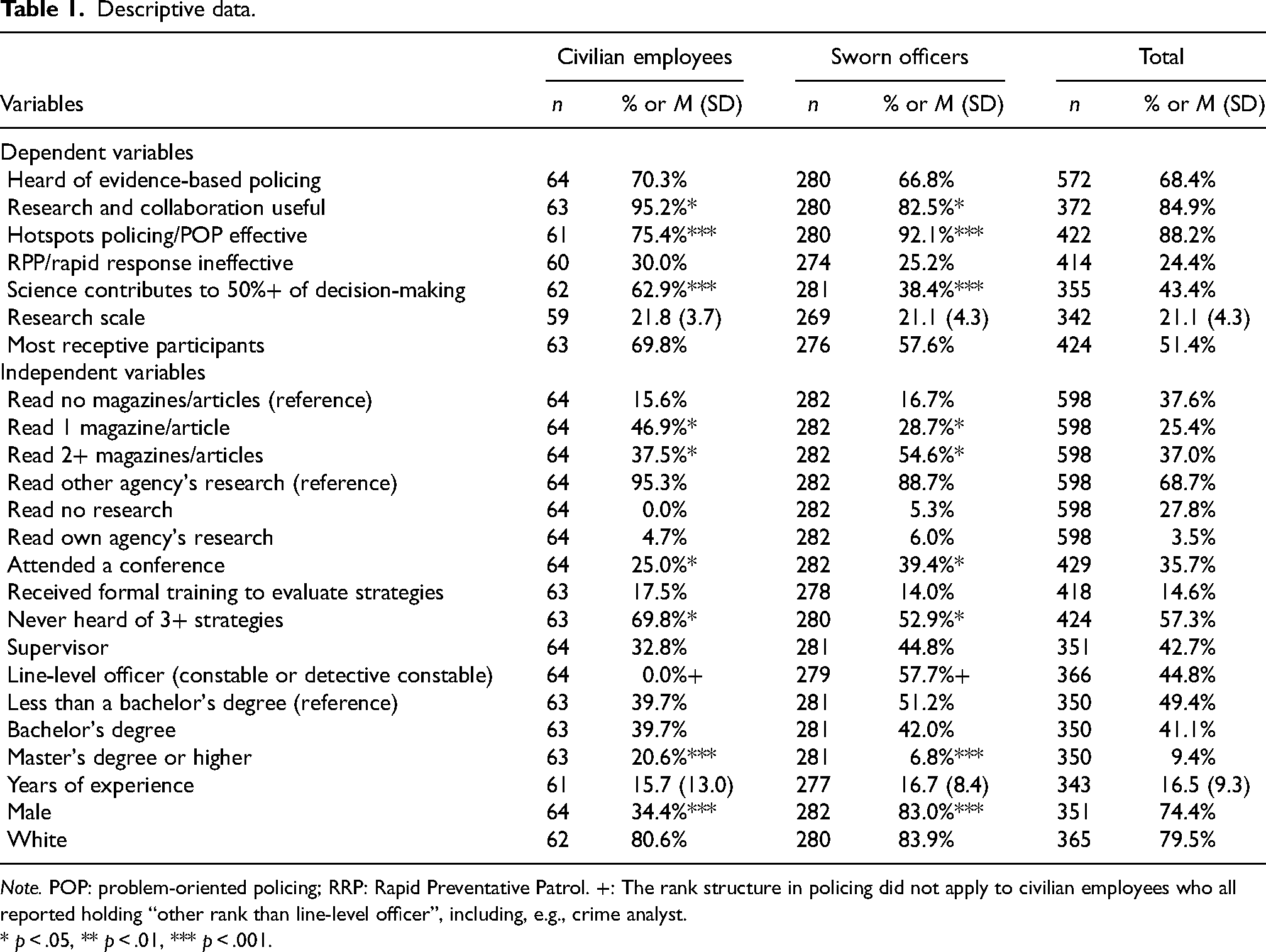
Descriptive data for the dependent and independent variables are presented in Table 1. Most participants had heard of the term “evidence-based policing” and believed that research and collaboration with researchers are important. Participants were generally good at identifying both policing strategies that receive some support in the research literature (i.e., hotspots policing and problem-oriented policing); however, only about one-quarter of participants identified that random preventative patrol and rapid response are ineffective strategies for reducing crime. Just under half the participants believed that science should contribute to at least 50% of day-to-day decision-making. Based on Telep's (2017) definition described above, we identified approximately half of our participants as the “most receptive” participants.
Descriptive data.
Note. POP: problem-oriented policing; RRP: Rapid Preventative Patrol. +: The rank structure in policing did not apply to civilian employees who all reported holding “other rank than line-level officer”, including, e.g., crime analyst.
* p < .05, ** p < .01, *** p < .001.
Just over one-third of participants had read two or more journal or magazine articles related to policing in the previous six months and had attended a professional policing conference in the previous year, and just over two-thirds of participants had read documents from an agency other than their own that discussed the effectiveness of policing strategies. Despite this, just over one-quarter of participants had not read any research that discussed the effectiveness of policing strategies, over one-third had not read any trade magazines or academic journals, and over half had never heard of three or more of the policing strategies that were presented to them.
Almost half of the participants were supervisors, a little under half were line-level officers, and approximately half had a university degree. On average, participants had approximately 17 years of police experience, approximately three-quarters of the sample was male, and almost 80% of respondents were White.
Chi-square tests of independence and independent samples t-tests were conducted to compare differences between civilians and officers on the examined variables. Adjusted standardized residuals were examined to probe the differences between groups for having read trade magazines or journals, exposure to effectiveness information from one's own or another organization, and education. Differences between these groups of participants emerged for some of the dependent and independent variables. Of note, civilians more frequently agreed that science should contribute to at least 50% of day-to-day decision-making and had obtained a master's degree or higher. Officers had more frequently attended a policing conference in the previous year, had heard of the listed policing strategies, and were male. A full breakdown of the results is given in Table 1.
General indicators of receptivity
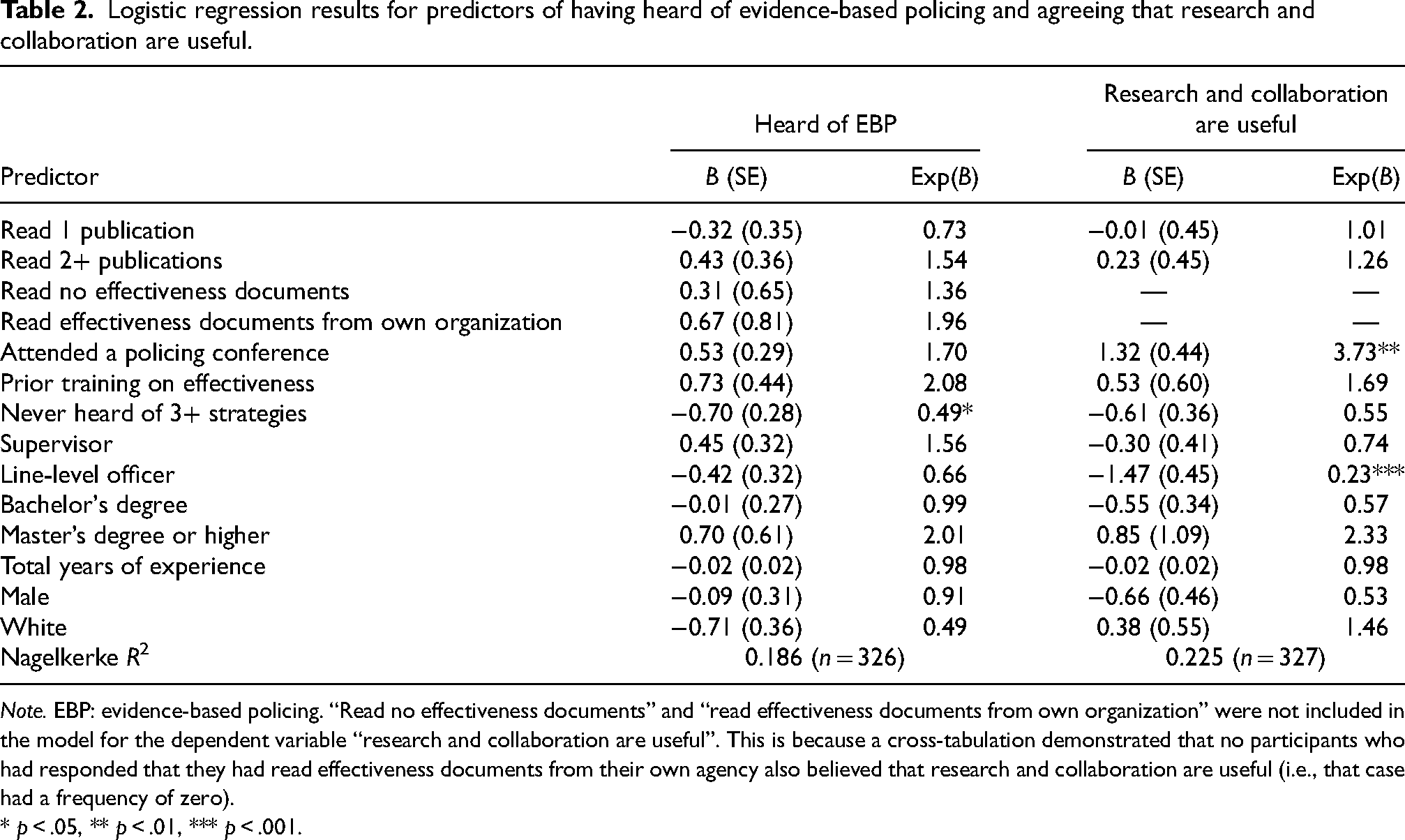
We conducted logistic regression analyses 8 to explore which factors predicted receptivity to research. First, we examined predictors of general indicators of receptivity, which included having heard of the term “evidence-based policing” and agreeing that research and collaboration are useful (Telep, 2017). These results are presented in Table 2. 9
Logistic regression results for predictors of having heard of evidence-based policing and agreeing that research and collaboration are useful.
Note. EBP: evidence-based policing. “Read no effectiveness documents” and “read effectiveness documents from own organization” were not included in the model for the dependent variable “research and collaboration are useful”. This is because a cross-tabulation demonstrated that no participants who had responded that they had read effectiveness documents from their own agency also believed that research and collaboration are useful (i.e., that case had a frequency of zero).
* p < .05, ** p < .01, *** p < .001.
The only significant predictor of having heard of EBP was not having heard of three or more of the listed policing strategies. Participants who had not heard of three or more of these strategies (compared with those who had heard of more than three strategies) had approximately half the odds of having heard of EBP. Two significant predictors emerged from the model predicting views towards research and collaboration. Participants who had attended a policing conference in the previous year (compared with those who had not) had 3.7 times the odds of agreeing that research and collaboration are useful. Being a line-level officer (i.e., constable or detective constable; compared with those who held a higher position than a line-level officer) was associated with approximately 75% lower odds of agreeing that research and collaboration are useful.
Specific indicators of receptivity
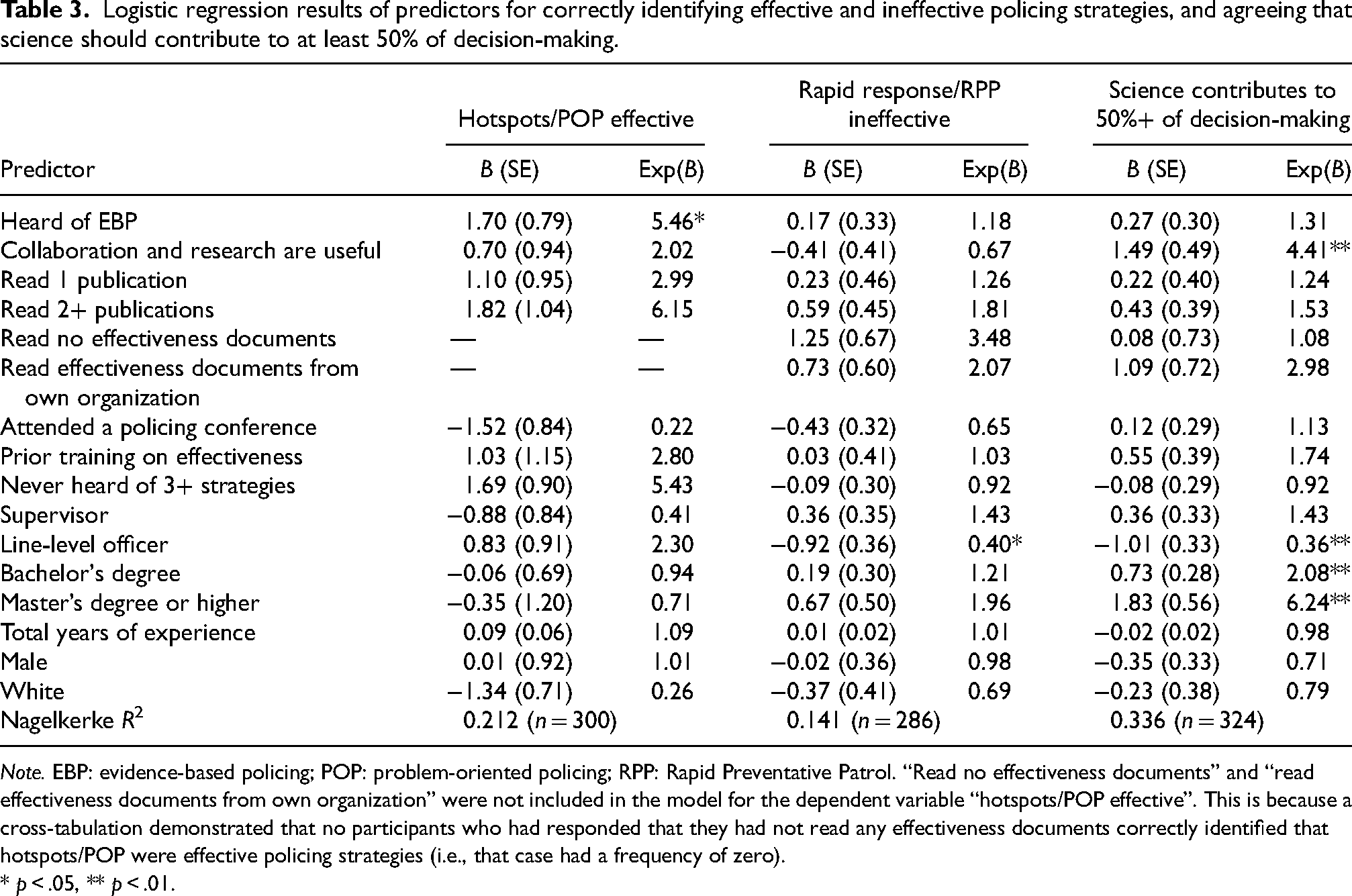
We also conducted logistic regression analyses to explore which factors predicted specific indicators of receptivity: correctly identifying that hotspots policing and problem-oriented policing can be effective policing strategies in some circumstances, correctly identifying that random preventative patrol and rapid response are generally ineffective policing strategies, and agreeing that science should contribute to at least 50% of day-to-day decision-making in addition to experience (Telep, 2017). These results are presented in Table 3.
Logistic regression results of predictors for correctly identifying effective and ineffective policing strategies, and agreeing that science should contribute to at least 50% of decision-making.
Note. EBP: evidence-based policing; POP: problem-oriented policing; RPP: Rapid Preventative Patrol. “Read no effectiveness documents” and “read effectiveness documents from own organization” were not included in the model for the dependent variable “hotspots/POP effective”. This is because a cross-tabulation demonstrated that no participants who had responded that they had not read any effectiveness documents correctly identified that hotspots/POP were effective policing strategies (i.e., that case had a frequency of zero).
* p < .05, ** p < .01.
The only significant predictor of correctly identifying policing strategies that have received some support in the research literature was having heard of EBP. Participants who reported having heard of EBP had 5.5 times the odds of correctly identifying these policing strategies compared with participants who had not heard of EBP. The only significant predictor of correctly identifying policing strategies that have generally been deemed ineffective was being a line-level officer. Being a line-level officer was associated with approximately 60% lower odds of correctly identifying these policing strategies as being generally ineffective. Finally, four predictors emerged for agreeing that science should contribute to at least 50% of day-to-day decision-making. Participants who agreed that research and collaboration are useful had almost 4.4 times higher odds of agreeing that science should contribute to at least 50% of day-to-day decision-making. Participants with a bachelor's degree had just over twice the odds, and those with a master's degree or higher had 6.2 times the odds of agreeing with this statement. Conversely, participants who were line-level officers had approximately 65% lower odds of agreeing that science should contribute to at least 50% of day-to-day decision-making.
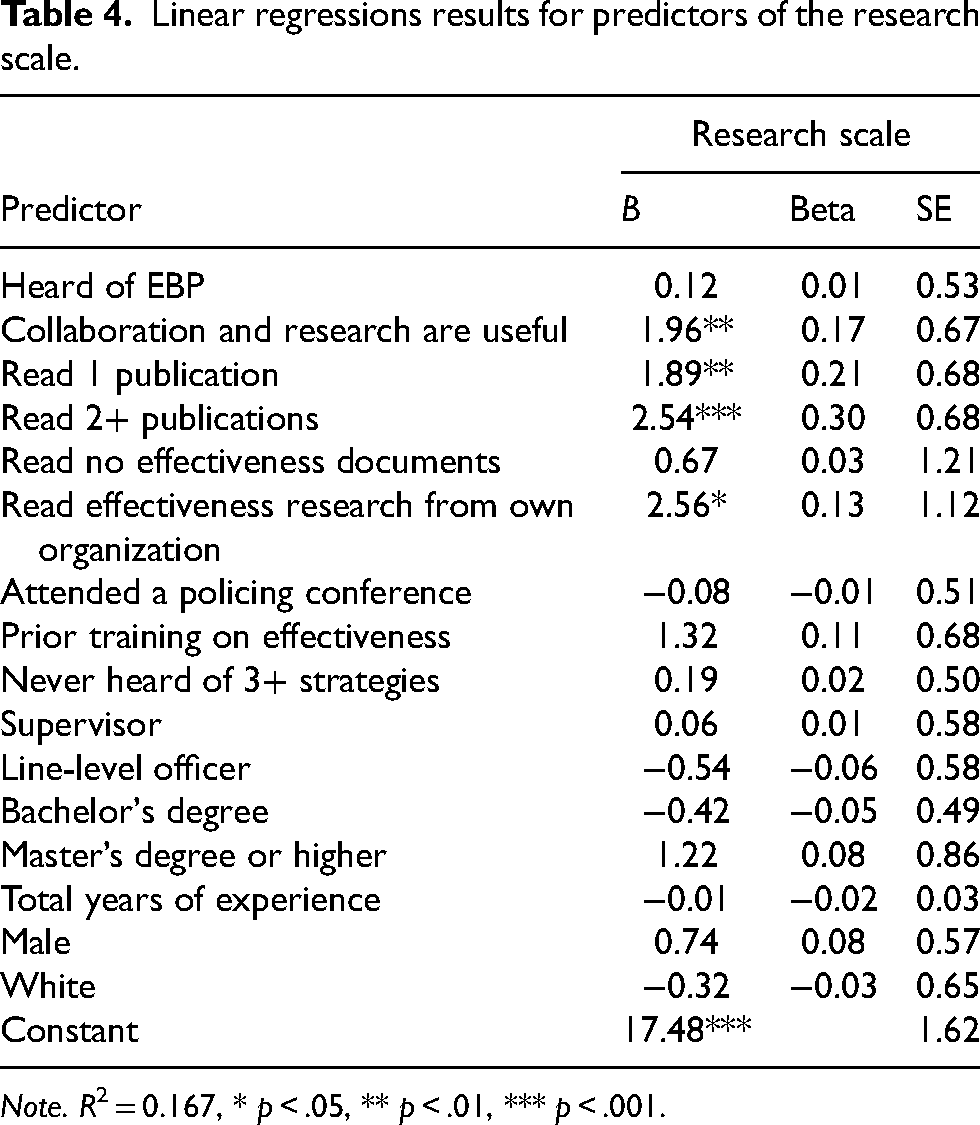
We also conducted a linear regression analysis 10 to explore which factors predicted the fourth specific indicator of receptivity: willingness to conduct research (measured using the Research Scale). These results are presented in Table 4. Participants who agreed that research and collaboration are useful scored approximately 2.0 points higher on the Research Scale compared with participants who did not agree with this statement. Participants who had read one publication scored approximately 1.9 points higher, and those who had read two or more publications scored approximately 2.5 points higher on the Research Scale, compared with participants who had read no publications. Finally, participants who had had been exposed to research from their own agency (i.e., read effectiveness documents from their own agency) scored approximately 2.6 points higher on the Research Scale compared with participants who read effectiveness documents from an agency other than their own.
Linear regressions results for predictors of the research scale.
Note. R2 = 0.167, * p < .05, ** p < .01, *** p < .001.
Most receptive police professionals
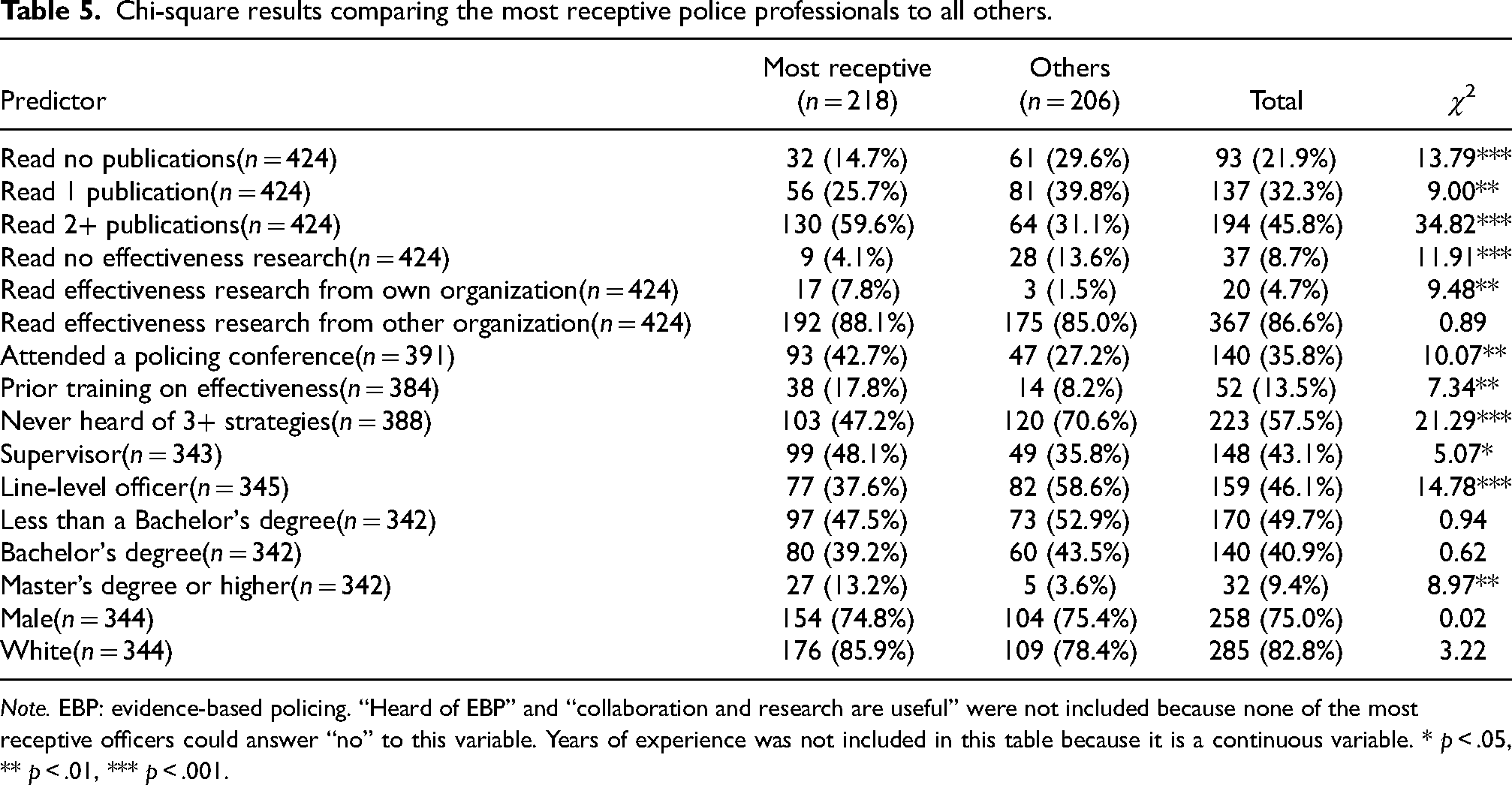
Chi-square tests of independence 11 were conducted to examine the differences between the most and least receptive police professionals in our sample. These results are presented in Table 5. Each row displays the number of most receptive police professionals, the number of all other police professionals, and the total number of police professionals who were coded as 1 on each respective variable. The percentages represent the frequency out of the total for the given category.
Chi-square results comparing the most receptive police professionals to all others.
Note. EBP: evidence-based policing. “Heard of EBP” and “collaboration and research are useful” were not included because none of the most receptive officers could answer “no” to this variable. Years of experience was not included in this table because it is a continuous variable. * p < .05, ** p < .01, *** p < .001.
The most receptive respondents more frequently had read several publications and less frequently had read no publications. The most receptive respondents more frequently had read effectiveness research from their own organization and less frequently had read no effectiveness research. The most receptive respondents had more frequently attended a policing conference, had received formal training on how to identify or evaluate which policing strategies are effective in reducing crime, were supervisors, and had completed a master's degree or higher. Finally, the most receptive respondents were less frequently line-level officers and less frequently had not heard of three or more of the listed policing strategies. We also conducted an independent samples t-test to examine whether years of experience differed between the groups. No significant difference was observed.
Discussion
Generally, our sample appeared to be fairly receptive to the role of research in policing, and more receptive than those sampled by Telep (2017). As we discuss in more detail below, this was particularly true of the civilian sub-sample. Most of our sample (68.4%) had heard of the term “evidence-based policing”, the vast majority (84.9%) agreed that research and collaboration with researchers are useful, and a little under half (43.4%) reported agreeing that science should contribute to at least 50% of day-to-day decision-making.
Despite these findings, advocates of research-informed policing will obviously still see room for improvement. Not only would 100% of the sample ideally know what EBP is, but specific issues identified in our study need to be addressed. For example, just over half our sample (57.3%) had never heard of three or more of the listed policing strategies and future research must seek to understand this. One possible explanation is that despite being generally receptive to the role of research in policing, the police professionals in our sample may not be able to access easily the sort of resources that describe and explain the strategies we examined.
Another important finding relates to the participants’ views about how science should contribute to day-to-day decision-making. Similar to what has been found in previous research (Hunter et al., 2015), our respondents tended to value experience over science in decision-making, although they saw a larger role for science compared with Telep's (2017) sample of police professionals. In contrast to other variables, such as knowing about research or understanding research, it might be argued that this variable is particularly important because it asks police professionals about their potential willingness to implement research (Lum et al., 2012).
Predictors of receptivity to research
The current study is the first known attempt to examine factors that might predict receptivity to research in a sample of Canadian police professionals. Although our sample seemed to be fairly receptive, civilian participants appeared to be particularly receptive to research compared with sworn officers. Indeed, civilians were more likely to agree that research and collaboration are useful (n = 60, 95.2%) compared with officers (n = 231, 82.5%), and that science should contribute to at least 50% of day-to-day decision-making (n = 39, 62.9%) compared with officers (n = 108, 38.4%). Below we discuss possible reasons for these differences and other predictors of receptivity to research that emerged from our survey, which we believe are particularly important.
Higher education
Perhaps unsurprisingly, higher education predicted receptivity to research within our sample, as it did in Telep's (2017) study. In fact, the differences in receptivity that we observed between the civilian and sworn professionals may relate to the education attained by these individuals. In the current study, 20.6% of civilians had obtained at least a master's degree compared with only 6.8% of officers, and higher education was associated with beliefs that science is important in day-to-day decision-making. In addition, significantly more of the “most receptive” police professionals had obtained a master's degree (13.2%) compared with the rest of the participants (3.6%).
Despite this association, more research needs to be conducted to determine why higher education might promote receptivity to research (Edwards, 2017). One possibility is that people who decide to complete higher education may be inherently more open to the value of research (Perl and Kahn, 1983). Another possibility is that obtaining a university education contributes to one's understanding of research and the research process, and underscores the positive impact that research can have on policing (Green and Linsdell, 2010; Perl and Kahn, 1983). If either of these things is true, it might be worthwhile continuing to develop partnerships between police professionals and universities to promote higher education, as others have recommended (Bradley and Nixon, 2009; Lumsden, 2016; Willis and Mastrofski, 2014).
Rank
Rank also appears to play an important role in predicting receptivity to research. Being a line-level officer was associated with lower odds of agreeing that research and collaboration are useful. It was also associated with being unable to correctly identify ineffective policing strategies (i.e., random preventative patrol and rapid response to 911 calls) and not believing that science should contribute to at least 50% of day-to-day decision-making. In addition, significantly fewer of the “most receptive” police professionals were line-level officers. These findings are consistent with those reported by Telep (2017).
What explains these results? One distinct possibility relates to the fact that line-level officers are less likely to have higher education, which as described above, is a significant predictor of receptivity (a possibility that is supported by the fact that rank and higher education are moderately correlated, V = 0.23, p = .003). In addition to this possibility, it is likely that line-level officers are not exposed to as many opportunities as more senior officers (e.g., attending conferences) to learn about the research process and how it might benefit policing. Creating such opportunities may increase their receptivity to research. Making research more accessible and meaningful to line-level officers (e.g., researchers explicitly discussing the practical implications of research; Lum, 2009), may also contribute to increased receptivity to that research.
Exposure to research
Related to our previous point, specific indicators of being exposed to research (e.g., attending conferences) predicted several variables related to research receptivity (e.g., agreeing that research and collaboration are useful) in our sample. In addition, when examining what differentiates our “most receptive” police professionals from the others, we observed that exposure to research (e.g., reading publications, attending policing conferences, and having received formal training on how to identify policing strategies that are more likely to be effective) was a characteristic of the most receptive respondents.
These findings further support the idea that enhancing exposure to research is likely a good way to help improve police professionals’ receptivity to research. Of course, this is more likely to be the case if the research they are exposed to is relevant (Lum, 2009). Collaboration between academics and practitioners can help ensure that this is the case (e.g., by increasing the chances that research will capture the complexities of police work, including the many constraints that police officers must work within). To increase exposure to their research, researchers also need to consider how they disseminate their findings. For example, as Telep (2017) suggested, it may be worthwhile for researchers to consider non-traditional ways to communicate their findings, such as publishing in trade magazines (e.g., Blue Line), presenting at professional conferences (e.g., International Association of Chiefs of Police), and using social media (e.g., Twitter).
A word of caution
We recognize that our research is aligned with a version of EBP that sees as its primary goal the use of rigorous research methods to help determine “what works” in policing. Consistent with that goal, the objective of our survey was to determine the degree to which police professionals in Canada are receptive to such research and to identify factors that predict their degree to of receptivity. Implicit in this investigation is the view that being receptive to research is a good thing, and that greater reliance on policing practices, programs, and policies that are informed by research will likely allow the police to perform their duties more efficiently and effectively.
It is important, however, to also recognize that this focus on efficiency and effectiveness through the adoption of research-informed practices, programs, and policies is not all that is required to reform policing. As one of the reviewers of this article appropriately pointed out: “One does not reform policing by turning the police into academics”. Although we believe that a greater reliance on research will help with the necessary reforms, we clearly need to see more than a reliance on research to transform policing into the “community sensitive, diversity-tolerant, legitimacy-orientated” profession that it needs to be to achieve its mandate to protect and serve, especially within communities that no longer trust or have confidence in the police. 12
Limitations
There are several limitations associated with the current study that warrant discussion. First, our sample size was relatively small, which prevented some analyses from being conducted. Furthermore, it was not uncommon for participants to not respond to some of the items in our survey, making the sample size even smaller for certain research questions. Given these issues, caution should be used when interpreting our findings, and generalizing them to other police professionals in Canada. Likewise, caution should be used in drawing Canadian–American comparisons until larger groups of police professionals are sampled from both countries.
Second, as indicated by Telep (2017), participating in studies such as this one is, to some extent, an indicator of being open and receptive to research. Thus, despite our attempts to recruit a diverse and representative sample of police professionals, it is possible that our sample is not fully representative of police professionals in Canada and may be biased in that respondents are more receptive to research than the general police population. For example, it is possible that the nature of this research (i.e., its focus on EBP) may have been a motivation to participate in the study in the first place. Again, special care needs to be taken in the future to collect a more random sample of police professionals to minimize any potential for this type of bias. Given that rank appears to be a particularly important factor in predicting receptivity to research, it is also important to ensure that enough officers of various ranks are sampled in future research.
Third, although our study sampled participants across agencies from seven Canadian provinces, we were unable to make comparisons between police agencies because the distribution of participants was so uneven. Furthermore, we did not possess the sort of in-depth knowledge of the specific agencies we examined (e.g., leadership culture, organizational policies) to make sensible inter-agency comparisons. Future research should examine inter-agency differences more closely to assess what certain Canadian police agencies are doing that might increase receptivity to research among their members.
Finally, it must be acknowledged that survey research tends to simplify the complex by focusing on hypotheticals, and this is no doubt true to some extent in the current research. For example, with respect to the interventions making up the Research Scale, it is one thing to say in a survey that one endorses a particular intervention for evaluation purposes, as many of our respondents did, it is quite another to be willing and able to implement such an intervention (i.e., our findings in relation to the Research Scale may not translate into action). Relatedly, it is likely that the Research Scale used in this and previous research did not capture important dimensions that may have influenced survey responses. It is possible, for instance, that a reluctance on the part of respondents to endorse specific evaluation methodologies had less to do with a lack of receptivity towards research and more to do with concerns associated with the ethics surrounding these methodologies (e.g., to withhold from one area a promising intervention in order to have a control site). Future research should rely on open-ended responses from respondents to a greater extent than we did to better capture the reasoning behind survey responses.
Conclusion
The current investigation sheds light on the factors that might help advance research-informed strategies in policing. However, further work remains to increase receptivity to research in Canadian police services. Our findings suggest that encouraging police professionals to consume more research might increase their openness to EBP. However, this means that researchers also need to make their research more relevant and accessible, in terms of how they conduct their research, talk about their findings, and disseminate their research. Through the adoption of research-informed practices, programs, and policies, police agencies will hopefully become more efficient and effective in the future. Although not the only thing that is required to ensure that they can meet their mandate to protect and serve the Canadian public, these are important goals.
Footnotes
Acknowledgments
We would like to express our gratitude to all the police professionals who took the time to participate in this study. We would also like to thank Cecilia Jorgenson for her assistance with data analysis.
Declaration of conflicting interests
The author(s) declared no potential conflicts of interest with respect to the research, authorship, and/or publication of this article.
Funding
The author(s) received no financial support for the research, authorship, and/or publication of this article.
