




Abstract
The aim of this article is to take stock of theorizing around the concept of police culture, the degree to which it may be static or dynamic, and the ways in which these collectively shared practices and ideals influence and are influenced by social structural problems. We take a “ground-up” approach to this problem by conducting interviews with officers and staff from a relatively small Southern California police department (National City Police Department). The interviews were aimed at gauging officer opinions on the issues of civilian oversight and departmental transparency. These were conducted using Q-sorts, which prompt the interviewee to rank order responses to the questions. These answers were subjected to exploratory factor analysis, the function of which is to take steps towards ascertaining latent causal relationships that underlie correlational relationships. The inductive nature of this methodological approach limits its generalizability but allows for exploration into open-ended questions that can serve as bases for the expansion or refashioning of theoretical approaches. Overall, our findings suggest a need for further exploration into the extent to which demographic and experiential characteristics may underlie a more diversified police occupational culture than the traditional police culture narrative suggests.
Introduction
Policing scholars have long debated the theoretical notion of police culture. Among its proposed attributes are a certain “occupational personality” that functions to cope with stressors, a collective emphasis on insular social values and the valorization of crime-fighting as the most important aspect of policework (Skolnick, 2008; Terrill et al., 2003). It has traditionally been characterized by a visceral “us vs them” mentality (Manning, 1977; Van Maanen, 1978), with an ideological orientation that tends to mythologize the police officer as a “warrior” 1 (Balko, 2013; McLean et al., 2020) on the front lines of a battle against (lower class) criminality (Wilson, 1975) or the generally “threatening” public.
Contemporary scholarship has emphasized that officer diversity could undermine this theorized ideological unity. Diversity is primarily envisioned along demographic boundaries but also can be conceived of in terms of occupational variables like experience and rank. These perspectives view culture in more evolutionary or dynamic terms. Rather than being relatively fixed across time and space, the “culture” is seen as being more responsive to change over time. Cultural adaptations can arise in response to formal imperatives, like reform initiatives that attempt to shift organizational systems, informal social movements or other external pressures (McLean et al., 2020). These can also manifest as psychological “coping mechanisms” utilized by officers to navigate the evolving stressors of the job (Chan, 2007; Paoline and Gau, 2018; Silver et al., 2017).
The aim of this article is to take stock of this conversation around the concept of police culture, the degree to which it may be static or dynamic, and the ways in which these collectively shared practices and ideals both influence and are influenced by social structural problems. It is our hope that we can not only gesture towards some potentially new directions in the study of police culture, but also assess how questions around this concept can be supplemented by work that critically engages policing as a paradigm. We are interested in exploring the ways in which political, institutional and emotive mechanisms may underlie observed cultural characteristics.
The significance of this engagement is evident given controversies around policing in America. The National City Police Department (NCPD), whose officers participated in our survey, has recently come under fire for the in-custody death of Tony Wilson, a 61-year-old man with mental illness who was hit by an officer with a taser five times within one minute while he was on his knees. Within two weeks, Wilson was taken off life support (Dorian Hargrove, 2020). Nationally, the killings of George Floyd and Breonna Taylor, among many others, have been among the latest illustrations of the country's long history of anti-Black police brutality. This institutionalized State violence surfaced not just in the moments of these killings, but in the heavily militarized responses to the protests that emerged in reaction to them. The La Mesa and San Diego police departments, whose jurisdictions neighbor NCPD, now face mounting lawsuits from the American Civil Liberties Union and other legal advocacy groups owing to accusations of excessive use of force against protestors (Stone, 2020).
If the traditional police culture (TPC) is characterized by beliefs that the suppression of crime and/or “disorder” are the most fundamentally important aspects of policing, and that ordinary citizens could not possibly have the capacity to understand the job (Paoline and Gau, 2018; Silver et al., 2017; Skogan, 2008), the question remains how operative this ideological mode is in shaping these responses to unrest, as well as the excessive force that precedes it. In other words, this analysis is important in terms of beginning to assess not only the degree or varying magnitudes of police culture, but also the connection between these characteristics and the problem of police violence.
Examining these relationships is a messy process, necessarily straddling aspects of each of these two conflictive theoretical frames (Demirkol and Nalla, 2020; Ingram et al., 2018; Paoline and Gau, 2018), and varying significantly across departments and jurisdictions (Chanin, 2015). A grounded analysis of culture could be a fruitful step towards interrogating the interrelation between this ideological orientation and viewpoints towards reformist policies as well as a glimpse into some of the motivations behind behavioral outcomes. A grounded methodological perspective, usually associated with ethnographic work, typically involves inductive coding, and sets out to engage the connection between “micro-level” meaning making and more theoretical questions (Muñiz, 2014; Tavory and Timmermans, 2013). By focusing on the viewpoints of officers in a relatively small Southern California department and doing a deep dive into these micro-level processes of symbolization and meaning, we can supplement more generalized theoretical debates about police culture and its connection to more abstract structural issues.
The national conversation around defunding police departments that unfolded in the wake of the abovementioned incidents is related to the problem of police culture to the extent that policing itself is influenced by the material excesses of the era of homeland security and its correlative incentives (Balko, 2013; Vitale, 2018). A more thorough consideration of cultural or ideological elements apart from these incentives or outgrowths could supplement such an approach, and its contributions to what might be described as a political economy of policing. In keeping with these aims, we focus on ideological orientations towards two issues that are of significant importance to both the theory of police culture and the often-unfruitful practice of attempting to reform policing. These are departmental transparency and civilian oversight.
We collected data through a Q-sort survey and subjected them to an exploratory factor analysis (EFA). Unlike Likert scale surveys, Q-sorts ask respondents to rank order various responses in terms of favorability. Q-sorting allows for a more nuanced analysis, incorporating the relative value accorded to certain statements. In our case, this involves the incomplete statements of “Departmental transparency is…” and “Civilian oversight is…” alongside an imperative to rank order several adjectives relating to each prompt. These answers are then subjected to EFA, which reveals how these viewpoints cluster. In theory, factor analysis uncovers latent causal structures that underlie covariance. This is an open-ended process operating at the nexus of qualitative and quantitative methodologies, designed to produce grounded theory rather than ascertain generalizable results. As such, these analyses are ideal as a starting point from which we can begin to engage new perspectives on police culture and the study of policing more generally.
Theories of police culture
Contemporary theoretical debates around police culture have largely engaged the magnitude and substance of cultural variation (Ingram et al., 2013; Paoline, 2004; Paoline and Gau, 2018; Skogan, 2008; Skolnick, 2008). The diversification of police officers and changes in organizational philosophy are examples of potential sources of variation. Attempts, locally and nationally, 2 to shift from “broken windows” 3 models of policing to community policing are examples of broader efforts to curtail what is typically conceived of as an insular and socially conservative TPC as well as its “warrior cop” corollary, both of which are antithetical to reformism.
The “monolithic” and warrior orientations are traditionally envisioned as being characterized by a hostility or hypervigilant skepticism towards outsiders and externally imposed reforms (McLean et al., 2020; Van Maanen, 1978; Weitzer, 2015). The often-external nature of police reform movements can, for those who adhere to TPC, spur existential concerns. Theories that place a greater emphasis on cultural variance posit that intradepartmental conflict is likely (i.e. “street” vs “management” cops) (Reuss-Ianni, 1983). In line with these perspectives, several have argued the concept of police culture is best described as multifaceted, dynamic, and historically embedded rather than a singular discrete ideological form (Demirkol and Nalla, 2019; Paoline, 2003; Skolnick, 2008).
The framework of “organizational justice”, which is related to the sociolegal concept of procedural justice, can be a useful lens for viewing the notion of competing cultural value systems. From this perspective, the differing viewpoints of decision-makers and those subjected to decisions are emphasized. Decision-makers are more likely preoccupied with an end result, whereas those affected tend to be more focused on the fairness of a process (Heuer et al., 2007). This framework can be considered in terms of both interactions between management and street cops and between police and citizens. Procedural justice, 4 by contrast, tends to be a commonly evoked theme in training programs meant to improve community–police relations (Sunshine and Tyler, 2003; Tyler, 1984). Reuss-Ianni's (1983) work draws out how the tensions highlighted by the organizational justice perspective are manifest within policing. “Street cops” are portrayed as being increasingly alienated from their work, drawn to a phantasmatic image of the “good-old days”, whereas management is seen as being preoccupied with manufacturing bureaucratic responses to the sociopolitical surround. The theorized cultural splitting that occurs can be interpreted as representing an intradepartmental conflict which, although it is consciously articulated as an issue of “street vs management”, could be understood as a projection of the perceived existential threat attached to the imposition of reform.
Although there is some evidence the implementation of training programs aiming to instill in police a mindset in line with tenets of procedural justice can reduce the excessive “over-policing” associated with TPC (Owens et al., 2018), the degree to which reforms can remain viable over longer periods is unclear (Chanin, 2015). Given this inconsistency, TPC could be understood as a reactionary ideological standpoint that stunts change (Skogan, 2008). To that end, current scholarship is focused on how police culture responds to reforms, both external and internal, as well as the ways in which intra-organizational conflict, such as tensions between patrol officers and upper management, may affect the way policing develops moving forward.
The persistence of certain aspects of TPC is psychopolitical. If the rank-and-file perceive a reform effort as being inconsistent with their view of the job, mistrust of both management and the public could increase (Paoline, 2003). It is also worth considering the extent to which changes to officer behavior are adaptive, the result of an ideological reorientation, or some combination of the two (Skolnick, 2008). It is possible that the rank-and-file officer complies with reforms out of necessity, but is ideologically averse to them, “neutralizing” (Sykes and Matza, 1957) his or her compliance to like-minded officers in the terms of the traditional culture (Chan, 2007). Even if shifts in behavior are taking place, officers may still find psychological comfort or social capital in “the old ways”. This identification with traditional order maps onto a set of affinities between the TPC and American conservative or right-wing politics. In their text The Politics of the Police, Bowling et al. (2019) map out several contours of this interconnection. These include, among other things, the structure of police institutions as relatively rigid disciplinary entities, the potentially strong individual “fit” of people who are ideologically conservative into such systems, and the historical use of police forces as means of repressing left-wing movements such as organized labor, the Civil Rights Movement and most recently, the Black Lives Matter movement (Barker et al., 2021).
Strict occupational socialization may be one mechanism that shapes the integration into an insular culture, especially given the psychological salience of direct and significant experiences (Garner, 2005) as well as conditional rewards or punishments (Johnson, 2011) on the alteration of attitudinal orientations. Conti (2006; see also Foucault, 1977) describes how the police academy subjects recruits to strict disciplinary training involving the meticulous control of one's time and body. Police cadets are compelled to endure certain “degradation ceremonies” through which individuals are conditioned to develop a “proper occupational personality”; those who share this experience are bonded into a tightly knit social network, which becomes a focal point of cultural reproduction (Doreian and Conti, 2017).
Evidence suggests that after the academy, peer socialization continues and an officer's attitudinal characteristics tend to map onto those of their intimate workgroups (Ingram et al., 2013). The kinship that forms can be felt very viscerally. Sierra-Arévalo's (2019) work demonstrates how an emphasis on the memorialization of death among police officers plays a key role in preserving aspects of an “us vs them” mentality through persistent reminders that interacting with the public is dangerous. This viewpoint is a hallmark of TPC, which has been found to be associated with more-favorable views towards aggressive policing, including the use of force, and less-favorable views toward reformist frameworks like procedural justice (Silver et al., 2017). although mid-range cultural models, such as the “work group” hypothesis, are limited in their ability to explain more macro-level cultural phenomena, they are useful in terms of bridging the gap between individual officer temperament and the broader sociopolitical surround (Ingram et al., 2013).
Organizational dynamics and culture
Because policing operates in an open system, cultural transmission may not be as important as how policing institutionally adapts to or resists pressures towards reform (Reiner, 2017). More generally, the beliefs held by police can be seen as being shaped by a confluence of internal and external factors (Frank and Brandl, 1991). The possibility of intra-organizational tension must be considered as well, especially given potentially differing priorities among various subgroups within an organization (Paoline, 2003). The theorized opposition between the “street cop” and “management cop” is a prominent example of this sort of tension (Reuss-Ianni, 1983). This conflict is viewed as a point of resistance to translating emerging value orientations to behavioral outcomes (Campeau, 2015). Ideological disagreements can give rise to practical difficulties for police who are attempting to act in accordance with relatively new philosophical approaches, such as community or problem-oriented policing (Skogan, 2008). If they feel unsupported by their supervisors or peers, they may not choose to act on these values, or be pressured to resist. Attitudinal variability is not always a reliable predictor of variations in behavior (Jerolmack and Khan, 2014), and the linkage between beliefs and behaviors has been particularly nebulous in terms of policing (Worden, 1995), but there is evidence of an association between the mistrust of citizens with a higher likelihood of using force or being the subject of citizen complaints (Engel and Worden, 2003; Ingram et al., 2018). One way of viewing this is that different “styles” of policing emerge as the profession evolves, but that the ability to employ these is constrained by cultural norms as well as the strict disciplinary context in which they form and persist. For individuals, the decision to utilize a certain policing “style” can be conceptualized as being adaptive, but also an indicator of one's orientation towards the cultural value system (Paoline, 2004).
Although TPC has been theorized as resistant to change, some level of dynamism is inevitable, and the importance of individual agency in crafting an emergent and variable culture may not be acknowledged often enough (Sierra-Arévalo, 2019). Age, for example, can be an important mediator of cultural change because younger employees have been shown to be more receptive to change than their older counterparts (Roscigno and Preito-Hodge, 2021; White and Robinson, 2014). If there are more broad-based trends such as this, that perhaps map onto various measurements of diversity, then we could infer that the “culture” in general could change in proportion to rising levels of officer diversity.
The empirical status of diversity as an engine of police cultural or behavioral change is mixed. Some have found that “blue” ideological frames that center on the TPC orientation are prevalent and somewhat uniform, even controlling for departmental demographics (Roscigno and Preito-Hodge, 2021). External structural factors, such as the socially constructed frames of reference attached to geographical spaces (Loftus, 2007) are closely related to the ways police conceptualize their work. Along these lines, Legewie and Fagan (2016) find that police-involved killings are more likely to take place in regions where Black-on-White homicide rates are higher than Black-on-Black ones; the inclusion of more Black police officers in a department was found to mitigate this relationship, however. Black officers may also be less likely to make discretionary stops than White officers, controlling for shift characteristics (Ba et al., 2021). Others have found that White officers are more likely to use deadly force than Hispanic officers (McElvain and Kposowa, 2008). For the most part, these studies are interested in assessing the degree to which officer diversity, net of other theoretically relevant factors, influences the probability of police engaging in various degrees of use of force. The cultural outlook or ideological frame can be viewed here as a more ethereal characteristic, mediating these differing tendencies towards intrusive behavior, and rooted in the socially constructed evaluations of geographic spaces and groupings which both subtend and exceed the culture.
Professionalization is another institutional factor that can influence cultural development. This process has a long history in American policing and can be traced back to August Vollmer, who emphasized the need for a “rationalized” policing that would rely on partnerships between departments and academia (Koehler, 2015). This coordination leads to the encouragement of police continuing their education after secondary school. As for related behavioral outcomes, there is some evidence that the likelihood of utilizing force is inversely related to education levels, although they have no discernible effect on other discretionary calls, such as the decision to make stops or arrests (Rydberg and Terrill, 2010). Even if behavioral changes are incremental, some contend these institutional factors may be driving a gradual withering away of the TPC. Although some studies have suggested that net of demographic characteristics, attitudes towards citizens have become generally less skeptical and there has been a more enthusiastic embrace of conflict resolution or de-escalation (Paoline et al., 2000), the results of others indicate that varying social climates in different departments or among different work groups may underlie observably different attitudinal clusters (Paoline, 2004). The question of whether demographic characteristics may be a locus of this variation is still an open one that has deep theoretical implications, both in terms of more micro-level theorizing of cultural orientations and more macro-level questions about policing and social inequality.
If the orientation of TPC towards reforms is one of hostility stemming from a mistrust of outsiders, questions remain around what constitutes “the outside” as well as which forces underlie these boundaries. The ideological frame of “police culture” cannot be cleanly separated from broader sociopolitical issues, such as the role policing has played in generating and maintaining social inequality, many times through the violent suppression of popular anti-racist or labor movements (Skolnick, 2008). In this regard, the violence we are witnessing in our time, although always shocking, is not necessarily surprising if it is viewed as repetitious 5 or perpetual (Martinot and Sexton, 2003). The deleterious outgrowths of this history are manifest in the institutionalized excesses of the legal system, most notably mass incarceration (see generally: Alexander, 2010, Davis, 2003, Gilmore, 1999; Platt, 2019; Wacquant, 2000).
Although these structural problems go beyond formal policing, any study purporting to say something of police culture would be incomplete without considering their implications. Some more specific research areas informed by this interconnection include those that have focused on the impact of demographics on citizen perceptions and experiences with police, as well as the general impacts of proportional representation throughout various stages of the legal process. As may be expected, several of these studies have drawn connections between the social position of citizens and their beliefs about experiences with police. Whereas White people tend to hold relatively favorable views of police, people of color are more likely to believe that officers engage in misconduct frequently; crucially as well, the police identity is viewed as something of a master status relative to the race of the officer (Weitzer and Tuch, 2004), a viewpoint that is substantiated by recent work which suggests a relatively uniform occupational outlook among police, regardless of race (Roscigno and Preito-Hodge, 2021). These perspectives seem to vary as well depending on social class and neighborhood (Weitzer, 2000). Consequently, people of color may be more likely than White people to anticipate being victimized by acts of police brutality and are more likely to support measures geared towards reform or accountability, such as body-worn cameras (BWCs) (Ray et al., 2017). Reforms geared towards altering the demographics of departments towards proportional representation have been suggested as well. There is some evidence that when the work groups involved in criminal justice decision-making, across various levels of the process, are more representative, disparate outcomes are less likely to occur (Anwar et al., 2012; Ward et al., 2009).
Oversight, transparency and the ideal of community policing
The ideal of community policing, pushed to its end, strives towards a conceptual dissolution or blurring of the boundaries between the police and citizens. In practice, this is hampered by social inequality as well as departmental conflicts over bureaucratic imperatives. In the age of social media, conflicts relating to these divisions are perhaps more readily apparent or visible than in the past (Weitzer, 2015). Greater visibility does not necessarily lead to more thorough understanding (Goldsmith, 2010). The process of “the grievance”, at least in its more informal aspects, becomes obscured as a constant flow of information through electronic mediums that are often riddled with confirmatory bias (Felstiner et al., 1980; Nisbet et al., 2015). If certain aspects of policing become more visible through media, departmental transparency does not necessarily follow (Mawby, 1999). This may be compounded by a disconnect between public perceptions of police misconduct and the legal standard of reasonableness (Mourtgos and Adams, 2020), although it should be noted that the latter is often difficult to coherently operationalize (Triola, 2022), and at times appears to be endogenous 6 to the whims of policing itself (Obasogie and Newman, 2019). Endogeneity often allows for impunity when institutionalized practices such as qualified immunity 7 shield police officers from liability in most circumstances (Cover, 2016). As Martinot and Sexton (2003) argue, the State enables police violence, but simultaneously disavows it when it appears in its spectacular form, allowing for it to remain as a fundamental or taken-for-granted aspect that survives in even the most banal practices of policing.
At the level of policy, BWCs have been a common intervention intended to improve transparency and have thus received a relatively large amount of focus in the literature that attempts to gauge officer perceptions of departmental transparency more generally. The results of these studies generally suggest a degree of ambivalence towards the use of BWCs, although perceptions towards them tend to become more positive after implementation (Kyle and White, 2017; Pelfrey and Keener, 2018).
When police hold positive perceptions of BWCs, it often relates to their perceptible effect on the completion of job-related objectives, such as using these devices have for gathering evidence or for exonerating officers who face accusations of wrongdoing (Saulnier et al., 2019). Although BWCs have been associated with a reduction in the use of force, there is mixed evidence about their association with the frequency of arrests or issuance of citations (Braga et al., 2018; Headley et al., 2017). In line with the organizational justice perspective, the police, when in their capacity as “decision-makers”, tend to hold more positive perceptions towards the utilitarian aspects of BWCs, while de-emphasizing the potential for them to be mechanisms of accountability. Moreover, some studies have found that aspects of TPC grow more pronounced post implementation, namely skepticism towards management cops and the social value of BWCs apart from their practical uses on the job (Hyatt et al., 2017).
Assuming that BWCs are somewhat effective in improving aspects of transparency, community trust has not been shown to necessarily follow (Sousa et al., 2018). Independent Citizen Review Boards (CRBs) can be a way of alleviating this problem. However, some of the inherent tensions of the conditions that necessitate CRBs render them ineffective. Ideally, CRBs function as both a liaison and a deterrent. These groups are meant to allow civilians to express their concerns to police departments or to aid in the facilitation of legal action against officers who violate individual rights (Merrick, 2003). Unfortunately, a CRB is often unable to overcome one of its fundamental antagonisms, this being that the communities which most need CRBs are often those in which community–police relations are most hostile (Muñiz, 2014; Seybold, 2015). Furthermore, there is some evidence community members are less likely to pursue mediation when an officer is White, which may be indicative of avoidance behaviors or a belief among potential complainants that the process is futile (Williams, 2021). These structural problems are often deeply embedded in communities as memories of State violence or other forms of misconduct. They can heavily influence the ways large swathes of citizens, particularly people of color and of lower socio-economic status, view the police (Weitzer, 2002). To analyze some of these complications is to interrogate the ways in which police culture is situated within both bureaucratic conflict and societal antagonisms. Thus, one of the primary aims of this article is to assess the ways officers of varying experiential and demographic backgrounds view the interrelated constructs of transparency and civilian oversight.
Methods and data collection
Data were collected from the NCPD, a department located in San Diego County, California. As of 2019, the estimated population of National City was approximately 61,394, making it one of the smallest cities in the county; the approximate median age in National City is 33.6 years and it was estimated that nearly two-thirds of its residents identify as Hispanic or Latinx (United States Census Bureau, 2020). The NCPD is a full-service department with 90 full-time sworn officers and 43 full-time civilian staff 8 .
A series of Q-sort exercises were used to gather officer perspectives on issues relating to departmental leadership styles, civilian oversight and organizational transparency. The data were collected in person during shift changes over the course of two weeks in February 2015. NCPD leadership facilitated the research and encouraged participation via email. Sixty-four respondents completed the survey, for a response rate of 48.1% 9 .
Q-sorting is a data collection technique that asks participants to rank order several statements on a particular issue. Unlike more traditional survey methods, a Q-sort forces respondents to make relative comparisons by fitting their rankings “onto a pre-defined quasi-normal” distribution (McKeown and Thomas, 2013; Ratcliffe et al. 2014; Watts and Stenner, 2012). This process effectively eliminates the possibility of extreme ranking (i.e. classifying everything as similarly important) and promotes a high level of inter-rating reliability (Ratcliffe et al., 2014). This allows the researcher to engage respondent views “holistically and [with] a high level of qualitative detail” (Watts and Stenner, 2012: 4).
Q-sorting is widely utilized across the social sciences (Ashena et al., 2019; Funder, 2016; Siddiki et al., 2012). Policing and organizational scholars have used this technique to analyze and compare, for example, how police executives perceive organizational transparency initiatives (Chanin and Espinosa, 2016), how intelligence experts view threats from organized crime groups (Ratcliffe et al., 2014) and how citizens contemplate police department performance (Rus et al., 2013).
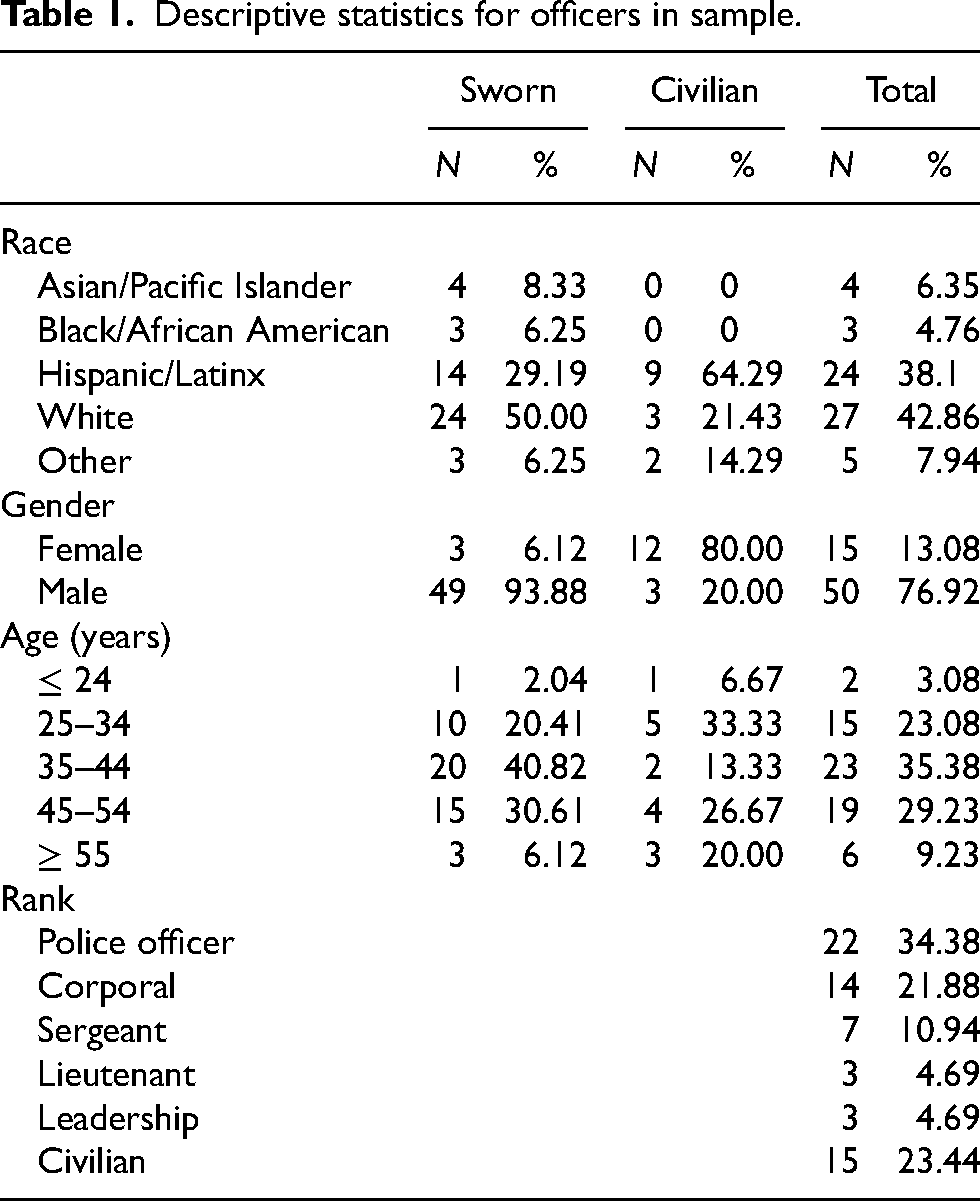
As shown in Table 1, a plurality of officers in the sample identifies as White (42.86%), with Latinx/Hispanic officers constituting the second largest racial group (38.1%). 10 More than 75% of the officers interviewed in this sample are over the age of 35. The lack of officers under the age of 35 may limit our ability to effectively analyze the evolutionary dynamics that underlie a more youthful workforce (White and Robinson, 2014). However, most of our sample (∼52%) have been police officers for a decade or longer, which could yield important insights regarding how age and work experience relate to perceptions of a changing occupational environment. Education levels tend to cluster around the categories of “some college” or “college graduate” with about 78% of respondents falling into these groupings. Approximately 77% of the officers interviewed are male, which severely limits our ability to assess the degree to which police culture is gendered, a fundamental topic within the culture literature. The plurality category of individuals surveyed for this study hold the rank of police officer (n = 22, 34.4%). Fifteen of the respondents are civilians (23.44%). Twenty-four of the respondents rank between corporal and lieutenant, with three of the surveyed individuals holding leadership positions in the department.
Descriptive statistics for officers in sample.
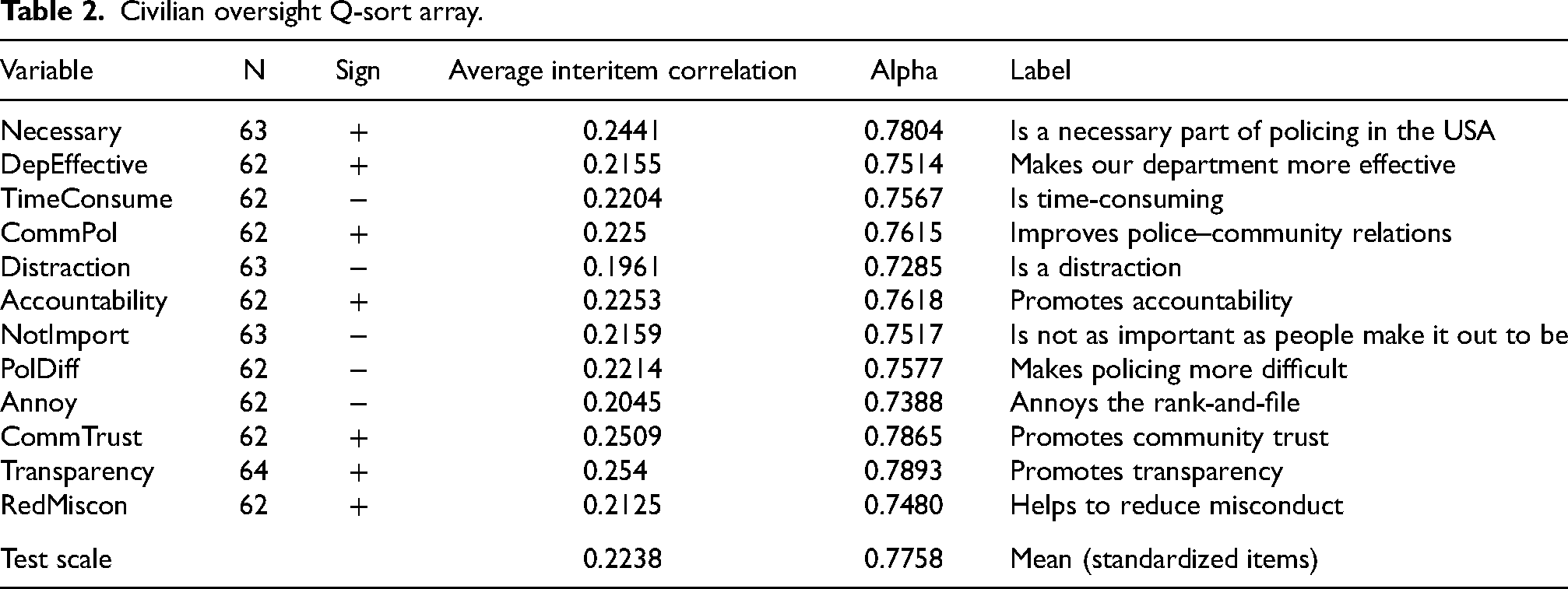
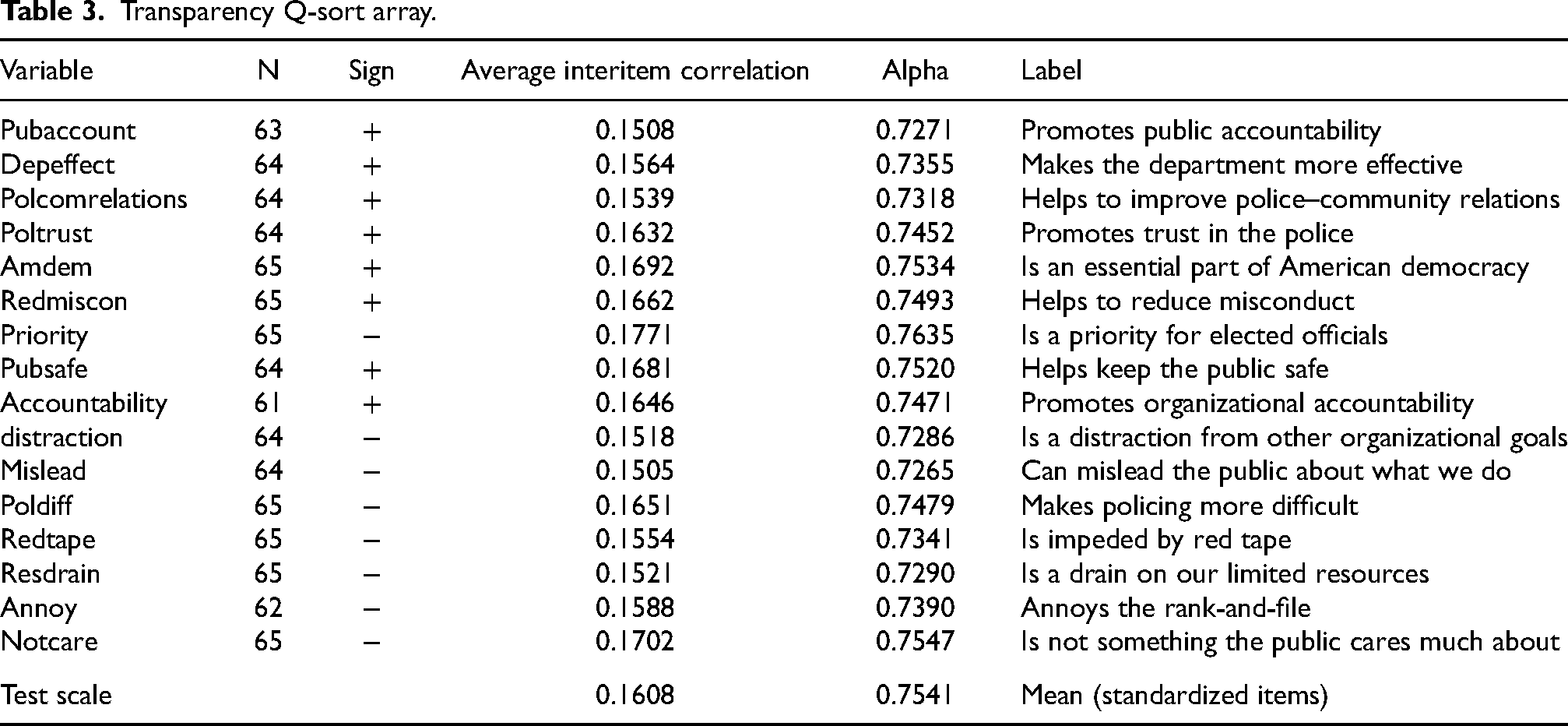
The survey is designed to capture respondent views on external oversight of police and the concept of transparency. Officers were presented with an open-ended statement and a series of words or phrases that they were asked to rank in terms of level of agreement or importance using a Q-sort scale measuring relative magnitudes of opinion. As shown in Table 2, Prompt 1 states, “In your view, civilian oversight of the police (e.g. The National City Community and Police Relations Commission) 11 ___________”, and lists 12 phrases to be ranked within a triangular matrix containing the same number of boxes which are coded to range from “strong agreement” to “strong disagreement”. Prompt 2 states, “In your view, organizational transparency ___________”, and lists 16 phrases to be Q-sorted, which are displayed in Table 3.
Civilian oversight Q-sort array.
Transparency Q-sort array.
Our aims in this project are to ascertain whether significant ideological differences exist across various demographic and occupational axes and if they do, to attempt to map out potentially unseen dynamics underlying them. We used EFA to evaluate officer survey responses to the civilian oversight and transparency prompts. This approach allows us to weigh the relative qualitative assessments officers attribute to oversight and transparency and facilitates an inductive analytical process.
Results
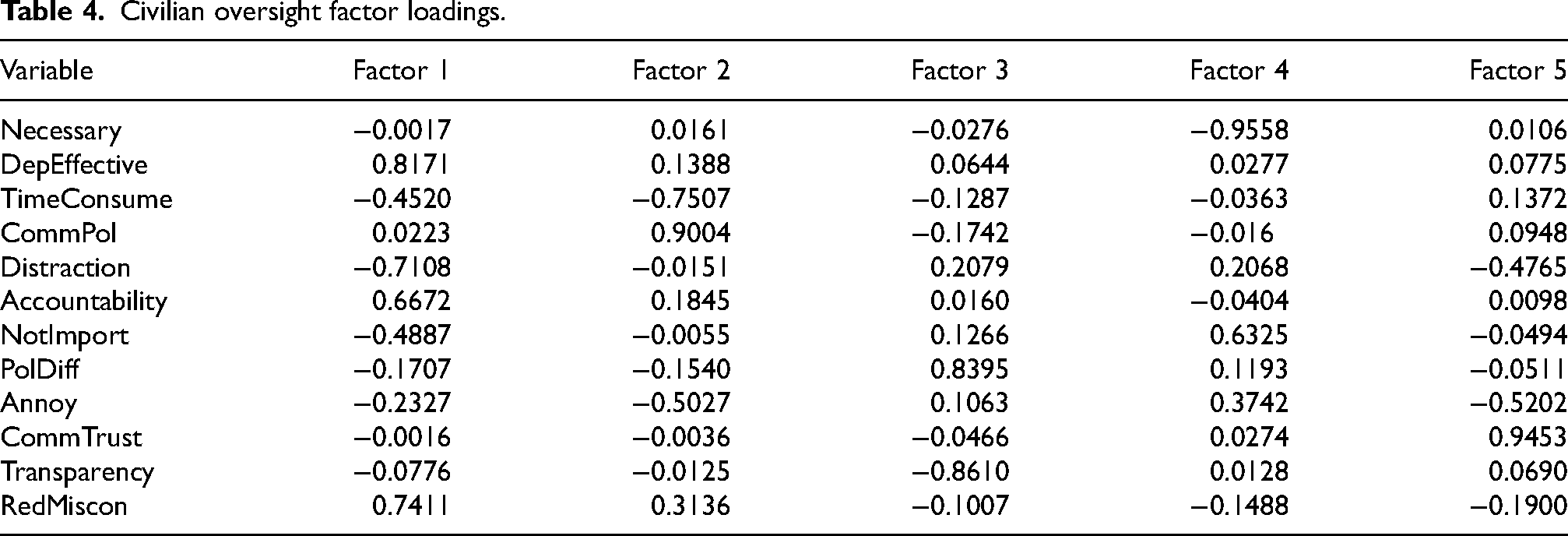
Table 4 displays the results of our EFA of the “oversight” Q-sort data for the full sample (n = 63). We extracted five factors using the Kaiser criterion (eigenvalue > 1) alongside a parallel analysis and a scree plot test. After orthogonal rotation, three of the five retained factors load highly on more positive themes, with two of these emphasizing a perceived connection between the presence of community oversight measures and a greater likelihood of community policing being a successful endeavor. The remaining factors are representative of a more neutral or negative outlook. One of these loads highly on the viewpoint that community oversight changes the way officers police, but low on its ability to promote transparency. The other loads highly on the viewpoints that oversight is unnecessary or unimportant.
Civilian oversight factor loadings.
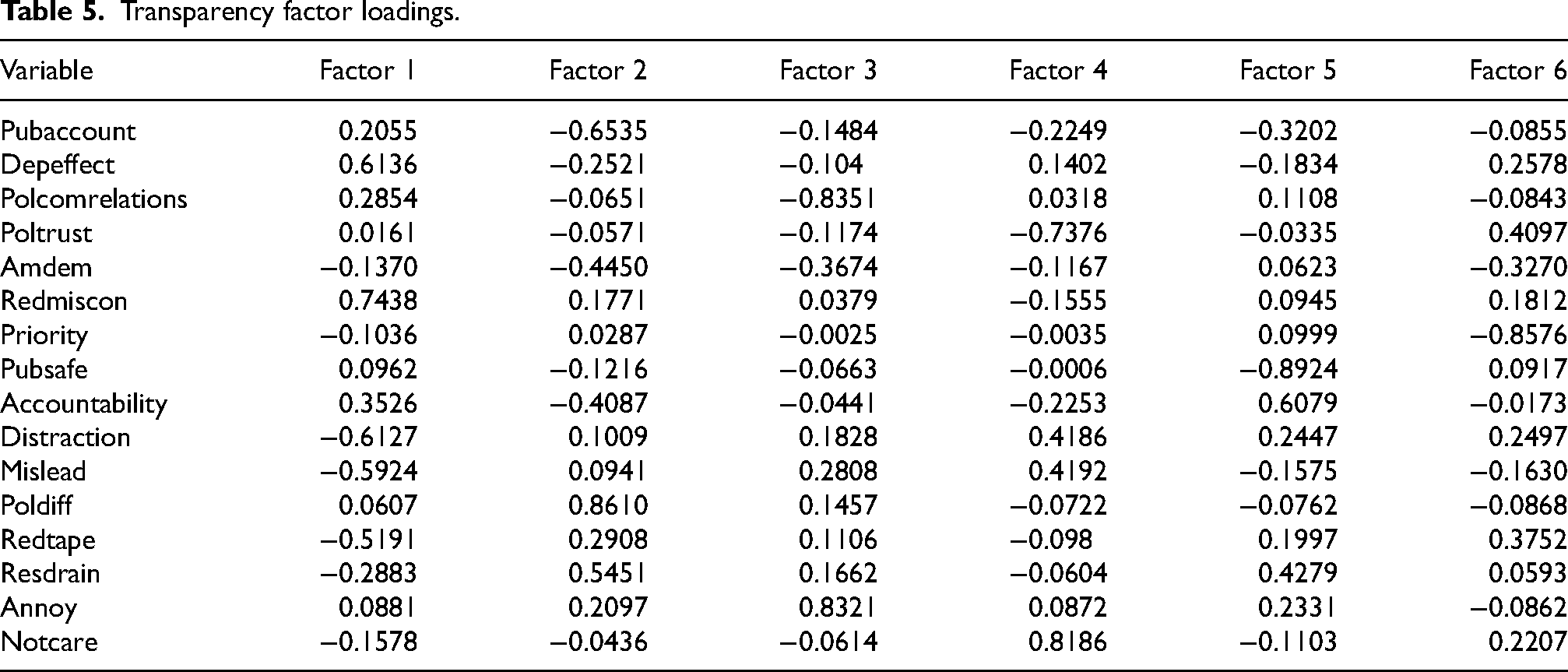
The results of our EFA of NCPD officers’ responses to the transparency prompt are shown in Table 5. We retained six factors, again relying on the Kaiser criterion, a scree plot test and a parallel analysis. The first two factors represent relatively polar ideological stances, albeit both are related to the perceived connection or conflict between transparency and efficiency. The first of these represents a viewpoint that positions transparency as being positively related to the reduction of misconduct as well as to the promotion of efficiency. The second clusters around the notion that transparency drains departmental resources and changes the way officers do their jobs while failing to promote accountability. Notably, neither of these viewpoints take seriously the possibility that departmental transparency possesses an inherent social value. In both factors, the “promotes American democratic values” variable loads negatively. The remaining factors in this model are characterized by a tendency towards either a negative viewpoint based on a feeling or perception of annoyance or a more neutral viewpoint that connects transparency to accountability and trust but minimizes its overall importance.
Transparency factor loadings.
In the hopes of teasing out the relationship between respondent characteristics and their views on civilian oversight, we engaged in a similar EFA process with relevant subsample groups. When we disaggregate these groups by race, White officers (n = 27) tend to cluster into viewpoints around the issue of transparency that are relatively positive compared with officers of color (n = 36). There is more of an emphasis in these clusters than in the full sample on community policing and democratic values. In the first grouping, for instance, transparency is viewed as being linked to stronger community–police relationships along with greater efficiency and the realization of American democratic values. The second major cluster, by contrast, represents a viewpoint that transparency is a source of inefficiency and that it is an insignificant aspect of policing. The other four clusters are all variously characterized by judgments around relationality or questions around values.
These subgroupings can be summarized as associating transparency with curbing misconduct, being obstructive of community–police relations through a furtherance of a perceived divide between civilians and cops, or either promoting higher order values (such as democratic values) at the expense of efficiency or just being a net-negative overall in terms of efficiency. Notably, compared with officers of color as well as to the full sample, these White officers place a greater emphasis on notions of relationality and values than on more concretized measures of efficiency. This may be indicative of a differential orientation towards policing and the sustainment of or attempt at cultivating a democratic society that cuts across racial lines.
The viewpoints of the White officers towards oversight are skewed even more positively. These variously load highly on points of view which link civilian oversight to greater levels of efficiency, a more successful community policing program and the realization of higher values in connection with this practice. The fifth extracted factor is an exception. This loads very highly on the viewpoint that oversight changes the way in which police do their jobs but loads negatively on viewpoints that connect it to improvements in either efficiency or community relations.
For officers of color, negative viewpoints cluster more around emotionality than around questions of social value or efficiency. These factors tend to load highly on variables like “distracting”, “annoying” or “creates red tape”. The practice of transparency here is not only something these officers seem to have a distaste for, but also something that they view as being ineffective in terms of promoting relationships with the community, cultivating trust, and by extension, promoting departmental efficiency. Of the other factors, two of three tend to cluster around viewpoints that characterize transparency as being a generally wasteful enterprise which is obstructive and/or does not improve relations with the community. Even when, as in Factor 5 of this model, the viewpoint is relatively positive, it does not come without its drawbacks. In the case of this grouping, transparency is viewed as something that can promote trust and reduce misconduct, but that also creates red tape, which would presumably curb efficiency.
The oversight factors are similarly negative for officers of color. The first retained factor, which represents the most positive outlook towards this practice, loads somewhat highly on community policing, as well as the reduction in misconduct and generally higher levels of department effectiveness. At the same time, however, this factor is marked by a recognition oversight as something that is distracting and perhaps overly time-consuming. As with the transparency sorts, officers of color seem more likely than their White counterparts to hedge or qualify their more positive viewpoints. The other three retained factors characterize generally negative points of view. One of these is based on the emotionally charged rejection of oversight, which views it as being something that is annoying, unnecessary and unimportant. The other two retained factors express a skepticism about the connection between oversight and improved community relations.
These striking differences between the White and officers of color are suggestive of the need to question the limits of community policing as a conceptual frame through which dynamics of relationality are analyzed. For these officers, the promotion of trust or an actual reduction of police misconduct does not necessarily bridge the divide between the community and police. This aligns a bit with Weitzer's perspective in which citizen attitudes around police trust are racialized and situated within class context. One possible interpretation of these findings is that officers of color are more attuned to this dynamic than their White counterparts, who tend to draw a greater association between transparency, the achievement of positive social values and a positive citizen–officer relationality.
More broadly, the racialized history of policing in America could underlie what at first blush may seem to be contradictory viewpoints among these officers of color, namely the absence of a relationality alongside the promotion of trust or the (perhaps inevitable) failure of social values in the wake of enhanced efficiency. That said, a limitation of this project is the lack of Black officers in the sample. Only three of the officers interviewed identify as African American. More than 80% of the sampled officers identify as either White or Latinx. Although the relative diversity of the sample (compared with other departments) allows a certain level of theoretical speculation around race and policing, an important aspect that remains is a further analysis of the ways in which distinctive dynamics relating to race are reflected in police culture and practices.
We also endeavored to tease out the influences of organizational status and officer rank as it relates to these issues. By and large, sworn staff (n = 49) hold generally positive views of both civilian oversight and transparency. Responses from sworn officers express a clear connection between oversight and organizational effectiveness, accountability and trust. Similarly, sworn staff view transparency initiatives as a potentially valuable means of reducing officer misconduct, but see such efforts as carrying noteworthy downsides. Indeed, sworn officers characterize transparency as holding the possibility of “annoying the rank-and-file”, draining scarce agency resources, and complicating police–community relations.
We examine the “street vs management” hypothesis by distinguishing the responses given by management, which we define as those maintaining the sergeant, corporal or lieutenant rank (n = 24), from respondent patrol officers. Three distinctive viewpoints can be mapped out among those at management level. The first two are generally negative, conceiving of transparency as being unhelpful either because it hampers efficiency or because it is obstructive to policing. The third viewpoint links transparency to greater levels of effectiveness in terms of the practice of policing, but not necessarily to an improvement in public safety or in the ways citizens view police. The clusters of viewpoints extracted about oversight all clearly point towards a positive attitude towards the practice. These variously connect oversight to greater levels of efficiency and accountability (Factor 1) as well as the promotion of community policing and higher order values such as transparency (Factors 2 and 3). It may be inferred that oversight, rather than being an existential threat to policing itself, as viewed by these officers, may in fact be viewed as something that enhances the ability of officers to do their jobs without some sort of fundamental transformation to the field.
By comparison, the views of the non-management officers seem to be a bit more variant. If we were to hypothesize from the perspective of the monolithic model, we may expect to see among officers (the “street cops”) a more pronounced leaning towards department transparency being an “annoyance”, or something that gets in the way of “real policing”. Although the fourth extracted factor from this subsample does load highly on the answers “annoyance” and “distraction”, the others vary, representing viewpoints that range from positively assessing the relationship between transparency and efficiency or community policing to coming to the opposite conclusions about these connections.
Oversight, by contrast, tends to collect more negative attributions. These tend to either minimize the importance or necessity of civilian oversight or question its connection to departmental efficiency. These results can be interpreted in several ways. First, and perhaps most obviously, it can be inferred that TPC theorizing can be viewed as overstating the significance of the “street cop” and his or her cultural milieu as one that prizes crime-fighting, machismo and in-group loyalty above all else, at least as it relates to what we can infer the TPC-minded officer would believe about transparency. This argument ought to be qualified by reiterating that these traditional “monolithic” readings of police culture make a point of hedging their arguments by claiming to deal with ideal types. That said, these results suggest that the old street–management dichotomy may be outmoded or even the opposite of what would have been anticipated in terms of ideological standpoints. Age could contribute to explaining a generally less-negative outlook towards transparency among lower-ranking officers than their managers. For officers over the age of 45 (n = 22), the factors retained using Kaiser criterion are uniformly negative in terms of viewpoints towards transparency. The younger age groups (25–34 and 35–44) tend to exhibit more variant sets of viewpoints, with several factors loading highly on more positive attributions.
Despite their promise, these findings should be considered in light of several limitations. It is worth re-emphasizing that research an exploratory inquiry into data describing the culture of a single police organization. Rather than generalizing our findings to other agencies or officer populations, we instead hope to identify patterns in the views of NCPD officers that can be used to both develop theory and produce testable hypotheses around which future research may develop. Relatedly, the sample of officers included in the study was disproportionately male and underrepresented both Black/African American and Asian/Pacific Islander officers. Though these communities are generally underrepresented in police departments across the United States, it is worth noting here given our attention to the influences of race, ethnicity and gender on officer perceptions. Finally, although the Q-sort technique is the most effective way to systematically evaluate subjective information, it does not provide the depth associated with more traditional qualitative inquiry or the breadth of a large-n quantitative study.
Discussion and conclusion
Our results suggest a need to further explore the degree to which police demographics and levels of experience are associated with varying ideological standpoints that influence perceptions of oversight and transparency. Although full sample analysis suggests an intuitive continuum and pairing of compatible viewpoints (i.e. the linkage of transparency or oversight to increased/decreased efficiency or improved/disimproved community relations), the indices derived from the subsample of officers of color suggests an ambivalence that runs slightly counter to conventional narratives around police reform. Striking here is what seems a more pronounced skepticism officers of color have compared with their White counterparts of the possible connections between oversight, transparency, and improved community relations. Although this could be attributed to the unique culture of the NCPD, it would be interesting to see whether these sorts of differences would be observable in samples from other departments. If this is the case, it may be suggestive of a distinct sort of skepticism among officers of color about the compatibility of policing and democratic society. These viewpoints could be understood as being situated within the history of policing in America and its complicity in sustaining systems of racialized social control. More exploration into these dynamics is warranted, especially as Americans continue to reckon with the country's racial history. In addition, further exploration into these dynamics could be enriching for theories of police culture. The debate around monolithic or more multifaceted models has not fully addressed the issue of policing and racialization. To this point, this has been engaged by way of assessing the history of policing (Skogan, 2008), or by questioning the ways in which police culture may shape racial relations (Weitzer and Tuch, 2004), but racialization has not as frequently been assessed as a constitutive element of the culture itself, on both a historical and dynamic social stage.
Our findings around officer rank and viewpoints towards transparency somewhat undermine the “street–management” dichotomy (Reuss-Ianni, 1983) if this is theorized as being specifically related to officer rank. The lower ranking officers interviewed, for example, generally had more positive, or at least more variant, viewpoint clusters towards oversight and transparency than their “management” counterparts. Differences in age could explain this discrepancy. The potential of intradepartmental conflict is an important conceptual frame within theorizing about police culture and needs further exploration. However, our findings suggest the possibility that ideological variance may occur more acutely along characteristics of social identity than of those relating to rank.
Overall, our work lends some credence to the idea that certain aspects of police culture can vary demographically. Viewpoints towards oversight and transparency seemed to shift within our sample along these different categories. Interestingly, there seemed to be different rationales or priorities among these subgroups. These findings are limited by the inductive conceptual frame of Q-sorting as well as a relatively small sample size. Future research could engage these questions with larger or more representative departments, as well as employ pathway models to ascertain more a more precise causal trajectory.
Footnotes
Declaration of conflicting interests
The author(s) declared no potential conflicts of interest with respect to the research, authorship, and/or publication of this article.
Funding
The author(s) received no financial support for the research, authorship, and/or publication of this article.
