



Abstract
In the 25 years since the first issue of the International Journal of Police Science & Management was published, policing has undergone significant change as a result of economic, political and social change. Yet this period has unfortunately been bookended by the Macpherson Report in 1999 and the Casey Review in 2023, both highly critical of the occupational cultures within policing. This article takes the issue of policing cultures and examines the extent to which early ethnographic writings on the everyday realities of policing reflect the cultures of today and examines the potential and the desire for both continued research in this area and for cultural change itself. An understanding of cultural characteristics as individual layers contributing to the overall sedimentation of policing practices enables us to see how change, albeit slowly, can potentially happen. The article also suggests, however, that the tendency towards conformity within policing – in terms of both conforming to organisational working practices and norms and conforming to informal occupational cultures – puts pressure on everyone within the policing organisation to ‘fit in’, restricting difference, challenge and ultimately, significant change. A better understanding of the deep roots of occupational cultures within policing and an appreciation of both its benefits and appeal is necessary for a whole organisation approach to reform.
The year 1998 saw the signing of the Good Friday Agreement between the United Kingdom (UK) and Irish governments and main Northern Irish political parties; the Royal Assent of both the Crime and Disorder Act and the Human Rights Act; and the UK government taking over the Presidency of the Council of Europe. The same year saw the first issue of the International Journal of Police Science & Management published with a call from the Editors – in keeping with the international focus of the work of the UK government – for an international approach to both policing research and the administration of policing practice. However, the optimism of this ‘global village’ (McKenzie and Brown, 1998) collided with a UK who voted to leave the European Union in 2016 and reinstate its borders. This suggests a retreat from globalisation or at the very least a stagnation in its progress.
Policing commentators might also reflect on what could be argued to be a stagnation in progress towards first, a more diverse police service and second, a more inclusive policing culture. In terms of diversity, Silvestri (2015) refers to a history of ‘progression and regression’ in her account of the position of women within policing, supported by Alexander and Charman's (2024) findings of continued structural and cultural barriers to women's career advancement. In terms of ethnic representation, between the years 2007 and 2021, the proportion of Black police officers only increased from 1% to 1.3% of the total workforce (Home Office, 2022), a significant gap from the 2021 census figure of 4% of the general population and 13.5% of the London population (HM Government, 2022a, 2022b). The Strategic Review of Policing has estimated that at current rates of growth, it will take 58.2 years to have an ethnically representative police service in England and Wales, based only upon the current Black and minority ethnic population (Police Foundation, 2022).
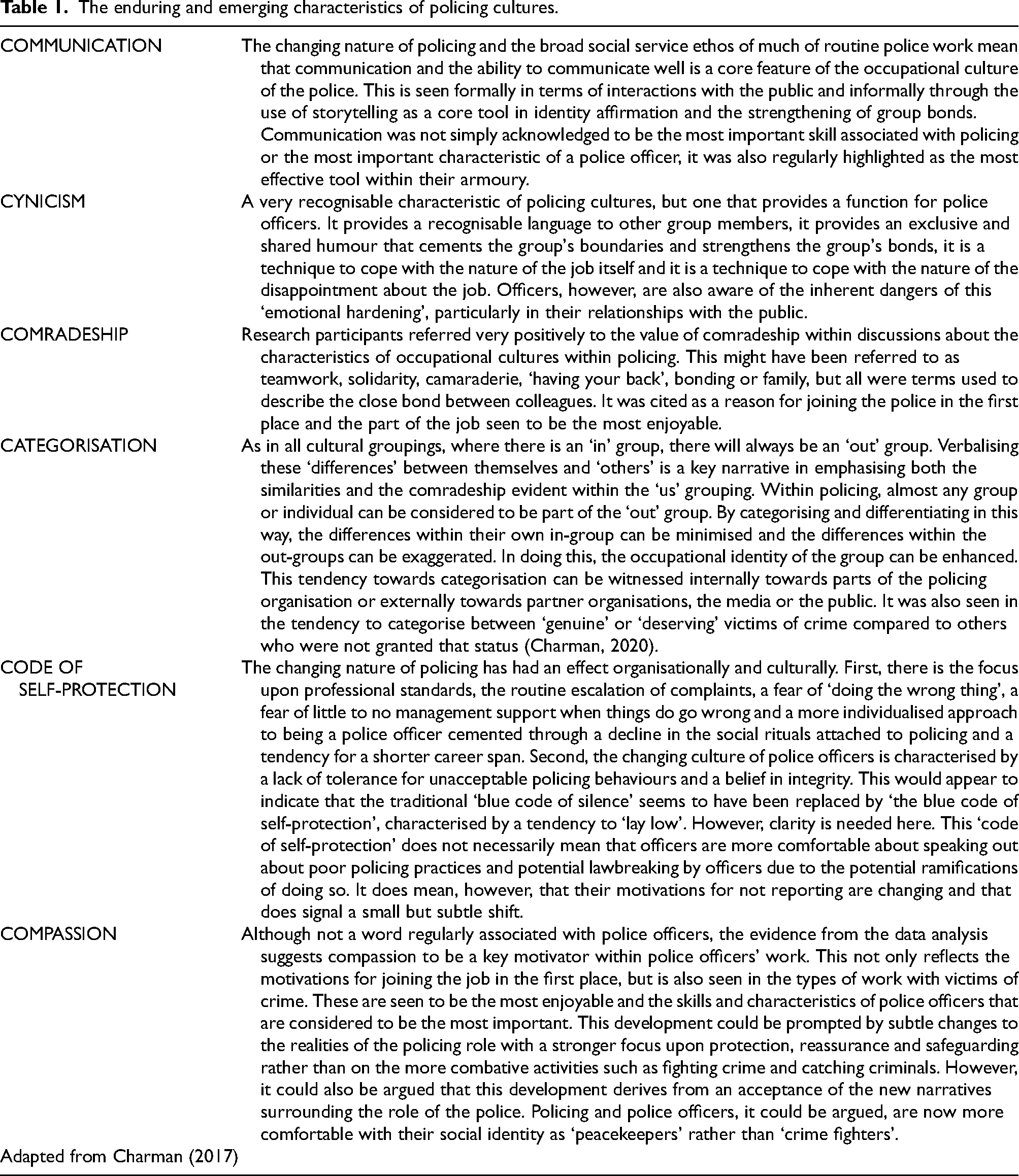
The enduring and emerging characteristics of policing cultures.
In terms of a more inclusive policing culture, the evidence of stagnation is compelling. In 1999, just a year after the launch of the International Journal of Police Science & Management, the inquiry into matters arising from the murder of Stephen Lawrence in 1993 published its findings (Macpherson, 1999). The report concluded that there were fundamental errors made by the Metropolitan Police Service (MPS) in their investigation of Stephen's death and that poor leadership, professional incompetence and institutional racism contributed to this failed investigation. The impact of the Macpherson Report was significant, with a litany of recommendations and subsequent actions and a plethora of academic and journalistic writing about the groundbreaking nature of the report and its publication being a watershed moment in British policing. A watershed moment it may have been, but it certainly was not the first time that concerns about the culture of policing had been voiced. The Scarman Report into the Brixton disorders of 1981 raised issues of a problematic policing culture, although as he acknowledged, perhaps not strongly enough (Hall, 1999). Eleven years later, in 1992, Sir John Woodcock (then Chief Inspector of Her Majesty's Inspectorate of Constabulary) when referring to police malpractice said ‘the problem is not one of individual predisposition to wrongdoing but of … cultural failure.’ (Woodcock, 1992; cited in Macpherson, 1999: s6.61). Many of the specific recommendations for change contained within these reports, however, did not outline how cultural reform could be achieved but instead called for structural and policy change. Although this is nonetheless important, it fails to grasp the distinct nature of culture as being something that organisations are rather than have, and is not an entity easily measured and managed (Day, 2020).
So, did the watershed moment of the publication of the Macpherson Report in 1999 result in lasting change and cultural reform within the police service? The Home Affairs Select Committee (HASC) undertook an inquiry to review the progress towards Macpherson's 70 recommendations (2021). Although there was progress in some areas of policing racist crimes, the aims of race equality contained within the report had not been met and its commitments not delivered (HASC, 2021). This HASC report marked the beginning of a turbulent time within British policing. Policing became beset by controversy, including widespread concerns over police misconduct and gross misconduct, convictions for serving officers for rape and murder, dangerous levels of vetting failures within police recruitment and continued concerns about misogyny, racism and sexism within policing [His Majesty’s Inspectorate of Constabulary and Fire & Rescue Servies (HMICFRS), 2022; Independent Office for Police Conduct (IOPC), 2022; Police Foundation, 2022]. These concerns culminated in the publication of Baroness Casey's excoriating report into the standards of behaviour and internal culture of the MPS (Casey, 2023) followed swiftly by Lady Angiolini's inquiry into the ability of a serving police officer to abduct, rape and murder Sarah Everard in 2021 (Angiolini, 2024). Rather than a stagnation in terms of drive towards a more inclusive policing culture since the publication of the Macpherson Report, Casey rather suggests a retrograde position with her finding of institutional racism, sexism and misogyny in the MPS. Much of the blame for this was laid at the door of a toxic culture of bullying, denial, prejudice and not speaking up, arguing that the MPS ‘has been losing its way and the worst aspects of its culture have impeded its ability to recognise this’ (Casey, 2023: 18). There is a widespread recognition, not least by some police leaders themselves, that these issues and concerns are significant for the entire policing organisation and not exclusive to the MPS (HASC, 2021; Police Scotland, 2023). There is also the recognition and agreement on the importance of a focus upon cultural reform with Casey arguing that, ‘problems with culture and attitudes cannot be addressed by developing a new policy, changing the rules or developing a new process’ (Casey, 2023: 14) and Angiolini suggesting that ‘policing … needs to do more than make further changes to policies, guidance and training’ (Angiolini, 2024: 2).
It could be suggested, therefore, that the police service rather took its eye off the ball with regard to cultural reform and was distracted by the fundamental structural changes taking place during the first two decades of the twenty-first century. It is not possible to discuss all of these structural changes here but a brief precis highlights the potential causes of this diversion. Budgetary cuts of 22% in real terms between 2010 and 2016 amounted to a £2.2 billion budget reduction (National Audit Office, 2015), a 12% reduction in police officers and a 20% reduction in police staff (Johnston and Politowski, 2016). Publicly elected police and crime commissioners, introduced in 2011, fundamentally altered governance and accountability arrangements. Crime became more complex and less visible in this period with unprecedented rises in violent and sexual offences and a huge migration from traditional acquisitive crime to fraud and cyber-enabled crime (ONS, 2018). A new Police Education and Qualifications Framework (PEQF) was introduced across the entire police service in 2016 with its roll-out to all new recruits in most forces coinciding with both the announcement of 20,000 new police officers to be recruited over a three-year period and a life-changing global pandemic. In addition, the police service was dealing with a surge of demand around non-crime related incidents such as mental health issues and missing people (College of Policing, 2015). The impact on policing has been declining levels of charging rates, declining conviction rates (Home Office, 2022), declining levels of public confidence in the police (Brown, 2021) and increases in the rates of voluntary resignations among police officers (Home Office, 2023).
My suggestion that the police service took its eye off the ball with regard to cultural reform over the past two decades raises the question of what research policing scholars were undertaking to highlight this persistent and recalcitrant culture within policing? Evidence suggests that the relationship between policing and higher education institutions (HEIs) during the early part of the twenty-first century were characterised by a thawing of previous distrust and a focus on partnerships in terms of both research endeavours and educational provision (Charman, 2017). In many ways, this placed the police service on the front foot in terms of granting access and awarding contracts, seen no more clearly than in the outsourcing of policing education to HEIs with the result of a considerable revenue stream from PEQF contracts. Coupled with a research funding climate that focused much more on evaluative research and solutions to policing problems, Peter Manning's comments in 2010 that there was ‘too much [focus] on the police and too little on the content or culture of policing’ may now appear a very prescient warning (Manning, 2010: 100). Research and policy analysis on performance, targets and management within the policing organisation all dominated during this period and the influence of ethnographic research with its broad cultural focus began to fade (Manning, 2010; Fleming and Charman, 2023). The suggestion, therefore, that the police service may have taken its eye off the ball with regard to cultural reform during the extensive levels of change experienced during the first two decades of the twenty-first century could also be levelled at academia's diminishing focus on cultures within policing during this time.
We had learned an enormous amount about the culture of the police from those early ethnographic accounts of the everyday realities of policing and police work. The tendency to embrace storytelling as a medium of communication is characteristic of both police officers and ethnographers, and this led to rich accounts of the seen and often unseen practices, behaviours, values and beliefs of those at the sharp end of policing (Newburn, 2023), most notably from writers such as Banton (1964), Skolnick (1966), Cain (1973) and Westley (1970). Much of this early work stressed the uniqueness of the job and the resulting impact of that on their working cultures. For example, Van Maanen (1978a) suggested that the police are strongly influenced in their beliefs and attitudes by two distinct occupational perspectives – first, the unique position that the police officer occupies in society and second, the nature of police work and how officers cope with performing that role. The impact of a unique set of working circumstances leads to the display of characteristics such as suspiciousness, isolation and through that, solidarity (Skolnick, 1966) in addition to secrecy and a tendency towards self-protection among police officers (Westley, 1970). These important themes of suspiciousness and isolation, of there being a distinctive ‘us versus them’ mind-set among police officers that sets them apart from the public, was also more widely pursued by scholars at the time (Holdaway, 1983; Van Maanen, 1973; Young, 1991). These notions play to the ideology of the unique status of policing and of police officers.
Discussions about the unique status of policing as an occupation also led writers to discuss the all-encompassing and potentially isolating nature of the policing identity. The military style rank structure, the promotion of discipline and obedience, the uniform and the 24-hour nature of the job all fed into an institutionalised ideology of a unique organisation set apart from the public. The inevitable impact of isolating those outside the organisation was a promotion of the imagery of solidarity and communality among its members and an expectation of remaining a member of that organisation for life (Soeters, 2000). Given the plethora of individual characteristics that are used to describe police officers, it is hardly surprising that Reiner's six (1978) and subsequently eleven (2010) characteristics of policing culture are widely cited. These are a sense of mission, the focus on action (referred to elsewhere as a preoccupation with the ‘crime-fighting image’), cynicism, pessimism, suspicion, isolation, solidarity, conservatism, machismo, racial prejudice and pragmatism. The descriptions of police culture from these early studies strongly featured the themes of solidarity, crime-fighting, masculinity and suspicion.
Much of this early and mostly ethnographic research describing policing cultures remained largely unchanged and mostly unchallenged, largely reflecting the view that these occupational cultures were dominant, static and monolithic. Challenges, however, began to emerge – at about the time of the first publication of the International Journal of Police Science & Management – notably from Chan (1997) and Waddington (1999a). Chan's three main criticisms of the early police culture research were: first, the assumptions of one universal police culture, which did not take account of differences through rank, role and location; second, the assumption of the passivity of police officers who unthinkingly absorb all aspects of police culture without question; and third, the assumption that despite the enormous change to policing and the environment in which police officers function, police culture has remained unchanged. Waddington's (1999a) challenge to the established literature on police culture was that what is said by police officers to researchers and in private and ‘backstage’ areas of police stations were not necessarily reflected in the publicly exhibited behaviours of police officers in the course of their duties. Action on the streets is characterised therefore as being instrumental, with talk in the ‘canteen’ or ‘backstage’ as being more expressive (Waddington, 1999b). According to Waddington (1999a), the prime motivating factor of police officers when undertaking their duties on the street is not the enactment of the more expressive ‘backstage’ talk but is more concerned with ‘staying out of trouble’.
However, this discussion has not been resolved and raises important issues that are crucial to understanding the relevance of the police occupational culture today. It is difficult, as Reiner has suggested, to argue that ‘people's perspectives … bear no relation to their practices’ (2010: 115). Shiner (2010) argues that our sense of self and identity and our self-narratives do have an impact in guiding future behaviour and actions because they are shaped by our social interactions with others. Storytelling as a medium of communication plays a key role in these interactions and in the affirming of identities. Cultural attitudes, which are formed through the telling and re-telling of stories, can ‘structure action’ (Shearing and Ericson, 1991); this is not to suggest a deterministic linear flow from talk to action but certainly a suggestion that culture is a resource that can actively guide action.
The classic ethnographic era of the later years of the twentieth century with its interest in the cultures within the police represented an important milestone in the study of policing with much continued relevance to some of policing's most intractable issues. Although this research focus may have diminished over time as discussed earlier in this article, that is not to say that the past 25 years – as this is the focus of this Special Issue – has been devoid of any academic attention. Although it is not the purpose of this article to catalogue these academic works in any way, it is clear that much of the focus has been on continuity or change (Hendriks and van Hulst, 2016; Loftus, 2009; McCarthy, 2013; Sklansky, 2006, 2007; Westmarland and Conway, 2020), difference or likeness (Campeau, 2015; Dick, 2005; Paoline, 2003; Skolnick, 2011) and indeed work that also challenges any sense of shared occupational cultural characteristics within policing at all (Rowe and Pearson, 2020). One of the prominent works during this period was Loftus’ interview and observational research in one English police force (2008, 2009, 2010). In contrast to Chan's (1997) belief in cultural change, the focus for Loftus was rather on cultural stability. She suggested that subtle changes in policing cultures were disguising much more persistent and steadfast elements of the occupational culture. The elements of cynicism, suspicion, bravado, ‘us versus them’ and a crime-fighting mind-set were all tenacious features of Loftus’ research, which were articulated through narratives of decline (2008, 2009). Researchers, she argued, had been too concerned about searching for difference while at the same time ignoring the resolute nature of cultural themes. Although the locations for the expression of these cultural values may have shifted [for Loftus the ‘white spaces’ (2008), for Atherton (2012) and Hesketh and Williams (2017) the blogs, for Keesman (2023) the online group chats], the research evidence suggests that sharing experiences and storytelling are still prominent features of the occupational culture within policing (van Hulst, 2013).
Sklansky's argument that ‘incomplete revolutions can easily escape notice’ (2006: 1242) inspired my conclusions that although there do remain some steadfast elements of policing cultures, there is also subtle yet discernible change (Charman, 2017). These conclusions are based on a longitudinal piece of research which, using ethnographic interviews, followed two cohorts of new police recruits through the first four years of their policing careers, meeting with them after four weeks in the job, six months, one year and four years. Table 1 highlights what I have considered, after the analysis of that data, to be the emerging but also enduring characteristics of policing cultures.
Rather than subscribing to the notion of ‘cultural inheritance’ within policing, that is the cultural characteristics of one generation of officers passing wholesale onto the next, I suggest instead that Bourdieu's (1986) ideas of the cultural knowledge of an organisation as represented through layers of social history, offers us instead a model of ‘cultural sedimentation’ (Charman, 2017). As new or existing cultural characteristics are added or re-added to the layering or sedimentation of policing practices, so existing cultural characteristics are strengthened, old characteristics appear to become further buried and new characteristics begin to take shape. As Chan (1997) has indicated, there is therefore the possibility of change. There is the potential for the weight of the newer top layers of cultural characteristics to compress and eventually extinguish the bottom layers. This is why it is still apparent that there are a multitude of contradictions in the analyses of policing cultures from both official inquiries and the academic literature.
The description of categorisation above emphasises the ways in which police officers tacitly and perhaps subconsciously organise themselves into groups and the description of comradeship emphasises the positive impact of those group identities. Yet what is perhaps not currently encapsulated within the six emerging and enduring characteristics of policing cultures discussed above is the obligation to self-categorise in this way in order to reap these comradely benefits. I would therefore like to add a seventh dimension of policing cultures which is conformity. Order and discipline are defining features of the police mission and there are clear synergies between the desire for social order within the policing role and a desire for order and conformity within policing occupational cultures. A culture of conformity percolates throughout policing and acts as a tool with which to maintain social order. Any threats to this conformity (in the form of difference, challenge or change) potentially disrupts this carefully crafted equilibrium.
Schein (1968) suggested that the options for the organisational newcomer are rebellion, creative individualism or conformity. Joining the ‘policing family’ brings with it expectations of assimilation and compliance, utilising divestiture socialisation techniques to create a clean slate upon which to build a ‘desirable’ organisational member (van Maanen, 1978b). The ways in which police officers are formally socialised into the organisation only exacerbates the pressures for police officers to conform to existing cultural norms (Workman-Stark, 2022). If rebellion and creative individualism seem unlikely options within that scenario, police officers are left with conformity. This can work to ‘benefit’ both individuals and organisations – individuals because social acceptability and ‘fitting in’ take prominence over identity coherence (Wieland, 2010) and organisations because by subtly exerting indirect control of employees’ identity in this way, organisations can enjoy a certain degree of normative compliance and a framing of police officers’ self-image in such a way that is organisationally advantageous (Charman and Tyson, 2023). This tendency to conformity, however, is not limited to the early parts of a policing career. Findings from subsequent research have indicated the impact of conformity on occupational norms. It is first seen in Australian research indicating that a desire to ‘fit in’ was the leading causal variable in alcohol consumption among police officers (Lindsay and Shelley, 2009). It is seen second in relation to conformity with the culture of extreme hours, a desire to ‘fit in’ and more traditionally ‘male’ career experiences for women who associate these behaviours with the achievement of leadership positions in the police (Alexander and Charman, 2024). And it is seen third in an inability to conform to the identity requirements, which ultimately leads to voluntary resignation (Charman and Tyson, 2023; Tyson and Charman, 2023).
The addition of conformity to the six emerging and enduring characteristics of policing cultures also serves to further enhance our understanding of comradeship in which the benefits are provided by the existing workforce but are not necessarily without recompense. Frewin and Tuffin argue that failure to conform ‘carries a cost’ (1998) including ostracisation, feeling forced to leave and being less well protected by colleagues. Within the realm of comradeship, it is important to understand that the co-operative working bond is based upon a form of reciprocal co-operation. Solidarity, camaraderie and loyalty are the rewards to reap but in exchange for that, these new members learn quickly the importance of ‘fitting in’ with the working culture of the team. If we consider some of the ‘blind eyes’ that have been turned to police misconduct, we can see that there are clear tensions between ‘laying low’ and speaking out – and much of that tension emanates from the very powerful and tangible benefits of sticking with the pack. To ‘fit in’ or not to ‘fit in’ are regularly mentioned phrases from officers interviewed as part of Casey's review of culture within the MPS (2023). ‘Fitting in’ within policing requires officers to acknowledge and prove their cultural congruence, their competence and their ability to be a team player, which (in a similar way to social capital) all contribute towards what Linklater has termed their ‘inclusion capital’ (2022). She goes on to suggest that although compliance with these three elements of inclusion capital is technically possible for all officers, it is clear that, for example, those with competing external commitments or those from non-dominant groups will find that conformity more challenging (2022). Feminist scholars have indeed argued that women in policing are continually negotiating their fit within the organisation and that being on the inside of that cultural boundary of acceptance for women is always precarious (Rabe-Hemp, 2009). Although the rewards of high levels of inclusion capital might be very positive and the evidence from new police recruits point to just that conclusion (Charman, 2017), there is no doubt that to be on the outside of that cultural boundary of acceptance, or to possess low levels of inclusion capital, would be a very different scenario.
Although the issues facing policing 25 years after the publication of the first issue of the International Journal of Police Science & Management have changed significantly in terms of both criminal activity and the breadth of the policing role, there remains consistency but also concern at some of the more recalcitrant characteristics of policing cultures. This is not to suggest organisational inertia or to argue that cultural change has not occurred in some form. It is instead to propose that the ‘fire brigade’ model of responsive policing has also been witnessed internally in terms of extinguishing the immediate fires of organisational and individual incidents associated with culture failure, but without an overriding understanding of the deep roots of occupational cultures within the police, the tangible ‘benefits’ offered to members of those occupational cultures and of a growing divide between police leaders and police officers. Police officers are both policing in an increasingly fractured and divided society and working in an increasingly fractured and divided organisation.
This was something that was mooted by a colleague and I when we published a paper in the first ever issue of the International Journal of Police Science & Management (Charman and Savage, 1998). In the article – on the professionalisation of the then Association of Chief Police Officers (now the National Police Chiefs’ Council) – we referred to Osbourne and Gaebler's (1992) distinction between ‘steering’ and ‘rowing’ in public policy and suggested that there might be a growing separation and increasing tensions between police leaders ‘steering’ policing policy and the police workforce ‘rowing’ through service delivery (Charman and Savage, 1998). As Osbourne and Gaebler noted, ‘steering is very difficult if an organisation's best energies and brains are devoted to rowing’ (1992: 30). As that performance culture within policing spread and the pressures of fundamental structural changes grew, this divide between police leaders and police officers may have been exacerbated. While those leaders attempted to ‘steer’ through policy strategies aimed at cultural reform, the communication to those ‘rowing’ failed to materialise. Additionally, an inability to recognise the impact of seemingly benign policy change on officers’ inclusion capital (eg flexible working on being a ‘team player’ or reporting misconduct on cultural congruence; Linklater, 2022) and the hugely powerful appeal of conformity with policing occupational cultures, in some ways negated the intended policy outcomes of positive change. For effective future policy changes in this area, the stagnation in progress towards a more diverse police service and a more inclusive policing culture needs addressing. Police leaders and managers need to be sensitive to the absolute requirement for fundamental cultural reform despite the inclination towards the status quo given their success within that system and the policing organisation needs to be sensitive to the unintended impacts of policy change on occupational cultures. In this regard the Home Office's Ethical Decision Making Model (2021) set up in the wake of the Windrush Lessons Learned Review could provide a useful template. Celebrating and advocating for non-conformity within a disciplined organisation is fraught with both difficulty and potential but unless those rowing the boat can have some voice in the direction of travel, those steering the boat will continue to move around in circles.
Footnotes
Declaration of conflicting interests
The author declared no potential conflicts of interest with respect to the research, authorship, and/or publication of this article.
Funding
The author received no financial support for the research, authorship, and/or publication of this article.
