




Abstract
In this article, we aim to examine whether intelligence-led policing in police practice reinforces the control model of the police organization. We argue that digitalization of police working life resurrects several of Taylor’s management principles, such as greater division of labor, specialization, standardization and focus on measurable and efficient processes. Drawing on empirical research via two cross-sectional surveys, focus group and individual in-depth interviews with 40 Norwegian police officers, we analyze the extent to which this is conditioned by how work processes are organized and how knowledge practices are operationalized and standardized. We show perceptions of standardization that break up policing processes and lead to greater control over which tasks the front line performs and how these should be carried out. As a result, traditional police discretion becomes more standardized, constrained and de-contextualized. This is reinforced by the implementation of intelligence-led policing to manage knowledge within the police organization, which may eventually lead to a more top-down, bureaucratic and fragmented style of policing. Thus police professionalism becomes understood as being greater standardization and organizational control. An unintended consequence is a shift towards digitalized neo-Taylorism in policing, with implications for de-skilling of the police. The results demonstrate a managerialist view of the police organization, in which top-down steering and use of technology ultimately lead to a narrowing of police discretion and a more invisible high-policing style of police that may increase militarization of the police organization.
Keywords
Introduction
According to organizational theory, standardization is one of the most important means of streamlining organizational behavior (Freidson, 2004; see also Ladegård and Vabo, 2011; Mintzberg, 1979; Wathne, 2020), and digitalization is an important tool for putting this into practice. In 2014, the Norwegian Police introduced its intelligence doctrine, which involved the digitalization of police work and separated knowledge management processes into different functions in the organization, in order to achieve more top-down control of police practice (Police Directorate, 2018). This re-jigged the institutional logic, the set of cultural symbols and practices formed by social and historical processes, which makes sense of daily activities, organizes time and affects experiences (Thornton et al., 2013). Standardization and digitalization do not necessarily lead to employees having less control of work processes, but this can happen, depending on the style of human resource management and institutional logic. Human resource management styles may feature control or high commitment practices (Giauque et al., 2013; Walton, 1985). “High commitment” practices are designed to enhance employees’ performance while promoting mutual influence, respect and responsibility (Giauque et al., 2013). By contrast, the control-oriented approach took shape in the early 20th century, alongside the division of work into small finite tasks for which individuals could be held accountable. To monitor and control effort, management organized its own responsibilities into a hierarchy of specialized roles; there was top-down allocation of authority and status was associated with positions in the hierarchy (Walton, 1985). Control practices include strict rules and fixed working procedures, together with results-based financial rewards (Giauque et al., 2013). In this article, we aim to examine whether applying the intelligence doctrine in police practice reinforces the control model. Drawing on our empirical research, we analyze the extent to which this is conditioned by how work processes are organized and how knowledge practices are operationalized and standardized.
The article has five sections. First, we outline how key scientific management principles relate to current police practice in managing and producing knowledge. Next, we present empirical qualitative and quantitative data on how police leaders describe the rationale driving digitalization and reform, and how the changes are interpreted and implemented lower down in the hierarchy. We first show how shifts in institutional logic and practice lead to a perception of increased standardization. We then demonstrate how the police intelligence doctrine (Police Directorate, 2014) legitimizes a control-oriented approach to management that includes greater centralization and control of knowledge practices, the standardization of equipment and working methods by digitalization, and the ability to break up front-line work processes. Finally, we conclude that these intelligence-led policing (ILP) organizational arrangements contribute to a new institutional logic that might constrain traditional police discretion.
A new management concept in the Norwegian Police
The above-mentioned control-oriented model emerged in the late 1800s, when Fredrick Taylor developed the concept of scientific management, a new form of leadership; this was known as Taylorism (Evans and Holmes, 2013). Inspired by industrialization, it takes an instrumental view of work processes. The core elements of the earlier craft tradition were split up, and the distinction made between work and skills led to a move from independent judgment to standardization. This distinction was based on management's efforts to map, systematize and monitor workers’ knowledge, in order to lay down work procedures. The new division of labor meant a high degree of specialization and standardization of processes. Tasks required less skill and could be done by unqualified workers. In larger companies, there was therefore a shift from high-skilled to low-skilled employees, which led to a need for more coordination and greater control. A central management principle was the strict division of responsibilities between managers and employees: managers planned work procedures and checked that employees followed them.
New public management (NPM) can be seen as a wide-ranging reform of ideas and theories on how organizations should be designed, managed and led. NPM is a blanket term for various ideas and tools that point in different directions regarding accountability; there are also tensions between the ideas and tools that can be used. Although some reform tools are taken from recent institutional economic theory (such as public choice, agent theory and transaction cost analysis), others derive from management theory (Christensen et al., 2012). Tools inspired by economic theory are management and control-oriented and have a certain centralizing tendency that seeks to manage through incentives. Their motto is “make the manager manage". In other words, the leader must be forced to lead through controlling measures. This was taken up by what was termed post-NPM reforms, focusing on how public organizations should increase the accountability for results (Jantz et al., 2015). 1 Reform tools taken from management theory are different, in that market orientation involves the reduction of hierarchical authority and favors decentralization and delegation, with the motto “let the managers manage” (Christensen et al., 2012: 216). In other words, the leader should be allowed to lead more freely, as regards finding good path choices and appropriate measures. Since 2001, the Norwegian approach to NPM reforms has been pragmatic and has mainly consisted of adopting the managerial tools of NPM: “Management by Objectives and Results, increased structural differentiation of the roles and functions of government, structural devolution to agencies and state-owned companies, and increased managerial autonomy” (Bezes et al., 2013: 154). In practice, the NPM reforms have left their mark on public institutions through management- and control-oriented measures that have led to increased hierarchy in control and bureaucracy (Christensen and Lægreid, 2015). Given that the NPM reforms are supposed to result in less bureaucracy, this is paradoxical. In this context, it is important to distinguish between bureaucracy understood as a negative, pointless time thief and as positive, ethical bureaucratic values, whereby personal interests are subordinated to procedural decisions: “… as Weber points it out, it is the honour of bureaucrats not to allow their ‘personal’ commitments to determine the manner this very “impersonality” is the source of many freedoms” (du Gay, 2005: 52). Currently, administrative policy in Norway, as in other countries, is ambiguous: the pace of NPM has slowed but has not been reversed. What we see are post-NPM elements that have been added to previous NPM reforms (Christensen and Lægreid, 2011) 2 . As with police reforms in other European countries, this mixture of features has strengthened the general trend towards the centralization of police organizations (Fyfe et al., 2013).
Although some believe that Taylorism ultimately came to nothing and was not widely adopted, others have asked whether development of the NPM paradigm may not be the modern equivalent of the specialization associated with industrialization (Skorstad, 2011; Thomassen, 2012). For example, it has been argued that electronic equipment such as tablets, smartphones and laptops helps support the NPM emphasis on performance management and accountability, while at the same time technology individualizes management and control (Glover, 2013; Tranvik and Bråten, 2015). Tranvik and Bråten (2015) argue that modern technology can therefore be seen as providing a high-tech version of Frederick Taylor’s scientific management.
The Norwegian Police is a good case through which to explore these shifts in professionalism towards de-skilling, because police education has traditionally been both academic and practice-oriented, with an emphasis on high professional skills. Since 1995, recruits have gained a bachelor's degree before entering the service (Aas, 2014; Hove and Vallès, 2020). Norway is regarded as having a highly educated police force that has a relatively high level of autonomy and aims to avoid unnecessary use of force. Education and training have been geared towards this professional ideal. However, key elements of the new organization, such as centralization, specialization and the emphasis on measurable and efficient processes, have been central to Norwegian police reform initiatives over the last 20 years. According to the Police Directorate (2007), the reason for this is the need for efficiency and for more specialized units to combat transnational organized crime. For example, the aim of the national strategy for intelligence and analysis is “for the police to more effectively prevent and combat crime, insecurity and disorder” (Police Directorate, 2007).
Government initiatives towards centralizing the Norwegian Police to achieve effectiveness, efficiency and increased performance management emerged in late 1990s and are seen in the 2000 police reform (Wathne, 2018, 2020). Over the past 20 years there has therefore been a trend towards larger units, specialization, the merging of units and the centralization of forces, as described by Fyfe et al. (2013, see also Terpstra and Fyfe, 2014), which has increasingly diverged from official rhetoric about a decentralized community police and practice (Larsson, 2010, 2017). Holmberg (2019: 210) describes continuity and changes in Scandinavian police reforms thus: “All three reforms contain elements of new public management such as the use of key performance indicators and management by results".
The drive for top-down and hierarchical control of street-level police became even stronger in the current Norwegian police reform, which was initiated in 2016 following the 2011 terrorist attack that caused 77 deaths, mostly of young political activists (Gundhus, 2017; see also Holmberg, 2019). In August 2012, a government inquiry concluded that the police failed in several ways because they lacked cultural norms for recognizing risks; it was felt that the number of casualties could have been much lower (NOU 2012: 14). The commission found weaknesses in the coordination of resources and the use of tactical and operational plans to manage crisis situations, and blamed police culture and attitudes, rather than structural dimensions such as resources or material preconditions. The political authorities were thus, to a certain extent, exonerated from blame. The police were criticized for lacking control over street-level practices and cultures, and increased governance and control was legitimized (Gundhus, 2017). The failure of police culture was framed as the police not being prepared—the police lacked the culture and attitudes that would enable them to make rational choices in emergencies. Proximity Police Reform was therefore designed to make the police better equipped to carry out its social mandate and improve response times, i.e. how long it takes for the police to arrive after receiving a call.
This report was followed by Police Analysis (NOU 2013: 9) which saw a better organized police service as the solution. As Christensen et al. (2018: 248) put it: The main recommendations in the report were greater focus on core police tasks, better preconditions for steering, improved leadership and development, an organizational structure creating capacity to fulfil core tasks and facilitating increased specialization, and continuous improvement and development.
Emergency police were regarded as more important than community police. The perception that the Norwegian Police needed better crisis management and greater preparedness thus led to a major police reform which was implemented 1 January 2016. NPM reforms that had already taken place meant that management techniques from the private sector had penetrated the police, but even so, the new work organization and functions that this further reform involved, together with the digitalization of work processes, amounted to a paradigm shift. An important element in it was the “police intelligence doctrine", a business model and management concept operationalized through new organization, functions and work roles and dependent on digital solutions (Police Directorate, 2018). Although ILP and police reform have had different historical trajectories, the two are now merged under the Commission of the Police Directorate. A key factor in this development was the conclusion reached by the inquiry commissions following the 2011 terrorist attack that police culture was too autonomous and hard to manage, particularly in the areas of crisis management and emergency responses. “Police culture” was framed as the problem that needed to be dealt with (Cockcroft, 2015; Gundhus, 2017). The police, therefore, should carry out more core control tasks, rather than service and auxiliary tasks, and there should be top-down direction of their practice. It was felt that the police front line had previously had too much scope to decide the means and ends of policing (NOU 2013:9; Prop. 61 LS (2014–2015)).
The police intelligence doctrine replaces not only the National Strategy for Intelligence and Analysis (Police Directorate, 2007), but also the dominance of community policing strategy from the 1970s and problem-oriented policing from 2000. The doctrine is the framework for intelligence; future training, professional development and knowledge production will be based on it. Intelligence targets individuals, groups and phenomena that create or could create crime, or unwanted or extraordinary events. The doctrine aims to establish a common understanding of intelligence, to define key concepts and to describe a procedure for decision-making (Police Directorate, 2014), changing the service's established notion of intelligence, and potentially the practices that can be related to institutional logic (Thornton et al., 2013). Because the police intelligence doctrine applies to all police employees, the institutional logic associated with it may affect the overall organizational identity of the police, which might determine their behavioral norms (Alvesson, 2011). Because the doctrine is based on ideas that redefine the established understanding of the police role, and introduce a new division of responsibility and work, it should be seen as a new management concept rather than as a new strategy.
In this article, we explore to what degree the new organizational structure and strategies match the central control management principles of Taylorism—centralization, standardized working methods and equipment, and stricter management of the “hands” through the division of work processes, specialization and focus on measurable and efficient processes. To date, there has been little empirical work on the influence of these processes on the police, and how they affect the use of force, legitimacy and further disappearance of the visible police into a police service (Bieler, 2016) that is more military and also more abstract (Terpstra et al., 2019). We do not fill this knowledge gap but provide an analysis of changes in practice and outline some paradoxical consequences of approaches that derive from new knowledge practices.
Methods
The extensive empirical data sources include discourse analysis of police documents, two cross-sectional surveys and interviews with 40 police employees.
The discourse analysis of police documents consists of a review of relevant laws and regulations, public documents such as reports to the Storting (Norwegian parliament), public reports (NOUs), evaluations, police guidelines and circulars, allocation letters, operational analyses, introductions, strategy documents and surveys. The document studies were carried out to gain important knowledge about various elements of the role and work of the police; the important question of the language used in these documents is also considered. Paying attention to forms of linguistic expression can be regarded as a key to a better understanding of social practice (Dunn and Neumann, 2016).
The first survey, conducted in 2013, was presented as an attempt to measure the effects of police reforms inspired by NPM and to assess how participants were experiencing the Management by Objective system. The second survey, in 2018, was presented as an attempt to measure perceptions of the most recent Norwegian police reform. Prior to the second survey, six exploratory focus group interviews were conducted, along with interviews with 16 key informants, to identify perspectives, experiences and unwritten practices that needed to be borne in mind when constructing the surveys. All these interviews were conducted with police officers working in the Oslo Police District and Police Directorate. The focus groups included patrol officers and investigators, while the key informants were officers higher up in the police hierarchy. The interviews were designed to ask open questions and follow up on the informants’ stories and accounts. This approach could be described as highly dynamic. Although cross-sectional, the quantitative data were collected three years prior to the police reform and two and a half years after it, thus making it possible to identify changes that may have been caused by the reform. The qualitative data collected during the reform period includes several descriptions by employees of how the reform has affected them and their tasks. These parts of the study were conducted after approval was obtained from the Norwegian Centre for Research Data (NSD), which is responsible for enforcing ethical guidelines, and after the police chief of the Oslo Police District and Police Directorate had given the go-ahead.
There are 12 individual in-depth interviews with key informants, two in-depth interviews with pairs of key informants (2 × 2) and six focus group interviews with 24 officers (12 from front-line patrols and 12 working in front-line investigation). Informed consent was gained, all informants receiving oral information prior to the interview and being given the opportunity to ask questions or withdraw from the study. With one exception, all informants agreed to a sound-recording being made of the interview. All interviews were conducted by the first or the third author and transcribed verbatim by the second author. The interviews were transcribed simultaneously and, except for one, were all checked against the audio-recording. All the interviews were conducted in 2017 or 2018. In the quotations, respondents from the key informant interviews are referred to as K and those from the focus groups as FG. The interviews were semi-directive, so that informants could talk spontaneously and cover as many points as possible, rather than the conversation being determined by the order of the interview questions. The interviews were summarized, initially coded and analyzed using a simple version of a thematic analysis inspired by Braun and Clarke (2006). The interviews were also examined using narrative analysis. This is a good combination to use when looking at accounts of knowledge production, because thematic analysis considers what the interviewees are talking about, whereas narrative analysis considers why and how (Sandberg, 2016). Because changes in discourse often go hand in hand with changes in organizational identity, this research design constitutes a promising starting point for capturing changes in institutional logic. Using the two types of analysis we look at how changes in policing tasks unfold and interpret forms or constellations of socially meaningful beliefs and values that can be related to cultural performances (Thornton et al., 2013: 128).
The first survey was conducted in October 2013 and the results of the second are compared with it. The survey was sent to 8,431 police employees and there was a response rate of 27% (2,248). The second survey, which is the one mainly used in this article, was sent to 9,861 police employees, with a response rate of 32% (3,131). The survey was conducted between June and October 2018. It included some open questions, where respondents were invited to type in their answers, and some questions where respondents could elaborate on their answers. Replies to the open questions elicited 272,657 words—867.5 pages of text 3 . A selection of these appear in the Results section. Seventeen of the questions/statements are identical or very similar in the two surveys. All differences between the two surveys presented in this article are statistically significant at the level of 0.01.
We did not find any indication that the number of non-respondents led to systematic bias in either survey. As regards gender, rank, age, percentage of leaders and geographical spread, the respondents are representative of the whole police population (Wathne et al., 2019). Studies on response rates have found that “response representativeness is more important than response rate in survey research” (Cook et al., 2000: 821), but the results should be interpreted with caution, because non-responders may differ from responders in other ways.
An important weakness of the empirical data is that it is retrospective and lacks ethnographic observations of practice. However, the aim with the qualitative data was to gain an understanding of the recent changes in the police by asking questions about specific cases and initiatives that led up to the 2015 reform and how this reform has been managed or implemented. Although this article focuses on the impact of the intelligence doctrine at different levels, the various data sets offer a broader picture of police governance and practice in this period.
An advantage of using a mixed methods design is that we can draw on the strengths and minimize the weaknesses of the various methods (Johnson and Onwuegbuzie, 2004). Combining methods allows us to make a thorough analysis and provide new information at different levels of a sociological description of the research topic (Creswell and Plano Clark, 2011; Erzberger and Kelle, 2003; Johnson and Onwuegbuzie, 2004). The fact that our findings converge indicates consistency in the data, and a high degree of reliability. Because our data are extensive, we believe it supports generalizations about changes in policing, and indicate key elements of the influence of digitalization on the production of knowledge within the police.
Digital Taylorism in police practice
Over many years, the scientification of police work has aimed for improvements, via technological tools and standardization (Ericson and Haggerty, 1997; Kaufmann et al., 2019; Manning, 1992). Studies of how successfully these have been implemented clearly show that acceptance is variable, due to police cultures, habitus and the autonomy of front-line officers (Chan, 2001; Manning, 2008; Gundhus, 2013). In what follows, we highlight two important aspects of how the introduction of more powerful digital tools has affected the organizational structure and culture of the police. First, we present results indicating greater standardization and specialization of police tasks and functions, that impact power relations within the organization. We will then explore how adopting the intelligence-led policing model further reinforces these processes, by increasing the decontextualization and fragmentation of police knowledge bases, in the interests of making the future more actionable.
Standardization: constraints on competence
Police work has traditionally involved a considerable element of discretion, and the professionalization of the Norwegian Police in the 1980s was designed to increase professional autonomy, as is recognized in scholarly literature (Sklansky, 2014; Gundhus, 2017). The police needed practical skills to apply social science and psychology in decision-making, in addition to the traditional education in physics and law. Deciding which law to select and how to use it is itself a matter of judgment (Ericson, 2007). There is a difference between “law in books” and “law in practice". However, the police have always had considerable room for maneuver when choosing which cases to take up and deciding how to deal with them. Because of the desire to deliver a more equitable service, the police reform includes new norms, standards and routines to guide policing. The police intelligence doctrine supports such changes, describing new functions in the police organization and new work processes for knowledge production (Police Directorate, 2014). The principles of the police intelligence doctrine favor centralization and control (Police Directorate, 2014: 19). In practice, this is seen by interviewees as meaning that patrols cover larger areas and are deployed by the operational command center in accordance with a fleet management principle. Police work is thus governed from further away and is more dependent on digital information than on contact with citizens or information from other, more immediate, sources. This turns police work into an abstract task, as shown by Terpstra et al. (2019).
Among other changes, new information technology gives all patrols access to the same information, and thus helps promote standardization and a more equal police service. This makes police employees more equal and more interchangeable. When police officers can be deployed where needed, human resources (i.e. officers) can be managed and targeted more effectively. Similarly, “Police Work on the Site” [PPS], the app “My Mission” [Mitt oppdrag] and various guidelines and descriptions of how missions should be carried out—so-called action cards—are designed to ensure a uniform service, to streamline police practice and to make interaction between officers and technological tools more seamless. Standardization and specialization have affected not only patrolling, but also crime investigation and crime prevention in the community. Standardization is supposed to help provide a better and more equal police service for citizens. However, standardization can be experienced by police officers both positively and negatively: it can help managers and employees to perform tasks efficiently and well, but it can also impede performance because certain tasks may need to be handled with flexibility and discretion. In both surveys we therefore offered the statement that one could not perform tasks as one would have wished, because other standards for doing them had been established (Figure 1).
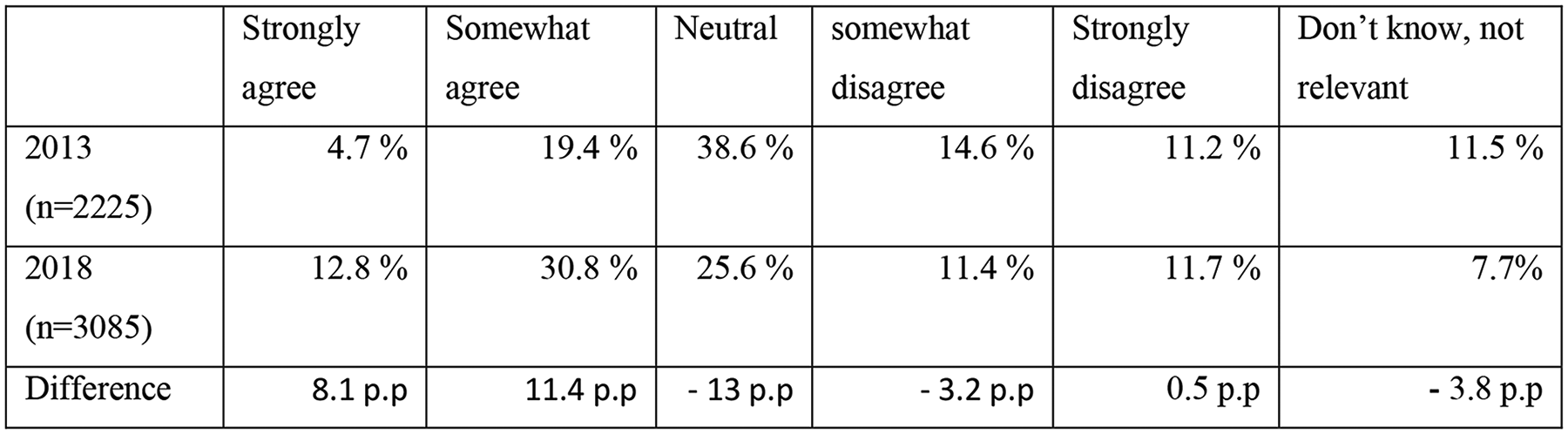
I cannot perform tasks in the way I wish, because other standards for doing them have been established. Results from the 2013 and 2018 surveys.
In 2018, we found that 44% of interviewees strongly or somewhat agreed with this proposition, whereas 23% completely or somewhat disagreed. In 2013, by contrast, 24% strongly or somewhat agreed that they could not perform tasks as they would have wished because other standards for doing them had been established. This is an increase of 20 percentage points since 2013.
In the 2018 survey, we had a field in which respondents could elaborate in their own words on why one might not be able to perform tasks as one would wish because of new standards. Some comments were about the mandatory use during police patrols of guidelines such as “Police Work on the Site” (PPS) and of audio interrogation, which meant they had less discretionary power; the new procedures and standards took too long and had “little effect". Similar findings emerged from Nesteng’s (2019) observation of and interviews with street patrols. The demands made on patrols have increased tremendously: they are tasked with obtaining data about potential street gang violence and open drug scenes, guarding the king, and policing demonstrations—all of which are spoken of as very complex challenges. Another proposition was that one cannot perform tasks as one would wish because other professional groups in the police have introduced their own guidelines. In 2018, 12% strongly agreed with this statement, while 27% agreed somewhat—39% in total (Figure 2).
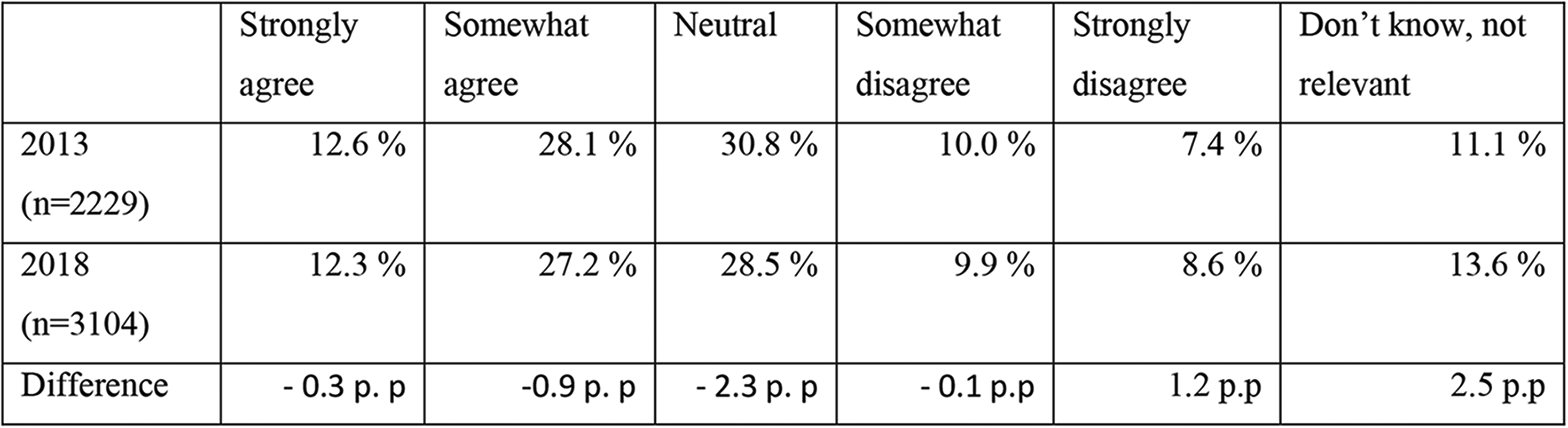
I cannot perform tasks in the way I wish, because other professional groups in the police have brought in their own special guidelines. Results from the 2013 and 2018 surveys.
Figure 2 shows little difference between the results of the two surveys, indicating that this is a long-standing process. However, in 2018 we had a field in which respondents could elaborate on their answers. Several comments related to how police work had become more incident-led, and how patrols had to do tasks for central joint functions, such as the operational command center or functional units. Target setting and being prepared for worst-case scenarios while patrolling were seen as particularly challenging. Several of the interviewees emphasized the lack of a holistic approach to police patrols. Specialists have contradictory expectations, and officers on patrol have to conduct tasks for various different agencies within the police.
In the open questions, several officers commented that, when resources and decisions are more centrally managed, there is less time to pursue self-initiated cases. The ability to perform tasks the way you want to can also be influenced by the resource situation, which affects officers’ coping mechanisms for overcoming or managing stress and other challenges that occur in everyday police work. Various studies have shown that, if they lack resources, employees may experience powerlessness, even if they do not lack skills. We therefore offered the statement: “I have enough resources (e.g. time, assistance, equipment, etc.) to do my work in a professional way". This statement also appeared in the 2013 survey. In 2018, 45% strongly disagreed and 30% somewhat disagreed (75% in total). In 2013, 30% strongly disagreed and 32% somewhat disagreed (a total of 63%). The percentage strongly disagreeing increased by 15 percentage points. In other words, after five years, officers were experiencing reduced access to resources. If three of four officers in 2018, to a varying degree, felt that they had insufficient resources to do their job properly, this suggests that many feel powerless in their work life.
The perception of being in control (or otherwise) can be located in the stomach as a positive or negative feeling. Thus a “gut feeling” can be a marker of the quality of the work one has done (Amble, 2010). We therefore offered the statement that one often had a bad feeling on the way home from work, because one was not given the time or resources to do as good a job as one would have wished. Thirty percent fully agreed with the statement, whereas 36% somewhat agreed (66% in total). The figures reflect the fact that officers are aware that they are often the first, last or only people many members of the public can turn to (Bittner, 1990; Finstad, 2000; Wathne, 2018).
In the 2018 survey, almost half the respondents completely or somewhat disagreed that one could greatly influence what tasks should be performed, which indicates a perception of the kind of control advocated by Taylor. This must be set alongside the fact that six out of ten completely or somewhat agreed that tasks had become more standardized over the last five years. In 2013 just over five in ten took this view. The 2018 survey response on standardization means that more people feel they are prevented from performing tasks in the way they wish, with up to half feeling this to some degree. This is an increase of 19 percentage points since 2013. Three of four believed that insufficient resources to some extent influenced their ability to perform tasks in the way they wished, and in 2018 more people believed insufficient resources affected their work than was the case in 2013. Accordingly, almost seven out of ten completely or somewhat agreed with the proposition that one often has a bad feeling on the way home from work, because one has not had time (or the resources) to do as good a job as one would have wished. We thus see that officers feel that tighter resources and stricter management mean they have less influence on what tasks they perform and how they carry them out. This adversely affects their sense that they are in control of their daily work.
The reforms aim to make police work more proactive, by means of more targeted preventive methods and by producing intelligence reports, so as to be prepared for the unexpected, as analyzed further below. However, in the survey and focus group interviews, officers say they see themselves more as a response force, waiting for assignments from above. Patrols feel they have less time for traditional community policing and prevention, and that they are interchangeable and replaceable like “cogs in the system". In interviews with key informants, police managers support the statement that police officers should be more interchangeable, as part of the standardization of work processes: We want the police to be “the last free profession” to a lesser extent. […] We now make all police cars the same. We take charge of the equipment, and how the cars are set up. So that they support the tasks of the patrol. (K, Police Directorate, 24 November 2017).
Our findings also provide evidence that the police have fewer encounters with the public. A policing style that is more response-oriented than community police-oriented seems to have consequences for the interface between the police and the public. The same goes for encounters between the police and those collaborating with them. Centralization and the closure of rural police stations result in less contact with the public. Centralization means the police patrol larger areas and therefore do not have the local embeddedness and anchorage that is produced by frequent contact with the public. It means that an officer is less likely to meet someone he or she knows. Police work therefore becomes less person-oriented and relational and more systemic and abstract, and ever more dependent on technology to communicate with citizens. This is in line with the above-mentioned analysis of the increasingly abstract character of policing in the Netherlands and Scotland, which describes the police as being more dependent on formalized and rigid systems and system information: The abstract police are also less dependent on personal knowledge of officer(s), as this is increasingly being replaced by “system knowledge", framed within the “logic” and categorisations of computer data systems (Terpstra et al., 2019: 340).
This shift in the way in which knowledge is generated affects how new knowledge practices are talked about and used knowledge within the police, as outlined below.
Intelligent managerialism
The aim of intelligence-led policing is to transfer discretionary decisions from individual police officers to management (Gundhus et al., 2019). As mentioned, an important driver of the police reform was the desire for improved crisis management and emergency policing, following criticism of the police after the 2011 terrorist attack. Concentrating resources on core police tasks such as crime fighting was a huge step in that direction. The objective was to integrate individual officers more fully into the police organization, rather than allowing them to be individual sheriffs handling their chosen cases. In the policy documents, officers’ freedom to decide what to do was framed as a challenge to overcome, and an obstacle to efficiency and effectiveness (Gundhus, 2017). 4 Their role is thus becoming more specialized, which leads to a less holistic approach: they must, for instance, deliver data, information or intelligence to managers, to support their decision-making processes at operational, tactical and strategical levels (Fyfe, 2018, Paulsen and Simensen, 2019; Ratcliffe, 2016).
“Intelligence-based police work” is therefore presented as a business model featuring new functions and roles and a new organization of knowledge work. Intelligence is to be produced to improve managers’ decision-making and the individual's discretionary power is constrained. This managerial and systemic approach to police work will redefine police front-line tasks: for instance, they will obtain data for investigators, await assignments from the operational command center, or—supported by computers—collect data for specialist units (Paulsen and Simensen, 2019). As a key informant says, those employed to create knowledge products for managers may not have had police training: an analyst may be a statistician or a mathematician rather than a police officer. However, there are issues involved in the move towards the police acting as knowledge brokers, either internally or for external collaborators. Unintended consequences of centralization of administration are that even more bureaucracy and guidelines are developed to solve these problems, which impede decision-making processes and individual job decision latitude. As a consequence, the overall information load increases, as one police officer says: There is so much information now. We talked about it this morning. We have our own mailbox where the public send pictures which go into everyone's mailbox, but no one follows them up. Also, all the tip-offs in Indicia [the police intelligence register]. And entries in the Police Operative data register. And operations we have initiated—the open drug scene, and then we get an order on that. There is too much information. You can have as much data as you like, but you must hand it over to living people. (FG, Patrol Downtown, 14 November 2017)
The intelligence process is expected to include all police employees, those working on investigation, intelligence and prevention, those in functional or geographical units, and those in front-line or management positions. Just as Taylorism split up the unity of work and skill of the craft tradition, the police intelligence doctrine divides the intelligence process into four sub-phases. Phase one is management and prioritization, focusing on the decision-makers’ (i.e. management's) need for information, followed by phase two—“acquisition”, carried out in various ways. In phase three, information is obtained from dissemination analysis and assessment—to make intelligence products, information is processed, analyzed and assessed. Finally, in phase four, intelligence products resulting from analysts’ work to link all available information on a requested subject and create a report on it for managers enable them to use it for prioritization, planning or further information gathering (Paulsen and Simensen, 2019).
The fragmentation of the work process, standardization and strong governance advocated by Taylor led to tasks being almost stripped of any need for skill, autonomy or discretion and, as a management concept, the intelligence doctrine has some of the same consequences. So even though reduction in individual autonomy and the ability to control work are intended, one unintended consequence is a reduction in work motivation among front-line officers. When front-line officers talk about gathering data for reasons that are unknown to them—data that are then fed into decision-making elsewhere in the organization, the image of a factory assembly line springs to mind. The computer systems in which officers must record information can be likened to how scientific management mapped and systematized workers’ knowledge to create systems and procedures for doing the work (Glover, 2013). Intelligence is seen as support for managers, who make decisions, and thus the level at which discretion is exercised moves upwards in the organization. This also changes power relations, as is described in this quote: "The old good investigator and the intelligence handler are on their way out, though we always want their flair. It will tilt power relations internally in the police organization. In future, the person with power is the person who can order information. Whoever makes good and clever orders will have access to good information”. (K, Police Directorate, 24 November 2017)
In practice, the power structure created by the new management concept and digitalization reduces the informed judgment of the front line. Digitalization decontextualizes judgment by standardizing the type of information to be collected, and by initiating centralized analysis that can give it a new meaning through recontextualization. This can happen because digitalization is strengthened by the centralization of police units and the way the in which operational command center increasingly steers patrols over large geographical areas. In focus group interviews, police officers talk about being “fleet-controlled” by the operational command center. This is a reform measure that enables the operational command center to direct patrols to priority incidents, and makes it harder to build relationships with local people. The patrol has access to a lot of information through the computer systems, but this information provides a completely different basis for action from that given by personal relationships: Proximity to the public is now part of the intelligence approach. We depend on getting integrated into the intelligence function. […] The original local police reform stressed that the police should have contact with people before anything happened. We need to be in contact with the public before anything happens out there, and this is now carried out by the intelligence functions. (K, Oslo Police District, 8 February 2018)
The ILP also feeds the police decontextualized information—as mentioned, police patrols collect data for specialist units (Paulsen and Simensen, 2019). Policing by consent is downgraded because of the focus on preparedness for emergencies, fragmentation, the splitting up of responsibility for tasks (the McDonaldization of police work), standardization and top-down governance supported by internal surveillance and the abstractness of the NPM ideology. Reform stakeholders are mainly consultants who deliver solutions to police reform managers and argue in favor of structuring and managing organizations by centralizing administrative tasks in big units, which leads to vertical fragmentation.
It seems like introduction of a more hierarchical top-down structure and implementation of the police intelligence doctrine views success in strengthening the control of front-line officers and aims to limit their professional discretion. Therefore, it steers the Norwegian Police in a more militarized direction (Gundhus et al., 2019). Intelligent policing is introducing less visible, more-remote control, leading to further integration of the intelligence cycle into organizational processes. As this police officer puts it: Sharing information is a new police role. We share info and solve things. Although the police are not visible, they may have info. They can meet someone else who carries out police activities [policing]. So even though the police are not visible somewhere they may still have a role. (FG, Downtown, 14 November 2017)
As Ericson and Haggerty (1999) argue, the introduction of intelligence as a basis for decision-making can be seen as a militarization of the police. The intelligence doctrine employs military language and logic; it is concerned with countermeasures and timeliness. The aim is to incapacitate opponents and disrupt criminal activities; it is less about dialogue, and more about being ready for terror, setting firm priorities, controlling and intervening less visibly in the environment. Standardization sets out to make “cogs” in the organization more mobile and less autonomous. The perfect intelligence worker has been trained in the military, not in the police university college, one police officer told us in an interview (K 15.12). The problem is that the new organizational structure means less flexibility, and more hierarchical and centralized management. To a certain extent, knowledge-based intelligence also means the collection of data is more management-driven, with the person closest to the intelligence manager having great influence on what is to be prioritized. This more deductive way of collecting information leads to less knowledge getting into the system from below. Knowledge-based intelligence thus also helps change organizational power structures.
Some police officers in the Oslo Police District express concern about the secrecy surrounding the origin of information, which makes it difficult to explain to citizens why they are being stopped and checked. They feel like retrievers of “bits and pieces” of data—the knowledge becomes an abstraction: It is different to be out on patrol now compared with two years ago. iPad in the car and constantly trying to sift and retrieve relevant info. It is interesting how we humans simplify. And interestingly, how this affects dialogue with citizens - there is a change in what it's like to be a police officer. (K, Oslo Police District, 13 October 2017)
Fears are also voiced about patrols being turned into confirmation machines, just collecting data ordered by the specialist units, and not being able to observe the environment more inductively: You have to collect as much data as possible. In a way, it becomes part of a generalist's task to report into the intelligence registers. (K, Oslo Police District, 13 October 2017) I find that the iPad's a bit frustrating. A lot of people at work log on and have their nose in it all day. They look at it all day and find work boring. They don't understand the police role. It is useful to raise your eyes and talk to people. And there is now less time for that. (FG, Patrol East, 23 November 2017)
As Brodeur (2017) pointed out, new police methods remove the need for proximity and face-to-face interaction. This applies even to prevention. The police become less visible and focus their attention on “things the public do not know, but which affect them”, as described in the interviews. Formerly separate police areas, such as intelligence and prevention, are merged when intelligence forms the basis for decisions. The intelligence products resulting from this are perceived as being manufactured for top management, as described in a focus group interview with patrols. This in contrast to being applied and used by the patrols themselves—the front-line units—who see the intelligence reports they receive from specialist units as abstract and lacking the timeliness they need. They do not see the value of decontextualized knowledge or data put into pre-formulated templates and forms.
Towards control-oriented human resource practices
How work is now organized clearly indicates a move towards control-oriented human resource practices. Managers and specialists are responsible for management and control, and because the front-line officers carry out tasks assigned them by the specialized units, they have less need for expertise and competence. Organizational management is increasingly shaped by digitalization and intelligence doctrine guidelines, and specialist work processes are broken up to enable more hierarchical steering mechanisms. The scope for discretion and decision-making moves from the front line to the higher reaches of the organization. The result is that six out of ten say that the reforms are making them less proud of being police officers.
To sum up, there are clear indications that specialization is having unintended consequences for police officers’ perceptions of the police role. New hierarchical structures (involving centralization, specialization and standardization) have unintended outcomes for the perception that high-quality policing is being delivered, and there are indications that specialization leads to reduced internal and external collaboration, not increased. Eight out of ten respondents totally or somewhat agree that the police should use their limited resources to work with other actors to prevent crime. However, six out of ten disagree that specialization makes this easier. Very few, less than one out of ten, agree that the proximity police reform makes it easier to collaborate with external bodies.
Discussion
Drawing on the national survey and the case study of Oslo Police Districts, we have shown how specialization and standardization limit discretion on the front line, and that digitalization is a key element in this. In several ways, increased specialization resembles neo-Taylorism. Greater division of labor cuts up police work processes. Police tasks are ever more standardized and the power of the command center is increased. There is a focus on measurable tasks and target setting, and the intelligence process is managed as a separate function and system within the organization. The police intelligence doctrine aims to equip management with a better knowledge base that will enable them to improve governance of front-line police, limit the discretion of individual police officers, and process information more systematically and objectively. It thus makes the management style of the Norwegian police more control-oriented. As we have seen, this steers the police in a more militarized direction: there is more secrecy, more intelligence-gathering and a high policing approach. This is a major break with the long tradition of policing by consent in Norway, based on there being a civil and decentralized police organization and on the 10 fundamental principles of the proximity police (Gundhus et al., 2018).
Analyzing the national survey, it is clear that the police officers express that the reform has led to further standardization and control. This is constraining their competence and professional skills as police officers. Increased control from above through standardization has the consequence of officers’ perceptions of powerlessness, of being deskilled, and having less latitude in their work decisions. When work processes are controlled by a combination of self-governance and standardization, practice is necessarily governed from a distance. In such a situation, work involves considerable autonomy and various opportunities (leading to new standards), but there is also less job decision latitude, leading to perceptions of a lack of control. Hvid (2009) argues that this standardization might contribute to the remote control of how work is conducted and of ideas about what should be learned from it. Responsibility is individualized, but individuals have less control over deciding what should be expected. In other sectors performance management and increased control of discretion have also been seen as a de-professionalization of occupations such as teaching and nursing (Evetts, 2008; Öberg and Bringselius, 2015).
There are several reasons why the intention of police reform is that police decision-making processes and prioritization should become more systematic and knowledge-based. One is the expectation to become more cost-effective and to use resources more efficiently by using performance indicators quantifying crime reduction, in line with the NPM. This is also the objective of the criminal intelligence doctrine, which seeks to increase the number of measurable activities. This has important implications for the role of the police front line and their interaction with the public (Paulsen and Simensen, 2019)—high-policing and undercover working affect both the distribution of information in the police organization and communication with the public. As we have seen, ILP organization of knowledge separates those collecting data from those analyzing it, with the aim of making the process more neutral and objective. Those collecting the data, however, are left wondering what use is made of their contribution to ILP, because only a minority of the intelligence products are communicated back to them. However, our data also indicate that some police officers appreciate more available information when they need it.
Knowledge-based police work is rooted in two contrasting trends in police innovation. One trend is to equip the police to become “real professionals”, whereas the other is to understand knowledge-based police work as part of the NPM approach, which emphasizes management's control over police practice, rather than collegial responsibility and individual experience-based knowledge and ethics (Gundhus, 2013). The latter is reinforced by a focus on efficiency and policing by numbers, the intelligence doctrine's centralized knowledge base, and specialization—with the focus on officers’ control role rather than that of service and assistance.
The intelligence doctrine's fragmentation of the work process, the widespread use of digital solutions and the operation center's control of patrols mean there is stricter control of police practice, less frictions at the system-level and less room for police officers professional discretion and maneuver. Another purpose of the standardization of task handling is to “make it easier to measure results and make comparisons” (NOU 2013:19: 44).
In contrast to the emphasis in the police analysis on standardization, we argue that standardization and management of the profession are based on a false positivist idea, which sees objective knowledge as the basis for rational decisions, and assumes problems relating to discretion are solvable by the use of refined scientific methods (see also 2018). Both the survey and findings from the case study are clearly expressing statements of resistance to the standardization process from the ground level. The police officers criticize the information system’s inability to measure what matters (Skogan, 2008: 29). Moreover, there will always be possibilities for resistance, as Rowe (2020: 100) puts it: Despite concerns about the impact of management systems on the professional exercise of police discretion, the capacity of officers and staff to resist or circumvent the micro-government of their behaviour should not be underestimated.
In this case, the increased digitalization and the organizational structure make it more difficult for police officers to resist in practice, as indicated by the case study of Oslo Police District. However, the answers in the surveys’ open questions indicate that constraint is a problem also in rural and more remote areas in Norway as well as in the metropolitan area of Oslo. More case studies in these areas are needed to provide a more fine-grained analysis of the micro-government of the standardization and intelligence doctrine in these remote, rural contexts. It will be interesting to see whether it is possible to adopt the same frictionless in rural areas, or might “distance from the centre” create some space for autonomy and resistance at the different levels in the police organization (Skogan, 2008).
We also argue that there has been a shift towards a new police role based on an institutional logic different from traditional policing by consent of the citizens—one that has some military aspects. There is more emphasis on core tasks such as crime control, and the discourse on the public's needs and security has changed. The language describing citizens is more abstract: they are referred to as numbers and percentages. There is more procedure, division of labor, bureaucracy and perhaps more transparency internally, but at the same time, more complicated invisible work is generated by requirements sent down from above to the local police.
Even though standardized work processes and functions are meant to support better interaction between different functions (Police Directorate, 2017: 8), the result seems to be de opposite. Fragmentation of tasks has consequences for police perceptions and how they regard their community (Finstad, 2000). Our finding therefore echoes several of Skogan’s (2008) reflections on why what is left with the community policing aspects of the reforms fails to be implemented. Understanding the local context and their involvement in it affects police responses and enables them to know when to negotiate order rather than enforce it. The question is whether lack of context is conducive to more or less safety and security, if cooperation with other actors implies the reduction of legal safeguards (Zedner, 2016). Local and contextual knowledge and involvement are necessary not only to understand the nuances of responding—whether one should seek to negotiate order rather than enforce it—but also to prevent the growth of uncertainty.
Conclusion
The aim of standardization and intelligence-led policing is to create efficient work processes and better policing, by introducing vertical steering mechanisms and control of the front line to make their performance more accountable. This means the police are militarized: there is more secrecy and intelligence-gathering, and a high policing style of working. Policing from a distance, using new standards, technology and routines for stronger management by objectives can be viewed as a shift towards digital Taylorism. Organizationally, this is manifested in increased specialization of functional entities, which require assistance requests, set procedures and routines, create new hierarchical structures and reduce horizontal interaction.
Rather than achieving standardization and a new knowledge regime, our findings reveal that “the focus of policing is shifted to the management rather than the substance of policing” (Tilley and Laylock, 2014: 370). This reflects Taylor's management principles and his desire to make processes more seamless. Our 2018 survey also indicates resistance from police officers to the standardization and fragmentation of police tasks, expressing that it constrains what matters in policing.
Further empirical research will show to what degree we will see more variety of responses and circumvention to micro-government of police officers behavior, because the management system’s capacity to curtail discretion to a certain degree is limited (Rowe, 2020: 100). It will be interesting to see if there are other obstacles that the reform highlights in rural and more remote areas. We have found that officers want a police service that is present in the local community, giving assistance when less serious crime is committed, as well as a robust police force that is able to meet new challenges (such as cybercrime and internet assaults). Traditional local policing has strong support within the police organization, and this might explain the huge amount of expressed resistance to the new requirements. It should be remembered that assisting the public is perceived as a major motivation for police officers in Norway (Wathne, 2018). Police officers find that the police reform's emphasis on serious crime and preparedness conflicts with proximity to the public and being able to perform the “small tasks” that most people need help with. In the survey, a majority agreed with the statement: “[I] often had a bad feeling in the stomach when going home from work, because one was not given time (or the resources) to do as good a job as one wanted” (see also Wathne, Talberg and Gundhus, 2019).
Limiting discretion and decision-making is designed to control front-line policing and the street level of the organization. This ignores the fact that decision-making often involves rather complex decisions made at different organizational levels (Lempert, 1992), which makes it difficult to govern practice from above. The top-down approach means change is driven from the management level to control the work of those on the front line. A more holistic approach towards discretion would include decisions made at the legislative, policy and enforcement levels (Bushway and Forst, 2013; Woude and Leun, 2017). Police studies are particularly likely to portray street-level discretionary powers as a problem involving inappropriate attitudes and norms, and one that therefore calls for change. Galligan (1986) argues that the key factor in the discretionary process lies within legislative and policy decisions, although most studies only address the enforcement level and consequently ignore the processes by which policy is formed (see also Woude and Leun, 2017). However, this research implies there is a need for studies of discretion at the management level. Goldstein (1979) famously criticized police discretion for being insufficiently informed by systematic analysis of the types of problems that constitute police practice. He argued that, to do proper police work, officers need to “know more”, so that they can understand and respond to situations more effectively. At present, the requirement for the front line to collect more and more real-time data leads to a paradox: the demand for a future-oriented police in practice makes the police more reactive and less informed, because they have only fragments of data, and less accumulated wisdom. The question remains: who should know what, at which level in the organization, so they can take decisions on holistic grounds?
Footnotes
Declaration of conflicting interests
The author(s) declared no potential conflicts of interest with respect to the research, authorship, and/or publication of this article.
Funding
The author(s) disclosed receipt of the following financial support for the research, authorship, and/or publication of this article: This work was supported by the Norwegian Research Council grant: 238170 ‘New Trends in Modern Policing’ and grant: 313626 ‘Algorithmic Governance and Cultures of Policing: Comparative Perspectives from Norway, India, Brazil, Russia, and South Africa’.
