




Abstract
This paper examines attitudes towards police ethics and integrity using the responses of police officers and support staff to some ethical dilemmas via an online questionnaire. The aim of the study was to explore potential connections between respondents’ beliefs about the seriousness or type of misdemeanour and their likelihood of reporting the behaviour. Using a series of scenarios, we explore professional ethics and integrity by analysing the evidence from our survey of around 1,500 police officers, police community support officers (PCSOs) and police support staff. Throughout, we aim to show which of the scenarios were considered the most ‘serious’, which are more likely to be reported, and offer some suggestions as to why the ‘blue code’ is significant. The findings suggest the persistence of a reluctance to report some misdemeanours; of the 10 scenarios created for the survey, there was a great deal of certainty around the reporting theft of cash, but respondents were less likely to report a colleague keeping a ‘found’ watch. Accessing the Police National Computer without due authority was seen as relatively ‘serious’ and covering up for a drink-driving colleague and use of excessive force were both likely to be reported. We discovered ambiguities in responses around sexual touching of a colleague in an office setting, but a lower level of concern regarding an officer who forms a romantic relationship with a victim of crime who he met in a professional setting. Respondents expressed distrust in the force’s anonymous messenger system, set up for reporting a colleague’s behaviour without revealing their own identity and said they could treat a whistle-blower with respect or caution, depending on the circumstances of the individual case.
Keywords
Introduction
The study from which this paper is drawn aimed to consider ethics and integrity by studying attitudes towards the reporting of colleagues’ rule-breaking within a UK police force. The so-called ‘blue code’ of silence is alleged to protect misbehaving officers and staff from outside scrutiny or punishment. We aimed to explore this code of silence and the extent to which the seriousness or type of infringements might influence a respondent to say they would report certain behaviours. Police integrity and the reporting of rule-breaking continues to be an area of concern and public interest, especially as it is over five years since publication of the first code of ethics by the UK’s College of Policing in 2014. One of the key issues addressed in the College of Policing’s Code of Ethics is the requirement for individual officers to report a colleague who breaks a rule, law or regulation. The question of why officers may fail to speak up when they see other officers misbehaving or breaking the law is a long-running conundrum. These instances are often attributed to the police’s ‘insider culture’ which maintains an impenetrable ‘curtain’ of silence. Attempts to change this culture and ‘professionalize’ policing led to the creation of the UK Home Office’s College of Policing in 2012 and the subsequent Code of Ethics (2014). The debate around the ‘blue code’ continues, however, as more misdemeanours are revealed as the police disciplinary process has included the publication of procedures and outcomes.
Over the past 50 years many studies of police behaviour and attitudes have shown that officers often bend – and in some cases purposefully break – rules and regulations (Cain, 1973; Skolnick, 1966; Van Maanen, 1978), but few are reported. This headline finding has been replicated in more recent research (Caldero et al., 2018; Kleinig, 1996; Punch, 2009; Westmarland, 2005) and suggests it is a continuing trend. Observational studies have shown that officers use the power with which they are entrusted by the public to cover up, or fail to report, colleagues’ misdeeds (Westmarland, 2005; Westmarland and Rowe, 2016; Bacon, 2016; Loftus, 2009; Rowe, 2007). Front line officers, who often work alone or in pairs, may lack close supervision, providing scope to make a range of discretionary decisions that remain unobserved. In some cases, officers have been shown to commit misdemeanours for personal financial gain or sometimes in the belief that they are enacting ‘street justice’, which can be termed ‘noble cause corruption’. Morton (1993) distinguishes between these two broad categories as ‘bent for self’ and ‘bent for the job’, although there are, of course many more definitions of corruption, some of which are explored in more detail later in this paper.
Following work by Westmarland (2005, 2013) and Westmarland and Rowe (2016), this paper is a further attempt to expand our understanding of a range of behaviours, and their relation to the police ‘code of silence’ by asking about attitudes towards rule-breaking and misdemeanours. This includes examples of ‘acquisitive corruption’ (for personal financial gain), ‘noble cause corruption’ (‘street justice’), potential sexual misconduct and minor rule infringements. As with the previous two surveys conducted by Westmarland and Rowe, 2016 and others, this study is designed to take account of police occupational culture and the part it is said to play in the ‘blue code’. This includes Reiner’s (2010) suggestions that the origins of camaraderie and team solidarity are the unpredictability and potential danger of police work, and that a culture of pressure for results is a motivating factor for rule-bending (Maguire and Norris, 1974; Punch, 2009; Waddington, 1999).
Despite obvious differences between policing in the USA and UK, this paper uses methods similar to those employed by Klockars et al. (2004). Building upon previous studies by Westmarland, 2005 and Westmarland and Rowe (2016), it addresses police rule-breaking, illegal and unethical behaviour, and whether survey respondents would report a colleague’s misdemeanours. In addition to sworn police officers, we also invited police community support officers (PCSOs) and police support staff to take part in the study. The main focus of the survey was 10 scenarios of misconduct and rule-breaking (n=1,509). A few additional questions were also included which aimed to ask specifically why officers might cover up for colleagues’ misdeeds. The survey was designed to capture the spectrum of police rule-breaking – from ‘minor’ infringements, to ‘harmful’ actions and violations of criminal law – which may be perceived by some respondents as excusable actions.
In addition to previous US studies by Klockars et al. (2004), Westmarland (2005: 151) as part of an earlier study also collected empirical data suggesting that only 50% of UK officers would definitely report a fellow officer covering up for a drink-driving colleague. They were also unlikely to report excessive use of force, despite claiming to find it serious or ‘very serious’ (n=275) (Westmarland, 2005). In a later study, Westmarland and Rowe, (2016) found that although a greater percentage of respondents was willing to report drink-driving, they were still unlikely to snitch on colleagues they observed using excessive force (n= 520). Although some of these and other corrupt behaviours may not be illegal, as Newburn (2015) points out, they all, in different ways, involve the abuse of position. Newburn argues that most definitions of noble cause corruption – where the actions are not illegal but the ends being sought are legitimate in organizational terms, tend to focus on personal rather than organizational gain (emphasis in the original) which is crucial to understanding such conduct. Miller (2003) argues that there is very little ‘organizational’ corruption in UK policing – suggesting that individual acts are much more common. Miller (2003) is referring here to ‘organizational’ in the sense of ‘organized’ crime or corruption, and he reports that cultural solidarity prevents officers from ‘telling on their own’ colleagues’ misbehaviour.
Although this paper does not claim to make direct links between police culture and corruption, we wish to add to the ‘seriousness and likely to report debate’ raised previously by the various studies using similar methods of enquiry. The survey was designed to explore everyday situations involving potential dilemmas with aspects of ethics and integrity via an online survey of serving police officers and support staff in a large UK police force in 2017 (n=1,509). It also reproduces two scenarios from Klockars et al.’s earlier study (2004) and those by Westmarland (2005). The new questions and scenarios were designed in consultation with the research force’s professional standards department (PSD) and included the adaptations of some recent cases they had encountered. As in the previous studies, the scenarios were aimed at comparing perceived ‘seriousness’ and ‘likeliness to report’ of a particular behaviour on a Likert scale. Unlike previous surveys, with the exception of Miller (2003), we also included police support staff in the survey invitation. The questions we posed are particularly pertinent since the introduction of a new Code of Ethics in 2014 (College of Policing, 2014) as it is now a statutory, legal duty to report any misbehaviour by a colleague. Section 10 of the Police Code of Ethics states that unethical or unprofessional behaviour on the part of a policing colleague should never be ignored ‘irrespective of the person’s rank, grade or role’ (College of Policing, 2014: 15). This Code of Ethics applies to all police officers and support staff and we were encouraged, by the research force, to include everyone classed a police service employee. Some of the scenarios may seem biased towards patrol officer activities, but we aimed to elicit responses which throw light on these issues and explore how respondents conceive of a range of misdemeanours and wrongdoing.
Background
Police ‘ethics’ and ‘integrity’ are often used interchangeably in discussions about misdemeanours and wrongdoing. According to Pagon (2004: 96), ‘having integrity means that police officers genuinely accept the values and moral standards of policing as they are espoused…They consistently act, out of their own will, in accordance with those values, standards and virtues, even in the face of external pressures’. While there is a long history of academic interest in police ethics and integrity in the USA, such issues took longer to gain systematic scholarly attention in the UK. In the 1990s, however, police misconduct increasingly gained academic attention, as exemplified in Kleinig’s (1996) comprehensive text on police ethics. A further early pioneering study is John Alderson’s (1998) discussion of ‘principled policing’, which presciently advocated a code of ethics – an issue developed by Neyroud and Beckley (2001) in eight principles for ethical policing. At that time, Neyroud and Beckley argued that human rights, ethics and police practice are linked. They stated that ‘(a)longside the broader movement to develop human rights internationally and within states, there has been a particular drive to provide international standards for policing’ (2009: 54).
In addition to the studies discussed above which use methods similar to those in this paper, some significant public policy research has been conducted over the past 20 years exploring police ethics, integrity and corruption in England and Wales. A series of papers and reports begins with Newburn’s first review of the literature in 1999, which discovered that although police corruption is hard to define, there are ‘practices within the police service which whilst they may be considered to be “deviant” are nonetheless tolerated; they are not perceived as corrupt’(Newburn, 1999: 8). These finding are similar to an Independent Police Complaints Commission (IPCC) report of 2012 which concluded that the public, or at least those whom they surveyed, find definitions difficult to agree upon, but ‘can make judgements about corrupt behaviour based on the context and understands what constitutes serious corruption’ (IPCC, 2012: 45). Newburn’s follow-up report in 2015 made 15 suggestions for reform, including the recommendation to ‘encourage reporting of misconduct/whistleblowing’ (2015: 29). His main conclusions were that public inquiries into police scandals are important and corruption is hard to tackle but can be significantly reduced with the right strategies. He also suggested that some low-level corruption is likely to persist and without extreme vigilance, more organized corruption will appear.
As Kleinig (1996) points out in his comprehensive review of police ethics, there are many variants on the term ‘police corruption’, including ‘acquisitive corruption’, and ‘noble cause’ corruption. Acquisitive corruption could take the form of something as banal as accepting a free cup of coffee. At the other end of the scale, activities such as accepting bribes to provide information that could aid organized crime have been shown to provide profitable return for corrupt officers. In Kleinig’s view, corruption is where officers exercise, or fail to exercise their authority with the primary intention of private or organizational advantage. Corrupt behaviour motivated by greed or personal debt problems can be described in this way, but individual acts of justice ‘without trial’ as Skolnick would have termed them in the 1960s, are often called ‘noble cause corruption’ (Skolnick, 1966). These acts do not appear to have any obvious material benefit for the officer concerned but seem to be the result of the individual believing that his or her actions are justified by the unequal nature or insufficient scope of the relevant criminal justice system. This includes changing or falsifying evidence, using excessive force to ‘punish’ the ‘bad guys’, allowing ‘good’ upstanding members of the public off with a word of warning despite obvious legal infringements, colluding with colleagues to help them when in difficulty due to their own misdemeanours, or using the Police National Computer (PNC) to look at information which they have no legal or operational reason to access. In a later paper, Skolnick (2002) concludes that the blue code of silence as a code of loyalty that ‘prohibits disclosing perjury or other misconduct by fellow officers’ (Chin and Wells, 1998 cited in Skolnick, 2002: 10). Skolnick goes on to give examples of other commentators’ views on ‘the Code’ which also ‘forbids actions that would embarrass another officer’ (van Maanen, 1978), and says that they must refuse to ‘offer testimony that would adversely affect another officer’ (Colbert 1993) and ‘the unwritten rule of police behaviour that constrains an officer from informing on or testifying against another officer’ (Smith, 1973, p. 21 in Skolnick, 2002, p. 10).
Our survey is linked to some of these discussions about why officers might not report colleagues’ misbehaviours, especially as they risk being punished for keeping silent. The relationship between which types of rule-breaking are perceived as ‘serious’ and the likelihood of them being reported is also addressed in our survey, as it has been in past studies. For instance, is taking some money from a found wallet worse than punching a suspect in the stomach? Would officers be more likely to report a colleague who covered up a drink-driving colleague than one who takes a watch from an already burgled jewellery shop? Does risk of harm to the individual or rule of law influence these decisions? Is it acceptable to receive drinks and kickbacks as a ‘thank you’, and how serious is it if someone accepts a bribe in exchange for a speeding fine? These questions were raised by Klockars et al. in 2004, and later by Westmarland in 2005 and Westmarland and Rowe in 2016, and we have aimed to ask a further series of questions about a wide range of different types of potentially corrupt behaviours. The perceived seriousness of these behaviours was considered in these previous surveys and has shown to be linked, in some cases, to the likelihood or otherwise, of reporting. The current survey uses some of these questions and others, to explore, with a much larger sample, attitudes towards such behaviours and whether they are likely to be reported.
Methods
Data were collected by distributing an electronic survey to the research force – a large, non-metropolitan organization that included a mix of rural and urban policing areas. It used scenarios that allowed respondents to consider, in some depth, situations they may have experienced (Waddington, 2013). We aimed to analyse respondents’ ranking of these scenarios to discover which they counted as more or less ‘serious’. We also explored the extent to which this perception of seriousness would affect their likelihood of reporting a colleague’s misbehaviour.
Two particular methodological limitations of the survey require explicit recognition. The first involved a design flaw, in failing to ask respondents to provide their role (as officers/PCSOs/Specials, or support staff). In designing the relevant section of the survey, a ‘drop-down’ menu was initially considered, but it was decided that a free-text box would provide respondents with greater assurance of anonymity. An unforeseen consequence of this design was that it generated in excess of 500 distinct responses, including vague terms such as ‘manager’ or ‘supervisor’. On reflection it would have been better to ask respondents to identify as either officers or staff. However, the fact that 334 individuals left this question blank or withheld their answer, in addition to the over 500 distinct responses, suggests that mandating a response to this or any other question may have reduced the scale of the sample. Indeed, a recurring theme of several free-text questions included in the survey was a statement of reluctance to answer due to concerns of lack of trust, despite our assurances of anonymity.
The second methodological problem we encountered in this process was that it is not possible to state the extent to which our sample of 1,509 responses accurately represents the research force. This is because revealing the number of respondents as a percentage of the overall workforce, would have potentially compromised the anonymity of the research force through revealing its size and composition. Although unfortunate, we had no hesitation in prioritizing the anonymity of the research force over these figures. We had assured the research force, the respondents and our university’s ethics committee that we would maintain the anonymity of respondents. In an attempt to address this issue partially, we have compared our sample with the wider national policing picture. Table 1 provides a gender comparison between our sample and the 44 police forces across England and Wales (the 43 territorial forces and British Transport Police) – covering both police/ PCSOs/special constables, and support staff. The authors recognize that additional ambiguity is introduced because – as already noted – respondents had the option of declining to answer any question (including role and gender details). However, we propose that providing this demographic comparison was the most adequate way of contextualizing the sample without risking the anonymity of the research force.
Comparison with research force and 44 forces England and Wales (43 territorial forces and British Transport Police).
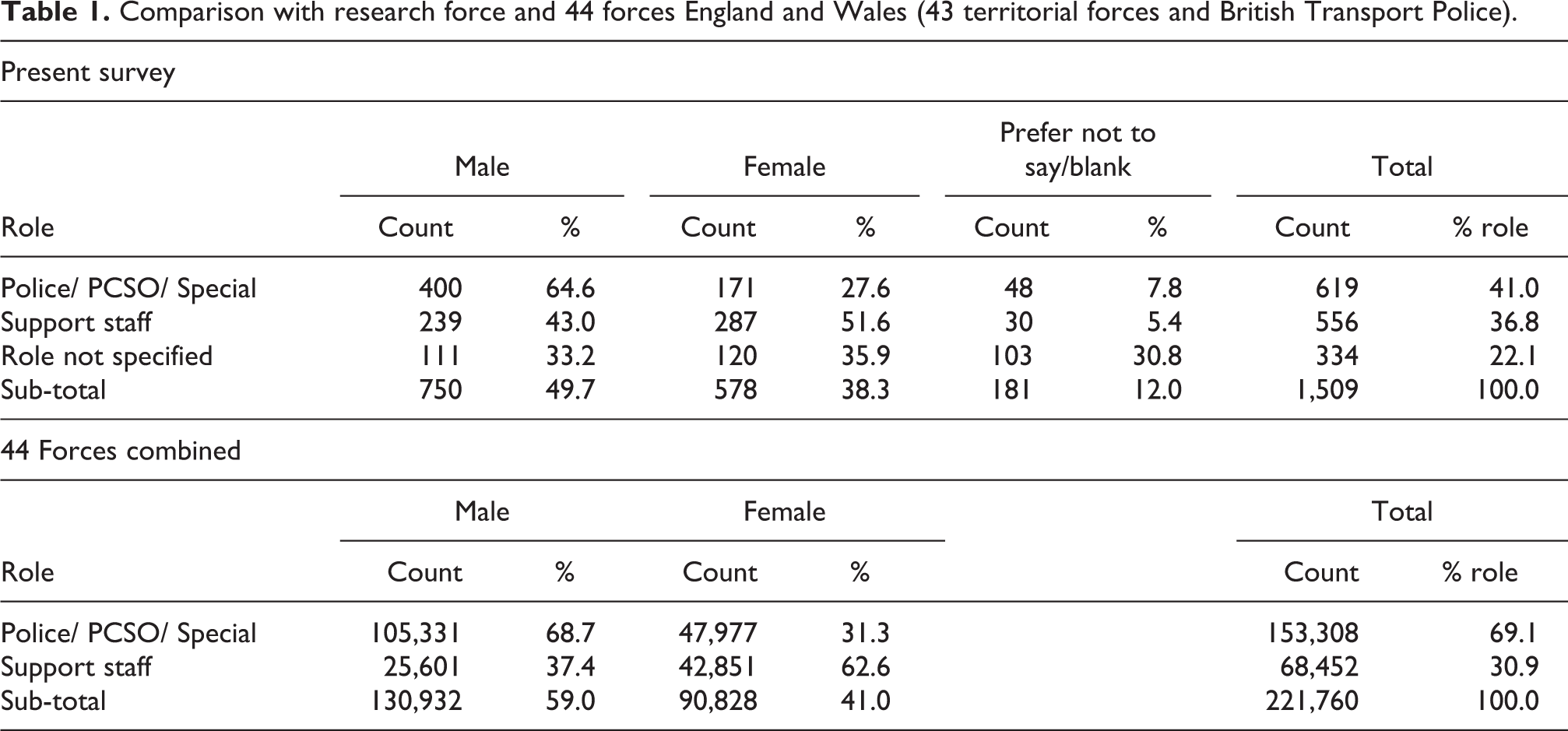
This comparison is based on Home Office figures detailing ‘workforce numbers in the 43 police forces in England and Wales and the British Transport Police’ (Home Office, 2017). This Home Office dataset was used because it captures the headcount of staffing levels as of March 2017; while the main data collection period of the survey took place in the three months from December 2016. As seen in Table 1, of the 619 respondents to the survey who were police/ PCSOs/specials, 65% were male and 28% female (with 8% respondents in this cluster of roles withholding their gender). This figure for the 44 forces was 69% male and 31% female. Of the 556 respondents to the survey who were staff, 43% were male and 52% female (with 5% of staff withholding their gender). The corresponding figures for the 44 forces were 37% and 63%. Making clear comparisons between the ratio of officers to staff was particularly difficult because of the number who declined to provide a role. Of those respondents that answered this question, 41% were police/PSCO/specials; and 37% staff. The equivalent ratio for the 44 forces was 69% to 31% respectively. In summary, although the authors recognize the limitations of this comparison, we feel that it serves the purpose of contextualizing our sample without risking the anonymity of the research force.
The survey
The survey posed two distinct sets of questions relating to perceptions and reporting of police rule breaking. First, which type of offence did respondents regard as most serious; and what sort of factors influenced judgements of relative severity? Second, how likely were respondents to report various types of misdemeanour; what factors influenced this relative propensity to report; and what approaches did respondents prefer in the eventuality of reporting hypothetical offences and indiscretions on the part of colleagues? There were also two further questions, pertaining to respondent’s attitudes as to why and how they might, or might not report colleagues’ misdemeanours. The front page of the electronic survey assured the potential respondents of anonymity – no names or identifiable details would be asked for or stored. The survey was then distributed electronically through an anonymous link advertised widely to personnel from across the whole force. The research was endorsed by the chief constable, encouraging people to take part. Respondents were therefore included from across the whole force – rather than being limited to particular local policing areas (LPA) within the force jurisdiction.
The research process asked respondents to consider a number of scenarios involving ethically problematic behaviour in a policing context. Having read each scenario, respondents were then asked to rate the seriousness of the behaviour addressed on a scale from 1 (not serious) to 5 (very serious); and then how likely they would be to report the behaviour on a scale from 1 (unlikely) to 5 (highly likely). There were three partial exceptions to this format. In the case of Scenario 8, an additional question was added of ‘how would you go about reporting this incident?’. The other exceptions were scenarios 1 and 9, which involved a degree of ambiguity regarding regulations, as well as the extent of force/supervisor discretion. In the case of two of these scenarios, the initial question regarding relative severity was replaced with one asking whether the respondent believed the behaviour to be against force policy. Respondents were then once again asked how likely they were to report the behaviour described in scenarios 1 and 9, on the same five-point Likert scale.
Once respondents had been presented with all 10 scenarios, they were asked three further questions about factors that would prevent or deter the reporting of an incident. They were also asked about their feelings regarding the prospect of working with a known whistle-blower and any further comments they may wish to add. These questions included an option for respondents to provide an open-ended response. Finally, respondents were asked to quantify their confidence in the force’s anonymous messenger system on a scale of 1–5, as well as being asked for basic demographic data relating to rank, role, age, gender and years of service. All questions and methods were given favourable opinion by the researchers’ university ethics committee prior to commencing the survey.
Survey design and sample composition
Some responses were removed from the final total – most prominently respondents who withdrew prior to completion. Although including partial answers was considered when designing the research, it was decided that doing so would make the final analysis somewhat ambiguous – resulting in a variable and diminishing total for every question. Moreover, in designing the survey, it was a deliberate decision to give respondents the option of skipping questions should they prefer not to answer. In the preamble to the survey, prospective respondents were told ‘you can decide to stop at any time by closing your browser and we will not use any of the information that you give us’. Therefore, those who did not complete the survey were removed from the final analysis. A total of 1,509 responses formed the sample upon which the present paper is based. Given that the response rate of police surveys administered by mail or internet are frequently recognised as tending to decline over time, the response rate achieved was robust (Nix et al. 2017, p. 13).
There were three related rationales for the inclusion of PCSOs and support staff alongside officers. First, this inclusion was at the request of the research force, who made it clear that they equally valued the views of all members of what is increasingly commonly referred to as the ‘police family’. The concept of the ‘police family’ itself can be interpreted as reflecting a wider institutional acknowledgement that the roles of officers and staff overlap in many respects, with greater collaboration in addressing social harms which are not necessarily recordable crime categories. In researching the attitudes, values and beliefs of new recruits, Millie and Hirschler (2018) found that an important motivation for many new recruits is the sense of identity afforded as part of a wider ‘police family’. Second, we wanted to capture the views of staff in recognition of the fact that ethical behaviour is expected of all police employees. For example, the Code of Ethics ‘applies to every individual who works in policing, whether a warranted officer, member of police staff, volunteer or someone contracted to work in a police force’ (College of Policing, 2014: V). Indeed, Miller (2003) has shown that police corruption and misconduct is by no means limited to serving officers – and can include a range of activities on the part of police staff including drug use, fraud, theft and domestic violence. Finally, owing to the status of staff as an indispensable component of policing infrastructure, this group necessarily contributes to – and is in turn influenced by – the wider institutional culture which is the focus of this study. We were therefore keen to capture the views, experience and insights of this group alongside those of sworn officers.
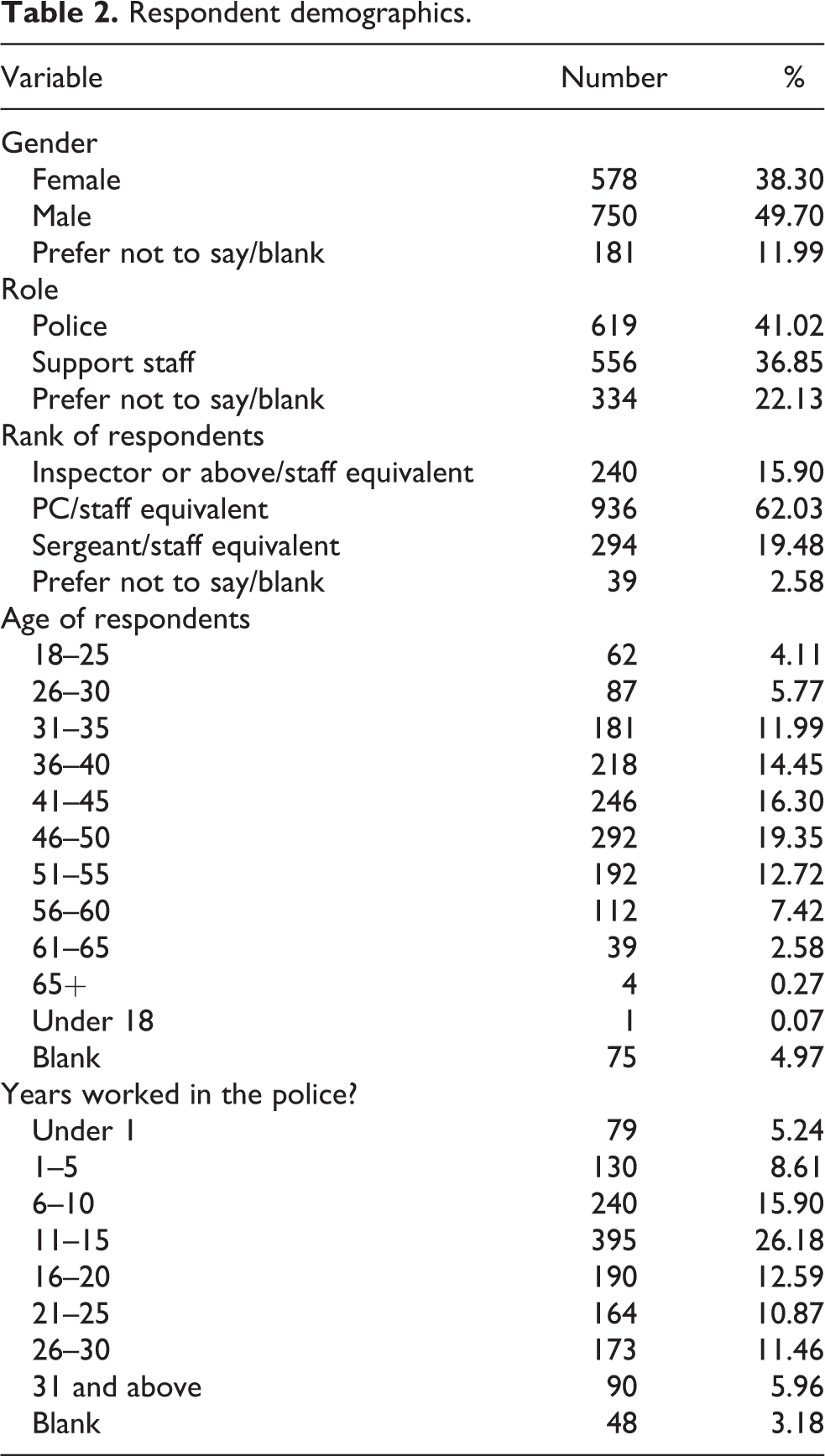
We suggest that the inclusion of this group in our sample begins to address this literature gap. In order to generate a figure for the breakdown of officers to staff, the authors manually checked each stated job role or acronym with the assistance of a senior officer from the research force. The majority of responses were unambiguous categories such as ‘custody sergeant’ or ‘shift inspector’. However, in some cases the phrasing of an individual’s role did leave ambiguity regarding their status as officers or staff, in which case these non-identified respondents were included in the ‘blank/withheld’ category. Table 2 shows an overview of respondent demographics.
Respondent demographics.
The scenarios
The nature of the scenarios varied considerably, with six distinct categories addressed: whether the behaviour was against force policy; acquisitive corruption (such as theft); ‘noble cause’ corruption (rule-bending for the good of others); the ‘blue code’ of silence (prohibiting snitching on colleagues); reputation damage (of self or the organization); sexual misconduct (related to the workplace or role).
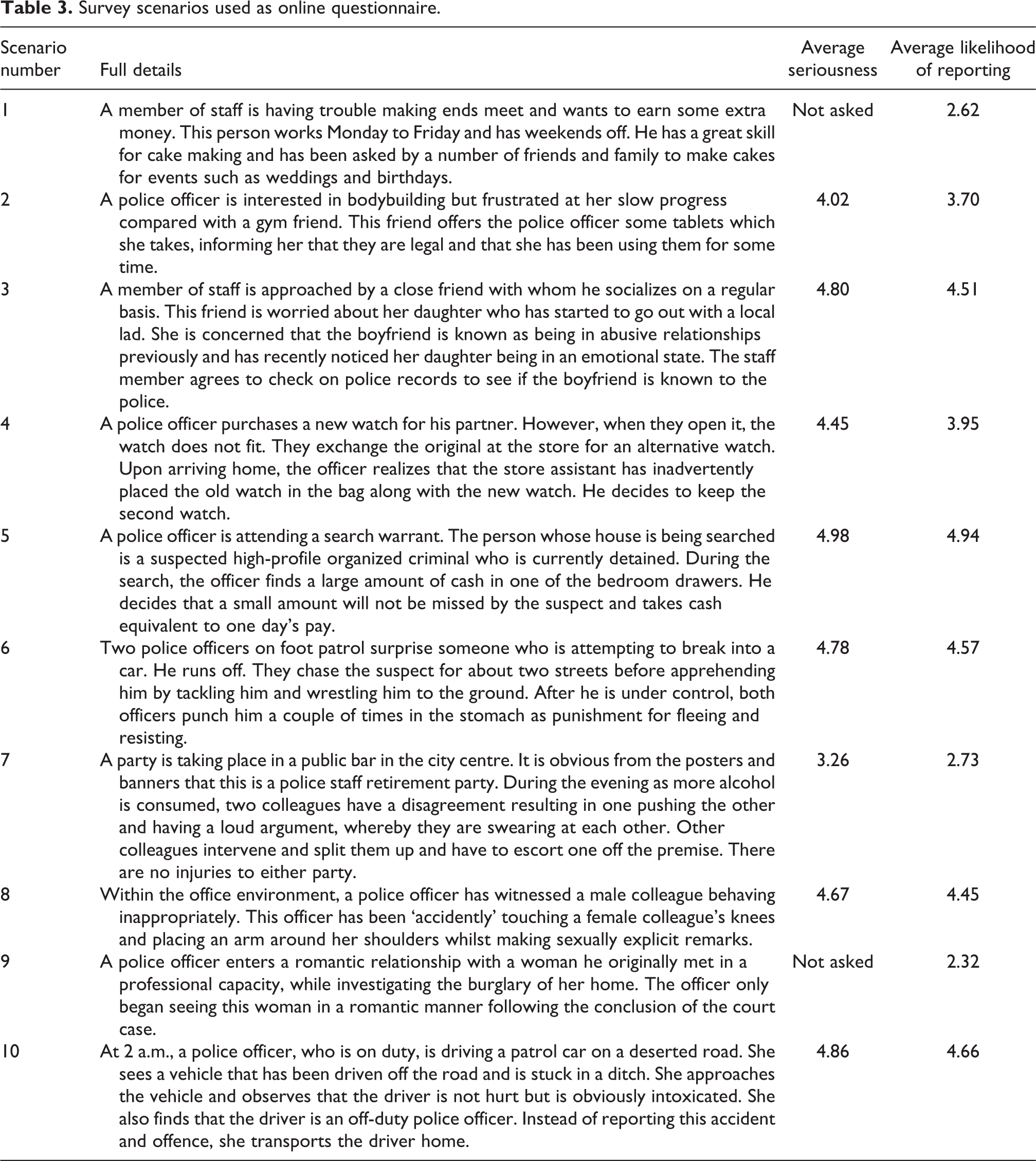
At the relatively innocuous end of the spectrum of wrongdoing, Scenario 1 involved members of staff supplementing their income for a few hours a week through making wedding and birthday cakes (Tables 4 and 5). At the more ‘serious’ end, the survey considered acquisitive crimes – from keeping a watch that was left accidently in a bag at a shop, to taking cash from a crime scene (scenarios 4 and 5, respectively). A further set of scenarios considered formal wrongdoing which may be normatively overlooked or viewed as acceptable within the organizational context of the police – that is, wrongdoing under the auspices of the ‘blue code’. The scenarios provided to respondents are reproduced in full in Table 3, along with the average seriousness and (where asked) the likelihood of reporting.
Survey scenarios used as online questionnaire.
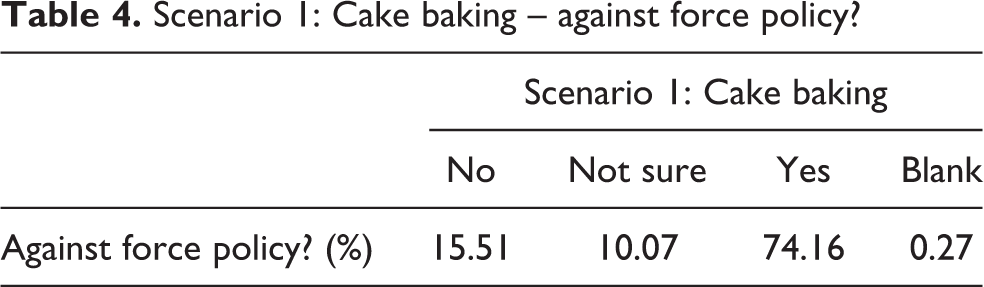
Scenario 1: Cake baking – against force policy?
Scenario 1: Cake baking – ‘likely to report’.

Summary of main findings
For the electronic survey, each of the 10 scenarios was presented on a separate page, with an arrow for navigation to the next question. Respondents were asked how serious they thought the behaviour described was, and how likely they were to report it. The scenarios began with a low level, minor ‘offence’ which we anticipated most people would not consider reporting.
Scenarios category 1: Minor infringements (Scenarios 1, 2 and 8)
In previous iterations (Westmarland, 2005, Westmarland and Rowe, 2016), it was suspected that the equivalent of this low-level/ambiguous question had caused some confusion among respondents, with some feedback along the lines of ‘I wouldn’t report this because it’s not against force policy’. Anticipating this potential issue, we decided to instead ask respondents whether they thought it was against force policy. As might be expected, Table 5 shows that the discovery of a cake baking business on the side would not lead many officers to report a colleague. Immediately following this scenario, respondents were presented with a scenario involving bodybuilding pills. This question was based on a similar case which the research force’s PSD had encountered. We anticipated that this scenario would be perceived as relatively low in terms of seriousness – and therefore unlikely to be reported.
As ‘warm-up’ questions, we felt that these two fairly innocuous, low-level rule-breaking activities would ease respondents into the survey. Scenario 2 was potentially slightly more serious than Scenario 1, as there was some indication that the bodybuilding drugs might be illicit, or possibly illegal (Table 6). A subsequent question was included at the request of the research force – addressing a disturbance at a party for police staff (Table 7). Alongside Scenario 9 (concerning an officer initiating a romantic relationship with someone met originally in a professional capacity), these scenarios received the lowest average ‘likelihood of reporting’ scores. A possible explanation for the relatively low concern about such behaviour may be that all four scenarios take place in a context that was both outside physical work premises and during off-duty hours.
Scenario 2: Bodybuilding.

Scenario 7: Party disturbance.

Scenarios category 2: Major infringements (scenarios 4 and 6)
At the other end of the spectrum, we anticipated that scenarios 4 and 5 would be regarded by respondents as potentially serious because both involved acquisitive misconduct.
As the results show, taking cash during a house search (Table 8), was seen as particularly serious – with 97% of respondents rating this behaviour as a 5 on the scale of seriousness (labelled in the survey as ‘very serious’). Despite the perceived seriousness of this scenario, only 95% selected the corresponding option of 5 on the scale (‘highly likely to report’). In the case of the watch (Table 9), fewer than half of respondents stated that they would be ‘highly likely’ to report the behaviour. Perhaps respondents thought that the watch being left in the bag was not outright theft. The suspected organized criminal whose house was being searched would not usually be regarded as a ‘good’ citizen and would in any case probably not keep the money following the raid – it would be confiscated as proceeds of crime. In some eyes, the officer would be committing an act in which no one would be harmed, but the difference in attitudes in each case is puzzling. In both of these cases the questions were devised with the research force’s PSD officers based loosely on real-life cases of which they had experience.
Scenario 5: Taking cash from suspect during search.

Scenario 4: Watch accidentally left in bag.

Scenarios category 3: Miscellaneous infringements (Scenario 3)
The behaviour described in Scenario 3 of accessing details on the PNC (Table 10) was viewed as a 5 on the scale (‘very serious’) by 83% of respondents. Despite this high seriousness rating, only 69% ranked their likelihood of reporting at 5 (‘highly likely’) – a gap of 14 percentage points. This is one of the largest gaps between indications of ‘seriousness’ and ‘likely to report’.
Scenario 3: Accessing PNC.

Scenarios category 4: Sex and relationships
These two scenarios were designed to judge attitudes towards the appropriateness of different types of sexual relationships at work. In the first scenario, a male colleague has been engaged in sexually inappropriate behaviour towards a female colleague (Table 11). This scenario was considered ‘very serious’ by 73% of respondents; with a further 20% viewing it as a 4/5 on the scale. In essence, around 93% of respondents thought this was a serious matter, and around 85% were prepared or likely to report. This was considered more serious than keeping the watch left in the bag, with 63% of respondents rating this behaviour at 5 on the scale of seriousness.
Scenario 8: Sexually inappropriate.

The other scenario which focused on sex and relationships involved an officer forming a romantic relationship with a victim of a crime, whose case he had dealt with recently (Table 12). This behaviour was not generally considered to be something worthy of reporting, with around 11% selecting both options 4 and 5 on the scale (Table 13).
Scenario 9: Romantic relationship.

Scenario 9: Romantic relationship, ‘Likely to report’.

Scenarios category 5: Potentially harmful infringements (scenarios 6 and 10)
The following two scenarios were considered potentially injurious or harmful in the sense that they involved behaviours known to cause death or serious injury. Aside from the injury that the officer could cause him or herself by drink-driving, there is the danger to other drivers and pedestrians of an increased risk of collisions. Similarly, punching someone with a pre-existing condition may cause serious harm, as recent cases of death after police contact have shown, such as the case of the newsvendor, Ian Tomlinson (Walker, 2012). In that case, a police officer pushed a member of the public, who later died of his injuries.
In both these cases – the drink-driver (Table 14) and officer using excessive force (Table 15) – the actions were viewed as ‘serious’ or ‘very serious’. Respondents exhibited correspondingly high levels of likelihood of reporting. Both these scenarios were replicated from the original Carl Klockars’ survey (2004).
Scenario 10: Intoxicated driver.

Scenario 6: Excessive force.

In addition to the 10 scenarios, we also asked two further questions; Your supervisor informs you that an officer is joining as a new member of the team. You will work closely with this individual for the foreseeable future. It is widely known that this officer moved from his last post after having whistle-blown on another officer who subsequently lost his job. How would you feel about working with this individual? How confident are you in the force’s current anonymous messenger system?
For question 1, respondents were provided with options that ranged from having no reservations about this prospect, to various points along a spectrum of mistrust – with the options ‘I would be somewhat reluctant about working with this person’, ‘I would be somewhat on my guard around this person’ and ‘I would have trouble trusting this person’ receiving 8%, 42% and 11% respectively. By a substantial margin, the most prominent response was ‘I would have no reservations about working with this person’, with over two-thirds of respondents selecting the option.
The prominence of this headline figure obscures a deeper ambiguity around this prospect. As with other questions addressed in this paper, respondents were able to decline to select any option; or select any combination of the five options – including ‘Other (Please Specify)’. Of the 1057 individuals who selected ‘I would have no reservations’, only 748 selected this option exclusively. A total of 269 individuals selected this response in combination with one or more of the additional multiple choice options - as well as 40 who provided a free-text response within the ‘Other (Please Specify)’ category. The ‘spectrum of mistrust’ responses could reasonably be seen as compatible. For example, one could be ‘somewhat reluctant about working with this person’, while having difficulty ‘trusting this person’ and therefore be ‘on guard’ around this individual. However, it is difficult to reconcile the position of having ‘no reservations’ while also being ‘reluctant’, ‘having trouble trusting’ the individual or being ‘on guard’ around them.
Although this pattern of responses emerging from the multiple-choice aspect of the question could therefore be interpreted as irreconcilable, detailed examination of the free-text responses to this question does not suggest disingenuousness. Instead, we suggest that this pattern of ostensibly contradictory responses is symptomatic of wider dichotomous feelings on the part of respondents. That is, the commitment to adhere to formal rules, regulations and ethical principles, while simultaneously recognizing the existence of normative standards which may technically qualify as an infringement. As Deutscher (1973) argued, there is a difference between ‘sentiments and acts’. ‘Moral attitudes’, he argues, cannot predict what people will do when faced with a particular situation (1973: 41).
Question 2 involved asking respondents ‘How confident are you in the force’s current anonymous messenger system?’, and providing them with a scale from 1 to 5, marked as ranging from ‘not confident’ to ‘highly confident’. The totals for each option are displayed in Table 16. The mean average of the total responses from the 1425 individuals who answered this question was 3.08. Option 3 was also the most regularly selected option – with 27% of respondents choosing it.
Confidence in anonymous messenger system.

However, the range of options varied considerably, with low-confidence ratings of 1 or 2 selected by 16.50% and 14.12%, respectively; and higher confidence ratings of 4 and 5 selected by 18.16% and 18.29%, respectively. This relative lack of confidence in the anonymous messenger system was a recurring theme in the free-text responses in several respects. One indicator of the level of mistrust around anonymous reporting is the explicit reluctance of several respondents to provide details, despite no identifying features being requested, and assurances of anonymity on the part of the research team at the start of the survey.
In both cases, as with some of the scenarios, especially those with a sexual element such as scenarios 8 and 9, we received many comments and qualifications typed into the free-text boxes. For example, the responses to question 1, above, about the whistle-blower, often came back with an ambiguous ‘depends on the circumstances’ response. There was also some evidence of a lack of confidence in the anonymous messenger system emerging from the free-text comments related to question 2 – mostly challenging how it could provide them with anonymity. Some respondents wrote comments next to these questions indicating their lack of faith in our assurances of not revealing their identity, presumably to people within their own force.
Discussion
As mentioned earlier, there have been many reasons put forward for police officers covering up, or for not reporting, colleagues’ misbehaviour. This has been illustrated in studies from various countries across the world using methods similar to those discussed here (Klockars et al., 2004; Novak and Ivković, 2005; Porter and Prenzler, 2015). In addition to surveys, observational studies of the police have provided evidence of the ‘blue code’ of silence supporting corrupt behaviour. In the 1960s, Skolnick was one of the first US academics to point out that operational discretion – whether to arrest a suspect, for example – was accompanied by the assumption that the decision would remain within the occupational group. Skolnick’s observations of a police ‘working personality’ based on ‘danger and authority’ (1966) and Reiner’s ‘core characteristics’ of policing (2010) point to the existence of a strong sense of solidarity and in-group secrecy. Some recent studies have re-emphasized these findings with Bacon’s (2017) ethnography of a drugs squad showing how ethnicity and ‘attitude’ can have an influence on whether to charge someone. Loftus (2009) also argues that status may determine who is potentially ‘suspicious’ in the police’s eyes (poor and low status minority ethnic men) and the way the ‘shift’ covers up for each other. On the other hand, Charman (2017) claims that although police recruits value comradeship and teamworking, the code of silence has been overwritten by a ‘code of self-protection’. She argues that new officers now fear doing the ‘wrong thing’ more than social isolation, due to the organization becoming more risk averse and accountable to the public.
Our study was an attempt to explore these theories by asking which activities and behaviours serving police officers and police support staff regard as serious, and whether they would report their rule-breaking colleagues. The main points we have discovered tend to support the continuing existence of the ‘blue code’, although there are some exceptions. To begin with, two of the scenarios we predicted would be regarded as the most serious – taking the organised criminal’s cash and keeping the watch left accidently in the bag, led to contradictory findings. Taking the money was clearly seen as wrong – with 95% of respondents saying they were ‘highly likely’ to report this behaviour. By contrast, keeping the watch, was only seen as ‘very serious’ by 63% and fewer than half were ‘highly likely’ to report this behaviour. Surprisingly, accessing the PNC database was seen as very serious by 83%, although only 69% said they were ‘highly likely’ to report it. The disparity between these percentages is part of a wider pattern we identified.
Ratings of seriousness and likelihood of reporting showed a fairly consistent disparity, with the latter around 10 percentage points lower than the former. For example, if 50% of respondents rated a behaviour ‘very serious’ (5 on the scale), then around 40% would say they were ‘highly likely’ to report. Anomalies to this pattern were Scenario 3 (accessing the PNC) and Scenario 4 (keeping the watch). These scenarios had the largest seriousness–report disparities, at 14.45% and 16.96%, respectively. At the other end of the scale, Scenario 5 (taking the cash) had the lowest seriousness–report disparity. The vast majority of respondents rated this scenario as both ‘very serious’ (97.48%), and simultaneously ‘very likely’ to be reported (94.90%) – a difference of 2.58 percentage points. The scenario with the next lowest seriousness–report disparity was Scenario 2 (bodybuilding pills). This scenario was seen as least serious by respondents – with 41.75% selecting the ‘very serious’ option. However, 35.79% selected the corresponding measure of ‘highly likely’ to report – a seriousness–report disparity of 5.96 percentage points.
As might be expected, the scenario that attracted the highest levels of ‘seriousness’ was also the one with the highest penalties in criminal law; stealing money from the suspect’s stash. It attracted the most ‘serious’ and ‘likely to report’ responses and clearly breaks the criminal code. As police officers and police support workers, respondents might be expected to see these behaviours as more serious because they might be coloured by their expectations of what the penalty would be for breaking the law. Some unexpected findings have arisen, however. It might be predicted that keeping the watch would be regarded as theft and would have also been seen as equally ‘serious’. Westmarland, 2005’s previous studies have suggested that stealing money or goods – attracting the most serious penalty in black letter law terms – translate as the most ‘serious’ misdemeanours (Westmarland, 2005; Westmarland and Rowe, 2016). Cake baking and the taking of bodybuilding pills are potentially ‘illegal’ or illicit – in the sense that the business on the side is against internal police rules – and could also potentially be a tax fraud offence, while some steroids are not licensed for use without prescription. However, neither would normally be considered a matter to be pursued via the criminal justice system, even if discovered. As mentioned above, one anomaly is the accessing of the PNC. Here, the level of seriousness is high, but likelihood of reporting is unusually low
Turning to the scenarios involving sexual and relationship issues, including the inappropriate sexual touching scenario, the respondents seemed, in general, to think that touching or flirting in the office was highly unacceptable, but having a romantic relationship with a former victim of crime was not worthy or reporting. Sexually inappropriate touching was rated as 4 or 5 on the scale of seriousness by 20% and 73% of respondents respectively (see Table 11). However, regarding the romantic relationship described in Scenario 9, very few thought they would report this potential abuse of power. Respondents were very likely to report sexual activity where it was a colleague, but not where it was a potentially vulnerable victim of crime. Although around 26% thought it was unacceptable to form such a relationship with the victim, only 11% said they would definitely report it. We had numerous free-text responses about the sexual touching in the office. These responses fell under a range of categories, including sentiments of ‘I would challenge the behaviour in person’ to ‘I would speak to the female colleague to establish her feelings and support if they wanted to report it’. This latter scenario was one which received a great deal of free-text comments, asking to know more about the situation, wondering if they were in ‘a relationship’ and what was the work/power dynamic between the two people. Our questions about working with the whistle-blower and the lack of confidence in the anonymous reporting system also invoked a large amount of free-text responses explaining the ambiguities of the questions and potential situations that might arise.
Finally, in terms of the two behaviours with the potential for serious harm, the use of excessive force and drink-driving, it should be noted that these two scenarios were reproduced directly from the previous surveys by Klockars et al. (2004), and had been used in previous surveys by Westmarland (2005) and Westmarland and Rowe (2016). It was interesting to compare these two sets of responses over the period of around 15 years’ duration. In both cases – the excessive force and the covering up for a drink-driving colleague – respondents said they were more likely to report the behaviours than in previous years. In the case of the drink-driving colleague, when Westmarland, 2005 first surveyed police officers in (2005) it was found that only 50% would report a colleague. When Westmarland and Rowe (2016) surveyed 520 officers, several years later, there were similar findings. The present survey, with a much bigger sample, although not directly comparable, found that around 77% were now ‘highly likely’ to report this behaviour. Similarly, regarding the use of excessive force, the first survey by Westmarland in (2005) 53% said they would report it, whereas for our present survey this figure was 74%, which is a potentially positive note upon which to conclude.
Conclusions
Our current research supports the findings from various previous studies (Klockars et al., 2004; Westmarland, 2005; Westmarland and Rowe, 2016). The survey was designed and administered around three years after the College of Policing’s Code of Ethics was published in 2014. This could be significant for future studies because the College’s code contains a much stronger, statutory requirement for officers to report misdemeanours. In some situations, adhering to the ‘blue code’ rather than the Code of Ethics could now be regarded as a criminal offence and/or gross misconduct and if proven, may result in dismissal and cases have already been brought under this new statute to date. This will obviously be more relevant in some of the scenarios than others. It seems unlikely for example that the cake baker or party rousers would be sacked. On the other hand, not reporting the theft of a valuable watch or cash taken during a house search might end in the dismissal of both the offender and the colleague who did not report it.
We feel that our study has discovered some interesting findings and a number of anomalies that we would like to explore further in future research. The perceived seriousness of the officer accessing the PNC, for example, was a surprise. Also, the potential for abuse by the officer dating the victim of crime compared with the manager who was making potentially unwelcome sexual approaches to a co-worker was surprising, albeit reassuring in some senses. The respondents said that generally, they had no problems working with a whistle-blower, but many did not trust the anonymous reporting system, which we have fed back to the research force. In several instances, regarding this question, the free-text responses explained that they needed more context to be able to answer the question fully.
We realize that some of our findings also raise more questions than answers. In addition to the findings presented here, we also have a great deal of further unused qualitative and quantitative data from our highly engaged respondents to explore. Overall, we think that there have been some changes in attitudes towards the reporting of misdemeanours, but that confidence in the processes and the means to report such actions may be lacking. We also think that there is a need for some exploration of the Code of Ethics and its influence upon police culture and the ‘blue code’. We found that there is ambiguity around the appropriateness of some sexual activities and relationships about which our respondents felt they needed to explain to us in their free-text responses. We felt our respondents were trying to ‘do the right thing’ but it was not always clear to them what this meant. We maintain that some elements of the ‘blue code’ are still clear to see, and our respondents, police officers and police support staff, wanted to engage in the debates around the scenarios we raised. Although both codes can clearly work in tandem, it is revealing to see some of the situations where the Code of Ethics and the ‘blue code’ of silence compete for prominence.
Footnotes
Acknowledgements
The authors of this paper thank sincerely the officers and staff who took the time to complete the questionnaires and to the PSD officers who helped to develop the scenarios and deliver the survey. Thanks also to the Senior Management Team for agreeing to the survey. Many thanks to the anonymous reviews who provided excellent comments to improve this paper.
Declaration of conflicting interests
The author(s) declared no potential conflicts of interest with respect to the research, authorship, and/or publication of this article.
Funding
The author(s) disclosed receipt of the following financial support for the research, authorship, and/or publication of this article: This work was supported by the force involved in the research via a small payment towards expenses such as travel to various meetings, coding of results and technical support.
