




Abstract
Police employees are exposed to a variety of complex, work-related stressors and are susceptible to experiencing reduced psychological wellbeing. To advance understanding of the personal and social factors underpinning psychological wellbeing in this population, the purpose of this study was to examine the relationship between psychological wellbeing, perceived support from colleagues, received support from colleagues and personality factors in police employees. A sample of 381 police employees from a county police force in England completed an online questionnaire assessing: psychological wellbeing; perceived support; received support; and personality factors. Psychological wellbeing was significantly and positively associated with perceived support from colleagues, received support from colleagues, extraversion, agreeableness, conscientiousness, emotional stability, and openness to experience. Further investigation of these relationships using multiple logistic regression analysis found that perceived support from colleagues, received support from colleagues, extraversion, and emotional stability significantly predicted psychological wellbeing. Given growing concerns about psychological wellbeing in police forces, the findings could help to inform the promotion of psychological wellbeing across operational and non-operational police employees. The results suggest that increasing both perceptions of available support and the amount of support received among employees in police forces is important for enhancing psychological wellbeing in this population. Furthermore, police employees with lower levels of extraversion and emotional stability should also be considered for additional support to promote psychological wellbeing.
Keywords
Psychological wellbeing is a broad construct that encompasses the presence of positive markers of psychological adjustment, such as high self-esteem, positive affect, and life satisfaction, as well as signs of psychological maladjustment, including low negative affect, life satisfaction, and stress (Carter et al., 2016; Houben et al., 2015). The workplace can play a crucial role in determining an individual’s psychological wellbeing (Johnson et al., 2018). Emergency service personnel are often exposed to stressful and traumatic events (Brough, 2004; Lucas et al., 2012), and the nature of working in such high-risk occupations can increase susceptibility to experiencing negative stress outcomes, such as absenteeism (Magnavita and Garbarino, 2013), burnout (Martinussen et al., 2007), and impaired psychological wellbeing (Johnson et al., 2005).
Policing is widely regarded as a highly stressful occupation (Noblet et al., 2009a, 2009b; Russell, 2014; Van Hasselt et al., 2008). By its nature, police work can involve exposure to a variety of acute and chronic stressors, such as witnessing or discussing distressing scenes, experiencing dangerous situations, and risk of injury. Consequently, it is widely acknowledged that the nature of police work can have a detrimental impact on physical and psychological health in this population (Garbarino et al., 2013; Juniper et al., 2010; Lawson et al., 2012; Magnavita et al., 2018; Shucard et al., 2012). From a psychological health perspective, police employees have reported lower than average scores on psychological wellbeing relative to other occupations (Johnson et al., 2005). Given the important role of police in society, susceptibility to impaired psychological wellbeing in police employees, and the beneficial impact of enhanced psychological health for optimal functioning, it is paramount to investigate psychosocial correlates and predictors of psychological wellbeing in this population.
To date, the majority of research on psychological health in policing has focused on police officers (Acquadro Maran et al., 2015; Duran et al., 2019; Ma et al., 2015). However, recent research has highlighted that police employees in non-operational roles can often be exposed to traumatic events directly (e.g. distressing calls) or vicariously, and are also susceptible to experiencing negative psychological outcomes in their work (Kerswell et al., 2019). In turn, this suggests that further research on psychological wellbeing in policing should adopt a broader perspective and also consider employees working in non-operational roles to ensure that a more holistic understanding of psychological wellbeing in this occupation can be developed. Therefore, this study sought to develop understanding of the personal and work-related factors that contribute to psychological wellbeing in policing by examining the relationship between psychological wellbeing, social support, and personality in police employees, comprising both operational (i.e. employees who deliver police or police-related services) and non-operational staff (i.e. professional and support staff).
Theoretical framework
Social support
One construct that has been widely associated with a myriad of positive physical and mental health outcomes is social support (Berkman et al., 2000; Holt-Lunstad et al., 2010; Uchino et al., 2012). In police employees, social support has been associated with reduced post-traumatic stress disorder symptoms (Stephens et al., 1997), enhanced general mental health (Hansson et al., 2017), increased job satisfaction (Brough and Frame, 2004), and decreased perceptions of organizational stress (Graf, 1986). Social support in the workplace refers to the general levels of aid and assistance provided through social interactions with both co-workers and supervisors (Karasek and Theorell, 1990). Work colleagues can act as key support providers (Shoss et al., 2013) and can often provide experientially salient information that allows an individual to foster a sense of control, which can subsequently promote psychological wellbeing (Taylor and Stanton, 2007). Although support can be obtained from many sources in an individual’s social network, supervisors and colleagues have been identified as key social support providers for ameliorating the negative effects of stress in police employees (Brough and Frame, 2004; Stephens et al., 1997). However, further research is required to understand the nature of the relationship between social support from colleagues and psychological wellbeing in this population.
Functional perspective
Social support is a complex construct that incorporates both structural and functional elements of interpersonal relationships (Cohen and Willis, 1985). Whereas a structural analysis of social support would focus on the size, range, and interconnectedness of social ties, functional support can be divided into two components: perceived availability of support (i.e. perceived support), and received support (Barrera, 2000; Cohen, 1988). Perceived support refers to a prospective appraisal of available support (Norris and Kaniasty, 1996). Alternatively, received support, which is sometimes termed enacted support, constitutes a retrospective rating of support transactions that an individual perceives have occurred, usually within a specific time frame (Schwarzer and Knoll, 2010). Despite the intuitive conceptual overlaps between perceived and received support, evidence suggests that a weak relationship exists between these constructs (Haber et al., 2007; Lakey et al., 2010). One possible explanation for the weak association between perceived and received support could be that perceived support reflects a general perspective of support based on interactions across day-to-day activities over a relatively long time, whereas received support is usually restricted to an exact period and could relate to specific stressful situations (Bolger and Amarel, 2007; Hobfoll, 2009).
To date, researchers have generally found that perceived support is positively related to psychological wellbeing (Lakey and Orehek, 2011; Thoits, 2011). Findings concerning the relationship between received support and wellbeing are, however, more ambiguous (Reinhardt et al., 2006). For example, some research has found positive associations between received support and aspects of wellbeing (Chu et al., 2010), whereas other research has found a negative relationship between these constructs (Bolger et al., 2000; Lee et al., 1995). Given that previous research has not always accounted for the differences between perceived and received support, it has been suggested that potential negative reactions caused by received support might counteract any benefits of perceived support (Bolger and Amarel, 2007; Maisel and Gable, 2009).
In explaining the equivocal findings concerning the social support–wellbeing relationship, researchers have argued that differences in the manner in which social support and wellbeing have been both conceptualized and operationally defined in the literature could have contributed to variation in the findings (Siedlecki et al., 2014). Furthermore, it has also been suggested that the received support–psychological wellbeing relationship could be affected by the potential lack of awareness among individuals of the receipt of support (Bolger et al., 2000). In acknowledgement of the complex interplay between perceived and received support, researchers have highlighted the importance of approaching social support research from both of these functional perspectives (Reinhardt et al., 2006). Although researchers have examined correlates of social support in police officers previously, the associations between psychological wellbeing and both perceived support and received support have yet to be examined across police employees (i.e. officers and staff). Therefore, given the potential intricacies of the relationship between psychological wellbeing and both perceived and received support, an investigation of the relationship between psychological wellbeing and both functional components of social support in police employees could provide further understanding of the relationship between social support and psychological wellbeing in this occupational setting. Based on the extant literature, it was hypothesized that: H1: Perceived support from colleagues would be positively related to, and significantly predict, psychological wellbeing; H2: Received support from colleagues would be positively related to, and significantly predict, psychological wellbeing.
Personality
The personality of an individual is another area that could be relevant to understanding psychological wellbeing in police employees. The most commonly used approach for conceptualizing and assessing personality is the Big Five personality model (Costa and McCrae, 1980). This model proposes that personality consists of five dimensions, which comprise: (1) agreeableness (i.e. likeability and cooperativeness with others); (2) conscientiousness (i.e. degree of organization, persistence and motivation to achieve a goal); (3) neuroticism (i.e. opposite of emotional stability); (4) extraversion (i.e. level of assertiveness and contrasts with introversion); and (5) openness to experience (i.e. desire to seek out new experiences). Associations have been found between the Big Five personality traits and wellbeing (see DeNeve and Cooper, 1998 for a meta-analysis). Notably, researchers have found that certain personality traits, particularly extraversion and neuroticism, are significant predictors of wellbeing (e.g. Gutierrez et al., 2005; Hayes and Joseph, 2003).
Within the context of policing, previous studies have also found links between personality dimensions and wellbeing. In police officers, wellbeing was inversely related to neuroticism (Hart et al., 1995; Ortega et al., 2007) and positively associated with extraversion (Hart et al., 2005). However, it should be noted that neither of these studies investigated the relationship between wellbeing and each of the Big Five personality characteristics. Furthermore, this research included only police officers and did not include employees in non-operational roles. Therefore, this suggests that further work sampling both operational and non-operational police employees would help to advance understanding of the relationship between psychological wellbeing and personality in policing. In line with the existing evidence base, it was hypothesized that: H3: Extraversion and emotional stability would be positively related to, and significantly predict, psychological wellbeing.
No specific hypotheses were formed concerning the relationship between psychological wellbeing and agreeableness, conscientiousness, and openness to experience due to the lack of empirical evidence on the relationship between these variables in policing.
The current study
The aim of the study was to examine the relationship between psychological wellbeing, perceived support from colleagues, received support from colleagues and personality characteristics in police employees, which comprised both operational and professional service staff (i.e. non-operational employees in professional, technical, and administrative roles). To date, the majority of research on psychological health in policing has focused on police officers. However, it was of interest in the current study to develop understanding of psychological wellbeing across all police employees. In turn, this study sought to extend the evidence base on psychological wellbeing in policing by sampling participants from across the full spectrum of roles in a police force. By doing so, this could help to inform the design of practical applied recommendations that aim to promote psychological wellbeing in a variety of policing roles.
Method
Participants
The participants were 381 (female n = 187, male n = 183, prefer not to say n = 11; M age = 42.49 years, SD = 9.85) employees of a police force in the Midlands region of England. Participants reported an average of 12.90 years (SD = 9.29) of service in the organization and had been employed in their current role for an average of 6.08 years (SD = 6.30). The sample consisted of operational (police officers n = 208, police community support officers n = 15) and professional service employees (i.e. non-operational employees; n = 134); 24 participants did not declare their role within the force.
Measures
Perceptions of available support
The level of support that participants perceived to be available from colleagues was measured using the 24-item Social Provisions Scale (SPS; Cutrona and Russell, 1987). Items were presented on a 4-point Likert scale, ranging from 1 (strongly disagree) to 4 (strongly agree). Because this study focused on perceptions of available support from work colleagues, participants were required to respond to each statement in relation to relationships with their colleagues in the organization. A higher total score is indicative of higher levels of perceived available support. Example items included: ‘there are people I know will help me if I really need it’; and ‘I have a trustworthy person to turn to if I have problems’. The measure has previously demonstrated excellent internal consistency (e.g. Perera, 2015) and good test–retest reliability scores (Russell et al., 1984). The internal consistency of the SPS was found to be excellent (α = .93) in the current study. Although the SPS is a multidimensional measure, only a total scale score was used because the current study focused on examining the relationships with global perceptions of available support rather than the distinct social features contained within the SPS.
Received support
Perceptions of received support were assessed using an adapted version of the Shortened Inventory of Socially Supportive Behaviours (SISSB; Barrera and Baca, 1990). This measure assessed perceptions of the amount of support that participants felt they received from their colleagues over the previous four weeks on a Likert scale ranging from 1 (not at all) to 5 (about every day). Some example items included: how often did other people tell you what they did in a situation that was similar to yours’, and how often did other people go with you to someone who could take action’. Although the SISSB contains 19 items, three were excluded as they were deemed unsuitable for this workplace setting after initial pilot testing and follow-up discussions between the research team and the organization. The excluded items were: ‘gave or loaned you over £20’; ‘comforted you by showing you some physical affection’; and ‘provided you with a place to stay’. The SISSB demonstrated good internal consistency (α = .84) in previous research (Barrera and Baca, 1990) and in the current study (α = .88).
Personality
Personality was measured using the Ten-Item Personality Inventory (TIPI; Gosling et al., 2003), which contains five subscales, comprising: agreeableness; conscientiousness; emotional stability; extraversion; and openness to experience. This measure asked participants to indicate the extent to which each item statement reflected their personality on a seven-point Likert scale, ranging from 1 (disagree strongly) to 7 (agree strongly). Each statement consisted of two items per scale, which included pairs of descriptive adjectives, such as ‘extraverted, enthusiastic’ and ‘anxious, easily upset’. Participants were asked to rate the extent to which these descriptions matched their own personality, even if they deemed that one trait applied more strongly than the other. The internal consistency values (α) for the extraversion, agreeableness, conscientiousness, emotional stability, and openness to experience subscales in the current study were .65, .27, .41, .76, and .39, respectively, which are similar to those reported previously 1 (Gosling et al., 2003). Although four subscales fell below the generally accepted Cronbach’s alpha value of .70 (George and Mallery, 2003), issues have been identified with the use of reliability tests for two-item scales (Eisinga et al., 2013). Further examination of the inter-item correlations (cf. Pallant, 2010) for the extraversion, agreeableness, conscientiousness, and openness to experience subscales indicated that values for each variable (.48, .16, .28, .24, respectively) fell within the recommended range (Clark and Watson, 1995). Thus, all subscales were included in subsequent analyses.
Psychological wellbeing
Psychological wellbeing was measured using the 14-item Warwick–Edinburgh Mental Well-being Scale (WEMWBS; Tennant et al., 2007). The WEMWBS captures both functional and affective aspects of psychological wellbeing on a scale that ranges from 14 to 70, with higher scores indicating greater levels of psychological wellbeing. In responding, participants were asked to identify the extent to which each item reflected their experiences in general (i.e. within and outside the workplace) in the preceding 4-week period on a 5-point scale that ranged from 1 (none of the time) to 5 (all of the time). Sample items include: ‘I’ve been feeling relaxed’; ‘I’ve been thinking clearly’; and ‘I’ve been dealing with problems well’. The internal consistency of the WEMWBS has been previously reported as good (α = .89; Tennant et al., 2007), with the measure demonstrating excellent internal consistency in the current study (α = .92).
Procedures
Ethical approval was obtained from a school ethics committee at an English university. Following agreement with appropriate personnel within the police organization, all employees (2000 ≤ n ≤ 3000) 2 in a regional police force were informed about the study through the organization’s intranet site. Participants who were willing to take part could select a link in their own time to gain access to an online questionnaire, which was accessible for a 4-week period. The online questionnaire solicited information about their demographics and obtained measures of psychological wellbeing, perceptions of available support, perceptions of received social support and personality characteristics. Each set of questions for the psychological measures was randomized to reduce the likelihood of order effects. To maximize the response rate, an initial message raising awareness about the study was sent to employees prior to commencement of data collection. Additionally, participants were sent several reminders after the launch of the online questionnaire. All participants completed the questionnaire on a voluntary basis and provided consent to take part in the study prior to completing the questionnaire, which took approximately 15 minutes. It was made clear to potential participants that this study was being conducted by researchers based at a university, with agreement by the police organization, to circumvent potential concerns with judgement from management or supervisors and ensure that answers for all participants reflected their actual thoughts and feelings. Participants were not required to report all demographic details to protect anonymity.
Data analysis
Preliminary analyses
Data were analysed using SPSS 22. Data were screened visually for missing cases and normality. Visual screening of scatterplots for each psychological measure suggested that data for all measures were not normally distributed. Statistical checks of normality were undertaken by computing the kurtosis and skewness scores for each variable, and then standardizing each score by dividing the test score by the standard error for the respective test statistic. These standardized z-scores were compared with recommended values (± 3.29, p < .001) for normally distributed data and revealed that data for each of the psychological measures were not normally distributed. Consequently, as the assumptions for running parametric tests were not satisfied, the median, interquartile range, and standard deviations of these measures were calculated, and non-parametric tests were employed.
Main analyses
A Mann–Whitney U-test was conducted to examine differences in psychological wellbeing between operational and non-operational staff. Spearman’s rank order correlation was employed to examine the relationships between psychological wellbeing, perceived support, received support and each of the personality components measured. Multiple logistic regression analysis was used to determine the predictive capacity of perceived support, received support, and the Big Five personality components on psychological wellbeing. These predictor variables were entered simultaneously using forced multiple logistic regression, as relationships have previously been found between perceived support, received support and personality with psychological wellbeing. The level of significance was set at p < .05. Results for the logistic regression are presented as an odds ratio (OR), with the regression coefficients, their standard errors, and 95% confidence intervals (CI) reported.
Results
The median, interquartile range and 95% CI for each of the psychological variables and results of the correlational analysis are presented in Table 1. No significant difference (p = .06) was found in psychological wellbeing between operational (Md = 43.00, M = 42.75) and non-operational staff (Md = 45.00, M = 44.43). Psychological wellbeing was significantly (p < .05) and positively related to perceived support, received support, and all five subscales of the TIPI. Moderate-to-strong associations were found between psychological wellbeing and perceived support (r = .47, p < .05), emotional stability (r = .47, p < .05), received support (r = .40, p < .05), and extraversion (r = .35, p < .05). Small-to-moderate positive correlations were found between psychological wellbeing and agreeableness (r = .19, p < .05) and openness to experience (r = .19, p < .05). Other noteworthy findings were that significant positive associations were found between perceived support and received support (r = .40, p < .05), agreeableness (r = .31, p < .05), and emotional stability (r = .24, p < .05).
Median, interquartile range, 95% confidence intervals, and correlations between psychological variables.
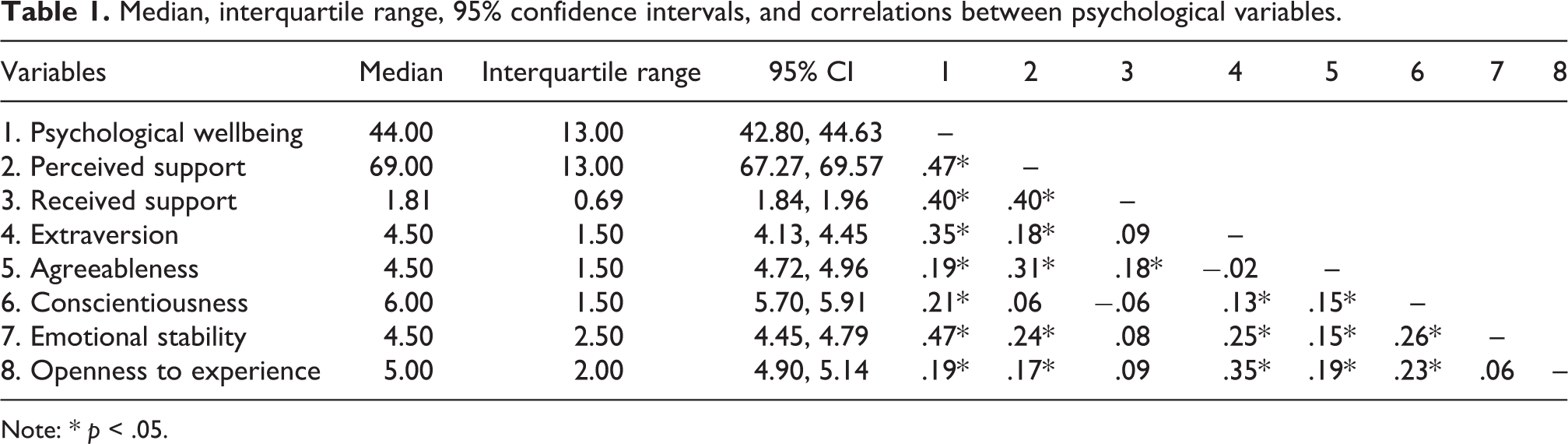
Note: * p < .05.
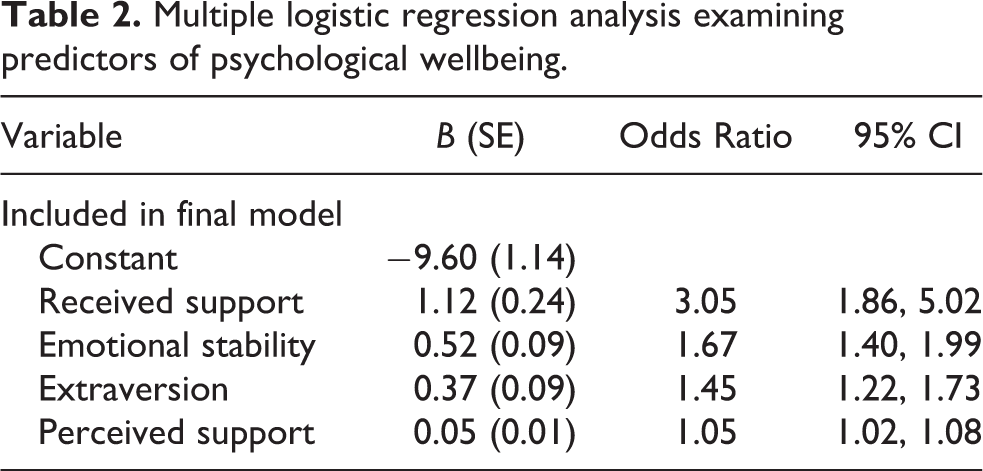
Results of the multiple logistic regression analysis are displayed in Table 2. Four of the seven predictor variables entered into the multiple logistic regression model were found to be significant predictors of psychological wellbeing. Compared with participants who reported lower levels of received support, participants that reported a higher degree of received support displayed significantly higher odds of increased psychological wellbeing (OR = 3.05, 95% CI 1.86, 5.02). Similarly, compared with those with lower perceptions of available support, participants who reported higher levels of perceived support had greater odds of enhanced psychological wellbeing (OR = 1.05, 95% CI 1.02, 1.08). Among the personality variables, emotional stability and extraversion were found to be the only significant predictors of psychological wellbeing in the sample. In comparison with participants with lower levels of emotional stability, individuals with higher levels of emotional stability had higher odds of heightened psychological wellbeing (OR = 1.67, 95% CI 1.40, 1.99), whereas participants with higher levels of extraversion were found to have greater odds of reporting greater psychological wellbeing (OR = 1.45, 95% CI 1.22, 1.73). Alternatively, conscientiousness, agreeableness, and openness to experience did not significantly predict psychological wellbeing.
Multiple logistic regression analysis examining predictors of psychological wellbeing.
Discussion
The purpose of the present study was to examine the relationship between psychological wellbeing, perceptions of available support, received support, and personality characteristics in police employees. To the best of the authors’ knowledge, this is the first study to investigate the relationships between psychological wellbeing, perceived support from colleagues, received support from colleagues, and personality factors across operational and non-operational police employees. Although operational employees reported lower psychological wellbeing, no significant difference was found between operational and non-operational staff. The results indicated that psychological wellbeing was significantly and positively correlated with perceived support and received support. These findings suggest that higher perceptions of available support and received support are linked to greater psychological wellbeing in police employees. Psychological wellbeing was also significantly and positively associated with emotional stability, extraversion, agreeableness, openness to experience, and conscientiousness, thus suggesting that higher levels of each of these personality characteristics are associated with enhanced psychological wellbeing. Consistent with the study hypotheses, perceived support, received support, extraversion, and emotional stability were significant predictors of higher psychological wellbeing among the predictor variables, whereas agreeableness, openness to experience, and conscientiousness were not significant predictors of psychological wellbeing.
A noteworthy finding from the current study was that receiving support from colleagues was the strongest predictor of psychological wellbeing. Although research concerning the relationship between received support and psychological wellbeing has been equivocal, the findings from the current study are similar to previous research which found that receiving social support was a significant and positive predictor of wellbeing in emergency service employees (Shakespeare-Finch et al., 2015) and police force employees (Rodwell et al., 2011). Received support is regarded as a situational factor that arises in response to stressful circumstances (Barrera, 2000) and many high-risk organizations have developed peer-support programmes to assist employees to counter the potentially deleterious effects of stressful situations (Creamer et al., 2012). According to Cohen and Wills (1985), social support can have a positive effect on wellbeing by buffering against the potential negative health consequences that arise in stressful circumstances (i.e. stress-buffering model), or can have a beneficial impact regardless of whether the individual is under stress (i.e. main-effect model). Given that police employees across the spectrum of roles in policing can be exposed to stressors (Acquadro Maran et al., 2015; Kerswell et al., 2019), receiving support from colleagues could be particularly important for buffering the potentially adverse impact of work-related stressors on psychological wellbeing in this population.
Although received support was the strongest predictor of psychological wellbeing among the social support variables, perceptions of available support from colleagues still significantly predicted psychological wellbeing. This finding is in line with previous research that found a positive relationship between organizational support and psychological wellbeing (Panaccio and Vandenberghe, 2009), and suggests that individuals who perceive more support to be available from their colleagues are more likely to report higher levels of psychological wellbeing. Although the OR for enhanced psychological wellbeing was substantially lower for perceived support compared with received support, it should be noted that both variables were significantly and positively related, and that perceived support was more strongly associated with psychological wellbeing than received support in the correlational analysis. Thus, although speculative, it is arguable that by controlling for received support in the regression model, this could have reduced the degree of variance predicted in psychological wellbeing by perceived support. Perceived support is suggested to be a stronger predictor of related outcomes, such as physical and mental health, in comparison with received support (Sarason et al., 1990; Uchino et al., 2012), albeit in the current study both variables predicted psychological wellbeing. Therefore, researchers, practitioners and colleagues should continue to recognize the importance of increasing perceptions of available support and providing actual support to enhance psychological wellbeing in this population.
According to the current findings, emotional stability could be particularly important for psychological wellbeing in police employees as the results of the multiple logistic regression analysis indicated that emotional stability was the strongest predictor of psychological wellbeing among the five personality traits. Thus, police employees who tend to be more emotionally stable, calm, and relaxed are more likely to report higher levels of psychological wellbeing, whereas those who have increased susceptibility to fluctuations in emotional stability are more likely to experience impaired psychological wellbeing. This is consistent with previous research that found that emotional stability, or neuroticism, is a stronger predictor of wellbeing than extraversion (Vittersø, 2001; Vittersø and Nilsen, 2002).
Identifying extraversion as a significant predictor of psychological wellbeing reconciles with previous studies in police officers (Hart et al., 1995) and other participant groups (DeNeve and Cooper, 1998). Individuals with higher levels of extraversion tend to be more sociable and are more likely to interact with people, which heightens their predisposition to positive affect and enhanced wellbeing (Costa and McCrae, 1980). Given the conceptual overlaps between extraversion and social support in terms of engagement in social relationships, it is worth noting that the current study found that extraversion was significantly and positively related to perceived support but displayed a positive, non-significant relationship with received support. These findings may be expected, as perceived and received support have been found to have distinct antecedents (Uchino, 2009). One possible explanation for this is that due to the increased level of familiarity that extraverted individuals have in social situations, it could be the case that police employees with higher levels of extraversion were less likely to identify and recognize supportive behaviours provided by their colleagues in the workplace.
Practical implications
The results of the current study could have important implications for the enhancement of psychological wellbeing in police employees by influencing empirically based psychosocial interventions. First, interventions that seek to enhance perceptions of available support and received support in operational and professional service employees within police organizations could be beneficial within this population. Given the diversity of roles across police organizations, increasing awareness of the importance of social support amongst police employees could help individuals to recognize the value of their role as support providers within the organization. This could be applied to existing support providers within an employees’ existing support network, such as supervisors and close colleagues, and could subsequently help to make employees more aware of the support that is available from their colleagues. Second, educating police employees on the types of behaviours and support that are beneficial in police work could also help to increase perceptions of available support and improve awareness of support received within this population, which could subsequently have a positive impact on psychological wellbeing. Third, police organizations should promote a culture that encourages employees to seek support from their colleagues (e.g. peers and/or line managers). Finally, assessing employees in terms of personality, particularly extraversion and emotional stability, could provide a means to identifying individuals who are more susceptible to experiencing lowered levels of psychological wellbeing. In turn, these employees could be provided with tailored support that seeks to enhance their psychological wellbeing.
Limitations and future directions
Although this study provided novel insights into the relationship between social support, personality, and psychological wellbeing across both operational and non-operational employees in a police force, a number of limitations are worthy of note. First, the study adopted a cross-sectional study design, which prevents the inference of causality. Second, the associations identified in this study are based on data generated from quantitative measures, which offer little insight into how and why the variables were linked to or increased the OR for enhanced psychological wellbeing. Third, the findings are based on the perceptions of employees from a single, regional police force in England, and it is possible that the findings might not be generalizable to all police organizations or other emergency service personnel (e.g. fire service). Finally, the response rate should be considered in the interpretation of the findings. Thus, given that less than one-fifth of possible participants completed the questionnaire, it is possible that responses from the non-respondents might have altered the findings.
In light of these limitations, a number of directions for future research are apparent. First, further work in this area should seek to adopt longitudinal designs to examine the relationships between social support, personality, and psychological wellbeing to enable an examination of cause and effect relationships between these variables. Second, to further investigate the relationships found between these variables in the current study, researchers should consider using qualitative methods to explore how and why received support, perceived support and the personality variables are associated with psychological wellbeing in police force employees. Furthermore, a qualitative approach could also provide a more nuanced insight into the specific types of support that are most desirable and relevant for increasing psychological wellbeing in police force employees. Third, further research should seek to adopt a multisite approach and investigate the relationships between social support, personality and psychological wellbeing across other emergency service contexts (e.g. fire and rescue service, ambulance). In turn, this could also provide some initial insights into the influence of organizational culture on findings reported in this study, as well as similarities or differences between employees across different emergency service organizations. Fourth, future research should also examine the potential influence of cultural factors, particularly in relation to help-seeking within UK police organizations. Such research is important given that police officers are often reluctant to seek help (see Bell and Eski, 2015) and that peer support interventions (e.g. trauma risk management [TRiM]) are becoming more common across the UK (Watson and Andrews, 2018). Finally, given that no significant difference was found in psychological wellbeing between operational and non-operational staff, this suggests that further research should seek to be more inclusive and consider all employees in policing.
Conclusion
In conclusion, the current study examined the relationship between psychological wellbeing, perceived support from colleagues, received support from colleagues, and personality factors in police employees. Received support from colleagues emerged as the strongest predictor of heightened psychological wellbeing among the predictor variables, while higher perceptions of available support from colleagues, extraversion and emotional stability also significantly increased the likelihood of greater psychological wellbeing. In turn, this study extends current understanding of psychological wellbeing in police force employees by suggesting that higher levels of both received and perceived social support from colleagues, as well as the personality factors of extraversion and emotional stability, could be particularly important for enhancing and maintaining psychological wellbeing in police employees. Given that increased psychological wellbeing is associated with a range of desirable and relevant individual and organizational outcomes in the workplace, and that police employees play a fundamental role in society, further studies are needed to explore psychosocial correlates and predictors of psychological wellbeing in this population.
Footnotes
Declaration of conflicting interests
The author(s) declared no potential conflicts of interest with respect to the research, authorship, and/or publication of this article.
Funding
The author(s) disclosed receipt of the following financial support for the research, authorship, and/or publication of this article: This research was supported by an internal fund at the institution of the lead author and a fund from an anonymised police force.
